

IEC TR 62102:2001
(Main)Electrical safety - Classification of interfaces for equipment to be connected to information and communications technology networks
General Information
- Abstract
This technical report applies to equipment interfaces. These interfaces within the equipment may be connected to telecommunications networks, they may form part of the telecommunications network infrastructure or they may provide localized transfer of data. This technical report provides guidance on the classification of interfaces in accordance with the circuit types defined in IEC 60950 following an analysis of the telecommunication network characteristics.
- Status
- Published
- Publication Date
- 14-Mar-2001
- Technical Committee
- TC 108 - Safety of electronic equipment within the field of audio/video, information technology and communication technology
- Drafting Committee
- WG 7 - TC 108/WG 7
- Current Stage
- DELPUB - Deleted Publication
- Start Date
- 30-May-2005
- Completion Date
- 28-Aug-2026

Overview
IEC TR 62102:2001 is a Technical Report from the IEC that gives guidance on the electrical safety classification of equipment interfaces intended to be connected to information and communications technology (ICT) networks. It interprets the circuit-type framework of IEC 60950 (SELV, TNV, hazardous voltages) in the context of telecommunication network characteristics and helps determine what safety category an equipment port should meet when connected locally or across networks. This document is informative (not a prescriptive test standard) and is intended as a design and installation guide.
Key topics and requirements
- Interface scope: Applies to equipment ports that connect to telecommunications networks, form part of network infrastructure, or provide localized data transfer. Network presentations are not covered.
- Circuit classification guidance: Aligns interfaces with IEC 60950 circuit types - SELV (safety extra-low voltage), TNV (telecommunication network voltage) subcategories (TNV-1, TNV-2, TNV-3), and hazardous voltage thresholds (notably hazardous voltage defined as >42.4 V peak or 60 V d.c. in the report).
- Network environment analysis: Considers network phenomena and installation conditions (e.g., Network Environment 0 and 1) that affect interface safety requirements and overvoltage exposure.
- Compatibility and connection rules: Advises that interfaces connected together must have compatible safety categories and protection levels; exceptions require controlled installation to ensure only like-rated interfaces are interconnected.
- Annex material: Contains practical guidance - consideration of interface phenomena, worked examples of network interfaces, conditions for specific network environments, and voltage ranges for SELV/TNV circuits.
Practical applications and users
- Equipment designers use the report to classify data and telecom ports during product development and to decide insulation and protective measures in accordance with IEC 60950.
- Network operators and installers apply the guidance when specifying acceptable interface types for network attachments and planning bonding/earthing practices.
- Standards writers and regulators use the guidance to harmonize product and network safety requirements.
- Safety assessors and integrators reference the report to ensure connected equipment meets compatible safety categories and to identify when additional protections or installation rules are required.
Related standards (select)
- IEC 60950 - Safety of information technology equipment (primary circuit definitions)
- IEC 62151 - Safety of equipment electrically connected to a telecommunication network
- IEC 60664-1 - Insulation coordination for low-voltage systems
- ITU‑T K.20 / K.21 / K.27 / K.31 - Resistibility, bonding and earthing of telecom installations
Keywords: IEC TR 62102, electrical safety, interface classification, ICT networks, SELV, TNV, IEC 60950, telecommunication interfaces, network environment.
Relations
- Effective Date
- 05-Sep-2023
Get Certified
Connect with accredited certification bodies for this standard

BSI Group
BSI (British Standards Institution) is the business standards company that helps organizations make excellence a habit.

IMQ S.p.A. (Certification)
Italian electrical product certification.

SLG Prüf- und Zertifizierungs GmbH
German testing and certification body.
Sponsored listings
Frequently Asked Questions
IEC TR 62102:2001 is a technical report published by the International Electrotechnical Commission (IEC). Its full title is "Electrical safety - Classification of interfaces for equipment to be connected to information and communications technology networks". This standard covers: This technical report applies to equipment interfaces. These interfaces within the equipment may be connected to telecommunications networks, they may form part of the telecommunications network infrastructure or they may provide localized transfer of data. This technical report provides guidance on the classification of interfaces in accordance with the circuit types defined in IEC 60950 following an analysis of the telecommunication network characteristics.
This technical report applies to equipment interfaces. These interfaces within the equipment may be connected to telecommunications networks, they may form part of the telecommunications network infrastructure or they may provide localized transfer of data. This technical report provides guidance on the classification of interfaces in accordance with the circuit types defined in IEC 60950 following an analysis of the telecommunication network characteristics.
IEC TR 62102:2001 is classified under the following ICS (International Classification for Standards) categories: 29.020 - Electrical engineering in general; 35.020 - Information technology (IT) in general. The ICS classification helps identify the subject area and facilitates finding related standards.
IEC TR 62102:2001 has the following relationships with other standards: It is inter standard links to IEC TR 62102:2005. Understanding these relationships helps ensure you are using the most current and applicable version of the standard.
IEC TR 62102:2001 is available in PDF format for immediate download after purchase. The document can be added to your cart and obtained through the secure checkout process. Digital delivery ensures instant access to the complete standard document.
Standards Content (Sample)
TECHNICAL IEC
REPORT
TR 62102
First edition
2001-03
Electrical safety –
Classification of interfaces for equipment
to be connected to information and
communications technology networks
Sécurité électrique –
Classification des interfaces pour les matériels
destinés à être connectés à des réseaux de
traitement de l'information et de communication
Reference number
IEC/TR 62102:2001(E)
Publication numbering
As from 1 January 1997 all IEC publications are issued with a designation in the
60000 series. For example, IEC 34-1 is now referred to as IEC 60034-1.
Consolidated editions
The IEC is now publishing consolidated versions of its publications. For example,
edition numbers 1.0, 1.1 and 1.2 refer, respectively, to the base publication, the
base publication incorporating amendment 1 and the base publication incorporating
amendments 1 and 2.
Further information on IEC publications
The technical content of IEC publications is kept under constant review by the IEC,
thus ensuring that the content reflects current technology. Information relating to
this publication, including its validity, is available in the IEC Catalogue of
publications (see below) in addition to new editions, amendments and corrigenda.
Information on the subjects under consideration and work in progress undertaken
by the technical committee which has prepared this publication, as well as the list
of publications issued, is also available from the following:
• IEC Web Site (www.iec.ch)
• Catalogue of IEC publications
The on-line catalogue on the IEC web site (www.iec.ch/catlg-e.htm) enables
you to search by a variety of criteria including text searches, technical
committees and date of publication. On-line information is also available on
recently issued publications, withdrawn and replaced publications, as well as
corrigenda.
• IEC Just Published
This summary of recently issued publications (www.iec.ch/JP.htm) is also
available by email. Please contact the Customer Service Centre (see below) for
further information.
• Customer Service Centre
If you have any questions regarding this publication or need further assistance,
please contact the Customer Service Centre:
Email: custserv@iec.ch
Tel: +41 22 919 02 11
Fax: +41 22 919 03 00
TECHNICAL IEC
REPORT
TR 62102
First edition
2001-03
Electrical safety –
Classification of interfaces for equipment
to be connected to information and
communications technology networks
Sécurité électrique –
Classification des interfaces pour les matériels
destinés à être connectés à des réseaux de
traitement de l'information et de communication
IEC 2001 Copyright - all rights reserved
No part of this publication may be reproduced or utilized in any form or by any means, electronic or
mechanical, including photocopying and microfilm, without permission in writing from the publisher.
International Electrotechnical Commission 3, rue de Varembé Geneva, Switzerland
Telefax: +41 22 919 0300 e-mail: inmail@iec.ch IEC web site http://www.iec.ch
Commission Electrotechnique Internationale
PRICE CODE
S
International Electrotechnical Commission
For price, see current catalogue
– 2 – TR 62102 IEC:2001(E)
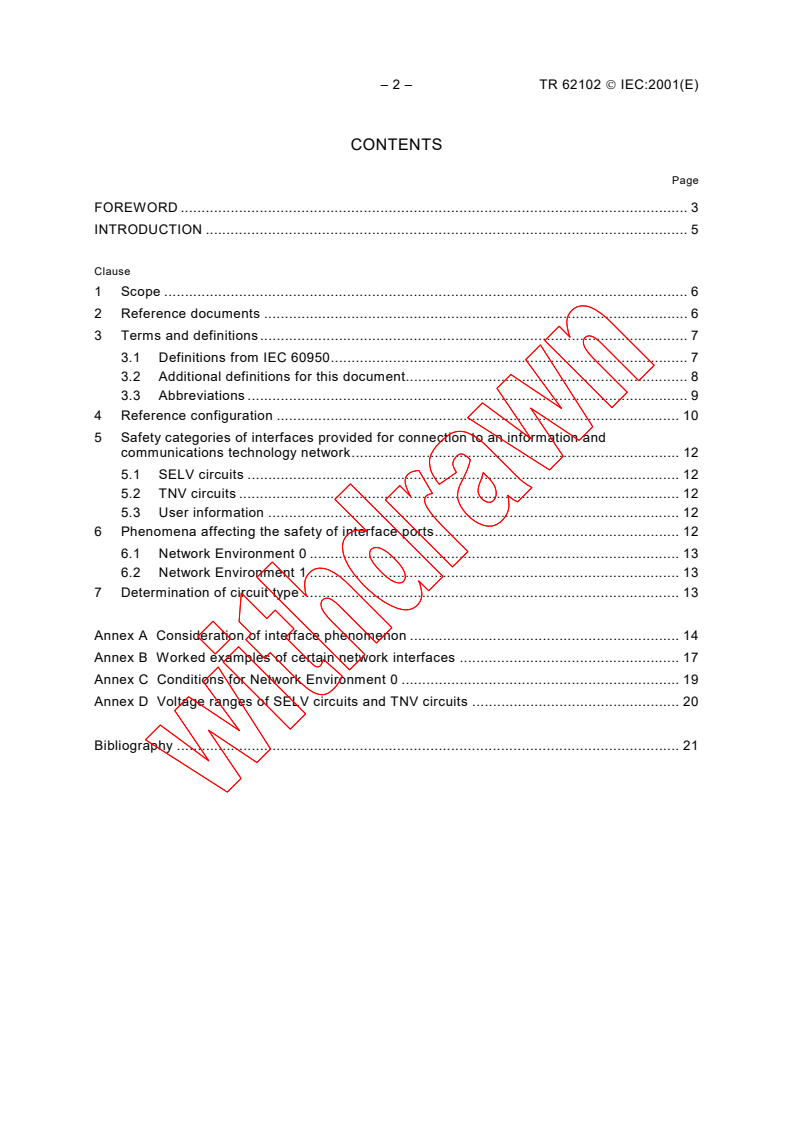
CONTENTS
Page
FOREWORD . 3
INTRODUCTION .5
Clause
1 Scope . 6
2 Reference documents . 6
3 Terms and definitions. 7
3.1 Definitions from IEC 60950. 7
3.2 Additional definitions for this document. 8
3.3 Abbreviations . 9
4 Reference configuration . 10
5 Safety categories of interfaces provided for connection to an information and
communications technology network. 12
5.1 SELV circuits . 12
5.2 TNV circuits . 12
5.3 User information . 12
6 Phenomena affecting the safety of interface ports. 12
6.1 Network Environment 0 . 13
6.2 Network Environment 1 . 13
7 Determination of circuit type . 13
Annex A Consideration of interface phenomenon . 14
Annex B Worked examples of certain network interfaces . 17
Annex C Conditions for Network Environment 0 . 19
Annex D Voltage ranges of SELV circuits and TNV circuits . 20
Bibliography . 21
TR 62102 IEC:2001(E) – 3 –
INTERNATIONAL ELECTROTECHNICAL COMMISSION
____________
ELECTRICAL SAFETY –
CLASSIFICATION OF INTERFACES FOR EQUIPMENT
TO BE CONNECTED TO INFORMATION
AND COMMUNICATIONS TECHNOLOGY NETWORKS
FOREWORD
1) The IEC (International Electrotechnical Commission) is a worldwide organization for standardization comprising
all national electrotechnical committees (IEC National Committees). The object of the IEC is to promote
international co-operation on all questions concerning standardization in the electrical and electronic fields. To
this end and in addition to other activities, the IEC publishes International Standards. Their preparation is
entrusted to technical committees; any IEC National Committee interested in the subject dealt with may
participate in this preparatory work. International, governmental and non-governmental organizations liaising
with the IEC also participate in this preparation. The IEC collaborates closely with the International Organization
for Standardization (ISO) in accordance with conditions determined by agreement between the two
organizations.
2) The formal decisions or agreements of the IEC on technical matters express, as nearly as possible, an
international consensus of opinion on the relevant subjects since each technical committee has representation
from all interested National Committees.
3) The documents produced have the form of recommendations for international use and are published in the form
of standards, technical specifications, technical reports or guides and they are accepted by the National
Committees in that sense.
4) In order to promote international unification, IEC National Committees undertake to apply IEC International
Standards transparently to the maximum extent possible in their national and regional standards. Any
divergence between the IEC Standard and the corresponding national or regional standard shall be clearly
indicated in the latter.
5) The IEC provides no marking procedure to indicate its approval and cannot be rendered responsible for any
equipment declared to be in conformity with one of its standards.
6) Attention is drawn to the possibility that some of the elements of this technical report may be the subject of
patent rights. The IEC shall not be held responsible for identifying any or all such patent rights.
The main task of IEC technical committees is to prepare International Standards. However, a
technical committee may propose the publication of a technical report when it has collected
data of a different kind from that which is normally published as an International Standard, for
example "state of the art".
IEC 62102 which is a technical report, has been prepared by technical committee 74: Safety
and energy efficiency of IT equipment.
The text of this technical report is based on the following documents:
Enquiry draft Report on voting
74/568/CDV 74/580/RVC
Full information on the voting for the approval of this technical report can be found in the report
on voting indicated in the above table.
This publication has been drafted in accordance with the ISO/IEC Directives, Part 3.
– 4 – TR 62102 IEC:2001(E)
The committee has decided that the contents of this publication will remain unchanged until
2002-11. At this date, the publication will be:
• reconfirmed;
• withdrawn;
• replaced by a revised edition, or
• amended.
This document, which is purely informative, is not to be regarded as an International Standard.
A bilingual version of this technical report may be issued at a later date.
TR 62102 IEC:2001(E) – 5 –
INTRODUCTION
This technical report is a guide to the determination of the interface requirements for
equipment in terms of safety. It lists a number of interfaces and indicates the safety category of
each listed interface. This technical report does not contain sufficient detail for conformance
testing purposes, except when used in conjunction with product standards such as IEC 60950.
The equipment safety standard IEC 60950 specifies the requirements for categories of circuits
as SELV circuits, TNV circuits and hazardous voltage circuits (among others). For stand-
alone equipment it is a relatively simple matter to determine the different categories of circuits.
However, an equipment which has data port interfaces is intended to be connected to other
equipment, either locally or via a network. In this case, the safety categories of the interfaces
which will be connected together have to be compatible with each other. Furthermore, the
category of the interface of the remote equipment may be unknown. This is the case in
systems where telecommunication equipment and data processing equipment are connected
together via different types of interfaces and networks.
To overcome this situation it is necessary to classify the interfaces of equipment in such
configurations according to the application and to select the safety category for the interfaces
of the equipment and for the type of the network. Similarly, the interfaces have to be classified
for protection against damage of the equipment and of the network. Aspects of protection are
dealt with in the ITU-T K series of Recommendations.
– 6 – TR 62102 IEC:2001(E)
ELECTRICAL SAFETY –
CLASSIFICATION OF INTERFACES FOR EQUIPMENT
TO BE CONNECTED TO INFORMATION
AND COMMUNICATIONS TECHNOLOGY NETWORKS
1 Scope
This technical report applies to equipment interfaces. These interfaces within the equipment
may be connected to telecommunication networks, they may form part of the
telecommunication network infrastructure or they may provide localized transfer of data. This
technical report provides guidance on the classification of interfaces in accordance with the
circuit types defined in IEC 60950 following an analysis of the telecommunication network
characteristics.
This technical report only covers equipment appropriately interconnected. Furthermore, it does
not address damage caused by one equipment to another equipment to which it is connected.
Exceptionally, interfaces may be designed for higher or lower levels for special applications. In
such cases it should be ensured that only interfaces having the same safety category and
protection level are connected together. This is based on the available specifications of the
equipment manufacturers and network providers, and on information regarding the installation
category of the mains interface.
This technical report is intended to be used by equipment designers, network operators,
network regulators/authorities, standards writers and network installers. It is applicable to
various interfaces of equipment. Network presentations are not equipment and so are not
covered by IEC 60950; hence they are also not covered by this technical report. However, it is
necessary to consider the characteristics, installation and presentation of telecommunication
networks when determining what equipment interface requirements apply (e.g. SELV circuit,
TNV-1 circuit, TNV-2 circuit, TNV-3 circuit etc.).
If a standard other than IEC 60950 is used for designing the equipment and its interface (e.g.
IEC 62151 in conjunction with other product safety standards), then the corresponding
requirements of these other standards are to be preferred.
If there is a conflict between this technical report and a more detailed specification, the latter
prevails.
This technical report applies regardless of ownership or responsibility for installation and
maintenance of the equipment or network.
NOTE Terminal equipment is often connected to customer premises cabling when used in a business
environment, and there are standards covering such cabling.
2 Reference documents
IEC Guide 112, Guide on the safety of multimedia equipment
IEC 60065, Audio, video and similar electronic apparatus – Safety requirements
IEC 60364 (all parts), Electrical installation of buildings
IEC 60664-1, Insulation coordination for equipment within low-voltage systems – Part 1:
Principles, requirements and tests
TR 62102 IEC:2001(E) – 7 –
IEC 60950, Safety of information technology equipment
IEC 61312-1, Protection against lightning electromagnetic impulse – Part 1: General principles
IEC 62151, Safety of equipment electrically connected to a telecommunication network
ISO/IEC 8802-3, Information technology – Telecommunications and information exchange
between systems – Local and metropolitan area networks – Specific requirements – Part 3:
Carrier sense multiple access with collision detection (CSMA/CD) access method and physical
layer specifications
ITU-T Recommendation K.20, Resistibility of telecommunication equipment installed in a
telecommunications centre to overvoltages and overcurrents
ITU-T Recommendation K.21, Resistibility of telecommunication equipment installed in
customer's premises to overvoltages and overcurrents
ITU-T Recommendation K.27, Bonding configurations and earthing inside a telecommunication
building
ITU-T Recommendation K.31, Bonding configurations and earthing of telecommunication
installations inside a subscriber's building
3 Terms and definitions
For the purposes of this technical report, the specified terms and definitions from IEC 60950 as
well as the following additional definitions apply.
3.1 Definitions from IEC 60950
3.1.1
a.c. mains supply
the external a.c. power distribution system supplying power to the equipment. These power
sources include public or private utilities and, unless otherwise specified, equivalent sources
such as motor-driven generators and uninterruptible power supplies
3.1.2
hazardous voltage
a voltage exceeding 42,4 V peak, or 60 V d.c., existing in a circuit which does not meet the
requirements for either a limited current circuit or a TNV circuit
3.1.3
limited current circuit
a circuit which is so designed and protected that, under both normal operating conditions and
single-fault conditions, the current which can be drawn is not hazardous
3.1.4
primary circuit
a circuit which is directly connected to the a.c. mains supply. It includes, for example, the
means for connection to the a.c. mains supply, the primary windings of transformers, motors
and other loading devices
– 8 – TR 62102 IEC:2001(E)
3.1.5
secondary circuit
a circuit which has no direct connection to a primary circuit and derives its power from a
transformer, converter or equivalent isolation device, or from a battery
3.1.6
SELV circuit
a secondary circuit which is so designed and protected that under normal operating
conditions and single-fault conditions, its voltages do not exceed a safe value
3.1.7
TNV circuit (including TNV-1 circuit, TNV-2 circuit, TNV-3 circuit)
a circuit which is in the equipment and to which the accessible area of contact is limited and
that is so designed and protected that, under normal operating conditions and single-fault
conditions, the voltages do not exceed specified limit values
3.1.8
telecommunication network
a metallically terminated transmission medium intended for communication between equip-
ments that may be located in separate buildings, excluding:
– the mains system for supply, transmission and distribution of electrical power, if used as a
telecommunication transmission medium;
– television distribution systems using cable;
– SELV circuits connecting units of data processing equipment
NOTE 1 The term telecommunication network is defined in terms of its functionality, not its electrical
characteristics. A telecommunication network is not itself defined as being either a SELV circuit or a TNV
circuit. Only the circuits in the equipment are so classified.
NOTE 2 A telecommunication network may be:
– publicly or privately owned;
– subject to transient overvoltages due to atmospheric discharges and faults in power distribution systems;
– subject to longitudinal (common mode) voltages induced from nearby power lines or electric traction lines.
NOTE 3 Examples of telecommunication networks are:
– a public switched telephone network;
– a public data network;
– an Integrated Services Digital Network (ISDN);
– a private network with electrical interface characteristics similar to the above.
3.1.9
service personnel
persons having appropriate technical training and experience necessary to be aware of
hazards to which they may be exposed in performing a task and of measures to minimize the
risks for themselves or other persons
3.1.10
user
any person, other than service personnel
3.2 Additional definitions for this document
3.2.1
antenna interface
a port for connection of a radio frequency antenna to equipment
TR 62102 IEC:2001(E) – 9 –
3.2.2
coaxial cable interface
a port for connection of a coaxial cable providing for asymmetrical transmission to equipment
NOTE In this technical report, the use of both indoor and outdoor twisted pair cables is considered separately.
3.2.3
network termination point
the physical point at the boundary of a network intended to accept the connection of a terminal
equipment or to be interconnected to another network
3.2.4
paired conductor interface
a port for connection of a cable providing for symmetrical transmission (e.g. twisted pair) to
equipment
NOTE In this technical report, the use of both indoor and outdoor twisted pair cables is considered separately.
3.2.5
terminal connection point
the physical point of the terminal equipment intended to be connected to a network
3.3 Abbreviations
For the purposes of this technical report, the following abbreviations apply to Clause 4,
annex B and annex C:
ADSL Asymmetric Digital Subscriber Line
FSP Remote Power Supply
ISDN Integrated Services Digital Network
LAN Local Area Network
LEPM Primary Multiplex
LPZ Lightning Protection Zone
LTU Line termination unit
NCP Network Connection Point
NO Network Operator
NT Network Termination
NTBA Network Termination, Basic Access
NTP Network Termination Point
NTU Network Terminating Unit
PABX Private Automatic Branch Exchange
PCM Pulse Code Modulation
PNO Public Network Operator
PSTN Public Switched Telephone Network
SDH Synchronous Digital Hierarchy
TA Terminal Adapter
TCP Terminal Connection Point
TE Terminal Equipment
ZWRBA Regenerator, Basic Access
– 10 – TR 62102 IEC:2001(E)
4 Reference configuration
Figure 1 illustrates a hypothetical configuration of "network clouds" giving examples of the
types of equipments covered by this technical report. Certain of these equipments will only
have one or two interface types, others may have many. Certain of the "network clouds" will be
elements within the PSTN (where the possibility of more than one network operator exists) and
others may be private networks. The equipment connected to this "network cloud" and part of
the "network cloud" itself can be any type covered by the scope of this technical report.
This technical report provides a framework for safety requirements and protection levels by
reference to the particular examples given in figures 1 and 2. Configurations not covered
should be treated using the same principles.
e.g. Analogue
e.g. Facsimile
PNO
telephones
machines
NO
e.g. Digital
e.g. Network
telephones
transmission
e.g. PABX
equipment &
multiplexers
PNO
NO
e.g. Modems
e.g. Network
& switching
e.g. Terminal
equipment
e.g. Telephone
answering
machines
IEC 342/01
Figure 1 – Reference configuration
Where, in a practical situation, an equipment has two or more interfaces of different types, it is
normally necessary to provide safety separation within the equipment between those interfaces
in accordance with IEC 60950.
Figure 2 illustrates examples of possible network configurations. Included are some of the
network elements involved in such networks and an indication of the various commercial
organizations, both Public Network Operators (PNOs) and Network Operators (NOs) generally
(who could be public or private) that are involved in providing network infrastructures to service
the end-customer.
TR 62102 IEC:2001(E) – 11 –
Example 1
NTP1 NTP2 TCP
NO
PNO
TE
Example 2
NTP4 TCP
NTP1
NTP3
NTP2
NO
PNO NO
NTU
TE
Example 3
e.g. Analogue
NO 2
telephones
TA
NT1
NT2
e.g. Basic
access ISDN
e.g. Digital
PABX
telephone
handsets
NT1
Public network
Street
Public network
Distribution
cabinet
NO 1
frame
(e.g .
e.g. SDH Fibre,
e.g. ISDN
multiplexer)
ISDN ‘U’, etc.
Primary rate
PNO 1
PNO 2
Customer’s building
IEC 343/01
Figure 2 – Example network configurations
– 12 – TR 62102 IEC:20
...