

ISO 17880:2026
(Main)Cellular plastics — Self-supporting metal faced sandwich panels
- Abstract
This document specifies requirements for factory made, self-supporting, double skin metal‑faced insulating sandwich panels where the insulating core materials are intended to be but not limited to cellular plastics and mineral wool as defined below. The sandwich panels are intended for discontinuous laying in the following applications: roofs and roof cladding; external walls and wall cladding. The insulating core materials covered by this document are rigid polyurethane foam (PUR), polyisocyanurate foam (PIR), expanded polystyrene foam (EPS), extruded polystyrene foam (XPS), phenolic foam (PF) and mineral wool. Sandwich panels with edge details that utilize different materials from the main insulating core are included in this document. Sandwich panels used in outdoor cold storage applications are included in this document. This document does not cover the following: sandwich panels with a declared thermal conductivity for the insulating core material greater than 0,06 W/m·K at 10 °C, or greater than 0,06 W/m·K at 23 °C; sandwich panels consisting of two or more clearly defined layers of different insulating core materials (multi-layered); sandwich panels consisting of more than one metal sheet per face; sandwich panels with perforated facing(s); curved sandwich panels; indoor cold storage applications.
- Status
- Published
- Publication Date
- 14-Sep-2026
- Technical Committee
- ISO/TC 61/SC 10 - Cellular plastics
- Drafting Committee
- ISO/TC 61/SC 10/WG 10 - Plastic insulation
- Parallel Committee
- ISO/TC 163 - Thermal performance and energy use in the built environment
- Current Stage
- 6060 - International Standard published
- Start Date
- 15-Sep-2026
- Due Date
- 05-Jul-2026
- Completion Date
- 15-Sep-2026
ISO 17880:2026 is an International Standard from ISO for factory-made, self-supporting, double-skin metal-faced insulating sandwich panels. It specifies the requirements, test methods, classification, designation, marking and packaging for panels used on roofs, roof cladding, external walls, wall cladding and outdoor cold storage applications. The standard is for manufacturers, test laboratories, designers, specifiers and purchasers who need a shared basis for checking panel performance and declaring it.
What does ISO 17880:2026 specify?
ISO 17880:2026 specifies requirements for factory-made, self-supporting, double-skin metal-faced insulating sandwich panels whose core is intended to be cellular plastics or mineral wool. The introduction says the document began with cellular plastics as the core subject and was later extended to include mineral wool.
The scope covers panels for discontinuous laying in roofs and roof cladding, and in external walls and wall cladding. It includes panels with edge details that use different materials from the main insulating core, and panels for outdoor cold storage applications.
The document excludes panels with higher declared thermal conductivity in the insulating core than the stated limit, multi-layer cores made of two or more clearly defined insulating layers, panels with more than one metal sheet per face, perforated facings, curved panels and indoor cold storage applications.
Clause 1 covers scope, Clause 2 lists normative references, Clause 3 gives terms and definitions, Clause 4 sets symbols and abbreviated terms, Clause 5 gives requirements and test methods, Clause 6 covers testing, assessment and sampling, Clause 7 covers classification and designation, and Clause 8 covers marking, labelling and packaging.
| Annex | What it covers |
|---|---|
| Annex A | Normative testing procedures for material properties, panel mechanics, thermal transmittance, water and air permeability, acoustics and related calculations |
| Annex B | Normative durability testing, including climate cycling, bond testing, repeated loading and thermal shock |
| Annex C | Informative fire tests, specimen mounting and field of application for fire results |
| Annex D | Normative dimensional tolerances and how to measure them |
| Annex E | Informative design procedures for mechanical resistance and limit-state verification |
What are the key requirements of ISO 17880:2026?
ISO 17880:2026 sets requirements for the panel materials, the finished panel performance, and the way conformity is shown in production and testing. In practice, it tells a manufacturer what to control, what to test, and what to declare.
Component materials - Clause 5.1 covers the metal facings, core materials, adhesives and bonding. It names steel, stainless steel, aluminium and copper facings, and core materials such as PUR, PIR, EPS, XPS, PF and mineral wool. For a buyer or specifier, this means the product is not only judged as a finished panel but also through the materials that make it up.
Mechanical resistance - Clause 5.2.1 covers shear strength, shear modulus, creep coefficient, compressive strength, long-term shear strength, cross panel tensile strength, bending moment capacity and wrinkling stress. This matters because these are the properties used to judge whether a panel can carry self-weight, snow, wind, pressure differences and access loads without unacceptable loss of performance.
Thermal and moisture performance - Clause 5.2.2 covers thermal transmittance, and Clause 5.2.6 to 5.2.8 cover water permeability, air permeability and water vapour permeability, with water permeability and water vapour permeability treated as optional characteristics. For practical use, this is the part that supports energy, airtightness and weather-tightness declarations.
Acoustic properties - Clause 5.2.9 and 5.2.10 cover airborne sound insulation and sound absorption, both optional characteristics. If a project has acoustic targets, these clauses tell the manufacturer what to test and what values can be declared.
Fire characteristics - Clause 5.2.4 covers reaction to fire, fire resistance, external fire performance for roofs and the related criteria or classification. Annex C gives the fire-test mounting, validity rules and direct field of application. In practice, this is the part used when the panel must meet a building fire classification or when the system result has to be extended to similar panel variants.
Dimensional tolerances - Clause 5.2.5 and Annex D set dimensional tolerances and how to check them. The standard covers panel thickness, profile depth, stiffener geometry, length, cover width, squareness, straightness, bowing, profile pitch, and rib and valley widths. For production and receiving inspection, this is what keeps panels compatible on site and limits fit-up problems.
Design against actions - Clause 5.3 requires the panel to resist the design loads from self-weight, snow, wind, temperature, pressure gradients and access. It uses the limit state concept and refers to ISO 22111 and Annex E. This matters because the standard is not only about test results - it also requires design verification for both serviceability and ultimate limit states.
Testing, TT and FPC - Clause 6 requires conformity to be shown by type testing (TT) and factory production control (FPC), including product assessment. It also allows family testing, shortened TT after product change, and characteristic values from families of tests. For manufacturers, this is the route to keeping product declarations aligned with real production.
Classification, designation and marking - Clause 7 requires classification and designation where needed, and Clause 8 requires the product to be identified with the manufacturer, product reference, mass, thickness, face and core descriptions, and declared characteristics. In practice, this is the information a buyer or inspector uses to match the delivered product to the declared performance.
What terms does ISO 17880:2026 define?
sandwich panel - A building product with two metal faces and a thermally insulating core bonded between them so the three parts act together under load.
self-supporting sandwich panel - A panel that can carry its own weight and, when fixed to spaced supports, can also transmit applied loads such as snow, wind and internal pressure to those supports.
core - The insulating layer between the faces; it gives the panel its thermal function and strongly affects strength, stiffness and fire behaviour.
face / facing - The thin metal sheet bonded to the core; the document distinguishes flat, lightly profiled and profiled faces because their geometry affects mechanics and testing.
bond / bonding - The adhesion between the core and the faces, normally provided by an approved adhesive; bond quality affects structural action and durability.
durability - The ability of the panel to withstand environmental effects over time, including temperature, humidity and freeze-thaw cycling, while retaining acceptable mechanical performance.
FPC (factory production control) - The manufacturer’s ongoing control system for materials, equipment, tests and records so production stays consistent with the declared product.
TT (type test) - The initial testing used to establish product characteristics and support declaration of performance for a defined panel type or family.
Who uses ISO 17880:2026?
ISO 17880:2026 is used by manufacturers of metal-faced insulated sandwich panels to set up product verification, production control and declarations. It is also used by test laboratories that run mechanical, thermal, acoustic, durability and fire tests, and by technical teams that need to prepare load tables, classifications and product data.
Designers, specifiers, quality managers and buyers use ISO 17880:2026 when comparing panel types for roofs, walls and cold storage applications. It helps them check whether the declared properties, test basis and marking match the intended use.
Which standards are used with ISO 17880:2026?
| Standards | What they contribute |
|---|---|
| ISO 354:2003, ISO 717-1, ISO 10140-1:2021, ISO 10140-2:2021, ISO 11654 | Sound absorption and airborne sound insulation measurement and rating |
| ISO 834-1, ISO 834-4, ISO 834-5, ISO 834-8, ISO 834-9, ISO 1182, ISO 11925-2, ISO 1716, ISO 12468-1, ISO/TR 12468-3, ISO 13784-1:2014, ISO 13784-2:2020, ISO 13785-1, ISO 13785-2, ISO 13943, ISO/TS 23657, EN 13823, CEN/TS 1187 | Reaction to fire, fire resistance, external fire performance, fire vocabulary and panel or facade fire test methods |
| ISO 4898, ISO 6946, ISO 8145, ISO 8301, ISO 8302, ISO 9229, ISO 10211, ISO 10456, ISO 14857, ISO 22111, ISO 29465, ISO 29466, ISO 29469, ISO 29470, ISO 29765, ISO 12576-1, ISO 9194, ISO 4354, ISO 4355 | Thermal properties, thermal transmittance, thermal bridges, design values, air permeance and structural design basis |
| ISO 845, ISO 6270-1, ISO 6361-2, ISO 6361-3, ISO 6892-1, ISO 9445-2:2009, ISO 16163, EN 508-1, EN 1172, EN 1396, EN 10088-1, EN 10143:2006, EN 10169, EN 10204, EN 12865 | Material properties, metal-sheet tolerances, humidity resistance, inspection documents and weather resistance for facings and related materials |
| ISO 12491, EN 1990:2002 + A1:2005 + A1:2005/AC:2010 | Statistical quality control and structural design principles used in family evaluation and load verification |
What does the ISO 17880:2026 document contain?
ISO 17880:2026 contains the test methods, calculations and reporting rules needed to support declared panel properties. Annex A covers the detailed procedures for mechanical tests, thermal transmittance, permeability tests, acoustic tests and related result calculations. Annex B covers durability cycles and reports for ageing, bond performance, repeated loading and thermal shock.
Annex C shows how fire tests are mounted and how test results can be applied to similar panel configurations. Annex D gives the measurement methods for dimensional checks in factory conditions. Annex E sets out the mechanical design procedures, load combinations, safety factors and time-dependent effects used for limit-state verification.
Get Certified
Connect with accredited certification bodies for this standard

DIN CERTCO
DIN Group product certification.

Smithers Quality Assessments
US management systems and product certification.
Sponsored listings
Frequently Asked Questions
ISO 17880:2026 is a standard published by the International Organization for Standardization (ISO). Its full title is "Cellular plastics — Self-supporting metal faced sandwich panels". This standard covers: This document specifies requirements for factory made, self-supporting, double skin metal‑faced insulating sandwich panels where the insulating core materials are intended to be but not limited to cellular plastics and mineral wool as defined below. The sandwich panels are intended for discontinuous laying in the following applications: roofs and roof cladding; external walls and wall cladding. The insulating core materials covered by this document are rigid polyurethane foam (PUR), polyisocyanurate foam (PIR), expanded polystyrene foam (EPS), extruded polystyrene foam (XPS), phenolic foam (PF) and mineral wool. Sandwich panels with edge details that utilize different materials from the main insulating core are included in this document. Sandwich panels used in outdoor cold storage applications are included in this document. This document does not cover the following: sandwich panels with a declared thermal conductivity for the insulating core material greater than 0,06 W/m·K at 10 °C, or greater than 0,06 W/m·K at 23 °C; sandwich panels consisting of two or more clearly defined layers of different insulating core materials (multi-layered); sandwich panels consisting of more than one metal sheet per face; sandwich panels with perforated facing(s); curved sandwich panels; indoor cold storage applications.
This document specifies requirements for factory made, self-supporting, double skin metal‑faced insulating sandwich panels where the insulating core materials are intended to be but not limited to cellular plastics and mineral wool as defined below. The sandwich panels are intended for discontinuous laying in the following applications: roofs and roof cladding; external walls and wall cladding. The insulating core materials covered by this document are rigid polyurethane foam (PUR), polyisocyanurate foam (PIR), expanded polystyrene foam (EPS), extruded polystyrene foam (XPS), phenolic foam (PF) and mineral wool. Sandwich panels with edge details that utilize different materials from the main insulating core are included in this document. Sandwich panels used in outdoor cold storage applications are included in this document. This document does not cover the following: sandwich panels with a declared thermal conductivity for the insulating core material greater than 0,06 W/m·K at 10 °C, or greater than 0,06 W/m·K at 23 °C; sandwich panels consisting of two or more clearly defined layers of different insulating core materials (multi-layered); sandwich panels consisting of more than one metal sheet per face; sandwich panels with perforated facing(s); curved sandwich panels; indoor cold storage applications.
ISO 17880:2026 is classified under the following ICS (International Classification for Standards) categories: 83.140.99 - Other rubber and plastics products. The ICS classification helps identify the subject area and facilitates finding related standards.
ISO 17880:2026 is available in PDF format for immediate download after purchase. The document can be added to your cart and obtained through the secure checkout process. Digital delivery ensures instant access to the complete standard document.
Standards Content (Sample)
International
Standard
ISO 17880
First edition
Cellular plastics — Self-supporting
2026-09
metal faced sandwich panels
Plastiques alvéolaires — Panneaux sandwich à parements
métalliques autoportants
Reference number
© ISO 2026
All rights reserved. Unless otherwise specified, or required in the context of its implementation, no part of this publication may
be reproduced or utilized otherwise in any form or by any means, electronic or mechanical, including photocopying, or posting on
the internet or an intranet, without prior written permission. Permission can be requested from either ISO at the address below
or ISO’s member body in the country of the requester.
ISO copyright office
CP 401 • Ch. de Blandonnet 8
CH-1214 Vernier, Geneva
Phone: +41 22 749 01 11
Email: copyright@iso.org
Website: www.iso.org
Published in Switzerland
ii
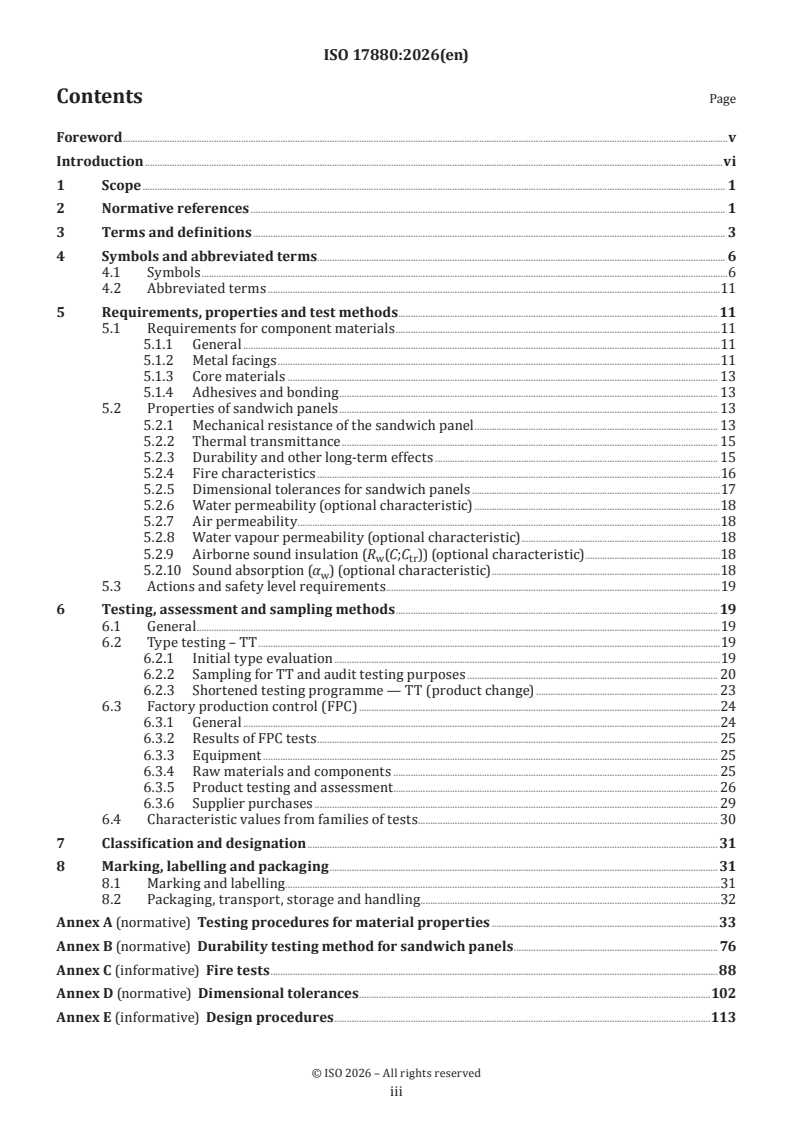
Contents Page
Foreword .v
Introduction .vi
1 Scope . 1
2 Normative references . 1
3 Terms and definitions . 3
4 Symbols and abbreviated terms. 6
4.1 Symbols .6
4.2 Abbreviated terms .11
5 Requirements, properties and test methods .11
5.1 Requirements for component materials .11
5.1.1 General .11
5.1.2 Metal facings .11
5.1.3 Core materials . 13
5.1.4 Adhesives and bonding . 13
5.2 Properties of sandwich panels . 13
5.2.1 Mechanical resistance of the sandwich panel . 13
5.2.2 Thermal transmittance . 15
5.2.3 Durability and other long-term effects . 15
5.2.4 Fire characteristics .16
5.2.5 Dimensional tolerances for sandwich panels .17
5.2.6 Water permeability (optional characteristic) .18
5.2.7 Air permeability . .18
5.2.8 Water vapour permeability (optional characteristic) .18
5.2.9 Airborne sound insulation (R (C;C )) (optional characteristic) .18
w tr
5.2.10 Sound absorption (α ) (optional characteristic) .18
w
5.3 Actions and safety level requirements .19
6 Testing, assessment and sampling methods . 19
6.1 General .19
6.2 Type testing – TT .19
6.2.1 Initial type evaluation .19
6.2.2 Sampling for TT and audit testing purposes . 20
6.2.3 Shortened testing programme — TT (product change) . 23
6.3 Factory production control (FPC) .24
6.3.1 General .24
6.3.2 Results of FPC tests . 25
6.3.3 Equipment . 25
6.3.4 Raw materials and components . 25
6.3.5 Product testing and assessment . 26
6.3.6 Supplier purchases . 29
6.4 Characteristic values from families of tests. 30
7 Classification and designation .31
8 Marking, labelling and packaging .31
8.1 Marking and labelling .31
8.2 Packaging, transport, storage and handling .32
Annex A (normative) Testing procedures for material properties .33
Annex B (normative) Durability testing method for sandwich panels . 76
Annex C (informative) Fire tests .88
Annex D (normative) Dimensional tolerances . .102
Annex E (informative) Design procedures .113
iii
Bibliography .132
iv
Foreword
ISO (the International Organization for Standardization) is a worldwide federation of national standards
bodies (ISO member bodies). The work of preparing International Standards is normally carried out through
ISO technical committees. Each member body interested in a subject for which a technical committee
has been established has the right to be represented on that committee. International organizations,
governmental and non-governmental, in liaison with ISO, also take part in the work. ISO collaborates closely
with the International Electrotechnical Commission (IEC) on all matters of electrotechnical standardization.
The procedures used to develop this document and those intended for its further maintenance are described
in the ISO/IEC Directives, Part 1. In particular, the different approval criteria needed for the different types
of ISO document should be noted. This document was drafted in accordance with the editorial rules of the
ISO/IEC Directives, Part 2 (see www.iso.org/directives).
ISO draws attention to the possibility that the implementation of this document may involve the use of (a)
patent(s). ISO takes no position concerning the evidence, validity or applicability of any claimed patent
rights in respect thereof. As of the date of publication of this document, ISO had not received notice of (a)
patent(s) which may be required to implement this document. However, implementers are cautioned that
this may not represent the latest information, which may be obtained from the patent database available at
www.iso.org/patents. ISO shall not be held responsible for identifying any or all such patent rights.
Any trade name used in this document is information given for the convenience of users and does not
constitute an endorsement.
For an explanation of the voluntary nature of standards, the meaning of ISO specific terms and expressions
related to conformity assessment, as well as information about ISO's adherence to the World Trade
Organization (WTO) principles in the Technical Barriers to Trade (TBT), see www.iso.org/iso/foreword.html.
This document was prepared by Technical Committee ISO/TC 61, Plastics, Subcommittee SC 10, Cellular
plastics.
Any feedback or questions on this document should be directed to the user’s national standards body. A
complete listing of these bodies can be found at www.iso.org/members.html.
v
Introduction
This document has been developed with cellular plastics as the core. It has been eventually modified to
include other materials, such as mineral wool.
vi
International Standard ISO 17880:2026(en)
Cellular plastics — Self-supporting metal faced sandwich
panels
1 Scope
This document specifies requirements for factory made, self-supporting, double skin metal-faced insulating
sandwich panels where the insulating core materials are intended to be but not limited to cellular plastics
and mineral wool as defined below.
The sandwich panels are intended for discontinuous laying in the following applications:
a) roofs and roof cladding;
b) external walls and wall cladding.
The insulating core materials covered by this document are rigid polyurethane foam (PUR), polyisocyanurate
foam (PIR), expanded polystyrene foam (EPS), extruded polystyrene foam (XPS), phenolic foam (PF) and
mineral wool. Sandwich panels with edge details that utilize different materials from the main insulating
core are included in this document. Sandwich panels used in outdoor cold storage applications are included
in this document.
This document does not cover the following:
— sandwich panels with a declared thermal conductivity for the insulating core material greater than
0,06 W/m·K at 10 °C, or greater than 0,06 W/m·K at 23 °C;
— sandwich panels consisting of two or more clearly defined layers of different insulating core materials
(multi-layered);
— sandwich panels consisting of more than one metal sheet per face;
— sandwich panels with perforated facing(s);
— curved sandwich panels;
— indoor cold storage applications.
2 Normative references
The following documents are referred to in the text in such a way that some or all of their content constitutes
requirements of this document. For dated references, only the edition cited applies. For undated references,
the latest edition of the referenced document (including any amendments) applies.
ISO 354:2003, Acoustics — Measurement of sound absorption in a reverberation room
ISO 717-1, Acoustics — Rating of sound insulation in buildings and of building elements — Part 1: Airborne
sound insulation
ISO 834-1, Fire-resistance tests — Elements of building construction — Part 1: General requirements
ISO 834-4, Fire-resistance tests — Elements of building construction — Part 4: Specific requirements for
loadbearing vertical separating elements
ISO 834-5, Fire-resistance tests — Elements of building construction — Part 5: Specific requirements for
loadbearing horizontal separating elements
ISO 834-8, Fire-resistance tests — Elements of building construction — Part 8: Specific requirements for non-
loadbearing vertical separating elements
ISO 834-9, Fire-resistance tests — Elements of building construction — Part 9: Specific requirements for non-
loadbearing ceiling elements
ISO 845, Cellular plastics and rubbers — Determination of apparent density
ISO 1182, Reaction to fire tests for products — Non-combustibility test
ISO 1716, Reaction to fire tests for products — Determination of the gross heat of combustion (calorific value)
ISO 4898, Rigid cellular plastics — Thermal insulation products for buildings — Specifications
ISO 6270-1, Paints and varnishes — Determination of resistance to humidity — Part 1: Condensation (single-
sided exposure)
ISO 6361-2, Wrought aluminium and aluminium alloys — Sheets, strips and plates — Part 2: Mechanical
properties
ISO 6361-3, Wrought aluminium and aluminium alloys — Sheets, strips and plates — Part 3: Strips: Tolerances
on shape and dimensions
ISO 6892-1, Metallic materials — Tensile testing — Part 1: Method of test at room temperature
ISO 6946, Building components and building elements — Thermal resistance and thermal transmittance —
Calculation methods
ISO 8145, Thermal insulation; mineral wool board for overdeck insulation of roofs — Specification
ISO 8301, Thermal insulation — Determination of steady-state thermal resistance and related properties —
Heat flow meter apparatus
ISO 8302, Thermal insulation — Determination of steady-state thermal resistance and related properties —
Guarded hot plate apparatus
ISO 9229, Thermal insulation — Vocabulary
ISO 9445-2:2009, Continuously cold-rolled stainless steel — Tolerances on dimensions and form — Part 2: Wide
strip and plate/sheet
ISO 10140-1:2021, Acoustics — Laboratory measurement of sound insulation of building elements — Part 1:
Application rules for specific products
ISO 10140-2:2021, Acoustics — Laboratory measurement of sound insulation of building elements — Part 2:
Measurement of airborne sound insulation
ISO 10211, Thermal bridges in building construction — Heat flows and surface temperatures — Detailed
calculations
ISO 10456, Building materials and products — Hygrothermal properties — Tabulated design values and
procedures for determining declared and design thermal values
ISO 11654, Acoustics — Sound absorbers for use in buildings — Rating of sound absorption
ISO 11925-2, Reaction to fire tests — Ignitability of products subjected to direct impingement of flame — Part 2:
Single-flame source test
ISO 12468-1, External exposure of roofs to fire — Part 1: Test method
ISO/TR 12468-3, External exposure of roofs to fire — Part 3: Commentary
ISO 12491, Statistical methods for quality control of building materials and components
ISO 13784-1:2014, Reaction to fire test for sandwich panel building systems — Part 1: Small room test
ISO 13784-2:2020, Reaction-to-fire tests for sandwich panel building systems — Part 2: Test method for large
rooms
ISO 13785-1, Reaction-to-fire tests for façades — Part 1: Intermediate-scale test
ISO 13785-2, Reaction-to-fire tests for façades — Part 2: Large-scale test
ISO 13943, Fire safety — Vocabulary
ISO 14857, Thermal performance in the built environment — Determination of air permeance of building
materials
ISO 16163, Continuously hot-dipped coated steel sheet products — Dimensional and shape tolerances
ISO 22111, Bases for design of structures — General requirements
ISO 29465, Thermal insulating products for building applications — Determination of length and width
ISO 29466, Thermal insulating products for building applications — Determination of thickness
ISO 29469, Thermal insulating products for building applications — Determination of compression behaviour
ISO 29470, Thermal insulating products for building applications — Determination of the apparent density
ISO 29765, Thermal insulating products for building applications — Determination of tensile strength
perpendicular to faces
EN 508-1, Roofing products from metal sheet — Specification for self-supporting products of steel, aluminium or
stainless steel sheet — Part 1: Steel
EN 1172, Copper and copper alloys — Sheet and strip for building purposes
EN 1396, Aluminium and aluminium alloys — Coil coated sheet and strip for general applications — Specifications
EN 1990:2002 + A1: 2005 + A1: 2005/ AC: 2010, Eurocode - Basis of structural design
EN 10088-1, Stainless steels — Part 1: List of stainless steels
EN 10143:2006, Continuously hot-dip metal coated steel sheet and strip — Tolerances on dimensions and shape
EN 10169, Continuously organic coated (coil coated) steel flat products — Technical delivery conditions
EN 10204, Metallic products - Types of inspection documents
EN 12865, Hygrothermal performance of building components and building elements — Determination of the
resistance of external wall systems to driving rain under pulsating air pressure
3 Terms and definitions
For the purposes of this document, the terms and definitions given in ISO 9229, ISO 13943 and the following
apply.
ISO and IEC maintain terminology databases for use in standardization at the following addresses:
— ISO Online browsing platform: available at https:// www .iso .org/ obp
— IEC Electropedia: available at https:// www .electropedia .org/
3.1
auto-adhesive bond
self-adhesion of the core to the face(s) occurring automatically without the use of an adhesive
Note 1 to entry: This technique is used for producing sandwich panels by foaming.
3.2
bending moment capacity
maximum bending moment recorded during a test on an individual panel
3.3
bending resistance
characteristic value of bending moment capacity determined on the basis of a test series
3.4
bond
bonding
adhesion between the face(s) and the core normally provided by an approved adhesive
3.5
core
layer of material, having thermal insulating properties, which is bonded between two metal faces, creating
a sandwich panel
3.6
durability
ability of the panel to withstand the environmental effects and accommodate the consequent decrease in
mechanical strength with time caused by factors such as temperature, humidity, freeze-thaw cycles and
their various combinations
3.7
edge
longitudinal edge
side of the panel where adjacent panels join together in the same plane
3.8
face
facing
flat, lightly profiled or profiled thin metal sheet firmly bonded to the core
3.9
flat face
face without any rolled or pressed profile or raised strengthening rib
3.10
lightly profiled face
face with a rolled or pressed profile not exceeding 5 mm in depth
3.11
profiled face
face with a rolled or pressed profile exceeding 5 mm in depth
3.12
incompletely bonded panel
panel in which one or both faces is incompletely bonded
3.13
joint
interface between two panels where the meeting edges have been designed to allow the panels to join
together in the same plane
Note 1 to entry: The joint can incorporate interlocking parts that enhance the mechanical properties of the system as
well as improving the thermal, acoustic and fire performance and restricting air movement.
Note 2 to entry: The term 'joint' does not refer to a junction between cut panels or a junction where the panels are not
installed in the same plane.
3.14
lamella
core material consisting of mineral wool that has been cut and orientated with the fibres perpendicular to
the facings prior to bonding
3.15
lightly profiled facing
facing with a rolled or pressed profile not exceeding 5 mm in depth
3.16
pre-manufactured
pre-formed
component or material that is supplied to the manufacturer ready for direct incorporation into the sandwich
panel as a core
3.17
sandwich panel
building product consisting of two metal faces positioned on either side of a core that is a thermally
insulating material, which is firmly bonded to both faces so that the three components act compositely when
under load
3.18
self-supporting sandwich panel
panel capable of supporting, by virtue of its materials and shape, its self-weight and in the case of panels fixed
to spaced structural supports all applied loadings (e.g. snow, wind, internal air pressure), and transmitting
these loadings to the supports
3.19
shift
period of production during a working day, normally 6 h to 8 h but can be less
3.20
side lap
folded area of one or both facing materials along the longitudinal edge of the panel which engages with the
adjacent panel to form an interlocking or overlapping joint
3.21
wrinkling strength
characteristic value of wrinkling stress (3.22)
3.22
wrinkling stress
stress in the compressed face of a panel undergoing failure in bending, where the failure mode takes the
form of a "wrinkle" extending over the full width of the panel near the section of maximum bending moment
4 Symbols and abbreviated terms
4.1 Symbols
For the purposes of this document, the following symbols and abbreviated terms apply.
A cross-sectional area of the specimen determined from the measured dimensions
A cross sectional area of the core based on measured depth d
C c
A area of the carrier
c
A measured area of cross-section of the top face based on measured metal thickness;
F1
A measured area of cross-section of the bottom face based on measured metal thickness;
F2
A area of facing sheet in square metres (m )
glue
B bending stiffness, overall width of the panel/specimen
B flexural rigidity of the face(s)
F
B minimum width of uncut core material across a line of cut ends
min
B bending stiffness with t and e
obs obs obs
B flexural rigidity of the sandwich part
S
C ratio, design value of a serviceability criterion
C limiting design value of the relevant serviceability criterion expressed as the maximum service-
d
ability limit state design stress or limit on deflection taking into account the material partial
factor for serviceability limit state design γ
M
C spectrum adaptation term calculated with A-weighted urban traffic noise
tr
D overall depth of the panel
E modulus of elasticity, design value of the effect of an action
E mean of the characteristic values of the tensile and compressive moduli of the core material
C
E compressive E-modulus of the core
Cc
E tensile E-modulus of the core
Ct
E E-modulus of the top face
F1
E E-modulus of the bottom face
F2
F force, load, support reaction
F self-weight of the panel
G
F load at the end of the linear part of the load-deflection curve
lin
F test value of reaction capacity
Ri
F ultimate load
u
G shear modulus, permanent action
G shear modulus of the core
C
G reduced shear modulus of the core
C, red
G characteristic value of the permanent action
k
I moment of inertia
I moment of inertia of the profiled face(s) (sum if both faces are profiled)
F
I moment of inertia of the sandwich part (see Annex E)
S
L span, distance,
L width of support plate
s
M bending moment
M , M Bending moments at ultimate limit state to determine σ
Du Su yr
M bending moment capacity
u
N axial compressive force
Q variable action
Q characteristic value of the dominant variable action
k1
Q characteristic value of the non-dominant variable action i (I > 1)
ki
R resistance
R test result modified to correspond to the design values of metal thickness
adj,i
R , R tensile strength
DUR 24
R degree of reflection relative to magnesium oxide = 100 %
G
R characteristic resistance
k
R result of test number I
obs,i
R external surface resistance (m K/W)
se
R internal surface resistance (m K/W)
si
R sound reduction index
w
S shear rigidity, value of a load effect, characteristic value of an action
S characteristic value of an action
ki
T temperature
U thermal transmittance value of the panel,
U thermal transmittance value of the panel including the influence of the panel joints
d,s
V shear force
a distance apart of clips
b width of test specimen, width of plate, width of ribs/valleys, bowing
b width of the clips
c
d depth of face profile or stiffeners,
d nominal thickness of the core (ignoring the thickness of the facings) and the geometry of the main
C
profiles), see Figure A.18 and Figure A.19
d design thickness of the panel
d
d depth of stiffeners
S
e distance between centroids of faces, base of natural logarithms (e = 2,718 282)
e additional thickness of the external face
e
e additional thickness of the internal face
i
e distance between the faces on basis of measured geometry
obs
f strength, yield stress , reduction factor
f mean compressive strength of the core
C
f compressive strength of the core
Cc
f cross panel tensile strength
Ct
f shear strength of the core
Cv
f reduced shear strength of the core
Cv, red
f thermal transmittance contribution factor
joint
f thermal transmittance contribution factor with clip
joint, c
f thermal transmittance contribution factor without (no) clip
joint, nc
f design yield stress
y
f measured yield stress
y,obs
h height of profile
h thickness of adhesive in millimetres (mm)
glue
k correction factor, distribution parameter
k reduction factor for cut ends in pre-formed cores
v
l length, deviation
m mass
m amount of adhesive in grams per square metre (g/m ) from measurements during production
adhesive
m mass of the carrier
c
m mass of the carrier and adhesive
a+c
m amount of adhesive in grams per square metre (g/m ) from measurements on a manufactured
glue
panel
m mass of facing + glue in grams (g)
m mass of facing in grams (g)
n number of tests, number of screws, number of webs
p pitch of profile
q live load
r radius, parameter
s length of web (s )
w1
t thickness of face sheet
t nominal thickness of the internal facing
ni
t nominal thickness of the external facing
ne
t nominal thickness of the steel sheet
nom
t measured thickness
obs
t total thickness of the zinc layers (or similar protective coating)
zinc
t thinnest, tested face thickness
t thicker face thickness
v variance factor
w cover width
i
w bending deflection
B
w is the deflection caused by the elastic extension of the faces (without shear deformation)
b
w shear deflection
S
w is the deflection measured at time t
t
w ideal displacement at ultimate load based on the linear part of the deflection curve
u
w is the deflection caused by the elastic extension of the faces (without shear deformation)
x, y, z coordinates
x predicted value by the design expression
des
x 5 %-fractile value of population x
p
x test result
n
α coefficient of thermal expansion
α sound absorption
w
β design parameter
δ deviation
φ angle
φ creep coefficient
t
γ partial safety factor for variable actions
F
γ partial safety factor for the permanent action
G
γ material safety factor
M
γ partial safety factor for the variable action i
Q,i
λ thermal conductivity, λ (design value)
Design
λ declared thermal conductivity of the core material
c
λ declared thermal conductivity of the internal facing
fi
λ declared thermal conductivity of the external facing
fe
λ declared value of the thermal conductivity of the core material
Declared
λ design value of the thermal conductivity of the core material
Design
θ design parameter
σ stress, standard deviation
σ compressive stress of the core at 10 % deformation
σ wrinkling stress
w
σ individual tested value for the wrinkling strength
w,obs,i
σ wrinkling stress of the thinnest face t
w,t1 1
σ wrinkling stress of a thicker face t
w,t2 2
σ wrinkling stress – apparent yield stress
yr
σ standard deviation of y
y
σ standard deviation of y
yn n
τ shear stress
Ψ combination coefficient
Ψ linear thermal transmittance of joints per metre length of panel (W/m·K) according to ISO 10211
j
ψ combination coefficient of a variable action i (see Table E.6)
ψ combination coefficient of a variable action i (i > 1) to be used in characteristic combinations
0i
ψ combination coefficient of the dominant action effect Q to be used in frequent combinations
11 k1
ψ combination coefficient of the other action effects Q (i > 1) to be used in frequent combinations
1i ki
ρ coefficient, density
ρ density of used glue in kilograms per cubic metre, i.e. density of uncured glue mixture, (kg/m )
glue
4.2 Abbreviated terms
EPS expanded polystyrene
EN European Norm
FPC factory production control
TT type test
MW mineral wool
NPD no performance determined
PCS gross calorific potential
PUR rigid polyurethane foam (the abbreviation PUR includes polyisocyanurate foam (PIR))
PF phenolic foam
XPS extruded polystyrene foam
5 Requirements, properties and test methods
5.1 Requirements for component materials
5.1.1 General
The product shall be manufactured with materials and components conforming to 5.1.2 to 5.1.4.
5.1.2 Metal facings
5.1.2.1 Steel
5.1.2.1.1 Steel faces
Steel faces (other than stainless steel) shall have minimum yield strength of 205 N/mm and shall conform
to the requirements of the appropriate standard given in Table 1.
For steels according to Table 1, the steel grade, nominal thickness and tolerance system of each face shall be
declared. Tolerances on thickness shall be according to the “special” or “normal” tolerances as described in
EN 10143:2006, Clause 6.
Table 1 — Standards for steel with metallic coating
Metallic coating Standard
Zinc, Zinc-Magnesium, 5 % Al-Zn, 55 % Al-Zn and Aluminium-silicon EN 10346
Differential zinc coating shall be permitted for the external face of a panel exposed to the climate for all core materials.
Organic protective coatings shall be selected according to their durability in the application environment.
Organic coated steel sheets shall conform to the requirements of EN 10169. Multi-layer coatings shall
conform to EN 508-1.
The panel manufacturer shall state the metal grade, thickness and tolerance system of each face. Tolerances
on thickness shall be according to “special” or “normal”. The thickness of steel facing sheets shall be
determined in accordance with ISO 16163.
NOTE Not all steels in Table 1 are suitable for sandwich panels in all the intended end uses.
5.1.2.1.2 Back face coating
If the metal face is bonded over its whole area to a rigid foam core with a closed cell structure, the reverse
side metallic coating mass shall be a minimum of 50 g/m .
When relevant to intended end use application, resistance of metallic protective coatings and organic back
face coat (duplex coating) against corrosion shall be ensured by laboratory tests. Minimum resistance of
backing coat shall be CPI2 according to EN 10169. Additionally, to the requirements in EN 10169 only slight
colour change (DE ≤ 2,0) shall be acceptable in the condensation-water test (in accordance with ISO 6270-1)
over 1 000 h.
The requirements in 5.1.2.1.2 are only applicable to back face coatings.
Measurement methods for metallic coating mass shall be followed according to the applicable standards in
the country of production.
5.1.2.2 Stainless steel faces
Stainless steel facings shall have a minimum yield strength of 205 N/mm . The chemical composition of
stainless steel faces and their physical properties shall conform to EN 10088-1.
The panel manufacturer shall state the metal grade, thickness and tolerance system of each face. Tolerances
on thickness shall be according to “special” or “normal” tolerances as described in ISO 9445-2:2009, Table 1.
The thickness of stainless steel facing sheets shall be determined in accordance with ISO 9445-2.
NOTE Not all stainless steels in EN 10088–1 are suitable for sandwich panels in all the intended end uses.
Reference can be made to EN 508–3, grades suitable for roofing.
5.1.2.3 Aluminium faces
The yield strength (0,2 %-strain limit) of the aluminium faces shall have a minimum value of 140 MPa. The
chemical composition, temper and mechanical properties of aluminium shall conform to ISO 6361-2.
Organic coated aluminium sheets shall conform to the requirements of EN 1396.
The panel manufacturer shall state the metal grade, thickness and tolerance system of each face. Tolerances
on thickness shall be according to “special” or “normal” tolerances. The thickness of aluminium facing sheets
shall be determined in accordance with ISO 6361-3.
NOTE Not all aluminium alloys covered by EN 485–2 or EN 1396 are suitable for sandwich panels in all the
intended end uses. Reference can be made to EN 508–2.
5.1.2.4 Copper faces
Copper facings shall have a design value of the stress at the 0,2 %-strain limit β (for simplification called
0,2
“yield strength“) of 180 N/mm . The chemical composition, temper, mechanical properties and thickness
tolerances of copper faces shall conform to EN 1172.
NOTE Only R240 and R290 grades in EN 1172 satisfy the requirement of 180 N/mm .
The panel manufacturer shall state the metal grade, thickness and tolerance system of each face. Tolerances
on thickness shall be according to “special” or “normal” tolerances. The thickness of copper facing sheets
shall be determined in accordance with EN 1172.
5.1.3 Core materials
5.1.3.1 Thermal performance
The declared and design thermal conductivity of core materials shall be determined in accordance with
5.2.2.
5.1.3.2 Thermal stability of core materials
The thermal stability of the core materials in a sandwich panel shall be evaluated through the durability
testing in accordance with 5.2.3.
5.1.3.3 Density of core material
The density of core material indicates the mass of core material per unit of volume. When assessed in
accordance with the method A.8, the performance is expressed with a single value in kg/m together with
the tolerance in kg/m .
5.1.4 Adhesives and bonding
Adhesives and bonding shall conform to 5.2.1.6 and 5.2.3.1.
The adhesion between the core and the faces of the sandwich panel has a fundamental role in the satisfactory
performance of the sandwich panel. The surface preparation of the facing material shall be appropriate for
the adhesive or the method of adhesion.
5.2 Properties of sandwich panels
5.2.1 Mechanical resistance of the sandwich panel
5.2.1.1 General
For mechanical properties, unless stated otherwise, the mean value and the characteristic value (5 %
fractile value assuming a confidence level of 75 % for each population of test results) shall be determined in
accordance with ISO 12491.
Declared values shall be given to either two or three significant figures.
5.2.1.2 Shear strength (f ) and shear modulus (G )
Cv c
The declared values of the shear strength and shear modulus of the core shall be determined using the
appropriate test procedures from A.3 or A.4 in Annex A, in accordance with Table 2. The same test procedure
shall be used to determine both the shear strength and shear modulus of a panel. In principle, each test
method is suitable for panels with flat, lightly profiled or profiled facings.
The declared value of the shear strength shall be less than or equal to the characteristic value and shall be
declared by the manufacturer in megapascals (MPa).
Only the mean value of the shear modulus obtained from the available test results shall be declared. The
5 %-fractile value shall be recorded for FPC purposes in accordance with A.3 or A.4.
Table 2 — Alternative shear test methods
Test procedure Core and face Formula for evaluation Comments
materials
Shear strength Shear modulus
A.3 – 2 load points All core and face ma- A.5 A.7 Basic procedure. May
terials be used in all situa-
(on small sample)
tions unless practical
requirements dictate
otherwise.
A.4 – 2 load points All core materials. A.10 A.7 Alternative to A.3.
(on full panel) Flat or lightly profiled For panels with one
faces or two profiled faces
wrinkling of the faces
One or both faces A.12 A.11
can occur
profiled
A.4 – Vacuum cham- All core materials. A.10 A.13 Alternative to the use
ber or air bag loading of 2 load points.
Flat or lightly
profiled faces
One or both faces A.15 A.14
profiled
5.2.1.3 Creep coefficient (φ )
t
The creep coefficients shall be determined according to A.6 and expressed as a number.
The creep coefficients shall be determined for all sandwich panels used as a roof designed to carry long
term or permanent loads, e.g. snow and self-weight.
5.2.1.4 Compressive strength (f ) or compressive stress (σ )
Cc 10
The compressive strength of the core f or its compressive stress at 10 % deformation σ (whichever is
Cc 10
reached first) shall be determined in accordance with the method given in A.2 and shall be declared by the
manufacturer in megapascals (MPa).
5.2.1.5 Shear strength after long-term loading (f )
Cv long-term
The shear strength after long term loading shall be determined in accordance with A.3.6. This value shall be
determined for all sandwich panels used as a roof designed to carry long term or permanent loads, e.g. snow
and self-weight. The declared value shall be less than or equal to the characteristic value ( f ) and shall be
Cv
declared by the manufacturer in megapascals (MPa).
NOTE The reduction obtained from the small-scale long-term test can be applied to panels where the shear
strength has been determined on the basis of large-scale tests to A.4 or calculated on the basis of A.3.5.3.
5.2.1.6 Cross panel tensile strength (f )
Ct
The characteristic value for cross panel tensile strength (tensile strength of the panel in the thickness
direction) shall be greater than 0,018 MPa when tested in accordance with A.1 and shall be declared by the
manufacturer in megapascals (MPa).
The declared values shall be less than or equal to the characteristic value.
NOTE Low tensile strength can reduce the wrinkling strength and increase its variability. Account is taken of this
in A.5.5.5 (k factor).
5.2.1.7 Bending moment capacity (M) and wrinkling stress (σ )
u w
The bending moment capacity shall be obtained by testing in accordance with A.5.
For panels with flat, lightly profiled or profiled faces, the wrinkling stress shall be calculated in accordance
with A.5.5 and the wrinkling strength shall be declared by the manufacturer in megapascals (MPa).
The declared wrinkling stress should generally be determined on the basis of the results of bending tests.
However, A.5.5.3 also allows a conservative value of the wrinkling stress to be calculated according to
Formula (A.34) and declared.
Wrinkling stress is related to bending moment by a simple mathematical relationship so that it is not
necessary to declare both the bending resistance and the wrinkling strength.
For a panel with a profiled face in compression, the bending resistance shall be declared together with the
span of the test specimen. Optionally, the wrinkling stress can be declared.
If it is intended that design shall be carried out on the basis of calculations in accordance with Annex E, it is
preferable to declare the wrinkling strength wherever possible.
NOTE Declaration of the wrinkling stresses are essential for design on the basis of testing.
5.2.1.8 Bending moment capacity and wrinkling stress over a central support
The bending moment capacity over a central support shall be determined in accordance with A.7. For
sandwich panels with flat or lightly profiled faces, the wrinkling stress shall then be calculated in accordance
with A.5.5.
The bending moment capacity over a central support is required when sandwich panels which are
continuous over two or more spans are to be designed by calculation in accordance with Annex E. In such
cases, the comparison of the design values of resistance according to E.2 is usually carried out in terms
...