


ISO/FDIS 14855-2
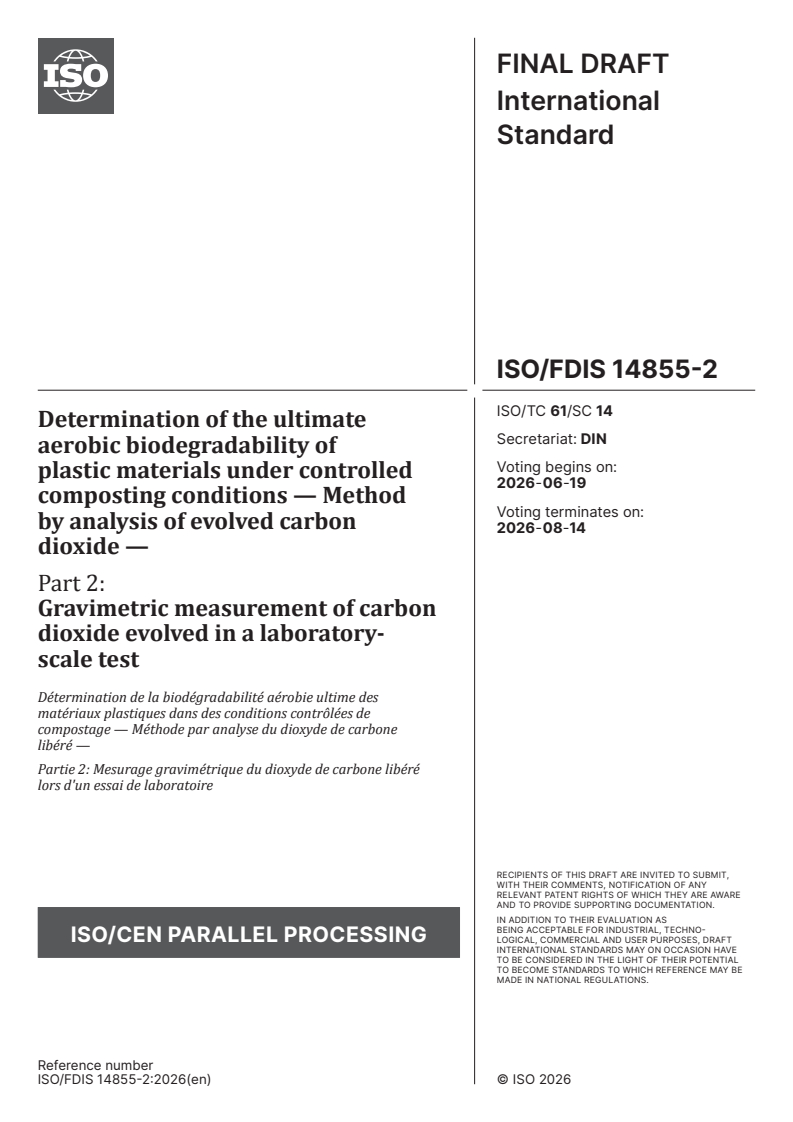
(Main)Determination of the ultimate aerobic biodegradability of plastic materials under controlled composting conditions — Method by analysis of evolved carbon dioxide — Part 2: Gravimetric measurement of carbon dioxide evolved in a laboratory-scale test
General Information
- Abstract
This document specifies a method for determining the ultimate aerobic biodegradability of plastic materials under controlled composting conditions by gravimetric measurement of the amount of carbon dioxide evolved. The method is designed to yield an optimum rate of biodegradation by adjusting the humidity, aeration and temperature of the composting vessel. The method applies to the following materials: — natural and/or synthetic polymers and copolymers, and mixtures of these; — plastic materials that contain additives such as plasticizers or colorants; — water-soluble polymers; — materials that, under the test conditions, do not inhibit the activity of microorganisms present in the inoculum. NOTE If the test material inhibits microorganisms in the inoculum, another type of mature compost or pre-exposure compost can be used.
- Status
- Not Published
- Technical Committee
- ISO/TC 61/SC 14 - Environmental aspects
- Drafting Committee
- ISO/TC 61/SC 14/WG 2 - Biodegradability
- Current Stage
- 5020 - FDIS ballot initiated: 2 months. Proof sent to secretariat
- Start Date
- 19-Jun-2026
- Completion Date
- 19-Jun-2026
Buy Documents
ISO/FDIS 14855-2 - Determination of the ultimate aerobic biodegradability of plastic materials under controlled composting conditions — Method by analysis of evolved carbon dioxide — Part 2: Gravimetric measurement of carbon dioxide evolved in a laboratory-scale test
REDLINE ISO/FDIS 14855-2 - Determination of the ultimate aerobic biodegradability of plastic materials under controlled composting conditions — Method by analysis of evolved carbon dioxide — Part 2: Gravimetric measurement of carbon dioxide evolved in a laboratory-scale test
ISO/FDIS 14855-2 - Détermination de la biodégradabilité aérobie ultime des matériaux plastiques dans des conditions contrôlées de compostage — Méthode par analyse du dioxyde de carbone libéré — Partie 2: Mesurage gravimétrique du dioxyde de carbone libéré lors d'un essai de laboratoire
Overview
ISO/FDIS 14855-2:2026 establishes an internationally recognized method for determining the ultimate aerobic biodegradability of plastic materials under controlled composting conditions, specifically using gravimetric measurement of carbon dioxide (CO₂) evolved during laboratory-scale tests. Developed by the International Organization for Standardization (ISO), this standard supports consistent and reliable assessment of how plastics break down in composting environments. The method is optimized by adjusting key composting conditions such as humidity, aeration, and temperature, enabling reproducible biodegradation rates.
This document applies to:
- Natural and synthetic polymers and copolymers (including mixtures)
- Plastics containing additives such as plasticizers or colorants
- Water-soluble polymers
- Plastics that do not inhibit microbial activity in compost inocula
Key Topics
Controlled Composting Conditions:
The standard outlines how to adjust environmental factors such as temperature, humidity, and aeration to achieve optimal biodegradation in a simulated compost environment.Gravimetric CO₂ Measurement:
The core of the method involves capturing and weighing the mass of carbon dioxide evolved from the degradation of plastics. Soda lime, soda talc, and related absorbents are used as key reagents to trap the CO₂ for accurate gravimetric analysis.Material Suitability:
The test is suitable for a wide range of plastics, including those with additives and water-soluble polymers, provided the material does not inhibit compost microbial activity. Guidance is provided for handling cases where inhibition is observed.Test Procedure:
Detailed steps cover sample preparation, inoculum sourcing and treatment, airflow management, and data analysis. The process is completed by comparing the measured CO₂ to the theoretical maximum value to quantify biodegradability.Safety Precautions:
Appropriate measures are recommended for handling compost, sewage, activated sludge, and unknown test materials, ensuring safe laboratory practice.
Applications
Product Certification:
The method is essential for manufacturers seeking certification that their plastic products or materials are industrially compostable and meet global sustainability standards.Research & Development:
R&D teams use this protocol to compare the biodegradability of different plastic formulations or additives under standardized lab-scale composting conditions.Regulatory Compliance:
Producers and importers of biodegradable plastics can demonstrate compliance with international, regional, or local environmental requirements using the procedures defined in ISO/FDIS 14855-2.Comparative Testing:
Institutions and laboratories can employ this method to benchmark new or existing materials against accepted reference materials for biodegradability.
Related Standards
ISO 14855-1:
General method for determining the ultimate aerobic biodegradability of plastic materials by analysis of evolved carbon dioxide, with applications for continuous infrared, gas chromatography, or titrimetric measurement.ISO 11721-1:
Method for assessing the resistance of cellulose-containing textiles to microorganisms via soil burial testing - relevant for evaluating organic material breakdown.Other ISO 14855 Series Parts:
Additional documents in this series provide further methodologies for composting biodegradability, supporting a broad range of analysis and testing requirements.
Conclusion
ISO/FDIS 14855-2 offers a reliable, reproducible laboratory-scale protocol for measuring the biodegradability of plastics under controlled composting conditions. Its gravimetric CO₂ analysis supports credible certification, compliance, and research in the growing field of biodegradable plastics, assisting stakeholders across manufacturing, environmental testing, and materials innovation to advance toward sustainable solutions. For robust, internationally harmonized assessment of compostable plastics, ISO/FDIS 14855-2 remains an essential reference.
Relations
- Effective Date
- 12-Feb-2026
- Effective Date
- 28-Sep-2024
Buy Documents
ISO/FDIS 14855-2 - Determination of the ultimate aerobic biodegradability of plastic materials under controlled composting conditions — Method by analysis of evolved carbon dioxide — Part 2: Gravimetric measurement of carbon dioxide evolved in a laboratory-scale test
REDLINE ISO/FDIS 14855-2 - Determination of the ultimate aerobic biodegradability of plastic materials under controlled composting conditions — Method by analysis of evolved carbon dioxide — Part 2: Gravimetric measurement of carbon dioxide evolved in a laboratory-scale test
ISO/FDIS 14855-2 - Détermination de la biodégradabilité aérobie ultime des matériaux plastiques dans des conditions contrôlées de compostage — Méthode par analyse du dioxyde de carbone libéré — Partie 2: Mesurage gravimétrique du dioxyde de carbone libéré lors d'un essai de laboratoire
Get Certified
Connect with accredited certification bodies for this standard

DIN CERTCO
DIN Group product certification.

Smithers Quality Assessments
US management systems and product certification.
Sponsored listings
Frequently Asked Questions
ISO/FDIS 14855-2 is a draft published by the International Organization for Standardization (ISO). Its full title is "Determination of the ultimate aerobic biodegradability of plastic materials under controlled composting conditions — Method by analysis of evolved carbon dioxide — Part 2: Gravimetric measurement of carbon dioxide evolved in a laboratory-scale test". This standard covers: This document specifies a method for determining the ultimate aerobic biodegradability of plastic materials under controlled composting conditions by gravimetric measurement of the amount of carbon dioxide evolved. The method is designed to yield an optimum rate of biodegradation by adjusting the humidity, aeration and temperature of the composting vessel. The method applies to the following materials: — natural and/or synthetic polymers and copolymers, and mixtures of these; — plastic materials that contain additives such as plasticizers or colorants; — water-soluble polymers; — materials that, under the test conditions, do not inhibit the activity of microorganisms present in the inoculum. NOTE If the test material inhibits microorganisms in the inoculum, another type of mature compost or pre-exposure compost can be used.
This document specifies a method for determining the ultimate aerobic biodegradability of plastic materials under controlled composting conditions by gravimetric measurement of the amount of carbon dioxide evolved. The method is designed to yield an optimum rate of biodegradation by adjusting the humidity, aeration and temperature of the composting vessel. The method applies to the following materials: — natural and/or synthetic polymers and copolymers, and mixtures of these; — plastic materials that contain additives such as plasticizers or colorants; — water-soluble polymers; — materials that, under the test conditions, do not inhibit the activity of microorganisms present in the inoculum. NOTE If the test material inhibits microorganisms in the inoculum, another type of mature compost or pre-exposure compost can be used.
ISO/FDIS 14855-2 is classified under the following ICS (International Classification for Standards) categories: 83.080.01 - Plastics in general. The ICS classification helps identify the subject area and facilitates finding related standards.
ISO/FDIS 14855-2 has the following relationships with other standards: It is inter standard links to FprEN ISO 14855-2, ISO 14855-2:2018. Understanding these relationships helps ensure you are using the most current and applicable version of the standard.
ISO/FDIS 14855-2 is available in PDF format for immediate download after purchase. The document can be added to your cart and obtained through the secure checkout process. Digital delivery ensures instant access to the complete standard document.
Standards Content (Sample)
FINAL DRAFT
International
Standard
ISO/TC 61/SC 14
Determination of the ultimate
Secretariat: DIN
aerobic biodegradability of
Voting begins on:
plastic materials under controlled
2026-06-19
composting conditions — Method
Voting terminates on:
by analysis of evolved carbon
2026-08-14
dioxide —
Part 2:
Gravimetric measurement of carbon
dioxide evolved in a laboratory-
scale test
Détermination de la biodégradabilité aérobie ultime des
matériaux plastiques dans des conditions contrôlées de
compostage — Méthode par analyse du dioxyde de carbone
libéré —
Partie 2: Mesurage gravimétrique du dioxyde de carbone libéré
lors d'un essai de laboratoire
RECIPIENTS OF THIS DRAFT ARE INVITED TO SUBMIT,
WITH THEIR COMMENTS, NOTIFICATION OF ANY
RELEVANT PATENT RIGHTS OF WHICH THEY ARE AWARE
AND TO PROVIDE SUPPOR TING DOCUMENTATION.
IN ADDITION TO THEIR EVALUATION AS
BEING ACCEPTABLE FOR INDUSTRIAL, TECHNO-
ISO/CEN PARALLEL PROCESSING LOGICAL, COMMERCIAL AND USER PURPOSES, DRAFT
INTERNATIONAL STANDARDS MAY ON OCCASION HAVE
TO BE CONSIDERED IN THE LIGHT OF THEIR POTENTIAL
TO BECOME STAN DARDS TO WHICH REFERENCE MAY BE
MADE IN NATIONAL REGULATIONS.
Reference number
FINAL DRAFT
International
Standard
ISO/TC 61/SC 14
Determination of the ultimate
Secretariat: DIN
aerobic biodegradability of
Voting begins on:
plastic materials under controlled
composting conditions — Method
Voting terminates on:
by analysis of evolved carbon
dioxide —
Part 2:
Gravimetric measurement of carbon
dioxide evolved in a laboratory-
scale test
Détermination de la biodégradabilité aérobie ultime des
matériaux plastiques dans des conditions contrôlées de
compostage — Méthode par analyse du dioxyde de carbone
libéré —
Partie 2: Mesurage gravimétrique du dioxyde de carbone libéré
lors d'un essai de laboratoire
RECIPIENTS OF THIS DRAFT ARE INVITED TO SUBMIT,
WITH THEIR COMMENTS, NOTIFICATION OF ANY
RELEVANT PATENT RIGHTS OF WHICH THEY ARE AWARE
AND TO PROVIDE SUPPOR TING DOCUMENTATION.
© ISO 2026
IN ADDITION TO THEIR EVALUATION AS
All rights reserved. Unless otherwise specified, or required in the context of its implementation, no part of this publication may
BEING ACCEPTABLE FOR INDUSTRIAL, TECHNO-
ISO/CEN PARALLEL PROCESSING
LOGICAL, COMMERCIAL AND USER PURPOSES, DRAFT
be reproduced or utilized otherwise in any form or by any means, electronic or mechanical, including photocopying, or posting on
INTERNATIONAL STANDARDS MAY ON OCCASION HAVE
the internet or an intranet, without prior written permission. Permission can be requested from either ISO at the address below
TO BE CONSIDERED IN THE LIGHT OF THEIR POTENTIAL
or ISO’s member body in the country of the requester.
TO BECOME STAN DARDS TO WHICH REFERENCE MAY BE
MADE IN NATIONAL REGULATIONS.
ISO copyright office
CP 401 • Ch. de Blandonnet 8
CH-1214 Vernier, Geneva
Phone: +41 22 749 01 11
Email: copyright@iso.org
Website: www.iso.org
Published in Switzerland Reference number
ii
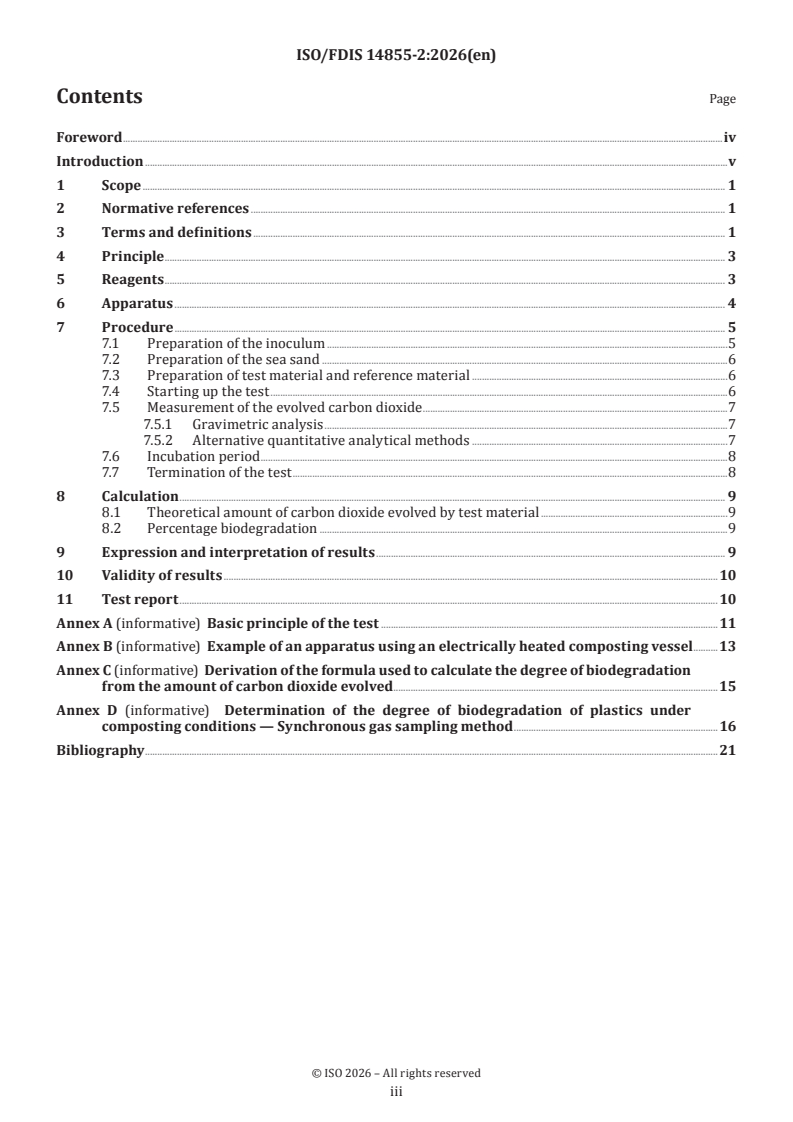
Contents Page
Foreword .iv
Introduction .v
1 Scope . 1
2 Normative references . 1
3 Terms and definitions . 1
4 Principle . 3
5 Reagents . 3
6 Apparatus . 4
7 Procedure . 5
7.1 Preparation of the inoculum .5
7.2 Preparation of the sea sand .6
7.3 Preparation of test material and reference material .6
7.4 Starting up the test .6
7.5 Measurement of the evolved carbon dioxide .7
7.5.1 Gravimetric analysis .7
7.5.2 Alternative quantitative analytical methods .7
7.6 Incubation period .8
7.7 Termination of the test .8
8 Calculation . 9
8.1 Theoretical amount of carbon dioxide evolved by test material .9
8.2 Percentage biodegradation .9
9 Expression and interpretation of results . 9
10 Validity of results . 10
11 Test report . 10
Annex A (informative) Basic principle of the test .11
Annex B (informative) Example of an apparatus using an electrically heated composting vessel .13
Annex C (informative) Derivation of the formula used to calculate the degree of biodegradation
from the amount of carbon dioxide evolved .15
Annex D (informative) Determination of the degree of biodegradation of plastics under
composting conditions — Synchronous gas sampling method .16
Bibliography .21
iii
Foreword
ISO (the International Organization for Standardization) is a worldwide federation of national standards
bodies (ISO member bodies). The work of preparing International Standards is normally carried out through
ISO technical committees. Each member body interested in a subject for which a technical committee
has been established has the right to be represented on that committee. International organizations,
governmental and non-governmental, in liaison with ISO, also take part in the work. ISO collaborates closely
with the International Electrotechnical Commission (IEC) on all matters of electrotechnical standardization.
The procedures used to develop this document and those intended for its further maintenance are described
in the ISO/IEC Directives, Part 1. In particular, the different approval criteria needed for the different types
of ISO document should be noted. This document was drafted in accordance with the editorial rules of the
ISO/IEC Directives, Part 2 (see www.iso.org/directives).
ISO draws attention to the possibility that the implementation of this document may involve the use of (a)
patent(s). ISO takes no position concerning the evidence, validity or applicability of any claimed patent
rights in respect thereof. As of the date of publication of this document, ISO had not received notice of (a)
patent(s) which may be required to implement this document. However, implementers are cautioned that
this may not represent the latest information, which may be obtained from the patent database available at
www.iso.org/patents. ISO shall not be held responsible for identifying any or all such patent rights.
Any trade name used in this document is information given for the convenience of users and does not
constitute an endorsement.
For an explanation of the voluntary nature of standards, the meaning of ISO specific terms and expressions
related to conformity assessment, as well as information about ISO's adherence to the World Trade
Organization (WTO) principles in the Technical Barriers to Trade (TBT), see www.iso.org/iso/foreword.html.
This document was prepared by Technical Committee ISO/TC 61, Plastics, Subcommittee SC 14, Environmental
aspects, in collaboration with the European Committee for Standardization (CEN) Technical Committee
CEN/TC 249, Plastics, in accordance with the Agreement on technical cooperation between ISO and CEN
(Vienna Agreement).
This third edition cancels and replaces the second edition (ISO 14855-2:2018), which has been technically
revised.
The main changes are as follows:
— the NDIR method to the measurement of evolved carbon dioxide in addition to the conventional
gravimetric method has been added;
— a schematic diagram of the measurement device and an example of biodegradability measurement using
an NDIR sensor have been added to Annex D.
A list of all parts in the ISO 14855 series can be found on the ISO website.
Any feedback or questions on this document should be directed to the user’s national standards body. A
complete listing of these bodies can be found at www.iso.org/members.html.
iv
Introduction
Management of plastics waste is a serious problem in the world. Plastics recovery technologies include
material recovery (mechanical recycling, chemical or feedstock recycling, and biological or organic recycling)
and energy recovery (heat, steam or electricity as a substitute for fossil fuels or other fuel resources). The
use of biodegradable plastics is one valuable recovery option (biological or organic recycling).
Several ISO standards for determining the ultimate aerobic/anaerobic biodegradability of plastic materials
have been published. In particular, ISO 14855-1 is a common test method that measures the amount of carbon
dioxide evolved using methods such as continuous infrared analysis, gas chromatography or titration.
Compared with ISO 14855-1, the amounts of compost inoculum and test sample used in this document are
one-tenth the size. In order to ensure the activity of the compost inoculum, inert material that gives the
mixture the same texture as soil is mixed into the inoculum. The carbon dioxide evolved from the test vessel
is determined by absorbing it in a carbon dioxide trap and carrying out gravimetric analysis of the absorbent.
The method described in this document, which uses a closed system to capture the carbon dioxide evolved,
can also be used to obtain valuable information, by means of isotopic-labelling studies, on the way in which
the molecular structure of co-polymers degrades.
In addition to traditional gravimetric methods, this test method adds a new way to measure carbon dioxide
using spectroscopic non-dispersive infrared (NDIR) technology, significantly reducing the routine work and
chemical use required for quantitative measurement without compromising the quantitative accuracy of
chemical methods.
v
FINAL DRAFT International Standard ISO/FDIS 14855-2:2026(en)
Determination of the ultimate aerobic biodegradability of
plastic materials under controlled composting conditions —
Method by analysis of evolved carbon dioxide —
Part 2:
Gravimetric measurement of carbon dioxide evolved in a
laboratory-scale test
WARNING — Sewage, activated sludge, soil and compost can contain potentially pathogenic
organisms. Therefore, appropriate precautions should be taken when handling them. Toxic test
compounds and those whose properties are unknown should be handled with care.
1 Scope
This document specifies a method for determining the ultimate aerobic biodegradability of plastic materials
under controlled composting conditions by gravimetric measurement of the amount of carbon dioxide
evolved. The method is designed to yield an optimum rate of biodegradation by adjusting the humidity,
aeration and temperature of the composting vessel.
The method applies to the following materials:
— natural and/or synthetic polymers and copolymers, and mixtures of these;
— plastic materials that contain additives such as plasticizers or colorants;
— water-soluble polymers;
— materials that, under the test conditions, do not inhibit the activity of microorganisms present in the
inoculum.
NOTE If the test material inhibits microorganisms in the inoculum, another type of mature compost or pre-
exposure compost can be used.
2 Normative references
The following documents are referred to in the text in such a way that some or all of their content constitutes
requirements of this document. For dated references, only the edition cited applies. For undated references,
the latest edition of the referenced document (including any amendments) applies.
ISO 11721-1, Textiles — Determination of resistance of cellulose-containing textiles to micro-organisms — Soil
burial test — Part 1: Assessment of rot-retardant finishing
ISO 14855-1, Determination of the ultimate aerobic biodegradability of plastic materials under controlled
composting conditions — Method by analysis of evolved carbon dioxide — Part 1: General method
3 Terms and definitions
For the purposes of this document, the following terms and definitions apply.
ISO and IEC maintain terminology databases for use in standardization at the following addresses:
— ISO Online browsing platform: available at https:// www .iso .org/ obp
— IEC Electropedia: available at https:// www .electropedia .org/
3.1
compost
organic soil conditioner obtained by biodegradation of a mixture principally consisting of various vegetable
residues, occasionally with other organic material and having a limited mineral content
3.2
composting
aerobic process designed to produce compost
3.3
total dry solids
amount of solids obtained by taking a known volume of test material or compost and drying at about 105 °C
to constant mass
3.4
volatile solids
amount of solids obtained by subtracting the residue of a known volume of test material or compost after
incineration at about 550 °C from the total dry solids of the same sample
Note 1 to entry: The volatile-solids content is an indication of the amount of organic matter present.
3.5
ultimate aerobic biodegradability
breakdown ratio by expressed as percentage of an organic compound by microorganisms in the presence of
oxygen into carbon dioxide, water and mineral salts of any other elements present (mineralization) plus new
biomass
[SOURCE: ISO 14852:2021, 3.1]
3.6
theoretical amount of evolved carbon dioxide
ThCO
maximum theoretical amount of carbon dioxide evolved after completely oxidizing a chemical compound,
calculated from the molecular formula and expressed as milligrams of carbon dioxide evolved per milligram
or gram of test compound
3.7
lag phase
time from the start of a test until adaptation and/or selection of the degradation microorganisms is achieved
and the degree of biodegradation of a chemical compound or organic matter has increased to about 10 % of
the maximum level of biodegradation
Note 1 to entry: It is measured in days.
3.8
maximum level of biodegradation
degree of biodegradation of a chemical compound or organic matter in a test, above which no further
biodegradation takes place during the test
Note 1 to entry: It is measured as a percentage.
3.9
biodegradation phase
time from the end of the lag phase of a test until about 90 % of the maximum level of biodegradation has
been reached
Note 1 to entry: It is measured in days.
3.10
plateau phase
time from the end of the biodegradation phase until the end of the test
Note 1 to entry: It is measured in days.
3.11
pre-exposure
pre-incubation of an inoculum in the presence of the chemical compound or organic matter under test,
with the aim of enhancing the ability of the inoculum to biodegrade the test material by adaptation and/or
selection of the micro-organisms
3.12
pre-conditioning
pre-incubation of an inoculum under the conditions of the subsequent test in the absence of the chemical
compound or organic matter under test, with the aim of improving the test by acclimatization of the
microorganisms to the test conditions
3.13
water-holding capacity
WHC
mass of water that evaporates from soil saturated with water when the soil is dried to constant mass at
105 °C, divided by the dry mass of the soil
4 Principle
This method is designed to yield the optimum rate of biodegradation of a plastic material in mature compost
by controlling the humidity, aeration ratio and temperature in the composting vessel. It also aims to
determine the ultimate biodegradability of the test material by using a small-scale reactor. The degradation
rate is periodically measured by determining the mass of the evolved carbon dioxide using an absorption
column filled with soda lime and soda talc on an electronic balance.
The test material is mixed with an inoculum derived from mature compost and with an inert material such
as sea sand. The sea sand plays an active part by acting as a holding body for humidity and microorganisms.
Examples of suitable test arrangements are presented in Annexes A and B. The amount of carbon dioxide
evolved is measured at intervals on an electronic balance and the carbon dioxide content is determined
using the following method. The derivation of the formula used to calculate the degree of biodegradation
from the amount of carbon dioxide evolved is given in Annex C. In this method, the degree of biodegradation,
expressed as a percentage, is calculated by comparing the amount of carbon dioxide evolved with the
theoretical amount (ThCO ).
The test is terminated when the plateau phase of biodegradation has been attained. The standard time for
termination is 45 days, but the test can be continued for up to six months.
5 Reagents
Use only analytical-grade reagents. Use only deionized water.
5.1 Soda lime, particle size between 2 mm and 4 mm, for CO absorption.
5.2 Anhydrous calcium chloride, particle size between 2 mm and 3 mm, for water absorption.
5.3 Sodium hydroxide on a talc support (commonly known as soda talc), particle size between 2 mm
and 3 mm, for CO absorption.
5.4 Silica gel (with moisture indicator), particle size between 2 mm and 4 mm, for water absorption.
5.5 Sea sand, particle size between 425 μm and 850 μm (20 mesh and 35 mesh).
5.6 Reference material: thin-layer chromatography (TLC) grade microcrystalline cellulose with a
particle size of less than 20 µm, for use as the reference material in the positive control.
6 Apparatus
Ensure that all glassware is thoroughly cleaned and, in particular, free from organic or toxic matter.
6.1 Air-supply system, capable of supplying each composting vessel with carbon-dioxide-free, water-
saturated air.
The air can be prepared by supplying compressed air through a carbon dioxide trap and a humidifier (see
examples in Annexes A and B), i.e. columns filled with soda lime and water, respectively. The air flow rate
shall be controlled with a flow controller so that it is high enough for aerobic conditions.
6.2 Composting vessels
Use bottles or columns that ensure a supply of water-saturated, carbon-dioxide-free air to the contents. A
suitable volume is 500 ml. If the loss in mass of the test material is to be determined, weigh each composting
vessel empty before starting the test.
6.3 System for the determination of carbon dioxide, capable of determining carbon dioxide directly
from the change in mass of a carbon dioxide trap. The carbon dioxide trap shall consist of columns filled
with soda lime, soda talc and anhydrous calcium chloride. The calcium chloride should preferably be in a
separate column from the soda lime and soda talc (see examples in Annexes A and B). An ammonia trap
(dilute sulfuric acid) and a water trap (silica gel and calcium chloride) are required between the composting
vessel and the carbon-dioxide-absorbing column.
6.4 Gas-tight tubes, used to connect the composting vessels to the air supply and the carbon dioxide
measurement system.
6.5 pH-meter, used for measurement of the pH of the test mixture. It shall be accurate to 0,1 pH-units or
better.
6.6 Analytical equipment, used for the determination of the dry solids (at 105 °C), volatile solids (at
550 °C) and total organic carbon (TOC), for elemental analysis of the test material and, if required, for the
determination of dissolved inorganic carbon (DIC), volatile fatty acids, oxygen in the air, water content and
total nitrogen.
6.7 Balance, used to periodically measure the mass of the carbon-dioxide-absorbing column, in order to
determine the amount of carbon dioxide evolved, and also to measure the mass of the composting vessel
containing compost and test material. A top-loading electronic balance with a display reading down to
10 mg and a capacity greater than 500 g is preferred.
6.8 Thermostatic-control unit, required to maintain the temperature of the composting vessels at
a controlled temperature during the test (see examples given in Annexes A and B). It shall be capable of
maintaining the temperature of the composting vessels constant to within ±2 °C.
6.9 Composting bioreactor. A box, made from polypropylene or another suitable material, having a size
that allows the contents to be stirred easily with a spatula. The box shall be provided with a tightly fitting
lid to avoid excessive water loss. Three holes with a diameter of about 1 cm shall be made at equal distances
along the centreline of the lid. These holes allow air to enter and gases to leave the box, as well as the gradual
evaporation of excess water.
7 Procedure
7.1 Preparation of the inoculum
Well-aerated compost from a properly operating aerobic composting plant shall be used as the inoculum.
The inoculum shall be homogeneous and free from large inert objects such as glass, stones or pieces of
metal. Remove such items manually and prepare compost with a particle size of 2 mm to 5 mm using sieves
with 2 mm and 5 mm openings.
Compost can be made as follows. Wood shavings, sawdust, used mushroom beds, chaff or rice straw can
be used as the carbon source. Livestock excrement is added as a source of composting microorganisms
and mineral salt nutrients. This is placed in a container with a volume of about 1 m and mixed well. It
is recommended that the compost be adjusted to a carbon/nitrogen (C/N) ratio of 15 and a carbon/
phosphorous (C/P) ratio of 30. Insufficient phosphorous and nitrogen levels can be supplemented using
calcium superphosphate and ammonium magnesium phosphate hexahydrate or urea, respectively. Water is
added to reach a water content equal to 65 %. The C/N, C/P and water-content values may also be adjusted
to other values, determined by experience, depending on seasonal variations and climatic differences. The
compost should be removed from the container once a week to turn it and add water, if necessary, before
returning it to the container to continue the composting process. The age of the compost should preferably
be between two and four months.
Normally, non-exposed inoculum is preferred, especially in the case of standard tests simulating
biodegradation behaviour in real composting facilities. Depending on the purpose of the test, however,
pre-exposed compost may be used, provided that this is clearly stated in the test report (e.g. percent
biodegradation = X %, using pre-exposed compost) and provided the method of pre-exposure is detailed in
the test report.
Determine the total dry solids and volatile-solids content of the compost inoculum. The total dry solids
should be between 35 % and 55 % of the wet solids and the volatile solids more than 30 % of the dry solids.
Adjust the water content, if necessary, before the compost is used by adding water or drying gently, e.g. by
aerating the compost with dry air.
Prepare a mixture of 1 part of inoculum to 5 parts of deionized water. Mix by shaking and measure the pH
immediately. It should be between 7,0 and 9,0.
For further characterization of the inoculum, suitable parameters such as the content of total organic carbon,
total nitrogen or fatty acids can optionally be determined at the beginning and the end of the test.
Check the activity of the inoculum during the test by means of a biodegradable reference material and
by measuring carbon dioxide evolution in the blank vessels. The reference material shall be degraded by
70 % or more at the end of the test. The inoculum in the blank should produce between 50 mg and 150 mg
of carbon dioxide per gram of volatile solids over the first 10 days of the test. If the production of carbon
dioxide is too high, stabilize the compost by aeration for several days before using it in a new test.
If biodegradation is inhibited by physicochemical conditions, such as a decrease in the pH of the test system
due to hydrolysis of the sample, solidification or aggregation of the compost due to melting, or a decrease in
water activity due to water absorption, it is recommended to conduct the test under milder conditions in a
water system, soil system, or home compost system.
7.2 Preparation of the sea sand
Dip the sea sand in tap water. After removing floating impurities by decantation, rinse the sand sufficiently,
drain off the water and dry the sand at about 105 °C.
NOTE Sea sand, or another inert mineral material (e.g. quartz sand) with SiO content ≥90 % and particle size
of 0,5 mm to 1 mm can be used. Sea sand plays an important role in maintaining appropriate moisture content and
promoting microbial growth.
7.3 Preparation of test material and reference material
Determine the total organic carbon (TOC) of the test material and the reference material using, for example,
ISO 8245 and report it preferably as grams of TOC per gram of total dry solids. Alternatively, provided that
the materials do not contain inorganic carbon, it is possible to determine the carbon content by elemental
analysis. For this, the test material should contain sufficient organic carbon to yield carbon dioxide in an
amount suitable for determination. Normally, a minimum of 10 g of total dry solids containing 4 g of TOC is
required per 500 ml-vessel.
The test material should preferably be used in powder form, but it may also be introduced as small pieces of
films or as fragments of shaped articles. A maximum particle size of 250 µm in diameter is recommended.
For materials containing inorganic carbon (e.g. carbonate fillers), the inorganic carbon shall be determined
and subtracted, or a suitable pre-treatment shall be applied to remove inorganic carbon before TOC
determination. The applied procedure shall be reported.
7.4 Starting up the test
Provide at least the following numbers of composting vessels:
a) three test vessels for the test mixture (symbol V );
T
b) three vessels for blank controls (symbol V );
B
c) three vessels for checking inoculum activity using a reference material (symbol V ).
R
The amount of test mixture, containing inoculum and the test material, used in the test depends on the
quality of the test material and the size of the composting vessels. The relation between the total dry solids
of the inoculum and the total dry solids of the test material should preferably be about 6:1. If added, inert
material is not considered in this relationship. The test mixture should have the same water content as the
inoculum. The water content of the test mixture should be set at 80 % to 90 % of the water-holding capacity
(
...
Style Definition
...
Style Definition
...
Style Definition
...
Style Definition
...
Style Definition
...
ISO/TC 61/SC 14
Style Definition
...
Date: 2026-05-05
Style Definition
...
Style Definition
...
ISO/FDIS 14855-2:2026(en)
Style Definition
...
ISO/TC 61/SC 14/WG 2
Style Definition
...
Style Definition
Secretariat: DIN .
Style Definition
...
Date: 2026-06-05
Style Definition
...
Style Definition
...
Style Definition
...
Style Definition
...
Style Definition
...
Style Definition
...
Determination of the ultimate aerobic biodegradability of plastic
Style Definition
...
materials under controlled composting conditions — Method by
Style Definition
...
analysis of evolved carbon dioxide — Part 2: Gravimetric
Style Definition
...
measurement of carbon dioxide evolved in a laboratory scale test
Style Definition
...
Style Definition
...
Style Definition
...
Style Definition
...
Style Definition
...
Part 2:
Style Definition
...
Gravimetric measurement of carbon dioxide evolved in a laboratory- Style Definition
...
Style Definition
scale test
...
Style Definition
...
Détermination de la biodégradabilité aérobie ultime des matériaux plastiques dans des conditions contrôlées de
Style Definition
...
compostage — Méthode par analyse du dioxyde de carbone libéré — Partie 2: Mesurage gravimétrique du
dioxyde de carbone libéré lors d'un essai de laboratoire Style Definition
...
Style Definition
...
Partie 2: Mesurage gravimétrique du dioxyde de carbone libéré lors d'un essai de laboratoire
Style Definition
...
Style Definition
...
Style Definition
...
Style Definition
...
Style Definition
...
TTTTTThhhhhhiiiiiis s s s s s drdrdrdrdrdraaaaaafffffftttttt i i i i i is s s s s s susususususubbbbbbmmmmmmiiiiiitttttttttttteeeeeed d d d d d ttttttoooooo aaaaaa ppppppaaaaaarrrrrraaaaaallellellellellellel l l l l l vvvvvvooooootttttteeeeee i i i i i innnnnn IIIIIISSSSSSOOOOOO,,,,,, CCCCCCEEEEEEN.N.N.N.N.N.
Style Definition
...
Style Definition
...
Style Definition
...
Style Definition
...
Style Definition
...
Style Definition
...
Style Definition
...
Style Definition
...
Style Definition
...
Style Definition
...
Style Definition
...
Style Definition
...
Style Definition
...
Style Definition
...
Style Definition
...
Style Definition
...
Style Definition
...
Style Definition
...
Style Definition
...
St l D fi iti
Formatted: English (United Kingdom)
Formatted: Space After: 0 pt
FDIS stage
Formatted: Space Before: 0 pt, After: 0 pt
Formatted: Font: Bold
Formatted: HeaderCentered, Left
Formatted: Default Paragraph Font
Formatted: Default Paragraph Font
All rights reserved. Unless otherwise specified, or required in the context of its implementation, no part of this publication
may be reproduced or utilized otherwise in any form or by any means, electronic or mechanical, including photocopying, Formatted: Left: 1.5 cm, Right: 1.5 cm, Gutter: 0 cm,
or posting on the internet or an intranet, without prior written permission. Permission can be requested from either ISO
Header distance from edge: 1.27 cm
at the address below or ISO’s member body in the country of the requester.
ISO copyright office
CP 401 • Ch. de Blandonnet 8
CH-1214 Vernier, Geneva
Phone: + 41 22 749 01 11
Formatted: French (France)
EmailE-mail: copyright@iso.org
Formatted: French (France)
Website: www.iso.orgwww.iso.org
Formatted: French (France)
Published in Switzerland
Formatted: French (France)
Formatted: English (United Kingdom)
Formatted: Font: 10 pt
Formatted: Font: 10 pt
Formatted: Font: 10 pt
Formatted: FooterCentered, Left, Space Before: 0 pt,
Tab stops: Not at 17.2 cm
Formatted: Font: 11 pt, Not Bold
Formatted: FooterPageRomanNumber, Left, Space
After: 0 pt, Tab stops: Not at 17.2 cm
© ISO 2026 – All rights reserved
iii
ISO/DISFDIS 14855-2:2025(E2026(en)
Formatted: Font: Bold
Formatted: Font: Bold
Formatted: Font: Bold
Contents
Formatted: HeaderCentered
Formatted: Adjust space between Latin and Asian text,
Foreword . vi
Adjust space between Asian text and numbers, Tab
Introduction . vii
stops: Not at 0.71 cm + 17.2 cm
1 Scope . 1
2 Normative references . 1
3 Terms and definitions . 2
4 Principle . 3
5 Reagents . 4
6 Apparatus . 4
7 Procedure . 5
7.1 Preparation of the inoculum . 5
7.2 Preparation of the sea sand . 6
7.3 Preparation of test material and reference material . 6
7.4 Starting up the test . 6
7.5 Measurement of the evolved carbon dioxide . 8
7.6 Incubation period . 8
7.7 Termination of the test . 9
8 Calculation . 9
8.1 Theoretical amount of carbon dioxide evolved by test material. 9
8.2 Percentage biodegradation . 10
9 Expression and interpretation of results . 10
10 Validity of results . 11
11 Test report . 11
Annex A (informative) Basic principle of the test . 12
Annex B (informative) Example of an apparatus using an electrically heated composting vessel15
Annex C (informative) Derivation of the formula used to calculate the degree of biodegradation
from the amount of carbon dioxide evolved . 18
Annex D (informative) Determination of the degree of biodegradation of plastics under
composting conditions — Synchronous gas sampling method . 20
Bibliography . 27
Page
Foreword . iv
Introduction . v
1 Scope . 1
2 Normative references . 1
3 Terms and definitions . 1
Formatted: FooterPageRomanNumber
iv
iv
Formatted: Font: Bold
Formatted: HeaderCentered, Left
4 Principle . 3
5 Reagents . 3
6 Apparatus . 4
7 Procedure . 5
7.1 Preparation of the inoculum . 5
7.2 Preparation of the sea sand . 6
7.3 Preparation of test material and reference material . 6
7.4 Starting up the test . 6
7.5 Measurement of the evolved carbon dioxide . 7
7.6 Incubation period . 8
7.7 Termination of the test . 9
8 Calculation . 9
8.1 Theoretical amount of carbon dioxide evolved by test material. 9
8.2 Percentage biodegradation . 9
9 Expression and interpretation of results . 10
10 Validity of results . 10
11 Test report . 10
Annex A (informative) Basic principle of the test . 12
Annex B (informative) Example of an apparatus using an electrically heated composting vessel14
Annex C (informative) Derivation of the formula used to calculate the degree of biodegradation
from the amount of carbon dioxide evolved . 16
Annex D (informative) Determination of the degree of biodegradation of plastics under
composting conditions — Synchronous gas sampling method . 18
D.1 Equipment that uses synchronous gas sampling to collect gases evolved under
composting conditions . 18
D.2 Instruments that use an NDIR gas sensor and a gas burette to measure cumulative gas
volume and carbon dioxide concentration . 19
D.3 Example of cellulose biodegradation from cumulative gas volume and carbon dioxide
concentration using NDIR gas sensor and gas burette . 20
Bibliography . 22
Formatted: Font: 10 pt
Formatted: Font: 10 pt
Formatted: Font: 10 pt
Formatted: FooterCentered, Left, Space Before: 0 pt,
Tab stops: Not at 17.2 cm
Formatted: Font: 11 pt, Not Bold
Formatted: FooterPageRomanNumber, Left, Space
After: 0 pt, Tab stops: Not at 17.2 cm
© ISO 2026 – All rights reserved
v
ISO/DISFDIS 14855-2:2025(E2026(en)
Formatted: Font: Bold
Formatted: Font: Bold
Formatted: Font: Bold
Foreword
Formatted: HeaderCentered
ISO (the International Organization for Standardization) is a worldwide federation of national standards
Formatted: Adjust space between Latin and Asian text,
bodies (ISO member bodies). The work of preparing International Standards is normally carried out through Adjust space between Asian text and numbers
ISO technical committees. Each member body interested in a subject for which a technical committee has been
established has the right to be represented on that committee. International organizations, governmental and
non-governmental, in liaison with ISO, also take part in the work. ISO collaborates closely with the
International Electrotechnical Commission (IEC) on all matters of electrotechnical standardization.
The procedures used to develop this document and those intended for its further maintenance are described
in the ISO/IEC Directives, Part 1. In particular, the different approval criteria needed for the different types of
ISO document should be noted. This document was drafted in accordance with the editorial rules of the
ISO/IEC Directives, Part 2 (see www.iso.org/directives).
Formatted: English (United Kingdom)
ISO draws attention to the possibility that the implementation of this document may involve the use of (a)
patent(s). ISO takes no position concerning the evidence, validity or applicability of any claimed patent rights
in respect thereof. As of the date of publication of this document, ISO had not received notice of (a) patent(s)
which may be required to implement this document. However, implementers are cautioned that this may not
represent the latest information, which may be obtained from the patent database available at
www.iso.org/patents.www.iso.org/patents. ISO shall not be held responsible for identifying any or all such
patent rights.
Any trade name used in this document is information given for the convenience of users and does not
constitute an endorsement.
Formatted: English (United Kingdom)
For an explanation of the voluntary nature of standards, the meaning of ISO specific terms and expressions
related to conformity assessment, as well as information about ISO's adherence to the World Trade
Formatted: Font: Not Italic
Organization (WTO) principles in the Technical Barriers to Trade (TBT), see
Formatted: Font: Not Italic
www.iso.org/iso/foreword.htmlwww.iso.org/iso/foreword.html.
Formatted: Font: Not Italic
This document was prepared by Technical Committee ISO/TC 61, Plastics, Subcommittee SC 14,
Formatted: Default Paragraph Font
Environmental aspects, in collaboration with the European Committee for Standardization (CEN) Technical
Formatted: Default Paragraph Font
Committee CEN/TC 249, Plastics, in accordance with the Agreement on technical cooperation between ISO
and CEN (Vienna Agreement). Formatted: Default Paragraph Font
Formatted: Adjust space between Latin and Asian text,
This third edition cancels and replaces the firstsecond edition (ISO 14855-2:20072018), which has been
Adjust space between Asian text and numbers
technically revised. It also incorporates the Technical Corrigendum ISO 14855-2:2007/Cor.1:2009.
Formatted: List Continue 1, Adjust space between Latin
and Asian text, Adjust space between Asian text and
The main changes are as follows:
numbers, Tab stops: Not at 0.7 cm + 2.1 cm + 2.8 cm
+ 3.5 cm + 4.2 cm + 4.9 cm + 5.6 cm + 6.3 cm + 7
— — ISO 14855-2:2026 (3rd edition) adds the NDIR method to the measurement of evolved carbon dioxide
cm
in addition to the conventional gravimetric method. A has been added;
Formatted: Default Paragraph Font
— a schematic diagram of the measurement device and an example of biodegradability measurement using
Formatted: Default Paragraph Font
an NDIR sensor have been added to Annex D.Annex D.
Formatted: Default Paragraph Font
A list of all parts in the ISO 14855 series can be found on the ISO website.
Formatted: Adjust space between Latin and Asian text,
Adjust space between Asian text and numbers
Any feedback or questions on this document should be directed to the user’s national standards body. A
Formatted: English (United Kingdom)
complete listing of these bodies can be found at www.iso.org/members.htmlwww.iso.org/members.html.
Formatted: English (United Kingdom)
Formatted: FooterPageRomanNumber
vi
vi
Formatted: Font: Bold
Formatted: HeaderCentered, Left
Formatted: Adjust space between Latin and Asian text,
Introduction
Adjust space between Asian text and numbers
Management of plastics waste is a serious problem in the world. Plastics recovery technologies include
material recovery (mechanical recycling, chemical or feedstock recycling, and biological or organic recycling)
and energy recovery (heat, steam or electricity as a substitute for fossil fuels or other fuel resources). The use
of biodegradable plastics is one valuable recovery option (biological or organic recycling).
Several ISO standards for determining the ultimate aerobic/anaerobic biodegradability of plastic materials
have been published. In particular, ISO 14855-1 is a common test method that measures the amount of carbon
Formatted: Default Paragraph Font
dioxide evolved using methods such as continuous infrared analysis, gas chromatography or titration.
Formatted: Default Paragraph Font
Formatted: Default Paragraph Font
Compared with ISO 14855-1, the amounts of compost inoculum and test sample used in this document are
one-tenth the size. In order to ensure the activity of the compost inoculum, inert material that gives the
Formatted: Default Paragraph Font
mixture the same texture as soil is mixed into the inoculum. The carbon dioxide evolved from the test vessel
Formatted: Default Paragraph Font
is determined by absorbing it in a carbon dioxide trap and carrying out gravimetric analysis of the absorbent.
The method described in this document, which uses a closed system to capture the carbon dioxide evolved, Formatted: Default Paragraph Font
can also be used to obtain valuable information, by means of isotopic-labelling studies, on the way in which
the molecular structure of co-polymers degrades.
In addition to traditional gravimetric methods, this test method adds a new way to measure carbon dioxide
using spectroscopic non-dispersive infrared (NDIR) technology, significantly reducing the routine work and
chemical use required for quantitative measurement without compromising the quantitative accuracy of
chemical methods.
Formatted: Font: 10 pt
Formatted: Font: 10 pt
Formatted: Font: 10 pt
Formatted: FooterCentered, Left, Space Before: 0 pt,
Tab stops: Not at 17.2 cm
Formatted: Font: 11 pt, Not Bold
Formatted: FooterPageRomanNumber, Left, Space
After: 0 pt, Tab stops: Not at 17.2 cm
© ISO 2026 – All rights reserved
vii
DRAFT International Standard ISO/DIS 14855-2:2025(en)
Formatted: Space After: 0 pt
Determination of the ultimate aerobic biodegradability of plastic
materials under controlled composting conditions — Method by
analysis of evolved carbon dioxide — Part 2: Gravimetric
measurement of carbon dioxide evolved in a laboratory scale test
Formatted: Left: 1.5 cm, Right: 1.5 cm, Gutter: 0 cm,
Part 2:
Section start: New page, Header distance from edge:
Gravimetric measurement of carbon dioxide evolved in a laboratory-
1.27 cm
scale test
WARNING — Sewage, activated sludge, soil and compost can contain potentially pathogenic
Formatted: Adjust space between Latin and Asian text,
organisms. Therefore, appropriate precautions should be taken when handling them. Toxic test Adjust space between Asian text and numbers
compounds and those whose properties are unknown should be handled with care.
1 Scope
This document specifies a method for determining the ultimate aerobic biodegradability of plastic materials
under controlled composting conditions by gravimetric measurement of the amount of carbon dioxide
evolved. The method is designed to yield an optimum rate of biodegradation by adjusting the humidity,
aeration and temperature of the composting vessel.
The method applies to the following materials:
— — natural and/or synthetic polymers and copolymers, and mixtures of these;
Formatted: Adjust space between Latin and Asian text,
Adjust space between Asian text and numbers, Tab
— — plastic materials that contain additives such as plasticizers or colorants;
stops: Not at 0.7 cm + 1.4 cm + 2.1 cm + 2.8 cm +
3.5 cm + 4.2 cm + 4.9 cm + 5.6 cm + 6.3 cm + 7 cm
— — water-soluble polymers;
— — materials that, under the test conditions, do not inhibit the activity of microorganisms present in the
Formatted: Adjust space between Latin and Asian text,
inoculum.
Adjust space between Asian text and numbers
NOTE If the test material inhibits microorganisms in the inoculum, another type of mature compost or pre-exposure Formatted: Default Paragraph Font
compost can be used.
Formatted: Default Paragraph Font
Formatted: Default Paragraph Font
2 Normative references
Formatted: Default Paragraph Font
The following documents are referred to in the text in such a way that some or all of their content constitutes
Formatted: Adjust space between Latin and Asian text,
requirements of this document. For dated references, only the edition cited applies. For undated references,
Adjust space between Asian text and numbers, Tab
the latest edition of the referenced document (including any amendments) applies.
stops: Not at 0.7 cm + 1.4 cm + 2.1 cm + 2.8 cm +
3.5 cm + 4.2 cm + 4.9 cm + 5.6 cm + 6.3 cm + 7 cm
ISO 11721--1, Textiles — Determination of resistance of cellulose-containing textiles to micro-organisms —
Formatted: Default Paragraph Font
Soil burial test — Part 1: Assessment of rot-retardant finishing
Formatted: Default Paragraph Font
ISO 14855--1, Determination of the ultimate aerobic biodegradability of plastic materials under controlled
Formatted: Default Paragraph Font
composting conditions — Method by analysis of evolved carbon dioxide — Part 1: General method
Formatted: Default Paragraph Font
Formatted: Footer, Left, Space After: 0 pt, Line
spacing: single, Tab stops: Not at 17.2 cm
ISO/DISFDIS 14855-2:2025(E2026(en)
Formatted: Font: Bold
Formatted: Font: Bold
Formatted: Font: Bold
3 Terms and definitions
Formatted: HeaderCentered
For the purposes of this document, the following terms and definitions apply.
Formatted: Adjust space between Latin and Asian text,
Adjust space between Asian text and numbers
ISO and IEC maintain terminologicalterminology databases for use in standardization at the following
addresses:
— — ISO Online browsing platform: available at https://www.iso.org/obphttps://www.iso.org/obp
Formatted: Adjust space between Latin and Asian text,
Adjust space between Asian text and numbers, Tab
— — IEC Electropedia: available at https://www.electropedia.org/https://www.electropedia.org/
stops: Not at 0.7 cm + 1.4 cm + 2.1 cm + 2.8 cm +
3.5 cm + 4.2 cm + 4.9 cm + 5.6 cm + 6.3 cm + 7 cm
3.1 3.1
Formatted: TermNum2, Adjust space between Latin
compost
and Asian text, Adjust space between Asian text and
organic soil conditioner obtained by biodegradation of a mixture principally consisting of various vegetable
numbers
residues, occasionally with other organic material and having a limited mineral content
3.2 3.2
composting
aerobic process designed to produce compost
3.3 3.3
total dry solids
amount of solids obtained by taking a known volume of test material or compost and drying at about 105 °C
to constant mass
3.4 3.4
volatile solids
amount of solids obtained by subtracting the residue of a known volume of test material or compost after
incineration at about 550 °C from the total dry solids of the same sample
Note 1 to entry: The volatile-solids content is an indication of the amount of organic matter present.
Formatted: Adjust space between Latin and Asian text,
Adjust space between Asian text and numbers, Tab
3.5 3.5
stops: Not at 0.7 cm + 1.4 cm + 2.1 cm + 2.8 cm +
ultimate aerobic biodegradability
3.5 cm + 4.2 cm + 4.9 cm + 5.6 cm + 6.3 cm + 7 cm
breakdown ratio by expressed as percentage of an organic compound by microorganisms in the presence of
Formatted: TermNum2, Adjust space between Latin
oxygen into carbon dioxide, water and mineral salts of any other elements present (mineralization) plus new
and Asian text, Adjust space between Asian text and
biomass
numbers
[SOURCE: ISO 14852:2021, 3.1]
3.6 3.6
theoretical amount of evolved carbon dioxide
ThCO
maximum theoretical amount of carbon dioxide evolved after completely oxidizing a chemical compound,
calculated from the molecular formula and expressed as milligrams of carbon dioxide evolved per milligram
or gram of test compound
3.7 3.7
lag phase
time from the start of a test until adaptation and/or selection of the degradation microorganisms is achieved
and the degree of biodegradation of a chemical compound or organic matter has increased to about 10 % of
the maximum level of biodegradation
Formatted: FooterPageNumber
Formatted: Font: Bold
Formatted: HeaderCentered, Left
Note 1 to entry: It is measured in days.
Formatted: Adjust space between Latin and Asian text,
Adjust space between Asian text and numbers, Tab
3.8 3.8
stops: Not at 0.7 cm + 1.4 cm + 2.1 cm + 2.8 cm +
maximum level of biodegradation
3.5 cm + 4.2 cm + 4.9 cm + 5.6 cm + 6.3 cm + 7 cm
degree of biodegradation of a chemical compound or organic matter in a test, above which no further
Formatted: TermNum2, Adjust space between Latin
biodegradation takes place during the test
and Asian text, Adjust space between Asian text and
numbers
Note 1 to entry: It is measured as a percentage.
Formatted: Adjust space between Latin and Asian text,
Adjust space between Asian text and numbers, Tab
3.9 3.9
stops: Not at 0.7 cm + 1.4 cm + 2.1 cm + 2.8 cm +
biodegradation phase
3.5 cm + 4.2 cm + 4.9 cm + 5.6 cm + 6.3 cm + 7 cm
time from the end of the lag phase of a test until about 90 % of the maximum level of biodegradation has been
reached Formatted: TermNum2, Adjust space between Latin
and Asian text, Adjust space between Asian text and
Note 1 to entry: It is measured in days. numbers
Formatted: Adjust space between Latin and Asian text,
3.10 3.10
Adjust space between Asian text and numbers, Tab
plateau phase
stops: Not at 0.7 cm + 1.4 cm + 2.1 cm + 2.8 cm +
time from the end of the biodegradation phase until the end of the test
3.5 cm + 4.2 cm + 4.9 cm + 5.6 cm + 6.3 cm + 7 cm
Formatted: TermNum2, Adjust space between Latin
Note 1 to entry: It is measured in days.
and Asian text, Adjust space between Asian text and
numbers
3.11 3.11
pre-exposure Formatted: Adjust space between Latin and Asian text,
pre-incubation of an inoculum in the presence of the chemical compound or organic matter under test, with Adjust space between Asian text and numbers, Tab
stops: Not at 0.7 cm + 1.4 cm + 2.1 cm + 2.8 cm +
the aim of enhancing the ability of the inoculum to biodegrade the test material by adaptation and/or selection
3.5 cm + 4.2 cm + 4.9 cm + 5.6 cm + 6.3 cm + 7 cm
of the micro-organisms
Formatted: TermNum2, Adjust space between Latin
3.12 3.12
and Asian text, Adjust space between Asian text and
pre-conditioning
numbers
pre-incubation of an inoculum under the conditions of the subsequent test in the absence of the chemical
compound or organic matter under test, with the aim of improving the test by acclimatization of the
microorganisms to the test conditions
3.13 3.13
water-holding capacity
WHC
mass of water that evaporates from soil saturated with water when the soil is dried to constant mass at 105 °C,
divided by the dry mass of the soil
4 Principle
This method is designed to yield the optimum rate of biodegradation of a plastic material in mature compost
by controlling the humidity, aeration ratio and temperature in the composting vessel. It also aims to determine
the ultimate biodegradability of the test material by using a small-scale reactor. The degradation rate is
periodically measured by determining the mass of the evolved carbon dioxide using an absorption column
filled with soda lime and soda talc on an electronic balance.
Formatted: Default Paragraph Font
The test material is mixed with an inoculum derived from mature compost and with an inert material such as
Formatted: Font: 10 pt
sea sand. The sea sand plays an active part by acting as a holding body for humidity and microorganisms.
Examples of suitable test arrangements are presented in Annexes AAnnexes A and B.B. The amount of carbon Formatted: Font: 10 pt
dioxide evolved is measured at intervals on an electronic balance and the carbon dioxide content is
Formatted: Font: 10 pt
determined using the following method. The derivation of the formula used to calculate the degree of
Formatted: FooterCentered, Left, Space Before: 0 pt,
biodegradation from the amount of carbon dioxide evolved is given in Annex C.Annex C. In this method, the
Line spacing: single, Tab stops: Not at 17.2 cm
Formatted: Font: 11 pt
© ISO 2026 – All rights reserved
ISO/DISFDIS 14855-2:2025(E2026(en)
Formatted: Font: Bold
Formatted: Font: Bold
Formatted: Font: Bold
degree of biodegradation, expressed as a percentage, is calculated by comparing the amount of carbon dioxide
Formatted: HeaderCentered
evolved with the theoretical amount (ThCO ).
The test is terminated when the plateau phase of biodegradation has been attained. The standard time for
termination is 45 days, but the test can be continued for up to six months.
5 Reagents
Formatted: Font: 11 pt, Not Bold
Use only analytical-grade reagents. Use only deionized water. Formatted: Font: Not Bold
Formatted: Adjust space between Latin and Asian text,
5.1 5.1 Soda lime, particle size between 2 mm and 4 mm, for CO absorption.
Adjust space between Asian text and numbers, Tab
stops: Not at 0.7 cm + 1.4 cm + 2.1 cm + 2.8 cm +
5.2 5.2 Anhydrous calcium chloride, particle size between 2 mm and 3 mm, for water absorption.
3.5 cm + 4.2 cm + 4.9 cm + 5.6 cm + 6.3 cm + 7 cm
Formatted: Font: 11 pt, Not Bold
5.3 5.3 Sodium hydroxide on a talc support (commonly known as soda talc), particle size
between 2 mm and 3 mm, for CO2 absorption.
Formatted: Font: Not Bold
Formatted: Font: 11 pt, Not Bold
5.4 5.4 Silica gel (with moisture indicator), particle size between 2 mm and 4 mm, for water
absorption. Formatted: Font: Not Bold
Formatted: Font: 11 pt, Not Bold
5.5 5.5 Sea sand, particle size between 425 μm and 850 μm (20 mesh and 35 mesh).
Formatted: Font: Not Bold
5.6 5.6 Reference material: thin-layer chromatography (TLC) grade microcrystalline cellulose with
Formatted: Font: 11 pt, Not Bold
a particle size of less than 20 µm, for use as the reference material in the positive control.
Formatted: Font: Not Bold
Formatted: Font: 11 pt, Not Bold
6 Apparatus
Formatted: Font: Not Bold
Ensure that all glassware is thoroughly cleaned and, in particular, free from organic or toxic matter.
Formatted: Adjust space between Latin and Asian text,
Adjust space between Asian text and numbers
6.1 6.1 Air-supply system, capable of supplying each composting vessel with carbon-dioxide-free,
water-saturated air. Formatted: Font: 11 pt, Not Bold
Formatted: Adjust space between Latin and Asian text,
The air can be prepared by supplying compressed air through a carbon dioxide trap and a humidifier (see
Adjust space between Asian text and numbers, Tab
examples in Annexes A and B), i.e.Annexes A and B), i.e. columns filled with soda lime and water, respectively.
stops: Not at 0.7 cm + 1.4 cm + 2.1 cm + 2.8 cm +
The air flow rate shall be controlled with a flow controller so that it is high enough for aerobic conditions.
3.5 cm + 4.2 cm + 4.9 cm + 5.6 cm + 6.3 cm + 7 cm
Formatted: Font: Not Bold
6.2 6.2 Composting vessels
Formatted: Adjust space between Latin and Asian text,
Use bottles or columns that ensure a supply of water-saturated, carbon-dioxide-free air to the contents. A Adjust space between Asian text and numbers
suitable volume is 500 ml. If the loss in mass of the test material is to be determined, weigh each composting
Formatted: Font: Not Bold
vessel empty before starting the test.
Formatted
...
6.3 6.3 System for the determination of carbon dioxide, capable of determining carbon dioxide
Formatted
...
directly from the change in mass of a carbon dioxide trap. The carbon dioxide trap shall consist of
Formatted: Font: 11 pt, Not Bold
columns filled with soda lime, soda talc and anhydrous calcium chloride. The calcium chloride should
preferably be in a separate column from the soda lime and soda talc (see examples in Annexes A and Formatted
...
B).Annexes A and B). An ammonia trap (dilute sulfuric acid) and a water trap (silica gel and calcium
Formatted: Font: 11 pt, Not Bold
chloride) are required between the composting vessel and the carbon-dioxide-absorbing column.
Formatted: Font: Not Bold
6.4 6.4 Gas-tight tubes, used to connect the composting vessels to the air supply and the carbon
Formatted: Font: 11 pt, Not Bold
dioxide measurement system.
Formatted: Font: Not Bold
Formatted: FooterPageNumber
Formatted: Font: Bold
Formatted: HeaderCentered, Left
6.5 6.5 pH-meter, used for measurement of the pH of the test mixture. It shall be accurate to 0,1 pH-
Formatted: Font: 11 pt, Not Bold
units or better.
Formatted: Font: Not Bold
6.6 6.6 Analytical equipment, used for the determination of the dry solids (at 105 °C), volatile
Formatted: Font: 11 pt, Not Bold
solids (at 550 °C) and total organic carbon (TOC), for elemental analysis of the test material and, if
required, for the determination of dissolved inorganic carbon (DIC), volatile fatty acids, oxygen in the
air, water content and total nitrogen.
Formatted: Font: Not Bold
6.7 6.7 Balance, used to periodically measure the mass of the carbon-dioxide-absorbing column, in
Formatted: Font: 11 pt, Not Bold
order to determine the amount of carbon dioxide evolved, and also to measure the mass of the
composting vessel containing compost and test material. A top-loading electronic balance with a display
reading down to 10 mg and a capacity greater than 500 g is preferred.
Formatted: Font: Not Bold
6.8 6.8 Thermostatic-control unit, required to maintain the temperature of the composting
Formatted: Font: 11 pt, Not Bold
vessels at a controlled temperature during the test (see examples given in Annexes A and
B).Annexes A and B). It shall be capable of maintaining the temperature of the composting vessels
Formatted: Font: 11 pt, Not Bold
constant to within ±2 °C.
Formatted: Font: Not Bold
6.9 6.9 Composting bioreactor. A box, made from polypropylene or another suitable material,
Formatted: Font: 11 pt, Not Bold
having a size that allows the contents to be stirred easily with a spatula. The box shall be provided with
a tightly fitting lid to avoid excessive water loss. Three holes with a diameter of about 1 cm shall be made
at equal distances along the centreline of the lid. These holes allow air to enter and gases to leave the
box, as well as the gradual evaporation of excess water.
Formatted: Font: Not Bold
7 Procedure
Formatted: Adjust space between Latin and Asian text,
Adjust space between Asian text and numbers
7.1 Preparation of the inoculum
Formatted: Adjust space between Latin and Asian text,
Adjust space between Asian text and numbers, Tab
Well-aerated compost from a properly operating aerobic composting plant shall be used as the inoculum. The
stops: Not at 0.71 cm
inoculum shall be homogeneous and free from large inert objects such as glass, stones or pieces of metal.
Formatted: Adjust space between Latin and Asian text,
Remove such items manually and prepare compost with a particle size of 2 mm to 5 mm using sieves with
Adjust space between Asian text and numbers
2 mm and 5 mm openings.
Compost can be made as follows. Wood shavings, sawdust, used mushroom beds, chaff or rice straw can be
used as the carbon source. Livestock excrement is added as a source of composting microorganisms and
mineral salt nutrients. This is placed in a container with a volume of about 1 m and mixed well. It is
recommended that the compost be adjusted to a carbon/nitrogen (C/N) ratio of 15 and a carbon/phosphorous
(C/P) ratio of 30. Insufficient phosphorous and nitrogen levels can be supplemented using calcium
superphosphate and ammonium magnesium phosphate hexahydrate or urea, respectively. Water is added to
reach a water content equal to 65 %. The C/N, C/P and water-content values may also be adjusted to other
values, determined by experience, depending on seasonal variations and climatic differences. The compost
should be removed from the container once a week to turn it and add water, if necessary, before returning it
to the container to continue the composting process. The age of the compost should preferably be between
two and four months.
Normally, non-exposed inoculum is preferred, especially in the case of standard tests simulating
biodegradation behaviour in real composting facilities. Depending on the purpose of the test, however, pre-
exposed compost may be used, provided that this is clearly stated in the test report (e.g. percent
biodegradation = X %, using pre-exposed compost) and provided the method of pre-exposure is detailed in
Formatted: Font: 10 pt
the test report.
Formatted: Font: 10 pt
Determine the total dry solids and volatile-solids content of the compost inoculum. The total dry solids should
Formatted: Font: 10 pt
be between 35 % and 55 % of the wet solids and the volatile solids more than 30 % of the dry solids. Adjust
Formatted: FooterCentered, Left, Space Before: 0 pt,
the water content, if necessary, before the compost is used by adding water or drying gently, e.g. by aerating
Line spacing: single, Tab stops: Not at 17.2 cm
the compost with dry air.
Formatted: Font: 11 pt
© ISO 2026 – All rights reserved
ISO/DISFDIS 14855-2:2025(E2026(en)
Formatted: Font: Bold
Formatted: Font: Bold
Formatted: Font: Bold
Prepare a mixture of 1 part of inoculum to 5 parts of deionized water. Mix by shaking and measure the pH
Formatted: HeaderCentered
immediately. It should be between 7,0 and 9,0.
For further characterization of the inoculum, suitable parameters such as the content of total organic carbon,
total nitrogen or fatty acids can optionally be determined at the beginning and the end of the test.
Check the activity of the inoculum during the test by means of a biodegradable reference material and by
measuring carbon dioxide evolution in the blank vessels. The reference material shall be degraded by 70 % or
more at the end of the test. The inoculum in the blank should produce between 50 mg and 150 mg of carbon
dioxide per gram of volatile solids over the first 10 days of the test. If the production of carbon dioxide is too
high, stabilize the compost by aeration for several days before using it in a new test.
If biodegradation is inhibited by physicochemical conditions, such as a decrease in the pH of the test system
due to hydrolysis of the sample, solidification or aggregation of the compost due to melting, or a decrease in
water activity due to water absorption, it is recommended to conduct the test under milder conditions in a
water system, soil system, or home compost system.
7.2 Preparation of the sea sand
Formatted: Adjust space between Latin and Asian text,
Adjust space between Asian text and numbers, Tab
Dip the sea sand in tap water. After removing floating impurities by decantation, rinse the sand sufficiently,
stops: Not at 0.71 cm
drain off the water and dry the sand at about 105 °C.
Formatted: Adjust space between Latin and Asian text,
Adjust space between Asian text and numbers
NOTE Sea sand, or another inert mineral material (e.g. quartz sand) with SiO₂SiO2 content ≥90 % and particle size
of 0,5 mm to 1 mm can be used. Sea sand plays an important role in maintaining appropriate moisture content and Formatted: Line spacing: At least 11 pt, Adjust space
between Latin and Asian text, Adjust space between
promoting microbial growth.
Asian text and numbers, Tab stops: Not at 0.7 cm +
7.3 Preparation of test material and reference material 1.4 cm + 2.1 cm + 2.8 cm + 3.5 cm + 4.2 cm + 4.9
cm + 5.6 cm + 6.3 cm + 7 cm
Determine the total organic carbon (TOC) of the test material and the reference material using, for example,
Formatted: Adjust space between Latin and Asian text,
ISO 8245 and report it preferably as grams of TOC per gram of total dry solids. Alternatively, provided that the
Adjust space between Asian text and numbers, Tab
materials do not contain inorganic carbon, it is possible to determine the carbon content by elemental analysis.
stops: Not at 0.71 cm
For this, the test material should contain sufficient organic carbon to yield carbon dioxide in an amount
Formatted: Adjust space between Latin and Asian text,
suitable for determination. Normally, a minimum of 10 g of total dry solids containing 4 g of TOC is required
Adjust space between Asian text and numbers
per 500 ml-vessel.
Formatted: Default Paragraph Font
The test material should preferably be used in powder form, but it may also be introduced as small pieces of
Formatted: Default Paragraph Font
films or as fragments of shaped articles. A maximum particle size of 250 µm in diameter is recommended.
For materials containing inorganic carbon (e.g. carbonate fillers), the inorganic carbon shall be determined
and subtracted, or a suitable pre-treatment shall be applied to remove inorganic carbon before TOC
...
PROJET FINAL
Norme
internationale
ISO/TC 61/SC 14
Détermination de la
Secrétariat: DIN
biodégradabilité aérobie ultime
Début de vote:
des matériaux plastiques dans
2026-06-19
des conditions contrôlées de
Vote clos le:
compostage — Méthode par analyse
2026-08-14
du dioxyde de carbone libéré —
Partie 2:
Mesurage gravimétrique du dioxyde
de carbone libéré lors d'un essai de
laboratoire
Determination of the ultimate aerobic biodegradability of plastic
materials under controlled composting conditions — Method by
analysis of evolved carbon dioxide —
Part 2: Gravimetric measurement of carbon dioxide evolved in a
laboratory-scale test
LES DESTINATAIRES DU PRÉSENT PROJET SONT
INVITÉS À PRÉSENTER, AVEC LEURS OBSERVATIONS,
NOTIFICATION DES DROITS DE PROPRIÉTÉ DONT ILS
AURAIENT ÉVENTUELLEMENT CONNAISSANCE ET À
FOURNIR UNE DOCUMENTATION EXPLICATIVE.
OUTRE LE FAIT D’ÊTRE EXAMINÉS POUR
ÉTABLIR S’ILS SONT ACCEPTABLES À DES FINS
INDUSTRIELLES, TECHNOLOGIQUES ET COM-MERCIALES,
AINSI QUE DU POINT DE VUE DES UTILISATEURS, LES
PROJETS DE NORMES
TRAITEMENT PARALLÈLE ISO/CEN
INTERNATIONALES DOIVENT PARFOIS ÊTRE CONSIDÉRÉS
DU POINT DE VUE DE LEUR POSSI BILITÉ DE DEVENIR DES
NORMES POUVANT
SERVIR DE RÉFÉRENCE DANS LA RÉGLEMENTATION
NATIONALE.
Numéro de référence
PROJET FINAL
Norme
internationale
ISO/TC 61/SC 14
Détermination de la
Secrétariat: DIN
biodégradabilité aérobie ultime
Début de vote:
des matériaux plastiques dans
2026-06-19
des conditions contrôlées de
Vote clos le:
compostage — Méthode par analyse
2026-08-14
du dioxyde de carbone libéré —
Partie 2:
Mesurage gravimétrique du dioxyde
de carbone libéré lors d'un essai de
laboratoire
Determination of the ultimate aerobic biodegradability of plastic
materials under controlled composting conditions — Method by
analysis of evolved carbon dioxide —
Part 2: Gravimetric measurement of carbon dioxide evolved in a
laboratory-scale test
LES DESTINATAIRES DU PRÉSENT PROJET SONT
INVITÉS À PRÉSENTER, AVEC LEURS OBSERVATIONS,
NOTIFICATION DES DROITS DE PROPRIÉTÉ DONT ILS
AURAIENT ÉVENTUELLEMENT CONNAISSANCE ET À
FOURNIR UNE DOCUMENTATION EXPLICATIVE.
DOCUMENT PROTÉGÉ PAR COPYRIGHT
OUTRE LE FAIT D’ÊTRE EXAMINÉS POUR
ÉTABLIR S’ILS SONT ACCEPTABLES À DES FINS
© ISO 2026 INDUSTRIELLES, TECHNOLOGIQUES ET COM-MERCIALES,
AINSI QUE DU POINT DE VUE DES UTILISATEURS, LES
Tous droits réservés. Sauf prescription différente ou nécessité dans le contexte de sa mise en œuvre, aucune partie de cette
PROJETS DE NORMES
TRAITEMENT PARALLÈLE ISO/CEN
INTERNATIONALES DOIVENT PARFOIS ÊTRE CONSIDÉRÉS
publication ne peut être reproduite ni utilisée sous quelque forme que ce soit et par aucun procédé, électronique ou mécanique,
DU POINT DE VUE DE LEUR POSSI BILITÉ DE DEVENIR DES
y compris la photocopie, ou la diffusion sur l’internet ou sur un intranet, sans autorisation écrite préalable. Une autorisation peut
NORMES POUVANT
être demandée à l’ISO à l’adresse ci-après ou au comité membre de l’ISO dans le pays du demandeur.
SERVIR DE RÉFÉRENCE DANS LA RÉGLEMENTATION
NATIONALE.
ISO copyright office
Case postale 401 • Ch. de Blandonnet 8
CH-1214 Vernier, Genève
Tél.: +41 22 749 01 11
E-mail: copyright@iso.org
Web: www.iso.org
Publié en Suisse Numéro de référence
ii
Sommaire Page
Avant-propos .iv
Introduction .v
1 Domaine d’application . 1
2 Références normatives . 1
3 Termes et définitions . 2
4 Principe. 3
5 Réactifs . 3
6 Appareillage . 4
7 Mode opératoire . 5
7.1 Préparation de l’inoculum .5
7.2 Préparation du sable marin .6
7.3 Préparation du matériau d’essai et du matériau de référence .6
7.4 Démarrage de l’essai .6
7.5 Mesurage du dioxyde de carbone libéré .7
7.5.1 Analyse gravimétrique .7
7.5.2 Autres méthodes d'analyse quantitative .8
7.6 Durée d’incubation .8
7.7 Fin de l’essai .9
8 Calcul . 9
8.1 Quantité théorique de dioxyde de carbone libéré par le matériau d’essai .9
8.2 Pourcentage de biodégradation .10
9 Expression et interprétation des résultats . 10
10 Validité des résultats. 10
11 Rapport d’essai .10
Annexe A (informative) Principe fondamental de l’essai .12
Annexe B (informative) Exemple d’appareillage utilisant un récipient de compostage chauffé
électriquement . 14
Annexe C (informative) Dérivation de la formule utilisée pour calculer le taux de biodégradation
à partir de la quantité de dioxyde de carbone libéré .16
Annexe D (informative) Détermination du taux de biodégradation des plastiques dans des
conditions de compostage — Méthode d’échantillonnage de gaz synchrone . 17
Bibliographie .22
iii
Avant-propos
L’ISO (Organisation internationale de normalisation) est une fédération mondiale d’organismes nationaux
de normalisation (comités membres de l’ISO). L’élaboration des Normes internationales est en général
confiée aux comités techniques de l’ISO. Chaque comité membre intéressé par une étude a le droit de faire
partie du comité technique créé à cet effet. Les organisations internationales, gouvernementales et non
gouvernementales, en liaison avec l’ISO participent également aux travaux. L’ISO collabore étroitement avec
la Commission électrotechnique internationale (IEC) en ce qui concerne la normalisation électrotechnique.
Les procédures utilisées pour élaborer le présent document et celles destinées à sa mise à jour sont
décrites dans les Directives ISO/IEC, Partie 1. Il convient, en particulier, de prendre note des différents
critères d’approbation requis pour les différents types de documents ISO. Le présent document a
été rédigé conformément aux règles de rédaction données dans les Directives ISO/IEC, Partie 2 (voir
www.iso.org/directives).
L’attention est attirée sur le fait que certains des éléments du présent document peuvent faire l’objet de
droits de brevet. L’ISO ne saurait être tenue pour responsable de ne pas avoir identifié tout ou partie de tels
droits de brevet. Les détails concernant les références aux droits de brevet identifiés lors de l’élaboration du
document sont indiqués dans l’Introduction et/ou dans la liste des déclarations de brevets reçues par l’ISO
(voir www.iso.org/brevets).
Les appellations commerciales éventuellement mentionnées dans le présent document sont données pour
information, par souci de commodité, à l’intention des utilisateurs et ne sauraient constituer un engagement.
Pour une explication de la nature volontaire des normes, la signification des termes et expressions
spécifiques de l’ISO liés à l’évaluation de la conformité, ou pour toute information au sujet de l’adhésion de
l’ISO aux principes de l’Organisation mondiale du commerce (OMC) concernant les obstacles techniques au
commerce (OTC), voir: www.iso.org/avant-propos.
Le présent document a été élaboré par le comité technique ISO/TC 61, Plastiques, sous-comité SC 14,
Plastiques et environnement, en collaboration avec le comité technique CEN/TC 249, Plastiques, du Comité
européen de normalisation (CEN), conformément à l’Accord de coopération technique entre l’ISO et le CEN
(Accord de Vienne).
Cette troisième édition annule et remplace la deuxième édition (ISO 14855-2:2018), qui a fait l’objet d’une
révision technique.
Les principales modifications sont les suivantes:
— la méthode NDIR a été ajoutée à la méthode gravimétrique classique pour la mesure du dioxyde de
carbone dégagé;
— un schéma du dispositif de mesure et un exemple de mesure de la biodégradabilité à l'aide d'un capteur
NDIR ont été ajoutés à l'Annexe D.
Une liste de toutes les parties de la série ISO 14855 se trouve sur le site web de l’ISO.
Il convient que l’utilisateur adresse tout retour d’information ou toute question concernant le présent
document à l’organisme national de normalisation de son pays. Une liste exhaustive desdits organismes se
trouve à l’adresse www.iso.org/fr/members.html.
iv
Introduction
La gestion des déchets à base de plastique est un problème important dans le monde. Les techniques de
valorisation des plastiques incluent la valorisation de la matière (recyclage mécanique, recyclage chimique
ou recyclage de matière première, et recyclage biologique ou organique) et la valorisation énergétique
(chaleur, vapeur ou électricité, comme substitut aux énergies fossiles ou aux autres ressources de carburant).
L’utilisation de plastique biodégradable est une option de valorisation intéressante (recyclage biologique ou
organique).
Plusieurs normes ISO concernant la détermination de la biodégradabilité aérobie/anaérobie des matières
plastiques ont déjà été publiées. L’ISO 14855-1 en particulier, est une méthode d’essai courante permettant
de mesurer la quantité de dioxyde de carbone libéré, en utilisant des méthodes comme l’analyse infrarouge
continue, la chromatographie en phase gazeuse ou le titrage.
Les quantités d’inoculum de compost et d’échantillons pour essai utilisées dans le présent document
représentent un dixième de celles utilisées dans l’ISO 14855-1. Afin de permettre l’activité de l’inoculum
de compost, une matière inerte donnant au mélange la même texture que le sol est mélangée à l’inoculum.
Le dioxyde de carbone dégagé par le récipient d’essai est déterminé par absorption dans un piège à dioxyde
de carbone et en effectuant une analyse gravimétrique de l’absorbant. La méthode décrite dans le présent
document, qui utilise un système clos pour retenir le dioxyde de carbone libéré, peut aussi être appliquée
pour obtenir des informations pertinentes, par des études par marquage isotopique, sur la manière dont la
structure moléculaire des copolymères se dégrade.
En plus des méthodes gravimétriques traditionnelles, cette méthode d’essai ajoute une nouvelle façon de
mesurer le dioxyde de carbone à l’aide de la technologie spectroscopique infrarouge non dispersive (NDIR),
réduisant considérablement le travail de routine et l’utilisation de produits chimiques nécessaires pour la
mesure quantitative sans compromettre l’exactitude quantitative des méthodes chimiques.
v
PROJET FINAL Norme internationale ISO/FDIS 14855-2:2026(fr)
Détermination de la biodégradabilité aérobie ultime des
matériaux plastiques dans des conditions contrôlées de
compostage — Méthode par analyse du dioxyde de carbone
libéré —
Partie 2:
Mesurage gravimétrique du dioxyde de carbone libéré lors
d'un essai de laboratoire
AVERTISSEMENT — Les eaux usées, les boues activées et les matières en suspension dans le sol et le
compost peuvent contenir des organismes potentiellement pathogènes. Il convient donc de prendre
les précautions appropriées pour les manipuler. Il convient de manipuler avec soin les composés
toxiques à analyser et ceux dont les propriétés ne sont pas connues.
1 Domaine d’application
Le présent document spécifie une méthode de détermination de la biodégradabilité aérobie ultime des
matériaux plastiques, dans des conditions de compostage contrôlées, par mesurage gravimétrique de la
quantité de dioxyde de carbone libéré. Cette méthode est conçue pour produire un taux de biodégradation
optimal en ajustant l’humidité, l’aération et la température du récipient de compostage.
La présente méthode s’applique aux matériaux suivants:
— polymères et copolymères naturels et/ou synthétiques, et mélanges des deux;
— matériaux plastiques contenant des additifs tels que plastifiants ou colorants;
— polymères solubles dans l’eau;
— matériaux qui, dans les conditions d’essai, n’inhibent pas l’activité des micro-organismes présents dans
l’inoculum.
NOTE Si le matériau d’essai inhibe les micro-organismes dans l’inoculum, il est possible d’utiliser un autre type de
compost mature ou un compost de pré-exposition.
2 Références normatives
Les documents suivants sont cités dans le texte de sorte qu’ils constituent, pour tout ou partie de leur
contenu, des exigences du présent document. Pour les références datées, seule l’édition citée s’applique. Pour
les références non datées, la dernière édition du document de référence s’applique (y compris les éventuels
amendements).
ISO 11721-1, Textiles — Détermination de la résistance aux micro-organismes des textiles contenant de la
cellulose — Essai d'enfouissement — Partie 1: Évaluation d'un traitement d'imputrescibilité
ISO 14855-1, Évaluation de la biodégradabilité aérobie ultime des matériaux plastiques dans des conditions
contrôlées de compostage — Méthode par analyse du dioxyde de carbone libéré — Partie 1: Méthode générale
3 Termes et définitions
Pour les besoins du présent document, les termes et définitions suivants s’appliquent.
L’ISO et l’IEC tiennent à jour des bases de données terminologiques destinées à être utilisées en normalisation,
consultables aux adresses suivantes:
— ISO Online browsing platform: disponible à l’adresse https:// www .iso .org/ obp
— IEC Electropedia: disponible à l’adresse https:// www .electropedia .org/
3.1
compost
conditionneur organique du sol obtenu par biodégradation d’un mélange principalement constitué de divers
résidus végétaux éventuellement associés à un autre matériau organique, et ayant une teneur en minéraux
limitée
3.2
compostage
procédé aérobie destiné à produire du compost
3.3
matières sèches totales
quantité de matières solides obtenue par prélèvement d’un volume connu de matériau d’essai ou de compost
et séchage à environ 105 °C jusqu’à l’obtention d’une masse constante
3.4
matières solides volatiles
quantité de matières solides obtenue par soustraction des résidus d’un volume connu de matériau d’essai ou
de compost, après incinération à environ 550 °C, de la teneur en matières sèches totales du même échantillon
Note 1 à l'article: La teneur en matières solides volatiles est un indicateur de la quantité de matière organique présente.
3.5
biodégradabilité aérobie ultime
taux de décomposition, exprimé en pourcentage, d’un composé chimique organique par des micro-
organismes en présence d’oxygène, en dioxyde de carbone, eau et sels minéraux de tous les autres éléments
présents (minéralisation) et en une nouvelle biomasse
[SOURCE: ISO 14852:2021, 3.1]
3.6
quantité théorique de dioxyde de carbone libéré
ThCO
quantité théorique maximale de dioxyde de carbone libéré après oxydation complète d’un composé
chimique, calculée d’après la formule moléculaire, exprimée en milligrammes de dioxyde de carbone libéré
par milligramme ou gramme de composé à analyser
3.7
phase de latence
durée écoulée à partir du début de l’essai jusqu’à obtention de l’adaptation et/ou de la sélection des micro-
organismes qui provoquent la dégradation, et jusqu’à ce que le taux de biodégradation du composé chimique
ou de la matière organique ait atteint environ 10 % du niveau maximal de biodégradation
Note 1 à l'article: Elle est mesurée en jours.
3.8
niveau maximal de biodégradation
degré de biodégradation d’un composé chimique ou d’une matière organique lors d’un essai, au-dessus
duquel la biodégradation ne se poursuit pas
Note 1 à l'article: Il est mesuré en pourcentage.
3.9
phase de biodégradation
durée depuis la fin de la phase de latence de l’essai jusqu’à ce que l’on ait obtenu environ 90 % du niveau
maximal de biodégradation
Note 1 à l'article: Elle est mesurée en jours.
3.10
phase stationnaire
durée écoulée entre la fin de la phase de biodégradation et la fin de l’essai
Note 1 à l'article: Elle est mesurée en jours.
3.11
pré-exposition
pré-incubation d’un inoculum en présence du composé chimique ou de la matière organique soumis(e) à
essai, dans le but d’améliorer la capacité de l’inoculum à biodégrader le matériau d’essai par adaptation et/
ou sélection des micro-organismes
3.12
pré-conditionnement
pré-incubation d’un inoculum dans les conditions de l’essai effectué ultérieurement, en l’absence de la
matière organique ou du composé chimique à analyser, dans le but d’améliorer l’essai par acclimatation des
micro-organismes aux conditions d’essai
3.13
capacité de rétention d’eau
WHC
masse d’eau évaporée du sol saturé d’eau lorsque le sol est séché à masse constante à 105 °C, divisée par la
masse sèche du sol
4 Principe
Cette méthode est conçue pour produire le taux de biodégradation optimal d’un matériau plastique dans
un compost mature en contrôlant l’humidité, le taux d’aération et la température dans le récipient de
compostage. Elle permet également de déterminer la biodégradabilité ultime du matériau d’essai en utilisant
un réacteur à petite échelle. Le taux de dégradation est périodiquement mesuré en déterminant la masse du
dioxyde de carbone libéré à l’aide d’une colonne d’absorption remplie de chaux sodée et de talc sodique sur
une balance électronique.
Le matériau d’essai est mélangé avec un inoculum dérivé du compost mature et avec un matériau inerte
comme du sable marin. Le sable marin joue un rôle actif de rétention de l’humidité et des micro-organismes.
Des exemples de montages d’essai appropriés sont présentés dans l’Annexe A et l’Annexe B. La quantité
de dioxyde de carbone libéré est mesurée périodiquement sur une balance électronique et la teneur en
dioxyde de carbone est déterminée en utilisant la méthode suivante. La dérivation de la formule utilisée
pour calculer le degré de biodégradation à partir de la quantité de dioxyde de carbone libéré est indiquée
dans l’Annexe C. Dans cette méthode, le degré de biodégradation, exprimé en pourcentage, est calculé en
comparant la quantité de dioxyde de carbone libéré avec la quantité théorique (ThCO ).
L’essai est terminé lorsque la phase stationnaire de biodégradation a été atteinte. La durée normale
d’accomplissement est de 45 jours, mais l’essai peut être prolongé jusqu’à six mois.
5 Réactifs
Utiliser uniquement des réactifs de qualité analytique. Utiliser uniquement de l’eau déionisée.
5.1 Chaux sodée, de granulométrie comprise entre 2 mm et 4 mm, pour l’absorption du CO .
5.2 Chlorure de calcium anhydre, de granulométrie comprise entre 2 mm et 3 mm, pour l’absorption de
l’eau.
5.3 Hydroxyde de sodium sur une base de talc (couramment appelé talc sodique), de granulométrie
comprise entre 2 mm et 3 mm, pour l’absorption du CO .
5.4 Gel de silice (avec indicateur d’humidité), de granulométrie comprise entre 2 mm et 4 mm, pour
l’absorption de l’eau.
5.5 Sable marin, de granulométrie comprise entre 425 μm et 850 μm (20 mesh et 35 mesh).
5.6 Matériau de référence: cellulose microcristalline de qualité CCM (chromatographie sur couche
mince) avec une granulométrie inférieure à 20 μm, pour une utilisation comme matériau de référence pour
le témoin positif.
6 Appareillage
S’assurer que toute la verrerie de laboratoire a été soigneusement nettoyée et, en particulier, qu’elle est
exempte de toute trace de substances organiques ou toxiques.
6.1 Système de production d’air, capable d’alimenter chaque récipient de compostage en air exempt de
dioxyde de carbone, saturé en eau.
L’air peut être préparé en injectant de l’air comprimé à travers un piège à dioxyde de carbone et un
humidificateur (voir les exemples en Annexe A et Annexe B), c’est-à-dire des colonnes remplies de chaux
sodée et d’eau. Le débit d’air doit être contrôlé par le biais d’un régulateur de débit afin qu’il soit assez élevé
pour des conditions aérobies.
6.2 Récipients de compostage
Utiliser des flacons ou des colonnes assurant l’alimentation en air exempt de dioxyde de carbone, saturé en
eau des contenus. 500 ml est un volume approprié. Si la perte de masse du matériau d’essai est à déterminer,
peser chaque récipient de compostage vide avant de commencer l’essai.
6.3 Appareillage pour la détermination du dioxyde de carbone, capable de déterminer le dioxyde de
carbone directement à partir du changement de masse du piège à dioxyde de carbone. Le piège à dioxyde de
carbone doit être composé de colonnes remplies de chaux sodée, de talc sodique et de chlorure de calcium
anhydre. Il convient que le chlorure de calcium soit de préférence contenu dans une colonne séparément de
la chaux sodée et du talc sodique (voir les exemples en Annexe A et Annexe B). Un piège à ammoniac (acide
sulfurique dilué) et un piège à eau (gel de silice et chlorure de calcium) sont nécessaires entre le récipient de
compostage et la colonne absorbant le dioxyde de carbone.
6.4 Tubes étanches aux gaz, utilisés pour raccorder les récipients de compostage au système de
production d’air et au dispositif de détermination du dioxyde de carbone.
6.5 pH-mètre, utilisé pour mesurer le pH du mélange d’essai. Il doit être précis à 0,1 unité de pH ou mieux.
6.6 Appareillage analytique, utilisé pour la détermination des matières sèches (à 105 °C), des matières
solides volatiles (à 550 °C) et du carbone organique total (COT), pour l’analyse élémentaire du matériau
d’essai et, si besoin est, pour la détermination du carbone inorganique dissous (CID), des acides gras volatils,
de l’oxygène dans l’air, du taux d’humidité et de l’azote total.
6.7 Balance, utilisée pour mesurer périodiquement la masse de la colonne absorbant le dioxyde de carbone
afin de déterminer la quantité de dioxyde de carbone libéré, et aussi de mesurer la masse du récipient de
compostage contenant le compost et le matériau d’essai. Une balance électronique à plateau supérieur, avec
un affichage à 10 mg près et une capacité supérieure à 500 g, est recommandée.
6.8 Unité de régulation thermostatique, servant à maintenir la température des récipients de
compostage à une température contrôlée pendant l’essai (voir les exemples en Annexe A et Annexe B). Elle
doit pouvoir maintenir la température des récipients de compostage constante à ± 2 °C près.
6.9 Bioréacteur de compostage. Une boîte, en polypropylène ou un autre matériau approprié, ayant une
taille qui permet de remuer facilement le contenu avec une spatule. La boîte doit être équipée d’un couvercle
étanche pour éviter les pertes d’eau excessives. Trois trous d’environ 1 cm de diamètre doivent être percés à
équidistance sur la ligne centrale du couvercle. Ces trous permettent à l’air d’entrer et aux gaz de sortir de la
boîte, et à l’eau en excès de s’évaporer graduellement.
7 Mode opératoire
7.1 Préparation de l’inoculum
Utiliser comme inoculum du compost bien aéré provenant d’une installation de compostage aérobie
convenablement exploitée. L’inoculum de compost doit être homogène et exempt d’objets inertes de grandes
dimensions tels que verre, cailloux ou fragments de métal. Retirer ceux-ci à la main, puis préparer un
compost dont la granulométrie est comprise entre 2 mm et 5 mm, à l'aide de tamis dont les mailles mesurent
respectivement 2 mm et 5 mm.
Le compost peut être produit comme suit. Des copeaux de bois, de la sciure, des couches de champignons,
des paillettes ou de la paille de riz peuvent être utilisés comme source de carbone. De l’excrément de bétail
est ajouté comme source de micro-organismes de compostage, ainsi que des nutriments (sels minéraux). Ces
éléments sont placés dans un récipient d’un volume d’environ 1 m puis bien mélangés. Il est recommandé
d’ajuster le compost à un rapport carbone/azote (C/N) de 15 et un rapport carbone/phosphore (C/P) de
30. Les insuffisances en phosphore et en azote peuvent être comblées en utilisant respectivement du
superphosphate de calcium et de l’hexahydrate phosphate ammoniacomagnésien ou de l’urée. De l’eau est
ajoutée pour atteindre une teneur en eau égale à 65 %. Les valeurs de C/N, C/P et de teneur en eau peuvent
aussi être ajustées à d’autres valeurs, suivant l’expérience, les variations saisonnières et les différences de
climat. Il convient de retirer le compost du récipient une fois par semaine pour le retourner et ajouter de
l’eau, si nécessaire, avant de le remettre dans le récipient pour que le processus de compostage se poursuive.
Il convient que l’âge du compost soit de préférence compris entre deux et quatre mois.
Un inoculum non exposé est généralement recommandé, particulièrement dans le cas d’essais normalisés
simulant un comportement de biodégradation dans des systèmes de compostage réels. Selon l’objet de l’essai,
il est cependant possible d’utiliser du compost pré-exposé, à condition que cela soit clairement mentionné
dans le rapport d’essai (par exemple pourcentage de biodégradation = X %, en utilisant du compost pré-
exposé) et à condition que la méthode de pré-exposition soit détaillée dans le rapport d’essai.
Déterminer la teneur en matières sèches totales et en matières solides volatiles de l’inoculum de compost.
Il convient que la teneur en matières sèches totales soit comprise entre 35 % et 55 % des matières humides
et que la teneur en matières solides volatiles soit supérieure à 30 % des matières sèches. Ajuster le taux
d’humidité, si nécessaire, avant utilisation du compost en ajoutant de l’eau ou par un séchage modéré, en
aérant par exemple le compost avec de l’air sec.
Préparer un mélange d’une partie d’inoculum avec cinq parties d’eau déionisée. Mélanger en agitant et
immédiatement mesurer le pH. Il convient que celui-ci soit compris entre 7,0 et 9,0.
Pour la caractérisation ultérieure de l’inoculum, on peut éventuellement déterminer des paramètres
appropriés, tels que la teneur en carbone organique total, en azote total ou en acides gras, au début et à la fin
de l’essai.
Vérifier l’activité de l’inoculum pendant l’essai au moyen d’un matériau de référence biodégradable et en
mesurant l’évolution du dioxyde de carbone dans les récipients du blanc. À la fin de l’essai, le matériau de
référence doit être dégradé à 70 % ou plus. Il convient que l’inoculum du blanc produise entre 50 mg et
150 mg de dioxyde de carbone par gramme de matières solides volatiles au cours des 10 premiers jours de
l’essai. Si la production de dioxyde de carbone est trop élevée, stabiliser le compost par aération pendant
plusieurs jours avant de l’utiliser dans le cadre d’un nouvel essai.
Si la biodégradation est inhibée par des conditions physico-chimiques, telles qu’une baisse du pH du système
d’essai due à l’hydrolyse de l’échantillon, la solidification ou l’agrégation du compost due à la fusion, ou encore
une diminution de l’activité de l’eau due à l’absorption d’eau, il est recommandé de réaliser l’essai dans des
conditions plus clémentes, dans un système aquatique, un système de sol ou un système de compostage
domestique.
7.2 Préparation du sable marin
Mettre le sable marin dans de l’eau du robinet. Après avoir retiré les impuretés flottantes par décantation,
rincer suffisamment le sable, drainer l’eau et sécher le sable à environ 105 °C.
NOTE On peut utiliser du sable marin ou tout autre matériau minéral inerte (par exemple, du sable de quartz)
présentant une teneur en SiO ≥ 90 % et une granulométrie comprise entre 0,5 mm et 1 mm. Le sable marin joue un
rôle important dans le maintien d'un taux d'humidité adéquat et favorise la croissance microbienne.
7.3 Préparation du matériau d’essai et du matériau de référence
Déterminer la teneur en carbone organique total (COT) du matériau d’essai et du matériau de référence (en
utilisant, par exemple, l’ISO 8245) et l’exprimer, de préférence, en grammes de COT par gramme de matières
sèches totales. Une autre solution consiste à déterminer la teneur en carbone par une analyse élémentaire,
à condition que les matériaux ne contiennent pas de carbone inorganique. Dans ce cas, il convient que le
matériau d’essai contienne suffisamment de carbone organique pour permettre l’obtention d’une quantité
de dioxyde de carbone appropriée à la détermination. Normalement, un minimum de 10 g de matières sèches
totales contenant 4 g de COT est nécessaire par récipient de 500 ml.
Il convient d’utiliser, de préférence, un matériau d’essai sous forme de poudre; toutefois, ce dernier peut
également être employé sous forme de petits morceaux de film ou de fragments d’articles façonnés. Une
granulométrie maximale de 250 µm de diamètre est recommandée.
Pour les matériaux contenant du carbone inorganique (par exemple, des charges carbonatées), le carbone
inorganique doit être dosé et soustrait, ou bien un prétraitement approprié pour éliminer le carbone
inorganique doit être appliqué avant le dosage du COT. La procédure appliquée doit être consignée.
7.4 Démarrage de l’essai
Fournir au moins le nombre suivant de récipients de compostage:
a) trois récipients pour le mélange d’essai (symbole V );
T
b) trois récipients pour les blancs (symbole V );
B
c) trois récipients pour contrôler l’activité de l’inoculum avec un matériau de référence (symbole V ).
R
La quantité de mélange d’essai contenant l’inoculum et le matériau d’essai utilisée lors de l’essai dépend
de la qualité du matériau d’essai et de la taille des récipients de compostage. Il convient que le rapport des
matières sèches totales de l’inoculum et des matières sèches totales du matériau d’essai soit d’environ 6:1.
Si un matériau inerte est ajouté, celui-ci n’est pas pris en compte dans ce rapport. Il convient que le mélange
d’essai ait la même teneur en eau que l’inoculum. Il convient que le taux d’humidité du mélange d’essai soit
compris entre 80 % et 90 % de la capacité de rétention d’eau (WHC) du mélange d’essai. Il convient de placer
dans chaque récipient d’essai la même quantité d’inoculum par matière sèche totale.
Dans un cas type, préparer des récipients fermés ayant un volume d’environ 500 ml, peser, pour chaque
récipient, une quantité d’inoculum contenant 60 g de matières sèches totales et ajouter suffisamment
d’eau pour atteindre une teneur en eau de 65 %. Après avoir bien mélangé, laisser le compost reposer à
température ambiante pendant 24 h. Puis, bien mélanger le compost avec du sable marin ayant une teneur
en eau de 15 %, préparé préalablement en ajoutant de l’eau à environ 320 g de sable marin et qui est utilisé
comme matériau inerte. Ajouter 10 g, à l’état sec, de matériau d’essai au mélange et bien mélanger. Il convient
que la consistance soit la même que le sol en remuant doucement. Si nécessaire, mesurer la WHC du mélange
d’essai, conformément à l’ISO 11721-1, puis ajuster le taux d’humidité du mélange à environ 90 % de la WHC
en ajoutant de l’eau ou en aérant avec de l’air sec. Introduire le mélange dans le récipient de compostage. Si
de la vermiculite est utilisée comme matériau inerte, la préparer conformément à l’ISO 14855-1.
La WHC du mélange de compost et de sable marin peut être déterminée conformément à l’ISO 11721-1,
adaptée aux mélanges de compost, ou par une méthode équivalente validée. La méthode utilisée doit être
indiquée.
Si du compost mature conservé dans un réfrigérateur est utilisé comme inoculum, pré-conditionner le
compost avant de l’utiliser. Dans un cas type, placer pour chaque récipient 60 g, à l’état sec, de compost
mature dans un bioréacteur de compostage, et ajuster le taux d’humidité du compost à environ 110 % de
la WHC en ajoutant de l’eau. Après mélange, le laisser reposer à température ambiante pendant 24 h, puis
l’incuber à 58 °C pendant 24 h. Ajouter le même volume de sable marin (environ 320 g à l’état sec) que pour
le compost mature et bien mélanger. Avant l’ajout, il convient d’ajuster le taux d’humidité du sable marin
à environ 15 % (soit la valeur de la WHC du sable marin). Il convient que le rapport C/N pour le mélange
d’essai soit de préférence compris entre 10 et 40. Il peut être ajusté avec de l’hexahydrate phosphate
ammoniacomagnésien ou de l’urée. Placer le mélange dans le bioréacteur de compostage et incuber pendant
une semaine à 58 °C. Plusieurs fois par jour, remuer le mélange pendant environ 10 min afin d’assurer les
conditions aérobies et laisser l’eau en excès s’évaporer. Après une semaine, ajuster le taux d’humidité du
mélange à environ 90 % de sa WHC. Il convient que le mélange final pèse environ 550 g, mais une masse
finale différente peut être obtenue en fonction du compost utilisé (différents composts auront des valeurs
de WHC différentes). Ajouter 10 g, à l’état sec, de matériau d’essai au mélange et bien mélanger. Introduire le
mélange dans les récipients de compostage.
Si les essais de biodégradabilité de l’ISO 14855-1 sont effectués, du compost mature avec une teneur en
eau d’environ 50 % doit être utilisé, tel que spécifié dans l’ISO 14855-1. Utiliser 120 g de compost mature,
contenant environ 60 g de matières sèches totales, par récipient de compostage. Ajouter 10 g, à l’état sec,
de matériau d’essai au mélange et bien mélanger. Introduire le mélange dans le récipient de compostage.
Si le mélange d’essai sèche trop vite, placer un matériau inerte contenant de l’eau dans le récipient avec le
mélange. Toutefois, le matériau contenant de l’eau ne doit pas être mélangé au mélange d’essai.
La teneur en carbone organique peut être calculée à partir du COT de l’inoculum et du matériau d’essai. La
teneur en azote total peut être mesurée sur un échantillon représentatif du mélange d’essai, par exemple
selon la méthode Kjeldahl décrite dans l’ISO 5663.
Placer les récipients de compostage dans l’environnement d’essai à (58 ± 2) °C et initier l’aération en utilisant
de l’air exempt de dioxyde de carbone et normalement saturé en eau. Ces deux conditions peuvent être
remplies, par exemple, en faisant passer l’air à travers un piège à dioxyde de carbone rempli de chaux sodée
et un humidificateur rempli d’eau (voir l’Annexe A et l’Annexe B). Ajuster le débit d’air à travers chaque
récipient de compostage au même débit, entre 10 ml/min et 30 ml/min.
Utiliser un débit suffisamment élevé pour garantir un maintien des conditions aérobies pendant l’essai dans
tout le récipient de compostage. Contrôler régulièrement le débit d’air à chaque sortie au moyen de pissettes
ou d’un débitmètre à bulles de savon, par exemple.
Manipuler le matériau de référence de la même manière que le matériau d’essai. Dans les récipients pour
les blancs, ne placer que l’inoculum et le sable marin, en même quantité que dans les récipients contenant le
matériau d’essai.
7.5 Mesurage du dioxyde de carbone libéré
7.5.1 Analyse gravimétrique
Remplir le flacon pour l’absorption de l’ammoniac avec de l’acide sulfurique à 1 mol/l afin d’enlever toute
trace d’ammoniac des gaz traversant le récipient de compostage. Remplir les deux déshumidificateurs de gel
de silice et de chlorure de calcium anhydre, respectivement.
La concentration en dioxyde de carbone est mesurée à l'aide d'une colonne d'absorption du dioxyde de
carbone et d'une colonne d'absorption de l'eau, comme indiqué dans la Formule (C.1) et la Formule (C.2) de
l'Annexe C. Remplir la colonne d’absorption du dioxyde de carbone et la colonne d’absorption d’eau avec de
l’absorbant de dioxyde de carbone et de l’absorbant d’eau, respectivement. Il convient d’utiliser de préférence
un mélange à quantités égales de chaux sodée et de talc sodique comme absorbant de dioxyde de carbone.
Il convient d’utiliser de préférence du chlorure de calcium anhydre comme absorbant d’eau. Déterminer la
masse de ce piège (c’est-à-dire des deux colonnes) sur la balance, à 10 mg près. La quantité de dioxyde de
carbone libéré est déterminée à partir de l’augmentation de la masse de l’unité.
Changer les réactifs dans les colonnes d’absorption du dioxyde de carbone et d’absorption d’eau lorsqu’elles
ont atteint 80 % de leur capacité d’absorption. Noter que 80 g d’un mélange à quantités égales de chaux
sodée et de talc sodique peut absorber environ 15 g de dioxyde de carbone.
7.5.2 Autres méthodes d'analyse quantitative
Cela inclut le titrage par neutralisation, l'analyse gravimétrique d'autres carbonates et l'analyse
spectroscopique à l'aide de capteurs de dioxyde de carbone NDIR (absorption infrarouge non dispersive).
Les méthodes de mesure NDIR ne peuvent être utilisées comme alternative à l'analyse gravimétrique que
si leur équivalence avec la valeur standard de l'analyse gravimétrique est prouvée (par exemple, un écart
inférieur ou égal à 10 %).
L’Annexe D contient un exemple de système de mesure de la biodégradation à 24 unités utilisant la méthode
NDIR. Ces systèmes garantissent la compatibilité en éliminant les erreurs d’échantillonnage de gaz entre les
échantillons grâce à un échantillonnage synchrone, en effectuant une mesure de débit cumulé à l’aide d’une
burette à gaz et en utilisant des capteurs NDIR dont l’erreur est inférieure ou égale à 3 %. La Figure D.1, la
Figure D.2 et la Figure D.3 présentent des schémas d’un dispositif de prélèvement synchrone de gaz, d’un
dispositif de quantification du dioxyde de carbone utilisant une burette à gaz et un capteur de dioxyde
de carbone, ainsi que les résultats de mesure pour la cellulose, une substance de référence démontrant la
validité de l’essai.
7.6 Durée d’incubation
Mesurer la quantité de dioxyde de carbone libéré hors de chaque récipient de compostage à intervalles de
temps intermédiaires, dans l’air de sortie, en mesurant le changement de masse du piège pour le dioxyde
de carbone libéré. Mesurer le dioxyde de carbone libéré au moins une fois par jour durant la phase de
biodégradation et ensuite une fois tous les deux jours durant la phase stationnaire.
Remuer le compost une fois par semaine pour empêcher tout cheminement préférentiel et garantir une
attaque uniforme des micro-organismes sur le matériau d’essai. Retirer le compost des récipients pour
effectuer cette opération. Ajouter de l’eau si nécessaire.
S’assurer, par un examen visuel, que le taux d’humidité du mélange d’essai dans les récipients de compostage
n’est ni trop élevé ni trop bas. On ne doit pas déceler d’eau ou d’agglomérat de matériau. En règle générale,
une siccité excessive se traduit par l’absence de condensat dans l’espace de tête du récipient de compostage.
L’humidité peut aussi se mesurer au moyen d’instruments appropriés. Dans ce cas, il convient de maintenir
l’humidité entre 80 % et 90 % de la WHC du mélange d’essai. On peut faire varier le taux d’humidité en
aérant avec de l’air saturé en humidité ou sec. Le taux d’humidité souhaité peut être obtenu en ajoutant de
l’eau ou par drainage par le sommet du récipient de compostage.
Pendant l’agitation hebdomadaire des récipients de compostage, et à la fin de la période d’essai, enregistrer
toute observation visuelle concernant l’aspect du compost, comme sa structure, son taux d’humidité, sa
couleur, son développement fongique, l’odeur de l’air évacué et le degré de dégradation du matériau d’essai.
Incuber les récipients de compostage pendant une période ne dépassant généralement pas six mois, à une
température constante de (58 ± 2) °C. Si une biodégrada
...