

ISO 19998
(Main)Structural bolting coordination — Tasks and responsibilities
- Abstract
This document specifies the essential bolting quality-related tasks and responsibilities included in structural bolting coordination.
- Status
- Not Published
- Technical Committee
- ISO/TC 167 - Steel and aluminium structures
- Drafting Committee
- ISO/TC 167 - Steel and aluminium structures
- Current Stage
- 6000 - International Standard under publication
- Start Date
- 29-Aug-2026
- Completion Date
- 10-Oct-2026
Buy Documents
ISO/FDIS 19998 - Structural bolting coordination — Tasks and responsibilities
REDLINE ISO/FDIS 19998 - Structural bolting coordination — Tasks and responsibilities
ISO 19998 is an ISO standard on structural bolting coordination - the planning, assignment, supervision and checking of bolting quality-related tasks and responsibilities. It tells contractors what to define for bolting coordination personnel, and what competence and documentation are expected for structural bolting work.
It is written for contractors, bolting coordination personnel, quality managers, supervisors and inspectors who need a clear basis for roles, authorization and competence in bolting-related activities.
What does ISO 19998 specify?
ISO 19998 specifies provisions for structural bolting coordination, including tasks and responsibilities. The document is organized into clauses on scope, normative references, terms and definitions, tasks and responsibilities, job description, and technical knowledge and competence, plus a normative task list in Annex A and assessment guidance in Annex B.
| Annex | What it covers |
|---|---|
| Annex A | Bolting coordination tasks to be considered when assigning work |
| Annex B | Guidance for assessing bolting coordination personnel |
What are the key requirements of ISO 19998?
ISO 19998 makes the contractor responsible for bolting coordination and for assigning the tasks to competent personnel. In practice, that means the company cannot leave coordination undefined or informal.
Task assignment and accountability
Clause 4 requires Annex A to be used when assigning bolting coordination tasks and responsibilities, and allows it to be supplemented for special applications. If several people share the work, their tasks and responsibilities must be clearly defined and assigned. If bolting coordination is subcontracted, the tasks, responsibilities and records must be documented, but the primary contractor still remains responsible.
Job descriptions and authorization
Clause 5 requires job descriptions for all bolting coordination personnel. These job descriptions must cover tasks, responsibilities and extent of authorization, including the permission to accept or validate technical administrative documents such as bolting procedure specifications (BPSs) and supervision reports. For a buyer or quality manager, this means job roles should be written closely enough that responsibility for approval and control is clear.
Competence and knowledge
Clause 6 requires the contractor to show that bolting coordination personnel are competent in their assigned tasks and have relevant technical knowledge gained through education, training or experience. Clause 6 also assigns personnel to one of three levels - comprehensive, specific or basic - depending on the complexity of the work and the consequences of failure. This matters because more complex or higher-risk bolting needs more capable personnel.
Review, planning and control
Annex A starts with review of requirements and technical review. It includes product standards, project specifications, contractor capability, connection details, accessibility, sequence, and inspection and testing access. In practice, coordination starts before work begins, so the team can confirm that the planned method fits the job.
Equipment, procedures and components
Annex A also covers equipment, production planning, qualification of bolting procedures, BPSs, work instructions, bolting components and assemblies, and connections. It points to items such as equipment suitability, maintenance, calibration, storage and handling, compatibility, traceability, and pre-installation verification testing where required. This helps control the hardware and process conditions that affect bolted joint quality.
Inspection, nonconformance and records
Annex A includes inspection before bolting, during bolting, and after bolting, plus non-conformance and corrective actions, identification and traceability, quality records, and health, safety and environment. It also notes that post-bolting verification can use visual inspection, torque, feeler gauges or other methods when required to check pretension. For users, this creates a practical checklist for control, correction and documentation.
What terms does ISO 19998 define?
- Contractor - the entity that carries out bolting and related activities under one technical and quality management system, and remains responsible for the operations.
- Bolting coordination - the coordination of all bolting and bolting-related activities.
- Bolting coordination personnel - the person or group performing defined bolting coordination tasks.
- Inspection - evaluation of bolting variables by observation and judgment, supported as appropriate by measurement or testing.
- Skill - the ability to apply knowledge and experience to complete tasks and solve problems.
- Knowledge - the body of facts, principles, theories and practices learned in a field of work.
- Qualification - the formal outcome of assessment and validation showing that learning outcomes have been achieved.
- Competence - the proven ability to use knowledge, skills and personal, social or methodological abilities effectively in work situations.
- Responsibility - the duties, obligations and associated rights assigned by the contractor as a result of competence.
Who uses ISO 19998?
ISO 19998 is used by contractors who plan and carry out structural bolting, and by the people they appoint to coordinate, inspect and supervise bolting work. It is also relevant to quality managers, project managers, inspectors and procurement staff who need to define responsibility, authorization, competence and records for bolted connections. Organizations working to project specifications, application standards or contract requirements can use it to structure the bolting coordination role.
Which standards are used with ISO 19998?
ISO 19998 cites these normative references:
- ISO 17607-1:2023 - general requirements and terms and definitions for the ISO 17607 series.
- ISO 17607-3:2023 - fabrication requirements for structural steelwork.
- ISO 17607-4:2023 - erection requirements for structural steelwork.
- ISO 17607-6:2023 - bolting requirements for structural steelwork.
Clause 6 also points to the ISO 17607 series and other applicable standards when determining the competence level needed for the work. The bibliography cites ISO 14731:2019, which is the source for several definitions used in Clause 3.
What does the ISO 19998 document contain?
ISO 19998 contains a role-and-task framework rather than a test method or calculation procedure. Annex A gives a structured checklist covering requirements review, technical review, subcontracting, personnel, equipment, planning, procedures, components, inspection, nonconformance, traceability, records, and health, safety and environment. Annex B gives guidance for assessing bolting coordination personnel through experience review, understanding of relevant standards, troubleshooting ability and interview or walk-around review. Clause 6.2 sets out three competence levels, which helps organizations match personnel capability to the complexity of the bolting work.
Buy Documents
ISO/FDIS 19998 - Structural bolting coordination — Tasks and responsibilities
REDLINE ISO/FDIS 19998 - Structural bolting coordination — Tasks and responsibilities
Frequently Asked Questions
ISO 19998 is a draft published by the International Organization for Standardization (ISO). Its full title is "Structural bolting coordination — Tasks and responsibilities". This standard covers: This document specifies the essential bolting quality-related tasks and responsibilities included in structural bolting coordination.
This document specifies the essential bolting quality-related tasks and responsibilities included in structural bolting coordination.
ISO 19998 is classified under the following ICS (International Classification for Standards) categories: 21.060.01 - Fasteners in general. The ICS classification helps identify the subject area and facilitates finding related standards.
ISO 19998 is available in PDF format for immediate download after purchase. The document can be added to your cart and obtained through the secure checkout process. Digital delivery ensures instant access to the complete standard document.
Standards Content (Sample)
FINAL DRAFT
International
Standard
ISO/FDIS 19998
ISO/TC 167
Structural bolting coordination —
Secretariat: SN
Tasks and responsibilities
Voting begins on:
2026-07-03
Voting terminates on:
2026-08-28
RECIPIENTS OF THIS DRAFT ARE INVITED TO SUBMIT,
WITH THEIR COMMENTS, NOTIFICATION OF ANY
RELEVANT PATENT RIGHTS OF WHICH THEY ARE AWARE
AND TO PROVIDE SUPPOR TING DOCUMENTATION.
IN ADDITION TO THEIR EVALUATION AS
BEING ACCEPTABLE FOR INDUSTRIAL, TECHNO
LOGICAL, COMMERCIAL AND USER PURPOSES, DRAFT
INTERNATIONAL STANDARDS MAY ON OCCASION HAVE
TO BE CONSIDERED IN THE LIGHT OF THEIR POTENTIAL
TO BECOME STAN DARDS TO WHICH REFERENCE MAY BE
MADE IN NATIONAL REGULATIONS.
Reference number
ISO/FDIS 19998:2026(en) © ISO 2026
FINAL DRAFT
ISO/FDIS 19998:2026(en)
International
Standard
ISO/FDIS 19998
ISO/TC 167
Structural bolting coordination —
Secretariat: SN
Tasks and responsibilities
Voting begins on:
Voting terminates on:
RECIPIENTS OF THIS DRAFT ARE INVITED TO SUBMIT,
WITH THEIR COMMENTS, NOTIFICATION OF ANY
RELEVANT PATENT RIGHTS OF WHICH THEY ARE AWARE
AND TO PROVIDE SUPPOR TING DOCUMENTATION.
© ISO 2026
IN ADDITION TO THEIR EVALUATION AS
All rights reserved. Unless otherwise specified, or required in the context of its implementation, no part of this publication may
BEING ACCEPTABLE FOR INDUSTRIAL, TECHNO
LOGICAL, COMMERCIAL AND USER PURPOSES, DRAFT
be reproduced or utilized otherwise in any form or by any means, electronic or mechanical, including photocopying, or posting on
INTERNATIONAL STANDARDS MAY ON OCCASION HAVE
the internet or an intranet, without prior written permission. Permission can be requested from either ISO at the address below
TO BE CONSIDERED IN THE LIGHT OF THEIR POTENTIAL
or ISO’s member body in the country of the requester.
TO BECOME STAN DARDS TO WHICH REFERENCE MAY BE
MADE IN NATIONAL REGULATIONS.
ISO copyright office
CP 401 • Ch. de Blandonnet 8
CH-1214 Vernier, Geneva
Phone: +41 22 749 01 11
Email: copyright@iso.org
Website: www.iso.org
Published in Switzerland Reference number
ISO/FDIS 19998:2026(en) © ISO 2026
ii
ISO/FDIS 19998:2026(en)
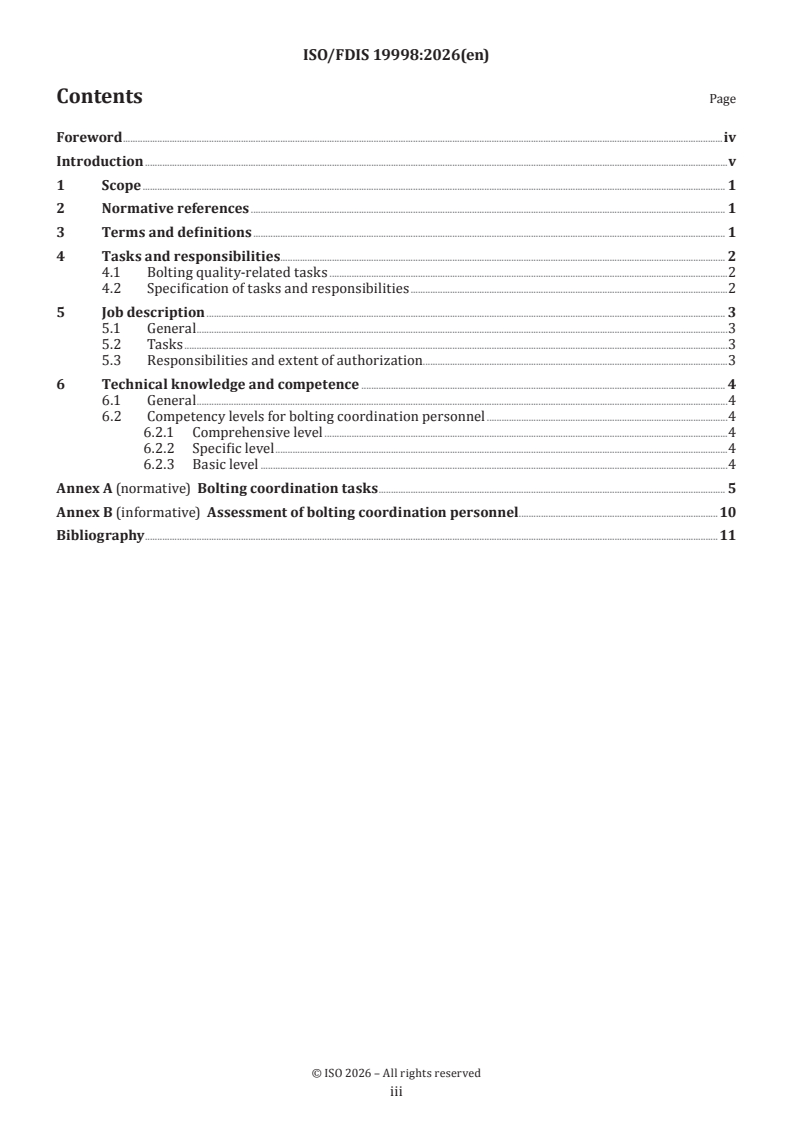
Contents Page
Foreword .iv
Introduction .v
1 Scope . 1
2 Normative references . 1
3 Terms and definitions . 1
4 Tasks and responsibilities. 2
4.1 Bolting quality-related tasks .2
4.2 Specification of tasks and responsibilities .2
5 Job description . 3
5.1 General .3
5.2 Tasks .3
5.3 Responsibilities and extent of authorization.3
6 Technical knowledge and competence . 4
6.1 General .4
6.2 Competency levels for bolting coordination personnel .4
6.2.1 Comprehensive level .4
6.2.2 Specific level .4
6.2.3 Basic level .4
Annex A (normative) Bolting coordination tasks . 5
Annex B (informative) Assessment of bolting coordination personnel .10
Bibliography .11
iii
ISO/FDIS 19998:2026(en)
Foreword
ISO (the International Organization for Standardization) is a worldwide federation of national standards
bodies (ISO member bodies). The work of preparing International Standards is normally carried out through
ISO technical committees. Each member body interested in a subject for which a technical committee
has been established has the right to be represented on that committee. International organizations,
governmental and non-governmental, in liaison with ISO, also take part in the work. ISO collaborates closely
with the International Electrotechnical Commission (IEC) on all matters of electrotechnical standardization.
The procedures used to develop this document and those intended for its further maintenance are described
in the ISO/IEC Directives, Part 1. In particular, the different approval criteria needed for the different types
of ISO document should be noted. This document was drafted in accordance with the editorial rules of the
ISO/IEC Directives, Part 2 (see www.iso.org/directives).
ISO draws attention to the possibility that the implementation of this document may involve the use of (a)
patent(s). ISO takes no position concerning the evidence, validity or applicability of any claimed patent
rights in respect thereof. As of the date of publication of this document, ISO had not received notice of (a)
patent(s) which may be required to implement this document. However, implementers are cautioned that
this may not represent the latest information, which may be obtained from the patent database available at
www.iso.org/patents. ISO shall not be held responsible for identifying any or all such patent rights.
Any trade name used in this document is information given for the convenience of users and does not
constitute an endorsement.
For an explanation of the voluntary nature of standards, the meaning of ISO specific terms and expressions
related to conformity assessment, as well as information about ISO's adherence to the World Trade
Organization (WTO) principles in the Technical Barriers to Trade (TBT), see www.iso.org/iso/foreword.html.
This document was prepared by Technical Committee ISO/TC 167, Steel and aluminium structures.
Any feedback or questions on this document should be directed to the user’s national standards body. A
complete listing of these bodies can be found at www.iso.org/members.html.
iv
ISO/FDIS 19998:2026(en)
Introduction
When structural bolting is performed, it is important for it to be coordinated properly to establish confidence
in the bolting quality and ensure reliable performance in service.
A clear definition of the tasks and responsibilities of bolting coordination personnel involved in bolting-
related activities (e.g. planning, executing, supervising and inspecting) is essential for proper coordination.
Specific requirements for bolting coordination personnel are sometimes included in regulatory documents,
application standards, and contracts.
v
FINAL DRAFT International Standard ISO/FDIS 19998:2026(en)
Structural bolting coordination — Tasks and responsibilities
1 Scope
This document specifies provisions for structural bolting coordination, including tasks and responsibilities.
2 Normative references
The following documents are referred to in the text in such a way that some or all of their content constitutes
requirements of this document. For dated references, only the edition cited applies. For undated references,
the latest edition of the referenced document (including any amendments) applies.
ISO 17607 (all parts), Steel structures — Execution of structural steelwork
3 Terms and definitions
For this document, the following terms and definitions apply.
ISO and IEC maintain terminology databases for use in standardization at the following addresses:
— ISO Online browsing platform: available at https:// www .iso .org/ obp
— IEC Electropedia: available at https:// www .electropedia .org/
3.1
contractor
entity carrying out bolting and related activities under the same technical and quality management
Note 1 to entry: Bolting and related activities can be carried out in a workshop or onsite or both, but the contractor
remains responsible for the bolting operations.
3.2
bolting coordination
coordination of operations for all bolting and bolting-related activities
Note 1 to entry: Bolting coordination can be assigned to an individual or a team.
3.3
bolting coordination personnel
person or group of people performing defined bolting coordination tasks
Note 1 to entry: Different personnel can be appointed by the contractor (3.1) for different bolting and related tasks.
Note 2 to entry: A qualification and/or practical experience can be required.
3.4
inspection
conformity evaluation of bolting variables by observation and judgment, accompanied as appropriate by
measurement or testing
Note 1 to entry: Bolting inspection is a part of bolting coordination.
ISO/FDIS 19998:2026(en)
3.5
skill
ability to apply knowledge and experience to complete tasks and solve problems
Note 1 to entry: Skills are described as cognitive (involving the use of logical, intuitive and creative thinking) or
practical (involving manual dexterity and the use of methods, materials, tools and instruments).
[SOURCE: ISO 14731:2019, 3.5]
3.6
knowledge
outcome of the assimilation of information, the body of facts, principles, theories and practices that is related
to a field of work, through learning (theoretical and/or factual)
[SOURCE: ISO 14731:2019, 3.6]
3.7
qualification
formal outcome of an assessment and validation process to determine that an individual has
achieved learning outcomes to a given program
[SOURCE: ISO 14731:2019, 3.7]
3.8
competence
proven ability to effectively use knowledge, skills and personal, social and/or methodological abilities, in a
wide variety of work situations in terms of responsibility and autonomy
[SOURCE: ISO 14731:2019, 3.8]
3.9
responsibility
accountability, duties, obligations and associated rights assigned by the contractor (3.1) as a result of
competence (3.8) in the job
[SOURCE: ISO 14731:2019, 3.9]
4 Tasks and responsibilities
4.1 Bolting quality-related tasks
Annex A shall be used by the contractor to assign bolting coordination tasks and responsibilities to bolting
coordination personnel. It may be supplemented for special applications. Not all the items are applicable to
all contractors or quality system requirements, and selection shall be made as appropriate.
EXAMPLE For example, where there is no post-installation testing specified, torque testing is not required.
4.2 Specification of tasks and responsibilities
Bolting coordination shall be the responsibility of the contractor.
The tasks of bolting coordination personnel shall be selected from Annex A and/or as specified, for example,
in application standards and other documents. The level of competence of bolting coordination personnel
shall be determined in accordance with the complexity of the bolting and related activities, product
type(s), criticality of the application, and the quality requirements described in or specified in ISO 17607-1,
ISO 17607-3, ISO 17607-4, ISO 17607-6, or other applicable standards.
Each task in Annex A can be associated with a number of activities, such as:
— specification and preparation;
ISO/FDIS 19998:2026(en)
— planning;
— production control;
— inspection, checking or witnessing.
The contractor shall appoint at least one person to be responsible for bolting coordination tasks.
Where more than one person carries out bolting coordination, the tasks and responsibilities shall be clearly
defined and assigned.
NOTE Clearly defining and assigning tasks and responsibilities ensures that competent persons are assigned to
each specific bolting coordination task.
If bolting coordination is subcontracted, the tasks and responsibilities shall be defined and documented.
However, compliance with this document shall remain the responsibility of the contractor.
EXAMPLE Examp
...
ISO/FDIS 19998:2025(en)
ISO/TC 167
Secretariat: SN
Date: 2026-04-2206-19
Structural bolting coordination ─ — Tasks and responsibilities
Coordination en boulonnage de construction métallique ─Tâches et responsabilités
FDIS stage
2 © ISO 2025 – All rights reserved
ISO/FDIS 19998:2026(en)
All rights reserved. Unless otherwise specified, or required in the context of its implementation, no part of this publication
may be reproduced or utilized otherwise in any form or by any means, electronic or mechanical, including photocopying,
or posting on the internet or an intranet, without prior written permission. Permission can be requested from either ISO
at the address below or ISO’s member body in the country of the requester.
ISO copyright office
CP 401 • Ch. de Blandonnet 8
CH-1214 Vernier, Geneva
Phone: + 41 22 749 01 11
EmailE-mail: copyright@iso.org
Website: www.iso.org
Published in Switzerland
iii
ISO/FDIS 19998:2026(en)
Contents
Foreword . v
Introduction . vi
1 Scope . 1
2 Normative references . 1
3 Terms and definitions . 1
4 Tasks and responsibilities . 2
4.1 Bolting quality-related tasks . 2
4.2 Specification of tasks and responsibilities . 3
5 Job description . 3
5.1 General. 3
5.2 Tasks . 3
5.3 Responsibilities and extent of authorization . 4
6 Technical knowledge and competence . 4
6.1 General. 4
6.2 Competency levels for bolting coordination personnel. 4
Annex A (normative) Bolting coordination tasks . 6
Annex B (informative) Assessment of bolting coordination personnel . 11
Bibliography . 12
iv
ISO/FDIS 19998:2026(en)
Foreword
ISO (the International Organization for Standardization) is a worldwide federation of national standards
bodies (ISO member bodies). The work of preparing International Standards is normally carried out through
ISO technical committees. Each member body interested in a subject for which a technical committee has been
established has the right to be represented on that committee. International organizations, governmental and
non-governmental, in liaison with ISO, also take part in the work. ISO collaborates closely with the
International Electrotechnical Commission (IEC) on all matters of electrotechnical standardization.
The procedures used to develop this document and those intended for its further maintenance are described
in the ISO/IEC Directives, Part 1. In particular, the different approval criteria needed for the different types of
ISO document should be noted. This document was drafted in accordance with the editorial rules of the
ISO/IEC Directives, Part 2 (see www.iso.org/directives).
ISO draws attention to the possibility that the implementation of this document may involve the use of (a)
patent(s). ISO takes no position concerning the evidence, validity or applicability of any claimed patent rights
in respect thereof. As of the date of publication of this document, ISO had not received notice of (a) patent(s)
which may be required to implement this document. However, implementers are cautioned that this may not
represent the latest information, which may be obtained from the patent database available at
www.iso.org/patents. ISO shall not be held responsible for identifying any or all such patent rights.
Any trade name used in this document is information given for the convenience of users and does not
constitute an endorsement.
For an explanation of the voluntary nature of standards, the meaning of ISO specific terms and expressions
related to conformity assessment, as well as information about ISO's adherence to the World Trade
Organization (WTO) principles in the Technical Barriers to Trade (TBT), see www.iso.org/iso/foreword.html.
This document was prepared by Technical Committee ISO/TC 167, Steel and aluminium structures.
Any feedback or questions on this document should be directed to the user’s national standards body. A
complete listing of these bodies can be found at www.iso.org/members.html.
v
ISO/FDIS 19998:2026(en)
Introduction
When structural bolting is performed, it is important for it to be coordinated properly to establish confidence
in the bolting quality and ensure reliable performance in service.
A clear definition of the tasks and responsibilities of bolting coordination personnel involved in bolting-related
activities (e.g. planning, executing, supervising and inspecting) is essential for proper coordination.
Specific requirements for bolting coordination personnel are sometimes included in regulatory documents,
application standards, and contracts.
vi
ISO/FDIS 19998:2026(en)
Structural bolting coordination ─ — Tasks and responsibilities
1 Scope
This document specifies provisions for structural bolting coordination, including tasks and responsibilities.
2 Normative references
The following documents are referred to in the text in such a way that some or all of their content constitutes
requirements of this document. For dated references, only the edition cited applies. For undated references,
the latest edition of the referenced document (including any amendments) applies.
ISO 17607-1:2023, (all parts), Steel structures — Execution of structural steelwork — Part 1: General
requirements and terms and definitions
ISO 17607-3:2023, Steel structures — Execution of structural steelwork — Part 3: Fabrication
ISO 17607-4:2023, Steel structures — Execution of structural steelwork — Part 4: Erection
ISO 17607-6:2023, Steel structures — Execution of structural steelwork — Part 6: Bolting
3 Terms and definitions
For this document, the following terms and definitions apply.
ISO and IEC maintain terminology databases for use in standardization at the following addresses:
— — ISO Online browsing platform: available at https://www.iso.org/obp
— — IEC Electropedia: available at https://www.electropedia.org/
3.1 3.1
contractor
entity carrying out bolting and related activities under the same technical and quality management
Note 1 to entry: Bolting and related activities can be carried out in a workshop or onsite or both, but the contractor
remains responsible for the bolting operations.
3.2 3.2
bolting coordination
coordination of operations for all bolting and bolting-related activities
Note 1 to entry: Bolting coordination can be assigned to an individual or a team.
3.3 3.3
bolting coordination personnel
person or group of people performing defined bolting coordination tasks
Note 1 to entry: Different personnel can be appointed by the contractor (3.1(3.1)) for different bolting and related tasks.
Note 2 to entry: A qualification and/or practical experience maycan be required.
ISO/FDIS 19998:2026(en)
3.4 3.4
inspection
conformity evaluation of bolting variables by observation and judgment, accompanied as appropriate by
measurement or testing
Note 1 to entry: Bolting inspection is a part of bolting coordination.
3.5 3.5
skill
ability to apply knowledge and experience to complete tasks and solve problems
Note 1 to entry: Skills are described as cognitive (involving the use of logical, intuitive and creative thinking) or practical
(involving manual dexterity and the use of methods, materials, tools and instruments).
[SOURCE: ISO 14731:2019, 3.5]
3.6 3.6
knowledge
outcome of the assimilation of information, the body of facts, principles, theories and practices that is related
to a field of work, through learning (theoretical and/or factual)
[SOURCE: ISO 14731:2019, 3.6]
3.7 3.7
qualification
formal outcome of an assessment and validation process to determine that an individual has
achieved learning outcomes to a given program
[SOURCE: ISO 14731:2019, 3.7]
3.8 3.8
competence
proven ability to effectively use knowledge, skills and personal, social and/or methodological abilities, in a
wide variety of work situations in terms of responsibility and autonomy
[SOURCE: ISO 14731:2019, 3.8]
3.9 3.9
responsibility
accountability, duties, obligations and associated rights assigned by the contractor (3.1(3.1)) as a result of
competence (3.8(3.8)) in the job
[SOURCE: ISO 14731:2019, 3.9]
4 Tasks and responsibilities
4.1 Bolting quality-related tasks
Annex AAnnex A shall be used by the contractor to assign bolting coordination tasks and responsibilities to
bolting coordination personnel. It may be supplemented for special applications. Not all the items are
applicable to all contractors or quality system requirements, and selection shall be made as appropriate.
EXAMPLE For example, where there is no post-installation testing specified, torque testing is not required.
ISO/FDIS 19998:2026(en)
4.2 Specification of tasks and responsibilities
Bolting coordination shall be the responsibility of the contractor.
The tasks of bolting coordination personnel shall be selected from Annex AAnnex A and/or as specified, for
example, in application standards and other documents. The level of competence of bolting coordination
personnel shall be determined in accordance with the complexity of the bolting and related activities, product
type(s), criticality of the application, and the quality requirements described in or specified in ISO 17607-1,
ISO 17607-3, ISO 17607-4, ISO 17607-6, or other applicable standards.
Each task in Annex AAnnex A can be associated with a number of activities, such as:
— — specification and preparation;
— — planning;
— — production control;
— — inspection, checking or witnessing.
The contractor shall appoint at least one person to be responsible for bolting coordination tasks.
Where more than one person carries out bolting coordination, the tasks and responsibilities shall be clearly
defined and assigned.
NOTE Clearly defining and assigning tasks and responsibilities ensures that competent persons are assigned to each
specific bolting coordination task.
If bolting coordination is subcontracted, the tasks and responsibilities shall be defined and documented.
However, compliance with this document shall remain the responsibility of the contractor.
EXAMPLE Examples of items to be addressed when bolting coordination is subcontracted:
a) a) a provision for the subcontracted bolting coordination personnel to visit the premises, routine or
otherwise;
b) b) reports of all visits, including purpose and activities carried out.
5 Job description
5.1 General
The contractor shall prepare job descriptions for all bolting coordination personnel. The job descriptions for
bolting coordination personnel shall include at least their tasks and responsibilities and their extent of
authorization, see 5.25.2 and 5.35.3.
The contractor shall determine the level of education, qualification, and experience (see Clause 6Clause 6))
required for bolting coordination personnel.
Each contractor is responsible for the appointment of their bolting coordination personnel. This appointment
is not transferable to other contractors. Appointment of tasks to other contractors does not relieve the primary
contractor of responsibility for that task.
5.2 Tasks
The tasks assigned to bolting coordination personnel shall be identified in accordance with 4.24.2.
ISO/FDIS 19998:2026(en)
5.3 Responsibilities and extent of authorization
The responsibilities and the extent of authorization assigned to bolting coordination pe
...