


ISO/FDIS 14505-3
(Main)Ergonomics of the thermal environment — Evaluation of the thermal environment in vehicles — Part 3: Evaluation of thermal comfort using human participants
General Information
- Abstract
ISO 14505-3:2006 gives guidelines and specifies a standard test method for the assessment, using human subjects, of thermal comfort in vehicles. It is not restricted to any particular vehicle but provides the general principles that allow assessment and evaluation. The method can be used to determine a measure of the performance of a vehicle for conditions of interest, in terms of whether it provides thermal comfort to people or not. This can be used in vehicle development and evaluation. ISO 14505-3:2006 is applicable to all types of vehicles, including cars, buses, trucks, off-road vehicles, trains, aircraft, ships, submarines, and to the cabins of cranes and similar spaces. It applies where people are enclosed in a vehicle and when they are exposed to outside conditions. For those exposed to outside conditions, such as riders of bicycles or motorcycles, drivers of open sports cars and operators of fork lift trucks without cabins, vehicle speed and weather conditions can dominate responses. The principles of assessment, however, will still apply. ISO 14505-3:2006 applies to both passengers and operators of vehicles where its application does not interfere with the safe operation of the vehicle.
- Status
- Not Published
- Technical Committee
- ISO/TC 159/SC 5 - Ergonomics of the physical environment
- Drafting Committee
- ISO/TC 159/SC 5 - Ergonomics of the physical environment
- Current Stage
- 5020 - FDIS ballot initiated: 2 months. Proof sent to secretariat
- Start Date
- 25-Jun-2026
- Completion Date
- 25-Jun-2026
Buy Documents

ISO/FDIS 14505-3 - Ergonomics of the thermal environment — Evaluation of the thermal environment in vehicles — Part 3: Evaluation of thermal comfort using human participants

REDLINE ISO/FDIS 14505-3 - Ergonomics of the thermal environment — Evaluation of the thermal environment in vehicles — Part 3: Evaluation of thermal comfort using human participants

ISO/FDIS 14505-3 - Ergonomie des ambiances thermiques — Évaluation des ambiances thermiques dans les véhicules — Partie 3: Évaluation du confort thermique en ayant recours à des participants humains
Overview
ISO/FDIS 14505-3: Ergonomics of the Thermal Environment - Evaluation of the Thermal Environment in Vehicles - Part 3: Evaluation of Thermal Comfort Using Human Participants, developed by the International Organization for Standardization (ISO), establishes standard guidelines and protocols for assessing thermal comfort in vehicle environments using human subjects. This international standard is applicable to a wide range of vehicles-including cars, trucks, buses, trains, aircraft, ships, submarines, and even operator cabins of cranes-and offers a robust method to evaluate if these environments are thermally comfortable for both passengers and operators.
The primary goal is to provide universal principles and a repeatable test method for vehicle thermal comfort assessment, supporting vehicle development and validation under various operational and environmental conditions. ISO/FDIS 14505-3 can be used for enclosed vehicle environments as well as open vehicles, considering factors like vehicle speed and outdoor weather.
Key Topics
- Human-Centered Assessment: The standard emphasizes using human participants to determine thermal comfort, as models and physical indices alone often fail to capture the complexity of real vehicle environments.
- Assessment Methods: Three main approaches are outlined:
- Subjective methods – Utilize participant perception via questionnaires, focusing on feelings of temperature, comfort, stickiness, wetness, and preference.
- Objective methods – Involve physical or physiological measurements like skin temperature to complement subjective feedback.
- Behavioural methods – Observe changes in posture, activity, or seat selection as indirect indicators of comfort or discomfort.
- Trial Design: Offers guidance on defining trial objectives, selecting participants representative of the target population, measurement intervals, and balancing experimental design considerations.
- Test Methodology: Describes step-by-step testing over meaningful timeframes-typically no less than 30 minutes-with regular participant feedback collection.
- Data Analysis and Criteria: Provides protocols for analyzing subjective ratings, using medians, ranges, and clear pass/fail criteria, to ensure reliable and actionable results.
Applications
Implementing ISO/FDIS 14505-3 offers several practical advantages and supports various industries:
- Vehicle Development and Testing: Automotive, rail, marine, and aerospace manufacturers can use the standard to validate heating, ventilation, and air-conditioning (HVAC) systems and materials (e.g., glazing and seating) for occupant thermal comfort.
- Regulatory Compliance: Enables demonstration of compliance with global and regional guidelines regarding ergonomics and passenger/operator welfare.
- Comparative Product Evaluation: Companies can confidently benchmark new products and design changes for thermal comfort performance under consistent, repeatable conditions.
- Research and Academic Use: Provides a robust, scientifically grounded framework suitable for academic studies, field testing, and user experience research in transportation environments.
- Operator and Passenger Safety & Well-Being: By ensuring effective thermal comfort, organizations contribute to improved safety, health, satisfaction, and performance of vehicle operators and passengers.
ISO/FDIS 14505-3 is also relevant to scenarios where occupants are exposed to external conditions, such as motorcyclists or operators of open vehicles, helping manufacturers understand and manage the unique influence of weather, speed, and other variables.
Related Standards
For a comprehensive evaluation of ergonomics and thermal comfort, ISO/FDIS 14505-3 should be used alongside related international standards:
- ISO 14505-1: Principles and general procedures for evaluating the thermal environment in vehicles.
- ISO 14505-2: Determination of equivalent temperature in vehicle cabins.
- ISO 10551: Subjective judgement scales for assessing physical environments-provides foundation for creating thermal comfort questionnaires.
- ISO 9886: Evaluation of thermal strain by physiological measurements-supports objective testing methods.
- ISO 12894: Medical supervision for individuals exposed to extreme hot or cold environments.
- ISO 13731: Provides vocabulary and symbols relevant to thermal environment ergonomics.
Aligning measurement, assessment, and analysis with these standards ensures consistent, reliable, and globally recognized evaluations of thermal comfort in the transportation sector.
Keywords: ISO 14505-3, vehicle thermal comfort, ergonomics, human participants, HVAC evaluation, subjective thermal comfort assessment, objective measurement, behavioral methods, vehicle environment testing, international standards, thermal comfort questionnaire, vehicle development, operator safety, passenger well-being.
Relations
- Effective Date
- 12-Feb-2026
- Effective Date
- 13-May-2023
- Effective Date
- 29-Apr-2023
Buy Documents
ISO/FDIS 14505-3 - Ergonomics of the thermal environment — Evaluation of the thermal environment in vehicles — Part 3: Evaluation of thermal comfort using human participants
REDLINE ISO/FDIS 14505-3 - Ergonomics of the thermal environment — Evaluation of the thermal environment in vehicles — Part 3: Evaluation of thermal comfort using human participants
ISO/FDIS 14505-3 - Ergonomie des ambiances thermiques — Évaluation des ambiances thermiques dans les véhicules — Partie 3: Évaluation du confort thermique en ayant recours à des participants humains
Get Certified
Connect with accredited certification bodies for this standard

TÜV Rheinland
TÜV Rheinland is a leading international provider of technical services.

TÜV SÜD
TÜV SÜD is a trusted partner of choice for safety, security and sustainability solutions.

BSI Group
BSI (British Standards Institution) is the business standards company that helps organizations make excellence a habit.
Sponsored listings
Frequently Asked Questions
ISO/FDIS 14505-3 is a draft published by the International Organization for Standardization (ISO). Its full title is "Ergonomics of the thermal environment — Evaluation of the thermal environment in vehicles — Part 3: Evaluation of thermal comfort using human participants". This standard covers: ISO 14505-3:2006 gives guidelines and specifies a standard test method for the assessment, using human subjects, of thermal comfort in vehicles. It is not restricted to any particular vehicle but provides the general principles that allow assessment and evaluation. The method can be used to determine a measure of the performance of a vehicle for conditions of interest, in terms of whether it provides thermal comfort to people or not. This can be used in vehicle development and evaluation. ISO 14505-3:2006 is applicable to all types of vehicles, including cars, buses, trucks, off-road vehicles, trains, aircraft, ships, submarines, and to the cabins of cranes and similar spaces. It applies where people are enclosed in a vehicle and when they are exposed to outside conditions. For those exposed to outside conditions, such as riders of bicycles or motorcycles, drivers of open sports cars and operators of fork lift trucks without cabins, vehicle speed and weather conditions can dominate responses. The principles of assessment, however, will still apply. ISO 14505-3:2006 applies to both passengers and operators of vehicles where its application does not interfere with the safe operation of the vehicle.
ISO 14505-3:2006 gives guidelines and specifies a standard test method for the assessment, using human subjects, of thermal comfort in vehicles. It is not restricted to any particular vehicle but provides the general principles that allow assessment and evaluation. The method can be used to determine a measure of the performance of a vehicle for conditions of interest, in terms of whether it provides thermal comfort to people or not. This can be used in vehicle development and evaluation. ISO 14505-3:2006 is applicable to all types of vehicles, including cars, buses, trucks, off-road vehicles, trains, aircraft, ships, submarines, and to the cabins of cranes and similar spaces. It applies where people are enclosed in a vehicle and when they are exposed to outside conditions. For those exposed to outside conditions, such as riders of bicycles or motorcycles, drivers of open sports cars and operators of fork lift trucks without cabins, vehicle speed and weather conditions can dominate responses. The principles of assessment, however, will still apply. ISO 14505-3:2006 applies to both passengers and operators of vehicles where its application does not interfere with the safe operation of the vehicle.
ISO/FDIS 14505-3 is classified under the following ICS (International Classification for Standards) categories: 13.180 - Ergonomics; 43.020 - Road vehicles in general. The ICS classification helps identify the subject area and facilitates finding related standards.
ISO/FDIS 14505-3 has the following relationships with other standards: It is inter standard links to FprEN ISO 14505-3, ISO 24183:2024, ISO 14505-3:2006. Understanding these relationships helps ensure you are using the most current and applicable version of the standard.
ISO/FDIS 14505-3 is available in PDF format for immediate download after purchase. The document can be added to your cart and obtained through the secure checkout process. Digital delivery ensures instant access to the complete standard document.
Standards Content (Sample)
FINAL DRAFT
International
Standard
ISO/TC 159/SC 5
Ergonomics of the thermal
Secretariat: BSI
environment — Evaluation of the
Voting begins on:
thermal environment in vehicles —
2026-06-25
Part 3:
Voting terminates on:
2026-08-20
Evaluation of thermal comfort using
human participants
Ergonomie des ambiances thermiques — Évaluation des
ambiances thermiques dans les véhicules —
Partie 3: Évaluation du confort thermique en ayant recours à des
sujets humains
RECIPIENTS OF THIS DRAFT ARE INVITED TO SUBMIT,
WITH THEIR COMMENTS, NOTIFICATION OF ANY
RELEVANT PATENT RIGHTS OF WHICH THEY ARE AWARE
AND TO PROVIDE SUPPOR TING DOCUMENTATION.
IN ADDITION TO THEIR EVALUATION AS
BEING ACCEPTABLE FOR INDUSTRIAL, TECHNO-
ISO/CEN PARALLEL PROCESSING LOGICAL, COMMERCIAL AND USER PURPOSES, DRAFT
INTERNATIONAL STANDARDS MAY ON OCCASION HAVE
TO BE CONSIDERED IN THE LIGHT OF THEIR POTENTIAL
TO BECOME STAN DARDS TO WHICH REFERENCE MAY BE
MADE IN NATIONAL REGULATIONS.
Reference number
FINAL DRAFT
International
Standard
ISO/TC 159/SC 5
Ergonomics of the thermal
Secretariat: BSI
environment — Evaluation of the
Voting begins on:
thermal environment in vehicles —
Part 3:
Voting terminates on:
Evaluation of thermal comfort using
human participants
Ergonomie des ambiances thermiques — Évaluation des
ambiances thermiques dans les véhicules —
Partie 3: Évaluation du confort thermique en ayant recours à des
sujets humains
RECIPIENTS OF THIS DRAFT ARE INVITED TO SUBMIT,
WITH THEIR COMMENTS, NOTIFICATION OF ANY
RELEVANT PATENT RIGHTS OF WHICH THEY ARE AWARE
AND TO PROVIDE SUPPOR TING DOCUMENTATION.
© ISO 2026
IN ADDITION TO THEIR EVALUATION AS
All rights reserved. Unless otherwise specified, or required in the context of its implementation, no part of this publication may
BEING ACCEPTABLE FOR INDUSTRIAL, TECHNO-
ISO/CEN PARALLEL PROCESSING
LOGICAL, COMMERCIAL AND USER PURPOSES, DRAFT
be reproduced or utilized otherwise in any form or by any means, electronic or mechanical, including photocopying, or posting on
INTERNATIONAL STANDARDS MAY ON OCCASION HAVE
the internet or an intranet, without prior written permission. Permission can be requested from either ISO at the address below
TO BE CONSIDERED IN THE LIGHT OF THEIR POTENTIAL
or ISO’s member body in the country of the requester.
TO BECOME STAN DARDS TO WHICH REFERENCE MAY BE
MADE IN NATIONAL REGULATIONS.
ISO copyright office
CP 401 • Ch. de Blandonnet 8
CH-1214 Vernier, Geneva
Phone: +41 22 749 01 11
Email: copyright@iso.org
Website: www.iso.org
Published in Switzerland Reference number
ii
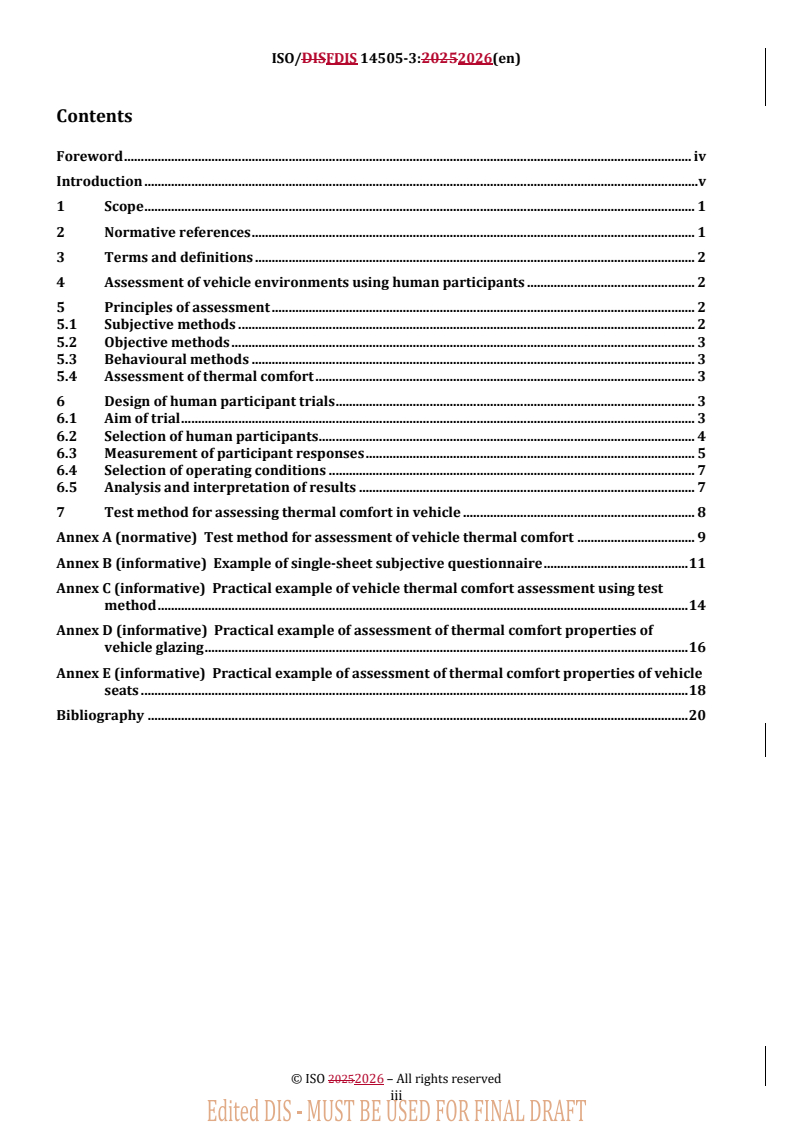
Contents Page
Foreword .iv
Introduction .v
1 Scope . 1
2 Normative references . 1
3 Terms and definitions . 1
4 Assessment of vehicle environments using human participants . 2
5 Principles of assessment . 2
5.1 Subjective methods .2
5.2 Objective methods .2
5.3 Behavioural methods . .3
5.4 Assessment of thermal comfort .3
6 Design of human participant trials . 3
6.1 Aim of trial .3
6.2 Selection of human participants .3
6.3 Measurement of participant responses .4
6.3.1 General .4
6.3.2 Subjective scales .4
6.4 Selection of operating conditions .6
6.5 Analysis and interpretation of results .6
7 Test method for assessing thermal comfort in vehicle . 7
Annex A (normative) Test method for assessment of vehicle thermal comfort . 8
Annex B (informative) Example of single-sheet subjective questionnaire .10
Annex C (informative) Practical example of vehicle thermal comfort assessment using test
method .12
Annex D (informative) Practical example of assessment of thermal comfort properties of
vehicle glazing . 14
Annex E (informative) Practical example of assessment of thermal comfort properties of
vehicle seats . 16
Bibliography .18
iii
Foreword
ISO (the International Organization for Standardization) is a worldwide federation of national standards
bodies (ISO member bodies). The work of preparing International Standards is normally carried out through
ISO technical committees. Each member body interested in a subject for which a technical committee
has been established has the right to be represented on that committee. International organizations,
governmental and non-governmental, in liaison with ISO, also take part in the work. ISO collaborates closely
with the International Electrotechnical Commission (IEC) on all matters of electrotechnical standardization.
The procedures used to develop this document and those intended for its further maintenance are described
in the ISO/IEC Directives, Part 1. In particular, the different approval criteria needed for the different types
of ISO document should be noted. This document was drafted in accordance with the editorial rules of the
ISO/IEC Directives, Part 2 (see www.iso.org/directives).
ISO draws attention to the possibility that the implementation of this document may involve the use of (a)
patent(s). ISO takes no position concerning the evidence, validity or applicability of any claimed patent
rights in respect thereof. As of the date of publication of this document, ISO had not received notice of (a)
patent(s) which may be required to implement this document. However, implementers are cautioned that
this may not represent the latest information, which may be obtained from the patent database available at
www.iso.org/patents. ISO shall not be held responsible for identifying any or all such patent rights.
Any trade name used in this document is information given for the convenience of users and does not
constitute an endorsement.
For an explanation of the voluntary nature of standards, the meaning of ISO specific terms and expressions
related to conformity assessment, as well as information about ISO's adherence to the World Trade
Organization (WTO) principles in the Technical Barriers to Trade (TBT), see www.iso.org/iso/foreword.html.
This document was prepared by Technical Committee ISO/TC 159, Ergonomics, Subcommittee SC 5,
Ergonomics of the physical environment, in collaboration with the European Committee for Standardization
(CEN) Technical Committee CEN/TC 122, Ergonomics, in accordance with the Agreement on technical
cooperation between ISO and CEN (Vienna Agreement).
This second edition cancels and replaces the first edition (ISO 14505-3:2006), which has been technically
revised.
The main changes are as follows:
— revision of references.
A list of all parts in the ISO 14505 series can be found on the ISO website.
Any feedback or questions on this document should be directed to the user’s national standards body. A
complete listing of these bodies can be found at www.iso.org/members.html.
iv
Introduction
Direct methods for the assessment of thermal environments (hot, moderate, cold) in vehicles involve
measurements of the responses of human participants. There are three types:
— subjective methods;
— objective methods;
— behavioural methods.
Subjective methods quantify the responses of people to an environment using subjective scales. Objective
methods are those which quantify the physical, physiological or mental condition of a person by the use of
instrumentation or measures of an output such as performance measures. Behavioural methods quantify or
represent human behaviour in response to an environment.
Each of these methods has been developed according to basic principles and the most appropriate form of
the method and combination of methods used in concert for the assessment of thermal environments in
vehicles will depend upon the context and vehicle environment of interest. This document provides both
principles and application of methods for the assessment of thermal comfort in vehicle environments
using human participants. The most appropriate methods for evaluating thermal comfort in vehicles are
subjective. The principles for the construction of subjective assessment scales are given in ISO 10551 and
are used in the development of the test method specified in this document. Physiological measurements on
human participants are described in ISO 9886 and are beyond the scope of this document.
This document complements standards concerned with the ergonomics of thermal environments and can be
used together with thermal indices that are valid for use in vehicle environments.
This document is a basic ergonomics standard which can contribute to the development of standards
concerned with specific vehicles and products.
v
FINAL DRAFT International Standard ISO/FDIS 14505-3:2026(en)
Ergonomics of the thermal environment — Evaluation of the
thermal environment in vehicles —
Part 3:
Evaluation of thermal comfort using human participants
1 Scope
This document specifies and gives guidelines for a standard test method for the assessment, using human
participants, of thermal comfort in vehicles. It is not restricted to any particular vehicle but provides the
general principles that allow assessment and evaluation. The method can be used to determine a measure
of the performance of a vehicle for conditions of interest, in terms of whether it provides thermal comfort to
people or not. This can be used in vehicle development and evaluation.
This document is applicable to all types of vehicles, including cars, buses, trucks, off-road vehicles,
trains, aircraft, ships, submarines, and to the cabins of cranes and similar spaces. It applies where people
are enclosed in a vehicle and when they are exposed to outside conditions. For those exposed to outside
conditions, such as riders of bicycles or motorcycles, drivers of open sports cars and operators of fork lift
trucks without cabins, vehicle speed and weather conditions can dominate responses. The principles of
assessment, however, still apply.
This document applies to both passengers and operators of vehicles where its application does not interfere
with the safe operation of the vehicle.
It describes the principles of the assessment and evaluation of thermal comfort, including the use of test
methods and trials. It also describes subjective methods that can be used in assessment.
2 Normative references
The following documents are referred to in the text in such a way that some or all of their content constitutes
requirements of this document. For dated references, only the edition cited applies. For undated references,
the latest edition of the referenced document (including any amendments) applies.
ISO 12894:2001, Ergonomics of the thermal environment — Medical supervision of individuals exposed to
extreme hot or cold environments
ISO 13731, Ergonomics of the thermal environment — Vocabulary and symbols
3 Terms and definitions
For the purposes of this document, the terms and definitions given in ISO 13731 and the following apply.
ISO and IEC maintain terminology databases for use in standardization at the following addresses:
— ISO Online browsing platform: available at https:// www .iso .org/ obp
— IEC Electropedia: available at https:// www .electropedia .org/
3.1
HVAC-system
heating, ventilation and air-conditioning system
system providing heating, ventilation and air-conditioning to the vehicle or cabin
4 Assessment of vehicle environments using human participants
Although mathematical and physical models and thermal indices can provide repeatable, reliable methods of
assessment, vehicle environments are often complex, dynamic and influenced by many factors. Models and
indices are therefore often limited in validity. Human participants are required to provide a direct means
of measuring thermal comfort and to validate other techniques. Therefore, assessment methods must be
developed involving human participants. Such methods shall only be used where ethical considerations and
accepted practices involving human participants, in accordance with ISO 12894, have been carried out. They
are used for one of four main reasons:
a) to evaluate thermal comfort in vehicle environments;
b) to set up or carry out standardized test methods of thermal comfort in vehicles;
c) to compare measures of thermal comfort in vehicles with prediction methods (models, indices) based
upon measures of the thermal environment in vehicles;
d) to determine the relationship between objective measures, such as skin temperatures, and subjective
measures of thermal comfort.
5 Principles of assessment
5.1 Subjective methods
Subjective methods quantify the response of people to an environment using subjective scales. Such scales
are based upon psychological continua (or constructs) that are relevant to the psychological phenomenon
of interest. The properties of the scales must be known in order to correctly interpret the results. Scales
of thermal sensation (hot or cold), preference, comfort, and stickiness are often used in thermal comfort
assessment. Advantages of subjective methods are that they are simple to administer and are directly related
to the psychological phenomenon. Disadvantages are that they can interfere with what they are measuring,
some groups will possibly not be able to perform the subjective task (for example, babies, children, people
with disabilities) and there is no reason given as to why such a response is provided. ISO 10551 should be
used for guidance on the construction of subjective scales. Five types of scales are identified.
— Perceptual (How do you feel now? e.g. hot).
— Affective (How do you find it? e.g. comfortable).
— Preference (How would you prefer to be? e.g. cooler).
— Acceptance (acceptable/unacceptable).
— Tolerance (Is the environment tolerable?).
From these basic subjective dimensions, questionnaires of subjective scales can be developed. The subjective
assessment methods presented in this document are concerned with thermal comfort and therefore do not
consider “tolerance”.
5.2 Objective methods
Objective methods are those which quantify the physical or mental condition of a person by the use of
instrumentation or measures of an output such as performance measures. The principle of the method is
that the measure can be interpreted in terms of the human condition of interest (e.g. thermal comfort). An
example is the measurement of mean skin temperature of the body that varies with the thermoregulatory
response to heat and cold (providing a rationale for the method) and that has been shown in research to
correlate with subjective responses of comfort. Another example would be skin wetness. Disadvantages of
objective methods can be that they can interfere with what they are attempting to measure, the correlation
between the measure and thermal comfort is not perfect and that thermal comfort is a psychological
phenomenon, a condition of mind. An advantage of objective measures is that they are often independent of,
and can be used to complement, the results of other methods such as subjective measures. ISO 9886 should
be used to provide methods for measurement and interpretation of physiological strain in terms of body
core temperature, mean skin temperature, heart rate and body mass loss. Other measures, such as heart
rate variability, can also be relevant.
5.3 Behavioural methods
Behavioural methods quantify or represent human behaviour in response to an environment. The particular
aspect of human behaviour observed is related to the human condition of interest (for example, thermal
comfort in vehicles) and a method of interpretation is required. Examples would include changes in posture,
movement patterns (for example, away from uncomfortable environments), and popularity of sitting
positions (for example, if some seats were in a cold draught they would be occupied “last”). Advantages
of behavioural methods include minimum interference with what is being measured and a direct “active”
measure of discomfort. Disadvantages include the difficulty in establishing validity and reliability of the
method and direct interpretation of the results in terms of thermal comfort. For example, a change in
posture can be due to chair discomfort or other “non-thermal” reasons.
5.4 Assessment of thermal comfort
Thermal comfort assessment is most effectively carried out using subjective methods. This is because
comfort is a psychological phenomenon and a subjective rating provides a direct and quantifiable method.
The simple test method provided in this document therefore uses subjective methods. Both objective and
behavioural methods can be used to complement the test method provided, however, they would require
expert advice beyond the scope of this document.
6 Design of human participant trials
6.1 Aim of trial
The design of any vehicle test or trial using human participants depends upon the specific aims of that test
or trial. However, there are general principles and these are outlined in Clause 6.
A typical thermal comfort trial involves driving vehicles over a route and measuring operating conditions
and thermal responses of passengers. For specific investigations, simulators, environmental chambers or
wind tunnels are often used.
An optimum trial design will achieve its aim with efficient use of resources. To achieve this, it is important to
be clear about the specific aim or aims. For example, if the aim is to compare three types of vehicle seats for
thermal comfort then a repeated measures design, where all participants sit on all seats (in a balanced order)
in identical conditions, can provide the best comparison of the seats. Contrast this with the evaluation of a
thermal comfort index where a wide range of environmental conditions, including seats, can be optimum. If
both aims are to be met, then both types of requirement shall be met in the trial design. The aims of the trial
must therefore be specified.
6.2 Selection of human participants
A valid method of evaluating environments would be to use a panel of experts. This technique is used in
wine tasting, for example, where acknowledged experts give opinions concerning the quality of wines. This
technique depends upon identifying unbiased acknowledged experts. This is not possible in the area of
thermal comfort and the trial designs should specifically avoid bias.
It is usual to identify a “random” sample of human participants as representative of the population of interest.
This is a question of statistical sampling, and relevant factors such as age, gender, driving experience and
anthropometry can be identified and influence participant selection. The number of participants selected
will depend upon the aim and experimental design. A calculation can be made based upon the power of a
statistical test; i.e. the probability of accepting the alternative hypothesis (for example, vehicle A is more
comfortable than vehicle B, given that it is true. This is a rather academic approach and requires assumptions
to be made about the strength of effect expected which is rather circular, as this is an objective of the trial.
Of practical importance will be the allocation of participants to treatments. If there are three cars and
three types of glazing being compared (i.e. nine conditions) then nine participants would allow a 9 x 9 Latin
square design. That is where each participant is exposed to each condition in a different, balanced, order. A
repeated measures design is where all participan
...
ISO/DISFDIS 14505-3:2025(en)
ISO /TC 159/SC 5/WG 1
Secretariat: BSI
Date: 2025-08-132026-06-11
Ergonomics of the thermal environment — Evaluation of the thermal
environment in vehicles —
—
Part 3:
Evaluation of thermal comfort using human participants
Ergonomie des ambiances thermiques — Évaluation des ambiances thermiques dans les véhicules —
Partie 3: Évaluation du confort thermique en ayant recours à des sujets humains
FDIS stage
TTTTTThhhhhhiiiiiis drs drs drs drs drs draaaaaafffffftttttt i i i i i is s s s s s susususususubbbbbbmmmmmmiiiiiitttttttttttteeeeeed d d d d d ttttttoooooo aaaaaa ppppppaaaaaarrrrrraaaaaallellellellellellel l l l l l vvvvvvooooootttttteeeeee i i i i i innnnnn IIIIIISSSSSSOOOOOO,,,,,, CCCCCCEEEEEEN.N.N.N.N.N.
2026(en)
All rights reserved. Unless otherwise specified, or required in the context of its implementation, no part of this publication
may be reproduced or utilized otherwise in any form or by any means, electronic or mechanical, including photocopying,
or posting on the internet or an intranet, without prior written permission. Permission can be requested from either ISO
at the address below or ISO’s member body in the country of the requester.
ISO copyright office
CP 401 • Ch. de Blandonnet 8
CH-1214 Vernier, Geneva
Phone: + 41 22 749 01 11
EmailE-mail: copyright@iso.org
Website: www.iso.org
Published in Switzerland
© ISO #### 2026 – All rights reserved
ii
ISO/DISFDIS 14505-3:20252026(en)
Contents
Foreword . iv
Introduction . v
1 Scope . 1
2 Normative references . 1
3 Terms and definitions . 2
4 Assessment of vehicle environments using human participants . 2
5 Principles of assessment . 2
5.1 Subjective methods . 2
5.2 Objective methods . 3
5.3 Behavioural methods . 3
5.4 Assessment of thermal comfort . 3
6 Design of human participant trials . 3
6.1 Aim of trial . 3
6.2 Selection of human participants . 4
6.3 Measurement of participant responses . 5
6.4 Selection of operating conditions . 7
6.5 Analysis and interpretation of results . 7
7 Test method for assessing thermal comfort in vehicle . 8
Annex A (normative) Test method for assessment of vehicle thermal comfort . 9
Annex B (informative) Example of single-sheet subjective questionnaire . 11
Annex C (informative) Practical example of vehicle thermal comfort assessment using test
method . 14
Annex D (informative) Practical example of assessment of thermal comfort properties of
vehicle glazing . 16
Annex E (informative) Practical example of assessment of thermal comfort properties of vehicle
seats . 18
Bibliography . 20
iii
2026(en)
Foreword
ISO (the International Organization for Standardization) is a worldwide federation of national standards
bodies (ISO member bodies). The work of preparing International Standards is normally carried out through
ISO technical committees. Each member body interested in a subject for which a technical committee has been
established has the right to be represented on that committee. International organizations, governmental and
non-governmental, in liaison with ISO, also take part in the work. ISO collaborates closely with the
International Electrotechnical Commission (IEC) on all matters of electrotechnical standardization.
The procedures used to develop this document and those intended for its further maintenance are described
in the ISO/IEC Directives, Part 1. In particular, the different approval criteria needed for the different types of
ISO document should be noted. This document was drafted in accordance with the editorial rules of the
ISO/IEC Directives, Part 2 (see www.iso.org/directives).
ISO draws attention to the possibility that the implementation of this document may involve the use of (a)
patent(s). ISO takes no position concerning the evidence, validity or applicability of any claimed patent rights
in respect thereof. As of the date of publication of this document, ISO had not received notice of (a) patent(s)
which may be required to implement this document. However, implementers are cautioned that this may not
represent the latest information, which may be obtained from the patent database available at
www.iso.org/patents. ISO shall not be held responsible for identifying any or all such patent rights.
Any trade name used in this document is information given for the convenience of users and does not
constitute an endorsement.
For an explanation of the voluntary nature of standards, the meaning of ISO specific terms and expressions
related to conformity assessment, as well as information about ISO's adherence to the World Trade
Organization (WTO) principles in the Technical Barriers to Trade (TBT), see www.iso.org/iso/foreword.html.
This document was prepared by Technical Committee ISO/TC 159, Ergonomics, Subcommittee SC 5,
Ergonomics of the physical environment, in collaboration with the European Committee for Standardization
(CEN) Technical Committee CEN/TC 122, Ergonomics, in accordance with the Agreement on technical
cooperation between ISO and CEN (Vienna Agreement).
This second edition cancels and replaces the first edition (ISO 14505-3:2006), which has been technically
revised.
The main changes are as follows:
— — Updated Standardsrevision of references.
A list of all parts in the ISO 14505 series can be found on the ISO website.
Any feedback or questions on this document should be directed to the user’s national standards body. A
complete listing of these bodies can be found at www.iso.org/members.html.
© ISO #### 2026 – All rights reserved
iv
ISO/DISFDIS 14505-3:20252026(en)
Introduction
Direct methods for the assessment of thermal environments (hot, moderate, cold) in vehicles involve
measurements of the responses of human participants. There are three types:
— — subjective methods;
— — objective methods;
— —behavioural methods.
Subjective methods quantify the responses of people to an environment using subjective scales. Objective
methods are those which quantify the physical, physiological or mental condition of a person by the use of
instrumentation or measures of an output such as performance measures. Behavioural methods quantify or
represent human behaviour in response to an environment.
Each of these methods has been developed according to basic principles and the most appropriate form of the
method and combination of methods used in concert for the assessment of thermal environments in vehicles
will depend upon the context and vehicle environment of interest. This document provides both principles
and application of methods for the assessment of thermal comfort in vehicle environments using human
participants. The most appropriate methods for evaluating thermal comfort in vehicles are subjective. The
principles for the construction of subjective assessment scales are given in ISO 10551 and are used in the
development of the test method specified in this document. Physiological measurements on human
participants are described in ISO 9886 and are beyond the scope of this part of ISO 14505document.
This part of ISO 14505document complements standards concerned with the ergonomics of thermal
environments and can be used together with thermal indices that are valid for use in vehicle environments.
This document is a basic ergonomics standard which can contribute to the development of standards
concerned with specific vehicles and products.
v
DRAFT International Standard ISO/DIS 14505-3:2025(en)
Ergonomics of the thermal environment — Evaluation of the thermal
environmentsenvironment in vehicles — —
Part 3:
Evaluation of thermal comfort using human participants
1 Scope
This part of ISO 14505document specifies and gives guidelines for a standard test method for the assessment,
using human participants, of thermal comfort in vehicles. It is not restricted to any particular vehicle but
provides the general principles that allow assessment and evaluation. The method can be used to determine
a measure of the performance of a vehicle for conditions of interest, in terms of whether it provides thermal
comfort to people or not. This can be used in vehicle development and evaluation.
This part of ISO 14505document is applicable to all types of vehicles, including cars, buses, trucks, off-road
vehicles, trains, aircraft, ships, submarines, and to the cabins of cranes and similar spaces. It applies where
people are enclosed in a vehicle and when they are exposed to outside conditions. For those exposed to outside
conditions, such as riders of bicycles or motorcycles, drivers of open sports cars and operators of fork lift
trucks without cabins, vehicle speed and weather conditions can dominate responses. The principles of
assessment, however, will still apply.
This part of ISO 14505document applies to both passengers and operators of vehicles where its application
does not interfere with the safe operation of the vehicle.
It presentsdescribes the principles of the assessment and evaluation of thermal comfort, including the use of
test methods and trials. It also presentsdescribes subjective methods that can be used in assessment.
This part of ISO 14505 is a basic ergonomics standard which can contribute to the development of standards
concerned with specific vehicles and products.
2 Normative references
The following documents are referred to in the text in such a way that some or all of their content constitutes
requirements of this document. For dated references, only the edition cited applies. For undated references,
the latest edition of the referenced document (including any amendments) applies.
ISO 9886:2004, Ergonomics — Evaluation of thermal strain by physiological measurements
ISO 10551:2019, Ergonomics of the physical environment — Subjective judgement scales for assessing physical
environments
ISO ISO 12894:2001, Ergonomics of the thermal environment — Medical supervision of individuals exposed to
extreme hot or cold environments
ISO 13731, Ergonomics of the thermal environment — Vocabulary and symbols
2026(en)
3 Terms and definitions
For the purposes of this document, the terms and definitions given in ISO 13731 and the following apply.
ISO and IEC maintain terminology databases for use in standardization at the following addresses:
— — ISO Online browsing platform: available at https://www.iso.org/obp
— — IEC Electropedia: available at https://www.electropedia.org/
3.1 3.1
HVAC-system
heating, ventilation and air-conditioning system of
system providing heating, ventilation and air-conditioning to the vehicle/ or cabin
4 Assessment of vehicle environments using human participants
Although mathematical and physical models and thermal indices can provide repeatable, reliable methods of
assessment, vehicle environments are often complex, dynamic and influenced by many factors. Models and
indices are therefore often limited in validity. Human participants are required to provide a direct means of
measuring thermal comfort and to validate other techniques. It is important, Therefore, there is a need to
develop assessment methods must be developed involving human participants. Such methods shall only be
used where ethical considerations and accepted practices involving human participants, as specified in
accordance with ISO 12894, have been carried out. They are used for one of four main reasons:
a) a) to evaluate thermal comfort in vehicle environments;
b) b) to set up or carry out standardized test methods of thermal comfort in vehicles;
c) c) to compare measures of thermal comfort in vehicles with prediction methods (models, indices)
based upon measures of the thermal environment in vehicles;
d) d) to determine the relationship between objective measures, such as skin temperatures, and
subjective measures of thermal comfort.
5 Principles of assessment
5.1 Subjective methods
Subjective methods quantify the response of people to an environment using subjective scales. Such scales are
based upon psychological continua (or constructs) that are relevant to the psychological phenomenon of
interest. The properties of the scales must be known in order to correctly interpret the results. Scales of
thermal sensation (hot or cold), preference, comfort, and stickiness are often used in thermal comfort
assessment. Advantages of subjective methods are that they are simple to administer and are directly related
to the psychological phenomenon. Disadvantages are that they can interfere with what they are measuring,
some groups will possibly not be able to perform the subjective task (for example, babies, children, people
with disabilities) and there is no reason given as to why such a response is provided. ISO 10551 should be
used for guidance on the construction of subjective scales. Five types of scales are identified.
— — Perceptual (How do you feel now? e.g. hot).
ISO/DISFDIS 14505-3:20252026(en)
— — Affective (How do you find it? e.g. comfortable).
— — Preference (How would you prefer to be? e.g. cooler).
— — Acceptance (acceptable/unacceptable).
— — Tolerance (Is the environment tolerable?).
From these basic subjective dimensions, questionnaires of subjective scales can be developed. The subjective
assessment methods presented in this document are concerned with thermal comfort and therefore do not
consider “tolerance”.
5.2 Objective methods
Objective methods are those which quantify the physical or mental condition of a person by the use of
instrumentation or measures of an output such as performance measures. The principle of the method is that
the measure can be interpreted in terms of the human condition of interest (e.g. thermal comfort). An example
is the measurement of mean skin temperature of the body that varies with the thermoregulatory response to
heat and cold (providing a rationale for the method) and that has been shown in research to correlate with
subjective responses of comfort. Another example would be skin wetness. Disadvantages of objective methods
can be that they mightcan interfere with what they are attempting to measure, the correlation between the
measure and thermal comfort is not perfect and that thermal comfort is a psychological phenomenon, a
condition of mind. An advantage of objective measures is that they are often independent of, and can be used
to complement, the results of other methods such as subjective measures. ISO 9886 should be used to provide
methods for measurement and interpretation of physiological strain in terms of body core temperature, mean
skin temperature, heart rate and body mass loss. Other measures, such as heart rate variability, can also be
relevant.
5.3 Behavioural methods
Behavioural methods quantify or represent human behaviour in response to an environment. The particular
aspect of human behaviour observed is related to the human condition of interest (for example, thermal
comfort in vehicles) and a method of interpretation is required. Examples would include changes in posture,
movement patterns (for example, away from uncomfortable environments), and popularity of sitting positions
(for example, if some seats were in a cold draught they would be occupied “last”). Advantages of behavioural
methods include minimum interference with what is being measured and a direct “active” measure of
discomfort. Disadvantages include the difficulty in establishing validity and reliability of the method and direct
interpretation of the results in terms of thermal comfort. For example, a change in posture couldcan be due to
chair discomfort or other “non-thermal” reasons.
5.4 Assessment of thermal comfort
Thermal comfort assessment is most effectively carried out using subjective methods. This is because comfort
is a psychological phenomenon and a subjective rating provides a direct and quantifiable method. The simple
test method provided in this part of ISO 14505document therefore uses subjective methods. Both objective
and behavioural methods can be used to complement the test method provided, however, they would require
expert advice beyond the scope of this part of ISO 14505document.
6 Design of human participant trials
6.1 Aim of trial
The design of any vehicle test or trial using human participants depends upon the specific aims of that test or
trial. However, there are general principles and these are outlined in Clause 6Clause 6.
2026(en)
A typical thermal comfort trial involves driving vehicles over a route and measuring operating conditions and
thermal responses of passengers. For specific investigations, simulators, environmental chambers or wind
tunnels are often used.
An optimum trial design will achieve its aim with efficient use of resources. To achieve this, it is important to
be clear about the specific aim or aims. For example, if the aim is to compare three types of vehicle seats for
thermal comfort then a repeated measures design, where all participants sit on all seats (in a balanced order)
in identical conditions, can provide the best comparison of the seats. Contrast this with the evaluation of a
thermal comfort index where a wide range of environmental conditions, including seats, can be optimum. If
both aims needare to be met, then it is essential that both types of requirement areshall be met in the trial
design. It is necessary, The aims of the trial must therefore be specified.
6.2 Selection of human participants
A valid method of evaluating environments would be to use a panel of experts. This technique is used in wine
tasting, for example, where acknowledged experts give opinions concerning the quality of wines. This
technique depends upon identifying unbiased acknowledged experts. This is not possible in the area of
thermal comfort and the trial designs should specifically avoid bias.
It is usual to identify a “random” sample of human participants as representative of the population of interest.
This is a question of statistical sampling, and relevant factors such as age, gender, driving experience and
anthropometry couldcan be identified and influence participant selection. The number of participants selected
will depend upon the aim and experimental design. A calculation can be made based upon the power of a
statistical test; i.e. the probability of accepting the alternative hypothesis (for example, vehicle A is more
comfortable than vehicle B, given that it is true. This is a rather academic approach and requires assumptions
to be made about the strength of effect expected which is rather circular, as this is an objective of the trial. Of
practical importance will be the allocation of participants to treatments. If there are three cars and three types
of glazing being compared (i.e. nine conditions) then nine participants would allow a 9 x 9 Latin square design.
That is where each participant is exposed to each condition in a different, balanced, order. A repeated
measures design is where all participants are exposed to all conditions. It is generally considered that, for
normally distributed responses, increasing the number of participants provides a diminishing return in terms
of a sample representing a population. Numbers of eight or more are often considered as an acceptable sample
size. It is also useful to consider approximate probability. For example, if two vehicles were compared by four
participants then the probability of all four participants preferring vehicle A to vehicle B due to chance (when
there is actually no difference in comfort between the vehicles) is 1/2 to the power of 4 = 1/16 = 6,25 %. So,
four participants is not sufficient to make a decision at a 5 % level even in the case of an extreme result.
An example of practical significance is whether the testers would be satisfied that if all their participants
preferred A to B then this would be considered sufficient evidence that A is more comfortable than B. It is
useful, therefore, to estimate how many participants it would take for practical significance to be established.
It may be that statisticalStatistical significance can possibly be established with the use of large groups of
participants, but the effect couldcan be small and not of practical significance. The above provides practical
guidance, whereas a more rigorous statistical approach can be taken in any particular test; nevertheless,
...
PROJET FINAL
Norme
internationale
ISO/TC 159/SC 5
Ergonomie des ambiances
Secrétariat: BSI
thermiques — Évaluation des
Début de vote:
ambiances thermiques dans les
2026-06-25
véhicules —
Vote clos le:
2026-08-20
Partie 3:
Évaluation du confort thermique
en ayant recours à des participants
humains
Ergonomics of the thermal environment — Evaluation of the
thermal environment in vehicles —
Part 3: Evaluation of thermal comfort using human participants
LES DESTINATAIRES DU PRÉSENT PROJET SONT
INVITÉS À PRÉSENTER, AVEC LEURS OBSERVATIONS,
NOTIFICATION DES DROITS DE PROPRIÉTÉ DONT ILS
AURAIENT ÉVENTUELLEMENT CONNAISSANCE ET À
FOURNIR UNE DOCUMENTATION EXPLICATIVE.
OUTRE LE FAIT D’ÊTRE EXAMINÉS POUR
ÉTABLIR S’ILS SONT ACCEPTABLES À DES FINS
INDUSTRIELLES, TECHNOLOGIQUES ET COM-MERCIALES,
AINSI QUE DU POINT DE VUE DES UTILISATEURS, LES
PROJETS DE NORMES
TRAITEMENT PARALLÈLE ISO/CEN
INTERNATIONALES DOIVENT PARFOIS ÊTRE CONSIDÉRÉS
DU POINT DE VUE DE LEUR POSSI BILITÉ DE DEVENIR DES
NORMES POUVANT
SERVIR DE RÉFÉRENCE DANS LA RÉGLEMENTATION
NATIONALE.
Numéro de référence
PROJET FINAL
Norme
internationale
ISO/TC 159/SC 5
Ergonomie des ambiances
Secrétariat: BSI
thermiques — Évaluation des
Début de vote:
ambiances thermiques dans les
2026-06-25
véhicules —
Vote clos le:
2026-08-20
Partie 3:
Évaluation du confort thermique
en ayant recours à des participants
humains
Ergonomics of the thermal environment — Evaluation of the
thermal environment in vehicles —
Part 3: Evaluation of thermal comfort using human participants
LES DESTINATAIRES DU PRÉSENT PROJET SONT
INVITÉS À PRÉSENTER, AVEC LEURS OBSERVATIONS,
NOTIFICATION DES DROITS DE PROPRIÉTÉ DONT ILS
AURAIENT ÉVENTUELLEMENT CONNAISSANCE ET À
FOURNIR UNE DOCUMENTATION EXPLICATIVE.
DOCUMENT PROTÉGÉ PAR COPYRIGHT
OUTRE LE FAIT D’ÊTRE EXAMINÉS POUR
ÉTABLIR S’ILS SONT ACCEPTABLES À DES FINS
© ISO 2026 INDUSTRIELLES, TECHNOLOGIQUES ET COM-MERCIALES,
AINSI QUE DU POINT DE VUE DES UTILISATEURS, LES
Tous droits réservés. Sauf prescription différente ou nécessité dans le contexte de sa mise en œuvre, aucune partie de cette
PROJETS DE NORMES
TRAITEMENT PARALLÈLE ISO/CEN
INTERNATIONALES DOIVENT PARFOIS ÊTRE CONSIDÉRÉS
publication ne peut être reproduite ni utilisée sous quelque forme que ce soit et par aucun procédé, électronique ou mécanique,
DU POINT DE VUE DE LEUR POSSI BILITÉ DE DEVENIR DES
y compris la photocopie, ou la diffusion sur l’internet ou sur un intranet, sans autorisation écrite préalable. Une autorisation peut
NORMES POUVANT
être demandée à l’ISO à l’adresse ci-après ou au comité membre de l’ISO dans le pays du demandeur.
SERVIR DE RÉFÉRENCE DANS LA RÉGLEMENTATION
NATIONALE.
ISO copyright office
Case postale 401 • Ch. de Blandonnet 8
CH-1214 Vernier, Genève
Tél.: +41 22 749 01 11
E-mail: copyright@iso.org
Web: www.iso.org
Publié en Suisse Numéro de référence
ii
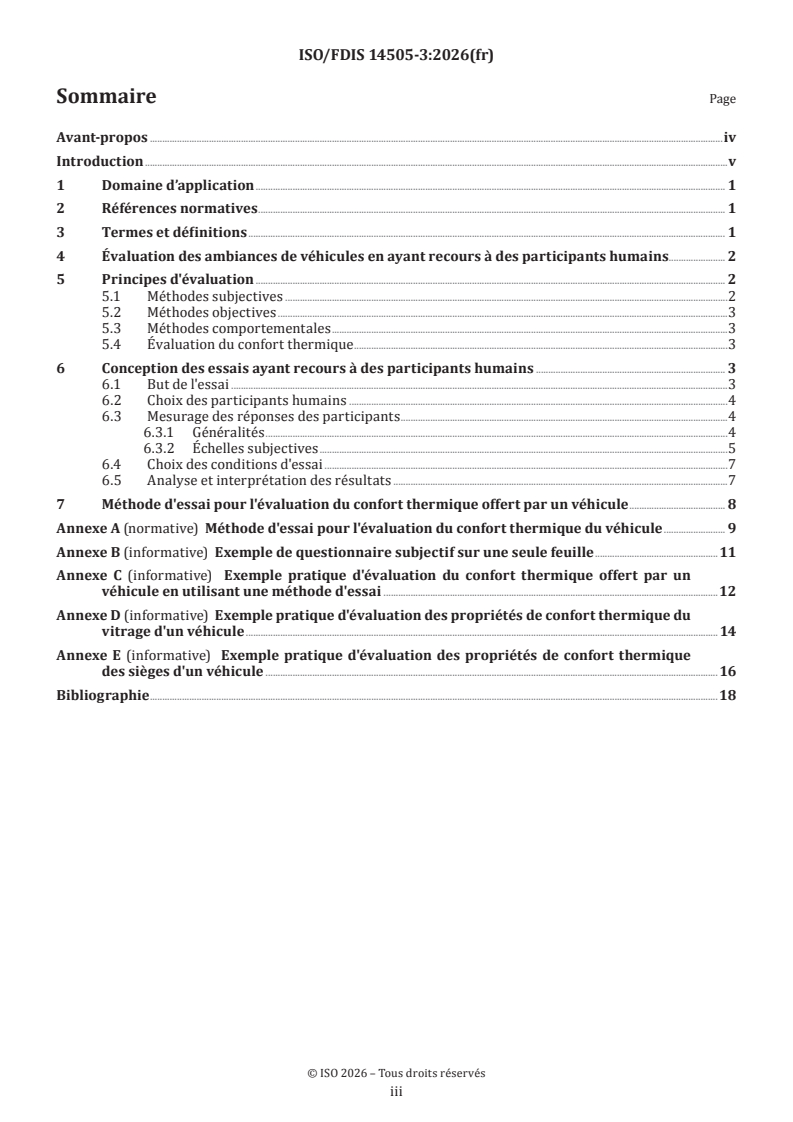
Sommaire Page
Avant-propos .iv
Introduction .v
1 Domaine d’application . 1
2 Références normatives . 1
3 Termes et définitions . 1
4 Évaluation des ambiances de véhicules en ayant recours à des participants humains. 2
5 Principes d'évaluation . 2
5.1 Méthodes subjectives .2
5.2 Méthodes objectives .3
5.3 Méthodes comportementales .3
5.4 Évaluation du confort thermique .3
6 Conception des essais ayant recours à des participants humains . 3
6.1 But de l'essai .3
6.2 Choix des participants humains .4
6.3 Mesurage des réponses des participants .4
6.3.1 Généralités .4
6.3.2 Échelles subjectives .5
6.4 Choix des conditions d'essai .7
6.5 Analyse et interprétation des résultats .7
7 Méthode d'essai pour l'évaluation du confort thermique offert par un véhicule . 8
Annexe A (normative) Méthode d'essai pour l'évaluation du confort thermique du véhicule . 9
Annexe B (informative) Exemple de questionnaire subjectif sur une seule feuille .11
Annexe C (informative) Exemple pratique d'évaluation du confort thermique offert par un
véhicule en utilisant une méthode d'essai .12
Annexe D (informative) Exemple pratique d'évaluation des propriétés de confort thermique du
vitrage d'un véhicule . 14
Annexe E (informative) Exemple pratique d'évaluation des propriétés de confort thermique
des sièges d'un véhicule . 16
Bibliographie .18
iii
Avant-propos
L'ISO (Organisation internationale de normalisation) est une fédération mondiale d'organismes nationaux
de normalisation (comités membres de l'ISO). L'élaboration des Normes internationales est en général
confiée aux comités techniques de l'ISO. Chaque comité membre intéressé par une étude a le droit de faire
partie du comité technique créé à cet effet. Les organisations internationales, gouvernementales et non
gouvernementales, en liaison avec l'ISO participent également aux travaux. L'ISO collabore étroitement avec
la Commission électrotechnique internationale (IEC) en ce qui concerne la normalisation électrotechnique.
Les procédures utilisées pour élaborer le présent document et celles destinées à sa mise à jour sont
décrites dans les Directives ISO/IEC, Partie 1. Il convient, en particulier, de prendre note des différents
critères d'approbation requis pour les différents types de documents ISO. Le présent document
a été rédigé conformément aux règles de rédaction données dans les Directives ISO/IEC, Partie 2
(voir www.iso.org/directives).
L'ISO attire l'attention sur le fait que la mise en application du présent document peut entraîner l'utilisation
d'un ou de plusieurs brevets. L'ISO ne prend pas position quant à la preuve, à la validité et à l'applicabilité
de tout droit de brevet revendiqué à cet égard. À la date de publication du présent document, l'ISO n’avait
pas reçu notification qu'un ou plusieurs brevets pouvaient être nécessaires à sa mise en application.
Toutefois, il y a lieu d'avertir les responsables de la mise en application du présent document que des
informations plus récentes sont susceptibles de figurer dans la base de données de brevets, disponible à
l'adresse www.iso.org/brevets. L'ISO ne saurait être tenue pour responsable de ne pas avoir identifié tout ou
partie de tels droits de brevet.
Les appellations commerciales éventuellement mentionnées dans le présent document sont données pour
information, par souci de commodité, à l'intention des utilisateurs et ne sauraient constituer un engagement.
Pour une explication de la nature volontaire des normes, la signification des termes et expressions
spécifiques de l'ISO liés à l'évaluation de la conformité, ou pour toute information au participant de l'adhésion
de l'ISO aux principes de l'Organisation mondiale du commerce (OMC) concernant les obstacles techniques
au commerce (OTC), voir le lien suivant: www.iso.org/iso/fr/avant-propos.html.
Le présent document a été élaboré par le comité technique ISO/TC 159, Ergonomie, SC 5, Ergonomie de
l'environnement physique, en collaboration avec le comité technique CEN/TC 122, Ergonomie, du Comité
européen de normalisation (CEN), conformément à l'Accord de coopération technique entre l'ISO et le CEN
(Accord de Vienne).
Cette seconde édition annule et remplace la première édition (ISO 14505-3:2006), qui a fait l'objet d'une
révision technique.
Les principales modifications sont les suivantes:
— révision des références.
Une liste de toutes les parties de la série ISO 14505 peut être consultée sur le site de l'ISO.
Il convient que l'utilisateur adresse tout retour d'information ou toute question concernant le présent
document à l'organisme national de normalisation de son pays. Une liste exhaustive desdits organismes se
trouve à l'adresse www.iso.org/fr/members.html.
iv
Introduction
Les méthodes directes d'évaluation des ambiances thermiques (chaudes, modérées, froides) dans les
véhicules font appel à des mesurages des réponses de participants humains. Il en existe trois types:
— les méthodes subjectives;
— les méthodes objectives;
— les méthodes comportementales.
Les méthodes subjectives quantifient les réponses des individus à une ambiance en utilisant des échelles
de jugements subjectifs. Les méthodes objectives sont celles qui quantifient l'état physique, physiologique
ou mental d'une personne au moyen d'une instrumentation ou par la mesure d'une série de résultats,
telles que les mesures de performances. Les méthodes comportementales quantifient ou représentent le
comportement humain en réponse à une ambiance.
Chacune de ces méthodes est élaborée conformément à des principes de base, et la méthode ou combinaison
de méthodes la plus appropriée pour l'évaluation des ambiances thermiques dans les véhicules dépend
du contexte et de l'ambiance du véhicule considéré. Le présent document définit les principes et le mode
d'application des méthodes d'évaluation du confort thermique offert par les véhicules, faisant appel à des
participants humains. Les méthodes les plus appropriées pour l'évaluation du confort thermique offert par
les véhicules sont subjectives. Les principes de construction d'échelles de jugements subjectifs sont décrits
dans l'ISO 10551 et sont adoptés pour l'élaboration de la méthode d'essai décrite dans le présent document.
Les mesures physiologiques effectuées sur des participants humains sont décrites dans l'ISO 9886 et ne
relèvent pas du domaine d'application du présent document.
Le présent document apporte des éléments complémentaires aux normes traitant de l'ergonomie des
ambiances thermiques et peut être utilisé conjointement avec des indices thermiques qui sont considérés
comme valables et applicables aux ambiances dans les véhicules.
Le présent document est une norme de base définissant des principes ergonomiques et elle peut contribuer à
l'élaboration de normes relatives à des véhicules et à des produits spécifiques.
v
PROJET FINAL Norme internationale ISO/FDIS 14505-3:2026(fr)
Ergonomie des ambiances thermiques — Évaluation des
ambiances thermiques dans les véhicules —
Partie 3:
Évaluation du confort thermique en ayant recours à des
participants humains
1 Domaine d’application
Le présent document spécifie et donne des lignes directrices relatives à une méthode d'essai pour l'évaluation
du confort thermique offert par les véhicules, en faisant appel à des participants humains. Il ne se limite pas
à un véhicule particulier mais pose des principes généraux permettant l'évaluation et l'appréciation. Cette
méthode peut servir à mesurer les performances d'un véhicule dans des conditions déterminées et peut
permettre de vérifier si celui-ci offre ou non un confort thermique à ses utilisateurs. Elle peut être utilisée
pour le développement et l'évaluation des véhicules.
Le présent document est applicable à l'ensemble des véhicules, y compris les voitures particulières, les
autobus, les camions, les véhicules tout terrain, les trains, les aéronefs, les navires, les sous-marins, les
cabines de grue et les espaces assimilés. Il est applicable aux personnes prenant place dans un véhicule
ainsi qu'à celles exposées aux conditions extérieures. Pour celles exposées aux conditions extérieures, par
exemple les cyclistes, les motocyclistes, les conducteurs et passagers de voitures de sport et les opérateurs
de chariots élévateurs à fourche sans cabine, la vitesse du véhicule et les conditions météorologiques peuvent
constituer des facteurs dominants qui conditionnent les réponses. Cependant, les principes d'évaluation
demeurent applicables.
Le présent document est applicable aux passagers ainsi qu'aux conducteurs ou opérateurs des véhicules,
dans la mesure où son application n'entrave pas la bonne marche et la sécurité du véhicule.
Il décrit les principes d'évaluation et d'appréciation du confort thermique, ainsi que l'utilisation des méthodes
d'essai et les essais. Il décrit également des méthodes subjectives qui peuvent être utilisées pour les besoins
d'évaluation.
2 Références normatives
Les documents suivants sont cités dans le texte de sorte qu’ils constituent, pour tout ou partie de leur
contenu, des exigences du présent document. Pour les références datées, seule l’édition citée s’applique. Pour
les références non datées, la dernière édition du document de référence s'applique (y compris les éventuels
amendements).
ISO 12894:2001, Ergonomie des ambiances thermiques — Surveillance médicale des personnes exposées à la
chaleur ou au froid extrêmes
ISO 13731, Ergonomie des ambiances thermiques — Vocabulaire et symboles
3 Termes et définitions
Pour les besoins du présent document, les termes et définitions de l'ISO 13731 ainsi que les suivants,
s’appliquent.
L'ISO et l'IEC tiennent à jour des bases de données terminologiques destinées à être utilisées en normalisation,
consultables aux adresses suivantes:
— ISO Online browsing platform: disponible à l'adresse https:// www .iso .org/ obp
— IEC Electropedia: disponible à l'adresse https:// www .electropedia .org/
3.1
système CVCA
système de chauffage, de ventilation et de climatisation d'air
système assurant le chauffage, la ventilation et la climatisation de l'air du véhicule ou de la cabine
4 Évaluation des ambiances de véhicules en ayant recours à des participants
humains
Bien que les modèles mathématiques et physiques et les indices thermiques soient aptes à fournir des
méthodes d'évaluation répétables et fiables, les ambiances de véhicules sont souvent complexes, dynamiques
et influencées par de multiples facteurs. La validité des modèles et des indices est donc dans ce cas souvent
limitée. Le fait de recourir à des participants humains constitue un moyen qui permet directement de
mesurer le confort thermique et de valider d'autres techniques. Par conséquent, il faut élaborer des méthodes
d'évaluation qui impliquent des participants humains. Ces méthodes ne doivent être utilisées que lorsque
l'on a mis en œuvre des mesures éthiques et des pratiques admises en matière de recours à des participants
humains conformément à l'ISO 12894. Elles sont utilisées pour une des quatre raisons essentielles suivantes:
a) évaluer les ambiances de véhicules en matière de confort thermique;
b) établir ou appliquer des méthodes d'essai normalisées pour évaluer le confort thermique offert par les
véhicules;
c) comparer les résultats de mesurage du confort thermique offert par des véhicules avec ceux issus de
méthodes prédictives (modèles, indices) fondées sur des mesurages des ambiances thermiques régnant
dans les véhicules;
d) déterminer la relation entre les mesures objectives, telles que les températures cutanées, et les mesures
subjectives du confort thermique.
5 Principes d'évaluation
5.1 Méthodes subjectives
Les méthodes subjectives quantifient la réponse des individus à une ambiance en utilisant des échelles
de jugements subjectifs. Ces échelles sont fondées sur des continuums psychologiques (ou concepts
hypothétiques) pertinents pour le phénomène psychologique concerné. Il faut connaître les caractéristiques
des échelles pour interpréter correctement les résultats. Les échelles de sensations thermiques (chaud
ou froid), de préférences, de confort et de collant sont souvent utilisées pour les besoins d'évaluation du
confort thermique. Les méthodes subjectives présentent l'avantage d'être faciles à mettre en œuvre et
elles sont directement reliées aux phénomènes psychologiques. Elles présentent cependant l'inconvénient
de pouvoir interférer avec ce qu'elles sont censées mesurer, certains groupes peuvent en effet se révéler
incapables d'exécuter la tâche subjective demandée (par exemple, les nourrissons, les enfants, les personnes
handicapées) et rien ne peut alors expliquer la raison pour laquelle telle ou telle réponse a été donnée. Il
convient d'utiliser l'ISO 10551 pour mettre à disposition des recommandations relatives à la construction
d'échelles de jugements subjectifs. On distingue cinq types d'échelles qui considèrent:
— la perception (comment vous sentez-vous maintenant? par exemple, j'ai chaud);
— l'affectif (comment la trouvez-vous? par exemple, confortable);
— la préférence (comment préféreriez-vous vous sentir? par exemple, avoir moins chaud);
— l'acceptabilité (acceptable/inacceptable);
— la tolérance (cette ambiance est-elle supportable?).
À partir de ces dimensions subjectives de base, des questionnaires comportant des échelles de jugements
subjectifs peuvent être établis. Les méthodes subjectives d'évaluation présentées dans le présent document
traitent du confort thermique et, par conséquent, ne concernent pas la "tolérance".
5.2 Méthodes objectives
Les méthodes objectives sont celles qui quantifient l'état physique ou mental d'une personne au moyen
d'une instrumentation ou par la mesure d'une série de résultats, tels que les mesures de performances. Le
principe de cette méthode est que le résultat du mesurage peut être interprété pour un état considéré de
la personne (par exemple, le confort thermique). Un exemple est le mesurage de la température cutanée
moyenne qui varie du fait des mécanismes de thermorégulation à la chaleur et au froid (justifiant la
méthode), des recherches ayant pu établir une corrélation entre ces valeurs et les réponses subjectives
au confort. Un autre exemple est celui de la mouillure cutanée. Les inconvénients des méthodes objectives
résident dans les aspects suivants: il se peut qu'elles interfèrent avec ce qu'elles cherchent à mesurer, la
corrélation entre la mesure et le confort thermique n'est pas parfaite, et ledit confort thermique est un
phénomène psychologique, un état d'esprit. L'un des avantages des méthodes de mesure objectives est
qu'elles sont souvent indépendantes des résultats d'autres démarches, telles que les méthodes de mesure
subjectives, et qu'elles peuvent être adoptées pour compléter ces dernières. Il convient d'utiliser l'ISO 9886
pour élaborer des méthodes qui permettent de mesurer et d'interpréter l'astreinte physiologique en termes
de température corporelle centrale, de température cutanée moyenne, de fréquence cardiaque et de perte
de masse corporelle. D'autres mesures, comme les variations de la fréquence cardiaque, peuvent également
être pertinentes.
5.3 Méthodes comportementales
Les méthodes comportementales quantifient ou représentent le comportement humain en réponse à une
ambiance. L'aspect particulier du comportement humain observé est mis en relation avec un état considéré
de la personne (par exemple, le confort thermique offert par les véhicules), ce qui nécessite l'élaboration d'une
méthode d'interprétation. À titre d'exemple, citons les changements de postures, les déplacements types
(par exemple, éloignement par rapport aux ambiances inconfortables) et la préférence donnée à certaines
places assises (par exemple, le cas de sièges situés dans un courant d'air froid qui seraient les "derniers" à
être occupés). Les avantages des méthodes comportementales résident dans le fait qu'elles interfèrent très
peu avec ce qui est mesuré et qu'elles permettent un mesurage direct et "actif" de l'inconfort. En revanche,
elles présentent l'inconvénient d'une validité et d'une fiabilité difficile à établir tant pour la méthode que
pour l'interprétation directe des résultats en termes de confort thermique. Par exemple, un changement de
posture peut être lié à l'inconfort de la chaise ou à d'autres raisons "non thermiques".
5.4 Évaluation du confort thermique
L'évaluation du confort thermique est menée à bien de manière extrêmement efficace par le biais de
méthodes subjectives. Cela s'explique par le fait que le confort est un phénomène psychologique et une
échelle d'évaluation subjective offre une méthode directe et quantifiable. Pour cette raison, la méthode
d'essai simplifiée proposée dans le présent document fait appel à des méthodes subjectives. Les méthodes
objectives et comportementales peuvent être utilisées en complément de la méthode d'essai décrite, sous
réserve toutefois d'être associées à une expertise qui dépasse le domaine d'application du présent document.
6 Conception des essais ayant recours à des participants humains
6.1 But de l'essai
La conception de tout essai sur véhicule faisant intervenir des participants humains dépend des objectifs
spécifiques de cet essai. Cependant, on peut dégager des principes généraux qui sont mentionnés à l'Article 6.
Un essai type de détermination du confort thermique implique la conduite de véhicules sur route et le
mesurage des conditions ambiantes et des réponses thermiques des passagers. Les études plus spécifiques
font en général appel à des simulateurs, des enceintes climatiques ou des souffleries.
Une conception optimale de l'essai permet d'atteindre l'objectif recherché à condition d'utiliser efficacement
les ressources. Pour ce faire, il est important de préciser clairement le ou les objectifs spécifiques. Par
exemple, si le but est de comparer le confort thermique procuré par trois types de sièges de véhicules, la
meilleure comparaison des sièges sera obtenue en mettant en œuvre un plan d'expérience à mesures
répétées où tous les participants sont invités à s'asseoir sur tous les sièges (dans un ordre équilibré) et dans
des conditions identiques. À l'inverse, lorsque l'on vise à évaluer l'indice de confort thermique avec un large
éventail d'ambiances et de sièges, c'est la variété des conditions qui permet d'obtenir la meilleure évaluation.
Lorsque l'on a les deux objectifs, les deux types d'exigences doivent être satisfaits au stade de la conception
de l'essai. Il faut donc spécifier les objectifs de l'essai.
6.2 Choix des participants humains
Une méthode valable pour l'évaluation des ambiances consisterait à utiliser un panel d'experts. Cette
technique est utilisée par exemple en œnologie, où des experts reconnus donnent leur opinion sur la qualité
des vins. Cette technique dépend du recrutement d'expert reconnus impartiaux (sans biais). Mais cela n'est
pas possible lorsqu'il s'agit de l'évaluation du confort thermique et il convient que les configurations d'essai
évitent tout particulièrement les biais.
Il est d'usage d'identifier un échantillon "aléatoire" de participants humains représentatifs de la population
concernée. C'est une question d'échantillonnage statistique et des facteurs pertinents tels que l'âge, le sexe,
l'expérience de la conduite et l'anthropométrie peuvent être identifiés et être utilisés pour influencer la
sélection des participants. Le nombre d'individus sélectionnés dépend de l'objectif à atteindre et du plan
d'expérience. Des calculs peuvent être effectués sur la base de la puissance d'un test statistique; c'est-à-dire
la probabilité d'acceptation de l'hypothèse alternative (par exemple, le véhicule A est plus confortable que
le véhicule B) à condition qu'elle soit vraie. C'est une approche plutôt scolaire; elle nécessite un ensemble
d'hypothèses concernant l'intensité de l'effet attendu, ce qui est plutôt circulaire car c'est un objectif de l'essai.
La répartition des participants par rapport aux traitements a une importance pratique. Si l'on compare trois
voitures et trois types de vitrage (soit neuf conditions), neuf participants permettraient alors de réaliser un
plan d'expérience en carré latin 9 × 9, où chaque participant est exposé à chacune des conditions dans un
ordre différent et équilibré. Un plan d'expérience à mesures répétées expose tous les participants à toutes
les conditions. Généralement, on considère que pour des réponses normalement distribuées, l'accroissement
du nombre de participants entraîne une représentativité de l'échantillon marginalement décroissante.
Des tailles d'échantillons de huit participants au moins sont souvent considérées comme acceptables. Il
est également utile d'établir une probabilité approchée. Par exemple, si quatre participants sont invités à
comparer deux véhicules, la probabilité de voir les quatre participants accorder, par hasard, leur préférence
au véhicule A plutôt qu'au véhicule B (lorsqu'il n'existe, en matière de confort, aucune différence réelle entre
les véhicules), est de 1/2 à la puissance 4 = 1/16 = 6,25 %. Ainsi, un échantillon de quatre participants n'est
pas suffisant pour prendre une décision à un niveau de 5 %, même dans le cas d'un résultat extrême.
Un ex
...