

ISO/FDIS 9308-4
(Main)Water quality — Enumeration of Escherichia coli and coliform bacteria — Part 4: Membrane filtration method for Escherichia coli in water with high levels of background bacteria
- Abstract
This document describes a highly specific method for the enumeration of Escherichia coli (E. coli) in water. The method is based on membrane filtration, subsequent culture at 44 °C on a chromogenic agar medium containing a chromogenic ingredient for the detection of the enzyme ß-glucuronidase, and calculation of the number of target organisms in the sample. Because of the high specificity of the method, this document is suitable for waters with high levels of background bacteria, such as surface waters including bathing water and wastewater. E. coli strains which do not grow at 44 °C and those that are β-glucuronidase negative, such as E. coli O157, will not be detected as E. coli by this method.
- Status
- Not Published
- Technical Committee
- ISO/TC 147/SC 4 - Microbiological methods
- Drafting Committee
- ISO/TC 147/SC 4 - Microbiological methods
- Current Stage
- 5000 - FDIS registered for formal approval
- Start Date
- 29-Jun-2026
- Completion Date
- 02-Jun-2026
Buy Documents
ISO/FDIS 9308-4 - Water quality — Enumeration of Escherichia coli and coliform bacteria — Part 4: Membrane filtration method for Escherichia coli in water with high levels of background bacteria
REDLINE ISO/FDIS 9308-4 - Water quality — Enumeration of Escherichia coli and coliform bacteria — Part 4: Membrane filtration method for Escherichia coli in water with high levels of background bacteria
ISO/FDIS 9308-4 is an ISO document for enumerating Escherichia coli (E. coli) in water by membrane filtration. It specifies a selective culture method for waters with high levels of background bacteria, including surface water, bathing water and wastewater, and it is written for laboratories that monitor water quality and faecal pollution.
What does ISO/FDIS 9308-4 specify?
ISO/FDIS 9308-4 specifies a membrane filtration method for counting E. coli in water, followed by culture at 44 °C on a chromogenic agar medium that detects β-glucuronidase activity. The document is organized into clauses for the principle, media and reagents, equipment, sampling, procedure, expression of results, performance characteristics, test report and quality assurance.
The method is aimed at waters with high levels of background bacteria, provided the water has little particulate or colloidal matter relative to the E. coli concentration. It covers two procedures - one for fresh water and one for marine water and brackish water.
| Annex | What it covers |
|---|---|
| Annex A | Flow diagram of the main steps of Procedure A and Procedure B |
| Annex B | Culture media and reagents, plus performance testing of the media and membrane filters |
| Annex C | Performance characteristics of the method |
What are the key requirements of ISO/FDIS 9308-4?
ISO/FDIS 9308-4 is built around three practical decisions: choose the right procedure for the water type, use the right filtration and incubation sequence, and report counts in a way that matches the method limits. In practice, these choices affect whether damaged cells recover, whether target colonies are visible, and whether the result is suitable for comparison with other samples.
Sample handling and method choice
- Clause 7 requires sampling, transport and storage in line with ISO 19458, with analysis as soon as possible and within 24 h, keeping samples at (5 ± 3) °C if stored. This matters because E. coli counts can change quickly after sampling.
- For brackish water, Clause 8.1 requires Procedure B or a comparison of Procedure A and Procedure B in accordance with ISO 17994 before using Procedure A. This matters because salinity can affect recovery.
- Clause 1 says the method is not for coliform bacteria other than E. coli. This matters if a laboratory needs a broader coliform result.
Filtration and incubation
- Clause 8.3 requires membrane filtration of test portions or dilutions using membrane filters, with a target range of at least 10 and at most 150 specific colonies expected per filter. This matters because counts outside that range reduce confidence in the result.
- Clause 8.3 recommends fourfold dilutions when the water content is unknown, and it allows multiple filters or duplicate plates to improve precision. This matters when the background load or contamination level is uncertain.
- Procedure A in Clause 8.4.1 is for fresh water: place the membrane on TBX agar, pre-incubate at 36 °C, then incubate at 44 °C. Procedure B in Clause 8.4.2 is for marine and brackish water: pre-incubate on MMGA, transfer to TBX agar, then incubate at 44 °C. This matters because the two procedures are tuned to different water matrices.
- Clause 8.5 counts colonies with a positive β-D-glucuronidase reaction, generally blue or blue-green, as E. coli. Strains that do not grow at 44 °C or are β-glucuronidase negative, such as E. coli O157, are not detected as E. coli by this method.
Reporting, performance and quality assurance
- Clause 9 requires results to be expressed as cfu per chosen reference volume, using the counts from filters that stay within the method limit. This matters because the same sample may be reported per ml, 100 ml or l depending on the water type and local practice.
- Clause 10 ties the method to validation data and single-laboratory verification. When not all colonies are confirmed, the clause gives a calculation approach based on false negative and false positive rates. This matters when only part of the growth can be confirmed in routine work.
- Clause 12 requires a laboratory quality control system, with performance testing of culture media, reagents and membranes. Positive controls, negative controls and blanks are part of the method. This matters because the media and filter system can change the result if they are not functioning correctly.
- Clause 11 requires the test report to identify the method and procedure used, the sample, the volume tested, the calculated result, deviations and the test date. This matters for traceability and for comparing results across laboratories.
What terms does ISO/FDIS 9308-4 define?
- Escherichia coli (E. coli) - A member of the Enterobacteriaceae that expresses β-D-glucuronidase and can grow at 44 °C in the presence of bile salts.
- TBX agar - Tryptone bile X-glucuronide agar, used to support growth and reveal β-D-glucuronidase-positive colonies by colour.
- MMGA - Minerals-modified glutamate agar, used in Procedure B to help damaged cells recover before transfer to TBX agar.
- cfu - Colony-forming units, the expression used for the calculated concentration in the sample.
- β-D-glucuronidase - The enzyme detected by the chromogenic ingredient; colonies showing this reaction are counted as E. coli.
- Productivity - The ability of the media and membrane filter system to recover E. coli in performance testing.
- Selectivity - The ability of the medium to suppress non-target organisms under the test conditions.
- Specificity - The ability of the method to react as intended with target and non-target organisms in the validation checks.
Who uses ISO/FDIS 9308-4?
ISO/FDIS 9308-4 is used by water testing laboratories, environmental microbiology laboratories, and public-health or regulatory bodies that monitor faecal pollution. It is relevant for fresh water, marine water, brackish water, bathing water and wastewater.
Quality managers use it to define the laboratory workflow, media control and reporting format. Buyers and technical evaluators use it to choose a method when high background bacterial growth makes less selective methods harder to read. Laboratory staff use it for routine enumeration, confirmation, quality control and result interpretation.
Which standards are used with ISO/FDIS 9308-4?
The document relies on these normative references and related companion standards:
- ISO 7704 - Sets requirements for performance testing of membrane filters used for direct enumeration by culture methods.
- ISO 8199:2018 - Gives general requirements and guidance for microbiological examinations by culture, including sampling support, diluents and result expression.
- ISO 11133 - Covers preparation, storage and performance testing of culture media and reagents.
- ISO 19458 - Specifies sampling for microbiological analysis.
- ISO 9308-2 - Provides the most probable number method for E. coli and coliform bacteria.
- ISO 9308-3 - Provides a miniaturized most probable number method for E. coli in surface water and wastewater.
- ISO 13843:2017 - Is used for performance characteristics, verification and related statistical treatment.
- ISO 17994 - Is used when comparing the relative recovery of two quantitative methods.
- ISO 16269-4 - Supports outlier treatment in the interlaboratory statistics described in the bibliography.
What does the ISO/FDIS 9308-4 document contain?
ISO/FDIS 9308-4 contains a flow diagram of the main analytical steps in Annex A, which helps users follow the sequence from filtration to counting. Annex B provides the culture media and reagents for TBX agar, MMGA and peptone saline solution, together with preparation details and the performance tests for media and membrane filters.
The document also contains performance-testing tables in Annex B that link the media to productivity, selectivity and specificity checks using reference organisms. Clause 10 includes formulas for handling performance-characteristic calculations when only part of the colonies are confirmed. Annex C summarizes interlaboratory performance data, including sensitivity, specificity, false positive rate, false negative rate, selectivity and efficiency, plus repeatability, reproducibility, robustness and the upper limit used for the method.
Relations
- Effective Date
- 12-Feb-2026
Buy Documents
ISO/FDIS 9308-4 - Water quality — Enumeration of Escherichia coli and coliform bacteria — Part 4: Membrane filtration method for Escherichia coli in water with high levels of background bacteria
REDLINE ISO/FDIS 9308-4 - Water quality — Enumeration of Escherichia coli and coliform bacteria — Part 4: Membrane filtration method for Escherichia coli in water with high levels of background bacteria
Frequently Asked Questions
ISO/FDIS 9308-4 is a draft published by the International Organization for Standardization (ISO). Its full title is "Water quality — Enumeration of Escherichia coli and coliform bacteria — Part 4: Membrane filtration method for Escherichia coli in water with high levels of background bacteria". This standard covers: This document describes a highly specific method for the enumeration of Escherichia coli (E. coli) in water. The method is based on membrane filtration, subsequent culture at 44 °C on a chromogenic agar medium containing a chromogenic ingredient for the detection of the enzyme ß-glucuronidase, and calculation of the number of target organisms in the sample. Because of the high specificity of the method, this document is suitable for waters with high levels of background bacteria, such as surface waters including bathing water and wastewater. E. coli strains which do not grow at 44 °C and those that are β-glucuronidase negative, such as E. coli O157, will not be detected as E. coli by this method.
This document describes a highly specific method for the enumeration of Escherichia coli (E. coli) in water. The method is based on membrane filtration, subsequent culture at 44 °C on a chromogenic agar medium containing a chromogenic ingredient for the detection of the enzyme ß-glucuronidase, and calculation of the number of target organisms in the sample. Because of the high specificity of the method, this document is suitable for waters with high levels of background bacteria, such as surface waters including bathing water and wastewater. E. coli strains which do not grow at 44 °C and those that are β-glucuronidase negative, such as E. coli O157, will not be detected as E. coli by this method.
ISO/FDIS 9308-4 is classified under the following ICS (International Classification for Standards) categories: 07.100.20 - Microbiology of water. The ICS classification helps identify the subject area and facilitates finding related standards.
ISO/FDIS 9308-4 has the following relationships with other standards: It is inter standard links to prEN ISO 9308-4. Understanding these relationships helps ensure you are using the most current and applicable version of the standard.
ISO/FDIS 9308-4 is available in PDF format for immediate download after purchase. The document can be added to your cart and obtained through the secure checkout process. Digital delivery ensures instant access to the complete standard document.
Standards Content (Sample)
FINAL DRAFT
International
Standard
ISO/TC 147/SC 4
Water quality — Enumeration
Secretariat: DIN
of Escherichia coli and coliform
Voting begins on:
bacteria —
2026-10-13
Part 4:
Voting terminates on:
2026-12-08
Membrane filtration method for
Escherichia coli in water with high
levels of background bacteria
Qualité de l'eau — Dénombrement des Escherichia coli et des
bactéries coliformes —
Partie 4: Méthode par filtration sur membrane pour Escherichia
coli pour les eaux à teneurs élevées en bactéries
RECIPIENTS OF THIS DRAFT ARE INVITED TO SUBMIT,
WITH THEIR COMMENTS, NOTIFICATION OF ANY
RELEVANT PATENT RIGHTS OF WHICH THEY ARE AWARE
AND TO PROVIDE SUPPOR TING DOCUMENTATION.
IN ADDITION TO THEIR EVALUATION AS
BEING ACCEPTABLE FOR INDUSTRIAL, TECHNO-
ISO/CEN PARALLEL PROCESSING LOGICAL, COMMERCIAL AND USER PURPOSES, DRAFT
INTERNATIONAL STANDARDS MAY ON OCCASION HAVE
TO BE CONSIDERED IN THE LIGHT OF THEIR POTENTIAL
TO BECOME STAN DARDS TO WHICH REFERENCE MAY BE
MADE IN NATIONAL REGULATIONS.
Reference number
FINAL DRAFT
International
Standard
ISO/TC 147/SC 4
Water quality — Enumeration
Secretariat: DIN
of Escherichia coli and coliform
Voting begins on:
bacteria —
Part 4:
Voting terminates on:
Membrane filtration method for
Escherichia coli in water with high
levels of background bacteria
Qualité de l'eau — Dénombrement des Escherichia coli et des
bactéries coliformes —
Partie 4: Méthode par filtration sur membrane pour Escherichia
coli pour les eaux à teneurs élevées en bactéries
© ISO 2026
All rights reserved.
RECIPIENTS OF THIS DRAFT ARE INVITED TO SUBMIT,
WITH THEIR COMMENTS, NOTIFICATION OF ANY
This ISO publication is protected by copyright and is owned by ISO and/or its licensors.
RELEVANT PATENT RIGHTS OF WHICH THEY ARE AWARE
The content of this ISO publication is provided under licence, not sold. Use is subject to the applicable licence terms issued by ISO,
AND TO PROVIDE SUPPOR TING DOCUMENTATION.
an ISO member body, or an authorized third-party distributor.
IN ADDITION TO THEIR EVALUATION AS
BEING ACCEPTABLE FOR INDUSTRIAL, TECHNO-
Except as required for implementation or expressly permitted by a separate licence, no part of this ISO publication may be
ISO/CEN PARALLEL PROCESSING
LOGICAL, COMMERCIAL AND USER PURPOSES, DRAFT
reproduced, distributed, modified, used, or made available in any form or by any means – electronic or mechanical, including
INTERNATIONAL STANDARDS MAY ON OCCASION HAVE
photocopying, scanning, recording, or posting on internal or external digital platforms. TO BE CONSIDERED IN THE LIGHT OF THEIR POTENTIAL
TO BECOME STAN DARDS TO WHICH REFERENCE MAY BE
Any use beyond the scope of the granted rights is prohibited and may result in legal action.
MADE IN NATIONAL REGULATIONS.
ISO copyright office
CP 401 • CH-1214 Vernier, Geneva
Phone: +41 22 749 01 11
Email: copyright@iso.org
Website: www.iso.org
Published in Switzerland
Reference number
ii
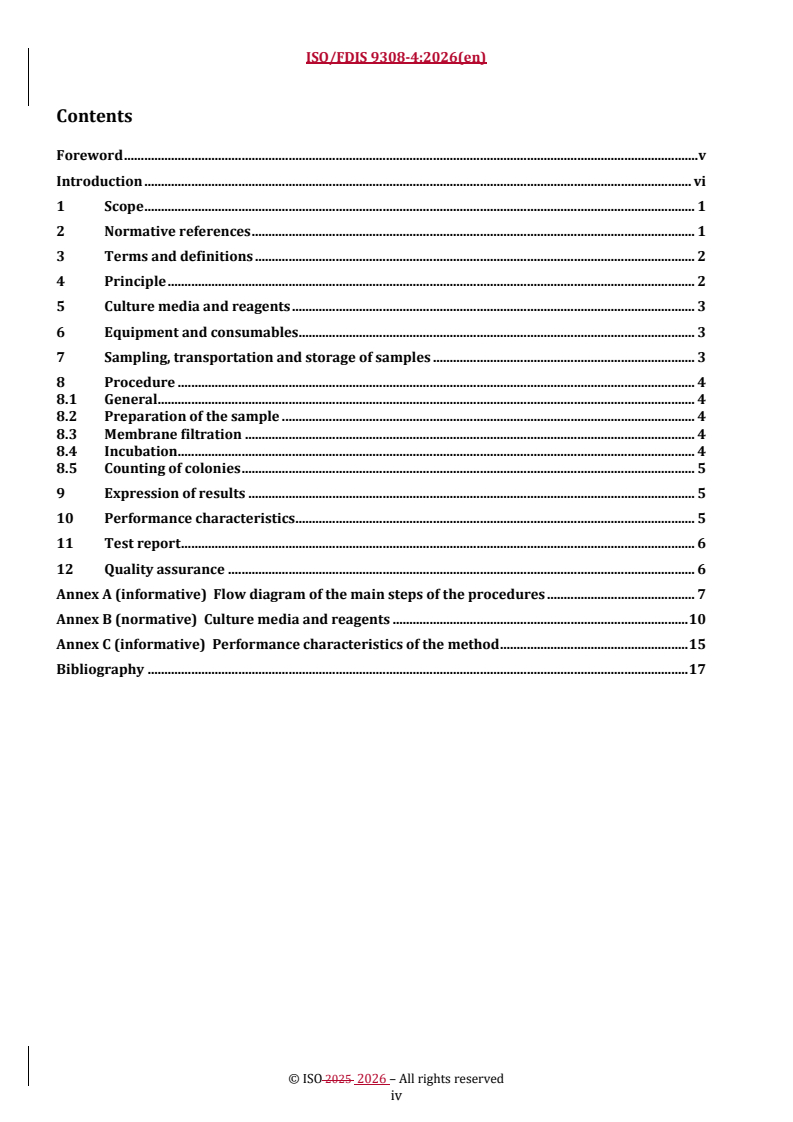
Contents Page
Foreword .iv
Introduction .v
1 Scope . 1
2 Normative references . 1
3 Terms and definitions . 1
4 Principle . 2
5 Culture media and reagents . 2
6 Equipment and consumables . 2
7 Sampling, transportation and storage of samples . 3
8 Procedure . 3
8.1 General .3
8.2 Preparation of the sample .4
8.3 Membrane filtration.4
8.4 Incubation .4
8.4.1 Procedure A .4
8.4.2 Procedure B .4
8.5 Counting of colonies .4
9 Expression of results . 5
10 Performance characteristics . 5
11 Test report . 5
12 Quality assurance . 6
Annex A (informative) Flow diagram of the main steps of the procedures . 7
Annex B (normative) Culture media and reagents . 8
Annex C (informative) Performance characteristics of the method .12
Bibliography . 14
iii
Foreword
ISO (the International Organization for Standardization) is a worldwide federation of national standards
bodies (ISO member bodies). The work of preparing International Standards is normally carried out through
ISO technical committees. Each member body interested in a subject for which a technical committee
has been established has the right to be represented on that committee. International organizations,
governmental and non-governmental, in liaison with ISO, also take part in the work. ISO collaborates closely
with the International Electrotechnical Commission (IEC) on all matters of electrotechnical standardization.
The procedures used to develop this document and those intended for its further maintenance are described
in the ISO/IEC Directives, Part 1. In particular, the different approval criteria needed for the different types
of ISO document should be noted. This document was drafted in accordance with the editorial rules of the
ISO/IEC Directives, Part 2 (see www.iso.org/directives).
ISO draws attention to the possibility that the implementation of this document may involve the use of (a)
patent(s). ISO takes no position concerning the evidence, validity or applicability of any claimed patent
rights in respect thereof. As of the date of publication of this document, ISO had not received notice of (a)
patent(s) which may be required to implement this document. However, implementers are cautioned that
this may not represent the latest information, which may be obtained from the patent database available at
www.iso.org/patents. ISO shall not be held responsible for identifying any or all such patent rights.
Any trade name used in this document is information given for the convenience of users and does not
constitute an endorsement.
For an explanation of the voluntary nature of standards, the meaning of ISO specific terms and expressions
related to conformity assessment, as well as information about ISO's adherence to the World Trade
Organization (WTO) principles in the Technical Barriers to Trade (TBT), see www.iso.org/iso/foreword.html.
This document was prepared by Technical Committee ISO/TC 147, Water quality, Subcommittee SC 4,
Microbiological methods, in collaboration with the European Committee for Standardization (CEN) Technical
Committee CEN/TC 230, Water analysis, in accordance with the Agreement on technical cooperation between
ISO and CEN (Vienna Agreement).
A list of all parts in the ISO 9308 series can be found on the ISO website.
Any feedback or questions on this document should be directed to the user’s national standards body.
A complete listing of these bodies can be found at https://www.iso.org/members.html.
iv
Introduction
The presence and extent of faecal pollution is an important factor in assessing the quality of water and
the risk to human health from infection. Examination of water samples for the presence of Escherichia
coli (E. coli), which normally inhabits the bowel of man and other warm-blooded animals, provides an
indication of such pollution.
EXAMPLE 1 Directive 2006/7/EC of the European Parliament and of the Council of 15 February 2006 concerning
the management of bathing water quality sets standards for the monitoring of levels of E. coli in official bathing waters.
[9]
EXAMPLE 2 According to the United States Environmental Protection Agency, states can require the measurement
of E. coli to determine whether water quality criteria have been met for fresh water that is designated for primary
[10]
contact recreation, including swimming and bathing.
As surface waters often contain other bacteria than E. coli, either of environmental origin or through
contamination with faeces from animal or human origin, a method with high specificity is essential for
the enumeration of E. coli in surface water. This method makes use of two features that E. coli generally
possesses: thermotolerance and expression of β-glucuronidase, to ensure such a high specificity.
v
FINAL DRAFT International Standard ISO/FDIS 9308-4:2026(en)
Water quality — Enumeration of Escherichia coli and coliform
bacteria —
Part 4:
Membrane filtration method for Escherichia coli in water with
high levels of background bacteria
WARNING — Persons using this document should be familiar with good laboratory practice. This
document does not purport to address all of the safety aspects, if any, associated with its use. It is the
responsibility of the user to establish appropriate safety and health practices.
IMPORTANT — Tests conducted in accordance with this document shall be carried out by suitably
qualified staff.
1 Scope
This document specifies a highly specific method for the enumeration of Escherichia coli (E. coli) in water,
based on membrane filtration followed by culture at 44 °C on chromogenic agar medium containing an
[5],[6],[13]
ingredient for the detection of the enzyme β-glucuronidase.
This document is applicable to waters with high levels of background bacteria (e.g. surface waters including
bathing water and wastewater) provided that these waters contain little particulate or colloidal matter
relative to the E. coli concentration. This document consists of two procedures one for fresh water and one
for marine water.
E. coli strains that do not grow at 44 °C and those that are β-glucuronidase negative (e.g. E. coli O157) are not
detected as E. coli by this method.
The method specified in this document does not apply to the enumeration of coliform bacteria other than E.
coli.
2 Normative references
The following documents are referred to in the text in such a way that some or all of their content constitutes
requirements of this document. For dated references, only the edition cited applies. For undated references,
the latest edition of the referenced document (including any amendments) applies.
ISO 7704, Water quality — Requirements for the performance testing of membrane filters used for direct
enumeration of microorganisms by culture methods
ISO 8199:2018, Water quality — General requirements and guidance for microbiological examinations by culture
ISO 11133, Microbiology of the food chain and water — Preparation, production, storage and performance
testing of culture media and reagents
ISO 19458, Water quality — Sampling for microbiological analysis
3 Terms and definitions
For the purposes of this document, the following terms and definitions apply.
ISO and IEC maintain terminology databases for use in standardization at the following addresses:
— ISO Online browsing platform: available at https:// www .iso .org/ obp
— IEC Electropedia: available at https:// www .electropedia .org/
3.1
Escherichia coli
E. coli
member of the Enterobacteriaceae that expresses β-d-glucuronidase and that is capable of growing at 44 °C
in the presence of bile salts
4 Principle
The enumeration of E. coli consists of the following steps:
— filtering test portion(s) or dilutions of the sample, through a membrane filter, which retains the organisms;
— depending on the type of sample, two different procedures for the enumeration of E. coli are used:
— procedure A: enumerating E. coli in fresh water by placement of the membrane filter on tryptone
bile-X-glucuronide (TBX) agar, placing the TBX agar at 36 °C for 4 h to 5 h to resuscitate stressed
cells, followed by incubation at 44 °C for 21 h;
— procedure B: enumerating E. coli in marine water and brackish water by placement of the membrane
filter on minerals-modified glutamate agar (MMGA), placing the MMGA at 36 °C for 4 h to 5 h to
resuscitate stressed cells, followed by incubation on TBX agar at 44 °C for 21 h;
— counting β-d-glucuronidase positive colonies (blue or blue green) as E. coli; as the shade of β-d-
glucuronidase positive colonies can vary between different manufacturers, follow the manufacturer’s
instructions for the specific colour of β-d-glucuronidase positive colonies;
— calculating the colony forming units (cfu) per required volume of the sample from the number of colonies
counted.
Figure A.1 gives the main steps of both procedures.
NOTE 1 Recovery of E. coli from marine water appears to be suboptimal on TBX agar while limited data are available
for brackish water (see “Supportive data for the use of MMGA during pre-incubation for the analysis of marine water”
provided in a machine-readable file at: https:// standards .iso .org/ iso/ 9308/ -4/ ed -1/ en). Pre-incubation on MMGA
[11],[12]
enhances resuscitation of damaged cells and optimizes recovery .
NOTE 2 Examples of colour variation of β-d-glucuronidase positive colonies on TBX agar from different
manufacturers are shown in “Variation in target colony colour on TBX agar” provided in a machine-readable file at:
https:// standards .iso .org/ iso/ 9308/ -4/ ed -1/ en.
5 Culture media and reagents
Follow good laboratory practices in accordance with ISO 8199. Use peptone saline solution for dilutions or,
alternatively, one of the other diluents presented in ISO 8199.
The composition of the culture media (TBX agar and MMGA) and reagents and their preparation are specified
in Annex B. For performance testing of the culture media and reagents, follow the procedures in accordance
with Annex B and ISO 11133.
6 Equipment and consumables
Disposable equipment is an acceptable alternative to reusable items if these have the suitable specifications.
The usual microbiological laboratory equipment (see ISO 8199) and, in particular, the following shall be
used.
6.1 Apparatus for sterilization by steam (autoclave) capable of operating at (121 ± 3) °C, as specified in
ISO 8199. In case the procedure for pre-incubation on MMGA (Procedure B) is used, the autoclave shall also
be capable of operating at (115 ± 3) °C.
6.2 Disinfected or sterilized forceps, for handling of membrane filters (6.5).
6.3 Equipment for membrane filtration, with funnels that can be disinfected or sterilized.
6.4 Incubators, one capable of operating at (36 ± 2) °C and one capable of operating at (44 ± 0,5) °C or
alternatively a cycling temperature incubator programmed to switch from (36 ± 2) °C to (44 ± 0,5) °C.
6.5 Membrane filters, composed of cellulose esters or other suitable material, usually 47 mm or 50 mm
in diameter, with filtration characteristics equivalent to a rated nominal pore diameter of 0,45 μm and,
preferentially, with grid lines.
6.6 pH meter, with an accuracy of ±0,1 at 20 °C to 25 °C.
6.7 Refrigerator (e.g. for storage of samples or media), capable of operating at (5 ± 3) °C.
6.8 Sterile Petri dishes with vents, with an appropriate diameter.
6.9 Sterile pipettes and micropipettes with sterile tips.
6.10 Water bath (optional), capable of operating at 47 °C to 50 °C (if culture medium is prepared from
dehydrated media).
7 Sampling, transportation and storage of samples
Take the samples and deliver them to the laboratory in accordance with ISO 19458.
Keep the time between sampling and analysis as short as possible in accordance with ISO 19458 and
maximally for 24 h. Samples can be kept at (5 ± 3) °C in a refrigerator (6.7) up to 24 h prior to analysis.
NOTE The maximum sample storage time of 24 h is above the acceptable maximum sample storage time for E. coli
as given in ISO 19458 (which is 18 h). The deviation from ISO 19458 is based on experimental data (see “Supportive
data for increasing the maximum sample storage time to 24 hours” provided in a machine-readable file at: https://
standards .iso .org/ iso/ 9308/ -4/ ed -1/ en).
8 Procedure
8.1 General
Depending on the type of sample, two different procedures for the enumeration of E. coli are used:
— procedure A: enumeration of E. coli in fresh water;
— procedure B: enumeration of E. coli in marine water and brackish water.
For brackish water with salinity of maximal 6 parts per thousand, data indicated an equally efficient
recovery on TBX agar as fresh water. The amount of data on brackish water is very limited however, and
the level of salinity at which recovery becomes significantly inhibited is unknown. For brackish water, it
is, therefore, required to use procedure B or test the relative recovery with procedure A versus procedure
B (following the method described in ISO 17994) to determine the suitability of procedure A for brackish
water prior to implementation of the method.
8.2 Preparation of the sample
For preparation and diluting of the sample, follow the instructions given in ISO 8199:2018, 6.3 and 8.2.1,
using sterile pipettes and micropipettes with sterile tips (6.9).
8.3 Membrane filtration
Filter appropriate test portions using membrane filters (6.5) in accordance with the instructions in
ISO 8199:2018, 9.1.4. Appropriate test portions are volumes or dilutions where growth of at least 10 specific
colonies and a maximum of 150 target colonies are expected. If the content of the water is unknown, a range
of fourfold dilutions is recommended.
NOTE 1 The test-volumes or levels of dilution depend on the presumed level of faecal contamination of the water to
2 5
be tested: as a guidance, E. coli concentrations generally range between 10 cfu/l and 10 cfu/l in surface water and
6 10 [8]
10 cfu/l to 10 cfu/l in untreated wastewater, but data varies between locations.
NOTE 2 The maximum volume that can be filtered depends on the particulate matter of the sample. Turbid samples
have lower maximum volumes or need diluting, which will influence the detection level. If samples are too turbid to
efficiently reach the desired detection level, the required volume can be filtered over multiple filters. Alternatively, a
most probable number method can be used (see ISO 9308-2 and ISO 9308-3).
NOTE 3 The use of duplicate plates per volume or dilution can increase the precision of the method.
In the case of multiple dilutions, proceed from the most to the least diluted test portion and in the case of
multiple volumes from the smallest to the largest volume.
Disinfect the filtration funnels (6.3) prior to the first sample and in between two different samples.
Directly prior to filtration, mix the sample well to ensure a uniform distribution of the microorganisms in
the sample.
8.4 Incubation
8.4.1 Procedure A
Place the membrane filters on the TBX agar (see Clause B.2) using sterile forceps (6.2), ensuring that no air
is trapped underneath. Invert the plates, then pre-incubate at (36 ± 2) °C for (4,5 ± 0,5) h and follow with
incubation at (44 ± 0,5) °C for (21 ± 3) h (6.4).
8.4.2 Procedure B
Place the membrane filters on the MMGA (see Clause B.3) using sterile forceps (6.2), ensuring that no air is
trapped between the filter and agar, invert the plates, and pre-incubate at (36 ± 2) °C for (4,5 ± 0,5) h (6.4).
Transfer the filters to TBX agar using sterile forceps and incubate at (44 ± 0,5) °C for (21 ± 3) h (6.4).
NOTE Alternatively, a double-layer MMGA/TBX agar can be used. When using dou
...
nd
(2 draft) ISO/FDIS 9308-4
ISO/TC 147/SC 4/WG 30/N 115
Secretariat: NEN DIN
Date: 2026-06-2209-29
Water quality — Enumeration of Escherichia coli and coliform
bacteria — —
Part 4:
Membrane filtration method for Escherichia coli in water with
high levels of background bacteria
TTTTTTTThhhhhhhhiiiiiiiis drs drs drss drs drs drs dr draaaaaaaaftfffffffttttttt i i i i i i i is s s s s s s s susususususususubbbbbbbbmmmmmmmmiiiiiiiitttttttttttttttteeeeeeeed d d d d d d d ttttttttoooooooo aaaaaaaa ppppppppaaaaaaaarrrrrrrraaaaaaaallellellellellellellellel l l l l l l l vvvvvvvvooooooootttttttteeeeeeee i i i i i i i innnnnnnn IIIIIIIISSSSSSSSOOOOOOOO,,,,,,,, CCCCCCCCEEEEEEEEN.N.N.N.N.N.N.N.
© Qualité de l'eau — Dénombrement des Escherichia coli et des bactéries coliformes —
Partie 4: Méthode par filtration sur membrane pour Escherichia coli pour les eaux à teneurs élevées en
bactéries
FDIS stage
TTTTTThhhhhhiiiiiiss drs drs drs drs dr draaaaaaftfffffttttt i i i i i is s s s s s susususususubbbbbbmimmmmmiiiiitttttttttttteeeeeed d d d d d ttttttoooooo aaaaaa ppppppaaaaaarrrrrraaaaaallellellellellellel l l l l l vvvvvovoooootttttteeeeee i i i i iinnnnn n IIIIIISSSSSSOOOOOO,,,,,, CCCCCCEEEEEEN.N.N.N.NN.
nd
(2 draft) ISO/FDIS 9308-4:2026(en)
All rights reserved. Unless otherwise specified,
This ISO publication is protected by copyright and is owned by ISO and/or its licensors.
The content of this ISO publication is provided under licence, not sold. Use is subject to the applicable licence terms issued
by ISO, an ISO member body, or an authorized third-party distributor.
Except as required in the context of its for implementation or expressly permitted by a separate licence, no part of this
ISO publication may be reproduced or utilized otherwise, distributed, modified, used, or made available in any form or
by any means, – electronic or mechanical, including photocopying, scanning, recording, or posting on internal or external
digital platforms.
Any use beyond the internet or an intranet, without prior written permission. Permission can be requested from either
ISO at the address below or ISO’s member body in the countryscope of the requestergranted rights is prohibited and may
result in legal action.
ISO copyright office
CP 401 • Ch. de Blandonnet 8
CH-1214 Vernier, Geneva
Phone: + 41 22 749 01 11
Email: copyright@iso.org
Website: www.iso.org
Published in Switzerland
iii
Contents
Foreword . v
Introduction . vi
1 Scope . 1
2 Normative references . 1
3 Terms and definitions . 2
4 Principle . 2
5 Culture media and reagents . 3
6 Equipment and consumables. 3
7 Sampling, transportation and storage of samples . 3
8 Procedure . 4
8.1 General . 4
8.2 Preparation of the sample . 4
8.3 Membrane filtration . 4
8.4 Incubation . 4
8.5 Counting of colonies . 5
9 Expression of results . 5
10 Performance characteristics . 5
11 Test report . 6
12 Quality assurance . 6
Annex A (informative) Flow diagram of the main steps of the procedures . 7
Annex B (normative) Culture media and reagents . 10
Annex C (informative) Performance characteristics of the method . 15
Bibliography . 17
iv
nd
(2 draft) ISO/FDIS 9308-4:2026(en)
Foreword
ISO (the International Organization for Standardization) is a worldwide federation of national standards
bodies (ISO member bodies). The work of preparing International Standards is normally carried out through
ISO technical committees. Each member body interested in a subject for which a technical committee has been
established has the right to be represented on that committee. International organizations, governmental and
non-governmental, in liaison with ISO, also take part in the work. ISO collaborates closely with the
International Electrotechnical Commission (IEC) on all matters of electrotechnical standardization.
The procedures used to develop this document and those intended for its further maintenance are described
in the ISO/IEC Directives, Part 1. In particular, the different approval criteria needed for the different types of
ISO document should be noted. This document was drafted in accordance with the editorial rules of the
ISO/IEC Directives, Part 2 (see www.iso.org/directives).
ISO draws attention to the possibility that the implementation of this document may involve the use of (a)
patent(s). ISO takes no position concerning the evidence, validity or applicability of any claimed patent rights
in respect thereof. As of the date of publication of this document, ISO had not received notice of (a) patent(s)
which may be required to implement this document. However, implementers are cautioned that this may not
represent the latest information, which may be obtained from the patent database available at
www.iso.org/patents. ISO shall not be held responsible for identifying any or all such patent rights.
Any trade name used in this document is information given for the convenience of users and does not
constitute an endorsement.
For an explanation of the voluntary nature of standards, the meaning of ISO specific terms and expressions
related to conformity assessment, as well as information about ISO's adherence to the World Trade
Organization (WTO) principles in the Technical Barriers to Trade (TBT), see www.iso.org/iso/foreword.html.
This document was prepared by Technical Committee ISO/TC 147, Water quality, Subcommittee SC 4,
Microbiological methods, in collaboration with the European Committee for Standardization (CEN) Technical
Committee CEN/TC 230, Water analysis, in accordance with the Agreement on technical cooperation between
ISO and CEN (Vienna Agreement).
A list of all parts in the ISO 9308 series can be found on the ISO website.
Any feedback or questions on this document should be directed to the user’s national standards body.
A complete listing of these bodies can be found at https://www.iso.org/members.html.
v
Introduction
The presence and extent of faecal pollution is an important factor in assessing the quality of water and the risk
to human health from infection. Examination of water samples for the presence of Escherichia coli (E. coli),
which normally inhabits the bowel of man and other warm-blooded animals, provides an indication of such
pollution.
EXAMPLE 1 In European Union Member States the monitoring of levels of E. coli is mandatory for official bathing
waters, as indicated by the 1 Directive 2006/7/EC of the European Parliament and of the Council of 15 February
[9]
2006 concerning the management of bathing water quality . sets standards for the monitoring of levels of E. coli in
[9]
official bathing waters.
EXAMPLE 2 According to the United States Environmental Protection Agency, states can require the measurement of
E. coli to determine whether water quality criteria have been met for fresh water that is designated for primary contact
[10] [10]
recreation, including swimming and bathing .
As surface waters often contain other bacteria than E. coli, either of environmental origin or through
contamination with faeces from animal or human origin, a method with high specificity is essential for the
enumeration of E. coli in surface water. This method makes use of two features that E. coli generally possesses:
thermotolerance and expression of β-glucuronidase, to ensure such a high specificity.
vi
nd
Final Draft International Standard (2 draft) ISO/FDIS 9308-4
Water quality — Enumeration of Escherichia coli and coliform bacteria
— —
Part 4:
Membrane filtration method for Escherichia coli in water with high
levels of background bacteria
WARNING — Persons using this document should be familiar with good laboratory practice. This
document does not purport to address all of the safety aspects, if any, associated with its use. It is the
responsibility of the user to establish appropriate safety and health practices.
IMPORTANT — It is absolutely essential that testsTests conducted in accordance with this document
shall be carried out by suitably qualified staff.
1 Scope
This document specifies a highly specific method for the enumeration of Escherichia coli (E. coli) in water. The
method is, based on membrane filtration followed by culture at 44 °C on chromogenic agar medium containing
[5]],[ [6] [5,6,13] ],[ [13]
an ingredient for the detection of the enzyme β-glucuronidase. .
This document is applicable to waters with high levels of background bacteria (e.g. surface waters including
bathing water and wastewater) provided that these waters contain little particulate or colloidal matter
relative to the E. coli concentration. This document consists of two procedures one for fresh water and one for
marine water.
E. coli strains that do not grow at 44 °C and those that are β-glucuronidase negative (e.g. E. coli O157) willare
not be detected as E. coli by this method.
The method specified in this document isdoes not appropriate forapply to the enumeration of coliform
bacteria other than E. coli.
2 Normative references
The following documents are referred to in the text in such a way that some or all of their content constitutes
requirements of this document. For dated references, only the edition cited applies. For undated references,
the latest edition of the referenced document (including any amendments) applies.
ISO 7704, Water quality — Requirements for the performance testing of membrane filters used for direct
enumeration of microorganisms by culture methods
ISO 8199:2018, Water quality — General requirements and guidance for microbiological examinations by
culture
ISO 11133, Microbiology of the food chain and water — Preparation, production, storage and performance
testing of culture media and reagents
ISO 19458, Water quality — Sampling for microbiological analysis
3 Terms and definitions
For the purposes of this document, the following terms and definitions apply.
ISO and IEC maintain terminology databases for use in standardization at the following addresses:
— — ISO Online browsing platform: available at https://www.iso.org/obp
— — IEC Electropedia: available at https://www.electropedia.org/
3.1 3.1
Escherichia coli
E. coli
member of the Enterobacteriaceae that expresses β-D-glucuronidase and that is capable of growing at 44 °C in
the presence of bile salts
4 Principle
The enumeration of E. coli consists of the following steps:
— — Filtration offiltering test portion(s) or dilutions of the sample, through a membrane filter, which
retains the organisms.;
— — Dependingdepending on the type of sample, two different procedures for the enumeration of E. coli
are used:
— — Procedureprocedure A: enumeration ofenumerating E. coli in fresh water by placement of the
membrane filter on tryptone bile-X-glucuronide (TBX) agar, placing the TBX agar at 36 °C for 4 h to
5 h to resuscitate stressed cells, followed by incubation at 44 °C for 21 h.;
— — Procedureprocedure B: enumeration ofenumerating E. coli in marine water and brackish water
by placement of the membrane filter on minerals-modified glutamate agar (MMGA), placing the
MMGA at 36 °C for 4 h to 5 h to resuscitate stressed cells, followed by incubation on TBX agar at 44 °C
for 21 h.;
— — Countingcounting β-D-glucuronidase positive colonies (blue or blue green) as E. coli; as the shade of β-
D-glucuronidase positive colonies (blue or blue green) as E. coli.
— — Calculationcan vary between different manufacturers, follow the manufacturer’s instructions for the
specific colour of β-D-glucuronidase positive colonies;
— calculating the colony forming units (cfu) per required volume of the sample from the number of colonies
counted.
Figure A.1Figure A.1 gives the main steps of both procedures.
NOTE 1 Recovery of E. coli from marine water appears to be suboptimal on TBX agar while limited data isare available
for brackish water (see document “Supportive data for the use of MMGA during pre-incubation for the analysis of marine
water” onprovided in a machine-readable file at: https://standards.iso.org/iso/9308/-4/ed-1/en). Pre-incubation on
[11]],[ [12][11],[12]
MMGA enhances resuscitation of damaged cells and optimizes recovery .
NOTE 2 The Examples of colour variation of β-D-glucuronidase positive colonies can vary on TBX agar from different
manufacturers (see documentare shown in “Variation in target colony colour on TBX agar” onprovided in a machine-
nd
(2 draft) ISO/FDIS 9308-4:2026(en)
readable file at: https://standards.iso.org/iso/9308/-4/ed-1/en): follow the manufacturer’s instructions for the specific
colour of β-D-glucuronidase positive colonies.
5 Culture media and reagents
Follow good laboratory practices in accordance with ISO 8199. Use peptone saline solution for dilutions or,
alternatively, one of the other diluents presented in ISO 8199.
The composition of the culture media (TBX agar and MMGA) and reagents and their preparation are specified
in Annex BAnnex B. For performance testing of the culture media and reagents, follow the procedures in
accordance with Annex BAnnex B and ISO 11133.
6 Equipment and consumables
Disposable equipment is an acceptable alternative to reusable items if these have the suitable specifications.
The usual microbiological laboratory equipment (see ISO 8199) and, in particular, the following shall be used.
6.1 6.1 Apparatus for sterilization by steam (autoclave) capable of operating at (121 ± 3) °C,
as specified in ISO 8199. In case the procedure for pre-incubation on MMGA (Procedure B) is used, the
autoclave shall also be capable of operating at (115 ± 3) °C.
6.2 6.2 Disinfected or sterilized forceps, for handling of membrane filters (6.5(6.5).).
6.3 6.3 Equipment for membrane filtration, with funnels that can be disinfected or sterilized.
6.4 6.4 Incubators, one capable of operating at (36 ± 2) °C and one capable of operating at
(44 ± 0,5) °C or alternatively a cycling temperature incubator programmed to switch from (36 ± 2) °C to
(44 ± 0,5) °C.
6.5 6.5 Membrane filters, composed of cellulose esters or other suitable material, usually 47 mm or
50 mm in diameter, with filtration characteristics equivalent to a rated nominal pore diameter of 0,45 μm and,
preferentially, with grid lines.
6.6 6.6 pH meter, with an accuracy of ±0,1 at 20 °C to 25 °C.
6.7 6.7 Refrigerator (e.g. for storage of samples or media), capable of operating at (5 ± 3) °C.
6.8 6.8 Sterile Petri dishes with vents, with an appropriate diameter.
6.9 6.9 Sterile pipettes and micropipettes with sterile tips.
6.10 6.10 Water bath (optional), capable of operating at 47 °C to 50 °C (if culture medium is prepared
from dehydrated media).
7 Sampling, transportation and storage of samples
Take the samples and deliver them to the laboratory in accordance with ISO 19458.
Keep the time between sampling and analysis as short as possible in accordance with ISO 19458 and
maximally for 24 h. Samples can be kept at (5 ± 3) °C in a refrigerator (6.7(6.7)) up to 24 h prior to analysis.
NOTE The maximum sample storage time of 24 h is above the acceptable maximum sample storage time for E. coli
as given in ISO 19458 (which is 18 h). The deviation from ISO 19458 is based on experimental data (see document
“Supportive data for increasing the maximum sample storage time to 24 hours” onprovided in a machine-readable file
at: https://standards.iso.org/iso/9308/-4/ed-1/en).
8 Procedure
8.1 General
Depending on the type of sample, two different procedures for the enumeration of E. coli are used:
— — Procedureprocedure A: enumeration of E. coli in fresh water.;
— — Procedureprocedure B: enumeration of E. coli in marine water and brackish water.
For brackish water with salinity of maximal 6 parts per thousand, data indicated an equally efficient recovery
on TBX agar as fresh water. The amount of data on brackish water is very limited however, and the level of
salinity at which recovery becomes significantly inhibited is unknown. For brackish water, it is, therefore,
required to use Procedureprocedure B or test the relative recovery with Procedureprocedure A versus
Procedureprocedure B (following the method described in ISO 17994) to determine the suitability of
Procedureprocedure A for brackish water prior to implementation of the method.
8.2 Preparation of the sample
For preparation and diluting of the sample, follow the instructions given in ISO 8199:2018, 6.3 and 8.2.1, using
sterile pipettes and micropipettes with sterile tips (6.9(6.9).).
8.3 Membrane filtration
Filter appropriate test portions using membrane filters (6.5(6.5)) in accordance with the instructions in
ISO 8199:2018, 9.1.4. Appropriate test portions are volumes or dilutions where growth of at least 10 specific
colonies and a maximum of 150 target colonies are expected. If the content of the water is unknown, a range
of four-foldfourfold dilutions is recommended.
NOTE 1 The test-volumes or levels of dilution depend on the presumed level of faecal contamination of the water to
2 5
be tested: “as a guidance, E. coli concentrations generally range between 10 cfu/l and 10 cfu/l in surface water and
6 10 [8] [8]
10 cfu/l to 10 cfu/l in untreated wastewater, but data varies between locations”. .
NOTE 2 The maximum volume that can be filtered depends on the particulate matter of the sample. Turbid samples
will have lower maximum volumes or will need diluting, which will influence the detection level. If samples are too turbid
to efficiently reach the desired detection level, the required volume can be filtered over multiple filters. Alternatively, a
most probable number method can be used (see ISO 9308-2 and ISO 9308-3).
NOTE 3 The use of duplicate plates per volume or dilution can increase the precision of the method.
In the case of multiple dilutions, proceed from the most to the least diluted test portion and in the case of
multiple volumes from the smallest to the largest volume.
Disinfect the filtration funnels (6.3(6.3)) prior to the first sample and in between two different samples.
Directly prior to filtration, mix the sample well to ensure a uniform distribution of the microorganisms in the
sample.
8.4 Incubation
8.4.1 Procedure A
Place the membrane filters on the TBX agar (see Clause B.2Clause B.2)) using sterile forceps (6.2(6.2),),
ensuring that no air is trapped underneath. Invert the plates, then pre-incubate at (36 ± 2) °C for (4,5 ± 0,5) h
and follow with incubation at (44 ± 0,5) °C for (21 ± 3) h (6.4(6.4).).
nd
(2 draft) ISO/FDIS 9308-4:2026(en)
8.4.2 Procedure B
Place the membrane filters on the MMGA (see Clause B.3Clause B.3)) using sterile forceps (6.2(6.2),), ensuring
that no air is trapped between the filter and agar, invert the plates, and pre-incubate at (36 ± 2) °C for
(4,5 ± 0,5) h (6.4(6.4).). Transfer the filters to TBX agar using sterile forceps and incubate at (44 ± 0,5) °C for
(21 ± 3) h (6.4(6.4).).
NOTE Alternatively, a double-layer MMGA/TBX agar can be used. When using double-layer MMGA/TBX agar, filters
are not transferred after pre-incubation.
8.5 Counting of colonies
Examine the membrane filters and count all colonies giving a positive β-D-glucuronidase reaction (generally
blue or blue green, see Clause 4Note, NOTE 2 of Clause 4) as E. coli.
Examination should be done on the same day and as soon as possible after the plates are removed from the
incubator.
9 Expression of results
From the number of typical colonies counted on the membrane filter(s) and the tested volume(s), calculate
the concentration of E. coli present in the sample in accordance with ISO 8199:2018, 9.1.7 and 9.1.8. Express
the results as cfu per reference volume of choice (e.g. ml, 100 ml, l), depending on the type(s) of water tested.
Use for calculation all filters (i.e. all test portions) with maximally 150 E. coli colonies.
NOTE Contrary to the general guidelines described in ISO 8199:2018, 9.1.7.2, the upper limit of this method is
defined by the number of target colonies rather than the number of total colonies.
The concentration can be determined with sufficient accuracy if there is at least one filter with 10 colonies to
150 target colonies. For situations with low counts or counts above the upper limits, follow the instructions in
ISO 8199:2018, 9.1.8.4 and 9.1.8.6.
10 Performance characteristics
The performance characteristics of the method were de
...