


IWA 37-2:2022
(Main)Safety, security and sustainability of cannabis facilities and operations - Part 2: Requirements for the secure handling of cannabis and cannabis products
Safety, security and sustainability of cannabis facilities and operations - Part 2: Requirements for the secure handling of cannabis and cannabis products
This document specifies minimum requirements for the security of sites and facilities that handle cannabis and cannabis products for the purposes of cultivation (indoor and outdoor), processing, storage/distribution, transportation, retail sales, and research and testing, in order to prevent harm and/or unauthorized access to assets including (but not limited to): - physical assets; - personnel; - cannabis and cannabis products; - records and information. NOTE Premises covered in this document include indoor and outdoor cultivation, processing/production facilities and retail stores. The overall security programme and individual security measures addressed in this document incorporate three types: a) physical controls; b) technical controls; c) administrative controls. This document specifies minimum requirements for general security of cannabis and cannabis products, up to and including: - physical security design/measures intended to deny, deter, delay, respond to, and recover from unauthorized access; - design, installation and maintenance of electronic security systems intended to restrict access, detect intrusion and visually monitor/record activity in security-sensitive areas; - procedural security measures intended to instruct day-to-day security activities, both routine and emergency, across an organization; - personnel security measures intended to ensure all personnel attending the facility are properly screened, instructed and trained in security awareness; - the monitoring of the security status of cannabis and cannabis products throughout the product lifecycle, from cultivation to retail sale, including transportation. This document provides guidelines for: - the installation, maintenance and inspection of physical and electronic premises security and cybersecurity systems; - the implementation of information security governance at organizational level to include policies, procedures, and standards to protect the confidentiality, integrity and availability of records and information. All requirements in this document are generic and intended to be applicable to all organizations in the cannabis supply chain, regardless of size and/or complexity.
Titre manque — Partie 2: Titre manque
General Information
Relations
Overview
IWA 37-2:2022 - published by ISO as part of the IWA 37 series - defines minimum security requirements for the secure handling of cannabis and cannabis products across the entire product lifecycle. It covers indoor/outdoor cultivation, processing, storage/distribution, transportation, retail/dispensaries, and research/testing laboratories. The document is organization-agnostic and intended to be applicable across the global cannabis supply chain, regardless of size or complexity.
Key topics and technical requirements
- Risk assessment: structured processes for identification, analysis, evaluation, treatment and acceptance of security risks specific to cannabis operations.
- Physical controls: perimeter barriers, access portals, protected cultivation/processing areas, lighting, security film and secure storage design to deny, deter, delay and enable recovery from unauthorized access.
- Technical/electronic controls: installation, maintenance and inspection of intrusion detection, access control, and video surveillance systems; electronic security system design and lifecycle requirements.
- Cybersecurity for operational technology: governance, roles and responsibilities, and risk assessment for OT and interconnected systems used in cultivation, processing and distribution.
- Administrative controls: security management policy, documentation and data control, emergency response, staff screening, training and awareness, continual improvement.
- Traceability and inventory controls: design considerations, minimum traceability requirements, mass-balance/product reconciliation, monitoring, KPIs and audit schedules to protect product integrity and prevent diversion.
- Activity-specific requirements: tailored guidance for cultivation, processing, storage/distribution, research/testing, retail/dispensary and transportation activities.
Practical applications and users
IWA 37-2:2022 is practical for organizations and professionals involved in the cannabis sector who need to design, implement or evaluate security regimes, including:
- Facility owners and operators (cultivation, processing, retail)
- Security managers and integrators (physical and electronic systems)
- Compliance officers and quality managers
- Transport and logistics providers
- Laboratory managers and researchers
- Regulators and auditors developing oversight frameworks Use cases include creating a site security program, specifying access control and CCTV requirements, implementing traceability systems, conducting security risk assessments, and defining staff screening and emergency response procedures.
Related standards
- Other parts of the IWA 37 series (see ISO website for list)
- Relevant ISO/IEC standards for information security and physical security measures may complement implementation (e.g., ISO/IEC 27000-series for information security governance).
By adopting IWA 37-2:2022, organizations can improve cannabis facility security, prevent unauthorized access and diversion, and strengthen compliance across the cannabis supply chain.
Standards Content (Sample)
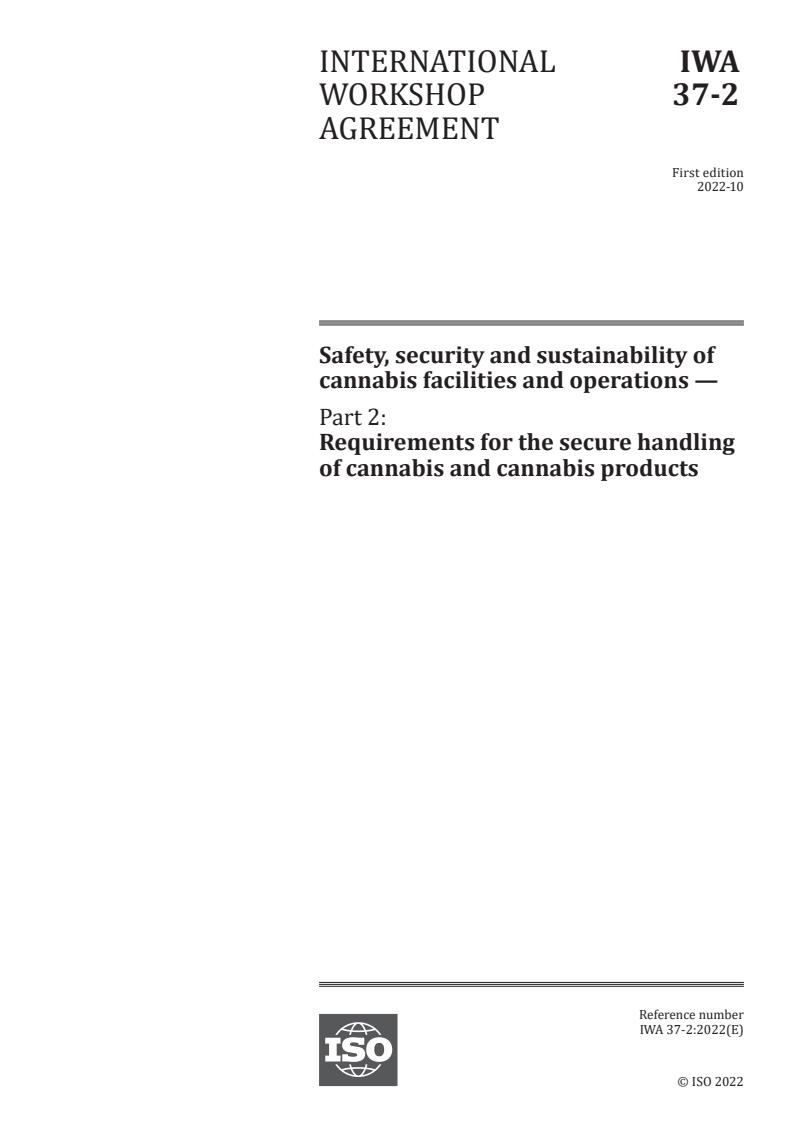
INTERNATIONAL IWA
WORKSHOP 37-2
AGREEMENT
First edition
2022-10
Safety, security and sustainability of
cannabis facilities and operations —
Part 2:
Requirements for the secure handling
of cannabis and cannabis products
Reference number
© ISO 2022
All rights reserved. Unless otherwise specified, or required in the context of its implementation, no part of this publication may
be reproduced or utilized otherwise in any form or by any means, electronic or mechanical, including photocopying, or posting on
the internet or an intranet, without prior written permission. Permission can be requested from either ISO at the address below
or ISO’s member body in the country of the requester.
ISO copyright office
CP 401 • Ch. de Blandonnet 8
CH-1214 Vernier, Geneva
Phone: +41 22 749 01 11
Email: copyright@iso.org
Website: www.iso.org
Published in Switzerland
ii
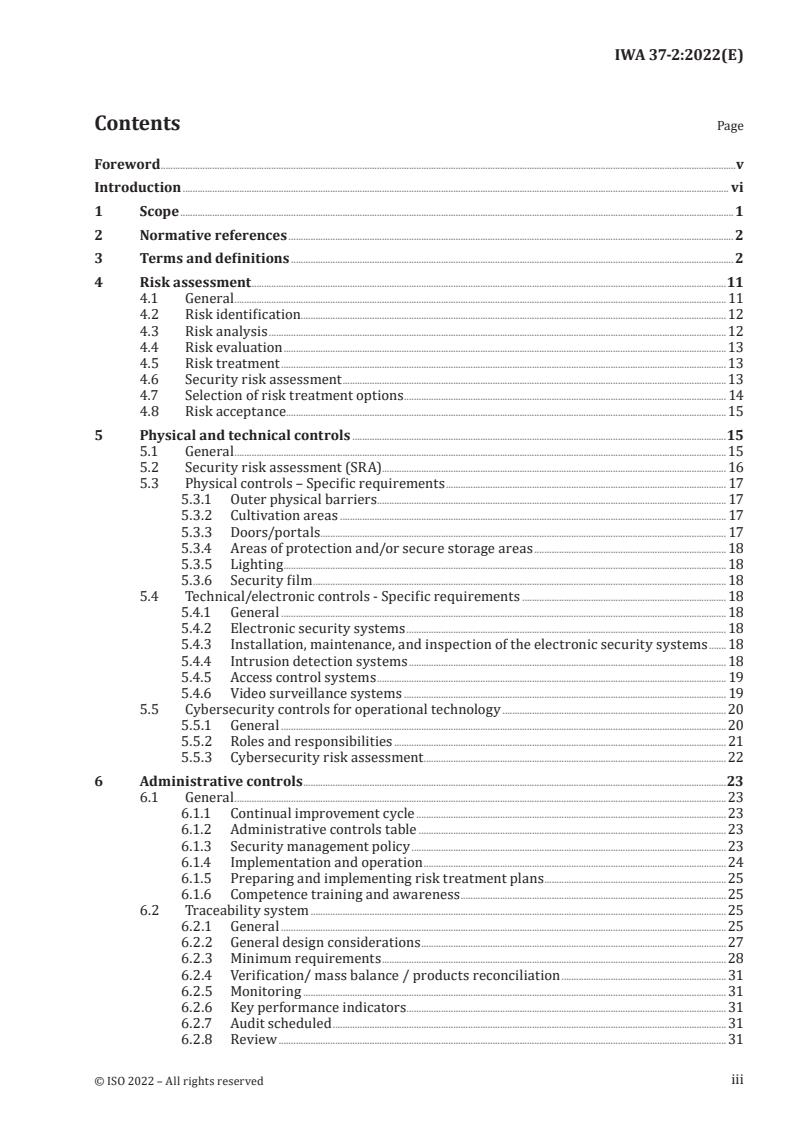
Contents Page
Foreword .v
Introduction . vi
1 Scope . 1
2 Normative references . 2
3 Terms and definitions . 2
4 Risk assessment .11
4.1 General . 11
4.2 Risk identification. 12
4.3 Risk analysis .12
4.4 Risk evaluation .13
4.5 Risk treatment . 13
4.6 Security risk assessment .13
4.7 Selection of risk treatment options . 14
4.8 Risk acceptance . . .15
5 Physical and technical controls .15
5.1 General . 15
5.2 Security risk assessment (SRA) . . 16
5.3 Physical controls – Specific requirements . 17
5.3.1 Outer physical barriers . . . 17
5.3.2 Cultivation areas . 17
5.3.3 Doors/portals . 17
5.3.4 Areas of protection and/or secure storage areas . 18
5.3.5 Lighting . 18
5.3.6 Security film . 18
5.4 Technical/electronic controls - Specific requirements . 18
5.4.1 General . 18
5.4.2 Electronic security systems . 18
5.4.3 Installation, maintenance, and inspection of the electronic security systems . 18
5.4.4 Intrusion detection systems . 18
5.4.5 Access control systems . 19
5.4.6 Video surveillance systems . 19
5.5 Cybersecurity controls for operational technology . 20
5.5.1 General .20
5.5.2 Roles and responsibilities . 21
5.5.3 Cybersecurity risk assessment . 22
6 Administrative controls .23
6.1 General .23
6.1.1 Continual improvement cycle . 23
6.1.2 Administrative controls table . 23
6.1.3 Security management policy . 23
6.1.4 Implementation and operation . 24
6.1.5 Preparing and implementing risk treatment plans . 25
6.1.6 Competence training and awareness . 25
6.2 Traceability system . 25
6.2.1 General . 25
6.2.2 General design considerations . 27
6.2.3 Minimum requirements .28
6.2.4 Verification/ mass balance / products reconciliation . 31
6.2.5 Monitoring . 31
6.2.6 Key performance indicators . 31
6.2.7 Audit scheduled . 31
6.2.8 Review . 31
iii
6.3 Security management documentation . 31
6.3.1 General . 31
6.3.2 Document and data control . 32
6.3.3 Operational control . 32
6.3.4 Emergency response and security recovery . 33
7 Requirements for specific activities .33
7.1 Cultivation . 33
7.1.1 Physical and technical/electronic controls for cultivation .33
7.1.2 Administrative controls for cultivation security . 33
7.2 Processing . 36
7.2.1 Physical controls for processing .36
7.2.2 Technical/Electronic controls for processing .36
7.2.3 Administrative controls for processing .36
7.3 Storage/distribution .40
7.3.1 Physical and technical/electronic controls for storage/distribution .40
7.3.2 Cybersecurity controls for storage/distribution .40
7.3.3 Administrative controls for storage/distribution .40
7.4 Research/Testing laboratory . 41
7.4.1 Physical controls for research/testing laboratory. 41
7.4.2 Technical/Electronic controls for research/testing laboratory . 42
7.4.3 Cybersecurity for research/testing laboratory . 43
7.4.4 Administrative controls for research/testing laboratory .44
7.5 Retail/dispensary .46
7.5.1 Physical controls for retail/dispensary .46
7.5.2 Technical/electronic controls for retail/dispensary . 47
7.5.3 Cybersecurity controls for retail/dispensary .49
7.5.4 Administrative controls for retail/dispensary .49
7.6 Transportation .50
7.6.1 Physical controls for transportation .50
7.6.2 Technical controls for transportation . 52
7.6.3 Administrative controls for transportation . 52
Annex A (informative) Threat and risk assessment checklist and instructions .54
Annex B (informative) Administrative controls and minimum required content of security
policy .59
Annex C (informative) Physical and technical/electronic controls .62
Bibliography .64
iv
Foreword
ISO (the International Organization for Standardization) is a worldwide federation of national standards
bodies (ISO member bodies). The work of preparing International Standards is normally carried out
through ISO technical committees. Each member body interested in a subject for which a technical
committee has been established has the right to be represented on that committee. International
organizations, governmental and non-governmental, in liaison with ISO, also take part in the work.
ISO collaborates closely with the International Electrotechnical Commission (IEC) on all matters of
electrotechnical standardization.
The procedures used to develop this document and those intended for its further maintenance are
described in the ISO/IEC Directives, Part 1. In particular, the different approval criteria needed for the
different types of ISO documents should be noted. This document was drafted in accordance with the
editorial rules of the ISO/IEC Directives, Part 2 (see www.iso.org/directives).
Attention is drawn to the possibility that some of the elements of this document may be the subject of
patent rights. ISO shall not be held responsible for identifying any or all such patent rights. Details of
any patent rights identified during the development of the document will be in the Introduction and/or
on the ISO list of patent declarations received (see www.iso.org/patents).
Any trade name used in this document is information given for the convenience of users and does not
constitute an endorsement.
For an explanation of the voluntary nature of standards, the meaning of ISO specific terms and
expressions related to conformity assessment, as well as information about ISO's adherence to
the World Trade Organization (WTO) principles in the Technical Barriers to Trade (TBT), see
www.iso.org/iso/foreword.html.
International Workshop Agreement IWA 37 was approved at a series of workshops hosted by the
Standards Council of Canada (SCC), in association with Underwriters Laboratories of Canada (ULC),
held virtually between December 2020 and June 2021.
A list of all parts in the IWA 37 series can be found on the ISO website.
Any feedback or questions on this document should be directed to the user’s national standards body. A
complete listing of these bodies can be found at www.iso.org/members.html.
v
Introduction
While cannabis has been fully legalized in Canada and in many states in the USA, it is a new and emerging
industry that is moving at a very fast pace in many other parts of the world. While legalization is being
deliberated by governments and legislative bodies, companies are creating their own infrastructure
in anticipation of legal approval. Meanwhile, government regulators and the societies they serve are
grappling with the lack of consistent rules and guidance to deliver safety, security and sustainability
of cannabis facilities and operations, while growers and producers use their own judgment on how to
establish and operate facilities.
It has become very clear that the global cannabis market is opening up very rapidly. The cannabis
product and the industry will become more and more ubiquitous as the global barriers start to lower
and come down. If the current trend continues, it is predicted that well over one third of the globe will
accommodate cannabis by 2024.
What is unique about this new and emerging industry is that it is coming from an illicit status into
decriminalization and evolving into a legitimate burgeoning business. Due to its pioneering status, very
little exists in terms of research, studies, historical experience and best practices. Standardization is
likewise very slow on the uptake and the cannabis industry remains severely underserved.
There are therefore distinct challenges for the safety, security and sustainability of cannabis facilities
and operations, which the IWA 37 series seeks to address as follows:
— Part 1: Requirements for the safety of cannabis buildings, equipment and oil extraction operations;
— Part 2 (this document): Requirements for the secure handling of cannabis and cannabis products;
— Part 3: Good production practices (GPP).
In addition to the requirements for facilities specified in this document, statutory and regulatory
requirements and codes can apply.
Supporting material to accompany the IWA 37 series is available at the following website:
IWA 37 — Safety, security and sustainability of cannabis facilities and operations.
A list of workshop participants is available from the Standards Council of Canada (SCC).
vi
International Workshop Agreement IWA 37-2:2022(E)
Safety, security and sustainability of cannabis facilities and
operations —
Part 2:
Requirements for the secure handling of cannabis and
cannabis products
1 Scope
This document specifies minimum requirements for the security of sites and facilities that handle
cannabis and cannabis products for the purposes of cultivation (indoor and outdoor), processing,
storage/distribution, transportation, retail sales, and research and testing, in order to prevent harm
and/or unauthorized access to assets including (but not limited to):
— physical assets;
— personnel;
— cannabis and cannabis products;
— records and information.
NOTE Premises covered in this document include indoor and outdoor cultivation, processing/production
facilities and retail stores.
The overall security programme and individual security measures addressed in this document
incorporate three types:
a) physical controls;
b) technical controls;
c) administrative controls.
This document specifies minimum requirements for general security of cannabis and cannabis
products, up to and including:
— physical security design/measures intended to deny, deter, delay, respond to, and recover from
unauthorized access;
— design, installation and maintenance of electronic security systems intended to restrict access,
detect intrusion and visually monitor/record activity in security-sensitive areas;
— procedural security measures intended to instruct day-to-day security activities, both routine and
emergency, across an organization;
— personnel security measures intended to ensure all personnel attending the facility are properly
screened, instructed and trained in security awareness;
— the monitoring of the security status of cannabis and cannabis products throughout the product
lifecycle, from cultivation to retail sale, including transportation.
This document provides guidelines for:
— the installation, maintenance and inspection of physical and electronic premises security and
cybersecurity systems;
— the implementation of information security governance at organizational level to include policies,
procedures, and standards to protect the confidentiality, integrity and availability of records and
information.
All requirements in this document are generic and intended to be applicable to all organizations in the
cannabis supply chain, regardless of size and/or complexity.
2 Normative references
The following documents are referred to in the text in such a way that some, or all, of their content
constitutes requirements of this document. For dated references, only the edition cited applies. For
undated references, the latest edition of the referenced document (including any amendments) applies.
IWA 37-1, Safety, security and sustainability of cannabis facilities and operations — Part 1: Requirements
for the safety of cannabis buildings, equipment and oil extraction operations
ISO 22005, Traceability in the feed and food chain — General principles and basic requirements for system
design and implementation
IEC 60839-11-1:2013, Alarm and electronic security systems — Part 11-1: Electronic access control systems
– System and components requirements
IEC 60839-11-2, Alarm and electronic security systems — Part 11-2: Electronic access control systems –
Application guidelines
IEC 62368-1, Audio/video, information and communication technology equipment — Part 1: Safety
requirements
IEC 62676-4, Video Surveillance Systems for Use in Security Applications — Part 4: Application Guidelines
ANSI/UL 681, Standard for Safety Installation and Classification of Burglar and Holdup Alarm Systems
ANSI/UL 687, Standard for Safety Burglary-Resistant Safes
ANSI/UL 827, Standard for Safety Central-Station Alarm Services
ASTM D8205, Standard Guide for Video Surveillance System
ASTM D8218, Standard Guide for Intrusion Detection System (IDS)
CAN/ULC -S301: 2018, Standard for Signal Receiving Centres Configurations and Operations
CAN/ULC-S302, Standard for the Installation, Inspection and Testing of Intrusion Alarm Systems
EN 1143-1, Secure storage units — Requirements, classification and methods of test for resistance to
burglary — Part 1: Safes, ATM safes, strongroom doors and strongrooms
EN 50518, Monitoring and alarm receiving centre
UL 972, Standard for Safety Burglary Resisting Glazing Material
3 Terms and definitions
For the purposes of this document, the following terms and definitions apply.
ISO and IEC maintain terminology databases for use in standardization at the following addresses:
— ISO Online browsing platform: available at https:// www .iso .org/ obp
— IEC Electropedia: available at https:// www .electropedia .org/
3.1
access control system
system designed to grant to authorized persons, or entities, entry to and/or exit from a security
controlled area (3.15) and deny such entry and/or exit to non-authorized individuals, or entities
[SOURCE: IEC 60839-11-1:2013, 3.63, modified – Second preferred term “electronic access control
system” and Note 1 to entry have been deleted.]
3.2
authority having jurisdiction
AHJ
organization (3.35), office, or individual responsible for enforcing the requirements (3.44) of a code or
standard, or for approving equipment, materials, an installation, or a procedure
Note 1 to entry: Note to entry: Also referred to as “competent authority”.
[SOURCE: ISO 7076-5:2014, 3.4, modified – Note 1 to entry has been added.]
3.3
cannabis
genus of flowering plants made up of many different phytocannabinoids and chemical compounds
Note 1 to entry: Research into cannabis by governing bodies and organizations (3.35) is ongoing around the
world, and drug classifications are constantly under review. Regulation of cannabis legalization frameworks can
vary between jurisdictions, based on the levels of tetrahydrocannabinol (THC) available in the plant.
3.4
cannabis derivative
secondary product (3.42) that can be extracted or obtained from a cannabis (3.3) biomass
Note 1 to entry: Classification of synthetically derived cannabinoids can vary between jurisdictions.
3.5
cannabis edible
food (3.24) which includes cannabis (3.3) or cannabis derivative (3.4) as an ingredient
Note 1 to entry: Dried cannabis, fresh cannabis, cannabis plants or cannabis plant seeds are not in themselves
considered food.
3.6
cannabis product
packaged goods containing cannabis (3.3) or cannabis derivative (3.4), available in multiple formats for
commercial and/or retail distribution
3.7
cannabis waste
solid, liquid or gaseous material that is a cannabis product (3.6), contains cannabis (3.3) or has come
into contact with cannabis, destined for disposal and not intended for sale or for use in any way other
than for agronomic purposes such as compost
Note 1 to entry: Definitions of cannabis waste can vary between jurisdictions. For example, in a jurisdiction that
sets a specific tetrahydrocannabinol (THC) threshold to define cannabis waste at a specific concentration of THC
(e.g. 10 μg/g), waste that has a concentration below that threshold is not considered to be cannabis waste.
3.8
chain of custody
process (3.41) by which inputs and outputs and associated information are transferred, monitored and
controlled as they move through each step in the relevant supply chain
[SOURCE: ISO 22095:2020, 3.1.1]
3.9
competence
ability to apply knowledge and skills to achieve intended results
[SOURCE: ISO 22000:2018, 3.4]
3.10
complete protection
electronic protection of any point at which entry can be gained without cutting or tearing down any
part of the premises structure, in order to detect entry through it, in addition to the detection of the
physical removal of any moveable or removable portion of the closure over the opening
3.11
conformity
fulfilment of a requirement (3.44)
[SOURCE: ISO 22000:2018, 3.5]
3.12
contamination
introduction or occurrence of a contaminant including a safety hazard (3.48) in a product (3.42) or
processing environment
[SOURCE: ISO 22000:2018, 3.6]
3.13
continual improvement
recurring activity to enhance performance (3.37)
[SOURCE: ISO 22000:2018, 3.7]
3.14
control measure
action or activity that is essential to prevent a safety hazard (3.48) and/or significant safety hazard or
reduce it to an acceptable level
Note 1 to entry: Control measure(s) is (are) identified by risk (3.46) assessment/hazard analysis.
[SOURCE: ISO 22000:2018, 3.8, modified — The words “a significant food safety hazard” have been
replaced with “a safety hazard and/or significant safety hazard” in the definition; the original Note 1
to entry has been deleted and the words “risk assessment” have been added to the remaining Note to
entry.]
3.15
controlled area
room, area, building, premises or parts thereof to which access is monitored, limited, or controlled
3.16
corrective action
action to eliminate the cause of a nonconformity (3.32) and to prevent recurrence
Note 1 to entry: There can be more than one cause for a nonconformity.
Note 2 to entry: Corrective action includes cause analysis.
[SOURCE: ISO 22000:2018, 3.10]
3.17
cultivation
process (3.41) of growing cannabis (3.3), including drying, trimming, milling and storing
3.18
documented information
information required to be controlled and maintained by an organization (3.35) and the medium on
which it is contained
Note 1 to entry: Documented information can be in any format and media, and from any source.
Note 2 to entry: Documented information can refer to:
— the management system (3.30), including related processes;
— information created in order for the organization to operate (documentation);
— evidence of results achieved (records).
[SOURCE: ISO 22000:2018, 3.13]
3.19
duress alarm
silent alarm signal generated by the manual entry of a designated code at the system keypad in the
event that the user needs assistance, such as when being forced to disarm the burglar alarm system
against the user’s will to enter the premises
Note 1 to entry: A duress alarm can also be referred to as an ambush alarm or a panic alarm
Note 2 to entry: Duress alarms are typically treated as holdup alarms (3.24) by monitoring (3.31) station
personnel and are dispatched upon immediately without the need for any type of alarm verification (3.55).
3.20
effectiveness
extent to which planned activities are realized and planned results achieved
[SOURCE: ISO 22000:2018, 3.14]
3.21
electronic security system
electronic system or combination of systems that monitor(s) or control(s) activity at a premises,
including alarm, access control, video surveillance and unmanned vehicle systems
3.22
extent of protection
designation used to describe the amount of electronic protection installed at a designated area (e.g.
complete protection (3.10), partial protection)
3.23
extraction
process (3.41) where a substance is removed or separated from other compounds, a solution or a
mixture
3.24
food
substance (ingredient), whether processed, semi-processed or raw, which is intended for consumption,
and includes drink, chewing gum and any substance which has been used in the manufacture,
preparation or treatment of “food” but does not include cosmetics or tobacco or substances (ingredients)
used only as drugs
[SOURCE: ISO 22000:2018, 3.18, modified — The original Note to entry has been deleted.]
3.25
greenhouse
building that can have unlimited size, and with more than 50 % of surface area of roofs and/or walls
being transparent and/or translucent for the cultivation (3.17) of cannabis (3.3) plants and other
cultivation activities
3.26
grow area
area of the site where cannabis (3.3) plants are cultivated, harvested or propagated
3.27
holdup alarm
alarm initiated by an individual who perceives a threat to the safety (3.47) and/or security of persons,
facilities, or vehicles, or of being coerced
Note 1 to entry: The alarm is typically silent, but can be visible, and/or audible.
Note 2 to entry: The signalling device can be covert or overt.
3.28
interested party
person or organization (3.35) that can affect, be affected by, or perceive itself to be affected by a decision
or activity
[SOURCE: ISO 22000:2018, 3.23, modified — The admitted term “stakeholder” has been deleted.]
3.29
lot
defined quantity of a product (3.42) produced and/or processed and/or packaged essentially under the
same conditions
Note 1 to entry: The lot is determined by parameters established beforehand by the organization (3.35) and may
be described by other terms, e.g. batch.
Note 2 to entry: The lot may be reduced to a single unit of product.
[SOURCE: ISO 22000:2018, 3.24]
3.30
management system
set of interrelated or interacting elements of an organization (3.35) to establish policies (3.39) and
objectives (3.33) and processes (3.41) to achieve those objectives
Note 1 to entry: A management system can address a single discipline or several disciplines.
Note 2 to entry: The system elements include the organization's structure, roles and responsibilities, planning
and operation.
Note 3 to entry: The scope of a management system may include the whole of the organization, specific and
identified functions of the organization, specific and identified sections of the organization, or one or more
functions across a group of organizations.
Note 4 to entry: Relevant disciplines are, for example, a quality management system or an environmental
management system.
[SOURCE: ISO 22000:2018, 3.25]
3.31
monitoring
determining the status of a system, a process (3.41) or an activity
Note 1 to entry: To determine the status, there may be a need to check, supervise or critically observe.
Note 2 to entry: In the context of cannabis (3.3) safety (3.47), monitoring is conducting a planned sequence of
observations or measurements to assess whether a process is operating as intended.
Note 3 to entry: Distinctions are made in this document between the terms validation (3.54), monitoring and
verification (3.55):
— validation is applied prior to an activity and provides information about the capability to deliver intended
results;
— monitoring is applied during an activity and provides information for action within a specified time frame;
— verification is applied after an activity and provides information for confirmation of conformity (3.11).
[SOURCE: ISO 22000:2018, 3.27, modified — The words “food safety” have been replaced with “cannabis
safety” in Note 2 to entry.]
3.32
nonconformity
non-fulfilment of a requirement (3.44)
[SOURCE: ISO 22000:2018, 3.28]
3.33
objective
result to be achieved
Note 1 to entry: An objective can be strategic, tactical, or operational.
Note 2 to entry: Objectives can relate to different disciplines (such as financial, health and safety (3.47), and
environmental goals) and can apply at different levels (such as strategic, organization-wide, project, product
(3.42), and process (3.41).
Note 3 to entry: An objective can be expressed in other ways, e.g. as an intended outcome, a purpose, an
operational criterion, as a food safety management system (3.30) objective, or by the use of other words with
similar meaning (e.g. aim, goal, or target).
Note 4 to entry: In the context of food safety management systems, objectives are set by the organization (3.35),
consistent with the food safety policy (3.39), to achieve specific results.
[SOURCE: ISO 22000:2018, 3.29]
3.34
operational technology
OT
hardware and software that detects or causes a change through the direct monitoring (3.31) and/or
control of physical devices and systems, processes (3.41), and events in an organization (3.35)
3.35
organization
person or group of people that has its own functions with responsibilities, authorities and relationships
to achieve its objectives (3.33)
Note 1 to entry: The concept of organization includes, but is not limited to sole-trader, company, corporation, firm,
enterprise, authority, partnership, charity or institution, or part or combination thereof, whether incorporated
or not, public or private.
[SOURCE: ISO 22000:2018, 3.31]
3.36
outsource
make an arrangement where an external organization (3.35) performs part of an organization’s function
or process (3.41)
Note 1 to entry: An external organization is outside the scope of the management system (3.30), although the
outsourced function or process is within the scope.
[SOURCE: ISO 22000:2018, 3.32]
3.37
performance
measurable result
Note 1 to entry: Performance can relate either to quantitative or qualitative findings.
Note 2 to entry: Performance can relate to the management of activities, processes (3.41), products (3.42)
(including services), systems or organizations (3.35).
[SOURCE: ISO 22000:2018, 3.33]
3.38
physical security
security measures that are designed to deny access to unauthorized persons from physically accessing
a building, premises, secured area or security container
3.39
policy
intentions and direction of an organization (3.35) as formally expressed by its top management (3.52)
[SOURCE: ISO 22000:2018, 3.34]
3.40
potency
amount per unit of the standardized component(s) which further characterizes the quantity of the
ingredient
Note 1 to entry: The use of the term potency in this document is not intended to refer to product (3.42) efficacy.
3.41
process
set of interrelated or interacting activities which transforms inputs to outputs
[SOURCE: ISO 22000:2018, 3.36]
3.42
product
output that is a result of a process (3.41)
Note 1 to entry: A product can be a service.
[SOURCE: ISO 22000:2018, 3.37]
3.43
protected area
protected premises, or an area within, that is provided with means to prevent an unwanted event
Note 1 to entry: Protected areas are imposed in the low security level.
3.44
requirement
need or expectation that is stated, generally implied or obligatory
Note 1 to entry: “Generally implied” means that it is custom or common practice for the organization (3.35) and
interested parties (3.28) that the need or expectation under consideration is implied.
Note 2 to entry: A specified requirement is one that is stated, for example in documented information (3.18).
[SOURCE: ISO 22000:2018, 3.38]
3.45
restricted area
room, area, or building within a site for which access is only permitted for authorized persons
Note 1 to entry: Restricted areas are imposed in the high security level.
[SOURCE: IEC 62128-1:2013, 3.9.5, modified – The word “area” has been replaced with “room, area, or
building within a site” and Note 1 to entry has been added.]
3.46
risk
effect of uncertainty
Note 1 to entry: An effect is a deviation from the expected – positive or negative.
Note 2 to entry: Uncertainty is the state, even partial, of deficiency of information related to, understanding or
knowledge of, an event, its consequence, or likelihood.
Note 3 to entry: Risk is often characterized by reference to potential “events” (as defined in ISO Guide 73:2009,
3.5.1.3) and “consequences” as defined in ISO Guide 73:2009, 3.6.1.3), or a combination of these.
Note 4 to entry: Risk is often expressed in terms of a combination of the consequences of an event (including
changes in circumstances) and the associated “likelihood” (as defined in ISO Guide 73:2009, 3.6.1.1) of occurrence.
[SOURCE: ISO 22000:2018, 3.39, modified — The original Note 5 to entry has been deleted.]
3.47
safety
assurance that the product (3.42) will not cause an adverse health effect for the consumer when it is
prepared and/or used according to its intended use
Note 1 to entry: Safety is related to the occurrence of safety hazards (3.48) in end products and does not include
other health aspects.
3.48
safety hazard
source or situation with the potential to cause an adverse health effect
Note 1 to entry: The term hazard is not to be confused with the term risk (3.46) which, in the context of safety
(3.47), means a function of the probability of an adverse health effect (e.g. becoming diseased) and the severity of
that effect (e.g. death, hospitalization) when exposed to a specified hazard.
Note 2 to entry: Safety hazards include allergens and radiological substances.
[SOURCE: ISO 22000:2018, 3.22, modified — The word “food” has been deleted from the term and from
Notes 1 and 2 to entry; the words “biological, chemical or physical agent in food” have been replaced
with “source or situation” in the definition; the original Notes 3 and 4 to entry have been deleted.]
3.49
secure area
area with defined physical perimeters and barriers, with physical entry controls or access point
protection or access point observation
Note 1 to entry: Secure areas are imposed in the medium security level.
[SOURCE: IEC 61162-460:2018, 3.37, modified – The original Note 1 to entry has been deleted and a new
Note 1 to entry has been added.]
3.50
security risk assessment
overall process (3.41) of identification, analysis and evaluation of risks (3.46) to security objectives
(3.33) and outcomes
3.51
signal receiving centre
SRC
portion, or portions of a building, occupied by the alarm operating company, which encompasses the
centre operations area and the facilities essential to the operation of monitoring (3.31), processing, and
disposition of alarm signals
[SOURCE: CAN/ULC -S301: 2018, 3.13]
3.52
top management
person or group of people who directs and controls an organization (3.35) at the highest level
Note 1 to entry: Top management has the power to delegate authority and provide resources within the
organization.
Note 2 to entry: If the scope of the management system (3.30) covers only part of an organization, then top
management refers to those who direct and control that part of the organization.
[SOURCE: ISO 22000:2018, 3.41]
3.53
traceability
ability to follow the history, application, movement and location of an object through specified stage(s)
of production, processing and distribution
Note 1 to entry: Movement can relate to the origin of the materials, processing history or distribution of the
product (3.42).
Note 2 to entry: An object can be a product, a material, a unit, equipment, a service, etc.
[SOURCE: ISO 22000:2018, 3.42, modified — The word “food” has been replaced with “product” in Note
1 to entry.]
3.54
validation
obtaining evidence that a control measure (3.14) (or combination of control measures) will be capable of
effectively controlling the significant safety hazard (3.48)
Note 1 to entry: Validation is performed at the time a control measure combination is designed, or whenever
changes are made to the implemented control measures.
Note 2 to entry: Distinctions are made in this document between the terms validation, monitoring (3.31) and
verificat
...
Frequently Asked Questions
IWA 37-2:2022 is a standardization document published by the International Organization for Standardization (ISO). Its full title is "Safety, security and sustainability of cannabis facilities and operations - Part 2: Requirements for the secure handling of cannabis and cannabis products". This standard covers: This document specifies minimum requirements for the security of sites and facilities that handle cannabis and cannabis products for the purposes of cultivation (indoor and outdoor), processing, storage/distribution, transportation, retail sales, and research and testing, in order to prevent harm and/or unauthorized access to assets including (but not limited to): - physical assets; - personnel; - cannabis and cannabis products; - records and information. NOTE Premises covered in this document include indoor and outdoor cultivation, processing/production facilities and retail stores. The overall security programme and individual security measures addressed in this document incorporate three types: a) physical controls; b) technical controls; c) administrative controls. This document specifies minimum requirements for general security of cannabis and cannabis products, up to and including: - physical security design/measures intended to deny, deter, delay, respond to, and recover from unauthorized access; - design, installation and maintenance of electronic security systems intended to restrict access, detect intrusion and visually monitor/record activity in security-sensitive areas; - procedural security measures intended to instruct day-to-day security activities, both routine and emergency, across an organization; - personnel security measures intended to ensure all personnel attending the facility are properly screened, instructed and trained in security awareness; - the monitoring of the security status of cannabis and cannabis products throughout the product lifecycle, from cultivation to retail sale, including transportation. This document provides guidelines for: - the installation, maintenance and inspection of physical and electronic premises security and cybersecurity systems; - the implementation of information security governance at organizational level to include policies, procedures, and standards to protect the confidentiality, integrity and availability of records and information. All requirements in this document are generic and intended to be applicable to all organizations in the cannabis supply chain, regardless of size and/or complexity.
This document specifies minimum requirements for the security of sites and facilities that handle cannabis and cannabis products for the purposes of cultivation (indoor and outdoor), processing, storage/distribution, transportation, retail sales, and research and testing, in order to prevent harm and/or unauthorized access to assets including (but not limited to): - physical assets; - personnel; - cannabis and cannabis products; - records and information. NOTE Premises covered in this document include indoor and outdoor cultivation, processing/production facilities and retail stores. The overall security programme and individual security measures addressed in this document incorporate three types: a) physical controls; b) technical controls; c) administrative controls. This document specifies minimum requirements for general security of cannabis and cannabis products, up to and including: - physical security design/measures intended to deny, deter, delay, respond to, and recover from unauthorized access; - design, installation and maintenance of electronic security systems intended to restrict access, detect intrusion and visually monitor/record activity in security-sensitive areas; - procedural security measures intended to instruct day-to-day security activities, both routine and emergency, across an organization; - personnel security measures intended to ensure all personnel attending the facility are properly screened, instructed and trained in security awareness; - the monitoring of the security status of cannabis and cannabis products throughout the product lifecycle, from cultivation to retail sale, including transportation. This document provides guidelines for: - the installation, maintenance and inspection of physical and electronic premises security and cybersecurity systems; - the implementation of information security governance at organizational level to include policies, procedures, and standards to protect the confidentiality, integrity and availability of records and information. All requirements in this document are generic and intended to be applicable to all organizations in the cannabis supply chain, regardless of size and/or complexity.
IWA 37-2:2022 is classified under the following ICS (International Classification for Standards) categories: 13.310 - Protection against crime; 65.020.20 - Plant growing. The ICS classification helps identify the subject area and facilitates finding related standards.
IWA 37-2:2022 has the following relationships with other standards: It is inter standard links to IWA 37-3:2022, IWA 37-1:2022. Understanding these relationships helps ensure you are using the most current and applicable version of the standard.
You can purchase IWA 37-2:2022 directly from iTeh Standards. The document is available in PDF format and is delivered instantly after payment. Add the standard to your cart and complete the secure checkout process. iTeh Standards is an authorized distributor of ISO standards.
Questions, Comments and Discussion
Ask us and Technical Secretary will try to provide an answer. You can facilitate discussion about the standard in here.
Loading comments...