


ISO 13794:2019
(Main)Ambient air — Determination of asbestos fibres — Indirect-transfer transmission electron microscopy method
Ambient air — Determination of asbestos fibres — Indirect-transfer transmission electron microscopy method
This document specifies a reference method using transmission electron microscopy for the determination of airborne asbestos fibres and structures in in a wide range of ambient air situations, including the interior atmospheres of buildings, and for a detailed evaluation for asbestos structures in any atmosphere. The specimen preparation procedure incorporates ashing and dispersion of the collected particulate, so that all asbestos is measured, including the asbestos originally incorporated in particle aggregates or particles of composite materials. The lengths, widths and aspect ratios of the asbestos fibres and bundles are measured, and these, together with the density of the type of asbestos, also allow the total mass concentration of airborne asbestos to be calculated. The method allows determination of the type(s) of asbestos fibres present. The method cannot discriminate between individual fibres of the asbestos and elongate fragments (cleavage fragments and acicular particles) from non-asbestos analogues of the same amphibole mineral[12].
Air ambiant — Dosage des fibres d'amiante — Méthode par microscopie électronique à transmission par transfert indirect
Le présent document spécifie une méthode de référence utilisant la microscopie électronique à transmission pour la détermination de la concentration en fibres et structures d'amiante en suspension dans l'air dans les atmosphères ambiantes, notamment les atmosphères intérieures de bâtiments, et pour l'évaluation détaillée des structures d'amiante dans les atmosphères. Le mode opératoire de préparation des échantillons comprend la calcination et la dispersion des particules recueillies, de sorte que la totalité de l'amiante est mesurée, y compris l'amiante initialement incorporée dans les agrégats particulaires ou les particules de matériaux composites. Les longueurs, largeurs et rapports longueur/largeur des fibres et faisceaux d'amiante sont mesurés. Ils permettent également, conjointement avec la densité du type d'amiante, de calculer la concentration massique totale d'amiante en suspension dans l'air. La méthode permet de déterminer le(s) type(s) de fibres d'amiante présentes. La méthode ne peut pas faire la différence entre les fibres individuelles d'amiante amphibole et fragments allongés (fragments de clivage et particules aciculaires) et les analogues non asbestiformes du même minéral amphibole[12].
Zunanji zrak - Določevanje azbestnih vlaken - Metoda transmisijske elektronske mikroskopije s posrednim prenosom
Ta dokument določa referenčno metodo, pri kateri se s prenosno elektronsko mikroskopijo določajo azbestna vlakna in strukture v zraku v najrazličnejših okoliščinah zunanjega zraka, vključno z notranjo atmosfero stavb, ter za podrobno oceno azbestnih struktur v poljubni atmosferi. Postopek priprave vzorca vključuje upepelitev in razpršitev zbranih delcev, tako da se izmeri ves azbest, vključno z azbestom, ki je bil prvotno vgrajen v agregat delcev ali delce kompozitnih materialov. Izmerijo se dolžine, širine in razmerja azbestnih vlaken in svežnjev, kar skupaj z gostoto vrste azbesta omogoča tudi izračun skupne masne koncentracije azbesta v zraku. Metoda omogoča določitev vrst(-e) prisotnih azbestnih vlaken. Z metodo ni mogoče razlikovati med posameznimi vlakni azbesta in razteznimi fragmenti (delci cepitve in acikularnimi delci) iz neazbestnih analogov istega amfibolovega minerala[12].
General Information
- Status
- Published
- Publication Date
- 30-Sep-2019
- Technical Committee
- ISO/TC 146/SC 3 - Ambient atmospheres
- Drafting Committee
- ISO/TC 146/SC 3/WG 1 - Determination of asbestos fibre content
- Current Stage
- 9093 - International Standard confirmed
- Start Date
- 04-Aug-2025
- Completion Date
- 12-Feb-2026
Relations
- Effective Date
- 15-Mar-2018
Overview
ISO 13794:2019 - Ambient air - Determination of asbestos fibres - Indirect-transfer transmission electron microscopy method - specifies a reference laboratory procedure for measuring asbestos fibres in ambient air using indirect-transfer transmission electron microscopy (TEM). The method covers sampling in a wide range of ambient atmospheres, including indoor building air, and supports a detailed evaluation of asbestos structures. Specimen preparation includes ashing and dispersion so that asbestos contained in aggregates or composite particles is measured. The procedure reports fibre dimensions (length, width, aspect ratio), identifies asbestos type(s), and-using fibre geometry and mineral density-enables estimation of total mass concentration of airborne asbestos.
Key topics and technical requirements
- Air sampling and analytical sensitivity: Defined sampling equipment (filter cassettes, pumps, flowmeters) and calculation of analytical sensitivity for ambient asbestos monitoring.
- Specimen preparation: Protocols for filter ashing, aqueous dispersion, filtration of residues, carbon-coating, and TEM grid preparation for both polycarbonate and cellulose ester filters.
- Instrumentation and calibration: Requirements for transmission electron microscope (TEM) performance, energy dispersive X‑ray analysis (EDXA) for fibre identification, plasma asher, vacuum coaters, and calibration specimens.
- Structure counting and sizing: Criteria and procedures for counting asbestos fibres and bundles, measuring lengths/widths/aspect ratios, and terminating examinations based on statistical criteria.
- Mass concentration estimation: Method for converting counted structures and measured dimensions into mass concentration using asbestos density.
- Quality control: Blank determinations, precision/accuracy considerations, limits of detection, and inter-/intra-laboratory performance requirements.
- Limitations: The method cannot reliably discriminate between asbestos fibres and elongate cleavage fragments or acicular particles from non‑asbestos amphiboles of similar morphology.
Practical applications
- Environmental monitoring of ambient air asbestos near demolition, renovation, or industrial sites.
- Indoor air assessments in buildings suspected of containing asbestos materials.
- Forensic and investigative studies requiring detailed morphological and mineralogical identification of airborne asbestos.
- Regulatory compliance testing and generation of technical reports for public health agencies, consultants, and stakeholders.
Who should use this standard
- Environmental and industrial hygiene laboratories performing asbestos testing.
- Accredited testing bodies, regulatory agencies, building inspectors, and consultants conducting asbestos exposure assessments.
- Researchers studying airborne asbestos occurrence, transport, and exposure metrics.
Related standards
- ISO 13794:2019 supersedes SIST ISO 13794:2002.
- The standard complements other asbestos monitoring approaches (e.g., phase-contrast microscopy comparisons and PCM-equivalent calculations referenced in annexes).
Keywords: ISO 13794:2019, asbestos fibres, ambient air, transmission electron microscopy, TEM, indirect-transfer, air sampling, asbestos monitoring, asbestos fibre measurement.


ISO 13794:2019 - Ambient air -- Determination of asbestos fibres -- Indirect-transfer transmission electron microscopy method

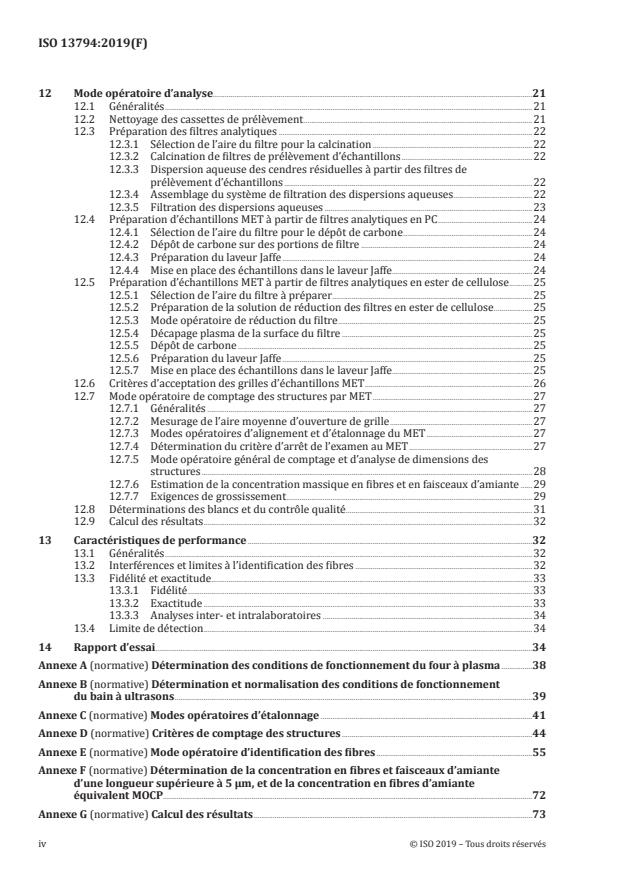
ISO 13794:2019 - Air ambiant -- Dosage des fibres d'amiante -- Méthode par microscopie électronique a transmission par transfert indirect
Get Certified
Connect with accredited certification bodies for this standard

NSF International
Global independent organization facilitating standards development and certification.

CIS Institut d.o.o.
Personal Protective Equipment (PPE) certification body. Notified Body NB-2890 for EU Regulation 2016/425 PPE.

Kiwa BDA Testing
Building and construction product certification.
Sponsored listings
Frequently Asked Questions
ISO 13794:2019 is a standard published by the International Organization for Standardization (ISO). Its full title is "Ambient air — Determination of asbestos fibres — Indirect-transfer transmission electron microscopy method". This standard covers: This document specifies a reference method using transmission electron microscopy for the determination of airborne asbestos fibres and structures in in a wide range of ambient air situations, including the interior atmospheres of buildings, and for a detailed evaluation for asbestos structures in any atmosphere. The specimen preparation procedure incorporates ashing and dispersion of the collected particulate, so that all asbestos is measured, including the asbestos originally incorporated in particle aggregates or particles of composite materials. The lengths, widths and aspect ratios of the asbestos fibres and bundles are measured, and these, together with the density of the type of asbestos, also allow the total mass concentration of airborne asbestos to be calculated. The method allows determination of the type(s) of asbestos fibres present. The method cannot discriminate between individual fibres of the asbestos and elongate fragments (cleavage fragments and acicular particles) from non-asbestos analogues of the same amphibole mineral[12].
This document specifies a reference method using transmission electron microscopy for the determination of airborne asbestos fibres and structures in in a wide range of ambient air situations, including the interior atmospheres of buildings, and for a detailed evaluation for asbestos structures in any atmosphere. The specimen preparation procedure incorporates ashing and dispersion of the collected particulate, so that all asbestos is measured, including the asbestos originally incorporated in particle aggregates or particles of composite materials. The lengths, widths and aspect ratios of the asbestos fibres and bundles are measured, and these, together with the density of the type of asbestos, also allow the total mass concentration of airborne asbestos to be calculated. The method allows determination of the type(s) of asbestos fibres present. The method cannot discriminate between individual fibres of the asbestos and elongate fragments (cleavage fragments and acicular particles) from non-asbestos analogues of the same amphibole mineral[12].
ISO 13794:2019 is classified under the following ICS (International Classification for Standards) categories: 13.040.20 - Ambient atmospheres. The ICS classification helps identify the subject area and facilitates finding related standards.
ISO 13794:2019 has the following relationships with other standards: It is inter standard links to ISO 13794:1999. Understanding these relationships helps ensure you are using the most current and applicable version of the standard.
ISO 13794:2019 is available in PDF format for immediate download after purchase. The document can be added to your cart and obtained through the secure checkout process. Digital delivery ensures instant access to the complete standard document.
Standards Content (Sample)
SLOVENSKI STANDARD
01-december-2019
Nadomešča:
SIST ISO 13794:2002
Zunanji zrak - Določevanje azbestnih vlaken - Metoda transmisijske elektronske
mikroskopije s posrednim prenosom
Ambient air - Determination of asbestos fibres - Indirect-transfer transmission electron
microscopy method
Air ambiant - Dosage des fibres d'amiante - Méthode par microscopie électronique à
transmission par transfert indirect
Ta slovenski standard je istoveten z: ISO 13794:2019
ICS:
13.040.20 Kakovost okoljskega zraka Ambient atmospheres
2003-01.Slovenski inštitut za standardizacijo. Razmnoževanje celote ali delov tega standarda ni dovoljeno.
INTERNATIONAL ISO
STANDARD 13794
Second edition
2019-10
Ambient air — Determination of
asbestos fibres — Indirect-transfer
transmission electron microscopy
method
Air ambiant — Dosage des fibres d'amiante — Méthode par
microscopie électronique à transmission par transfert indirect
Reference number
©
ISO 2019
© ISO 2019
All rights reserved. Unless otherwise specified, or required in the context of its implementation, no part of this publication may
be reproduced or utilized otherwise in any form or by any means, electronic or mechanical, including photocopying, or posting
on the internet or an intranet, without prior written permission. Permission can be requested from either ISO at the address
below or ISO’s member body in the country of the requester.
ISO copyright office
CP 401 • Ch. de Blandonnet 8
CH-1214 Vernier, Geneva
Phone: +41 22 749 01 11
Fax: +41 22 749 09 47
Email: copyright@iso.org
Website: www.iso.org
Published in Switzerland
ii © ISO 2019 – All rights reserved
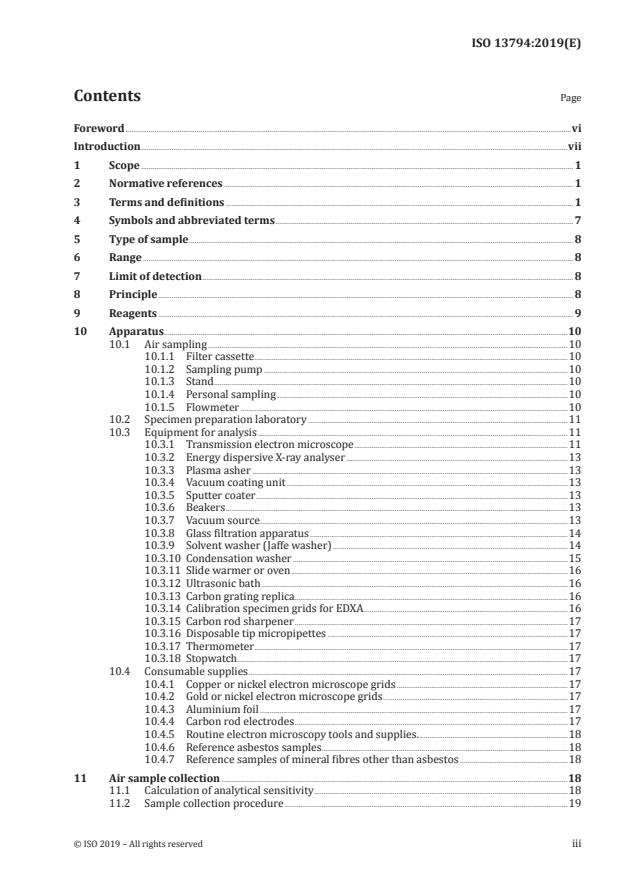
Contents Page
Foreword .vi
Introduction .vii
1 Scope . 1
2 Normative references . 1
3 Terms and definitions . 1
4 Symbols and abbreviated terms . 7
5 Type of sample . 8
6 Range . 8
7 Limit of detection . 8
8 Principle . 8
9 Reagents . 9
10 Apparatus .10
10.1 Air sampling .10
10.1.1 Filter cassette .10
10.1.2 Sampling pump .10
10.1.3 Stand .10
10.1.4 Personal sampling .10
10.1.5 Flowmeter .10
10.2 Specimen preparation laboratory .11
10.3 Equipment for analysis .11
10.3.1 Transmission electron microscope .11
10.3.2 Energy dispersive X-ray analyser .13
10.3.3 Plasma asher .13
10.3.4 Vacuum coating unit .13
10.3.5 Sputter coater .13
10.3.6 Beakers .13
10.3.7 Vacuum source .13
10.3.8 Glass filtration apparatus .14
10.3.9 Solvent washer (Jaffe washer) .14
10.3.10 Condensation washer .15
10.3.11 Slide warmer or oven .16
10.3.12 Ultrasonic bath .16
10.3.13 Carbon grating replica.16
10.3.14 Calibration specimen grids for EDXA .16
10.3.15 Carbon rod sharpener .17
10.3.16 Disposable tip micropipettes .17
10.3.17 Thermometer .17
10.3.18 Stopwatch.17
10.4 Consumable supplies .17
10.4.1 Copper or nickel electron microscope grids .17
10.4.2 Gold or nickel electron microscope grids .17
10.4.3 Aluminium foil .17
10.4.4 Carbon rod electrodes .17
10.4.5 Routine electron microscopy tools and supplies. .18
10.4.6 Reference asbestos samples . .18
10.4.7 Reference samples of mineral fibres other than asbestos .18
11 Air sample collection .18
11.1 Calculation of analytical sensitivity .18
11.2 Sample collection procedure .19
12 Procedure for analysis .20
12.1 General .20
12.2 Cleaning of sample cassettes .20
12.3 Preparation of analytical filters .20
12.3.1 Selection of filter area for ashing .20
12.3.2 Ashing of sample collection filters.20
12.3.3 Aqueous dispersal of residual ash from sample collection filters .21
12.3.4 Assembly of system for filtration of aqueous dispersions .21
12.3.5 Filtration of aqueous dispersions.21
12.4 Preparation of TEM specimens from PC analytical filters .22
12.4.1 Selection of filter area for carbon-coating .22
12.4.2 Carbon-coating of filter portions .22
12.4.3 Preparation of the Jaffe washer .23
12.4.4 Placing of specimens into the Jaffe washer .23
12.5 Preparation of TEM specimens from cellulose ester analytical filters .23
12.5.1 Selection of area of filter for preparation .23
12.5.2 Preparation of solution for collapsing cellulose ester filters .23
12.5.3 Filter-collapsing procedure .23
12.5.4 Plasma etching of the filter surface .23
12.5.5 Carbon-coating .24
12.5.6 Preparation of the Jaffe washer .24
12.5.7 Placing of specimens in the Jaffe washer .24
12.6 Criteria for acceptable TEM specimen grids .24
12.7 Procedure for structure counting by TEM.25
12.7.1 General.25
12.7.2 Measurement of mean grid opening area .25
12.7.3 TEM alignment and calibration procedures .26
12.7.4 Determination of criterion for termination of TEM examination.26
12.7.5 General procedure for structure counting and size analysis .26
12.7.6 Estimation of mass concentration of asbestos fibres and bundles .27
12.7.7 Magnification requirements .27
12.8 Blank and quality control determinations .29
12.9 Calculation of results .30
13 Performance characteristics .30
13.1 General .30
13.2 Interferences and limitations of fibre identification .30
13.3 Precision and accuracy.31
13.3.1 Precision.31
13.3.2 Accuracy .31
13.3.3 Inter- and intra-laboratory analyses .31
13.4 Limit of detection .32
14 Test report .32
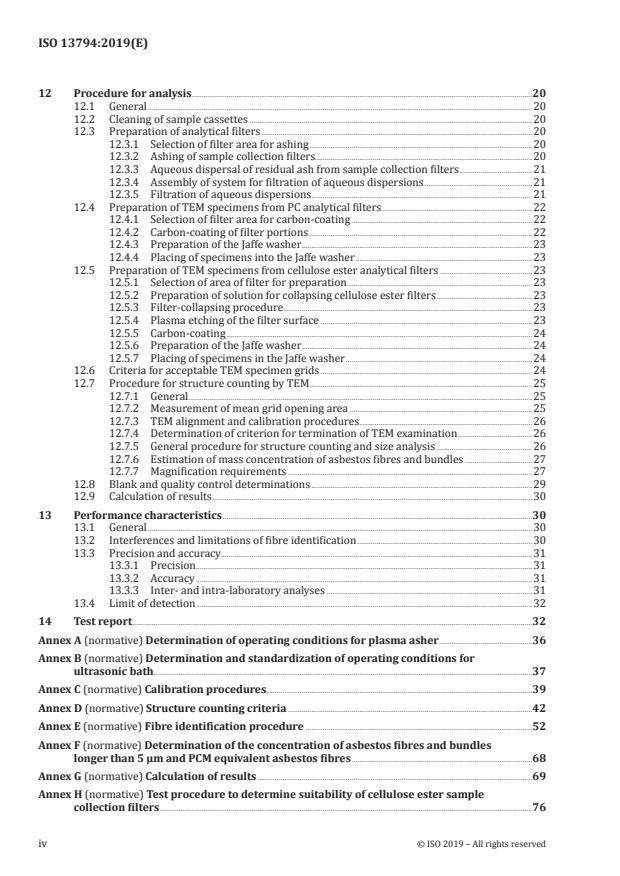
Annex A (normative) Determination of operating conditions for plasma asher .36
Annex B (normative) Determination and standardization of operating conditions for
ultrasonic bath .37
Annex C (normative) Calibration procedures .39
Annex D (normative) Structure counting criteria .42
Annex E (normative) Fibre identification procedure .52
Annex F (normative) Determination of the concentration of asbestos fibres and bundles
longer than 5 µm and PCM equivalent asbestos fibres .68
Annex G (normative) Calculation of results .69
Annex H (normative) Test procedure to determine suitability of cellulose ester sample
collection filters .76
iv © ISO 2019 – All rights reserved
Annex I (informative) Strategies for collection of air samples .77
Bibliography .78
Foreword
ISO (the International Organization for Standardization) is a worldwide federation of national standards
bodies (ISO member bodies). The work of preparing International Standards is normally carried out
through ISO technical committees. Each member body interested in a subject for which a technical
committee has been established has the right to be represented on that committee. International
organizations, governmental and non-governmental, in liaison with ISO, also take part in the work.
ISO collaborates closely with the International Electrotechnical Commission (IEC) on all matters of
electrotechnical standardization.
The procedures used to develop this document and those intended for its further maintenance are
described in the ISO/IEC Directives, Part 1. In particular, the different approval criteria needed for the
different types of ISO documents should be noted. This document was drafted in accordance with the
editorial rules of the ISO/IEC Directives, Part 2 (see www .iso .org/directives).
Attention is drawn to the possibility that some of the elements of this document may be the subject of
patent rights. ISO shall not be held responsible for identifying any or all such patent rights. Details of
any patent rights identified during the development of the document will be in the Introduction and/or
on the ISO list of patent declarations received (see www .iso .org/patents).
Any trade name used in this document is information given for the convenience of users and does not
constitute an endorsement.
For an explanation of the voluntary nature of standards, the meaning of ISO specific terms and
expressions related to conformity assessment, as well as information about ISO's adherence to the
World Trade Organization (WTO) principles in the Technical Barriers to Trade (TBT) see the following
URL: www .iso .org/iso/foreword .html.
This document was prepared by Technical Committee ISO/TC 146, Air quality, Subcommittee SC 3,
Ambient atmospheres.
This second edition cancels and replaces the first edition (ISO 13794:1999), which has been technically
revised. The main changes compared to the previous edition are as follows:
— the use of electronic display systems with measurement software is permitted;
— the maximum particulate loading for TEM specimens is increased from 10 % to 25 %;
— a simplified fibre identification procedure for investigation of known sources of the regulated
asbestos varieties and richterite/winchite asbestos is permitted;
— the reporting requirements have been changed to permit reporting of the concentrations of fibres
and bundles longer than 5 µm and/or the concentrations of PCM equivalent fibres without the
requirement to report the concentrations of structures equal to or greater than 0,5 µm;
— there is no requirement to report the 95 % confidence intervals of the fibre concentrations.
Any feedback or questions on this document should be directed to the user’s national standards body. A
complete listing of these bodies can be found at www .iso .org/members .html.
vi © ISO 2019 – All rights reserved
Introduction
This document is applicable to the measurement of airborne asbestos in a wide range of ambient
air situations, including the interior atmospheres of buildings, and for a detailed evaluation of
any atmosphere. Because the best available medical evidence indicates that the numerical fibre
concentration and the fibre size and type are the relevant parameters for evaluation of the inhalation
hazards, a fibre counting and measuring technique is the only logical approach. Most fibres in ambient
atmospheres are not asbestos, and therefore there is a requirement for fibres to be identified. Many
airborne asbestos fibres in ambient atmospheres have diameters below the resolution limit of the
optical microscope. This document is based on transmission electron microscopy, which has adequate
resolution to allow for the detection of small fibres and is currently the only technique capable of
unequivocal identification of the majority of individual fibres of asbestos. The fibres found suspended
in an ambient atmosphere can often be identified unequivocally, if sufficient measurement effort is
expended. However, if each fibre were to be identified in this way, the analysis becomes prohibitively
expensive. Because of instrumental deficiencies or because of the nature of the particulate, some
fibres cannot be positively identified as asbestos, even though the measurements all indicate that they
could be asbestos. Subjective and instrumental factors therefore contribute to this measurement, and
consequently a very precise definition of the procedure for identification and enumeration of asbestos
fibres is required.
In addition to single fibres and bundles, asbestos is often found in air samples as very complex,
aggregated structures, which may or may not be also aggregated with other particles. The number
of asbestos fibres and bundles incorporated in these complex structures often exceeds the number
of isolated fibres and bundles observed, and many of them may be completely obscured in direct-
transfer transmission electron microscope (TEM) preparations. The method defined in this document
incorporates specimen preparation procedures that result in the selective concentration of asbestos
fibres and the removal of organic, water-soluble and acid-soluble materials. These procedures have the
effect of dispersing the majority of the complex clusters and aggregates of fibres into their component
fibres and bundles so that the asbestos in the air sample can be more accurately quantified. All of the
feasible specimen preparation techniques result in some modification of the airborne particulate. Even
the collection of particles from a three-dimensional airborne dispersion on to a two-dimensional filter
surface can be considered a modification of the particulate, and some of the particles in most samples
are modified by the specimen preparation procedures. Although this method results in dispersal of
complex clusters and aggregates, it minimizes other effects on the size distribution of fibres and fibre
bundles.
This document requires a very detailed and logical procedure is used to reduce the subjective aspects
of the measurement. The method of data recording specified in the document is designed to allow re-
evaluation of the fibre counting data as new medical evidence becomes available.
This document describes the method of analysis for a single air filter. However, one of the largest
potential errors in characterizing asbestos in ambient atmospheres is associated with the variability
between filter samples. For this reason, it is necessary to design a replicate sampling scheme in order to
determine the standard's accuracy and precision.
Comparison of results obtained using this indirect-transfer procedure with those from the direct-
transfer procedure cannot be done a priori. This can only be achieved by a site-specific inter-comparison
study that takes into account the fibre size and type of asbestos, and also the nature of the source of the
airborne asbestos.
INTERNATIONAL STANDARD ISO 13794:2019(E)
Ambient air — Determination of asbestos fibres — Indirect-
transfer transmission electron microscopy method
1 Scope
This document specifies a reference method using transmission electron microscopy for the
determination of airborne asbestos fibres and structures in in a wide range of ambient air situations,
including the interior atmospheres of buildings, and for a detailed evaluation for asbestos structures
in any atmosphere. The specimen preparation procedure incorporates ashing and dispersion of the
collected particulate, so that all asbestos is measured, including the asbestos originally incorporated
in particle aggregates or particles of composite materials. The lengths, widths and aspect ratios of the
asbestos fibres and bundles are measured, and these, together with the density of the type of asbestos,
also allow the total mass concentration of airborne asbestos to be calculated. The method allows
determination of the type(s) of asbestos fibres present. The method cannot discriminate between
individual fibres of the asbestos and elongate fragments (cleavage fragments and acicular particles)
[12]
from non-asbestos analogues of the same amphibole mineral .
2 Normative references
The following documents are referred to in the text in such a way that some or all of their content
constitutes requirements of this document. For dated references, only the edition cited applies. For
undated references, the latest edition of the referenced document (including any amendments) applies.
ISO 4225, Air quality — General aspects — Vocabulary
3 Terms and definitions
For the purposes of this document, the terms and definitions given in ISO 4225 and the following apply.
ISO and IEC maintain terminological databases for use in standardization at the following addresses:
— ISO Online browsing platform: available at https: //www .iso .org/obp
— IEC Electropedia: available at http: //www .electropedia .org/
3.1
acicular
shape shown by an extremely slender crystal with cross-sectional dimensions which are small relative
to its length, i.e. needle-like
[SOURCE: ISO 10312:1995, 3.1]
3.2
amphibole
group of rock-forming ferromagnesium silicate minerals, closely related in crystal form and
composition, and having the nominal formula:
A B C T O (OH,F,Cl)
0-1 2 5 8 22 2
where
A is K, Na;
2+
B is Fe , Mn, Mg, Ca, Na;
3+ 2+
C is Al, Cr, Ti, Fe , Mg, Fe ;
3+
T is Si, Al, Cr, Fe , Ti.
Note 1 to entry: In some varieties of amphibole, these elements can be partially substituted by Li, Pb, or Zn.
Amphibole is characterized by a cross-linked double chain of Si-O tetrahedra with a silicon: oxygen ratio of 4:11,
by columnar or fibrous prismatic crystals and by good prismatic cleavage in two directions parallel to the crystal
faces and intersecting at angles of about 56° and 124°.
[SOURCE: ISO 10312:1995, 3.2]
3.3
amphibole asbestos
amphibole in an asbestiform habit
[SOURCE: ISO 10312:1995, 3.3]
3.4
analytical filter
filter through which an aqueous dispersion of ash from the sample collection filter is passed, and from
which transmission electron microscope specimen grids are prepared
[SOURCE: ISO 13794:1999, 2.4]
3.5
analytical sensitivity
calculated airborne asbestos structure concentration in structures/litre, equivalent to counting of one
asbestos structure in the analysis
Note 1 to entry: It is expressed in structures/litre.
Note 2 to entry: This method does not specify a unique analytical sensitivity. The analytical sensitivity is
determined by the needs of the measurement and the conditions found on the prepared sample.
[SOURCE: ISO 10312:1995, 3.4]
3.6
asbestiform
specific type of mineral fibrosity in which the fibres and fibrils possess high tensile strength and
flexibility
[SOURCE: ISO 10312:1995, 3.5]
3.7
asbestos
group of silicate minerals belonging to the serpentine and amphibole groups which have crystallized in
the asbestiform habit, causing them to be easily separated into long, thin, flexible, strong fibres when
crushed or processed
Note 1 to entry: The Chemical Abstracts Service Registry Numbers of the most common asbestos varieties are:
chrysotile (12001-29-5), crocidolite (12001-28-4), grunerite asbestos (Amosite) (12172-73-5), anthophyllite
asbestos (77536-67-5), tremolite asbestos (77536-68-6) and actinolite asbestos (77536-66-4). Other varieties
[18]
of asbestiform amphibole, such as richterite asbestos and winchite asbestos , are also found in some products
such as vermiculite and talc.
[SOURCE: ISO 10312:1995, 3.6]
2 © ISO 2019 – All rights reserved
3.8
asbestos structure
individual fibre, or any connected or overlapping grouping of asbestos fibres or bundles, with or without
other particles
[SOURCE: ISO 10312:1995, 3.7]
3.9
ashed filter blank
fibre count made on transmission electron microscope specimens prepared by the indirect procedure
from a blank membrane filter of the type used for collection of air samples
[SOURCE: ISO 13794:1999, 2.9]
3.10
aspect ratio
ratio of length to width of a particle
[SOURCE: ISO 10312:1995, 3.8]
3.11
blank
structure count made on transmission electron microscope specimens prepared from an unused filter,
to determine the background measurement
[SOURCE: ISO 10312:1995, 3.9]
3.12
camera length
equivalent projection length between the specimen and its electron diffraction pattern, in the absence
of lens action
[SOURCE: ISO 10312:1995, 3.10]
3.13
chrysotile
fibrous mineral of the serpentine group, which has the nominal composition:
Mg Si O (OH)
3 2 5 4
Note 1 to entry: Most natural chrysotile deviates little from this nominal composition. In some varieties of
3+ 3+ 2+ 3+
chrysotile, minor substitution of silicon by Al may occur. Minor substitution of magnesium by Al , Fe , Fe ,
2+ 2+ 2+
Ni , Mn and Co may also be present. Chrysotile is the most prevalent type of asbestos.
[SOURCE: ISO 10312:1995, 3.11]
3.14
cleavage
breaking of a mineral along one of its crystallographic directions
[SOURCE: ISO 10312:1995, 3.12]
3.15
cleavage fragment
fragment of a crystal that is bounded by cleavage faces
Note 1 to entry: Crushing of non-asbestiform amphibole generally yields elongated fragments that conform to
the definition of a fibre, but rarely have aspect ratios exceeding 30:1.
[SOURCE: ISO 10312:1995, 3.13, modified — Note 1 to entry added.]
3.16
cluster
structure in which two or more fibres, or fibre bundles, are randomly oriented in a connected grouping
[SOURCE: ISO 10312:1995, 3.14]
3.17
direct-transfer blank
structure count made on transmission electron microscope specimens prepared by the direct-transfer
procedure from a blank filter of the type used for filtration of aqueous dispersions of ash
[SOURCE: ISO 13794:1999, 2.17]
3.18
d-spacing
distance between identical adjacent and parallel planes of atoms in a crystal
[SOURCE: ISO 10312:1995, 3.15]
3.19
electron diffraction
technique in electron microscopy by which the crystal structure of a specimen is examined
[SOURCE: ISO 10312:1995, 3.16]
3.20
electron scattering power
extent to which a thin layer of substance scatters electrons from their original directions
[SOURCE: ISO 10312:1995, 3.17]
3.21
empty beaker blank
fibre count made on transmission electron microscope specimens prepared by the indirect procedure
using an empty beaker as the initial sample
[SOURCE: ISO 13794:1999, 2.21]
3.22
energy dispersive X-ray analysis
measurement of the energies and intensities of X-rays by use of a solid state detector and multi-channel
analyser system
[SOURCE: ISO 10312:1995, 3.18]
3.23
eucentric
condition when the area of interest of an object is placed on a tilting axis at the intersection of the
electron beam with that axis and is in the plane of focus
[SOURCE: ISO 10312:1995, 3.19]
3.24
field blank
filter cassette that has been taken to the sampling site, opened and then closed and which is used to
determine the background structure count for the measurement
[SOURCE: ISO 10312:1995, 3.20]
4 © ISO 2019 – All rights reserved
3.25
fibril
single fibre of asbestos, which cannot be further separated longitudinally into smaller components
without losing its fibrous properties or appearances
[SOURCE: ISO 10312:1995, 3.21]
3.26
fibre
elongated particle which has parallel or stepped sides
Note 1 to entry: For the purposes of this document, a fibre is defined to have an aspect ratio equal to or greater
than 5:1 and a minimum length of 0,5 μm.
[SOURCE: ISO 10312:1995, 3.22]
3.27
fibre bundle
structure composed of parallel, smaller diameter fibres attached along their lengths
Note 1 to entry: A fibre bundle may exhibit diverging fibres at one or both ends.
[SOURCE: ISO 10312:1995, 3.23]
3.28
fibrous structure
fibre, or connected grouping of fibres, with or without other particles
[SOURCE: ISO 10312:1995, 3.24]
3.29
funnel blank
structure count made on transmission electron microscope specimens prepared by the direct-transfer
method from a filter used for filtration of a sample of distilled water
[SOURCE: ISO 13794:1999, 2.29]
3.30
habit
characteristic crystal growth form or combination of these forms of a mineral, including characteristic
irregularities
[SOURCE: ISO 10312:1995, 3.25]
3.31
limit of detection
calculated airborne fibre concentration in structures/l, equivalent to the upper 95 % confidence limit
of 2,99 structures predicted by the Poisson distribution for a count of zero structures
[SOURCE: ISO 10312:1995, 3.26]
3.32
matrix
structure in which one or more fibres, or fibre bundles, touch, are attached to, or partially concealed by,
a single particle or connected group of non-fibrous particles
[SOURCE: ISO 10312:1995, 3.27]
3.33
Miller index
set of either three or four integer numbers used to specify the orientation of a crystallographic plane in
relation to the crystal axes
[SOURCE: ISO 10312:1995, 3.28]
3.34
PCM equivalent fibre
fibre of aspect ratio greater than or equal to 3:1, longer than 5 μm, and which has a diameter between
0,2 μm and 3,0 μm
[SOURCE: ISO 10312:1995, 3.29]
3.35
PCM equivalent structure
fibrous structure of aspect ratio greater than or equal to 3:1, longer than 5 μm, and which has a diameter
between 0,2 μm and 3,0 μm
[SOURCE: ISO 10312:1995, 3.30]
3.36
pixel
smallest image-forming element to which a grey level is assigned
[SOURCE: ISO 23900-6:2015, 2.10]
3.37
primary structure
fibrous structure that is a separate entity in the transmission electron microscope image
[SOURCE: ISO 10312:1995, 3.31]
3.38
replication
procedure in electron microscopy specimen preparation in which a thin copy, or replica, of a surface is
made
[SOURCE: ISO 10312:1995, 3.32]
3.39
selected area electron diffraction
technique in electron microscopy in which the crystal structure of a small area of a sample is examined
[SOURCE: ISO 10312:1995, 3.33]
3.40
serpentine
group of common rock-forming minerals having the nominal formula:
Mg Si O (OH)
3 2 5 4
[SOURCE: ISO 10312:1995, 3.34]
3.41
structure
single fibre, fibre bundle, cluster or matrix
[SOURCE: ISO 10312:1995, 3.35]
6 © ISO 2019 – All rights reserved
3.42
twinning
occurrence of crystals of the same species joined together at a particular mutual orientation, and such
that the relative orientations are related by a definite law
[SOURCE: ISO 10312:1995, 3.36]
3.43
unopened fibre
large diameter asbestos fibre bundle that has not been separated into its constituent fibrils or fibres
[SOURCE: ISO 10312:1995, 3.37]
3.44
zone-axis
line or crystallographic direction through the centre of a crystal that is parallel to the intersection
edges of the crystal faces defining the crystal zone
[SOURCE: ISO 10312:1995, 3.38]
4 Symbols and abbreviated terms
eV electron volt
kV kilovolt
l/min litres per minute
−6
μg microgram (10 grams)
−6
μm micrometre (10 metre)
−9
nm nanometre (10 metre)
W Watt
DMF Dimethylformamide
ED Electron diffraction
EDXA Energy dispersive X-ray analysis
FWHM Full width, half maximum
HEPA High efficiency particle absolute
MEC Mixed esters of cellulose
PC Polycarbonate
PCM Phase contrast optical microscopy
SAED Selected area electron diffraction
SEM Scanning electron microscope
STEM Scanning transmission electron microscope
TEM Transmission electron microscope
UICC Union Internationale Contre le Cancer
5 Type of sample
The method is defined for polycarbonate capillary-pore filters or cellulose ester (either mixed esters of
cellulose or cellulose nitrate) filters through which a known volume of air has been drawn.
6 Range
The upper limit for the range of concentration that can be measured on the analytical filter is
7 000 structures/mm . The lower limit of the range that can be measured on the analytical filter
corresponds to the detection of 2,99 structures in the area of specimen examined. Measurement of
concentrations lower than 1 structure/mm can be achieved. The air concentrations represented by
these values are a function of the volume of air sampled and the degree of dilution or concentration
selected during the specimen preparation procedures. The method is particularly applicable to
measurements in areas with high suspended particulate concentrations (exceeding 25 μg/m ), or where
detection and identification of asbestos fibres are likely to be prevented or hindered by other types of
particulate in direct-transfer TEM preparations. In theory, there is no lower limit to the dimensions of
asbestos fibres that can be detected. In practice, microscopists vary in their ability to detect very short
asbestos fibres. Therefore, a minimum length of 0,5 μm has been defined as the shortest fibre to be
incorporated in the reported results.
The method also includes provision for measurement of the concentrations of fibres with sizes thought
to be of particular biological importance (fibres and bundles >5 µm), and also fibres of sizes defined in
regulations (PCM equivalent fibres).
7 Limit of detection
The limit of detection theoretically can be lowered indefinitely by filtration of progressively larger
volumes of air, concentrating the sample during specimen preparation, and by extending the
examination of the specimens in the electron microscope. In practice, the lowest achievable limit of
detection for a particular area of an examined TEM specimen is controlled by the total suspended
particulate concentration remaining after the ashing and aqueous dispersal steps, and this depends
on the chemical nature of the suspended particulate. For total suspended particulate concentrations of
approximately 10 μg/m , corresponding to clean, rural atmospheres, and assuming filtration of 4 000 l
of air, an analytical sensitivity of 0,5 structure/l can be obtained, equivalent to a limit of detection
of 1,8 structure/l, if an area of 0,195 mm of the TEM specimens is examined. For fibres longer than
5 µm, examined at lower magnifications, this limit of detection can be reduced by a further order of
magnitude. Lower limits of detection can be achieved by increasing the area of the TEM specimens
that is examined, or by concentration of the sample during specimen preparation. In order to achieve
lower limits of detection for fibres and bundles longer than 5 μm, and for PCM equivalent fibres,
lower magnifications are specified which permit more rapid examination of larger areas of the TEM
specimens when the examination is limited to these dimensions of fibre.
8 Principle
A sample of airborne particulate is collected by drawing a measured volume of air through either a
capillary-pore polycarbonate (PC) membrane filter of maximum pore size 0,4 μm or a cellulose ester
(either mixed esters of cellulose or cellulose nitrate) membrane filter of maximum pore size 0,8 μm
by means of a battery-powered or mains-powered pump. A portion of the filter is ashed in an oxygen
[22]
plasma , and the residual ash is dispersed in distilled water with adjustment of the pH to between
3,0 and 4,0 using acetic acid. Analytical filters are then prepared by filtration of known volumes of
this aqueous dispersion through either capillary-pore polycarbonat
...
INTERNATIONAL ISO
STANDARD 13794
Second edition
2019-10
Ambient air — Determination of
asbestos fibres — Indirect-transfer
transmission electron microscopy
method
Air ambiant — Dosage des fibres d'amiante — Méthode par
microscopie électronique à transmission par transfert indirect
Reference number
©
ISO 2019
© ISO 2019
All rights reserved. Unless otherwise specified, or required in the context of its implementation, no part of this publication may
be reproduced or utilized otherwise in any form or by any means, electronic or mechanical, including photocopying, or posting
on the internet or an intranet, without prior written permission. Permission can be requested from either ISO at the address
below or ISO’s member body in the country of the requester.
ISO copyright office
CP 401 • Ch. de Blandonnet 8
CH-1214 Vernier, Geneva
Phone: +41 22 749 01 11
Fax: +41 22 749 09 47
Email: copyright@iso.org
Website: www.iso.org
Published in Switzerland
ii © ISO 2019 – All rights reserved
Contents Page
Foreword .vi
Introduction .vii
1 Scope . 1
2 Normative references . 1
3 Terms and definitions . 1
4 Symbols and abbreviated terms . 7
5 Type of sample . 8
6 Range . 8
7 Limit of detection . 8
8 Principle . 8
9 Reagents . 9
10 Apparatus .10
10.1 Air sampling .10
10.1.1 Filter cassette .10
10.1.2 Sampling pump .10
10.1.3 Stand .10
10.1.4 Personal sampling .10
10.1.5 Flowmeter .10
10.2 Specimen preparation laboratory .11
10.3 Equipment for analysis .11
10.3.1 Transmission electron microscope .11
10.3.2 Energy dispersive X-ray analyser .13
10.3.3 Plasma asher .13
10.3.4 Vacuum coating unit .13
10.3.5 Sputter coater .13
10.3.6 Beakers .13
10.3.7 Vacuum source .13
10.3.8 Glass filtration apparatus .14
10.3.9 Solvent washer (Jaffe washer) .14
10.3.10 Condensation washer .15
10.3.11 Slide warmer or oven .16
10.3.12 Ultrasonic bath .16
10.3.13 Carbon grating replica.16
10.3.14 Calibration specimen grids for EDXA .16
10.3.15 Carbon rod sharpener .17
10.3.16 Disposable tip micropipettes .17
10.3.17 Thermometer .17
10.3.18 Stopwatch.17
10.4 Consumable supplies .17
10.4.1 Copper or nickel electron microscope grids .17
10.4.2 Gold or nickel electron microscope grids .17
10.4.3 Aluminium foil .17
10.4.4 Carbon rod electrodes .17
10.4.5 Routine electron microscopy tools and supplies. .18
10.4.6 Reference asbestos samples . .18
10.4.7 Reference samples of mineral fibres other than asbestos .18
11 Air sample collection .18
11.1 Calculation of analytical sensitivity .18
11.2 Sample collection procedure .19
12 Procedure for analysis .20
12.1 General .20
12.2 Cleaning of sample cassettes .20
12.3 Preparation of analytical filters .20
12.3.1 Selection of filter area for ashing .20
12.3.2 Ashing of sample collection filters.20
12.3.3 Aqueous dispersal of residual ash from sample collection filters .21
12.3.4 Assembly of system for filtration of aqueous dispersions .21
12.3.5 Filtration of aqueous dispersions.21
12.4 Preparation of TEM specimens from PC analytical filters .22
12.4.1 Selection of filter area for carbon-coating .22
12.4.2 Carbon-coating of filter portions .22
12.4.3 Preparation of the Jaffe washer .23
12.4.4 Placing of specimens into the Jaffe washer .23
12.5 Preparation of TEM specimens from cellulose ester analytical filters .23
12.5.1 Selection of area of filter for preparation .23
12.5.2 Preparation of solution for collapsing cellulose ester filters .23
12.5.3 Filter-collapsing procedure .23
12.5.4 Plasma etching of the filter surface .23
12.5.5 Carbon-coating .24
12.5.6 Preparation of the Jaffe washer .24
12.5.7 Placing of specimens in the Jaffe washer .24
12.6 Criteria for acceptable TEM specimen grids .24
12.7 Procedure for structure counting by TEM.25
12.7.1 General.25
12.7.2 Measurement of mean grid opening area .25
12.7.3 TEM alignment and calibration procedures .26
12.7.4 Determination of criterion for termination of TEM examination.26
12.7.5 General procedure for structure counting and size analysis .26
12.7.6 Estimation of mass concentration of asbestos fibres and bundles .27
12.7.7 Magnification requirements .27
12.8 Blank and quality control determinations .29
12.9 Calculation of results .30
13 Performance characteristics .30
13.1 General .30
13.2 Interferences and limitations of fibre identification .30
13.3 Precision and accuracy.31
13.3.1 Precision.31
13.3.2 Accuracy .31
13.3.3 Inter- and intra-laboratory analyses .31
13.4 Limit of detection .32
14 Test report .32
Annex A (normative) Determination of operating conditions for plasma asher .36
Annex B (normative) Determination and standardization of operating conditions for
ultrasonic bath .37
Annex C (normative) Calibration procedures .39
Annex D (normative) Structure counting criteria .42
Annex E (normative) Fibre identification procedure .52
Annex F (normative) Determination of the concentration of asbestos fibres and bundles
longer than 5 µm and PCM equivalent asbestos fibres .68
Annex G (normative) Calculation of results .69
Annex H (normative) Test procedure to determine suitability of cellulose ester sample
collection filters .76
iv © ISO 2019 – All rights reserved
Annex I (informative) Strategies for collection of air samples .77
Bibliography .78
Foreword
ISO (the International Organization for Standardization) is a worldwide federation of national standards
bodies (ISO member bodies). The work of preparing International Standards is normally carried out
through ISO technical committees. Each member body interested in a subject for which a technical
committee has been established has the right to be represented on that committee. International
organizations, governmental and non-governmental, in liaison with ISO, also take part in the work.
ISO collaborates closely with the International Electrotechnical Commission (IEC) on all matters of
electrotechnical standardization.
The procedures used to develop this document and those intended for its further maintenance are
described in the ISO/IEC Directives, Part 1. In particular, the different approval criteria needed for the
different types of ISO documents should be noted. This document was drafted in accordance with the
editorial rules of the ISO/IEC Directives, Part 2 (see www .iso .org/directives).
Attention is drawn to the possibility that some of the elements of this document may be the subject of
patent rights. ISO shall not be held responsible for identifying any or all such patent rights. Details of
any patent rights identified during the development of the document will be in the Introduction and/or
on the ISO list of patent declarations received (see www .iso .org/patents).
Any trade name used in this document is information given for the convenience of users and does not
constitute an endorsement.
For an explanation of the voluntary nature of standards, the meaning of ISO specific terms and
expressions related to conformity assessment, as well as information about ISO's adherence to the
World Trade Organization (WTO) principles in the Technical Barriers to Trade (TBT) see the following
URL: www .iso .org/iso/foreword .html.
This document was prepared by Technical Committee ISO/TC 146, Air quality, Subcommittee SC 3,
Ambient atmospheres.
This second edition cancels and replaces the first edition (ISO 13794:1999), which has been technically
revised. The main changes compared to the previous edition are as follows:
— the use of electronic display systems with measurement software is permitted;
— the maximum particulate loading for TEM specimens is increased from 10 % to 25 %;
— a simplified fibre identification procedure for investigation of known sources of the regulated
asbestos varieties and richterite/winchite asbestos is permitted;
— the reporting requirements have been changed to permit reporting of the concentrations of fibres
and bundles longer than 5 µm and/or the concentrations of PCM equivalent fibres without the
requirement to report the concentrations of structures equal to or greater than 0,5 µm;
— there is no requirement to report the 95 % confidence intervals of the fibre concentrations.
Any feedback or questions on this document should be directed to the user’s national standards body. A
complete listing of these bodies can be found at www .iso .org/members .html.
vi © ISO 2019 – All rights reserved
Introduction
This document is applicable to the measurement of airborne asbestos in a wide range of ambient
air situations, including the interior atmospheres of buildings, and for a detailed evaluation of
any atmosphere. Because the best available medical evidence indicates that the numerical fibre
concentration and the fibre size and type are the relevant parameters for evaluation of the inhalation
hazards, a fibre counting and measuring technique is the only logical approach. Most fibres in ambient
atmospheres are not asbestos, and therefore there is a requirement for fibres to be identified. Many
airborne asbestos fibres in ambient atmospheres have diameters below the resolution limit of the
optical microscope. This document is based on transmission electron microscopy, which has adequate
resolution to allow for the detection of small fibres and is currently the only technique capable of
unequivocal identification of the majority of individual fibres of asbestos. The fibres found suspended
in an ambient atmosphere can often be identified unequivocally, if sufficient measurement effort is
expended. However, if each fibre were to be identified in this way, the analysis becomes prohibitively
expensive. Because of instrumental deficiencies or because of the nature of the particulate, some
fibres cannot be positively identified as asbestos, even though the measurements all indicate that they
could be asbestos. Subjective and instrumental factors therefore contribute to this measurement, and
consequently a very precise definition of the procedure for identification and enumeration of asbestos
fibres is required.
In addition to single fibres and bundles, asbestos is often found in air samples as very complex,
aggregated structures, which may or may not be also aggregated with other particles. The number
of asbestos fibres and bundles incorporated in these complex structures often exceeds the number
of isolated fibres and bundles observed, and many of them may be completely obscured in direct-
transfer transmission electron microscope (TEM) preparations. The method defined in this document
incorporates specimen preparation procedures that result in the selective concentration of asbestos
fibres and the removal of organic, water-soluble and acid-soluble materials. These procedures have the
effect of dispersing the majority of the complex clusters and aggregates of fibres into their component
fibres and bundles so that the asbestos in the air sample can be more accurately quantified. All of the
feasible specimen preparation techniques result in some modification of the airborne particulate. Even
the collection of particles from a three-dimensional airborne dispersion on to a two-dimensional filter
surface can be considered a modification of the particulate, and some of the particles in most samples
are modified by the specimen preparation procedures. Although this method results in dispersal of
complex clusters and aggregates, it minimizes other effects on the size distribution of fibres and fibre
bundles.
This document requires a very detailed and logical procedure is used to reduce the subjective aspects
of the measurement. The method of data recording specified in the document is designed to allow re-
evaluation of the fibre counting data as new medical evidence becomes available.
This document describes the method of analysis for a single air filter. However, one of the largest
potential errors in characterizing asbestos in ambient atmospheres is associated with the variability
between filter samples. For this reason, it is necessary to design a replicate sampling scheme in order to
determine the standard's accuracy and precision.
Comparison of results obtained using this indirect-transfer procedure with those from the direct-
transfer procedure cannot be done a priori. This can only be achieved by a site-specific inter-comparison
study that takes into account the fibre size and type of asbestos, and also the nature of the source of the
airborne asbestos.
INTERNATIONAL STANDARD ISO 13794:2019(E)
Ambient air — Determination of asbestos fibres — Indirect-
transfer transmission electron microscopy method
1 Scope
This document specifies a reference method using transmission electron microscopy for the
determination of airborne asbestos fibres and structures in in a wide range of ambient air situations,
including the interior atmospheres of buildings, and for a detailed evaluation for asbestos structures
in any atmosphere. The specimen preparation procedure incorporates ashing and dispersion of the
collected particulate, so that all asbestos is measured, including the asbestos originally incorporated
in particle aggregates or particles of composite materials. The lengths, widths and aspect ratios of the
asbestos fibres and bundles are measured, and these, together with the density of the type of asbestos,
also allow the total mass concentration of airborne asbestos to be calculated. The method allows
determination of the type(s) of asbestos fibres present. The method cannot discriminate between
individual fibres of the asbestos and elongate fragments (cleavage fragments and acicular particles)
[12]
from non-asbestos analogues of the same amphibole mineral .
2 Normative references
The following documents are referred to in the text in such a way that some or all of their content
constitutes requirements of this document. For dated references, only the edition cited applies. For
undated references, the latest edition of the referenced document (including any amendments) applies.
ISO 4225, Air quality — General aspects — Vocabulary
3 Terms and definitions
For the purposes of this document, the terms and definitions given in ISO 4225 and the following apply.
ISO and IEC maintain terminological databases for use in standardization at the following addresses:
— ISO Online browsing platform: available at https: //www .iso .org/obp
— IEC Electropedia: available at http: //www .electropedia .org/
3.1
acicular
shape shown by an extremely slender crystal with cross-sectional dimensions which are small relative
to its length, i.e. needle-like
[SOURCE: ISO 10312:1995, 3.1]
3.2
amphibole
group of rock-forming ferromagnesium silicate minerals, closely related in crystal form and
composition, and having the nominal formula:
A B C T O (OH,F,Cl)
0-1 2 5 8 22 2
where
A is K, Na;
2+
B is Fe , Mn, Mg, Ca, Na;
3+ 2+
C is Al, Cr, Ti, Fe , Mg, Fe ;
3+
T is Si, Al, Cr, Fe , Ti.
Note 1 to entry: In some varieties of amphibole, these elements can be partially substituted by Li, Pb, or Zn.
Amphibole is characterized by a cross-linked double chain of Si-O tetrahedra with a silicon: oxygen ratio of 4:11,
by columnar or fibrous prismatic crystals and by good prismatic cleavage in two directions parallel to the crystal
faces and intersecting at angles of about 56° and 124°.
[SOURCE: ISO 10312:1995, 3.2]
3.3
amphibole asbestos
amphibole in an asbestiform habit
[SOURCE: ISO 10312:1995, 3.3]
3.4
analytical filter
filter through which an aqueous dispersion of ash from the sample collection filter is passed, and from
which transmission electron microscope specimen grids are prepared
[SOURCE: ISO 13794:1999, 2.4]
3.5
analytical sensitivity
calculated airborne asbestos structure concentration in structures/litre, equivalent to counting of one
asbestos structure in the analysis
Note 1 to entry: It is expressed in structures/litre.
Note 2 to entry: This method does not specify a unique analytical sensitivity. The analytical sensitivity is
determined by the needs of the measurement and the conditions found on the prepared sample.
[SOURCE: ISO 10312:1995, 3.4]
3.6
asbestiform
specific type of mineral fibrosity in which the fibres and fibrils possess high tensile strength and
flexibility
[SOURCE: ISO 10312:1995, 3.5]
3.7
asbestos
group of silicate minerals belonging to the serpentine and amphibole groups which have crystallized in
the asbestiform habit, causing them to be easily separated into long, thin, flexible, strong fibres when
crushed or processed
Note 1 to entry: The Chemical Abstracts Service Registry Numbers of the most common asbestos varieties are:
chrysotile (12001-29-5), crocidolite (12001-28-4), grunerite asbestos (Amosite) (12172-73-5), anthophyllite
asbestos (77536-67-5), tremolite asbestos (77536-68-6) and actinolite asbestos (77536-66-4). Other varieties
[18]
of asbestiform amphibole, such as richterite asbestos and winchite asbestos , are also found in some products
such as vermiculite and talc.
[SOURCE: ISO 10312:1995, 3.6]
2 © ISO 2019 – All rights reserved
3.8
asbestos structure
individual fibre, or any connected or overlapping grouping of asbestos fibres or bundles, with or without
other particles
[SOURCE: ISO 10312:1995, 3.7]
3.9
ashed filter blank
fibre count made on transmission electron microscope specimens prepared by the indirect procedure
from a blank membrane filter of the type used for collection of air samples
[SOURCE: ISO 13794:1999, 2.9]
3.10
aspect ratio
ratio of length to width of a particle
[SOURCE: ISO 10312:1995, 3.8]
3.11
blank
structure count made on transmission electron microscope specimens prepared from an unused filter,
to determine the background measurement
[SOURCE: ISO 10312:1995, 3.9]
3.12
camera length
equivalent projection length between the specimen and its electron diffraction pattern, in the absence
of lens action
[SOURCE: ISO 10312:1995, 3.10]
3.13
chrysotile
fibrous mineral of the serpentine group, which has the nominal composition:
Mg Si O (OH)
3 2 5 4
Note 1 to entry: Most natural chrysotile deviates little from this nominal composition. In some varieties of
3+ 3+ 2+ 3+
chrysotile, minor substitution of silicon by Al may occur. Minor substitution of magnesium by Al , Fe , Fe ,
2+ 2+ 2+
Ni , Mn and Co may also be present. Chrysotile is the most prevalent type of asbestos.
[SOURCE: ISO 10312:1995, 3.11]
3.14
cleavage
breaking of a mineral along one of its crystallographic directions
[SOURCE: ISO 10312:1995, 3.12]
3.15
cleavage fragment
fragment of a crystal that is bounded by cleavage faces
Note 1 to entry: Crushing of non-asbestiform amphibole generally yields elongated fragments that conform to
the definition of a fibre, but rarely have aspect ratios exceeding 30:1.
[SOURCE: ISO 10312:1995, 3.13, modified — Note 1 to entry added.]
3.16
cluster
structure in which two or more fibres, or fibre bundles, are randomly oriented in a connected grouping
[SOURCE: ISO 10312:1995, 3.14]
3.17
direct-transfer blank
structure count made on transmission electron microscope specimens prepared by the direct-transfer
procedure from a blank filter of the type used for filtration of aqueous dispersions of ash
[SOURCE: ISO 13794:1999, 2.17]
3.18
d-spacing
distance between identical adjacent and parallel planes of atoms in a crystal
[SOURCE: ISO 10312:1995, 3.15]
3.19
electron diffraction
technique in electron microscopy by which the crystal structure of a specimen is examined
[SOURCE: ISO 10312:1995, 3.16]
3.20
electron scattering power
extent to which a thin layer of substance scatters electrons from their original directions
[SOURCE: ISO 10312:1995, 3.17]
3.21
empty beaker blank
fibre count made on transmission electron microscope specimens prepared by the indirect procedure
using an empty beaker as the initial sample
[SOURCE: ISO 13794:1999, 2.21]
3.22
energy dispersive X-ray analysis
measurement of the energies and intensities of X-rays by use of a solid state detector and multi-channel
analyser system
[SOURCE: ISO 10312:1995, 3.18]
3.23
eucentric
condition when the area of interest of an object is placed on a tilting axis at the intersection of the
electron beam with that axis and is in the plane of focus
[SOURCE: ISO 10312:1995, 3.19]
3.24
field blank
filter cassette that has been taken to the sampling site, opened and then closed and which is used to
determine the background structure count for the measurement
[SOURCE: ISO 10312:1995, 3.20]
4 © ISO 2019 – All rights reserved
3.25
fibril
single fibre of asbestos, which cannot be further separated longitudinally into smaller components
without losing its fibrous properties or appearances
[SOURCE: ISO 10312:1995, 3.21]
3.26
fibre
elongated particle which has parallel or stepped sides
Note 1 to entry: For the purposes of this document, a fibre is defined to have an aspect ratio equal to or greater
than 5:1 and a minimum length of 0,5 μm.
[SOURCE: ISO 10312:1995, 3.22]
3.27
fibre bundle
structure composed of parallel, smaller diameter fibres attached along their lengths
Note 1 to entry: A fibre bundle may exhibit diverging fibres at one or both ends.
[SOURCE: ISO 10312:1995, 3.23]
3.28
fibrous structure
fibre, or connected grouping of fibres, with or without other particles
[SOURCE: ISO 10312:1995, 3.24]
3.29
funnel blank
structure count made on transmission electron microscope specimens prepared by the direct-transfer
method from a filter used for filtration of a sample of distilled water
[SOURCE: ISO 13794:1999, 2.29]
3.30
habit
characteristic crystal growth form or combination of these forms of a mineral, including characteristic
irregularities
[SOURCE: ISO 10312:1995, 3.25]
3.31
limit of detection
calculated airborne fibre concentration in structures/l, equivalent to the upper 95 % confidence limit
of 2,99 structures predicted by the Poisson distribution for a count of zero structures
[SOURCE: ISO 10312:1995, 3.26]
3.32
matrix
structure in which one or more fibres, or fibre bundles, touch, are attached to, or partially concealed by,
a single particle or connected group of non-fibrous particles
[SOURCE: ISO 10312:1995, 3.27]
3.33
Miller index
set of either three or four integer numbers used to specify the orientation of a crystallographic plane in
relation to the crystal axes
[SOURCE: ISO 10312:1995, 3.28]
3.34
PCM equivalent fibre
fibre of aspect ratio greater than or equal to 3:1, longer than 5 μm, and which has a diameter between
0,2 μm and 3,0 μm
[SOURCE: ISO 10312:1995, 3.29]
3.35
PCM equivalent structure
fibrous structure of aspect ratio greater than or equal to 3:1, longer than 5 μm, and which has a diameter
between 0,2 μm and 3,0 μm
[SOURCE: ISO 10312:1995, 3.30]
3.36
pixel
smallest image-forming element to which a grey level is assigned
[SOURCE: ISO 23900-6:2015, 2.10]
3.37
primary structure
fibrous structure that is a separate entity in the transmission electron microscope image
[SOURCE: ISO 10312:1995, 3.31]
3.38
replication
procedure in electron microscopy specimen preparation in which a thin copy, or replica, of a surface is
made
[SOURCE: ISO 10312:1995, 3.32]
3.39
selected area electron diffraction
technique in electron microscopy in which the crystal structure of a small area of a sample is examined
[SOURCE: ISO 10312:1995, 3.33]
3.40
serpentine
group of common rock-forming minerals having the nominal formula:
Mg Si O (OH)
3 2 5 4
[SOURCE: ISO 10312:1995, 3.34]
3.41
structure
single fibre, fibre bundle, cluster or matrix
[SOURCE: ISO 10312:1995, 3.35]
6 © ISO 2019 – All rights reserved
3.42
twinning
occurrence of crystals of the same species joined together at a particular mutual orientation, and such
that the relative orientations are related by a definite law
[SOURCE: ISO 10312:1995, 3.36]
3.43
unopened fibre
large diameter asbestos fibre bundle that has not been separated into its constituent fibrils or fibres
[SOURCE: ISO 10312:1995, 3.37]
3.44
zone-axis
line or crystallographic direction through the centre of a crystal that is parallel to the intersection
edges of the crystal faces defining the crystal zone
[SOURCE: ISO 10312:1995, 3.38]
4 Symbols and abbreviated terms
eV electron volt
kV kilovolt
l/min litres per minute
−6
μg microgram (10 grams)
−6
μm micrometre (10 metre)
−9
nm nanometre (10 metre)
W Watt
DMF Dimethylformamide
ED Electron diffraction
EDXA Energy dispersive X-ray analysis
FWHM Full width, half maximum
HEPA High efficiency particle absolute
MEC Mixed esters of cellulose
PC Polycarbonate
PCM Phase contrast optical microscopy
SAED Selected area electron diffraction
SEM Scanning electron microscope
STEM Scanning transmission electron microscope
TEM Transmission electron microscope
UICC Union Internationale Contre le Cancer
5 Type of sample
The method is defined for polycarbonate capillary-pore filters or cellulose ester (either mixed esters of
cellulose or cellulose nitrate) filters through which a known volume of air has been drawn.
6 Range
The upper limit for the range of concentration that can be measured on the analytical filter is
7 000 structures/mm . The lower limit of the range that can be measured on the analytical filter
corresponds to the detection of 2,99 structures in the area of specimen examined. Measurement of
concentrations lower than 1 structure/mm can be achieved. The air concentrations represented by
these values are a function of the volume of air sampled and the degree of dilution or concentration
selected during the specimen preparation procedures. The method is particularly applicable to
measurements in areas with high suspended particulate concentrations (exceeding 25 μg/m ), or where
detection and identification of asbestos fibres are likely to be prevented or hindered by other types of
particulate in direct-transfer TEM preparations. In theory, there is no lower limit to the dimensions of
asbestos fibres that can be detected. In practice, microscopists vary in their ability to detect very short
asbestos fibres. Therefore, a minimum length of 0,5 μm has been defined as the shortest fibre to be
incorporated in the reported results.
The method also includes provision for measurement of the concentrations of fibres with sizes thought
to be of particular biological importance (fibres and bundles >5 µm), and also fibres of sizes defined in
regulations (PCM equivalent fibres).
7 Limit of detection
The limit of detection theoretically can be lowered indefinitely by filtration of progressively larger
volumes of air, concentrating the sample during specimen preparation, and by extending the
examination of the specimens in the electron microscope. In practice, the lowest achievable limit of
detection for a particular area of an examined TEM specimen is controlled by the total suspended
particulate concentration remaining after the ashing and aqueous dispersal steps, and this depends
on the chemical nature of the suspended particulate. For total suspended particulate concentrations of
approximately 10 μg/m , corresponding to clean, rural atmospheres, and assuming filtration of 4 000 l
of air, an analytical sensitivity of 0,5 structure/l can be obtained, equivalent to a limit of detection
of 1,8 structure/l, if an area of 0,195 mm of the TEM specimens is examined. For fibres longer than
5 µm, examined at lower magnifications, this limit of detection can be reduced by a further order of
magnitude. Lower limits of detection can be achieved by increasing the area of the TEM specimens
that is examined, or by concentration of the sample during specimen preparation. In order to achieve
lower limits of detection for fibres and bundles longer than 5 μm, and for PCM equivalent fibres,
lower magnifications are specified which permit more rapid examination of larger areas of the TEM
specimens when the examination is limited to these dimensions of fibre.
8 Principle
A sample of airborne particulate is collected by drawing a measured volume of air through either a
capillary-pore polycarbonate (PC) membrane filter of maximum pore size 0,4 μm or a cellulose ester
(either mixed esters of cellulose or cellulose nitrate) membrane filter of maximum pore size 0,8 μm
by means of a battery-powered or mains-powered pump. A portion of the filter is ashed in an oxygen
[22]
plasma , and the residual ash is dispersed in distilled water with adjustment of the pH to between
3,0 and 4,0 using acetic acid. Analytical filters are then prepared by filtration of known volumes of
this aqueous dispersion through either capillary-pore polycarbonate membrane filters of maximum
pore size 0,2 μm or cellulose ester membrane filters of maximum pore size 0,22 μm. TEM specimens
[10]
are prepared from polycarbonate analytical filters by a carbon replication procedure in which a
thin film of carbon is applied to the filter surface by vacuum evaporation. Small areas are cut from
the carbon-coated filter, supported on TEM specimen grids, and the filter medium is dissolved away
by a solvent extraction procedure. This procedure leaves a thin film carbon replica which bridges the
openings in the TEM specimen grid, and which supports each particle from the analytical filter in its
8 © ISO 2019 – All rights reserved
original position. Cellulose ester analytical filters are chemically treated to collapse the pore structure
[22]
of the filter, and the surface of the collapsed filter is then etched in an oxygen plasma to ensure that
[11]
all particles are exposed . A thin film of carbon is evaporated onto the filter surface and small areas
are cut from the filter. These sections are supported on TEM specimen grids and the filter medium is
dissol
...
NORME ISO
INTERNATIONALE 13794
Deuxième édition
2019-10
Air ambiant — Dosage des fibres
d'amiante — Méthode par microscopie
électronique à transmission par
transfert indirect
Ambient air — Determination of asbestos fibres — Indirect-transfer
transmission electron microscopy method
Numéro de référence
©
ISO 2019
DOCUMENT PROTÉGÉ PAR COPYRIGHT
© ISO 2019
Tous droits réservés. Sauf prescription différente ou nécessité dans le contexte de sa mise en œuvre, aucune partie de cette
publication ne peut être reproduite ni utilisée sous quelque forme que ce soit et par aucun procédé, électronique ou mécanique,
y compris la photocopie, ou la diffusion sur l’internet ou sur un intranet, sans autorisation écrite préalable. Une autorisation peut
être demandée à l’ISO à l’adresse ci-après ou au comité membre de l’ISO dans le pays du demandeur.
ISO copyright office
Case postale 401 • Ch. de Blandonnet 8
CH-1214 Vernier, Genève
Tél.: +41 22 749 01 11
Fax: +41 22 749 09 47
E-mail: copyright@iso.org
Web: www.iso.org
Publié en Suisse
ii © ISO 2019 – Tous droits réservés
Sommaire Page
Avant-propos .vi
Introduction .vii
1 Domaine d’application . 1
2 Références normatives . 1
3 Termes et définitions . 1
4 Symboles et abréviations . 7
5 Type d’échantillon . 8
6 Plage de mesure . 8
7 Limite de détection . 9
8 Principe . 9
9 Réactifs .10
10 Appareillage .10
10.1 Prélèvement d’air .10
10.1.1 Cassette porte-filtre.10
10.1.2 Pompe de prélèvement .11
10.1.3 Support .11
10.1.4 Prélèvement individuel .11
10.1.5 Débitmètre .11
10.2 Laboratoire de préparation des échantillons .11
10.3 Équipement d’analyse .12
10.3.1 Microscope électronique à transmission .12
10.3.2 Analyse en dispersion d’énergie des rayons X .14
10.3.3 Four à plasma.14
10.3.4 Évaporateur sous vide .14
10.3.5 Appareil à pulvérisation cathodique .14
10.3.6 Béchers .14
10.3.7 Source de vide .15
10.3.8 Appareil de filtration en verre .15
10.3.9 Laveur à solvant (laveur Jaffe) .15
10.3.10 Dissolveur à condensation .16
10.3.11 Plaque chauffante ou étuve .17
10.3.12 Bain à ultrasons .17
10.3.13 Réplique d’un réseau carbone .17
10.3.14 Grilles d’échantillons d’étalonnage pour SDEX .17
10.3.15 Aiguiseur d’électrodes en carbone .18
10.3.16 Micropipettes jetables .18
10.3.17 Thermomètre .18
10.3.18 Chronomètre .18
10.4 Consommables .18
10.4.1 Grilles de microscope électronique en cuivre ou en nickel .18
10.4.2 Grilles de microscope électronique en or ou en nickel .18
10.4.3 Feuille d’aluminium . .18
10.4.4 Électrodes en carbone .19
10.4.5 Outils et fournitures courants pour microscopie électronique .19
10.4.6 Échantillons d’amiante de référence .19
10.4.7 Échantillons de référence de fibres minérales autres que l’amiante .19
11 Prélèvement d’échantillons d’air .19
11.1 Calcul de la sensibilité analytique .19
11.2 Mode opératoire de prélèvement d’échantillons . .20
12 Mode opératoire d’analyse .21
12.1 Généralités .21
12.2 Nettoyage des cassettes de prélèvement .21
12.3 Préparation des filtres analytiques .22
12.3.1 Sélection de l’aire du filtre pour la calcination .22
12.3.2 Calcination de filtres de prélèvement d’échantillons .22
12.3.3 Dispersion aqueuse des cendres résiduelles à partir des filtres de
prélèvement d’échantillons .22
12.3.4 Assemblage du système de filtration des dispersions aqueuses .22
12.3.5 Filtration des dispersions aqueuses .23
12.4 Préparation d’échantillons MET à partir de filtres analytiques en PC .24
12.4.1 Sélection de l’aire du filtre pour le dépôt de carbone .24
12.4.2 Dépôt de carbone sur des portions de filtre .24
12.4.3 Préparation du laveur Jaffe .24
12.4.4 Mise en place des échantillons dans le laveur Jaffe.24
12.5 Préparation d’échantillons MET à partir de filtres analytiques en ester de cellulose .25
12.5.1 Sélection de l’aire du filtre à préparer .25
12.5.2 Préparation de la solution de réduction des filtres en ester de cellulose .25
12.5.3 Mode opératoire de réduction du filtre .25
12.5.4 Décapage plasma de la surface du filtre .25
12.5.5 Dépôt de carbone .25
12.5.6 Préparation du laveur Jaffe .25
12.5.7 Mise en place des échantillons dans le laveur Jaffe.25
12.6 Critères d’acceptation des grilles d’échantillons MET .26
12.7 Mode opératoire de comptage des structures par MET .27
12.7.1 Généralités .27
12.7.2 Mesurage de l’aire moyenne d’ouverture de grille .27
12.7.3 Modes opératoires d’alignement et d’étalonnage du MET .27
12.7.4 Détermination du critère d’arrêt de l’examen au MET .27
12.7.5 Mode opératoire général de comptage et d’analyse de dimensions des
structures .28
12.7.6 Estimation de la concentration massique en fibres et en faisceaux d’amiante .29
12.7.7 Exigences de grossissement .29
12.8 Déterminations des blancs et du contrôle qualité .31
12.9 Calcul des résultats .32
13 Caractéristiques de performance .32
13.1 Généralités .32
13.2 Interférences et limites à l’identification des fibres .32
13.3 Fidélité et exactitude .33
13.3.1 Fidélité .33
13.3.2 Exactitude .33
13.3.3 Analyses inter- et intralaboratoires .34
13.4 Limite de détection .34
14 Rapport d’essai .34
Annexe A (normative) Détermination des conditions de fonctionnement du four à plasma .38
Annexe B (normative) Détermination et normalisation des conditions de fonctionnement
du bain à ultrasons .39
Annexe C (normative) Modes opératoires d’étalonnage .41
Annexe D (normative) Critères de comptage des structures .44
Annexe E (normative) Mode opératoire d’identification des fibres .55
Annexe F (normative) Détermination de la concentration en fibres et faisceaux d’amiante
d’une longueur supérieure à 5 µm, et de la concentration en fibres d’amiante
équivalent MOCP .72
Annexe G (normative) Calcul des résultats .73
iv © ISO 2019 – Tous droits réservés
Annexe H (normative) Mode opératoire d’essai pour déterminer l’adéquation de filtres de
prélèvement d’échantillons en ester de cellulose.80
Annexe I (informative) Stratégies de prélèvement d’échantillons d’air .81
Bibliographie .82
Avant-propos
L’ISO (Organisation internationale de normalisation) est une fédération mondiale d’organismes
nationaux de normalisation (comités membres de l’ISO). L’élaboration des Normes internationales est
en général confiée aux comités techniques de l’ISO. Chaque comité membre intéressé par une étude
a le droit de faire partie du comité technique créé à cet effet. Les organisations internationales,
gouvernementales et non gouvernementales, en liaison avec l’ISO participent également aux travaux.
L’ISO collabore étroitement avec la Commission électrotechnique internationale (IEC) en ce qui
concerne la normalisation électrotechnique.
Les procédures utilisées pour élaborer le présent document et celles destinées à sa mise à jour sont
décrites dans les Directives ISO/IEC, Partie 1. Il convient, en particulier de prendre note des différents
critères d’approbation requis pour les différents types de documents ISO. Le présent document a été
rédigé conformément aux règles de rédaction données dans les Directives ISO/IEC, Partie 2 (voir www
.iso .org/directives).
L’attention est appelée sur le fait que certains des éléments du présent document peuvent faire l’objet de
droits de propriété intellectuelle ou de droits analogues. L’ISO ne saurait être tenue pour responsable
de ne pas avoir identifié de tels droits de propriété et averti de leur existence. Les détails concernant
les références aux droits de propriété intellectuelle ou autres droits analogues identifiés lors de
l’élaboration du document sont indiqués dans l’Introduction et/ou dans la liste des déclarations de
brevets reçues par l’ISO (voir www .iso .org/brevets).
Les appellations commerciales éventuellement mentionnées dans le présent document sont données
pour information, par souci de commodité, à l’intention des utilisateurs et ne sauraient constituer un
engagement.
Pour une explication de la nature volontaire des normes, de la signification des termes et expressions
spécifiques de l’ISO liés à l’évaluation de la conformité, ou pour toute autre information au sujet de
l’adhésion de l’ISO aux principes de l’Organisation mondiale du commerce (OMC) concernant les
obstacles techniques au commerce (OTC), voir le lien suivant: www .iso .org/iso/fr/avant -propos .html.
Le présent document a été élaboré par le comité technique ISO/TC 146, Qualité de l’air, sous-comité SC 3,
Atmosphères ambiantes.
Cette deuxième édition annule et remplace la première édition (ISO 13794:1999), qui a fait l’objet d’une
révision technique. Les principales modifications par rapport à l’édition précédente sont les suivantes:
— l’utilisation de systèmes de visualisation électronique équipés d’un logiciel de mesure est autorisée;
— la densité de particules maximale pour les échantillons MET est augmentée de 10 % à 25 %;
— un mode opératoire simplifié d’identification des fibres de variétés d’amiante réglementées de
source connue et d’amiante richtérite/winchite, est autorisé;
— les exigences de consignation ont été modifiées pour pouvoir consigner les concentrations en fibres
et en faisceaux de plus de 5 µm et/ou les concentrations en fibres équivalent MOCP sans l’exigence
de consignation des concentrations en structures égales ou supérieures à 0,5 µm;
— l’exigence de consignation des intervalles de confiance à 95 % des concentrations en fibres a été
supprimée.
Il convient que l’utilisateur adresse tout retour d’information ou toute question concernant le présent
document à l’organisme national de normalisation de son pays. Une liste exhaustive desdits organismes
se trouve à l’adresse www .iso .org/fr/members .html.
vi © ISO 2019 – Tous droits réservés
Introduction
Le présent document est applicable au mesurage de l’amiante en suspension dans l’air ambiant pour
un nombre varié de situations, y compris les atmosphères intérieures des bâtiments, et à l’évaluation
précise de toute atmosphère. Les recherches médicales les plus avancées indiquant que la concentration
numérique des fibres ainsi que leur taille et leur type sont les meilleurs paramètres pour évaluer les
risques pour la santé liés à l’inhalation, une technique de comptage et de mesurage des fibres est la
seule qui soit valable. La plupart des fibres dans les atmosphères ambiantes ne sont pas de l’amiante,
et par conséquent il est nécessaire de les identifier. De nombreuses fibres d’amiante en suspension
dans l’air dans les atmosphères ambiantes ont des diamètres inférieurs à la limite de résolution du
microscope optique. Le présent document est fondé sur la microscopie électronique à transmission,
qui a une résolution adéquate pour permettre la détection de petites fibres et qui est actuellement
la seule technique capable d’identifier sans équivoque la majorité des fibres individuelles d’amiante.
Les fibres trouvées en suspension dans une atmosphère ambiante peuvent souvent être identifiées
sans équivoque, si un soin suffisant est apporté à l’analyse. Cependant, s’il faut identifier chaque fibre
ainsi, le coût de l’analyse devient prohibitif. En raison des insuffisances des instruments ou de la
nature des particules, certaines fibres ne peuvent pas être identifiées de façon positive comme étant
de l’amiante, même si les mesures indiquent toutes qu’elles pourraient en être. Des facteurs subjectifs
et instrumentaux interviennent dans ces mesures, et en conséquence une définition très précise de la
méthode d’identification et de numération des fibres d’amiante est nécessaire.
En plus des fibres simples et des faisceaux, on trouve souvent l’amiante dans les échantillons d’air
sous forme de structures agrégées très complexes qui peuvent aussi être ou non agrégées à d’autres
particules. Le nombre de fibres et de faisceaux d’amiante incorporés dans ces structures complexes
dépasse souvent le nombre de fibres et de faisceaux isolés observés, et bon nombre d’entre eux peuvent
être complètement masqués dans les préparations de microscope électronique à transmission (MET)
par transfert direct. La méthode définie dans le présent document comprend des modes opératoires de
préparation d’échantillons qui entraîne la concentration sélective des fibres d’amiante, et l’élimination
des matières organiques, solubles dans l’eau et solubles dans l’acide. Ces modes opératoires ont pour
effet de disperser la majorité des agglomérats complexes et agrégats de fibres en leurs composants,
fibres et faisceaux, ce qui permet de quantifier plus précisément l’amiante présente dans l’échantillon
d’air. Toutes les techniques possibles de préparation des échantillons entraînent des modifications des
caractéristiques des particules en suspension dans l’air. Le prélèvement même de particules à partir
d’une dispersion tridimensionnelle sur une surface filtrante bidimensionnelle peut être considéré
comme apportant des modifications aux caractéristiques des particules; en outre, pour la plupart
des échantillons, ces caractéristiques sont aussi modifiées par les modes opératoires de préparation
des échantillons. Bien que la présente méthode entraîne la dispersion des agglomérats et agrégats
complexes, elle réduit les autres effets exercés sur la granulométrie des fibres et faisceaux de fibres.
Le présent document exige l’utilisation d’un mode opératoire très détaillé et logique pour réduire les
aspects subjectifs du mesurage. La méthode d’enregistrement des données spécifiée dans le document
est destinée à permettre une réévaluation des données de comptage des fibres lorsque de nouvelles
données médicales seront disponibles.
Le présent document décrit la méthode d’analyse applicable à un seul filtre à air. Cependant, l’une
des plus grandes erreurs qui peuvent se produire lors de la caractérisation de l’amiante dans les
atmosphères ambiantes est associée à la variabilité entre des échantillons de filtre. Pour cette raison, il
est nécessaire de prévoir un plan d’échantillonnage stratifié afin de déterminer l’exactitude et la fidélité
de la norme.
La comparaison entre les résultats obtenus à l’aide de ce mode opératoire de transfert indirect et ceux
obtenus à l’aide du mode opératoire de transfert direct ne peut pas être effectuée a priori. Cela ne peut
être effectué qu’en réalisant une étude comparative spécifique du site, tenant compte de la taille des
fibres et du type d’amiante, ainsi que de la nature de la source de l’amiante en suspension dans l’air.
NORME INTERNATIONALE ISO 13794:2019(F)
Air ambiant — Dosage des fibres d'amiante — Méthode
par microscopie électronique à transmission par transfert
indirect
1 Domaine d’application
Le présent document spécifie une méthode de référence utilisant la microscopie électronique à
transmission pour la détermination de la concentration en fibres et structures d’amiante en suspension
dans l’air dans les atmosphères ambiantes, notamment les atmosphères intérieures de bâtiments, et
pour l’évaluation détaillée des structures d’amiante dans les atmosphères. Le mode opératoire de
préparation des échantillons comprend la calcination et la dispersion des particules recueillies, de sorte
que la totalité de l’amiante est mesurée, y compris l’amiante initialement incorporée dans les agrégats
particulaires ou les particules de matériaux composites. Les longueurs, largeurs et rapports longueur/
largeur des fibres et faisceaux d’amiante sont mesurés. Ils permettent également, conjointement avec
la densité du type d’amiante, de calculer la concentration massique totale d’amiante en suspension
dans l’air. La méthode permet de déterminer le(s) type(s) de fibres d’amiante présentes. La méthode
ne peut pas faire la différence entre les fibres individuelles d’amiante amphibole et fragments allongés
(fragments de clivage et particules aciculaires) et les analogues non asbestiformes du même minéral
[12]
amphibole .
2 Références normatives
Les documents suivants sont cités dans le texte de sorte qu’ils constituent, pour tout ou partie de leur
contenu, des exigences du présent document. Pour les références datées, seule l’édition citée s’applique.
Pour les références non datées, la dernière édition du document de référence s'applique (y compris les
éventuels amendements).
ISO 4225, Qualité de l’air — Aspects généraux — Vocabulaire
3 Termes et définitions
Pour les besoins du présent document, les termes et définitions donnés dans l’ISO 4225 ainsi que les
suivants s’appliquent.
L’ISO et l’IEC tiennent à jour des bases de données terminologiques destinées à être utilisées en
normalisation, consultables aux adresses suivantes:
— ISO Online Browsing Platform (OBP): disponible à l’adresse https: //www .iso .org/obp;
— IEC Electropedia: disponible à l’adresse http: //www .electropedia .org/.
3.1
aciculaire
forme d’un cristal extrêmement mince avec une section petite par rapport à sa longueur, par exemple
en forme d’aiguille
[SOURCE: ISO 10312:1995, 3.1]
3.2
amphibole
groupe de minéraux formés de silicate de fer ou magnésium, étroitement liés sous forme cristalline,
avec la composition chimique nominale:
A B C T O (OH,F,Cl)
0-1 2 5 8 22 2
où
A est K, Na;
2+
B est Fe , Mn, Mg, Ca, Na;
3+ 2+
C est Al, Cr, Ti, Fe , Mg, Fe ;
3+
T est Si, Al, Cr, Fe , Ti
Note 1 à l'article: Dans certaines variétés d’amphibole, ces éléments peuvent être partiellement substitués par
Li, Pb ou Zn. L’amphibole est caractérisée par une double chaîne réticulée formée de tétraèdres Si-O avec un
rapport silicium/oxygène de 4/11, par des cristaux prismatiques en forme de colonne ou de fibre et par un clivage
prismatique net selon deux directions parallèles à la surface des cristaux et se croisant à des angles d’environ 56°
et 124°.
[SOURCE: ISO 10312:1995, 3.2]
3.3
amiante amphibole
amphibole de forme asbestiforme
[SOURCE: ISO 10312:1995, 3.3]
3.4
filtre analytique
filtre au travers duquel une dispersion aqueuse de cendre provenant du filtre de prélèvement
d’échantillons est introduite, et à partir duquel les grilles d’échantillons de microscope électronique à
transmission sont préparées
[SOURCE: ISO 13794:1999, 2.4]
3.5
sensibilité analytique
concentration calculée de structures d’amiante en suspension par litre d’air, équivalant à l’observation
d’une structure d’amiante dans l’analyse
Note 1 à l'article: Elle est exprimée en nombre de structures/litre.
Note 2 à l'article: La présente méthode ne spécifie pas de sensibilité analytique unique. La sensibilité analytique
est déterminée par les besoins du mesurage et par les conditions observées sur l’échantillon préparé.
[SOURCE: ISO 10312:1995, 3.4]
3.6
asbestiforme
type spécifique de minéral fibreux dans lequel les fibres et les fibrilles possèdent une haute résistance à
la traction et une grande souplesse
[SOURCE: ISO 10312:1995, 3.5]
2 © ISO 2019 – Tous droits réservés
3.7
amiante
terme regroupant les minéraux de silicates appartenant aux groupes des amphiboles et des serpentines
qui se sont cristallisés en faciès asbestiforme, ce qui permet, lorsqu’ils sont traités ou broyés, de les
séparer facilement en fibres longues, minces, souples et solides
Note 1 à l'article: Les numéros d’enregistrement du Chemical Abstracts Service pour les variétés d’amiante les
plus courantes sont: chrysotile (12001-29-5), crocidolite (12001-28-4), amiante grünérite (amosite) (12172-
73-5), amiante anthophyllite (77536-67-5), amiante trémolite (77536-68-6) et amiante actinolite (77536-66-
[18]
4). D’autres variétés d’amphibole asbestiforme, notamment l’amiante richtérite et l’amiante winchite, sont
également présentes dans certains produits tels que la vermiculite et le talc.
[SOURCE: ISO 10312:1995, 3.6]
3.8
structure d’amiante
fibre individuelle ou tout groupement contigu ou formé par chevauchement de fibres ou de faisceaux
d’amiante, avec ou sans particules associées
[SOURCE: ISO 10312:1995, 3.7]
3.9
blanc de filtre calciné
comptage de fibres effectué sur des échantillons de microscope électronique à transmission préparés
par le mode opératoire indirect à partir d’une membrane filtrante non utilisée du type utilisé pour le
prélèvement d’échantillons d’air
[SOURCE: ISO 13794:1999, 2.9]
3.10
rapport longueur/largeur
rapport de la longueur d’une particule à sa largeur
[SOURCE: ISO 10312:1995, 3.8]
3.11
blanc
comptage de structures effectué sur des échantillons de microscope électronique à transmission
préparés à partir d’un filtre non utilisé pour déterminer la concentration en bruit de fond
[SOURCE: ISO 10312:1995, 3.9]
3.12
longueur de caméra
équivalent de la longueur de projection entre l’échantillon et le diagramme de diffraction électronique,
en l’absence d’action d’une lentille
[SOURCE: ISO 10312:1995, 3.10]
3.13
chrysotile
minéral fibreux du groupe des serpentines ayant une composition répondant à la formule chimique brute:
Mg Si O (OH)
3 2 5 4
Note 1 à l'article: La plupart des chrysotiles naturels s’écartent peu de cette composition nominale. Dans certaines
3+
variétés, il peut se produire une substitution mineure de silicium par de l’Al . Une substitution mineure de
3+ 2+ 3+ 2+ 2+ 2+
magnésium par de l’Al , du Fe , du Fe , du Ni , du Mn et du Co peut aussi se présenter. Le chrysotile est le
type d’amiante le plus répandu.
[SOURCE: ISO 10312:1995, 3.11]
3.14
clivage
fracturation d’un minéral dans une de ses directions cristallographiques
[SOURCE: ISO 10312:1995, 3.12]
3.15
fragment de clivage
fragment de cristal délimité par les plans de clivage
Note 1 à l'article: En général, le broyage de l’amphibole non asbestiforme produit des fragments allongés
conformes à la définition d’une fibre, mais dont les rapports longueur/largeur dépassent rarement 30/1.
[SOURCE: ISO 10312:1995, 3.13, modifiée — La note 1 à l'article a été ajoutée.]
3.16
agglomérat
structure dans laquelle deux ou plusieurs fibres ou faisceaux de fibres sont orientés au hasard et
forment un groupement contigu
[SOURCE: ISO 10312:1995, 3.14]
3.17
blanc de transfert direct
comptage de structures effectué sur des échantillons de microscope électronique à transmission
préparés par le mode opératoire de transfert direct à partir d’un filtre non utilisé du type employé pour
la filtration de dispersions aqueuses de cendres
[SOURCE: ISO 13794:1999, 2.17]
3.18
espace interréticulaire
distance entre des plans identiques parallèles et adjacents d’atomes du cristal
[SOURCE: ISO 10312:1995, 3.15]
3.19
diffraction électronique
technique utilisée en microscopie électronique permettant d’examiner la structure cristalline d’un
échantillon
[SOURCE: ISO 10312:1995, 3.16]
3.20
pouvoir de diffusion d’électrons
mesure à laquelle une couche mince de substance diffuse des électrons à partir de leurs directions
d’origine
[SOURCE: ISO 10312:1995, 3.17]
3.21
blanc de bécher vide
comptage de fibres effectué sur des échantillons de microscope électronique à transmission préparés
par le mode opératoire indirect en utilisant un bécher vide comme échantillon de départ
[SOURCE: ISO 13794:1999, 2.21]
4 © ISO 2019 – Tous droits réservés
3.22
analyse en dispersion d’énergie des rayons X
mesurage des énergies et des intensités des rayons X à l’aide d’un détecteur à semi-conducteurs et d’un
système analyseur à voies multiples
[SOURCE: ISO 10312:1995, 3.18]
3.23
eucentrique
condition d’un objet dont la zone d’observation est placée sur un axe d’inclinaison au point d’intersection
avec le faisceau d’électrons et est dans le plan de focalisation
[SOURCE: ISO 10312:1995, 3.19]
3.24
témoin
filtre qui a été emporté sur le site de prélèvement, et dont la cassette a été ouverte et refermée, et qui
sert à déterminer le nombre de structures en bruit de fond
[SOURCE: ISO 10312:1995, 3.20]
3.25
fibrille
fibre unitaire d’amiante qui ne peut pas être séparée davantage longitudinalement en composants plus
petits sans perdre ses propriétés de fibres ou son apparence
[SOURCE: ISO 10312:1995, 3.21]
3.26
fibre
particule allongée qui a des côtés parallèles ou étagés
Note 1 à l'article: Aux fins du présent document, une fibre est définie comme ayant un rapport longueur/largeur
égal ou supérieur à 5/1 et une longueur minimale de 0,5 µm.
[SOURCE: ISO 10312:1995, 3.22]
3.27
faisceau de fibres
structure composée de fibres parallèles de diamètres inférieurs attachées sur leur longueur
Note 1 à l'article: Un faisceau de fibres peut présenter des fibres divergentes à l’une ou aux deux extrémités.
[SOURCE: ISO 10312:1995, 3.23]
3.28
structure fibreuse
fibre ou groupement contigu de fibres avec ou sans particules associées
[SOURCE: ISO 10312:1995, 3.24]
3.29
blanc d’entonnoir
comptage de structures effectué sur des échantillons de microscope électronique à transmission
préparés par le mode opératoire de transfert direct à partir d’un filtre utilisé pour la filtration d’un
échantillon d’eau distillée
[SOURCE: ISO 13794:1999, 2.29]
3.30
faciès
forme de croissance cristalline caractéristique ou combinaison de ces formes d’un minéral, y compris
les irrégularités caractéristiques
[SOURCE: ISO 10312:1995, 3.25]
3.31
limite de détection
concentration de fibres en suspension dans l’air calculée en structures par litre, équivalant à la limite
supérieure de l’intervalle de confiance à 95 % de 2,99 structures prévue par la loi de Poisson pour un
comptage de zéro structure
[SOURCE: ISO 10312:1995, 3.26]
3.32
matrice
structure dans laquelle une ou plusieurs fibres ou un ou plusieurs faisceaux de fibres sont en contact,
attaché(e)s à ou partiellement dissimulé(e)s par une particule unitaire ou un groupe contigu de
particules non fibreuses
[SOURCE: ISO 10312:1995, 3.27]
3.33
indice de Miller
ensemble de trois ou quatre nombres entiers utilisés pour spécifier l’orientation d’un plan
cristallographique par rapport aux axes d’un cristal
[SOURCE: ISO 10312:1995, 3.28]
3.34
fibre équivalent MOCP
fibre de rapport longueur/largeur égal ou supérieur à 3/1, de longueur supérieure à 5 µm et dont le
diamètre est compris entre 0,2 µm et 3,0 µm
[SOURCE: ISO 10312:1995, 3.29]
3.35
structure équivalent MOCP
structure fibreuse de rapport longueur/largeur égal ou supérieur à 3/1, de longueur supérieure à 5 µm
et dont le diamètre est compris entre 0,2 µm et 3,0 µm
[SOURCE: ISO 10312:1995, 3.30]
3.36
pixel
plus petit élément formant une image auquel est assigné un niveau de gris
[SOURCE: ISO 23900-6:2015, 2.10]
3.37
structure primaire
structure fibreuse qui représente une entité distincte sur l’image du microscope électronique à
transmission
[SOURCE: ISO 10312:1995, 3.31]
6 © ISO 2019 – Tous droits réservés
3.38
réplication
méthode de préparation d’échantillons de microscopie électronique dans laquelle une copie mince ou
réplique d’une surface est faite
[SOURCE: ISO 10312:1995, 3.32]
3.39
microdiffraction électronique
technique utilisée en microscopie électronique dans laquelle la structure cristalline d’une petite surface
d’un échantillon est examinée
[SOURCE: ISO 10312:1995, 3.33]
3.40
serpentine
groupe de minéraux communs de formule chimique brute:
Mg Si O (OH)
3 2 5 4
[SOURCE: ISO 10312:1995, 3.34]
3.41
structure
fibre individuelle, faisceau de fibres, agglomérat ou matrice
[SOURCE: ISO 10312:1995, 3.35]
3.42
maclage
phénomène par lequel des cristaux de même espèce sont accolés ensemble suivant une orientation
particulière de telle sorte que les orientations relatives sont contrôlées par une loi bien définie
[SOURCE: ISO 10312:1995, 3.36]
3.43
fibre non ouverte
faisceau de fibres d’amiante de grand diamètre qui n’a pas été divisé en fibrilles ou fibres le constituant
[SOURCE: ISO 10312:1995, 3.37]
3.44
axe de zone
ligne ou direction cristallographique à travers le centre d’un cristal qui est parallèle aux arêtes
d’intersection des faces d’un cristal définissant la zone cristalline
[SOURCE: ISO 10312:1995, 3.38]
4 Symboles et abréviations
eV électronvolt
kV kilovolt
l/min litres par minute
−6
μg microgramme (10 gramme)
−6
μm micromètre (10 mètre)
−9
nm nanomètre (10 mètre)
W watt
DMF Diméthylformamide
ED Diffraction électronique
SDEX Analyse en dispersion d’énergie des rayons X
FWHM Largeur totale à mi-hauteur
HEPA Filtre de haute efficacité pour l’arrêt des particules
MEC Esters mélangés de cellulose
PC Polycarbonate
MOCP Microscopie optique en contraste de phase
SAED Microdiffraction électronique
MEB Microscope électronique à balayage
MEBT Microscope électronique à transmission avec balayage
MET Microscope électronique à transmission
UICC Union Internationale Contre le Cancer
5 Type d’échantillon
La méthode est définie pour les filtres à pores capillaires en polycarbonate ou en esters de cellulose
(esters mélangés de cellulose ou nitrate de cellulose) à travers lesquels un volume connu d’air a été aspiré.
6 Plage de mesure
La limite supérieure de la gamme de concentrations qui peut être mesurée sur le filtre analytique est de
7 000 structures/mm . La limite inférieure de la gamme qui peut être mesurée sur le filtre analytique
correspond à la détection de 2,99 structures dans la zone d’échantillon examinée. Il est possible de
mesurer des concentrations inférieures à 1 structure/mm . Les concentrations dans l’air représentées
par ces valeurs sont fonction du volume d’air prélevé et du degré de dilution ou de concentration choisi
pendant les modes opératoires de préparation des échantillons. La méthode est particulièrement
applicable aux mesurages dans les zones à hautes concentrations en particules en suspension
(dépassant 25 µg/m ), ou dans les zones où la détection et l’identification des fibres d’amiante sont
susceptibles d’être empêchées ou gênées par d’autres types de particule lors des préparations MET
à transfert direct. En théorie, il n’existe pas de limite inférieure applicable aux dimensions des fibres
d’amiante qui peuvent être détectées. Dans la pratique, les techniciens n’ont pas tous la même habileté à
détecter les fibres d’amiante très courtes. Par conséquent, une longueur de 0,5 µm a été définie comme
longueur minimale des fibres les plus courtes à prendre en compte dans les résultats rapportés.
La méthode prévoit également de mesurer les concentrations de fibres dont les tailles sont censées
avoir une importance biologique particulière (fibres et faisceaux > 5 µm) ainsi que les fibres dont les
tailles sont définies dans les règlements (fibres équivalent MOCP).
8 © ISO 2019 – Tous droits réservés
7 Limite de détection
La limite de détection peut en théorie être abaissée indéfiniment par la filtration de volumes de plus en
plus importants d’air, en concentrant l’échantillon pendant sa préparation et en prolongeant l’examen
des échantillons au microscope électronique. Dans la pratique, la limite de détection la plus basse que
l’on puisse atteindre pour une zone particulière d’un échantillon MET examiné est déterminée par la
c
...
Questions, Comments and Discussion
Ask us and Technical Secretary will try to provide an answer. You can facilitate discussion about the standard in here.
Loading comments...