

ISO 11075:2007
(Main)Aircraft — De-icing/anti-icing fluids — ISO type I
General Information
- Abstract
ISO 11075:2007 defines the requirements for ISO type I fluids used in the removal and prevention of ice, snow, or frost on exterior surfaces of main line and regional civil transport airplanes on the ground. ISO 11075:2007 is applicable to de-icing/anti-icing fluids for use on airplanes in general. However, the applicability may have limitations for particular airplane types. It is the airplane operator's responsibility to consult the aircraft operations manual, the aircraft maintenance manual and the service letters of the airplane manufacturer, to determine any limitations/restrictions relating to the use of de-icing/anti-icing fluids that conform to ISO 11075:2007 for the type and model of airplane to be treated.
- Status
- Published
- Publication Date
- 18-Apr-2007
- Technical Committee
- ISO/TC 20/SC 9 - Air cargo and ground equipment
- Drafting Committee
- ISO/TC 20/SC 9 - Air cargo and ground equipment
- Current Stage
- 9093 - International Standard confirmed
- Start Date
- 10-Mar-2025
- Completion Date
- 29-Aug-2026
Buy Documents
ISO 11075:2007 - Aircraft — De-icing/anti-icing fluids — ISO type I Released:4/19/2007
ISO 11075:2007 - Aéronefs — Liquides de dégivrage/d'antigivrage — ISO type I Released:4/19/2007
Overview
ISO 11075:2007 - Aircraft - De-icing/anti-icing fluids - ISO type I defines the international requirements for ISO type I de-icing and anti-icing fluids used on the ground to remove and prevent ice, snow or frost from exterior surfaces of main line and regional civil transport airplanes. The standard harmonizes critical fluid characteristics (Newtonian or non-Newtonian) to ensure safe ground de-icing/anti-icing operations worldwide and endorses industry practice by aligning with SAE AMS 1424.
Key topics and requirements
- Scope and applicability: Applies to de-icing/anti-icing fluids for main line airplanes (maximum ramp mass > 50 000 kg) and regional airplanes (10 000–50 000 kg). Applicability may be limited for particular aircraft types - operators must consult the aircraft operations manual, maintenance manual and manufacturer service letters for restrictions.
- Designation: Fluids must be designated and used as ISO type I for international operations (see ISO 11076 for application guidance).
- Conformance to AMS 1424: ISO 11075:2007 requires fluids to conform to Aerospace Material Specification AMS 1424, with AMS 1424 maintained by SAE Committee G‑12 with AEA and ISO experts to reflect state-of-the-art formulations and testing.
- Application and control methods: Methods for applying and controlling ISO type I fluids shall follow ISO 11076, ICAO Doc. 9640‑AN/940 and relevant civil aviation authority requirements.
- Safety and standardization objective: The standard’s aim is to standardize critical properties of de-icing/anti-icing fluids to improve safety and interoperability in ground de-icing operations.
Applications and users
ISO 11075:2007 is directly useful to:
- Aircraft operators and airlines managing ground de-icing/anti-icing programs
- Airport ground handling and de-icing service providers
- De-icing/anti-icing fluid manufacturers and suppliers seeking ISO type I certification
- Aircraft maintenance engineers and safety managers verifying compatibility and limitations
- Civil aviation authorities and regulators harmonizing operational guidance
Practical uses include selecting compliant ISO type I fluids, developing ground de-icing procedures, training groundcrew, and ensuring regulatory and manufacturer compatibility before treating aircraft surfaces.
Related standards and documents
- ISO 11076 - Aircraft - Ground-based de-icing/anti-icing methods with fluids (application methods)
- AMS 1424 - Deicing/Anti-icing Fluid, Aircraft, Type I (specification referenced by ISO 11075)
- ICAO Doc. 9640-AN/940 - Manual of aircraft ground de-icing/anti-icing operations
- National advisory circulars and guidance (FAA, JAA/now EASA, Transport Canada) referenced in ISO 11075 bibliography
Keywords: ISO 11075, aircraft de-icing fluids, ISO type I, de-icing/anti-icing, AMS 1424, ground de-icing, ICAO, aircraft operator.
Relations
- Effective Date
- 09-Feb-2026
- Effective Date
- 09-Feb-2026
- Effective Date
- 09-Feb-2026
- Effective Date
- 09-Feb-2026
- Effective Date
- 09-Feb-2026
- Effective Date
- 09-Feb-2026
- Effective Date
- 09-Feb-2026
- Effective Date
- 09-Feb-2026
- Effective Date
- 09-Feb-2026
- Effective Date
- 15-Apr-2008
Buy Documents
ISO 11075:2007 - Aircraft — De-icing/anti-icing fluids — ISO type I Released:4/19/2007
ISO 11075:2007 - Aéronefs — Liquides de dégivrage/d'antigivrage — ISO type I Released:4/19/2007
Get Certified
Connect with accredited certification bodies for this standard

BUREAU VERITAS Certification Germany
Bureau Veritas certification in Germany.

Element Materials Technology
Materials testing and product certification.

AQMS Ltd.
AQMS provides ISO certification to SMEs across the UK.
Sponsored listings
Frequently Asked Questions
ISO 11075:2007 is a standard published by the International Organization for Standardization (ISO). Its full title is "Aircraft — De-icing/anti-icing fluids — ISO type I". This standard covers: ISO 11075:2007 defines the requirements for ISO type I fluids used in the removal and prevention of ice, snow, or frost on exterior surfaces of main line and regional civil transport airplanes on the ground. ISO 11075:2007 is applicable to de-icing/anti-icing fluids for use on airplanes in general. However, the applicability may have limitations for particular airplane types. It is the airplane operator's responsibility to consult the aircraft operations manual, the aircraft maintenance manual and the service letters of the airplane manufacturer, to determine any limitations/restrictions relating to the use of de-icing/anti-icing fluids that conform to ISO 11075:2007 for the type and model of airplane to be treated.
ISO 11075:2007 defines the requirements for ISO type I fluids used in the removal and prevention of ice, snow, or frost on exterior surfaces of main line and regional civil transport airplanes on the ground. ISO 11075:2007 is applicable to de-icing/anti-icing fluids for use on airplanes in general. However, the applicability may have limitations for particular airplane types. It is the airplane operator's responsibility to consult the aircraft operations manual, the aircraft maintenance manual and the service letters of the airplane manufacturer, to determine any limitations/restrictions relating to the use of de-icing/anti-icing fluids that conform to ISO 11075:2007 for the type and model of airplane to be treated.
ISO 11075:2007 is classified under the following ICS (International Classification for Standards) categories: 49.100 - Ground service and maintenance equipment. The ICS classification helps identify the subject area and facilitates finding related standards.
ISO 11075:2007 has the following relationships with other standards: It is inter standard links to EN 3909:2016, EN 4708-101:2017, EN 4708-201:2022, EN 4641-102:2009, EN 6059-303:2017, EN 4708-203:2022, EN 4708-204:2023, EN 3909:2007, EN 3021:2017, ISO 11075:1993. Understanding these relationships helps ensure you are using the most current and applicable version of the standard.
ISO 11075:2007 is available in PDF format for immediate download after purchase. The document can be added to your cart and obtained through the secure checkout process. Digital delivery ensures instant access to the complete standard document.
Standards Content (Sample)
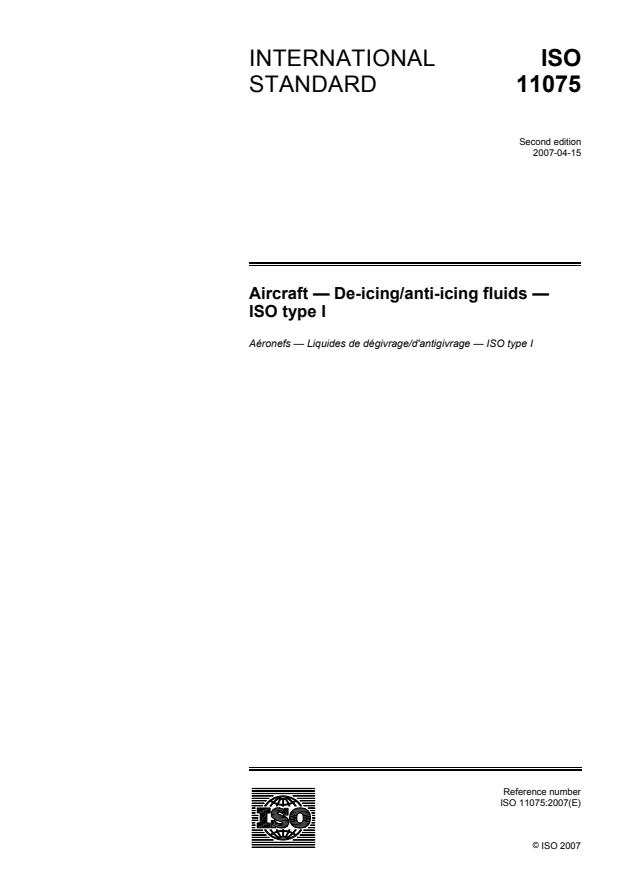
INTERNATIONAL ISO
STANDARD 11075
Second edition
2007-04-15
Aircraft — De-icing/anti-icing fluids —
ISO type I
Aéronefs — Liquides de dégivrage/d'antigivrage — ISO type I
Reference number
©
ISO 2007
PDF disclaimer
This PDF file may contain embedded typefaces. In accordance with Adobe's licensing policy, this file may be printed or viewed but
shall not be edited unless the typefaces which are embedded are licensed to and installed on the computer performing the editing. In
downloading this file, parties accept therein the responsibility of not infringing Adobe's licensing policy. The ISO Central Secretariat
accepts no liability in this area.
Adobe is a trademark of Adobe Systems Incorporated.
Details of the software products used to create this PDF file can be found in the General Info relative to the file; the PDF-creation
parameters were optimized for printing. Every care has been taken to ensure that the file is suitable for use by ISO member bodies. In
the unlikely event that a problem relating to it is found, please inform the Central Secretariat at the address given below.
© ISO 2007
All rights reserved. Unless otherwise specified, no part of this publication may be reproduced or utilized in any form or by any means,
electronic or mechanical, including photocopying and microfilm, without permission in writing from either ISO at the address below or
ISO's member body in the country of the requester.
ISO copyright office
Case postale 56 • CH-1211 Geneva 20
Tel. + 41 22 749 01 11
Fax + 41 22 749 09 47
E-mail copyright@iso.org
Web www.iso.org
Published in Switzerland
ii © ISO 2007 – All rights reserved
Foreword
ISO (the International Organization for Standardization) is a worldwide federation of national standards bodies
(ISO member bodies). The work of preparing International Standards is normally carried out through ISO
technical committees. Each member body interested in a subject for which a technical committee has been
established has the right to be represented on that committee. International organizations, governmental and
non-governmental, in liaison with ISO, also take part in the work. ISO collaborates closely with the
International Electrotechnical Commission (IEC) on all matters of electrotechnical standardization.
International Standards are drafted in accordance with the rules given in the ISO/IEC Directives, Part 2.
The main task of technical committees is to prepare International Standards. Draft International Standards
adopted by the technical committees are circulated to the member bodies for voting. Publication as an
International Standard requires approval by at least 75 % of the member bodies casting a vote.
Attention is drawn to the possibility that some of the elements of this document may be the subject of patent
rights. ISO shall not be held responsible for identifying any or all such patent rights.
ISO 11075 was prepared by Technical Committee ISO/TC 20, Aircraft and space vehicles, Subcommittee
SC 9, Air cargo and ground equipment.
This second edition cancels and replaces the first edition (ISO 11075:1993), of which it constitutes a complete
1)
technical revision to endorse SAE AMS 1424, also supported by the Association of European Airlines (AEA).
1) This data requires frequent updating. ISO TC 20/SC 9 has agreed to delegating this task under its own guidance to
the Association of European Airlines (AEA) and the Society of Automotive Engineers (SAE), which are organizations
recognized as experts in the field of de-icing/anti-icing aircraft on the ground.
Introduction
The aim of this International Standard is to standardize the critical characteristics of Newtonian or non
Newtonian fluids designated ISO type I which are used for ground de-icing and anti-icing of airplanes, in order
to ensure worldwide safety of civil transport airplanes under icing weather conditions.
In order to reduce duplication of reference documents as much as possible and to benefit from easier
industry-approved updating that takes into account the continuously evolving state of the art and knowledge,
this International Standard constitutes a de facto recognition of the AMS 1424 standard, published by SAE on
the basis of a permanent joint Committee with the Association of European Airlines (AEA) and with
endorsement from the Civil Aviation Authorities concerned.
iv © ISO 2007 – All rights reserved
INTERNATIONAL STANDARD ISO 11075:2007(E)
Aircraft — De-icing/anti-icing fluids — ISO type I
1 Scope
This International Standard defines the requirements for
...
NORME ISO
INTERNATIONALE 11075
Deuxième édition
2007-04-15
Aéronefs — Liquides de
dégivrage/d'antigivrage — ISO type I
Aircraft — De-icing/anti-icing fluids — ISO type I
Numéro de référence
©
ISO 2007
PDF – Exonération de responsabilité
Le présent fichier PDF peut contenir des polices de caractères intégrées. Conformément aux conditions de licence d'Adobe, ce fichier
peut être imprimé ou visualisé, mais ne doit pas être modifié à moins que l'ordinateur employé à cet effet ne bénéficie d'une licence
autorisant l'utilisation de ces polices et que celles-ci y soient installées. Lors du téléchargement de ce fichier, les parties concernées
acceptent de fait la responsabilité de ne pas enfreindre les conditions de licence d'Adobe. Le Secrétariat central de l'ISO décline toute
responsabilité en la matière.
Adobe est une marque déposée d'Adobe Systems Incorporated.
Les détails relatifs aux produits logiciels utilisés pour la création du présent fichier PDF sont disponibles dans la rubrique General Info
du fichier; les paramètres de création PDF ont été optimisés pour l'impression. Toutes les mesures ont été prises pour garantir
l'exploitation de ce fichier par les comités membres de l'ISO. Dans le cas peu probable où surviendrait un problème d'utilisation,
veuillez en informer le Secrétariat central à l'adresse donnée ci-dessous.
DOCUMENT PROTÉGÉ PAR COPYRIGHT
© ISO 2007
Droits de reproduction réservés. Sauf prescription différente, aucune partie de cette publication ne peut être reproduite ni utilisée sous
quelque forme que ce soit et par aucun procédé, électronique ou mécanique, y compris la photocopie et les microfilms, sans l'accord écrit
de l'ISO à l'adresse ci-après ou du comité membre de l'ISO dans le pays du demandeur.
ISO copyright office
Case postale 56 • CH-1211 Geneva 20
Tel. + 41 22 749 01 11
Fax. + 41 22 749 09 47
E-mail copyright@iso.org
Web www.iso.org
Publié en Suisse
ii © ISO 2007 – Tous droits réservés
Avant-propos
L'ISO (Organisation internationale de normalisation) est une fédération mondiale d'organismes nationaux de
normalisation (comités membres de l'ISO). L'élaboration des Normes internationales est en général confiée
aux comités techniques de l'ISO. Chaque comité membre intéressé par une étude a le droit de faire partie du
comité technique créé à cet effet. Les organisations internationales, gouvernementales et non
gouvernementales, en liaison avec l'ISO participent également aux travaux. L'ISO collabore étroitement avec
la Commission électrotechnique internationale (CEI) en ce qui concerne la normalisation électrotechnique.
Les Normes internationales sont rédigées conformément aux règles données dans les Directives ISO/CEI,
Partie 2.
La tâche principale des comités techniques est d'élaborer les Normes internationales. Les projets de Normes
internationales adoptés par les comités techniques sont soumis aux comités membres pour vote. Leur
publication comme Normes internationales requiert l'approbation de 75 % au moins des comités membres
votants.
L'attention est appelée sur le fait que certains des éléments du présent document peuvent faire l'objet de
droits de propriété intellectuelle ou de droits analogues. L'ISO ne saurait être tenue pour responsable de ne
pas avoir identifié de tels droits de propriété et averti de leur existence.
L'ISO 11075 a été élaborée par le comité technique ISO/TC 20, Aéronautique et espace, sous-comité SC 9,
Chargement et équipement au sol.
Cette deuxième édition annule et remplace la première édition (ISO 11075:1993), dont elle constitue une
révision technique complète entérinant l'AMS 1424 SAE, également soutenue par l'Association of European
1)
Airlines (AEA).
1) Cette information nécessite une fréquente mise à jour. L'ISO TC20/SC9 a convenu de déléguer cette tâche sous ses
propres orientations à l'Association of European Airlines (AEA) et à la Society of Automotive Engineers (SAE), organismes
reconnus comme experts dans le domaine du dégivrage/antigivrage des aéronefs au sol.
Introduction
Le but de la présente Norme internationale est de normaliser les caractéristiques critiques des liquides
newtoniens ou non newtoniens désignés ISO type I utilisés pour le dégivrage/antigivrage au sol des avions,
de façon à assurer dans le monde entier la sécurité des avions de transport civil en conditions
météorologiques givrantes.
De façon à réduire, autant que possible, la duplication des documents de référence et à bénéficier plus
facilement d'une mise à jour approuvée par l'industrie pour prendre en compte l'état d'évolution continue des
règles de l'art, la présente Norme internationale constitue un entérinement de l'AMS 1424, publiée par la SAE
sur la base d'un comité permanent conjoint avec l'Association of European Airlines (AEA) et avec le soutien
des autorités de l'aviation civile concernées.
iv © ISO 2007 – Tous droits réservés
NORME INTERNATIONALE ISO 11075:2007(F)
Aéronefs — Liquides de dégivrage/d'antigivrage — ISO type I
1 Domaine d'application
La présente Norme inte
...