


ISO/FDIS 9001
(Main)Quality management systems — Requirements
Quality management systems — Requirements
This document specifies requirements for a quality management system when an organization: a) needs to demonstrate its ability to consistently provide products and services that meet customer and applicable statutory and regulatory requirements, and b) aims to enhance customer satisfaction through the effective application of the system, including processes for improvement of the system and the assurance of conformity to customer and applicable statutory and regulatory requirements. All the requirements of this document are generic and are intended to be applicable to any organization, regardless of its type or size, or the products and services it provides.
Systèmes de management de la qualité — Exigences
Ce document spécifie les exigences relatives au système de management de la qualité lorsqu'un organisme: a) doit démontrer son aptitude à fournir constamment des produits et des services conformes aux exigences des clients et aux exigences légales et réglementaires applicables, et b) vise à accroître la satisfaction de ses clients par l'application efficace du système, y compris les processus pour l'amélioration du système et l'assurance de la conformité aux exigences des clients et aux exigences légales et réglementaires applicables. Toutes les exigences de ce document sont génériques et prévues pour s'appliquer à tout organisme, quels que soient son type ou sa taille, ou les produits et services qu'il fournit.
General Information
- Status
- Not Published
- Technical Committee
- ISO/TC 176/SC 2 - Quality systems
- Current Stage
- 5020 - FDIS ballot initiated: 2 months. Proof sent to secretariat
- Start Date
- 14-May-2026
- Completion Date
- 14-May-2026
Buy Documents

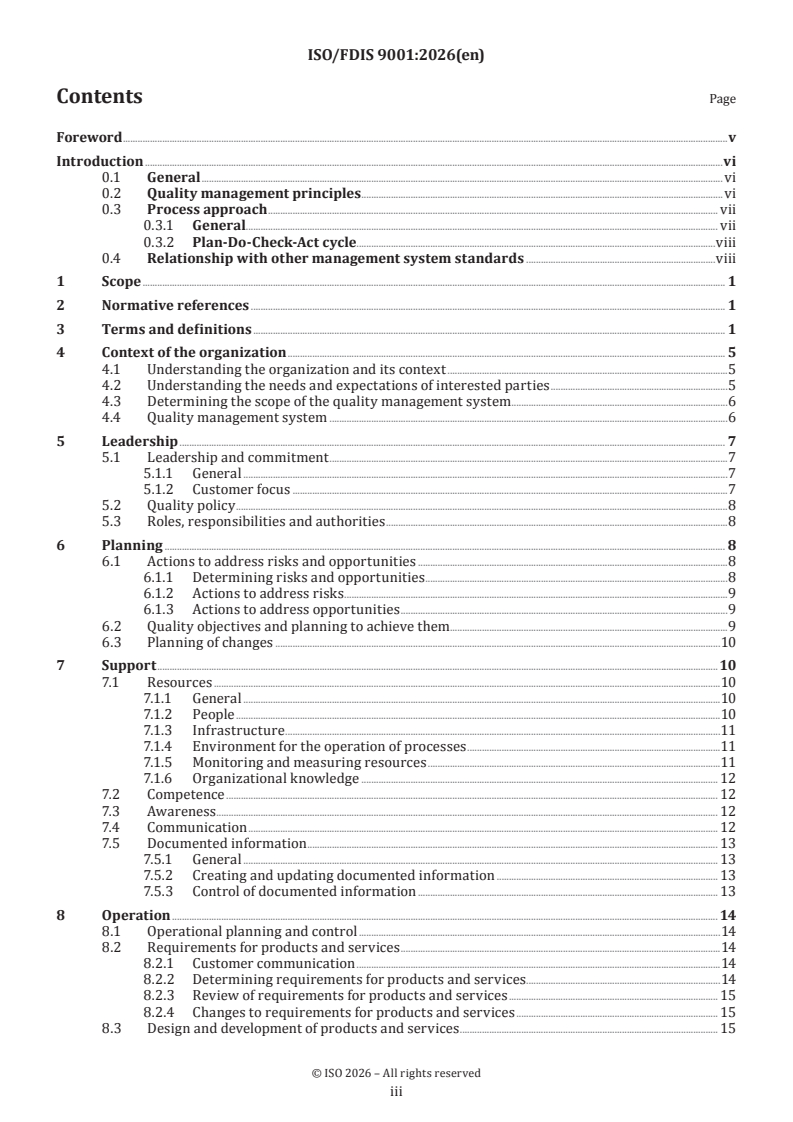
ISO/FDIS 9001 - Quality management systems — Requirements
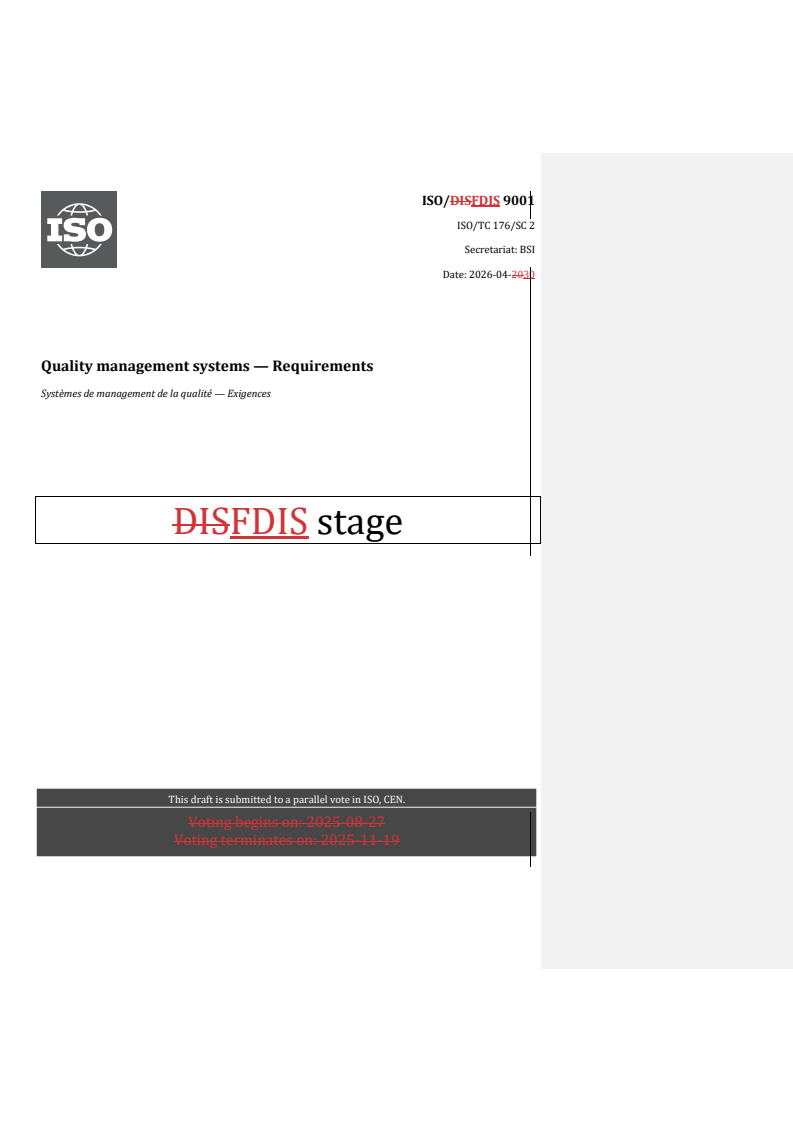
REDLINE ISO/FDIS 9001 - Quality management systems — Requirements

ISO/FDIS 9001 - Systèmes de management de la qualité — Exigences
Relations
- Effective Date
- 12-Feb-2026
- Effective Date
- 25-Nov-2023
- Effective Date
- 18-Nov-2023
Overview
ISO/FDIS 9001:2026, developed by the International Organization for Standardization (ISO), establishes requirements for quality management systems (QMS) suitable for organizations of any type, size, or industry. The standard provides a systematic framework to ensure organizations consistently deliver products and services that meet customer and regulatory requirements. ISO/FDIS 9001 also emphasizes continual improvement, process effectiveness, risk and opportunity management, and enhanced customer satisfaction.
Adoption of a quality management system based on ISO/FDIS 9001 is a strategic decision that can support improved organizational performance, strengthen competitive advantage, and form a foundation for sustainable development. The requirements outlined are generic and intended to be flexible, allowing adaptation for organizations with diverse operational contexts.
Key Topics
Core Concepts and Principles:
- Quality Management Principles: The standard is grounded in fundamental concepts such as customer focus, leadership, engagement of people, process approach, improvement, evidence-based decision-making, and relationship management.
- Process Approach and PDCA Cycle: ISO/FDIS 9001 promotes the process approach, encouraging organizations to understand and manage interrelated processes as a coherent system, using the Plan-Do-Check-Act (PDCA) methodology.
- Leadership and Commitment: Clear requirements for top management to demonstrate leadership, accountability, quality culture, and ethical behavior.
- Risk- and Opportunity-Based Thinking: Identification and proactive management of risks and opportunities that influence the achievement of QMS objectives.
- Documented Information: Requirements for maintaining essential documentation to demonstrate system operation and compliance.
System Requirements:
- Context of the Organization: Understanding external and internal factors that can affect QMS objectives, including relevant issues such as climate change.
- Interested Parties: Identification of stakeholders and their requirements that are relevant to the QMS.
- Quality Policy and Objectives: Establishing, communicating, and reviewing policies and measurable quality objectives aligned with the organization’s strategic direction.
- Operational Planning and Control: Procedures for delivering consistent products and services, including control of nonconformities and changes.
- Performance Evaluation: Use of monitoring, measurement, data analysis, audits, and management reviews to assess and improve QMS performance.
- Continual Improvement: Ongoing activities aimed at enhancing system effectiveness and customer satisfaction based on performance evaluation outcomes.
Applications
ISO/FDIS 9001:2026 is applicable to any organization regardless of size, industry, or nature of products and services. Implementation of this quality management standard provides organizations with a structured approach to:
- Demonstrate consistent capability to meet customer, statutory, and regulatory requirements
- Enhance customer satisfaction through process effectiveness and responsiveness to customer needs
- Improve operational efficiency by optimizing processes and eliminating waste
- Mitigate risks and seize opportunities with systematic risk and opportunity management
- Support sustainable organizational development with continual improvement processes
- Facilitate integration with other management system standards for a unified business management approach
- Strengthen stakeholder trust by evidencing conformity with internationally recognized requirements
Typical sectors that utilize ISO 9001 include manufacturing, healthcare, finance, logistics, education, technology, and professional services. It is frequently required or recognized in supply chain qualification, tendering, and certified third-party assessments.
Related Standards
Organizations seeking to benefit fully from ISO/FDIS 9001 may also reference related international standards, including:
- ISO 9000: Quality management systems - Fundamentals and vocabulary. Provides definitions and core concepts supporting ISO/FDIS 9001.
- ISO 9004: Guidelines for sustained success. Offers guidance to improve organizational performance beyond ISO/FDIS 9001 requirements.
- ISO 9002: Guidance on the application of ISO/FDIS 9001 requirements.
- Sector-specific quality standards: Developed for industries with unique needs (e.g., automotive, medical devices, aerospace).
ISO/FDIS 9001 is designed for compatibility with other management system standards (such as ISO 14001 for environmental management and ISO 45001 for occupational health and safety), facilitating integrated management systems.
Keywords: ISO 9001, quality management system, QMS, process approach, risk management, customer satisfaction, continual improvement, international standards, compliance, ISO requirements, performance evaluation, leadership, documented information, management system standards.
Buy Documents
ISO/FDIS 9001 - Quality management systems — Requirements
REDLINE ISO/FDIS 9001 - Quality management systems — Requirements
ISO/FDIS 9001 - Systèmes de management de la qualité — Exigences
Get Certified
Connect with accredited certification bodies for this standard

BSI Group
BSI (British Standards Institution) is the business standards company that helps organizations make excellence a habit.

Bureau Veritas
Bureau Veritas is a world leader in laboratory testing, inspection and certification services.

DNV
DNV is an independent assurance and risk management provider.
Sponsored listings
Frequently Asked Questions
ISO/FDIS 9001 is a draft published by the International Organization for Standardization (ISO). Its full title is "Quality management systems — Requirements". This standard covers: This document specifies requirements for a quality management system when an organization: a) needs to demonstrate its ability to consistently provide products and services that meet customer and applicable statutory and regulatory requirements, and b) aims to enhance customer satisfaction through the effective application of the system, including processes for improvement of the system and the assurance of conformity to customer and applicable statutory and regulatory requirements. All the requirements of this document are generic and are intended to be applicable to any organization, regardless of its type or size, or the products and services it provides.
This document specifies requirements for a quality management system when an organization: a) needs to demonstrate its ability to consistently provide products and services that meet customer and applicable statutory and regulatory requirements, and b) aims to enhance customer satisfaction through the effective application of the system, including processes for improvement of the system and the assurance of conformity to customer and applicable statutory and regulatory requirements. All the requirements of this document are generic and are intended to be applicable to any organization, regardless of its type or size, or the products and services it provides.
ISO/FDIS 9001 is classified under the following ICS (International Classification for Standards) categories: 03.100.70 - Management systems; 03.120.10 - Quality management and quality assurance. The ICS classification helps identify the subject area and facilitates finding related standards.
ISO/FDIS 9001 has the following relationships with other standards: It is inter standard links to FprEN ISO 9001, ISO 9001:2015/Amd 1:2024, ISO 9001:2015. Understanding these relationships helps ensure you are using the most current and applicable version of the standard.
ISO/FDIS 9001 is available in PDF format for immediate download after purchase. The document can be added to your cart and obtained through the secure checkout process. Digital delivery ensures instant access to the complete standard document.
Standards Content (Sample)
FINAL DRAFT
International
Standard
ISO/TC 176/SC 2
Quality management systems —
Secretariat: BSI
Requirements
Voting begins on:
Systèmes de management de la qualité — Exigences 2026-05-14
Voting terminates on:
2026-07-09
RECIPIENTS OF THIS DRAFT ARE INVITED TO SUBMIT,
WITH THEIR COMMENTS, NOTIFICATION OF ANY
RELEVANT PATENT RIGHTS OF WHICH THEY ARE AWARE
AND TO PROVIDE SUPPOR TING DOCUMENTATION.
IN ADDITION TO THEIR EVALUATION AS
BEING ACCEPTABLE FOR INDUSTRIAL, TECHNO
ISO/CEN PARALLEL PROCESSING LOGICAL, COMMERCIAL AND USER PURPOSES, DRAFT
INTERNATIONAL STANDARDS MAY ON OCCASION HAVE
TO BE CONSIDERED IN THE LIGHT OF THEIR POTENTIAL
TO BECOME STAN DARDS TO WHICH REFERENCE MAY BE
MADE IN NATIONAL REGULATIONS.
Reference number
FINAL DRAFT
International
Standard
ISO/TC 176/SC 2
Quality management systems —
Secretariat: BSI
Requirements
Voting begins on:
Systèmes de management de la qualité — Exigences
Voting terminates on:
RECIPIENTS OF THIS DRAFT ARE INVITED TO SUBMIT,
WITH THEIR COMMENTS, NOTIFICATION OF ANY
RELEVANT PATENT RIGHTS OF WHICH THEY ARE AWARE
AND TO PROVIDE SUPPOR TING DOCUMENTATION.
© ISO 2026
IN ADDITION TO THEIR EVALUATION AS
All rights reserved. Unless otherwise specified, or required in the context of its implementation, no part of this publication may
BEING ACCEPTABLE FOR INDUSTRIAL, TECHNO
ISO/CEN PARALLEL PROCESSING
LOGICAL, COMMERCIAL AND USER PURPOSES, DRAFT
be reproduced or utilized otherwise in any form or by any means, electronic or mechanical, including photocopying, or posting on
INTERNATIONAL STANDARDS MAY ON OCCASION HAVE
the internet or an intranet, without prior written permission. Permission can be requested from either ISO at the address below
TO BE CONSIDERED IN THE LIGHT OF THEIR POTENTIAL
or ISO’s member body in the country of the requester.
TO BECOME STAN DARDS TO WHICH REFERENCE MAY BE
MADE IN NATIONAL REGULATIONS.
ISO copyright office
CP 401 • Ch. de Blandonnet 8
CH-1214 Vernier, Geneva
Phone: +41 22 749 01 11
Email: copyright@iso.org
Website: www.iso.org
Published in Switzerland Reference number
ii
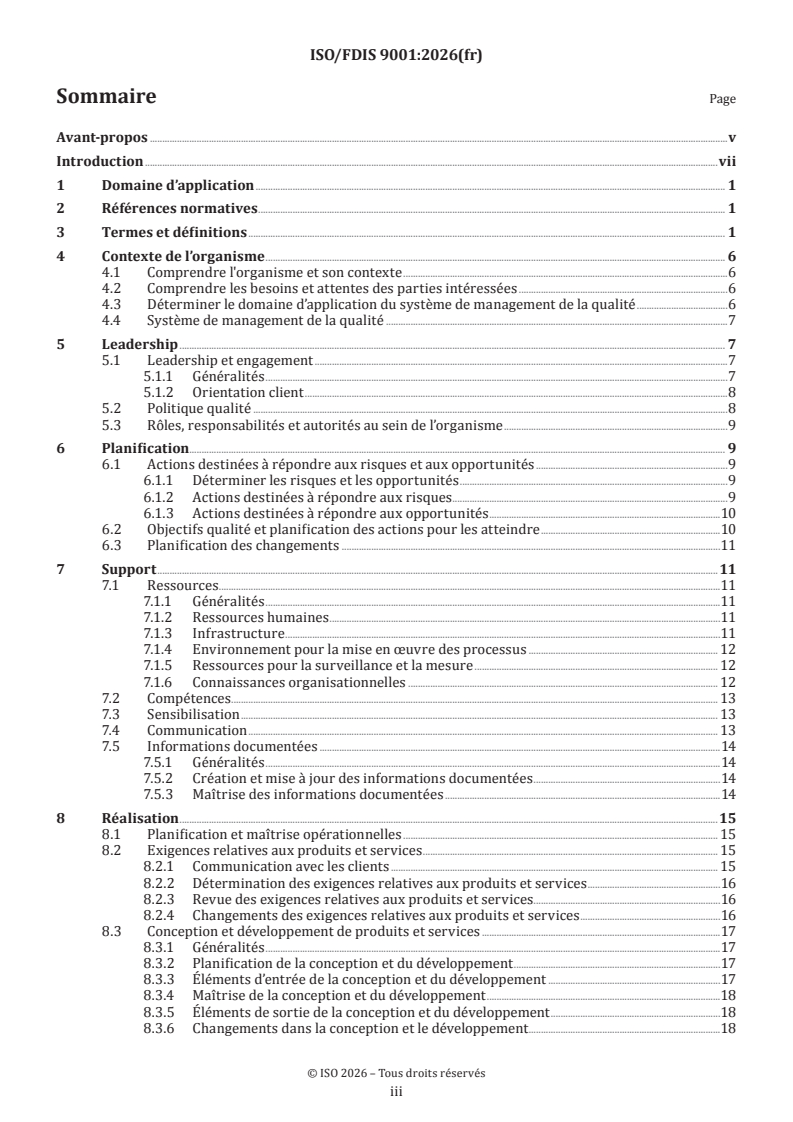
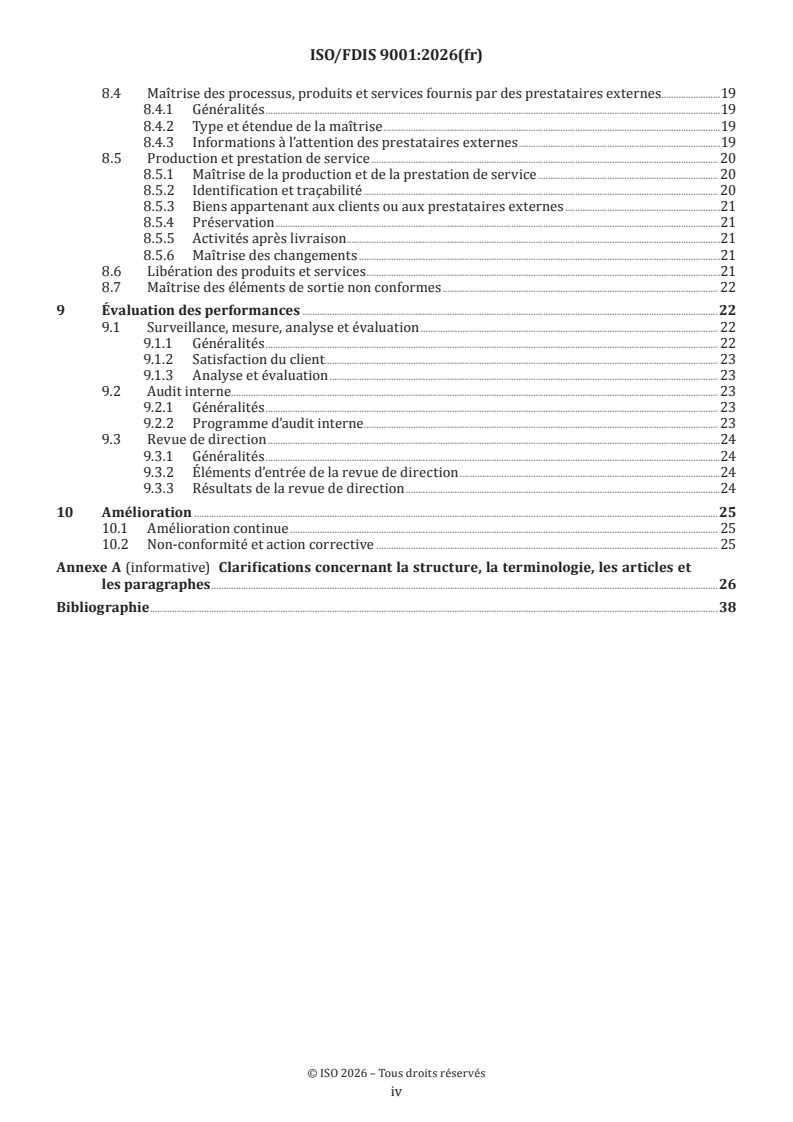
Contents Page
Foreword .v
Introduction .vi
0.1 General .vi
0.2 Quality management principles .vi
0.3 Process approach . vii
0.3.1 General. vii
0.3.2 Plan-Do-Check-Act cycle.viii
0.4 Relationship with other management system standards .viii
1 Scope . 1
2 Normative references . 1
3 Terms and definitions . 1
4 Context of the organization . 5
4.1 Understanding the organization and its context .5
4.2 Understanding the needs and expectations of interested parties .5
4.3 Determining the scope of the quality management system .6
4.4 Quality management system .6
5 Leadership . 7
5.1 Leadership and commitment .7
5.1.1 General .7
5.1.2 Customer focus .7
5.2 Quality policy .8
5.3 Roles, responsibilities and authorities .8
6 Planning . 8
6.1 Actions to address risks and opportunities .8
6.1.1 Determining risks and opportunities .8
6.1.2 Actions to address risks .9
6.1.3 Actions to address opportunities .9
6.2 Quality objectives and planning to achieve them.9
6.3 Planning of changes .10
7 Support .10
7.1 Resources .10
7.1.1 General .10
7.1.2 People .10
7.1.3 Infrastructure .11
7.1.4 Environment for the operation of processes .11
7.1.5 Monitoring and measuring resources .11
7.1.6 Organizational knowledge . 12
7.2 Competence . 12
7.3 Awareness . 12
7.4 Communication . 12
7.5 Documented information . 13
7.5.1 General . 13
7.5.2 Creating and updating documented information . 13
7.5.3 Control of documented information . 13
8 Operation . 14
8.1 Operational planning and control .14
8.2 Requirements for products and services .14
8.2.1 Customer communication .14
8.2.2 Determining requirements for products and services . .14
8.2.3 Review of requirements for products and services . 15
8.2.4 Changes to requirements for products and services . 15
8.3 Design and development of products and services . 15
iii
8.3.1 General . 15
8.3.2 Design and development planning . 15
8.3.3 Design and development inputs .16
8.3.4 Design and development controls .16
8.3.5 Design and development outputs .16
8.3.6 Design and development changes .17
8.4 Control of externally provided processes, products and services .17
8.4.1 General .17
8.4.2 Type and extent of control .17
8.4.3 Information for external providers .18
8.5 Production and service provision .18
8.5.1 Control of production and service provision .18
8.5.2 Identification and traceability .19
8.5.3 Property belonging to customers or external providers .19
8.5.4 Preservation .19
8.5.5 Post-delivery activities .19
8.5.6 Control of changes . 20
8.6 Release of products and services . 20
8.7 Control of nonconforming outputs . 20
9 Performance evaluation .21
9.1 Monitoring, measurement, analysis and evaluation . .21
9.1.1 General .21
9.1.2 Customer satisfaction .21
9.1.3 Analysis and evaluation .21
9.2 Internal audit . 22
9.2.1 General . 22
9.2.2 Internal audit programme . 22
9.3 Management review . 22
9.3.1 General . 22
9.3.2 Management review inputs . 22
9.3.3 Management review results . 23
10 Improvement .23
10.1 Continual improvement . 23
10.2 Nonconformity and corrective action . 23
Annex A (informative) Clarification of structure, terminology and clauses .25
Bibliography .36
iv
Foreword
ISO (the International Organization for Standardization) is a worldwide federation of national standards
bodies (ISO member bodies). The work of preparing International Standards is normally carried out through
ISO technical committees. Each member body interested in a subject for which a technical committee
has been established has the right to be represented on that committee. International organizations,
governmental and non-governmental, in liaison with ISO, also take part in the work. ISO collaborates closely
with the International Electrotechnical Commission (IEC) on all matters of electrotechnical standardization.
The procedures used to develop this document and those intended for its further maintenance are described
in the ISO/IEC Directives, Part 1. In particular, the different approval criteria needed for the different types
of ISO document should be noted. This document was drafted in accordance with the editorial rules of the
ISO/IEC Directives, Part 2 (see www.iso.org/directives).
ISO draws attention to the possibility that the implementation of this document may involve the use of (a)
patent(s). ISO takes no position concerning the evidence, validity or applicability of any claimed patent
rights in respect thereof. As of the date of publication of this document, ISO had not received notice of (a)
patent(s) which may be required to implement this document. However, implementers are cautioned that
this may not represent the latest information, which may be obtained from the patent database available at
www.iso.org/patents. ISO shall not be held responsible for identifying any or all such patent rights.
Any trade name used in this document is information given for the convenience of users and does not
constitute an endorsement.
For an explanation of the voluntary nature of standards, the meaning of ISO specific terms and expressions
related to conformity assessment, as well as information about ISO’s adherence to the World Trade
Organization (WTO) principles in the Technical Barriers to Trade (TBT), see www.iso.org/iso/foreword.html.
This document was prepared by Technical Committee ISO/TC 176, Quality management and quality
assurance, Subcommittee SC 2, Quality systems, in collaboration with the European Committee for
Standardization (CEN), in accordance with the Agreement on technical cooperation between ISO and CEN
(Vienna Agreement).
This sixth edition cancels and replaces the fifth edition (ISO 9001:2015), which has been technically revised.
It also incorporates the Amendment ISO 9001:2015/Amd 1:2024.
The main changes are as follows:
— Inclusion of core ISO management system terms and definitions: Clause 3 of the document now includes
a limited number of terms and definitions. ISO 9000 remains the normative reference for all quality
management terms and definitions.
— Introduction of quality culture and ethical behaviour: Quality culture and ethical behaviour are now
addressed within the requirements, particularly in relation to leadership, awareness and the environment
for the operation of processes.
— Separation of risks and opportunities: Risks and opportunities are more clearly distinguished, with
separate consideration of actions to address each.
— Strengthened management of change: Requirements related to changes to the quality management
system have been reinforced to support the achievement of intended results.
— Enhanced explanatory content in Annex A: It has been revised to provide enhanced clarification of the
structure, terminology and intent of the requirements as informative text, without introducing additional
requirements.
— Removal of Annex B: It previously provided information on other ISO/TC 176 standards. References to
these standards are now included in Annex A and on the ISO/TC 176 website.
Any feedback or questions on this document should be directed to the user’s national standards body. A
complete listing of these bodies can be found at www.iso.org/members.html.
v
Introduction
0.1 General
Establishing and implementing a quality management system is a strategic decision for an organization that
supports improved performance, enhances customer satisfaction, and provides a foundation for sustained
success and sustainable development initiatives.
The potential benefits to an organization of implementing a quality management system based on the
requirements in this document are:
a) the ability to consistently provide products and services that meet customer and applicable statutory
and regulatory requirements;
b) facilitating opportunities to enhance customer satisfaction;
c) addressing risks and opportunities associated with its context and objectives;
d) the ability to demonstrate conformity to quality management system requirements.
This document can be used by internal and external parties.
This document does not imply the need for:
— uniformity in the structure of different quality management systems;
— alignment of documentation to the clause structure of this document;
— the use of the specific terminology of this document within the organization.
The quality management system requirements in this document are complementary to requirements for
products and services.
Consistently meeting requirements and addressing future needs and expectations of customers and other
relevant interested parties poses a challenge for organizations in an increasingly dynamic and complex
environment. To achieve this objective, the organization can pursue continual improvement in various ways,
such as incremental or breakthrough change, innovation or reorganization initiatives.
Annex A provides information and clarifications that can support understanding of the structure, terms and
clauses of this document. It does not contain any additional requirements.
[1]
For guidance on the application of all clauses in this document, see ISO/DIS 9002 .
0.2 Quality management principles
[2]
This document is based on the quality management principles described in ISO 9000 . The descriptions
include a statement of each principle, a rationale of why the principle is important for the organization, some
examples of benefits associated with the principle and examples of actions to improve the organization’s
performance when applying the principle.
The quality management principles are:
— customer focus;
— leadership;
— engagement of people;
— process approach;
— improvement;
vi
— evidence-based decision-making;
— relationship management.
0.3 Process approach
0.3.1 General
This document promotes the adoption of a process approach when establishing, implementing and
improving the effectiveness of a quality management system, to enhance customer satisfaction by meeting
customer requirements. Specific requirements considered essential to the application of a process approach
are included in 4.4.
Understanding and managing interrelated processes as a system contributes to the organization’s
effectiveness and efficiency in achieving its intended results. This approach enables the organization to
control the interrelationships and interdependencies among the processes of the system, so that the overall
performance of the organization can be enhanced.
The process approach involves the systematic determination and management of processes, and their
interactions, so as to achieve the intended results in accordance with the quality policy and strategic
direction of the organization. Management of the processes and the system as a whole can be achieved using
the Plan-Do-Check-Act (PDCA) cycle (see 0.3.2) with an overall focus on risk-based thinking (see A.6.1.2)
aimed at preventing undesired results, and opportunity-based thinking (see A.6.1.3) aimed at pursuing
desired results by taking advantage of opportunities.
The application of the process approach in a quality management system enables:
a) understanding and consistency in meeting requirements;
b) consideration of processes in terms of risk, opportunity and added value;
c) achievement of effective process performance;
d) improvement of processes based on the results of evaluation of data and information.
Figure 1 gives a schematic representation of any single process and shows the interaction of its elements.
The monitoring and measuring check points, which are necessary for control, are specific to each process
and will vary depending on the process steps and related risks.
Figure 1 — Schematic representation of the elements of a single process
vii
0.3.2 Plan-Do-Check-Act cycle
The PDCA cycle can be briefly described as follows:
— Plan: Establish the objectives of the system and its processes, and the resources needed to deliver results
in accordance with customer and other relevant interested party requirements and the organization’s
policies, and determine and address risks and opportunities.
— Do: Implement what was planned.
— Check: Monitor and (as applicable) measure processes and the resulting products and services against
policies, objectives, requirements and planned activities, and report the results.
— Act: Take actions to improve the performance of the quality management system.
The PDCA cycle can be applied to all processes and to the quality management system as a whole. Figure 2
illustrates how Clause 4 to Clause 10 can be grouped in relation to the PDCA cycle.
NOTE Numbers in brackets refer to the clauses in this document.
Figure 2 — Representation of the structure of this document in the PDCA cycle
0.4 Relationship with other management system standards
This document applies the harmonized approach as published in the ISO/IEC Directives related to the
development of management system standards (MSS). The intention is to support alignment and facilitate
the integration of the requirements and recommendations of one or more MSS into an organization’s
management system.
For more information, see https://www.iso.org/management-system-standards.html.
This document provides a basis for an organization to apply the process approach, coupled with the
PDCA cycle, risk-based thinking and opportunity-based thinking, in order to align or integrate its quality
management system with the requirements of other management system standards.
viii
This document relates to the following standards:
[2]
— ISO 9000 provides the fundamental concepts and vocabulary essential for understanding the
requirements of this document;
[1]
— ISO/DIS 9002 provides guidance on the application of the requirements of this document;
[3]
— ISO 9004 provides guidance on enhancing the quality of an organization and its ability to achieve
sustained success.
This document does not include requirements specific to other management systems, such as those for
environmental management, occupational health and safety management, or asset management.
Sector-specific ISO quality management system standards based on the requirements of this document have
been developed. Some of these standards specify additional quality management system requirements,
while others are limited to providing guidance to the application of this document within the particular
sector.
ix
FINAL DRAFT International Standard ISO/FDIS 9001:2026(en)
Quality management systems — Requirements
1 Scope
This document specifies requirements for a quality management system when an organization:
a) needs to demonstrate its ability to consistently provide products and services that meet customer and
applicable statutory and regulatory requirements;
b) aims to enhance customer satisfaction through the effective application of the system, including
processes for improvement of the system and the assurance of conformity to customer and applicable
statutory and regulatory requirements.
All the requirements of this document are generic.
This document is applicable to any organization, regardless of its type or size, or the products and services
it provides.
NOTE 1 In this document, the terms “product” or “service” only apply to products and services intended for, or
required by, a customer.
NOTE 2 Statutory and regulatory requirements can be expressed as legal requirements.
2 Normative references
The following documents are referred to in the text in such a way that some or all of their content constitutes
requirements of this document. For dated references, only the edition cited applies. For undated references,
the latest edition of the referenced document (including any amendments) applies.
ISO 9000, Quality management — Fundamentals and vocabulary
3 Terms and definitions
For the purposes of this document, the terms and definitions given in ISO 9000 and the following apply.
ISO and IEC maintain terminology databases for use in standardization at the following addresses:
— ISO Online browsing platform: available at https:// www .iso .org/ obp
— IEC Electropedia: available at https:// www .electropedia .org
3.1
organization
person or group of people that has its own functions with responsibilities, authorities and relationships to
achieve its objectives (3.6)
Note 1 to entry: The concept of organization includes, but is not limited to, sole-trader, company, corporation, firm,
enterprise, authority, partnership, charity or institution, or part or combination thereof, whether incorporated or not,
public or private.
Note 2 to entry: If the organization is part of a larger entity, the term “organization” refers only to the part of the larger
entity that is within the scope of the quality management system (3.4.1).
3.2
interested party
stakeholder
person or organization (3.1) that can affect, be affected by, or perceive itself to be affected by a decision or
activity
EXAMPLE Customers, owners, people in an organization, providers, bankers, regulatory authorities, unions,
partners or society that can include competitors or opposing pressure groups.
3.3
top management
person or group of people who directs and controls an organization (3.1) at the highest level
Note 1 to entry: Top management has the power to delegate authority and provide resources within the organization.
Note 2 to entry: If the scope of the management system (3.4) covers only part of an organization, then top management
refers to those who direct and control that part of the organization.
3.4
management system
set of interrelated or interacting elements of an organization (3.1) to establish policies (3.5) and objectives
(3.6), as well as processes (3.8) to achieve those objectives
Note 1 to entry: A management system can address a single discipline or several disciplines.
Note 2 to entry: The management system elements include the organization’s structure, roles and responsibilities,
planning and operation.
Note 3 to entry: The management system elements can include the organization’s policies, practices, rules and beliefs.
Note 4 to entry: An organization manages its interrelated elements in an orderly manner to achieve its objectives.
Note 5 to entry: The scope of a management system can include the whole of the organization, specific and identified
functions of the organization, specific and identified sections of the organization, or one or more functions across a
group of organizations.
3.4.1
quality management system
part of the overall management system (3.4) of an organization (3.1) related to quality
3.5
policy
intentions and direction of an organization (3.1) as formally expressed by its top management (3.3)
3.5.1
quality policy
policy (3.5) related to quality
Note 1 to entry: The quality policy:
— is generally consistent with the overall policy of the organization (3.1);
— can be aligned with the organization’s vision and mission;
— provides a framework for the setting of quality objectives.
[2]
Note 2 to entry: The quality management principles presented in ISO 9000 can form a basis for the establishment of
a quality policy.
3.6
objective
result to be achieved
Note 1 to entry: An objective can be strategic, tactical or operational.
Note 2 to entry: Objectives can relate to different disciplines (e.g. finance, health and safety, environment). They can
be, for example, organization-wide or specific to a project, product, service or process (3.8).
Note 3 to entry: An objective can be expressed in other ways, such as an intended result, as a purpose, as an operational
criterion, as a quality objective (3.6.1) or by the use of other words with similar meaning (e.g. aim, goal, target).
Note 4 to entry: In the context of quality management systems (3.4.1), quality objectives (3.6.1) are set by the organization
(3.1), consistent with the quality policy (3.5.1), to achieve specific results.
3.6.1
quality objective
objective (3.6) related to quality
Note 1 to entry: Quality objectives are generally based on the organization’s (3.1) quality policy (3.5.1).
Note 2 to entry: Quality objectives are generally specified for relevant functions, levels and processes (3.8) in the
organization.
3.7
risk
effect of uncertainty
Note 1 to entry: An effect is a deviation from the expected — positive or negative.
Note 2 to entry: Uncertainty is the state, even partial, of deficiency of information related to, understanding or
knowledge of, an event, its consequence, or likelihood.
Note 3 to entry: Risk is often characterized by reference to potential events and consequences, or a combination of
these.
Note 4 to entry: Risk is often expressed in terms of a combination of the consequences of an event (including changes
in circumstances) and the associated likelihood of occurrence.
Note 5 to entry: The word “risk” is sometimes used when there is the possibility of only negative consequences.
3.8
process
set of interrelated or interacting activities that uses or transforms inputs to deliver a result
Note 1 to entry: Whether the result of a process is called an output, a product or a service depends on the context of
the reference.
Note 2 to entry: Inputs to a process are generally the outputs of other processes and outputs of a process are generally
the inputs to other processes.
Note 3 to entry: Two or more interrelated and interacting processes in series can also be referred to as a “process”.
Note 4 to entry: Processes in an organization (3.1) are generally planned and carried out under controlled conditions
to ensure that intended results can be achieved.
Note 5 to entry: A process where the conformity (3.15) of the resulting output cannot be readily or economically
validated is frequently referred to as a “special process”.
3.9
competence
ability to apply knowledge and skills to achieve intended results
3.10
documented information
information required to be controlled and maintained by an organization (3.1) and the medium on which it
is contained
Note 1 to entry: Documented information can be in any format and media and from any source.
Note 2 to entry: Documented information can refer to:
— the management system (3.4), including related processes (3.8);
— information created in order for the organization to operate (documentation);
— evidence of results achieved (records).
3.11
performance
measurable result
Note 1 to entry: Performance can relate either to quantitative or qualitative findings.
Note 2 to entry: Performance can relate to managing activities, processes (3.8), products, services, systems or
organizations (3.1).
3.12
continual improvement
recurring activity to enhance performance (3.11)
3.13
effectiveness
extent to which planned activities are realized and planned results are achieved
3.14
requirement
need or expectation that is stated, generally implied or obligatory
Note 1 to entry: “Generally implied” means that it is custom or common practice for the organization (3.1) and
interested parties (3.2) that the need or expectation under consideration is implied.
Note 2 to entry: A specified requirement is one that is stated, e.g. in documented information (3.10).
Note 3 to entry: A qualifier can be used to denote a specific type of requirement, e.g. product requirement, service
requirement, quality management requirement, customer requirement, quality requirement.
Note 4 to entry: Requirements can be generated by different interested parties or by the organization itself.
Note 5 to entry: It can be necessary for achieving high customer satisfaction to fulfil an expectation of a customer even
if it is neither stated nor generally implied or obligatory.
3.15
conformity
fulfilment of a requirement (3.14)
Note 1 to entry: The term “conformance” is synonymous but deprecated.
3.16
nonconformity
non-fulfilment of a requirement (3.14)
3.17
corrective action
action to eliminate the cause(s) of a nonconformity (3.16) and to prevent recurrence
Note 1 to entry: Corrective action is taken to prevent recurrence whereas preventive action is taken to prevent
occurrence.
3.18
audit
systematic and independent process (3.8) for obtaining evidence and evaluating it objectively to determine
the extent to which the audit criteria are fulfilled
Note 1 to entry: An audit can be an internal audit (first party) or an external audit (second party or third party), and it
can be a combined audit (combining two or more disciplines).
Note 2 to entry: An internal audit is conducted by the organization (3.1) itself, or by an external party on its behalf.
[4]
Note 3 to entry: “Audit evidence” and “audit criteria” are defined in ISO 19011 .
Note 4 to entry: The fundamental elements of an audit include the determination of the conformity (3.15) of an object
according to a procedure carried out by people selected to ensure impartiality and objectivity of the audit process.
Note 5 to entry: Internal audits are conducted for management review and other internal purposes and can form
the basis for an organization’s declaration of conformity. Independence can be demonstrated by the freedom from
responsibility for the activity being audited.
Note 6 to entry: Second-party audits are conducted by parties having an interest in the organization, such as
customers, or by other persons on their behalf. Third-party audits are conducted by external, independent auditing
organizations such as those providing certification or registration of conformity or governmental agencies.
Note 7 to entry: An audit can also be a joint audit conducted by two or more auditing organizations.
3.19
measurement
process (3.8) to determine a value
[5]
Note 1 to entry: According to ISO 3534-2:2006 , the value determined is generally the value of a quantity.
3.20
monitoring
determining the status of a system, a process (3.8) or an activity
Note 1 to entry: To determine the status, there can be a need to check, supervise or critically observe.
Note 2 to entry: Monitoring can also determine the status of a product or a service.
Note 3 to entry: Monitoring is generally a determination of the status of an object, carried out at different stages or at
different times.
4 Context of the organization
4.1 Understanding the organization and its context
The organization shall determine external and internal issues that are relevant to its purpose and its
strategic direction and that affect its ability to achieve the intended result(s) of its quality management
system.
The organization shall determine whether climate change is a relevant issue.
The organization shall monitor and review information about these external and internal issues.
NOTE 1 Issues can include positive and negative factors or conditions for consideration.
NOTE 2 Understanding the external context can be facilitated by considering legal, technological, competitive,
market, cultural, political, social, economic and environmental issues at the international, national, regional or local
level.
NOTE 3 Understanding the internal context can be facilitated by considering issues related to the organization’s
strategic direction, values, culture, resources, knowledge and performance.
4.2 Understanding the needs and expectations of interested parties
The organization shall determine:
a) the interested parties that are relevant to the quality management system;
b) the relevant requirements of these interested parties;
c) which of these requirements will be addressed through the quality management system.
The organization shall monitor and review information about these interested parties and their relevant
r
...
ISO/DISFDIS 9001
ISO/TC 176/SC 2
Secretariat: BSI
Date: 2026-04-2030
Quality management systems — Requirements
Systèmes de management de la qualité — Exigences
DISFDIS stage
TThhiiss d drraftaft i iss s suubbmmiitttteded t too a pa pararallel vallel vootte e iinn I ISSOO,, C CEENN.
VVototiinngg b beeggiinnss on on:: 22002255--0088--2277
VVootintingg te termrmiinnaatetess o onn:: 2 2002255--1111--1199
All rights reserved. Unless otherwise specified, or required in the context of its implementation, no part of this publication
may be reproduced or utilized otherwise in any form or by any means, electronic or mechanical, including photocopying,
or posting on the internet or an intranet, without prior written permission. Permission can be requested from either ISO
at the address below or ISO’s member body in the country of the requester.
ISO copyright office
CP 401 • Ch. de Blandonnet 8
CH-1214 Vernier, Geneva
Phone: + 41 22 749 01 11
E-mail: copyright@iso.org
Website: www.iso.org
Published in Switzerland
ii
Contents
Foreword . iv
Introduction . vi
1 Scope . 1
2 Normative references . 1
3 Terms and definitions . 1
4 Context of the organization . 6
4.1 Understanding the organization and its context . 6
4.2 Understanding the needs and expectations of interested parties . 6
4.3 Determining the scope of the quality management system . 6
4.4 Quality management system . 7
5 Leadership . 7
5.1 Leadership and commitment . 7
5.2 Quality policy . 8
5.3 Roles, responsibilities and authorities . 9
6 Planning . 9
6.1 Actions to address risks and opportunities . 9
6.2 Quality objectives and planning to achieve them . 10
6.3 Planning of changes . 11
7 Support . 11
7.1 Resources . 11
7.2 Competence . 13
7.3 Awareness . 13
7.4 Communication . 14
7.5 Documented information . 14
8 Operation . 15
8.1 Operational planning and control . 15
8.2 Requirements for products and services . 15
8.3 Design and development of products and services . 17
8.4 Control of externally provided processes, products and services . 19
8.5 Production and service provision . 20
8.6 Release of products and services . 22
8.7 Control of nonconforming outputs . 22
9 Performance evaluation . 23
9.1 Monitoring, measurement, analysis and evaluation . 23
9.2 Internal audit . 24
9.3 Management review. 24
10 Improvement . 25
10.1 Continual improvement . 25
10.2 Nonconformity and corrective action. 25
Annex A (informative) Clarification of structure, terminology and clauses . 27
Bibliography . 39
iii
Foreword
ISO (the International Organization for Standardization) is a worldwide federation of national standards
bodies (ISO member bodies). The work of preparing International Standards is normally carried out through
ISO technical committees. Each member body interested in a subject for which a technical committee has been
established has the right to be represented on that committee. International organizations, governmental and
non-governmental, in liaison with ISO, also take part in the work. ISO collaborates closely with the
International Electrotechnical Commission (IEC) on all matters of electrotechnical standardization.
The procedures used to develop this document and those intended for its further maintenance are described
in the ISO/IEC Directives, Part 1. In particular, the different approval criteria needed for the different types of
ISO document should be noted. This document was drafted in accordance with the editorial rules of the
ISO/IEC Directives, Part 2 (see www.iso.org/directives).
ISO draws attention to the possibility that the implementation of this document may involve the use of (a)
patent(s). ISO takes no position concerning the evidence, validity or applicability of any claimed patent rights
in respect thereof. As of the date of publication of this document, ISO had not received notice of (a) patent(s)
which may be required to implement this document. However, implementers are cautioned that this may not
represent the latest information, which may be obtained from the patent database available at
www.iso.org/patents. ISO shall not be held responsible for identifying any or all such patent rights.
Any trade name used in this document is information given for the convenience of users and does not
constitute an endorsement.
For an explanation of the voluntary nature of standards, the meaning of ISO specific terms and expressions
related to conformity assessment, as well as information about ISO’s adherence to the World Trade
Organization (WTO) principles in the Technical Barriers to Trade (TBT), see www.iso.org/iso/foreword.html.
This document was prepared by Technical Committee ISO/TC 176, Quality management and quality assurance,
Subcommittee SC 2, Quality systems, in collaboration with the European Committee for Standardization (CEN),
in accordance with the Agreement on technical cooperation between ISO and CEN (Vienna Agreement).
This sixth edition cancels and replaces the fifth edition (ISO 9001:2015), which has been technically revised.
It also incorporates the Amendment ISO 9001:2015/Amd 1:2024.
The main changes are as follows:
— Inclusion of core ISO management system terms and definitions: Clause 3 of the document now includes a
limited number of terms and definitions. ISO 9000 remains the normative reference for all quality
management terms and definitions.
— Introduction of quality culture and ethical behaviour: Quality culture and ethical behaviour are now
addressed within the requirements, particularly in relation to leadership, awareness and the environment
for the operation of processes.
— Separation of risks and opportunities: Risks and opportunities are more clearly distinguished, with
separate consideration of actions to address each.
— Strengthened management of change: Requirements related to changes to the quality management system
have been reinforced to support the achievement of intended results.
— Enhanced explanatory content in Annex A: Annex AIt has been revised to provide enhanced clarification
of the structure, terminology and intent of the requirements as informative text, without introducing
additional requirements.
iv
— Removal of Annex B: Annex BIt previously provided information on other ISO/TC 176 standards.
References to these standards are now included in Annex A and on the ISO/TC 176 website.
Any feedback or questions on this document should be directed to the user’s national standards body. A
complete listing of these bodies can be found at www.iso.org/members.html.
v
Introduction
0.1 General
Establishing and implementing a quality management system is a strategic decision for an organization that
supports improved performance, enhances customer satisfaction, and provides a foundation for sustained
success and sustainable development initiatives.
The potential benefits to an organization of implementing a quality management system based on the
requirements in this document are:
a) the ability to consistently provide products and services that meet customer and applicable statutory and
regulatory requirements;
b) facilitating opportunities to enhance customer satisfaction;
c) addressing risks and opportunities associated with its context and objectives;
d) the ability to demonstrate conformity to quality management system requirements.
This document can be used by internal and external parties.
This document does not imply the need for:
— uniformity in the structure of different quality management systems;
— alignment of documentation to the clause structure of this document;
— the use of the specific terminology of this document within the organization.
The quality management system requirements in this document are complementary to requirements for
products and services.
Consistently meeting requirements and addressing future needs and expectations of customers and other
relevant interested parties poses a challenge for organizations in an increasingly dynamic and complex
environment. To achieve this objective, the organization can pursue continual improvement in various ways,
such as incremental or breakthrough change, innovation or reorganization initiatives.
Annex A provides information and clarifications that can support understanding of the structure, terms and
clauses of this document. It does not contain any additional requirements.
For guidance on the application of all clauses in this document, see ISO/TSDIS 9002.
Field Code Changed
0.2 Quality management principles
This document is based on the quality management principles described in ISO 9000 . The descriptions include
a statement of each principle, a rationale of why the principle is important for the organization, some examples
of benefits associated with the principle and examples of actions to improve the organization'sorganization’s
performance when applying the principle.
The quality management principles are:
— customer focus;
— leadership;
vi
— engagement of people;
— process approach;
— improvement;
— evidence-based decision-making;
— relationship management.
0.3 Process approach
0.3.1 General
This document promotes the adoption of a process approach when establishing, implementing and improving
the effectiveness of a quality management system, to enhance customer satisfaction by meeting customer
requirements. Specific requirements considered essential to the application of a process approach are
included in 4.4.
Understanding and managing interrelated processes as a system contributes to the
organization'sorganization’s effectiveness and efficiency in achieving its intended results. This approach
enables the organization to control the interrelationships and interdependencies among the processes of the
system, so that the overall performance of the organization can be enhanced.
The process approach involves the systematic determination and management of processes, and their
interactions, so as to achieve the intended results in accordance with the quality policy and strategic direction
of the organization. Management of the processes and the system as a whole can be achieved using the Plan-
Do-Check-Act (PDCA) cycle (see 0.3.2) with an overall focus on risk-based thinking (see A.6.1.2) aimed at
preventing undesired results, and opportunity-based thinking (see A.6.1.3) aimed at pursuing desired results
by taking advantage of opportunities.
The application of the process approach in a quality management system enables:
a) understanding and consistency in meeting requirements;
b) the consideration of processes in terms of risk, opportunity and added value;
c) the achievement of effective process performance;
d) improvement of processes based on the results of evaluation of data and information.
Figure 1 gives a schematic representation of any single process and shows the interaction of its elements. The
monitoring and measuring check points, which are necessary for control, are specific to each process and will
vary depending on the process steps and related risks.
vii
Figure 1— Schematic representation of the elements of a single process
0.3.2 Plan-Do-Check-Act cycle
The PDCA cycle can be briefly described as follows:
— Plan: establishEstablish the objectives of the system and its processes, and the resources needed to deliver
results in accordance with customer and other relevant interested party requirements and the
organization'sorganization’s policies, and determine and address risks and opportunities;.
— Do: implementImplement what was planned;.
— Check: monitorMonitor and (as applicable) measure processes and the resulting products and services
against policies, objectives, requirements and planned activities, and report the results;.
— Act: takeTake actions to improve the performance of the quality management system.
The PDCA cycle can be applied to all processes and to the quality management system as a whole. Figure 2
illustrates how Clause 4 to Clause 10 of this document can be grouped in relation to the PDCA cycle.
viii
NOTE Numbers in brackets refer to the clauses in this document.
ix
Figure 2— Representation of the structure of this document in the PDCA cycle
0.4 Relationship with other management system standards
This document applies the harmonized approach as published in the ISO/IEC Directives related to the
development of management system standards (MSS). The intention is to support alignment and facilitate the
integration of the requirements and recommendations of one or more MSS into an organization’s management
system.
For more information, see https://www.iso.org/management-system-standards.html.
This document provides a basis for an organization to apply the process approach, coupled with the PDCA
cycle, risk-based thinking and opportunity-based thinking, in order to align or integrate its quality
management system with the requirements of other management system standards.
This document relates to the following standards:
— ISO 9000 - provides the fundamental concepts and vocabulary essential for understanding the
requirements of this document;
— ISO/DIS 9002- provides guidelinesguidance on the application of the requirements of this document.;
— ISO 9004 - provides guidance on enhancing the quality of an organization and its ability to achieve
sustained success.
This document does not include requirements specific to other management systems, such as those for
environmental management, occupational health and safety management, or asset management.
Sector-specific ISO quality management system standards based on the requirements of this document have
been developed. Some of these standards specify additional quality management system requirements, while
others are limited to providing guidance to the application of this document within the particular sector.
NOTE See for a list of all management system standards.
x
Quality management systems — Requirements
1 Scope
This document specifies requirements for a quality management system when an organization:
a) needs to demonstrate its ability to consistently provide products and services that meet customer and
applicable statutory and regulatory requirements;
b) aims to enhance customer satisfaction through the effective application of the system, including processes
for improvement of the system and the assurance of conformity to customer and applicable statutory and
regulatory requirements.
All the requirements of this document are generic.
This document is applicable to any organization, regardless of its type or size, or the products and services it
provides.
NOTE 1 In this document, the terms “product” or “service” only apply to products and services intended for, or
required by, a customer.
NOTE 2 Statutory and regulatory requirements can be expressed as legal requirements.
2 Normative references
The following documents are referred to in the text in such a way that some or all of their content constitutes
requirements of this document. For dated references, only the edition cited applies. For undated references,
the latest edition of the referenced document (including any amendments) applies.
ISO/DIS 9000, Quality management — Fundamentals and vocabulary
3 Terms and definitions
For the purposes of this document, the terms and definitions given in ISO/DIS 9000 and the following apply.
ISO and IEC maintain terminology databases for use in standardization at the following addresses:
— ISO Online browsing platform: available at https://www.iso.org/obp
— IEC Electropedia: available at https://www.electropedia.org
3.1
organization
person or group of people that has its own functions with responsibilities, authorities and relationships to
achieve its objectives (3.6)
Note 1 to entry: The concept of organization includes, but is not limited to, sole-trader, company, corporation, firm,
enterprise, authority, partnership, charity or institution, or part or combination thereof, whether incorporated or not,
public or private.
Note 2 to entry: If the organization is part of a larger entity, the term “organization” refers only to the part of the larger
entity that is within the scope of the quality management system (3.4.1).
3.2
interested party
stakeholder
person or organization (3.1) that can affect, be affected by, or perceive itself to be affected by a decision or
activity
EXAMPLE Customers, owners, people in an organization, providers, bankers, regulatory authorities, unions,
partners or society that can include competitors or opposing pressure groups.
3.3
top management
person or group of people who directs and controls an organization (3.1) at the highest level
Note 1 to entry: Top management has the power to delegate authority and provide resources within the organization.
Note 2 to entry: If the scope of the management system (3.4) covers only part of an organization, then top management
refers to those who direct and control that part of the organization.
3.4
management system
set of interrelated or interacting elements of an organization (3.1) to establish policies (3.5) and objectives
(3.6), as well as processes (3.8) to achieve those objectives
Note 1 to entry: A management system can address a single discipline or several disciplines.
Note 2 to entry: The management system elements include the organization’s structure, roles and responsibilities,
planning and operation.
Note 3 to entry: The management system elements can include the organization’s policies, practices, rules and beliefs.
Note 4 to entry: An organization manages its interrelated elements in an orderly manner to achieve its objectives.
Note 5 to entry: The scope of a management system can include the whole of the organization, specific and identified
functions of the organization, specific and identified sections of the organization, or one or more functions across a group
of organizations.
3.4.1
quality management system
part of the overall management system (3.4) of an organization (3.1) related to quality
3.5
policy
intentions and direction of an organization (3.1) as formally expressed by its top management (3.3)
3.5.1
quality policy
policy (3.5) related to quality
Note 1 to entry: The quality policy:
— is generally consistent with the overall policy of the organization (3.1;);
— can be aligned with the organization'sorganization’s vision and mission;
— provides a framework for the setting of quality objectives.
Note 2 to entry: The quality management principles presented in ISO 9000 can form a basis for the establishment of a
quality policy.
3.6
objective
result to be achieved
Note 1 to entry: An objective can be strategic, tactical, or operational.
Note 2 to entry: Objectives can relate to different disciplines (such ase.g. finance, health and safety, and environment).
They can be, for example, organization-wide or specific to a project, product, service or process (3.8).
Note 3 to entry: An objective can be expressed in other ways, e.g.such as an intended result, as a purpose, as an
operational criterion, as a quality objective (3.6.1) or by the use of other words with similar meaning (e.g. aim, goal, or
target).
Note 4 to entry: In the context of quality management systems (3.4.1), quality objectives (3.6.1) are set by the organization
(3.1), consistent with the quality policy (3.5.1), to achieve specific results.
3.6.1
quality objective
objective (3.6) related to quality
Note 1 to entry: Quality objectives are generally based on the organization'sorganization’s (3.1)quality policy (3.5.1).
Note 2 to entry: Quality objectives are generally specified for relevant functions, levels and processes (3.8) in the
organization.
3.7
risk
effect of uncertainty
Note 1 to entry: An effect is a deviation from the expected — positive or negative.
Note 2 to entry: Uncertainty is the state, even partial, of deficiency of information related to, understanding or knowledge
of, an event, its consequence, or likelihood.
Note 3 to entry: Risk is often characterized by reference to potential events and consequences, or a combination of these.
Note 4 to entry: Risk is often expressed in terms of a combination of the consequences of an event (including changes in
circumstances) and the associated likelihood of occurrence.
Note 5 to entry: The word “risk” is sometimes used when there is the possibility of only negative consequences.
3.8
process
set of interrelated or interacting activities that uses or transforms inputs to deliver a result
Note 1 to entry: Whether the result of a process is called an output, a product or a service depends on the context of the
reference.
Note 2 to entry: Inputs to a process are generally the outputs of other processes and outputs of a process are generally
the inputs to other processes.
Note 3 to entry: Two or more interrelated and interacting processes in series can also be referred to as a “process”.
Note 4 to entry: Processes in an organization (3.1) are generally planned and carried out under controlled conditions to
ensure that intended results can be achieved.
Note 5 to entry: A process where the conformity (3.15) of the resulting output cannot be readily or economically validated
is frequently referred to as a “special process”.
3.9
competence
ability to apply knowledge and skills to achieve intended results
3.10
documented information
information required to be controlled and maintained by an organization (3.1) and the medium on which it is
contained
Note 1 to entry: Documented information can be in any format and media and from any source.
Note 2 to entry: Documented information can refer to:
— the management system (3.4), including related processes (3.8);
— information created in order for the organization to operate (documentation);
— evidence of results achieved (records).
3.11
performance
measurable result
Note 1 to entry: Performance can relate either to quantitative or qualitative findings.
Note 2 to entry: Performance can relate to managing activities, processes (3.8), products, services, systems or
organizations (3.1).
3.12
continual improvement
recurring activity to enhance performance (3.11)
3.13
effectiveness
extent to which planned activities are realized and planned results are achieved
3.14
requirement
need or expectation that is stated, generally implied or obligatory
Note 1 to entry: “Generally implied” means that it is custom or common practice for the organization (3.1) and interested
parties (3.2) that the need or expectation under consideration is implied.
Note 2 to entry: A specified requirement is one that is stated, e.g. in documented information (3.10).
Note 3 to entry: A qualifier can be used to denote a specific type of requirement, e.g. product requirement, service
requirement, quality management requirement, customer requirement, quality requirement.
Note 4 to entry: Requirements can be generated by different interested parties or by the organization itself.
Note 5 to entry: It can be necessary for achieving high customer satisfaction to fulfil an expectation of a customer even if
it is neither stated nor generally implied or obligatory.
3.15
conformity
DEPRECATED: conformance
fulfilment of a requirement (3.14)
Note 1 to entry: The term “conformance” is synonymous but deprecated.
3.16
nonconformity
non-fulfilment of a requirement (3.14)
3.17
corrective action
action to eliminate the cause(s) of a nonconformity (3.16) and to prevent recurrence
Note 1 to entry: Corrective action is taken to prevent recurrence whereas preventive action is taken to prevent
occurrence.
3.18
audit
systematic and independent process (3.8) for obtaining evidence and evaluating it objectively to determine
the extent to which the audit criteria are fulfilled
Note 1 to entry: An audit can be an internal audit (first party) or an external audit (second party or third party), and it
can be a combined audit (combining two or more disciplines).
Note 2 to entry: An internal audit is conducted by the organization (3.1) itself, or by an external party on its behalf.
Note 3 to entry: “Audit evidence” and “audit criteria” are defined in ISO 19011 .
Note 4 to entry: The fundamental elements of an audit include the determination of the conformity (3.15) of an object
according to a procedure carried out by people selected to ensure impartiality and objectivity of the audit process.
Note 5 to entry: Internal audits are conducted for management review and other internal purposes and can form the
basis for an organization’s declaration of conformity. Independence can be demonstrated by the freedom from
responsibility for the activity being audited.
Note 6 to entry: Second-party audits are conducted by parties having an interest in the organization, such as customers,
or by other persons on their behalf. Third-party audits are conducted by external, independent auditing organizations
such as those providing certification or registration of conformity or governmental agencies.
Note 7 to entry: An audit can also be a joint audit conducted by two or more auditing organizations.
3.19
measurement
process (3.8) to determine a value
Note 1 to entry: According to ISO 3534-2:2006 ,, the value determined is generally the value of a quantity.
3.20
monitoring
determining the status of a system, a process (3.8) or an activity
Note 1 to entry: To determine the status, there can be a need to check, supervise or critically observe.
Note 2 to entry: Monitoring can also determine the status of a product or a service.
Note 3 to entry: Monitoring is generally a determination of the status of an object, carried out at different stages or at
different times.
4 Context of the organization
4.1 Understanding the organization and its context
The organization shall determine external and internal issues that are relevant to its purpose and its strategic
direction and that affect its ability to achieve the intended result(s) of its quality management system.
The organization shall determine whether climate change is a relevant issue.
The organization shall monitor and review information about these external and internal issues.
NOTE 1 Issues can include positive and negative factors or conditions for consideration.
NOTE 2 Understanding the external context can be facilitated by considering legal, technological, competitive, market,
cultural, political, social, economic and environmental issues at the international, national, regional or local level.
NOTE 3 Understanding the internal context can be facilitated by considering issues related to the
organization'sorganization’s strategic direction, values, culture, resources, knowledge and performance.
4.2 Understanding the needs and expectations of interested parties
The organization shall determine:
a) the interested parties that are relevant to the quality management system;
b) the relevant requirements of these interested parties;
c) which of these requirements will be addressed through the quality management system.
The organization shall monitor and review information about these interested parties and their relevant
requirements.
NOTE Relevant interested parties can have requirements related to climate change.
4.3 Determining the scope of the quality management system
The organization shall determine the boundaries and applicability of the quality management system to
establish its scope.
When determining this scope, the organization shall consider:
a) the external and internal issues referred to in 4.1;
b) the requirements referred to in 4.2;
c) the products and services of the organization.
The organization shall apply all the requirements of this document if they are applicable within the
determined scope of its quality management system.
The scope shall state the types of products and services covered.
The scope shall include justification for any requirement of this document that the organization determines is
not applicable to its quality management system.
The scope shall be available as documented information.
Conformity to this document can only be claimed if the requirements determined as not being applicable do
not affect the organization’s ability or responsibility to ensure the conformity of its products and services and
the enhancement of customer satisfaction.
4.4 Quality management system
4.4.1 The organization shall establish, implement, maintain and continually improve a quality management
system, including the processes needed and their interactions, in accordance with the requirements of this
document.
The organization shall:
a) determine the processes needed for the quality management system and their application throughout the
organization;
b) determine the inputs required and the outputs expected from these processes;
c) determine the sequence and interaction of these processes;
d) determine and apply the criteria and methods needed (including monitoring, measurements and related
performance indicators) to ensure the effective operation and control of these processes;
e) determine the resources needed for these processes and ensure their availability;
f) assign the responsibilities and authorities for these processes;
g) address the risks and opportunities as determined in accordance with the requirements of 6.1;
h) evaluate these processes and implement any changes needed to ensure that these processes achieve their
intended results;
i) improve the processes and the quality management system.
4.4.2 Documented information shall be available to the extent necessary:
a) to support the operation of the organization'sorganization’s processes;
b) as evidence that the processes are being carried out as planned.
5 Leadership
5.1 Leadership and commitment
5.1.1 General
Top management shall demonstrate leadership and commitment with respect to the quality management
system by:
a) ensuring that the quality policy and quality objectives are established and are compatible with the
strategic direction of the organization;
b) ensuring the integration of the quality management system requirements into the organization’s business
processes;
c) ensuring that the resources needed for the quality management system are available;
d) communicating the importance of effective quality management and of conforming to the quality
management system requirements;
e) ensuring that the quality management system achieves its intended result(s);
f) directing and supporting persons to contribute to the effectiveness of the quality management system;
g) promoting continual improvement;
h) supporting other relevant roles to demonstrate their leadership, as it applies to their areas of
responsibility;
i) promoting quality culture and ethical behaviour;
j) promoting the use of the process approach;
k) promoting risk-based thinking and opportunity-based thinking;
l) taking accountability for the effectiveness of the quality management system.
NOTE 1 Reference to “business” in this document can be interpreted broadly to mean those activities that are core to
the purposes of the organization’s existence.
NOTE 2 An organization'sorganization’s quality culture and ethical behaviour are reflected in its shared values,
attitudes, practices and actions.
5.1.2 Customer focus
Top management shall demonstrate leadership and commitment with respect to customer focus by ensuring
that:
a) customer and applicable statutory and regulatory requirements are determined, understood and
consistently met;
b) the risks and opportunities that can affect conformity of products and services and the ability to enhance
customer satisfaction are determined and addressed;
c) the focus on enhancing customer satisfaction is maintained.
5.2 Quality policy
5.2.1 Top management shall establish a quality policy that:
a) is appropriate to the purpose of the organization;
b) provides a framework for setting quality objectives;
c) includes a commitment to meet applicable requirements;
d) includes a commitment to continual improvement of the quality management system;
e) takes into account the context of the organization and supports its strategic direction.
5.2.2 The quality policy shall:
a) be available as documented information;
b) be communicated within the organization;
c) be available to interested parties, as appropriate;
d) be implemented, understood and applied within the organization.
5.3 Roles, responsibilities and authorities
Top management shall ensure that the responsibilities and authorities for relevant roles are assigned and
communicated within the organization.
Top management shall assign the responsibility and authority for:
a) ensuring that the quality management system conforms to the requirements of this document;
b) reporting on the performance of the quality management system to top management;
c) ensuring that the processes are delivering their intended results;
d) ensuring the promotion of customer focus throughout the organization;
e) reporting on opportunities for improvement to top management;
f) ensuring that the integrity of the quality management system is maintained, including when changes to
the quality management system are planned and implemented.
6 Planning
6.1 Actions to address risks and opportunities
6.1.1 Determining risks and opportunities
When planning for the quality management system, the organization shall consider the issues referred to in
4.1 and the requirements referred to in 4.2 and determine the risks and opportunities that need to be
addressed to:
a) give assurance that the quality management system can achieve its intended result(s);
b) prevent, or reduce, undesired effects;
c) achieve continual improvement;
d) enhance desired effects.
6.1.2 Actions to address risks
The organization shall determine, analyse, and evaluate risks that can have an undesired effect on its ability
to continually and consistently provide conforming products and services and enhance customer satisfaction.
The organization shall plan:
a) actions to address these risks;
b) how to:
1) integrate and implement the actions into its quality management system processes;
2) evaluate the effectiveness of these actions.
Actions taken shall be proportionate to the potential impact of the risks on the intended results of the quality
management system.
NOTE 1 Determined risks can include risks related to the ability to provide conforming products and services during
and after a disruption.
NOTE 2 Actions to address risks can include avoiding risk, taking risk in order to pursue an opportunity, eliminating
the risk source, changing the likelihood or consequences, sharing the risk, or retaining risk by informed decision.
6.1.3 Actions to address opportunities
The organization shall determine, analyse, and evaluate opportunities that can have a desired effect on its
ability to continually and consistently provide conforming products and services and enhance customer
satisfaction.
The organization shall plan:
a) actions to address these opportunities;
b) how to:
1) integrate and implement the actions into its quality management system processes;
2) evaluate the effectiveness of these actions.
Actions taken to address opportunities shall be appropriate to the organization’s context and support the
achievement of desired results.
NOTE Actions to address opportunities can include adopting new practices, launching new products or services,
creating new partnerships, leveraging emerging technologies, implementing initiatives, and other actions to address the
current and changing needs and expectations of an organization’s customers and other relevant interested parties.
6.2 Quality objectives and planning to achieve them
6.2.1 The organization shall establish quality objectives at relevant functions, levels and processes.
The quality objectives shall:
a) be consistent with the quality policy;
b) be measurable;
c) take into account applicable requirements;
d) be monitored;
e) be communicated;
f) be updated as appropriate;
g) be available as documented information;
h) be relevant to the conformity of products and services and the ability to enhance customer satisfaction.
6.2.2 When planning how to achieve its quality objectives, the organization shall determine:
a) what will be done;
b) what resources will be required;
c) who will be responsible;
d) when it will be completed;
e) how the results will be evaluated.
6.3 Planning of changes
When the organization determines the need for changes to the quality management system, the changes shall
be carried out in a planned manner.
To ensure changes are implemented effectively to achieve intended results, the organization shall consider:
a) the purpose of the changes and their potential consequences;
b) the potential impact on the integrity of the quality management system;
c) the availability of resources and information;
d) the allocation or reallocation of responsibilities and authorities;
e) the communication of the changes;
f) how the effectiveness of the changes will be monitored and evaluated;
g) how the results of the changes will be reviewed.
7 Support
7.1 Resources
7.1.1 General
The organization shall determine and provide the resources needed for the establishment, implementation,
maintenance and continual improvement of the quality management system.
The organization shall consider:
a) the
...
PROJET FINAL
Norme
internationale
ISO/TC 176/SC 2
Systèmes de management de la
Secrétariat: BSI
qualité — Exigences
Début de vote:
Quality management systems — Requirements 2026-05-14
Vote clos le:
2026-07-09
LES DESTINATAIRES DU PRÉSENT PROJET SONT
INVITÉS À PRÉSENTER, AVEC LEURS OBSERVATIONS,
NOTIFICATION DES DROITS DE PROPRIÉTÉ DONT ILS
AURAIENT ÉVENTUELLEMENT CONNAISSANCE ET À
FOURNIR UNE DOCUMENTATION EXPLICATIVE.
OUTRE LE FAIT D’ÊTRE EXAMINÉS POUR
ÉTABLIR S’ILS SONT ACCEPTABLES À DES FINS
INDUSTRIELLES, TECHNOLOGIQUES ET COM-MERCIALES,
AINSI QUE DU POINT DE VUE DES UTILISATEURS, LES
PROJETS DE NORMES
TRAITEMENT PARALLÈLE ISO/CEN
INTERNATIONALES DOIVENT PARFOIS ÊTRE CONSIDÉRÉS
DU POINT DE VUE DE LEUR POSSI BILITÉ DE DEVENIR DES
NORMES POUVANT
SERVIR DE RÉFÉRENCE DANS LA RÉGLEMENTATION
NATIONALE.
Numéro de référence
PROJET FINAL
Norme
internationale
ISO/TC 176/SC 2
Systèmes de management de la
Secrétariat: BSI
qualité — Exigences
Début de vote:
Quality management systems — Requirements
2026-05-14
Vote clos le:
2026-07-09
LES DESTINATAIRES DU PRÉSENT PROJET SONT
INVITÉS À PRÉSENTER, AVEC LEURS OBSERVATIONS,
NOTIFICATION DES DROITS DE PROPRIÉTÉ DONT ILS
AURAIENT ÉVENTUELLEMENT CONNAISSANCE ET À
FOURNIR UNE DOCUMENTATION EXPLICATIVE.
DOCUMENT PROTÉGÉ PAR COPYRIGHT
OUTRE LE FAIT D’ÊTRE EXAMINÉS POUR
ÉTABLIR S’ILS SONT ACCEPTABLES À DES FINS
© ISO 2026 INDUSTRIELLES, TECHNOLOGIQUES ET COM-MERCIALES,
AINSI QUE DU POINT DE VUE DES UTILISATEURS, LES
Tous droits réservés. Sauf prescription différente ou nécessité dans le contexte de sa mise en œuvre, aucune partie de cette
PROJETS DE NORMES
TRAITEMENT PARALLÈLE ISO/CEN
INTERNATIONALES DOIVENT PARFOIS ÊTRE CONSIDÉRÉS
publication ne peut être reproduite ni utilisée sous quelque forme que ce soit et par aucun procédé, électronique ou mécanique,
DU POINT DE VUE DE LEUR POSSI BILITÉ DE DEVENIR DES
y compris la photocopie, ou la diffusion sur l’internet ou sur un intranet, sans autorisation écrite préalable. Une autorisation peut
NORMES POUVANT
être demandée à l’ISO à l’adresse ci-après ou au comité membre de l’ISO dans le pays du demandeur.
SERVIR DE RÉFÉRENCE DANS LA RÉGLEMENTATION
NATIONALE.
ISO copyright office
Case postale 401 • Ch. de Blandonnet 8
CH-1214 Vernier, Genève
Tél.: +41 22 749 01 11
E-mail: copyright@iso.org
Web: www.iso.org
Publié en Suisse Numéro de référence
ii
Sommaire Page
Avant-propos .v
Introduction .vii
1 Domaine d’application . 1
2 Références normatives . 1
3 Termes et définitions . 1
4 Contexte de l’organisme . 6
4.1 Comprendre l'organisme et son contexte .6
4.2 Comprendre les besoins et attentes des parties intéressées .6
4.3 Déterminer le domaine d’application du système de management de la qualité .6
4.4 Système de management de la qualité .7
5 Leadership . 7
5.1 Leadership et engagement .7
5.1.1 Généralités .7
5.1.2 Orientation client .8
5.2 Politique qualité .8
5.3 Rôles, responsabilités et autorités au sein de l’organisme .9
6 Planification. 9
6.1 Actions destinées à répondre aux risques et aux opportunités .9
6.1.1 Déterminer les risques et les opportunités .9
6.1.2 Actions destinées à répondre aux risques .9
6.1.3 Actions destinées à répondre aux opportunités .10
6.2 Objectifs qualité et planification des actions pour les atteindre .10
6.3 Planification des changements .11
7 Support .11
7.1 Ressources .11
7.1.1 Généralités .11
7.1.2 Ressources humaines .11
7.1.3 Infrastructure .11
7.1.4 Environnement pour la mise en œuvre des processus . 12
7.1.5 Ressources pour la surveillance et la mesure . 12
7.1.6 Connaissances organisationnelles . 12
7.2 Compétences . . . 13
7.3 Sensibilisation . 13
7.4 Communication . 13
7.5 Informations documentées .14
7.5.1 Généralités .14
7.5.2 Création et mise à jour des informations documentées .14
7.5.3 Maîtrise des informations documentées .14
8 Réalisation .15
8.1 Planification et maîtrise opérationnelles . 15
8.2 Exigences relatives aux produits et services . 15
8.2.1 Communication avec les clients . 15
8.2.2 Détermination des exigences relatives aux produits et services .16
8.2.3 Revue des exigences relatives aux produits et services .16
8.2.4 Changements des exigences relatives aux produits et services .16
8.3 Conception et développement de produits et services .17
8.3.1 Généralités .17
8.3.2 Planification de la conception et du développement .17
8.3.3 Éléments d’entrée de la conception et du développement .17
8.3.4 Maîtrise de la conception et du développement .18
8.3.5 Éléments de sortie de la conception et du développement .18
8.3.6 Changements dans la conception et le développement .18
iii
8.4 Maîtrise des processus, produits et services fournis par des prestataires externes .19
8.4.1 Généralités .19
8.4.2 Type et étendue de la maîtrise .19
8.4.3 Informations à l’attention des prestataires externes .19
8.5 Production et prestation de service . 20
8.5.1 Maîtrise de la production et de la prestation de service . 20
8.5.2 Identification et traçabilité . 20
8.5.3 Biens appartenant aux clients ou aux prestataires externes .21
8.5.4 Préservation .21
8.5.5 Activités après livraison .21
8.5.6 Maîtrise des changements .21
8.6 Libération des produits et services .21
8.7 Maîtrise des éléments de sortie non conformes . 22
9 Évaluation des performances .22
9.1 Surveillance, mesure, analyse et évaluation . 22
9.1.1 Généralités . 22
9.1.2 Satisfaction du client . . . 23
9.1.3 Analyse et évaluation . 23
9.2 Audit interne . . 23
9.2.1 Généralités . 23
9.2.2 Programme d’audit interne . 23
9.3 Revue de direction .24
9.3.1 Généralités .24
9.3.2 Éléments d’entrée de la revue de direction .24
9.3.3 Résultats de la revue de direction .24
10 Amélioration .25
10.1 Amélioration continue . 25
10.2 Non-conformité et action corrective . 25
Annexe A (informative) Clarifications concernant la structure, la terminologie, les articles et
les paragraphes .26
Bibliographie .38
iv
Avant-propos
L’ISO (Organisation internationale de normalisation) est une fédération mondiale d’organismes nationaux
de normalisation (comités membres de l’ISO). L’élaboration des Normes internationales est en général
confiée aux comités techniques de l’ISO. Chaque comité membre intéressé par une étude a le droit de faire
partie du comité technique créé à cet effet. Les organisations internationales, gouvernementales et non
gouvernementales, en liaison avec l’ISO participent également aux travaux. L’ISO collabore étroitement avec
la Commission électrotechnique internationale (IEC) en ce qui concerne la normalisation électrotechnique.
Les procédures utilisées pour élaborer le présent document et celles destinées à sa mise à jour sont
décrites dans les Directives ISO/IEC, Partie 1. Il convient, en particulier, de prendre note des différents
critères d’approbation requis pour les différents types de documents ISO. Le présent document a
été rédigé conformément aux règles de rédaction données dans les Directives ISO/IEC, Partie 2 (voir
www.iso.org/directives).
L’ISO attire l’attention sur le fait que la mise en application du présent document peut entraîner l’utilisation
d’un ou de plusieurs brevets. L’ISO ne prend pas position quant à la preuve, à la validité et à l’applicabilité
de tout droit de brevet revendiqué à cet égard. À la date de publication du présent document, l’ISO n’avait
pas reçu notification qu’un ou plusieurs brevets pouvaient être nécessaires à sa mise en application.
Toutefois, il y a lieu d’avertir les responsables de la mise en application du présent document que des
informations plus récentes sont susceptibles de figurer dans la base de données de brevets, disponible à
l’adresse www.iso.org/brevets. L’ISO ne saurait être tenue pour responsable de ne pas avoir identifié tout ou
partie de tels droits de propriété.
Les appellations commerciales éventuellement mentionnées dans le présent document sont données pour
information, par souci de commodité, à l’intention des utilisateurs et ne sauraient constituer un engagement.
Pour une explication de la nature volontaire des normes, la signification des termes et expressions
spécifiques de l’ISO liés à l’évaluation de la conformité, ou pour toute information au sujet de l’adhésion de
l’ISO aux principes de l’Organisation mondiale du commerce (OMC) concernant les obstacles techniques au
commerce (OTC), voir www.iso.org/iso/fr/avant-propos.html.
Le présent document a été élaboré par le comité technique ISO/TC 176, Management et assurance de la
qualité, sous-comité SC 2, Systèmes qualité, en collaboration le Comité européen de normalisation (CEN),
conformément à l’Accord de coopération technique entre l’ISO et le CEN (Accord de Vienne).
Cette sixième édition annule et remplace la cinquième édition (ISO 9001:2015), qui a fait l’objet d’une
révision technique. Elle intègre également l’amendement ISO 9001:2015/Amd 1:2024.
Les principales modifications sont les suivantes:
— Intégration des principaux termes et définitions relatifs aux systèmes de management de l’ISO: l’Article 3
du présent document comprend désormais un nombre limité de termes et définitions. L’ISO 9000 reste la
référence normative pour tous les termes et définitions relatifs au management de la qualité.
— Introduction à la culture de la qualité et au comportement éthique de l’organisme: la culture de la qualité
et le comportement éthique sont désormais traités dans les exigences, notamment en ce qui concerne le
leadership, la sensibilisation et l’environnement pour la mise en œuvre des processus.
— Distinction entre risques et opportunités: les risques et opportunités sont distingués de façon plus claire,
et les actions à mettre en œuvre pour répondre sont examinées séparément.
— Renforcement de la gestion des changements: les exigences liées aux changements du système de
management de la qualité ont été renforcées afin de faciliter l’obtention des résultats attendus.
— Amélioration du contenu explicatif de l’Annexe A: celui-ci a été révisé afin de clarifier davantage la
structure, la terminologie et l’intention des exigences sous forme de texte informatif, sans introduire
d’exigences supplémentaires.
v
— Suppression de l’Annexe B: celle-ci fournissait auparavant des informations relatives à d’autres normes
de l'ISO/TC 176. Les références à ces normes sont désormais incluses dans l’Annexe A et sont disponibles
sur le site de l’ISO/TC 176.
Il convient que l’utilisateur adresse tout retour d’information ou toute question concernant le présent
document à l’organisme national de normalisation de son pays. Une liste exhaustive desdits organismes se
trouve à l’adresse www.iso.org/fr/members.html.
vi
Introduction
0.1 Généralités
L’établissement et la mise en œuvre d’un système de management de la qualité constituent une décision
stratégique pour un organisme, qui contribue à améliorer ses performances, renforce la satisfaction des
clients et pose les bases d'un succès durable et d'initiatives permettant d'assurer sa pérennité.
En mettant en œuvre un système de management de la qualité fondé sur les exigences du présent document,
les avantages potentiels pour un organisme sont les suivants:
a) aptitude à fournir en permanence des produits et des services conformes aux exigences du client et aux
exigences légales et réglementaires applicables;
b) plus grandes opportunités d’amélioration de la satisfaction du client;
c) répondre aux risques et opportunités associés au contexte et aux objectifs de l’organisme;
d) aptitude à démontrer la conformité aux exigences du système de management de la qualité.
Le présent document peut être utilisé aussi bien par l’organisme en interne que par des parties externes.
Le présent document n’implique pas la nécessité:
— d'une uniformité de structure des différents systèmes de management de la qualité;
— d'un alignement de la documentation pour se conformer à la structure du présent document;
— de l’utilisation au sein de l’organisme de la terminologie spécifique du présent document.
Les exigences en matière de système de management de la qualité du présent document sont complémentaires
aux exigences relatives aux produits et services.
Dans un environnement de plus en plus dynamique et complexe, satisfaire en permanence aux exigences et
répondre aux besoins et attentes futurs des clients et des autres parties intéressées pertinentes représente
un défi pour les organismes. Afin d’atteindre cet objectif, l’organisme peut s’engager dans une démarche
d’amélioration continue de différentes manières, notamment des changements progressifs ou par rupture,
des initiatives d’innovation ou de réorganisation.
L’Annexe A fournit des informations et des clarifications qui peuvent faciliter la compréhension de la
structure, des termes et des articles et paragraphes du présent document. Elle ne contient pas d’exigences
supplémentaires.
Pour des recommandations sur l’application de tous les articles et paragraphes du présent document,
[1]
voir l’ISO/DIS 9002 .
0.2 Principes de management de la qualité
[2]
Le présent document est fondé sur les principes de management de la qualité décrits dans l’ISO 9000.
Les descriptions comprennent un énoncé de chaque principe, les raisons pour lesquelles le principe est
important pour l’organisme, des exemples de bénéfices associés au principe et des exemples d’actions visant
à améliorer les performances de l’organisme lorsqu’il applique le principe.
Les principes de management de la qualité sont:
— orientation client;
— leadership;
— implication du personnel;
— approche processus;
vii
— amélioration;
— prise de décision fondée sur des preuves;
— management des relations avec les parties intéressées.
0.3 Approche processus
0.3.1 Généralités
Le présent document promeut l’adoption d’une approche processus lors de l’établissement, de la mise en
œuvre et de l’amélioration de l’efficacité d’un système de management de la qualité, afin d’accroître la
satisfaction des clients par le respect de leurs exigences. Des exigences spécifiques jugées essentielles pour
l’application d’une approche processus sont incluses en 4.4.
Comprendre et piloter des processus en interaction comme un système contribue à l’efficacité et l’efficience
de l’organisme par l’atteinte des résultats attendus. Cette approche permet à l’organisme de maîtriser les
interactions et interdépendances entre les processus du système de telle sorte que les performances globales
de l’organisme puissent être améliorées.
L’approche processus s’appuie sur une détermination systématique et un management des processus et
de leurs interactions de manière à obtenir les résultats attendus conformément à la politique qualité et à
l’orientation stratégique de l’organisme. Le management des processus et du système dans son ensemble
peut être réalisé en appliquant le cycle PDCA (voir 0.3.2), en lui intégrant globalement une approche par
les risques (voir A.6.1.2) visant à prévenir et limiter les résultats indésirables et une approche par les
opportunités (voir A.6.1.3) visant à tirer profit des opportunités.
L’application de l’approche processus dans le cadre d’un système de management de la qualité permet:
a) la compréhension et la satisfaction permanentes des exigences;
b) la prise en considération des processus en matière de risques, d’opportunités et de valeur ajoutée;
c) l’obtention de performances efficaces des processus;
d) l’amélioration des processus sur la base des résultats d’une évaluation de données et d’informations.
La Figure 1 est une représentation schématique d'un processus et montre l’interaction entre ses éléments.
Les points de surveillance et de mesure, qui sont nécessaires à la maîtrise, sont spécifiques de chaque
processus et varieront selon les étapes du processus et les risques associés.
Figure 1 — Représentation schématique des éléments d’un processus
viii
0.3.2 Cycle PDCA (Plan-Do-Check-Act: planifier-réaliser-vérifier-agir)
Le cycle PDCA peut être décrit succinctement comme suit:
— Planifier: établir les objectifs du système, ses processus ainsi que les ressources nécessaires pour fournir
des résultats correspondant aux exigences des clients et autres parties intéressées pertinentes ainsi
qu'aux politiques de l’organisme, et déterminer et répondre aux risques et opportunités.
— Réaliser: mettre en œuvre ce qui a été planifié.
— Vérifier: surveiller et (le cas échéant) mesurer les processus et les produits et services obtenus par
rapport aux politiques, objectifs, exigences et activités planifiées, et rendre compte des résultats.
— Agir: entreprendre des actions afin d’améliorer les performances du système de management de la
qualité.
Le cycle PDCA peut s’appliquer à tous les processus et au système de management de la qualité dans son
ensemble. La Figure 2 illustre la façon dont les Articles 4 à 10 peuvent être regroupés en fonction du
cycle PDCA.
NOTE Les nombres entre parenthèses font référence aux articles du présent document.
Figure 2 — Représentation de la structure du présent document dans le cycle PDCA
0.4 Relation avec les autres normes de système de management
Le présent document applique l’approche harmonisée telle que publiée dans les Directives ISO/IEC relatives
à l'élaboration des normes de systèmes de management (NSM). L’objectif est de favoriser l’harmonisation et
de faciliter l’intégration des exigences et recommandations d’une ou de plusieurs NSM au sein du système de
management d’un organisme.
Pour de plus amples informations, voir https://www.iso.org/management-system-standards.html.
ix
Le présent document fournit une base à un organisme pour appliquer l’approche processus, associée
au cycle PDCA, à une approche par les risques et à une approche par les opportunités, afin d’aligner ou
d’intégrer son propre système de management de la qualité avec les exigences d’autres normes de systèmes
de management.
Le présent document est en lien avec les normes suivantes:
[2]
— l’ISO 9000 , qui fournit les concepts fondamentaux et le vocabulaire essentiel à la compréhension des
exigences du présent document;
[1]
— l’ISO/DIS 9002 , qui fournit des recommandations relatives à l’application des exigences du présent
document;
[3]
— l’ISO 9004 , qui fournit des recommandations relatives à l’amélioration de la qualité d’un organisme et
de sa capacité à atteindre un succès durable.
Le présent document ne comporte pas d’exigences spécifiques d’autres systèmes de management, tels que le
management environnemental, le management de la santé et de la sécurité au travail ou la gestion d'actifs.
Des normes de systèmes de management de la qualité ISO spécifiques de secteurs donnés, fondées sur
les exigences du présent document, ont été élaborées. Certaines de ces normes spécifient des exigences
supplémentaires pour le système de management de la qualité, alors que d’autres se limitent à fournir des
recommandations pour l’application du présent document au secteur concerné.
x
PROJET FINAL Norme internationale ISO/FDIS 9001:2026(fr)
Systèmes de management de la qualité — Exigences
1 Domaine d’application
Le présent document spécifie les exigences relatives au système de management de la qualité lorsqu’un
organisme:
a) doit démontrer son aptitude à fournir en permanence des produits et des services conformes aux
exigences des clients et aux exigences légales et réglementaires applicables;
b) vise à accroître la satisfaction de ses clients par l’application efficace du système, y compris les processus
pour l’amélioration du système et l’assurance de la conformité aux exigences des clients et aux exigences
légales et réglementaires applicables.
Toutes les exigences du présent document sont génériques.
Le présent document est applicable à tout organisme, quels que soient son type ou sa taille, les produits et
services qu'il fournit.
NOTE 1 Dans le présent document, les termes "produit" ou "service" s’appliquent uniquement aux produits et
services destinés à, ou exigés par, un client.
NOTE 2 L’expression "legal requirement" recouvre en anglais le concept, utilisé dans le présent document,
d’exigence légale et réglementaire.
2 Références normatives
Les documents suivants sont cités dans le texte de sorte qu’ils constituent, pour tout ou partie de leur
contenu, des exigences du présent document. Pour les références datées, seule l’édition citée s’applique. Pour
les références non datées, la dernière édition du document de référence s’applique (y compris les éventuels
amendements).
ISO 9000, Management de la qualité — Principes essentiels et vocabulaire
3 Termes et définitions
Pour les besoins du présent document, les termes et les définitions de l’ISO 9000 ainsi que les suivants
s’appliquent.
L’ISO et l’IEC tiennent à jour des bases de données terminologiques destinées à être utilisées en normalisation,
consultables aux adresses suivantes:
— ISO Online browsing platform: disponible à l’adresse https:// www .iso .org/ obp
— IEC Electropedia: disponible à l’adresse https:// www .electropedia .org
3.1
organisme
personne ou groupe de personnes ayant ses propres fonctions, avec des responsabilités, des autorités et des
relations lui permettant d’atteindre ses objectifs (3.6)
Note 1 à l'article: Le concept d’organisme englobe sans s’y limiter, les travailleurs indépendants, les compagnies,
les sociétés, les firmes, les entreprises, les administrations, les partenariats, les organisations caritatives ou les
institutions, ou bien une partie ou une combinaison des entités précédentes, à responsabilité limitée ou ayant un autre
statut, de droit public ou privé.
Note 2 à l'article: Si l’organisme fait partie d’une plus grande entité, le terme "organisme" fait uniquement référence à
la partie de cette entité qui est comprise dans le domaine d’application du système de management de la qualité (3.4.1).
3.2
partie intéressée
partie prenante
personne ou organisme (3.1) qui peut soit influer sur une décision ou une activité, soit être influencé(e) ou se
sentir influencé(e) par une décision ou une activité
EXEMPLE Clients, propriétaires, personnel d’un organisme, prestataires, établissements financiers, autorités
réglementaires, syndicats, partenaires ou société qui peut inclure des concurrents ou des groupes de pression
d’opposition.
3.3
direction
personne ou groupe de personnes qui oriente et dirige un organisme (3.1) au plus haut niveau
Note 1 à l'article: La direction a le pouvoir de déléguer son autorité et de fournir des ressources au sein de l’organisme.
Note 2 à l'article: Si le domaine d’application du système de management (3.4) ne couvre qu’une partie de l’organisme,
alors "direction" fait référence à ceux qui orientent et dirigent cette partie de l’organisme.
3.4
système de management
ensemble d’éléments corrélés ou en interaction d’un organisme (3.1), utilisés pour établir des politiques (3.5),
des objectifs (3.6) et des processus (3.8) de façon à atteindre ces objectifs
Note 1 à l'article: Un système de management peut aborder un seul ou plusieurs domaines.
Note 2 à l'article: Les éléments du système de management comprennent la structure, les rôles et responsabilités, la
planification et le fonctionnement de l’organisme.
Note 3 à l'article: Les éléments du système de management peuvent inclure les politiques, les pratiques, les règles et les
croyances de l’organisme.
Note 4 à l'article: Un organisme gère ses éléments corrélés de manière ordonnée afin d’atteindre ses objectifs.
Note 5 à l'article: Le domaine d’application d’un système de management peut comprendre l’ensemble de l’organisme,
des fonctions ou des sections spécifiques et identifiées de l’organisme, ou une ou plusieurs fonctions dans un groupe
d’organismes.
3.4.1
système de management de la qualité
partie du système de management (3.4) global d’un organisme (3.1) relatif à la qualité
3.5
politique
intentions et orientations d’un organisme (3.1), telles qu’elles sont officiellement formulées par sa direction
(3.3)
3.5.1
politique qualité
politique (3.5) en matière de qualité
Note 1 à l'article: La politique qualité:
— est généralement cohérente avec la politique générale de l’organisme (3.1);
— peut être alignée sur la vision de l’organisme et sur sa mission;
— fournit un cadre permettant de définir les objectifs qualité.
Note 2 à l'article: La politique qualité peut s’appuyer sur les principes de management de la qualité énoncés
[2]
dans l’ISO 9000
.
3.6
objectif
résultat à atteindre
Note 1 à l'article: Un objectif peut être stratégique, tactique ou opérationnel.
Note 2 à l'article: Les objectifs peuvent se rapporter à différents domaines (tels que la finance, la santé, la sécurité et
l’environnement). Ils peuvent, par exemple, concerner tout l’organisme ou bien un projet, un produit ou un processus
(3.8).
Note 3 à l'article: Il est possible qu’un objectif soit exprimé de différentes manières, par exemple par un résultat
attendu, une finalité, un critère opérationnel, un objectif qualité (3.6.1), ou par l’utilisation d’autres termes ayant la
même signification (par exemple ambition, but ou cible).
Note 4 à l'article: Dans le contexte des systèmes de management de la qualité (3.4.1), les objectifs qualité (3.6.1) sont
fixés par l’organisme (3.1), en cohérence avec sa politique qualité (3.5.1) et en vue d’obtenir des résultats précis.
3.6.1
objectif qualité
objectif (3.6) relatif à la qualité
Note 1 à l'article: Les objectifs qualité sont généralement fondés sur la politique qualité (3.5.1) de l’organisme (3.1).
Note 2 à l'article: Les objectifs qualité sont généralement spécifiés pour des fonctions, niveaux et processus (3.8)
pertinents dans l’organisme.
3.7
risque
effet de l’incertitude
Note 1 à l'article: Un effet est un écart, positif ou négatif, par rapport à une attente.
Note 2 à l'article: L’incertitude est l’état, même partiel, de manque d’information, de compréhension ou de connaissance
relative à un événement, à ses conséquences ou à sa vraisemblance.
Note 3 à l'article: Un risque est souvent caractérisé par référence à des événements potentiels et à des conséquences
potentielles ou par référence à une combinaison des deux.
Note 4 à l'article: Un risque est souvent exprimé en termes de combinaison des conséquences d’un événement (y
compris une variation des circonstances) et de la vraisemblance de son occurrence.
Note 5 à l'article: Le terme "risque" est parfois utilisé lorsqu’il n’existe qu’une possibilité de conséquences négatives.
3.8
processus
ensemble d’activités corrélées ou en interaction qui utilise ou transforme des éléments d’entrée pour
produire un résultat
Note 1 à l'article: La désignation du résultat d’un processus comme "élément de sortie", "produit" ou "service" dépend
du contexte de référence.
Note 2 à l'article: Les éléments d’entrée d’un processus sont généralement les éléments de sortie d’autres processus et
les éléments de sortie d’un processus sont généralement les éléments d’entrée d’autres processus.
Note 3 à l'article: Deux processus, ou plus, corrélés et en interaction en série peuvent également être qualifiés de
"processus".
Note 4 à l'article: Les processus d’un organisme (3.1) sont généralement planifiés et mis en œuvre dans des conditions
maîtrisées afin d’assurer l’atteinte des résultats attendus.
Note 5 à l'article: Lorsque la conformité (3.15) de l’élément de sortie résultant ne peut pas être immédiatement ou
économiquement validée, le processus est souvent qualifié de "procédé spécial".
3.9
compétence
aptitude à mettre en pratique des connaissances et des savoir-faire pour obtenir les résultats attendus
3.10
information documentée
information devant être maîtrisée et tenue à jour par un organisme (3.1) ainsi que le support sur lequel elle
est disponible
Note 1 à l'article: Les informations documentées peuvent se présenter sous n’importe quels format et support et
peuvent provenir de n’importe quelle source.
Note 2 à l'article: "Information documentée" peut renvoyer:
— au système de management (3.4), y compris les processus (3.8) connexes;
— aux informations créées en vue du fonctionnement de l’organisme (documentation);
— aux preuves des résultats atteints (enregistrements).
3.11
performance
résultat mesurable
Note 1 à l'article: Les performances peuvent se rapporter à des résultats quantitatifs ou qualitatifs.
Note 2 à l'article: Les performances peuvent concerner le management d’activités, de processus (3.8), de produits, de
services, de systèmes ou d’organismes (3.1).
3.12
amélioration continue
activité récurrente menée pour améliorer les performances (3.11)
3.13
efficacité
niveau de réalisation des activités planifiées et des résultats attendus
3.14
exigence
besoin ou attente formulé(e), généralement implicite ou obligatoire
Note 1 à l'article: "Généralement implicite" signifie qu’il est habituel ou courant, pour l’organisme (3.1) et les parties
intéressées (3.2), que le besoin ou l’attente en question soit implicite.
Note 2 à l'article: Une exigence spécifiée est une exigence qui est formulée, par exemple dans des informations
documentées (3.10).
Note 3 à l'article: Un qualificatif peut être utilisé pour désigner un type spécifique d’exigence, par exemple exigence
relative au produit, exigence relative au service, exigence relative au management de la qualité, exigence du client,
exigence pour la qualité.
Note 4 à l'article: Les exigences peuvent être générées par différentes parties intéressées ou par l’organisme lui-même.
Note 5 à l'article: Pour atteindre un niveau élevé de satisfaction du client, il peut être nécessaire de satisfaire une
attente d’un client, même si celle-ci n’est pas formulée, ni généralement implicite ou obligatoire.
3.15
conformité
satisfaction d’une exigence (3.14)
Note 1 à l'article: En anglais, le terme "conformance" est synonyme, mais a été abandonné.
3.16
non-conformité
non-satisfaction d’une exigence (3.14)
3.17
action corrective
action visant à éliminer la ou les causes d’une non-conformité (3.16) et à prévenir sa récurrence
Note 1 à l'article: Une action corrective est entreprise pour empêcher la récurrence alors qu’une action préventive est
entreprise pour empêcher l’occurrence.
3.18
audit
processus (3.8) systématique et indépendant visant à obtenir des preuves et à les évaluer de manière
objective pour déterminer dans quelle mesure les critères d’audit sont satisfaits
Note 1 à l'article: Un audit peut être interne (de première partie) ou externe (de seconde ou tierce partie), et il peut être
un audit combiné (s’il combine au moins deux domaines).
Note 2 à l'article: Un audit interne est conduit par l’organisme (3.1) lui-même ou par une partie externe pour le compte
de celui-ci.
[4]
Note 3 à l'article: Les termes "preuves d’audit" et "critères d’audit" sont définis dans l’ISO 19011 .
Note 4 à l'article: Les éléments fondamentaux d’un audit comprennent la détermination de la conformité (3.15) d’un
objet selon une procédure réalisée par des personnes choisies pour assurer l’impartialité et l’objectivité du processus
d’audit.
Note 5 à l'article: Les audits internes sont réalisés pour la revue de direction et d’autres finalités internes et peuvent
servir de base à la déclaration de conformité de l’organisme. L’indépendance peut être démontrée par l’absence de
responsabilité vis-à-vis de l’activité à auditer.
Note 6 à l'article: Les audits de seconde partie sont réalisés par des parties ayant un intérêt dans l’organisme, comme
les clients ou d’autres personnes agissant pour leur compte. Les audits de tierce partie sont réalisés par des organismes
d’audit externes et indépen
...