


ISO 4803:1978
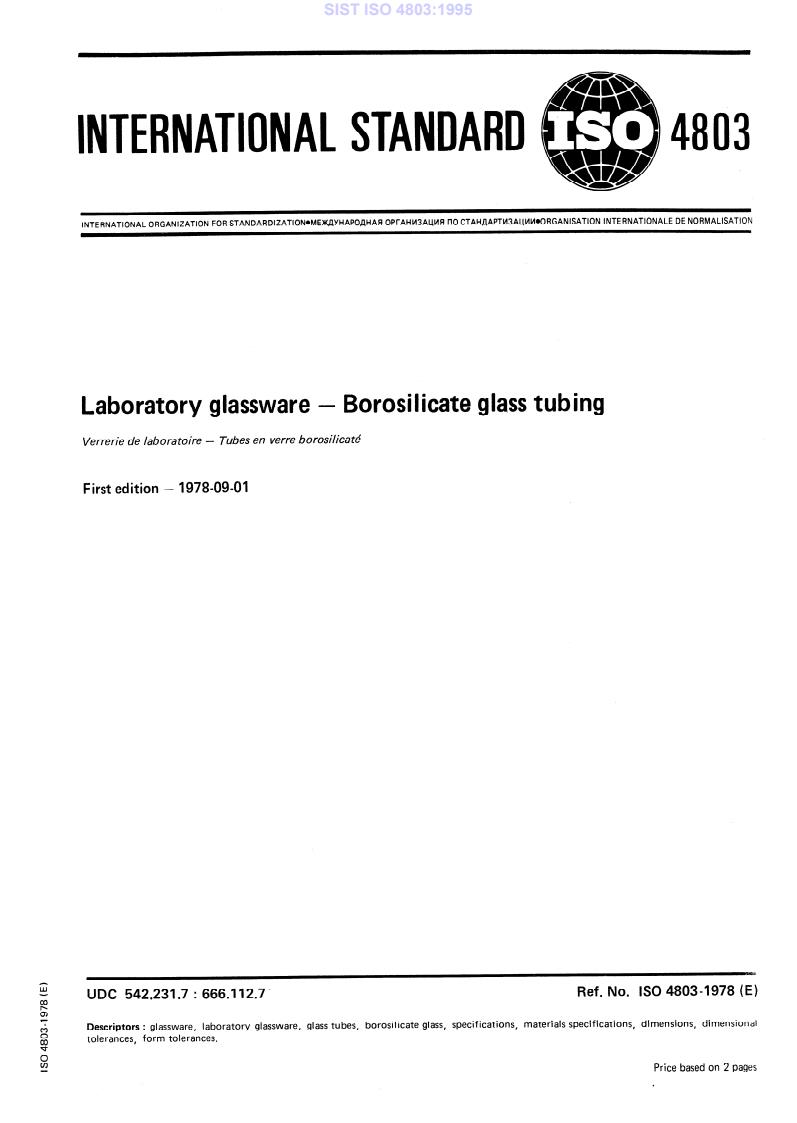
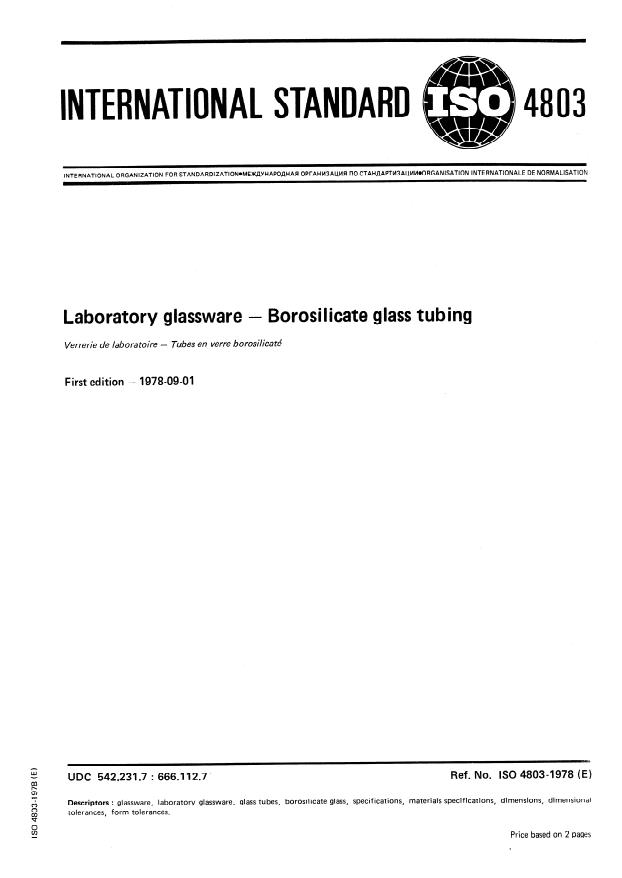
(Main)Laboratory glassware - Borosilicate glass tubing
Laboratory glassware - Borosilicate glass tubing
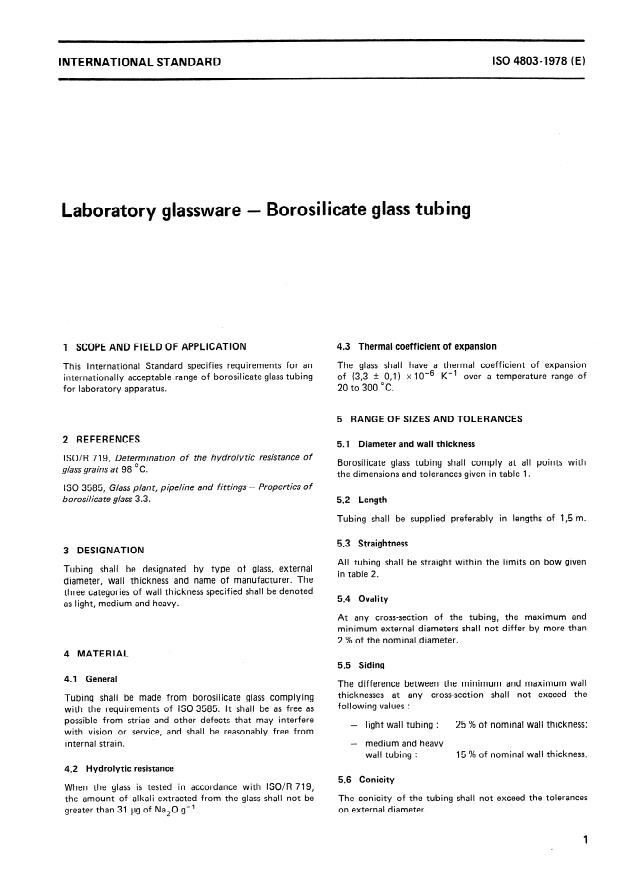
The requirements specify material including its hydrolytic resistance and thermal coefficient of expansion. The range of sizes and tolerance and external diameters and well thickness are tabled and described. In a second table the limits on bow for different external diameters are specified.
Verrerie de laboratoire — Tubes en verre borosilicaté
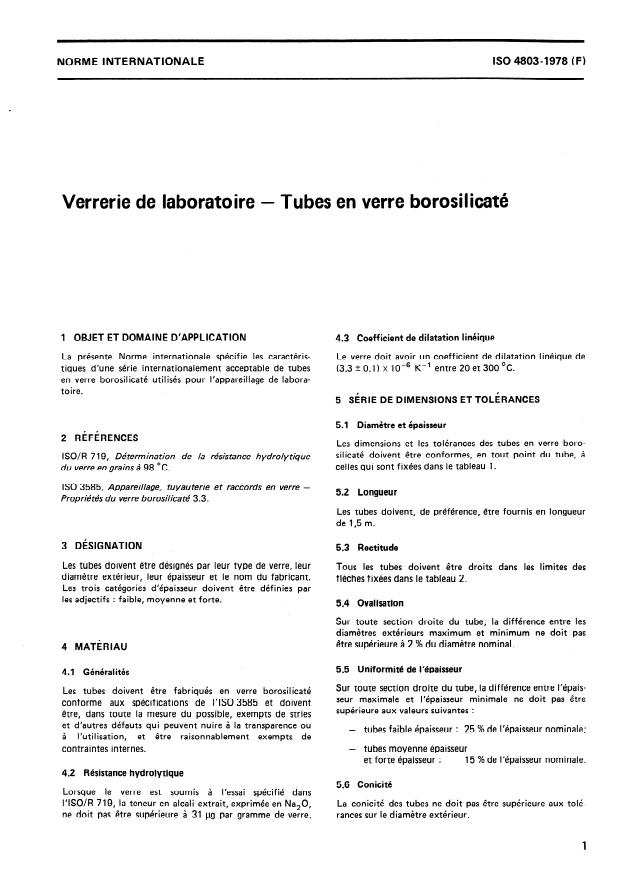
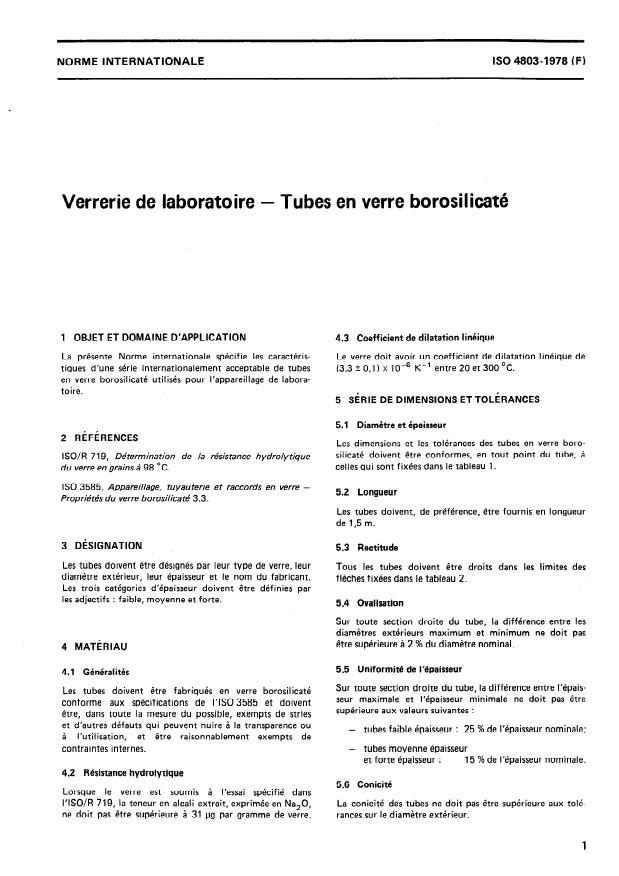
La présente Norme internationale spécifie les caractéristiques d'une série internationalement acceptable de tubes en verre borosilicaté utilisés pour l'appareillage de laboratoire.
Laboratorijska steklovina - Borosilikatne steklene cevi
General Information
Relations
Frequently Asked Questions
ISO 4803:1978 is a standard published by the International Organization for Standardization (ISO). Its full title is "Laboratory glassware - Borosilicate glass tubing". This standard covers: The requirements specify material including its hydrolytic resistance and thermal coefficient of expansion. The range of sizes and tolerance and external diameters and well thickness are tabled and described. In a second table the limits on bow for different external diameters are specified.
The requirements specify material including its hydrolytic resistance and thermal coefficient of expansion. The range of sizes and tolerance and external diameters and well thickness are tabled and described. In a second table the limits on bow for different external diameters are specified.
ISO 4803:1978 is classified under the following ICS (International Classification for Standards) categories: 71.040.20 - Laboratory ware and related apparatus. The ICS classification helps identify the subject area and facilitates finding related standards.
ISO 4803:1978 has the following relationships with other standards: It is inter standard links to ISO 4803:2021. Understanding these relationships helps ensure you are using the most current and applicable version of the standard.
You can purchase ISO 4803:1978 directly from iTeh Standards. The document is available in PDF format and is delivered instantly after payment. Add the standard to your cart and complete the secure checkout process. iTeh Standards is an authorized distributor of ISO standards.
Standards Content (Sample)
SLOVENSKI STANDARD
01-avgust-1995
Laboratorijska steklovina - Borosilikatne steklene cevi
Laboratory glassware -- Borosilicate glass tubing
Verrerie de laboratoire -- Tubes en verre borosilicaté
Ta slovenski standard je istoveten z: ISO 4803:1978
ICS:
71.040.20 Laboratorijska posoda in Laboratory ware and related
aparati apparatus
2003-01.Slovenski inštitut za standardizacijo. Razmnoževanje celote ali delov tega standarda ni dovoljeno.
~~_~~~
INTERNATIONAL STANDARD
INTERNATIONAL ORGANIZATION FOR STANDARDIZATION*ME)I(C1YHAPOfiHAR OPfAHM3AlWlR I-IO CTAH~APTl43Ai@lM.ORGANISATION INTERNATIONALE DE NORMALISATION
Borosilicate glass tubing
Laboratory glassware -
Tubes en verre borosilicatti
Verrerie de laboratoire -
First edition - 1978-09-01
UDC 542.231.7 : 666.112.7' Ref. No. ISO 4803-1978 (E)
borosilicate glass, specif ications, materials specifications, dimensions, dimensional
Descriptors : gl assware, laboratory glassware, glass tubes,
tolerantes, form tolerantes.
Price based on 2 pages
FOREWORD
ISO (the International Organization for Standardization) is a worldwide federation
of national Standards institutes (ISO member bodies). The work of developing
International Standards is carried out through ISO technical committees. Every
member body interested in a subject for which a technical committee has been set
up has the right to be represented on that committee. International organizations,
governmental and non-governmental, in liaison with ISO, also take part in the work.
Draft International Standards adopted by the technical committees are circulated
to the member bodies for approval before their acceptance as International
Standards by the ISO Council.
International Standard ISO 4803 was developed by Technical Committee
ISO/TC 48, Laboratory glassware and related apparatus, and was circulated to the
member bodies in October 1976.
lt has been approved by the member bodies of the following countries :
Austral ia France Netherlands
Austria
Germany Poland
Belgium
Hungary Romania
Canada India Turkey
Chile I taly United Kingdom
Czechoslo Jak ia Mexico U.S.S. R.
The member body of the following contry expressed disapproval of the document
on t echnical grounds :
U.S.A.
@ International Organkation for Standardkation, 1978 l
Printed in Switzerland
ISO 48034978 (E)
INTERNATIONAL STANDARD
Borosilicate glass tubing
Laboratory glassware -
1 SCOPE AND FIELD OF APPLICATION 4.3 Thermal coefficient of expansion
This International Standard specifies requirements for an The glass shall have a thermal coefficient of expansion
-6
internationally acceptable range of borosilicate glass tubing of (3,3 + 0,l) x 10 K” over a temperature range of
20 to 300 “c.
for laboratory apparatus.
5 RANGE OF SIZES AND TOLERANCES
2 REFERENCES
5.1 Diameter and wall thickness
ISQ/R 719, Determination of the hydrolytic resistance of
Borosilicate glass tubing shall comply at all Points with
giass grains at 98 “C.
the dimensions and tolerantes given in table 1.
ISO 3585, Glass plant, Pipeline and fittings - Properties of
borosilicate glass 3.3.
5.2 Length
Tubing shall be supplied preferably in lengths of 1,s m.
5.3 Straightness
3 DESIGNATION
All tubing shall be straight within the Iimits on
...
~~_~~~
INTERNATIONAL STANDARD
INTERNATIONAL ORGANIZATION FOR STANDARDIZATION*ME)I(C1YHAPOfiHAR OPfAHM3AlWlR I-IO CTAH~APTl43Ai@lM.ORGANISATION INTERNATIONALE DE NORMALISATION
Borosilicate glass tubing
Laboratory glassware -
Tubes en verre borosilicatti
Verrerie de laboratoire -
First edition - 1978-09-01
UDC 542.231.7 : 666.112.7' Ref. No. ISO 4803-1978 (E)
borosilicate glass, specif ications, materials specifications, dimensions, dimensional
Descriptors : gl assware, laboratory glassware, glass tubes,
tolerantes, form tolerantes.
Price based on 2 pages
FOREWORD
ISO (the International Organization for Standardization) is a worldwide federation
of national Standards institutes (ISO member bodies). The work of developing
International Standards is carried out through ISO technical committees. Every
member body interested in a subject for which a technical committee has been set
up has the right to be represented on that committee. International organizations,
governmental and non-governmental, in liaison with ISO, also take part in the work.
Draft International Standards adopted by the technical committees are circulated
to the member bodies for approval before their acceptance as International
Standards by the ISO Council.
International Standard ISO 4803 was developed by Technical Committee
ISO/TC 48, Laboratory glassware and related apparatus, and was circulated to the
member bodies in October 1976.
lt has been approved by the member bodies of the following countries :
Austral ia France Netherlands
Austria
Germany Poland
Belgium
Hungary Romania
Canada India Turkey
Chile I taly United Kingdom
Czechoslo Jak ia Mexico U.S.S. R.
The member body of the following contry expressed disapproval of the document
on t echnical grounds :
U.S.A.
@ International Organkation for Standardkation, 1978 l
Printed in Switzerland
ISO 48034978 (E)
INTERNATIONAL STANDARD
Borosilicate glass tubing
Laboratory glassware -
1 SCOPE AND FIELD OF APPLICATION 4.3 Thermal coefficient of expansion
This International Standard specifies requirements for an The glass shall have a thermal coefficient of expansion
-6
internationally acceptable range of borosilicate glass tubing of (3,3 + 0,l) x 10 K” over a temperature range of
20 to 300 “c.
for laboratory apparatus.
5 RANGE OF SIZES AND TOLERANCES
2 REFERENCES
5.1 Diameter and wall thickness
ISQ/R 719, Determination of the hydrolytic resistance of
Borosilicate glass tubing shall comply at all Points with
giass grains at 98 “C.
the dimensions and tolerantes given in table 1.
ISO 3585, Glass plant, Pipeline and fittings - Properties of
borosilicate glass 3.3.
5.2 Length
Tubing shall be supplied preferably in lengths of 1,s m.
5.3 Straightness
3 DESIGNATION
All tubing shall be straight within the Iimits on bow given
Tubing shall be designated by type of glass, external
in table 2.
diameter, wall thickness and name of manufacturer. The
three categories of wall thickness specified shall be denoted
5.4 Ovality
as light, medium and heavy.
At any Cross-section of the tubing, the maximum and
minimum external diameters shall not
...
NORME INTERNATIONALE
INTFRNATIONAL ORGANIZATlON FOR STANDARDIZATION.ME~YHAPO~HAR OPrAHH3ALWl n0 CTAH~APTH3A~HH.ORGANlSATION INTERNATIONALE DE NORMALISATION
Verrerie de laboratoire - Tubes en verre borosilicaté
Laboratory glassware - Borosilica te glass tubing
Première Édition - 1978-09-01
iî
Y
CDU 542.231.7 : 666.112.7 Réf. no : ISO 4803-1978 (F)
f?
Descripteurs : verrerie, verrerie de laboratoire, tube en verre, verre borosilicaté, spécification, spécification de matière, dimension, tolérance
de dimension, tolérance de forme.
Prix basé sur 2 pages
AVANT-PROPOS
L’ISO (Organisation internationale de normalisation) est une fédération mondiale
d’organismes nationaux de normalisation (comités membresde I’ISO). L’élaboration
des Normes internationales est confiée aux comités techniques de I’ISO. Chaque
comité membre intéressé par une étude a le droit de faire partiedu comité technique
Les organisations internationales, gouverne,mentales et non
correspondant.
gouvernementales, en liaison avec I’ISO, participent également aux travaux.
Les projets de Normes internationales adoptés par les comités techniques sont
soumis aux comités membres pour approbation, avant leur acceptation comme
Normes internationales par le Conseil de I’ISO.
La Norme internationale ISO 4803 a été élaborée par le comité technique
ISOfK 48, Verrerie de laboratoire et appareils connexes, et a été soumise aux
comités membres en octobre 1976.
Les comités membres des pays suivants l’ont approuvée :
Allemagne France Pologne
Australie Hongrie Roumanie
Autriche Inde Royaume-Uni
Belgique Italie Tchécoslovaquie
Canada Mexique Turquie
Chili Pays-Bas U.R.S.S.
Le comité membre du pays suivant l’a désapprouvée pour des raisons techniques :
U.S.A.
0 Organisation internationale de normalisation, 1978 l
Imprimé en Suisse
ISO 48034978 (F)
NORME INTERNATIONALE
Verrerie de laboratoire - Tubes en verre borosilicaté
1 OBJET ET DOMAINE D’APPLICATION 4.3 Coefficient de dilatation linéique
La présente Norme internationale spécifie les caractéris- Le verre doit avoir un coefficient de dilatation linéique de
tiques d’une série internationalement acceptable de tubes (3,3 + 0,l) x 10-6 K-l entre 20 et 300 “C.
en verre borosilicaté utilisés pour l’appareillage de labora-
toire.
5 SÉRIE DE DIMENSIONS ET TOLÉRANCES
5.1 Diamètre et épaisseur
2 RÉFÉRENCES
Les dimensions et les tolérances des tubes en verre boro-
silicaté doivent être conformes, en tout point du tube, à
ISO/R 719, Détermination de la résistance hydrolytique
celles qui sont fixées dans le tableau 1.
du verre en grains à 98 “C.
ISO 3585, Appareillage, tuyauterie et raccords en verre -
5.2 Longueur
Propriétés du verre borosilicaté 3.3.
Les tubes doivent, de préférence, être fournis en longueur
de 1,5 m.
3 DÉSIGNATION
5.3 Rectitude
Les tubes doivent être désignés par leur type de verre, leur
Tous les tubes doivent être droits dans les limites des
diamètre extérieur, leur épaisseur et le nom du fabricant.
flèches fixées dans le tableau 2.
Les trois catégories d’épaisseur doivent être définies par
les adjectifs : faible, moyenne et forte.
5.4 Ovalisation
Sur toute section droite du tube, la différence entre les
diamètres extérieurs maximum et minimum ne doit pas
être supérieure à 2 % du diamè
...
NORME INTERNATIONALE
INTFRNATIONAL ORGANIZATlON FOR STANDARDIZATION.ME~YHAPO~HAR OPrAHH3ALWl n0 CTAH~APTH3A~HH.ORGANlSATION INTERNATIONALE DE NORMALISATION
Verrerie de laboratoire - Tubes en verre borosilicaté
Laboratory glassware - Borosilica te glass tubing
Première Édition - 1978-09-01
iî
Y
CDU 542.231.7 : 666.112.7 Réf. no : ISO 4803-1978 (F)
f?
Descripteurs : verrerie, verrerie de laboratoire, tube en verre, verre borosilicaté, spécification, spécification de matière, dimension, tolérance
de dimension, tolérance de forme.
Prix basé sur 2 pages
AVANT-PROPOS
L’ISO (Organisation internationale de normalisation) est une fédération mondiale
d’organismes nationaux de normalisation (comités membresde I’ISO). L’élaboration
des Normes internationales est confiée aux comités techniques de I’ISO. Chaque
comité membre intéressé par une étude a le droit de faire partiedu comité technique
Les organisations internationales, gouverne,mentales et non
correspondant.
gouvernementales, en liaison avec I’ISO, participent également aux travaux.
Les projets de Normes internationales adoptés par les comités techniques sont
soumis aux comités membres pour approbation, avant leur acceptation comme
Normes internationales par le Conseil de I’ISO.
La Norme internationale ISO 4803 a été élaborée par le comité technique
ISOfK 48, Verrerie de laboratoire et appareils connexes, et a été soumise aux
comités membres en octobre 1976.
Les comités membres des pays suivants l’ont approuvée :
Allemagne France Pologne
Australie Hongrie Roumanie
Autriche Inde Royaume-Uni
Belgique Italie Tchécoslovaquie
Canada Mexique Turquie
Chili Pays-Bas U.R.S.S.
Le comité membre du pays suivant l’a désapprouvée pour des raisons techniques :
U.S.A.
0 Organisation internationale de normalisation, 1978 l
Imprimé en Suisse
ISO 48034978 (F)
NORME INTERNATIONALE
Verrerie de laboratoire - Tubes en verre borosilicaté
1 OBJET ET DOMAINE D’APPLICATION 4.3 Coefficient de dilatation linéique
La présente Norme internationale spécifie les caractéris- Le verre doit avoir un coefficient de dilatation linéique de
tiques d’une série internationalement acceptable de tubes (3,3 + 0,l) x 10-6 K-l entre 20 et 300 “C.
en verre borosilicaté utilisés pour l’appareillage de labora-
toire.
5 SÉRIE DE DIMENSIONS ET TOLÉRANCES
5.1 Diamètre et épaisseur
2 RÉFÉRENCES
Les dimensions et les tolérances des tubes en verre boro-
silicaté doivent être conformes, en tout point du tube, à
ISO/R 719, Détermination de la résistance hydrolytique
celles qui sont fixées dans le tableau 1.
du verre en grains à 98 “C.
ISO 3585, Appareillage, tuyauterie et raccords en verre -
5.2 Longueur
Propriétés du verre borosilicaté 3.3.
Les tubes doivent, de préférence, être fournis en longueur
de 1,5 m.
3 DÉSIGNATION
5.3 Rectitude
Les tubes doivent être désignés par leur type de verre, leur
Tous les tubes doivent être droits dans les limites des
diamètre extérieur, leur épaisseur et le nom du fabricant.
flèches fixées dans le tableau 2.
Les trois catégories d’épaisseur doivent être définies par
les adjectifs : faible, moyenne et forte.
5.4 Ovalisation
Sur toute section droite du tube, la différence entre les
diamètres extérieurs maximum et minimum ne doit pas
être supérieure à 2 % du diamè
...
Questions, Comments and Discussion
Ask us and Technical Secretary will try to provide an answer. You can facilitate discussion about the standard in here.
Loading comments...