

ISO 18270:2026
(Main)Classification and performance guidelines for leather upholstered products
General Information
- Abstract
This document provides guidelines for the classification and performance of leather upholstered products. This document is applicable to products made of leather upholstered for all levels of production. This document is applied if the upholstered material is made of leather or rather is a leather semi-finished product.
- Status
- Published
- Publication Date
- 28-Jan-2026
- Technical Committee
- ISO/TC 120/SC 3 - Leather products
- Drafting Committee
- ISO/TC 120/SC 3 - Leather products
- Current Stage
- 6060 - International Standard published
- Start Date
- 29-Jan-2026
- Due Date
- 09-Nov-2025
- Completion Date
- 29-Jan-2026

Overview
ISO 18270:2026 provides comprehensive classification and performance guidelines for leather upholstered products. Developed by the International Organization for Standardization (ISO), this standard applies to all types of products using leather as the main upholstery material, ranging from furniture and decorative items to products for babies and everyday consumer goods. The guidelines address both semi-finished and fully finished leather upholstery materials, ensuring consistency across all levels of production and usage.
Implementing ISO 18270:2026 helps manufacturers, suppliers, and consumers benefit from standardized leather quality, reliability, and product labelling, supporting informed choices and increased product safety.
Key Topics
Product Classification: The standard distinguishes leather upholstered products into four main product classes, based on their intended use and contact with the human body:
- Class I: Products for babies and small children (up to 36 months).
- Class II: Products with direct skin contact (e.g., chairs, beds).
- Class III: Products without direct skin contact or with minimal, occasional contact (e.g., wall coverings, cabinets).
- Class IV: Decorative products with no regular direct skin contact.
Performance Guidelines: ISO 18270:2026 sets forth recommended performance characteristics for leather upholstery, including:
- Mechanical durability (e.g., tear load, flex resistance)
- Color fastness (resistance to rubbing, perspiration, and light)
- Safety (such as burning behavior and cold crack resistance)
- pH specification and finish adhesion for appropriate classes
Testing and Sampling: The guidelines recommend preparation and testing of either finished products or their component materials to verify compliance with performance requirements.
Marking and Labelling: Proper product labelling is required, including manufacturer information, product class, reference to ISO 18270:2026, care instructions, and precise designation of the materials used (e.g., "leather," "part leather").
Terminology: Clear definitions of key terms such as "upholstered product," "contact area," and "product class" ensure consistency and understanding throughout the industry.
Applications
ISO 18270:2026 is valuable across various industries and scenarios, including:
- Furniture Manufacturing: Assists manufacturers in designing, producing, and certifying leather sofas, chairs, beds, and other seating in compliance with international standards for safety and quality.
- Children’s Products: Ensures that leather products intended for babies and small children adhere to rigorous safety and performance criteria.
- Interior Design and Decor: Supports the creation and labelling of decorative leather goods for both commercial and residential spaces.
- Retail and E-commerce: Provides clear guidelines for accurate product description, fair marketing, and customer transparency.
- Quality Assurance: Offers a benchmark for regulatory bodies, testing laboratories, and quality control departments in assessing leather upholstered products.
By implementing ISO 18270:2026, organizations can enhance product reputation, promote consumer safety, and gain access to new international markets by demonstrating compliance with recognized classification and performance guidelines for leather upholstered products.
Related Standards
Key ISO standards referenced in ISO 18270:2026 include:
- ISO 3377-1 - Determination of tear load for leather
- ISO 5402-1 - Determination of flex resistance
- ISO 11640 - Color fastness to rubbing
- ISO 11641 - Color fastness to perspiration
- ISO 105-B02 - Color fastness to artificial light
- ISO 4045 - Determination of pH
- ISO 8191-1 & ISO 8191-2 - Assessment of the ignitability of upholstered furniture
- ISO 11644 - Adhesion of finish
- ISO 15115 - Leather vocabulary
- ISO 17233 - Cold crack resistance
- ISO 15700 - Color fastness to water spotting
These related standards help manufacturers, laboratories, and regulatory authorities apply consistent testing, terminology, and evaluation methods for leather upholstered products, supporting the effective implementation of ISO 18270:2026.
Get Certified
Connect with accredited certification bodies for this standard

Control Union Certifications
Global certification for agriculture and sustainability.

Hohenstein Institut
Textile testing and certification.

Bureau Veritas Bangladesh
Bureau Veritas certification services in Bangladesh.
Sponsored listings
Frequently Asked Questions
ISO 18270:2026 is a standard published by the International Organization for Standardization (ISO). Its full title is "Classification and performance guidelines for leather upholstered products". This standard covers: This document provides guidelines for the classification and performance of leather upholstered products. This document is applicable to products made of leather upholstered for all levels of production. This document is applied if the upholstered material is made of leather or rather is a leather semi-finished product.
This document provides guidelines for the classification and performance of leather upholstered products. This document is applicable to products made of leather upholstered for all levels of production. This document is applied if the upholstered material is made of leather or rather is a leather semi-finished product.
ISO 18270:2026 is classified under the following ICS (International Classification for Standards) categories: 59.140.35 - Leather products. The ICS classification helps identify the subject area and facilitates finding related standards.
ISO 18270:2026 is available in PDF format for immediate download after purchase. The document can be added to your cart and obtained through the secure checkout process. Digital delivery ensures instant access to the complete standard document.
Standards Content (Sample)
International
Standard
ISO 18270
First edition
Classification and performance
2026-01
guidelines for leather upholstered
products
Classification et lignes directrices de performance pour les
produits rembourrés en cuir
Reference number
© ISO 2026
All rights reserved. Unless otherwise specified, or required in the context of its implementation, no part of this publication may
be reproduced or utilized otherwise in any form or by any means, electronic or mechanical, including photocopying, or posting on
the internet or an intranet, without prior written permission. Permission can be requested from either ISO at the address below
or ISO’s member body in the country of the requester.
ISO copyright office
CP 401 • Ch. de Blandonnet 8
CH-1214 Vernier, Geneva
Phone: +41 22 749 01 11
Email: copyright@iso.org
Website: www.iso.org
Published in Switzerland
ii
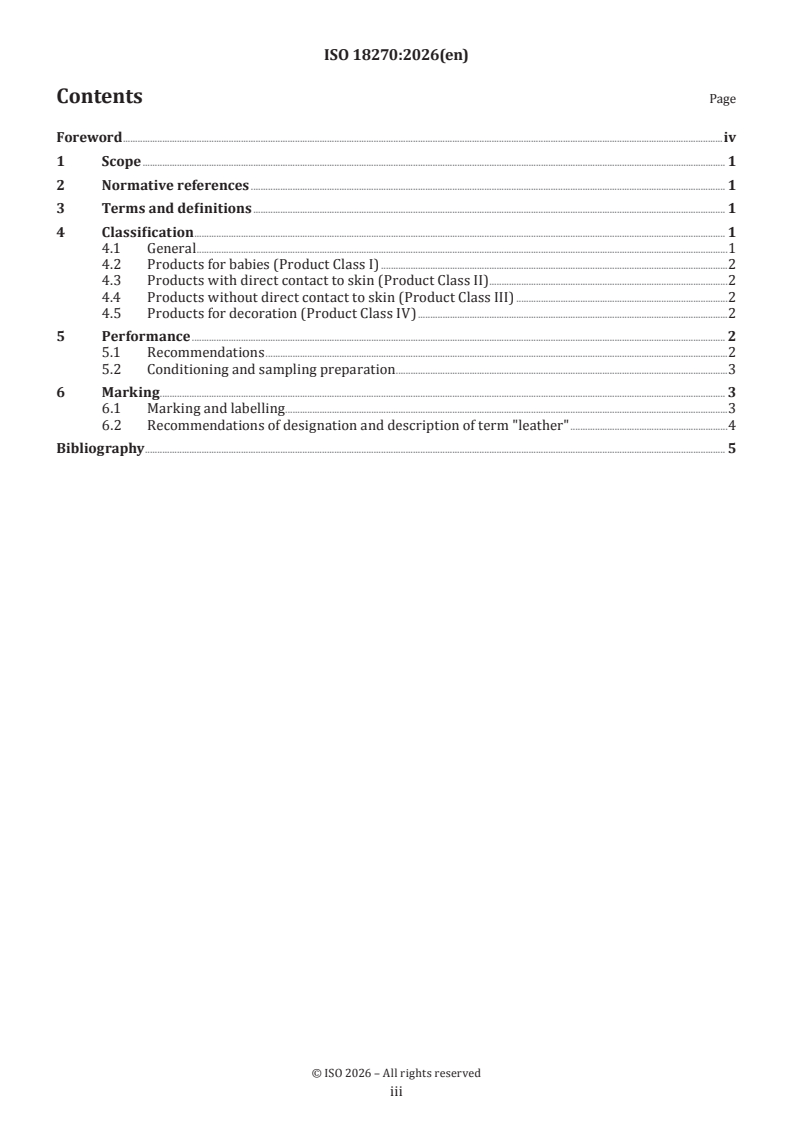
Contents Page
Foreword .iv
1 Scope . 1
2 Normative references . 1
3 Terms and definitions . 1
4 Classification . 1
4.1 General .1
4.2 Products for babies (Product Class I) .2
4.3 Products with direct contact to skin (Product Class II) .2
4.4 Products without direct contact to skin (Product Class III) .2
4.5 Products for decoration (Product Class IV) .2
5 Performance . 2
5.1 Recommendations .2
5.2 Conditioning and sampling preparation .3
6 Marking . .3
6.1 Marking and labelling .3
6.2 Recommendations of designation and description of term "leather" .4
Bibliography .5
iii
Foreword
ISO (the International Organization for Standardization) is a worldwide federation of national standards
bodies (ISO member bodies). The work of preparing International Standards is normally carried out through
ISO technical committees. Each member body interested in a subject for which a technical committee
has been established has the right to be represented on that committee. International organizations,
governmental and non-governmental, in liaison with ISO, also take part in the work. ISO collaborates closely
with the International Electrotechnical Commission (IEC) on all matters of electrotechnical standardization.
The procedures used to develop this document and those intended for its further maintenance are described
in the ISO/IEC Directives, Part 1. In particular, the different approval criteria needed for the different types
of ISO document should be noted. This document was drafted in accordance with the editorial rules of the
ISO/IEC Directives, Part 2 (see www.iso.org/directives).
ISO draws attention to the possibility that the implementation of this document may involve the use of (a)
patent(s). ISO takes no position concerning the evidence, validity or applicability of any claimed patent
rights in respect thereof. As of the date of publication of this document, ISO had not received notice of (a)
patent(s) which may be required to implement this document. However, implementers are cautioned that
this may not represent the latest information, which may be obtained from the patent database available at
www.iso.org/patents. ISO shall not be held responsible for identifying any or all such patent rights.
Any trade name used in this document is information given for the convenience of users and does not
constitute an endorsement.
For an explanation of the voluntary nature of standards, the meaning of ISO specific terms and expressions
related to conformity assessment, as well as information about ISO's adherence to the World Trade
Organization (WTO) principles in the Technical Barriers to Trade (TBT), see www.iso.org/iso/foreword.html.
This document was prepared by Technical Committee ISO/TC 120, Leather, Subcommittee SC 3, Leather
products.
Any feedback or questions on this document should be directed to the user’s national standards body. A
complete listing of these bodies can be found at www.iso.org/members.html.
iv
International Standard ISO 18270:2026(en)
Classification and performance guidelines for leather
upholstered products
1 Scope
This document provides guidelines for the classification and performance of leather upholstered products.
This document is applicable to products made of leather upholstered for all levels of production.
This document is applied if the upholstered material is made of leather or rather is a leather semi-finished
product.
2 Normative references
There are no normative references in this document.
3 Terms and definitions
For the purposes of this document, the following terms and definitions apply.
ISO and IEC maintain terminology databases for use in standardization at the following addresses:
— ISO Online browsing platform: available at https:// www .iso .org/ obp
— IEC Electropedia: available at https:// www .electropedia .org/
3.1
upholstered product
product comprising a frame, cushioning material and a covering, excluding loose cushions and free coverings,
unless they are an integral part of the pr
...