

ISO 13935-2:2026
(Main)Textiles — Seam tensile properties of fabrics and made-up textile articles — Part 2: Determination of maximum force to seam rupture using the grab method
General Information
- Abstract
This document specifies methods for the determination of seam maximum force of sewn seams when the force is applied perpendicularly to the seam. It describes the method known as the grab test. The method defined in this document is applicable to woven textile fabrics, including fabrics which exhibit stretch characteristics imparted by the presence of an elastomeric fibre, mechanical or chemical treatment. It can be applicable to fabrics produced by other techniques. It is normally not applicable to geotextiles, nonwovens, coated fabrics, textile-glass woven fabrics and fabrics made from carbon fibres or polyolefin tape yarns.[2], [3], [4] This method is applicable to straight seams only (obtained from previously sewn articles or prepared from fabric samples) and not to curved seams (see Annex B for considerations on seams). The method is restricted to the use of constant-rate-of-extension (CRE) testing machines.
- Status
- Published
- Publication Date
- 21-Apr-2026
- Technical Committee
- ISO/TC 38/SC 24 - Conditioning atmospheres and physical tests for textile fabrics
- Drafting Committee
- ISO/TC 38/SC 24/WG 2 - Fabrics - Physical Tests
- Current Stage
- 6060 - International Standard published
- Start Date
- 22-Apr-2026
- Due Date
- 07-Nov-2026
- Completion Date
- 22-Apr-2026
Buy Documents
ISO 13935-2:2026 - Textiles — Seam tensile properties of fabrics and made-up textile articles — Part 2: Determination of maximum force to seam rupture using the grab method
ISO 13935-2:2026 - Textiles — Propriétés de résistance à la traction des coutures d'étoffes et d'articles textiles confectionnés — Partie 2: Détermination de la force maximale avant rupture des coutures par la méthode d'arrachement (Grab test)
Overview
ISO 13935-2:2026 establishes standardized methods for determining the maximum force required to rupture a sewn seam in textiles and textile articles. Specifically, this standard details the procedures for using the "grab test" to evaluate the tensile strength of straight seams in woven fabrics and fabrics exhibiting stretch characteristics due to elastomeric fibers or treatments. The grab method involves applying a perpendicular force to a seam using a constant-rate-of-extension (CRE) machine until the seam fails.
This standard is instrumental in quality assurance and product development in the textile and apparel sectors, enabling manufacturers and laboratories to consistently assess seam durability under controlled and repeatable conditions.
Key Topics
- Applicability of the Grab Test:
- Relevant for woven textile fabrics, including those with stretch, and possibly other fabric production techniques.
- Not suitable for geotextiles, nonwovens, coated fabrics, textile-glass woven fabrics, or textiles made from carbon fibers or polyolefin tape yarns.
- Limitation to Straight Seams:
- Applies strictly to straight seams, either sourced from finished articles or specially prepared samples.
- Excludes curved seams due to non-uniform stress distribution.
- Testing Equipment:
- Mandates the use of constant-rate-of-extension (CRE) tensile testing machines, ensuring precise and repeatable results.
- Sample Preparation and Conditioning:
- Detailed guidance on cutting, marking, and preparing specimens to ensure representative and reliable testing.
- Specifies requirements for sewing seams, seam positioning, and test specimen size.
- Testing Methodology:
- Clear instructions on machine settings, mounting of specimens, and execution of tests.
- Documentation of seam rupture causes (such as fabric tear or thread failure) and exclusion criteria to maintain data integrity.
- Reporting and Calculation:
- Includes minimum reporting requirements, such as sample information, test method reference, mean seam rupture force, and details of seam failures.
Applications
ISO 13935-2:2026 is widely used for:
- Textile Manufacturing: Supporting quality control protocols by quantifying seam strength, helping ensure product durability and compliance with internal or customer specifications.
- Apparel and Fashion Industry: Verifying that garments withstand day-to-day stresses, especially in structural seams critical to garment integrity.
- Research and Development: Providing a standard test method for fabric development and benchmarking, particularly when introducing new textiles or seam constructions.
- Third-Party Testing Laboratories: Offering internationally recognized test results that support supply chain quality assurance for retailers and brands.
- Procurement and Specification Writing: Assisting buyers and technical teams in evaluating and specifying minimum seam performance during sourcing or tendering processes.
Related Standards
Integration and comparison with other standards enhance the value and consistency of test results:
- ISO 13934-2: Measures tensile properties of fabrics using the grab method, allowing for direct comparison with seam strengths evaluated under ISO 13935-2:2026.
- ISO 13934-1: Evaluates tensile properties with the strip method, suitable for different fabric and seam configurations.
- ISO 13935-1: Specifies determination of maximum force to seam rupture using the strip method, offering an alternative approach to ISO 13935-2:2026.
- ISO 139: Defines standard atmospheres for textile conditioning and testing, ensuring test consistency.
- ISO 7500-1: Outlines calibration and verification requirements for testing machine force-measurement systems.
- ISO 10012: Covers management systems for measurement processes and equipment.
- ISO 11610: Provides vocabulary relevant to protective clothing and textile testing.
Implementing ISO 13935-2:2026 promotes reliable, comparable seam tensile property data, supporting product safety, durability, and market access across the global textile industry.
Relations
- Effective Date
- 12-Feb-2026
- Effective Date
- 25-Nov-2023
- Effective Date
- 11-Nov-2023
Buy Documents
ISO 13935-2:2026 - Textiles — Seam tensile properties of fabrics and made-up textile articles — Part 2: Determination of maximum force to seam rupture using the grab method
ISO 13935-2:2026 - Textiles — Propriétés de résistance à la traction des coutures d'étoffes et d'articles textiles confectionnés — Partie 2: Détermination de la force maximale avant rupture des coutures par la méthode d'arrachement (Grab test)
Get Certified
Connect with accredited certification bodies for this standard

Control Union Certifications
Global certification for agriculture and sustainability.

Hohenstein Institut
Textile testing and certification.

Bureau Veritas Bangladesh
Bureau Veritas certification services in Bangladesh.
Sponsored listings
Frequently Asked Questions
ISO 13935-2:2026 is a standard published by the International Organization for Standardization (ISO). Its full title is "Textiles — Seam tensile properties of fabrics and made-up textile articles — Part 2: Determination of maximum force to seam rupture using the grab method". This standard covers: This document specifies methods for the determination of seam maximum force of sewn seams when the force is applied perpendicularly to the seam. It describes the method known as the grab test. The method defined in this document is applicable to woven textile fabrics, including fabrics which exhibit stretch characteristics imparted by the presence of an elastomeric fibre, mechanical or chemical treatment. It can be applicable to fabrics produced by other techniques. It is normally not applicable to geotextiles, nonwovens, coated fabrics, textile-glass woven fabrics and fabrics made from carbon fibres or polyolefin tape yarns.[2], [3], [4] This method is applicable to straight seams only (obtained from previously sewn articles or prepared from fabric samples) and not to curved seams (see Annex B for considerations on seams). The method is restricted to the use of constant-rate-of-extension (CRE) testing machines.
This document specifies methods for the determination of seam maximum force of sewn seams when the force is applied perpendicularly to the seam. It describes the method known as the grab test. The method defined in this document is applicable to woven textile fabrics, including fabrics which exhibit stretch characteristics imparted by the presence of an elastomeric fibre, mechanical or chemical treatment. It can be applicable to fabrics produced by other techniques. It is normally not applicable to geotextiles, nonwovens, coated fabrics, textile-glass woven fabrics and fabrics made from carbon fibres or polyolefin tape yarns.[2], [3], [4] This method is applicable to straight seams only (obtained from previously sewn articles or prepared from fabric samples) and not to curved seams (see Annex B for considerations on seams). The method is restricted to the use of constant-rate-of-extension (CRE) testing machines.
ISO 13935-2:2026 is classified under the following ICS (International Classification for Standards) categories: 59.080.30 - Textile fabrics; 61.020 - Clothes. The ICS classification helps identify the subject area and facilitates finding related standards.
ISO 13935-2:2026 has the following relationships with other standards: It is inter standard links to EN ISO 13935-2:2026, ISO/IEC 23090-9:2023, ISO 13935-2:2014. Understanding these relationships helps ensure you are using the most current and applicable version of the standard.
ISO 13935-2:2026 is available in PDF format for immediate download after purchase. The document can be added to your cart and obtained through the secure checkout process. Digital delivery ensures instant access to the complete standard document.
Standards Content (Sample)
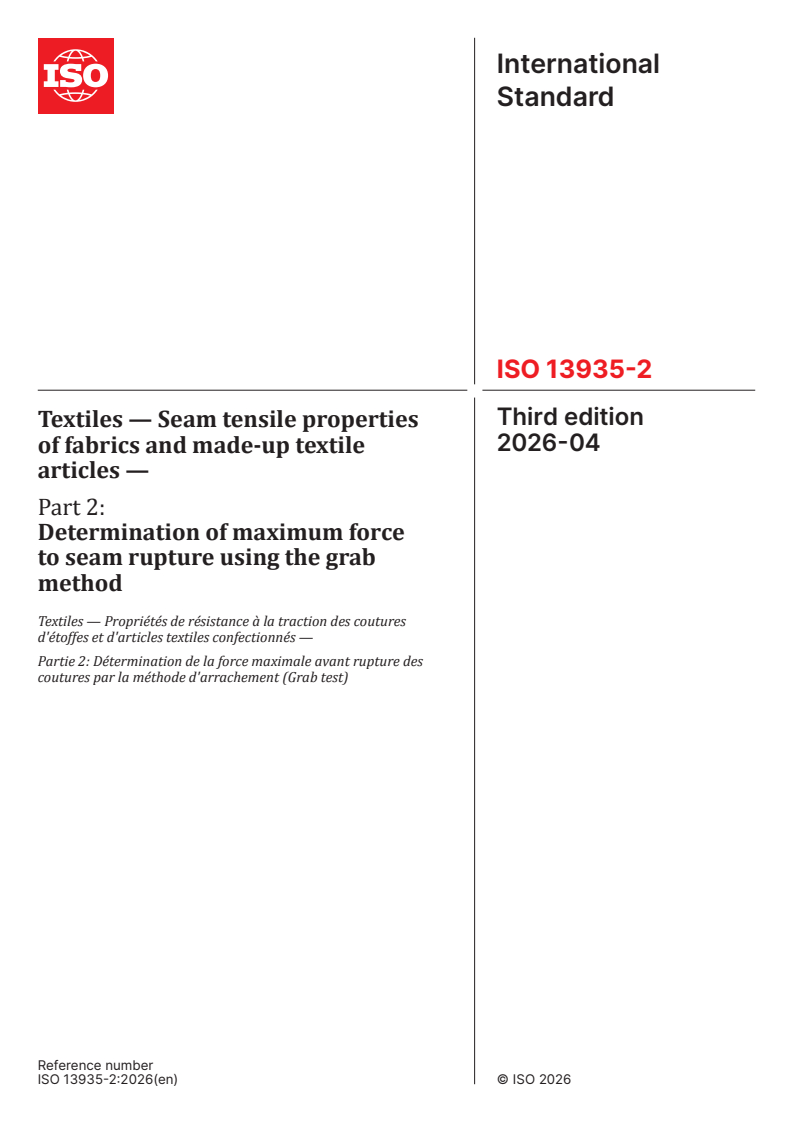
International
Standard
ISO 13935-2
Third edition
Textiles — Seam tensile properties
2026-04
of fabrics and made-up textile
articles —
Part 2:
Determination of maximum force
to seam rupture using the grab
method
Textiles — Propriétés de résistance à la traction des coutures
d'étoffes et d'articles textiles confectionnés —
Partie 2: Détermination de la force maximale avant rupture des
coutures par la méthode d'arrachement (Grab test)
Reference number
© ISO 2026
All rights reserved. Unless otherwise specified, or required in the context of its implementation, no part of this publication may
be reproduced or utilized otherwise in any form or by any means, electronic or mechanical, including photocopying, or posting on
the internet or an intranet, without prior written permission. Permission can be requested from either ISO at the address below
or ISO’s member body in the country of the requester.
ISO copyright office
CP 401 • Ch. de Blandonnet 8
CH-1214 Vernier, Geneva
Phone: +41 22 749 01 11
Email: copyright@iso.org
Website: www.iso.org
Published in Switzerland
ii
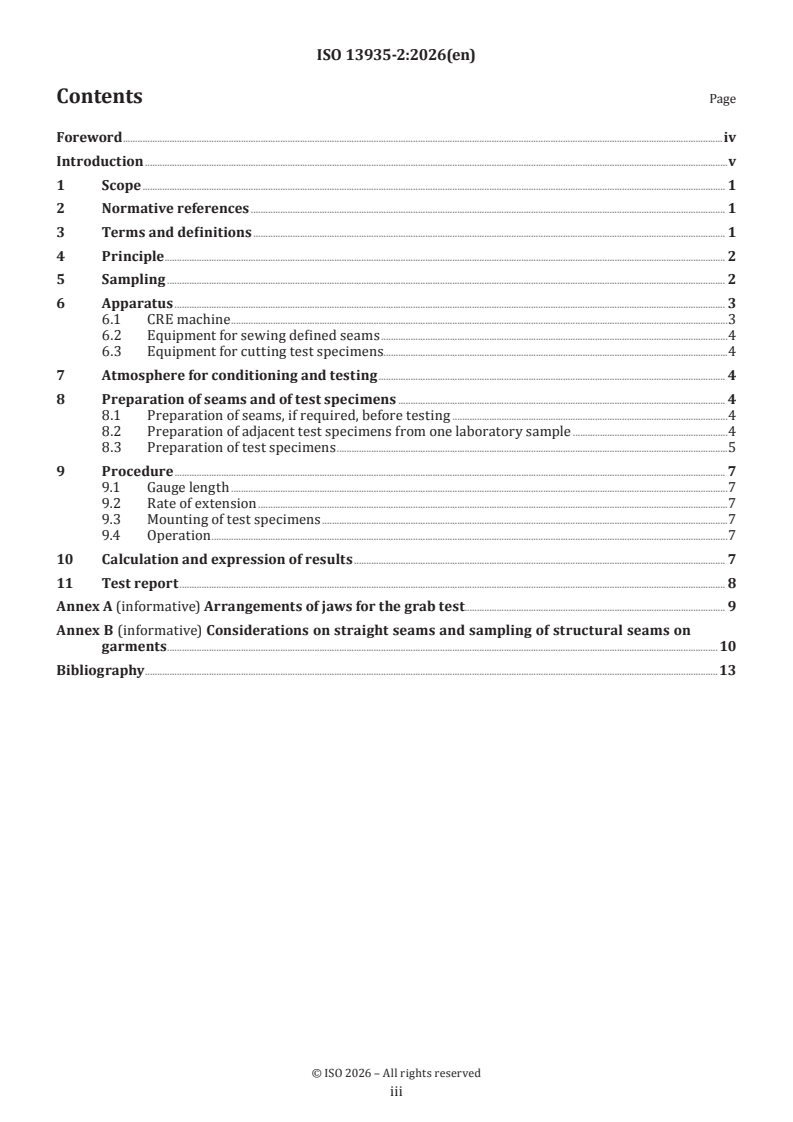
Contents Page
Foreword .iv
Introduction .v
1 Scope . 1
2 Normative references . 1
3 Terms and definitions . 1
4 Principle . 2
5 Sampling . 2
6 Apparatus . 3
6.1 CRE machine .3
6.2 Equipment for sewing defined seams .4
6.3 Equipment for cutting test specimens.4
7 Atmosphere for conditioning and testing . 4
8 Preparation of seams and of test specimens . 4
8.1 Preparation of seams, if required, before testing .4
8.2 Preparation of adjacent test specimens from one laboratory sample .4
8.3 Preparation of test specimens .5
9 Procedure . 7
9.1 Gauge length .7
9.2 Rate of extension .7
9.3 Mounting of test specimens .7
9.4 Operation .7
10 Calculation and expression of results . 7
11 Test report . 8
Annex A (informative) Arrangements of jaws for the grab test . 9
Annex B (informative) Considerations on straight seams and sampling of structural seams on
garments . 10
Bibliography .13
iii
Foreword
ISO (the International Organization for Standardization) is a worldwide federation of national standards
bodies (ISO member bodies). The work of preparing International Standards is normally carried out through
ISO technical committees. Each member body interested in a subject for which a technical committee
has been established has the right to be represented on that committee. International organizations,
governmental and non-governmental, in liaison with ISO, also take part in the work. ISO collaborates closely
with the International Electrotechnical Commission (IEC) on all matters of electrotechnical standardization.
The procedures used to develop this document and those intended for its further maintenance are described
in the ISO/IEC Directives, Part 1. In particular, the different approval criteria needed for the different types
of ISO document should be noted. This document was drafted in accordance with the editorial rules of the
ISO/IEC Directives, Part 2 (see www.iso.org/directives).
ISO draws attention to the possibility that the implementation of this document may involve the use of (a)
patent(s). ISO takes no position concerning the evidence, validity or applicability of any claimed patent
rights in respect thereof. As of the date of publication of this document, ISO had not received notice of (a)
patent(s) which may be required to implement this document. However, implementers are cautioned that
this may not represent the latest information, which may be obtained from the patent database available at
www.iso.org/patents. ISO shall not be held responsible for identifying any or all such patent rights.
Any trade name used in this document is information given for the convenience of users and does not
constitute an endorsement.
For an explanation of the voluntary nature of standards, the meaning of ISO specific terms and expressions
related to conformity assessment, as well as information about ISO's adherence to the World Trade
Organization (WTO) principles in the Technical Barriers to Trade (TBT), see www.iso.org/iso/foreword.html.
This document was prepared by Technical Committee ISO/TC 38, Textiles, Subcommittee SC 24, Conditioning
atmospheres and physical tests for textile fabrics, in collaboration with the European Committee for
Standardization (CEN) Technical Committee CEN/TC 248, Textiles and textile products, in accordance with
the Agreement on technical cooperation between ISO and CEN (Vienna Agreement).
This third edition cancels and replaces the second edition (ISO 13935-2:2014), which has been technically
revised.
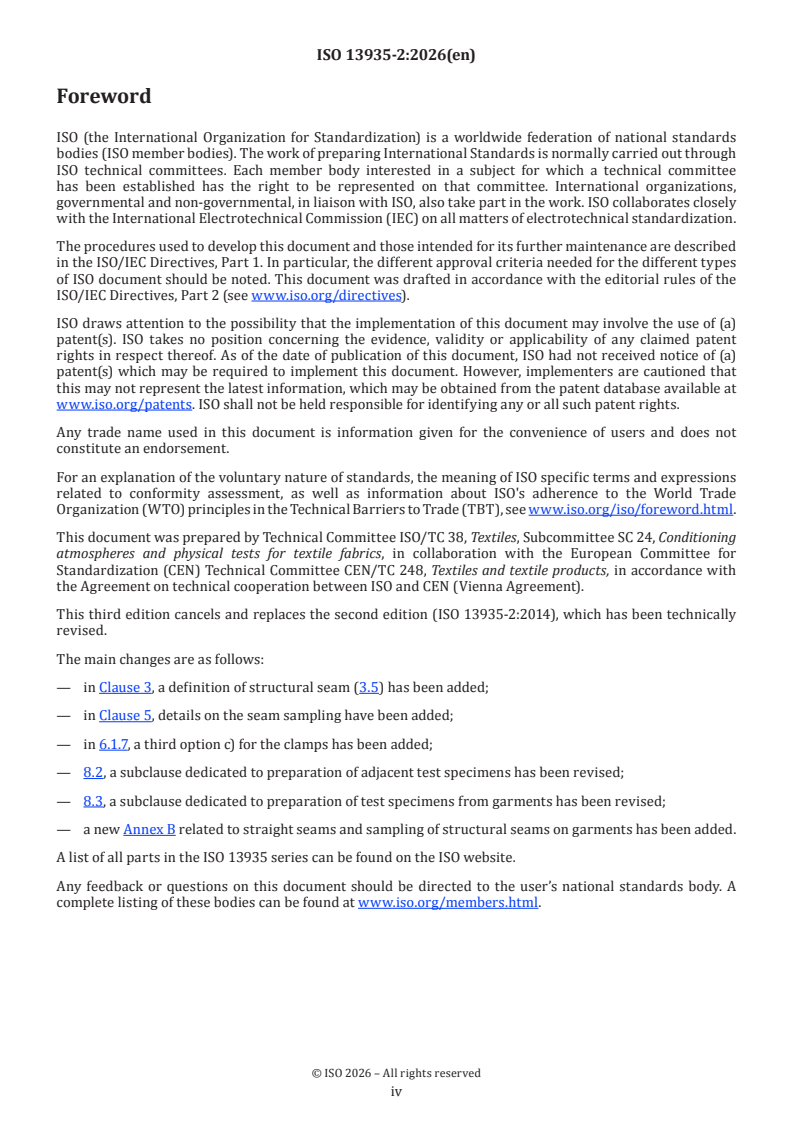
The main changes are as follows:
— in Clause 3, a definition of structural seam (3.5) has been added;
— in Clause 5, details on the seam sampling have been added;
— in 6.1.7, a third option c) for the clamps has been added;
— 8.2, a subclause dedicated to preparation of adjacent test specimens has been revised;
— 8.3, a subclause dedicated to preparation of test specimens from garments has been revised;
— a new Annex B related to straight seams and sampling of structural seams on garments has been added.
A list of all parts in the ISO 13935 series can be found on the ISO website.
Any feedback or questions on this document should be directed to the user’s national standards body. A
complete listing of these bodies can be found at www.iso.org/members.html.
iv
Introduction
This document has been prepared in the context of several test methods for determination of certain
mechanical properties of textiles using mainly tensile testing machines, e.g. tensile properties, seam tensile
properties, tear properties, seam slippage. The procedure for these standards agrees where appropriate.
The results obtained by one of the methods should not be compared with those obtained by the other
methods. See References [2], [3] and [4].
Where it is intended to compare the seam maximum force values of sewn seams with the fabric maximum
force, it is important to use the same type of test, test conditions and test specimens in the tests in this
[2]
document and ISO 13934-2 .
v
International Standard ISO 13935-2:2026(en)
Textiles — Seam tensile properties of fabrics and made-up
textile articles —
Part 2:
Determination of maximum force to seam rupture using the
grab method
1 Scope
This document specifies methods for the determination of seam maximum force of sewn seams when the
force is applied perpendicularly to the seam. It describes the method known as the grab test.
The method defined in this document is applicable to woven textile fabrics, including fabrics which exhibit
stretch characteristics imparted by the presence of an elastomeric fibre, mechanical or chemical treatment.
It can be applicable to fabrics produced by other techniques. It is normally not applicable to geotextiles,
nonwovens, coated fabrics, textile-glass woven fabrics and fabrics made from carbon fibres or polyolefin
, ,
tape yarns.[2] [3] [4]
This method is applicable to straight seams only (obtained from previously sewn articles or prepared from
fabric samples) and not to curved seams (see Annex B for considerations on seams).
The method is restricted to the use of constant-rate-of-extension (CRE) testing machines.
2 Normative references
The following documents are referred to in the text in such a way that some or all of their content constitutes
requirements of this document. For dated references, only the edition cited applies. For undated references,
the latest edition of the referenced document (including any amendments) applies.
ISO 139, Textiles — Standard atmospheres for conditioning and testing
ISO 7500-1, Metallic materials — Calibration and verification of static uniaxial testing machines — Part 1:
Tension/compression testing machines — Calibration and verification of the force-measuring system
ISO 10012, Measurement management systems — Requirements for measurement processes and measuring
equipment
3 Terms and definitions
For the purposes of this document, the following terms and definitions apply.
ISO and IEC maintain terminology databases for use in standardization at the following addresses:
— ISO Online browsing platform: available at https:// www .iso .org/ obp
— IEC Electropedia: available at https:// www .electropedia .org/
3.1
constant-rate-of-extension (CRE) testing machine
tensile-testing machine provided with one clamp which is stationary and another clamp which moves with a
constant speed throughout the test, the entire testing system being virtually free from deflection
[2]
[SOURCE: ISO 13934-1:2013, 3.1]
3.2
grab test
tensile test in which only the centre part of the test sp
...
Norme
internationale
ISO 13935-2
Troisième édition
Textiles — Propriétés de résistance
2026-04
à la traction des coutures
d'étoffes et d'articles textiles
confectionnés —
Partie 2:
Détermination de la force maximale
avant rupture des coutures par la
méthode d'arrachement (Grab test)
Textiles — Seam tensile properties of fabrics and made-up textile
articles —
Part 2: Determination of maximum force to seam rupture using
the grab method
Numéro de référence
DOCUMENT PROTÉGÉ PAR COPYRIGHT
© ISO 2026
Tous droits réservés. Sauf prescription différente ou nécessité dans le contexte de sa mise en œuvre, aucune partie de cette
publication ne peut être reproduite ni utilisée sous quelque forme que ce soit et par aucun procédé, électronique ou mécanique,
y compris la photocopie, ou la diffusion sur l’internet ou sur un intranet, sans autorisation écrite préalable. Une autorisation peut
être demandée à l’ISO à l’adresse ci-après ou au comité membre de l’ISO dans le pays du demandeur.
ISO copyright office
Case postale 401 • Ch. de Blandonnet 8
CH-1214 Vernier, Genève
Tél.: +41 22 749 01 11
E-mail: copyright@iso.org
Web: www.iso.org
Publié en Suisse
ii
Sommaire Page
Avant-propos .iv
Introduction .v
1 Domaine d’application . 1
2 Références normatives . 1
3 Termes et définitions . 1
4 Principe. 2
5 Échantillonnage . 2
6 Appareillage . 3
6.1 Appareil à vitesse constante d’allongement .3
6.2 Matériel pour effectuer les coutures spécifiées .4
6.3 Matériel pour le prélèvement des éprouvettes .4
7 Atmosphères de conditionnement et d’essai . 4
8 Préparation des coutures et des éprouvettes . 4
8.1 Préparation des coutures, le cas échéant, avant les essais .4
8.2 Préparation d’éprouvettes adjacentes à partir d’un échantillon pour laboratoire .4
8.3 Préparation des éprouvettes .5
9 Mode opératoire . 7
9.1 Longueur d’essai .7
9.2 Vitesse d’extension . .7
9.3 Mise en place des éprouvettes .7
9.4 Essai .7
10 Calcul et expression des résultats . 7
11 Rapport d’essai . 8
Annexe A (informative) Agencement des mâchoires pour l’essai d’arrachement . 9
Annexe B (informative) Considérations relatives aux coutures droites et échantillonnage des
coutures de structure sur des vêtements . 10
Bibliographie .13
iii
Avant-propos
L’ISO (Organisation internationale de normalisation) est une fédération mondiale d’organismes nationaux
de normalisation (comités membres de l’ISO). L’élaboration des Normes internationales est en général
confiée aux comités techniques de l’ISO. Chaque comité membre intéressé par une étude a le droit de faire
partie du comité technique créé à cet effet. Les organisations internationales, gouvernementales et non
gouvernementales, en liaison avec l’ISO participent également aux travaux. L’ISO collabore étroitement avec
la Commission électrotechnique internationale (IEC) en ce qui concerne la normalisation électrotechnique.
Les procédures utilisées pour élaborer le présent document et celles destinées à sa mise à jour sont
décrites dans les Directives ISO/IEC, Partie 1. Il convient, en particulier, de prendre note des différents
critères d'approbation requis pour les différents types de documents ISO. Le présent document a
été rédigé conformément aux règles de rédaction données dans les Directives ISO/IEC, Partie 2 (voir
www.iso.org/directives).
L'ISO attire l'attention sur le fait que la mise en application du présent document peut entraîner l'utilisation
d'un ou de plusieurs brevets. L'ISO ne prend pas position quant à la preuve, à la validité et à l'applicabilité
de tout droit de propriété revendiquée à cet égard. À la date de publication du présent document, l'ISO
n'avait pas reçu notification qu'un ou plusieurs brevets pouvaient être nécessaires à sa mise en application.
Toutefois, il y a lieu d'avertir les responsables de la mise en application du présent document que des
informations plus récentes sont susceptibles de figurer dans la base de données de brevets, disponible à
l'adresse www.iso.org/brevets. L'ISO ne saurait être tenue pour responsable de ne pas avoir identifié tout ou
partie de tels droits de brevet.
Les appellations commerciales éventuellement mentionnées dans le présent document sont données pour
information, par souci de commodité, à l'intention des utilisateurs et ne sauraient constituer un engagement.
Pour une explication de la nature volontaire des normes, la signification des termes et expressions
spécifiques de l'ISO liés à l'évaluation de la conformité, ou pour toute information au sujet de l'adhésion de
l'ISO aux principes de l'Organisation mondiale du commerce (OMC) concernant les obstacles techniques au
commerce (OTC), voir www.iso.org/avant-propos.
Le présent document a été élaboré par le comité technique ISO/TC 38, Textiles, sous-comité SC 24,
Atmosphères de conditionnement et essais physiques des étoffes, en collaboration avec le comité technique
CEN/TC 248, Textiles et produits textiles, du Comité européen de normalisation (CEN) conformément à
l’Accord de coopération technique entre l’ISO et le CEN (Accord de Vienne).
Cette troisième édition annule et remplace la deuxième édition (ISO 13935-2:2014), qui a fait l’objet d’une
révision technique.
Les principales modifications sont les suivantes:
— à l’Article 3, ajout de la définition de la couture de structure (3.5);
— à l’Article 5, ajout des détails de prélèvement de coutures;
— en 6.1.7, ajout d’une troisième option pour les mâchoires;
— 8.2, révision d’un paragraphe dédié à la préparation d’éprouvettes adjacentes;
— 8.3, révision d’un paragraphe dédié à la préparation d’éprouvettes issues de vêtements;
— ajout d’une nouvelle Annexe B relative aux coutures droites et aux prélèvements de coutures de structure
sur vêtements.
Une liste de toutes les parties de la série ISO 13935 se trouve sur le site web de l’ISO.
Il convient que l’utilisateur adresse tout retour d’information ou toute question concernant le présent
document à l’organisme national de normalisation de son pays. Une liste exhaustive desdits organismes se
trouve à l’adresse www.iso.org/fr/members.html.
iv
Introduction
Le présent document a été préparé dans le contexte de plusieurs méthodes d’essai pour la détermination de
certaines propriétés mécaniques des textiles utilisant principalement des appareils d’essais de traction, par
exemple les propriétés en traction, propriétés en traction des coutures, propriétés à la déchirure, glissement
des coutures. Les modes opératoires pour ces normes s’accordent là où cela est approprié. Il convient que
les résultats obtenus avec l’une des méthodes ne soient pas comparés avec ceux obtenus avec les autres
méthodes. Voir les Références [2], [3] et [4].
Lorsque l’objectif est de comparer les valeurs des forces maximales des coutures avec la force maximale
de l’étoffe, il est important d’utiliser le même type d’essai dans les mêmes conditions avec les mêmes
[2]
éprouvettes, dans les essais relatifs au présent document et à l’ISO 13934-2 .
v
Norme internationale ISO 13935-2:2026(fr)
Textiles — Propriétés de résistance à la traction des coutures
d'étoffes et d'articles textiles confectionnés —
Partie 2:
Détermination de la force maximale avant rupture des
coutures par la méthode d'arrachement (Grab test)
1 Domaine d’application
Le présent document spécifie des méthodes pour la détermination de la force maximale des coutures avec
application de la force perpendiculairement à la couture. Le présent document décrit la méthode dite essai
d’arrachement.
La méthode d’essai définie dans ce document s’applique aux étoffes tissées, y compris les étoffes qui
présentent des caractéristiques d’extensibilité induites par la présence de fibres élastomères, par traitement
mécanique ou chimique. Elle peut être appliquée aux étoffes produites par d’autres techniques. Elle ne
s’applique normalement pas aux géotextiles, aux nontissés, aux support textiles revêtus, aux tissus en verre
[2] [3] [4]
textile et aux étoffes en fibres de carbone ou en fils provenant de lames de polyoléfine , , .
La présente méthode d’essai s’applique aux coutures droites uniquement (obtenues à partir d’articles
préalablement cousus ou préparées à partir d’échantillons d’étoffes) et non pas aux coutures courbes (voir
l’Annexe B pour les considérations sur les coutures).
La présente méthode permet uniquement l’utilisation d’appareils d’essai à vitesse constante d’allongement
(CRE).
2 Références normatives
Les documents suivants sont cités dans le texte de sorte qu’ils constituent, pour tout ou partie de leur
contenu, des exigences du présent document. Pour les références datées, seule l’édition citée s’applique. Pour
les références non datées, la dernière édition du document de référence s'applique (y compris les éventuels
amendements).
ISO 139, Textiles — Atmosphères normales de conditionnement et d'essai
ISO 7500-1, Matériaux métalliques — Étalonnage et vérification des machines pour essais statiques uniaxiaux
— Partie 1: Machines d'essai de traction/compression — Étalonnage et vérification du système de mesure de
force
ISO 10012, Systèmes de management de la mesure — Exigences pour les processus et les équipements de mesure
3 Termes et définitions
Pour les besoins du présent document, les termes et définitions suivants s’appliquent.
L’ISO et l’IEC tiennent à jour des bases de données terminologiques destinées à être utilisées en normalisation,
consultables aux adresses suivantes:
— ISO Online browsing platform: disponible à l’adresse https:// www .iso .org/ obp
— IEC Electropedia: disponible à l’adresse https:// www .electropedia .org/
3.1
appareil d’essai à vitesse constante d’allongement (CRE)
appareil d’essai de traction équipé d’une pince qui reste fixe et d’une autre qui se déplace à une vitesse
constante tout au long de l’essai, l’ensemble du dispositif d’essai ne présentant pratiquement aucune
déviation
[2]
[SOURCE: ISO 13934-1:2013, 3.1]
3.2
essai d’arrachement
essai de traction dans lequel seule la partie centrale de l’éprouvette est serrée dans les mâchoires de
l’appareil d’essai
[3]
[SOURCE: ISO 13934-2:2014, 3.2]
3.3
force maximale avant rupture de la couture
force maximale enregistrée au moment où une éprouvette avec une couture perpendiculaire au sens
d’extension est rompue à la couture pendant un essai de traction réalisé dans les conditions spécifiées
[4]
[SOURCE: ISO 13935-1:2014, 3.3]
3.4
longueur d’essai
distance entre les deux points utiles de serrage d’un dispositif d’essai
Note 1 à l'article: Les points utiles du serrage (ou lignes) des mâchoires peuvent être vérifiés en serrant une éprouvette
sous une pré-tension définie
...