

ISO/TR 5202:2023
(Main)Buildings and civil engineering works — Building resilience strategies related to public health emergencies — Compilation of relevant information
General Information
- Abstract
This document provides a compilation of relevant information on building resilience strategies in response to public health emergencies, including: — challenges of public health emergencies on built environment; — resilience strategies to meet the challenges; excluding: — emergency operations; — personnel organization and management.
- Status
- Published
- Publication Date
- 01-Jun-2023
- Technical Committee
- ISO/TC 59 - Buildings and civil engineering works
- Drafting Committee
- ISO/TC 59/WG 4 - Resilience of buildings and civil engineering works
- Current Stage
- 6060 - International Standard published
- Start Date
- 02-Jun-2023
- Completion Date
- 02-Jun-2023
Overview
ISO/TR 5202:2023 is a Technical Report that compiles relevant information on building resilience strategies for public health emergencies. Rather than prescribing new mandatory requirements, it gathers challenges, adaptation measures and literature to inform resilient design and operation of the built environment. The report focuses on six derivative scenarios commonly seen during epidemics and pandemics: maintaining indoor safety, quarantine, maintaining hospital operations, alternate care sites, working/studying from home, and reopening (including mold/Legionella risks). Excluded are emergency operations and personnel organization/management.
Key Topics and Technical Focus
ISO/TR 5202:2023 organizes practical resilience topics across building systems and scenarios. Key technical topics include:
- Concepts and terminology: resilience and definitions of public health emergencies.
- Derivative scenarios: six typical building-use situations that inform adaptation strategies.
- Challenges faced by the built environment, e.g., infection risk, medical overload, functional mismatch, reduced productivity at home, and post-closure health hazards.
- Resilience strategies by system and scenario:
- Layout and spatial planning for infection control and quarantine zones.
- Building envelope and interior finishes that support hygiene and cleaning.
- HVAC strategies for ventilation, airflow management and filtration to reduce infection risk.
- Plumbing and waste considerations (including Legionella prevention on reopening).
- Structure and interior design adaptations for alternate care sites.
- Electrical and smart systems to support telework, monitoring and rapid reconfiguration.
- Advanced technologies and references to relevant literature and guidance.
- Bibliography and references to existing guidance and studies (non-normative).
Practical Applications
ISO/TR 5202:2023 is useful for translating pandemic lessons into built-environment practice. Typical applications:
- Designing new buildings with improved infection resilience (ventilation, layout, materials).
- Retrofitting offices, schools, malls and residential buildings for safer occupancy during health emergencies.
- Planning and converting spaces into alternate care sites (stadiums, halls).
- Developing reopening protocols that address mold and Legionella risks after closures.
- Implementing HVAC, plumbing and smart-system upgrades to support remote work and health monitoring.
Who Should Use This Standard
- Architects, building engineers and HVAC/plumbing designers
- Facility managers and building owners
- Healthcare planners and hospital administrators
- Public health authorities and policymakers
- Standards-developing organizations, manufacturers and builders
- Investors and project managers assessing resilience risk
Related Standards (if applicable)
ISO/TR 5202 complements other ISO and regional standards on building services, ventilation, plumbing, and health & safety. Users should consult applicable ISO building standards and public-health guidance when applying the strategies summarized in this technical report.
Keywords: ISO TR 5202, building resilience, public health emergencies, HVAC, quarantine, alternate care site, infection control, Legionella, reopening, built environment.
Get Certified
Connect with accredited certification bodies for this standard

BSI Group
BSI (British Standards Institution) is the business standards company that helps organizations make excellence a habit.

Bureau Veritas
Bureau Veritas is a world leader in laboratory testing, inspection and certification services.

DNV
DNV is an independent assurance and risk management provider.
Sponsored listings
Frequently Asked Questions
ISO/TR 5202:2023 is a technical report published by the International Organization for Standardization (ISO). Its full title is "Buildings and civil engineering works — Building resilience strategies related to public health emergencies — Compilation of relevant information". This standard covers: This document provides a compilation of relevant information on building resilience strategies in response to public health emergencies, including: — challenges of public health emergencies on built environment; — resilience strategies to meet the challenges; excluding: — emergency operations; — personnel organization and management.
This document provides a compilation of relevant information on building resilience strategies in response to public health emergencies, including: — challenges of public health emergencies on built environment; — resilience strategies to meet the challenges; excluding: — emergency operations; — personnel organization and management.
ISO/TR 5202:2023 is classified under the following ICS (International Classification for Standards) categories: 13.020.20 - Environmental economics. Sustainability; 91.040.01 - Buildings in general; 93.010 - Civil engineering in general. The ICS classification helps identify the subject area and facilitates finding related standards.
ISO/TR 5202:2023 is available in PDF format for immediate download after purchase. The document can be added to your cart and obtained through the secure checkout process. Digital delivery ensures instant access to the complete standard document.
Standards Content (Sample)
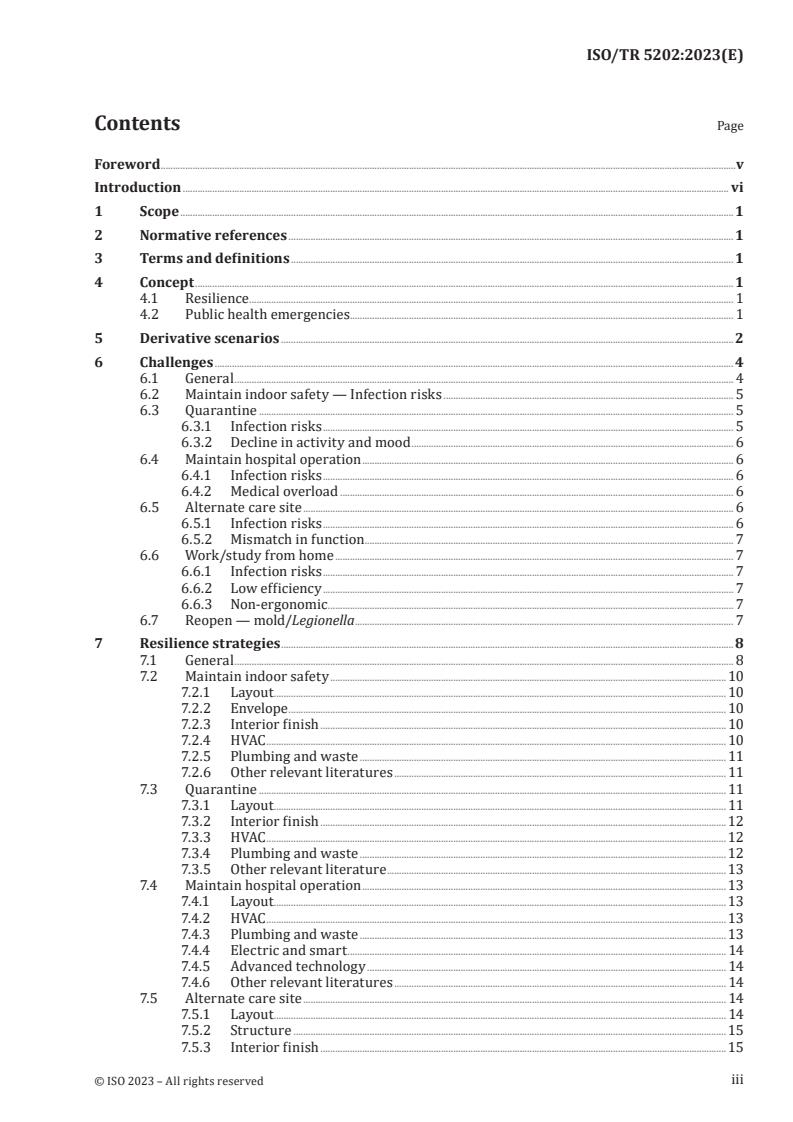
TECHNICAL ISO/TR
REPORT 5202
First edition
2023-06
Buildings and civil engineering
works — Building resilience strategies
related to public health emergencies
— Compilation of relevant
information
Reference number
© ISO 2023
All rights reserved. Unless otherwise specified, or required in the context of its implementation, no part of this publication may
be reproduced or utilized otherwise in any form or by any means, electronic or mechanical, including photocopying, or posting on
the internet or an intranet, without prior written permission. Permission can be requested from either ISO at the address below
or ISO’s member body in the country of the requester.
ISO copyright office
CP 401 • Ch. de Blandonnet 8
CH-1214 Vernier, Geneva
Phone: +41 22 749 01 11
Email: copyright@iso.org
Website: www.iso.org
Published in Switzerland
ii
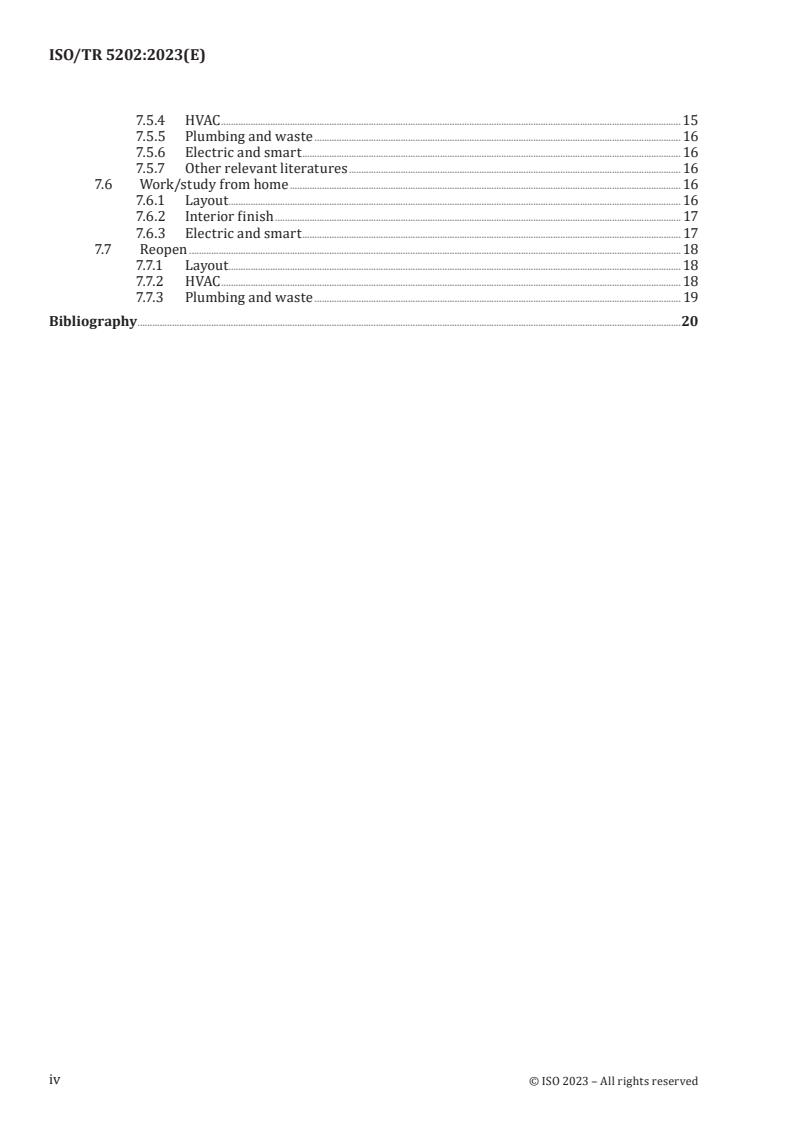
Contents Page
Foreword .v
Introduction . vi
1 Scope . 1
2 Normative references . 1
3 Terms and definitions . 1
4 Concept . 1
4.1 Resilience . 1
4.2 Public health emergencies . 1
5 Derivative scenarios .2
6 Challenges . 4
6.1 General . 4
6.2 Maintain indoor safety — Infection risks . 5
6.3 Quarantine . 5
6.3.1 Infection risks . 5
6.3.2 Decline in activity and mood . 6
6.4 Maintain hospital operation . 6
6.4.1 Infection risks . 6
6.4.2 Medical overload . 6
6.5 Alternate care site . 6
6.5.1 Infection risks . 6
6.5.2 Mismatch in function . 7
6.6 Work/study from home . 7
6.6.1 Infection risks . 7
6.6.2 Low efficiency . 7
6.6.3 Non-ergonomic . 7
6.7 Reopen — mold/Legionella . 7
7 Resilience strategies .8
7.1 General . 8
7.2 Maintain indoor safety . 10
7.2.1 Layout . 10
7.2.2 Envelope . 10
7.2.3 Interior finish . 10
7.2.4 HVAC . 10
7.2.5 Plumbing and waste . 11
7.2.6 Other relevant literatures . 11
7.3 Quarantine . 11
7.3.1 Layout . 11
7.3.2 Interior finish .12
7.3.3 HVAC . 12
7.3.4 Plumbing and waste .12
7.3.5 Other relevant literature . 13
7.4 Maintain hospital operation . 13
7.4.1 Layout . 13
7.4.2 HVAC . 13
7.4.3 Plumbing and waste . 13
7.4.4 Electric and smart . 14
7.4.5 Advanced technology . 14
7.4.6 Other relevant literatures . 14
7.5 Alternate care site . 14
7.5.1 Layout . 14
7.5.2 Structure . 15
7.5.3 Interior finish .15
iii
7.5.4 HVAC . 15
7.5.5 Plumbing and waste . 16
7.5.6 Electric and smart . 16
7.5.7 Other relevant literatures . 16
7.6 Work/study from home . 16
7.6.1 Layout . 16
7.6.2 Interior finish . 17
7.6.3 Electric and smart . 17
7.7 Reopen . 18
7.7.1 Layout . 18
7.7.2 HVAC . 18
7.7.3 Plumbing and waste . 19
Bibliography .20
iv
Foreword
ISO (the International Organization for Standardization) is a worldwide federation of national standards
bodies (ISO member bodies). The work of preparing International Standards is normally carried out
through ISO technical committees. Each member body interested in a subject for which a technical
committee has been established has the right to be represented on that committee. International
organizations, governmental and non-governmental, in liaison with ISO, also take part in the work.
ISO collaborates closely with the International Electrotechnical Commission (IEC) on all matters of
electrotechnical standardization.
The procedures used to develop this document and those intended for its further maintenance are
described in the ISO/IEC Directives, Part 1. In particular, the different approval criteria needed for the
different types of ISO document should be noted. This document was drafted in accordance with the
editorial rules of the ISO/IEC Directives, Part 2 (see www.iso.org/directives).
ISO draws attention to the possibility that the implementation of this document may involve the use
of (a) patent(s). ISO takes no position concerning the evidence, validity or applicability of any claimed
patent rights in respect thereof. As of the date of publication of this document, ISO had not received
notice of (a) patent(s) which may be required to implement this document. However, implementers are
cautioned that this may not represent the latest information, which may be obtained from the patent
database available at www.iso.org/patents. ISO shall not be held responsible for identifying any or all
such patent rights.
Any trade name used in this document is information given for the convenience of users and does not
constitute an endorsement.
For an explanation of the voluntary nature of standards, the meaning of ISO specific terms and
expressions related to conformity assessment, as well as information about ISO's adherence to
the World Trade Organization (WTO) principles in the Technical Barriers to Trade (TBT), see
www.iso.org/iso/foreword.html.
This document was prepared by Technical Committee ISO/TC 59, Buildings and civil engineering works.
Any feedback or questions on this document should be directed to the user’s national standards body. A
complete listing of these bodies can be found at www.iso.org/members.html.
v
Introduction
Looking back at the history of building design, improvements have sometimes been driven by epidemics,
such as the 19th century cholera outbreak in London, which led to a greater emphasis on ventilation
[1]
and the use of dense, easy-to-clean materials such as tiles rather than carpets . After the 1918 flu
[2]
pandemic, guest bathrooms were added to residences to reduce exposure and infection risk .
Improvements are still required in public health emergencies of the 21st century where buildings based
on current design standards show inadequate adaptability. In COVID-19, for example, large numbers of
densely populated public buildings such as schools, offices, malls were forced to close due to high risk
of infection. Even in homes the risk of infection still existed. Medical facilities could not bear the sudden
increase in infectious patients, and some sports stadiums, exhibition halls, etc., were transformed into
temporary hospitals. In face of these challenges, a number of improvements have already appeared in
some cases, as well as in some guidelines, standards and studies by relevant international, national, and
regional organizations and institutions.
This document collects the challenges posed by the epidemic to built environment and the corresponding
adaptation solutions during 21st century public health emergencies, particularly COVID-19, to provide
a reference for resilience design of built environment to adapt to future changing environment.
Figure 1 — Generation of derivative scenarios
For better comprehension, this document categorizes the challenges and solutions in terms of six
typical derivative built environment scenarios during the pandemic, including maintaining indoor
safety, quarantine, maintaining hospital operation, alternate care site, working/studying from home,
and reopening. These six scenarios are informed by an information search based on combinations of
such key words as different population groups, building types, public health emergencies and adaptive
capacities (see Figure 1).
vi
The document is helpful to stakeholders including end-users, investors, authorities, standards
developing organisations, specialists (engineers, architects, etc.), manufacturers and builders, as well
as other parties involved in public health emergencies, such as public health administrators, medical
staff.
vii
TECHNICAL REPORT ISO/TR 5202:2023(E)
Buildings and civil engineering works — Building
resilience strategies related to public health emergencies
— Compilation of relevant information
1 Scope
This document provides a compilation of relevant information on building resilience strategies in
response to public health emergencies, including:
— challenges of public health emergencies on built environment;
— resilience strategies to meet the challenges;
excluding:
— emergency operations;
— personnel organization and management.
2 Normative references
There are no normative references in this document.
3 Terms and definitions
For the purposes of this document, the following terms and definitions apply.
ISO and IEC maintain terminology databases for use in standardization at the following addresses:
— ISO Online browsing platform: available at https:// www .iso .org/ obp
— IEC Electropedia: available at https:// www .electropedia .org/
3.1
resilience
adaptive capacity of an organization in a complex and changing environment
[SOURCE: ISO Guide 73:2009, 3.8.1.7]
4 Concept
4.1 Resilience
Buildings with a service life of decades or even hundreds of years can encounter challenges that were
not anticipated when they were designed. Resilience of built assets can reduce losses in the future
complex and changing environment.
4.2 Public health emergencies
Expressions of public health emergency vary in different contexts. They are generally described as the
events that seriously affect public health. Table 1 lists some typical expressions.
Table 1 — Expressions of public health emergency
Expressions Description Source
A likelihood of an event that can affect adversely the health
of human populations, with an emphasis on one which can
Public health risk
spread internationally or can present a serious and direct
danger
International health reg-
[4]
An extraordinary event which is determined, as provided ulations (2005)
in these regulations:
WHO
Public health emergency
— to constitute a public health risk to other states through
of international concern
the international spread of disease and
— to potentially require a coordinated international response
Outbreaks of major infectious diseases, group diseases of
Regulations on emer-
unknown origin, major food and occupational poisoning
gency response to public
and other events seriously affecting public health that occur [5]
health emergencies
suddenly and cause or are likely to cause serious harm to
China
public health
National disaster medical
system memorandum
Public health emergency
of agreement among the
An emergency need for health care services to respond to
departments of home-
a disaster, significant outbreak of an infectious disease, bi-
land security, health and
oterrorist attack, or other significant or catastrophic event
human services, veterans
[6]
affairs, and defense
United States
5 Derivative scenarios
There are six typical derivative scenarios for built environment during 21st century public health
emergencies:
— maintain indoor safety
— quarantine
— maintain hospital operation
— alternate care site
— work/study from home
— reopen
NOTE 1 Quarantine at designated places and home are effective control measures to separate suspected
patients from the general population.
NOTE 2 Alternate care sites that are temporarily constructed or converted from exhibition centre, gymnasium,
etc., can supplement existing medical facilities to a certain extent.
NOTE 3 In a prolonged public health emergency, people must work or study at home for a long time.
NOTE 4 Buildings that have been closed for a long time must ensure the safety and health of their occupants
when reopen.
Table 2 shows the derivative scenarios emerged in typical public health emergencies of 21st century.
[7][8]
Table 2 — Derivative scenarios in typical public health emergencies of 21st century
Derivative scenarios
Public health Year of
Maintain in- Quaran- Maintain hos- Alternate Work/study
emergencies breakout
Reopen
door safety tine pital operation care site from home
Ebola virus dis-
2014 √ √ √ √
ease
Zika 2016 √ √ √ √
MERS 2012 √ √ √
SARS 2003 √ √ √ √ √ √
H1N1 2009 √ √ √
COVID-19 2019 √ √ √ √ √ √
At different phases of public health emergencies, different types of building can experience different
derivative scenarios (one type of building can experience one or more scenarios) (See Figure 2). This
document summarizes the challenges in different derivative scenarios (see Clause 6) and resilience
strategies to deal with them (see Clause 7).
NOTE The phases of public health emergencies are adapted from the “continuum of pandemic phases” of
[9]
WHO .
Figure 2 — Typical derivative scenarios in different types of buildings in different phases of
public health emergencies
6 Challenges
6.1 General
Unlike earthquakes and climate change, in derivative scenarios of public health emergencies, buildings
can not be damaged, but their performance and functionality can be inadequate, resulting in impacts
on safety, health and well-being of users.
This clause summarizes the challenges in each typical scenario (see Clause 5) and lists some examples.
Infection risks exist in each scenario. Infection risks in work/study from home and reopen scenarios are
the same as in maintaining indoor safety (see 6.2) and are therefore not elaborated again. Quarantine,
maintaining hospital operation, and alternative care site scenarios have more specific infection
risks due to their treatment functions, which are elaborated in this clause (see 6.3.1, 6.4.1 and 6.5.1
respectively).
NOTE Examples in this document mainly focuses on COVID-19. The examples related to public health
emergencies other than COVID-19 are marked (e.g. [Zika]). There are also examples that are generic and labelled
[General].
6.2 Maintain indoor safety — Infection risks
All types of buildings must be kept safe indoors, as viruses can transmit through inhalation of aerosols,
[10]
spray of large droplets, and touching a contaminated surface . It is possible that the existing built
environment is not effective in preventing or reducing these transmissions. The following are some
examples.
Virus transmission by droplets or aerosols in crowded and closed indoor spaces such as homes, offices,
restaurants, and fitness centres has been mentioned in many literatures. For example, an analysis of
75 465 COVID-19 cases in China shows that 78 % to 85 % of cluster transmission occurred in the home
[11]
environment .
The transmission is more serious in some places due to their special functions:
[12]
— church choirs talking and singing loudly produce more respiratory droplets, including aerosols ;
— the small space and poor ventilation in prisons contribute to the high rate of infection among
[13]
inmates . The COVID-19 infection rate of inmates in federal and state prisons in the United States
[14]
is 7 %, four times higher than that of residents .
Several other modes of transmission have been mentioned in some literatures, such as:
[15]
— transmission through contact with furniture and interior surfaces contaminated by patients,
[16]
even faecal-oral transmission ; [Hepatitis]
— house-to-house transmission can occur in high-rise residential buildings through drainage pipes,
[17]
ventilation ducts, etc., for example, the SARS spread in Amoy Gardens, Hong Kong SAR, China ;
[SARS]
— a nursing home in Ireland has more risk of transmission in COVID-19 due to communal bathrooms
[18]
and bedrooms ;
— mosquitoes carrying the Zika virus can easily enter open doors and windows without screens, thus
[19]
causing virus transmission . [Zika]
6.3 Quarantine
6.3.1 Infection risks
Some literatures mention the risk of virus transmission through ventilation ducts, drains, etc., in
specialized quarantine stations and buildings temporarily converted into quarantine facilities:
— an institutional quarantine facility in India, where dozens of quarantined people were infected, was
[20]
found to have spread through stacks connecting the upper and lower bathrooms ;
— in a COVID-19 quarantine hotel in New Zealand, two people living on the upper and lower floors
[21]
were infected, presumably through plumbing system ;
— residents living in Room 2502 and Room 2702 of a 30-story residential building in Guangzhou, China,
during the COVID-19 home quarantine were infected by residents living in Room 1502 probably due
[22]
to using the same drainage system .
6.3.2 Decline in activity and mood
Some literatures show that the inadequate built environment negatively affects the physical and mental
health of people during quarantine:
— epidemiologic and molecular evidence suggests that substantially decreased physical activity levels
[23]
during quarantine can increase the risk of cardiovascular disease ;
— feelings of loneliness, depression and lack of physical contact due to quarantine can have a negative
[24]
impact on an individual's mental health ;
— residents living in small apartments during lockdown in Milan, Italy, are at increased risk of
[25]
depressive symptoms due to poor views and scarce indoor quality .
6.4 Maintain hospital operation
6.4.1 Infection risks
Some literatures show that as hospitals shoulder the most important responsibility of treatment in the
pandemic, infection risk in hospitals will have a particularly large or even decisive impact on overall
infection prevention and control efforts, the risk there is much greater than that in residential and
office buildings:
— during the early outbreaks of COVID-19, SARS and MERS, the proportion of nosocomial infection was
[26]
relatively high, and a considerable part of the nosocomial infected patients were medical staff ;
[COVID-19] [MERS] [SARS]
— in Cape Town, South Africa, peripheral clinics that have received confirmed COVID-19 cases were
closed for a period of time to decontaminate the facilities, leading to disruptions in patients' regular
[27]
visits and some people avoiding these clinics for fear of infection ;
— the reluctance of individuals to attend hospitals for diagnostic tests or treatment due to heightened
public anxiety can have contributed to the decline in acute hospital attendances and excessive
[28]
mortality toll .
6.4.2 Medical overload
Some literatures show that due to the proliferation of patients caused by COVID-19, medical facilities
are overloaded, which can lead to higher mortality rate:
— a study in the US has shown that mortality rates are higher in areas with fewer medical resources per
COVID-19 patient; these medical resources include ICU beds, intensivists or critical care physicians,
emergency physicians, nurses, and general hospital beds, among which the biggest factor is ICU bed
[29]
availability ;
— during COVID-19, the risk of death of severely sick patients nearly doubles when a hospital's ICU
[30]
capacity is at its maximum ;
— the surge in COVID patients is overloading the healthcare system and disrupting routine care
for cancer patients, including the prevention and diagnosis. Study shows that a 4-week delay in
[31]
treatment can increase the risk of death by 6 % to 13 %, depending on the type of cancer .
6.5 Alternate care site
6.5.1 Infection risks
Some literatures show that alternate care site (ACS) that have been temporarily modified from other
types of buildings are at risk of infection due to the limitations of air-conditioning system and temporary
partition among others. For example, temporary patient compartments in large spaces have no ceiling
and the curtain is not airtight, so air can flow between the patient compartment and the corridor, thus
[32]
increases the risk of cross-infection .
6.5.2 Mismatch in function
Some literatures mention the difficulties of ACS renovation due to the mismatch of the existing
structure, layout, facilities, etc.:
— the sizes and geometries of some hotels converted to ACS does not match the requirements
1)
of hospital. For example, hotel corridors are only 5 ft to 6 ft wide, while hospital corridors are
[33]
typically 8 ft wide for the gurney to pass through ;
— an office building in Suifenhe, China, which has been converted into an ACS, needs to have fire
[34]
evacuation channels sealed to isolate clean areas from crossing contaminated areas ;
— surge field hospitals were found to be inadequate, such as their inability to separate confirmed
patients, asymptomatic patients from those who came for testing; inadequate working space and
protection for health care workers; facilities without windows or sufficient artificial lighting;
inadequate space and facilities in inpatient units, causing many problems such as crowded patients
[35]
and lack of confidentiality and privacy ;
— an alternative care facility converted from a newly built psychiatric centre in New York state, USA,
suffers from lack of oxygen supply, small size of the ward, which uses beds smaller than standard
[36]
hospital beds, and lack of separate sink and bathroom .
6.6 Work/study from home
6.6.1 Infection risks
Residential buildings with people working or studying from home due to the pandemic experience the
same infection risks as in 6.2.
6.6.2 Low efficiency
Some literatures mention that lack of a specific office space makes people susceptible to being distracted
[37][38]
by other family members and noise from household appliances when working from home .
6.6.3 Non-ergonomic
When working from home, inappropriate or non-ergonomic furniture can cause musculoskeletal
[39]
damage in the neck or back .
6.7 Reopen — mold/Legionella
Buildings that reopen after prolonged closures due to the pandemic experience the same infection
risks as in 6.2. Meanwhile, some literatures show that improper maintenance during the closure and
ineffective cleaning can pose health hazards including mold, Legionella, lead and copper contamination
to their occupants:
— when a building is closed for an extended period of time, moisture that leaks in via or condenses on
roofs, windows, pipes, etc., can go unnoticed, triggering mold that threatens people with asthma,
[40]
respiratory problems, mold allergies, and weakened immune systems ;
— when buildings are unoccupied due to an outbreak, water stays in pipes and storage tanks for long
periods of time, this can lead to water temperatures suitable for the growth of Legionella (25 °C to
42 °C). After reopening, people can inhale Legionella in areas such as cooling towers, showers, pools,
[40]
hot tubs and fountains, which can lead to Legionellosis .
1) 1 ft = 0,304 8 m.
7 Resilience strategies
7.1 General
In order to make buildings better meet the challenges in public health emergencies, a number of
improvements have already appeared in some cases, as well as in some guidelines, standards and
studies by relevant international, national, and regional organizations and institutions. This clause
summarizes resilience strategies in terms of six typical derivative built environment scenarios during
the pandemic (see Clause 5), and categorizes them by building elements, including indoor and outdoor
layout, structure, envelope, interior finish, HVAC, plumbing and waste, electric and smart, etc. (see
Figure 3). Examples of the strategies are given in Tables 3 to 28.
NOTE The resilience strategies collected in this clause mainly focus on COVID-19. The strategies related to
public health emergencies other than COVID-19 are marked (e.g. [Zika]). There are also examples that are generic
and labelled [General].
Figure 3 — Matrix of derivative scenarios, challenges and resilience strategies
7.2 Maintain indoor safety
7.2.1 Layout
Table 3 — Examples of layout strategies in maintaining indoor safety
Key points Example
A route design method that can help keep social distancing
[41]
indoors was proposed in a Malaysian literature . That is,
in some public buildings, the space that accommodates a
Sequence flow
large number of people is arranged near the entrance, while
the space for a small number of people is arranged in a deep
position, and a one-way route is set.
[42] [43]
Some literatures, such as the WHO and the US EPA ,
mention ways to maintain a safe distance by reducing the
density of people. For example, controlling the maximum
Safe distance
number of people per unit area in places such as restaurants,
breakfast and dining rooms and bars in hotels, as well as using
partitions between staff and clients.
7.2.2 Envelope
Table 4 — Examples of envelope strategies in maintaining indoor safety
Key points Example
[44] [45]
Literatures from WHO and the Borgen Project mention
Screens the use of screens on windows and doors of buildings to keep
mosquitoes out and prevent the spread of Zika virus. [Zika]
7.2.3 Interior finish
Table 5 — Examples of interior finish strategies in maintaining indoor safety
Key points Example
[46] [47]
The literatures from ASHRAE and DHA recommend the
use of compact non-porous materials that are easy to clean
Easy to clean
for frequently touched indoor parts such as the surfaces of
walls and door, as well as furniture.
[48]
The WELL literature mentions the use of antibacterial
Antimicrobial active titanium coatings in common areas of buildings, such
as elevators and walkways.
7.2.4 HVAC
Table 6 — Examples of HVAC strategies in maintaining indoor safety
Key points Example
[12]
Literature from ECDC mentions increasing the rate of air
Ventilation exchange in the room and reducing the risk of virus transmis-
sion through natural and mechanical ventilation.
Eliminate air-recir- Some literatures mention avoiding air-recirculation in ven-
[49]
culation tilation systems .
[50] [51]
Literatures from REHVA and Kurabuchi, et al. mention
installing CO sensors and visualization devices in indoor
Air monitoring
spaces, where people spend long periods of time, to warn
against insufficient ventilation.
TTabablele 6 6 ((ccoonnttiinnueuedd))
Key points Example
Literature from the New York State Department of Health
Filtration recommends that public buildings be equipped with a highly
[52]
rated filtration at least MERV-13 for central HVAC systems .
[49]
The literature from Morawska, et al. suggests using indoor
Air disinfection air cleaning and disinfection devices such as germicidal ultra-
violet in indoor environments with poor ventilation.
7.2.5 Plumbing and waste
Table 7 — Examples of plumbing and waste strategies in maintaining indoor safety
Key points Example
[53] [51]
The literatures from ASHRAE and Kurabuchi, et al.
Water seal mention that all water seals in drainage piping systems should
be ensured to be effective.
[50] [51]
The literatures from REHVA and Kurabuchi, et al. men-
Airflow control
tion flushing toilets with closed lid to control airflow.
7.2.6 Other relevant literatures
— 2019 novel coronavirus (COVID-19) pandemic: Built environment considerations to reduce
[54]
transmission
[55]
— Future of offices: In a post-pandemic world
[56]
— Ventilation control for COVID-19 and beyond
[57]
— Airborne infectious disease management methods for temporary negative pressure isolation
[59]
— Indoor environmental health
[59]
— Ultraviolet air and surface treatment
— Protecting workers: Guidance on mitigating and preventing the spread of COVID-19 in the
[60]
workplace
[61]
— Robotics utilization for healthcare digitization in global COVID-19 management
[62]
— Managing HVAC systems to reduce infectious disease transmission
[10]
— ASHRAE position document on infectious aerosols
7.3 Quarantine
7.3.1 Layout
Table 8 — Examples of layout strategies in quarantine
Key points Example
[63]
The literature from MASS Design Group suggests sepa-
rating clean and dirty areas to avoid cross-infection, such as
Sequence flow separating entrances for different groups of people including
staff, vendors, and residents and create separate area for staff
to don and doff PPE.
TTabablele 8 8 ((ccoonnttiinnueuedd))
Key points Example
[64]
Literature from Dhagat, et al. recommends passage of
sufficient width such as entrance doors and floor corridors
Adequate size
to fit stretchers and medical equipment to pass through in
emergency.
[42]
Literature from WHO recommends setting physical barriers
Physical distance such as glass panels at reception between staff and guests to
maintain physical distance.
[65]
The literature from OCHA suggests that quarantine rooms
Adequate facilities
should have separate toilets and adequate ventilation.
[63] [24]
Literatures from MASS Design Group , NHMRC and
[66]
Australia Department of Health and Aged Care propose to
provide outdoor activity space and green space that can be
Access to nature
safely accessed by isolated personnel. For example, provide
balconies for each room, and provide shared balconies for
multiple units.
7.3.2 Interior finish
Table 9 — Examples of interior finish strategies in quarantine
Key points Example
[67]
The literature from the MHT(India) suggests that the sur-
Easy to clean and
faces of indoor walls and floors in quarantine facilities should
be made of materials that have antibacterial properties and
antimicrobial
are suitable for cleaning.
7.3.3 HVAC
Table 10 — Examples of HVAC strategies in quarantine
Key points Example
[42]
Literature from the WHO recommends natural ventilation
Natural ventilation
of isolation rooms whenever possible
[42]
The literature from WHO recommends increasing indoor
Mechanical venti- ventilation rates of natural and mechanical ventilation, as
lation well as unidirectional air flow from clean to unclean areas
through flow and pressure control.
7.3.4 Plumbing and waste
Table 11 — Plumbing and waste
Key points Example
[68]
The literature from Nghiem, et al. mentions that wastewater
Wastewater moni- monitoring in quarantine facilities can help to monitor and
toring assess the incidence of COVID-19 that will aid public health
policy formulation.
[69]
The literature from HTID, et al. (China) suggested that
Temporary sewage temporary sewage treatment facilities should be set up at the
treatment tank quarantine facilities, and the sewage should be disinfected
before being discharged.
7.3.5 Other relevant literature
[70]
— The future of hotel design
7.4 Maintain hospital operation
7.4.1 Layout
Table 12 — Examples of layout strategies in maintaining hospital operation
Key points Example
[71] [72]
Literatures from DHSC, et al. (UK) , ASHRAE and HHS(US)
[73]
Partition/ avoid mention that hospitals should avoid infected patients
cross infection crossing with other patients, visitors and staff by setting
designated entrances, reception areas and passageways, etc.
[74]
The literature from WHO mentions the safe distance
between patients and the rapid triage of patients with acute
Distance
febrile respiratory diseases through spatial and streamlined
planning.
7.4.2 HVAC
Table 13 — Examples of HVAC strategies in maintaining hospital operation
Key points Example
[75]
The literature from WHO mentions that when natural
ventilation is used in new construction and major renovations,
Natural ventilation the hourly average ventilation rate in the airborne precaution
rooms should be 160 l/s per patient (with a minimum of 80 l/s
per patient), which is greater than that in general wards.
[72] [76] [77]
The literatures from ASHRAE , TAHPI , WHO and
[73]
HHS and CDC(US) put forward special requirements of
Mechanical venti- mechanical ventilation for AII/PE rooms, isolation rooms,
lation operating room, etc., covering air distribution, pressure
gradient, temperature and humidity. It is also required to
avoid the use of window air conditioners in new construction.
7.4.3 Plumbing and waste
Table 14 — Examples of plumbing and waste strategies in maintaining hospital operation
Key points Example
[73] [78]
Literatures from HHS and CDC(US) and TAHPI(US)
mention that in order to avoid the breeding of gram-negative
Water quality main- waterborne bacteria such as Legionella spp. and NTM in water
tenance supply systems, it is recommended to avoid long dead legs
in pipes, keep water temperature below 20 °C (cold water
systems) or above 60 °C (hot water systems).
[77] [73]
The literatures from WHO and HHS and CDC (US)
Waste disposal mention dedicated storage areas, reasonable sterilization,
pulverization and deep burial for medical waste.
...