


ISO 15540:2016
(Main)Ships and marine technology — Fire resistance of non-metallic hose assemblies and non-metallic compensators — Test methods
Ships and marine technology — Fire resistance of non-metallic hose assemblies and non-metallic compensators — Test methods
ISO 15540:2016 specifies a test procedure for determining the fire resistance of non-metallic hose assemblies and non-metallic compensators with nominal diameter of up to 150 mm. It may be used for larger sizes provided proper test bench conditions are obtained. It serves for proving whether, after the period of fire effect on the test bench specified in ISO 15541, hose assemblies and non-metallic compensators continue to be tight, even when subjected to proof pressure. Only water is permitted as a test medium. With a view to ensuring maximum safety for both the operating personnel and the test bench in the event of damage to the hose or non-metallic compensator during the test, the use of combustible test media is excluded.
Navires et technologie maritime — Résistance au feu des flexibles et des compensateurs non métalliques — Méthodes d’essais
General Information
- Status
- Published
- Publication Date
- 18-Jul-2016
- Technical Committee
- ISO/TC 8/SC 3 - Piping and machinery
- Drafting Committee
- ISO/TC 8/SC 3 - Piping and machinery
- Current Stage
- 9093 - International Standard confirmed
- Start Date
- 09-Sep-2022
- Completion Date
- 14-Feb-2026
Relations
- Effective Date
- 06-Jun-2022
- Revises
ISO 15540:1999 - Ships and marine technology — Fire resistance of hose assemblies — Test methods - Effective Date
- 23-Aug-2014
Overview
ISO 15540:2016 establishes internationally recognized test methods for assessing the fire resistance of non-metallic hose assemblies and non-metallic compensators used onboard ships and in marine technology applications. The standard applies to hose assemblies and compensators with nominal diameters up to 150 mm, but may also be suitable for larger components if proper test conditions are met. This standard ensures that components remain tight under fire conditions, including when subjected to proof pressure, thereby supporting the safety and reliability of marine piping and machinery systems. Only water may be used as the test medium to maximize safety during testing and exclude combustible fluids.
Key Topics
- Fire Resistance Testing: Defines procedures to evaluate the fire resistance of non-metallic hose assemblies and compensators, confirming their ability to maintain tightness after exposure to fire.
- Test Bench Requirements: Requires use of a test bench compliant with ISO 15541. The specimen must be installed to ensure complete flame exposure according to strict test arrangement guidelines.
- Specimen Preparation: Specifies specimen requirements, including minimum lengths, conditions for fire sleeves, and ambient pre-test storage.
- Measurement Parameters: Outlines the measurement of water and flame temperatures, internal pressure during fire exposure, and flow rates to ensure precise, reproducible test conditions.
- Test Duration and Conditions: Mandates a fire application duration of 30 minutes, with tight control of working pressure and flame temperature.
- Pass/Fail Criteria: The assembly or compensator passes the test if it remains tight when subjected to proof pressure after fire exposure. An official type test certificate is issued upon passing.
Applications
ISO 15540:2016 is essential for marine manufacturers, classification societies, and regulatory authorities for the following applications:
- Design Verification and Certification: Manufacturers of non-metallic hose assemblies and compensators use these tests during product development and certification processes to demonstrate compliance with international safety requirements.
- Quality Assurance in Shipbuilding: Shipyards and marine equipment suppliers rely on ISO 15540 to select components with verified fire resistance for use in critical piping networks.
- Regulatory Compliance and Approval: Marine regulatory bodies and classification societies reference this standard during inspections to confirm component suitability for use in fire-prone shipboard environments.
- Safety Risk Mitigation: Ensures that flexible connections in engine rooms, fuel systems, and other hazardous zones maintain integrity during fire incidents, supporting vessel safety and crew protection.
Related Standards
For comprehensive compliance and testing, related international standards should be considered:
- ISO 15541:2016 - Ships and marine technology - Fire resistance of non-metallic hose assemblies and non-metallic compensators - Requirements for the test bench. ISO 15541 describes the construction and performance requirements for the test bench used in the fire resistance tests specified in ISO 15540.
- ISO TC 8 Standards - A series of standards developed by ISO Technical Committee 8 for ships and marine technology, covering additional aspects of piping, machinery, and safety systems.
By following ISO 15540:2016, organizations help ensure that non-metallic hose assemblies and compensators meet stringent fire safety standards, contributing to the protection of life, property, and the marine environment.
Buy Documents


ISO 15540:2016 - Ships and marine technology -- Fire resistance of non-metallic hose assemblies and non-metallic compensators -- Test methods
ISO 15540:2016 - Ships and marine technology — Fire resistance of non-metallic hose assemblies and non-metallic compensators — Test methods/19/2016
Get Certified
Connect with accredited certification bodies for this standard

DNV
DNV is an independent assurance and risk management provider.

Lloyd's Register
Lloyd's Register is a global professional services organisation specialising in engineering and technology.

DIN CERTCO
DIN Group product certification.
Sponsored listings
Frequently Asked Questions
ISO 15540:2016 is a standard published by the International Organization for Standardization (ISO). Its full title is "Ships and marine technology — Fire resistance of non-metallic hose assemblies and non-metallic compensators — Test methods". This standard covers: ISO 15540:2016 specifies a test procedure for determining the fire resistance of non-metallic hose assemblies and non-metallic compensators with nominal diameter of up to 150 mm. It may be used for larger sizes provided proper test bench conditions are obtained. It serves for proving whether, after the period of fire effect on the test bench specified in ISO 15541, hose assemblies and non-metallic compensators continue to be tight, even when subjected to proof pressure. Only water is permitted as a test medium. With a view to ensuring maximum safety for both the operating personnel and the test bench in the event of damage to the hose or non-metallic compensator during the test, the use of combustible test media is excluded.
ISO 15540:2016 specifies a test procedure for determining the fire resistance of non-metallic hose assemblies and non-metallic compensators with nominal diameter of up to 150 mm. It may be used for larger sizes provided proper test bench conditions are obtained. It serves for proving whether, after the period of fire effect on the test bench specified in ISO 15541, hose assemblies and non-metallic compensators continue to be tight, even when subjected to proof pressure. Only water is permitted as a test medium. With a view to ensuring maximum safety for both the operating personnel and the test bench in the event of damage to the hose or non-metallic compensator during the test, the use of combustible test media is excluded.
ISO 15540:2016 is classified under the following ICS (International Classification for Standards) categories: 47.020.30 - Piping systems; 83.140.40 - Hoses. The ICS classification helps identify the subject area and facilitates finding related standards.
ISO 15540:2016 has the following relationships with other standards: It is inter standard links to ISO 8596:2017/Amd 1:2019, ISO 15540:1999. Understanding these relationships helps ensure you are using the most current and applicable version of the standard.
ISO 15540:2016 is available in PDF format for immediate download after purchase. The document can be added to your cart and obtained through the secure checkout process. Digital delivery ensures instant access to the complete standard document.
Standards Content (Sample)
INTERNATIONAL ISO
STANDARD 15540
Second edition
2016-07-15
Ships and marine technology —
Fire resistance of non-metallic
hose assemblies and non-metallic
compensators — Test methods
Navires et technologie maritime — Résistance au feu des flexibles et
des compensateurs non métalliques — Méthodes d’essais
Reference number
©
ISO 2016
© ISO 2016, Published in Switzerland
All rights reserved. Unless otherwise specified, no part of this publication may be reproduced or utilized otherwise in any form
or by any means, electronic or mechanical, including photocopying, or posting on the internet or an intranet, without prior
written permission. Permission can be requested from either ISO at the address below or ISO’s member body in the country of
the requester.
ISO copyright office
Ch. de Blandonnet 8 • CP 401
CH-1214 Vernier, Geneva, Switzerland
Tel. +41 22 749 01 11
Fax +41 22 749 09 47
copyright@iso.org
www.iso.org
ii © ISO 2016 – All rights reserved
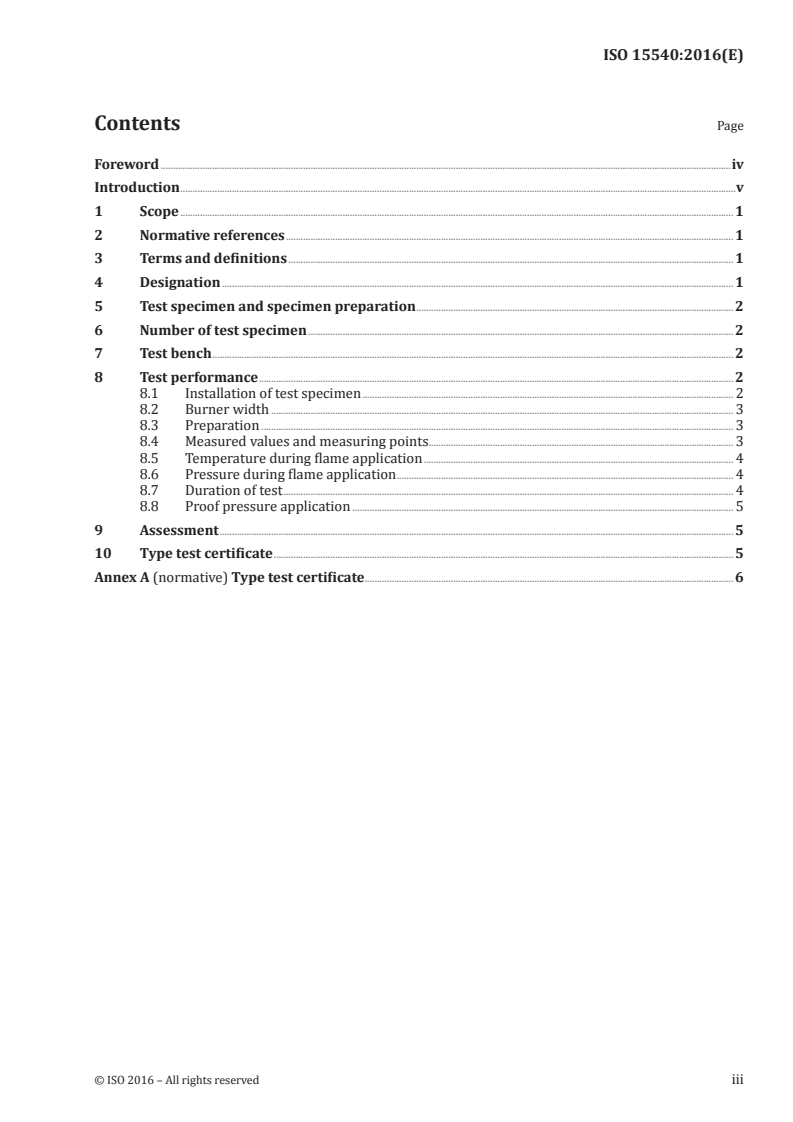
Contents Page
Foreword .iv
Introduction .v
1 Scope . 1
2 Normative references . 1
3 Terms and definitions . 1
4 Designation . 1
5 Test specimen and specimen preparation . 2
6 Number of test specimen . 2
7 Test bench . 2
8 Test performance . 2
8.1 Installation of test specimen . 2
8.2 Burner width . 3
8.3 Preparation . 3
8.4 Measured values and measuring points . 3
8.5 Temperature during flame application . 4
8.6 Pressure during flame application . 4
8.7 Duration of test . 4
8.8 Proof pressure application . 5
9 Assessment . 5
10 Type test certificate . 5
Annex A (normative) Type test certificate . 6
Foreword
ISO (the International Organization for Standardization) is a worldwide federation of national standards
bodies (ISO member bodies). The work of preparing International Standards is normally carried out
through ISO technical committees. Each member body interested in a subject for which a technical
committee has been established has the right to be represented on that committee. International
organizations, governmental and non-governmental, in liaison with ISO, also take part in the work.
ISO collaborates closely with the International Electrotechnical Commission (IEC) on all matters of
electrotechnical standardization.
The procedures used to develop this document and those intended for its further maintenance are
described in the ISO/IEC Directives, Part 1. In particular the different approval criteria needed for the
different types of ISO documents should be noted. This document was drafted in accordance with the
editorial rules of the ISO/IEC Directives, Part 2 (see www.iso.org/directives).
Attention is drawn to the possibility that some of the elements of this document may be the subject of
patent rights. ISO shall not be held responsible for identifying any or all such patent rights. Details of
any patent rights identified during the development of the document will be in the Introduction and/or
on the ISO list of patent declarations received (see www.iso.org/patents).
Any trade name used in this document is information given for the convenience of users and does not
constitute an endorsement.
For an explanation on the meaning of ISO specific terms and expressions related to conformity assessment,
as well as information about ISO’s adherence to the World Trade Organization (WTO) principles in the
Technical Barriers to Trade (TBT) see the following URL: www.iso.org/iso/foreword.html.
The committee responsible for this document is ISO/TC 8, Ships and marine technology, Subcommittee
SC 3, Piping and machinery.
This second edition cancels and replaces the first edition (ISO 15540:1999), which has been technically
revised. It also incorporates the Technical Corrigendum ISO 15540:1999/Cor 1:1999.
The most significant change in this second edition is the inclusion of non-metallic compensators to the
fire test procedures outlined in this document. The first edition of this document applied primarily to
non-metallic hose assemblies. Because the compensators are used in common piping systems and may
have similar materials to hose assemblies, the applicability of the test procedures was expanded to
include compensators.
iv © ISO 2016 – All rights reserved
Introduction
The main objective of the test using the test bench described in this document is to determine whether
and for a safety period a non-metallic hose (made of rubber) assembly or non-metallic compensator
(bellow made of rubber) can be exposed to fire without becoming inoperable when subjected to the
design working pressure. Although the attacking fire is simulated such that it corresponds to a fire
occurring in practice, it cannot be assumed that the duration of fire resistance as recorded during that
test will also occur in the event of an actual fire, as the installation conditions, which greatly affect to
the duration of fire resistance, may vary from case to case.
When carried out using the test bench specified in ISO 15541, the test procedure according to this
document is intended to lead to results capable of being reproduced by testing the same size and type.
A specimen test certificate is specified in Annex A.
INTERNATIONAL STANDARD ISO 15540:2016(E)
Ships and marine technology — Fire resistance of non-
metallic hose assemblies and non-metallic compensators
— Test methods
1 Scope
This document specifies a test procedure for determining the fire resistance of non-metallic hose
assemblies and non-metallic compensators with nominal diameter of up to 150 mm. It may be used for
larger sizes provided proper test bench conditions are obtained.
It serves for proving whether, after the period of fire effect on the test bench specified in ISO 15541,
hose assemblies and non-metallic compensators continue to be tight, even when subjected to proof
pressure.
Only water is permitted as a test medium. With a view to ensuring maximum safety for both the
operating personnel and the test bench in the event of damage to the hose or non-metallic compensator
during the test, the use of combustible test media is excluded.
2 Normative references
The fo
...
INTERNATIONAL ISO
STANDARD 15540
Second edition
2016-07-15
Ships and marine technology —
Fire resistance of non-metallic
hose assemblies and non-metallic
compensators — Test methods
Navires et technologie maritime — Résistance au feu des flexibles et
des compensateurs non métalliques — Méthodes d’essais
Reference number
©
ISO 2016
© ISO 2016, Published in Switzerland
All rights reserved. Unless otherwise specified, no part of this publication may be reproduced or utilized otherwise in any form
or by any means, electronic or mechanical, including photocopying, or posting on the internet or an intranet, without prior
written permission. Permission can be requested from either ISO at the address below or ISO’s member body in the country of
the requester.
ISO copyright office
Ch. de Blandonnet 8 • CP 401
CH-1214 Vernier, Geneva, Switzerland
Tel. +41 22 749 01 11
Fax +41 22 749 09 47
copyright@iso.org
www.iso.org
ii © ISO 2016 – All rights reserved
Contents Page
Foreword .iv
Introduction .v
1 Scope . 1
2 Normative references . 1
3 Terms and definitions . 1
4 Designation . 1
5 Test specimen and specimen preparation . 2
6 Number of test specimen . 2
7 Test bench . 2
8 Test performance . 2
8.1 Installation of test specimen . 2
8.2 Burner width . 3
8.3 Preparation . 3
8.4 Measured values and measuring points . 3
8.5 Temperature during flame application . 4
8.6 Pressure during flame application . 4
8.7 Duration of test . 4
8.8 Proof pressure application . 5
9 Assessment . 5
10 Type test certificate . 5
Annex A (normative) Type test certificate . 6
Foreword
ISO (the International Organization for Standardization) is a worldwide federation of national standards
bodies (ISO member bodies). The work of preparing International Standards is normally carried out
through ISO technical committees. Each member body interested in a subject for which a technical
committee has been established has the right to be represented on that committee. International
organizations, governmental and non-governmental, in liaison with ISO, also take part in the work.
ISO collaborates closely with the International Electrotechnical Commission (IEC) on all matters of
electrotechnical standardization.
The procedures used to develop this document and those intended for its further maintenance are
described in the ISO/IEC Directives, Part 1. In particular the different approval criteria needed for the
different types of ISO documents should be noted. This document was drafted in accordance with the
editorial rules of the ISO/IEC Directives, Part 2 (see www.iso.org/directives).
Attention is drawn to the possibility that some of the elements of this document may be the subject of
patent rights. ISO shall not be held responsible for identifying any or all such patent rights. Details of
any patent rights identified during the development of the document will be in the Introduction and/or
on the ISO list of patent declarations received (see www.iso.org/patents).
Any trade name used in this document is information given for the convenience of users and does not
constitute an endorsement.
For an explanation on the meaning of ISO specific terms and expressions related to conformity assessment,
as well as information about ISO’s adherence to the World Trade Organization (WTO) principles in the
Technical Barriers to Trade (TBT) see the following URL: www.iso.org/iso/foreword.html.
The committee responsible for this document is ISO/TC 8, Ships and marine technology, Subcommittee
SC 3, Piping and machinery.
This second edition cancels and replaces the first edition (ISO 15540:1999), which has been technically
revised. It also incorporates the Technical Corrigendum ISO 15540:1999/Cor 1:1999.
The most significant change in this second edition is the inclusion of non-metallic compensators to the
fire test procedures outlined in this document. The first edition of this document applied primarily to
non-metallic hose assemblies. Because the compensators are used in common piping systems and may
have similar materials to hose assemblies, the applicability of the test procedures was expanded to
include compensators.
iv © ISO 2016 – All rights reserved
Introduction
The main objective of the test using the test bench described in this document is to determine whether
and for a safety period a non-metallic hose (made of rubber) assembly or non-metallic compensator
(bellow made of rubber) can be exposed to fire without becoming inoperable when subjected to the
design working pressure. Although the attacking fire is simulated such that it corresponds to a fire
occurring in practice, it cannot be assumed that the duration of fire resistance as recorded during that
test will also occur in the event of an actual fire, as the installation conditions, which greatly affect to
the duration of fire resistance, may vary from case to case.
When carried out using the test bench specified in ISO 15541, the test procedure according to this
document is intended to lead to results capable of being reproduced by testing the same size and type.
A specimen test certificate is specified in Annex A.
INTERNATIONAL STANDARD ISO 15540:2016(E)
Ships and marine technology — Fire resistance of non-
metallic hose assemblies and non-metallic compensators
— Test methods
1 Scope
This document specifies a test procedure for determining the fire resistance of non-metallic hose
assemblies and non-metallic compensators with nominal diameter of up to 150 mm. It may be used for
larger sizes provided proper test bench conditions are obtained.
It serves for proving whether, after the period of fire effect on the test bench specified in ISO 15541,
hose assemblies and non-metallic compensators continue to be tight, even when subjected to proof
pressure.
Only water is permitted as a test medium. With a view to ensuring maximum safety for both the
operating personnel and the test bench in the event of damage to the hose or non-metallic compensator
during the test, the use of combustible test media is excluded.
2 Normative references
The fo
...
Questions, Comments and Discussion
Ask us and Technical Secretary will try to provide an answer. You can facilitate discussion about the standard in here.
Loading comments...