


ISO 21873-2:2019
(Main)Building construction machinery and equipment — Mobile crushers — Part 2: Safety requirements and verification
Building construction machinery and equipment — Mobile crushers — Part 2: Safety requirements and verification
This document establishes the safety requirements for mobile crushers, as defined in ISO 21873‑1, for crushing rocks or for reprocessing construction materials and capable of re-location between worksites. It applies to mobile crushers that are either — self-propelled (mounted on a chassis); — lorry (truck) mounted; — or semi-trailer mounted. It does not apply to — fixed (stationary) crushers; — large mining-type movable crushers. This document deals with significant hazards, hazardous situations and events relevant to mobile crushers when used as intended and under the conditions of misuse which are reasonably foreseeable by the manufacturer. This document is not applicable to machines which are manufactured before the date of its publication.
Machines et matériels pour la construction des bâtiments — Concasseurs mobiles — Partie 2: Exigences de sécurité et vérification
General Information
- Status
- Published
- Publication Date
- 06-May-2019
- Technical Committee
- ISO/TC 195 - Building construction machinery and equipment
- Drafting Committee
- ISO/TC 195 - Building construction machinery and equipment
- Current Stage
- 9093 - International Standard confirmed
- Start Date
- 08-Oct-2024
- Completion Date
- 12-Feb-2026
Relations
- Consolidated By
ISO 10993-23:2021 - Biological evaluation of medical devices — Part 23: Tests for irritation - Effective Date
- 06-Jun-2022
- Effective Date
- 05-Nov-2015
Overview
ISO 21873-2:2019 - Building construction machinery and equipment - Mobile crushers - Part 2: Safety requirements and verification - specifies safety requirements for mobile crushers (as defined in ISO 21873‑1) used to crush rock or reprocess construction materials and capable of relocation between worksites. It applies to self‑propelled, lorry (truck) mounted and semi‑trailer mounted mobile crushers, and excludes fixed (stationary) crushers and large mining‑type movable crushers. The standard addresses significant hazards, foreseeable misuse and verification of protective measures for machines manufactured on or after its publication date (2019).
Key topics and technical requirements
ISO 21873-2 sets out practical design, testing and documentation elements focused on safe operation and verification. Major technical topics include:
- Access and operator’s station - safe ingress/egress, operator visibility, protection from moving parts and exhaust, and ergonomics.
- Controls and indicators - emergency stop, start systems, prevention of inadvertent activation, remote control safety, and clear symbols.
- Drive, steering and brake systems - requirements for steering, service and parking brakes to prevent uncontrolled motion.
- Feed hopper and crushing device safety - guarding, safe feed openings and device‑specific guidance for jaw, HSI/VSI, cone and roll crushers.
- By‑pass and conveyor guards - prevention of accidental movement, falling material, entanglement and safe conveyor guarding recommendations.
- Magnetic separators and auxiliary equipment - magnet hazard control and safe discharge procedures.
- Noise, EMC and electrical systems - sound power/pressure considerations, electromagnetic compatibility, degrees of protection, battery/disconnect provisions and over‑current protection.
- Pressurized systems and tanks - hydraulic lines/hoses, fuel/hydraulic tanks, filler openings and pressure vessel safety.
- Fire protection and maintenance - fire resistance, extinguisher provision, safe maintenance access, support devices and blocked‑crusher clearing guidelines.
- Verification and information for use - testing/verification requirements, safety labels, operator manuals and marking.
Applications and practical value
This standard is used to design, manufacture, test and commission mobile crushers for construction, demolition, recycling and site remediation projects. Applying ISO 21873-2 helps:
- Reduce operator and bystander risk through documented safety measures
- Provide manufacturers with verification steps to demonstrate compliance
- Inform maintenance teams on safe servicing and blocked‑crusher procedures
- Support purchasers and site managers in specifying safe mobile crushing equipment
Who should use this standard
- Equipment manufacturers (design and safety engineering)
- Machine safety and compliance officers
- Test laboratories and certification bodies
- Site owners, fleet managers and contractors procuring mobile crushers
- Maintenance and training personnel responsible for safe operation
Related standard
- ISO 21873‑1 - defines mobile crusher types and terminology referenced by Part 2.
Keywords: ISO 21873-2, mobile crushers safety, mobile crusher verification, construction machinery safety, crusher guarding, operator manual, noise emission, EMC, crushing device safety.


Get Certified
Connect with accredited certification bodies for this standard

ICC Evaluation Service
Building products evaluation and certification.

QAI Laboratories
Building and construction product testing and certification.

Aboma Certification B.V.
Specialized in construction, metal, and transport sectors.
Sponsored listings
Frequently Asked Questions
ISO 21873-2:2019 is a standard published by the International Organization for Standardization (ISO). Its full title is "Building construction machinery and equipment — Mobile crushers — Part 2: Safety requirements and verification". This standard covers: This document establishes the safety requirements for mobile crushers, as defined in ISO 21873‑1, for crushing rocks or for reprocessing construction materials and capable of re-location between worksites. It applies to mobile crushers that are either — self-propelled (mounted on a chassis); — lorry (truck) mounted; — or semi-trailer mounted. It does not apply to — fixed (stationary) crushers; — large mining-type movable crushers. This document deals with significant hazards, hazardous situations and events relevant to mobile crushers when used as intended and under the conditions of misuse which are reasonably foreseeable by the manufacturer. This document is not applicable to machines which are manufactured before the date of its publication.
This document establishes the safety requirements for mobile crushers, as defined in ISO 21873‑1, for crushing rocks or for reprocessing construction materials and capable of re-location between worksites. It applies to mobile crushers that are either — self-propelled (mounted on a chassis); — lorry (truck) mounted; — or semi-trailer mounted. It does not apply to — fixed (stationary) crushers; — large mining-type movable crushers. This document deals with significant hazards, hazardous situations and events relevant to mobile crushers when used as intended and under the conditions of misuse which are reasonably foreseeable by the manufacturer. This document is not applicable to machines which are manufactured before the date of its publication.
ISO 21873-2:2019 is classified under the following ICS (International Classification for Standards) categories: 91.220 - Construction equipment. The ICS classification helps identify the subject area and facilitates finding related standards.
ISO 21873-2:2019 has the following relationships with other standards: It is inter standard links to ISO 10993-23:2021, ISO 21873-2:2009. Understanding these relationships helps ensure you are using the most current and applicable version of the standard.
ISO 21873-2:2019 is available in PDF format for immediate download after purchase. The document can be added to your cart and obtained through the secure checkout process. Digital delivery ensures instant access to the complete standard document.
Standards Content (Sample)
INTERNATIONAL ISO
STANDARD 21873-2
Second edition
2019-05
Building construction machinery and
equipment — Mobile crushers —
Part 2:
Safety requirements and verification
Machines et matériels pour la construction des bâtiments —
Concasseurs mobiles —
Partie 2: Exigences de sécurité et vérification
Reference number
©
ISO 2019
© ISO 2019
All rights reserved. Unless otherwise specified, or required in the context of its implementation, no part of this publication may
be reproduced or utilized otherwise in any form or by any means, electronic or mechanical, including photocopying, or posting
on the internet or an intranet, without prior written permission. Permission can be requested from either ISO at the address
below or ISO’s member body in the country of the requester.
ISO copyright office
CP 401 • Ch. de Blandonnet 8
CH-1214 Vernier, Geneva
Phone: +41 22 749 01 11
Fax: +41 22 749 09 47
Email: copyright@iso.org
Website: www.iso.org
Published in Switzerland
ii © ISO 2019 – All rights reserved
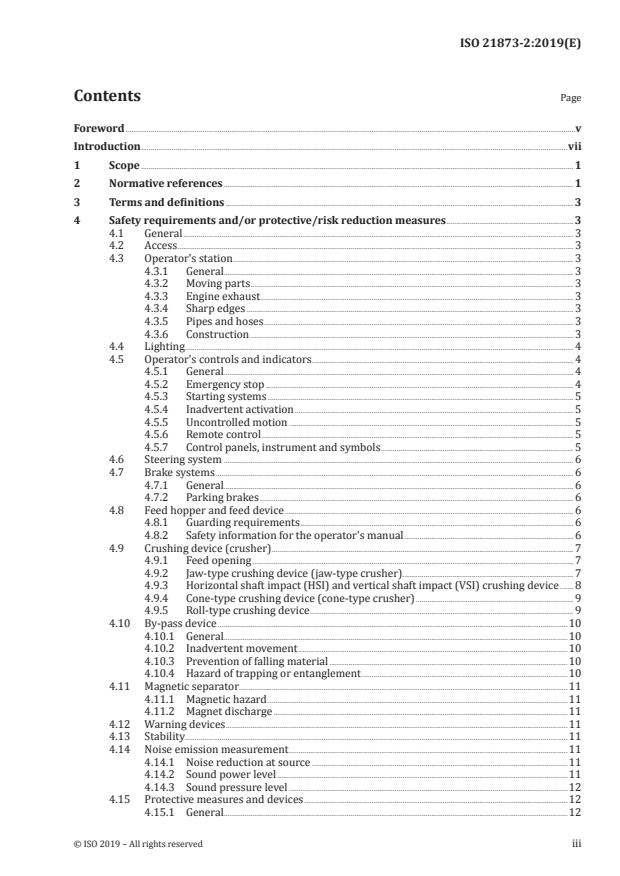
Contents Page
Foreword .v
Introduction .vii
1 Scope . 1
2 Normative references . 1
3 Terms and definitions . 3
4 Safety requirements and/or protective/risk reduction measures . 3
4.1 General . 3
4.2 Access . 3
4.3 Operator's station . 3
4.3.1 General. 3
4.3.2 Moving parts . 3
4.3.3 Engine exhaust. 3
4.3.4 Sharp edges . 3
4.3.5 Pipes and hoses . 3
4.3.6 Construction . 3
4.4 Lighting . 4
4.5 Operator's controls and indicators . 4
4.5.1 General. 4
4.5.2 Emergency stop . 4
4.5.3 Starting systems . 5
4.5.4 Inadvertent activation . 5
4.5.5 Uncontrolled motion . 5
4.5.6 Remote control . 5
4.5.7 Control panels, instrument and symbols . 5
4.6 Steering system . 6
4.7 Brake systems . 6
4.7.1 General. 6
4.7.2 Parking brakes . 6
4.8 Feed hopper and feed device . 6
4.8.1 Guarding requirements . 6
4.8.2 Safety information for the operator's manual . 6
4.9 Crushing device (crusher) . 7
4.9.1 Feed opening . 7
4.9.2 Jaw-type crushing device (jaw-type crusher). 7
4.9.3 Horizontal shaft impact (HSI) and vertical shaft impact (VSI) crushing device . 8
4.9.4 Cone-type crushing device (cone-type crusher) . 9
4.9.5 Roll-type crushing device . 9
4.10 By-pass device .10
4.10.1 General.10
4.10.2 Inadvertent movement .10
4.10.3 Prevention of falling material .10
4.10.4 Hazard of trapping or entanglement .10
4.11 Magnetic separator .11
4.11.1 Magnetic hazard .11
4.11.2 Magnet discharge .11
4.12 Warning devices .11
4.13 Stability .11
4.14 Noise emission measurement .11
4.14.1 Noise reduction at source .11
4.14.2 Sound power level .11
4.14.3 Sound pressure level .12
4.15 Protective measures and devices .12
4.15.1 General.12
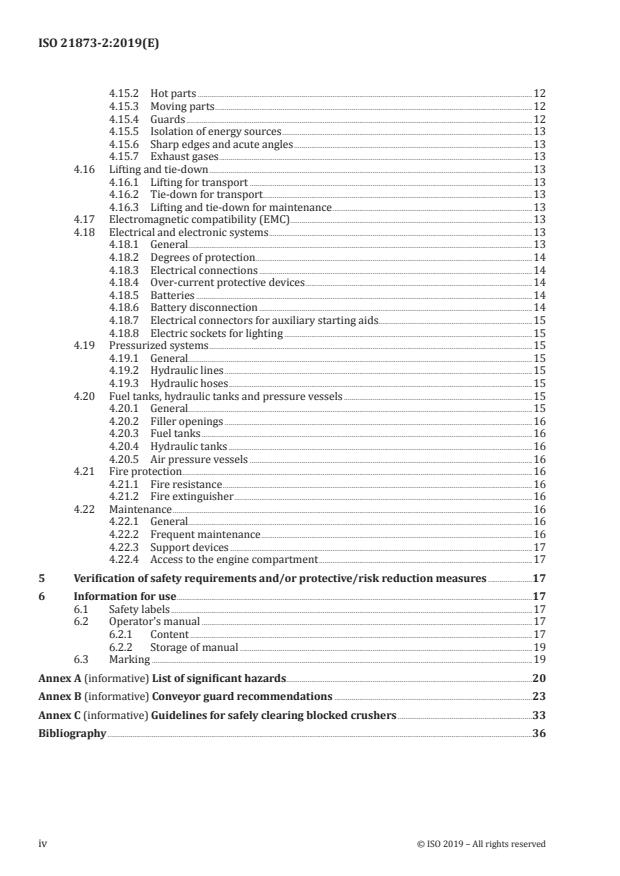
4.15.2 Hot parts .12
4.15.3 Moving parts .12
4.15.4 Guards .12
4.15.5 Isolation of energy sources .13
4.15.6 Sharp edges and acute angles .13
4.15.7 Exhaust gases .13
4.16 Lifting and tie-down .13
4.16.1 Lifting for transport .13
4.16.2 Tie-down for transport . .13
4.16.3 Lifting and tie-down for maintenance .13
4.17 Electromagnetic compatibility (EMC).13
4.18 Electrical and electronic systems .13
4.18.1 General.13
4.18.2 Degrees of protection.14
4.18.3 Electrical connections .14
4.18.4 Over-current protective devices .14
4.18.5 Batteries .14
4.18.6 Battery disconnection .14
4.18.7 Electrical connectors for auxiliary starting aids.15
4.18.8 Electric sockets for lighting .15
4.19 Pressurized systems .15
4.19.1 General.15
4.19.2 Hydraulic lines .15
4.19.3 Hydraulic hoses .15
4.20 Fuel tanks, hydraulic tanks and pressure vessels .15
4.20.1 General.15
4.20.2 Filler openings .16
4.20.3 Fuel tanks .16
4.20.4 Hydraulic tanks .16
4.20.5 Air pressure vessels .16
4.21 Fire protection .16
4.21.1 Fire resistance .16
4.21.2 Fire extinguisher .16
4.22 Maintenance .16
4.22.1 General.16
4.22.2 Frequent maintenance .16
4.22.3 Support devices .17
4.22.4 Access to the engine compartment .17
5 Verification of safety requirements and/or protective/risk reduction measures .17
6 Information for use .17
6.1 Safety labels .17
6.2 Operator's manual .17
6.2.1 Content .17
6.2.2 Storage of manual .19
6.3 Marking .19
Annex A (informative) List of significant hazards.20
Annex B (informative) Conveyor guard recommendations .23
Annex C (informative) Guidelines for safely clearing blocked crushers .33
Bibliography .36
iv © ISO 2019 – All rights reserved
Foreword
ISO (the International Organization for Standardization) is a worldwide federation of national standards
bodies (ISO member bodies). The work of preparing International Standards is normally carried out
through ISO technical committees. Each member body interested in a subject for which a technical
committee has been established has the right to be represented on that committee. International
organizations, governmental and non-governmental, in liaison with ISO, also take part in the work.
ISO collaborates closely with the International Electrotechnical Commission (IEC) on all matters of
electrotechnical standardization.
The procedures used to develop this document and those intended for its further maintenance are
described in the ISO/IEC Directives, Part 1. In particular the different approval criteria needed for the
different types of ISO documents should be noted. This document was drafted in accordance with the
editorial rules of the ISO/IEC Directives, Part 2 (see www .iso .org/directives).
Attention is drawn to the possibility that some of the elements of this document may be the subject of
patent rights. ISO shall not be held responsible for identifying any or all such patent rights. Details of
any patent rights identified during the development of the document will be in the Introduction and/or
on the ISO list of patent declarations received (see www .iso .org/patents).
Any trade name used in this document is information given for the convenience of users and does not
constitute an endorsement.
For an explanation on the voluntary nature of standards, the meaning of ISO specific terms and
expressions related to conformity assessment, as well as information about ISO's adherence to the
World Trade Organization (WTO) principles in the Technical Barriers to Trade (TBT) see the following
URL: www .iso .org/iso/foreword .html.
This document was prepared by Technical Committee ISO/TC 195, Building construction machinery and
equipment.
This second edition cancels and replaces the first edition (ISO 21873-2:2009), which has been
technically revised.
The main changes compared to the previous edition are as follows:
— general — applying to the entire document:
— "and verification" has been added to the title for consistency;
— additional clause numbering has been added for better readability and consistency;
— "this part of ISO 21873" has been changed to "this document";
— in the Introduction, additional information has been added to conform with ISO Guide 78;
— in Clause 2, normative references have been updated as appropriate;
— in Clause 3, a reference to the ISO and IEC terminological databases has been added;
— in Clause 4:
— 4.2 has been simplified as the former text was already covered in the reference;
— in 4.3.2, examples have been added;
— in 4.4, the text related to visibility has been removed as it was ambiguous and not verifiable;
— in the title of 4.5, the term "Operator's" has been added;
— a new 4.5.6 relating to remote control has been added;
— 4.7 on brake systems has been split into 2 parts: one general and one for parking brakes;
— in 4.9, the term "crusher" has been replaced by "crushing device";
— in 4.8, 4.9, 4.10, and 4.11, titles have been added for better readability;
— in 4.9.5, gyratory crushers have been removed and the clause has been rewritten;
— in 4.14, an alternative method for noise emission measurement has been added;
— in 4.16, lifting and tie-down clarifications have been added on what requirements are for
transport and what requirements are for maintenance;
— in Clause 5, clarifications have been made regarding documentation;
— in Clause 6, the term "machine" has been removed when relating to safety labels;
— in Annex A:
— references have been updated as appropriate;
— column for ISO 12100-2 has been removed;
— in Annex C, a new general warning related to rock breakers has been added;
— in the Bibliography, the references have been updated and a reference to ISO 13732-1 for hot surfaces
has been added.
A list of all parts in the ISO 21873 series can be found on the ISO website.
Any feedback or questions on this document should be directed to the user’s national standards body. A
complete listing of these bodies can be found at www .iso .org/members .html.
vi © ISO 2019 – All rights reserved
Introduction
This document is a type-C standard as stated in ISO 12100.
This document is of relevance, in particular, for the following stakeholder groups representing the
market players with regard to machinery safety:
— machine manufacturers (small, medium and large enterprises);
— health and safety bodies (regulators, accident prevention organisations, market surveillance, etc.).
Others can be affected by the level of machinery safety achieved with the means of the document by the
above-mentioned stakeholder groups:
— machine users/employers (small, medium and large enterprises);
— machine users/employees (e.g. trade unions, organizations for people with special needs);
— service providers, e.g. for maintenance (small, medium and large enterprises);
— consumers (in the case of machinery intended for use by consumers).
The above-mentioned stakeholder groups have been given the possibility to participate at the drafting
process of this document.
The machinery concerned and the extent to which hazards, hazardous situations or hazardous events
are covered are indicated in the Scope of this document.
When requirements of this type-C standard are different from those which are stated in type-A or -B
standards, the requirements of this type-C standard take precedence over the requirements of the
other standards for machines that have been designed and built according to the requirements of this
type-C standard.
This document deals with mobile crushers which are used for crushing rocks or reprocessing
construction materials.
INTERNATIONAL STANDARD ISO 21873-2:2019(E)
Building construction machinery and equipment — Mobile
crushers —
Part 2:
Safety requirements and verification
1 Scope
This document establishes the safety requirements for mobile crushers, as defined in ISO 21873-1,
for crushing rocks or for reprocessing construction materials and capable of re-location between
worksites.
It applies to mobile crushers that are either
— self-propelled (mounted on a chassis);
— lorry (truck) mounted;
— or semi-trailer mounted.
It does not apply to
— fixed (stationary) crushers;
— large mining-type movable crushers.
This document deals with significant hazards, hazardous situations and events relevant to mobile
crushers when used as intended and under the conditions of misuse which are reasonably foreseeable
by the manufacturer.
This document is not applicable to machines which are manufactured before the date of its publication.
2 Normative references
The following documents are referred to in the text in such a way that some or all of their content
constitutes requirements of this document. For dated references, only the edition cited applies. For
undated references, the latest edition of the referenced document (including any amendments) applies.
ISO 2860, Earth-moving machinery — Minimum access dimensions
ISO 2867, Earth-moving machinery — Access systems
ISO 3457, Earth-moving machinery — Guards — Definitions and requirements
ISO 3744, Acoustics — Determination of sound power levels and sound energy levels of noise sources using
sound pressure — Engineering methods for an essentially free field over a reflecting plane
ISO 3795, Road vehicles, and tractors and machinery for agriculture and forestry — Determination of
burning behaviour of interior materials
ISO 4413, Hydraulic fluid power — General rules and safety requirements for systems and their components
ISO 6011, Earth-moving machinery — Visual display of machine operation
ISO 6405-1, Earth-moving machinery — Symbols for operator controls and other displays — Part 1:
Common symbols
ISO 6750, Earth-moving machinery — Operator's manual — Content and format
ISO 9244, Earth-moving machinery — Machine safety labels — General principles
ISO 9247, Earth-moving machinery — Electrical wires and cables — Principles of identification and marking
ISO 10264, Earth-moving machinery — Key-locked starting systems
ISO 10265, Earth-moving machinery — Crawler machines — Performance requirements and test
procedures for braking systems
ISO 10533, Earth-moving machinery — Lift-arm support devices
ISO 10968:2004, Earth-moving machinery — Operator’s controls
ISO 12100:2010, Safety of machinery — General principles for design — Risk assessment and risk reduction
ISO 12508, Earth-moving machinery — Operator station and maintenance areas — Bluntness of edges
ISO 13766-1, Earth-moving and building construction machinery — Electromagnetic compatibility (EMC)
of machines with internal electrical power supply — Part 1: General EMC requirements under typical
electromagnetic environmental conditions
ISO 13766-2, Earth-moving and building construction machinery — Electromagnetic compatibility (EMC) of
machines with internal electrical power supply — Part 2: Additional EMC requirements for functional safety
ISO 13849-1, Safety of machinery — Safety-related parts of control systems — Part 1: General principles
for design
ISO 13850, Safety of machinery — Emergency stop function — Principles for design
ISO 13857, Safety of machinery — Safety distances to prevent hazard zones being reached by upper and
lower limbs
ISO 14120, Safety of machinery — Guards — General requirements for the design and construction of fixed
and movable guards
ISO 15817, Earth-moving machinery — Safety requirements for remote operator control systems
ISO 15818, Earth-moving machinery — Lifting and tying-down attachment points — Performance
requirements
ISO 15998, Earth-moving machinery — Machine-control systems (MCS) using electronic components —
Performance criteria and tests for functional safety
ISO 16528-1, Boilers and pressure vessels — Part 1: Performance requirements
ISO 16528-2, Boilers and pressure vessels — Part 2: Procedures for fulfilling the requirements of ISO 16528-1
ISO 17063, Earth-moving machinery — Braking systems of pedestrian-controlled machines — Performance
requirements and test procedures
ISO 21507, Earth-moving machinery — Performance requirements for non-metallic fuel tanks
ISO 21873-1:2015, Building construction machinery and equipment — Mobile crushers — Part 1:
Terminology and commercial specifications
IEC 60204-1, Safety of machinery — Electrical equipment of machines — Part 1: General requirements
IEC 60529, Degrees of protection provided by enclosures (IP Code)
2 © ISO 2019 – All rights reserved
3 Terms and definitions
For the purposes of this document, the terms and definitions given in ISO 12100 and ISO 21873-1 apply.
ISO and IEC maintain terminological databases for use in standardization at the following addresses:
— ISO Online browsing platform: available at https: //www .iso .org/obp
— IEC Electropedia: available at http: //www .electropedia .org/
4 Safety requirements and/or protective/risk reduction measures
4.1 General
4.1.1 Machinery shall comply with the safety requirements and/or protective/risk reduction measures
of this clause.
4.1.2 In addition, the machine shall be designed according to the principles of ISO 12100:2010 for
relevant but not significant hazards which are not dealt with by this document.
4.2 Access
Access systems shall be in accordance with ISO 2867.
4.3 Operator's station
4.3.1 General
If the travel and working controls are in different locations, the requirements of this document shall be
met at each location.
4.3.2 Moving parts
Measures shall be taken to avoid accidental contact from the operating position with moving parts, for
example, wheels, tracks or working equipment and/or attachments, in accordance with the relevant
sub-clauses of Clause 4.
4.3.3 Engine exhaust
The engine exhaust system shall release the exhaust gas away from the operator.
4.3.4 Sharp edges
The operator's working space within the operator's station, for example, instrument panels and access
to the operator's station, shall not present any sharp exposed edges or acute angles/corners. The radius
of corners and the bluntness of edges shall comply with ISO 12508, in order to avoid sharp edges.
4.3.5 Pipes and hoses
Pipes and hoses shall be guarded in accordance with 4.19.2.
4.3.6 Construction
For self-propelled mobile crushers equipped with an operator station, all handrails shall be constructed
in accordance with ISO 2867. Especially for travel, the operator station shall be large enough to prevent
injury to the operator during travel over irregular surfaces. It shall include provisions for stopping the
operator from falling on, or being ejected from, the machine and for allowing the operator to maintain
control when travelling over irregular surfaces. The operator station shall be provided with a ROPS (roll
over protective structure) if there is a risk of the machine rolling over, or FOPS (falling object protective
structure) if there is a risk from falling objects.
4.4 Lighting
Machines shall be equipped with lighting devices for travel only. If required, illumination for operation
should be provided by surrounding light sources. This shall be noted in the operator's manual.
4.5 Operator's controls and indicators
4.5.1 General
4.5.1.1 Self-propelled mobile crushers equipped with an operator station for travel shall have the
controls (for example, hand levers, joysticks, pedals, switches) and indicators located, designed and
manufactured in accordance with ISO 10968, and such that
a) they are of easy access, in accordance with ISO 6682 and ISO 10968,
b) the neutral positions of the controls are in accordance with ISO 10968:2004, 5.1.3,
c) they are clearly identified in accordance with ISO 6405-1 and ISO 6405-2 in the operator's station
and explained in the operation manual (see 6.2),
d) the movement of their controls for activating functions and indicators shall correspond to the
intended effect or common practice whenever possible,
e) the normal engine stop device is within the zone of reach as defined by ISO 6682, when a control
such as a keyboard or joystick control (see the requirements for joysticks given in ISO 10968) is
designed and constructed to carry out several of the machine's functions, the activated function(s)
are clearly identified,
f) for the safety-related functions of control system(s), the principles outlined in ISO 13849-1 shall be
followed.
4.5.1.2 A mobile crusher shall be equipped with components to allow isolation of the main power source
(lockout/tag-out of the machine). This can be accomplished by providing a locking battery disconnect
and/or e-stop switch. These lockout/tag-out provisions shall be noted in the operator's manual.
4.5.1.3 The controls shall include a pre-start warning alerting that a function is about to start in case
the operator cannot verify that personnel are clear of all hazard zones from any control position. An
acoustic and/or visual warning signal shall be activated prior to the start of a function for a duration
sufficient to allow personnel to leave the hazard zone.
4.5.2 Emergency stop
4.5.2.1 Self-propelled mobile crushers equipped with an operator station for travel shall have an
emergency stop conforming to ISO 13850 located in close proximity to the travel controls.
4.5.2.2 All mobile crushers shall have at least one emergency stop mounted on each side of the machine
that is accessible while standing on the ground. Emergency stops shall not be located such that personnel
have to enter a hazard zone in order for them to be activated. Emergency stops shall have a provision for
isolating the main energy source (lockout provisions), if no other lockout provisions are provided on the
machine.
4 © ISO 2019 – All rights reserved
4.5.3 Starting systems
Mobile crushers equipped with an on-board power supply (for example, a diesel engine) shall be
equipped with a starting system that complies with ISO 10264.
4.5.4 Inadvertent activation
4.5.4.1 Controls that can cause a hazard due to inadvertent activation shall be so arranged, deactivated
or guarded as to minimize the risk — particularly while the operator is getting into or out of the
operator's station. The deactivation device shall either be self-acting or shall act by compulsory actuation
of the relevant device.
4.5.4.2 Controls shall be placed automatically in a neutral (or safe) starting condition when the mobile
crusher is shut down so as to prevent accidental activation at re-start.
4.5.4.3 Where there is more than one control position, the control system shall be designed such
that one control position will preclude the use of controls in other positions. This does not include stop
controls or emergency stops.
4.5.5 Uncontrolled motion
Machine and equipment/attachment movement from the holding position — other than by actuation
of the controls by the operator — due to drift or creep (for example, by leaking) or when power supply
stops, shall be limited to the extent that it cannot create a risk to exposed persons.
4.5.6 Remote control
Remote operator control used for machine travel and operation shall comply with ISO 15817. The
remote control shall
a) provide neutral control positions in accordance with ISO 10968, and
b) identify each control and explain it in the operator's manual (see ISO 6405-1 and ISO 7000).
4.5.7 Control panels, instrument and symbols
4.5.7.1 Control panels
Control panels for self-propelled mobile crushers equipped with machine-mounted operator stations
shall be located to minimize visual obstructions. The operator shall be able to see from this operator's
station, in either daylight or darkness, the necessary indicators allowing a check of the proper function
of the machine. Glare shall be minimized. Switches, instruments and indicator lights on machine-
mounted panels shall be designed for visibility in low light conditions.
4.5.7.2 Operating instrumentation
Control indicators for the safe and proper operation of the machine shall be in accordance with ISO 6011
in respect of the use of safety colours (in compliance with IEC 60204-1) and related aspects.
4.5.7.3 Symbols
For symbols used on operator controls and other displays on mobile crushers, see, for example,
ISO 6405-1 or ISO 6405-2 or ISO 7000.
4.6 Steering system
The steering system shall be such that the movement of the steering control corresponds to the intended
direction of steering according to ISO 10968.
4.7 Brake systems
Self-propelled, lorry (truck) mounted and semi-trailer mounted mobile crushers shall be equipped with
service, emergency, and parking brake systems.
4.7.1 General
4.7.1.1 All brake systems shall be designed to perform adequately under all intended service
conditions, including load, speed, terrain and slope.
4.7.1.2 Self-propelled mobile crushers equipped with tracks shall be provided with service and parking
brake systems. The service brakes for these mobile crushers shall be individually controlled, one for each
track, and may be combined with the steering system.
4.7.1.3 Brake systems for wheeled self-propelled mobile crushers with an off-road chassis shall comply
with ISO 3450.
4.7.1.4 Brake systems for wheeled self-propelled mobile crushers with an on-road chassis are deemed
to comply with national and/or regional requirements for road vehicles.
4.7.1.5 Brake systems for self-propelled mobile crushers equipped with tracks shall comply with
ISO 10265 (design speed 20 km/h or less) or ISO 17063 (design speed less than 6 km/h), according to
the speed capability of the tracks.
4.7.2 Parking brakes
The parking brakes shall be of a size sufficient to withstand the mass of the machine, at the maximum
incline recommended by the machine manufacturer.
4.8 Feed hopper and feed device
4.8.1 Guarding requirements
An emergency stop device shall be mounted with easy access for personnel standing on the platform
facing the crusher and/or feed device. The emergency stop device shall be as specified in 4.5.2. A guard
shall be provided to protect the operator from material ejected from the crusher. Parts transmitting
power to the feed device (for example, flywheels, drive belts) shall be guarded. If inspection openings are
added to drive guards, they shall be enclosed by a cover that is keyed or requires the use of tools to open.
4.8.2 Safety information for the operator's manual
The following shall be noted in the operator's manual.
— “Stop the feed device, shut down power to the machine and lockout/tag-out the energy sources
before entering the feed device for any reason.” This should also be indicated by the use of a machine
safety label affixed to the equipment.
— “Stand clear of the feed hopper to avoid injury due to falling material.” This should also be indicated
by the use of a machine safety label affixed to the equipment.
6 © ISO 2019 – All rights reserved
— Location of pinch points that can cause injury, with particular mention of the surging action of a
vibratory feeder when started and stopped. Pinch points should also be indicated by the use of a
machine safety label affixed to the equipment.
— “Stop equipment and shut down power to the machine and lockout/tag-out the energy sources
before performing any maintenance on the equipment.” This should also be indicated by the use of
a machine safety label affixed to the equipment.
— “All guards shall be in place before starting the feeder.” This should also be indicated by the use of a
machine safety label affixed to the equipment.
4.9 Crushing device (crusher)
4.9.1 Feed opening
4.9.1.1 Guarding requirements
The feed opening of the crusher shall be provided with a guard to minimize hazards caused by ejected
material.
4.9.1.2 Safety information for the operator's manual
4.9.1.2.1 The following shall be included in the operator's manual:
— the types of material the crusher is intended to process;
— the maximum feed size for material fed to crusher;
— a procedure for safely removing blockages and foreseen risks associated with the particular activity
(see Annex C).
4.9.1.2.2 The operator's manual shall also indicate the proper set-up, operation and maintenance of
the guards for the crushing device as specified in 4.9.2 to 4.9.5.
4.9.1.2.3 See below for indications specific to a crushing unit that are also to be included in the
operator's manual.
4.9.2 Jaw-type crushing device (jaw-type crusher)
4.9.2.1 Guarding requirements
4.9.2.1.1 If a platform is mounted in close proximity to the feed opening of a jaw-type crusher, a guard
shall be provided to prevent the operator from falling into the feed opening. The minimum height of the
guard shall be 1,1 m above the walking surface of the platform. The platform shall be positioned so as to
minimize direct exposure to material ejected from the crusher. An emergency stop device, as specified in
4.5.2, shall be mounted on the platform.
4.9.2.1.2 The following areas shall also be guarded:
— parts transmitting power to the crusher (flywheels, drive belts, etc.);
— pinch points in areas accessed during normal operation or maintenance (including coil springs that
compress during operation).
4.9.2.2 Inspection openings
If inspection openings are added to drive guards, they shall be enclosed with a cover that requires a key
or the use of tools to open.
4.9.2.3 Maintenance
4.9.2.3.1 A safe method for preventing the unintended swing of the movable jaw of a jaw-type crusher
during maintenance shall be included in the operator's manual.
4.9.2.3.2 Compression springs and tension rods shall be guarded so as to contain any sudden rel
...
Questions, Comments and Discussion
Ask us and Technical Secretary will try to provide an answer. You can facilitate discussion about the standard in here.
Loading comments...