

ISO 11565:2024
(Main)Road vehicles — Spark-plugs — Test methods and requirements
General Information
- Abstract
This document specifies the test methods and requirements for the mechanical and electrical performance of spark-plugs for use with spark ignition engines.
- Status
- Published
- Publication Date
- 10-Jun-2024
- Current Stage
- 9092 - International Standard to be revised
- Start Date
- 15-Aug-2025
- Completion Date
- 29-Aug-2026
Overview
ISO 11565:2024 - Road vehicles - Spark-plugs - Test methods and requirements is the third edition International Standard that defines mechanical and electrical test methods and pass/fail requirements for spark-plugs used in spark‑ignition engines. It updates and replaces ISO 11565:2006, introducing separate test procedures for normally aspirated (Type A) and boosted (Type B) engines and modified test sequences. Normal test ambient conditions are (20 ± 15) °C and (65 ± 20) % relative humidity.
Key topics and technical requirements
The standard lays out detailed tests, acceptance criteria and references to related standards (ISO 28741, ISO 6518‑1, IEC 60068‑2‑6). Major technical topics include:
- Visual inspection / General characteristics
- External gasket, scavenging area, electrodes, shell, insulator condition and marking.
- Dimensions
- Dimensional checks in accordance with ISO 28741.
- Mechanical performance
- Breaking torque of the shell (example minimums): M10×1 flat ≥ 25 Nm; M12×1.25 flat ≥ 35 Nm; M14×1.25 flat ≥ 60 Nm; M18×1.5 flat ≥ 80 Nm. Conical seating values are also specified.
- Tear‑off resistance of high‑voltage terminals: axial load up to (400 ± 10) N - plug must remain intact.
- Bending resistance: withstand a lateral moment of 15 Nm.
- Vibration preconditioning per IEC 60068‑2‑6 (50–500 Hz sinusoidal, 30 g, 8 h each axis).
- Gas tightness
- Tests to ensure combustion‑chamber sealing; installation torque for test fixtures varies by seating and fixture material (examples given in the standard).
- Thermal shock / thermal resistance
- Procedures and pass/fail criteria for thermal cycling.
- Electrical performance
- Resistance of EMI suppression element, withstand voltage of the insulator and loading life tests for incorporated resistors.
Applications and users
ISO 11565:2024 is intended for:
- Spark‑plug manufacturers and component suppliers for design verification and production testing
- Automotive OEMs and engine manufacturers for specifying supplier acceptance criteria
- Independent test laboratories and quality assurance teams conducting conformity or pre‑production testing
- Design engineers validating mechanical, thermal and electrical robustness of spark‑ignition components
Using ISO 11565 helps ensure reliable ignition performance, combustion chamber sealing, EMI compliance and mechanical durability under real‑world engine conditions.
Related standards
- ISO 28741 - Spark‑plug dimensions and basic characteristics
- ISO 6518‑1 - Ignition systems vocabulary
- IEC 60068‑2‑6 - Vibration test methods
Keywords: ISO 11565:2024, spark-plugs, road vehicles, test methods, mechanical performance, electrical performance, gas tightness, vibration resistance, EMI suppression.
Relations
- Effective Date
- 06-Jun-2022
- Effective Date
- 06-Jun-2022
Get Certified
Connect with accredited certification bodies for this standard

TÜV Rheinland
TÜV Rheinland is a leading international provider of technical services.

TÜV SÜD
TÜV SÜD is a trusted partner of choice for safety, security and sustainability solutions.

DEKRA Certification Inc.
DEKRA US certification services.
Sponsored listings
Frequently Asked Questions
ISO 11565:2024 is a standard published by the International Organization for Standardization (ISO). Its full title is "Road vehicles — Spark-plugs — Test methods and requirements". This standard covers: This document specifies the test methods and requirements for the mechanical and electrical performance of spark-plugs for use with spark ignition engines.
This document specifies the test methods and requirements for the mechanical and electrical performance of spark-plugs for use with spark ignition engines.
ISO 11565:2024 is classified under the following ICS (International Classification for Standards) categories: 43.060.50 - Electrical and electronic equipment. Control systems. The ICS classification helps identify the subject area and facilitates finding related standards.
ISO 11565:2024 has the following relationships with other standards: It is inter standard links to ISO 11565:2006/Cor 1:2007, ISO 11565:2006. Understanding these relationships helps ensure you are using the most current and applicable version of the standard.
ISO 11565:2024 is available in PDF format for immediate download after purchase. The document can be added to your cart and obtained through the secure checkout process. Digital delivery ensures instant access to the complete standard document.
Standards Content (Sample)
International
Standard
ISO 11565
Third edition
Road vehicles — Spark-plugs — Test
2024-06
methods and requirements
Véhicules routiers — Bougies d'allumage — Méthodes d'essai et
exigences
Reference number
© ISO 2024
All rights reserved. Unless otherwise specified, or required in the context of its implementation, no part of this publication may
be reproduced or utilized otherwise in any form or by any means, electronic or mechanical, including photocopying, or posting on
the internet or an intranet, without prior written permission. Permission can be requested from either ISO at the address below
or ISO’s member body in the country of the requester.
ISO copyright office
CP 401 • Ch. de Blandonnet 8
CH-1214 Vernier, Geneva
Phone: +41 22 749 01 11
Email: copyright@iso.org
Website: www.iso.org
Published in Switzerland
ii
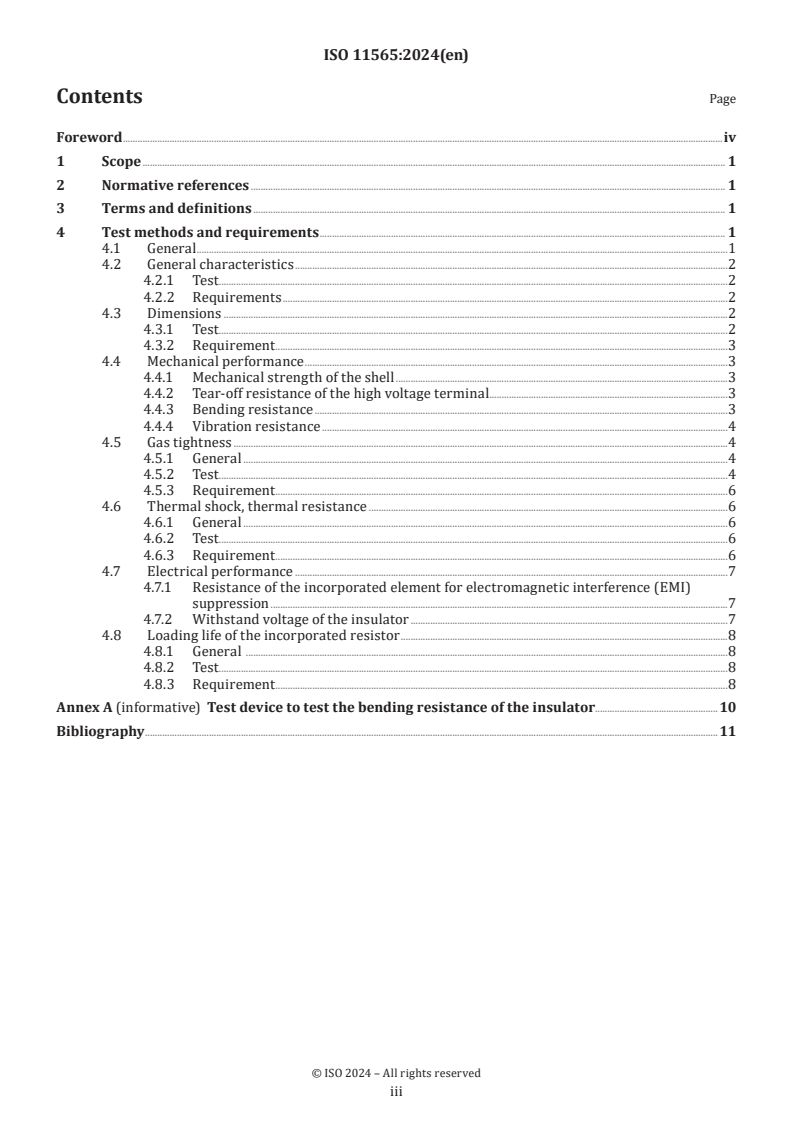
Contents Page
Foreword .iv
1 Scope . 1
2 Normative references . 1
3 Terms and definitions . 1
4 Test methods and requirements . 1
4.1 General .1
4.2 General characteristics .2
4.2.1 Test . . .2
4.2.2 Requirements .2
4.3 Dimensions .2
4.3.1 Test . . .2
4.3.2 Requirement .3
4.4 Mechanical performance .3
4.4.1 Mechanical strength of the shell .3
4.4.2 Tear-off resistance of the high voltage terminal .3
4.4.3 Bending resistance .3
4.4.4 Vibration resistance .4
4.5 Gas tightness .4
4.5.1 General .4
4.5.2 Test . . .4
4.5.3 Requirement .6
4.6 Thermal shock, thermal resistance .6
4.6.1 General .6
4.6.2 Test . .6
4.6.3 Requirement .6
4.7 Electrical performance .7
4.7.1 Resistance of the incorporated element for electromagnetic interference (EMI)
suppression .7
4.7.2 Withstand voltage of the insulator .7
4.8 Loading life of the incorporated resistor .8
4.8.1 General .8
4.8.2 Test . .8
4.8.3 Requirement .8
Annex A (informative) Test device to test the bending resistance of the insulator.10
Bibliography .11
iii
Foreword
ISO (the International Organization for Standardization) is a worldwide federation of national standards
bodies (ISO member bodies). The work of preparing International Standards is normally carried out through
ISO technical committees. Each member body interested in a subject for which a technical committee
has been established has the right to be represented on that committee. International organizations,
governmental and non-governmental, in liaison with ISO, also take part in the work. ISO collaborates closely
with the International Electrotechnical Commission (IEC) on all matters of electrotechnical standardization.
The procedures used to develop this document and those intended for its further maintenance are described
in the ISO/IEC Directives, Part 1. In particular, the different approval criteria needed for the different types
of ISO document should be noted. This document was drafted in accordance with the editorial rules of the
ISO/IEC Directives, Part 2 (see www.iso.org/directives).
ISO draws attention to the possibility that the implementation of this document may involve the use of (a)
patent(s). ISO takes no position concerning the evidence, validity or applicability of any claimed patent
rights in respect thereof. As of the date of publication of this document, ISO had not received notice of (a)
patent(s) which may be required to implement this document. However, implementers are cautioned that
this may not represent the latest information, which may be obtained from the patent database available at
www.iso.org/patents. ISO shall not be held responsible for identifying any or all such patent rights.
Any trade name used in this document is information given for the convenience of users and does not
constitute an endorsement.
For an explanation of the voluntary nature of standards, the meaning of ISO specific terms and expressions
related to conformity assessment, as well as information about ISO's adherence to the World Trade
Organization (WTO) principles in the Technical Barriers to Trade (TBT), see www.iso.org/iso/foreword.html.
This document was prepared by Technical Committee ISO/TC 22, Road vehicles, Subcommittee SC 32,
Electrical and electronic components and general system aspects.
This third edition cancels and replaces the second edition edition (ISO 11565:2006), which has been
technically revised. It also incorporates the Technical Corrigendum ISO 11565:2006/Cor. 1:2007.
The main changes are as follows:
— the test procedures have been divided into spark plugs for natural aspirated engines and boosted
engines;
— the test sequences have been modified.
Any feedback or questions on this document should be directed to the user’s national standards body. A
complete listing of these bodies can be found at www.iso.org/members.html.
iv
International Standard ISO 11565:2024(en)
Road vehicles — Spark-plugs — Test methods and
requirements
1 Scope
This document specifies the test methods and requirements for the mechanical and electrical performance
of spark-plugs for use with spark ignition engines.
2 Normative references
The following documents are referred to in the text in such a way that some or all of their content constitutes
requirements of this document. For dated references, only the edition cited applies. For undated references,
the latest edition of the referenced document (including any amendments) applies.
ISO 6518-1, Road vehicles — Ignition systems — Part 1: Vocabulary
ISO 28741, Road vehicles — Spark-plugs and their cylinder head housings — Basic characteristics and dimensions
IEC 60068-2-6, Environmental Testing — Part 2-6: Tests — Test Fc: Vibration (sinusoidal)
3 Terms and definitions
For the purposes of this document, the terms and definitions given in ISO 6518-1 apply.
ISO and IEC maintain terminology databases for use in standardization at the following addresses:
— ISO Online browsing platform: available at https:// www .iso .org/ obp
— IEC Electropedia: available at https:// www .electropedia .org/
4 Test methods and requirements
4.1 General
The tests shall be carried out at an ambient temperature of (20 ± 15) °C and a relative humidity of (65 ± 20) %
unless otherwise specified.
For each test sample in Table 1, the test sequence is indicated by "X" from top to bottom.
Each test sequence shall be started with unused samples.
“Type A” refers to normally aspirated engines and “Type B” refers to boosted engines.
Which type (A or B) to be applied for each test shall be agreed between the customer and the supplier.
Table 1 — Test sequences
In accord- Test sample
Characteristic to be checked ance with
A B C D E F
sub-clause
General characteristics (visual examination) 4.2 X X X X X X
Dimensions 4.3 X X X X X X
Resistance of the incorporated element for elec
...