


ISO/FDIS 14068
(Main)Climate change management — Carbon neutrality
Climate change management — Carbon neutrality
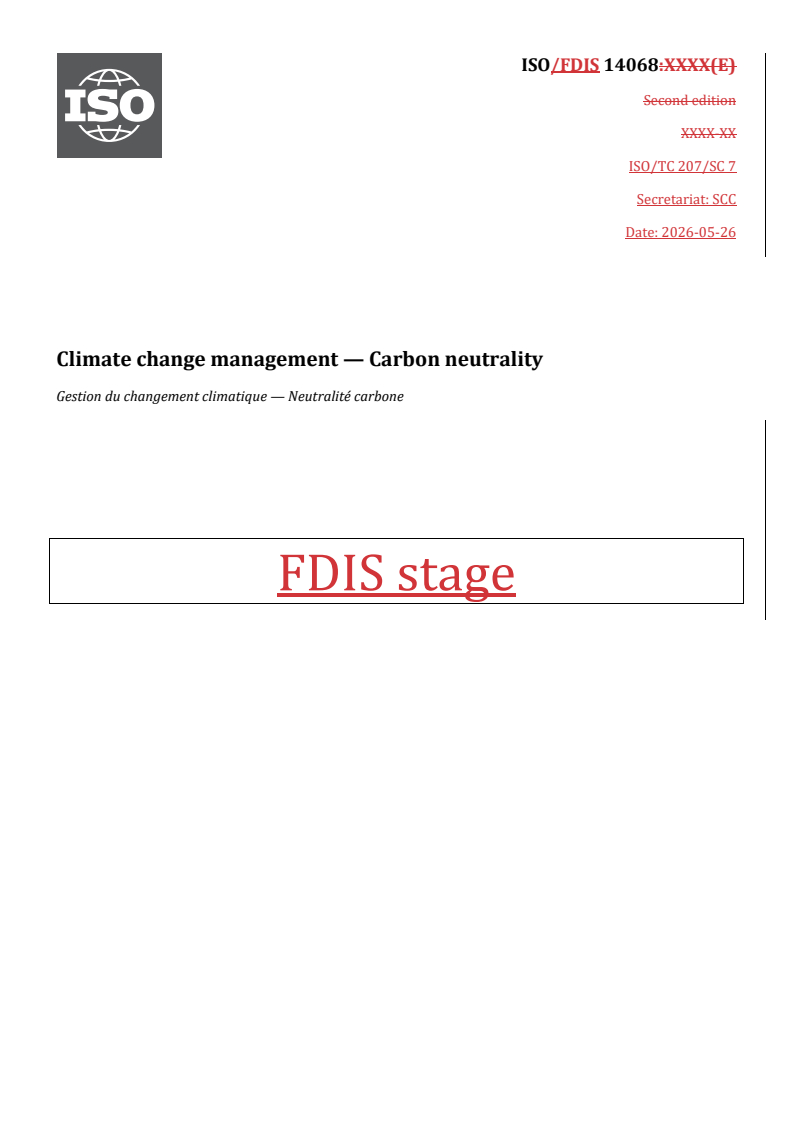
This document specifies principles, requirements and guidance for achieving and demonstrating carbon neutrality through the quantification, reduction and offsetting of the carbon footprint. This document defines terms used in relation to carbon neutrality and provides guidance on the actions necessary to achieve and demonstrate carbon neutrality. In accordance with common practice, it uses the word “carbon” to refer to all greenhouse gases (GHGs) in compound expressions such as “carbon neutrality”. It is applicable to a wide range of subjects such as organizations (including companies, local authorities and financial institutions) and products (goods or services, including buildings and events). It is not intended to be used for territories (such as regions, countries, states or cities), including signatories to the United Nations Framework Convention on Climate Change (UNFCCC) when reporting national outcomes for the purposes of that Convention. This document establishes a hierarchy for carbon neutrality where GHG emission reductions (direct and indirect) and GHG removal enhancements within the value chain take priority over offsetting. It includes requirements for carbon neutrality commitments and making carbon neutrality claims. This document is GHG programme neutral. If a GHG programme is applicable, the requirements of that GHG programme are additional to the requirements of this document.
Gestion du changement climatique — Neutralité carbone
General Information
- Status
- Not Published
- Technical Committee
- ISO/TC 207/SC 7 - Greenhouse gas management and related activities
- Drafting Committee
- ISO/TC 207/SC 7 - Greenhouse gas management and related activities
- Current Stage
- 5000 - FDIS registered for formal approval
- Start Date
- 13-May-2026
- Completion Date
- 30-May-2026
Buy Documents


ISO/FDIS 14068 - Climate change management — Carbon neutrality
REDLINE ISO/FDIS 14068 - Climate change management — Carbon neutrality
Relations
- Revises
ISO 14068-1:2023 - Climate change management — Transition to net zero — Part 1: Carbon neutrality - Effective Date
- 09-May-2026
Buy Documents
ISO/FDIS 14068 - Climate change management — Carbon neutrality
REDLINE ISO/FDIS 14068 - Climate change management — Carbon neutrality
Get Certified
Connect with accredited certification bodies for this standard

BSI Group
BSI (British Standards Institution) is the business standards company that helps organizations make excellence a habit.

Bureau Veritas
Bureau Veritas is a world leader in laboratory testing, inspection and certification services.

DNV
DNV is an independent assurance and risk management provider.
Sponsored listings
Frequently Asked Questions
ISO/FDIS 14068 is a draft published by the International Organization for Standardization (ISO). Its full title is "Climate change management — Carbon neutrality". This standard covers: This document specifies principles, requirements and guidance for achieving and demonstrating carbon neutrality through the quantification, reduction and offsetting of the carbon footprint. This document defines terms used in relation to carbon neutrality and provides guidance on the actions necessary to achieve and demonstrate carbon neutrality. In accordance with common practice, it uses the word “carbon” to refer to all greenhouse gases (GHGs) in compound expressions such as “carbon neutrality”. It is applicable to a wide range of subjects such as organizations (including companies, local authorities and financial institutions) and products (goods or services, including buildings and events). It is not intended to be used for territories (such as regions, countries, states or cities), including signatories to the United Nations Framework Convention on Climate Change (UNFCCC) when reporting national outcomes for the purposes of that Convention. This document establishes a hierarchy for carbon neutrality where GHG emission reductions (direct and indirect) and GHG removal enhancements within the value chain take priority over offsetting. It includes requirements for carbon neutrality commitments and making carbon neutrality claims. This document is GHG programme neutral. If a GHG programme is applicable, the requirements of that GHG programme are additional to the requirements of this document.
This document specifies principles, requirements and guidance for achieving and demonstrating carbon neutrality through the quantification, reduction and offsetting of the carbon footprint. This document defines terms used in relation to carbon neutrality and provides guidance on the actions necessary to achieve and demonstrate carbon neutrality. In accordance with common practice, it uses the word “carbon” to refer to all greenhouse gases (GHGs) in compound expressions such as “carbon neutrality”. It is applicable to a wide range of subjects such as organizations (including companies, local authorities and financial institutions) and products (goods or services, including buildings and events). It is not intended to be used for territories (such as regions, countries, states or cities), including signatories to the United Nations Framework Convention on Climate Change (UNFCCC) when reporting national outcomes for the purposes of that Convention. This document establishes a hierarchy for carbon neutrality where GHG emission reductions (direct and indirect) and GHG removal enhancements within the value chain take priority over offsetting. It includes requirements for carbon neutrality commitments and making carbon neutrality claims. This document is GHG programme neutral. If a GHG programme is applicable, the requirements of that GHG programme are additional to the requirements of this document.
ISO/FDIS 14068 is classified under the following ICS (International Classification for Standards) categories: 13.020.40 - Pollution, pollution control and conservation. The ICS classification helps identify the subject area and facilitates finding related standards.
ISO/FDIS 14068 has the following relationships with other standards: It is inter standard links to ISO 14068-1:2023. Understanding these relationships helps ensure you are using the most current and applicable version of the standard.
ISO/FDIS 14068 is available in PDF format for immediate download after purchase. The document can be added to your cart and obtained through the secure checkout process. Digital delivery ensures instant access to the complete standard document.
Standards Content (Sample)
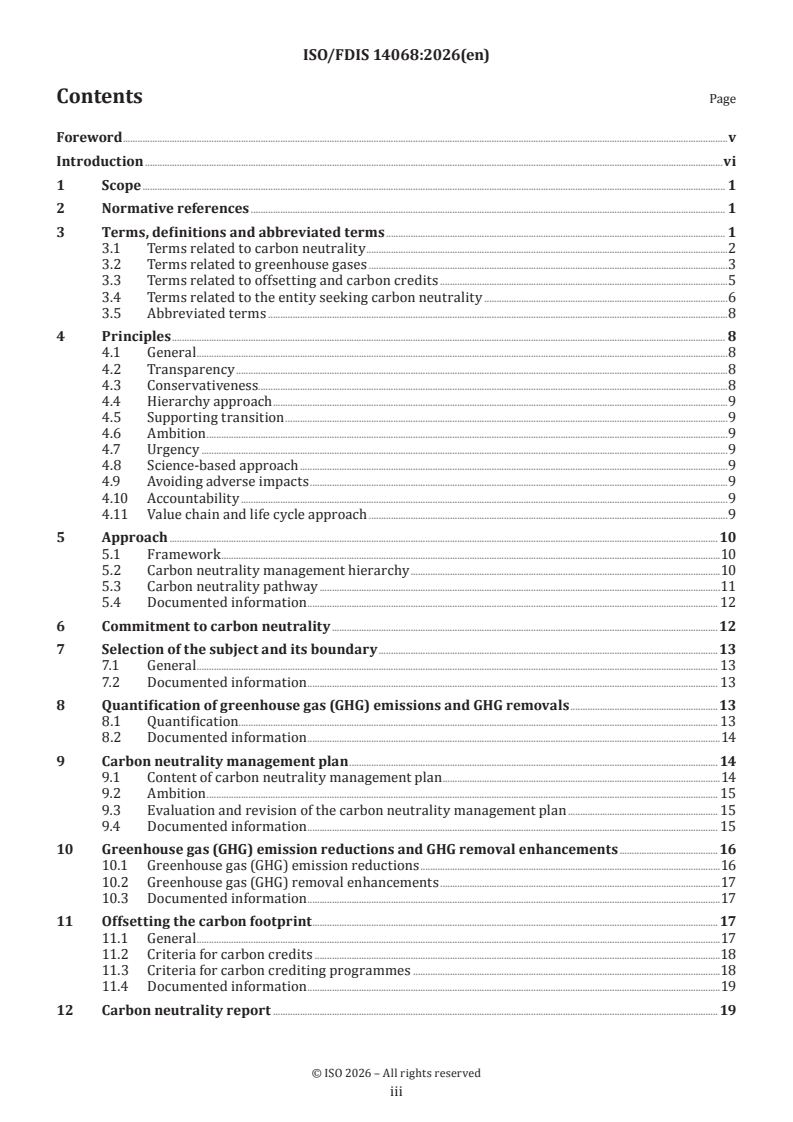
FINAL DRAFT
International
Standard
ISO/TC 207/SC 7
Climate change management —
Secretariat: SCC
Carbon neutrality
Voting begins on:
Gestion du changement climatique — Neutralité carbone 2026-06-11
Voting terminates on:
2026-08-06
RECIPIENTS OF THIS DRAFT ARE INVITED TO SUBMIT,
WITH THEIR COMMENTS, NOTIFICATION OF ANY
RELEVANT PATENT RIGHTS OF WHICH THEY ARE AWARE
AND TO PROVIDE SUPPOR TING DOCUMENTATION.
IN ADDITION TO THEIR EVALUATION AS
BEING ACCEPTABLE FOR INDUSTRIAL, TECHNO
LOGICAL, COMMERCIAL AND USER PURPOSES, DRAFT
INTERNATIONAL STANDARDS MAY ON OCCASION HAVE
TO BE CONSIDERED IN THE LIGHT OF THEIR POTENTIAL
TO BECOME STAN DARDS TO WHICH REFERENCE MAY BE
MADE IN NATIONAL REGULATIONS.
Reference number
FINAL DRAFT
International
Standard
ISO/TC 207/SC 7
Climate change management —
Secretariat: SCC
Carbon neutrality
Voting begins on:
Gestion du changement climatique — Neutralité carbone
Voting terminates on:
RECIPIENTS OF THIS DRAFT ARE INVITED TO SUBMIT,
WITH THEIR COMMENTS, NOTIFICATION OF ANY
RELEVANT PATENT RIGHTS OF WHICH THEY ARE AWARE
AND TO PROVIDE SUPPOR TING DOCUMENTATION.
© ISO 2026
IN ADDITION TO THEIR EVALUATION AS
All rights reserved. Unless otherwise specified, or required in the context of its implementation, no part of this publication may
BEING ACCEPTABLE FOR INDUSTRIAL, TECHNO
LOGICAL, COMMERCIAL AND USER PURPOSES, DRAFT
be reproduced or utilized otherwise in any form or by any means, electronic or mechanical, including photocopying, or posting on
INTERNATIONAL STANDARDS MAY ON OCCASION HAVE
the internet or an intranet, without prior written permission. Permission can be requested from either ISO at the address below
TO BE CONSIDERED IN THE LIGHT OF THEIR POTENTIAL
or ISO’s member body in the country of the requester.
TO BECOME STAN DARDS TO WHICH REFERENCE MAY BE
MADE IN NATIONAL REGULATIONS.
ISO copyright office
CP 401 • Ch. de Blandonnet 8
CH-1214 Vernier, Geneva
Phone: +41 22 749 01 11
Email: copyright@iso.org
Website: www.iso.org
Published in Switzerland Reference number
ii
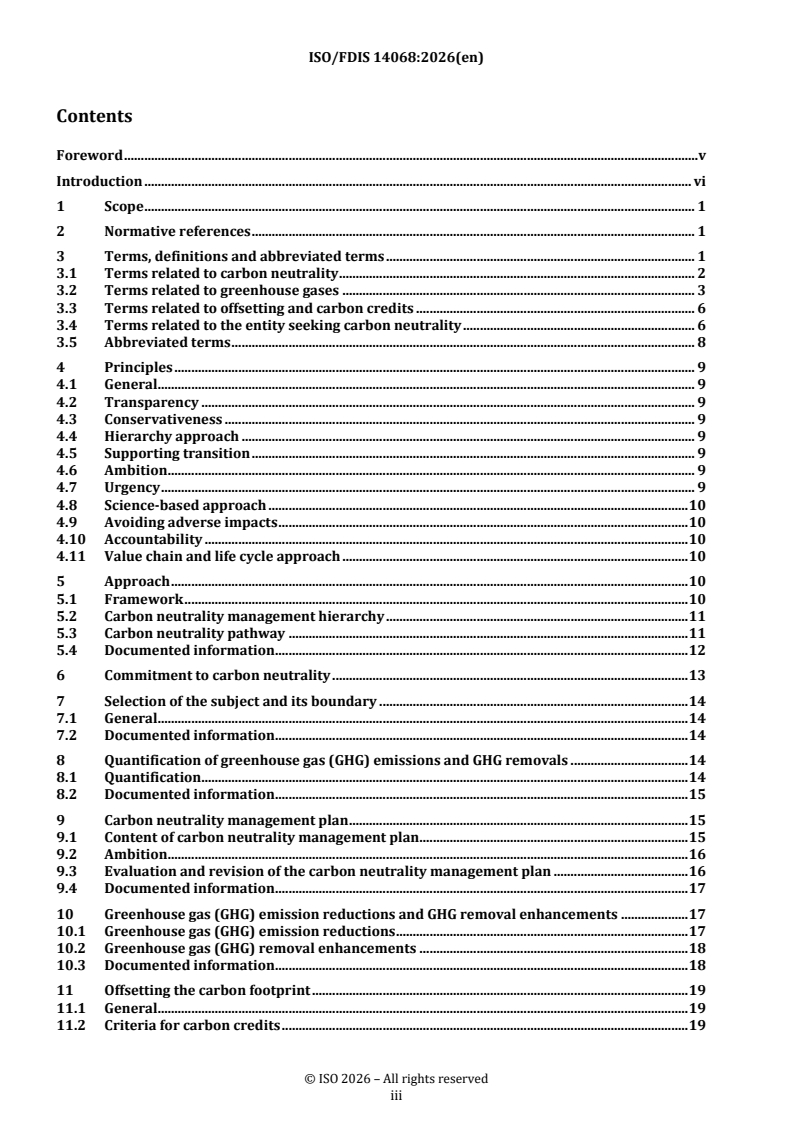
Contents Page
Foreword .v
Introduction .vi
1 Scope . 1
2 Normative references . 1
3 Terms, definitions and abbreviated terms . 1
3.1 Terms related to carbon neutrality .2
3.2 Terms related to greenhouse gases .3
3.3 Terms related to offsetting and carbon credits .5
3.4 Terms related to the entity seeking carbon neutrality .6
3.5 Abbreviated terms .8
4 Principles . 8
4.1 General .8
4.2 Transparency .8
4.3 Conservativeness.8
4.4 Hierarchy approach .9
4.5 Supporting transition .9
4.6 Ambition .9
4.7 Urgency .9
4.8 Science-based approach .9
4.9 Avoiding adverse impacts .9
4.10 Accountability .9
4.11 Value chain and life cycle approach .9
5 Approach . 10
5.1 Framework .10
5.2 Carbon neutrality management hierarchy .10
5.3 Carbon neutrality pathway .11
5.4 Documented information . 12
6 Commitment to carbon neutrality .12
7 Selection of the subject and its boundary .13
7.1 General . 13
7.2 Documented information . 13
8 Quantification of greenhouse gas (GHG) emissions and GHG removals .13
8.1 Quantification . . . 13
8.2 Documented information .14
9 Carbon neutrality management plan . 14
9.1 Content of carbon neutrality management plan .14
9.2 Ambition . 15
9.3 Evaluation and revision of the carbon neutrality management plan . 15
9.4 Documented information . 15
10 Greenhouse gas (GHG) emission reductions and GHG removal enhancements .16
10.1 Greenhouse gas (GHG) emission reductions .16
10.2 Greenhouse gas (GHG) removal enhancements .17
10.3 Documented information .17
11 Offsetting the carbon footprint . 17
11.1 General .17
11.2 Criteria for carbon credits .18
11.3 Criteria for carbon crediting programmes .18
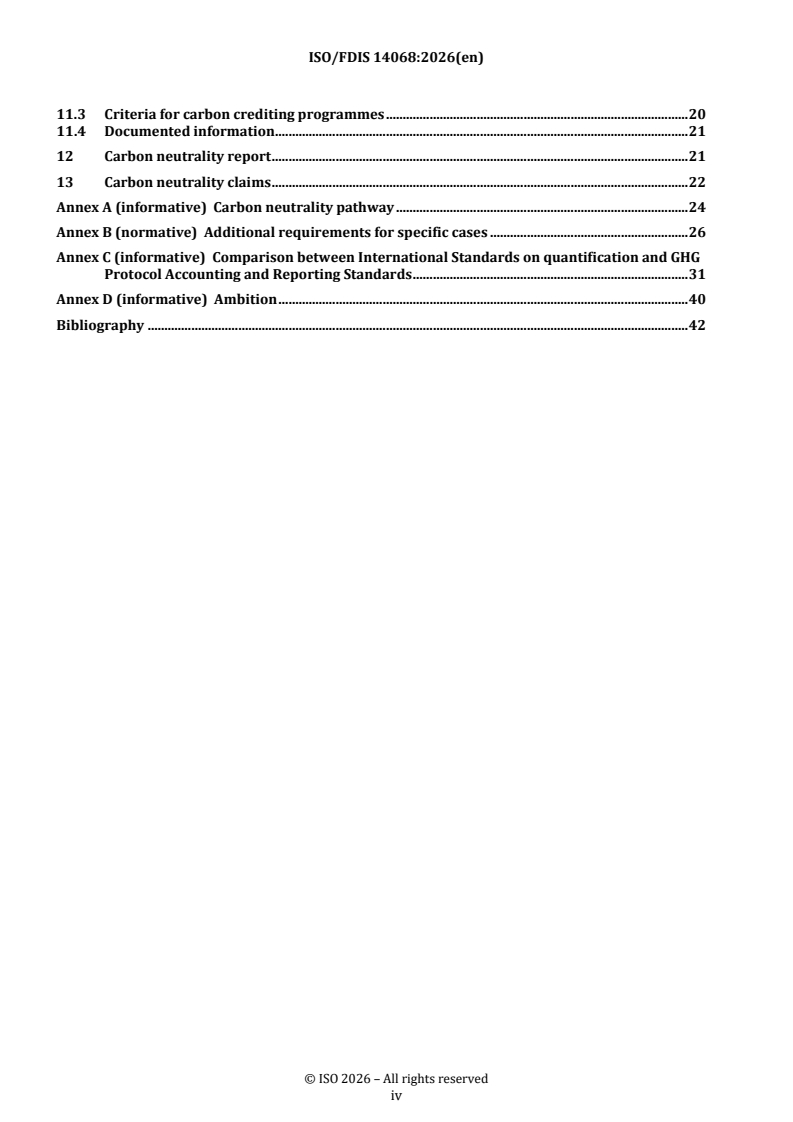
11.4 Documented information .19
12 Carbon neutrality report . 19
iii
13 Carbon neutrality claims .20
Annex A (informative) Carbon neutrality pathway .22
Annex B (normative) Additional requirements for specific cases .24
Annex C (informative) Comparison between International Standards on quantification and
GHG Protocol Accounting and Reporting Standards .29
Annex D (informative) Ambition .37
Bibliography .38
iv
Foreword
ISO (the International Organization for Standardization) is a worldwide federation of national standards
bodies (ISO member bodies). The work of preparing International Standards is normally carried out through
ISO technical committees. Each member body interested in a subject for which a technical committee
has been established has the right to be represented on that committee. International organizations,
governmental and non-governmental, in liaison with ISO, also take part in the work. ISO collaborates closely
with the International Electrotechnical Commission (IEC) on all matters of electrotechnical standardization.
The procedures used to develop this document and those intended for its further maintenance are described
in the ISO/IEC Directives, Part 1. In particular, the different approval criteria needed for the different types
of ISO document should be noted. This document was drafted in accordance with the editorial rules of the
ISO/IEC Directives, Part 2 (see www.iso.org/directives).
ISO draws attention to the possibility that the implementation of this document may involve the use of (a)
patent(s). ISO takes no position concerning the evidence, validity or applicability of any claimed patent
rights in respect thereof. As of the date of publication of this document, ISO had not received notice of (a)
patent(s) which may be required to implement this document. However, implementers are cautioned that
this may not represent the latest information, which may be obtained from the patent database available at
www.iso.org/patents. ISO shall not be held responsible for identifying any or all such patent rights.
Any trade name used in this document is information given for the convenience of users and does not
constitute an endorsement.
For an explanation of the voluntary nature of standards, the meaning of ISO specific terms and expressions
related to conformity assessment, as well as information about ISO’s adherence to the World Trade
Organization (WTO) principles in the Technical Barriers to Trade (TBT), see www.iso.org/iso/foreword.html.
This document was prepared by Technical Committee ISO/TC 207, Environmental management,
Subcommittee SC 7, Greenhouse gas and climate change management and related activities.
This first edition cancels and replaces ISO 14068-1:2023, of which it constitutes a minor revision.
The changes are as follows:
— the title has been updated.
— the part number has been removed.
Any feedback or questions on this document should be directed to the user’s national standards body. A
complete listing of these bodies can be found at www.iso.org/members.html.
v
Introduction
0.1 Climate change and the documents on climate change management developed by ISO/TC 207/SC 7
Climate change arising from anthropogenic activity has been identified as one of the greatest challenges
facing the world and will continue to affect businesses and citizens over future decades.
Climate change has implications for both human and natural systems and can lead to significant impacts
on resource availability, economic activity, biodiversity and human well-being. In response, international,
regional, national and local initiatives are being developed and implemented by public and private sectors
to mitigate climate change by reducing greenhouse gases (GHGs) in the Earth’s atmosphere as well as to
facilitate adaptation to climate change.
There is a need for effective and transformative responses to the urgent threat of climate change on the
basis of the best available scientific knowledge. ISO develops documents that support the transformation of
scientific knowledge into tools that will help address climate change.
Climate change mitigation initiatives rely on the quantification, monitoring, reporting, validation and
verification of GHG emissions and removals.
The documents on climate change management developed by ISO/TC 207/SC 7 benefit organizations, GHG
project proponents and stakeholders worldwide by providing clarity and consistency for quantifying,
monitoring, reporting, validating and verifying GHG emissions and removals and carbon neutrality.
Specifically, the use of the documents on climate change management developed by ISO/TC 207/SC 7:
— enhances the credibility and transparency of GHG quantification, monitoring, reporting, validation and
verification;
— facilitates the development and implementation of GHG management strategies and plans;
— facilitates the development and implementation of mitigation actions that provide GHG emission
reductions or GHG removal enhancements;
— facilitates the ability to track performance and progress in the reduction of either GHG emissions or the
increase in GHG removals, or both;
— supports sustainable development and the actions needed to achieve a low-carbon economy.
Applications of the documents on climate change management developed by ISO/TC 207/SC 7 include:
— corporate decisions, such as identifying GHG emission reduction opportunities and increasing
profitability by reducing energy consumption;
— risk management, such as the identification and management of climate risks and opportunities;
— voluntary initiatives, such as participation in voluntary GHG programmes or sustainability reporting
initiatives;
— GHG markets, such as the buying and selling of GHG allowances or credits;
— regulatory/government GHG programmes, such as credit for early action, agreements or national and
local reporting initiatives.
The following summarizes each of the documents on climate change management developed by
ISO/TC 207/SC 7:
— ISO 14064-1 details principles and requirements for designing, developing, managing and reporting
organization-level GHG inventories. It includes requirements for determining GHG emission and removal
boundaries, quantifying an organization’s GHG emissions and removals, and identifying specific
organizational actions or activities aimed at improving GHG management. It also includes requirements
and guidance on inventory quality management, reporting, internal auditing and the organization’s
responsibilities in verification activities.
vi
— ISO 14064-2 details principles and requirements for determining baseline scenarios and for the
monitoring, quantifying and reporting of project emissions and removals. It focuses on GHG projects or
project-based activities specifically designed to reduce either GHG emissions or enhance GHG removals,
or both. It provides the basis for GHG projects to be validated and verified.
— ISO 14064-3 details requirements for verifying GHG statements related to GHG inventories, GHG projects
and carbon footprints of products. It describes the process for validation or verification, including
validation or verification planning, assessment procedures, and the evaluation of organizational, project
and product GHG statements.
— ISO 14065 defines requirements for bodies that validate and verify GHG statements. Its requirements
cover impartiality, competence, communication, validation and verification processes, appeals,
complaints, and the management system of validation and verification bodies. It can be used as a basis for
accreditation and other forms of recognition in relation to the impartiality, competence, and consistency
of validation and verification bodies.
— ISO 14066 specifies competence requirements for validation teams and verification teams. It includes
principles and specifies competence requirements based on the tasks that validation teams or verification
teams must be able to perform.
— ISO 14067 defines the principles, requirements and guidelines for the quantification of the carbon
footprint of products (e.g. goods or services, including buildings and events). It describes the process
to quantify GHG emissions associated with the life cycle stages of a product, beginning with resource
extraction and raw material sourcing and extending through the production, use and end-of-life stages
of the product.
— ISO/TS 14064-4 assists users in the application of ISO 14064-1, providing guidelines and examples for
improving transparency in the quantification of emissions and their reporting.
0.2 ISO 14068-1(this document) — Carbon neutrality
This document is designed to build upon existing International Standards addressing GHG quantification,
reporting, validation and verification, such as ISO 14064-1, ISO 14064-3 and ISO 14067. Figure 1 illustrates
the relationship with the documents on climate change management developed by ISO/TC 207/SC 7 as well
as some related International Standards on environmental labels and declarations.
vii
Figure 1 — ISO 14068-1 (this document) in relation to other International Standards
This document provides a standardized approach to achieving and demonstrating carbon neutrality.
It is applicable to subjects, i.e. organizations and products (e.g. goods and services, including events and
buildings).
The hierarchy approach presented in this document prioritizes actions to reduce the direct and indirect
GHG emissions and enhance GHG removals of the subject, with offsetting used only for the carbon footprint
remaining after these actions.
Avoided GHG emissions, for example by the use of goods or services, are not addressed in this document
but they also have a role to play in the strategy of organizations to support the global objective of carbon
neutrality. Avoided GHG emissions reflect the efforts of organizations to provide low-carbon products or
solutions.
The quantification, monitoring and reporting related to GHG projects undertaken with the primary purpose
of creating GHG emission reductions or GHG removal enhancements are also outside the scope of this
document.
Achievement of carbon neutrality by organizations and products entails actions that reduce GHG emissions
and enhance GHG removals, and thus can help support countries to fulfil their nationally determined
[14]
contributions (NDCs) and to meet the goals of the Paris Agreement .
0.3 Carbon neutrality and net zero GHG emissions
Carbon neutrality (as defined in this document) and net zero GHG emissions are related concepts. At
1)
a global scale, these terms are defined by the Intergovernmental Panel on Climate Change (IPCC) as
1) The IPCC is the United Nations body for assessing the science related to climate change, https://www.ipcc.ch/.
viii
being equivalent, both referring to the condition in which anthropogenic GHG emissions are balanced by
anthropogenic GHG removals over a specified period. In this document, this condition is referred to as
“global net zero GHG emissions”.
At sub-global scale, carbon neutrality is generally used for organizations and products, and achieving
carbon neutrality commonly involves offsetting to counterbalance the carbon footprint of the subject. In
this document, carbon neutrality is considered as a pathway of continual improvement along which the
carbon footprint of the subject is reduced by implementing emissions reduction and removal enhancement
activities, and therefore the need for offsetting decreases over time.
At sub-global scale, net zero GHG emissions is generally applied to territories (e.g. a country, a municipality)
and to organizations, but not to products. Net zero GHG emissions is defined and assessed differently in
different contexts. For organizations, net zero GHG emissions is commonly considered as the condition in
which emissions have been reduced such that only residual emissions remain, and offsetting is restricted to
removal credits only.
With respect to territories, assessment of net zero GHG emissions considers the emissions and removals
under direct control or jurisdiction of the territory, and offsetting is sometimes excluded.
This document does not address requirements or recommendations for net zero GHG emissions at either the
global or a sub-global scale.
ix
FINAL DRAFT International Standard ISO/FDIS 14068:2026(en)
Climate change management — Carbon neutrality
1 Scope
This document specifies principles, requirements and guidance for achieving and demonstrating carbon
neutrality through the quantification, reduction and offsetting of the carbon footprint.
This document defines terms used in relation to carbon neutrality and provides guidance on the actions
necessary to achieve and demonstrate carbon neutrality. In accordance with common practice, it uses the
word “carbon” to refer to all greenhouse gases (GHGs) in compound expressions such as “carbon neutrality”.
It is applicable to a wide range of subjects such as organizations (including companies, local authorities and
financial institutions) and products (goods or services, including buildings and events). It is not intended
to be used for territories (such as regions, countries, states or cities), including signatories to the United
Nations Framework Convention on Climate Change (UNFCCC) when reporting national outcomes for the
purposes of that Convention.
This document establishes a hierarchy for carbon neutrality where GHG emission reductions (direct and
indirect) and GHG removal enhancements within the value chain take priority over offsetting. It includes
requirements for carbon neutrality commitments and making carbon neutrality claims.
This document is GHG programme neutral. If a GHG programme is applicable, the requirements of that GHG
programme are additional to the requirements of this document.
2 Normative references
The following documents are referred to in the text in such a way that some or all of their content constitutes
requirements of this document. For dated references, only the edition cited applies. For undated references,
the latest edition of the referenced document (including any amendments) applies.
ISO 14064-1, Greenhouse gases — Part 1: Specification with guidance at the organization level for quantification
and reporting of greenhouse gas emissions and removals
ISO 14064-3, Greenhouse gases — Part 3: Specification with guidance for the verification and validation of
greenhouse gas statements
ISO 14067, Greenhouse gases — Carbon footprint of products — Requirements and guidelines for quantification
3 Terms, definitions and abbreviated terms
For the purposes of this document, the terms and definitions given in ISO 14064-1, ISO 14067 and the
following apply.
ISO and IEC maintain terminology databases for use in standardization at the following addresses:
— ISO Online browsing platform: available at https:// www .iso .org/ obp
— IEC Electropedia: available at https:// www .electropedia .org/
3.1 Terms related to carbon neutrality
3.1.1
carbon neutral
condition in which, during a specified period of time, the carbon footprint (3.2.4) has been reduced as a result
of greenhouse gas (GHG) emission reductions (3.2.3) or GHG removal enhancements (3.2.8) and, if greater than
zero, is then counterbalanced by offsetting (3.3.1)
Note 1 to entry: Carbon credits (3.3.2) used for offsetting shall meet certain criteria (see Clause 11) and are only used
after GHG emission reductions and GHG removal enhancements have been made in line with the carbon neutrality
management plan.
Note 2 to entry: The specified period of time is a finite number of years, for organizations (3.4.3), or the full or partial
life cycle, for products (3.4.4).
3.1.2
carbon neutrality
state of being carbon neutral (3.1.1)
Note 1 to entry: The Intergovernmental Panel on Climate Change (IPCC) distinguishes between carbon neutrality, a
condition in which CO emissions are balanced by CO removals, and greenhouse gas (GHG) neutrality, in which all
2 2
GHG emissions (3.2.2) are balanced by GHG removals (3.2.7). The definition of carbon neutrality in this document is
equivalent to the IPCC definition of GHG neutrality.
3.1.3
carbon neutrality claim
public declaration made by an entity (3.4.1) regarding the carbon neutrality (3.1.2) of the subject (3.4.2)
3.1.4
unabated greenhouse gas emission
unabated GHG emission
GHG emission (3.2.2) of the subject (3.4.2) remaining after activities resulting in GHG emission reductions
(3.2.3) within the boundary (3.2.16, 3.2.17) of the subject
Note 1 to entry: Additional information on unabated and residual GHG emissions (3.1.5) can be found in Annex A.
Note 2 to entry: Unabated GHG emissions include, but are not limited to, residual GHG emissions.
3.1.5
residual greenhouse gas emission
residual GHG emission
unabated GHG emission (3.1.4) remaining after implementing all technically and economically feasible GHG
emission reductions (3.2.3)
Note 1 to entry: Additional information on unabated and residual GHG emissions can be found in Annex A.
3.1.6
reporting period
specific historical period selected for the determination of carbon neutrality (3.1.2)
Note 1 to entry: The reporting period is specified in the carbon neutrality management plan of the entity (3.4.1) and
is typically a year, but can be shorter, e.g. in relation to an event that recurs every six months, or longer, such as for
agricultural or forest systems, which can involve multi-year management.
3.2 Terms related to greenhouse gases
3.2.1
greenhouse gas
GHG
gaseous constituent of the atmosphere, both natural and anthropogenic, that absorbs and emits radiation
at specific wavelengths within the spectrum of infrared radiation emitted by the Earth’s surface, the
atmosphere and clouds
Note 1 to entry: For a list of GHGs, see the latest Intergovernmental Panel on Climate Change (IPCC) Assessment
Report.
Note 2 to entry: The most common anthropogenic GHGs are carbon dioxide (CO ), methane (CH ), nitrous oxide
2 4
(N O), hydrofluorocarbons (HFCs), nitrogen trifluoride (NF ), perfluorocarbons (PFCs) and sulfur hexafluoride (SF ).
2 3 6
Emissions from these gases are reported as carbon dioxide equivalents (3.2.12) using global warming potentials (3.2.11).
[SOURCE: ISO 14064-1:2018, 3.1.1, modified — Note 2 to entry added.]
3.2.2
greenhouse gas emission
GHG emission
release of a GHG (3.2.1) into the atmosphere
[SOURCE: ISO 14064-1:2018, 3.1.5]
3.2.3
greenhouse gas emission reduction
GHG emission reduction
decrease in GHG emissions (3.2.2) quantified between two points in time or relative to a baseline (3.2.13)
Note 1 to entry: Adapted from ISO 14064-2:2019, 3.1.7.
3.2.4
carbon footprint
sum of greenhouse gas (GHG) emissions (3.2.2) and GHG removals (3.2.7) of the subject (3.4.2) expressed as
carbon dioxide equivalents (3.2.12)
Note 1 to entry: For a product (3.4.4), the carbon footprint is based on a life cycle assessment using the single impact
category of climate change in accordance with ISO 14067.
Note 2 to entry: For an organization (3.4.3), the carbon footprint is equivalent to the sum of the direct GHG emissions
(3.2.5), indirect GHG emissions (3.2.6) and GHG removals, if applicable, within the boundary (3.2.16) of the subject
quantified in accordance with ISO 14064-1.
3.2.5
direct greenhouse gas emission
direct GHG emission
GHG emission (3.2.2) within the boundary (3.2.16, 3.2.17) of the subject (3.4.2), from GHG sources (3.2.9)
owned or controlled by the entity (3.4.1)
[SOURCE: ISO 14064-1:2018, 3.1.9, modified — “within the boundary of the subject” added and “entity”
replaced “organization”. Note 1 to entry deleted.]
3.2.6
indirect greenhouse gas emission
indirect GHG emission
GHG emission (3.2.2) that is a consequence of, and within the boundary (3.2.16, 3.2.17) of, the subject (3.4.2),
but that arises from GHG sources (3.2.9) that are not owned or controlled by the entity (3.4.1)
Note 1 to entry: These emissions occur generally in the upstream and/or downstream value chain (3.4.7) of the subject.
[SOURCE: ISO 14064-1:2018, 3.1.11, modified — “and within the boundary of, the subject” replaced “an
organization’s operations and activities” and “entity” replaced “organization” in the definition. “value chain
of the subject” replaced “chain” in Note 1 to entry.]
3.2.7
greenhouse gas removal
GHG removal
withdrawal of a GHG (3.2.1) from the atmosphere by a GHG sink (3.2.10)
Note 1 to entry: Examples of ways in which GHG removals can be achieved include reforestation, carbon sequestration
in soils, sustainable bioenergy with carbon capture and storage, and direct air carbon capture and storage.
[SOURCE: ISO 14064-1:2018, 3.1.6, modified — “GHG sink” made singular. Note 1 to entry added.]
3.2.8
greenhouse gas removal enhancement
GHG removal enhancement
quantified increase in GHG removals (3.2.7) between two points in time or relative to a baseline (3.2.13)
Note 1 to entry: Adapted from ISO 14064-2:2019, 3.1.8.
3.2.9
greenhouse gas source
GHG source
process that releases a GHG (3.2.1) into the atmosphere
[SOURCE: ISO 14064-1:2018, 3.1.2]
3.2.10
greenhouse gas sink
GHG sink
process that removes a GHG (3.2.1) from the atmosphere
Note 1 to entry: A process can be natural or anthropogenic.
[SOURCE: ISO 14064-1:2018, 3.1.3, modified — Note 1 to entry added.]
3.2.11
global warming potential
GWP
index, based on radiative properties of greenhouse gases (GHGs) (3.2.1), measuring the radiative forcing
following a pulse emission of a unit mass of a given GHG in the present-day atmosphere integrated over a
chosen time horizon, relative to that of carbon dioxide (CO )
Note 1 to entry: The Intergovernmental Panel on Climate Change (IPCC) publishes and regularly updates GWP values
for various time horizons, including 20, 100 and 500 years.
[SOURCE: ISO 14064-1:2018, 3.1.12, modified — Note 1 to entry added.]
3.2.12
carbon dioxide equivalent
CO e
unit for expressing the radiative forcing of a greenhouse gas (GHG) (3.2.1) in relation to that of carbon dioxide
Note 1 to entry: The carbon dioxide equivalent is calculated by multiplying the mass of a given GHG by its global
warming potential (3.2.11).
[SOURCE: ISO 14064-1:2018, 3.1.13, modified — “expressing” replaced “comparing” and “in relation to”
added in the definition. Note 1 to entry clarified.]
3.2.13
baseline
quantified greenhouse gas (GHG) emissions (3.2.2) and/or GHG removals (3.2.7) of a subject (3.4.2) for a base
period (3.2.14)
Note 1 to entry: The baseline is used when quantifying changes in the carbon footprint (3.2.4) over time and towards
targets in the carbon neutrality management plan.
Note 2 to entry: In a case where the base period cannot be determined, e.g. for a one-off event, the baseline can be
estimated on the basis of a reference situation that best represents the conditions most likely to occur in the absence
of climate change mitigation (3.2.15) activities.
3.2.14
base period
specific, historical period identified for the purpose of comparing greenhouse gas (GHG) emissions (3.2.2) or
GHG removals (3.2.7) or other GHG-related information over time
[SOURCE: ISO 14064-1:2018, 3.2.10, modified — “period” replaced “year” in the term.]
3.2.15
climate change mitigation
human intervention to reduce greenhouse gas (GHG) emissions (3.2.2) or enhance GHG removals (3.2.7)
[SOURCE: ISO Guide 84:2020, 3.1.4, modified — Admitted term “mitigation” deleted.]
3.2.16
boundary
grouping of greenhouse gas (GHG) emissions (3.2.2) or GHG removals (3.2.7) reported from
within the organizational boundary as well as those significant indirect GHG emissions (3.2.6) that are a
consequence of the organization’s (3.4.3) operations and activities
Note 1 to entry: “Organizational boundary” and “significant indirect GHG emissions” are defined in ISO 14064-1.
Note 2 to entry: In this document, the term “boundary” is equivalent to “reporting boundary” in ISO 14064-1.
[SOURCE: ISO 14064-1:2018, 3.4.8 modified — “reporting” removed from the term. Domain
added. Notes 1 and 2 to entry added.]
3.2.17
boundary
system boundary
set of criteria representing which unit processes are a part of the product system under study
Note 1 to entry: “Unit process” and “product system” are defined in ISO 14067.
Note 2 to entry: In this document, the term “boundary” is equivalent to “system boundary” in ISO 14067.
[SOURCE: ISO 14067:2018, 3.1.3.4, modified — Reference to “boundary based on” removed. “product system”
replaced “system”. Notes 1 and 2 to entry added.]
3.3 Terms related to offsetting and carbon credits
3.3.1
offsetting
counterbalancing of the carbon footprint (3.2.4), by retiring a carbon credit(s) (3.3.2)
Note 1 to entry: The final step in the process of offsetting is to retire the carbon credits in a public registry (3.3.5)
by, or on behalf of, the entity (3.4.1). Some registries use “to cancel” as synonymous with “to retire” and the terms
are effectively interchangeable. The two terms “retire” and “cancel” result in the same outcome of ensuring that the
carbon credits cannot be used again or be further traded.
3.3.2
carbon credit
greenhouse gas credit
GHG credit
tradeable certificate representing one tonne of carbon dioxide equivalent (3.2.12) from GHG emission
reductions (3.2.3) or GHG removal enhancements (3.2.8)
Note 1 to entry: An entity (3.4.1) can retire a carbon credit without using it for offsetting (3.3.1).
Note 2 to entry: Carbon credits can be of different types: avoidance credits, reduction credits or removal credits.
Note 3 to entry: Carbon credits used for carbon neutrality claims (3.1.3) are generated outside the boundary (3.2.16,
3.2.17) of the subject (3.4.2).
3.3.3
greenhouse gas programme
GHG programme
voluntary or mandatory international, national or subnational system or scheme that registers, accounts
or manages GHG emissions (3.2.2), GHG removals (3.2.7), GHG emission reductions (3.2.3) or GHG removal
enhancements (3.2.8)
[SOURCE: ISO 14064-1:2018, 3.2.8, modified — “outside the organization or GHG project” removed.]
3.3.4
carbon crediting programme
greenhouse gas (GHG) programme (3.3.3) that issues carbon credits (3.3.2)
Note 1 to entry: The carbon credits shall conform to the criteria established by the programme as well as the
requirements of this document (see Clause 11).
3.3.5
public registry
information system that makes available to stakeholders (3.4.5) details of carbon credits (3.3.2) issued
Note 1 to entry: A public registry includes the serial numbers, ownership and retirement status of carbon credits.
Note 2 to entry: A public registry can be maintained by a carbon crediting programme (3.3.4) or by a third party.
3.4 Terms related to the entity seeking carbon neutrality
3.4.1
entity
organization (3.4.3) that is seeking to achieve and demonstrate carbon neutrality (3.1.2) for the subject (3.4.2)
Note 1 to entry: The entity and the subject can be identical, e.g. a company that is seeking carbon neutrality for all its
operations.
Note 2 to entry: There can be greenhouse gas (GHG) emissions (3.2.2) associated with the subject from GHG sources
(3.2.9) that are not under the operational or financial control of the entity.
Note 3 to entry: An entity may be responsible for several subjects, such as where a company is seeking carbon
neutrality for different products (3.4.4) that it manufactures.
Note 4 to entry: In this document, the term “entity” is equivalent to “responsible party” in ISO 14064-1:2018, 3.4.3, and
“organization” in ISO 14067:2018, 3.1.5.1.
3.4.2
subject
organization (3.4.3) or product (3.4.4)
Note 1 to entry: The entity (3.4.1) is committed to reduce the carbon footprint (3.2.4) of the subject as part of the
carbon neutrality management plan.
3.4.3
organization
person or group of people that has its own functions with responsibilities, authorities and relationships to
achieve its objectives
Note 1 to entry: The concept of an organization includes, but is not limited to sole-trader, company, corporation, firm,
enterprise, authority, partnership, charity or institution, or part or combination thereof, whether incorporated or not,
public or private (e.g. foundation, union, association, public administration, intergovernmental agency).
Note 2 to entry: A group of organizations can also be considered as an organization that has, alone or collectively, its
own objectives.
[SOURCE: ISO 14064-1:2018, 3.4.2, modified — Examples added in Note 1 to entry. Note 2 to entry added.]
3.4.3.1
financial institution
organization (3.4.3) that is principally engaged in financial intermediation and/or in auxiliary financial
activities
Note 1 to entry: Typically, the activity of a financial institution is the acquisition of financial assets while incurring
liabilities on its own account by engaging in financial transactions in a market for the purposes of providing payment,
securities, banking, financial, insurance or investment services or activities. A financial organization is typically:
a) licensed by, authorized by or registered with a financial market regulator;
b) subject to supervision by a financial market regulator;
c) an international, supranational, intergovernmental or national governmental body or institution that as a
main activity engages in payment, securities, banking, financial, insurance or investment services or activities
(including central banks).
Note 2 to entry: Information about carbon neutrality (3.1.2) for financial institutions is given in Clause B.3.
[SOURCE: ISO 9362:2022, 3.1, modified — “shall be” in Note 1 to entry changed to “is typically”. Note 2 to
entry added.]
3.4.4
product
goods or service
EXAMPLE Services include transport, events, financial services and investments; goods include manufactured
goods, computer software, processed material, unprocessed material, buildings and other types of construction
works.
[SOURCE: ISO 14067:2018, 3.1.3.1, modified — Notes 1 and 2 to entry deleted. Example added.]
3.4.5
stakeholder
interested party
person or organization (3.4.3) that can affect, be affected by, or perceive itself to be affected by a decision or
activity
EXAMPLE Consumers, customers, communities, suppliers, regulators, non-governmental organizations,
investors, employees.
Note 1 to entry: The decision or activity is und
...
Second edition
XXXX-XX
ISO/TC 207/SC 7
Secretariat: SCC
Date: 2026-05-26
Climate change management — Carbon neutrality
Gestion du changement climatique — Neutralité carbone
FDIS stage
All rights reserved. Unless otherwise specified, or required in the context of its implementation, no part of this publication
may be reproduced or utilized otherwise in any form or by any means, electronic or mechanical, including photocopying,
or posting on the internet or an intranet, without prior written permission. Permission can be requested from either ISO
at the address below or ISO’s member body in the country of the requester.
ISO copyright office
CP 401 • Ch. de Blandonnet 8
CH-1214 Vernier, Geneva
Phone: + 41 22 749 01 11
E-mail: copyright@iso.org
Website: www.iso.org
Published in Switzerland
ii
Contents
Foreword . v
Introduction . vi
1 Scope . 1
2 Normative references . 1
3 Terms, definitions and abbreviated terms . 1
3.1 Terms related to carbon neutrality . 2
3.2 Terms related to greenhouse gases . 3
3.3 Terms related to offsetting and carbon credits . 6
3.4 Terms related to the entity seeking carbon neutrality . 6
3.5 Abbreviated terms . 8
4 Principles . 9
4.1 General . 9
4.2 Transparency . 9
4.3 Conservativeness . 9
4.4 Hierarchy approach . 9
4.5 Supporting transition . 9
4.6 Ambition . 9
4.7 Urgency . 9
4.8 Science-based approach . 10
4.9 Avoiding adverse impacts . 10
4.10 Accountability . 10
4.11 Value chain and life cycle approach . 10
5 Approach . 10
5.1 Framework . 10
5.2 Carbon neutrality management hierarchy . 11
5.3 Carbon neutrality pathway . 11
5.4 Documented information . 12
6 Commitment to carbon neutrality . 13
7 Selection of the subject and its boundary . 14
7.1 General . 14
7.2 Documented information . 14
8 Quantification of greenhouse gas (GHG) emissions and GHG removals . 14
8.1 Quantification. 14
8.2 Documented information . 15
9 Carbon neutrality management plan . 15
9.1 Content of carbon neutrality management plan . 15
9.2 Ambition . 16
9.3 Evaluation and revision of the carbon neutrality management plan . 16
9.4 Documented information . 17
10 Greenhouse gas (GHG) emission reductions and GHG removal enhancements . 17
10.1 Greenhouse gas (GHG) emission reductions . 17
10.2 Greenhouse gas (GHG) removal enhancements . 18
10.3 Documented information . 18
11 Offsetting the carbon footprint . 19
11.1 General . 19
11.2 Criteria for carbon credits . 19
iii
11.3 Criteria for carbon crediting programmes . 20
11.4 Documented information . 21
12 Carbon neutrality report . 21
13 Carbon neutrality claims . 22
Annex A (informative) Carbon neutrality pathway . 24
Annex B (normative) Additional requirements for specific cases . 26
Annex C (informative) Comparison between International Standards on quantification and GHG
Protocol Accounting and Reporting Standards . 31
Annex D (informative) Ambition . 40
Bibliography . 42
iv
Foreword
ISO (the International Organization for Standardization) is a worldwide federation of national standards
bodies (ISO member bodies). The work of preparing International Standards is normally carried out through
ISO technical committees. Each member body interested in a subject for which a technical committee has been
established has the right to be represented on that committee. International organizations, governmental and
non-governmental, in liaison with ISO, also take part in the work. ISO collaborates closely with the
International Electrotechnical Commission (IEC) on all matters of electrotechnical standardization.
The procedures used to develop this document and those intended for its further maintenance are described
in the ISO/IEC Directives, Part 1. In particular, the different approval criteria needed for the different types of
ISO document should be noted. This document was drafted in accordance with the editorial rules of the
ISO/IEC Directives, Part 2 (see www.iso.org/directives).
ISO draws attention to the possibility that the implementation of this document may involve the use of (a)
patent(s). ISO takes no position concerning the evidence, validity or applicability of any claimed patent rights
in respect thereof. As of the date of publication of this document, ISO had not received notice of (a) patent(s)
which may be required to implement this document. However, implementers are cautioned that this may not
represent the latest information, which may be obtained from the patent database available at
www.iso.org/patents. ISO shall not be held responsible for identifying any or all such patent rights.
Any trade name used in this document is information given for the convenience of users and does not
constitute an endorsement.
For an explanation of the voluntary nature of standards, the meaning of ISO specific terms and expressions
related to conformity assessment, as well as information about ISO’s adherence to the World Trade
Organization (WTO) principles in the Technical Barriers to Trade (TBT), see www.iso.org/iso/foreword.html.
This document was prepared by Technical Committee ISO/TC 207, Environmental management,
Subcommittee SC 7, Greenhouse gas and climate change management and related activities.
This secondfirst edition iscancels and replaces ISO 14068-1:2023, of which it constitutes a minor revision of
ISO 14068-1:2023 to update .
The changes are as follows:
— the title and remove has been updated.
— the part number has been removed.
Any feedback or questions on this document should be directed to the user’s national standards body. A
complete listing of these bodies can be found at www.iso.org/members.html.
v
Introduction
0.1 Climate change and the documents on climate change management developed by
ISO 14060 family of standards/TC 207/SC 7
Climate change arising from anthropogenic activity has been identified as one of the greatest challenges facing
the world and will continue to affect businesses and citizens over future decades.
Climate change has implications for both human and natural systems and can lead to significant impacts on
resource availability, economic activity, biodiversity and human well-being. In response, international,
regional, national and local initiatives are being developed and implemented by public and private sectors to
mitigate climate change by reducing greenhouse gases (GHGs) in the Earth’s atmosphere as well as to facilitate
adaptation to climate change.
There is a need for effective and transformative responses to the urgent threat of climate change on the basis
of the best available scientific knowledge. ISO develops documents that support the transformation of
scientific knowledge into tools that will help address climate change.
Climate change mitigation initiatives rely on the quantification, monitoring, reporting, validation and
verification of GHG emissions and removals.
The ISO 14060 family of standards benefitsThe documents on climate change management developed by
ISO/TC 207/SC 7 benefit organizations, GHG project proponents and stakeholders worldwide by providing
clarity and consistency for quantifying, monitoring, reporting, validating and verifying GHG emissions and
removals and carbon neutrality. Specifically, the use of the ISO 14060 family of standardsdocuments on
climate change management developed by ISO/TC 207/SC 7:
— enhances the credibility and transparency of GHG quantification, monitoring, reporting, validation and
verification;
— facilitates the development and implementation of GHG management strategies and plans;
— facilitates the development and implementation of mitigation actions that provide GHG emission
reductions or GHG removal enhancements;
— facilitates the ability to track performance and progress in the reduction of either GHG emissions or the
increase in GHG removals, or both;
— supports sustainable development and the actions needed to achieve a low-carbon economy.
Applications of the ISO 14060 family of standardsdocuments on climate change management developed by
ISO/TC 207/SC 7 include:
— corporate decisions, such as identifying GHG emission reduction opportunities and increasing profitability
by reducing energy consumption;
— risk management, such as the identification and management of climate risks and opportunities;
— voluntary initiatives, such as participation in voluntary GHG programmes or sustainability reporting
initiatives;
— GHG markets, such as the buying and selling of GHG allowances or credits;
— regulatory/government GHG programmes, such as credit for early action, agreements or national and local
reporting initiatives.
vi
The following summarizes each of the documents in the ISO 14060 family of standardson climate change
management developed by ISO/TC 207/SC 7:
— ISO 14064-1 details principles and requirements for designing, developing, managing and reporting
organization-level GHG inventories. It includes requirements for determining GHG emission and removal
boundaries, quantifying an organization’s GHG emissions and removals, and identifying specific
organizational actions or activities aimed at improving GHG management. It also includes requirements
and guidance on inventory quality management, reporting, internal auditing and the organization’s
responsibilities in verification activities.
— ISO 14064-2 details principles and requirements for determining baseline scenarios and for the
monitoring, quantifying and reporting of project emissions and removals. It focuses on GHG projects or
project-based activities specifically designed to reduce either GHG emissions or enhance GHG removals,
or both. It provides the basis for GHG projects to be validated and verified.
— ISO 14064-3 details requirements for verifying GHG statements related to GHG inventories, GHG projects
and carbon footprints of products. It describes the process for validation or verification, including
validation or verification planning, assessment procedures, and the evaluation of organizational, project
and product GHG statements.
— ISO 14065 defines requirements for bodies that validate and verify GHG statements. Its requirements
cover impartiality, competence, communication, validation and verification processes, appeals,
complaints, and the management system of validation and verification bodies. It can be used as a basis for
accreditation and other forms of recognition in relation to the impartiality, competence, and consistency
of validation and verification bodies.
— ISO 14066 specifies competence requirements for validation teams and verification teams. It includes
principles and specifies competence requirements based on the tasks that validation teams or verification
teams must be able to perform.
— ISO 14067 defines the principles, requirements and guidelines for the quantification of the carbon
footprint of products (e.g. goods or services, including buildings and events). It describes the process to
quantify GHG emissions associated with the life cycle stages of a product, beginning with resource
extraction and raw material sourcing and extending through the production, use and end-of-life stages of
the product.
— ISO/TS 14064-4 assists users in the application of ISO 14064-1, providing guidelines and examples for
improving transparency in the quantification of emissions and their reporting.
0.2 ISO 14068-1(this document) — Carbon neutrality
This document is designed to build upon existing International Standards addressing GHG quantification,
reporting, validation and verification, such as ISO 14064-1, ISO 14064-3 and ISO 14067. Figure 1 illustrates
the relationship with the documents within the on climate change management developed by ISO 14060
family of GHG standards/TC 207/SC 7 as well as some related International Standards on environmental
labels and declarations.
Under preparation. Stage at the time of publication: ISO/CD TS 14064-4:2023.
vii
Figure 1 — ISO 14068-1 (this document) in relation to other International Standards
This document provides a standardized approach to achieving and demonstrating carbon neutrality. It is
applicable to subjects, i.e. organizations and products (e.g. goods and services, including events and buildings).
The hierarchy approach presented in this document prioritizes actions to reduce the direct and indirect GHG
emissions and enhance GHG removals of the subject, with offsetting used only for the carbon footprint
remaining after these actions.
Avoided GHG emissions, for example by the use of goods or services, are not addressed in this document but
they also have a role to play in the strategy of organizations to support the global objective of carbon
neutrality. Avoided GHG emissions reflect the efforts of organizations to provide low-carbon products or
solutions.
The quantification, monitoring and reporting related to GHG projects undertaken with the primary purpose
of creating GHG emission reductions or GHG removal enhancements are also outside the scope of this
document.
Achievement of carbon neutrality by organizations and products entails actions that reduce GHG emissions
and enhance GHG removals, and thus can help support countries to fulfil their nationally determined
[14]
contributions (NDCs) and to meet the goals of the Paris Agreement .
viii
0.3 Carbon neutrality and net zero GHG emissions
Carbon neutrality (as defined in this document) and net zero GHG emissions are related concepts. At a global
1)
scale, these terms are defined by the Intergovernmental Panel on Climate Change (IPCC) as being equivalent,
both referring to the condition in which anthropogenic GHG emissions are balanced by anthropogenic GHG
removals over a specified period. In this document, this condition is referred to as “global net zero GHG
emissions”.
At sub-global scale, carbon neutrality is generally used for organizations and products, and achieving carbon
neutrality commonly involves offsetting to counterbalance the carbon footprint of the subject. In this
document, carbon neutrality is considered as a pathway of continual improvement along which the carbon
footprint of the subject is reduced by implementing emissions reduction and removal enhancement activities,
and therefore the need for offsetting decreases over time.
At sub-global scale, net zero GHG emissions is generally applied to territories (e.g. a country, a municipality)
and to organizations, but not to products. Net zero GHG emissions is defined and assessed differently in
different contexts. For organizations, net zero GHG emissions is commonly considered as the condition in
which emissions have been reduced such that only residual emissions remain, and offsetting is restricted to
removal credits only.
With respect to territories, assessment of net zero GHG emissions considers the emissions and removals under
direct control or jurisdiction of the territory, and offsetting is sometimes excluded.
This document does not address requirements or recommendations for net zero GHG emissions at either the
global or a sub-global scale.
0.4 General
In this document, the following verbal forms are used:
— “shall” indicates a requirement;
— “should” indicates a recommendation;
— “may” indicates a permission;
— “can” indicates a possibility or a capability.
1)
The IPCC is the United Nations body for assessing the science related to climate change, https://www.ipcc.ch/.
ix
Climate change management — Transition to net zero —
Part 1:
Carbon neutrality
1 Scope
This document specifies principles, requirements and guidance for achieving and demonstrating carbon
neutrality through the quantification, reduction and offsetting of the carbon footprint.
This document defines terms used in relation to carbon neutrality and provides guidance on the actions
necessary to achieve and demonstrate carbon neutrality. In accordance with common practice, it uses the
word “carbon” to refer to all greenhouse gases (GHGs) in compound expressions such as “carbon neutrality”.
It is applicable to a wide range of subjects such as organizations (including companies, local authorities and
financial institutions) and products (goods or services, including buildings and events). It is not intended to
be used for territories (such as regions, countries, states or cities), including signatories to the United Nations
Framework Convention on Climate Change (UNFCCC) when reporting national outcomes for the purposes of
that Convention.
This document establishes a hierarchy for carbon neutrality where GHG emission reductions (direct and
indirect) and GHG removal enhancements within the value chain take priority over offsetting. It includes
requirements for carbon neutrality commitments and making carbon neutrality claims.
This document is GHG programme neutral. If a GHG programme is applicable, the requirements of that GHG
programme are additional to the requirements of this document.
2 Normative references
The following documents are referred to in the text in such a way that some or all of their content constitutes
requirements of this document. For dated references, only the edition cited applies. For undated references,
the latest edition of the referenced document (including any amendments) applies.
ISO 14064-1, Greenhouse gases — Part 1: Specification with guidance at the organization level for quantification
and reporting of greenhouse gas emissions and removals
ISO 14064-3, Greenhouse gases — Part 3: Specification with guidance for the verification and validation of
greenhouse gas statements
ISO 14067, Greenhouse gases — Carbon footprint of products — Requirements and guidelines for quantification
3 Terms, definitions and abbreviated terms
For the purposes of this document, the terms and definitions given in ISO 14064-1, ISO 14067 and the
following apply.
ISO and IEC maintain terminology databases for use in standardization at the following addresses:
— ISO Online browsing platform: available at https://www.iso.org/obp
— IEC Electropedia: available at https://www.electropedia.org/
3.1 Terms related to carbon neutrality
3.1.1
carbon neutral
condition in which, during a specified period of time, the carbon footprint (3.2.4) has been reduced as a result
of greenhouse gas (GHG) emission reductions (3.2.3) or GHGremovalGHG removal enhancements (3.2.8) and, if
greater than zero, is then counterbalanced by offsetting (3.3.1)
Note 1 to entry: Carbon credits (3.3.2) used for offsetting shall meet certain criteria (see Clause 11) and are only used
after GHG emission reductions and GHG removal enhancements have been made in line with the carbon neutrality
management plan.
Note 2 to entry: The specified period of time is a finite number of years, for organizations (3.4.3), or the full or partial life
cycle, for products (3.4.4).
3.1.2
carbon neutrality
state of being carbon neutral (3.1.1)
Note 1 to entry: The Intergovernmental Panel on Climate Change (IPCC) distinguishes between carbon neutrality, a
condition in which CO emissions are balanced by CO removals, and greenhouse gas (GHG) neutrality, in which all GHG
2 2
emissions (3.2.2) are balanced by GHG removals (3.2.7). The definition of carbon neutrality in this document is equivalent
to the IPCC definition of GHG neutrality.
3.1.3
carbon neutrality claim
public declaration made by an entity (3.4.1) regarding the carbon neutrality (3.1.2) of the subject (3.4.2)
3.1.4
unabated greenhouse gas emission
unabated GHG emission
GHG emission (3.2.2) of the subject (3.4.2) remaining after activities resulting in GHG emission reductions (3.2.3)
within the boundary (3.2.16, 3.2.17) of the subject
Note 1 to entry: Additional information on unabated and residual GHG emissions (3.1.5) can be found in Annex A.
Note 2 to entry: Unabated GHG emissions include, but are not limited to, residual GHG emissions.
3.1.5
residual greenhouse gas emission
residual GHG emission
unabated GHG emission (3.1.4) remaining after implementing all technically and economically feasible GHG
emission reductions (3.2.3)
Note 1 to entry: Additional information on unabated and residual GHG emissions can be found in Annex A.
3.1.6
reporting period
specific historical period selected for the determination of carbon neutrality (3.1.2)
Note 1 to entry: The reporting period is specified in the carbon neutrality management plan of the entity (3.4.1) and is
typically a year, but can be shorter, e.g. in relation to an event that recurs every six months, or longer, such as for
agricultural or forest systems, which can involve multi-year management.
3.2 Terms related to greenhouse gases
3.2.1
greenhouse gas
GHG
gaseous constituent of the atmosphere, both natural and anthropogenic, that absorbs and emits radiation at
specific wavelengths within the spectrum of infrared radiation emitted by the Earth’s surface, the atmosphere
and clouds
Note 1 to entry: For a list of GHGs, see the latest Intergovernmental Panel on Climate Change (IPCC) Assessment Report.
Note 2 to entry: The most common anthropogenic GHGs are carbon dioxide (CO ), methane (CH ), nitrous oxide (N O),
2 4 2
hydrofluorocarbons (HFCs), nitrogen trifluoride (NF3), perfluorocarbons (PFCs) and sulfur hexafluoride (SF6). Emissions
from these gases are reported as carbon dioxide equivalents (3.2.12) using global warming potentials (3.2.11).
[SOURCE: ISO 14064-1:2018, 3.1.1, modified — Note 2 to entry added.]
3.2.2
greenhouse gas emission
GHG emission
release of a GHG (3.2.1) into the atmosphere
[SOURCE: ISO 14064-1:2018, 3.1.5]
3.2.3
greenhouse gas emission reduction
GHG emission reduction
decrease in GHG emissions (3.2.2) quantified between two points in time or relative to a baseline (3.2.13)
Note 1 to entry: Adapted from ISO 14064-2:2019, 3.1.7.
3.2.4
carbon footprint
sum of greenhouse gas (GHG) emissions (3.2.2) and GHG removals (3.2.7) of the subject (3.4.2) expressed as
carbon dioxide equivalents (3.2.12)
Note 1 to entry: For a product (3.4.4), the carbon footprint is based on a life cycle assessment using the single impact
category of climate change in accordance with ISO 14067.
Note 2 to entry: For an organization (3.4.3), the carbon footprint is equivalent to the sum of the direct GHG emissions
(3.2.5), indirect GHG emissions (3.2.6) and GHG removals, if applicable, within the boundary (3.2.16) of the subject
quantified in accordance with ISO 14064-1.
3.2.5
direct greenhouse gas emission
direct GHG emission
GHG emission (3.2.2) within the boundary (3.2.16, 3.2.17) of the subject (3.4.2), from GHG sources (3.2.9) owned
or controlled by the entity (3.4.1)
[SOURCE: ISO 14064-1:2018, 3.1.9, modified — “within the boundary of the subject” added and “entity”
replaced “organization”. Note 1 to entry deleted.]
3.2.6
indirect greenhouse gas emission
indirect GHG emission
GHG emission (3.2.2) that is a consequence of, and within the boundary (3.2.16, 3.2.17) of, the subject (3.4.2),
but that arises from GHG sources (3.2.9) that are not owned or controlled by the entity (3.4.1)
Note 1 to entry: These emissions occur generally in the upstream and/or downstream value chain (3.4.7) of the subject.
[SOURCE: ISO 14064-1:2018, 3.1.11, modified — “and within the boundary of, the subject” replaced “an
organization’s operations and activities” and “entity” replaced “organization” in the definition. “value chain of
the subject” replaced “chain” in Note 1 to entry.]
3.2.7
greenhouse gas removal
GHG removal
withdrawal of a GHG (3.2.1) from the atmosphere by a GHG sink (3.2.10)
Note 1 to entry: Examples of ways in which GHG removals can be achieved include reforestation, carbon sequestration
in soils, sustainable bioenergy with carbon capture and storage, and direct air carbon capture and storage.
[SOURCE: ISO 14064-1:2018, 3.1.6, modified — “GHG sink” made singular. Note 1 to entry added.]
3.2.8
greenhouse gas removal enhancement
GHG removal enhancement
quantified increase in GHG removals (3.2.7) between two points in time or relative to a baseline (3.2.13)
Note 1 to entry: Adapted from ISO 14064-2:2019, 3.1.8.
3.2.9
greenhouse gas source
GHG source
process that releases a GHG (3.2.1) into the atmosphere
[SOURCE: ISO 14064-1:2018, 3.1.2]
3.2.10
greenhouse gas sink
GHG sink
process that removes a GHG (3.2.1) from the atmosphere
Note 1 to entry: A process can be natural or anthropogenic.
[SOURCE: ISO 14064-1:2018, 3.1.3, modified — Note 1 to entry added.]
3.2.11
global warming potential
GWP
index, based on radiative properties of greenhouse gases (GHGs) (3.2.1), measuring the radiative forcing
following a pulse emission of a unit mass of a given GHG in the present-day atmosphere integrated over a
chosen time horizon, relative to that of carbon dioxide (CO )
Note 1 to entry: The Intergovernmental Panel on Climate Change (IPCC) publishes and regularly updates GWP values for
various time horizons, including 20, 100 and 500 years.
[SOURCE: ISO 14064-1:2018, 3.1.12, modified — Note 1 to entry added.]
3.2.12
carbon dioxide equivalent
CO e
unit for expressing the radiative forcing of a greenhouse gas (GHG) (3.2.1) in relation to that of carbon dioxide
Note 1 to entry: The carbon dioxide equivalent is calculated by multiplying the mass of a given GHG by its global warming
potential (3.2.11).
[SOURCE: ISO 14064-1:2018, 3.1.13, modified — “expressing” replaced “comparing” and “in relation to” added
in the definition. Note 1 to entry clarified.]
3.2.13
baseline
quantified greenhouse gas (GHG) emissions (3.2.2) and/or GHG removals (3.2.7) of a subject (3.4.2) for a base
period (3.2.14)
Note 1 to entry: The baseline is used when quantifying changes in the carbon footprint (3.2.4) over time and towards
targets in the carbon neutrality management plan.
Note 2 to entry: In a case where the base period cannot be determined, e.g. for a one-off event, the baseline can be
estimated on the basis of a reference situation that best represents the conditions most likely to occur in the absence of
climate change mitigation (3.2.15) activities.
3.2.14
base period
specific, historical period identified for the purpose of comparing greenhouse gas (GHG) emissions (3.2.2) or
GHG removals (3.2.7) or other GHG-related information over time
[SOURCE: ISO 14064-1:2018, 3.2.10, modified — “period” replaced “year” in the term.]
3.2.15
climate change mitigation
human intervention to reduce greenhouse gas (GHG) emissions (3.2.2) or enhance GHG removals (3.2.7)
[SOURCE: ISO Guide 84:2020, 3.1.4, modified — Admitted term “mitigation” deleted.]
3.2.16
boundary
grouping of greenhouse gas (GHG) emissions (3.2.2) or GHG removals (3.2.7) reported from
within the organizational boundary as well as those significant indirect GHG emissions (3.2.6) that are a
consequence of the organization’s (3.4.3) operations and activities
Note 1 to entry: “Organizational boundary” and “significant indirect GHG emissions” are defined in ISO 14064-1.
Note 2 to entry: In this document, the term “boundary” is equivalent to “reporting boundary” in ISO 14064-1.
[SOURCE: ISO 14064-1:2018, 3.4.8 modified — “reporting” removed from the term. Domain
added. Notes 1 and 2 to entry added.]
3.2.17
boundary
system boundary
set of criteria representing which unit processes are a part of the product system under study
Note 1 to entry: “Unit process” and “product system” are defined in ISO 14067.
Note 2 to entry: In this document, the term “boundary” is equivalent to “system boundary” in ISO 14067.
[SOURCE: ISO 14067:2018, 3.1.3.4, modified — Reference to “boundary based on” removed. “product system”
replaced “system”. Notes 1 and 2 to entry added.]
3.3 Terms related to offsetting and carbon credits
3.3.1
offsetting
counterbalancing of the carbon footprint (3.2.4), by retiring a carbon credit(s) (3.3.2)
Note 1 to entry: The final step in the process of offsetting is to retire the carbon credits in a public registry (3.3.5) by, or
on behalf of, the entity (3.4.1). Some registries use “to cancel” as synonymous with “to retire” and the terms are effectively
interchangeable. The two terms “retire” and “cancel” result in the same outcome of ensuring that the carbon credits
cannot be used again or be further traded.
3.3.2
carbon credit
greenhouse gas credit
GHG credit
tradeable certificate representing one tonne of carbon dioxide equivalent (3.2.12) from GHG emission
reductions (3.2.3) or GHG removal enhancements (3.2.8)
Note 1 to entry: An entity (3.4.1) can retire a carbon credit without using it for offsetting (3.3.1).
Note 2 to entry: Carbon credits can be of different types: avoidance credits, reduction credits or removal credits.
Note 3 to entry: Carbon credits used for carbon neutrality claims (3.1.3) are generated outside the boundary (3.2.16,
3.2.17) of the subject (3.4.2).
3.3.3
greenhouse gas programme
GHG programme
voluntary or mandatory international, national or subnational system or scheme that registers, accounts or
manages GHG emissions (3.2.2), GHG removals (3.2.7), GHG emission reductions (3.2.3) or GHG removal
enhancements (3.2.8)
[SOURCE: ISO 14064-1:2018, 3.2.8, modified — “outside the organization or GHG project” removed.]
3.3.4
carbon crediting programme
greenhouse gas (GHG) programme (3.3.3) that issues carbon credits (3.3.2)
Note 1 to entry: The carbon credits shall conform to the criteria established by the programme as well as the
requirements of this document (see Clause 11).
3.3.5
public registry
information system that makes available to stakeholders (3.4.5) details of carbon credits (3.3.2) issued
Note 1 to entry: A public registry includes the serial numbers, ownership and retirement status of carbon credits.
Note 2 to entry: A public registry can be maintained by a carbon crediting programme (3.3.4) or by a third party.
3.4 Terms related to the entity seeking carbon neutrality
3.4.1
entity
organization (3.4.3) that is seeking to achieve and demonstrate carbon neutrality (3.1.2) for the subject (3.4.2)
Note 1 to entry: The entity and the subject can be identical, e.g. a company that is seeking carbon neutrality for all its
operations.
Note 2 to entry: There can be greenhouse gas (GHG) emissions (3.2.2) associated with the subject from GHG sources (3.2.9)
that are not under the operational or financial control of the entity.
Note 3 to entry: An entity may be responsible for several subjects, such as where a company is seeking carbon neutrality
for different products (3.4.4) that it manufactures.
Note 4 to entry: In this document, the term “entity” is equivalent to “responsible party” in ISO 14064-1:2018:, 3.4.3, and
“organization” in ISO 14067:2018, 3.1.5.1.
3.4.2
subject
organization (3.4.3) or product (3.4.4)
Note 1 to entry: The entity (3.4.1) is committed to reduce the carbon footprint (3.2.4) of the subject as part of the carbon
neutrality management plan.
3.4.3
organization
person or group of people that has its own functions with responsibilities, authorities and relationships to
achieve its objectives
Note 1 to entry: The concept of an organization includes, but is not limited to sole-trader, company, corporation, firm,
enterprise, authority, partnership, charity or institution, or part or combination thereof, whether incorporated or not,
public or private (e.g. foundation, union, association, public administration, intergovernmental agency).
Note 2 to entry: A group of organizations can also be considered as an organization that has, alone or collectively, its own
objectives.
[SOURCE: ISO 14064-1:2018, 3.4.2, modified — Examples added in Note 1 to entry. Note 2 to entry added.]
3.4.3.1
financial institution
organization (3.4.3) that is principally engaged in financial intermediation and/or in auxiliary financial
activities
Note 1 to entry: Typically, the activity of a financial institution is the acquisition of financial assets while incurring
liabilities on its own account by engaging in financial transactions in a market for the purposes of providing payment,
securities, banking, financial, insurance or investment services or activities. A financial organization is typically:
a) licensed by, authorized by or registered with a financial market regulator;
b) subject to supervision by a financial market regulator;
c) an international, supranational, intergovernmental or national governmental body or institution that as a main
activity engages in payment, securities, banking, financial, insurance or investment services or activities (including
central banks).
Note 2 to entry: Information about carbon neutrality (3.1.2) for financial institutions is given in Clause B.3.
[SOURCE: ISO 9362:2022, 3.1, modified — “shall be” in Note 1 to entry changed to “is typically”. Note 2 to entry
added.]
3.4.4
product
goods or service
EXAMPLE Services include transport, events, financial services and investments; goods include manufactured
goods, computer software, processed material, unprocessed material, buildings and other types of construction works.
[SOURCE: ISO 14067:2018, 3.1.3.1, modified — Notes 1 and 2 to entry deleted. Example added.]
3.4.5
stakeholder
interested party
person or organization (3.4.3) that can affect, be affected by, or perceive itself to be affected by a decision or
activity
EXAMPLE Consumers, customers, communities, suppliers, regulators, non-governmental organizations, investors,
employees.
Note 1 to entry: The decision or activity is undertaken by the entity (3.4.1).
[SOURCE: ISO 14001:20152026, 3.1.67, modified — “stakeholder” added as the preferred term. “Consumers”
added in example. Note 1 to entry added and the original note deleted.]
3.4.6
top management
person or group of people who directs and controls an entity (3.4.1) at the highest level
Note 1 to entry: Top management has the power to delegate authority and provide resources within the entity.
[SOURCE: ISO 14001:20152026, 3.1.56, modified — “entity” replaced “organization” in the definition and in
Note 1 to entry. Note 2 to entry deleted.]
3.4.7
value chain
entire sequence of activities or parties that provide or receive value
Note 1 to entry: Parties that provide value include suppliers, outsourced workers and contractors.
Note 2 to entry: Parties that receive value include customers, consumers, clients and other users.
Note 3 to entry: For a product (3.4.4), the value chain includes its full life cycle including the end of life.
Note 4 to entry: For an organization (3.4.3), the value chain includes its upstream and downstream activities.
[SOURCE: ISO 26000:2010, 2.25, modified — “in the form of products or services” deleted in the definition.
“members” deleted in Note 2 to entry. Notes 3 and 4 to entry added.]
3.4.8
documented information
information required to be controlled and maintained by an entity (3.4.1) on behalf of its subject (3.4.2), and
the medium on which it is contained
Note 1 to entry: Documented information can be in any format and media and from any source.
Note 2 to entry: Documented information can refer to:
— information created in order for the entity to operate (documentation);
— evidence of results achieved (record).
3.5 Abbreviated terms
CO e carbon dioxide equivalent
GHG greenhouse gas
GWP global warming potential
IPCC Intergovernmental Panel on Climate Change
4 Principles
4.1 General
Application of these principles is fundamental to ensure that the achievement and demonstration of the
carbon neutrality of the subject is undertaken in a true and fair manner, is scientifically and technically valid,
and is communicated in an accurate and non-misleading way. The principles are the basis for the requirements
and guidance in this document.
4.2 Transparency
Relevant information is disclosed publicly to enable stakeholders to understand all statements concerning a
commitment to, and achievement of, carbon neutrality and to make decisions with reasonable confidence.
4.3 Conservativeness
Assumptions, values and procedures involved in achieving and demonstrating carbon neutrality ensure that
the current status and progress are not overstated.
4.4 Hierarchy approach
Carbon neutrality is primarily achieved through GHG emission reductions, th
...