

ISO 25250:2026
(Main)Carbon fixation rate in farmed macroalgae — Method for sampling and analysis
- Abstract
This document specifies sampling and analysis methods of carbon fixation rate in farmed macroalgae. This document is applicable to the determination and calculation of carbon fixation rate in farmed macroalgae.
- Status
- Published
- Publication Date
- 14-Sep-2026
- Technical Committee
- ISO/TC 234 - Fisheries and aquaculture
- Drafting Committee
- ISO/TC 234 - Fisheries and aquaculture
- Current Stage
- 6060 - International Standard published
- Start Date
- 15-Sep-2026
- Due Date
- 13-Nov-2026
- Completion Date
- 15-Sep-2026
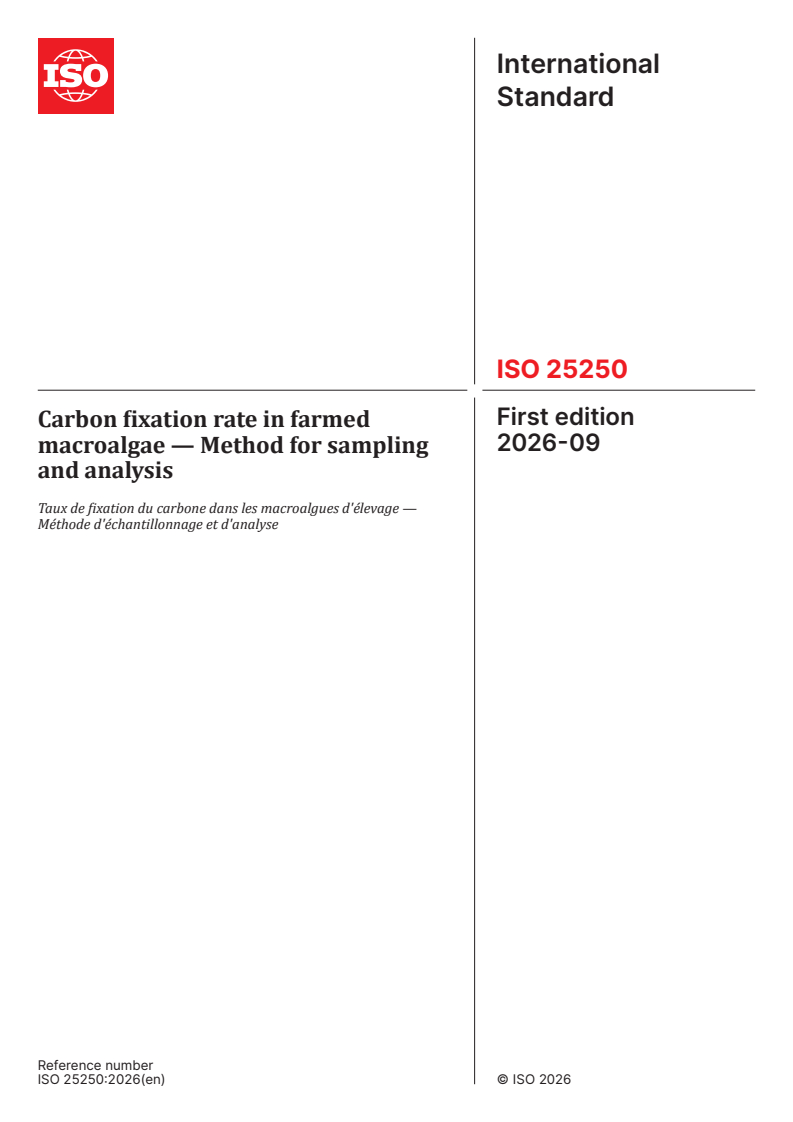
ISO 25250:2026 is an International Standard from the International Organization for Standardization (ISO). It specifies how to sample farmed macroalgae and how to analyze those samples to determine and calculate carbon fixation rate. The document is intended for farms, laboratories, government users, and third-party testing or evaluation bodies working with harvested macroalgae biomass.
What does ISO 25250:2026 specify?
ISO 25250:2026 covers the sampling and analysis methods used to determine carbon fixation rate in farmed macroalgae. The document is organized into clauses 1 to 5, followed by informative Annex A and a bibliography.
| Annex | What it covers |
|---|---|
| A | Indicative carbon content values for common farmed macroalgae on a dry mass basis |
Clause 4 explains what carbon is counted in the calculation, and Clause 5 sets out the laboratory workflow from sampling through to the final carbon fixation rate.
What are the key requirements of ISO 25250:2026?
ISO 25250:2026 focuses on harvested biomass and uses measured carbon content to calculate carbon fixation rate. In practice, that means users sample the crop correctly, prepare the sample consistently, measure moisture and carbon content, and then convert the results into a carbon fixation value.
Sampling and pre-treatment
Clause 5.3 requires representative random sampling from the same batch. The document treats macroalgae harvested from the same sea area or the same farm as one batch, and it calls for 3 to 12 samples depending on harvest volume. Sampling should be planned in advance and carried out either before harvest or immediately after transport to the distribution centre.
Clause 5.4 requires the fresh sample to be rinsed briefly with deionized or distilled water, blotted dry, homogenized, and mixed. If the sample mass is above 5 kg, quartering is used to reduce it to at least 1 kg. The pretreated sample is then sealed, kept at 5 °C to 15 °C, and sent to the laboratory within 24 h.
Moisture and carbon measurement
Clause 5.5 determines moisture content by constant-mass drying. This matters because the carbon result is first measured on a dry basis and then converted to fresh sample basis.
Clause 5.6 uses the thermal conductivity method with an elemental analyser. The sample is ground, sieved through a 178 μm mesh, and analyzed with blank correction, reference calibration, and three replicate measurements. The mean result is reported to two decimal places, and the maximum deviation between parallel samples shall not exceed 5 % of the mean.
What is counted in the carbon fixation rate
Clause 4 explains that the document counts carbon stored in harvested biomass. It excludes carbon in seedlings by applying the cut-off criterion from ISO 20423:2025, and it does not count dissolved organic carbon (DOC) or particulate organic carbon (POC) as biomass carbon fixation. In practice, that means the method is conservative and focused on what is removed through harvest.
Clause 4.6 and Clause 5.8 define the calculation basis for the culture cycle and the batch-average carbon content. The final result is expressed as mass of carbon dioxide (CO2) fixed, using the harvested fresh mass and the measured fresh-sample carbon content.
What terms does ISO 25250:2026 define?
- Macroalgae - Macroscopic multicellular eukaryotic organisms that obtain energy using chromophores; the document notes common farmed examples such as kelp, laver, wakame, sargassum, and ulva.
- Carbon content of organism - The percentage of carbon element in the total mass of an organism.
- Carbon fixation rate in farmed macroalgae - The rate of carbon fixed through photosynthesis at a specified time and within a specified range, expressed as CO2 mass.
- Macroalgae culture cycle - The time required from seedling release to market size.
- Dissolved organic carbon (DOC) - Organic carbon in water that cannot be removed by specified phase separation.
- Particulate organic carbon (POC) - Organic particulate carbon not dissolved in water.
- Recalcitrant dissolved organic carbon (RDOC) - Dissolved organic carbon that is not easy to break down in water bodies.
Who uses ISO 25250:2026?
ISO 25250:2026 is relevant to the farmed macroalgae sector. The introduction names enterprises, government departments, and third-party testing or evaluation institutions as users.
In practice, it supports people who need to:
- design sampling programs,
- prepare and analyze macroalgae samples in a laboratory,
- calculate carbon fixation rate for harvested biomass,
- support carbon accounting or reporting for farmed macroalgae.
Which standards are used with ISO 25250:2026?
- ISO 20423:2025 - Provides the carbon footprint rules for macroalgae and the cut-off criterion used to exclude seedlings.
- EN 17980:2024 - Provides guidance for defining sampling programmes and sampling protocols, including representativeness and timing.
- ISO 5725-1:2023 - Supplies the repeatability terminology referenced in the repeatability note in Clause 5.6.6.
- ISO 6107:2021 - Provides the source definition for dissolved organic carbon (DOC).
- EN 17399:2024 - Provides the source definition for macroalgae used in Clause 3.
What does the ISO 25250:2026 document contain?
ISO 25250:2026 includes the full workflow for the method, from batch sampling to the final calculation of carbon fixation rate. It gives procedures for sampling, rinsing, homogenizing, quartering, drying to constant mass, grinding, sieving, calibration, blank correction, and replicate analysis.
It also includes four calculation formulas covering moisture content, dry-mass carbon content, fresh-sample carbon content, and carbon fixation rate. Annex A provides an informative table of dry-mass carbon content for common farmed macroalgae, which can be used as a reference but not as a substitute for direct measurement when carbon accounting or reporting is needed.
Get Certified
Connect with accredited certification bodies for this standard

CIS Institut d.o.o.
Personal Protective Equipment (PPE) certification body. Notified Body NB-2890 for EU Regulation 2016/425 PPE.

Kiwa BDA Testing
Building and construction product certification.
Kmetijski inštitut Slovenije
Agricultural Institute of Slovenia. Soil testing, plant health, agricultural product analysis.
Sponsored listings
Frequently Asked Questions
ISO 25250:2026 is a standard published by the International Organization for Standardization (ISO). Its full title is "Carbon fixation rate in farmed macroalgae — Method for sampling and analysis". This standard covers: This document specifies sampling and analysis methods of carbon fixation rate in farmed macroalgae. This document is applicable to the determination and calculation of carbon fixation rate in farmed macroalgae.
This document specifies sampling and analysis methods of carbon fixation rate in farmed macroalgae. This document is applicable to the determination and calculation of carbon fixation rate in farmed macroalgae.
ISO 25250:2026 is classified under the following ICS (International Classification for Standards) categories: 13.060.70 - Examination of biological properties of water. The ICS classification helps identify the subject area and facilitates finding related standards.
ISO 25250:2026 is available in PDF format for immediate download after purchase. The document can be added to your cart and obtained through the secure checkout process. Digital delivery ensures instant access to the complete standard document.
Standards Content (Sample)
International
Standard
ISO 25250
First edition
Carbon fixation rate in farmed
2026-09
macroalgae — Method for sampling
and analysis
Taux de fixation du carbone dans les macroalgues d'élevage —
Méthode d'échantillonnage et d'analyse
Reference number
© ISO 2026
All rights reserved. Unless otherwise specified, or required in the context of its implementation, no part of this publication may
be reproduced or utilized otherwise in any form or by any means, electronic or mechanical, including photocopying, or posting on
the internet or an intranet, without prior written permission. Permission can be requested from either ISO at the address below
or ISO’s member body in the country of the requester.
ISO copyright office
CP 401 • Ch. de Blandonnet 8
CH-1214 Vernier, Geneva
Phone: +41 22 749 01 11
Email: copyright@iso.org
Website: www.iso.org
Published in Switzerland
ii
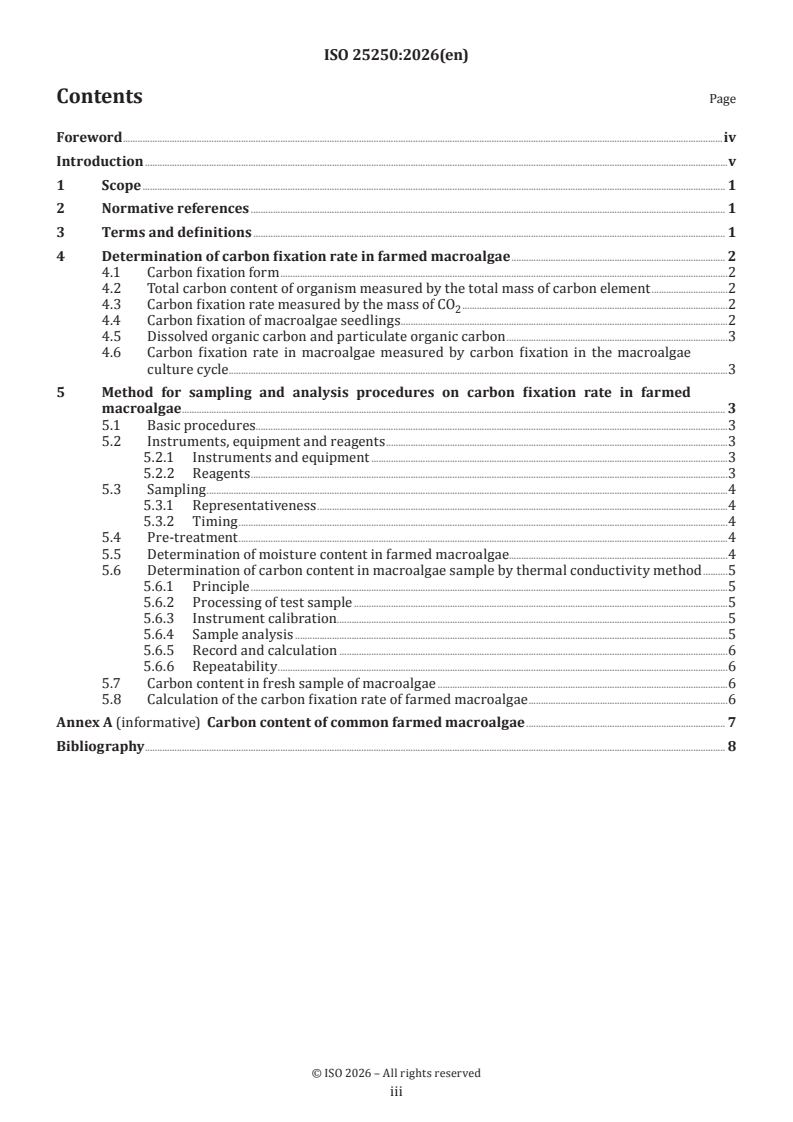
Contents Page
Foreword .iv
Introduction .v
1 Scope . 1
2 Normative references . 1
3 Terms and definitions . 1
4 Determination of carbon fixation rate in farmed macroalgae . 2
4.1 Carbon fixation form .2
4.2 Total carbon content of organism measured by the total mass of carbon element .2
4.3 Carbon fixation rate measured by the mass of CO .2
4.4 Carbon fixation of macroalgae seedlings .2
4.5 Dissolved organic carbon and particulate organic carbon .3
4.6 Carbon fixation rate in macroalgae measured by carbon fixation in the macroalgae
culture cycle .3
5 Method for sampling and analysis procedures on carbon fixation rate in farmed
macroalgae . 3
5.1 Basic procedures.3
5.2 Instruments, equipment and reagents .3
5.2.1 Instruments and equipment .3
5.2.2 Reagents .3
5.3 Sampling .4
5.3.1 Representativeness .4
5.3.2 Timing .4
5.4 Pre-treatment .4
5.5 Determination of moisture content in farmed macroalgae.4
5.6 Determination of carbon content in macroalgae sample by thermal conductivity method .5
5.6.1 Principle .5
5.6.2 Processing of test sample .5
5.6.3 Instrument calibration.5
5.6.4 Sample analysis .5
5.6.5 Record and calculation .6
5.6.6 Repeatability .6
5.7 Carbon content in fresh sample of macroalgae .6
5.8 Calculation of the carbon fixation rate of farmed macroalgae .6
Annex A (informative) Carbon content of common farmed macroalgae . 7
Bibliography . 8
iii
Foreword
ISO (the International Organization for Standardization) is a worldwide federation of national standards
bodies (ISO member bodies). The work of preparing International Standards is normally carried out through
ISO technical committees. Each member body interested in a subject for which a technical committee
has been established has the right to be represented on that committee. International organizations,
governmental and non-governmental, in liaison with ISO, also take part in the work. ISO collaborates closely
with the International Electrotechnical Commission (IEC) on all matters of electrotechnical standardization.
The procedures used to develop this document and those intended for its further maintenance are described
in the ISO/IEC Directives, Part 1. In particular, the different approval criteria needed for the different types
of ISO document should be noted. This document was drafted in accordance with the editorial rules of the
ISO/IEC Directives, Part 2 (see www.iso.org/directives).
ISO draws attention to the possibility that the implementation of this document may involve the use of (a)
patent(s). ISO takes no position concerning the evidence, validity or applicability of any claimed patent
rights in respect thereof. As of the date of publication of this document, ISO had not received notice of (a)
patent(s) which may be required to implement this document. However, implementers are cautioned that
this may not represent the latest information, which may be obtained from the patent database available at
www.iso.org/patents. ISO shall not be held responsible for identifying any or all such patent rights.
Any trade name used in this document is information given for the convenience of users and does not
constitute an endorsement.
For an explanation of the voluntary nature of standards, the meaning of ISO specific terms and expressions
related to conformity assessment, as well as information about ISO’s adherence to the World Trade
Organization (WTO) principles in the Technical Barriers to Trade (TBT), see www.iso.org/iso/foreword.html.
This document was prepared by Technical Committee ISO/TC 234, Fisheries and aquaculture.
Any feedback or questions on this document should be directed to the user’s national standards body. A
complete listing of these bodies can be found at www.iso.org/members.html.
iv
Introduction
With the increasing global climate crisis, the “low-carbon revolution” of globalization is rising. As a result,
“carbon peaking” and “carbon neutrality” have become important goals of global low-carbon development.
Countries all over the world are actively carrying out “double carbon” research to achieve the goal of “carbon
neutrality” as soon as possible.
As an important organism that participates in the ocean carbon cycle, macroalgae can absorb carbon
dioxide through photosynthesis, and then convert the inorganic carbon in seawater to organic carbon.
Large amounts of carbon can be fixed through macroalgae harvesting. Thus, the analysis method of carbon
fixation rate in farmed macroalgae will provide a technical basis for carbon peaking and carbon neutrality
measurement.
This document is relevant for all stakeholders within the farmed macroalgae sector, including but not limited
to, enterprises, government departments, the third party of testing or evaluation institutions.
v
International Standard ISO 25250:2026(en)
Carbon fixation rate in farmed macroalgae — Method for
sampling and analysis
1 Scope
This document specifies sampling and analysis methods of carbon fixation rate in farmed macroalgae.
This document is applicable to the determination and calculation of carbon fixation rate in farmed
macroalgae.
2 Normative references
The following documents are referred to in the text in such a way that some or all of their content constitutes
requirements of this document. For dated references, only the edition cited applies. For undated references,
the latest edition of the referenced document (including any amendments) applies.
ISO 20423:2025, Carbon footprint for seafood — Product category rules (CFP-PCR) for macroalgae
EN 17980:2024, Algae and algae products — Sampling — Guidelines for the definition of sampling programs
and sampling protocols
3 Terms and definitions
For the purposes of this document, the following terms and definitions apply.
ISO and IEC maintain terminology databases for use in standardization at the following addresses:
— ISO Online browsing platform: available at https:// www .iso .org/ obp
— IEC Electropedia: available at https:// www .electropedia .org/
3.1
macroalgae
macroscopic eukaryotic pluricellular organisms composed of single differentiated cells able to obtain energy
using chromophores
Note 1 to entry: Macroalgae mainly include Rhodophyta, Phaeophyceae and Chlorophyta. Common farmed macroalgae
are kelp, laver, wakame, sargassum, ulva, etc.
[SOURCE: EN 17399:2024, 3.1.21, modified — Note 1 to entry added.]
3.2
carbon content of organism
percentage of carbon element in the total mass of an organism
3.3
carbon fixation rate in farmed macroalgae
rate of carbon fixed in farmed macroalgae (3.1) through photosynthesis at a specified time and within a
specified range
Note 1 to entry: It is expressed as the mass of CO .
Note 2 to entry: This document only measures carbon fixation in harvested biomass and does not assess long-term
carbon sequestration or permanence.
3.4
macroalgae culture cycle
time (in years) required from seedling releasing to the market size of macroalgae farming
3.5
dissolved organic carbon
DOC
part of the organic carbon in water which cannot be removed by specified phase separation
Note 1 to entry: Phase separation may be specified, for example, by centrifugation at 40 000g for 15 min or by
membrane filtration using membr
...