


ISO 6425-1:1981
(Main)Title missing - Legacy paper document
Title missing - Legacy paper document
General Information
- Status
- Withdrawn
- Publication Date
- 31-Dec-1980
- Technical Committee
- ISO/TMBG - Technical Management Board - groups
- Drafting Committee
- ISO/TMBG - Technical Management Board - groups
- Current Stage
- 9599 - Withdrawal of International Standard
- Start Date
- 01-Jan-1986
- Completion Date
- 14-Feb-2026
Relations
- Consolidated By
ISO 17652-1:2003 - Welding — Test for shop primers in relation to welding and allied processes — Part 1: General requirements - Effective Date
- 28-Feb-2023
Buy Documents
ISO 6425-1:1981 - Title missing - Legacy paper document Released:1/1/1981
ISO 6425-1:1981 - Title missing - Legacy paper document Released:1/1/1981
Frequently Asked Questions
ISO 6425-1:1981 is a standard published by the International Organization for Standardization (ISO). Its full title is "Title missing - Legacy paper document". This standard covers: Title missing - Legacy paper document
Title missing - Legacy paper document
ISO 6425-1:1981 has the following relationships with other standards: It is inter standard links to ISO 17652-1:2003. Understanding these relationships helps ensure you are using the most current and applicable version of the standard.
ISO 6425-1:1981 is available in PDF format for immediate download after purchase. The document can be added to your cart and obtained through the secure checkout process. Digital delivery ensures instant access to the complete standard document.
Standards Content (Sample)
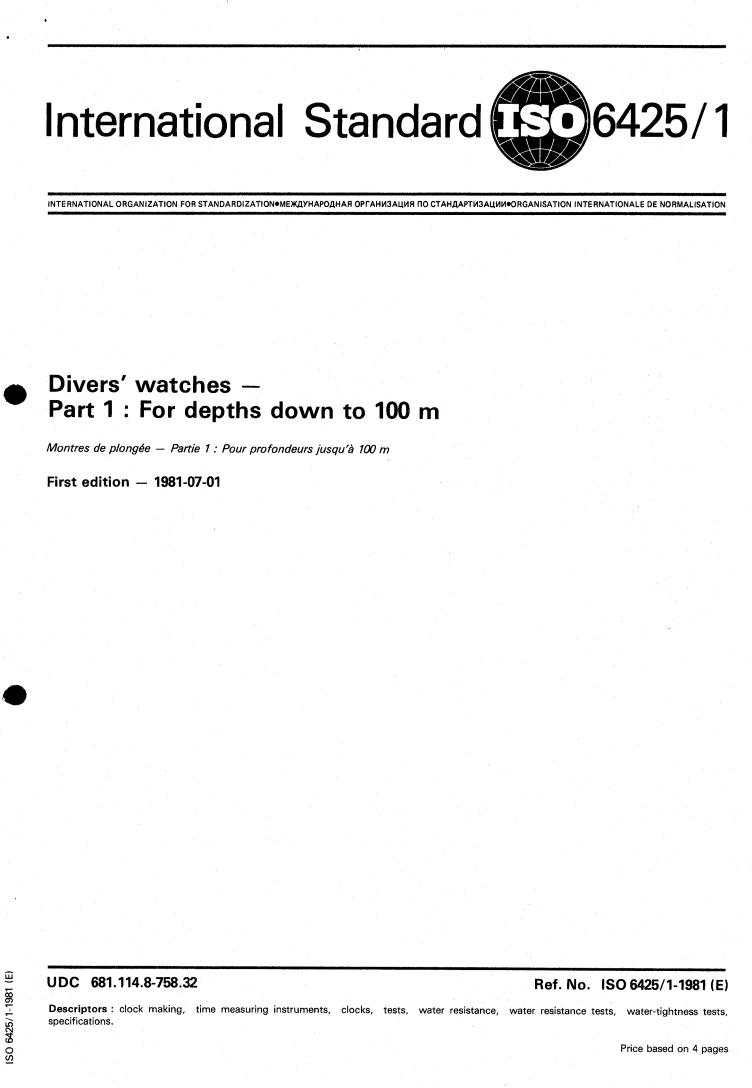
International Standard
INTERNATIONAL ORGANIZATION FOR STANDARDIZATlON*MEXiiYHAPOLiHAR OPrAHHJAUHR il0 CTAHLlAPTH3AUHM*ORGANlSATlON INTERNATIONALE DE NORMALISATION
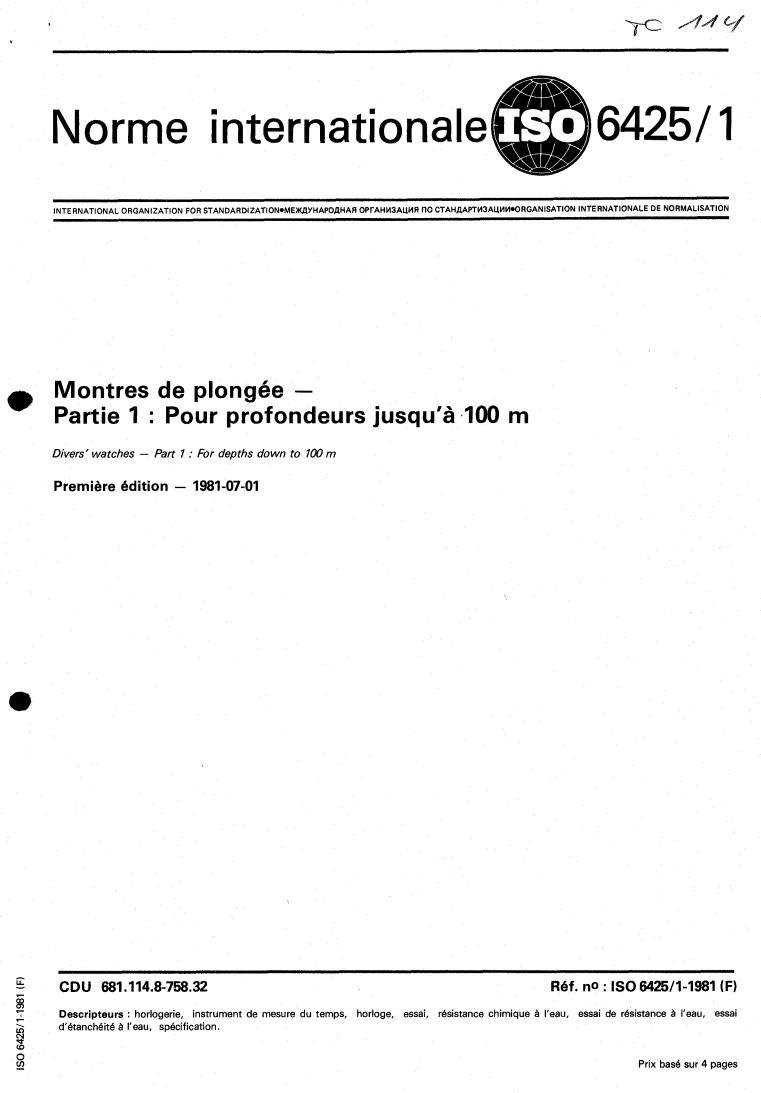
Divers' watches -
Part 1 : For depths down to 100 m
Montres de plongée - Partie 1 : Pour profondeurs jusqu'à 100 m
First edition - 1981-07-01
~
UDC 681.114.8-758.32
Ref. No. IS0 6425/1-1981 (E)
Descriptors : clock making, time measuring instruments, clocks, tests, water resistance, water resistance tests, water-tightness tests,
specifications.
Price based on 4 pages
Foreword
IS0 (the International Organization for Standardization) is a worldwide federation of
national standards institutes (IS0 member bodies). The work of developing Inter-
national Standards is carried out through IS0 technical committees. Every member
body interested in a subject for which a technical committee has been set up has the
right to be represented on that committee. International organizations, governmental
ISO, also take part in the work.
and non-governmental, in liaison with
Draft international Standards adopted by the technical committees are circulated to
the member bodies for approval before their acceptance as International Standards by
the IS0 Council.
International Standard IS0 64251 1 was developed by Technical Committee
ISO/TC 114, Horology, and was circulated to the member bodies in April 1980.
It has been approved by the member bodies of the following countries :
Australia Germany, F. R. South Africa, Rep. of
Czechoslovakia India Switzerland
Egypt, Arab Rep. of Japan United Kingdom
Romania USSR
France
No member body expressed disapproval of the document.
O International Organization for Standardization, 1981 0
Printed in Switzerland
INTERNATIONAL STANDARD IS0 6425/1-1981 (E)
Divers‘ watches -
Part I : For depths down to 100 m
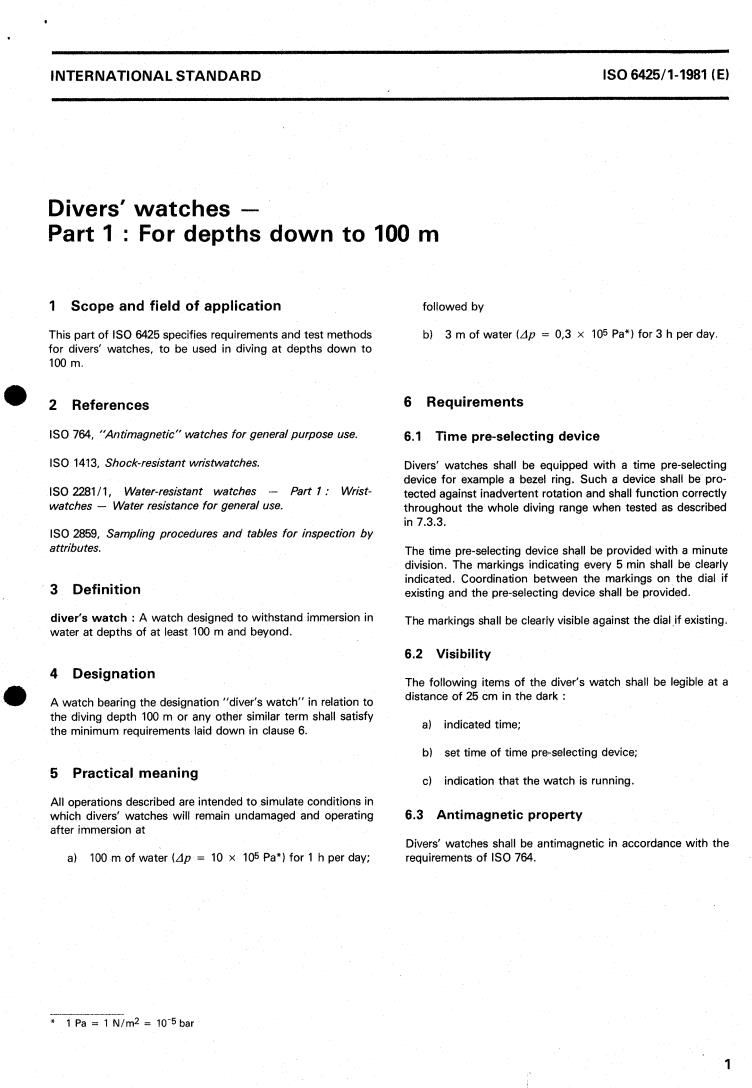
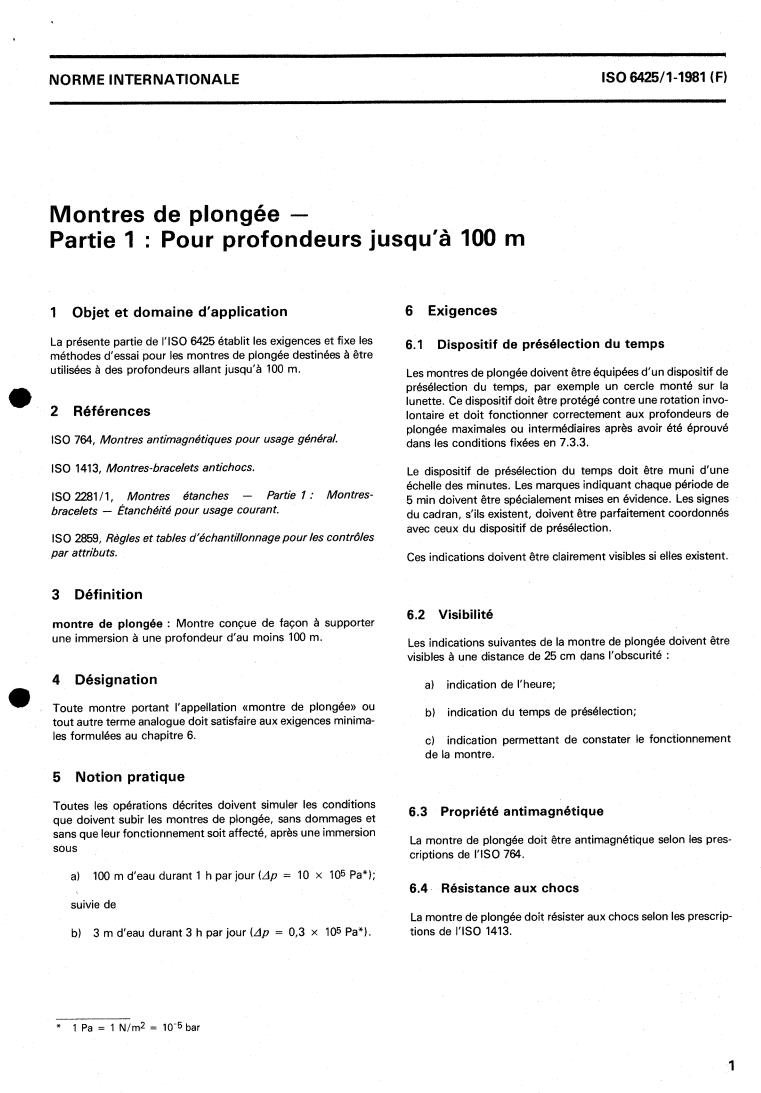
1 Scope and field of application followed by
This part of IS0 6425 specifies requirements and test methods 3 m of water (dp = 0,3 x IO5 Pa*) for 3 h per day.
b)
for divers’ watches, to be used in diving at depths down to
100 m.
6 Requirements
2 References
IS0 764, “‘Antimagnetic” watches for general purpose use.
6.1 Time pre-selecting device
IS0 1413, Shock-resistant wristwatches.
Divers‘ watches shall be equipped with a time pre-selecting
device for example a bezel ring. Such a device shall be pro-
IS0 2281 Il, Water-resistant watches - Part 1 : Wrist-
tected against inadvertent rotation and shall function correctly
watches - Water resistance for general use.
throughout the whole diving range when tested as described
in 7.3.3.
IS0 2859, Sampling procedures and tables for inspection by
attributes.
The time pre-selecting device shall be provided with a minute
division. The markings indicating every 5 min shall be clearly
indicated. Coordination between the markings on the dial if
3 Definition
existing and the pre-selecting device shall be provided.
diver‘s watch : A watch designed to withstand immersion in
The markings shall be clearly visible against the dial,if existing.
water at depths of at least 100 m and beyond.
6.2 Visibility
4 Designation
The following items of the diver’s watch shall be legible at a
distance of 25 cm in the dark :
A watch bearing the designation ”diver‘s watch” in relation to
the diving depth 100 rn or any other similar term shall satisfy
a) indicated time;
6.
the minimum requirements laid down in clause
b) set time of time pre-selecting device;
5 Practical meaning
c) indication that the watch is running.
All operations described are intended to simulate conditions in
which divers‘ watches will remain undamaged and operating 6.3 Antimagnetic property
after immersion at
Divers’ watches shall be antimagnetic in accordance with the
100 m of water (dp = 10 x IO5 Pa*) for 1 h per day; IS0 764.
a) requirements of
*
I Pa = I N/m2 = 10.5 bar
IS0 642511-1981 (E)
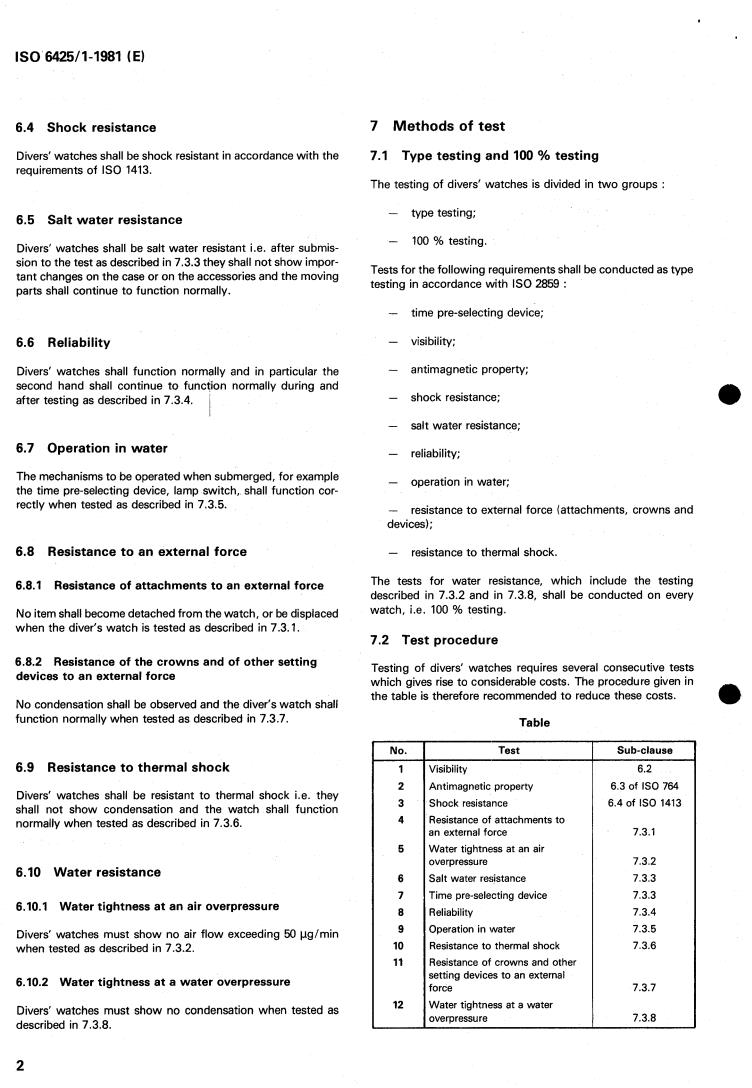
6.4 Shock resistance 7 Methods of test
Divers‘ watches shall be shock resistant in accordance with the
7.1 Type testing and 100 YO testing
requirements of IS0 1413.
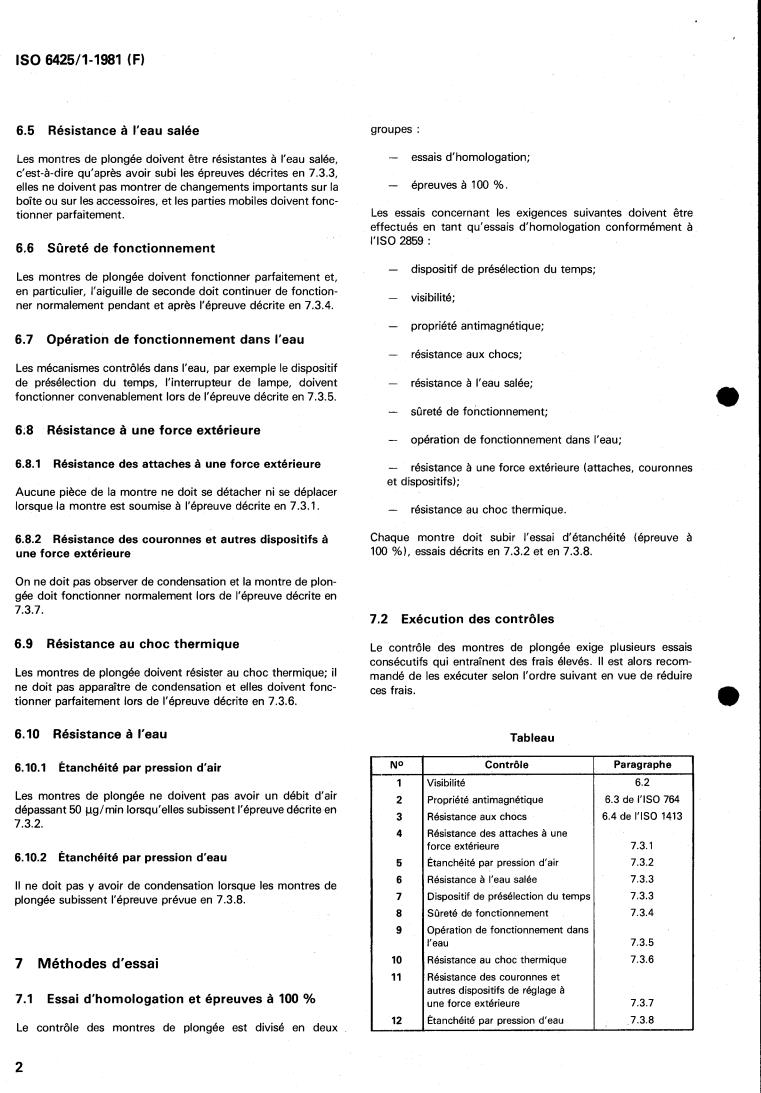
The testing of divers‘ watches is divided in two groups :
- type testing;
6.5 Salt water resistance
- 100 % testing.
Divers‘ watches shall be salt water resistant i.e. after submis-
sion to the test as described in 7.3.3 they shall not show impor-
Tests for the following requirements shall be conducted as type
tant changes on the case or on the accessories and the moving
testing in accordance with IS0 2859 :
parts shall continue to function normally.
- time pre-selecting device;
- visibility:
6.6 Reliability
- antimagnetic property;
Divers’ watches shall function normally and in particular the
second hand shall continue to function normally during and
- shock resistance;
after testing as described in 7.3.4.
- salt water resistance;
6.7 Operation in water
- reliability;
The mechanisms to be operated when submerged, for example
- operation in water;
the time pre-selecting device, lamp switch, shall function cor-
rectly when tested as described in 7.3.5.
-
resistance to external force (attachments, crowns and
devices);
6.8 Resistance to an external force - resistance to thermal shock.
The tests for water resistance, which include the testing
6.8.1 Resistance of attachments to an external force
described in 7.3.2 and in 7.3.8, shall be conducted on every
i.e. 100 % testing.
watch,
No
...
Norme internationale
~~ ~ ~~~
INTERNATIONAL ORGANIZATION FOR STANDARDIZATIONOME)I(LIYHAPOAHAR OPTAHHJAUHR no CTAH~APTH3AUMM.ORGANlSATlON INTERNATIONALE DE NORMALISATION
Montres de plongée -
Partie 1 : Pour profondeurs jusqu‘à-100 m
Divers’ watches - Part I : For depths down to Io0 rn
Première édition - 1981-07-01
Réf. no : IS0 6425/1-1981 (FI
CDU 681.114.8-758.32
Descripteurs : horlogerie, instrument de mesure du temps, horloge, essai, résistance chimique à l’eau, essai de résistance à l’eau, essai
d’étanchéité à l’eau, spécification.
basé sur 4 pages
Prix
Avant-propos
L'ISO (organisation internationale de normalisation) est une fédération mondiale
d'organismes nationaux de normalisation (comités membres de I'ISO). L'élaboration
I'ISO. Chaque
des Normes internationales est confiée aux comités techniques de
comité membre intéressé par une étude a le droit de faire partie du comité technique
correspondant. Les organisations internationales, gouvernementales et non gouverne-
mentales, en liaison avec I'ISO, participent également aux travaux.
Les projets de Normes internationales adoptés par les comités techniques sont soumis
aux comités membres pour approbation, avant leur acceptation comme Normes inter-
nationales par le Conseil de I'ISO.
La Norme internationale 642511 a été élaborée par le comité technique ISO/TC 114,
Horlogerie, et a été soumise aux comités membres en avril 1980.
Les comités membres des pays suivants l'ont approuvée
Afrique du Sud, Rép. d' France Royaume- Uni
Allemagne, R. F. Inde Suisse
Australie Japon Tchécoslovaquie
Égypte, Rép. arabe d' Roumanie URSS
Aucun comité membre ne l'a désapprouvée.
O Organisation internationale de normalisation, 1981 O
Imprimé en Suisse
IS0 6425/1-1981 (FI
NORM E I NTER NAT1 ON A LE
Montres de plongee -
Partie 1 : Pour profondeurs jusqu'à 100 m
1 Objet et domaine d'application 6 Exigences
La présente partie de I'ISO 6425 établit les exigences et fixe les
6.1 Dispositif de présélection du temps
méthodes d'essai pour les montres de plongée destinées à être
utilisées à des profondeurs allant jusqu'à 100 m.
Les montres de plongée doivent être équipées d'un dispositif de
présélection du temps, par exemple un cercle monté sur la
lunette. Ce dispositif doit être protégé contre une rotation invo-
O
2 Références
lontaire et doit fonctionner correctement aux profondeurs de
plongée maximales ou intermédiaires après avoir été éprouve
IS0 764, Montres antirnagnétiques pour usage général.
dans les conditions fixées en 7.3.3.
IS0 1413, Montres-bracelets antichocs.
Le dispositif de présélection du temps doit être muni d'une
échelle des minutes. Les marques indiquant chaque période de
IS0 228111, Montres éfanches - Partie 1 : Montres-
5 min doivent être spécialement mises en évidence. Les signes
bracelets - Etanchéité pour usage courant.
du cadran, s'ils existent, doivent être parfaitement coordonnés
avec ceux du dispositif de présélection.
IS0 2859, Règles et tables dréchantillonnage pour les contrôles
par attributs.
Ces indications doivent être clairement visibles si elles existent.
3 Définition
6.2 Visibilité
montre de plongée : Montre conçue de façon à supporter
à une profondeur d'au moins 100 m.
une immersion
Les indications suivantes de la montre de plongée doivent être
visibles à une distance de 25 cm dans l'obscurité :
4 Désignation
a) indication de l'heure;
Toute montre portant l'appellation ((montre de plongée)) ou
b) indication du temps de présélection;
tout autre terme analogue doit satisfaire aux exigences minima-
les formulées au chapitre 6.
c) indication permettant de constater le fonctionnement
de la montre.
5 Notion pratique
Toutes les opérations décrites doivent simuler les conditions
6.3 Propriété antimagnélique
que doivent subir les montres de plongée, sans dommages et
sans que leur fonctionnement soit affecté, après une immersion
La montre de plongée doit être antimagnétique selon les pres-
sous
criptions de l'lS0 764.
100 m d'eau durant 1 h par jour (dp = 10 x IO5 Pa");
a)
6.4 Résistance aux chocs
suivie de
La montre de plongée doit résister aux chocs selon les prescrip-
tions de IWO 1413.
b) 3 m d'eau durant 3 h par jour (dp = 0,3 x IO5 Pa").
*
1 Pa = 1 N/m2 = 10-5bar
IS0 6425/1-198
groupes :
6.5 Résistance à l’eau salée
- essais d‘homologation;
Les montres de plongée doivent être résistantes à l‘eau salée,
c’est-à-dire qu’après avoir subi les épreuves décrites en 7.3.3,
- épreuves à 100 %.
elles ne doivent pas montrer de changements importants sur la
boîte ou sur les accessoires, et les parties mobiles doivent fonc-
Les essais concernant les exigences suivantes doivent être
tionner parfaitement.
effectués en tant qu‘essais d‘homologation conformément à
I’ISO 2859 :
6.6 Sûreté de fonctionnement
-
dispositif de présélection du temps;
Les montres de plongée doivent fonctionner parfaitement et,
en particulier, l‘aiguille de seconde doit continuer de fonction-
- visibilité;
ner normalement pendant et après l’épreuve décrite en 7.3.4.
- propriété antimagnétique;
6.7 Opération de fonctionnement dans l’eau
- résistance aux chocs;
Les mécanismes contrôlés dans l’eau, par exemple le dispositif
de présélection du temps, l‘interrupteur de lampe, doivent - résistance à l’eau salée;
fonctionner convenablement lors de l’épreuve décrite en 7.3.5.
- sûreté de fonctionnement;
6.8 Résistance à une force extérieure
-
opération de fonctionnement dans l’eau;
6.8.1 Résistance des attaches à une force extérieure
-
résistance à une force extérieure (attaches, couronnes
et dispositifs);
Aucune pièce de la montre ne doit se détacher ni se déplacer
lorsque la montre est soumise à l‘épreuve décrite en 7.3.1.
- résistance au choc thermique.
Chaque montre doit subir l’essai d’étanchéité (épreuve à
6.8.2 Rési
...
Questions, Comments and Discussion
Ask us and Technical Secretary will try to provide an answer. You can facilitate discussion about the standard in here.
Loading comments...