

ISO 15534-3:2000
(Main)Ergonomic design for the safety of machinery — Part 3: Anthropometric data
General Information
- Abstract
This part of ISO 15534 specifies current requirements for human body measurements (anthropometric data) that are required by ISO 15534-1 and ISO 15534-2 for the calculation of access-opening dimensions as applied to machinery. The anthropometric data originate from static measurements of nude persons and do not take into account body movements, clothing, equipment, machinery-operating conditions or environmental conditions. The data are based on information from anthropometric surveys representative of population groups within Europe comprising at least three million people. Both men and women are taken into account. Measurements are given, as required by ISO 15534-1 and ISO 15534-2, for the 5th, 95th and 99th percentiles of the relevant population group within Europe.
- Status
- Published
- Publication Date
- 16-Feb-2000
- Technical Committee
- ISO/TC 159/SC 3 - Anthropometry and biomechanics
- Drafting Committee
- ISO/TC 159/SC 3 - Anthropometry and biomechanics
- Current Stage
- 9092 - International Standard to be revised
- Start Date
- 29-Jan-2024
- Completion Date
- 29-Aug-2026
Overview - ISO 15534-3:2000 (Anthropometric data)
ISO 15534-3:2000 is the part of the ISO 15534 series that specifies anthropometric data for ergonomic design of machinery access openings. It provides the human body measurements (from European surveys) required by ISO 15534-1 and ISO 15534-2 to calculate minimum dimensions for whole‑body and partial‑body access into machinery. The data are derived from static measurements of nude persons and are given for the 5th, 95th and 99th percentiles of the relevant European population groups.
Key topics and technical requirements
- Scope of data: Static anthropometric measurements only - they do not account for clothing, movements, tools, equipment, operating postures or environmental conditions.
- Population basis: Values come from European anthropometric surveys representative of populations of at least three million people, including both men and women.
- Percentiles provided: Data are tabulated for 5th, 95th and 99th percentiles to support design for small and large users. The standard prescribes how to combine national survey results to derive European values (e.g., how to select/average male and female percentiles).
- Measurement definitions: Symbols and definitions align with ISO 7250 and include stature, grip reach, buttock‑knee length, hand and foot dimensions, and several fixed values used in access calculations. Example values given include stature P95 = 1881 mm and P99 = 1944 mm (mm units).
- Integration with ISO 15534-1/-2: Table values are intended to be substituted directly into the formulae in ISO 15534-1 and ISO 15534-2 for calculating access‑opening dimensions.
Applications and who uses it
ISO 15534-3 is practical for:
- Machine designers and mechanical engineers calculating safe access and escape openings.
- Ergonomists and human factors specialists developing machine ergonomics and clearance requirements.
- Safety engineers and compliance officers verifying conformity with machinery safety principles.
- Regulatory bodies and certification agents assessing machinery access dimensions against harmonized European guidance.
- OEMs and facility planners designing maintenance access, inspection ports and operator entryways.
Practical applications include sizing doors, inspection hatches, maintenance openings, escape routes and guard clearances so that access accommodates the range of user sizes.
Related standards
- ISO 15534-1: Principles for whole‑body access dimensions
- ISO 15534-2: Principles for partial‑body access dimensions
- ISO 7250: Basic human body measurements for technological design (reference for measurement definitions)
- EN 547-3 / EN 614-1: Related European ergonomic safety guidance referenced in the introduction
Keywords: ISO 15534-3:2000, anthropometric data, ergonomic design, safety of machinery, access openings, percentiles, European anthropometry.
Relations
- Effective Date
- 25-Aug-2026
- Effective Date
- 25-Aug-2026
- Effective Date
- 25-Aug-2026
- Effective Date
- 25-Aug-2026
- Effective Date
- 25-Aug-2026
- Effective Date
- 03-Jun-2026
Get Certified
Connect with accredited certification bodies for this standard

CIS Institut d.o.o.
Personal Protective Equipment (PPE) certification body. Notified Body NB-2890 for EU Regulation 2016/425 PPE.

Kiwa BDA Testing
Building and construction product certification.
Kmetijski inštitut Slovenije
Agricultural Institute of Slovenia. Soil testing, plant health, agricultural product analysis.
Sponsored listings
Frequently Asked Questions
ISO 15534-3:2000 is a standard published by the International Organization for Standardization (ISO). Its full title is "Ergonomic design for the safety of machinery — Part 3: Anthropometric data". This standard covers: This part of ISO 15534 specifies current requirements for human body measurements (anthropometric data) that are required by ISO 15534-1 and ISO 15534-2 for the calculation of access-opening dimensions as applied to machinery. The anthropometric data originate from static measurements of nude persons and do not take into account body movements, clothing, equipment, machinery-operating conditions or environmental conditions. The data are based on information from anthropometric surveys representative of population groups within Europe comprising at least three million people. Both men and women are taken into account. Measurements are given, as required by ISO 15534-1 and ISO 15534-2, for the 5th, 95th and 99th percentiles of the relevant population group within Europe.
This part of ISO 15534 specifies current requirements for human body measurements (anthropometric data) that are required by ISO 15534-1 and ISO 15534-2 for the calculation of access-opening dimensions as applied to machinery. The anthropometric data originate from static measurements of nude persons and do not take into account body movements, clothing, equipment, machinery-operating conditions or environmental conditions. The data are based on information from anthropometric surveys representative of population groups within Europe comprising at least three million people. Both men and women are taken into account. Measurements are given, as required by ISO 15534-1 and ISO 15534-2, for the 5th, 95th and 99th percentiles of the relevant population group within Europe.
ISO 15534-3:2000 is classified under the following ICS (International Classification for Standards) categories: 13.110 - Safety of machinery; 13.180 - Ergonomics. The ICS classification helps identify the subject area and facilitates finding related standards.
ISO 15534-3:2000 has the following relationships with other standards: It is inter standard links to EN ISO 14122-2:2016, EN ISO 13482:2014, EN ISO 14738:2008, EN ISO 4254-17:2022, EN ISO 22734-1:2025, EN ISO 15537:2004. Understanding these relationships helps ensure you are using the most current and applicable version of the standard.
ISO 15534-3:2000 is available in PDF format for immediate download after purchase. The document can be added to your cart and obtained through the secure checkout process. Digital delivery ensures instant access to the complete standard document.
Standards Content (Sample)
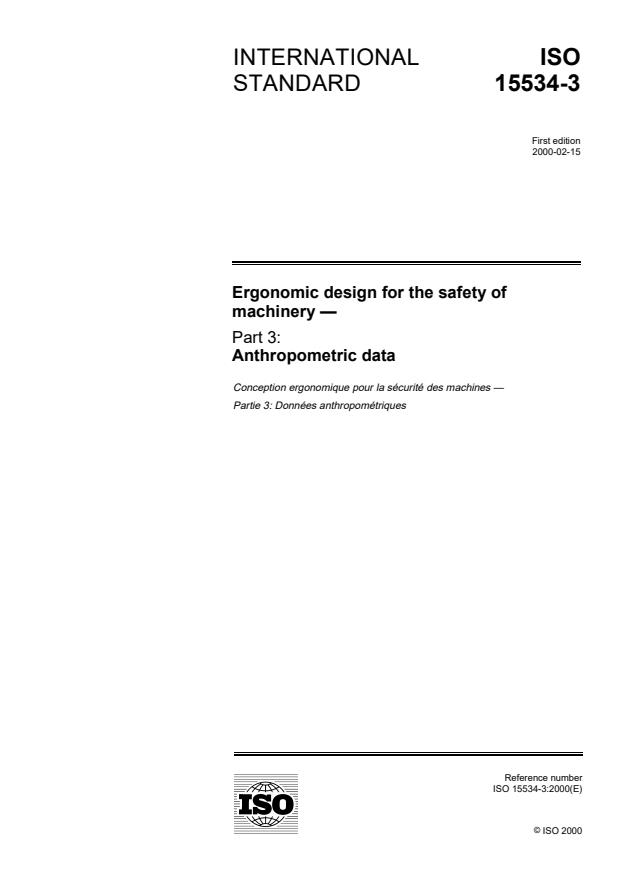
INTERNATIONAL ISO
STANDARD 15534-3
First edition
2000-02-15
Ergonomic design for the safety of
machinery —
Part 3:
Anthropometric data
Conception ergonomique pour la sécurité des machines —
Partie 3: Données anthropométriques
Reference number
©
ISO 2000
PDF disclaimer
This PDF file may contain embedded typefaces. In accordance with Adobe's licensing policy, this file may be printed or viewed but shall not
be edited unless the typefaces which are embedded are licensed to and installed on the computer performing the editing. In downloading this
file, parties accept therein the responsibility of not infringing Adobe's licensing policy. The ISO Central Secretariat accepts no liability in this
area.
Adobe is a trademark of Adobe Systems Incorporated.
Details of the software products used to create this PDF file can be found in the General Info relative to the file; the PDF-creation parameters
were optimized for printing. Every care has been taken to ensure that the file is suitable for use by ISO member bodies. In the unlikely event
that a problem relating to it is found, please inform the Central Secretariat at the address given below.
All rights reserved. Unless otherwise specified, no part of this publication may be reproduced or utilized in any form or by any means, electronic
or mechanical, including photocopying and microfilm, without permission in writing from either ISO at the address below or ISO's member body
in the country of the requester.
ISO copyright office
Case postale 56 � CH-1211 Geneva 20
Tel. + 41 22 749 01 11
Fax + 41 22 734 10 79
E-mail copyright@iso.ch
Web www.iso.ch
Printed in Switzerland
ii © ISO 2000 – All rights reserved
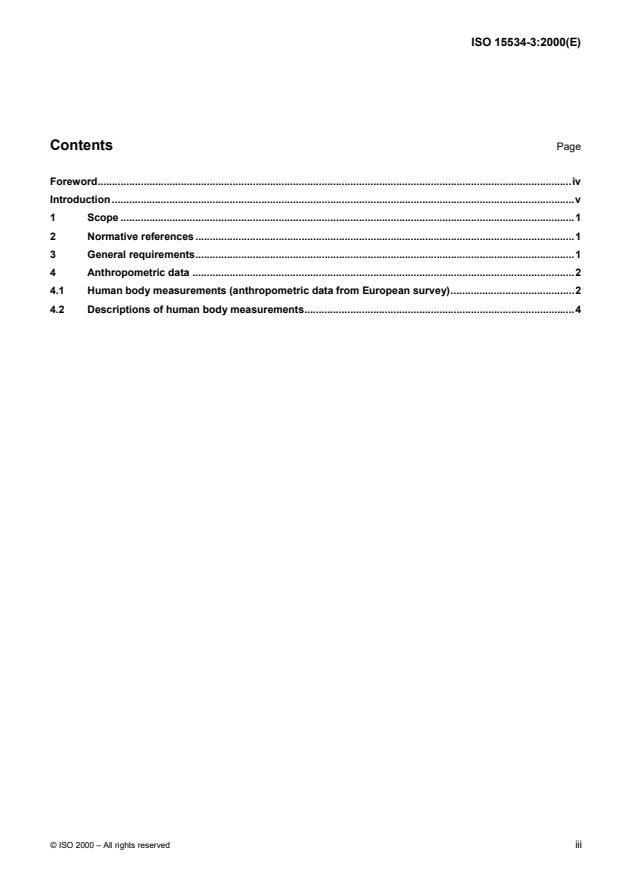
Contents Page
Foreword.iv
Introduction.v
1 Scope .1
2 Normative references .1
3 General requirements.1
4 Anthropometric data .2
4.1 Human body measurements (anthropometric data from European survey).2
4.2 Descriptions of human body measurements.4
Foreword
ISO (the International Organization for Standardization) is a worldwide federation of national standards bodies (ISO
member bodies). The work of preparing International Standards is normally carried out through ISO technical
committees. Each member body interested in a subject for which a technical committee has been established has
the right to be represented on that committee. International organizations, governmental and non-governmental, in
liaison with ISO, also take part in the work. ISO collaborates closely with the International Electrotechnical
Commission (IEC) on all matters of electrotechnical standardization.
International Standards are drafted in accordance with the rules given in the ISO/IEC Directives, Part 3.
Draft International Standards adopted by the technical committees are circulated to the member bodies for voting.
Publication as an International Standard requires approval by at least 75 % of the member bodies casting a vote.
Attention is drawn to the possibility that some of the elements of this part of ISO 15534 may be the subject of
patent rights. ISO shall not be held responsible for identifying any or all such patent rights.
International Standard ISO 15534-3 was prepared by Technical Committee ISO/TC 159, Ergonomics,
Subcommittee SC 3, Anthropometry and biomechanics.
ISO 15534 consists of the following parts, under the general title Ergonomic design for the safety of machinery :
� Part 1: Principles for determining the dimensions required for openings for whole-body access into machinery
� Part 2: Principles for determining the dimensions required for access openings
� Part 3: Anthropometric data
iv © ISO 2000 – All rights reserved
Introduction
This part of ISO 15534 is one of several ergonomics standards for the safety of machinery. EN 614-1:1995, Safety of
machinery — Ergonomic design principles — Part 1: Terminology and general principles, describes the principles
designers should adopt in order to take account of ergonomic factors.
This part of ISO 15534 is based on EN 547-3:1996 that was prepared as a harmonized standard conforming with
the Machinery Directive and associated European Free Trade Association (EFTA) regulations.
INTERNATIONAL STANDARD ISO 15534-3:2000(E)
Ergonomic design for the safety of machinery —
Part 3:
Anthropometric data
1 Scope
This part of ISO 15534 specifies current requirements for human body measurements (anthropometric data) that are
required by ISO 15534-1 and ISO 15534-2 for the calculation of access-opening dimensions as applied to machinery.
The anthropometric data originate from static measurements of nude persons and do not take into account body
movements, clothing, equipment, machinery-operating conditions or environmental conditions.
The data are based on information from anthropometric surveys representative of population groups within Europe
comprising at least three million people. Both men and women are
...