

ISO 20001
(Main)Food loss and waste management system — Requirements for the prevention and minimization of food loss and waste across the food supply chain
General Information
- Abstract
This document specifies requirements for a food loss and waste (FLW) management system to enable an organization that is involved in the food supply chain: to plan, implement, operate, maintain, review, improve and update an FLW management system to minimize FLW within its operations and/or its supply chain; to put in place arrangements to quantify, measure, monitor, document and report its excess food and FLW; to contribute to reducing FLW throughout the food supply chain; to evaluate, assess and collaborate with interested parties within the food supply chain; to effectively communicate FLW issues to interested parties within the food supply chain; to ensure that the organization conforms to its stated FLW policy; to demonstrate continual improvement in its efforts to prevent and minimize FLW to relevant interested parties; to seek certification or registration of its FLW management system by an external organization or make a self-assessment or self-declaration of conformity to this document. All the requirements of this document are generic. This document is applicable to all organizations in the food supply chain regardless of size or complexity. Organizations that are directly or indirectly involved include, but are not limited to, farmers, feed producers, animal food producers, harvesters of wild plants and animals, producers of ingredients, food manufacturers, providers of transportation, storage and distribution services, wholesalers, retailers, food charities, organizations providing food services or catering services and organizations providing food waste management services. This document allows any organization, including small and/or less developed organizations (e.g. a small farm, a small packer-distributor, a small retailer or a food service outlet) to implement externally developed elements in its FLW management system. NOTE 1 Organizations can also choose to address or take steps to reduce consumer food waste within their FLW management system if this is considered a significant FLW hotspot (see Annex A). NOTE 2 Competent authorities seeking to reduce FLW within their jurisdictions can incorporate this document into their activities.
- Status
- Not Published
- Technical Committee
- ISO/TC 34/SC 20 - Food loss and waste
- Drafting Committee
- ISO/TC 34/SC 20 - Food loss and waste
- Current Stage
- 6000 - International Standard under publication
- Start Date
- 18-Aug-2026
- Completion Date
- 24-Aug-2026
Buy Documents
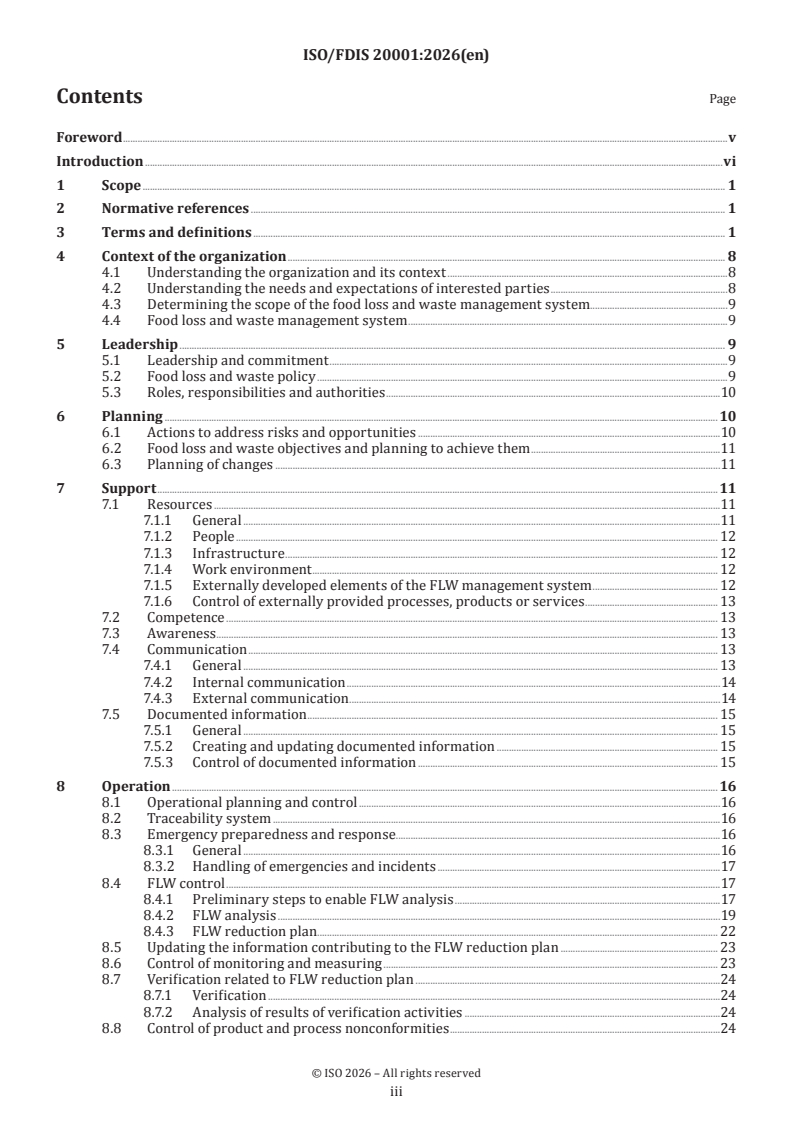
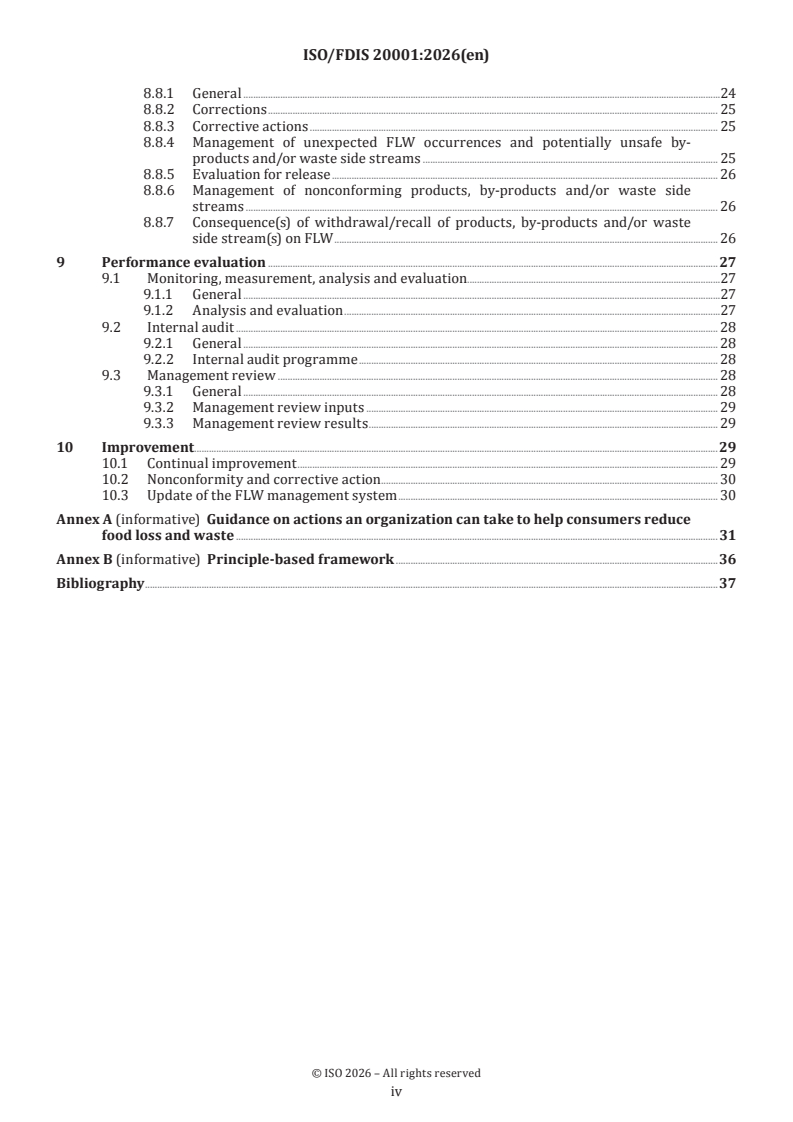
ISO/FDIS 20001 - Food loss and waste management system — Requirements for the prevention and minimization of food loss and waste across the food supply chain
REDLINE ISO/FDIS 20001 - Food loss and waste management system — Requirements for the prevention and minimization of food loss and waste across the food supply chain
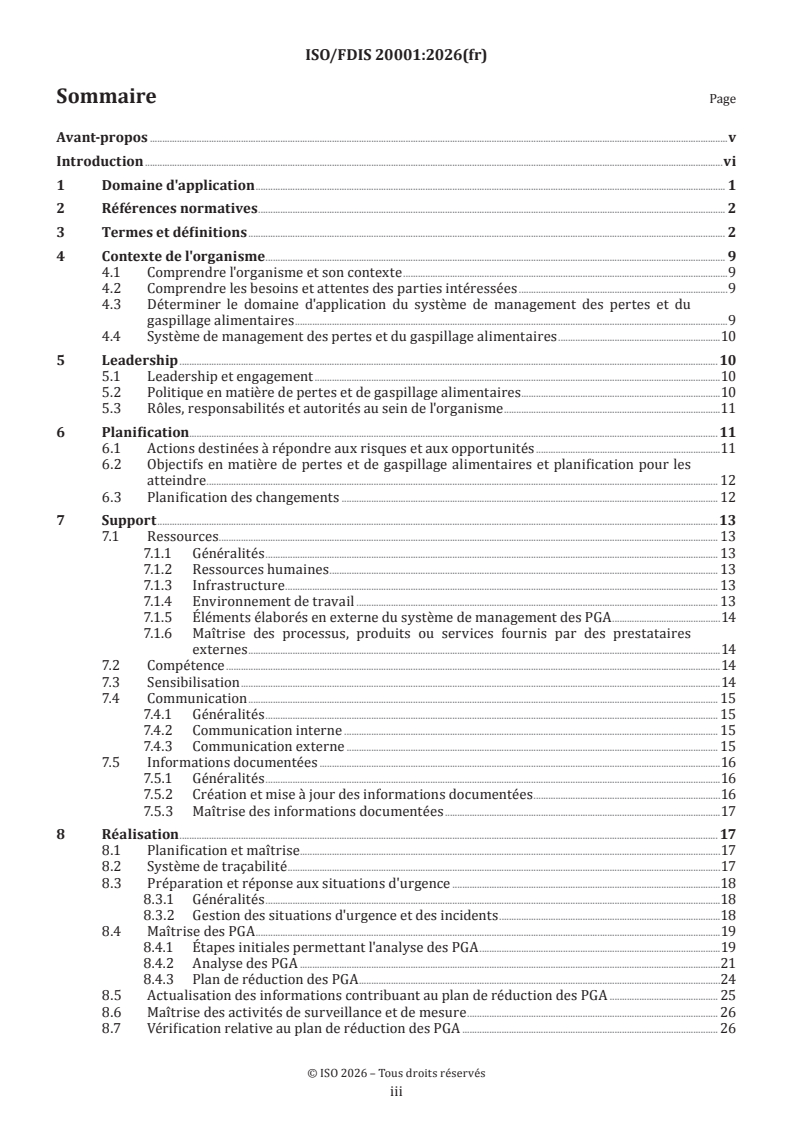
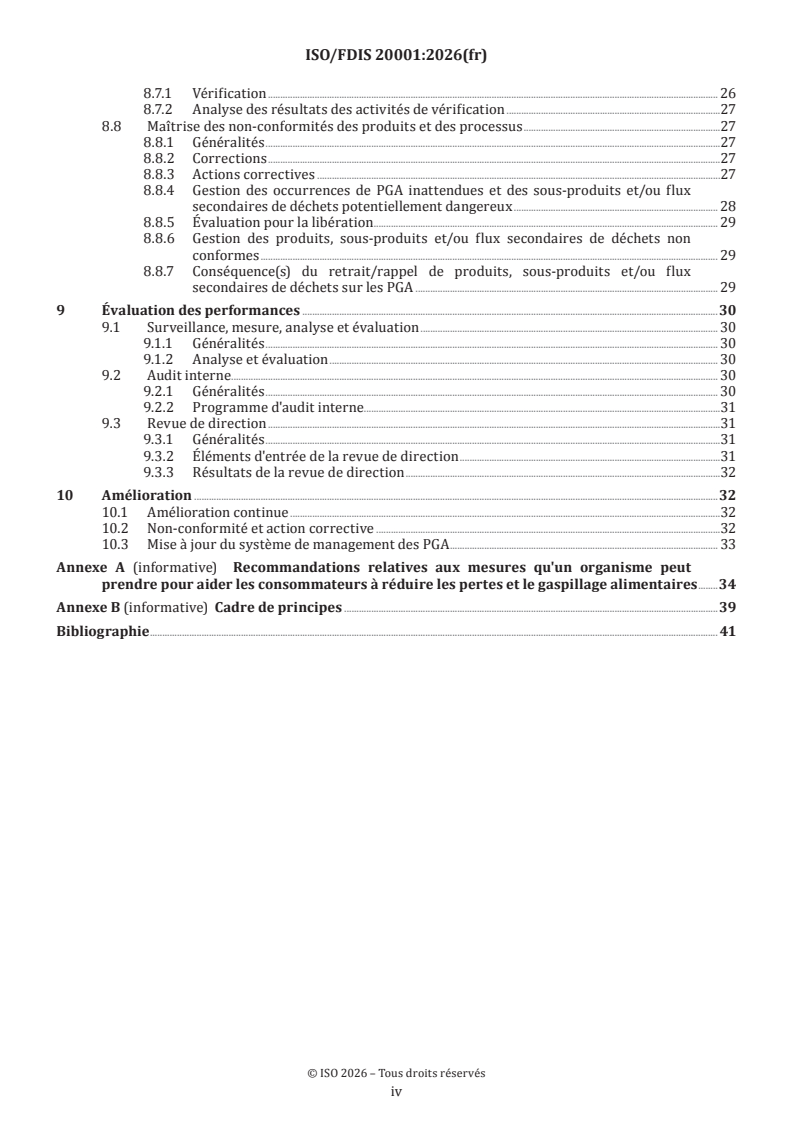
ISO/FDIS 20001 - Système de management des pertes et du gaspillage alimentaires — Exigences relatives à la prévention et à la réduction des pertes et du gaspillage alimentaires dans l'ensemble de la chaîne d'approvisionnement alimentaire
Overview
ISO 20001: Food Loss and Waste Management System sets internationally recognized requirements for organizations to prevent and minimize food loss and waste (FLW) across the food supply chain. Developed by the International Organization for Standardization (ISO), this standard provides a comprehensive framework for all food-related organizations - from primary production through to retailers and food service - to systematically address food loss and waste. By implementing the ISO 20001 management system standard (MSS), organizations can measure, monitor, report, and continuously improve their FLW outcomes, aligning with global sustainability goals and regulatory demands.
Key Topics
- Systematic FLW Management: Establishes requirements for developing, maintaining, and improving a food loss and waste management system (FLW-MS) that is adaptable to organizations of all sizes and complexities involved in the food chain.
- Quantification and Monitoring: Outlines how to quantify, measure, and monitor FLW, providing a foundation for credible reporting and reduction strategies.
- Principle-Based Framework: Guides organizations using a food loss and waste hierarchy, prioritizing prevention, repurposing, redistribution, and responsible disposal, while considering food safety and market factors.
- Process Approach & PDCA Cycle: Encourages adoption of the Plan-Do-Check-Act (PDCA) methodology and risk-based thinking to ensure continual improvement and effective risk management within food systems.
- Stakeholder Engagement: Supports collaboration and communication with stakeholders such as suppliers, customers, and regulatory bodies to address FLW hotspots throughout the food supply chain.
- Documentation and Compliance: Specifies the need for documented policies, objectives, roles, procedures, and performance records, enabling organizations to demonstrate conformity and seek external certification or self-declaration.
Applications
ISO 20001 is applicable to a wide variety of organizations, including but not limited to:
- Farms, fisheries, and primary producers
- Feed and ingredient manufacturers
- Food processing and packaging operations
- Storage, transportation, and distribution services
- Wholesalers, retailers, and food markets
- Food banks, charities, and catering or food service providers
- Food waste management and recycling services
Benefits of implementation:
- Regulatory Compliance: Ensures alignment with national and international sustainability initiatives, including United Nations Sustainable Development Goal 12.3.
- Operational Efficiency: Reduces costs by identifying and minimizing inefficiencies, loss, and waste throughout food processes.
- Market Advantage: Demonstrates responsible practices to partners, customers, and consumers, enhancing brand reputation and trust.
- Environmental Impact: Supports responsible use of resources, contributing to reduced environmental footprint from food production and waste disposal.
Even smaller or less developed organizations, such as small farms, retailers, or food service outlets, can implement the standard by integrating externally developed system elements to suit their scale and needs.
Related Standards
Organizations seeking to optimize their FLW management systems often integrate ISO 20001 with other relevant standards, including:
- ISO 22000: Food safety management systems - Requirements for any organization in the food chain
- ISO 14001: Environmental management systems - Requirements with guidance for use
- ISO 9001: Quality management systems - Requirements
- Local regulations and guidelines on food waste and sustainability
These integrations facilitate streamlined compliance, operational synergy, and greater impact across safety, quality, environmental, and waste management processes.
ISO 20001 delivers a structured and practical approach to food loss and waste management, empowering organizations to drive measurable improvements, fulfill stakeholder expectations, and advance global sustainability goals throughout the food supply chain.
Buy Documents
ISO/FDIS 20001 - Food loss and waste management system — Requirements for the prevention and minimization of food loss and waste across the food supply chain
REDLINE ISO/FDIS 20001 - Food loss and waste management system — Requirements for the prevention and minimization of food loss and waste across the food supply chain
ISO/FDIS 20001 - Système de management des pertes et du gaspillage alimentaires — Exigences relatives à la prévention et à la réduction des pertes et du gaspillage alimentaires dans l'ensemble de la chaîne d'approvisionnement alimentaire
Get Certified
Connect with accredited certification bodies for this standard

BSI Group
BSI (British Standards Institution) is the business standards company that helps organizations make excellence a habit.

Bureau Veritas
Bureau Veritas is a world leader in laboratory testing, inspection and certification services.

DNV
DNV is an independent assurance and risk management provider.
Sponsored listings
Frequently Asked Questions
ISO 20001 is a draft published by the International Organization for Standardization (ISO). Its full title is "Food loss and waste management system — Requirements for the prevention and minimization of food loss and waste across the food supply chain". This standard covers: This document specifies requirements for a food loss and waste (FLW) management system to enable an organization that is involved in the food supply chain: to plan, implement, operate, maintain, review, improve and update an FLW management system to minimize FLW within its operations and/or its supply chain; to put in place arrangements to quantify, measure, monitor, document and report its excess food and FLW; to contribute to reducing FLW throughout the food supply chain; to evaluate, assess and collaborate with interested parties within the food supply chain; to effectively communicate FLW issues to interested parties within the food supply chain; to ensure that the organization conforms to its stated FLW policy; to demonstrate continual improvement in its efforts to prevent and minimize FLW to relevant interested parties; to seek certification or registration of its FLW management system by an external organization or make a self-assessment or self-declaration of conformity to this document. All the requirements of this document are generic. This document is applicable to all organizations in the food supply chain regardless of size or complexity. Organizations that are directly or indirectly involved include, but are not limited to, farmers, feed producers, animal food producers, harvesters of wild plants and animals, producers of ingredients, food manufacturers, providers of transportation, storage and distribution services, wholesalers, retailers, food charities, organizations providing food services or catering services and organizations providing food waste management services. This document allows any organization, including small and/or less developed organizations (e.g. a small farm, a small packer-distributor, a small retailer or a food service outlet) to implement externally developed elements in its FLW management system. NOTE 1 Organizations can also choose to address or take steps to reduce consumer food waste within their FLW management system if this is considered a significant FLW hotspot (see Annex A). NOTE 2 Competent authorities seeking to reduce FLW within their jurisdictions can incorporate this document into their activities.
This document specifies requirements for a food loss and waste (FLW) management system to enable an organization that is involved in the food supply chain: to plan, implement, operate, maintain, review, improve and update an FLW management system to minimize FLW within its operations and/or its supply chain; to put in place arrangements to quantify, measure, monitor, document and report its excess food and FLW; to contribute to reducing FLW throughout the food supply chain; to evaluate, assess and collaborate with interested parties within the food supply chain; to effectively communicate FLW issues to interested parties within the food supply chain; to ensure that the organization conforms to its stated FLW policy; to demonstrate continual improvement in its efforts to prevent and minimize FLW to relevant interested parties; to seek certification or registration of its FLW management system by an external organization or make a self-assessment or self-declaration of conformity to this document. All the requirements of this document are generic. This document is applicable to all organizations in the food supply chain regardless of size or complexity. Organizations that are directly or indirectly involved include, but are not limited to, farmers, feed producers, animal food producers, harvesters of wild plants and animals, producers of ingredients, food manufacturers, providers of transportation, storage and distribution services, wholesalers, retailers, food charities, organizations providing food services or catering services and organizations providing food waste management services. This document allows any organization, including small and/or less developed organizations (e.g. a small farm, a small packer-distributor, a small retailer or a food service outlet) to implement externally developed elements in its FLW management system. NOTE 1 Organizations can also choose to address or take steps to reduce consumer food waste within their FLW management system if this is considered a significant FLW hotspot (see Annex A). NOTE 2 Competent authorities seeking to reduce FLW within their jurisdictions can incorporate this document into their activities.
ISO 20001 is classified under the following ICS (International Classification for Standards) categories: 03.100.70 - Management systems; 67.020 - Processes in the food industry. The ICS classification helps identify the subject area and facilitates finding related standards.
ISO 20001 is available in PDF format for immediate download after purchase. The document can be added to your cart and obtained through the secure checkout process. Digital delivery ensures instant access to the complete standard document.
Standards Content (Sample)
FINAL DRAFT
International
Standard
ISO/FDIS 20001
ISO/TC 34/SC 20
Food loss and waste management
Secretariat: DS
system — Requirements for the
Voting begins on:
prevention and minimization of
2026-06-22
food loss and waste across the food
Voting terminates on:
supply chain
2026-08-17
RECIPIENTS OF THIS DRAFT ARE INVITED TO SUBMIT,
WITH THEIR COMMENTS, NOTIFICATION OF ANY
RELEVANT PATENT RIGHTS OF WHICH THEY ARE AWARE
AND TO PROVIDE SUPPOR TING DOCUMENTATION.
IN ADDITION TO THEIR EVALUATION AS
BEING ACCEPTABLE FOR INDUSTRIAL, TECHNO
LOGICAL, COMMERCIAL AND USER PURPOSES, DRAFT
INTERNATIONAL STANDARDS MAY ON OCCASION HAVE
TO BE CONSIDERED IN THE LIGHT OF THEIR POTENTIAL
TO BECOME STAN DARDS TO WHICH REFERENCE MAY BE
MADE IN NATIONAL REGULATIONS.
Reference number
ISO/FDIS 20001:2026(en) © ISO 2026
FINAL DRAFT
ISO/FDIS 20001:2026(en)
International
Standard
ISO/FDIS 20001
ISO/TC 34/SC 20
Food loss and waste management
Secretariat: DS
system — Requirements for the
Voting begins on:
prevention and minimization of
2026-06-22
food loss and waste across the food
Voting terminates on:
supply chain
2026-08-17
RECIPIENTS OF THIS DRAFT ARE INVITED TO SUBMIT,
WITH THEIR COMMENTS, NOTIFICATION OF ANY
RELEVANT PATENT RIGHTS OF WHICH THEY ARE AWARE
AND TO PROVIDE SUPPOR TING DOCUMENTATION.
© ISO 2026
IN ADDITION TO THEIR EVALUATION AS
All rights reserved. Unless otherwise specified, or required in the context of its implementation, no part of this publication may
BEING ACCEPTABLE FOR INDUSTRIAL, TECHNO
LOGICAL, COMMERCIAL AND USER PURPOSES, DRAFT
be reproduced or utilized otherwise in any form or by any means, electronic or mechanical, including photocopying, or posting on
INTERNATIONAL STANDARDS MAY ON OCCASION HAVE
the internet or an intranet, without prior written permission. Permission can be requested from either ISO at the address below
TO BE CONSIDERED IN THE LIGHT OF THEIR POTENTIAL
or ISO’s member body in the country of the requester.
TO BECOME STAN DARDS TO WHICH REFERENCE MAY BE
MADE IN NATIONAL REGULATIONS.
ISO copyright office
CP 401 • Ch. de Blandonnet 8
CH-1214 Vernier, Geneva
Phone: +41 22 749 01 11
Email: copyright@iso.org
Website: www.iso.org
Published in Switzerland Reference number
ISO/FDIS 20001:2026(en) © ISO 2026
ii
ISO/FDIS 20001:2026(en)
Contents Page
Foreword .v
Introduction .vi
1 Scope . 1
2 Normative references . 1
3 Terms and definitions . 1
4 Context of the organization . 8
4.1 Understanding the organization and its context .8
4.2 Understanding the needs and expectations of interested parties .8
4.3 Determining the scope of the food loss and waste management system.9
4.4 Food loss and waste management system .9
5 Leadership . 9
5.1 Leadership and commitment .9
5.2 Food loss and waste policy .9
5.3 Roles, responsibilities and authorities .10
6 Planning . 10
6.1 Actions to address risks and opportunities .10
6.2 Food loss and waste objectives and planning to achieve them .11
6.3 Planning of changes .11
7 Support .11
7.1 Resources .11
7.1.1 General .11
7.1.2 People . 12
7.1.3 Infrastructure . 12
7.1.4 Work environment . 12
7.1.5 Externally developed elements of the FLW management system . 12
7.1.6 Control of externally provided processes, products or services . 13
7.2 Competence . 13
7.3 Awareness . 13
7.4 Communication . 13
7.4.1 General . 13
7.4.2 Internal communication .14
7.4.3 External communication .14
7.5 Documented information . 15
7.5.1 General . 15
7.5.2 Creating and updating documented information . 15
7.5.3 Control of documented information . 15
8 Operation .16
8.1 Operational planning and control .16
8.2 Traceability system .16
8.3 Emergency preparedness and response .16
8.3.1 General .16
8.3.2 Handling of emergencies and incidents .17
8.4 FLW control .17
8.4.1 Preliminary steps to enable FLW analysis .17
8.4.2 FLW analysis .19
8.4.3 FLW reduction plan. 22
8.5 Updating the information contributing to the FLW reduction plan . 23
8.6 Control of monitoring and measuring . 23
8.7 Verification related to FLW reduction plan .24
8.7.1 Verification .24
8.7.2 Analysis of results of verification activities .24
8.8 Control of product and process nonconformities .24
iii
ISO/FDIS 20001:2026(en)
8.8.1 General .24
8.8.2 Corrections . 25
8.8.3 Corrective actions . 25
8.8.4 Management of unexpected FLW occurrences and potentially unsafe by-
products and/or waste side streams . 25
8.8.5 Evaluation for release . 26
8.8.6 Management of nonconforming products, by-products and/or waste side
streams . 26
8.8.7 Consequence(s) of withdrawal/recall of products, by-products and/or waste
side stream(s) on FLW . 26
9 Performance evaluation .27
9.1 Monitoring, measurement, analysis and evaluation . .27
9.1.1 General .27
9.1.2 Analysis and evaluation .27
9.2 Internal audit . 28
9.2.1 General . 28
9.2.2 Internal audit programme . 28
9.3 Management review . 28
9.3.1 General . 28
9.3.2 Management review inputs . 29
9.3.3 Management review results . 29
10 Improvement .29
10.1 Continual improvement . 29
10.2 Nonconformity and corrective action . 30
10.3 Update of the FLW management system . 30
Annex A (informative) Guidance on actions an organization can take to help consumers reduce
food loss and waste .31
Annex B (informative) Principle-based framework .36
Bibliography .37
iv
ISO/FDIS 20001:2026(en)
Foreword
ISO (the International Organization for Standardization) is a worldwide federation of national standards
bodies (ISO member bodies). The work of preparing International Standards is normally carried out through
ISO technical committees. Each member body interested in a subject for which a technical committee
has been established has the right to be represented on that committee. International organizations,
governmental and non-governmental, in liaison with ISO, also take part in the work. ISO collaborates closely
with the International Electrotechnical Commission (IEC) on all matters of electrotechnical standardization.
The procedures used to develop this document and those intended for its further maintenance are described
in the ISO/IEC Directives, Part 1. In particular, the different approval criteria needed for the different types
of ISO document should be noted. This document was drafted in accordance with the editorial rules of the
ISO/IEC Directives, Part 2 (see www.iso.org/directives).
ISO draws attention to the possibility that the implementation of this document may involve the use of (a)
patent(s). ISO takes no position concerning the evidence, validity or applicability of any claimed patent
rights in respect thereof. As of the date of publication of this document, ISO had not received notice of (a)
patent(s) which may be required to implement this document. However, implementers are cautioned that
this may not represent the latest information, which may be obtained from the patent database available at
www.iso.org/patents. ISO shall not be held responsible for identifying any or all such patent rights.
Any trade name used in this document is information given for the convenience of users and does not
constitute an endorsement.
For an explanation of the voluntary nature of standards, the meaning of ISO specific terms and expressions
related to conformity assessment, as well as information about ISO’s adherence to the World Trade
Organization (WTO) principles in the Technical Barriers to Trade (TBT), see www.iso.org/iso/foreword.html.
This document was prepared by Technical Committee ISO/TC 34, Food products, Subcommittee SC 20, Food
loss and waste.
Any feedback or questions on this document should be directed to the user’s national standards body. A
complete listing of these bodies can be found at www.iso.org/members.html.
v
ISO/FDIS 20001:2026(en)
Introduction
0.1 General
ISO supports in principle and through the development of its standards the implementation of the United
Nations’ 2030 Agenda for Sustainable Development and its 17 Sustainable Development Goals (SDGs). This
includes SDG 12 to “Ensure sustainable consumption and production patterns”, and its Target 12.3:
“By 2030, halve per capita global food waste at the retail and consumer levels and reduce food losses
[7]
along production and supply chains, including post-harvest losses”.
In addition to helping to achieve UN SDG Target 12.3, reducing food loss and waste (FLW) supports the
delivery of 14 of the other 17 UN SDGs.
FLW has significant economic, social and environmental impacts. Various studies have indicated that FLW
results, among other things, in:
— the loss of a significant amount of food produced for human consumption;
— major economic losses;
— increased food insecurity and malnutrition;
— wasted agricultural resources including water, fertilizer and land use;
— a negative effect on climate including increased emissions from global food systems.
Reducing FLW, therefore, has a financial benefit for businesses in the food supply chain and beneficial social
impact, including alleviating world hunger. It also reduces pressure on climate and natural resources.
0.2 Adoption of a food loss and waste management system
The adoption of a food loss and waste management system (FLW management system) is a strategic decision
for an organization that can help improve its overall performance in mitigating FLW.
The potential benefits to an organization of implementing an FLW management system based on this
document are:
— the ability to facilitate the measurement, quantification, monitoring, prevention and minimization of its
FLW, including calculating the economic cost of FLW;
— the ability to communicate and report on its FLW and the actions it is taking to prevent and reduce FLW;
— improving existing production and processing methods and enriching and adding value to by-products;
— the production of products and services that meet customer and applicable statutory and regulatory
requirements;
— identifying and addressing risks and opportunities associated with its FLW objectives;
— the ability to demonstrate conformity to specified FLW requirements, and the objectives set out in an
organization’s sustainability, environment, social and governance (ESG) or circular economy strategy.
This document employs the process approach (see 0.5), which incorporates the Plan-Do-Check-Act (PDCA)
cycle (see 0.5.2) and risk-based thinking (see 0.5.3).
0.3 FLW management system principles
Risks of FLW and opportunities for the mitigation of FLW exist at each stage of the food supply chain and
within each food organization. Therefore, FLW prevention and minimization actions throughout the food
supply chain are essential and mitigation is ensured through the combined efforts of all the parties involved
in the food supply chain. In some cases, governments and non-profit organizations are also able to support
vi
ISO/FDIS 20001:2026(en)
the overarching objective of reducing FLW. Measures to reduce the risk of FLW should not compromise food
safety.
This document specifies the requirements for an FLW management system that is based on the principles
that are common to ISO management system standards.
0.4 Principle-based framework for the prevention and minimization of excess food and FLW
The principle-based framework for the prevention and minimization of excess food and FLW (see Figure 1),
hereinafter referred to as “principle-based framework”, provides a useful principle-based framework to
help organizations prioritize their FLW prevention and minimization actions in their own operations and/or
food supply chains in a way that maximizes the economic and societal benefits of those actions, at the same
time as minimizing the environmental impacts of FLW without compromising food safety.
The principle-based framework is based on the FLW hierarchy which is an internationally recognized
approach that prioritizes “non-waste” destinations. The principle-based framework encourages
organizations to prioritize prevention of excess food and FLW. The other FLW reduction actions that keep
food in the human food supply chain are the repurposing and upcycling of food that would otherwise be
lost or wasted, into new food ingredients and products, and the redistribution and donation of safe food
for direct human consumption (e.g. food relief). When food is not suitable for direct human consumption,
the next best option is to use previously lost or wasted food as or in animal feed, if suitable. These options
(prevention, repurposing/upcycling, redistribution, and feed) allow food to remain in the food supply chain
and are preferable over FLW destinations lower in the principle-based framework that result in food leaving
the human food supply chain.
Any actions by organizations that move FLW up the principle-based framework out of landfill, add value
to food and FLW, and reduce their environmental impact should still be considered as a positive step.
Organizations should use the principle-based framework flexibly. The factors influencing organizations’
decisions can include the type, nature, marketability, edibility and perishability of the food, their position
in the food supply chain, the geography in which they operate, the regulations that apply to them, and the
infrastructure and resources available to them.
Organizations should seek to engage with relevant interested parties to prevent the generation of excess food
and FLW that can occur upstream and downstream in their food supply chains. For example, organizations
can collaborate with suppliers and customers to find ways to maximize the utilization of crops or donate
food to food redistribution organizations and facilitate the movement of food or FLW up the principle-based
framework.
Organizations can also use the principle-based framework to quantify, monitor and report their total FLW
and the quantity of FLW that occurs in their own operations or food supply chains at each option of the
principle-based framework. This will help them demonstrate the progress they are making to prevent or
reduce their FLW and identify opportunities to move food and FLW up the principle-based framework over
time.
Organizations can also identify which of their business functions is best suited to implement FLW prevention
or minimization actions at each option of the principle-based framework. For example, new product
development teams can be best placed to bring to market new products or services that result in less food
being lost or wasted, while community or ESG teams can support food donation to food redistribution
organizations, and waste management teams can select the most appropriate or beneficial options for any
food that is lost or wasted.
vii
ISO/FDIS 20001:2026(en)
NOTE The framework is principle based. The position of actions within each band can vary depending on food
type, perishability, supply chain position, geography, regulations, available infrastructure and organizational
objectives. Any action moving upward is a positive step. For details of the categories, see Annex B. Only the bottom
three bands represent FLW (i.e. food and any associated inedible parts removed from the food supply chain), while the
top three bands aim to prevent and minimize it.
Figure 1 — Principle-based framework
0.5 Process approach
0.5.1 General
This document adopts a process approach when developing and implementing an FLW management system
and improving its effectiveness to enhance production of food products and services with less FLW, while
meeting applicable safety and other requirements. Understanding and managing interrelated processes as
viii
ISO/FDIS 20001:2026(en)
a system contributes to the organization’s effectiveness and efficiency in achieving its intended results. The
process approach involves the systematic definition and management of processes, and their interactions,
to achieve the intended results in accordance with the organization’s FLW policy and the strategic direction
of the organization. Management of the processes and the system as a whole can be achieved using the
PDCA cycle, with an overall focus on risk-based thinking aimed at taking advantage of opportunities and
preventing undesirable results.
The recognition of the organization’s role and position within the food supply chain is essential to ensure
effective interactions and communication between organizations throughout the food supply chain.
0.5.2 Plan-Do-Check-Act cycle
The PDCA cycle can be described briefly as follows:
— Plan: Establish the objectives of the system and its processes, provide the resources needed to deliver
the results, and identify and address risks and opportunities.
— Do: Implement what was planned.
— Check: Monitor and (where relevant) measure processes and the resulting products and services, analyse
and evaluate information and data from monitoring, measuring and verification activities, and report
results.
— Act: Take actions to improve performance, as necessary.
In this document, and as illustrated in Figure 2, the process approach uses the concept of the PDCA cycle
at two levels. The first covers the overall frame of the FLW management system (Clause 4 to Clause 7 and
Clause 9 to Clause 10). The other level (operational planning and control) covers the operational processes
within the FLW management system as described in Clause 8. Communication between the two levels is
therefore essential. Annex B provides examples on implementing this cycle.
NOTE Adapted PDCA model from ISO 22000:—, Figure 1.
Figure 2 — Illustration of the Plan-Do-Check-Act cycle at the two levels
ix
ISO/FDIS 20001:2026(en)
0.5.3 Risk-based thinking
0.5.3.1 General
Risk-based thinking is essential for achieving an effective FLW management system. In this document, risk-
based thinking is addressed on two levels, organizational (see 0.5.3.2) and operational (see 0.5.3.3), which is
consistent with the process approach described in 0.5.2.
0.5.3.2 Organizational risk management
Risk is the effect of uncertainty, and any such uncertainty can have positive or negative effects. In the context
of organizational risk management, a positive deviation arising from a risk can provide an opportunity, but
not all positive effects of risk result in opportunities.
To conform to the requirements of this document, an organization plans and implements actions to address
organizational risks (see Clause 6). Addressing risks establishes a basis for increasing the effectiveness of
the FLW management system, achieving improved results and preventing negative effects.
0.5.3.3 Operational processes
The concept of risk-based thinking based on risk analysis principles at the operational level is implicit in this
document.
1)
The approach adopted is similar to that used in ISO 22000:— . This approach was chosen as many food
businesses will already have in place a food safety management system and, as a result, will be familiar with
the key steps in the approach and will have in hand most of the required information for the analysis.
Decisions taken in the application of the FLW analysis should be based on science, free from bias and
documented. The documentation should include any key assumptions in the decision-making process.
0.6 Relationship with other management system standards
This document applies the harmonized approach as published in the ISO/IEC Directives related to the
development of management system standards (MSS). The intention is to support alignment and facilitate
the integration of the requirements and recommendations of one or more MSS into an organization’s
management system.
For more information, see https://www.iso.org/management-system-standards.html.
For more information on an integrated management system, see Reference [8].
1) Under preparation. Stage at the time of publication: ISO/DIS 22000:2026.
x
FINAL DRAFT International Standard ISO/FDIS 20001:2026(en)
Food loss and waste management system — Requirements
for the prevention and minimization of food loss and waste
across the food supply chain
1 Scope
This document specifies requirements for a food loss and waste (FLW) management system to enable an
organization that is involved in the food supply chain:
a) to plan, implement, operate, maintain, review, improve and update an FLW management system to
minimize FLW within its operations and/or its supply chain;
b) to put in place arrangements to quantify, measure, monitor, document and report its FLW;
c) to contribute to reducing FLW throughout the food supply chain;
d) to evaluate, assess and collaborate with interested parties within the food supply chain;
e) to effectively communicate FLW issues to interested parties within the food supply chain;
f) to ensure that the organization conforms to its stated FLW policy;
g) to demonstrate continual improvement in its efforts to prevent and minimize FLW to relevant interested
parties;
h) to seek certification or registration of its FLW management system by an external organization or make
a self-assessment or self-declaration of conformity to this document.
All the requirements of this document are generic. This document is applicable to all organizations in the
food supply chain regardless of size or complexity. Organizations that are directly or indirectly involved
include, but are not limited to, farmers, feed producers, animal food producers, harvesters of wild plants and
animals, producers of ingredients, food manufacturers, providers of transportation, storage and distribution
services, wholesalers, retailers, food charities, organizations providing food services or catering services
and organizations providing food waste management services.
This document allows any organization, including small and/or less developed organizations (e.g. a small
farm, a small packer-distributor, a small retailer or a food service outlet) to implement externally developed
elements in its FLW management system.
NOTE 1 Organizations can also choose to address or take steps to reduce consumer food waste within their FLW
management system if this is considered a significant FLW hotspot (see Annex A).
NOTE 2 Competent authorities seeking to reduce FLW within their jurisdictions can incorporate this document
within their activities.
2 Normative references
There are no normative references in this document.
3 Terms and definitions
For the purposes of this document, the following terms and definitions apply.
ISO/FDIS 20001:2026(en)
ISO and IEC maintain terminology databases for use in standardization at the following addresses:
— ISO Online browsing platform: available at https:// www. iso. org/o bp
— IEC Electropedia: available at https:// www.e lectropedia. org/
3.1
action criterion
measurable or observable specification for monitoring (3.33) food loss and waste (3.22)
3.2
audit
systematic and independent process (3.41) for obtaining evidence and evaluating it objectively to determine
the extent to which the audit criteria are fulfilled
Note 1 to entry: An audit can be an internal audit (first party) or an external audit (second party or third party), and it
can be a combined audit (combining two or more disciplines).
Note 2 to entry: An internal audit is conducted by the organization (3.36) itself, or by an external party on its behalf.
Note 3 to entry: “Audit evidence” and “audit criteria” are defined in ISO 19011.
3.3
by-product
secondary output from a process (3.41), of potential economic value (3.12), that is produced in parallel with a
defined primary product
3.4
competence
ability to apply knowledge and skills to achieve intended results
3.5
competent authority
government authority or official body authorized by the government that is responsible for the setting and
enforcement of regulatory requirements
3.6
conformity
fulfilment of a requirement (3.42)
3.7
continual improvement
recurring activity to enhance performance (3.38)
3.8
correction
action to eliminate a detected nonconformity (3.34)
3.9
corrective action
action to eliminate the cause(s) of a nonconformity (3.34) and to prevent recurrence
3.10
documented information
information required to be controlled and maintained by an organization (3.36) and the medium on which it
is contained
Note 1 to entry: Documented information can be in any format and media and from any source.
Note 2 to entry: Documented information can refer to:
— the management system (3.30), including related processes (3.41);
ISO/FDIS 20001:2026(en)
— information created in order for the organization to operate (documentation);
— evidence of results achieved (records).
3.11
donated food
food items that are deemed safe and suitable for consumption and are voluntarily contributed by an
organization (3.36) with the intention of providing sustenance or reducing food loss and waste (3.22)
Note 1 to entry: Donated food can include surplus, near expiry, past and near best before, damaged or incorrect
packaging and products with cosmetic defects.
3.12
economic value
monetary worth of food (3.21) to an organization (3.36), determined by its market or potential market
price, encompassing measurable costs associated with its production, handling, storage, transportation and
disposal, as well as quantifiable revenues from realistic alternative uses or redistribution opportunities
3.13
effectiveness
extent to which planned activities are realized and planned results are achieved
3.14
end product
product that will undergo no further processing or transformation by the organization (3.36)
Note 1 to entry: A product that undergoes further processing or transformation by another organization is an end
product in the context of the first organization and a raw material or an ingredient in the context of the second
organization.
[SOURCE: ISO 22000:—, 3.15]
3.15
environmental impact
change to the environment, whether adverse or beneficial, wholly or partially resulting from an organization’s
(3.36) environmental aspects
[SOURCE: ISO 14001:2026, 3.2.4]
3.16
excess food
food (3.21) which goes beyond what is required for consumption or use in a specific sector and time period,
generated purposefully
3.17
excess food supply
management practices that lead to overproduction or overstocking of food products
Note 1 to entry: Excess food supply is a planned and intentional step, often taken as a preventive measure against
potential demand spikes or to maintain a consistent image of abundance in retail settings, that can result in surplus
food (3.45), and as an unintended consequence create food loss and waste (3.22).
3.18
externally developed element
aspect, component or part of a food loss and waste (3.22)management system (3.30) provided by an external
party
Note 1 to entry: Any element of a food loss and waste management system can be sourced externally (e.g. training,
withdrawal/recall, traceability system, hazard analysis, prerequisite programme (PRP), hazard control plan).
Note 2 to entry: Sources for externally developed elements can include industry associations, universities, governments
and other relevant sources of knowledge.
ISO/FDIS 20001:2026(en)
3.19
food loss and waste hotspot
FLW hotspot
anywhere within an organization (3.36) (internal hotspot) or across the food supply chain (3.27) (external
hotspot) where there is significant FLW (3.22), either by quantity, economic value (3.12) and/or other criteria
Note 1 to entry: Examples of other criteria are carbon intensity, water footprint and loss nutritional content/value.
3.20
food loss and waste reduction action
FLW reduction action
defined activity or combination of activities capable of preventing or reducing FLW (3.22) with the ultimate
goal of minimizing identified FLW
Note 1 to entry: Includes preventing excess food (3.16).
3.21
food
substance (ingredient), whether processed, semi-processed or raw, which is intended for consumption, and
includes drink, chewing gum and any substance which has been used in the manufacture, preparation or
treatment of “food” but does not include cosmetics or tobacco or substances (ingredients) used only as drugs
Note 1 to entry: Distinctions are made in this document between the terms food, feed and animal food:
— food is intended for consumption by humans and animals, and includes feed and animal food;
— feed is intended to be fed to food-producing animals;
— animal food is intended to be fed to non-food-producing animals.
[SOURCE: ISO 22000:—, 3.18]
3.22
food loss and waste
FLW
food (3.21) and/or associated inedible parts removed from the food supply chain (3.27)
Note 1 to entry: Inedible parts vary in different cultures and can change over time through technological development.
3.23
food safety hazard
biological, chemical or physical agent in food (3.21) with the potential to cause an adverse health effect
Note 1 to entry: The term “hazard” is not to be confused with the term “risk” (3.43) which, in the context of food safety,
means a function of the probability of an adverse health effect (e.g. becoming diseased) and the severity of that effect
(e.g. death, hospitalization) when exposed to a specified hazard.
Note 2 to entry: Food safety hazards include allergens and radiological substances.
Note 3 to entry: In the context of feed and feed ingredients, relevant food safety hazards are those that can be present
in and/or on feed and feed ingredients and that can through animal consumption of feed be transferred to food and
can thus have the potential to cause an adverse health effect for the animal or the human consumer. In the context of
operations other than those directly handling feed and food (e.g. producers of packaging materials, disinfectants),
relevant food safety hazards are those hazards that can be directly or indirectly transferred to food when used as
intended.
Note 4 to entry: In the context of animal food relevant food safety hazards are those that are hazardous to the animal
species for which the food is intended.
[SOURCE: ISO 22000:—, 3.24]
ISO/FDIS 20001:2026(en)
3.24
food loss and waste aspect
FLW aspect
element of an organization’s (3.36) activities or products or services that can cause FLW (3.22)
3.25
food loss and waste destination
FLW destination
destination where food (3.21) and inedible parts go when removed from the food supply chain (3.27)
Note 1 to entry: The destinations should refer to the principle-based framework (3.40).
Note 2 to entry: Inedible parts vary in different cultures and can change over time through technological development.
3.26
food loss and waste inventory
FLW inventory
quantified list, arranged by cause, of the organization’s (3.36) FLW (3.22)
3.27
food supply chain
sequence of the business activities in the production, processing, storage, distribution and handling of a food
(3.21) and its ingredients, from primary production to consumption
Note 1 to entry: This includes the production of feed and animal food.
3.28
interested party
stakeholder
person or organization (3.36) that can affect, be affected by, or perceive itself to be affected by a decision or
activity
3.29
intermediate product
output from a unit process that is input to other unit processes that require further transformation within
the system
[SOURCE: ISO 14044:2006, 3.23]
3.30
management system
set of
...
Text for ISO/FDIS 20001:2025(E)
ISO/TC 34/SC 20/WG 1 N 149
Replaces N 148
Secretariat: DS
Date: 2026-05-2806-12
Food loss and waste management system — Requirements for the
prevention and minimization of food loss and waste across the food
supply chain
FDIS stage
This draft contains the updated Annex A and the minor amendments made at the virtual meeting 28 May
2026.
A version with tracked changes is circulated as document N 148.
Project leader: Liz Goodwin
Next step: This document will be sent to ISO/CS for the FDIS procedure.
Voting begins on: 2026-06-22
Voting terminates on: 2026-08-17
ISO/FDIS 20001:2026(en)
All rights reserved. Unless otherwise specified, or required in the context of its implementation, no part of this publication
may be reproduced or utilized otherwise in any form or by any means, electronic or mechanical, including photocopying,
or posting on the internet or an intranet, without prior written permission. Permission can be requested from either ISO
at the address below or ISO’s member body in the country of the requester.
ISO copyright office
CP 401 • Ch. de Blandonnet 8
CH-1214 Vernier, Geneva
Phone: + 41 22 749 01 11
E-mail: copyright@iso.org
Website: www.iso.org
Published in Switzerland
ii
ISO/FDIS 20001:2026(en)
Contents
Foreword . iv
Introduction . v
1 Scope . 1
2 Normative references . 1
3 Terms and definitions . 1
4 Context of the organization . 8
4.1 Understanding the organization and its context . 8
4.2 Understanding the needs and expectations of interested parties . 9
4.3 Determining the scope of the food loss and waste management system . 9
4.4 Food loss and waste management system . 9
5 Leadership . 10
5.1 Leadership and commitment . 10
5.2 Food loss and waste policy . 10
5.3 Roles, responsibilities and authorities . 11
6 Planning . 11
6.1 Actions to address risks and opportunities . 11
6.2 Food loss and waste objectives and planning to achieve them . 11
6.3 Planning of changes . 12
7 Support . 12
7.1 Resources . 12
7.2 Competence . 14
7.3 Awareness . 14
7.4 Communication . 14
7.5 Documented information . 16
8 Operation . 17
8.1 Operational planning and control . 17
8.2 Traceability system . 17
8.3 Emergency preparedness and response . 18
8.4 FLW control . 18
8.5 Updating the information contributing to the FLW reduction plan . 25
8.6 Control of monitoring and measuring . 25
8.7 Verification related to FLW reduction plan . 26
8.8 Control of product and process nonconformities . 27
9 Performance evaluation . 29
9.1 Monitoring, measurement, analysis and evaluation . 29
9.2 Internal audit . 30
9.3 Management review . 31
10 Improvement . 32
10.1 Continual improvement . 32
10.2 Nonconformity and corrective action . 32
10.3 Update of the FLW management system . 33
Annex A (informative) Guidance on actions an organization can take to help consumers reduce
food loss and waste . 34
Annex B (informative) Principle-based framework . 8
Bibliography . 10
iii
ISO/FDIS 20001:2026(en)
Foreword
ISO (the International Organization for Standardization) is a worldwide federation of national standards
bodies (ISO member bodies). The work of preparing International Standards is normally carried out through
ISO technical committees. Each member body interested in a subject for which a technical committee has been
established has the right to be represented on that committee. International organizations, governmental and
non-governmental, in liaison with ISO, also take part in the work. ISO collaborates closely with the
International Electrotechnical Commission (IEC) on all matters of electrotechnical standardization.
The procedures used to develop this document and those intended for its further maintenance are described
in the ISO/IEC Directives, Part 1. In particular, the different approval criteria needed for the different types of
ISO document should be noted. This document was drafted in accordance with the editorial rules of the
ISO/IEC Directives, Part 2 (see www.iso.org/directives).
ISO draws attention to the possibility that the implementation of this document may involve the use of (a)
patent(s). ISO takes no position concerning the evidence, validity or applicability of any claimed patent rights
in respect thereof. As of the date of publication of this document, ISO had not received notice of (a) patent(s)
which may be required to implement this document. However, implementers are cautioned that this may not
represent the latest information, which may be obtained from the patent database available at
www.iso.org/patents. ISO shall not be held responsible for identifying any or all such patent rights.
Any trade name used in this document is information given for the convenience of users and does not
constitute an endorsement.
For an explanation of the voluntary nature of standards, the meaning of ISO specific terms and expressions
related to conformity assessment, as well as information about ISO’s adherence to the World Trade
Organization (WTO) principles in the Technical Barriers to Trade (TBT), see www.iso.org/iso/foreword.html.
This document was prepared by Technical Committee ISO/TC 34, Food products, Subcommittee SC 20, Food
loss and waste.
Any feedback or questions on this document should be directed to the user’s national standards body. A
complete listing of these bodies can be found at www.iso.org/members.html.
iv
ISO/FDIS 20001:2026(en)
Introduction
0.1 General
ISO supports in principle and through the development of its standards the implementation of the United
Nations’ 2030 Agenda for Sustainable Development and its 17 Sustainable Development Goals (SDGs). This
includes SDG 12 to “Ensure sustainable consumption and production patterns”, and its Target 12.3:
“By 2030, halve per capita global food waste at the retail and consumer levels and reduce food losses
[7]
along production and supply chains, including post-harvest losses”.
In addition to helping to achieve UN SDG Target 12.3, reducing food loss and waste (FLW) supports the
delivery of 14 of the other 17 UN SDGs.
FLW has significant economic, social and environmental impacts. Various studies have indicated that FLW
results, among other things, - in:
— the loss of a significant amount of food produced for human consumption;
— major economic losses;
— increased food insecurity and malnutrition;
— wasted agricultural resources including water, fertilizer and land use;
— a negative effect on climate including increased emissions from global food systems.
Reducing FLW, therefore, has a financial benefit for businesses in the food supply chain and beneficial social
impact, including alleviating world hunger. It also reduces pressure on climate and natural resources.
0.2 Adoption of a food loss and waste management system
The adoption of a food loss and waste management system (FLW management system) is a strategic decision
for an organization that can help to improve its overall performance in mitigating FLW.
The potential benefits to an organization of implementing an FLW management system based on this
document are:
— the ability to facilitate the measurement, quantification, monitoring, prevention and minimization of its
FLW, including calculating the economic cost of FLW;
— the ability to communicate and report on its FLW and the actions it is taking to prevent and reduce FLW;
— improving existing production and processing methods and enriching and adding value to by-products;
— the production of products and services that meet customer and applicable statutory and regulatory
requirements;
— identifying and addressing risks and opportunities associated with its FLW objectives;
— the ability to demonstrate conformity to specified FLW requirements, and the objectives set out in an
organization’s sustainability, environment, social and governance (ESG) or circular economy strategy.
This document employs the process approach (see 0.5), which incorporates the Plan-Do-Check-Act (PDCA)
cycle (see 0.5.2) and risk-based thinking (see 0.5.3).
v
ISO/FDIS 20001:2026(en)
0.3 FLW management system principles
Risks of FLW and opportunities for the mitigation of FLW exist at each stage of the food supply chain and
within each food organization. Therefore, FLW prevention and minimization actions throughout the food
supply chain are essential and mitigation is ensured through the combined efforts of all the parties involved
in the food supply chain. In some cases, governments and non-profit organizations are also able to support the
overarching objective of reducing FLW. Measures to reduce the risk of FLW should not compromise food
safety.
This document specifies the requirements for an FLW management system that is based on the principles that
are common to ISO management system standards.
0.4 Principle-based framework for the prevention and minimization of excess food and FLW
The principle-based framework for the prevention and minimization of excess food and FLW (see Figure 1) –
), hereinafter referred to as “principle-based framework” -”, provides a useful principle-based framework to
help organizations prioritize their FLW prevention and minimization actions in their own operations and/or
food supply chains in a way that maximizes the economic and societal benefits of those actions, at the same
time as minimizing the environmental impacts of FLW without compromising food safety.
The principle-based framework is based on the FLW hierarchy which is an internationally recognized
approach that prioritizes ‘““non-waste’waste” destinations. The principle-based framework encourages
organizations to prioritize prevention of excess food and FLW. The other FLW reduction actions that keep
food in the human food supply chain are the repurposing and upcycling of food that would otherwise be lost
or wasted, into new food ingredients and products, and the redistribution and donation of safe food for direct
human consumption (e.g. food relief). When food is not suitable for direct human consumption, the next best
option is to use previously lost or wasted food as or in animal feed, if suitable. These options (prevention,
repurposing/upcycling, redistribution, and feed) allow food to remain in the food supply chain and are
preferable over FLW destinations lower in the principle-based framework that result in food leaving the
human food supply chain.
Any actions by organizations that move FLW up the principle-based framework out of landfill, that add value
to food and FLW, and reduce itstheir environmental impact should still be considered as a positive step.
Organizations should use the principle-based framework flexibly. The factors influencing organizations’
decisions can include the type, nature, marketability, edibility and perishability of the food, their position in
the food supply chain, the geography in which they operate, the regulations that apply to them, and the
infrastructure and resources available to them.
Organizations should seek to engage with relevant interested parties to prevent the generation of excess food
and FLW that may can occur upstream and downstream in their food supply chains. For example,
organizations can collaborate with suppliers and customers to find ways to maximize the utilization of crops
or donate food to food redistribution organizations and facilitate the movement of food or FLW up the
principle-based framework.
Organizations can also use the principle-based framework to quantify, monitor and report their total FLW and
the quantity of FLW that occurs in their own operations or food supply chains at each option of the principle-
based framework. This will help them to demonstrate the progress they are making to prevent or reduce their
FLW and to identify opportunities to move food and FLW up the principle-based framework over time.
Organizations can also identify which of their business functions is best suited to implement FLW prevention
or minimization actions at each option of the principle-based framework. For example, new product
development teams can be best placed to bring to market new products or services that result in less food
being lost or wasted, while community or ESG teams can support food donation to food redistribution
organizations, and waste management teams can select the most appropriate or beneficial options for any
food that is lost or wasted.
vi
ISO/FDIS 20001:2026(en)
vii
ISO/FDIS 20001:2026(en)
NOTE The framework is principle -based. The position of actions within each band can vary depending on food type,
perishability, supply chain position, geography, regulations, available infrastructure, and organizational objectives. Any
action moving upward is a positive step. For details of the categories, see Annex B. Only the bottom three bands represent
FLW (i.e. food and any associated inedible parts removed from the food supply chain), while the top three bands aim to
prevent and minimize it.
Figure 1 — Principle-based framework for the prevention and minimization of FLW
viii
ISO/FDIS 20001:2026(en)
0.5 Process approach
0.5.1 General
This document adopts a process approach when developing and implementing an FLW management system
and improving its effectiveness to enhance production of food products and services with less FLW, while
meeting applicable safety and other requirements. Understanding and managing interrelated processes as a
system contributes to the organization’s effectiveness and efficiency in achieving its intended results. The
process approach involves the systematic definition and management of processes, and their interactions, to
achieve the intended results in accordance with the organization’s FLW policy and the strategic direction of
the organization. Management of the processes and the system as a whole can be achieved using the PDCA
cycle, with an overall focus on risk-based thinking aimed at taking advantage of opportunities and preventing
undesirable results.
The recognition of the organization’s role and position within the food supply chain is essential to ensure
effective interactions and communication between organizations throughout the food supply chain.
0.5.2 Plan-Do-Check-Act cycle
The PDCA cycle can be described briefly as follows:
— Plan: establishEstablish the objectives of the system and its processes, provide the resources needed to
deliver the results, and identify and address risks and opportunities.
— Do: implementImplement what was planned.
— Check: monitorMonitor and (where relevant) measure processes and the resulting products and services,
analyzeanalyse and evaluate information and data from monitoring, measuring and verification activities,
and report results.
— Act: takeTake actions to improve performance, as necessary.
In this document, and as illustrated in Figure 2, the process approach uses the concept of the PDCA cycle at
two levels. The first covers the overall frame of the FLW management system ((Clause 4 to Clause 7 and
Clause 9 to Clause 10). The other level (operational planning and control) covers the operational processes
within the FLW management system as described in Clause 8. Communication between the two levels is
therefore essential. Annex BAnnex B provides guidanceexamples on implementing this cycle.
ix
ISO/FDIS 20001:2026(en)
NOTE Adapted PDCA model from ISO 22000:2018,:—, Figure 1.
Figure 2 — Illustration of the Plan-Do-Check-Act cycle at the two levels
x
ISO/FDIS 20001:2026(en)
0.5.3 Risk-based thinking
0.5.3.1 General
Risk-based thinking is essential for achieving an effective FLW management system. In this document, risk-
based thinking is addressed on two levels, organizational (see 0.5.3.2) and operational (see 0.5.3.3), which is
consistent with the process approach described in 0.5.2.
0.5.3.2 Organizational risk management
Risk is the effect of uncertainty, and any such uncertainty can have positive or negative effects. In the context
of organizational risk management, a positive deviation arising from a risk can provide an opportunity, but
not all positive effects of risk result in opportunities.
To conform to the requirements of this document, an organization plans and implements actions to address
organizational risks (see Clause 6). Addressing risks establishes a basis for increasing the effectiveness of the
FLW management system, achieving improved results and preventing negative effects.
0.5.3.3 Operational processes
The concept of risk-based thinking based on risk analysis principles at the operational level is implicit in this
document.
1)
The approach adopted is similar to that used in ISO 22000:2018.:— . This approach was chosen as many food
businesses will already have in place a food safety management system and, as a result, will be familiar with
the key steps in the approach and will have in hand most of the required information for the analysis.
Decisions taken in the application of the FLW analysis should be based on science, free from bias and
documented. The documentation should include any key assumptions in the decision-making process.
0.6 Relationship with other management system standards
This document has been prepared using the ISO harmonized structure (i.e. clause sequence, identical core text,
and common terms and core definitions).
This is intended to enhance alignment among ISO management system standards, and to facilitate their
implementation for organizations that need to meet the requirements of two or more such standards.
This document applies the harmonized approach as published in the ISO/IEC Directives related to the
development of management system standards (MSS). The intention is to support alignment and facilitate the
integration of the requirements and recommendations of one or more MSS into an organization’s management
system.
For more information, see https://www.iso.org/management-system-standards.html.
For more information on an integrated management system, see Reference[8]please see Integrated
Management Systems – A Practical Guide (https://www.iso.org/publication/PUB100435.html).
1)
Under preparation. Stage at the time of publication: ISO/DIS 22000:2026.
xi
ISO/FDIS 20001:2026(en)
Food loss and waste management system — Requirements for the
prevention and minimization of food loss and waste across the food
supply chain
1 Scope
This document specifies requirements for a food loss and waste (FLW) management system (FLW
management system) to enable an organization that is involved in the food supply chain:
a) to plan, implement, operate, maintain, review, improve and update an FLW management system to
minimize FLW within its operations and/or its supply chain;
b) to put in place arrangements to quantify, measure, monitor, document and report its FLW;
c) to contribute to reducing FLW throughout the food supply chain;
d) to evaluate, assess and collaborate with interested parties within the food supply chain;
e) to effectively communicate FLW issues to interested parties within the food supply chain;
f) to ensure that the organization conforms to its stated FLW policy;
g) to demonstrate continual improvement in its efforts to prevent and minimize FLW to relevant interested
parties; and
h) to seek certification or registration of its FLW management system by an external organization or make a
self-assessment or self-declaration of conformity to this document.
All the requirements of this document are generic. This document is applicable to all organizations in the food
supply chain regardless of size andor complexity. Organizations that are directly or indirectly involved
include, but are not limited to, farmers, feed producers, animal food producers, harvesters of wild plants and
animals, producers of ingredients, food manufacturers, providers of transportation, storage and distribution
services, wholesalers, retailers, food charities, organizations providing food services or catering services and
organizations providing food waste management services.
This document allows any organization, including small and/or less developed organizations (e.g. a small
farm, a small packer-distributor, a small retailer or a food service outlet) to implement externally developed
elements in its FLW management system.
NOTE 1 Organizations can also choose to address or take steps to reduce consumer food waste within their FLW
management system if this is considered a significant FLW hotspot (see Annex A).
NOTE 2 Competent authorities seeking to reduce FLW within their jurisdictions can incorporate this document within
their activities.
2 Normative references
There are no normative references in this document.
3 Terms and definitions
For the purposes of this document, the following terms and definitions apply.
ISO/FDIS 20001:2026(en)
ISO and IEC maintain terminology databases for use in standardization at the following addresses:
— ISO Online browsing platform: available at https://www.iso.org/obp
— IEC Electropedia: available at https://www.electropedia.org/
3.1
action criterion
measurable or observable specification for the monitoring (3.33) of the FLWfood loss and waste (3.22)
3.2
audit
systematic and independent process (3.41) for obtaining evidence and evaluating it objectively to determine
the extent to which the audit criteria are fulfilled
Note 1 to entry: An audit can be an internal audit (first party) or an external audit (second party or third party), and it
can be a combined audit (combining two or more disciplines).
Note 2 to entry: An internal audit is conducted by the organization (3.36) itself, or by an external party on its behalf.
Note 3 to entry: “Audit evidence” and “audit criteria” are defined in ISO 19011.
3.3
by-product
secondary output from a process (3.41), of potential economic value (3.12), that is produced in parallel with a
defined primary product
3.4
competence
ability to apply knowledge and skills to achieve intended results
3.5
competent authority
government authority or official body authorized by the government that is responsible for the setting and
enforcement of regulatory requirements
3.6
conformity
fulfilment of a requirement (3.42)
3.7
continual improvement
recurring activity to enhance performance (3.38)
3.8
correction
action to eliminate a detected nonconformity (3.34)
3.9
corrective action
action to eliminate the cause(s) of a nonconformity (3.34) and to prevent recurrence
3.10
documented information
information required to be controlled and maintained by an organization (3.36) and the medium on which it
is contained
ISO/FDIS 20001:2026(en)
Note 1 to entry: Documented information can be in any format and media and from any source.
Note 2 to entry: Documented information can refer to:
— the management system (3.30(3.31),), including related processes (3.41);
— information created in order for the organization to operate (documentation);
— evidence of results achieved (records).
3.11
donated food
food items that are deemed safe and suitable for consumption and are voluntarily contributed by an
organization (3.36) with the intention of providing sustenance or reducing food loss and waste (3.22)
Note 1 to entry: Donated food can include surplus, near expiry, past and near best before, damaged or incorrect
packaging and products with cosmetic defects.
3.12
economic value
monetary worth of food (3.21) to an organization (3.36,), determined by its market or potential market price,
encompassing measurable costs associated with its production, handling, storage, transportation and
disposal, as well as quantifiable revenues from realistic alternative uses or redistribution opportunities
3.13
effectiveness
extent to which planned activities are realized and planned results are achieved
3.14
end -product
product that will undergo no further processing or transformation by the organization (3.36)
Note 1 to entry: A product that undergoes further processing or transformation by another organization is an end -
product in the context of the first organization and a raw material or an ingredient in the context of the second
organization.
[SOURCE: ISO 22000:2018,:—, 3.15]
3.15
environmental impact
change to the environment, whether adverse or beneficial, wholly or partially resulting from an organization’s
(3.36) environmental aspects (3.15)
[SOURCE: ISO 14001:2026, 3.2.4]
3.16
excess food
food (3.21) which gogoes beyond what is required for consumption or use in a specific sector and time period,
generated purposefully
3.17
excess food supply
management practices that lead to overproduction or overstocking of food products
Note 1 to entry: Excess food supply is a planned and intentional step, often taken as a preventive measure against
potential demand spikes or to maintain a consistent image of abundance in retail settings, that can result in surplus food
(3.45), and as an unintended consequence create food loss and waste (3.22).
ISO/FDIS 20001:2026(en)
3.18
externally developed element
aspect, component or part of a food loss and waste (3.22)management system (3.30) provided by an external
party
Note 1 to entry: Any element of a food loss and waste management system can be sourced externally (e.g. training,
withdrawal/recall, traceability system, hazard analysis, prerequisite programme (PRP), hazard control plan).
Note 2 to entry: Sources for externally developed elements can include industry associations, universities, governments
and other relevant sources of knowledge.
3.19
food loss and waste hotspot
FLW hotspot
anywhere within an organization (3.36) (internal hotspot) or across the food supply chain (3.27) (external
hotspot) where there is significant FLW (3.22), either by quantity, economic value (3.12) and/or other criteria
Note 1 to entry: Examples of other criteria are carbon intensity, water footprint, and loss nutritional content/value.
3.20
food loss and waste reduction action
FLW reduction action
defined activity or combination of activities capable of preventing or reducing FLW (3.22) with the ultimate
goal of minimizing identified FLW
Note 1 to entry: Includes preventing excess food (3.16).
3.21
food
substance (ingredient), whether processed, semi-processed or raw, which is intended for consumption, and
includes drink, chewing gum and any substance which has been used in the manufacture, preparation or
treatment of “food” but does not include cosmetics or tobacco or substances (ingredients) used only as drugs
Note 1 to entry: Distinctions are made in this document between the terms food, feed and animal food:
— food is intended for consumption by humans and animals, and includes feed and animal food;
— feed is intended to be fed to food-producing animals;
— animal food is intended to be fed to non-food-producing animals.
[SOURCE: ISO 22000:2018,:—, 3.18]
3.22
food loss and waste
FLW
food (3.21) and/or associated inedible parts removed from the food supply chain (3.27)
Note 1 to entry: Inedible parts vary in different cultures and can change over time through technological development.
3.23
food safety hazard
biological, chemical or physical agent in food (3.21) with the potential to cause an adverse health effect
Note 1 to entry: The term “hazard” is not to be confused with the term “risk” (3.43) which, in the context of food safety,
means a function of the probability of an adverse health effect (e.g. becoming diseased) and the severity of that effect (e.g.
death, hospitalization) when exposed to a specified hazard.
ISO/FDIS 20001:2026(en)
Note 2 to entry: Food safety hazards include allergens and radiological substances.
Note 3 to entry: In the context of feed and feed ingredients, relevant food safety hazards are those that can be present in
and/or on feed and feed ingredients and that can through animal consumption of feed be transferred to food and can
thus have the potential to cause an adverse health effect for the animal or the human consumer. In the context of
operations other than those directly handling feed and food (e.g. producers of packaging materials, disinfectants),
relevant food safety hazards are those hazards that can be directly or indirectly transferred to food when used as
intended.
Note 4 to entry: In the context of animal food relevant food safety hazards are those that are hazardous to the animal
species for which the food is intended.
[SOURCE: ISO 22000:2018,:—, 3.24]
3.24
food loss and waste aspect
FLW aspect
element of an organization’s (3.36) activities or products or services that can cause FLW (3.22)
3.25
food loss and waste destination
FLW destination
destination where food (3.21) and inedible parts goesgo when removed from the food supply chain (3.27)
Note 1 to entry: The destinations should refer to the principle-based framework (3.40).
Note 2 to entry: inedible Inedible parts vary in different cultures and can change over time through technological
development.
3.26
food loss and waste inventory
FLW inventory
quantified list, arranged by cause, of the organization’s (3.36) FLW (3.22)
3.27
food supply chain
sequence of the business activities in the production, processing, storage, distribution and handling of a food
(3.21) and its ingredients, from primary production to consumption
Note 1 to entry: This includes the production of feed and animal food.
3.28
interested party (preferred term)
stakeholder (admitted term)
person or organization (3.36) that can affect, be affected by, or perceive itself to be affected by a decision or
activity
3.29
intermediate product
output from a unit process that is input to other unit processes that require further transformation within the
system
[SOURCE: ISO 14044:2006, 3.23]
ISO/FDIS 20001:2026(en)
3.30
management system
set of interrelated or interacting elements of an organization (3.36(3.37)) to establish policies (3.39) and
objectives (3.35), as well as processes (3.41) to achieve those objectives
Note 1 to entry: A management system can address a single discipline or several disciplines.
Note 2 to entry: The management system elements include the organization’s structure, roles and responsibilities,
planning and operation.
3.31
material flow
movements of a material or group of materials within an organization (3.36) or along a food supply chain (3.27)
[SOURCE: ISO 14051:2011, 3.14, modified: — “between various quantity centres” deleted and “food”
insertedadded before “supply chain”]”.]
3.32
measurement
process (3.41) to determine a value
3.33
monitoring
determining the status of a system, a process (3.41) or an activity
Note 1 to entry: To determine the status, there can be a need to check, supervise or critically observe.
3.34
nonconformity
non-fulfilment of a requirement (3.42)
3.35
objective
result to be achieved
Note 1 to entry: An objective can be strategic, tactical, or operational.
Note 2 to entry: Objectives can relate to different disciplines (such ase.g. finance, health and safety, and environment).
They can be, for example, organization-wide or specific to a project, product, service or process (3.41).
Note 3 to entry: An objective can be expressed in other ways, e.g.such as an intended result, as a purpose, as an
operational criterion, as a food loss and waste (3.22) objective or by the use of other words with similar meaning (e.g.
aim, goal, or target).
Note 4 to entry: In the context of food loss and waste management systems (3.30), food loss and waste objectives are set
by the organization (3.36), consistent with the food loss and waste policy (3.39), to achieve specific results.
3.36
organization
person or group of people that has its own functions with responsibilities, authorities and relationships to
achieve its objectives (3.35)
Note 1 to entry: The concept of organization includes, but is not limited to, sole-trader, company, corporation, firm,
enterprise, authority, partnership, charity or institution, or part or combination thereof, whether incorporated or not,
public or private.
ISO/FDIS 20001:2026(en)
Note 2 to entry: If the organization is part of a larger entity, the term “organization” refers only to the part of the larger
entity that is within the scope of the food loss and waste (3.22) management system (3.30.).
3.37
packaging system
system comprisescomprising all of the products made from any materials and/or technologies of any nature
to be used for the containment, protection, handling, delivery and presentation of goods, from raw materials
to processed goods, from the producer to the user or the consumer
3.38
performance
measurable result
Note 1 to entry: Performance can relate either to quantitative or qualitative findings.
Note 2 to entry: Performance can relate to managing activities, processes (3.41), products, services, systems or
organizations (3.36).
3.39
policy
intentions and direction of an organization (3.36) as formally expressed by its top management (3.46)
3.40
principle-based framework
management strategy for the prevention and minimization of excess food (3.16) and food loss and waste (FLW)
(3.22,), placing prevention at the top
Note 1 to entry: The framework is principle based, positioning options based on environmental impact (3.15), but
organizations (3.36) should make decisions depending on food type, perishability, supply chain position, geography,
regulation, available infrastructure and organisationalorganizational objectives (3.35).
Note 2 to entry: Any action moving up the principle-based framework is beneficial. The options are presented below: :
— Preventprevent excess food (3.16) and FLW (3.22) at source;
— Retainretain value for human food consumption;
— Retainretain value for animal uses;
— Retainretain materials, nutrients and energy;
— Retainretain energy only;
— Disposedispose.
Note 3 to entry: Annex B provides examples for each option.
3.41
process
set of interrelated or interacting activities that uses or transforms inputs to deliver a result
Note 1 to entry: Whether the result of a process is called an output, a product or a service depends on the context of the
reference.
3.42
requirement
need or expectation that is stated, generally implied or obligatory
ISO/FDIS 20001:2026(en)
Note 1 to entry: “Generally implied” means that it is custom or common practice for the organization (3.36) and interested
parties (3.28) that the need or expectation under consideration is implied.
Note 2 to entry: A specified requirement is one that is stated, e.g. in documented information (3.10).
3.43
risk
effect of uncertainty
Note 1 to entry: An effect is a deviation from the expected — positive or negative.
Note 2 to entry: Uncertainty is the state, even partial, of deficiency of information related to, understanding or knowledge
of, an event, its consequence, or likelihood.
Note 3 to entry: Risk is often characterized by reference to potential events and consequences, or a combination of these.
Note 4 to entry: Risk is often expressed in terms of a combination of the consequences of an event (including changes in
circumstances) and the associated likelihood of occurrence.
3.44
root cause analysis
process (3.41) of identifying the systemic cause of a failure or an incident
3.45
surplus food
food (3.21) that is fit for consumption and which remains unused for its original intended purpose
Note 1 to entry: Surplus food can be a result of excess food supply (3.17) or other reasons.
[SOURCE: Food and Agriculture Organization of the United Nations (FAO). The State of Food and Agriculture
[9]
2019. FAO, Rome, 2019 ]
3.46
top management
person or group of people who directs and controls an organization (3.36) at the highest level
Note 1 to entry: Top management has the power to delegate authority and provide resources within the organization.
Note 2 to entry: If the scope of the management system (3.30) covers only part of an organization, then top management
refers to those who direct and control that part of the organization.
3.47
upcycling
process (3.41) of transforming food (3.21), by-products (3.3) and waste side streams (3.48) that would
otherwise be lost or wasted, into new value-added food products
3.48
waste side stream
residual materials that are not the primary product but can still be utilized
4 Context of the organization
4.1 Understanding the organization and its context
The organization shall determine external and internal issues that are relevant to its purpose and that affect
its ability to achieve the intended result(s) of its FLW management system. Such issues shall include FLW
aspects affecting the organization and/or its products and services, and their resulting impacts.
ISO/FDIS 20001:2026(en)
The organization shall determine whether climate change is a relevant issue, given the significant contribution
that FLW prevention and/or reduction can make to lowering greenhouse gas emissions.
The organization shall identify, review and update information related to these external and internal issues.
NOTE 1 Issues can include positive and negative factors or conditions for consideration.
NOTE 2 Understanding the context of the organization can be facilitated by considering external and internal issues,
including, but not limited to, the physical location, its surrounding environment, its place in the food supply chain,
commercial, legal, technological, competitive, market, cultural, social and economic environments, cybersecurity and
food fraud, food defence and intentional contamination, knowledge and performance of the organization, whether
international, national, regional or local.
4.2 Understanding the needs and expectations of interested parties
To ensure that the organization has the a
...
PROJET FINAL
Norme
internationale
ISO/FDIS 20001
ISO/TC 34/SC 20
Système de management des pertes
Secrétariat: DS
et du gaspillage alimentaires —
Début de vote:
Exigences relatives à la prévention
2026-06-22
et à la réduction des pertes
Vote clos le:
et du gaspillage alimentaires
2026-08-17
dans l'ensemble de la chaîne
d'approvisionnement alimentaire
Food loss and waste management system — Requirements for the
prevention and minimization of food loss and waste across the
food supply chain
LES DESTINATAIRES DU PRÉSENT PROJET SONT
INVITÉS À PRÉSENTER, AVEC LEURS OBSERVATIONS,
NOTIFICATION DES DROITS DE PROPRIÉTÉ DONT ILS
AURAIENT ÉVENTUELLEMENT CONNAISSANCE ET À
FOURNIR UNE DOCUMENTATION EXPLICATIVE.
OUTRE LE FAIT D’ÊTRE EXAMINÉS POUR
ÉTABLIR S’ILS SONT ACCEPTABLES À DES FINS
INDUSTRIELLES, TECHNOLOGIQUES ET COM-MERCIALES,
AINSI QUE DU POINT DE VUE DES UTILISATEURS, LES
PROJETS DE NORMES
INTERNATIONALES DOIVENT PARFOIS ÊTRE CONSIDÉRÉS
DU POINT DE VUE DE LEUR POSSI BILITÉ DE DEVENIR DES
NORMES POUVANT
SERVIR DE RÉFÉRENCE DANS LA RÉGLEMENTATION
NATIONALE.
Numéro de référence
ISO/FDIS 20001:2026(fr) © ISO 2026
PROJET FINAL
ISO/FDIS 20001:2026(fr)
Norme
internationale
ISO/FDIS 20001
ISO/TC 34/SC 20
Système de management des pertes
Secrétariat: DS
et du gaspillage alimentaires —
Début de vote:
Exigences relatives à la prévention
2026-06-22
et à la réduction des pertes
Vote clos le:
et du gaspillage alimentaires
2026-08-17
dans l'ensemble de la chaîne
d'approvisionnement alimentaire
Food loss and waste management system — Requirements for the
prevention and minimization of food loss and waste across the
food supply chain
LES DESTINATAIRES DU PRÉSENT PROJET SONT
INVITÉS À PRÉSENTER, AVEC LEURS OBSERVATIONS,
NOTIFICATION DES DROITS DE PROPRIÉTÉ DONT ILS
AURAIENT ÉVENTUELLEMENT CONNAISSANCE ET À
FOURNIR UNE DOCUMENTATION EXPLICATIVE.
DOCUMENT PROTÉGÉ PAR COPYRIGHT
OUTRE LE FAIT D’ÊTRE EXAMINÉS POUR
ÉTABLIR S’ILS SONT ACCEPTABLES À DES FINS
© ISO 2026 INDUSTRIELLES, TECHNOLOGIQUES ET COM-MERCIALES,
AINSI QUE DU POINT DE VUE DES UTILISATEURS, LES
Tous droits réservés. Sauf prescription différente ou nécessité dans le contexte de sa mise en œuvre, aucune partie de cette
PROJETS DE NORMES
INTERNATIONALES DOIVENT PARFOIS ÊTRE CONSIDÉRÉS
publication ne peut être reproduite ni utilisée sous quelque forme que ce soit et par aucun procédé, électronique ou mécanique,
DU POINT DE VUE DE LEUR POSSI BILITÉ DE DEVENIR DES
y compris la photocopie, ou la diffusion sur l’internet ou sur un intranet, sans autorisation écrite préalable. Une autorisation peut
NORMES POUVANT
être demandée à l’ISO à l’adresse ci-après ou au comité membre de l’ISO dans le pays du demandeur.
SERVIR DE RÉFÉRENCE DANS LA RÉGLEMENTATION
NATIONALE.
ISO copyright office
Case postale 401 • Ch. de Blandonnet 8
CH-1214 Vernier, Genève
Tél.: +41 22 749 01 11
E-mail: copyright@iso.org
Web: www.iso.org
Publié en Suisse Numéro de référence
ISO/FDIS 20001:2026(fr) © ISO 2026
ii
ISO/FDIS 20001:2026(fr)
Sommaire Page
Avant-propos .v
Introduction .vi
1 Domaine d'application . 1
2 Références normatives . 2
3 Termes et définitions . 2
4 Contexte de l'organisme . 9
4.1 Comprendre l'organisme et son contexte .9
4.2 Comprendre les besoins et attentes des parties intéressées .9
4.3 Déterminer le domaine d'application du système de management des pertes et du
gaspillage alimentaires .9
4.4 Système de management des pertes et du gaspillage alimentaires .10
5 Leadership . 10
5.1 Leadership et engagement .10
5.2 Politique en matière de pertes et de gaspillage alimentaires .10
5.3 Rôles, responsabilités et autorités au sein de l'organisme .11
6 Planification.11
6.1 Actions destinées à répondre aux risques et aux opportunités .11
6.2 Objectifs en matière de pertes et de gaspillage alimentaires et planification pour les
atteindre . 12
6.3 Planification des changements . 12
7 Support .13
7.1 Ressources . 13
7.1.1 Généralités . 13
7.1.2 Ressources humaines . 13
7.1.3 Infrastructure . 13
7.1.4 Environnement de travail . 13
7.1.5 Éléments élaborés en externe du système de management des PGA .14
7.1.6 Maîtrise des processus, produits ou services fournis par des prestataires
externes .14
7.2 Compétence .14
7.3 Sensibilisation .14
7.4 Communication . 15
7.4.1 Généralités . 15
7.4.2 Communication interne . 15
7.4.3 Communication externe . 15
7.5 Informations documentées .16
7.5.1 Généralités .16
7.5.2 Création et mise à jour des informations documentées .16
7.5.3 Maîtrise des informations documentées .17
8 Réalisation . 17
8.1 Planification et maîtrise . .17
8.2 Système de traçabilité .17
8.3 Préparation et réponse aux situations d'urgence .18
8.3.1 Généralités .18
8.3.2 Gestion des situations d'urgence et des incidents .18
8.4 Maîtrise des PGA .19
8.4.1 Étapes initiales permettant l'analyse des PGA .19
8.4.2 Analyse des PGA .21
8.4.3 Plan de réduction des PGA .24
8.5 Actualisation des informations contribuant au plan de réduction des PGA . 25
8.6 Maîtrise des activités de surveillance et de mesure . 26
8.7 Vérification relative au plan de réduction des PGA . 26
iii
ISO/FDIS 20001:2026(fr)
8.7.1 Vérification . 26
8.7.2 Analyse des résultats des activités de vérification .27
8.8 Maîtrise des non-conformités des produits et des processus .27
8.8.1 Généralités .27
8.8.2 Corrections .27
8.8.3 Actions correctives .27
8.8.4 Gestion des occurrences de PGA inattendues et des sous-produits et/ou flux
secondaires de déchets potentiellement dangereux . 28
8.8.5 Évaluation pour la libération . 29
8.8.6 Gestion des produits, sous-produits et/ou flux secondaires de déchets non
conformes . 29
8.8.7 Conséquence(s) du retrait/rappel de produits, sous-produits et/ou flux
secondaires de déchets sur les PGA . 29
9 Évaluation des performances .30
9.1 Surveillance, mesure, analyse et évaluation . 30
9.1.1 Généralités . 30
9.1.2 Analyse et évaluation . 30
9.2 Audit interne . . 30
9.2.1 Généralités . 30
9.2.2 Programme d'audit interne.31
9.3 Revue de direction .31
9.3.1 Généralités .31
9.3.2 Éléments d'entrée de la revue de direction .31
9.3.3 Résultats de la revue de direction .32
10 Amélioration .32
10.1 Amélioration continue .32
10.2 Non-conformité et action corrective .32
10.3 Mise à jour du système de management des PGA . 33
Annexe A (informative) Recommandations relatives aux mesures qu'un organisme peut
prendre pour aider les consommateurs à réduire les pertes et le gaspillage alimentaires .34
Annexe B (informative) Cadre de principes .39
Bibliographie . 41
iv
ISO/FDIS 20001:2026(fr)
Avant-propos
L'ISO (Organisation internationale de normalisation) est une fédération mondiale d'organismes nationaux
de normalisation (comités membres de l'ISO). L'élaboration des Normes internationales est en général
confiée aux comités techniques de l'ISO. Chaque comité membre intéressé par une étude a le droit de faire
partie du comité technique créé à cet effet. Les organisations internationales, gouvernementales et non
gouvernementales, en liaison avec l'ISO participent également aux travaux. L'ISO collabore étroitement avec
la Commission électrotechnique internationale (IEC) en ce qui concerne la normalisation électrotechnique.
Les procédures utilisées pour élaborer le présent document et celles destinées à sa mise à jour sont
décrites dans les Directives ISO/IEC, Partie 1. Il convient, en particulier, de prendre note des différents
critères d'approbation requis pour les différents types de documents ISO. Le présent document
a été rédigé conformément aux règles de rédaction données dans les Directives ISO/IEC, Partie 2
(voir www.iso.org/directives).
L'ISO attire l'attention sur le fait que la mise en application du présent document peut entraîner l'utilisation
d'un ou de plusieurs brevets. L'ISO ne prend pas position quant à la preuve, à la validité et à l'applicabilité de
tout droit de brevet revendiqué à cet égard. À la date de publication du présent document, l'ISO n'avait pas
reçu notification qu'un ou plusieurs brevets pouvaient être nécessaires à sa mise en application. Toutefois,
il y a lieu d'avertir les responsables de la mise en application du présent document que des informations
plus récentes sont susceptibles de figurer dans la base de données de brevets, disponible à l'adresse
www.iso.org/brevets. L'ISO ne saurait être tenue pour responsable de ne pas avoir identifié tout ou partie de
tels droits de brevet.
Les appellations commerciales éventuellement mentionnées dans le présent document sont données pour
information, par souci de commodité, à l'intention des utilisateurs et ne sauraient constituer un engagement.
Pour une explication de la nature volontaire des normes, la signification des termes et expressions
spécifiques de l'ISO liés à l'évaluation de la conformité, ou pour toute information au sujet de l'adhésion de
l'ISO aux principes de l'Organisation mondiale du commerce (OMC) concernant les obstacles techniques au
commerce (OTC), voir le lien suivant: www.iso.org/iso/fr/avant-propos.html.
Le présent document a été préparé par le comité technique ISO/TC 34 Produits alimentaires, sous-
comité SC 20, Perte et gaspillage de produits alimentaires.
Il convient que l'utilisateur adresse tout retour d'information ou toute question concernant le présent
document à l'organisme national de normalisation de son pays. Une liste exhaustive desdits organismes se
trouve à l'adresse www.iso.org/fr/members.html.
v
ISO/FDIS 20001:2026(fr)
Introduction
0.1 Généralités
L'ISO soutient par principe et à travers l'élaboration de ses normes la mise en œuvre du Programme de
développement durable à l'horizon 2030 de l'Organisation des Nations Unies (ONU) et de ses 17 objectifs de
développement durable (ODD). Cela inclut l'ODD 12 “Établir des modes de consommation et de production
durables” et sa cible 12.3:
“D'ici à 2030, réduire de moitié à l'échelle mondiale le volume de déchets alimentaires par habitant, au
niveau de la distribution comme de la consommation, et réduire les pertes de produits alimentaires
[7]
tout au long des chaînes de production et d'approvisionnement, y compris les pertes après récolte.”
Outre sa contribution à la réalisation de la cible 12.3 des ODD de l'ONU, la réduction des pertes et du
gaspillage alimentaires (PGA) soutient la réalisation de 14 des 17 autres ODD.
Les PGA ont des répercussions économiques, sociales et environnementales importantes. Diverses études
ont montré que les PGA entraînent, entre autres:
— la perte d'une quantité importante de denrées alimentaires produites pour la consommation humaine;
— des pertes économiques considérables;
— un accroissement de l'insécurité alimentaire et de la malnutrition;
— un gaspillage des ressources agricoles, notamment l'eau, les intrants et l'utilisation des terres;
— un effet négatif sur le climat, notamment une augmentation des émissions provenant des systèmes
alimentaires mondiaux.
La réduction des PGA présente ainsi un intérêt financier pour les entreprises de la chaîne d'approvisionnement
alimentaire et un impact social bénéfique, notamment en atténuant la faim dans le monde. Elle abaisse
également la pression sur le climat et les ressources naturelles.
0.2 Adoption d'un système de management des pertes et du gaspillage alimentaires (PGA)
L'adoption d'un système de management des pertes et du gaspillage alimentaires (système de management
des PGA, SMPGA) relève d'une décision stratégique de l'organisme qui peut l'aider à améliorer ses
performances globales en matière d'atténuation des PGA.
En mettant en œuvre un système de management des PGA fondé sur le présent document, les bénéfices
potentiels pour un organisme sont les suivants:
— aptitude à faciliter la mesure, la quantification, la surveillance, la prévention et la réduction, le plus
possible, de ses PGA, y compris le calcul de leur coût économique;
— aptitude à communiquer et à rendre compte au sujet de ses PGA et des mesures prises pour les prévenir
et les réduire;
— amélioration des méthodes de production et de transformation existantes, enrichissement et valorisation
des sous-produits;
— production de produits et services conformes aux exigences des clients et aux exigences légales et
réglementaires applicables;
— identification et prise en compte des risques et opportunités associés aux objectifs de l'organisme en
matière de PGA;
— aptitude à démontrer la conformité aux exigences spécifiées en matière de PGA, ainsi qu'aux objectifs
fixés dans la stratégie de développement durable, dans la stratégie environnementale, sociale et de
gouvernance (ESG) ou dans la stratégie d'économie circulaire d'un organisme.
vi
ISO/FDIS 20001:2026(fr)
Le présent document emploie l'approche processus (voir 0.5), qui intègre le cycle PDCA (Plan-Do-Check-Act)
(voir 0.5.2) et une approche par les risques (voir 0.5.3).
0.3 Principes d'un système de management des PGA
Il existe des risques de PGA et des opportunités d'atténuer les PGA à chaque étape de la chaîne
d'approvisionnement alimentaire et au sein de chaque organisme alimentaire. Par conséquent, les mesures
visant à prévenir et à réduire le plus possible les PGA tout au long de la chaîne d'approvisionnement
alimentaire sont essentielles, et l'atténuation est assurée grâce aux efforts combinés de toutes les parties
impliquées dans la chaîne d'approvisionnement alimentaire. Dans certains cas, les pouvoirs publics et les
organisations à but non lucratif sont également en mesure de soutenir l'objectif global de réduction des PGA.
Il convient que les mesures visant à réduire le risque de PGA ne compromettent pas la sécurité des denrées
alimentaires.
Le présent document spécifie les exigences pour un système de management des PGA fondé sur les principes
communs aux normes ISO de systèmes de management.
0.4 Cadre de principes pour prévenir et réduire le plus possible les excédents alimentaires et les
PGA
Le cadre de principes pour prévenir et réduire le plus possible les excédents alimentaires et les PGA
(voir Figure 1), ci-après désigné “cadre de principes”, fournit un cadre fondé sur des principes utiles pour
aider les organismes à hiérarchiser leurs mesures de prévention et de réduction des PGA dans leurs propres
activités et/ou chaînes d'approvisionnement alimentaire de manière à maximiser les bénéfices économiques
et sociétaux de ces mesures, tout en réduisant le plus possible les impacts environnementaux des PGA sans
compromettre la sécurité des denrées alimentaires.
Le cadre de principes repose sur la hiérarchie des PGA, une approche reconnue au niveau international qui
donne la priorité aux destinations “zéro gaspillage”. Le cadre de principes encourage les organismes à donner
la priorité à la prévention des excédents alimentaires et des PGA. Les autres mesures de réduction des PGA
qui permettent de maintenir les denrées alimentaires dans la chaîne d'approvisionnement alimentaire
destinée à l'alimentation humaine sont le changement d'usage et le surcyclage des denrées alimentaires
autrement perdues ou gaspillées, pour en faire de nouveaux ingrédients et produits alimentaires, ainsi que
la redistribution et le don de denrées alimentaires sûres destinées à la consommation humaine directe
(par exemple, l'aide alimentaire). Lorsque les denrées alimentaires ne sont pas propres à la consommation
humaine de manière directe, la deuxième meilleure option consiste à utiliser les denrées alimentaires
précédemment perdues ou gaspillées comme ou dans des aliments pour animaux producteurs de denrées
alimentaires, si cela est approprié. Ces options (prévention, changement d'usage/surcyclage, redistribution
et alimentation animale) permettent aux denrées alimentaires de rester dans la chaîne d'approvisionnement
alimentaire et sont préférables aux destinations des PGA situées plus bas dans le cadre de principes qui
conduisent les denrées alimentaires hors de la chaîne d'approvisionnement alimentaire destinée à
l'alimentation humaine.
Il convient de considérer comme une avancée toute mesure prise par les organismes ayant pour effet de
faire progresser les PGA dans le cadre de principes et de les écarter de la mise en décharge, d'ajouter de
la valeur aux denrées alimentaires et aux PGA ou encore de réduire l'impact environnemental des PGA. Il
convient que les organismes utilisent le cadre de principes avec souplesse. Les facteurs qui influencent les
décisions des organismes peuvent inclure le type, la nature, la possibilité de commercialisation, le caractère
comestible et la périssabilité des denrées alimentaires, leur position dans la chaîne d'approvisionnement
alimentaire, la localisation d'exercice de leurs activités, les réglementations qui leur sont applicables, ainsi
que les infrastructures et les ressources dont ils disposent.
Il convient que les organismes cherchent à collaborer avec les parties intéressées pertinentes afin de
prévenir la production d'excédents alimentaires et de PGA qui peuvent se produire en amont et en aval de
leurs chaînes d'approvisionnement alimentaire. Par exemple, les organismes peuvent collaborer avec leurs
fournisseurs et leurs clients afin de trouver des moyens d'optimiser l'utilisation des récoltes ou de faire
don de denrées alimentaires à des organismes de redistribution alimentaire, et faciliter la progression des
denrées alimentaires ou des PGA dans le cadre de principes.
Les organismes peuvent également utiliser le cadre de principes pour quantifier, surveiller et rendre
compte de leurs PGA totaux et de la quantité de PGA qui se produit dans leurs propres activités ou chaînes
vii
ISO/FDIS 20001:2026(fr)
d'approvisionnement alimentaire pour chaque option du cadre de principes. Cela aide à démontrer les
progrès accomplis pour prévenir ou réduire les PGA et à identifier les opportunités de faire progresser les
denrées alimentaires et les PGA dans le cadre de principes au fil du temps.
Les organismes peuvent également déterminer la fonction métier la mieux adaptée pour mettre en œuvre
des mesures visant à prévenir et à réduire le plus possible les PGA pour chaque option du cadre de principes.
Par exemple, les équipes de développement de nouveaux produits peuvent être les mieux placées pour
mettre sur le marché de nouveaux produits ou services qui entraînent moins de pertes ou de gaspillages
alimentaires, tandis que les équipes chargées des questions locales ou les équipes ESG peuvent œuvrer aux
dons alimentaires à destination des organismes de redistribution alimentaire, et les équipes de gestion des
déchets peuvent choisir les options les plus appropriées ou les plus bénéfiques pour les denrées alimentaires
perdues ou gaspillées.
viii
ISO/FDIS 20001:2026(fr)
NOTE Le cadre repose sur des principes. La position des mesures au sein de chaque groupe peut varier en fonction
du type d'aliment, de la périssabilité, de la position dans la chaîne d'approvisionnement, de la géographie, de la
réglementation, de l'infrastructure disponible et des objectifs de l'organisme. Toute action permettant de progresser
dans le cadre de principes constitue une avancée. Pour plus de détails sur les catégories, voir l'Annexe B. Seuls les trois
groupes inférieurs représentent des PGA (c'est-à-dire, les denrées alimentaires et toutes les parties non comestibles
associées qui sont retirées de la chaîne d'approvisionnement alimentaire), tandis que les trois groupes supérieurs
visent à les prévenir et à les réduire le plus possible.
Figure 1 — Cadre de principes
0.5 Approche processus
0.5.1 Généralités
ix
ISO/FDIS 20001:2026(fr)
Le présent document adopte une approche processus lors du développement et de la mise en œuvre d'un
système de management des PGA et de l'amélioration de son efficacité, afin de favoriser la production de
produits et de services alimentaires avec moins de PGA, tout en satisfaisant aux exigences applicables en
matière de sécurité et autres. Comprendre et piloter des processus en interaction en tant que système
contribue à l'efficacité et à l'efficience de l'organisme pour atteindre les résultats prévus. L'approche
processus s'appuie sur une identification systématique et un management des processus, et de leurs
interactions, afin d'obtenir les résultats escomptés conformément à la politique de l'organisme en matière
de PGA et à l'orientation stratégique de l'organisme. Le management des processus et du système dans son
ensemble peut être réalisé en appliquant le cycle PDCA (Plan-Do-Check-Act), avec une attention particulière
à l'approche par les risques qui vise à tirer profit des opportunités et à prévenir les résultats indésirables.
Il est essentiel que le rôle et la place de l'organisme au sein de la chaîne d'approvisionnement alimentaire
soient clairement identifiés, afin d'assurer des interactions et une communication efficaces entre les
organismes à tous les niveaux de la chaîne d'approvisionnement alimentaire.
0.5.2 Cycle PDCA
Le cycle PDCA (Plan-Do-Check-Act) peut être décrit succinctement comme suit:
— Planifier (plan): établir les objectifs du système et ses processus, fournir les ressources nécessaires pour
obtenir les résultats, et identifier et traiter les risques et opportunités.
— Déployer (do): mettre en œuvre ce qui a été planifié.
— Contrôler (check): surveiller et (le cas échéant) mesurer les processus et les produits et services qui en
résultent, analyser et évaluer les informations et les données issues des activités de surveillance, de
mesure et de vérification, et rendre compte des résultats.
— Agir (act): entreprendre les actions pour améliorer les performances, en tant que de besoin.
Dans le présent document, et comme le montre la Figure 2, l'approche processus utilise le concept du cycle
PDCA à deux niveaux. Le premier couvre le cadre global du système de management des PGA (Articles 4 à 7
et 9 à 10). Le second (organisation et maîtrise opérationnelles) couvre les processus opérationnels au sein
du système de management des PGA, comme décrit au 8. La communication entre les deux niveaux est donc
essentielle. L'Annexe B fournit des exemples de mise en œuvre de ce cycle.
x
ISO/FDIS 20001:2026(fr)
NOTE Modèle de PDCA adapté de l'ISO 22000:—, Figure 1.
Figure 2 — Illustration du cycle PDCA aux deux niveaux
0.5.3 Approche par les risques
0.5.3.1 Généralités
L'approche par les risques est essentielle à l'obtention d'un système de management des PGA efficace. Dans
le présent document, l'approche par les risques est abordée à deux niveaux, organisationnel (voir 0.5.3.2) et
opérationnel (voir 0.5.3.3), ce qui est cohérent avec l'approche processus décrite en 0.5.2.
0.5.3.2 Gestion des risques de l'organisme
Le risque est l'effet de l'incertitude et une telle incertitude peut avoir des effets positifs ou négatifs. Dans
le cadre du management du risque organisationnel, un écart positif engendré par un risque peut offrir une
opportunité, mais les effets positifs d'un risque ne se traduisent pas tous par des opportunités.
Pour se conformer aux exigences du présent document, un organisme planifie et met en œuvre des actions
face aux risques organisationnels identifiés (voir 6). La prise en compte des risques constitue un support
pour améliorer l'efficacité du système de management des PGA, obtenir de meilleurs résultats et prévenir les
effets négatifs.
0.5.3.3 Processus opérationnels
Le concept d'approche par les risques, qui est basé sur les principes d'analyse du risque au niveau
opérationnel, est implicite dans le présent document.
1)
L'approche adoptée est similaire à celle utilisée dans l'ISO 22000:— . Cette approche a été choisie car de
nombreuses entreprises alimentaires ont déjà mis en place un système de management de la sécurité des
denrées alimentaires et, par conséquent, connaissent bien les étapes clés de l'approche et disposent de la
plupart des informations nécessaires à l'analyse.
1) En cours d'élaboration. Stade au moment de la publication: ISO/DIS 22000:2026.
xi
ISO/FDIS 20001:2026(fr)
Il convient que les décisions prises en application de l'analyse des PGA soient fondées sur une base
scientifique, impartiales et documentées. Il convient que la documentation inclue les principales hypothèses
intervenant dans le processus de prise de décision.
0.6 Relation avec les autres normes de systèmes de management
Le présent document met en œuvre l'approche harmonisée publiée dans les Directives ISO/IEC relatives à
l'élaboration de normes de systèmes de management (NSM). L'objectif est de contribuer à l'alignement et
de faciliter l'intégration des exigences et recommandations d'une ou de plusieurs NSM dans le système de
management d'un organisme.
Pour plus d'informations, voir https://www.iso.org/management-system-standards.html.
Pour plus d'informations sur un système de management intégré, voir Référence [8].
xii
PROJET FINAL Norme internationale ISO/FDIS 20001:2026(fr)
Système de management des pertes et du gaspillage
alimentaires — Exigences relatives à la prévention et à la
réduction des pertes et du gaspillage alimentaires dans
l'ensemble de la chaîne d'approvisionnement alimentaire
1 Domaine d'application
Le présent document spécifie les exigences relatives à un système de management des pertes et du
gaspillage alimentaires (PGA) pour permettre à un organisme impliqué dans la chaîne d'approvisionnement
alimentaire, de:
a) planifier, mettre en œuvre, exploiter, maintenir, passer en revue, améliorer et mettre à jour un système
de management des PGA, afin de réduire le plus possible les PGA dans le cadre de ses activités et/ou de
sa chaîne d'approvisionnement;
b) mettre en place des dispositifs pour quantifier, mesurer, surveiller, documenter ses PGA et en rendre
compte;
c) contribuer à réduire les PGA tout au long de la chaîne d'approvisionnement alimentaire;
d) évaluer et apprécier les parties intéressées au sein de la chaîne d'approvisionnement alimentaire et
collaborer avec elles;
e) communiquer efficacement sur les questions relatives aux PGA avec les parties intéressées de la chaîne
d'approvisionnement alimentaire;
f) s'assurer de la conformité avec sa politique déclarée en matière de PGA;
g) faire preuve auprès des parties intéressées pertinentes d'une amélioration continue de ses efforts pour
prévenir et réduire le plus possible les PGA;
h) faire certifier ou enregistrer son système de management des PGA par un organisme externe, ou
effectuer une auto-évaluation ou une auto-déclaration de conformité au présent document.
L'ensemble des exigences du présent document sont génériques. Le présent document s'applique à tous les
organismes de la chaîne d'approvisionnement alimentaire, quelle que soit leur taille ou leur complexité. Les
organismes directement ou indirectement impliqués incluent, entre autres, les agriculteurs, les producteurs
d'aliments pour animaux producteurs de denrées alimentaires, les producteurs d'aliments pour animaux
non producteurs de denrées alimentaires, les chasseurs/pêcheurs/cueilleurs, les producteurs d'ingrédients,
les transformateurs de denrées alimentaires, les prestataires de services de transport, d'entreposage et
de distribution, les grossistes, les détaillants, les associations caritatives alimentaires, les organismes
fournissant des services de restauration collective ou commerciale et les organismes fournissant des
services de gestion des déchets alimentaires.
Le présent document permet à tout organisme, y compris les organismes de petite taille et/ou peu développés
(comme une petite exploitation agricole, un petit conditionneur-distributeur, un petit magasin de détail ou
un point de vente alimentaire), de mettre en œuvre des éléments élaborés en externe dans son système de
management des PGA.
NOTE 1 Les organismes peuvent également choisir de traiter ou de prendre des mesures pour réduire le gaspillage
alimentaire des consommateurs dans le cadre de leur système de management des PGA si cela est considéré comme un
point clé de PGA important (voir Annexe A).
ISO/FDIS 20001:2026(fr)
NOTE 2 Les autorités compétentes qui cherchent à réduire les PGA dans leur juridiction peuvent intégrer le présent
document dans leurs activités.
2 Références normatives
Le présent document ne contient aucune référence normative.
3 Termes et définitions
Pour les besoins du présent document, les termes et définitions suivants s'appliquent.
L'ISO et l'IEC tiennent à jour des bases de données terminologiques destinées à être utilisées en normalisation,
consultables aux adresses suivantes:
— ISO Online browsing platform: disponible à l'adresse https:// www .iso .org/ obp
— IEC Electropedia: disponible à l'adresse https:// www .electropedia .org/
3.1
critère d'action
spécification mesurable ou observable pour la surveillance (3.33) des pertes et du gaspillage alimentaires
(3.22)
3.2
audit
processus (3.41) systématique et indépendant visant à obtenir des preuves et à les évaluer de manière
objective pour déterminer dans quelle mesure les critères d'audit sont satisfaits
Note 1 à l'article: Un audit peut être interne (de première partie) ou externe (de seconde ou tierce partie), et il peut être
un audit combiné (s'il combine au moins deux domaines).
Note 2 à l'article: Un audit interne est conduit par l'organisme (3.36) lui-même ou par une partie externe pour le compte
de celui-ci.
Note 3 à l'article: Les termes “preuves d'audit” et “critères d'audit” sont définis dans l'ISO 19011.
3.3
sous-produit
produit secondaire issu d'un processus (3.41), qui présente une valeur économique (3.12) potentielle et qui
est fabriqué parallèlement à un produit primaire défini
3.4
compétence
aptitude à mettre en pratique des connaissances et des savoir-faire pour obtenir les résultats attendus
3.5
autorité compétente
autorité publique ou organisme officiel mandaté par le gouvernement d'un pays, chargé de définir et de faire
respecter les exigences réglementaires
3.6
conformité
satisfaction d'une exigence (3.42)
3.7
amélioration continue
activité récurrente menée pour améliorer les performances (3.38)
3.8
correction
action visant à éliminer une non-conformité (3.34) détectée
ISO/FDIS 20001:2026(fr)
3.9
action corrective
action visant à éliminer la ou les causes d'une non-conformité (3.34) et à prévenir sa récurrence
3.10
information documentée
information devant être maîtrisée et tenue à jour par un organisme (3.36) ainsi que le support sur lequel elle
est disponible
Note 1 à l'article: Les informations documentées peuvent se présenter sous n'importe quels format et support et
peuvent provenir de n'importe quelle source.
Note 2 à l'article: “Information documentée” peut renvoyer:
— au système de management (3.30), y compris les processus (3.41) connexes;
— aux informations créées en vue du fonctionnement de l'organisme (documentation);
— aux preuves des résultats atteints (enregistrements).
3.11
denrée alimentaire donnée
denrée alimentaire jugée sûre et propre à la consommation, offerte volontairement par un organisme (3.36)
dans le but de fournir de la nourriture et de réduire les pertes et le gaspillage alimentaire (3.22)
Note 1 à l'article: Les denrées alimentaires données peuvent inclure des produits issus de surplus ou comportant une
date de péremption proche, une date de durabilité minimale proche ou dépassée, un emballage endommagé ou des
défauts esthétiques.
3.12
valeur économique
valeur monétaire d'une denrée alimentaire (3.21) pour l'organisme (3.36), déterminée par son prix ou son prix
potentiel sur le marché, englobant les coûts mesurables liés à sa production, sa manutention, son entreposage,
son transport et son élimination, ainsi que les revenus quantifiables provenant d'utilisations alternatives
réalistes ou d'opportunités de redistribution
3.13
efficacité
niveau de réalisation des activités planifiées et des résultats attendus
3.14
produit fini
produit ne
...