

ISO/FDIS 14918
(Main)Thermal spraying — Qualification testing of thermal sprayers
- Abstract
ISO 14918:2018 specifies procedural instructions for qualification testing of thermal sprayers. It defines requirements, ranges of qualification, test conditions, acceptance requirements and certification for qualification testing of thermal spray performance. ISO 14918:2018 is applicable when the thermal sprayer's qualification is required by this document, the purchaser, by inspection authorities or by other organizations. The thermal spraying processes referred to in this document include those spraying processes which are designated as manual or mechanized. The test for mechanised application includes the use of automatically controlled thermal spraying, e.g. robotics, scan units.
- Status
- Not Published
- Technical Committee
- ISO/TC 107 - Metallic and other inorganic coatings
- Drafting Committee
- ISO/TC 107/WG 1 - Thermal spraying
- Current Stage
- 5020 - FDIS ballot initiated: 2 months. Proof sent to secretariat
- Start Date
- 16-Oct-2026
- Completion Date
- 16-Oct-2026
Buy Documents

ISO/FDIS 14918 - Thermal spraying — Qualification testing of thermal sprayers
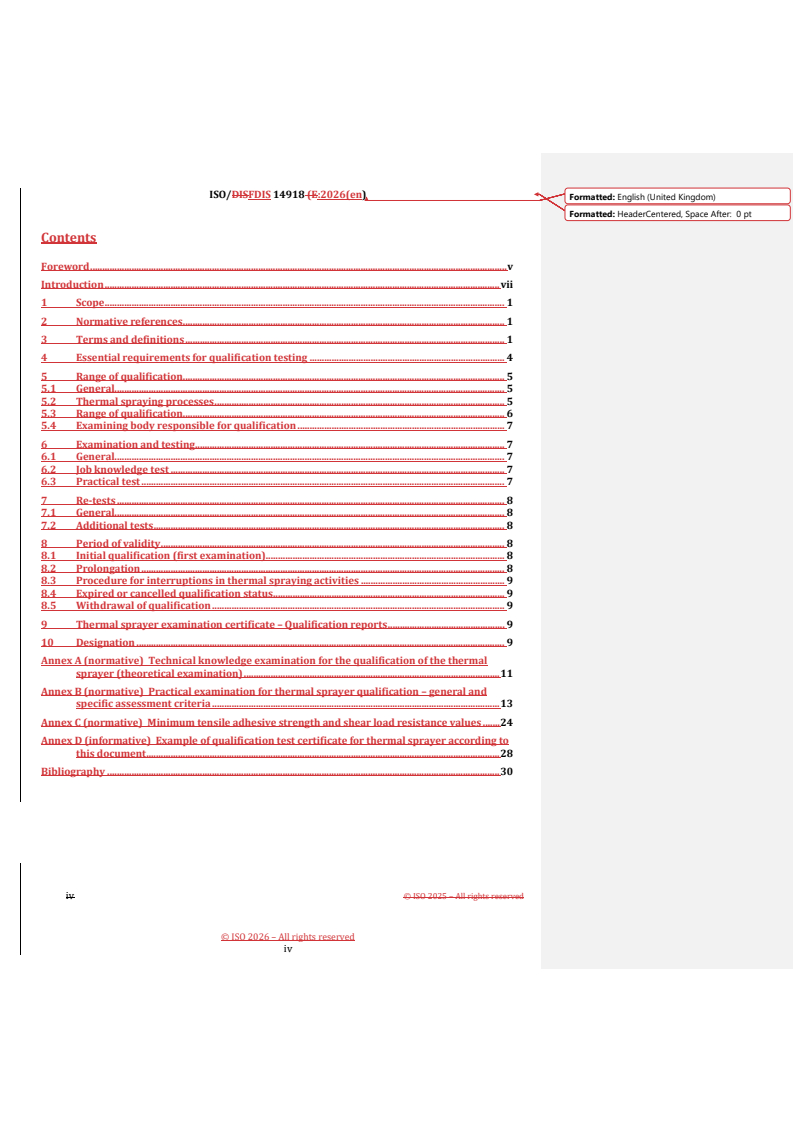
REDLINE ISO/FDIS 14918 - Thermal spraying — Qualification testing of thermal sprayers
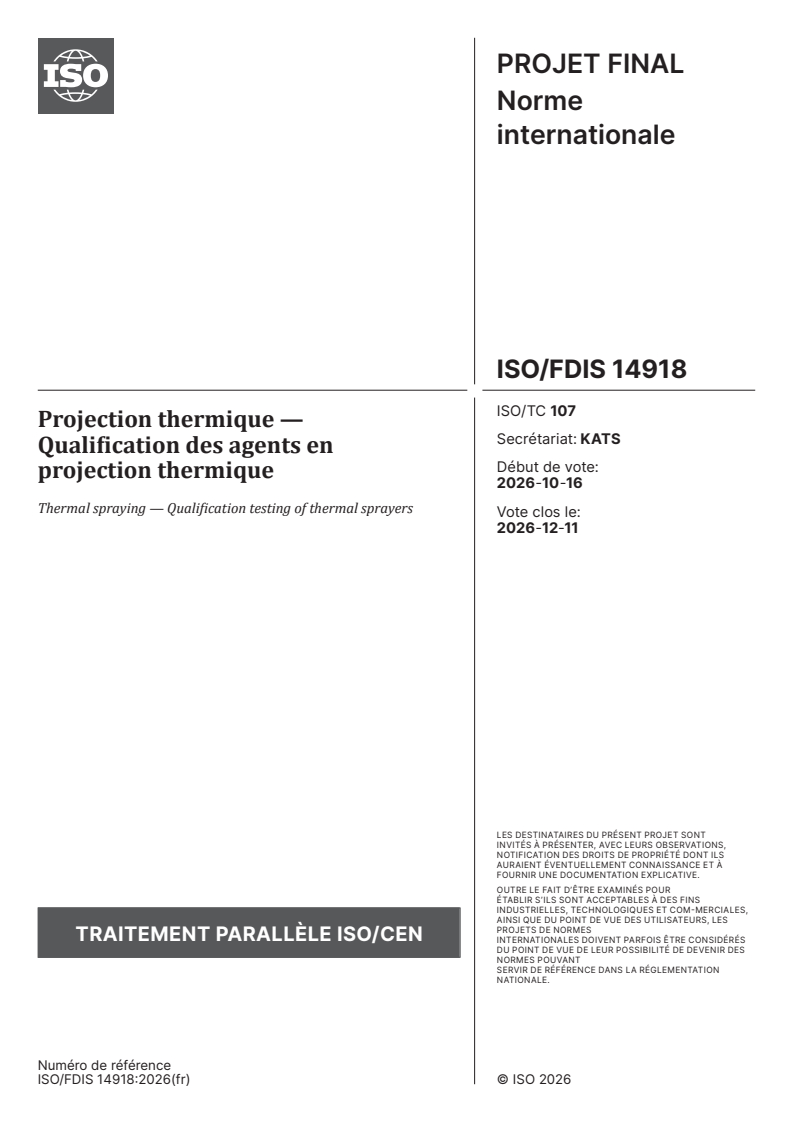
ISO/FDIS 14918 - Projection thermique — Qualification des agents en projection thermique
ISO/FDIS 14918 is an ISO draft International Standard for thermal spraying - Qualification testing of thermal sprayers. It specifies how thermal sprayers are examined, which spray processes and application methods are covered, what test conditions and acceptance criteria apply, and how qualification is recorded and certified. It is intended for examiners, thermal spray employers, purchasers, and inspection authorities that need a common basis for checking sprayer competence.
What does ISO/FDIS 14918 specify?
ISO/FDIS 14918 specifies procedural instructions for qualifying thermal sprayers. It covers the requirements for the examination, the qualification range, test conditions, acceptance requirements, and certification of thermal spray performance.
The document applies to manual and mechanized thermal spraying. For mechanized application, it also includes automatically controlled thermal spraying such as robotics and scan units.
The document is organized into clauses 1 to 10 and four annexes:
| Annex | What it covers |
|---|---|
| Annex A | Technical knowledge examination for thermal sprayer qualification |
| Annex B | Practical examination and specific assessment criteria |
| Annex C | Minimum tensile adhesive strength and shear load resistance values |
| Annex D | Example of a qualification test certificate for a thermal sprayer |
What are the key requirements of ISO/FDIS 14918?
ISO/FDIS 14918 treats qualification as a process-specific assessment, not a general approval. A sprayer is qualified for a defined thermal spray process and a defined method of application, and the result is only valid within that scope.
- Clause 4 requires both a theoretical and a practical examination for initial qualification. The theoretical part checks process knowledge, materials, surface preparation, safety, and inspection topics, while the practical part checks whether the candidate can operate the equipment and make an acceptable sprayed test piece. In practice, this means employers and examiners need to assess both knowledge and actual spraying skill, not only one or the other.
- Clause 5 limits qualification to specific process groups and application methods. The document covers arc spraying, plasma spraying, HVOF, cold spraying, detonation spraying, powder flame spraying, plastic flame spraying, wire/rods/cords flame spraying, powder flame spraying with fusing, laser spraying, and plasma transferred arc spraying (PTA). This matters because passing one process does not automatically qualify a sprayer for another.
- Table 1 in Clause 5 defines the range of qualification by application method. A manual examination covers manual and mechanized application methods for the same process, while a mechanized examination covers mechanized application only. That affects how an examining body writes the qualification scope on the certificate.
- Clause 5.4 and Clause 6 require an independent examiner and an examining body with impartiality, competence, and suitable resources. The practical and theoretical examinations are carried out and assessed independently, and the results are documented for each candidate and each process. In practice, the qualification is only as credible as the independence and traceability of the body that issues it.
- Clause 6 requires two parts for the exam: a job knowledge test and a practical test. The candidate must answer questions on coating processes, application technology, test methods, and materials, then produce and demonstrate control over a coated test piece according to a thermal spray procedure specification (TSPS). If several candidates are tested under identical mechanized conditions, the examination of samples may be reduced to a 20% random check unless irregularities occur.
- Clauses 7 and 8 cover re-tests, validity, prolongation, interruptions, expiry, and withdrawal. The qualification is valid for three years, is confirmed every six months if the sprayer has worked within the original scope, and requires requalification after an interruption of more than six months. If doubts arise about the sprayer’s ability to meet quality requirements or safety practice, the qualification can be withdrawn.
- Clauses 9 and 10 define the qualification certificate and its designation. The certificate must confirm successful technical and practical examination, include the essential influencing factors, and cannot be issued if a mandatory laboratory test fails. The designation on the certificate identifies the document, the process, the application method, and the spray material.
What terms does ISO/FDIS 14918 define?
ISO/FDIS 14918 defines the following terms in Clause 3, using ISO 14917 and related vocabulary for the rest.
- Thermal sprayer - a person who performs thermal spraying with a manual or mechanized system.
- Manual thermal spraying - a process in which the spraying gun or torch is manipulated by hand.
- Mechanized thermal spraying - a process in which some spraying actions are mechanized and the gun or torch is not manipulated by hand.
- Automatic thermal spraying - a process in which all spraying operations, including handling such as loading and unloading, are fully mechanized in a programmed system.
- Examiner - a competent person who conducts and scores an examination where professional judgement is needed.
- Examining body - the organization that verifies compliance with the application standard.
- Specific acceptance criteria - the document that gives the detailed criteria used to qualify a thermal sprayer for a particular spraying technique or application area.
Who uses ISO/FDIS 14918?
ISO/FDIS 14918 is used by thermal spray companies, coating manufacturers, and independent examining bodies that qualify sprayers. It is also used by spray supervisors, quality managers, purchasers, and inspection authorities that need to verify competence before work starts or continues.
In practice, it supports qualification of operators who apply corrosion protection coatings, wear-resistant coatings, hard-facing, ceramics, and other thermally sprayed layers. It is also used for documenting initial qualification, six-month confirmations, requalification, and any withdrawal of qualification.
What changed in ISO/FDIS 14918 from the previous edition?
ISO/FDIS 14918 is the third edition and replaces ISO 14918:2018. The foreword states that the main changes are updated normative references, additional terms and definitions, a restructured document, revised Annex A and Annex B, a formally adapted Annex D, and a bibliography added. It also states that Annex C was changed to informative.
Which standards are used with ISO/FDIS 14918?
ISO/FDIS 14918 cites these standards in Clause 2 and the annexes:
- ISO 14917 - provides the terminology and classification of thermal spraying processes.
- ISO 2063-1 - gives design considerations and quality requirements for zinc, aluminium, and their alloys used in corrosion protection systems.
- ISO 2063-2:2017 - supports execution and testing of corrosion protection systems, including coating thickness and adhesion-related checks.
- ISO 4624 - provides the pull-off adhesion test used as an optional adhesion check.
- ISO 6508-1 - provides the Rockwell hardness test used for sprayed coatings after autogenous melting.
- ISO 14916 - provides the tensile adhesive strength test used for optional assessment.
- EN 15340 - provides the shear load resistance test for thermally sprayed coatings.
- ISO/IEC 17024 and ISO/IEC 17000 - are used as sources for certification and conformity-assessment vocabulary in the term definitions and bibliography.
What does the ISO/FDIS 14918 document contain?
ISO/FDIS 14918 contains the theory examination method in Annex A, including written, oral, observation-based, and computer-based options. It also contains the practical examination method in Annex B, with test-piece selection, surface condition checks, spray setup, process execution, and assessment criteria for different material groups.
Annex B includes example test-piece figures for manual and mechanized coating and gives the laboratory checks used for acceptance, such as coating thickness, visual assessment, adhesion, shear resistance, hardness, machining checks, and metallographic examination.
Annex C provides minimum values for tensile adhesive strength and shear load resistance for different coating materials and spray processes. Annex D gives an example qualification certificate and a sample activity-log format for maintaining validity over time.
Relations
- Consolidates
FprEN ISO 14918 - Thermal spraying - Qualification testing of thermal sprayers (ISO/FDIS 14918:2026) - Effective Date
- 12-Feb-2026
- Consolidates
ISO 24569:2023 - Ships and marine technology — External firefighting system test methods - Effective Date
- 11-Nov-2023
- Effective Date
- 11-Nov-2023
Buy Documents
ISO/FDIS 14918 - Thermal spraying — Qualification testing of thermal sprayers
REDLINE ISO/FDIS 14918 - Thermal spraying — Qualification testing of thermal sprayers
ISO/FDIS 14918 - Projection thermique — Qualification des agents en projection thermique
Get Certified
Connect with accredited certification bodies for this standard

DVS-ZERT GmbH
German welding certification society.
CARES (UK Certification Authority for Reinforcing Steels)
UK certification for reinforcing steels and construction.
EWF/IIW (European/International Welding Federation)
International welding personnel certification.
Sponsored listings
Frequently Asked Questions
ISO/FDIS 14918 is a draft published by the International Organization for Standardization (ISO). Its full title is "Thermal spraying — Qualification testing of thermal sprayers". This standard covers: ISO 14918:2018 specifies procedural instructions for qualification testing of thermal sprayers. It defines requirements, ranges of qualification, test conditions, acceptance requirements and certification for qualification testing of thermal spray performance. ISO 14918:2018 is applicable when the thermal sprayer's qualification is required by this document, the purchaser, by inspection authorities or by other organizations. The thermal spraying processes referred to in this document include those spraying processes which are designated as manual or mechanized. The test for mechanised application includes the use of automatically controlled thermal spraying, e.g. robotics, scan units.
ISO 14918:2018 specifies procedural instructions for qualification testing of thermal sprayers. It defines requirements, ranges of qualification, test conditions, acceptance requirements and certification for qualification testing of thermal spray performance. ISO 14918:2018 is applicable when the thermal sprayer's qualification is required by this document, the purchaser, by inspection authorities or by other organizations. The thermal spraying processes referred to in this document include those spraying processes which are designated as manual or mechanized. The test for mechanised application includes the use of automatically controlled thermal spraying, e.g. robotics, scan units.
ISO/FDIS 14918 is classified under the following ICS (International Classification for Standards) categories: 25.220.20 - Surface treatment. The ICS classification helps identify the subject area and facilitates finding related standards.
ISO/FDIS 14918 has the following relationships with other standards: It is inter standard links to FprEN ISO 14918, ISO 24569:2023, ISO 14918:2018. Understanding these relationships helps ensure you are using the most current and applicable version of the standard.
ISO/FDIS 14918 is available in PDF format for immediate download after purchase. The document can be added to your cart and obtained through the secure checkout process. Digital delivery ensures instant access to the complete standard document.
Standards Content (Sample)
FINAL DRAFT
International
Standard
ISO/TC 107
Thermal spraying — Qualification
Secretariat: KATS
testing of thermal sprayers
Voting begins on:
Projection thermique — Qualification des agents en projection 2026-10-16
thermique
Voting terminates on:
2026-12-11
RECIPIENTS OF THIS DRAFT ARE INVITED TO SUBMIT,
WITH THEIR COMMENTS, NOTIFICATION OF ANY
RELEVANT PATENT RIGHTS OF WHICH THEY ARE AWARE
AND TO PROVIDE SUPPOR TING DOCUMENTATION.
IN ADDITION TO THEIR EVALUATION AS
BEING ACCEPTABLE FOR INDUSTRIAL, TECHNO
ISO/CEN PARALLEL PROCESSING LOGICAL, COMMERCIAL AND USER PURPOSES, DRAFT
INTERNATIONAL STANDARDS MAY ON OCCASION HAVE
TO BE CONSIDERED IN THE LIGHT OF THEIR POTENTIAL
TO BECOME STAN DARDS TO WHICH REFERENCE MAY BE
MADE IN NATIONAL REGULATIONS.
Reference number
FINAL DRAFT
International
Standard
ISO/TC 107
Thermal spraying — Qualification
Secretariat: KATS
testing of thermal sprayers
Voting begins on:
Projection thermique — Qualification des agents en projection
thermique
Voting terminates on:
© ISO 2026
All rights reserved.
RECIPIENTS OF THIS DRAFT ARE INVITED TO SUBMIT,
WITH THEIR COMMENTS, NOTIFICATION OF ANY
This ISO publication is protected by copyright and is owned by ISO and/or its licensors.
RELEVANT PATENT RIGHTS OF WHICH THEY ARE AWARE
The content of this ISO publication is provided under licence, not sold. Use is subject to the applicable licence terms issued by ISO,
AND TO PROVIDE SUPPOR TING DOCUMENTATION.
an ISO member body, or an authorized third-party distributor.
IN ADDITION TO THEIR EVALUATION AS
BEING ACCEPTABLE FOR INDUSTRIAL, TECHNO
Except as required for implementation or expressly permitted by a separate licence, no part of this ISO publication may be
ISO/CEN PARALLEL PROCESSING
LOGICAL, COMMERCIAL AND USER PURPOSES, DRAFT
reproduced, distributed, modified, used, or made available in any form or by any means – electronic or mechanical, including
INTERNATIONAL STANDARDS MAY ON OCCASION HAVE
photocopying, scanning, recording, or posting on internal or external digital platforms. TO BE CONSIDERED IN THE LIGHT OF THEIR POTENTIAL
TO BECOME STAN DARDS TO WHICH REFERENCE MAY BE
Any use beyond the scope of the granted rights is prohibited and may result in legal action.
MADE IN NATIONAL REGULATIONS.
ISO copyright office
CP 401 • CH-1214 Vernier, Geneva
Phone: +41 22 749 01 11
Email: copyright@iso.org
Website: www.iso.org
Published in Switzerland
Reference number
ii
Contents Page
Foreword .iv
Introduction .v
1 Scope . 1
2 Normative references . 1
3 Terms and definitions . 1
4 Essential requirements for qualification testing . 3
5 Range of qualification . 4
5.1 General .4
5.2 Thermal spraying processes .4
5.2.1 Grouping of thermal spraying processes .4
5.2.2 Application methods .4
5.2.3 Spray materials .4
5.3 Range of qualification .5
5.4 Examining body responsible for qualification .5
6 Examination and testing . 6
6.1 General .6
6.2 Job knowledge test .6
6.3 Practical test .6
7 Re-tests. 6
7.1 General .6
7.2 Additional tests .6
8 Period of validity . 7
8.1 Initial qualification (first examination) .7
8.2 Prolongation .7
8.3 Procedure for interruptions in thermal spraying activities .7
8.4 Expired or cancelled qualification status .7
8.5 Withdrawal of qualification .7
9 Thermal sprayer examination certificate – Qualification reports . 8
10 Designation . 8
Annex A (normative) Technical knowledge examination for the qualification of the thermal
sprayer (theoretical examination) . 9
Annex B (normative) Practical examination for thermal sprayer qualification – general and
specific assessment criteria .11
Annex C (normative) Minimum tensile adhesive strength and shear load resistance values . 19
Annex D (informative) Example of qualification test certificate for thermal sprayer according
to this document.22
Bibliography .24
iii
Foreword
ISO (the International Organization for Standardization) is a worldwide federation of national standards
bodies (ISO member bodies). The work of preparing International Standards is normally carried out through
ISO technical committees. Each member body interested in a subject for which a technical committee
has been established has the right to be represented on that committee. International organizations,
governmental and non-governmental, in liaison with ISO, also take part in the work. ISO collaborates closely
with the International Electrotechnical Commission (IEC) on all matters of electrotechnical standardization.
The procedures used to develop this document and those intended for its further maintenance are described
in the ISO/IEC Directives, Part 1. In particular, the different approval criteria needed for the different types
of ISO document should be noted. This document was drafted in accordance with the editorial rules of the
ISO/IEC Directives, Part 2 (see www.iso.org/directives).
ISO draws attention to the possibility that the implementation of this document may involve the use of (a)
patent(s). ISO takes no position concerning the evidence, validity or applicability of any claimed patent
rights in respect thereof. As of the date of publication of this document, ISO had not received notice of (a)
patent(s) which may be required to implement this document. However, implementers are cautioned that
this may not represent the latest information, which may be obtained from the patent database available at
www.iso.org/patents. ISO shall not be held responsible for identifying any or all such patent rights.
Any trade name used in this document is information given for the convenience of users and does not
constitute an endorsement.
For an explanation of the voluntary nature of standards, the meaning of ISO specific terms and expressions
related to conformity assessment, as well as information about ISO's adherence to the World Trade
Organization (WTO) principles in the Technical Barriers to Trade (TBT), see www.iso.org/iso/foreword.html.
This document was prepared by Technical Committee ISO/TC 107, Metallic and other inorganic coatings, in
collaboration with the European Committee for Standardization (CEN) Technical Committee CEN/TC 240,
Thermal spraying and thermally sprayed coatings, in accordance with the Agreement on technical cooperation
between ISO and CEN (Vienna Agreement).
This third edition cancels and replaces the second edition (ISO 14918:2018), which has been technically
revised.
The main changes are as follows:
— normative reverences have been updated;
— further terms and definitions have been added;
— the document has been restructured (inconsistencies were fixed, in particular regarding the theoretical
and practical examinations, handling of the extension of the qualification, stipulations for the repeat
examination etc.);
— Annex A has been restructured and revised regarding the technical knowledge examination, additional
explanations added;
— Annex B has been restructured and revised regarding specific assessment conditions, new assessment
criteria added;
— Annex C has been changed into informative and formally adapted;
— Annex D has been formally adapted;
— a Bibliography has been added.
Any feedback or questions on this document should be directed to the user’s national standards body. A
complete listing of these bodies can be found at www.iso.org/members.html.
iv
Introduction
This document examines the principles of qualification testing of sprayer performance for thermal spraying.
The quality of work involved in thermal spraying depends on the skill, operation of the spray equipment and
job knowledge of the thermal sprayer.
The ability of the thermal sprayer to follow verbal and written instructions and the testing of their skill and
operation of the spray equipment are therefore important factors in ensuring the quality of the thermally
sprayed product.
This document is intended to provide the basis for mutual recognition by examining bodies for qualification
relating to a thermal sprayer’s competence in the various fields of application. Tests can be carried out
according to this document, unless more severe tests are specified by the relevant application standards, in
which case these can be applied.
The thermal sprayer’s skill and job knowledge continues to be classified as qualified as long as the thermal
sprayer works with reasonable continuity on thermal spraying work within the extent of qualification.
v
FINAL DRAFT International Standard ISO/FDIS 14918:2026(en)
Thermal spraying — Qualification testing of thermal sprayers
1 Scope
This document specifies procedural instructions for qualification testing of thermal sprayers. It defines
requirements, ranges of qualification, test conditions, acceptance requirements and certification for
qualification testing of thermal spray performance.
This document is applicable when the thermal sprayer’s qualification is required in accordance with Clause
7 and Clause 8, by the purchaser, by inspection authorities or by other organizations.
This document describes thermal spraying processes that are designated as manual or mechanized.
The test for mechanised application includes the use of automatically controlled thermal spraying, e.g.
robotics, scan units.
2 Normative references
The following documents are referred to in the text in such a way that some or all of their content constitutes
requirements of this document. For dated references, only the edition cited applies. For undated references,
the latest edition of the referenced document (including any amendments) applies.
ISO 2063-1, Thermal spraying — Zinc, aluminium and their alloys — Part 1: Design considerations and quality
requirements for corrosion protection systems
ISO 2063-2:2017, Thermal spraying — Zinc, aluminium and their alloys — Part 2: Execution of corrosion
protection systems
ISO 4624, Paints and varnishes — Pull-off test for adhesion
ISO 6508-1, Metallic materials — Rockwell hardness test — Part 1: Test method
ISO 14916, Thermal spraying — Determination of tensile adhesive strength
ISO 14917, Thermal spraying — Terminology, classification
EN 15340, Thermal spraying — Determination of shear load resistance of thermally sprayed coatings
3 Terms and definitions
For the purposes of this document, the terms and definitions given in ISO 14917 and the following apply.
ISO and IEC maintain terminology databases for use in standardization at the following addresses:
— ISO Online browsing platform: available at https:// www .iso .org/ obp
— IEC Electropedia: available at https:// www .electropedia .org/
3.1
thermal sprayer
person who performs thermal spraying with a manual or mechanized system
3.2
manual thermal spraying
process in which the spraying gun or torch is manipulated by hand
3.3
mechanized thermal spraying
process in which some aspects are mechanized, i.e. with the gun or torch not manipulated by hand
3.4
automatic thermal spraying
process in which all operations typical of the spraying process are fully mechanized including all handling,
e.g. workpiece loading and unloading, and which are integrated in a programmed system
Note 1 to entry: For examination, it is equal to mechanized thermal spraying (3.3).
3.5
examiner
person competent to conduct and score an examination, where the examination requires judgement on the
competence of persons
[SOURCE: ISO/IEC 17024:2026, 3.14]
3.6
examining body
organization who verifies compliance with the application standard
Note 1 to entry: In certain cases, an external independent examining body can be required.
3.7
specific acceptance criteria
document providing in detail the criteria by which a thermal sprayer (3.1) can be tested to be qualified for a
particular spraying technique or application area
3.8
test piece
thermal spray workpiece used for the qualification test (3.10)
3.9
test specimen
portion cut from the test piece (3.8) in order to perform a specified analytical test (3.10)
3.10
test
series of operations which include the making of a thermally sprayed test piece (3.8), subsequent non-
destructive and/or destructive testing and reporting of results
3.11
competence
ability to apply knowledge and skills to achieve intended results
[SOURCE: ISO/IEC 17024:2026, 3.9]
3.12
qualification
demonstrated education, training and work experience
[SOURCE: ISO/IEC 17024:2026, 3.11]
3.13
validity
evidence that an assessment (3.15) measures what it is intended to measure, as defined by the certification
scheme
Note 1 to entry: In this document, validity is also used in its adjective form "valid".
[SOURCE: ISO/IEC 17024:2026, 3.24, modified — Note 1 to entry has been removed.]
3.14
independence
freedom of a person or organization from the control or authority of another person or organization
[SOURCE: ISO/IEC 17000:2020, 5.4, modified — EXAMPLE has been removed.]
3.15
assessment
evaluation of a person's fulfilment of the certification requirements specified in the certification scheme
[SOURCE: ISO/IEC 17024:2026, 3.12]
4 Essential requirements for qualification testing
The examination of thermal sprayers is based on key influencing factors (e.g. the spraying process, execution
method). A scope is defined for each key influencing factor. The competence of the thermal sprayer in the
respective areas is determined using the criteria prescribed in this clause.
The qualification examination mainly takes place after the thermal sprayer training and includes a
theoretical part and a practical part.
NOTE Candidates (thermal sprayers) who already have proven practical experience can proceed directly (without
taking part in additional training) with the qualification testing.
The thermal sprayer candidate shall be examined for basic technical knowledge and specific process-related
knowledge of all thermal spray processes and activities to be qualified.
The following specialist topics are examined as part of the specialist theoretical examination (technical
knowledge examination):
— facilities and environmental conditions for thermal spraying;
— thermal spray processes to be qualified;
— substrate materials and consumables;
— surface preparation;
— safety and accident prevention;
— examination procedures and examination of prepared and thermally sprayed surfaces;
— other specialist topics, e.g. operating the facilities, masking processes, using the equipment.
For additional explanations, see Annex A.
The test pieces for the practical part of the examination shall be selected in accordance with Clause B.5,
according to the application technique manual or mechanized spraying and the spray process chosen by the
candidate.
The candidate shall thermally coat the test item in accordance with a thermal spray procedure specification
(TSPS). The thermal sprayer should be able to demonstrate (during the practical examination) that they are
able to handle the spray gun/facility and set the spray parameters (according to TSPS).
For additional explanations, see Annex B.
5 Range of qualification
5.1 General
Thermal sprayers shall be qualified for thermal spraying to a specific coating process and method of
application technique (execution method). The qualification shall only be valid for that specific coating
process and method of application. The thermal spraying processes and methods of application covered by
this document are identified in 5.2.
NOTE It is possible to qualify a thermal sprayer for several spray processes. This can be done by coating several
test pieces (different spray processes and execution methods) and several technical knowledge examinations.
5.2 Thermal spraying processes
5.2.1 Grouping of thermal spraying processes
This document covers the following thermal spraying processes according to ISO 14917:
— arc spraying;
— plasma spraying;
— high velocity oxy fuel flame spraying, cold spraying, detonation spraying;
— powder flame spraying, plastic flame spraying;
— wire/rods/cords flame spraying;
— powder flame spraying with fusing, laser spraying, plasma transferred arc spraying (PTA).
5.2.2 Application methods
This document covers the following application methods:
— manual;
— mechanized.
The range of qualification listed in Table 1 depends on the application technique used in the examination.
Table 1 — Range of qualification – Application methods
Test piece/application technique Range of qualification
manual manual and mechanized
mechanized mechanized
5.2.3 Spray materials
5.2.3.1 General
The spray materials used in the qualification test are split into material groups.
The materials listed in 5.2.3.2 to 5.2.3.5 are given for information to show which material is generally
appropriate for each process.
5.2.3.2 Flame spraying (powder, wire, cords or rods)/arc spraying
The following materials are appropriate for flame (powder, wire, cords or rods) or arc spraying:
— metals and alloys (for engineering purposes);
— zinc, aluminium and their alloys and plastic (for corrosion protection).
5.2.3.3 Flame spraying (powder, wire, cords or rods, PTA, laser spraying and flame sprayed and
fused)
The following materials are appropriate for flame spraying (powder, wire, cords or rods, PTA, laser spraying
and flame sprayed and fused):
— self-fluxing alloys, cobalt based alloys, hard-facing.
5.2.3.4 Plasma spraying, plasma spraying in controlled atmospheres
The following materials are appropriate for plasma spraying, plasma spraying in a chamber under vacuum:
— metals and alloys;
— metal-based hard material;
— ceramics, hydroxyl-apatite.
5.2.3.5 High velocity flame spraying
The following materials are appropriate for high velocity flame spraying:
— metals and alloys;
— metal-based hard material.
5.3 Range of qualification
The requirements for the initial approval (initial qualification) of a thermal sprayer are different for each of
the processes referred to in 5.2. The qualification in one group (process, see 5.2.1) does not mean that skills
and experience in the use of this specific thermal spray technique are also available in any other group.
NOTE 1 This means that, if a candidate has taken and passed a qualification examination for a specific spray
process, they are only qualified to carry out this spray process as a qualified sprayer (see Annex B).
NOTE 2 The qualification range of the thermal sprayer is defined in the sprayer examination certificate (according
to this document) by the examiner responsible for the qualification, based on the information on the thermal coating
process and the application technique. For example, “arc spraying - manual” can stand for the manual operation of
an arc spraying facility. On request, information on the spray material (material group) used in the qualification
examination on request is provided by the examiner (see Annex A, Annex B and Annex D).
5.4 Examining body responsible for qualification
The qualification examination of the sprayer as well as the testing of the test pieces shall be carried out by
an independent examiner.
The examining body shall ensure its impartiality and independence. The personnel of the examiner shall
have sufficient expertise in the field of thermal spraying to be able to carry out thermal spray testing
properly and professionally. The examiner shall have the necessary resources to adequately carry out the
technical and administrative tasks associated with thermal sprayer examination, including access to all
necessary equipment and examination facilities.
6 Examination and testing
6.1 General
The thermal sprayer candidate shall take two examinations on the respective spray process:
— They shall complete a technical job knowledge test to determine their knowledge of the process.
— They shall undergo a practical test to demonstrate their skill and ability to operate the equipment in the
appropriate area.
At the end of the qualification examination, the independent examining body creates an evaluation
documentation of all results (technical knowledge, practical examination including laboratory results) for
each candidate and each spray process to be qualified.
NOTE A possible documentation process of activities is shown in Table D.1.
6.2 Job knowledge test
The candidate or the thermal sprayer shall satisfactorily answer all questions about the coating processes,
the application technology, the coating tests to be carried out and the material.
The independent examining body shall take the theoretical examination and prepare and assess it.
The individual points that shall be covered are described in Annex A of this document.
6.3 Practical test
The practical test serves to assess whether the candidate has the necessary practical skills. Details of the
practical examination and the specific assessment criteria can be found in Annex B.
The examining body is responsible for taking the examination and evaluating the practical examination. The
results of the laboratory tests on the sprayed samples (see specifications in Annex B) shall be documented.
NOTE If several candidates complete a similar thermal spray examination (i.e. with identical process parameters
or spray equipment and material) in the mechanized spray process, the assessment of the examination can be
reduced to a random test of 20 %, provided that no unacceptable coatings were produced. However, in the event of
irregularities, testing of the samples of all candidates is appropriate.
7 Re-tests
7.1 General
If the candidate does not meet the requirements of this document or does not pass the examinations taken,
the examining body may, at its discretion, schedule a repeat examination, but only after additional training
(if necessary, practical and/or theoretical training).
7.2 Additional tests
If the thermal sprayer candidate can show during spraying (practical examination) that an externally caused
error prevents them from producing a good test piece, a new attempt may be made if this error has been
eliminated.
8 Period of validity
8.1 Initial qualification (first examination)
The validity of the thermal sprayer examination certificate (certificate) begins on the date of the qualification
examination taken. The qualification of a thermal sprayer is valid for three years (see 8.2).
A thermal sprayer’s qualification shall remain valid for a period of three years provided that:
— The sprayer has provably sprayed in their relevant production field.
— This activity has not been interrupted for more than six months.
— A re-qualification has been carried out showing a satisfactory test piece.
The relevant certificate shall be signed at six months intervals by the employer or coordinator and shall
show that the conditions outlined in 8.2, 8.3, 8.4 and 8.5 are fulfilled.
8.2 Prolongation
The qualification of the thermal sprayer for a spray process shall be confirmed every six months by the spray
supervisor (manufacturer) or the examiner or examining body. It shall be confirmed that the sprayer has
sprayed within the original scope during this period, thereby extending the validity of the thermal sprayer
examination certificate for a further period of six months (see Annex D).
The qualification (repeat qualification) of the thermal sprayer shall be extended every three years. The
extension of the qualification shall be carried out by an independent examining body.
The condition for extending the qualification is that acceptable thermally sprayed samples are sprayed (see
6.3).
A technical knowledge examination (see 6.2) is not required, provided that the evidence mentioned in
this subclause (i.e. the sprayer can confirm their spraying activities or no interruption for longer than six
months) is presented (see Annex D). See also 8.4.
NOTE The practical examination of the thermally sprayed test pieces is carried out according to Annex B
(analogous to the initial qualification).
8.3 Procedure for interruptions in thermal spraying activities
A thermal sprayer who has not carried out any spray work in production for a period of six months within the
original scope of application shall go through the procedural steps for re-qualification in order to regain the
qualification. The requalification examinations are carried out in the same way as the initial qualification.
NOTE The thermal sprayer's examinations (technical knowledge, practical) are carried out according to An
...
Style Definition
...
Style Definition
...
Style Definition
...
Style Definition
...
Style Definition
...
Style Definition
...
ISO/TC 107/SC /WG 1
Style Definition
...
Style Definition
...
Secretariat: KATS
Style Definition
...
Date: 2026-10-02-26
Style Definition
...
Style Definition
...
Style Definition
...
Style Definition
...
Style Definition
...
Style Definition
...
Thermal spraying — Qualification testing of thermal sprayers
Style Definition
...
Projection thermique — Qualification des agents en projection thermique
Style Definition
...
Style Definition
...
Style Definition
...
Style Definition
...
Style Definition
...
Style Definition
...
Style Definition
...
Style Definition
...
Style Definition
...
Style Definition
...
Style Definition
...
Style Definition
...
Style Definition
...
Style Definition
...
Style Definition
...
Style Definition
...
Style Definition
...
Style Definition
...
Style Definition
...
Style Definition
...
Style Definition
...
Style Definition
...
TThhiiss d drraftaft i iss s suubbmmiitttteded t too a pa pararallel vallel vootte e iinn I ISSOO,, C CEENN.
Style Definition
...
Style Definition
...
Style Definition
...
Style Definition
...
Style Definition
...
Style Definition
...
Style Definition
...
Style Definition
...
Style Definition
...
Style Definition
...
Style Definition
...
Style Definition
...
Style Definition
...
Style Definition
...
Style Definition
...
Style Definition
...
Style Definition
...
Style Definition
...
Style Definition
...
Style Definition
© FDIS stage
Formatted: Font: Bold, English (United Kingdom)
Formatted: Font: Bold
Formatted: HeaderCentered, Left
© ISO 2026
Formatted: Default Paragraph Font
All rights reserved. Unless otherwise specified, Formatted: Default Paragraph Font
This ISO publication is protected by copyright and is owned by ISO and/or its licensors.
Formatted: Adjust space between Latin and Asian text,
The content of this ISO publication is provided under licence, not sold. Use is subject to the applicable licence terms issued
Adjust space between Asian text and numbers
by ISO, an ISO member body, or an authorized third-party distributor.
Formatted: Left: 1.5 cm, Right: 1.5 cm, Gutter: 0 cm,
Except as required in the context of its for implementation or expressly permitted by a separate licence, no part of this
ISO publication may be reproduced or utilized otherwise, distributed, modified, used, or made available in any form or Header distance from edge: 1.27 cm
by any means, – electronic or mechanical, including photocopying, scanning, recording, or posting on internal or external
digital platforms.
Any use beyond the internet or an intranet, without prior written permission. Permission can be requested from either
Formatted: Adjust space between Latin and Asian text,
ISO at the address below or ISO's member body in the countryscope of the requestergranted rights is prohibited and may
Adjust space between Asian text and numbers
result in legal action.
ISO Copyright Officecopyright office
CP 401 • CH-1214 Vernier, Geneva
Phone: + 41 22 749 01 11
Email: copyright@iso.org
Email: copyright@iso.org
Website: www.iso.orgwww.iso.org
Published in Switzerland.
Formatted: Font: 10 pt
Formatted: Font: 10 pt
Formatted: Font: 10 pt
Formatted: FooterCentered, Left, Space Before: 0 pt,
Tab stops: Not at 17.2 cm
Formatted: Font: 11 pt, Not Bold
© ISO 2026 – All rights reserved
iii
ISO/DISFDIS 14918 (E:2026(en)
Formatted: English (United Kingdom)
Formatted: HeaderCentered, Space After: 0 pt
Contents
Foreword . v
Introduction . vii
1 Scope . 1
2 Normative references . 1
3 Terms and definitions . 1
4 Essential requirements for qualification testing . 4
5 Range of qualification. 5
5.1 General. 5
5.2 Thermal spraying processes . 5
5.3 Range of qualification. 6
5.4 Examining body responsible for qualification . 7
6 Examination and testing . 7
6.1 General. 7
6.2 Job knowledge test . 7
6.3 Practical test . 7
7 Re-tests . 8
7.1 General. 8
7.2 Additional tests . 8
8 Period of validity . 8
8.1 Initial qualification (first examination). 8
8.2 Prolongation . 8
8.3 Procedure for interruptions in thermal spraying activities . 9
8.4 Expired or cancelled qualification status . 9
8.5 Withdrawal of qualification . 9
9 Thermal sprayer examination certificate – Qualification reports . 9
10 Designation . 9
Annex A (normative) Technical knowledge examination for the qualification of the thermal
sprayer (theoretical examination) . 11
Annex B (normative) Practical examination for thermal sprayer qualification – general and
specific assessment criteria . 13
Annex C (normative) Minimum tensile adhesive strength and shear load resistance values . 24
Annex D (informative) Example of qualification test certificate for thermal sprayer according to
this document . 28
Bibliography . 30
iv
iv
Formatted: Font: Bold, English (United Kingdom)
Formatted: Font: Bold
Formatted: HeaderCentered, Left
Foreword
Formatted: Adjust space between Latin and Asian text,
Adjust space between Asian text and numbers
ISO (the International Organization for Standardization) is a worldwide federation of national standards
bodies (ISO member bodies). The work of preparing International Standards is normally carried out through
ISO technical committees. Each member body interested in a subject for which a technical committee has been
established has the right to be represented on that committee. International organizations, governmental and
non-governmental, in liaison with ISO, also take part in the work. ISO collaborates closely with the
International Electrotechnical Commission (IEC) on all matters of electrotechnical standardization.
The procedures used to develop this document and those intended for its further maintenance are described
in the ISO/IEC Directives, Part 1. In particular, the different approval criteria needed for the different types of
ISO document should be noted. This document was drafted in accordance with the editorial rules of the
ISO/IEC Directives, Part 2 (see www.iso.org/directives).
Formatted: English (United Kingdom)
Formatted: Default Paragraph Font, English (United
ISO draws attention to the possibility that the implementation of this document may involve the use of (a)
Kingdom)
patent(s). ISO takes no position concerning the evidence, validity or applicability of any claimed patent rights
in respect thereof. As of the date of publication of this document, ISO had not received notice of (a) patent(s)
which may be required to implement this document. However, implementers are cautioned that this may not
represent the latest information, which may be obtained from the patent database available at
www.iso.org/patents.www.iso.org/patents. ISO shall not be held responsible for identifying any or all such
patent rights.
Any trade name used in this document is information given for the convenience of users and does not
constitute an endorsement.
For an explanation of the voluntary nature of standards, the meaning of ISO specific terms and expressions
related to conformity assessment, as well as information about ISO's adherence to the World Trade
Organization (WTO) principles in the Technical Barriers to Trade (TBT), see
www.iso.org/iso/foreword.htmlwww.iso.org/iso/foreword.html.
Formatted: English (United Kingdom)
This document was prepared by Technical Committee ISO/TC 107, Metallic and other inorganic coatings, in
Formatted: Font: Not Italic
collaboration with the European Committee for Standardization (CEN) Technical Committee CEN/TC 240,
Formatted: Font: Not Italic
Thermal spraying and thermally sprayed coatings, in accordance with the Agreement on technical cooperation
Formatted: Font: Not Italic
between ISO and CEN (Vienna Agreement).
This third edition cancels and replaces the second edition (ISO 14918:2018), which has been technically
Formatted: Default Paragraph Font
revised.
Formatted: Default Paragraph Font
Formatted: Default Paragraph Font
The main changes are as follows:
Formatted: Adjust space between Latin and Asian text,
— — normative reverences have been updated;
Adjust space between Asian text and numbers
— — further terms and definitions have been added;
— — the document has been restructured (inconsistencies were fixed, in particular regarding the
theoretical and practical examinations, handling of the extension of the qualification, stipulations for the
repeat examination etc.);
— — Annex AAnnex A has been restructured and revised regarding the technical knowledge examination,
Formatted: Font: 10 pt
additional explanations added;
Formatted: Font: 10 pt
Formatted: Font: 10 pt
— — Annex BAnnex B has been restructured and revised regarding specific assessment conditions, new
assessment criteria added;
Formatted: FooterCentered, Left, Space Before: 0 pt,
Tab stops: Not at 17.2 cm
— — Annex CAnnex C has been changed into informative and formally adapted;
Formatted: Font: 11 pt, Not Bold
© ISO 2026 – All rights reserved
v
ISO/DISFDIS 14918 (E:2026(en)
Formatted: English (United Kingdom)
Formatted: HeaderCentered, Space After: 0 pt
— — Annex DAnnex D has been formally adapted;
— — a Bibliography has been added.
Any feedback or questions on this document should be directed to the user’s national standards body. A
Formatted: English (United Kingdom)
complete listing of these bodies can be found at www.iso.org/members.html.
Formatted: English (United Kingdom)
Formatted: Default Paragraph Font, English (United
Kingdom)
Formatted: English (United Kingdom)
Field Code Changed
vi
vi
Formatted: Font: Bold, English (United Kingdom)
Formatted: Font: Bold
Formatted: HeaderCentered, Left
Introduction
Formatted: Adjust space between Latin and Asian text,
Adjust space between Asian text and numbers
This document examines the principles of qualification testing of sprayer performance for thermal spraying.
The quality of work involved in thermal spraying depends on the skill, operation of the spray equipment and
job knowledge of the thermal sprayer.
The ability of the thermal sprayer to follow verbal and written instructions and the testing of their skill and
operation of the spray equipment are therefore important factors in ensuring the quality of the thermally
sprayed product.
This document is intended to provide the basis for mutual recognition by examining bodies for qualification
relating to a thermal sprayer’s competence in the various fields of application. Tests can be carried out in
accordance withaccording to this document, unless more severe tests are specified by the relevant application
standards, in which case these can be applied.
The thermal sprayer’s skill and job knowledge continues to be classified as qualified as long as the thermal
sprayer works with reasonable continuity on thermal spraying work within the extent of qualification.
Formatted: Font: 10 pt
Formatted: Font: 10 pt
Formatted: Font: 10 pt
Formatted: FooterCentered, Left, Space Before: 0 pt,
Tab stops: Not at 17.2 cm
Formatted: Font: 11 pt, Not Bold
© ISO 2026 – All rights reserved
vii
DRAFT International Standard ISO/FDIS 14918:2026(en)
Thermal spraying — Qualification testing of thermal sprayers
Formatted: Left: 1.5 cm, Right: 1.5 cm, Gutter: 0 cm,
Section start: New page, Header distance from edge:
1 Scope 1.27 cm
Formatted: Default Paragraph Font
This document specifies procedural instructions for qualification testing of thermal sprayers. It defines
Formatted: Default Paragraph Font
requirements, ranges of qualification, test conditions, acceptance requirements and certification for
qualification testing of thermal spray performance.
Formatted: Default Paragraph Font
Formatted: Default Paragraph Font
This document is applicable when the thermal sprayer’s qualification is required by this documentin
Formatted: Adjust space between Latin and Asian text,
accordance with Clause 7 and Clause 8, by the purchaser, by inspection authorities or by other organizations.
Adjust space between Asian text and numbers, Tab
stops: Not at 0.7 cm + 1.4 cm + 2.1 cm + 2.8 cm +
The thermal spraying processes referred to in thisThis document includedescribes thermal spraying
3.5 cm + 4.2 cm + 4.9 cm + 5.6 cm + 6.3 cm + 7 cm
processes that are designated as manual or mechanized.
Formatted: Default Paragraph Font
The test for mechanised application includes the use of automatically controlled thermal spraying, e.g.
Formatted: Default Paragraph Font
robotics, scan units.
Formatted: Default Paragraph Font
2 Normative references Formatted: Default Paragraph Font
Formatted: Default Paragraph Font
The following documents are referred to in the text in such a way that some or all of their content constitutes
Formatted: Default Paragraph Font
requirements of this document. For dated references, only the edition cited applies. For undated references,
the latest edition of the referenced document (including any amendments) applies.
Formatted: Default Paragraph Font
Formatted: Default Paragraph Font
ISO 2063--1, Thermal spraying — Zinc, aluminium and their alloys — Part 1: Design considerations and
quality requirements for corrosion protection systems Formatted: Default Paragraph Font
Formatted: Default Paragraph Font
ISO 2063--2:2017, Thermal spraying — Zinc, aluminium and their alloys — Part 2: Execution of corrosion
Formatted: Default Paragraph Font
protection systems
Formatted: Default Paragraph Font
ISO 4624, Paints and varnishes — Pull-off test for adhesion
Formatted: Default Paragraph Font
Formatted: Default Paragraph Font
ISO 6508--1, Metallic materials — Rockwell hardness test — Part 1: Test method
Formatted: Default Paragraph Font
ISO 14916, Thermal spraying — Determination of tensile adhesive strength
Formatted: Default Paragraph Font
ISO 14917, Thermal spraying — Terminology, classification
Formatted: Default Paragraph Font
Formatted: Default Paragraph Font
EN 15340, Thermal spraying — Determination of shear load resistance of thermally sprayed coatings
Formatted: Default Paragraph Font
3 Terms and definitions
Formatted: Default Paragraph Font
Formatted: Default Paragraph Font
For the purposes of this document, the terms and definitions given in ISO 14917 and the following apply.
Formatted: Default Paragraph Font
ISO and IEC maintain terminology databases for use in standardization at the following addresses:
Formatted: English (United Kingdom)
Formatted: Font: Cambria, 11 pt, English (United
— — ISO Online browsing platform: available at https://www.iso.org/obphttps://www.iso.org/obp
Kingdom)
— — IEC Electropedia: available at https://www.electropedia.org/https://www.electropedia.org/ Formatted: English (United Kingdom)
Formatted: English (United Kingdom)
Formatted: Font: Cambria, English (United Kingdom)
ISO/DISFDIS 14918 (E:2026(en)
Formatted: English (United Kingdom)
Formatted: HeaderCentered, Space After: 0 pt
3.1 3.1
thermal sprayer
person who performs thermal spraying with a manual or mechanized system
3.2 3.2
manual thermal spraying
process in which the spraying gun or torch is manipulated by hand
3.3 3.3
mechanized thermal spraying
process in which some aspects are mechanized, i.e. with the gun or torch not manipulated by hand
3.4 3.4
automatic thermal spraying
process in which all operations typical of the spraying process are fully mechanized including all handling, e.g.
workpiece loading and unloading, and which are integrated in a programmed system
NOTE Note 1 to entry: For examination, it is equal to mechanized thermal spraying (3.3).(3.3).
3.5 3.5
examiner
person competent to conduct and score an examination, where the examination requires professional
judgement on the competence of persons
[SOURCE: ISO/IEC 17024:20122026, 3.1014]
Formatted: Default Paragraph Font
Formatted: Default Paragraph Font
3.6 3.6
examining body Formatted: Default Paragraph Font
organization who verifies compliance with the application standard
NOTE Note 1 to entry: In certain cases, an external independent examining body can be required.
Formatted: Line spacing: At least 11 pt, Adjust space
between Latin and Asian text, Adjust space between
3.7 3.7
Asian text and numbers, Tab stops: Not at 0.7 cm +
specific acceptance criteria
1.4 cm + 2.1 cm + 2.8 cm + 3.5 cm + 4.2 cm + 4.9
document providing in detail the criteria by which a thermal sprayer (3.1)(3.1) can be tested to be qualified
cm + 5.6 cm + 6.3 cm + 7 cm
for a particular spraying technique or application area
3.8 3.8
test piece
thermal spray workpiece used for the qualification test (3.10)(3.10)
3.9 3.9
test specimen
portion cut from the test piece (3.8)(3.8) in order to perform a specified analytical test (3.10)(3.10)
3.10 3.10
test
series of operations which include the making of a thermally sprayed test piece (3.8),(3.8), subsequent non-
destructive and/or destructive testing and reporting of results
Formatted: Font: Bold, English (United Kingdom)
Formatted: Font: Bold
Formatted: HeaderCentered, Left
3.11
certification process
activities by which a certification body determines that a person fulfils certification requirements (3.13),
including application, assessment, decision on certification, recertification and use of certificates (3.12) and
logos/marks
[SOURCE: ISO/IEC 17024:2012, 3.1]
3.12
certificate
document issued by a certification body under the provisions of this document, indicating that the named
person has fulfilled the certification requirements (3.13)
[SOURCE: ISO/IEC 17024:2012, 3.5]
3.13
certification requirements
set of specified requirements, including requirements of the scheme to be fulfilled in order to establish or
maintain certification
Formatted: Default Paragraph Font
Formatted: Default Paragraph Font
[SOURCE: ISO/IEC 17024:2012, 3.3]
Formatted: Default Paragraph Font
3.11 3.14
Formatted: Default Paragraph Font
competence
ability to apply knowledge and skills to achieve intended results
Formatted: Default Paragraph Font
Formatted: Default Paragraph Font
[SOURCE: ISO/IEC 17024:20122026, 3.69]
Formatted: Font: Not Italic
3.12 3.15
Formatted: Default Paragraph Font
qualification
Formatted: Default Paragraph Font
demonstrated education, training and work experience, where applicable
Formatted: Default Paragraph Font
[SOURCE: ISO/IEC 17024:20122026, 3.711]
Formatted: Default Paragraph Font
Formatted: Default Paragraph Font
3.13 3.16
validity
Formatted: Adjust space between Latin and Asian text,
evidence that thean assessment (3.18)(3.15) measures what it is intended to measure, as defined by the
Adjust space between Asian text and numbers
certification scheme (3.19)
Formatted: Default Paragraph Font
Formatted: Default Paragraph Font
Note 1 to entry: In this document, validity is also used in its adjective form "valid".
Formatted: Default Paragraph Font
[SOURCE: ISO/IEC 17024:20122026, 3.1724, modified — NOTENote 1 to entry has been removed.]
Formatted: Default Paragraph Font
3.14 3.17
Formatted: Font: Not Italic
independence
Formatted: Default Paragraph Font
freedom of a person or organization from the control or authority of another person or organization
Formatted: Default Paragraph Font
[SOURCE: ISO/IEC 17000:2020, 5.4, modified — EXAMPLE has been removed.]
Formatted: Default Paragraph Font
Formatted: Font: 10 pt
3.15 3.18
assessment Formatted: Font: 10 pt
process that evaluates evaluation of a person's fulfilment of the certification requirements ofspecified in the
Formatted: Font: 10 pt
certification scheme (3.19)
Formatted: FooterCentered, Left, Space Before: 0 pt,
Line spacing: single, Tab stops: Not at 17.2 cm
[SOURCE: ISO/IEC 17024:20122026, 3.812]
Formatted: Font: 11 pt
© ISO 2026 – All rights reserved
ISO/DISFDIS 14918 (E:2026(en)
Formatted: English (United Kingdom)
Formatted: HeaderCentered, Space After: 0 pt
3.19
certification scheme
competence (3.14) and other requirements related to specific occupational or skilled categories of persons
[SOURCE: ISO/IEC 17024:2012, 3.2, modified — NOTE 1 to entry has been removed.]
4 Essential requirements for qualification testing
The examination of thermal sprayers is based on key influencing factors (e.g. the spraying process, execution
method). A scope is defined for each key influencing factor. The competence of the thermal sprayer in the
respective areas is determined using the criteria prescribed in this clause.
The qualification examination mainly takes place after the thermal sprayer training and includes a theoretical
part and a practical part.
NOTE Candidates (thermal sprayers) who already have proven practical experience can proceed directly (without
Formatted: Adjust space between Latin and Asian text,
taking part in additional training) with the qualification testing.
Adjust space between Asian text and numbers, Tab
stops: Not at 0.7 cm + 1.4 cm + 2.1 cm + 2.8 cm +
The thermal sprayer candidate shall be examined for basic technical knowledge and specific process-related
3.5 cm + 4.2 cm + 4.9 cm + 5.6 cm + 6.3 cm + 7 cm
knowledge of all thermal spray processes and activities to be qualified.
Formatted: Adjust space between Latin and Asian text,
Adjust space between Asian text and numbers
The following specialist topics are examined as part of the specialist theoretical examination (technical
knowledge examination):
— — facilities and environmental conditions for thermal spraying;
— — thermal spray processes to be qualified;
— — substrate materials and consumables;
— — surface preparation;
— — safety and accident prevention;
— — examination procedures and examination of prepared and thermally sprayed surfaces;
— — other specialist topics, e.g. operating the facilities, masking processes, using the equipment.
For additional explanations, see Annex A.Annex A.
The test pieces for the practical part of the examination shall be selected in accordance with
Clause B.5,Clause B.5, according to the application technique manual or mechanized spraying and the spray
process chosen by the candidate.
The candidate shall thermally coat the test item in accordance with a thermal spray procedure specification
(TSPS). The thermal sprayer should be able to demonstrate (during the practical examination) that they are
able to handle the spray gun/facility and set the spray parameters (according to TSPS).
For additional explanations, see Annex B.Annex B.
Formatted: Font: Bold, English (United Kingdom)
Formatted: Font: Bold
Formatted: HeaderCentered, Left
5 Range of qualification
5.1 General
Thermal sprayers shall be qualified for thermal spraying to a specific coating process and method of
application technique (execution method). The qualification shall only be valid for that specific coating process
and method of application. The thermal spraying processes and methods of application covered by this
document are identified in 5.2.5.2.
NOTE It is possible to qualify a thermal sprayer for several spray processes. This can be done by coating several test
pieces (different spray processes and execution methods) and several technical knowledge examinations.
5.2 Thermal spraying processes
5.2.1 Grouping of thermal spraying processes
This document covers the following thermal spraying processes according to ISO 14917:
Formatted: Default Paragraph Font
Formatted: Default Paragraph Font
— — arc spraying;
Formatted: Adjust space between Latin and Asian text,
Adjust space between Asian text and numbers
— — plasma spraying;
— — high velocity oxy fuel flame spraying, cold spraying, detonation spraying;
— — powder flame spraying, plastic flame spraying;
Formatted: Adjust space between Latin and Asian text,
— — wire/rods/cords flame spraying;
Adjust space between Asian text and numbers
— — powder flame spraying with fusing, laser spraying, plasma transferred arc spraying (PTA).
Formatted: None, Adjust space between Latin and
Asian text, Adjust space between Asian text and
5.2.2 Application methods
numbers
Formatted: Font: 11 pt, Not Bold
This document covers the following application methods:
Formatted: Font: 11 pt, Not Bold
— — manual;
Formatted: Table header (+), Adjust space between
Latin and Asian text, Adjust space between Asian text
— — mechanized.
and numbers
Formatted Table
The range of qualification listed in Table 1Table 1 depends on the application technique used in the
examination.
Formatted: Indent: Left: 0 cm, Right: 0 cm, Adjust
space between Latin and Asian text, Adjust space
Table 1 — Range of qualification – Application methods between Asian text and numbers
Formatted: Indent: Left: 0 cm, Right: 0 cm, Adjust
Test piece/application technique Range of qualification
space between Latin and Asian text, Adjust space
between Asian text and numbers
manual manual and mechanized
Formatted: Adjust space between Latin and Asian text,
mechanized mechanized
Adjust space between Asian text and numbers
Formatted: Default Paragraph Font
5.2.3 Spray materials
Formatted: Font: 10 pt
5.2.3.1 General
Formatted: Font: 10 pt
The spray materials, used in the qualification test are split into material groups.
Formatted: Font: 10 pt
Formatted: FooterCentered, Left, Space Before: 0 pt,
The materials listed in 5.2.3.25.2.3.2 to 5.2.3.55.2.3.5 are given for information only to show which material is
Line spacing: single, Tab stops: Not at 17.2 cm
generally appropriate for each process.
Formatted: Font: 11 pt
© ISO 2026 – All rights reserved
ISO/DISFDIS 14918 (E:2026(en)
Formatted: English (United Kingdom)
Formatted: HeaderCentered, Space After: 0 pt
5.2.3.2 Flame spraying (powder, wire, cords or rods)/arc spraying
The following materials are appropriate for flame (powder, wire, cords or rods) or arc spraying:
Formatted: Body Text
— — Metalsmetals and alloys (for engineering purposes);
— — Zinczinc, aluminium and their alloys and plastic (for corrosion protection).
5.2.3.3 Flame spraying (powder, wire, cords or rods, PTA, laser spraying and flame sprayed and
fused)
The following materials are appropriate for flame spraying (powder, wire, cords or rods, PTA, laser spraying
Formatted: Body Text
and flame sprayed and fused)):
— — Selfself-fluxing alloys, cobalt based alloys, hard-facing.
5.2.3.4 Plasma spraying, plasma spraying in controlled atmospheres
The following materials are appropriate for Plasmaplasma spraying, plasma spraying in a chamber under
Formatted: Body Text
vacuum:
— — Metalsmetals and alloys;
— — Metal metal-based hard material;
— — Ceramicsceramics, hydroxyl-apatite.
5.2.3.5 High velocity flame spraying
The following materials are appropriate for Highhigh velocity flame spraying:
Formatted: Body Text
— — Metalsmetals and alloys.;
— — Metal metal-based hard material.
5.3 Range of qualification
The requirements for the initial approval (initial qualification) of a thermal sprayer are different for each of
the processes referred to in 5.2.5.2. The qualification in one group (process, see 5.2.1)5.2.1) does not mean
that skills and experience in the use of this specific thermal spray technique are also available in any other
group.
NOTE 1 This means that, if a candidate has taken and passed a qualification examination for a specific spray process,
they mayare only qualified to carry out this spray process as a qualified sprayer (see Annex B).Annex B).
NOTE 2 The qualification range of the thermal sprayer is defined in the sprayer examination certificate (according to
this document) by the examiner responsible for the qualification, based on the information on the thermal coating
process and the application technique. For example, “arc spraying - manual” can stand for the manual operation of an arc
spraying facility. In addition, the examiner shall provideOn request, information on the spray material (material group)
Formatted: Font: Bold, English (United Kingdom)
Formatted: Font: Bold
Formatted: HeaderCentered, Left
used in the qualification examination on request (see Annex A, Annex B and Annex D).is provided by the examiner (see
Annex A, Annex B and Annex D).
5.4 Examining body responsible for qualification
The qualification examination of the sprayer as well as the testing of the test pieces shall be carried out by an
Formatted: Adjust space between Latin and Asian text,
independent examiner.
Adjust space between Asian text and numbers
The examining body shall ensure its impartiality and independence. The personnel of the examiner shall have
Formatted: Body Text, Adjust space between Latin and
sufficient expertise in the field of thermal spraying to be able to carry out thermal spray testing properly and
Asian text, Adjust space between Asian text and
professionally. The examiner shall have the necessary resources to adequately carry out the technical and numbers, Tab stops: Not at 0.7 cm + 1.4 cm + 2.1 cm
+ 2.8 cm + 3.5 cm + 4.2 cm + 4.9 cm + 5.6 cm + 6.3
administrative tasks associated with thermal sprayer examination, including access to all necessary
cm + 7 cm
equipment and examination facilities.
6 Examination and testing
6.1 General
The thermal sprayer candidate shall take two examinations on the respective spray process:
Formatted: Adjust space between Latin and Asian text,
Adjust space between Asian text and numbers
— — They shall complete a technical job knowledge test to determine their knowledge of the process.
— — They shall undergo a practical test to demonstrate their skill and ability to operate the equipment in
the appropriate area.
At the end of the qualification examination, the independent examining body creates an evaluation
Formatted: Adjust space between Latin and Asian text,
documentation of all results (technical knowledge, practical examination including laboratory results) for Adjust space between Asian text and numbers
each candidate and each spray process to be qualified.
NOTE A possible documentation process of activities is shown in Table D.1.Table D.1.
6.2 Job knowledge test
The candidate or the thermal sprayer shall satisfactorily answer all questions about the coating processes, the
Formatted: Adjust space between Latin and Asian text,
application technology, the coating tests to be carried out and the material.
Adjust space between Asian text and numbers
The independent examining body shall take the theoretical examination and prepare/ and assess it.
The individual points that shall be covered are described in Annex AAnnex A of this document.
6.3 Practical test
The practical test serves to assess whether the candidate has the necessary practical skills. Details of the
practical examination and the specific assessment criteria can be found in Annex B.Annex B.
Formatted: Adjust space between Latin and Asian text,
The examining body is responsible for taking the examination and evaluating the practical examination. The
Adjust space between Asian text and numbers, Tab
results of the laboratory tests on the sprayed samples (see specifications in Annex B)Annex B) shall be
stops: Not at 0.7 cm + 1.4 cm + 2.1 cm + 2.8 cm +
documented.
3.5 cm + 4.2 cm + 4.9 cm + 5.6 cm + 6.3 cm + 7 cm
NOTE If several candidates complete a similar thermal spray examination (i.e. with identical process parameters or Formatted: Font: 10 pt
spray equipment and material) in the mechanized spray process, the assessment of the examination can be reduced to a
Formatted: Font: 10 pt
random test of 20 %, provided that no unacceptable coatings were produced. However, in the event of irregularities,
testing of the samples of all candidates may be testedis appropriate. Formatted: Font: 10 pt
Formatted: FooterCentered, Left, Space Before: 0 pt,
Line spacing: single, Tab stops: Not at 17.2 cm
Formatted: Font: 11 pt
© ISO 2026 – All rights reserved
ISO/DISFDIS 14918 (E:2026(en)
Formatted: English (United Kingdom)
Formatted: HeaderCentered, Space After: 0 pt
7 Re-tests
7.1 General
If the candidate does not meet the requirements of this document or does not pass the examinations taken,
Formatted: Adjust space between Latin and Asian text,
the examining body may, at its discretion, schedule a repeat examination, but only after additional training (if
Adjust space between Asian text and numbers
necessary, practical and/or theoretical training).
7.2 Additional tests
If the thermal sprayer candidate can show during spraying (practical examination) that an externally caused
Formatted: Adjust space between Latin and Asian text,
error prevents them from producing a good test piece, a new attempt may be made if this error has been Adjust space between Asian text and numbers
eliminated.
8 Period of validity
8.1 Initial qualification (first examination)
The validity of the thermal sprayer examination certificate (certificate) begins on the date of the qualification
examination taken. The qualification of a thermal sprayer is valid for three years (see 8.2).8.2).
A thermal sprayer’s qualification shall remain valid for a period of three years provided that:
— - The sprayer has provably sprayed in their relevant production field.
— - This activity has not been interrupted for more than six months.
— - A re-qualification has been carried out showing a satisfactory test piece.
The relevant certificate shall be signed at six months intervals by the employer/ or coordinator and shall show
that the following conditions outlined in 8.2, 8.3, 8.4 and 8.5 are fulfilled.
8.2 Prolongation
The qualification of the thermal sprayer for a spray process shall be confirmed every 6six months by the spray
supervisor (manufacturer) or the examiner or examining body. It shall be confirmed that the sprayer has
sprayed within the original scope during this period, thereby extending the validity of the thermal sprayer
examination certificate for a further period of 6six months (see Annex D).Annex D).
The qualification (repeat qualification) of the thermal sprayer shall be extended every three years. The
Formatted: English (United Kingdom)
extension of the qualification shall be carried out by an independent examining body.
Formatted: English (United Kingdom)
The condition for extending the qualification is that acceptable thermally sprayed samples are sprayed (see
6.3).6.3).
A technical knowledge examination (see 6.2)6.2) is not required, provided that the evidence mentioned in
8.2this subclause (i.e. the sprayer can confirm their spraying activities or no interruption for longer than six
months) is presented (see Annex D). See also 8.4.Annex D). See also 8.4.
NOTE The practical examination of the thermally sprayed test pieces is carried out in accordance with
Annex Baccording to Annex B (analogous to the initial qualification).
Formatted: Font: Bold, English (United Kingdom)
Formatted: Font: Bold
Formatted: HeaderCentered, Left
8.3 Procedure for interruptions in thermal spraying activities
A thermal sprayer who has not carried out any spray work in production for a period of six months within the
Formatted: Adjust space between Latin and Asian text,
original scope of application shall go through the procedural steps for re-qualification in order to regain the Adjust space between Asian text and numbers
qualification. The requalification examinations are carried out in the same way as the initial qualification.
NOTE The thermal sprayer's examinations (technical knowledge, practical) are carried out in accordance with
Annex Aaccording to Annex A and Annex BAnnex B (analogous to the initial qualification). A possible documentation
Formatted: Default Paragraph Font
process of activities is shown in Table D.2.Table D.2.
8.4 Expired or cancelled qualification status
Thermal sprayers with an expired or cancelled qualification shall not be permitted to perform thermal spray
Formatted: Adjust space between Latin and Asian text,
operations on parts covered by this document. Adjust space between Asian text and numbers
8.5 Withdrawal of qualification
If there are reasonable doubts about the ability of a sprayer to produce thermally sprayed coatings according
Formatted: Adjust space between Latin and Asian text,
to the quality requirements of the product standards, the qualifications concerned shall be withdrawn. All Adjust space between Asian text and numbers
other qualifications that are not in doubt remain valid.
The qualification can be withdrawn by the spraying supervisor if it is determined that the thermal sprayer has
Formatted: Body Text, Adjust space between Latin and
not mastered or does not have the required basic knowledge of thermal spraying and safety and accident Asian text, Adjust space between Asian text and
prevention principles during the spraying process. The examining body shall be informed of this by the numbers, Tab stops: Not at 0.7 cm + 1.4 cm + 2.1 cm
spraying supervisor. + 2.8 cm + 3.5 cm + 4.2 cm + 4.9 cm + 5.6 cm + 6.3
cm + 7 cm
9 Thermal sprayer examination certificate – Qualification reports
Annex A It shall be confirmed that the thermal sprayer has passed the examination (technical
knowledge and practical examination). All essential influencing factors shall be included in the examination
certificate (qualification report). If one of the laboratory tests prescribed for the test piece has not been passed
(see specifications regarding laboratory tests on sprayed test pieces in Annex B, B.3.1.3),Annex B, B.3.1.3),
no spray qualification certificate may be issued.
The thermal spray examination certificate is issued under the sole responsibility of the examining body and
shall contain all the information listed in Clause 10.Clause 10.
The examining body shall keep copies of examination certificates, the examination evidence of the thermal
sprayer (technical knowledge examination, practical examination, including examination report of the
sprayed test piece) and copies of extension certificates (repeat qualification) for at least one year beyond the
qualification validity.
Formatted: Default Paragraph Font
Formatted: Default Paragraph Font
10 Designation
Formatted: Default Paragraph Font
The thermal sprayer’s qualification test shall be designated by the following information:
Formatted: Default Paragraph Font
Formatted: Default Paragraph Font
— — number of this document, i.e. ISO 14918;
Formatted: Default Paragraph Font
— — thermal spray process (see 5.2.15.2.1 or thermal spray processes in accordance with ISO 14917);
Formatted: Font: 10 pt
Formatted: Font: 10 pt
— — application method (i.e. execution method: manual, mechanized);
Formatted: Font: 10 pt
— — spray material (see 5.2.3).5.2.3).
Formatted: FooterCentered, Left, Space Before: 0 pt,
Line spacing: single, Tab stops: Not at 17.2 cm
EXAMPLE Thermal sprayer qualification test ISO 14918 Wire flame spraying – manual – zinc, aluminium and their
alloys.
Formatted: Font: 11 pt
© ISO 2026 – All rights reserved
ISO/DISFDIS 14918 (E:2026(en)
Formatted: English (United Kingdom)
Formatted: HeaderCentered, Space After: 0 pt
An example of a qualification test certificate for a thermal sprayer is provided in Annex D.Annex D.
Formatted: Font: Bold, English (United Kingdom)
Formatted: Font: Bold
Formatted: HeaderCentered, Left
Annex BAnnex A
(
...
PROJET FINAL
Norme
internationale
ISO/TC 107
Projection thermique —
Secrétariat: KATS
Qualification des agents en
Début de vote:
projection thermique
2026-10-16
Thermal spraying — Qualification testing of thermal sprayers
Vote clos le:
2026-12-11
LES DESTINATAIRES DU PRÉSENT PROJET SONT
INVITÉS À PRÉSENTER, AVEC LEURS OBSERVATIONS,
NOTIFICATION DES DROITS DE PROPRIÉTÉ DONT ILS
AURAIENT ÉVENTUELLEMENT CONNAISSANCE ET À
FOURNIR UNE DOCUMENTATION EXPLICATIVE.
OUTRE LE FAIT D’ÊTRE EXAMINÉS POUR
ÉTABLIR S’ILS SONT ACCEPTABLES À DES FINS
INDUSTRIELLES, TECHNOLOGIQUES ET COM-MERCIALES,
AINSI QUE DU POINT DE VUE DES UTILISATEURS, LES
PROJETS DE NORMES
TRAITEMENT PARALLÈLE ISO/CEN
INTERNATIONALES DOIVENT PARFOIS ÊTRE CONSIDÉRÉS
DU POINT DE VUE DE LEUR POSSI BILITÉ DE DEVENIR DES
NORMES POUVANT
SERVIR DE RÉFÉRENCE DANS LA RÉGLEMENTATION
NATIONALE.
Numéro de référence
PROJET FINAL
Norme
internationale
ISO/TC 107
Projection thermique —
Secrétariat: KATS
Qualification des agents en
Début de vote:
projection thermique
2026-10-16
Thermal spraying — Qualification testing of thermal sprayers
Vote clos le:
2026-12-11
DOCUMENT PROTÉGÉ PAR COPYRIGHT
© ISO 2026
LES DESTINATAIRES DU PRÉSENT PROJET SONT
Tous droits réservés.
INVITÉS À PRÉSENTER, AVEC LEURS OBSERVATIONS,
NOTIFICATION DES DROITS DE PROPRIÉTÉ DONT ILS
La présente publication de l’ISO est protégée par le droit d’auteur et demeure la propriété de l’ISO et/ou de ses concédants de
AURAIENT ÉVENTUELLEMENT CONNAISSANCE ET À
licence.
FOURNIR UNE DOCUMENTATION EXPLICATIVE.
Le contenu de la présente publication de l’ISO est fourni sous licence, et n’est pas vendu. Son utilisation est soumise aux conditions
OUTRE LE FAIT D’ÊTRE EXAMINÉS POUR
ÉTABLIR S’ILS SONT ACCEPTABLES À DES FINS
de licence applicables définies par l’ISO, un organisme membre de l’ISO, ou un distributeur tiers agréé.
INDUSTRIELLES, TECHNOLOGIQUES ET COM-MERCIALES,
Sous réserve des besoins liés à sa mise en œuvre ou d’une autorisation expresse prévue aux termes d’une licence distincte, aucune
AINSI QUE DU POINT DE VUE DES UTILISATEURS, LES
partie de la présente publication de l’ISO ne peut être reproduite, distribuée, modifiée, utilisée ou mise à disposition sous quelque PROJETS DE NORMES
TRAITEMENT PARALLÈLE ISO/CEN
INTERNATIONALES DOIVENT PARFOIS ÊTRE CONSIDÉRÉS
forme ou par quelque moyen que ce soit – électronique ou mécanique, y compris la photocopie, la numérisation, l’enregistrement
DU POINT DE VUE DE LEUR POSSI BILITÉ DE DEVENIR DES
ou la publication sur des plateformes numériques internes ou externes.
NORMES POUVANT
SERVIR DE RÉFÉRENCE DANS LA RÉGLEMENTATION
Toute utilisation hors du champ d’application des droits accordés est interdite et peut donner lieu à des poursuites judiciaires.
NATIONALE.
ISO copyright office
Case postale 401 • CH-1214 Vernier, Genève
Tél.: +41 22 749 01 11
E-mail: copyright@iso.org
Web: www.iso.org
Publié en Suisse
Numéro de référence
ii
Sommaire Page
Avant-propos .iv
Introduction .vi
1 Domaine d'application . 1
2 Références normatives . 1
3 Termes et définitions . 1
4 Exigences essentielles pour la qualification . 3
5 Domaines de validité de la qualification . 4
5.1 Généralités .4
5.2 Procédés de projection thermique .4
5.2.1 Groupe des procédés de projection thermique .4
5.2.2 Méthodes d'application .4
5.2.3 Matériaux d'apport .5
5.3 Domaines de validité de la qualification .5
5.4 Organisme d'inspection responsable de la qualification .6
6 Examen et épreuve. 6
6.1 Généralités .6
6.2 Examen de compétence technologique .6
6.3 Examen pratique .6
7 Contre-essais . 7
7.1 Généralités .7
7.2 Essais supplémentaires .7
8 Durée de validité. 7
8.1 Qualification initiale (premier examen) .7
8.2 Reconduction .7
8.3 Procédure pour les interruptions des activités de projection thermique .8
8.4 Expiration ou annulation de la qualification .8
8.5 Retrait de qualification .8
9 Certificat d'examen de l'agent en projection thermique – Rapports de qualification. 8
10 Désignation . 8
Annexe A (normative) Examen des connaissances techniques pour la qualification de l'agent
en projection thermique (examen théorique) . 10
Annexe B (normative) Examen pratique pour la qualification des agents en projection
thermique – critères d'évaluation généraux et spécifiques .12
Annexe C (normative) Valeurs minimales de résistance d'adhérence en traction et de résistance
au cisaillement .21
Annexe D (informative) Exemple de Certificat de qualification de l'agent en projection
thermique selon le présent document .24
Bibliographie .26
iii
Avant-propos
L'ISO (Organisation internationale de normalisation) est une fédération mondiale d'organismes nationaux
de normalisation (comités membres de l'ISO). L'élaboration des Normes internationales est en général
confiée aux comités techniques de l'ISO. Chaque comité membre intéressé par une étude a le droit de faire
partie du comité technique créé à cet effet. Les organisations internationales, gouvernementales et non
gouvernementales, en liaison avec l'ISO participent également aux travaux. L'ISO collabore étroitement avec
la Commission électrotechnique internationale (IEC) en ce qui concerne la normalisation électrotechnique.
Les procédures utilisées pour élaborer le présent document et celles destinées à sa mise à jour sont
décrites dans les Directives ISO/IEC, Partie 1. Il convient, en particulier, de prendre note des différents
critères d'approbation requis pour les différents types de documents ISO. Le présent document
a été rédigé conformément aux règles de rédaction données dans les Directives ISO/IEC, Partie 2
(voir www.iso.org/directives).
L'ISO attire l'attention sur le fait que la mise en application du présent document peut entraîner l'utilisation
d'un ou de plusieurs brevets. L'ISO ne prend pas position quant à la preuve, à la validité et à l'applicabilité de
tout droit de brevet revendiqué à cet égard. À la date de publication du présent document, l'ISO n'avait pas
reçu notification qu'un ou plusieurs brevets pouvaient être nécessaires à sa mise en application. Toutefois,
il y a lieu d'avertir les responsables de la mise en application du présent document que des informations
plus récentes sont susceptibles de figurer dans la base de données de brevets, disponible à l'adresse
www.iso.org/brevets. L'ISO ne saurait être tenue pour responsable de ne pas avoir identifié tout ou partie de
tels droits de brevet.
Les appellations commerciales éventuellement mentionnées dans le présent document sont données pour
information, par souci de commodité, à l'intention des utilisateurs et ne sauraient constituer un engagement.
Pour une explication de la nature volontaire des normes, la signification des termes et expressions
spécifiques de l'ISO liés à l'évaluation de la conformité, ou pour toute information au sujet de l'adhésion de
l'ISO aux principes de l'Organisation mondiale du commerce (OMC) concernant les obstacles techniques au
commerce (OTC), voir www.iso.org/iso/fr/avant-propos.html.
Le présent document a été élaboré par le comité technique ISO/TC 107, Revêtements métalliques et autres
revêtements inorganiques, en collaboration avec le comité technique CEN/TC 240, Projection thermique et
revêtements obtenus par projection thermique, du Comité européen de normalisation (CEN), conformément à
l'accord de coopération technique entre l'ISO et le CEN (Accord de Vienne).
Cette troisième édition annule et remplace la deuxième édition (ISO 14918:2018), qui a fait l'objet d'une
révision technique.
Les principales modifications sont les suivantes:
— les références normatives ont été mises à jour;
— d'autres termes et définitions ont été ajoutés;
— le document a été restructuré (des incohérences ont été corrigées, notamment concernant les examens
théoriques et pratiques, le traitement du renouvellement de la qualification, les stipulations pour les
examens de recertification, etc.);
— l’Annexe A a été restructurée et révisée en ce qui concerne l'examen des connaissances techniques, des
explications supplémentaires ont été ajoutées;
— l’Annexe B a été restructurée et révisée en ce qui concerne les conditions d'évaluation spécifiques, de
nouveaux critères d'évaluation ont été ajoutés;
— l’Annexe C a été transformée en annexe informative et a fait l'objet d'une adaptation formelle;
— l’Annexe D a fait l'objet d'une adaptation formelle;
— une Bibliographie a été ajoutée.
iv
Il convient que l'utilisateur adresse tout retour d'information ou toute question concernant le présent
document à l'organisme national de normalisation de son pays. Une liste exhaustive desdits organismes se
trouve à l'adresse www.iso.org/fr/members.html.
v
Introduction
Le présent document examine les principes de qualification des agents en projection thermique.
La qualité du travail de projection thermique dépend de l'utilisation de l'équipement de projection par l'agent
en projection thermique, de son habileté et de sa compétence technologique.
L'aptitude de l'agent en projection thermique à suivre les instructions verbales et écrites, ainsi que la
vérification de son habileté dans l'utilisation de l'équipement de projection, sont par conséquent des facteurs
importants qui garantissent la qualité du produit obtenu par projection thermique.
Le présent document a pour but de fournir les bases d'un système de reconnaissance mutuelle de la
qualification de la compétence de l'agent en projection thermique délivrée par les examinateurs dans les
divers domaines d'application. Les épreuves peuvent se dérouler selon le présent document sauf si des
conditions plus sévères sont exigées par la norme d'application.
L'habileté manuelle et la compétence technologique de l'agent en projection thermique continuent d'être
reconnues tant que celui-ci pratique régulièrement la projection thermique dans le cadre de la validité de sa
qualification.
vi
PROJET FINAL Norme internationale ISO/FDIS 14918:2026(fr)
Projection thermique — Qualification des agents en
projection thermique
1 Domaine d'application
Le présent document spécifie les instructions de procédure relatives à la qualification des agents en
projection thermique. Il définit les exigences, les domaines de validité, les conditions de contrôle, les critères
d'acceptation et de notification des résultats de l'épreuve de qualification de l'agent en projection thermique.
Le présent document est applicable lorsque la qualification de l'agent en projection thermique est requise
conformément à l'Article 7 et à l'Article 8, par le client, l'organisme d'inspection ou toute autre instance.
Le présent document décrit les procédés de projection thermique désignés comme manuels ou mécanisés.
L'épreuve de projection mécanisée prévoit l'utilisation d'appareils de projection thermique à pilotage
automatique, tels que des robots, des unités de balayage.
2 Références normatives
Les documents suivants sont cités dans le texte de sorte qu'ils constituent, pour tout ou partie de leur
contenu, des exigences du présent document. Pour les références datées, seule l'édition citée s'applique. Pour
les références non datées, la dernière édition du document de référence s'applique (y compris les éventuels
amendements).
ISO 2063-1, Projection thermique — Zinc, aluminium et alliages de ces métaux — Partie 1: Considérations de
conception et exigences de qualité pour les systèmes de protection contre la corrosion
ISO 2063-2:2017, Projection thermique — Zinc, aluminium et alliages de ces métaux — Partie 2: Exécution des
système de protection contre la corrosion
ISO 4624, Peintures et vernis — Essai de traction
ISO 6508-1, Matériaux métalliques — Essai de dureté Rockwell — Partie 1: Méthode d'essai
ISO 14916, Projection thermique — Mesure de l'adhérence par essais de traction
ISO 14917, Projection thermique — Terminologie, classification
EN 15340, Projection thermique — Détermination de la résistance au cisaillement des revêtements obtenus par
projection thermique
3 Termes et définitions
Pour les besoins du présent document, les termes et définitions donnés dans l'ISO 14917 ainsi que les
suivants, s'appliquent.
L'ISO et l'IEC tiennent à jour des bases de données terminologiques destinées à être utilisées en normalisation,
consultables aux adresses suivantes:
— ISO Online browsing platform: disponible à l'adresse https:// www .iso .org/ obp
— IEC Electropedia: disponible à l'adresse https:// www .electropedia .org/
3.1
agent en projection thermique
personne qui effectue une projection thermique à l'aide d'un système manuel ou mécanisé
3.2
projection thermique manuelle
procédé dans lequel la projection est effectuée manuellement à l'aide d'un pistolet ou d'une torche
3.3
projection thermique mécanisée
procédé dans lequel certains aspects de la projection sont mécanisés, effectués à l'aide d'un pistolet ou d'une
torche non actionné(e) manuellement
3.4
projection thermique automatisée
procédé dans lequel toutes les opérations propres au procédé de projection sont entièrement mécanisées, y
compris toute manipulation, par exemple chargement et déchargement de la pièce à usiner, et intégrées à un
système de programmation
Note 1 à l'article: Dans le cadre de l'examen, la projection thermique automatisée est semblable à la projection
thermique mécanisée (3.3).
3.5
examinateur
personne possédant les compétences permettant de diriger et noter un examen, lorsque l'examen exige de
juger des compétences des personnes
[SOURCE: ISO/IEC 17024:2026, 3.14]
3.6
organisme d'inspection
organisation qui vérifie la conformité à la norme d'application
Note 1 à l'article: Dans certains cas, un organisme d'inspection externe indépendant peut être exigé.
3.7
critères d'acceptation spécifiques
document détaillant les critères par lesquels un agent en projection thermique (3.1) peut être soumis à une
épreuve de qualification relative à une technique de projection ou à un domaine d'application particuliers
3.8
assemblage de qualification
pièce obtenue par projection thermique, utilisée pour l'essai (3.10) de qualification
3.9
éprouvette d'essai
prélèvement effectué dans l'assemblage de qualification (3.8) dans le but d'effectuer un essai (3.10) analytique
spécifié
3.10
essai
série d'opérations comprenant l'exécution d'un assemblage de qualification (3.8) obtenu par projection
thermique, suivie d'examens destructifs et/ou non destructifs dont les résultats sont consignés dans un
rapport
3.11
compétence
aptitude à mettre en pratique des connaissances et des savoir-faire pour obtenir les résultats attendus
[SOURCE: ISO/IEC 17024:2026, 3.9]
3.12
qualification
enseignement, formation et expérience professionnelle démontrés
[SOURCE: ISO/IEC 17024:2026, 3.11]
3.13
validité
preuve qu'une évaluation (3.15) mesure ce qu'elle est censée mesurer, tel que défini dans le système
particulier de certification
Note 1 à l'article: Dans le présent document, le terme “validité” est également utilisé sous sa forme adjectivale “valide”.
[SOURCE: ISO/IEC 17024:2026, 3.24, modifié — La Note 1 à l'article a été supprimée.]
3.14
indépendance
liberté d'une personne ou d'une organisation vis-à-vis de tout contrôle ou autorité d'une autre personne ou
organisation
[SOURCE: ISO/IEC 17000:2020, 5.4, modifié — L'EXEMPLE a été supprimé.]
3.15
évaluation
appréciation du respect par une personne des exigences de certification spécifiées dans le système
particulier de certification
[SOURCE: ISO/IEC 17024:2026, 3.12]
4 Exigences essentielles pour la qualification
L'examen des agents en projection thermique est basé sur des facteurs d'influence clés (par exemple, le
procédé de projection, la méthode d'exécution). Un domaine d'application est défini pour chaque facteur
d'influence clé. La compétence de l'agent en projection thermique dans les domaines respectifs est
déterminée en utilisant les critères prescrits dans le présent article.
L'examen de qualification a lieu principalement après la formation de l'agent en projection thermique et
comprend une partie théorique et une partie pratique.
NOTE Les candidats (agents en projection thermique) qui ont déjà une expérience pratique avérée peuvent
procéder directement (sans participer à une formation supplémentaire) aux épreuves de qualification.
Les connaissances techniques de base et les connaissances spécifiques liées au procédé du candidat des
agents en projection thermique doivent être examinées pour tous les procédés et activités de projection
thermique à qualifier.
Les sujets spécialisés suivants sont examinés dans le cadre de l'examen théorique spécialisé (examen des
connaissances techniques):
— les installations et les conditions environnementales pour la projection thermique;
— les procédés de projection thermique à qualifier;
— les matériaux constituant le substrat et produits consommables;
— la préparation des surfaces;
— la sécurité et la prévention des accidents;
— les procédures d'examen et l'examen des surfaces préparées et obtenues par projection thermique;
— d'autres sujets spécialisés, par exemple l'exploitation des installations, les procédés de masquage,
l'utilisation de l'équipement.
Pour des explications supplémentaires, voir l’Annexe A.
Les assemblages de qualification pour la partie pratique de l'examen doivent être sélectionnés conformément
à l’Article B.5, en fonction de la technique d'application par projection manuelle ou mécanisée et du procédé
de projection choisi par le candidat.
Le candidat doit revêtir thermiquement l'article d'essai conformément à une spécification du mode
opératoire de projection thermique (SMOPT). Il convient que l'agent en projection thermique soit en
mesure de démontrer (lors de l'examen pratique) qu'il est capable de manipuler le pistolet/l'installation de
projection et de définir les paramètres de projection (en fonction de la SMOPT).
Pour des explications supplémentaires, voir l’Annexe B.
5 Domaines de validité de la qualification
5.1 Généralités
Les agents en projection thermique doivent être qualifiés pour une projection thermique relative à un
procédé de revêtement et à une méthode d'application spécifiques (méthode d'exécution). La qualification
n'est valable que pour ce procédé de revêtement et cette méthode d'application spécifiques. Les procédés de
projection thermique et les méthodes d'application couverts par le présent document sont identifiés au 5.2.
NOTE Il est possible de qualifier un agent en projection thermique pour plusieurs procédés de projection. Cela
peut se faire en revêtant plusieurs assemblages de qualification (différents procédés de projection et méthodes
d'exécution) et en passant plusieurs examens de connaissances techniques.
5.2 Procédés de projection thermique
5.2.1 Groupe des procédés de projection thermique
Le présent document couvre les procédés de projection thermique suivants, selon l'ISO 14917:
— projection à l'arc;
— projection au plasma;
— projection HVOF, projection à froid, projection par détonation;
— projection au pistolet à flamme avec poudre, projection au pistolet à flamme avec plastique;
— projection au pistolet à flamme avec fils/barres/cordons;
— projection au pistolet à flamme avec poudre avec fusion, projection au laser, projection à l'arc (PTA).
5.2.2 Méthodes d'application
Le présent document couvre les méthodes d'application suivantes:
— manuelle;
— mécanisée.
Les domaines de validité de la qualification énumérés dans le Tableau 1 dépendent de la technique
d'application utilisée lors de l'examen.
Tableau 1 — Domaines de validité de la qualification – Méthodes d'application
Assemblage de qualification/technique d'applica-
Domaines de validité de la qualification
tion
manuelle manuelle et mécanisée
mécanisée mécanisée
5.2.3 Matériaux d'apport
5.2.3.1 Généralités
Les matériaux d'apport utilisés lors de la qualification sont divisés en plusieurs groupes.
Les matériaux listés du 5.2.3.2 au 5.2.3.5 sont indiqués à titre d'information afin de présenter le matériau
généralement adapté à chaque procédé.
5.2.3.2 Projection au pistolet à flamme (poudre, fils, cordons ou barres)/projection à l'arc
Les matériaux suivants sont appropriés pour la projection au pistolet à flamme (poudre, fils, cordons ou
barres) ou à l'arc:
— métaux et alliages (pour utilisation industrielle);
— zinc, aluminium et leurs alliages et plastique (pour la protection contre la corrosion).
5.2.3.3 Projection au pistolet à flamme (poudre, fils, cordons ou barres), PTA, projection au laser et
projection à la flamme avec fusion
Les matériaux suivants sont appropriés pour la projection au pistolet à flamme (poudre, fils, cordons ou
barres), PTA, projection au laser et projection à la flamme avec fusion:
— alliages auto-fondants, alliages à base de cobalt, fritté.
5.2.3.4 Projection au plasma, projection au plasma dans des atmosphères contrôlées
Les matériaux suivants sont appropriés pour la projection au plasma, la projection au plasma dans une
chambre sous vide:
— métaux et alliages;
— matériaux métalliques durs;
— céramique, hydroxyapatite.
5.2.3.5 Projection HVOF
Les matériaux suivants sont appropriés pour la projection HVOF:
— métaux et alliages;
— matériaux métalliques durs.
5.3 Domaines de validité de la qualification
Les exigences relatives à l'agrément initial (qualification initiale) d'un agent en projection thermique sont
différentes pour chacun des procédés visés au 5.2. La qualification dans un groupe (procédé – voir 5.2.1)
ne signifie pas que le candidat possède les aptitudes et l'expérience dans l'utilisation de cette technique de
projection thermique spécifique dans tout autre groupe.
NOTE 1 Cela signifie que, si un candidat a passé et réussi un examen de qualification pour un procédé de projection
spécifique, il n'est qualifié que pour effectuer ce procédé de projection en tant qu'agent en projection thermique
qualifié (voir l’Annexe B).
NOTE 2 Les domaines de validité de la qualification de l'agent en projection thermique sont définis dans le certificat
d'examen de l'agent en projection thermique (conformément au présent document) par l'examinateur responsable
de la qualification, sur la base des informations relatives au procédé de revêtement thermique et à la technique
d'application. Par exemple, le terme «projection à l'arc - manuelle» peut désigner le fonctionnement manuel d'une
installation de projection à l'arc. Sur demande, des informations sur le matériau d'apport (groupe de matériaux) utilisé
dans l'examen de qualification sont fournies par l'examinateur (voir l’Annexe A, l’Annexe B et l’Annexe D).
5.4 Organisme d'inspection responsable de la qualification
L'examen de qualification de l'agent en projection thermique ainsi que l'épreuve de projection thermique
doivent être effectués par un examinateur indépendant.
L'organisme d'inspection doit démontrer son impartialité et son indépendance. Le personnel de l'examinateur
doit posséder une expertise suffisante dans le domaine de la projection thermique pour pouvoir effectuer
des essais de projection thermique de manière appropriée et professionnelle. L'examinateur doit disposer
des ressources nécessaires pour effectuer de manière adéquate les tâches techniques et administratives
associées à l'examen de l'agent en projection thermique, y compris l'accès à tous les équipements et
installations d'examen nécessaires.
6 Examen et épreuve
6.1 Généralités
Le candidat des agents en projection thermique doit passer deux examens sur le procédé de projection
respectif:
— Il doit se soumettre à un examen de compétence technologique afin de déterminer sa connaissance du
procédé.
— Il doit se soumettre à un examen pratique pour démontrer son aptitude et sa compétence dans la
manipulation de l'équipement dans le domaine approprié.
À la fin de l'examen de qualification, l'organisme d'inspection indépendant crée une documentation
d'évaluation de tous les résultats (connaissances techniques, examen pratique, y compris les résultats de
laboratoire) pour chaque candidat et chaque procédé de projection à qualifier.
NOTE Un processus de documentation possible des activités est indiqué dans le Tableau D.1.
6.2 Examen de compétence technologique
Le candidat ou l'agent en projection thermique doit répondre de manière satisfaisante à toutes les questions
concernant les procédés de revêtement, la technologie d'application, les essais de revêtement à effectuer et
le matériau.
L'organisme d'inspection indépendant doit faire passer l'examen théorique et le préparer et l'évaluer.
Les points individuels qui doivent être couverts sont décrits dans l’Annexe A du présent document.
6.3 Examen pratique
L'examen pratique sert à évaluer si le candidat possède les aptitudes pratiques nécessaires. Les détails de
l'examen pratique et les critères d'évaluation spécifiques sont donnés dans l'Annexe B.
L'organisme d'inspection est chargé de faire passer l'examen et d'évaluer l'examen pratique. Les résultats
des essais de laboratoire sur les échantillons obtenus par projection thermique (voir les spécifications à
l’Annexe B) doivent être documentés.
NOTE Si plusieurs candidats effectuent un examen de projection thermique similaire (c'est-à-dire avec des
paramètres de procédé identiques ou un équipement et un matériau de projection identiques) pour le procédé de
projection mécanisée, l'évaluation de l'examen peut être réduite à un essai aléatoire portant sur un échantillon de 20 %,
à condition qu'il n'y ait aucun revêtement non acceptable. Cependant, en cas d'irrégularités, l'essai des échantillons de
tous les candidats est approprié.
7 Contre-essais
7.1 Généralités
Si le candidat ne satisfait pas aux exigences du présent document ou ne réussit pas les examens, l'organisme
d'inspection peut, à sa discrétion, programmer un nouvel examen, mais seulement après une formation
supplémentaire (si nécessaire, une formation pratique et/ou théorique).
7.2 Essais supplémentaires
Si le candidat des agents en projection thermique peut démontrer au cours de la projection thermique
(examen pratique) qu'une erreur provoquée de l'extérieur l'empêche de produire un assemblage de
qualification correct, une nouvelle tentative peut être faite si cette erreur a été éliminée.
8 Durée de validité
8.1 Qualification initiale (premier examen)
La validité du certificat d'examen de l'agent en projection thermique (certificat) commence à la date à
laquelle l'examen de qualification a été passé. La qualification d'un agent en projection thermique est valable
trois ans (voir 8.2).
La qualification d'un agent en projection thermique doit rester valable pendant une période de trois ans sous
réserve que:
— L'agent en projection thermique prouve sa compétence en travaux de projection dans son domaine de
production.
— Cette activité n'a pas été interrompue pendant plus de six mois.
— Une pièce de qualité satisfaisante a été produite à l'occasion d'une requalification.
Le certificat de qualification doit être signé tous les six mois par l'employeur ou le coordinateur et doit
préciser que les conditions énoncées aux 8.2, 8.3, 8.4 et 8.5 sont remplies.
8.2 Reconduction
La qualification de l'agent en projection thermique pour un procédé de projection doit être confirmée tous
les six mois par le superviseur de projection (fabricant) ou l'examinateur ou l'organisme d'inspection. Il
doit être confirmé que l'agent en projection thermique a réalisé la projection thermique dans le cadre du
domaine d'application initial pendant cette période, prolongeant ainsi la validité du certificat d'examen de
l'agent en projection thermique pour une période supplémentaire de six mois (voir l’Annexe D).
La qualification (qualification répétée) de l'agent en projection thermique doit être renouvelée tous les trois
ans. Le renouvellement de la qualification doit être effectué par un organisme d'inspection indépendant.
La condition pour renouveler la qualification est que les échantillons obtenus par projection thermique
soient acceptables (voir 6.3).
Un examen des connaissances techniques (voir 6.2) n'est pas requis, à condition que les preuves mentionnées
dans ce paragraphe (c'est-à-dire que l'agent en projection thermique peut confirmer ses activités de
projection ou qu'il n'y a pas eu d'interruption pendant plus de six mois) soient présentées (voir l'Annexe D).
Voir également 8.4.
NOTE L'examen pratique des assemblages de qualification obtenus par projection thermique est réalisé selon
l'Annexe B (analogue à la qualification initiale).
8.3 Procédure pour les interruptions des activités de projection thermique
Un agent en projection thermique qui n'a effectué aucun travail de projection en production pendant une
période de six mois dans le cadre du domaine d'application initial doit suivre les étapes de la procédure de
requalification afin de récupérer la qualification. Les examens de requalification sont réalisés de la même
manière que la qualification initiale.
NOTE Les examens de l'agent en projection thermique (connaissances techniques, pratiques) sont réalisés selon
l’Annexe A et l’Annexe B (analogues à la qualification initiale). Un processus de documentation possible des activités
est indiqué dans le Tableau D.2.
8.4 Expiration ou annulation de la qualification
Les agents en projection thermique, dont la qualification a expiré ou a été annulée, ne doivent pas être
autorisés à effectuer des opérations de projection thermique sur des pièces couvertes par le présent
document.
8.5 Retrait de qualification
S'il existe des doutes raisonnables quant à la capacité d'un agent en projection à produire des revêtements
par projection thermique conformément aux exigences de qualité des normes de produits, les qualifications
concernées doivent être retirées. Toutes les autres qualifications qui ne sont pas mises en doute restent
valables.
La qualification peut être retirée par le superviseur de projection s'il est déterminé que l'agent en projection
thermique ne maîtrise pas ou ne possède pas les connaissances fondamentales requises en matière de
projection thermique et les principes de sécurité et de prévention des accidents pendant le procédé de
projection. L'organisme d'inspection doit en être informé par le superviseur de projection.
9 Certificat d'examen de l'agent en projection thermique – Rapports de qualification
Il doit être confirmé que l'agent en projection thermique a réussi l'examen (connaissances techniques et
examen pratique). Tous les facteurs d'influence essentiels doivent être inclus dans le certificat d'examen
(rapport de qualification). Si l'un des essais de laboratoire prescrits pour l'assemblage de qualification n'a pas
été réussi (voir les spécifications concernant les essais de laboratoire sur les assemblages de qualification
obtenus par projection thermique à l’Annexe B, B.3.1.3), aucun certificat de qualification de projection ne
peut être délivré.
Le certificat d'examen de projection thermique est délivré sous la seule responsabilité de l'organisme
d'inspection et doit contenir toutes les informations énumérées à l' Article 10
L'organisme d'inspection doit conserver des copies des certificats d'examen, les preuves d'examen de l'agent
en projection thermique (examen des connaissances techniques, examen pratique, y compris le rapport
d'examen de l'assemblage de qualification obtenu par projection thermique) et des copies des certificats de
renouvellement (qualification répétée) pendant au moins un an après la validité de la qualification.
10 Désignation
L'épreuve de qualification des agents en projection thermique doit comporter les informations suivantes:
— le numéro du présent document, à savoir ISO 14918;
— le procédé de projection thermique (voir 5.2.1 ou les procédés de projection thermique conformément à
l'ISO 14917);
— la méthode d'application (c'est-à-dire méthode d'exécution: manuelle, mécanisée);
— le matériau d'apport (voir 5.2.3).
EXEMPLE Épreuve de qualification de l'agent en projection thermique ISO 14918, Projection au pistolet à flamme
– manuelle – zinc, aluminium et leurs alliages.
Un exemple de certificat de qualification d'un agent en projection thermique est fourni dans l’Annexe D.
Annexe A
(normative)
Examen des connaissances techniques pour la qualification de l'agent
en projection thermique (examen théorique)
A.1 Généralités
Pour la qualification initiale d'un candidat en tant qu'agent en projection thermique, un examen de
connaissances techniques est requis en plus d'un examen pratique.
La présente annexe rassemble les compétences technologiques qu'un agent en projection thermique doit
posséder pour assurer la conformité aux procédures et aux pratiques courantes.
L'examen des connaissances techniques et l'évaluation des résultats de l'examen doivent être effectués par
l'organisme d'inspection indépendant. L'examen des connaissances techniques doit être spécialement conçu
pour le procédé de projection thermique en question.
Les compétences technologiques d'un agent en projection thermique peuvent être vérifiées par n'importe
laquelle des méthodes ou combinaisons de méthodes suivantes:
— épreuves écrites (par exemple à choix unique/multiple);
— interrogation orale selon un questionnaire écrit (par exemple, peut être effectuée lors de l'examen
pratique);
— épreuves de démonstration et d'observation, à la suite d'une série de critères écrits (par exemple, peuvent
être effectuées lors de l'examen pratique);
— si nécessaire/possible, épreuves sur ordinateur.
Pour toutes ces options, une documentation écrite des résultats par l'organisme d'inspection est requise.
L'examen des connaissances techniques doit être effectué conformément aux paragraphes A.2.1 à A.2.5.
A.2 Recommandations
A.2.1 Équipement de projection thermique
Il convient que les connaissances fondamentales portent sur les appareils d'alimentation en gaz et en
électricité, les composants essentiels et les systèmes de refroidissement.
A.2.2 Procédé de projection thermique
Il convient que les connaissances fondamentales portent sur:
— la préparation des pièces à usiner pour la projection;
— les aspects géométriques;
— les procédés de masquage;
— la connaissance des procédés de projection;
— le contrôle des paramètres (installation de projection/pistolet de projection);
— l'utilisation de l'équipement/installation de projection;
— la connaissance de base du matériau d'apport;
— les conditions environnementales pour la projection thermique;
— le stockage des pièces à usiner;
— le post-traitement;
— les procédures d'examen pendant et après les procédés de projection;
— la préparation des surfaces (par exemple, rugosité, propreté, inspection visuelle, essai d'adhérence, si
nécessaire), y compris l'identification des irrégularités de la couche.
Les exigences exactes en matière de connaissances peuvent varier d'un procédé à l'autre.
A.2.3 Matériaux constituant le substrat et produits consommables
Il convient que les connaissances fondamentales portent sur l'identification, le stockage et la manutention.
A.2.4 Préparation des surfaces pour la projection thermique
Il convient que les connaissances fondamentales portent sur les procédés de masquage, les procédés
de préparation des surfaces requis pour obtenir une finition de surface appropriée pour la projection
thermique, l'évaluation/l'examen des surfaces avant/après la préparation des surfaces (y compris les
procédures d'examen telles que la rugosité, la propreté et l'inspection visuelle).
Lors des épreuves, l'examinateur peut présenter à l'agent en projection thermique les surfaces d'assemblages
de qualification inadéquates, adéquates et bien préparées (en tant qu'éprouvettes d'essai physiques) ou des
images représentatives de surfaces défectueuses, adéquates et bien préparées.
A.2.5 Sécurité et prévention des accidents
Il convient que les connaissances fondamentales portent sur la sécurité de montage, les procédures de
réglage et d'arrêt, la protection individuelle, les risques d'incendie, les coups de poussière, les risques
électriques, les retours de flamme, la détection de fuites, le rayonnement et le bruit.
Annexe B
(normative)
Examen pratique pour la qualification des agents en projection
thermique – critères d'évaluation généraux et spécifiques
B.1 Généralités
En plus de l'examen des connaissances techniques, un examen pratique est effectué dans le cadre de la
qualification initiale de l'agent en projection thermique.
Cette annexe spécifie les exigences pour la réalisation de l'examen pratique (y compris les assemblages de
qualification/échantillons requis, la manipulation lors du procédé de revêtement et les procédés de travail
qui l'accompagnent, etc.) et contient les critères d'évaluation spécifiques pour les résultats obtenus.
L'organisme d'inspection accepte la qualification pratique de l'agent en projection thermique et évalue
les résultats de l'examen. L'examen pratique doit être spécialement conçu pour le procédé de projection
thermique correspondant. Il doit être effectué conformément à l’Article B.3, l’Article B.4 et l’Article B.5. Si
un candidat doit être qualifié pour plusieurs procédés de projection, un assemblage de qualification distinct
doit être préparé pour chacun de ces procédés de projection. L'examen pratique peut être effectué soit à
l'organisme d'inspection, soit sur site (usine de
...