


ISO/FDIS 23611-1
(Main)Soil quality — Sampling of soil invertebrates — Part 1: Hand-sorting and extraction of earthworms
Soil quality — Sampling of soil invertebrates — Part 1: Hand-sorting and extraction of earthworms
This document specifies a method for sampling and handling earthworms from field soils as a prerequisite for using these animals as bioindicators (e.g. to assess the quality of a soil as a habitat for organisms). This document applies to all terrestrial biotopes in which earthworms occur. The sampling design of field studies in general is given in ISO 18400‑101 and guidance on the determination of effects of pollutants on earthworms in field situations is given in ISO 11268‑3. These aspects can vary according to the national requirements or the climatic/regional conditions of the site to be sampled (see also Annex C). This document is not applicable for semi-terrestrial soils and it can be difficult to use under extreme climatic or geographical conditions (e.g. in high mountains). Methods for some other soil organism groups, such as collembolans, are covered in other parts of ISO 23611.
Qualité du sol — Prélèvement des invertébrés du sol — Partie 1: Tri manuel et extraction des vers de terre
Le présent document spécifie une méthode pour le prélèvement et la manipulation de vers de terre sur le terrain, comme prérequis à l'utilisation de ces animaux en tant que bio-indicateurs (par exemple, pour évaluer la qualité d'un sol en tant qu'habitat pour des organismes). Le présent document est utilisé pour tous les biotopes terrestres abritant des vers de terre. La conception de l'échantillonnage pour les études sur le terrain est, de manière générale, décrite dans l'ISO 18400‑101 et les lignes directrices relatives à la détermination des effets sur site des polluants vis-à-vis des vers de terre sont données dans l'ISO 11268‑3. Ces aspects peuvent varier en fonction des exigences nationales ou des conditions climatiques/régionales du site sur lequel l'échantillon doit être prélevé (voir également l'Annexe C). Le présent document ne s'applique pas aux sols semi-terrestres et il peut s'avérer difficile de l'appliquer dans des conditions climatiques ou géographiques extrêmes (en haute montagne, par exemple). Les méthodes pour quelques autres groupes d'organismes du sol, tels que les Collemboles, sont traitées dans d'autres parties de l'ISO 23611.
General Information
- Status
- Not Published
- Technical Committee
- ISO/TC 190/SC 4 - Biological characterization
- Drafting Committee
- ISO/TC 190/SC 4/WG 2 - Effects on soil fauna
- Current Stage
- 5020 - FDIS ballot initiated: 2 months. Proof sent to secretariat
- Start Date
- 30-Mar-2026
- Completion Date
- 30-Mar-2026
Relations
- Effective Date
- 12-Feb-2026
- Effective Date
- 28-Oct-2023
Overview
ISO/FDIS 23611-1:2026 specifies standardized methods for sampling and handling earthworms in field soils, supporting their use as bioindicators in soil quality assessment. Developed by ISO Technical Committee 190, Subcommittee 4, this international standard provides clear procedures for collecting, extracting, preserving, and analyzing earthworms, which play a critical role in terrestrial ecosystems. The standard is applicable to all terrestrial habitats where earthworms are present, ensuring a consistent approach to soil invertebrate sampling for environmental monitoring and research.
Key Topics
- Standardized Sampling Methods: Detailed procedures for both hand-sorting and chemical extraction (using AITC) of earthworms, ensuring reliable and repeatable field studies.
- Bioindicator Value: Earthworms are recognized as key bioindicators due to their sensitivity to soil conditions and pollutants. This standard supports their use in soil quality monitoring and environmental impact assessments.
- Sample Handling and Preservation: Guidance on effective preservation-including ethanol and formalin methods-ensures samples remain suitable for various analyses, including morphological examination and genetic studies.
- Field Equipment and Safety: Recommendations for equipment (forceps, spades, containers, etc.) and important safety considerations when handling chemical extractants like allyl isothiocyanate (AITC) and formalin.
- Identification and Biomass Determination: Procedures for earthworm identification (live or preserved) and accurate biomass measurements, supporting ecological and taxonomic studies.
- Ecological Categories: Overview of earthworm ecological types (endogeic, epigeic, and anecic) and guidance for working with different species in varying climates and habitats.
Applications
ISO/FDIS 23611-1 is used by:
- Environmental Monitoring Agencies: To assess soil quality, track remediation efforts, and monitor the effects of land use or pollutants.
- Soil Scientists and Ecologists: For ecological research, biodiversity studies, and long-term monitoring programs involving earthworm communities.
- Agriculture and Land Management: Informing sustainable practices and evaluating soil health as it relates to crop productivity and ecosystem services.
- Environmental Consultancies: Conducting impact assessments and compliance studies for land development, waste management, and contamination remediation projects.
- Academic Researchers: Supporting standard methods in soil zoology, taxonomy, and biomonitoring, and facilitating comparative studies across different regions.
Consistent methods ensure that results are comparable across projects and geographic areas, aiding in data sharing and international research collaborations.
Related Standards
For a comprehensive approach to soil quality assessment and soil invertebrate sampling, consider:
- ISO 18400-101: Provides principles for sampling strategies in field studies, including design and implementation.
- ISO 11268-3: Guidance for assessing the impact of pollutants on earthworm populations in the field.
- ISO 23611-5: Describes methods for sampling macrofauna (including earthworms) more broadly.
- Other ISO 23611 Parts: Cover protocols for other soil organism groups such as collembolans and enchytraeids.
These related standards, referenced within ISO/FDIS 23611-1, ensure harmonized methodologies within the context of broader soil quality and biodiversity monitoring programs.
Keywords: earthworm sampling, soil invertebrates, soil quality, bioindicator, environmental monitoring, ISO standard, hand-sorting, AITC extraction, soil fauna, international standards, environmental impact assessment, earthworm preservation.
Buy Documents

ISO/FDIS 23611-1 - Soil quality — Sampling of soil invertebrates — Part 1: Hand-sorting and extraction of earthworms
REDLINE ISO/FDIS 23611-1 - Soil quality — Sampling of soil invertebrates — Part 1: Hand-sorting and extraction of earthworms
ISO/FDIS 23611-1 - Qualité du sol — Prélèvement des invertébrés du sol — Partie 1: Tri manuel et extraction des vers de terre
Get Certified
Connect with accredited certification bodies for this standard

CIS Institut d.o.o.
Personal Protective Equipment (PPE) certification body. Notified Body NB-2890 for EU Regulation 2016/425 PPE.

Kiwa BDA Testing
Building and construction product certification.
Kmetijski inštitut Slovenije
Agricultural Institute of Slovenia. Soil testing, plant health, agricultural product analysis.
Sponsored listings
Frequently Asked Questions
ISO/FDIS 23611-1 is a draft published by the International Organization for Standardization (ISO). Its full title is "Soil quality — Sampling of soil invertebrates — Part 1: Hand-sorting and extraction of earthworms". This standard covers: This document specifies a method for sampling and handling earthworms from field soils as a prerequisite for using these animals as bioindicators (e.g. to assess the quality of a soil as a habitat for organisms). This document applies to all terrestrial biotopes in which earthworms occur. The sampling design of field studies in general is given in ISO 18400‑101 and guidance on the determination of effects of pollutants on earthworms in field situations is given in ISO 11268‑3. These aspects can vary according to the national requirements or the climatic/regional conditions of the site to be sampled (see also Annex C). This document is not applicable for semi-terrestrial soils and it can be difficult to use under extreme climatic or geographical conditions (e.g. in high mountains). Methods for some other soil organism groups, such as collembolans, are covered in other parts of ISO 23611.
This document specifies a method for sampling and handling earthworms from field soils as a prerequisite for using these animals as bioindicators (e.g. to assess the quality of a soil as a habitat for organisms). This document applies to all terrestrial biotopes in which earthworms occur. The sampling design of field studies in general is given in ISO 18400‑101 and guidance on the determination of effects of pollutants on earthworms in field situations is given in ISO 11268‑3. These aspects can vary according to the national requirements or the climatic/regional conditions of the site to be sampled (see also Annex C). This document is not applicable for semi-terrestrial soils and it can be difficult to use under extreme climatic or geographical conditions (e.g. in high mountains). Methods for some other soil organism groups, such as collembolans, are covered in other parts of ISO 23611.
ISO/FDIS 23611-1 is classified under the following ICS (International Classification for Standards) categories: 13.080.05 - Examination of soils in general; 13.080.30 - Biological properties of soils. The ICS classification helps identify the subject area and facilitates finding related standards.
ISO/FDIS 23611-1 has the following relationships with other standards: It is inter standard links to FprEN ISO 23611-1, ISO 23611-1:2018. Understanding these relationships helps ensure you are using the most current and applicable version of the standard.
ISO/FDIS 23611-1 is available in PDF format for immediate download after purchase. The document can be added to your cart and obtained through the secure checkout process. Digital delivery ensures instant access to the complete standard document.
Standards Content (Sample)
FINAL DRAFT
International
Standard
ISO/TC 190/SC 4
Soil quality — Sampling of soil
Secretariat: AFNOR
invertebrates —
Voting begins on:
2026-03-30
Part 1:
Hand-sorting and extraction of
Voting terminates on:
2026-05-25
earthworms
Qualité du sol — Prélèvement des invertébrés du sol —
Partie 1: Tri manuel et extraction des vers de terre
RECIPIENTS OF THIS DRAFT ARE INVITED TO SUBMIT,
WITH THEIR COMMENTS, NOTIFICATION OF ANY
RELEVANT PATENT RIGHTS OF WHICH THEY ARE AWARE
AND TO PROVIDE SUPPOR TING DOCUMENTATION.
IN ADDITION TO THEIR EVALUATION AS
BEING ACCEPTABLE FOR INDUSTRIAL, TECHNO-
ISO/CEN PARALLEL PROCESSING LOGICAL, COMMERCIAL AND USER PURPOSES, DRAFT
INTERNATIONAL STANDARDS MAY ON OCCASION HAVE
TO BE CONSIDERED IN THE LIGHT OF THEIR POTENTIAL
TO BECOME STAN DARDS TO WHICH REFERENCE MAY BE
MADE IN NATIONAL REGULATIONS.
Reference number
FINAL DRAFT
International
Standard
ISO/TC 190/SC 4
Soil quality — Sampling of soil
Secretariat: AFNOR
invertebrates —
Voting begins on:
Part 1:
Hand-sorting and extraction of
Voting terminates on:
earthworms
Qualité du sol — Prélèvement des invertébrés du sol —
Partie 1: Tri manuel et extraction des vers de terre
RECIPIENTS OF THIS DRAFT ARE INVITED TO SUBMIT,
WITH THEIR COMMENTS, NOTIFICATION OF ANY
RELEVANT PATENT RIGHTS OF WHICH THEY ARE AWARE
AND TO PROVIDE SUPPOR TING DOCUMENTATION.
© ISO 2026
IN ADDITION TO THEIR EVALUATION AS
All rights reserved. Unless otherwise specified, or required in the context of its implementation, no part of this publication may
BEING ACCEPTABLE FOR INDUSTRIAL, TECHNO-
ISO/CEN PARALLEL PROCESSING
LOGICAL, COMMERCIAL AND USER PURPOSES, DRAFT
be reproduced or utilized otherwise in any form or by any means, electronic or mechanical, including photocopying, or posting on
INTERNATIONAL STANDARDS MAY ON OCCASION HAVE
the internet or an intranet, without prior written permission. Permission can be requested from either ISO at the address below
TO BE CONSIDERED IN THE LIGHT OF THEIR POTENTIAL
or ISO’s member body in the country of the requester.
TO BECOME STAN DARDS TO WHICH REFERENCE MAY BE
MADE IN NATIONAL REGULATIONS.
ISO copyright office
CP 401 • Ch. de Blandonnet 8
CH-1214 Vernier, Geneva
Phone: +41 22 749 01 11
Email: copyright@iso.org
Website: www.iso.org
Published in Switzerland Reference number
ii
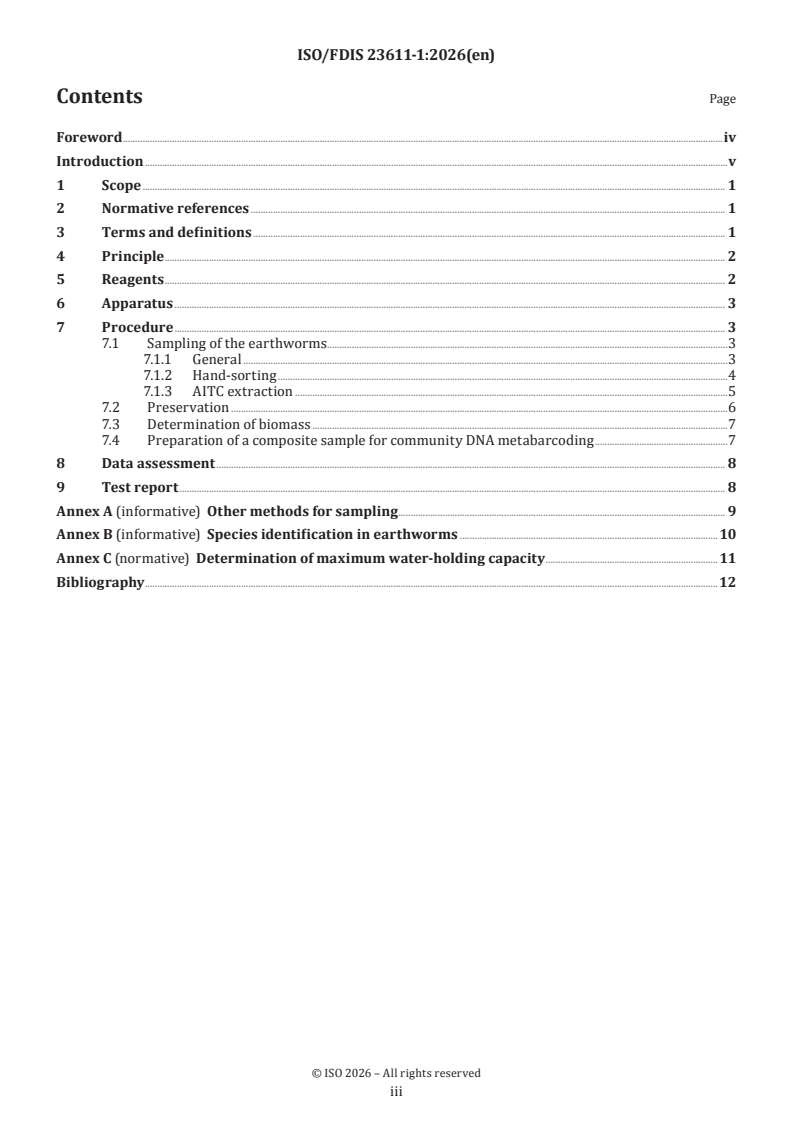
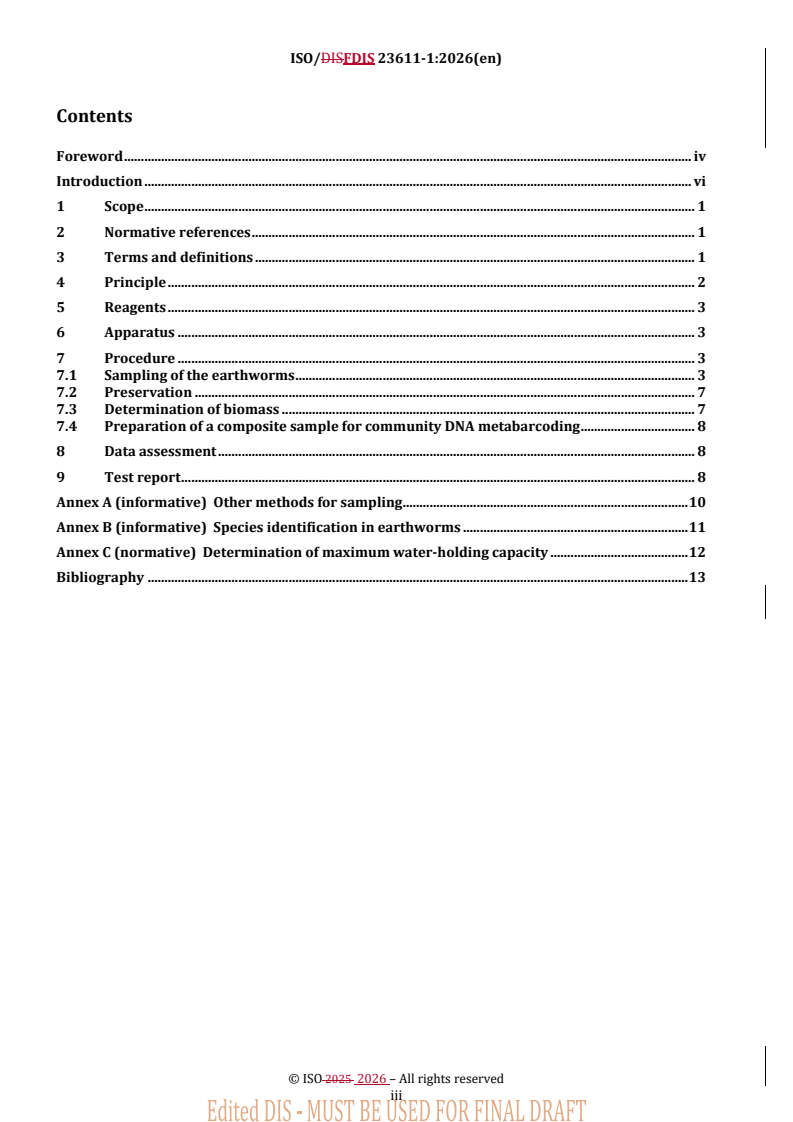
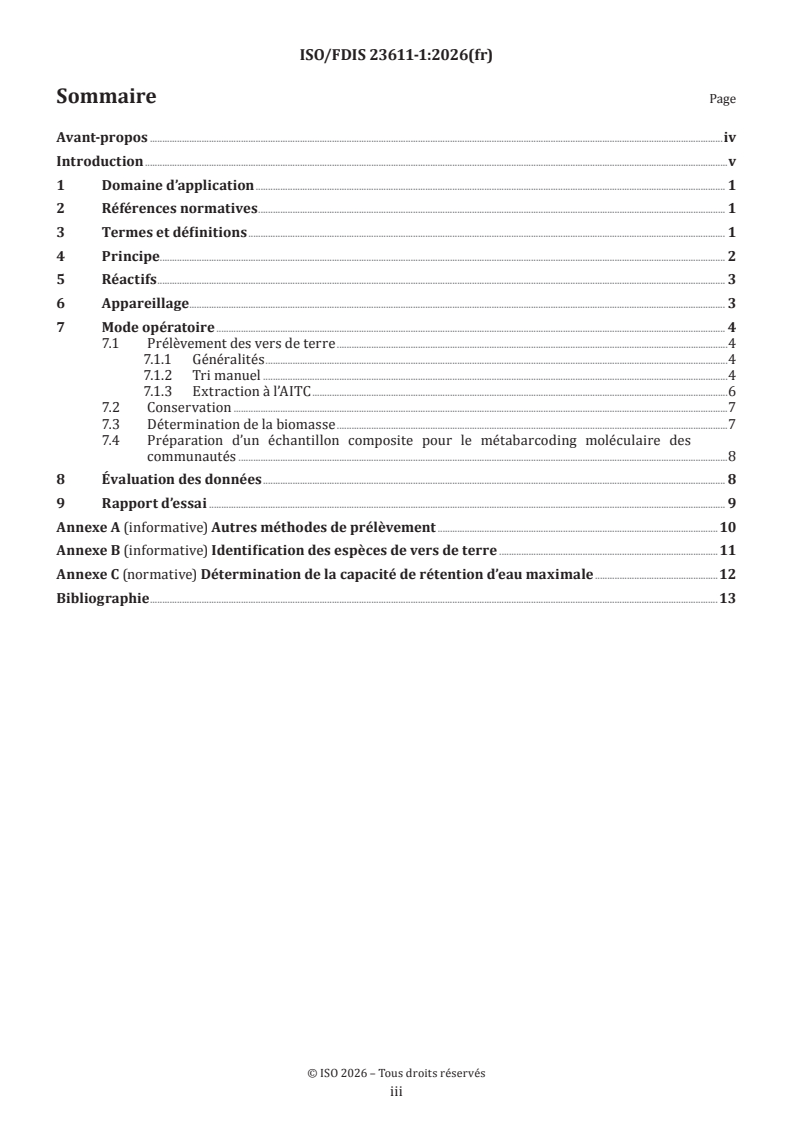
Contents Page
Foreword .iv
Introduction .v
1 Scope . 1
2 Normative references . 1
3 Terms and definitions . 1
4 Principle . 2
5 Reagents . 2
6 Apparatus . 3
7 Procedure . 3
7.1 Sampling of the earthworms.3
7.1.1 General .3
7.1.2 Hand-sorting .4
7.1.3 AITC extraction .5
7.2 Preservation .6
7.3 Determination of biomass .7
7.4 Preparation of a composite sample for community DNA metabarcoding .7
8 Data assessment . 8
9 Test report . 8
Annex A (informative) Other methods for sampling . 9
Annex B (informative) Species identification in earthworms .10
Annex C (normative) Determination of maximum water-holding capacity .11
Bibliography .12
iii
Foreword
ISO (the International Organization for Standardization) is a worldwide federation of national standards
bodies (ISO member bodies). The work of preparing International Standards is normally carried out through
ISO technical committees. Each member body interested in a subject for which a technical committee
has been established has the right to be represented on that committee. International organizations,
governmental and non-governmental, in liaison with ISO, also take part in the work. ISO collaborates closely
with the International Electrotechnical Commission (IEC) on all matters of electrotechnical standardization.
The procedures used to develop this document and those intended for its further maintenance are described
in the ISO/IEC Directives, Part 1. In particular, the different approval criteria needed for the different types
of ISO documents should be noted. This document was drafted in accordance with the editorial rules of the
ISO/IEC Directives, Part 2 (see www.iso.org/directives).
ISO draws attention to the possibility that the implementation of this document may involve the use of (a)
patent(s). ISO takes no position concerning the evidence, validity or applicability of any claimed patent
rights in respect thereof. As of the date of publication of this document, ISO had not received notice of (a)
patent(s) which may be required to implement this document. However, implementers are cautioned that
this may not represent the latest information, which may be obtained from the patent database available at
www.iso.org/patents. ISO shall not be held responsible for identifying any or all such patent rights.
Any trade name used in this document is information given for the convenience of users and does not
constitute an endorsement.
For an explanation of the voluntary nature of standards, the meaning of ISO specific terms and expressions
related to conformity assessment, as well as information about ISO’s adherence to the World Trade
Organization (WTO) principles in the Technical Barriers to Trade (TBT), see www.iso.org/iso/foreword.html.
This document was prepared by Technical Committee ISO/TC 190, Soil quality, Subcommittee SC 4, Biological
characterization, in collaboration with the European Committee for Standardization (CEN) Technical
Committee CEN/TC 444, Environmental characterization of solid matrices, in accordance with the Agreement
on technical cooperation between ISO and CEN (Vienna Agreement).
This third edition cancels and replaces the second edition (ISO 23611-1:2018), which has been technically
revised.
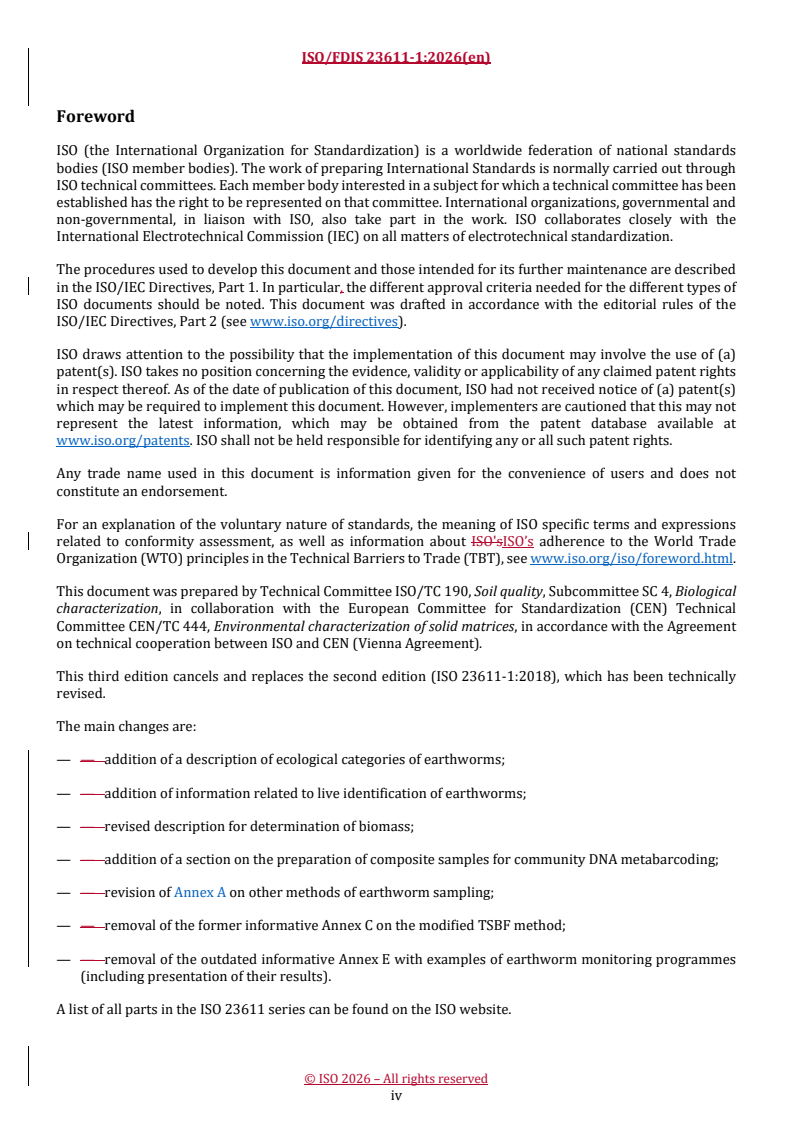
The main changes are:
— addition of a description of ecological categories of earthworms;
— addition of information related to live identification of earthworms;
— revised description for determination of biomass;
— addition of a section on the preparation of composite samples for community DNA metabarcoding;
— revision of Annex A on other methods of earthworm sampling;
— removal of the former informative Annex C on the modified TSBF method;
— removal of the outdated informative Annex E with examples of earthworm monitoring programmes
(including presentation of their results).
A list of all parts in the ISO 23611 series can be found on the ISO website.
Any feedback or questions on this document should be directed to the user’s national standards body. A
complete listing of these bodies can be found at www.iso.org/members.html.
iv
Introduction
This document was originally drawn up because of the growing need for the standardization of terrestrial
zoological field methods. Such methods, mainly covering the sampling, extraction and handling of soil
invertebrates, are necessary for the following purposes:
[9][24][36][39][51]
— biological classification of soils including soil quality assessment;
[2][16][18][45][50]
— terrestrial bio-indication and long-term monitoring;
[35]
— evaluation of the effects of chemicals on soil animals in the field.
Data for these purposes are gained by standardized methods since they can form the basis for far-reaching
decisions (e.g. whether a given site should be remediated or not). In fact, the lack of such standardized
methods is one of the most important reasons why bio-classification and bio-assessment in terrestrial (i.e.
soil) habitats has so far been used relatively rarely in comparison to aquatic sites.
Since it is neither possible nor useful to standardize methods for all soil organisms, the most important ones
have been selected. In this document, the sampling of earthworms is described.
Originally, the methods described in this document were developed for taxonomical and ecological studies,
investigating the role of earthworms (macrofauna) in various soil ecosystems. These animals are without
[27][29][41]
doubt the most important soil invertebrates in temperate regions. This does not necessarily imply
that earthworms are less important in tropical soils. In fact, there is wide evidence that earthworms can
be as important as or even more important than the abundant termites and ants in many locations of the
[28]
tropical region. Since Darwin (1881) (see Reference [11]), their influence on soil structure (e.g. aeration,
water holding capacity) and on soil functions (e.g. litter decomposition and nutrient cycling) is well-known.
[14]
Due to their often very high biomass they are also important in many terrestrial food-webs.
In earlier versions of this document the chemical formalin was recommended as extraction fluid. Since
then, evidence has increased that formalin has properties of concern, mainly in terms of human toxicity.
According to the European Chemicals Agency (ECHA) chemical database, this chemical is labelled as
[13]
carcinogenic and suspected to be mutagenic (Categories Carc. 1B and Muta. 2). In addition, negative
effects on non-target organisms (including soil microorganisms, mesofauna and plants) have been reported
(e.g. see Reference [10]). Therefore, this substance has been replaced.
Due to the growing reservations against the use of formalin, several alternatives have been studied. In
Reference [52] allyl isothiocyanate (AITC) was tested for its effectiveness as a chemical expellant for
sampling earthworms. AITC is a natural breakdown product of glucosinolates in many Cruciferae, i.e. it is
the component imparting the sharp taste of mustard. The ECHA chemical database provides an overview
[12]
of the hazard classification and labelling and of properties of concern. Hence, although not currently
labelled as carcinogenic like formalin, AITC must only be used with appropriate safety precautions.
Some studies have been performed in which the extraction efficiency of formalin and AITC were compared
at the same sites and dates. According to Reference [33] no differences were found in numbers or biomass
of earthworms extracted at crop sites when using either formalin or AITC as extractant. Also, no interaction
was found on the sampling sites between the extractant and the site, indicating that no site-specific
differences were observed in extraction efficiency of the extractants. When plotting the correlation between
earthworm numbers extracted with AITC versus formalin in a Bland-Altman graph (a common way to
compare a gold-standard method to an alternative method in the medical sciences), no significant bias of the
AITC method as compared to the formalin method was found, indicating the similarity and exchangeability
[38]
of the two methods.
[6]
Earthworms can be divided into three main ecological categories: endogeic, epigeic and anecic. Endogeic
species vary greatly in size, with little or no pigmentation, are geophagous, live in the soil and rarely rise
to the surface, creating galleries with little connectivity to the soil surface. Epigeics tend to have smaller
sizes, are dorsally or completely pigmented, live on or near the soil surface or in places with accumulation
of organic matter (composters, bromeliads, rotten trunks, epiphytic soils), ingest little soil and produce
basically organic casts. Anecics often move to the soil surface, have dorsal pigmentation especially in the
anterior part of the body, are usually large in size and produce vertical galleries and accumulations of
v
organo-mineral casts (often with higher organic matter contents than the ingested soil) on the surface of
the soil at the entrance of its galleries. These categories are evident in temperate regions. But, especially
[4]
in tropical and subtropical regions, there are blends of categories, such as “epi-endogeic” , and the anecic
category is not as common as in the temperate region, with a predominance of endogeics especially in
[15]
agroecosystems .
Basic information on the ecology of earthworms and their use as bioindicators in the terrestrial environment
can be found in the references listed in the Bibliography.
[20] [23]
The sampling design of field studies in general is given in ISO 18400-101 and ISO 23611-6 , and guidance
1)
on the determination of effects of pollutants on earthworms in field situations is given in ISO 11268-3 .
These aspects can vary according to the national requirements or the climatic and regional conditions of the
site to be sampled.
1) This document will be replaced by an Organisation for Economic Co-operation and Development (OECD) document
(either a Test Guideline or Guidance Document) currently under development (OECD project no. 2.47 ‘New Test Guideline
on Determination of Effects on Earthworms in Field Studies’).
vi
FINAL DRAFT International Standard ISO/FDIS 23611-1:2026(en)
Soil quality — Sampling of soil invertebrates —
Part 1:
Hand-sorting and extraction of earthworms
1 Scope
This document specifies a method for sampling and handling earthworms from field soils as a prerequisite
for using these animals as bioindicators (e.g. to assess the quality of a soil as a habitat for organisms).
This document is applicable to all terrestrial biotopes in which earthworms occur. This document
does not apply to semi-terrestrial soils (i.e. soils that are partly aquatic, such as bogs, beaches, marshes,
stream margins) and it can be difficult to use under extreme climatic or geographical conditions (e.g. in
high mountains). Methods for other soil organism groups, such as micro-arthropods and enchytraeids
(mesofauna), are covered in other parts of the ISO 23611 series.
2 Normative references
The following documents are referred to in the text in such a way that some or all of their content constitutes
requirements of this document. For dated references, only the edition cited applies. For undated references,
the latest edition of the referenced document (including any amendments) applies.
ISO 10390, Soil, treated biowaste and sludge — Determination of pH
ISO 10694, Soil quality — Determination of organic and total carbon after dry combustion (elementary analysis)
ISO 11260, Soil quality — Determination of effective cation exchange capacity and base saturation level using
barium chloride solution
ISO 11277, Soil quality — Determination of particle size distribution in mineral soil material — Method by
sieving and sedimentation
ISO 11465, Sludge and solid environmental matrices — Determination of dry residue or water content and
calculation of the dry matter fraction on a mass basis
3 Terms and definitions
For the purposes of this document, the following terms and definitions apply.
ISO and IEC maintain terminology databases for use in standardization at the following addresses:
— ISO Online browsing platform: available at https:// www .iso .org/ obp
— IEC Electropedia: available at https:// www .electropedia .org/
3.1
earthworm
megadrile soil-inhabiting invertebrate belonging to the order Crassiclitellata (class Clitellata, phylum
Annelida) and classified as soil macrofauna
Note 1 to entry: The length of adult individuals can vary from a few centimetres to more than 1 m.
EXAMPLE Species of the families Lumbricidae (Holarctic), Glossoscolecidae and Rhinodrilidae (Latin America),
Eudrilidae (Africa) or Megascolecidae [Asia, North America (Pacific Coast)].
3.2
peregrine species
earthworm species occurring in many regions world-wide today, usually introduced by man
Note 1 to entry: The pan-tropical species Pontoscolex corethrurus (probably coming from Northern Brazil and/or
the Guyanas) is the most common species in the world. Other well-known examples of peregrine species are several
lumbricid species such as Aporrectodea caliginosa (originally coming from Eurasia, but now living also in the Americas
and Oceania).
Note 2 to entry: See References [7],[29],[31],[47].
3.3
clitellum
ring-shaped or saddle-shaped epidermal thickening found near the anterior portion of mature earthworms,
that eventually forms the cocoon
4 Principle
Earthworms at a certain site are sampled from the soil by using a combination of two different methods:
— hand-sorting animals from a certain area (e.g. 0,25 m ) of varying depth, depending on land use (e.g. at
crop sites: 20 cm), soil properties and the scope of the sampling;
— extraction of the earthworms from the soil by applying AITC.
The first method is known for approximately 100 years while the second method using the new extraction
[10][33][52]
fluid was first proposed in 2003. After extraction, the earthworms are fixed and taken to the
laboratory. There they are preserved in a way that they can be stored indefinitely in a collection (e.g. for
taxonomical purposes). In addition, the determination of the biomass of earthworms is described. In addition
to identification of fixed earthworms, some species (especially Lumbricidae, and often P. corethrurus)
can also be identified alive (see Annex B). Thus, after extraction, taxonomic identification and biomass
determination are carried out on the living animals rather than after fixation. An advantage of performing
the taxonomic identification on living animals is that, in many cases, juvenile animals can also be identified
to species level. Finally, abundance and biomass values can be recalculated to area (usually 1 m ) or, more
rarely, volume parameters.
NOTE 1 Alternative methods and combinations thereof can be useful under special circumstances (e.g. electrical
extraction) but are beyond the scope of this document (see Annex A).
NOTE 2 The sampling of earthworms is often included in much broader monitoring programs, trying to cover the
whole soil fauna or parts of it (e.g. the macrofauna). The method for sampling edaphic macrofauna is described in
[22]
ISO 23611-5. The design of such programmes is not included in this document.
NOTE 3 Some suggestions for the taxonomic identification of peregrine (occurring in many regions world-wide,
mainly the Northern hemisphere) earthworms, mainly belonging to the family Lumbricidae, are given in Annex B. In
the Southern hemisphere the earthworm species of the Lumbricidae family are less common, except for e.g. Australia
[29] [29]
and New Zealand. In the latter, they dominate the earthworm fauna, with 15 lumbricid species occurring.
The most common peregrine species in the world is Pontoscolex corethrurus, belonging to Family Rhinodrilidae, but
species of the Family Megascolecidae, Acanthodrilidae and Benhamiidae can also be common in some regions. The
identification of these species can be performed using keys available in References [3] and [8]. P. corethrurus usually
can be identified live, but depending on the location of sampling (e.g. Central America or Northern South America), it
can be confused with other Pontoscolex species.
5 Reagents
5.1 Allyl-isothiocyanate (AITC), synthetic grade, approximately 94 % to 97 % (volume fraction).
5.2 Isopropanol, 100 % (volume fraction).
5.3 Ethanol, 70 % to 80 % (volume fraction).
5.4 Formalin, formaldehyde solution 4 % (volume fraction), for storage purposes only.
5.5 Ethanol, ≥95 % (volume fraction), for storage purposes when using genetic methods such as barcoding.
6 Apparatus
Use standard laboratory equipment and the following.
6.1 Plastic vessels, capacities 250 ml and 500 ml, for storing the earthworms.
6.2 Rubber gloves.
6.3 Forceps.
2 2
6.4 Folding table, piece of thick plastic sheeting, 1 m to 2 m or large bucket, e.g. 100 l, to collect the
soil for hand-sorting.
6.5 Spade or shovel.
6.6 Stereomicroscope, with low magnification (×10 to ×40).
6.7 Balance, weight range from 0,01 g to 200 g; If weighing is carried out at the species level, a scale with
an accuracy of 0,001 g or 0,000 1 g can be necessary.
6.8 Water-can, preferably 20 l, with water (5 l to 10 l per sampling plot).
6.9 Watering can, preferably 10 l.
6.10 Pencil, notebook, water resistant marker, labels that go in the vessel.
6.11 Thermometer, for measuring air temperature.
6.12 Drying oven, for soil moisture determination.
7 Procedure
7.1 Sampling of the earthworms
7.1.1 General
Sampling of earthworms is done by a combination of two different methods: hand-sorting and AITC
extraction. Based on several comparative studies, the combination of a physical and a chemical method
is clearly recommended in the various reviews on earthworm ecology, regardless of the type of chemical
expellant (e.g. References [10] and [25]).
Sampling should be done at times of the year when the animals are not forced by the environmental
conditions (i.e. low soil moisture or high temperatures, or both) into diapause (i.e. when they are not
reacting to AITC). In temperate regions, such unfavourable sampling times occur in winter and, in particular,
[29]
midsummer periods. Earthworms sampled from the same plot but sampled under the two different
methods should be stored in separate individual plastic vessels. After the end of the sampling process, the
excavated and examined soil is returned to the original sampling plot. When no deep-burrowing animals
are occurring at a given site, AITC extraction is not necessary. At sites where giant earthworms are living
(parts of South America, Southeast Asia and Australia), hand-sorting can be inappropriate and should be at
[37]
least complemented by chemical extraction, in order to collect the large species.
NOTE Usually, earthworms are identified after preservation. However, the most common peregrine lumbricid
[26]
species can also be identified alive. This offers the advantage that many juvenile stages of these species can also be
identified to species level based on their characteristic colouring and behaviour (see Annex B).
In case the collected earthworms are to be used for further analysis or testing, e.g. for biomarker
measurements or for use in bioassays, storage or incubation of the earthworms in a small portion of soil
from the sampling site is recommended. In the case of AITC extraction, the earthworms should be rinsed in
tap water before incubation in soil.
For the interpretation of test results, the following characteristics shall be determined for the field site to be
studied:
a) pH in accordance with ISO 10390;
b) texture (sand, loam, silt) in accordance with ISO 11277;
c) water content in accordance with ISO 11465;
d) water holding capacity as specified in Annex C;
e) cationic exchange capacity in accordance with ISO 11260;
f) organic carbon in accordance with ISO 10694.
7.1.2 Hand-sorting
The size of the sample plot should be chosen according to the expected mean size and density of the
earthworms. A square of 50 cm × 50 cm is often sufficient in the Holarctic where most adult earthworms
have approximate lengths between 1 cm and 20 cm. At places with a low density of earthworms [e.g. soils
with low pH (< 4,5) or which are anthropogenically used such as crop sites], larger plots (i.e. 1 m ) can be
necessary. On the other hand, at sites with a high earthworm density (e.g. many meadows in temperate
2 [40] 2 [53]
regions), a smaller plot of 1/8 m is sufficient. Even smaller sample sizes (e.g. 1/16 m ) can lead to
very low, and thus variable, individual earthworm numbers per sample, which in turn leads to an increase in
sample numbers (e.g. 16 replicates).
The soil is removed by means of a spade or shovel (6.5) up to a depth of 20 cm to 30 cm from this plot
(20 cm are suitable for many temperate sites, but the depth also depends on site properties such as the
depth of the plough layer). The excavated soil is spread out, e.g. on a folding table or a piece of plastic or
collected in a large bucket (6.4). This can be done in the field but, especially in periods of bad weather, the
whole procedure can also be performed in the laboratory or greenhouse. The soil is searched cautiously
for earthworms. Large earthworms are collected by hand using rubber gloves (6.2) and small ones by
using forceps (6.3). To avoid autotomy and further damage to the earthworms, the animals should only be
touched at the anterior part of the body. If earthworms are cut by the spade used to dig out the soil, both
parts are collected in order to measure the correct biomass, whereas only front parts are counted when
determining the number of individuals. Pieces of earthworms that cannot be identified as either the head
or tail should not be quantified for abundance unless there is only one. Sometimes the pieces can be united
back as an incomplete earthworm and be accounted as a juvenile. The pieces shall be weighed together with
all individuals and fragments to determine the total biomass of the sample.
NOTE 1 With the naked eye, the front end of adult earthworms can be identified by the position of the clitellum: it is
always located closer to the head than to the tail.
The collected earthworms should immediately be fixed in 70 % ethanol (volume fraction) (5.3). It is
recommended to exchange the ethanol solution after 24 h. The volume of liquid in the vessel should be at
least 3 times the volume occupied by the earthworms. If the use of molecular methods for the identification
of earthworms is planned, preference should be given to ethanol at a concentration of ≥95 % (volume
[21]
fraction) and storage of individuals in a freezer at ≤–20 °C (see ISO 21286) . The vessels shall be labelled
and observations (e.g. whether earthworms have been in a quiescence stage) should be recorded in the
notebook (6.10).
An immediate fixation in 4 % formalin (volume fraction) (5.4) is possible, but not recommended, because the
handling of this compound should be minimised as much as possible (in particular under field conditions)
and because formalin degrades DNA, thus preventing the application of molecular methods.
NOTE 2 In order to avoid morphological changes (e.g. an inversion of the prostomium) due to immediate fixation in
ethanol, the individual earthworms can be put briefly (approximately one minute) into warm (e.g. 30 °C to 40 °C) tap
water. Alternatively, they can be relaxed in sparkling water or 5 % diluted ethanol (volume fraction) for up to 3 min
before fixation. After that they can be transferred to 70 % ethanol solution (volume fraction).
Large earthworms or a high number of earthworms with high body water content can dilute 70 % ethanol
(volume fraction) used as fixative solution, causing them to become soggy and lose important morphological
features necessary for taxonomic identification. In such cases, it is recommended to use a more concentrated
ethanol solution., e.g. 80 % (volume fraction).
For live identification, the earthworms are transferred to suitable containers (e.g. plastic jars with a volume
of at least 0,5 l). The earthworms are kept either on moist blotting paper or in moist soil. The earthworms
will excrete on moist blotting paper, allowing a more exact determination of the biomass, but, unlike when
they are kept in soil, they only have a limited shelf life and shall therefore be identified within at most 3 days.
Damaged specimens need to be separated and immediately fixed since a dead earthworm in a sampling
container leads to the death of the entire batch in a short time.
The earthworms are transported to the laboratory in cooling boxes and stored in the refrigerator at 4 °C to
8 °C.
7.1.3 AITC extraction
The same sampling point from which the topsoil has been removed for hand-sorting is used for AITC
extraction. A sufficient amount of water shall be transported (5 l to 10 l per sampling point) beforehand to
the sampling points using large water-cans (6.8). AITC readily degrades in water, and less rapidly also in
isopropanol. Degradation is enhanced by sunlight and warmth. To prepare th
...
ISO/DISFDIS 23611-1:2026(en)
ISO/TC 190/SC 4
Secretariat: AFNOR
Date: 2026-02-1803-16
Soil quality — Sampling of soil invertebrates — —
Part 1: Handsorting
Hand-sorting and extraction of earthworms
Qualité du sol — Prélèvement des invertébrés du sol —
Partie 1: Tri manuel et extraction des vers de terre
FDIS stage
TTTTTThhhhhhiiiiiis drs drs drs drs drs draaaaaafffffftttttt i i i i i is s s s s s susususususubbbbbbmmmmmmiiiiiitttttttttttteeeeeed d d d d d ttttttoooooo aaaaaa ppppppaaaaaarrrrrraaaaaallellellellellellel l l l l l vvvvvvooooootttttteeeeee i i i i i innnnnn IIIIIISSSSSSOOOOOO,,,,,, CCCCCCEEEEEEN.N.N.N.N.N.
All rights reserved. Unless otherwise specified, or required in the context of its implementation, no part of this publication
may be reproduced or utilized otherwise in any form or by any means, electronic or mechanical, including photocopying,
or posting on the internet or an intranet, without prior written permission. Permission can be requested from either ISO
at the address below or ISO’s member body in the country of the requester.
ISO copyright office
CP 401 • Ch. de Blandonnet 8
CH-1214 Vernier, Geneva
Phone: + 41 22 749 01 11
EmailE-mail: copyright@iso.org
Website: www.iso.org
Published in Switzerland
ii
ISO/DISFDIS 23611-1:2026(en)
Contents
Foreword . iv
Introduction . vi
1 Scope . 1
2 Normative references . 1
3 Terms and definitions . 1
4 Principle . 2
5 Reagents . 3
6 Apparatus . 3
7 Procedure . 3
7.1 Sampling of the earthworms . 3
7.2 Preservation . 7
7.3 Determination of biomass . 7
7.4 Preparation of a composite sample for community DNA metabarcoding . 8
8 Data assessment . 8
9 Test report . 8
Annex A (informative) Other methods for sampling . 10
Annex B (informative) Species identification in earthworms . 11
Annex C (normative) Determination of maximum water-holding capacity . 12
Bibliography . 13
iii
Foreword
ISO (the International Organization for Standardization) is a worldwide federation of national standards
bodies (ISO member bodies). The work of preparing International Standards is normally carried out through
ISO technical committees. Each member body interested in a subject for which a technical committee has been
established has the right to be represented on that committee. International organizations, governmental and
non-governmental, in liaison with ISO, also take part in the work. ISO collaborates closely with the
International Electrotechnical Commission (IEC) on all matters of electrotechnical standardization.
The procedures used to develop this document and those intended for its further maintenance are described
in the ISO/IEC Directives, Part 1. In particular, the different approval criteria needed for the different types of
ISO documents should be noted. This document was drafted in accordance with the editorial rules of the
ISO/IEC Directives, Part 2 (see www.iso.org/directives).
ISO draws attention to the possibility that the implementation of this document may involve the use of (a)
patent(s). ISO takes no position concerning the evidence, validity or applicability of any claimed patent rights
in respect thereof. As of the date of publication of this document, ISO had not received notice of (a) patent(s)
which may be required to implement this document. However, implementers are cautioned that this may not
represent the latest information, which may be obtained from the patent database available at
www.iso.org/patents. ISO shall not be held responsible for identifying any or all such patent rights.
Any trade name used in this document is information given for the convenience of users and does not
constitute an endorsement.
For an explanation of the voluntary nature of standards, the meaning of ISO specific terms and expressions
related to conformity assessment, as well as information about ISO'sISO’s adherence to the World Trade
Organization (WTO) principles in the Technical Barriers to Trade (TBT), see www.iso.org/iso/foreword.html.
This document was prepared by Technical Committee ISO/TC 190, Soil quality, Subcommittee SC 4, Biological
characterization, in collaboration with the European Committee for Standardization (CEN) Technical
Committee CEN/TC 444, Environmental characterization of solid matrices, in accordance with the Agreement
on technical cooperation between ISO and CEN (Vienna Agreement).
This third edition cancels and replaces the second edition (ISO 23611-1:2018), which has been technically
revised.
The main changes are:
— — addition of a description of ecological categories of earthworms;
— — addition of information related to live identification of earthworms;
— — revised description for determination of biomass;
— — addition of a section on the preparation of composite samples for community DNA metabarcoding;
— — revision of Annex A on other methods of earthworm sampling;
— — removal of the former informative Annex C on the modified TSBF method;
— — removal of the outdated informative Annex E with examples of earthworm monitoring programmes
(including presentation of their results).
A list of all parts in the ISO 23611 series can be found on the ISO website.
iv
ISO/DISFDIS 23611-1:2026(en)
Any feedback or questions on this document should be directed to the user’s national standards body. A
complete listing of these bodies can be found at www.iso.org/members.html.
v
Introduction
This document has beenwas originally drawn up since there was abecause of the growing need for the
standardization of terrestrial zoological field methods. Such methods, mainly covering the sampling,
extraction and handling of soil invertebrates, are necessary for the following purposes:
[9]][[24]][[36]][[39][9][24][36][39][51] ][[51]
— — biological classification of soils including soil quality assessment; ;
[2]][[16]][[18]][[45][2][16][18][45][50] ][[50]
— — terrestrial bio-indication and long-term monitoring; ;
[35] [35]
— — evaluation of the effects of chemicals on soil animals in the field .
Data for these purposes are gained by standardized methods since they can form the basis for far-reaching
decisions (e.g. whether a given site should be remediated or not). In fact, the lack of such standardized
methods is one of the most important reasons why bio-classification and bio-assessment in terrestrial (i.e.
soil) habitats has so far been used relatively rarely been used in comparison to aquatic sites.
Since it is neither possible nor useful to standardize methods for all soil organisms, the most important ones
have been selected. In this document, the sampling of earthworms is described.
Originally, the methods described in this document were developed for taxonomical and ecological studies,
investigating the role of earthworms (macrofauna) in various soil ecosystems. These animals are without
[27]][[29] [27][29][41]][[41]
doubt the most important soil invertebrates in temperate regions. . This does not necessarily
imply that earthworms are less important in tropical soils. In fact, there is wide evidence that earthworms can
be as important as or even more important than the abundant termites and ants in many locations of the
[28] [28]
tropical region. . Since Darwin (1881) (see Reference [11][11]),), their influence on soil structure (e.g.
aeration, water holding capacity) and on soil functions like(e.g. litter decomposition and nutrient cycling) is
[14] [14]
well-known. . Due to their often very high biomass they are also important in many terrestrial food-webs.
In earlier versions of this document the chemical formalin was recommended as extraction fluid. Since then,
evidence has increased that formalin has properties of concern, mainly in terms of human toxicity. According
to the European Chemicals Agency (ECHA) chemical database, this chemical is labelled as carcinogenic and
[13] [13]
suspected to be mutagenic (Categories Carc. 1B and Muta. 2). ). In addition, negative effects on non-target
organisms (including soil microorganisms, mesofauna and plants) have been reported (e.g. see
Reference [10][10]).). Therefore, this substance has been replaced.
Due to the growing reservations against the use of formalin, several alternatives have been studied. In
Reference [52][52] allyl isothiocyanate (AITC) was tested for its effectiveness as a chemical expellant for
sampling earthworms. AITC is a natural breakdown product of glucosinolates in many Cruciferae, i.e. it is the
component imparting the sharp taste of mustard. The ECHA chemical database provides an overview onof the
[12] [12]
hazard classification &and labelling and of properties of concern. . Hence, although not currently labelled
as carcinogenic like formalin, AITC shallmust only be used with appropriate safety precautions.
Some studies have been performed in which the extraction efficiency of formalin and AITC were compared at
the same sites and dates. According to Reference [33][33] no differences were found in numbers or biomass
of earthworms extracted at crop sites when using either formalin or AITC as extractant. Also, no interaction
was found on the sampling sites between the extractant and the site, indicating that no site-specific differences
were observed in extraction efficiency of the extractants. When plotting the correlation between earthworm
numbers extracted with AITC versus formalin in a Bland-Altman graph (a common way to compare a gold-
standard method to an alternative method in the medical sciences), no significant bias of the AITC method as
compared to the formalin method was found, indicating the similarity and exchangeability of the two
[38] [38]
methods. .
vi
ISO/DISFDIS 23611-1:2026(en)
[6] [6]
Earthworms can be divided into three main ecological categories: endogeic, epigeic and anecic. . Endogeic
species vary greatly in size, with little or no pigmentation, are geophagous, live in the soil and rarely rise to
the surface, creating galleries with little connectivity to the soil surface. Epigeics tend to have smaller sizes,
are dorsally or completely pigmented, live on or near the soil surface or in places with accumulation of organic
matter (composters, bromeliads, rotten trunks, epiphytic soils), ingest little soil and produce basically organic
casts. Anecics often move to the soil surface, have dorsal pigmentation especially in the anterior part of the
body, are usually large in size and produce vertical galleries and accumulations of organo-mineral casts (often
with higher organic matter contents than the ingested soil) on the surface of the soil at the entrance of its
galleries. These categories are evident in temperate regions. But, especially in tropical and subtropical regions,
[4] [4]
there are blends of categories, likesuch as “epi-endogeic” ” , and the anecic category is not as common as in
15 [15]
the temperate region, with a predominance of endogeics especially in agroecosystems . .
Basic information on the ecology of earthworms and their use as bioindicators in the terrestrial environment
can be found in the references listed in the Bibliography.
[20][20] [23][23]
The sampling design of field studies in general is given in ISO 18400-101 and ISO 23611-6 ,, and
guidance on the determination of effects of pollutants on earthworms in field situations is given in ISO 11268-
1 1)
3 . . These aspects can vary according to the national requirements or the climatic/ and regional conditions
of the site to be sampled.
This Standard will be replaced by an Organisation for Economic Co-operation and Development (OECD) document
(either a Test Guideline or Guidance Document) currently under development (OECD project no. 2.47 ‘New Test Guideline
on Determination of Effects on Earthworms in Field Studies’).
1)
This document will be replaced by an Organisation for Economic Co-operation and Development (OECD) document
(either a Test Guideline or Guidance Document) currently under development (OECD project no. 2.47 ‘New Test Guideline
on Determination of Effects on Earthworms in Field Studies’).
vii
DRAFT International Standard ISO/DIS 23611-1:2025(en)
Soil quality — Sampling of soil invertebrates — —
Part 1: Handsorting
Hand-sorting and extraction of earthworms
1 Scope
This document specifies a method for sampling and handling earthworms from field soils as a prerequisite for
using these animals as bioindicators (e.g. to assess the quality of a soil as a habitat for organisms).
This document is applicable to all terrestrial biotopes in which earthworms occur. This document does not
apply to semi-terrestrial soils (i.e. soils that are partly aquatic, such as bogs, beaches, marshes, stream margins,
etc.)) and it can be difficult to use under extreme climatic or geographical conditions (e.g. in high mountains).
Methods for other soil organism groups, such as micro-arthropods and enchytraeids (mesofauna), are covered
in other parts of the ISO 23611 series.
2 Normative references
The following documents are referred to in the text in such a way that some or all of their content constitutes
requirements of this document. For dated references, only the edition cited applies. For undated references,
the latest edition of the referenced document (including any amendments) applies.
ISO 10390, Soil, treated biowaste and sludge – — Determination of pH
ISO 10694, Soil quality — Determination of organic and total carbon after dry combustion (elementary analysis)
ISO 11260, Soil quality — Determination of effective cation exchange capacity and base saturation level using
barium chloride solution
ISO 11277, Soil quality — Determination of particle size distribution in mineral soil material — Method by
sieving and sedimentation
ISO 11465, Soil qualitySludge and solid environmental matrices — Determination of dry matter andresidue or
water content and calculation of the dry matter fraction on a mass basis — Gravimetric method
3 Terms and definitions
For the purposes of this document, the following terms and definitions apply.
ISO and IEC maintain terminology databases for use in standardization at the following addresses:
— — ISO Online browsing platform: available at https://www.iso.org/obp
— — IEC Electropedia: available at https://www.electropedia.org/
3.1 3.1
earthworm
megadrile soil-inhabiting invertebrate belonging to the order Crassiclitellata (class Clitellata, phylum
Annelida) and classified as soil macrofauna
Note 1 to entry: The length of adult individuals can vary from a few centimetres to more than 1 m.
EXAMPLE Species of the families Lumbricidae (Holarctic), Glossoscolecidae and Rhinodrilidae (Latin America),
Eudrilidae (Africa) or Megascolecidae [Asia, North America (Pacific Coast)].
3.2 3.2
peregrine species
earthworm species occurring in many regions world-wide today, usually introduced by man
Note 1 to entry: The pan-tropical species Pontoscolex corethrurus (probably coming from Northern Brazil and/or the
Guyanas) is the most common species in the world. Other well-known examples of peregrine species are several
lumbricid species likesuch as Aporrectodea caliginosa (originally coming from Eurasia, but now living also in the
Americas and Oceania).
Note 2 to entry: See References [7],[29],[31],[47][7] [29] [31] [47].
3.3 3.3
clitellum
ring-shaped or saddle-shaped epidermal thickening found near the anterior portion of mature earthworms,
that eventually forms the cocoon
4 Principle
Earthworms at a certain site are sampled from the soil by using a combination of two different methods:
— — hand-sorting animals from a certain area (e.g. 0,25 m ) of varying depth, depending on land use (e.g.
at crop sites: 20 cm), soil properties and the scope of the sampling;
— — extraction of the earthworms from the soil by applying AITC.
The first method is known for aboutapproximately 100 years while the second method using the new
[10]][[33] [10][33][52]][[52]
extraction fluid was first proposed in 2003. . After extraction, the earthworms are fixed and
taken to the laboratory. There they are preserved in a way that they can be stored indefinitely in a collection
(e.g. for taxonomical purposes). In addition, the determination of the biomass of earthworms is described. In
addition to identification of fixed earthworms, some species (especially Lumbricidae, and often P. corethrurus)
can also be identified alive (see Annex B). Thus, after extraction, taxonomic identification and biomass
determination are carried out on the living animals rather than after fixation. An advantage of performing the
taxonomic identification aliveon living animals is that, in many cases, juvenile animals can also be identified
to species level. Finally, abundance and biomass values can be recalculated to area (usually 1 m ) or, more
rarely, volume parameters.
NOTE 1 Alternative methods and combinations thereof can be useful under special circumstances (e.g. electrical
extraction) but are beyond the scope of this document (see Annex A).
NOTE 2 The sampling of earthworms is often included in much broader monitoring programs, trying to cover the
whole soil fauna or parts of it (e.g. the macrofauna). The method for sampling edaphic macrofauna is described in
[22] [22]
ISO 23611-5 . The design of such programmes is not included in this document.
NOTE 3 Some hintssuggestions for the taxonomytaxonomic identification of peregrine (occurring in many regions
world-wide, mainly the Northern hemisphere) earthworms, mainly belonging to the family Lumbricidae, are given in
Annex B. In the Southern hemisphere the earthworm species of the Lumbricidae family are less common, except for e.g.
[29] [29]
Australia and New Zealand . In the latter, they dominate the earthworm fauna, with 15 lumbricid species
[29] [29]
occurring . The most common peregrine species in the world is Pontoscolex corethrurus, belonging to Family
Rhinodrilidae, but species of the Family Megascolecidae, Acanthodrilidae and Benhamiidae can also be common in some
regions. The identification of these species can be performed using keys available in References [3][3] and[8] [8]. P.
corethrurus usually can be identified live, but depending on the location of sampling (e.g.,. Central America or Northern
South America), it couldcan be confused with other Pontoscolex species.
© ISO #### 2026 – All rights reserved
ISO/DISFDIS 23611-1:20252026(en)
5 Reagents
5.1 5.1 Allyl-isothiocyanate (AITC), synthetic grade (, approximately 94 % to 97 % (volume
fraction)).).
5.2 5.2 Isopropanol, 100 % (volume fraction).
5.3 5.3 Ethanol, 70 % to 80 % (volume fraction).
5.4 5.4 Formalin, formaldehyde solution 4 % (volume fraction), for storage purposes only.
5.5 5.5 Ethanol, ≥95 % (volume fraction), for storage purposes when using genetic methods such as
barcoding.
6 Apparatus
Use standard laboratory equipment and the following.
6.1 6.1 Plastic vessels, capacities 250 ml and 500 ml, for storing the earthworms.
6.2 6.2 Rubber gloves.
6.3 6.3 Forceps.
2 2
6.4 6.4 Folding table, piece of thick plastic sheeting, 1 m to 2 m or large bucket, e.g. 100 l,
to collect the soil for hand-sorting.
6.5 6.5 Spade or shovel.
6.6 6.6 Stereomicroscope, with low magnification (×10 to ×40).
6.7 6.7 Balance, weight range from 0,01 g to 200 g; If weighing is carried out at the species level, a
scale with an accuracy of 0,001 g or 0,000 1 g can be necessary.
6.8 6.8 Water-can, preferably 20 l, with water (5 l to 10 l per sampling plot).
6.9 6.9 Watering can, preferably 10 l.
6.10 6.10 Pencil, notebook, water resistant marker, labels that go in the vessel.
6.11 6.11 Thermometer, for measuring air temperature.
6.12 6.12 Drying oven, for soil moisture determination.
7 Procedure
7.1 Sampling of the earthworms
7.1.1 General
Sampling of earthworms is done by a combination of two different methods: hand-sorting and AITC extraction.
Based on several comparative studies, the combination of a physical and a chemical method is clearly
recommended in the various reviews on earthworm ecology, independentregardless of the type of chemical
expellant (e.g. References [10][10] and [25] [25]).).
Sampling should be done at times of the year when the animals are not forced by the environmental conditions
(i.e. low soil moisture or high temperatures, or both) into diapause (i.e. when they are not reacting to AITC).
In temperate regions, such unfavourable sampling times occur in winter and, in particular, midsummer
[29] [29]
periods. . Earthworms sampled from the same plot, but sampled under the two different methods, should
be stored in separate individual plastic vessels. After the end of the sampling process, the excavated and
examined soil is returned to the original sampling plot. When no deep-burrowing animals are occurring at a
given site, AITC extraction is not necessary. At sites where giant earthworms are living (parts of South
America, Southeast Asia and Australia), hand-sorting can be inappropriate and should be at least
[37] [37]
complemented by chemical extraction, in order to collect the large species .
NOTE Usually, earthworms are identified after preservation. However, the most common peregrine lumbricid
[26] 26
species can also be identified alive. . This offers the advantage that many juvenile stages of these species can also be
identified to species level based on their characteristic colouring and behaviour (see Annex B).
In case the collected earthworms are to be used for further analysis or testing, e.g. for biomarker
measurements or for use in bioassays, storage or incubation of the earthworms in a small portion of soil from
the sampling site is recommended. In the case of AITC extraction, the earthworms should be rinsed in tap
water before incubation in soil.
For the interpretation of test results, the following characteristics shall be determined for the field site to be
studied:
a) a) pH in accordance with ISO 10390;
b) b) texture (sand, loam, silt) in accordance with ISO 11277;
c) c) water content in accordance with ISO 11465;
d) d) water holding capacity as specified in Annex C;
e) e) cationic exchange capacity in accordance with ISO 11260;
f) f) organic carbon in accordance with ISO 10694.
7.1.2 Hand-sorting
The size of the sample plot should be chosen according to the expected mean size and density of the
earthworms. A square of 50 cm × 50 cm is often sufficient in the Holarctic where most adult earthworms have
approximate lengths between 1 cm and 20 cm. At places with a low density of earthworms [e.g. soils with low
pH (< 4,5) or which are anthropogenically used such as crop sites], larger plots (i.e. 1 m ) can be necessary.
On the other hand, at sites with a high earthworm density (e.g. many meadows in temperate regions), a smaller
2 [40] [40] 2[53] [53]
plot of 1/8 m is sufficient. . Even smaller sample sizes (e.g. 1/16 m )) can lead to very low, and thus
variable, individual earthworm numbers per sample, which in turn leads to an increase in sample numbers
(e.g. 16 replicates).
The soil is removed by means of a spade or shovel (6.5(6.5)) up to a depth of 20 cm to 30 cm from this plot
(20 cm are suitable for many temperate sites, but the depth also depends on site properties such as the depth
of the plough layer). The excavated soil is spread out, e.g. on a folding table or a piece of plastic or collected in
a large bucket (6.4(6.4).). This can be done in the field but, especially in periods of bad weather, the whole
procedure can also be performed in the laboratory or greenhouse. The soil is searched cautiously for
earthworms. Large earthworms are collected by hand using rubber gloves (6.2(6.2)) and small ones by using
forceps (6.3(6.3).). To avoid autotomy and further damage to the earthworms, the animals should only be
touched at the anterior part of the body. If earthworms are cut by the spade used to dig out the soil, both parts
are collected in order to measure the correct biomass, whereas only front parts are counted when determining
the number of individuals. Pieces of earthworms that cannot be identified as either the head or tail should not
© ISO #### 2026 – All rights reserved
ISO/DISFDIS 23611-1:20252026(en)
be quantified for abundance unless there is only one. Sometimes the pieces can be united back as an
incomplete earthworm and be accounted as a juvenile. The pieces shall be weighed together with all
individuals and fragments to determine the total biomass of the sample.
NOTE 1 With the naked eye, the front end of adult earthworms can be identified by the position of the clitellum: it is
always located closer to the head than to the tail.
The collected earthworms should immediately be fixed in 70 % ethanol (volume fraction) (5.3(5.3)). It is
recommended to exchange the ethanol solution after 24 h. The volume of liquid in the vessel should be at least
3 times the volume occupied by the earthworms. If the use of molecular methods for the identification of
earthworms is planned, preference should be given to ethanol at a concentration of ≥95 % (volume fraction)
[21][21]
and storage of individuals in a freezer at ≤–20 °C (see ISO 21286) ). The vessels shall be labelled and
observations (e.g. whether earthworms have been in a quiescence stage) should be recorded in the notebook
(6.10(6.10).).
An immediate fixation in 4 % formalin (volume fraction) (5.4(5.4)) is possible, but not recommended due to
the fact that, because the handling of this compound should be minimised as much as possible (in particular
under field conditions) and because formalin degrades DNA, thus preventing the useapplication of molecular
methods would not be possible anymore since formalin degrades DNA.
NOTE 2 In order to avoid morphological changes (e.g. an inversion of the prostomium) due to immediate fixation in
ethanol, the individual earthworms can be put briefly (aboutapproximately one minute) into warm (e.g. 30 °C to 40 °C)
tap water. Alternatively, they can be relaxed in sparkling water or 5 % diluted ethanol (volume fraction) for up to 3 min
before fixation. After that they can be transferred to 70 % ethanol solution (volume fraction).
Large earthworms or a high number of earthworms with high body water content can dilute 70 % ethanol
(volume fraction) used as fixative solution, causing them to become soggy and lose important morphological
features necessary for taxonomic identification. In such cases, it is recommended to use a more concentrated
ethanol solution., e.g. 80 % (volume fraction).
For live identification, the earthworms are transferred to suitable containers (e.g. plastic jars with a volume
of at least 0,5 l). The earthworms are kept either on moist blotting paper or in moist soil. The earthworms will
excrete on moist blotting paper for, allowing a more exact determination of the biomass, but in contrast to
keeping them, unlike when they are kept in soil, they only have a limited shelf life and shall therefore be
identified within at most 3 days.
Damaged specimens need to be separated and immediately fixed since a dead earthworm in a sampling
container leads to the death of the entire batch in a short time.
The earthworms are transported to the laboratory in cooling boxes and stored in the refrigerator at 4 °C to
8 °C.
7.1.3 AITC extraction
The same sampling point, from which the topsoil has been removed for hand-sorting, is used for AITC
extraction. A sufficient amount of water shall be transported (5 l to 10 l per sampling point) beforehand to the
sampling points using large water-cans (6.8(6.8).). AITC readily degrades in water, and less rapidly also in
isopropanol. Degradation is enhanced by sunlight and warmth. To prepare the AITC solution, an amount of 1 g
of AITC (5.1(5.1)) is dissolved in 50 ml of isopropanol (5.2(5.2)) under a fume hood in the laboratory up to
one week prior to use, and the resulting stock solution is topped up with water to a total volume of 10 l
immediately before use in the field. The density of AITC is 1,013 kg/l; i.e. using a volume fraction, the
concentration would be given as 98,7 ml/l. The diluted AITC solution is carefully and evenly applied into the
sampling point from which the topsoil has been removed for hand-sorting. The solution should be applied in
several portions (usually 2 to 3) according to the seepage capacity of the soil until 5 l to 10 l of AITC-solution
have been added, depending on the soil properties (in cases where the sampling plot is larger than 0,25 m ,
the amount of AITC-solution shall be increased accordingly). During the application, the plot shall be observed
in order to collect all earthworms appearing on the soil surface of the sampling plot. The sampling is finished
30 min after the application of the last watering can. If earthworms continue to emerge, this duration should
be prolonged by another 15 min.
Large earthworms should be collected by hand using rubber gloves (6.2(6.2)) and small earthworms by
forceps (6.3(6.3).). The repellent AITC produces rapid earthworm emergence from the soil. Earthworms
should only be collected when the largest (preferably whole) portion of the body becomes visible, otherwise
damage or retraction back into the soil occurs. To avoid autotomy and damage of the earthworms, the animals
should only be touched at th
...
PROJET FINAL
Norme
internationale
ISO/TC 190/SC 4
Qualité du sol — Prélèvement des
Secrétariat: AFNOR
invertébrés du sol —
Début de vote:
2026-03-30
Partie 1:
Tri manuel et extraction des vers de
Vote clos le:
2026-05-25
terre
Soil quality — Sampling of soil invertebrates —
Part 1: Hand-sorting and extraction of earthworms
LES DESTINATAIRES DU PRÉSENT PROJET SONT
INVITÉS À PRÉSENTER, AVEC LEURS OBSERVATIONS,
NOTIFICATION DES DROITS DE PROPRIÉTÉ DONT ILS
AURAIENT ÉVENTUELLEMENT CONNAISSANCE ET À
FOURNIR UNE DOCUMENTATION EXPLICATIVE.
OUTRE LE FAIT D’ÊTRE EXAMINÉS POUR
ÉTABLIR S’ILS SONT ACCEPTABLES À DES FINS
INDUSTRIELLES, TECHNOLOGIQUES ET COM-MERCIALES,
AINSI QUE DU POINT DE VUE DES UTILISATEURS, LES
PROJETS DE NORMES
TRAITEMENT PARALLÈLE ISO/CEN
INTERNATIONALES DOIVENT PARFOIS ÊTRE CONSIDÉRÉS
DU POINT DE VUE DE LEUR POSSI BILITÉ DE DEVENIR DES
NORMES POUVANT
SERVIR DE RÉFÉRENCE DANS LA RÉGLEMENTATION
NATIONALE.
Numéro de référence
PROJET FINAL
Norme
internationale
ISO/TC 190/SC 4
Qualité du sol — Prélèvement des
Secrétariat: AFNOR
invertébrés du sol —
Début de vote:
Partie 1: 2026-03-30
Tri manuel et extraction des vers de
Vote clos le:
2026-05-25
terre
Soil quality — Sampling of soil invertebrates —
Part 1: Hand-sorting and extraction of earthworms
LES DESTINATAIRES DU PRÉSENT PROJET SONT
INVITÉS À PRÉSENTER, AVEC LEURS OBSERVATIONS,
NOTIFICATION DES DROITS DE PROPRIÉTÉ DONT ILS
AURAIENT ÉVENTUELLEMENT CONNAISSANCE ET À
FOURNIR UNE DOCUMENTATION EXPLICATIVE.
DOCUMENT PROTÉGÉ PAR COPYRIGHT
OUTRE LE FAIT D’ÊTRE EXAMINÉS POUR
ÉTABLIR S’ILS SONT ACCEPTABLES À DES FINS
© ISO 2026 INDUSTRIELLES, TECHNOLOGIQUES ET COM-MERCIALES,
AINSI QUE DU POINT DE VUE DES UTILISATEURS, LES
Tous droits réservés. Sauf prescription différente ou nécessité dans le contexte de sa mise en œuvre, aucune partie de cette
PROJETS DE NORMES
TRAITEMENT PARALLÈLE ISO/CEN
INTERNATIONALES DOIVENT PARFOIS ÊTRE CONSIDÉRÉS
publication ne peut être reproduite ni utilisée sous quelque forme que ce soit et par aucun procédé, électronique ou mécanique,
DU POINT DE VUE DE LEUR POSSI BILITÉ DE DEVENIR DES
y compris la photocopie, ou la diffusion sur l’internet ou sur un intranet, sans autorisation écrite préalable. Une autorisation peut
NORMES POUVANT
être demandée à l’ISO à l’adresse ci-après ou au comité membre de l’ISO dans le pays du demandeur.
SERVIR DE RÉFÉRENCE DANS LA RÉGLEMENTATION
NATIONALE.
ISO copyright office
Case postale 401 • Ch. de Blandonnet 8
CH-1214 Vernier, Genève
Tél.: +41 22 749 01 11
E-mail: copyright@iso.org
Web: www.iso.org
Publié en Suisse Numéro de référence
ii
Sommaire Page
Avant-propos .iv
Introduction .v
1 Domaine d’application . 1
2 Références normatives . 1
3 Termes et définitions . 1
4 Principe. 2
5 Réactifs . 3
6 Appareillage . 3
7 Mode opératoire . 4
7.1 Prélèvement des vers de terre .4
7.1.1 Généralités .4
7.1.2 Tri manuel .4
7.1.3 Extraction à l’AITC .6
7.2 Conservation .7
7.3 Détermination de la biomasse .7
7.4 Préparation d’un échantillon composite pour le métabarcoding moléculaire des
communautés .8
8 Évaluation des données . 8
9 Rapport d’essai . 9
Annexe A (informative) Autres méthodes de prélèvement .10
Annexe B (informative) Identification des espèces de vers de terre .11
Annexe C (normative) Détermination de la capacité de rétention d’eau maximale .12
Bibliographie .13
iii
Avant-propos
L’ISO (Organisation internationale de normalisation) est une fédération mondiale d’organismes nationaux
de normalisation (comités membres de l’ISO). L’élaboration des Normes internationales est en général
confiée aux comités techniques de l’ISO. Chaque comité membre intéressé par une étude a le droit de faire
partie du comité technique créé à cet effet. Les organisations internationales, gouvernementales et non
gouvernementales, en liaison avec l’ISO participent également aux travaux. L’ISO collabore étroitement avec
la Commission électrotechnique internationale (IEC) en ce qui concerne la normalisation électrotechnique.
Les procédures utilisées pour élaborer le présent document et celles destinées à sa mise à jour sont
décrites dans les Directives ISO/IEC, Partie 1. Il convient, en particulier, de prendre note des différents
critères d’approbation requis pour les différents types de documents ISO. Le présent document a été rédigé
conformément aux règles de rédaction des Directives ISO/IEC, Partie 2 (voir www.iso.org/directives).
L’ISO attire l’attention sur le fait que la mise en application du présent document peut entraîner l’utilisation
d’un ou de plusieurs brevets. L’ISO ne prend pas position quant à la preuve, à la validité et à l’applicabilité de
tout droit de brevet revendiqué à cet égard. À la date de publication du présent document, l’ISO n’avait pas
reçu notification qu’un ou plusieurs brevets pouvaient être nécessaires à sa mise en application. Toutefois,
il y a lieu d’avertir les responsables de la mise en application du présent document que des informations
plus récentes sont susceptibles de figurer dans la base de données de brevets, disponible à l’adresse
www.iso.org/brevets. L’ISO ne saurait être tenue pour responsable de ne pas avoir identifié de tels droits de
propriété.
Les appellations commerciales éventuellement mentionnées dans le présent document sont données pour
information, par souci de commodité, à l’intention des utilisateurs et ne sauraient constituer un engagement.
Pour une explication de la nature volontaire des normes, la signification des termes et expressions
spécifiques de l’ISO liés à l’évaluation de la conformité, ou pour toute information au sujet de l’adhésion de
l’ISO aux principes de l’Organisation mondiale du commerce (OMC) concernant les obstacles techniques au
commerce (OTC), voir www.iso.org/avant-propos.
Le présent document a été élaboré par le comité technique ISO/TC 190, Qualité du sol, sous-comité SC 4,
Caractérisation biologique, en collaboration avec le comité technique CEN/TC 444, Méthodes d’essai pour
la caractérisation environnementale des matrices solides, du Comité européen de normalisation (CEN),
conformément à l’Accord de coopération technique entre l’ISO et le CEN (Accord de Vienne).
Cette troisième édition annule et remplace la deuxième édition (ISO 23611-1:2018), qui a fait l’objet d’une
révision technique.
Les principales modifications sont les suivantes:
— ajout d’une description des catégories écologiques de vers de terre;
— ajout d’informations relatives à l’identification des vers de terre vivants;
— révision de la description pour la détermination de la biomasse;
— ajout d’une section sur la préparation d’échantillons composites pour le métabarcoding moléculaire
(ADN) des communautés;
— révision de l’Annexe A concernant d’autres méthodes de prélèvement de vers de terre;
— suppression de l’ancienne Annexe C informative relative à la méthode TSBF modifiée;
— suppression de l’Annexe E informative obsolète contenant des exemples de programmes de surveillance
des vers de terre (avec présentation de leurs résultats).
Une liste de toutes les parties de la série ISO 23611 se trouve sur le site web de l’ISO.
Il convient que l’utilisateur adresse tout retour d’information ou toute question concernant le présent
document à l’organisme national de normalisation de son pays. Une liste exhaustive desdits organismes se
trouve à l’adresse www.iso.org/fr/members.html.
iv
Introduction
Le présent document a été établi en raison du besoin croissant de normalisation des méthodes de prélèvement
et d’analyse des organismes du sol. Ces méthodes couvrent principalement le prélèvement, l’extraction et la
manipulation des invertébrés du sol et sont nécessaires pour les applications suivantes:
[9][24][36][39][51]
— la classification biologique des sols, y compris l’évaluation de la qualité des sols ;
[2][16][18][45][50]
— la bioindication terrestre et la surveillance à long terme ;
[35]
— l’évaluation des effets de substances chimiques vis-à-vis des animaux du sol sur site .
Les données utilisables pour ces applications sont obtenues par des méthodes normalisées, car elles peuvent
servir de base pour des décisions de grande portée (par exemple la décision de décontamination ou non
d’un site). En fait, l’absence de telles méthodes normalisées est l’une des principales raisons pour lesquelles
la classification biologique et la bioévaluation ont été relativement rarement utilisées, jusqu’à présent, dans
des habitats terrestres (c’est-à-dire le sol) par rapport aux sites aquatiques.
Étant donné qu’il n’est ni possible ni utile de normaliser des méthodes pour tous les organismes du sol, seuls
les plus importants ont été sélectionnés. Le présent document décrit le prélèvement des vers de terre.
À l’origine, les méthodes décrites dans le présent document ont été développées pour des études
taxonomiques ou écologiques, visant à élucider le rôle des vers de terre (macrofaune) dans différents
écosystèmes terrestres. Ces animaux sont indubitablement les invertébrés du sol les plus importants dans les
[27][29][41]
régions tempérées. Cela ne signifie pas nécessairement que les vers de terre sont moins importants
dans les sols tropicaux. En fait, il est largement prouvé que les vers de terre peuvent être aussi importants,
voire plus importants, que les termites et les fourmis qui abondent dans de nombreux endroits de la région
[28]
tropicale. Depuis Darwin (1881) (voir la Référence [11]), leur incidence sur la structure du sol (par
exemple l’aération, la capacité de rétention d’eau) et sur les fonctions du sol (par exemple la décomposition
[14]
de la litière et le cycle des éléments nutritifs) est bien connue. En raison de leur biomasse souvent très
élevée, ils jouent également un rôle majeur dans un grand nombre de réseaux trophiques terrestres.
Dans la version précédente du présent document, le formol chimique était recommandé comme fluide
d’extraction. Depuis lors, un faisceau grandissant de preuves a confirmé que le formol possède des propriétés
préoccupantes, en particulier sur le plan de la toxicité pour l’homme. Selon la base de données des produits
chimiques de l’Agence européenne des produits chimiques (ECHA), ce produit chimique est classé comme
cancérogène et il existe de fortes présomptions d’effet mutagène (cancérogène de catégorie 1B et mutagène
[13]
de catégorie 2). En outre, des effets négatifs ont été identifiés sur des organismes non-cibles (y compris
les micro-organismes du sol, la mésofaune et les végétaux) (voir la Référence [10]). Cette substance a donc
été remplacée.
En raison des réserves grandissantes concernant l’utilisation du formol, plusieurs autres substances ont
été étudiées. Dans la Référence [52], l’isothiocyanate d’allyle (AITC) a été soumis à essai afin d’évaluer son
efficacité comme agent chimique d’expulsion pour le prélèvement des vers de terre. L’AITC est un produit de
décomposition naturel des glucosinolates chez de nombreuses brassicacées, c’est-à-dire le composant qui
donne son goût piquant à la moutarde. La base de données des produits chimiques de l’ECHA fournit une vue
[12]
d’ensemble de la classification et de l’étiquetage des dangers, ainsi que des propriétés préoccupantes. Par
conséquent, bien qu’actuellement non classé comme cancérogène comme le formol, l’AITC doit être utilisé
uniquement avec les précautions de sécurité appropriées.
Certaines études ont été réalisées dans le but de comparer l’efficacité d’extraction du formol et de l’AITC
sur les mêmes sites et aux mêmes dates. D’après la Référence [33], aucune différence n’a été observée quant
au nombre ou à la biomasse de vers de terre extraits dans les zones cultivées selon que le formol ou l’AITC
était utilisé comme agent d’extraction. En outre, aucune interaction n’a été observée sur les différents sites
échantillonnés entre les agents d’extraction et le sol, ce qui indique qu’en matière d’efficacité des agents
d’extraction, aucune différence spécifique aux sites n’a été identifiée. En traçant une courbe de corrélation
entre le nombre de vers de terre extraits avec l’AITC et celui obtenu avec le formol dans un graphique de
Bland-Altman (une approche courante pour comparer une méthode de référence et une méthode alternative
dans les sciences médicales), aucun biais significatif de la méthode à l’AITC n’apparaît par rapport à la
[38]
méthode au formol, ce qui indique la similarité et l’interchangeabilité des deux méthodes .
v
Les vers de terre peuvent être divisés en trois catégories écologiques principales: endogés, épigés et
[6]
anéciques. Les espèces endogées varient considérablement en taille, sont peu ou pas pigmentées,
géophages, vivent dans le sol et remontent rarement à la surface, créant des galeries peu connectées à la
surface du sol. Les épigés ont tendance à être plus petits, à avoir une pigmentation dorsale ou complète, à
vivre à la surface du sol ou dans des endroits où il y a une accumulation de matière organique (composteurs,
broméliacées, troncs pourris, sols épiphytiques), à ingérer peu de terre et à produire essentiellement des
déjections organiques. Les anéciques se déplacent souvent à la surface du sol, présentent une pigmentation
dorsale surtout dans la partie antérieure du corps, sont généralement de grande taille et creusent des
galeries verticales et produisent des accumulations de déjections organo-minérales (souvent avec des
teneurs en matière organique plus élevées que dans la terre ingérée) à la surface du sol, à l’entrée de leurs
galeries. Ces catégories sont classiques dans les régions tempérées. Mais, particulièrement dans les régions
[4]
tropicales et subtropicales, il existe des mélanges de catégories, comme la catégorie “épi-endogée” , la
catégorie anécique n’est pas aussi courante que dans les régions tempérées, où les endogés prédominent,
[15]
notamment dans les agroécosystèmes .
Des informations de base sur l’écologie des vers de terre et leur utilisation en tant que bioindicateurs pour
l’environnement terrestre sont disponibles dans les références citées dans la bibliographie.
La conception de l’échantillonnage pour les études sur le terrain est, de manière générale, décrite dans
[20] [23]
l’ISO 18400-101 et l’ISO 23611-6 ; les recommandations relatives à la détermination des effets sur site
1)
des polluants vis-à-vis des vers de terre sont données dans l’ISO 11268-3 . Ces aspects peuvent varier en
fonction des exigences nationales ou des conditions climatiques et régionales du site sur lequel le site est
échantillonné.
1) Le présent document sera remplacé par un document de l’Organisation de coopération et de développement
économiques (OCDE) (ligne directrice d’essai ou document d’orientation) actuellement en cours d’élaboration (projet
n° 2.47 de l’OCDE "New Test Guideline on Determination of Effects on Earthworms in Field Studies").
vi
PROJET FINAL Norme internationale ISO/FDIS 23611-1:2026(fr)
Qualité du sol — Prélèvement des invertébrés du sol —
Partie 1:
Tri manuel et extraction des vers de terre
1 Domaine d’application
Le présent document spécifie une méthode pour le prélèvement et la manipulation de vers de terre sur le
terrain, comme prérequis à l’utilisation de ces animaux en tant que bioindicateurs (par exemple pour évaluer
la qualité d’un sol en tant qu’habitat pour des organismes).
Le présent document s’applique à tous les biotopes terrestres abritant des vers de terre. Le présent
document ne s’applique pas aux sols semi-terrestres (c’est-à-dire aux sols partiellement aquatiques comme
les tourbières, les plages, les marais, les rives de cours d’eau) et il peut s’avérer difficile de l’appliquer dans
des conditions climatiques ou géographiques extrêmes (par exemple en haute montagne). Les méthodes
pour d’autres groupes d’organismes du sol, tels que les microarthropodes et les enchytréides (mésofaune),
sont traitées dans d’autres parties de la série ISO 23611.
2 Références normatives
Les documents suivants sont cités dans le texte de sorte qu’ils constituent, pour tout ou partie de leur
contenu, des exigences du présent document. Pour les références datées, seule l’édition citée s’applique. Pour
les références non datées, la dernière édition du document de référence s’applique (y compris les éventuels
amendements).
ISO 10390, Sols, biodéchets traités et boues — Détermination du pH
ISO 10694, Qualité du sol — Dosage du carbone organique et du carbone total après combustion sèche (analyse
élémentaire)
ISO 11260, Qualité du sol — Détermination de la capacité d'échange cationique et du taux de saturation en
bases échangeables à l'aide d'une solution de chlorure de baryum
ISO 11277, Qualité du sol — Détermination de la répartition granulométrique de la matière minérale des sols —
Méthode par tamisage et sédimentation
ISO 11465, Boues et matrices environnementales solides — Détermination de la teneur en résidu sec ou en eau et
calcul de la fraction massique de matière sèche
3 Termes et définitions
Pour les besoins du présent document, les termes et définitions suivants s’appliquent.
L’ISO et l’IEC tiennent à jour des bases de données terminologiques destinées à être utilisées en normalisation,
consultables aux adresses suivantes:
— ISO Online browsing platform: disponible à l’adresse https:// www .iso .org/ obp
— IEC Electropedia: disponible à l’adresse https:// www .electropedia .org/
3.1
ver de terre
invertébré mégadrile vivant dans le sol appartenant à l’ordre des Crassiclitellata (classe Clitellata, phylum
Annelida) et classé comme macrofaune du sol
Note 1 à l'article: La longueur des individus adultes peut varier de quelques centimètres à plus de 1 m.
EXEMPLE Espèces des familles des Lumbricidae (Holarctiques), des Glossoscolecidae et des Rhinodrilidae
(Amérique latine), des Eudrilidae (Afrique) ou des Megascolecidae [Asie, Amérique du Nord (Côte Pacifique)].
3.2
espèces pérégrines
espèces de vers de terre actuellement présentes dans un grand nombre de régions du monde, généralement
introduites par l’homme
Note 1 à l'article: L’espèce pantropicale Pontoscolex corethrurus (probablement originaire du Nord du Brésil et/ou des
Guyanes) est l’espèce la plus répandue dans le monde. D’autres exemples bien connus d’espèces pérégrines sont des
espèces de lombricidés telles que Aporrectodea caliginosa (originaire d’Eurasie, mais vivant actuellement aussi aux
Amériques et en Océanie).
Note 2 à l'article: Voir Référence [7], [29], [31] et [47].
3.3
clitellum
épaississement épidermique en forme d’anneau ou de selle situé près de la partie antérieure des vers
matures, et qui forme à terme un cocon
4 Principe
Sur un site donné, les vers de terre sont prélevés dans le sol en combinant deux méthodes différentes:
— tri manuel des animaux sur une surface donnée (par exemple 0,25 m ) de profondeur variable selon
l’utilisation du terrain (par exemple dans les zones cultivées: 20 cm), les propriétés du sol et le champ
d’application du prélèvement;
— extraction des vers de terre du sol par application d’AITC.
La première méthode est connue depuis une centaine d’années environ, alors que la seconde méthode
[10][33][52]
mettant en œuvre le nouvel agent d’extraction a été proposée en 2003. Après l’extraction, les vers
de terre sont fixés, puis transportés jusqu’au laboratoire. Là, ils sont conservés de manière à pouvoir être
stockés indéfiniment dans une collection (par exemple à des fins taxonomiques). De plus, la détermination
de la biomasse des vers de terre est décrite. Outre l’identification des vers de terre fixés, certaines espèces
(notamment les Lumbricidae, et souvent P. corethrurus) peuvent également être identifiées alors qu’elles
sont vivantes (voir Annexe B). Ainsi, après l’extraction, l’identification taxonomique et la détermination de la
biomasse sont effectuées sur les animaux vivants plutôt qu’après leur fixation. L’identification taxonomique
des individus vivants présente l’avantage de permettre, dans de nombreux cas, d’identifier également les
spécimens juvéniles au niveau de l’espèce. Pour finir, les valeurs d’abondance et de biomasse peuvent être
recalculées et rapportées à une surface (généralement 1 m ) ou plus rarement à un volume.
NOTE 1 Des méthodes alternatives et leurs combinaisons peuvent s’avérer utiles dans certaines circonstances
particulières (par exemple l’extraction électrique), mais elles ne relèvent pas du domaine d’application du présent
document (voir Annexe A).
NOTE 2 Le prélèvement de vers de terre est souvent inclus dans des programmes de surveillance plus vastes visant
à couvrir la totalité ou une partie de la faune du sol (par exemple la macrofaune). La méthode de prélèvement de la
[22]
macrofaune édaphique est décrite dans l’ISO 23611-5 . La conception de tels programmes n’est pas comprise dans le
présent document.
NOTE 3 Quelques suggestions sur l’identification taxonomique des vers de terre pérégrins (répartis dans un
grand nombre de régions du monde, principalement dans l’hémisphère nord), appartenant principalement à la
famille des Lumbricidae, sont fournies à l’Annexe B. Dans l’hémisphère sud, les espèces de vers de terre de la famille
[29]
des Lumbricidae sont moins courantes, à l’exception par exemple de l’Australie et de la Nouvelle-Zélande. Dans
[29]
ce dernier pays, elles dominent la faune de lombriciens, avec la présence de 15 espèces de lombricidés. L’espèce
pérégrine la plus commune au monde est Pontoscolex corethrurus, appartenant à la famille Rhinodrilidae, mais des
espèces de la famille Megascolecidae, Acanthodrilidae et Benhamiidae peuvent également être communes dans
certaines régions. L’identification de ces espèces peut être effectuée à l’aide des clés disponibles dans les Références [3]
et [8]. P. corethrurus peut généralement être identifiée sur des individus vivants, mais selon le lieu de prélèvement (par
exemple en Amérique centrale ou dans le nord de l’Amérique du Sud), elle peut être confondue avec d’autres espèces
du genre Pontoscolex.
5 Réactifs
5.1 Isothiocyanate d’allyle (AITC), qualité synthétique, à environ 94 % à 97 % (fraction volumique).
5.2 Isopropanol, à 100 % (fraction volumique).
5.3 Éthanol, de 70 % à 80 % (fraction volumique).
5.4 Formol, solution de formaldéhyde à 4 % (fraction volumique), à des fins de stockage uniquement.
5.5 Éthanol, à ≥ 95 % (fraction volumique), à des fins de stockage lorsque des méthodes génétiques telles
que le métabarcoding moléculaire sont utilisées.
6 Appareillage
Utiliser du matériel courant de laboratoire, ainsi que ce qui suit.
6.1 Récipients en plastique, de 250 ml et de 500 ml, pour le stockage des vers de terre.
6.2 Gants en caoutchouc.
6.3 Pinces.
2 2
6.4 Table pliante, bâche en plastique épais, de 1 m à 2 m ou grand seau, par exemple de 100 l, pour
recueillir la terre en vue du tri manuel.
6.5 Bêche ou pelle.
6.6 Stéréomicroscope, à faible grossissement ( × 10 à × 40).
6.7 Balance, pesant de 0,01 g à 200 g; si la pesée est effectuée par espèce, une balance d’une précision de
0,001 g ou 0,000 1 g peut s’avérer nécessaire.
6.8 Bonbonne à eau, de préférence de 20 l de capacité, remplie d’eau (de 5 l à 10 l par point
d’échantillonnage).
6.9 Arrosoir, de préférence de 10 l de préférence.
6.10 Crayon, carnet de notes, marqueur indélébile, étiquettes qui tiennent sur le récipient.
6.11 Thermomètre, pour mesurer la température de l’air.
6.12 Four de séchage, pour déterminer l’humidité du sol.
7 Mode opératoire
7.1 Prélèvement des vers de terre
7.1.1 Généralités
Le prélèvement des vers de terre est effectué en combinant deux méthodes différentes: le tri manuel et
l’extraction à l’AITC. Les différentes revues traitant de l’écologie des vers de terre, s’appuyant sur plusieurs
études comparatives, recommandent clairement la combinaison d’une méthode physique et d’une méthode
chimique, indépendamment de l’agent chimique d’expulsion (par exemple Références [10] et [25]).
Il convient de réaliser le prélèvement pendant les périodes de l’année où les animaux ne sont pas contraints
par les conditions environnementales (c’est-à-dire une faible humidité du sol ou des températures élevées,
ou les deux) à une période de diapause (c’est-à-dire lorsqu’ils ne réagissent pas à l’AITC). Dans les régions
tempérées, les périodes défavorables au prélèvement correspondent à l’hiver et surtout au milieu de l’été.
[29]
Il convient que les vers de terre issus d’un même point d’échantillonnage, mais prélevés selon les deux
différentes méthodes, soient stockés dans des récipients en plastique distincts. À la fin de l’échantillonnage,
le sol excavé et examiné est remis dans la zone d’échantillonnage d’origine. Lorsqu’aucun animal fouisseur
profond n’est répertorié pour un site donné, l’extraction à l’AITC n’est pas nécessaire. Sur les sites où vivent
des vers de terre géants (régions d’Amérique du Sud, d’Asie du Sud-Est et d’Australie), le tri manuel peut être
inapproprié et il convient de le compléter au moins par une extraction chimique, afin de prélever les grandes
[37]
espèces .
NOTE La détermination des vers de terre intervient généralement après conservation. Cependant, les espèces
[26]
de lombricidés pérégrines les plus courantes peuvent également être identifiées alors qu’elles sont vivantes.
Cela présente l’avantage de permettre d’identifier l’espèce de nombreux stades juvéniles de ces espèces grâce à leur
coloration et à leur comportement caractéristiques (voir Annexe B).
Si les vers de terre prélevés sont utilisés pour d’autres analyses ou d’autres essais, par exemple des mesures
de biomarqueurs ou des essais biologiques, le stockage ou l’incubation des vers de terre dans une petite
portion de sol du site de prélèvement sont recommandés. Dans le cas de l’extraction d’AITC, il convient de
rincer les vers de terre à l’eau du robinet avant d’être placés en incubation dans le sol.
Pour l’interprétation des résultats d’essai, les caractéristiques suivantes doivent être déterminées pour le
site à étudier:
a) le pH, conformément à l’ISO 10390;
b) la texture (sableuse, argileuse, limoneuse), conformément à l’ISO 11277;
c) la teneur en eau, conformément à l’ISO 11465;
d) la capacité de rétention d’eau, telle que spécifiée à l’Annexe C;
e) la capacité d’échange cationique, conformément à l’ISO 11260;
f) la teneur en carbone organique, conformément à l’ISO 10694.
7.1.2 Tri manuel
Il convient de choisir les dimensions du point d’échantillonnage selon la taille et la densité moyennes
attendues des vers de terre. Un carré de 50 cm × 50 cm suffit généralement dans les régions holarctiques où
la longueur de la plupart des vers de terre adultes est comprise entre 1 cm et 20 cm. Dans les régions à faible
densité en vers de terre [par exemple les sols à faible pH (<4,5) ou avec des usages anthropiques comme
dans les zones cultivées], des zones plus étendues (c’est-à-dire de 1 m ) peuvent se révéler nécessaires. Par
ailleurs, dans les zones à forte densité en vers de terre (par exemple la plupart des prairies dans les régions
2 [40]
tempérées), une surface plus réduite de 1/8 m suffit. Des tailles d’échantillons encore plus réduites
2[53]
(par exemple 1/16 m ) peuvent produire des nombres très faibles, et donc variables, de vers de terre par
échantillon, ce qui entraîne une augmentation du nombre d’échantillons (par exemple 16 réplicats).
Le sol est prélevé à l’aide d’une bêche ou d’une pelle (6.5) sur une profondeur de 20 cm à 30 cm pour chaque
point d’échantillonnage (20 cm conviennent pour la plupart des sites en zones tempérées, mais la profondeur
dépend également des propriétés du site, comme la profondeur de la couche de labour). Le sol excavé est
étalé, par exemple sur une table pliante ou une bâche en plastique, ou bien recueilli dans un grand seau
(6.4). Cette opération peut être effectuée sur le terrain, mais la totalité du mode opératoire peut également
être réalisée en laboratoire ou sous serre, en particulier dans les périodes de mauvais temps. Le sol est
examiné avec soin, à la recherche de vers de terre. Les vers de terre de grande taille sont recueillis à la main
avec des gants en caoutchouc (6.2) et ceux de petite taille à l’aide de pinces (6.3). Afin d’éviter l’autotomie
et d’endommager les vers de terre davantage, il convient de ne toucher les animaux que dans leur partie
antérieure. Si des vers de terre sont coupés par la bêche utilisée pour creuser le sol, les deux parties sont
ramassées pour une mesure correcte de la biomasse, tandis que seules les parties antérieures sont comptées
lors de la détermination du nombre d’individus. Il convient de ne pas quantifier l’abondance des morceaux de
vers de terre qui ne peuvent pas être identifiés comme la tête ou la queue, sauf s’il n’y en a qu’un seul. Parfois,
les morceaux peuvent être unis comme un ver de terre incomplet et être considérés comme un juvénile. Les
morceaux doivent être pesés avec tous les individus et fragments afin de déterminer la biomasse totale de
l’échantillon.
NOTE 1 Il est possible d’identifier la partie antérieure des vers de terre adultes à l’œil nu par la position du clitellum:
celui-ci est toujours situé plus près de la tête que de la queue.
Il convient de fixer immédiatement les vers de terre recueillis dans de l’éthanol à 70 % (fraction volumique)
(5.3). Il est recommandé de remplacer la solution d’éthanol après 24 h. Il convient que le volume de
liquide dans le récipient soit au moins égal à 3 fois le volume occupé par les vers de terre. Si l’utilisation
de méthodes moléculaires pour l’identification des vers de terre est prévue, il convient de privilégier
l’éthanol à une concentration ≥ 95 % (fraction volumique) et le stockage des individus au congélateur à une
[21]
température ≤ –20 °C (voir ISO 21286). Les récipients doivent être étiquetés et il convient de consigner les
observations (par exemple si les vers de terre étaient ou non en quiescence) dans le carnet de notes (6.10).
La fixation immédiate dans le formol à 4 % (fraction volumique) (5.4) est possible, mais elle n’est pas
recommandée étant donné qu’il convient de réduire la manipulation de ce composé autant que possible, en
particulier en conditions de terrain, et car le formol dégrade l’ADN, ce qui empêche l’utilisation de méthodes
moléculaires.
NOTE 2 Afin d’éviter des modifications morphologiques (par exemple une inversion du prostomium) dues à la
fixation immédiate dans l’éthanol, les vers de terre peuvent être placés brièvement (pendant environ une minute)
dans de l’eau du robinet chaude (par exemple 30 °C à 40 °C). Ils peuvent également être détendus dans de l’eau gazeuse
ou de l’éthanol dilué à 5 % (fraction volumique) pendant 3 min avant la fixation. Ils peuvent ensuite être transférés
dans une solution d’éthanol à 70 % (fraction volumique).
Les vers de terre de grande taille ou un nombre élevé de vers de terre présentant une forte teneur en eau
corporelle peuvent diluer l’éthanol à 70 % (fraction volumique) utilisé comme solution de fixation; ils
peuvent se ramollir et perdre des caractéristiques morphologiques importantes nécessaires à l’identification
taxonomique. Dans ce cas, il est recommandé d’utiliser une solution d’éthanol plus concentrée, par exemple
à 80 % (fraction volumique).
Pour l’identification alors qu’ils sont vivants, les vers de terre sont transférés dans des récipients adaptés
(par exemple des bocaux en plastique d’un volume d’au moins 0,5 l). Les vers de terre sont conservés soit
sur du papier buvard humide, soit dans de la terre humide. Les vers de terre vont excréter sur du papier
buvard humide, ce qui permet une détermination plus exacte de la biomasse; toutefois, contrairement à la
conservation en terre, leur durée de conservation est limitée et ils doivent donc être identifiés dans un délai
maximal de trois jours.
Il est nécessaire de séparer et fixer immédiatement les spécimens endommagés, car un ver de terre mort
dans un récipient d’échantillonnage entraîne la mort de tout le lot en très peu de temps.
Les vers de terre sont transportés au laboratoire dans des glacières et conservés au réfrigérateur à une
température comprise entre 4 °C et 8 °C.
7.1.3 Extraction à l’AITC
Le même point d’échantillonnage que celui dans lequel l’horizon superficiel a été prélevé pour le tri manuel
est utilisé pour l’extraction à l’AITC. Une quantité suffisante d’eau (5 l à 10 l par point) doit être transportée
au préalable vers les points d’échantillonnage à l’aide de grandes bonbonnes à eau (6.8). L’AITC se dégrade
rapidement dans l’eau, et un peu moins rapidement dans l’isopropanol. La dégradation est accélérée par le
rayonnement solaire et la chaleur. Pour préparer la solution d’AITC, une quantité de 1 g d’AITC (5.1) est
dissoute dans 50 ml d’isopropanol (5.2) sous une hotte aspirante au plus tard une semaine avant utilisation,
puis la solution mère obtenue est complétée à 10 l avec de l’eau immédiatement avant son utilisation sur
le terrain. La masse volumique de l’AITC est de 1,013 kg/l; c’est-à-dire en utilisant une fraction volumique,
la concentration est de 98,7 ml/l. La solution d’AITC diluée est appliquée soigneusement et de manière
homogène sur la surface du point d’échantillonnage dont l’horizon superficiel a été prélevé pour le tri manuel.
Il convient d’appliquer la solution en plusieurs fois (généralement 2 à 3), selon la capacité d’infiltration du
sol, jusqu’à ce que 5 l à 10 l de solution d’AITC aient été ajoutés, en fonction des propriétés du sol (si le point
d’échantillonnage couvre une surface supérieure à 0,25 m , la quantité de solution d’AITC doit être augmentée
en conséquence). Pendant l’application, le point d’échantillonnage doit être observé afin de recueillir tous les
vers de terre apparaissant à la surface du sol du point d’échantillonnage. Le prélèvement est terminé 30 min
après l’application du dernier arrosoir. Si des vers de terre continuent à émerger, il convient de prolonger
cette durée de 15 min.
Il convient de recueillir les vers de terre de grande taille à la main avec des gants en caoutchouc (6.2) et ceux
de petite taille à l’aide de pinces (6.3). L’AITC est répulsif et entraîne l’émergence rapide des vers de terre
du sol. Il convient de ne recueillir les vers de terre que lorsque la plus grande partie, voire de préférence la
totalité, du corps est visible, sous peine de les endommager ou d’entraîner leur rétraction dans le sol. Afin
d’éviter l’autotomie des vers de terre et pour ne pas les endommager, il convient de ne toucher les animaux
que dans leur partie antérieure, généralement devant le clitellum. Il convient de fixer immédiatement les
vers de terre recueillis dans de l’éthanol à 70 % (fraction volumique) (5.3) à l’aide de récipients en plastique
de 250 ml ou 500 ml (6.1) pendant au moins 30 min et de les plonger dans les 24 h dans une nouvelle
solution d’éthanol à 70 % (fraction volumique) afin d’assurer une fixation et une conservation adéquates des
individus recueillis sur le long terme. Les récipients doivent être étiquetés et il convient de consigner toutes
les observations dans le cahier (6.10).
Dans les sites abritant des vers de terre géants (Amérique du Sud, Asie du Sud-Est et Australie) et où le tri
manuel ne se prête pas à leur collecte, il convient d’appliquer la solution d’AITC sur une surface de 4 m
[37]
(la quantité d’AITC doit être augmentée en conséquence). Avant de commencer, les herbes et la litière
doivent être retirées de la surface du sol. Pour le reste, le procédé de prélèvement est en tout point identique.
L’extraction à l’AITC n’est pas nécessaire en l’absence de fouisseurs verticaux (notamment Lumbricus terrestris
ou Aporrectodea longa) sur un site donné (par exemple si le sol est très acide). La présence de ces grands vers
de terre peut être observée par l’examen des empreintes de surface et de la litière recueillie au niveau des
orifices des galeries (diamètre ≥ 0,5 cm) qui sont décelées avant le déblai du sol servant au tri manuel. Ces
[44]
espèces n’existent pas dans certains endroits (par exemple Brésil), et des espèces anecdotiques d’autres
familles produisent des galeries verticales. Certains d’entre eux produisent des déjections à la surface, mais
leur présence n’indique pas nécessairement la présence de vers de terre anéciques. Par conséquent, il est
intéressant de prospecter avant l’échantillonnage en utilisant l’AITC afin de spécifier son utilisation ou non à
un emplacement donné.
NOTE 1 Dans le cas de sols fortement argileux, la réalisation de la fosse de prélèvement peut entraîner l’obturation
d’un grand nombre de galeries de vers de terre au fond de la fosse, et empêcher ainsi l’infiltration de l’AITC et/ou
l’émergence des vers de terre fouisseurs profonds. Dans ces conditions, il est possible d’ouvrir les galeries ainsi
obturées (par exemple à l’aide d’un couteau) avant l’application de l’AITC.
Les vers de terre de grande taille ou un nombre élevé de vers de terre contenant beaucoup d’eau conservés
dans de l’éthanol à 70 % (fraction volumique) peuvent diluer l’éthanol, se ramollir et perdre leurs
caractéristiques morphologiques nécessaires à l’identification taxonomique. Dans ce cas, il est recommandé
d’utiliser une solution d’éthanol plus concentrée, par exemple à 80 % (fraction volumique).
AVERTISSEMENT — L’AITC est une substance dangereuse. La base de données des produits chimiques
de l’ECHA fournit une vue d’ensemble de la classification et de l’étiquetage des dangers, ainsi que
[12]
des propriétés préoccupantes. Le présent document ne prétend pas traiter toutes les questions
de sécurité connexes. Il incombe à l’utilisateur du présent document de prendre les mesures
appropriées pour assurer la sécurité et la protection de la santé du personnel avant de mettre en
œuvre les méthodes décrites dans le présent document.
Pour l’identification alors qu’ils sont vivants, les vers de terre sont transférés dans des récipients adaptés
(par exemple des bocaux en plastique d’un volume d’au moins 0,5 l). Les vers de terre sont conservés soit
sur du papier buvard humide, soit dans de la terre humide. Les vers de terre vont excréter sur du papier
buvard humide, ce qui permet une détermination plus exacte de la biomasse; toutefois, contrairement à la
conservation en terre, leur durée de conservation est limitée et ils doivent donc être identifiés dans un délai
maximal de trois jours.
Il est nécessaire de séparer et fixer immédiatement les spécimens endommagés, car un ver de terre mort
dans un récipient d’échantillonnage entraîne la mort de tout le lot en très peu de temps.
Les vers de terre sont transportés au laboratoire dans des glacières et conservés au réfrigérateur à une
température comprise entre 4 °C et 8 °C.
7.2 Conservation
Les méthodes suivantes sont possibles:
a) après fixation, il est possible de conserver les animaux dans du formol à 4 % (fraction volumique) (5.4)
pendant quatre jours au moins, mais une ou deux semaines de préférence. Les vers de terre peuvent
ensuite être conservés pendant une période illimitée dans de l’éthanol de 70 % à 80 % (fraction
volumique) (5.3);
b) une autre méthode consiste à fixer les vers de terre immédiatement après leur prélèvement dans un
mélange d’éthanol de 70 % à 80 % (fraction volumique) (5.3) et de formol à 4 % (fraction volumique)
(5.4) dans un
...
Questions, Comments and Discussion
Ask us and Technical Secretary will try to provide an answer. You can facilitate discussion about the standard in here.
Loading comments...