


ISO 7218:2024
(Main)Microbiology of the food chain — General requirements and guidance for microbiological examinations
Microbiology of the food chain — General requirements and guidance for microbiological examinations
This document specifies general requirements and gives guidance on microbiological examinations. It is applicable to: — the implementation of specific horizontal or vertical International Standards developed by ISO/TC 34/SC 9 or ISO/TC 34/SC 5 for detection or enumeration of microorganisms, named hereafter “specific standards”; — good laboratory practices for microbiology laboratories testing samples from the food chain; — guidance for microbiological laboratories testing samples from the food chain on the technical requirements for conforming to ISO/IEC 17025. The requirements of this general standard supersede corresponding ones in existing specific standards. Additional instructions for examinations using the polymerase chain reaction (PCR) are specified in ISO 22174. This document is applicable to examinations for bacteria, yeasts and moulds and can be used, if supplemented with specific guidance, for parasites and viruses. It does not apply to examinations for toxins or other metabolites (e.g. amines) from microorganisms. This document is applicable to microbiology of the food chain, from primary production stage to food and animal feed products, including the premises where the food or feed production and handling takes place. It is also applicable to the microbiological examination of water where water is used in food production or is regarded as a food in national legislation.
Microbiologie de la chaîne alimentaire — Exigences générales et recommandations pour les examens microbiologiques
Le présent document spécifie des exigences générales et donne des recommandations relatives aux examens microbiologiques. Il couvre: — l’application des normes internationales horizontales ou verticales spécifiques élaborées par l’ISO/TC 34/SC 9 ou l’ISO/TC 34/SC 5 pour la détection ou le dénombrement des micro-organismes, nommées ci-après «normes spécifiques»; — les bonnes pratiques de laboratoire pour les laboratoires de microbiologie soumettant à essai des échantillons issus de la chaîne alimentaire; — les recommandations destinées aux laboratoires de microbiologie soumettant à essai des échantillons issus de la chaîne alimentaire concernant les exigences techniques conformément à l’ISO/IEC 17025. Les exigences de la présente norme générale prennent le pas sur les exigences correspondantes des normes spécifiques existantes. Des instructions supplémentaires concernant les examens ayant recours à la réaction de polymérisation en chaîne (PCR) sont spécifiées dans l’ISO 22174. Le présent document est applicable aux examens des bactéries, des levures et des moisissures et peut être utilisé s’il est complété par des recommandations spécifiques, pour les examens des parasites et des virus. Il ne s’applique pas aux examens des toxines ou autres métabolites (par exemple, les amines) provenant de micro-organismes. Le présent document est applicable à la microbiologie de la chaîne alimentaire, du stade de la production primaire aux produits alimentaires pour la consommation humaine et pour les animaux, y compris les locaux de production et de manutention des aliments ou aliments pour animaux. Il peut également s’appliquer à l’examen microbiologique de l’eau si celle-ci est utilisée dans la production alimentaire ou si la législation nationale la considère comme un aliment.
General Information
- Status
- Published
- Publication Date
- 25-Jun-2024
- Technical Committee
- ISO/TC 34/SC 9 - Microbiology
- Current Stage
- 6060 - International Standard published
- Start Date
- 26-Jun-2024
- Due Date
- 16-Dec-2023
- Completion Date
- 26-Jun-2024
Relations
- Effective Date
- 09-Feb-2026
- Effective Date
- 09-Feb-2026
- Effective Date
- 09-Feb-2026
- Effective Date
- 12-Feb-2026
- Effective Date
- 06-Jun-2022
- Effective Date
- 10-Jul-2021
- Effective Date
- 23-Apr-2020
Overview
ISO 7218:2024 - Microbiology of the food chain - General requirements and guidance for microbiological examinations is the fourth edition (2024) of a horizontal standard that establishes general requirements and guidance for microbiological testing across the entire food chain. It is intended to support the implementation of specific ISO microbiological test methods (ISO/TC 34/SC 9 and SC 5), promote good laboratory practice, and provide guidance for laboratories seeking or maintaining conformity with ISO/IEC 17025.
This standard applies to examinations for bacteria, yeasts and moulds, and - when supplemented with specific guidance - can be used for parasites and viruses. It does not apply to testing for toxins or other microbial metabolites. ISO 7218 covers testing from primary production through food and animal feed, including premises where production and handling take place, and also the microbiological examination of water used in food production or regarded as a food under national legislation.
Key Topics and Technical Requirements
ISO 7218 provides comprehensive, high-level requirements and guidance, including:
- Laboratory premises and design: biosafety considerations, layout of testing and general areas, fittings, cleaning and disinfection.
- Personnel: competence, training, hygiene and verification of ongoing competence.
- Equipment and consumables: requirements for sterilization devices (autoclaves, ovens), incubators, balances, pipettes, centrifuges, protective cabinets and other essential laboratory equipment.
- Sterilization, decontamination and waste management: procedures for sterilizing materials, decontamination before/after use, and disposal.
- Preparation and use of culture media and reagents.
- Sampling and sample handling: sampling techniques, transport, sample receipt and chain of custody/traceability.
- Verification, monitoring and documentation: calibration, routine checks and records required to support reliable results.
Note: Additional instructions for PCR-based examinations are provided in ISO 22174. The requirements of ISO 7218 supersede corresponding requirements in existing specific standards.
Practical Applications and Who Uses It
ISO 7218 is essential for:
- Food and feed microbiology laboratories (public, private and commercial)
- Accreditation bodies and assessors (ISO/IEC 17025 conformity)
- Quality assurance/quality control (QA/QC) teams in food manufacturing
- Regulatory laboratories and public health agencies
- Lab managers designing or upgrading facilities and procedures
- Consultants implementing good laboratory practices and biosafety
Using ISO 7218 helps ensure reproducible, comparable microbiological results, strengthens laboratory accreditation readiness, and reduces risk to public health through consistent testing practices.
Related Standards
- ISO 22174 - PCR-related instructions for microbiological examinations
- ISO/IEC 17025 - General requirements for the competence of testing and calibration laboratories
- Specific ISO standards developed by ISO/TC 34/SC 9 and SC 5 for detection or enumeration methods
Keywords: ISO 7218, microbiology of the food chain, microbiological examinations, food microbiology laboratory, ISO/IEC 17025, PCR, ISO 22174, laboratory competence, food safety testing.
ISO 7218:2024 - Microbiology of the food chain — General requirements and guidance for microbiological examinations Released:26. 06. 2024
ISO 7218:2024 - Microbiologie de la chaîne alimentaire — Exigences générales et recommandations pour les examens microbiologiques Released:26. 06. 2024
Frequently Asked Questions
ISO 7218:2024 is a standard published by the International Organization for Standardization (ISO). Its full title is "Microbiology of the food chain — General requirements and guidance for microbiological examinations". This standard covers: This document specifies general requirements and gives guidance on microbiological examinations. It is applicable to: — the implementation of specific horizontal or vertical International Standards developed by ISO/TC 34/SC 9 or ISO/TC 34/SC 5 for detection or enumeration of microorganisms, named hereafter “specific standards”; — good laboratory practices for microbiology laboratories testing samples from the food chain; — guidance for microbiological laboratories testing samples from the food chain on the technical requirements for conforming to ISO/IEC 17025. The requirements of this general standard supersede corresponding ones in existing specific standards. Additional instructions for examinations using the polymerase chain reaction (PCR) are specified in ISO 22174. This document is applicable to examinations for bacteria, yeasts and moulds and can be used, if supplemented with specific guidance, for parasites and viruses. It does not apply to examinations for toxins or other metabolites (e.g. amines) from microorganisms. This document is applicable to microbiology of the food chain, from primary production stage to food and animal feed products, including the premises where the food or feed production and handling takes place. It is also applicable to the microbiological examination of water where water is used in food production or is regarded as a food in national legislation.
This document specifies general requirements and gives guidance on microbiological examinations. It is applicable to: — the implementation of specific horizontal or vertical International Standards developed by ISO/TC 34/SC 9 or ISO/TC 34/SC 5 for detection or enumeration of microorganisms, named hereafter “specific standards”; — good laboratory practices for microbiology laboratories testing samples from the food chain; — guidance for microbiological laboratories testing samples from the food chain on the technical requirements for conforming to ISO/IEC 17025. The requirements of this general standard supersede corresponding ones in existing specific standards. Additional instructions for examinations using the polymerase chain reaction (PCR) are specified in ISO 22174. This document is applicable to examinations for bacteria, yeasts and moulds and can be used, if supplemented with specific guidance, for parasites and viruses. It does not apply to examinations for toxins or other metabolites (e.g. amines) from microorganisms. This document is applicable to microbiology of the food chain, from primary production stage to food and animal feed products, including the premises where the food or feed production and handling takes place. It is also applicable to the microbiological examination of water where water is used in food production or is regarded as a food in national legislation.
ISO 7218:2024 is classified under the following ICS (International Classification for Standards) categories: 07.100.30 - Food microbiology. The ICS classification helps identify the subject area and facilitates finding related standards.
ISO 7218:2024 has the following relationships with other standards: It is inter standard links to EN ISO 22174:2024, EN ISO 16187:2025, EN ISO 6579-4:2025, EN ISO 7218:2024, ISO/IEC 20547-3:2020, ISO 7218:2007/Amd 1:2013, ISO 7218:2007. Understanding these relationships helps ensure you are using the most current and applicable version of the standard.
ISO 7218:2024 is available in PDF format for immediate download after purchase. The document can be added to your cart and obtained through the secure checkout process. Digital delivery ensures instant access to the complete standard document.
Standards Content (Sample)
International
Standard
ISO 7218
Fourth edition
Microbiology of the food chain —
2024-06
General requirements and guidance
for microbiological examinations
Microbiologie de la chaîne alimentaire — Exigences générales et
recommandations pour les examens microbiologiques
Reference number
© ISO 2024
All rights reserved. Unless otherwise specified, or required in the context of its implementation, no part of this publication may
be reproduced or utilized otherwise in any form or by any means, electronic or mechanical, including photocopying, or posting on
the internet or an intranet, without prior written permission. Permission can be requested from either ISO at the address below
or ISO’s member body in the country of the requester.
ISO copyright office
CP 401 • Ch. de Blandonnet 8
CH-1214 Vernier, Geneva
Phone: +41 22 749 01 11
Email: copyright@iso.org
Website: www.iso.org
Published in Switzerland
ii
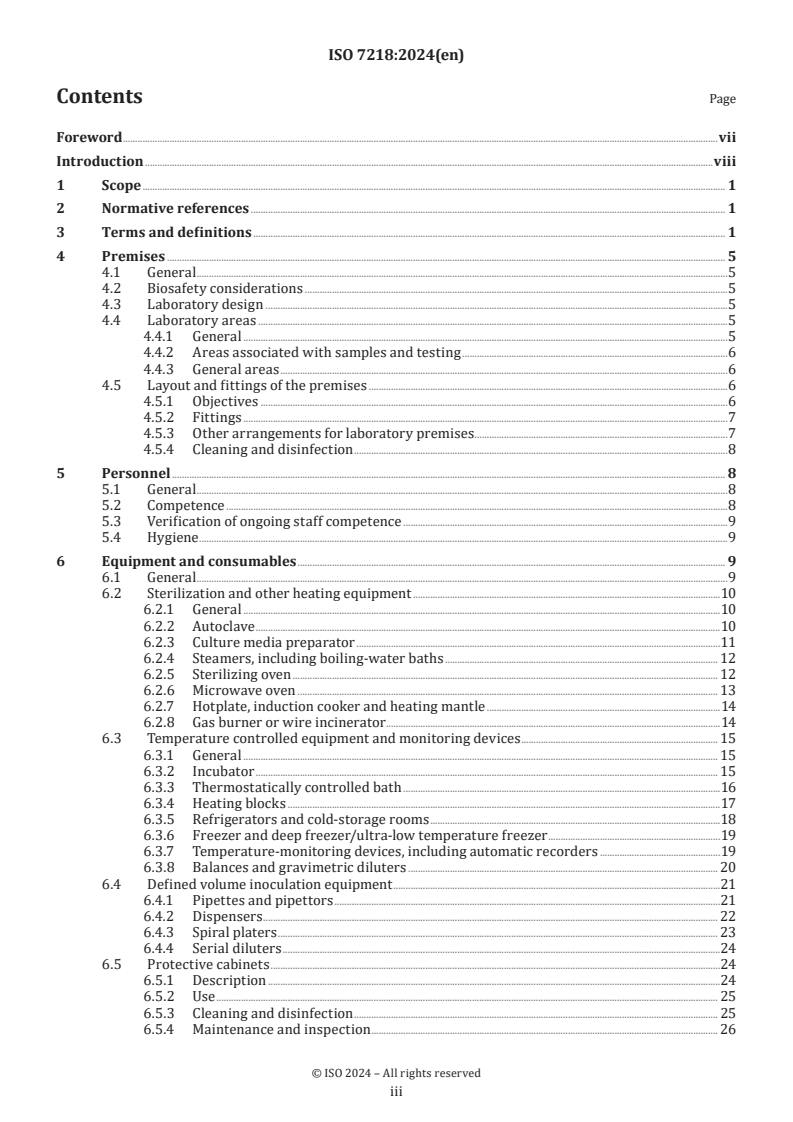
Contents Page
Foreword .vii
Introduction .viii
1 Scope . 1
2 Normative references . 1
3 Terms and definitions . 1
4 Premises . 5
4.1 General .5
4.2 Biosafety considerations .5
4.3 Laboratory design .5
4.4 Laboratory areas .5
4.4.1 General .5
4.4.2 Areas associated with samples and testing .6
4.4.3 General areas .6
4.5 Layout and fittings of the premises .6
4.5.1 Objectives .6
4.5.2 Fittings .7
4.5.3 Other arrangements for laboratory premises .7
4.5.4 Cleaning and disinfection .8
5 Personnel . 8
5.1 General .8
5.2 Competence .8
5.3 Verification of ongoing staff competence .9
5.4 Hygiene .9
6 Equipment and consumables . 9
6.1 General .9
6.2 Sterilization and other heating equipment .10
6.2.1 General .10
6.2.2 Autoclave .10
6.2.3 Culture media preparator .11
6.2.4 Steamers, including boiling-water baths . 12
6.2.5 Sterilizing oven . 12
6.2.6 Microwave oven . 13
6.2.7 Hotplate, induction cooker and heating mantle .14
6.2.8 Gas burner or wire incinerator .14
6.3 Temperature controlled equipment and monitoring devices . 15
6.3.1 General . 15
6.3.2 Incubator . 15
6.3.3 Thermostatically controlled bath .16
6.3.4 Heating blocks .17
6.3.5 Refrigerators and cold-storage rooms .18
6.3.6 Freezer and deep freezer/ultra-low temperature freezer .19
6.3.7 Temperature-monitoring devices, including automatic recorders .19
6.3.8 Balances and gravimetric diluters . 20
6.4 Defined volume inoculation equipment .21
6.4.1 Pipettes and pipettors .21
6.4.2 Dispensers . 22
6.4.3 Spiral platers . 23
6.4.4 Serial diluters .24
6.5 Protective cabinets .24
6.5.1 Description .24
6.5.2 Use . 25
6.5.3 Cleaning and disinfection . 25
6.5.4 Maintenance and inspection . 26
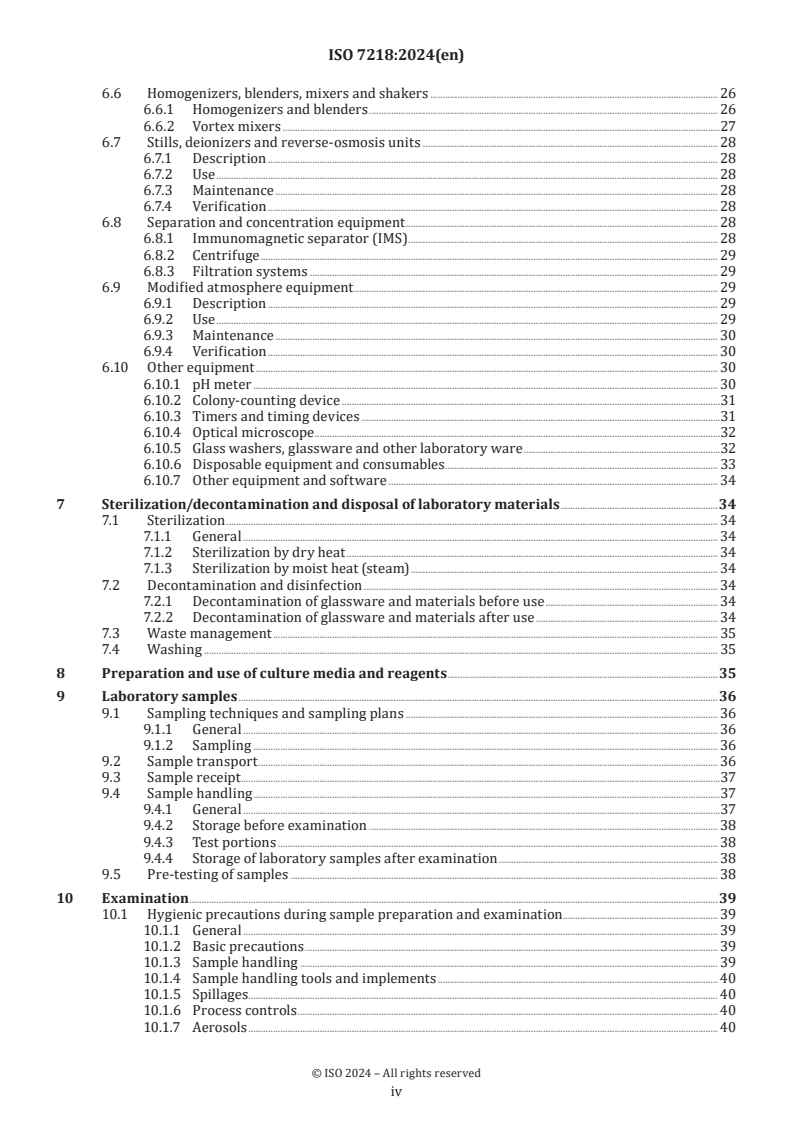
iii
6.6 Homogenizers, blenders, mixers and shakers . 26
6.6.1 Homogenizers and blenders . 26
6.6.2 Vortex mixers .27
6.7 Stills, deionizers and reverse-osmosis units . 28
6.7.1 Description . 28
6.7.2 Use . 28
6.7.3 Maintenance . 28
6.7.4 Verification . 28
6.8 Separation and concentration equipment . 28
6.8.1 Immunomagnetic separator (IMS) . 28
6.8.2 Centrifuge . 29
6.8.3 Filtration systems . 29
6.9 Modified atmosphere equipment . 29
6.9.1 Description . 29
6.9.2 Use . 29
6.9.3 Maintenance . 30
6.9.4 Verification . 30
6.10 Other equipment . 30
6.10.1 pH meter . 30
6.10.2 Colony-counting device .31
6.10.3 Timers and timing devices .31
6.10.4 Optical microscope .32
6.10.5 Glass washers, glassware and other laboratory ware .32
6.10.6 Disposable equipment and consumables . 33
6.10.7 Other equipment and software . 34
7 Sterilization/decontamination and disposal of laboratory materials .34
7.1 Sterilization . 34
7.1.1 General . 34
7.1.2 Sterilization by dry heat . 34
7.1.3 Sterilization by moist heat (steam) . 34
7.2 Decontamination and disinfection . 34
7.2.1 Decontamination of glassware and materials before use . 34
7.2.2 Decontamination of glassware and materials after use . 34
7.3 Waste management . 35
7.4 Washing . 35
8 Preparation and use of culture media and reagents .35
9 Laboratory samples .36
9.1 Sampling techniques and sampling plans . 36
9.1.1 General . 36
9.1.2 Sampling . 36
9.2 Sample transport . 36
9.3 Sample receipt .37
9.4 Sample handling .37
9.4.1 General .37
9.4.2 Storage before examination . 38
9.4.3 Test portions . 38
9.4.4 Storage of laboratory samples after examination . 38
9.5 Pre-testing of samples . 38
10 Examination .39
10.1 Hygienic precautions during sample preparation and examination . 39
10.1.1 General . 39
10.1.2 Basic precautions . 39
10.1.3 Sample handling . 39
10.1.4 Sample handling tools and implements . 40
10.1.5 Spillages. 40
10.1.6 Process controls . 40
10.1.7 Aerosols . 40
iv
10.1.8 Molecular methods .41
10.2 Preparation of initial suspension and dilutions .41
10.2.1 General .41
10.2.2 Concentration .41
11 Enumeration (quantitative) methods . 41
11.1 General .41
11.2 Enumeration using a solid medium .42
11.2.1 General .42
11.2.2 Pour plate technique .42
11.2.3 Surface plating techniques .43
11.2.4 Enumeration of yeasts and moulds. 44
11.2.5 Incubation.45
11.2.6 Calculation and expression of results obtained with solid culture media .45
11.2.7 Calculations for enumeration methods .47
11.3 Enumeration using liquid media . 54
11.3.1 Principle . 54
11.3.2 General MPN procedure . 54
11.3.3 Limitations of MPN . 54
11.3.4 Inoculation procedure . 55
11.3.5 Choice of MPN configuration . 55
11.3.6 Incubation. 56
11.3.7 Interpretation and expression of results . 56
11.3.8 Determination of MPN values using MPN calculators . 56
11.3.9 Rarity categories .57
11.4 Estimates of uncertainty of test results.57
12 Detection (qualitative) methods .58
12.1 General . 58
12.2 Principle . 58
13 Confirmation and identification methods .58
13.1 General . 58
13.2 Preparation of a pure culture .59
13.3 Confirmation methods .59
13.3.1 Latex agglutination test .59
13.3.2 Nucleic acid hybridization or molecular amplification methods .59
13.3.3 Slide agglutination tests . 60
13.4 Identification methods . 60
13.4.1 Biochemical galleries . 60
13.4.2 DNA sequencing . 60
13.4.3 Mass spectrometry .61
14 Selection and characterization of control microorganisms . 61
14.1 General .61
14.2 Characterization of microorganisms.62
14.2.1 General .62
14.2.2 Phenotypic characterization .62
14.2.3 Molecular characterization .62
14.3 Selection of control microorganisms.62
15 Test report .63
16 Laboratory quality control in microbiology .64
16.1 General . 64
16.2 Internal quality control . 65
16.2.1 General . 65
16.2.2 Process controls . 65
16.2.3 Replicate testing . 66
16.2.4 Spiked samples . 66
16.2.5 IQC assessment using control charts . 66
16.3 External quality assessment . 66
v
17 Validation and verification of microbiological methods . 67
17.1 General .67
17.2 Performance characteristics .67
17.3 Validation .67
17.4 Verification . . 68
Annex A (informative) Properties of disinfectants .69
Annex B (informative) Confidence intervals for colony count technique .70
Annex C (normative) General confirmation tests .73
Bibliography .78
vi
Foreword
ISO (the International Organization for Standardization) is a worldwide federation of national standards
bodies (ISO member bodies). The work of preparing International Standards is normally carried out through
ISO technical committees. Each member body interested in a subject for which a technical committee
has been established has the right to be represented on that committee. International organizations,
governmental and non-governmental, in liaison with ISO, also take part in the work. ISO collaborates closely
with the International Electrotechnical Commission (IEC) on all matters of electrotechnical standardization.
The procedures used to develop this document and those intended for its further maintenance are described
in the ISO/IEC Directives, Part 1. In particular, the different approval criteria needed for the different types
of ISO documents should be noted. This document was drafted in accordance with the editorial rules of the
ISO/IEC Directives, Part 2 (see www.iso.org/directives).
ISO draws attention to the possibility that the implementation of this document may involve the use of (a)
patent(s). ISO takes no position concerning the evidence, validity or applicability of any claimed patent
rights in respect thereof. As of the date of publication of this document, ISO had not received notice of (a)
patent(s) which may be required to implement this document. However, implementers are cautioned that
this may not represent the latest information, which may be obtained from the patent database available at
www.iso.org/patents. ISO shall not be held responsible for identifying any or all such patent rights.
Any trade name used in this document is information given for the convenience of users and does not
constitute an endorsement.
For an explanation of the voluntary nature of standards, the meaning of ISO specific terms and expressions
related to conformity assessment, as well as information about ISO’s adherence to the World Trade
Organization (WTO) principles in the Technical Barriers to Trade (TBT), see www.iso.org/iso/foreword.html.
This document was prepared by Technical Committee ISO/TC 34, Food products, Subcommittee SC 9,
Microbiology, in collaboration with the European Committee for Standardization (CEN) Technical Committee
CEN/TC 463, Microbiology of the food chain, in accordance with the Agreement on technical cooperation
between ISO and CEN (Vienna Agreement).
This fourth edition cancels and replaces the third edition (ISO 7218:2007), which has been technically
revised. It also incorporates the Amendment ISO 7218:2007/Amd 1:2013.
The main changes are as follows:
— the calculations section has been simplified and two further calculators have been added;
— the equipment section has been reorganized into groups with similar purposes and requirements;
— cross-references have been added to other general microbiology standards such as those for media,
validation and verification, and uncertainty to reduce repetition;
— information on laboratory quality control and characterization of control microorganisms has been added.
Any feedback or questions on this document should be directed to the user’s national standards body. A
complete listing of these bodies can be found at www.iso.org/members.html.
vii
Introduction
When conducting microbiological examinations, it is especially important that:
— only those microorganisms present in the samples are detected and/or enumerated;
— these microorganisms do not contaminate the environment.
To achieve this, good laboratory practices are essential, including personal hygiene and aseptic working
techniques which exclude extraneous contamination as far as possible.
Only limited information on the precautions to be taken during microbiological examinations is given in
this document, so a thorough knowledge of the microbiological techniques and microorganisms involved
is essential. It is important that examinations are conducted safely, correctly and as carefully as possible,
including monitoring and recording aspects that can affect results, calculating numbers of microorganisms
and assessing the uncertainty of test results.
The most common risks and their control in the microbiological laboratory are given in this document.
However, work processes in each laboratory can differ and appropriate risk analysis should be considered to
ensure good laboratory practices. Periodic evaluation and control of critical points not only maintains safe
and hygienic practices but can also improve reliability of test results.
The purpose of this document is to help to ensure the validity of microbiology examinations in the food
chain. In particular, to ensure that general techniques for conducting examinations are the same in all
laboratories, to achieve consistent results in different laboratories and to contribute to safety of laboratory
personnel by preventing risks of infection.
This document includes the main measures necessary for conducting the wide range of microbiological
examinations. Additional information is available from the literature listed in the Bibliography (see
References [43] to [47]).
In this document, the following verbal forms are used:
— “shall” indicates a requirement;
— “should” indicates a recommendation;
— “may” indicates a permission;
— “can” indicates a possibility or a capability.
In addition, the imperative mood is used to give instructions or where actions are required.
viii
International Standard ISO 7218:2024(en)
Microbiology of the food chain — General requirements and
guidance for microbiological examinations
1 Scope
This document specifies general requirements and gives guidance on microbiological examinations.
It is applicable to:
— the implementation of specific horizontal or vertical International Standards developed by ISO/TC 34/SC 9
or ISO/TC 34/SC 5 for detection or enumeration of microorganisms, named hereafter “specific standards”;
— good laboratory practices for microbiology laboratories testing samples from the food chain;
— guidance for microbiological laboratories testing samples from the food chain on the technical
requirements for conforming to ISO/IEC 17025.
The requirements of this general standard supersede corresponding ones in existing specific standards.
Additional instructions for examinations using the polymerase chain reaction (PCR) are specified in
ISO 22174.
This document is applicable to examinations for bacteria, yeasts and moulds and can be used, if supplemented
with specific guidance, for parasites and viruses. It does not apply to examinations for toxins or other
metabolites (e.g. amines) from microorganisms.
This document is applicable to microbiology of the food chain, from primary production stage to food and
animal feed products, including the premises where the food or feed production and handling takes place. It
is also applicable to the microbiological examination of water where water is used in food production or is
regarded as a food in national legislation.
2 Normative references
There are no normative references in this document.
3 Terms and definitions
For the purposes of this document, the following terms and definitions apply.
ISO and IEC maintain terminology databases for use in standardization at the following addresses:
— ISO Online browsing platform: available at https:// www .iso .org/ obp
— IEC Electropedia: available at https:// www .electropedia .org/
3.1
food chain
sequence of the stages in the production, processing, distribution, storage and handling of a food (3.2) and
its ingredients, from primary production to consumption
Note 1 to entry: The food chain includes the environment of primary production, food and feed production, and
handling.
Note 2 to entry: The food chain also includes the packaging materials intended to come into contact with food, feed
(3.3) or raw materials.
[SOURCE: ISO 22000:2018, 3.20, modified — Notes to entry replaced.]
3.2
food
products intended for human consumption
substance (ingredient), whether processed, semi-processed or raw, which is intended for human
consumption, and includes beverages and any substance which has been used in the manufacture,
preparation or treatment of “food” but does not include cosmetics or tobacco or substances (ingredients)
used only as drugs
[SOURCE: CAC/GL 81-2013, 6, modified — Admitted term added. “(ingredient)” added, “beverages” replaced
“drink” and “chewing-gum” deleted in the definition.]
3.3
feed
products for feeding animals
single or multiple product(s), whether processed, semi-processed or raw, which is (are) intended to be fed
to animals
Note 1 to entry: These products are intended for food-producing animals and non-food producing animals such as pets.
[SOURCE: ISO 22000:2018, 3.16, modified — Admitted term added. “food-producing” deleted in the
definition. Note 1 to entry replaced.
3.4
food or feed production and handling
any operation in the processing (e.g. preparation, cooking, packaging), storage, transport, distribution and
servi
...
Norme
internationale
ISO 7218
Quatrième édition
Microbiologie de la chaîne
2024-06
alimentaire — Exigences générales
et recommandations pour les
examens microbiologiques
Microbiology of the food chain — General requirements and
guidance for microbiological examinations
Numéro de référence
DOCUMENT PROTÉGÉ PAR COPYRIGHT
© ISO 2024
Tous droits réservés. Sauf prescription différente ou nécessité dans le contexte de sa mise en œuvre, aucune partie de cette
publication ne peut être reproduite ni utilisée sous quelque forme que ce soit et par aucun procédé, électronique ou mécanique,
y compris la photocopie, ou la diffusion sur l’internet ou sur un intranet, sans autorisation écrite préalable. Une autorisation peut
être demandée à l’ISO à l’adresse ci-après ou au comité membre de l’ISO dans le pays du demandeur.
ISO copyright office
Case postale 401 • Ch. de Blandonnet 8
CH-1214 Vernier, Genève
Tél.: +41 22 749 01 11
E-mail: copyright@iso.org
Web: www.iso.org
Publié en Suisse
ii
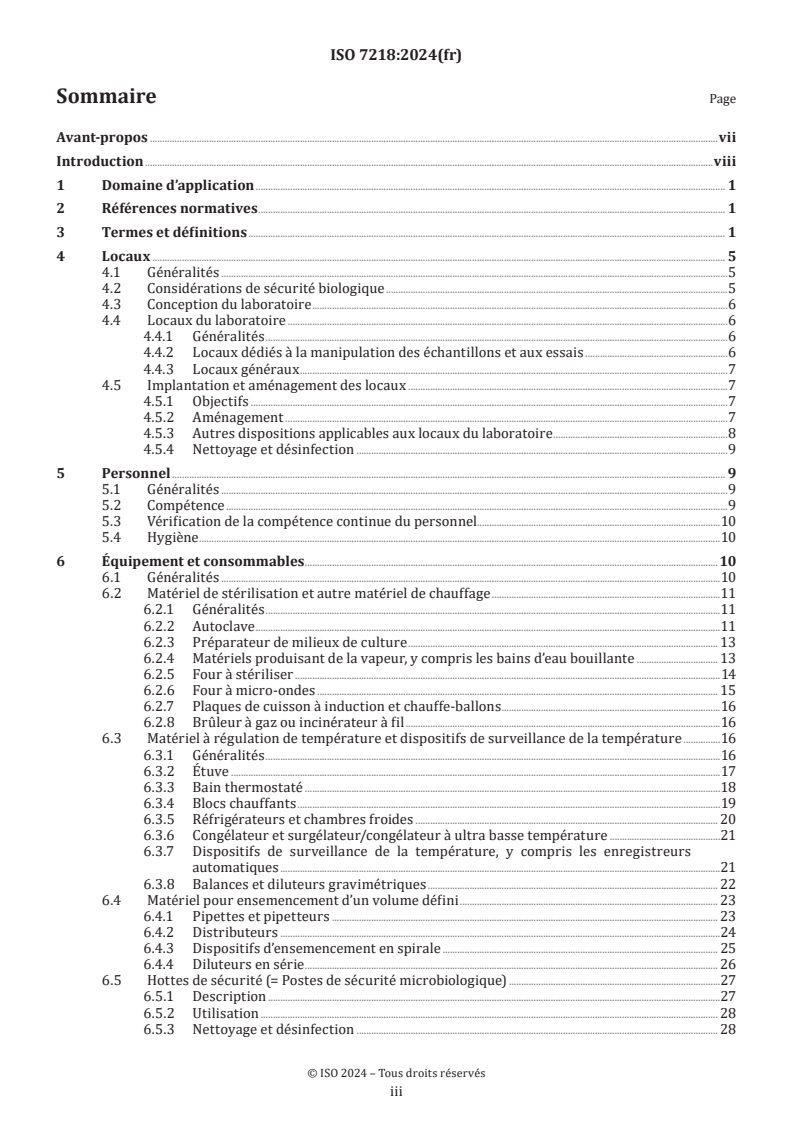
Sommaire Page
Avant-propos .vii
Introduction .viii
1 Domaine d’application . 1
2 Références normatives . 1
3 Termes et définitions . 1
4 Locaux . 5
4.1 Généralités .5
4.2 Considérations de sécurité biologique .5
4.3 Conception du laboratoire .6
4.4 Locaux du laboratoire .6
4.4.1 Généralités .6
4.4.2 Locaux dédiés à la manipulation des échantillons et aux essais .6
4.4.3 Locaux généraux .7
4.5 Implantation et aménagement des locaux .7
4.5.1 Objectifs .7
4.5.2 Aménagement .7
4.5.3 Autres dispositions applicables aux locaux du laboratoire .8
4.5.4 Nettoyage et désinfection .9
5 Personnel . 9
5.1 Généralités .9
5.2 Compétence .9
5.3 Vérification de la compétence continue du personnel.10
5.4 Hygiène .10
6 Équipement et consommables . 10
6.1 Généralités .10
6.2 Matériel de stérilisation et autre matériel de chauffage .11
6.2.1 Généralités .11
6.2.2 Autoclave .11
6.2.3 Préparateur de milieux de culture . 13
6.2.4 Matériels produisant de la vapeur, y compris les bains d’eau bouillante . 13
6.2.5 Four à stériliser .14
6.2.6 Four à micro-ondes . 15
6.2.7 Plaques de cuisson à induction et chauffe-ballons .16
6.2.8 Brûleur à gaz ou incinérateur à fil .16
6.3 Matériel à régulation de température et dispositifs de surveillance de la température .16
6.3.1 Généralités .16
6.3.2 Étuve .17
6.3.3 Bain thermostaté .18
6.3.4 Blocs chauffants .19
6.3.5 Réfrigérateurs et chambres froides . 20
6.3.6 Congélateur et surgélateur/congélateur à ultra basse température .21
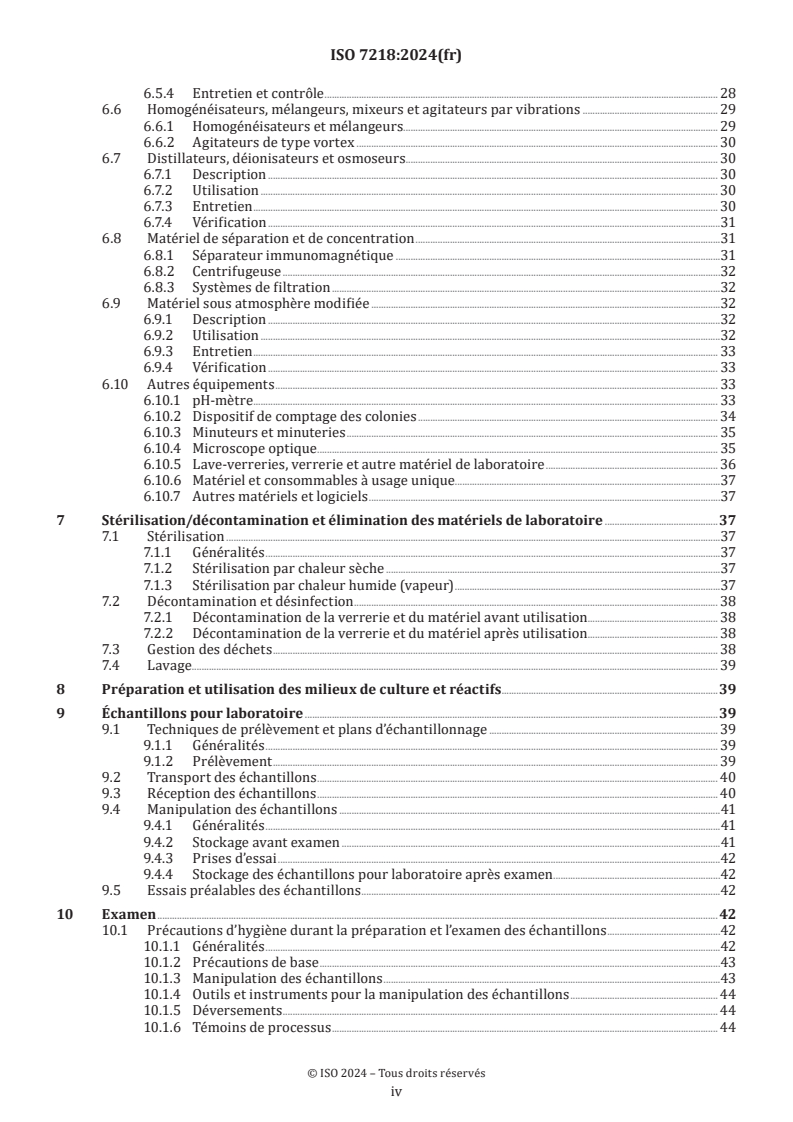
6.3.7 Dispositifs de surveillance de la température, y compris les enregistreurs
automatiques .21
6.3.8 Balances et diluteurs gravimétriques . 22
6.4 Matériel pour ensemencement d’un volume défini . 23
6.4.1 Pipettes et pipetteurs . 23
6.4.2 Distributeurs .24
6.4.3 Dispositifs d’ensemencement en spirale . 25
6.4.4 Diluteurs en série . 26
6.5 Hottes de sécurité (= Postes de sécurité microbiologique) .27
6.5.1 Description .27
6.5.2 Utilisation . 28
6.5.3 Nettoyage et désinfection . 28
iii
6.5.4 Entretien et contrôle . 28
6.6 Homogénéisateurs, mélangeurs, mixeurs et agitateurs par vibrations . 29
6.6.1 Homogénéisateurs et mélangeurs . . 29
6.6.2 Agitateurs de type vortex . 30
6.7 Distillateurs, déionisateurs et osmoseurs. 30
6.7.1 Description . 30
6.7.2 Utilisation . 30
6.7.3 Entretien . 30
6.7.4 Vérification .31
6.8 Matériel de séparation et de concentration .31
6.8.1 Séparateur immunomagnétique .31
6.8.2 Centrifugeuse .32
6.8.3 Systèmes de filtration .32
6.9 Matériel sous atmosphère modifiée .32
6.9.1 Description .32
6.9.2 Utilisation .32
6.9.3 Entretien . 33
6.9.4 Vérification . 33
6.10 Autres équipements . 33
6.10.1 pH-mètre . . 33
6.10.2 Dispositif de comptage des colonies . 34
6.10.3 Minuteurs et minuteries . 35
6.10.4 Microscope optique . 35
6.10.5 Lave-verreries, verrerie et autre matériel de laboratoire . 36
6.10.6 Matériel et consommables à usage unique . .37
6.10.7 Autres matériels et logiciels .37
7 Stérilisation/décontamination et élimination des matériels de laboratoire .37
7.1 Stérilisation .37
7.1.1 Généralités .37
7.1.2 Stérilisation par chaleur sèche .37
7.1.3 Stérilisation par chaleur humide (vapeur) .37
7.2 Décontamination et désinfection . 38
7.2.1 Décontamination de la verrerie et du matériel avant utilisation. 38
7.2.2 Décontamination de la verrerie et du matériel après utilisation . 38
7.3 Gestion des déchets . 38
7.4 Lavage . . 39
8 Préparation et utilisation des milieux de culture et réactifs .39
9 Échantillons pour laboratoire .39
9.1 Techniques de prélèvement et plans d’échantillonnage . 39
9.1.1 Généralités . 39
9.1.2 Prélèvement . 39
9.2 Transport des échantillons . 40
9.3 Réception des échantillons . 40
9.4 Manipulation des échantillons .41
9.4.1 Généralités .41
9.4.2 Stockage avant examen .41
9.4.3 Prises d’essai .42
9.4.4 Stockage des échantillons pour laboratoire après examen .42
9.5 Essais préalables des échantillons .42
10 Examen .42
10.1 Précautions d’hygiène durant la préparation et l’examen des échantillons .42
10.1.1 Généralités .42
10.1.2 Précautions de base .43
10.1.3 Manipulation des échantillons .43
10.1.4 Outils et instruments pour la manipulation des échantillons . 44
10.1.5 Déversements . 44
10.1.6 Témoins de processus . 44
iv
10.1.7 Aérosols . 44
10.1.8 Méthodes moléculaires . .45
10.2 Préparation de la suspension mère et des dilutions .45
10.2.1 Généralités .45
10.2.2 Concentration .45
11 Méthodes de dénombrement (quantitatives) .46
11.1 Généralités . 46
11.2 Dénombrement sur milieu solide . 46
11.2.1 Généralités . 46
11.2.2 Technique d’ensemencement en profondeur .47
11.2.3 Techniques d’ensemencement en surface .47
11.2.4 Dénombrement des levures et moisissures . 49
11.2.5 Incubation. 49
11.2.6 Calcul et expression des résultats sur milieu de culture solide . 50
11.2.7 Calculs pour les méthodes de dénombrement .52
11.3 Dénombrement en milieux liquides .59
11.3.1 Principe.59
11.3.2 Mode opératoire général de NPP (nombre le plus probable) .59
11.3.3 Limites du NPP . 60
11.3.4 Mode opératoire d’ensemencement . 60
11.3.5 Choix de la configuration de NPP .61
11.3.6 Incubation.62
11.3.7 Interprétation et expression des résultats .62
11.3.8 Détermination des valeurs NPP avec les calculateurs de NPP .62
11.3.9 Catégories de rareté .62
11.4 Estimations de l’incertitude des résultats d’essai . 63
12 Méthodes de détection (qualitatives) .63
12.1 Généralités . 63
12.2 Principe . 63
13 Méthodes d’identification et de confirmation .64
13.1 Généralités . 64
13.2 Préparation d’une culture pure . 65
13.3 Méthodes de confirmation . 65
13.3.1 Essai d’agglutination au latex . 65
13.3.2 Méthodes par hybridation d’acide nucléique ou amplification moléculaire . 65
13.3.3 Essais d’agglutination sur lame . 65
13.4 Méthodes d’identification . 66
13.4.1 Galeries biochimiques . 66
13.4.2 Séquençage de l’ADN . 66
13.4.3 Spectrométrie de masse .67
14 Choix et caractérisation des micro-organismes témoins. 67
14.1 Généralités .67
14.2 Caractérisation des micro-organismes . 68
14.2.1 Généralités . 68
14.2.2 Caractérisation phénotypique. 68
14.2.3 Caractérisation moléculaire . . 68
14.3 Choix des micro-organismes témoins . 68
15 Rapport d’essai .70
16 Contrôle qualité de laboratoire en microbiologie .70
16.1 Généralités .70
16.2 Contrôle qualité interne .71
16.2.1 Généralités .71
16.2.2 Témoins de processus . 72
16.2.3 Répétitions d’essai . 73
16.2.4 Échantillons dopés . 73
16.2.5 Évaluation des contrôles qualité internes à l’aide de cartes de contrôle . 73
v
16.3 Évaluation des contrôles qualité externes . 73
17 Validation et vérification des méthodes microbiologiques . 74
17.1 Généralités .74
17.2 Caractéristiques de performance .74
17.3 Validation . 75
17.4 Vérification . . 75
Annexe A (informative) Propriétés de désinfectants . 76
Annexe B (informative) Intervalles de confiance pour la technique de comptage de colonies .77
Annexe C (normative) Tests généraux de confirmation .80
Bibliographie .85
vi
Avant-propos
L’ISO (Organisation internationale de normalisation) est une fédération mondiale d’organismes nationaux
de normalisation (comités membres de l’ISO). L’élaboration des Normes internationales est en général
confiée aux comités techniques de l’ISO. Chaque comité membre intéressé par une étude a le droit de faire
partie du comité technique créé à cet effet. Les organisations internationales, gouvernementales et non
gouvernementales, en liaison avec l’ISO participent également aux travaux. L’ISO collabore étroitement avec
la Commission électrotechnique internationale (IEC) en ce qui concerne la normalisation électrotechnique.
Les procédures utilisées pour élaborer le présent document et celles destinées à sa mise à jour sont
décrites dans les Directives ISO/IEC, Partie 1. Il convient, en particulier, de prendre note des différents
critères d’approbation requis pour les différents types de documents ISO. Le présent document a
été rédigé conformément aux règles de rédaction données dans les Directives ISO/IEC, Partie 2 (voir
www.iso.org/directives).
L’ISO attire l’attention sur le fait que la mise en application du présent document peut entraîner l’utilisation
d’un ou de plusieurs brevets. L’ISO ne prend pas position quant à la preuve, à la validité et à l’applicabilité de
tout droit de brevet revendiqué à cet égard. À la date de publication du présent document, l’ISO n’avait pas
reçu notification qu’un ou plusieurs brevets pouvaient être nécessaires à sa mise en application. Toutefois,
il y a lieu d’avertir les responsables de la mise en application du présent document que des informations
plus récentes sont susceptibles de figurer dans la base de données de brevets, disponible à l’adresse
www.iso.org/brevets. L’ISO ne saurait être tenue pour responsable de ne pas avoir identifié tout ou partie de
tels droits de propriété.
Les appellations commerciales éventuellement mentionnées dans le présent document sont données pour
information, par souci de commodité, à l’intention des utilisateurs et ne sauraient constituer un engagement.
Pour une explication de la nature volontaire des normes, la signification des termes et expressions
spécifiques de l’ISO liés à l’évaluation de la conformité, ou pour toute information au sujet de l’adhésion de
l’ISO aux principes de l’Organisation mondiale du commerce (OMC) concernant les obstacles techniques au
commerce (OTC), voir www.iso.org/avant-propos.
Le présent document a été élaboré par le comité technique ISO/TC 34, Produits alimentaires, sous-comité SC 9,
Microbiologie, en collaboration avec le comité technique CEN/TC 463, Microbiologie de la chaîne alimentaire,
du Comité européen de normalisation (CEN), conformément à l’Accord sur la coopération technique entre
l’ISO et le CEN (Accord de Vienne).
Cette quatrième édition annule et remplace la troisième édition (ISO 7218:2007), qui a fait l’objet d’une
révision technique. Elle intègre également l’amendement ISO 7218:2007/Amd 1:2013.
Les principales modifications sont les suivantes:
— simplification de la partie calculs et ajout de deux autres calculateurs;
— restructuration de la partie appareillage par groupes d’équipements ayant les mêmes finalités et soumis
aux mêmes exigences;
— référence à d’autres normes générales de microbiologie telles que celles traitant des milieux, de la
validation, de la vérification et de l’incertitude afin de limiter les répétitions;
— ajout d’informations sur le contrôle qualité du laboratoire et la caractérisation des micro-organismes
témoins.
Il convient que l’utilisateur adresse tout retour d’information ou toute question concernant le présent
document à l’organisme national de normalisation de son pays. Une liste exhaustive desdits organismes se
trouve à l’adresse www.iso.org/fr/members.html.
vii
Introduction
Lorsque des examens microbiologiques sont effectués, il est particulièrement important:
— de détecter et/ou de dénombrer seulement les micro-organismes présents dans les échantillons; et
— que ces micro-organismes ne contaminent pas l’environnement.
Pour cela, il est essentiel d’appliquer de bonnes pratiques de laboratoire, notamment de veiller à l’hygiène
du personnel et d’utiliser des techniques de travail aseptiques qui permettent d’éviter, autant que possible,
toute contamination par l’environnement de l’essai.
Les informations données dans le présent document sur les précautions à prendre pendant les examens
microbiologiques n’étant pas exhaustives, une connaissance approfondie des techniques microbiologiques
et des micro-organismes en question est donc essentielle. Il est important que les examens soient conduits
de manière aussi sûre, correcte et minutieuse que possible, notamment en ce qui concerne les aspects liés au
contrôle et à l’enregistrement pouvant avoir une incidence sur les résultats, ainsi que le calcul des nombres
de micro-organismes et l’évaluation de l’incertitude des résultats d’essai.
Les risques les plus courants et leur contrôle dans le laboratoire de microbiologie sont énoncés dans le
présent document. Toutefois, les méthodologies de travail peuvent être différentes d’un laboratoire à un
autre et il convient de mener une analyse des risques appropriée pour garantir de bonnes pratiques de
laboratoire. L’évaluation et le contrôle périodiques de points décisifs contribuent non seulement à respecter
les pratiques d’hygiène et de sécurité, mais peuvent aussi améliorer la fiabilité des résultats d’essai.
Le présent document a pour objet d’aider à garantir la validité des examens microbiologiques dans la chaîne
alimentaire. Il vise en particulier à faire en sorte que les méthodes générales pour effectuer des examens
soient les mêmes dans tous les laboratoires, à participer ainsi à l’obtention de résultats cohérents entre les
différents laboratoires et à contribuer à la sécurité du personnel de laboratoire, en prévenant les risques
d’infection.
Le présent document intègre les principales mesures nécessaires pour mener des examens microbiologiques
de divers types. De plus amples informations sont disponibles dans la littérature mentionnée dans la
Bibliographie (voir Références [43] à [47]).
Dans le présent document, les formes verbales suivantes sont utilisées:
— «doit» indique une exigence;
— «il convient de» indique une recommandation;
— «peut» indique parfois une autorisation («may» en anglais), ou encore une possibilité ou une capacité
(«can» en anglais).
En outre, l’impératif est utilisé pour énoncer des instructions ou lorsque des actions sont requises.
viii
Norme internationale ISO 7218:2024(fr)
Microbiologie de la chaîne alimentaire — Exigences générales
et recommandations pour les examens microbiologiques
1 Domaine d’application
Le présent document spécifie des exigences générales et donne des recommandations relatives aux examens
microbiologiques.
Il couvre:
— l’application des normes internationales horizontales ou verticales spécifiques élaborées par
l’ISO/TC 34/SC 9 ou l’ISO/TC 34/SC 5 pour la détection ou le dénombrement des micro-organismes,
nommées ci-après «normes spécifiques»;
— les bonnes pratiques de laboratoire pour les laboratoires de microbiologie soumettant à essai des
échantillons issus de la chaîne alimentaire;
— les recommandations destinées aux laboratoires de microbiologie soumettant à essai des échantillons
issus de la chaîne alimentaire concernant les exigences techniques conformément à l’ISO/IEC 17025.
Les exigences de la présente norme générale prennent le pas sur les exigences correspondantes des normes
spécifiques existantes.
Des instructions supplémentaires concernant les examens ayant recours à la réaction de polymérisation en
chaîne (PCR) sont spécifiées dans l’ISO 22174.
Le présent document est applicable aux examens des bactéries, des levures et des moisissures et peut être
utilisé s’il est complété par des recommandations spécifiques, pour les examens des parasites et des virus.
Il ne s’applique pas aux examens des toxines ou autres métabolites (par exemple, les amines) provenant de
micro-organismes.
Le présent document est applicable à la microbiologie de la chaîne alimentaire, du stade de la production
primaire aux produits alimentaires pour la consommation humaine et pour les animaux, y compris les locaux
de production et de manutention des aliments ou aliments pour animaux. Il peut également s’appliquer à
l’examen microbiologique de l’eau si celle-ci est utilisée dans la production alimentaire ou si la législation
nationale la considère comme un aliment.
2 Références normatives
Le présent document ne contient aucune référence normative.
3 Termes et définitions
Pour les besoins du présent document, les termes et définitions suivants s’appliquent.
L’ISO et l’IEC tiennent à jour des bases de données terminologiques destinées à être utilisées en normalisation,
consultables aux adresses suivantes:
— ISO Online browsing platform: disponible à l’adresse https:// www .iso .org/ obp
— IEC Electropedia: disponible à l’adresse https:// www .electropedia .org/
3.1
chaîne alimentaire
séquence des étapes dans la production, la transformation, la distribution, l’entreposage et la manutention
d’une denrée alimentaire (3.2) et de ses ingrédients, de la production primaire à la consommation
Note 1 à l'article: La chaîne alimentaire inclut l’environnement de production primaire, de production et de
manutention des denrées alimentaires et aliments pour animaux.
Note 2 à l'article: La chaîne alimentaire inclut également les matériaux de conditionnement destinés à être en contact
avec les denrées alimentaires, les aliments pour animaux (3.3) ou les matières premières.
[SOURCE: ISO 22000:2018, 3.20, modifié — Les Notes à l’article ont été remplacées.]
3.2
denrée alimentaire
produits destinés à l’alimentation humaine
substance (ingrédient), traitée, partiellement traitée ou brute, destinée à l’alimentation humaine, englobant
les boissons et toutes les substances utilisées dans la fabrication, la préparation ou le traitement des
«aliments» à l’exclusion des cosmétiques ou du tabac ou des substances (ingrédients) employées uniquemen
...
Questions, Comments and Discussion
Ask us and Technical Secretary will try to provide an answer. You can facilitate discussion about the standard in here.
Loading comments...