


ISO/IEC/IEEE 21451-4:2010
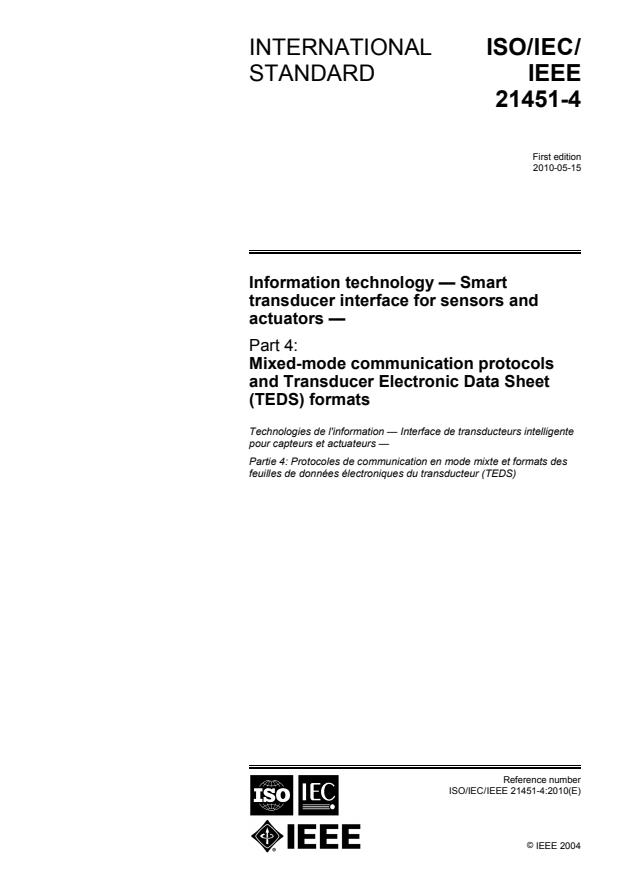
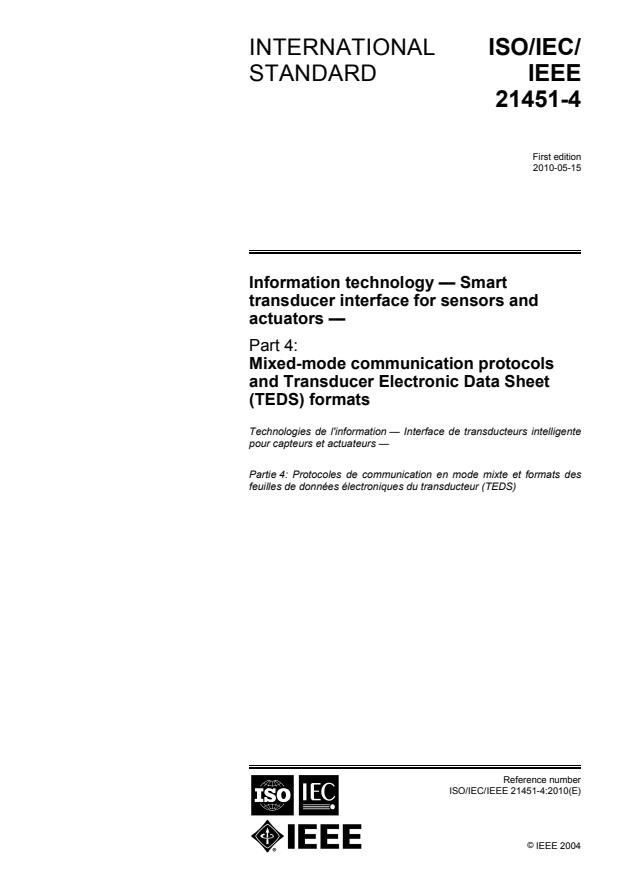
(Main)Information technology — Smart transducer interface for sensors and actuators — Part 4: Mixed-mode communication protocols and Transducer Electronic Data Sheet (TEDS) formats
Information technology — Smart transducer interface for sensors and actuators — Part 4: Mixed-mode communication protocols and Transducer Electronic Data Sheet (TEDS) formats
ISO/IEC/IEEE 21451-4:2010 defines the protocol and interface that allows analog transducers to communicate digital information with an ISO/IEC/IEEE 21451 object. It also defines the format of the Transducer Electronic Data Sheet (TEDS), which is based on the ISO/IEC/IEEE 21451-2 TEDS. It does not specify the transducer design, signal conditioning, or the specific use of the TEDS.
Technologies de l'information — Interface de transducteurs intelligente pour capteurs et actuateurs — Partie 4: Protocoles de communication en mode mixte et formats des feuilles de données électroniques du transducteur (TEDS)
General Information
- Status
- Published
- Publication Date
- 19-May-2010
- Technical Committee
- ISO/IEC JTC 1/SC 31 - Automatic identification and data capture techniques
- Drafting Committee
- ISO/IEC JTC 1/SC 31/WG 4 - Radio communications
- Current Stage
- 9093 - International Standard confirmed
- Start Date
- 15-Dec-2022
- Completion Date
- 12-Feb-2026
Overview
ISO/IEC/IEEE 21451-4:2010 - "Smart transducer interface for sensors and actuators - Part 4" - defines mixed-mode communication protocols and the Transducer Electronic Data Sheet (TEDS) formats to enable analog transducers to exchange digital information with an ISO/IEC/IEEE 21451 object. The standard specifies the protocol and interface for connecting analog sensors and actuators into a smart-transducer environment and establishes a digital metadata format for transducer identification and configuration. It does not prescribe transducer hardware design, signal conditioning circuits, or specific operational use of the TEDS.
Key topics and requirements
- Mixed‑mode communication protocols: Defines how analog transducers are accessed and managed using combined analog signals and digital control/metadata channels to support smart-transducer interoperability.
- TEDS format (based on ISO/IEC/IEEE 21451-2): Specifies the structure for the Transducer Electronic Data Sheet used to store transducer metadata and enable plug-and-play discovery and configuration.
- Interoperability focus: Protocols and TEDS formats are intended to allow different vendors’ transducers and interface modules to work together under the 21451 framework.
- Interface and protocol requirements: Defines message exchange, addressing, and metadata handling needed for an ISO/IEC/IEEE 21451 object to represent analog transducers digitally.
- Limitations: The standard does not define transducer internal design, signal conditioning techniques, or mandatory TEDS usage scenarios - implementers decide those details.
Applications and practical value
ISO/IEC/IEEE 21451-4 is targeted at systems where analog sensors/actuators must participate in digital, smart-transducer ecosystems. Typical applications include:
- Industrial automation and process control systems integrating legacy analog sensors into modern networks.
- Instrumentation and test systems requiring automated sensor identification and configuration.
- IoT/IIoT gateways and edge devices that bridge analog field sensors with digital monitoring platforms.
- Sensor manufacturers and module vendors implementing standardized metadata (TEDS) for plug-and-play support.
Benefits:
- Faster integration and reduced commissioning time via standardized metadata and protocols.
- Improved interoperability across suppliers and reduced custom driver development.
- Easier sensor replacement, calibration tracking, and system-level diagnostics.
Related standards
- ISO/IEC/IEEE 21451-2 - referenced for TEDS structure and semantics.
- Other parts of the ISO/IEC/IEEE 21451 series cover networked and mixed transducer interfaces and can be consulted for comprehensive smart-transducer system design.
Keywords: ISO 21451-4, ISO/IEC/IEEE 21451-4:2010, TEDS, Transducer Electronic Data Sheet, smart transducer, mixed-mode communication protocols, sensor interface, plug-and-play sensors, sensor interoperability.

ISO/IEC/IEEE 21451-4:2010 - Information technology -- Smart transducer interface for sensors and actuators
ISO/IEC/IEEE 21451-4:2010 - Information technology -- Smart transducer interface for sensors and actuators
Get Certified
Connect with accredited certification bodies for this standard

BSI Group
BSI (British Standards Institution) is the business standards company that helps organizations make excellence a habit.

NYCE
Mexican standards and certification body.
Sponsored listings
Frequently Asked Questions
ISO/IEC/IEEE 21451-4:2010 is a standard published by the International Organization for Standardization (ISO). Its full title is "Information technology — Smart transducer interface for sensors and actuators — Part 4: Mixed-mode communication protocols and Transducer Electronic Data Sheet (TEDS) formats". This standard covers: ISO/IEC/IEEE 21451-4:2010 defines the protocol and interface that allows analog transducers to communicate digital information with an ISO/IEC/IEEE 21451 object. It also defines the format of the Transducer Electronic Data Sheet (TEDS), which is based on the ISO/IEC/IEEE 21451-2 TEDS. It does not specify the transducer design, signal conditioning, or the specific use of the TEDS.
ISO/IEC/IEEE 21451-4:2010 defines the protocol and interface that allows analog transducers to communicate digital information with an ISO/IEC/IEEE 21451 object. It also defines the format of the Transducer Electronic Data Sheet (TEDS), which is based on the ISO/IEC/IEEE 21451-2 TEDS. It does not specify the transducer design, signal conditioning, or the specific use of the TEDS.
ISO/IEC/IEEE 21451-4:2010 is classified under the following ICS (International Classification for Standards) categories: 35.040 - Information coding; 35.040.50 - Automatic identification and data capture techniques. The ICS classification helps identify the subject area and facilitates finding related standards.
ISO/IEC/IEEE 21451-4:2010 is available in PDF format for immediate download after purchase. The document can be added to your cart and obtained through the secure checkout process. Digital delivery ensures instant access to the complete standard document.
Standards Content (Sample)
INTERNATIONAL ISO/IEC/
STANDARD IEEE
21451-4
First edition
2010-05-15
Information technology — Smart
transducer interface for sensors and
actuators —
Part 4:
Mixed-mode communication protocols
and Transducer Electronic Data Sheet
(TEDS) formats
Technologies de l'information — Interface de transducteurs intelligente
pour capteurs et actuateurs —
Partie 4: Protocoles de communication en mode mixte et formats des
feuilles de données électroniques du transducteur (TEDS)
Reference number
©
IEEE 2004
PDF disclaimer
This PDF file may contain embedded typefaces. In accordance with Adobe's licensing policy, this file may be printed or viewed but
shall not be edited unless the typefaces which are embedded are licensed to and installed on the computer performing the editing. In
downloading this file, parties accept therein the responsibility of not infringing Adobe's licensing policy. The ISO Central Secretariat,
the IEC Central Office and IEEE do not accept any liability in this area.
Adobe is a trademark of Adobe Systems Incorporated.
Details of the software products used to create this PDF file can be found in the General Info relative to the file; the PDF-creation
parameters were optimized for printing. Every care has been taken to ensure that the file is suitable for use by ISO member bodies
and IEEE members. In the unlikely event that a problem relating to it is found, please inform the ISO Central Secretariat or IEEE at the
address given below.
© IEEE 2004
All rights reserved. Unless otherwise specified, no part of this publication may be reproduced or utilized in any form or by any means,
electronic or mechanical, including photocopying and microfilm, without permission in writing from either ISO or IEEE at the respective
address below.
ISO copyright office Institute of Electrical and Electronics Engineers, Inc.
Case postale 56 CH-1211 Geneva 20 3 Park Avenue, New York NY 10016-5997, USA
Tel. + 41 22 749 01 11 E-mail stds.ipr@ieee.org
Fax + 41 22 749 09 47 Web www.ieee.org
E-mail copyright@iso.org
Web www.iso.org
ISO version published 2010
Published in Switzerland
ii © IEEE 2004 – All rights reserved
Foreword
ISO (the International Organization for Standardization) and IEC (the International Electrotechnical
Commission) form the specialized system for worldwide standardization. National bodies that are members of
ISO or IEC participate in the development of International Standards through technical committees established
by the respective organization to deal with particular fields of technical activity. ISO and IEC technical
committees collaborate in fields of mutual interest. Other international organizations, governmental and non-
governmental, in liaison with ISO and IEC, also take part in the work. In the field of information technology, ISO
and IEC have established a joint technical committee, ISO/IEC JTC 1.
IEEE Standards documents are developed within the IEEE Societies and the Standards Coordinating
Committees of the IEEE Standards Association (IEEE-SA) Standards Board. The IEEE develops its standards
through a consensus development process, approved by the American National Standards Institute, which
brings together volunteers representing varied viewpoints and interests to achieve the final product. Volunteers
are not necessarily members of the Institute and serve without compensation. While the IEEE administers the
process and establishes rules to promote fairness in the consensus development process, the IEEE does not
independently evaluate, test, or verify the accuracy of any of the information contained in its standards.
The main task of ISO/IEC JTC 1 is to prepare International Standards. Draft International Standards adopted
by the joint technical committee are circulated to national bodies for voting. Publication as an International
Standard requires approval by at least 75 % of the national bodies casting a vote.
Attention is called to the possibility that implementation of this standard may require the use of subject matter
covered by patent rights. By publication of this standard, no position is taken with respect to the existence or
validity of any patent rights in connection therewith. ISO/IEEE is not responsible for identifying essential
patents or patent claims for which a license may be required, for conducting inquiries into the legal validity or
scope of patents or patent claims or determining whether any licensing terms or conditions provided in
connection with submission of a Letter of Assurance or a Patent Statement and Licensing Declaration Form, if
any, or in any licensing agreements are reasonable or non-discriminatory. Users of this standard are expressly
advised that determination of the validity of any patent rights, and the risk of infringement of such rights, is
entirely their own responsibility. Further information may be obtained from ISO or the IEEE Standards
Association.
ISO/IEC/IEEE 21451-4 was prepared by the Technical Committee on Sensor Technology of the IEEE
Instrumentation and Measurement Society of the IEEE (as IEEE Std 1451.4-2004). It was adopted by Joint
Technical Committee ISO/IEC JTC 1, Information technology, Subcommittee SC 31, Automatic identification
and data capture techniques, in parallel with its approval by the ISO/IEC national bodies, under the “fast-track
procedure” defined in the Partner Standards Development Organization cooperation agreement between ISO
and IEEE. IEEE is responsible for the maintenance of this document with participation and input from ISO/IEC
national bodies.
© IEEE 2004 – All rights reserved iii
(blank page)
iv © IEEE 2004 – All rights reserved
™
IEEE Std 1451.4 -2004
TM
1451.4
IEEE Standard for A Smart Transducer
Interface for Sensors and Actuators—
Mixed-Mode Communication Protocols
and Transducer Electronic Data Sheet
(TEDS) Formats
IEEE Instrumentation and Measurement Society
Sponsored by the
Technical Committee on Sensor Technology TC-9
15 December 2004
Print: SH95225
3 Park Avenue, NewYork, NY 10016-5997, USA
PDF: SS95225
© IEEE 2004 – All rights reserved v
IEEE Standards
IEEE Standards
(blank page)
vi © IEEE 2004 – All rights reserved
™
Recognized as an
IEEE Std 1451.4 -2004
American National Standard (ANSI)
IEEE Standard for a Smart Transducer
Interface for Sensors and Actuators—
Mixed-Mode Communication Protocols
and Transducer Electronic Data Sheet
(TEDS) Formats
Sponsor
Technical Committee on Sensor Technology
of the
IEEE Instrument and Measurement Society
Approved 25 August 2004
American National Standards Institute
Approved 25 March 2004
IEEE-SA Standards Board
Abstract: This standard defines the protocol and interface that allows analog transducers to com-
municate digital information with an IEEE 1451 object. It also defines the format of the Transducer
TEDS. The Transducer TEDS is based on the IEEE 1451.2™ TEDS. The standard does not specify
the transducer design, signal conditioning, or the specific use of the TEDS.
Keywords: appended TEDS, basic TEDS, device configuration file, family code, IEEE 1451.4 in-
terface, IEEE 1451.4 transducer, mixed-mode Interface (MMI), mixed-mode transducer (MMXD-
CR), network capable application processor (NCAP), plug-and-play, smart transducer, TEDS,
template, template ID, transducer electronic data sheet (TEDS), template description language,
transparent protocol, template description language, tbom schema, transducer block
The Institute of Electrical and Electronics Engineers, Inc.
3 Park Avenue, New York, NY 10016-5997, USA
All rights reserved. Published 14 December 2004. Printed in the United States of America.
IEEE is a registered trademark in the U.S. Patent & Trademark Office, owned by the Institute of Electrical and Electronics Engineers, Incorpo-
rated.
1-Wire & MicroLAN are trademarks of Maxim-Dallas Semiconductor Corporation.
Print: ISBN 0-7381-4007-4 SH95225
PDF: ISBN 0-7381-4008-2 SS95225
No part of this publication may be reproduced in any form, in an electronic retrieval system or otherwise, without the prior written permission
of the publisher.
© IEEE 2004 – All rights reserved vii
IEEE Standards documents are developed within the IEEE Societies and the Standards Coordinating
Committees of the IEEE Standards Association (IEEE-SA) Standards Board. The IEEE develops its standards
through a consensus development process, approved by the American National Standards Institute, which brings
together volunteers representing varied viewpoints and interests to achieve the final product. Volunteers are not
necessarily members of the Institute and serve without compensation. While the IEEE administers the process
and establishes rules to promote fairness in the consensus development process, the IEEE does not independently
evaluate, test, or verify the accuracy of any of the information contained in its standards.
Use of an IEEE Standard is wholly voluntary. The IEEE disclaims liability for any personal injury, property or
other damage, of any nature whatsoever, whether special, indirect, consequential, or compensatory, directly or
indirectly resulting from the publication, use of, or reliance upon this, or any other IEEE Standard document.
The IEEE does not warrant or represent the accuracy or content of the material contained herein, and expressly
disclaims any express or implied warranty, including any implied warranty of merchantability or fitness for a
specific purpose, or that the use of the material contained herein is free from patent infringement. IEEE Standards
documents are supplied “AS IS.”
The existence of an IEEE Standard does not imply that there are no other ways to produce, test, measure,
purchase, market, or provide other goods and services related to the scope of the IEEE Standard. Furthermore, the
viewpoint expressed at the time a standard is approved and issued is subject to change brought about through
developments in the state of the art and comments received from users of the standard. Every IEEE Standard is
subjected to review at least every five years for revision or reaffirmation. When a document is more than five
years old and has not been reaffirmed, it is reasonable to conclude that its contents, although still of some value,
do not wholly reflect the present state of the art. Users are cautioned to check to determine that they have the
latest edition of any IEEE Standard.
In publishing and making this document available, the IEEE is not suggesting or rendering professional or other
services for, or on behalf of, any person or entity. Nor is the IEEE undertaking to perform any duty owed by any
other person or entity to another. Any person utilizing this, and any other IEEE Standards document, should rely
upon the advice of a competent professional in determining the exercise of reasonable care in any given
circumstances.
Interpretations: Occasionally questions may arise regarding the meaning of portions of standards as they relate to
specific applications. When the need for interpretations is brought to the attention of IEEE, the Institute will initiate
action to prepare appropriate responses. Since IEEE Standards represent a consensus of concerned interests, it is
important to ensure that any interpretation has also received the concurrence of a balance of interests. For this rea-
son, IEEE and the members of its societies and Standards Coordinating Committees are not able to provide an in-
stant response to interpretation requests except in those cases where the matter has previously received formal
consideration. At lectures, symposia, seminars, or educational courses, an individual presenting information on
IEEE standards shall make it clear that his or her views should be considered the personal views of that individual
rather than the formal position, explanation, or interpretation of the IEEE.
Comments for revision of IEEE Standards are welcome from any interested party, regardless of membership
affiliation with IEEE. Suggestions for changes in documents should be in the form of a proposed change of text,
together with appropriate supporting comments. Comments on standards and requests for interpretations should
be addressed to:
Secretary, IEEE-SA Standards Board
445 Hoes Lane
P.O. Box 1331
Piscataway, NJ 08855-1331USA
NOTE−Attention is called to the possibility that implementation of this standard may require use of subject
matter covered by patent rights. By publication of this standard, no position is taken with respect to the
existence or validity of any patent rights in connection therewith. The IEEE shall not be responsible for
identifying patents for which a license may be required by an IEEE standard or for conducting inquiries into the
legal validity or scope of those patents that are brought to its attention.
Authorization to photocopy portions of any individual standard for internal or personal use is granted by the
Institute of Electrical and Electronics Engineers, Inc., provided that the appropriate fee is paid to Copyright
Clearance Center. To arrange for payment of licensing fee, please contact Copyright Clearance Center, Customer
Service, 222 Rosewood Drive, Danvers, MA 01923 USA; +1 978 750 8400. Permission to photocopy portions of
any individual standard for educational classroom use can also be obtained through the Copyright Clearance
Center.
viii © IEEE 2004 – All rights reserved
Introduction
[This introduction is not part of IEEE Std 1451.4-2004, IEEE Standard for a Smart Transducer Interface for Sensors and
Actuators—Mixed-Mode Communication Protocols and Transducer Electronic Data Sheet (TEDS) Formats.]
The main objectives of this standard are to
— Enable plug-and-play at the transducer level by providing a common IEEE 1451.4 Transducer
communication interface compatible with legacy transducers.
— Enable and simplify the creation of smart transducers.
— Facilitate the support of multiple networks.
— Simplify the setup and maintenance of instrumentation systems.
— Provide a bridge between the legacy instrumentation systems and the smart mixed-mode transducers.
— Enable implementation of smart transducers with minimal use of memory.
There was previously no defined common digital communication interface standard between mixed-mode
transducers and network capable application processors (NCAPs). Each transducer manufacturer defined its
own interface. Consequently, transducer manufacturers could not support all of the control networks for
which their products might be suitable. A universally accepted mixed-mode transducer interface standard
will facilitate the development of compliant smart sensors and actuators and could lead to lower
development costs. This common interface allows the transducer manufacturers to support multiple control
networks easily and helps to preserve the user’s investment if it becomes necessary to migrate to a different
network standard. In addition, this standard will make systems much easier to implement and use.
This standard simplifies the development of smart mixed-mode transducers by defining hardware and
software blocks that are independent of specific control networks. The standard describes the following:
— An IEEE 1451.4 Transducer containing a Mixed-Mode Interface (MMI) and a transducer electronic
data sheet (TEDS).
— The MMI, which is a master-slave, multidrop, serial connection. It requires a master device to
initiate each transaction with each slave or node according to a defined digital communication
protocol. The MMI may contain circuitry to detect and report a hotswap of transducers. The MMI
may use either separate digital and analog connections, or two wires for power supply and time-
shared analog signal and digital TEDS data. The MMI is used to access the TEDS.
— The TEDS, which is fixed and dynamic data, contained in one or more memory nodes on the MMI.
— A template, which is a software object describing the data structure of TEDS. It is implemented in
the Template Description Language and resides in the Transducer Block.
— The Template Description Language, which is a scripted and tagged language providing a standard
method to describe the functionality of IEEE 1451.4 Transducer.
— A Transducer Block, which is a software object describing the IEEE 1451.4 Transducer. It resides in
the NCAP, which is the master device (e.g., an instrument or data acquisition system). The
Transducer Block is used to access, decode, and encode TEDS using the TDL.
Furthermore, the Working Group has defined a set of TEDS templates for various transducers to facilitate
the creation of sensor systems containing plug-and-play smart transducers.
The IEEE 1451.4 Transducer provides a self-describing capability, via the TEDS. The TEDS contains fields
that describe the identity, type, operation, and attributes of the transducer. The IEEE 1451.4 Transducer is a
sensor or actuator with one or more addressable devices, referred to as nodes, on a 2-conductor digital bus.
The TEDS is required to be either physically, or virtually, associated with the IEEE 1451.4 Transducer. The
resulting hardware partition encapsulates the measurement aspects inside the IEEE 1451.4 Transducer,
while the application related aspects may reside either in the NCAP or in the TEDS.
© IEEE 2004 – All rights reserved ix
The IEEE 1451.4 Transducer is a sensor or actuator with one, or more, addressable devices, which herein
will be referred to as nodes, containing TEDS.
A digital communication protocol is defined for transactions on the bus. The transactions are as follows:
—Read (Read TEDS)
— Write (Write TEDS)
— Configure (Set Gain, Change Mode, Set Filter)
— Check status (Read Settings)
The IEEE 1451.4 MMI may be used for control networks and data acquisition in a variety of applications,
such as portable instruments and data acquisition plug-in cards for PCs.
The Transducer Block object located in the NCAP describes the behavior of the IEEE 1451.4 Transducer. It
interprets TEDS data according to the data structure defined in templates. Further processing of the data may
take place both in the NCAP and in other processors in larger systems. The NCAP includes an IEEE 1451.1
object model with an IEEE 1451.4 Transducer Block.
The standard does not constrain competitive differentiation in areas of quality, feature set, and cost, and at
the same time, offers the opportunity to design to a common interface, which can be used in a wide variety
of applications.
Acknowledgements
The working group would like to acknowledge the following individuals who made special contributions to
the development of this standard:
Steven Chen, Former Chair, who proposed the mixed-mode transducer interface concept and initiated the
development of the standard.
Jørgen Bække, Former Vice Chair, who was instrumental in getting the 2-conductor bus interface and
transducer description language concept accepted by the group.
The IEEE has defined a common digital communication interface standard for mixed-mode transducers
utilizing a single wire serial bus technology developed by Maxim/Dallas Semiconductor Corporation.
Notice to users
Errata
Errata, if any, for this and all other standards can be accessed at the following URL: http://
standards.ieee.org/reading/ieee/updates/errata/index.html. Users are encouraged to check this URL for
errata periodically.
Interpretations
Current interpretations can be accessed at the following URL: http://standards.ieee.org/reading/ieee/interp/
index.html.
x © IEEE 2004 – All rights reserved
Patents
Attention is called to the possibility that implementation of this standard may require use of subject matter
covered by patent rights. By publication of this standard, no position is taken with respect to the existence or
validity of any patent rights in connection therewith. The IEEE shall not be responsible for identifying
patents or patent applications for which a license may be required to implement an IEEE standard or for
conducting inquiries into the legal validity or scope of those patents that are brought to its attention. A patent
holder or patent applicant has filed a statement of assurance that it will grant licenses under these rights
without compensation or under reasonable rates and nondiscriminatory, reasonable terms and conditions to
applicants desiring to obtain such licenses. The IEEE makes no representation as to the reasonableness of
rates, terms, and conditions of the license agreements offered by patent holders or patent applicants. Further
information may be obtained from the IEEE Standards Department.
© IEEE 2004 – All rights reserved xi
Contents
1. Overview. 1
1.1 Scope. 2
1.2 Purpose. 2
1.3 Conformance, shall, should, may, and can . 2
2. References. 2
3. Definitions and abbreviations . 3
3.1 Terms . 3
3.2 Abbreviations. 6
4. IEEE 1451.4 Transducer. 7
4.1 Foundation . 7
4.2 IEEE 1451.4 Transducer configuration . 8
4.3 Compliance with this standard, IEEE Std 1451.4-2004 . 9
5. Transducer Electronic Data Sheet. 10
5.1 Basic TEDS. 10
5.2 IEEE, User, and Manufacturer TEDS. 11
5.3 Data format and templates . 11
5.4 Nodes, addresses, Family Codes, URN, and CRC . 13
5.5 Data transmission. 14
5.6 Structure of the TEDS data system.14
6. Templates. 15
6.1 Overview. 15
6.2 Discovery of the transducer(s) present . 16
6.3 Identification of transducers and their nodes . 16
6.4 Assembling the Transducer TEDS . 19
6.5 Parsing the Transducer TEDS. 20
7. Template Description Language (TDL) . 22
7.1 Overview. 22
7.2 Identification commands. 23
7.3 Control commands. 27
7.4 Property commands (%) . 30
8. Mixed Mode Transducer Interface (MMI) specification. 56
8.1 Introduction. 56
8.2 Analog Mode . 59
8.3 Digital Mode . 60
8.4 Line definitions . 60
8.5 MMI digital Data Transmission Protocol . 61
xii © IEEE 2004 – All rights reserved
9. Transducer Block specification . 67
9.1 Overview. 68
9.2 TBOM specification . 72
9.3 Common Object Interface (COI) specification. 89
9.4 TEDS Service . 102
9.5 IEEE 1451.4 Transducer Block general interface . 104
Annex A (normative) IEEE standard templates . 126
Annex B (normative) Property definitions . 147
Annex C (informative) TDL formal grammar . 286
Annex D (informative) Template file checksum example. 321
Annex E (informative) Family Codes. 324
Annex F (informative) IEEE 1451.4 XML device description schema. 339
Annex G (informative) Communication with nodes in sensors on remote locations . 343
Annex H (normative) Procedures for adding new IEEE templates and TDL items and to get URNs . 377
Annex I (informative) IEEE P1451.4, version 0.9, and beta information . 378
Annex J (normative) IEEE 1451.4 Manufacturer IDs and model numbers. 380
Annex K (normative) IEEE 1451.4 TBOM schema. 383
Annex L (normative) IEEE 1451.4 Transducer Block IEEE 1451.1 adapter definition . 409
Annex M (informative) Bibliography. 430
Annex B (informative) IEEE list of participants . 431
© IEEE 2004 – All rights reserved xiii
IEEE Standard for a Smart
Transducer Interface for Sensors and
Actuators—Mixed-Mode
Communication Protocols and
Transducer Electronic Data Sheet
(TEDS) Formats
1. Overview
This standard is divided into nine clauses. Clause 1 provides the scope of this standard. Clause 2 lists
references to other standards that are useful in applying this standard. Clause 3 provides definitions that are
either not found in other standards or have been modified for use with this standard. Clause 4 describes the
™
IEEE 1451.4 Interface and the IEEE 1451.4 Transducer and levels of compliance with this standard.
Clause 5 describes the TEDS. Clause 6 describes the usage of the template structure. Clause 7 describes the
syntax and semantics of the language used in the templates. Clause 8 describes the Mixed-Mode Transducer
Interface (MMI) that ensures the robust transfer of an analog transducer signal and the digital TEDS data.
Clause 9 describes the Transducer Block, which is the collective logic required to manage the transducer bus
and all external components.
This standard also contains several annexes. Annex A lists the IEEE templates. Annex B lists the definitions
of properties used in templates. Annex C contains the Template Description Language (TDL) formal
grammar. Annex D gives a template file checksum example. Annex E gives information about the Family
Code in the Unique Registration Number (URN). Annex F gives the Device Configuration File format
needed for a parser to be able to understand Family Codes and act accordingly. Annex G contains an XML
device description schema to be used to add support for new devices. Annex G contains information about
the transparent protocol facilitating the communication with 2-conductor bus devices. Annex H describes
the procedure for adding new IEEE templates and TDL items. Annex I contains information about the early
draft of the standard IEEE P1451.4, version 0.9. Annex J lists the IEEE 1451.4 Manufacturer IDs. Annex K
gives the IEEE 1451.4 Transducer Block Object Model (TBOM) schema. Annex L defines the Transducer
Block adapter class that shall be used to represent transducers adhering to IEEE 1451.4 within an IEEE
™
1451.1 environment. Annex M is the bibliography.
Information on references can be found in Clause 2.
© IEEE 2004 – All rights reserved 1
IEEE
Std 1451.4-2004 IEEE STANDARD FOR A SMART TRANSDUCER INTERFACE
1.1 Scope
This standard defines the protocol and interface that allows analog transducers to communicate digital
information with an IEEE 1451 object. It also defines the format of the Transducer TEDS. The Transducer
™
TEDS is based on the IEEE 1451.2 TEDS. The standard does not specify the transducer design, signal
conditioning, or the specific use of the TEDS.
1.2 Purpose
An independent and openly defined standard for MMI and TEDS serves the following purposes:
— Provide interoperability, which enables plug-and-play capability
— Simplify the implementation of mixed-mode smart transducer systems
— Accelerate the emergence and acceptance of the MMI and TEDS
1.3 Conformance, shall, should, may, and can
Several keywords are used to differentiate among various levels of requirements, as follows:
The word shall is used to indicate mandatory requirements strictly to be followed in order to conform to the
standard and from which no deviation is permitted (shall equals is required to).
The word should is used to indicate that among several possibilities one is recommended as particularly
suitable, without mentioning or excluding others; or that a certain course of action is preferred but not
necessarily required; or that (in the negative form) a certain course of action is deprecated but not prohibited
(should equals is recommended that).
The word may is used to indicate a course of action permissible within the limits of the standard (may equals
is permitted).
The word can is used for statements of possibility and capability, whether material, physical, or causal (can
equals is able to).
2. References
This standard shall be used in conjunction with the following standards publications. When the following
standards are superseded by an approved revision, the revision shall apply.
ANSI X3.4-2000, US-ASCII. Coded Character Sets—7-Bit American Standard Code for Information Inter-
change.
3,4
™
IEEE Std 754 -1985 (Reaff 1990), IEEE Standard for Binary Floating-Point Arithmetic.
IEEE Std 1451.1-1999, IEEE Standard for a Smart Transducer Interface for Sensors and Actuators—
Network Capable Application Processor (NCAP) Information Model.
ANSI publications are available from the Sales Department, American National Standards Institute, 25 West 43rd Street, 4th Floor,
New York, NY 10036, USA (http://www.ansi.org/).
The IEEE standards or products referred to in this clause are trademarks of the Institute of Electrical and Electronics Engineers, Inc.
IEEE publications are available from the Institute of Electrical and Electronics Engineers, Inc., 445 Hoes Lane, Piscataway, NJ 08854,
USA (http://standards.ieee.org/).
2 Copyright © 2004 IEEE. All rights reserved.
2 © IEEE 2004 – All rights reserved
IEEE
FOR SENSORS AND ACTUATORS Std 1451.4-2004
IEEE Std 1451.2-1997, IEEE Standard for a Smart Transducer Interface for Sensors and Actuators—
Transducer to Microprocessor Communication Protocols and Transducer Electronic Data Sheet (TEDS)
Formats.
ISO/IEC 10646-1:2000, Information technology—Universal Multiple-Octet Coded Character Set (UCS)—
Part 1: Architecture and Basic Multilingual Plane.
Le Système international d’unités (SI), The International System of Units (SI), 7th Edition (1998), with Sup-
plement 2000.
3. Definitions and abbreviations
This clause provides definitions that are either not found in other standards or have been modified for use
with this standard.
3.1 Terms
This subclause contains key terms as they are used in this standard.
3.1.1 active mode: A condition of a transducer where its analog output is enabled.
3.1.2 actuator: A transducer that accepts an electrical signal and converts it into a physical, chemical, or
biological action.
3.1.3 address: A character or group of characters that identifies a register, a particular part of storage, or
some other data source or destination.
3.1.4 Appended TEDS: An Appended TEDS is a TEDS not located on the transducer. It provides a mecha-
nism for defining properties without memory size constraints.
3.1.5 Basic TEDS: TEDS data that follows the defined IEEE 1451.4 format of manufacturer, model, version
letter, version number, and serial number.
3.1.6 byte: A group of eight bits, also known as an octet.
3.1.7 calibration: The determination of the data to reside in the TEDS and to be used for correction.
3.1.8 channel: A single flow path for digital data or an analog signal, usually in distinction from other paral-
lel paths.
3.1.9 correction: The evaluation of a function using information from the TEDS together with data from the
same channel.
3.1.10 data sheet: A set of information on a device that defines the parameters of operation and conditions
of usage (usually produced by the device’s manufacturer).
ISO/IEC publications are available from the ISO Central Secretariat, Case Postale 56, 1 rue de Varembé, CH-1211, Genève 20, Swit-
zerland/Suisse (http://www.iso.ch/). ISO/IEC publications are also available in the United States from Global Engineering Documents,
15 Inverness Way East, Englewood, CO 80112, USA (http://global.ihs.com/). Electronic copies are available in the United States from
the American National Standards Institute, 25 West 43rd Street, 4th Floor, New York, NY 10036, USA (http://www.ansi.org/).
This publication is available from the Bureau International des Poids et Mesures, Pavillion de Breteuil F, 92312 Sèvres, Cedex, France
(http://www1.bipm.org/en/publications/brochure/).
© IEEE 2004 – All rights reserved 3
IEEE
Std 1451.4-2004 IEEE STANDARD FOR A SMART TRANSDUCER INTERFACE
3.1.11 data structure: A group of digital data fields organized in some logical order for some specific pur-
pose. A two-dimensional paper version of a data structure is an empty fill-in-the-blanks form or an empty
tabular chart with organized column and row headings. A data structure is the template by which data is
stored in computer memory.
3.1.12 digital interface: A set of wires and a protocol for transferring information by binary means only.
3.1.13 electronic data sheet: A data sheet stored in some form of electrically readable memory (as opposed
to a piece of paper).
3.1.14 enumeration: The listing of the meaning associated with each binary numeric value possible in a
data field’s storage. Binary numbers are usually expressed in decimal terms for human convenience. Not all
possible numeric values need to have a specific meaning. Values without meaning are declared to be unused
or reserved for future use. Enumeration is the process of declaring the encoding of human interpretable
information in a manner convenient for digital electronic machine storage and interchange. The subclause
that defines each TEDS data field that is of data type enumeration shall contain a table that defines the
meaning of the data field for each binary number possible. The meanings encoded in each data field shall be
specific and unique to that data field and only that data field. The value becomes meaningless if not associ-
ated with the data field and its defining table.
3.1.15 Family Code: The part of the URN for a device, which is used to identify the device functions and
specific communication commands for the node.
3.1.16 hotswap: The act of connecting or disconnecting an IEEE 1451.4 Transducer and a higher level
object such as an NCAP without first turning off the power that the higher level object supplies to the IEEE
1451.4 Transducer over the MMI.
3.1.17 IEEE 1451.4 Interface: A mixed-mode interface (MMI) permitting analog and digital signal trans-
mission according to IEEE 1451.4 specifications.
3.1.18 IEEE 1451.4 Transducer: An entity containing the TEDS, at least one node and one transducer that
meet IEEE 1451.4 specifications.
3.1.19 least significant bit (lsb): The bit in the binary notation of a number that is the coefficient of the low-
est exponent possible.
3.1.20 least significant byte (LSByte): The byte in a multibyte word that represents the least significant
values.
3.1.21 metadata: Literally described as data about data. Metadata provides a higher level of abstraction
about data.
3.1.22 Mixed-Mode Interface or Mixed-Mode Transducer Interface (MMI): The same as IEEE 1451.4
Interface.
3.1.23 Mixed-Mode Transducer (MMXdcr): The same as IEEE 1451.4 Transducer.
3.1.24 most significant bit (msb): The bit in the binary notation of a number that is the coefficient of the
highest exponent possible.
3.1.25 most significant byte (MSByte): The byte in a multibyte word that represents the most significant
values.
3.1.26 node: Addressable device.
4 Copyright © 2004 IEEE. All rights reserved.
4 © IEEE 2004 – All rights reserved
IEEE
FOR SENSORS AND ACTUATORS Std 1451.4-2004
3.1.27 Node-List: If more than one node is included in an IEEE 1451.4 Transducer, one of the nodes shall
have a memory block that holds the Node-List, which is a list of the IDs of the other nodes included in the
same transducer.
3.1.28 negative logic: An electronic logic system where the voltage representing one, active or true, has a
more negative value that the voltage representing zero, inactive or false. Also known as negative-true logic.
Normally used in electronic and computing data and communications switching systems for noise immunity
reasons.
3.1.29 network capable application processor (NCAP): A device between the MMI and the network that
performs network communications, MMI communications, and data conversion functions.
3.1.30 passive mode: A condition of a transducer where its analog output is disabled.
3.1.31 plug-and-play: To retrieve information from the IEEE 1451.4 Transducer and thereby enable auto-
matic configuration.
3.1.32 positive logic: An electronic logic system where the voltage representing one, active or true, has a
more positive value that the voltage representing zero, inactive or false. Normally used in industrial and
commercial control switching systems for safety reasons.
3.1.33 sensor: A transducer that converts a physical, biological, or chemical parameter into an electrical
signal.
3.1.34 signal conditioning: Sensor signal processing involving operations such as amplification, compensa-
tion, filtering, and normalization.
3.1.35 smart transducer: A transducer (actuator or sensor) with an associated TEDS and a circuit that
allows both the signal and the TEDS data to be transferred through the MMI under defined conditions.
3.1.36 TEDS service: A TEDS service is an interface specification grouping operations that provide support
for locating Appended TEDS, encoding TEDS, decoding TEDS, and a template database.
3.1.37 template: A software object describing the data structure of TEDS. It is implemented in the TDL and
is available to the transducer block.
3.1.38 Template ID: An identification number at the beginning of each template that identifies the template.
3.1.39 transducer: A device converting energy from one domain into another. The device may either be a
sensor or an actuator.
3.1.40 Transducer Electronic Data Sheet (TEDS): A data sheet describing a transducer stored in some
form of electrically readable memory.
3.1.41 transducer interface: The physical connection by which a transducer communicates with the control
or data systems that it is a member of, including the physical connector, the signal wires used, and the rules
by which information is passed across the connection.
3.1.42 transfer: The act or process of moving a block of information from one digital device to another.
3.1.43 Unique Registration Number (URN): The URN is an electronically stored ID number, including an
8-bit Family Code, 48-bit unique serial number, and 8-bit cyclic redundancy check (CRC) byte.
© IEEE 2004 – All rights reserved 5
IEEE
Std 1451.4-2004 IEEE STANDARD FOR A SMART TRANSDUCER INTERFACE
3.2 Abbreviations
This subclause contains abbreviations of key terms as they are used in this standard.
# number
AC alternating current
ADC analog-to-digital converter
ASCII American Standard Code for Information Interchange
COI Common Object Interface
CRC cyclic redundancy ch
...
INTERNATIONAL ISO/IEC/
STANDARD IEEE
21451-4
First edition
2010-05-15
Information technology — Smart
transducer interface for sensors and
actuators —
Part 4:
Mixed-mode communication protocols
and Transducer Electronic Data Sheet
(TEDS) formats
Technologies de l'information — Interface de transducteurs intelligente
pour capteurs et actuateurs —
Partie 4: Protocoles de communication en mode mixte et formats des
feuilles de données électroniques du transducteur (TEDS)
Reference number
©
IEEE 2004
PDF disclaimer
This PDF file may contain embedded typefaces. In accordance with Adobe's licensing policy, such files may be printed or viewed but
shall not be edited unless the typefaces which are embedded are licensed to and installed on the computer performing the editing. In
downloading a PDF file, parties accept therein the responsibility of not infringing Adobe's licensing policy. The ISO Central Secretariat,
the IEC Central Office and IEEE do not accept any liability in this area.
Adobe is a trademark of Adobe Systems Incorporated.
Details of the software products used to create the PDF file(s) constituting this document can be found in the General Info relative to
the file(s); the PDF-creation parameters were optimized for printing. Every care has been taken to ensure that the files are suitable for
use by ISO member bodies and IEEE members. In the unlikely event that a problem relating to them is found, please inform the ISO
Central Secretariat or IEEE at the address given below.
This CD-ROM contains the publication ISO/IEC/IEEE 21451-4:2010 in portable document format (PDF),
which can be viewed using Adobe® Acrobat® Reader.
Adobe and Acrobat are trademarks of Adobe Systems Incorporated.
© IEEE 2004
All rights reserved. Unless required for installation or otherwise specified, no part of this CD-ROM may be reproduced, stored in a retrieval
system or transmitted in any form or by any means without prior permission from either ISO or IEEE. Requests for permission to
reproduce this product should be addressed to
ISO copyright office Institute of Electrical and Electronics Engineers, Inc.
Case postale 56 • CH-1211 G
...
Questions, Comments and Discussion
Ask us and Technical Secretary will try to provide an answer. You can facilitate discussion about the standard in here.
Loading comments...