


ISO 3691-2:2016
(Main)Industrial trucks — Safety requirements and verification — Part 2: Self-propelled variable-reach trucks
Industrial trucks — Safety requirements and verification — Part 2: Self-propelled variable-reach trucks
ISO 3691-2:2016 gives safety requirements and the means for their verification for self-propelled industrial variable-reach trucks and variable-reach container handlers/reach stackers as defined in ISO 5053‑1 (hereafter referred to as trucks), equipped with forks or integral load-handling devices for normal industrial duties (e.g. fork arms or means, such as spreaders, for handling containers). It is not applicable to - rough-terrain variable-reach trucks, - rough-terrain variable-reach trucks for handling containers, - machines designed primarily for earth-moving (e.g. loaders and dozers), even when their buckets and blades are replaced with forks, - machines from which the load can swing freely in all directions. For the purposes of this part of ISO 3691, fork arms and integrated attachments are considered to be a part of the truck, whereas attachments/equipment mounted on the load carrier or on the fork arms which are removable by the user are not. Nevertheless, requirements for such attachments are also given by the document. Any regional requirements additional to the provisions of this part of ISO 3691 are addressed in ISO/TS 3691‑7 and ISO/TS 3691‑8. ISO 3691-2:2016 deals with all significant hazards, hazardous situations or hazardous events, as listed in Annex B, with the exception of the following, relevant to the applicable machines when used as intended and under conditions of misuse which are reasonably foreseeable by the manufacturer. It does not establish requirements for hazards that can occur - during construction, - when using trucks on public roads, - when operating in potentially explosive atmospheres, or - when lifting persons.
Chariots de manutention — Exigences de sécurité et vérification — Partie 2: Chariots automoteurs à portée variable
ISO 3691-2:2016 définit les exigences de sécurité ainsi que leurs moyens de vérification pour les chariots de manutention automoteurs à portée variable et les chariots porte-conteneur à portée variable/gerbeurs à portée variable tels que définis dans l'ISO 5053‑1 (ci-après désignés chariots), équipés de fourches ou de dispositifs complets de manutention de la charge pour des activités industrielles normales (par exemple, des bras de fourche ou des moyens, tels que des palonniers pour la manutention de conteneurs). Elle n'est pas applicable aux: - chariots tout-terrain à portée variable, - chariots tout-terrain à portée variable pour la manutention de conteneurs, - machines conçues principalement pour le terrassement (par exemple, les chargeuses et les bouteurs) même si leurs godets et leurs lames sont remplacés par des fourches, - machines dont la charge peut osciller librement dans toutes les directions. Pour les besoins de la présente partie de l'ISO 3691, les bras de fourche et les accessoires intégrés sont considérées comme une partie du chariot, tandis que les accessoires/équipement monté sur le tablier porte-charge ou sur les bras de fourche qui sont démontables par l'utilisateur, ne le sont pas. Toutefois, les exigences pour de tels accessoires sont également données dans le document. Toutes les exigences régionales supplémentaires aux dispositions de la présente partie de l'ISO 3691, sont traitées dans l'ISO/TS 3691‑7 et dans l'ISO/TS 3691‑8. ISO 3691-2:2016 de tous les phénomènes dangereux, des situations dangereuses ou des événements dangereux, tels que listés dans l'Annexe B, à l'exception des suivants, relatifs aux machines concernées lorsqu'elles sont utilisées comme prévu et dans des conditions de mauvaise utilisation qui sont raisonnablement prévisibles par le fabricant. Elle n'établit pas d'exigences concernant les phénomènes dangereux qui peuvent apparaître - en cours de fabrication, - lorsque les chariots sont utilisés sur des voies publiques, - lors d'utilisation en atmosphères potentiellement explosives, ou - lors du levage de personnes.
General Information
- Status
- Withdrawn
- Publication Date
- 03-Jan-2016
- Technical Committee
- ISO/TC 110/SC 2 - Safety of powered industrial trucks
- Drafting Committee
- ISO/TC 110/SC 2 - Safety of powered industrial trucks
- Current Stage
- 9599 - Withdrawal of International Standard
- Start Date
- 01-Mar-2023
- Completion Date
- 12-Feb-2026
Relations
- Effective Date
- 09-Feb-2026
- Effective Date
- 09-Feb-2026
- Effective Date
- 12-Feb-2026
- Effective Date
- 04-Sep-2021






Frequently Asked Questions
ISO 3691-2:2016 is a standard published by the International Organization for Standardization (ISO). Its full title is "Industrial trucks — Safety requirements and verification — Part 2: Self-propelled variable-reach trucks". This standard covers: ISO 3691-2:2016 gives safety requirements and the means for their verification for self-propelled industrial variable-reach trucks and variable-reach container handlers/reach stackers as defined in ISO 5053‑1 (hereafter referred to as trucks), equipped with forks or integral load-handling devices for normal industrial duties (e.g. fork arms or means, such as spreaders, for handling containers). It is not applicable to - rough-terrain variable-reach trucks, - rough-terrain variable-reach trucks for handling containers, - machines designed primarily for earth-moving (e.g. loaders and dozers), even when their buckets and blades are replaced with forks, - machines from which the load can swing freely in all directions. For the purposes of this part of ISO 3691, fork arms and integrated attachments are considered to be a part of the truck, whereas attachments/equipment mounted on the load carrier or on the fork arms which are removable by the user are not. Nevertheless, requirements for such attachments are also given by the document. Any regional requirements additional to the provisions of this part of ISO 3691 are addressed in ISO/TS 3691‑7 and ISO/TS 3691‑8. ISO 3691-2:2016 deals with all significant hazards, hazardous situations or hazardous events, as listed in Annex B, with the exception of the following, relevant to the applicable machines when used as intended and under conditions of misuse which are reasonably foreseeable by the manufacturer. It does not establish requirements for hazards that can occur - during construction, - when using trucks on public roads, - when operating in potentially explosive atmospheres, or - when lifting persons.
ISO 3691-2:2016 gives safety requirements and the means for their verification for self-propelled industrial variable-reach trucks and variable-reach container handlers/reach stackers as defined in ISO 5053‑1 (hereafter referred to as trucks), equipped with forks or integral load-handling devices for normal industrial duties (e.g. fork arms or means, such as spreaders, for handling containers). It is not applicable to - rough-terrain variable-reach trucks, - rough-terrain variable-reach trucks for handling containers, - machines designed primarily for earth-moving (e.g. loaders and dozers), even when their buckets and blades are replaced with forks, - machines from which the load can swing freely in all directions. For the purposes of this part of ISO 3691, fork arms and integrated attachments are considered to be a part of the truck, whereas attachments/equipment mounted on the load carrier or on the fork arms which are removable by the user are not. Nevertheless, requirements for such attachments are also given by the document. Any regional requirements additional to the provisions of this part of ISO 3691 are addressed in ISO/TS 3691‑7 and ISO/TS 3691‑8. ISO 3691-2:2016 deals with all significant hazards, hazardous situations or hazardous events, as listed in Annex B, with the exception of the following, relevant to the applicable machines when used as intended and under conditions of misuse which are reasonably foreseeable by the manufacturer. It does not establish requirements for hazards that can occur - during construction, - when using trucks on public roads, - when operating in potentially explosive atmospheres, or - when lifting persons.
ISO 3691-2:2016 is classified under the following ICS (International Classification for Standards) categories: 53.060 - Industrial trucks. The ICS classification helps identify the subject area and facilitates finding related standards.
ISO 3691-2:2016 has the following relationships with other standards: It is inter standard links to EN ISO 3691-4:2020, EN ISO 24134:2018, EN ISO 3691-2:2016, ISO 3691-2:2023. Understanding these relationships helps ensure you are using the most current and applicable version of the standard.
ISO 3691-2:2016 is available in PDF format for immediate download after purchase. The document can be added to your cart and obtained through the secure checkout process. Digital delivery ensures instant access to the complete standard document.
Standards Content (Sample)
INTERNATIONAL ISO
STANDARD 3691-2
First edition
2016-01-15
Industrial trucks — Safety
requirements and verification —
Part 2:
Self-propelled variable-reach trucks
Chariots de manutention — Exigences de sécurité et vérification —
Partie 2: Chariots automoteurs à portée variable
Reference number
©
ISO 2016
© ISO 2016, Published in Switzerland
All rights reserved. Unless otherwise specified, no part of this publication may be reproduced or utilized otherwise in any form
or by any means, electronic or mechanical, including photocopying, or posting on the internet or an intranet, without prior
written permission. Permission can be requested from either ISO at the address below or ISO’s member body in the country of
the requester.
ISO copyright office
Ch. de Blandonnet 8 • CP 401
CH-1214 Vernier, Geneva, Switzerland
Tel. +41 22 749 01 11
Fax +41 22 749 09 47
copyright@iso.org
www.iso.org
ii © ISO 2016 – All rights reserved
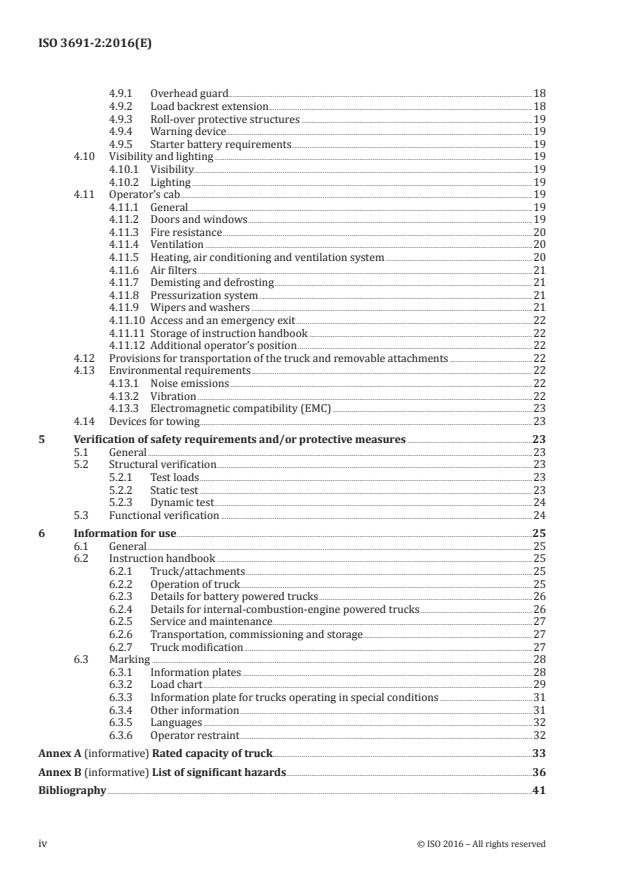
Contents Page
Foreword .v
Introduction .vi
1 Scope . 1
2 Normative references . 1
3 Terms and definitions . 3
4 Safety requirements and/or protective measures . 5
4.1 General . 5
4.1.1 Overall requirements . 5
4.1.2 Normal climatic conditions. 5
4.1.3 Normal operating conditions . 5
4.1.4 Sharp edges . 6
4.1.5 Electrical requirements . 6
4.1.6 Stored energy components . 6
4.2 Starting/moving. 6
4.2.1 Unauthorized starting . 6
4.2.2 Unintended movement and inadvertent activation . 6
4.3 Brakes . 7
4.3.1 General. 7
4.3.2 Failure of energy supply . 7
4.4 Manual control actuator. 7
4.4.1 General. 7
4.4.2 Travel and braking controls . 7
4.4.3 Steering controls . 8
4.4.4 Load-handling controls . 8
4.4.5 Other controls . 9
4.4.6 Marking . 9
4.5 Power systems and accessories. 9
4.5.1 Exhaust system . 9
4.5.2 Cooling system . 9
4.5.3 Fuel tanks .10
4.5.4 Access to engine and other compartments .10
4.5.5 Liquefied petroleum gas (LPG)-powered trucks .10
4.6 Systems for telescoping, lifting and tilting .12
4.6.1 Lift chains .12
4.6.2 Hydraulic lifting, telescoping and carriage tilting .13
4.6.3 Hydraulic systems .14
4.6.4 Fork arms .14
4.6.5 Fork-arm extensions .14
4.6.6 Fork carriers .14
4.6.7 Load-handling attachments .15
4.7 Operator positions .15
4.7.1 Dimensions .15
4.7.2 Operator’s seat .15
4.7.3 Operator restraint .16
4.7.4 Operator access and egress .16
4.7.5 Protection from road wheels and objects thrown up by the wheels .17
4.7.6 Protection from burning .17
4.7.7 Protection against crushing, shearing and trapping .17
4.8 Stability .17
4.8.1 General.17
4.8.2 Specific operating conditions .18
4.8.3 Longitudinal stability determination .18
4.9 Protective devices .18
4.9.1 Overhead guard.18
4.9.2 Load backrest extension .18
4.9.3 Roll-over protective structures .19
4.9.4 Warning device .19
4.9.5 Starter battery requirements .19
4.10 Visibility and lighting .19
4.10.1 Visibility.19
4.10.2 Lighting .19
4.11 Operator’s cab .19
4.11.1 General.19
4.11.2 Doors and windows . .19
4.11.3 Fire resistance .20
4.11.4 Ventilation .20
4.11.5 Heating, air conditioning and ventilation system .20
4.11.6 Air filters .21
4.11.7 Demisting and defrosting .21
4.11.8 Pressurization system .21
4.11.9 Wipers and washers .21
4.11.10 Access and an emergency exit .22
4.11.11 Storage of instruction handbook .22
4.11.12 Additional operator’s position .22
4.12 Provisions for transportation of the truck and removable attachments .22
4.13 Environmental requirements .22
4.13.1 Noise emissions .22
4.13.2 Vibration .22
4.13.3 Electromagnetic compatibility (EMC) .23
4.14 Devices for towing.23
5 Verification of safety requirements and/or protective measures .23
5.1 General .23
5.2 Structural verification .23
5.2.1 Test loads .23
5.2.2 Static test .23
5.2.3 Dynamic test .24
5.3 Functional verification .24
6 Information for use .25
6.1 General .25
6.2 Instruction handbook .25
6.2.1 Truck/attachments .25
6.2.2 Operation of truck.25
6.2.3 Details for battery powered trucks .26
6.2.4 Details for internal-combustion-engine powered trucks .26
6.2.5 Service and maintenance .27
6.2.6 Transportation, commissioning and storage .27
6.2.7 Truck modification .27
6.3 Marking .28
6.3.1 Information plates .28
6.3.2 Load chart .29
6.3.3 Information plate for trucks operating in special conditions .31
6.3.4 Other information .31
6.3.5 Languages .32
6.3.6 Operator restraint .32
Annex A (informative) Rated capacity of truck .33
Annex B (informative) List of significant hazards.36
Bibliography .41
iv © ISO 2016 – All rights reserved
Foreword
ISO (the International Organization for Standardization) is a worldwide federation of national standards
bodies (ISO member bodies). The work of preparing International Standards is normally carried out
through ISO technical committees. Each member body interested in a subject for which a technical
committee has been established has the right to be represented on that committee. International
organizations, governmental and non-governmental, in liaison with ISO, also take part in the work.
ISO collaborates closely with the International Electrotechnical Commission (IEC) on all matters of
electrotechnical standardization.
The procedures used to develop this document and those intended for its further maintenance are
described in the ISO/IEC Directives, Part 1. In particular the different approval criteria needed for the
different types of ISO documents should be noted. This document was drafted in accordance with the
editorial rules of the ISO/IEC Directives, Part 2 (see www.iso.org/directives).
Attention is drawn to the possibility that some of the elements of this document may be the subject of
patent rights. ISO shall not be held responsible for identifying any or all such patent rights. Details of
any patent rights identified during the development of the document will be in the Introduction and/or
on the ISO list of patent declarations received (see www.iso.org/patents).
Any trade name used in this document is information given for the convenience of users and does not
constitute an endorsement.
For an explanation on the meaning of ISO specific terms and expressions related to conformity
assessment, as well as information about ISO’s adherence to the WTO principles in the Technical
Barriers to Trade (TBT) see the following URL: Foreword - Supplementary information
The committee responsible for this document is ISO/TC 110, Industrial trucks, Subcommittee SC 2,
Safety of powered industrial trucks.
ISO 3691 consists of the following parts, under the general title Industrial trucks — Safety requirements
and verification:
— Part 1: Self-propelled industrial trucks, other than driverless, variable-reach and burden-carrier trucks
— Part 2: Self-propelled variable-reach trucks
— Part 3: Additional requirements for trucks with elevating operator position and trucks specifically
designed to travel with elevated loads
— Part 4: Driverless industrial trucks and their systems
— Part 5: Pedestrian-propelled trucks
— Part 6: Burden and personnel carriers
— Part 7: Regional requirements for countries within the European Community [Technical Specification]
— Part 8: Regional requirements for countries outside the European Community [Technical Specification]
Introduction
General
This document is a type-C standard as stated in ISO 12100.
The machines concerned and the extent to which hazards, hazardous situations or hazardous events
are covered are indicated in the Scope of this document.
When requirements of this type-C standard are different from those which are stated in type-A or B
standards, the requirements of this type-C standard take precedence over the requirements of the
other standards for machines that have been designed and built according to the requirements of this
type-C standard.
The ISO 3691- series of standards covers safety requirements and their verification for industrial trucks
as defined in ISO 5053-1.
Structure
An important step forward in the work on the ISO 3691- series of standards was the agreement to issue
a new structure of International Standards for industrial trucks having on one side basic standards for
all kinds of trucks (see Foreword) and on the other side independent standards to cover the respective
specific functions of industrial trucks, e.g. visibility, noise, vibration, electrical requirements, etc.
Assessment of hazards
The product needs to be designed in such a way that it is fit for its purpose or function and can be
adjusted and maintained without putting persons at risk when used under the conditions foreseen by
the manufacturer.
In order to properly design a product and to cover all specific safety requirements, the manufacturer
will have to identify the hazards that apply to his product and carry out a risk assessment. The
manufacturer will then need to design and construct the product taking this assessment into account.
The aim of this procedure is to eliminate the risk of accidents throughout the foreseeable lifetime of
the machinery, including the phases of assembling and dismantling where risks of accidents could also
arise from foreseeable abnormal situations.
In selecting the most appropriate methods, the manufacturer will need to apply the following principles,
in the order given here:
a) eliminate or reduce risks as far as possible by design (inherently safe machinery design and
construction);
b) take the necessary protective measures in relation to risks that cannot be eliminated by design;
c) inform users of any shortcoming of the protective measures adopted;
d) indicate whether any particular training is required;
e) specify any need to provide personal protection equipment;
f) refer to the appropriate user’s document for proper operating instructions.
Industrial trucks need to be designed to prevent foreseeable misuse wherever possible, if such would
engender risk. In other cases, the instructions will need to draw the user’s attention to ways shown by
experience in which the machinery ought not to be used.
This part of ISO 3691 does not repeat all the technical rules which are state-of-the art and which are
applicable to the material used to construct the industrial truck. Reference will also need to be made
to ISO 12100.
vi © ISO 2016 – All rights reserved
Legislative situation/Vienna Agreement
From the very beginning, the task of the working group was to revise ISO 3691:1980 and establish
worldwide basic standards to comply with the major legislative regulations in, for example, the EU,
Japan, Australia and North America.
Every effort was made to develop a globally relevant International Standard. That goal was achieved
with most of the issues. For several potential problem areas compromises were needed and will
be needed in the future. Where divergent regional requirements remain, these are addressed by
ISO/TS 3691-7 and ISO/TS 3691-8.
In order to ensure that the revised International Standard will be actively used in the ISO member
countries, worldwide, procedures will be necessary to replace the existing national standards and
technical regulations by the revised International Standard. In the European Community, ISO and the
European Committee for Standardization (CEN) agreed on technical co-operation under the Vienna
Agreement, with the aim of replacing European Standards (EN) by International Standards. Other
countries are asked to make similar agreements to ensure that their national standards and technical
regulations are replaced by this International Standard.
Only by these actions will there be the guarantee that products in accordance with International
Standards can be shipped worldwide freely without any technical barriers.
INTERNATIONAL STANDARD ISO 3691-2:2016(E)
Industrial trucks — Safety requirements and
verification —
Part 2:
Self-propelled variable-reach trucks
1 Scope
This part of ISO 3691 gives safety requirements and the means for their verification for self-propelled
industrial variable-reach trucks and variable-reach container handlers/reach stackers as defined in
ISO 5053-1 (hereafter referred to as trucks), equipped with forks or integral load-handling devices for
normal industrial duties (e.g. fork arms or means, such as spreaders, for handling containers).
It is not applicable to
— rough-terrain variable-reach trucks,
— rough-terrain variable-reach trucks for handling containers,
— machines designed primarily for earth-moving (e.g. loaders and dozers), even when their buckets
and blades are replaced with forks,
— machines from which the load can swing freely in all directions.
For the purposes of this part of ISO 3691, fork arms and integrated attachments are considered to be
a part of the truck, whereas attachments/equipment mounted on the load carrier or on the fork arms
which are removable by the user are not. Nevertheless, requirements for such attachments are also
given by the document.
Any regional requirements additional to the provisions of this part of ISO 3691 are addressed in
ISO/TS 3691-7 and ISO/TS 3691-8.
This part of ISO 3691 deals with all significant hazards, hazardous situations or hazardous events, as
listed in Annex B, with the exception of the following, relevant to the applicable machines when used as
intended and under conditions of misuse which are reasonably foreseeable by the manufacturer.
It does not establish requirements for hazards that can occur
— during construction,
— when using trucks on public roads,
— when operating in potentially explosive atmospheres, or
— when lifting persons.
2 Normative references
The following documents, in whole or in part, are normatively referenced in this document and are
indispensable for its application. For dated references, only the edition cited applies. For undated
references, the latest edition of the referenced document (including any amendments) applies.
ISO 2328, Fork-lift trucks — Hook-on type fork arms and fork arm carriages — Mounting dimensions
ISO 2330, Fork-lift trucks — Fork arms — Technical characteristics and testing
ISO 2867, Earth-moving machinery — Access systems
ISO 3287, Powered industrial trucks — Symbols for operator controls and other displays
ISO/TS 3691-7, Industrial trucks — Safety requirements and verification — Part 7: Regional requirements
for countries within the European Community
ISO/TS 3691-8, Industrial trucks — Safety requirements and verification — Part 8: Regional requirements
for countries outside the European Community
ISO 3411:2007, Earth-moving machinery — Physical dimensions of operators and minimum operator
space envelope
ISO 3795, Road vehicles, and tractors and machinery for agriculture and forestry — Determination of
burning behaviour of interior materials
ISO 4413, Hydraulic fluid power — General rules and safety requirements for systems and their components
ISO 5053-1, Industrial trucks — Terminology and classification — Part 1: Types of industrial trucks
ISO 5353, Earth-moving machinery, and tractors and machinery for agriculture and forestry — Seat index
point
ISO 6055:2004, Industrial trucks — Overhead guards — Specification and testing
ISO 6292, Powered industrial trucks and tractors — Brake performance and component strength
ISO 10263-2, Earth-moving machinery — Operator enclosure environment — Part 2: Air filter element test
method
ISO 10263-3, Earth-moving machinery — Operator enclosure environment — Part 3: Pressurization test
method
ISO 10263-4, Earth-moving machinery — Operator enclosure environment — Part 4: Heating, ventilating
and air conditioning (HVAC) test method and performance
ISO 12100:2010, Safety of machinery — General principles for design — Risk assessment and risk reduction
ISO 13284, Fork-lift trucks — Fork-arm extensions and telescopic fork arms — Technical characteristics
and strength requirements
ISO 13564-1, Powered industrial trucks — Test methods for verification of visibility — Part 1: Sit-on and
stand-on operator trucks and variable-reach trucks up to and including 10 t capacity
ISO 15870, Powered industrial trucks — Safety signs and hazard pictorials — General principles
ISO 15871, Industrial trucks — Specifications for indicator lights for container handling and grappler
arm operations
ISO 21281, Construction and layout of pedals of self-propelled sit-down rider-controlled industrial trucks —
Rules for the construction and layout of pedals
ISO 22915-1, Industrial trucks — Verification of stability — Part 1: General
ISO 22915-10, Industrial trucks — Verification of stability — Part 10: Additional stability test for trucks
operating in the special condition of stacking with load laterally displaced by powered devices
ISO 22915-11, Industrial trucks — Verification of stability — Part 11: Industrial variable-reach trucks
ISO 22915-12, Industrial trucks — Verification of stability — Part 12: Industrial variable-reach trucks
handling freight containers of 6 m (20 ft) length and longer
ISO 22915-20, Industrial trucks — Verification of stability — Part 20: Additional stability test for trucks
operating in the special condition of offset load, offset by utilization
2 © ISO 2016 – All rights reserved
ISO 24135-1, Industrial trucks — Specifications and test methods for operator restraint systems — Part 1:
Lap-type seat belts
3 Terms and definitions
For the purposes of this document, the terms and definitions given in ISO 5053-1 and ISO 12100, and
the following apply.
3.1
self-propelled industrial variable-reach truck
seated-rider-operated, counterbalanced lift truck with one or more articulated arms, telescopic, non-
slewing, used for stacking loads and for operation on smooth, level, prepared and consolidated surfaces
3.2
actual capacity at maximum lift height with forks
maximum load, Q , specified by the manufacturer that the truck is capable of lifting to its maximum
height in normal operating conditions
Note 1 to entry: It is equal to the maximum load, with centre of gravity G (see Figure A.1), carried on the fork
arms (3.7) at the standard load centre distance, D, as specified in Annex A, and with the boom (3.9) adjusted to its
maximum height. It is expressed in kilograms.
3.3
actual capacity at container position with spreader
maximum load, Q, with row (d) and height (h), specified by the manufacturer that the truck is capable of
lifting to its maximum height in normal operating conditions
3.4
axle locking
mechanism designed to stop oscillation of the rear axle so as to improve truck stability
3.5
stabilizer
extendable or pivoting mechanical supports used to improve stability of a stationary truck
3.6
lateral levelling
act of changing the angular relationship between the boom pivot and the ground in order to adjust the
boom pivot to horizontal when the truck is standing on a side slope
Note 1 to entry: Used to ensure that the boom (3.9) operates in a vertical plane.
3.7
fork arms
device consisting of two or more solid forks, hook-mounted or shaft-mounted, that is fitted on the
carriage and usually spread manually
3.8
fork arm extension
device fitted over the fork arms (3.7) to increase their length
3.9
boom
pivoting support member providing radial and telescoping (if equipped) movement of the load-
engaging means
3.10
spreader
device fitted to the boom (3.9), designed to connect the lifting points of freight containers, swap bodies
and semi-trailers
Note 1 to entry: It can include powered devices used to connect the lifting points of the load and an articulated
mechanism to facilitate engagement.
3.11
bucket
device intended for carrying bulk products such as sand, gravel or coal
3.12
overhead guard
device fitted to the truck for the purpose of protecting the operator against falling objects
3.13
load backrest
portion of the fork carriage serving to restrain the load when the load is tilted rearward or upward
3.14
normal operating position
position in which the operator is able to control all functions for driving and load handling as defined
by the manufacturer
Note 1 to entry: Additional positions may be defined by the manufacturer if it is not possible to control all the
functions of the truck from a single position. A rotating seat or stand-up end-control truck with more than one
operating direction is considered as being or having a single operating position.
3.15
fork carrier
device fitted at the end of the boom (3.9) to connect and lock interchangeable attachments without the
use of a tool
3.16
auxiliary mast
mast at the end of the boom (3.9) intended for reaching greater lifting heights
Note 1 to entry: Referred to simply as mast in this part of ISO 3691.
3.17
non-slewing
having a slewing movement not greater than 5° on either side of the longitudinal axis of the truck
Note 1 to entry: See Figure 1.
Figure 1 — Slewing movement ≤ 5° (non-slewing)
4 © ISO 2016 – All rights reserved
5º
5º
3.18
rated capacity with fork arms
load, Q , in kilograms, permitted by the manufacturer, that the truck type is capable of transporting
and lifting in normal operating conditions with the boom fully retracted
Note 1 to entry: For centre of gravity G.
Note 2 to entry: The rated capacity is used to compare the capacity of different manufacturers’ trucks and to
provide the break points used in technical standards and statistics. The operating limits for the truck are defined
by the actual capacity (3.2, 3.3).
3.19
rated capacity with spreader
load, Q , in kilograms, permitted by the manufacturer that the truck type is capable of transporting
and lifting in normal operating conditions with the spreader in the position of the first container row at
measurement d and lift height 6,5 m
Note 1 to entry: For the second container, see Figure A.2.
4 Safety requirements and/or protective measures
4.1 General
4.1.1 Overall requirements
The truck shall comply with the safety requirements and/or protective measures of this clause.
In addition, the truck shall be designed according to the principles of ISO 12100:2010 for relevant but
not significant hazards which are not dealt with by this document.
4.1.2 Normal climatic conditions
For truck operation, the following climatic conditions apply:
— average ambient temperature for continuous duty: + 25 °C;
— maximum ambient temperature, short term (up to 1 h): + 40 °C;
— lowest ambient temperature for trucks intended for use in normal indoor conditions: + 5 °C;
— lowest ambient temperature for trucks intended for use in normal outdoor conditions: − 20 °C;
— altitude: up to 2 000 m.
4.1.3 Normal operating conditions
Normal operating conditions are the following:
— driving (travelling and lifting) on substantially firm, smooth, level and consolidated surfaces — the
surface conditions on which the truck is designed to operate shall be specified in the instruction
handbook (see 6.2);
— driving with the horizontal load centre of gravity approximately on the longitudinal centre plane
of the truck;
— travelling with the boom retracted and, if fork arms are fitted, with these tilted backwards and both
with and without a load, the load in the designated travel position.
If the above is not sufficient to allow the conditions for stability of a particular truck type to be
specified, then the operating conditions shall be according to the International Standards referenced
for stability in 4.8.
4.1.4 Sharp edges
There shall be no sharp edges or angles posing a hazard in the area of the operator in the normal
operating position or in the area of access and egress during normal operation and daily checks.
NOTE For guidance, see ISO 12508.
4.1.5 Electrical requirements
Electrical requirements are subject to regional requirements. See ISO/TS 3691-7 and ISO/TS 3691-8.
4.1.6 Stored energy components
Components which store energy and that would cause a risk during removal or disassembly, e.g.
hydraulic accumulator or spring-applied brakes, shall be provided with a means to release the energy
before removal or disassembly.
4.2 Starting/moving
4.2.1 Unauthorized starting
Trucks shall be provided with a device (e.g. key, code, magnetic card) which prevents starting
without its use.
4.2.2 Unintended movement and inadvertent activation
Truck movement from the holding position, other than by actuation of the controls by the operator, due
to drift or creep (e.g. by leakage), shall be avoided.
4.2.2.1 Parking brake
A parking brake shall be provided complying with 4.3.1.
Failure of the control system of an automatically applied parking brake shall be indicated to the operator.
4.2.2.2 Internal-combustion-engine powered trucks
Internal-combustion-engine powered trucks shall be fitted with a device which prevents the engine
being started while the transmission is engaged.
4.2.2.3 Travel controls
Travel controls shall be so arranged that on level ground the truck will not move from rest until the
transmission has been engaged.
4.2.2.4 Powered travel movement
Powered travel movement of the truck shall be possible only if the operator is in the normal
operating position.
Powered travel shall not occur automatically when the operator returns to the normal operating
position without an additional operation, e.g. by requiring a resetting of the direction control or
reactivation of the speed control.
6 © ISO 2016 – All rights reserved
4.3 Brakes
4.3.1 General
All industrial trucks shall be designed with service and parking brakes. Brakes shall comply with ISO 6292.
The parking brake shall be equipped with a system preventing unintentional release. The parking
brake force shall be applied by mechanical means.
Braking requirements are subject to regional requirements, additional to the requirements of this part
of ISO 3691. See ISO/TS 3691-8.
For sit-down rider trucks, the parking brake system shall be manually operable from the normal
operating position or automatically applied by leaving the normal operating position.
Trucks with only non-automatically applied parking brake(s) shall have a warning to the operator to
apply brakes before leaving the truck.
4.3.2 Failure of energy supply
Failure of the energy supply to the service brake shall not result in a total loss of braking and shall
enable a controlled stop.
4.4 Manual control actuator
4.4.1 General
The controls shall be confined within the plan view outline of the truck’s overhead guard or falling
object protective structure (FOPS).
NOTE See ISO 6682 for guidance on zones of comfort and reach for operator controls.
4.4.1.1 Consistency with the truck motions
Movement of these controls shall be consistent with the motions of the truck being operated
wherever practicable.
4.4.1.2 Multiple operators
If additional operating positions are fitted, e.g. for more than one operator, the operation of these
controls shall only be possible from one operating position at a time, excepting the emergency
disconnect switch, which shall be operable from all positions.
4.4.1.3 Multiple operating positions
If more than one operating position is fitted for a single operator, the use of the controls for one of these
operating positions shall preclude the use of the controls of another operating position. The exception
to this is the emergency disconnect switch, which shall be operable from all positions.
4.4.2 Travel and braking controls
4.4.2.1 General
The motion of the speed operating control shall be so designed that an increase in the movement of the
control increases the travel speed. When the control is released, it shall return to the neutral position of
the control actuator.
4.4.2.2 Pedal-operated travel and braking controls
Trucks with pedal-operated travel and braking controls shall comply with ISO 21281.
4.4.2.3 Differential locking pedal
If the truck is equipped with a pedal -operated differential lock, depressing the pedal shall lock the
differential.
If the truck is equipped with a dif
...
NORME ISO
INTERNATIONALE 3691-2
Première édition
2016-01-15
Chariots de manutention — Exigences
de sécurité et vérification —
Partie 2:
Chariots automoteurs à portée variable
Industrial trucks — Safety requirements and verification —
Part 2: Self-propelled variable-reach trucks
Numéro de référence
©
ISO 2016
DOCUMENT PROTÉGÉ PAR COPYRIGHT
© ISO 2016, Publié en Suisse
Droits de reproduction réservés. Sauf indication contraire, aucune partie de cette publication ne peut être reproduite ni utilisée
sous quelque forme que ce soit et par aucun procédé, électronique ou mécanique, y compris la photocopie, l’affichage sur
l’internet ou sur un Intranet, sans autorisation écrite préalable. Les demandes d’autorisation peuvent être adressées à l’ISO à
l’adresse ci-après ou au comité membre de l’ISO dans le pays du demandeur.
ISO copyright office
Ch. de Blandonnet 8 • CP 401
CH-1214 Vernier, Geneva, Switzerland
Tel. +41 22 749 01 11
Fax +41 22 749 09 47
copyright@iso.org
www.iso.org
ii © ISO 2016 – Tous droits réservés
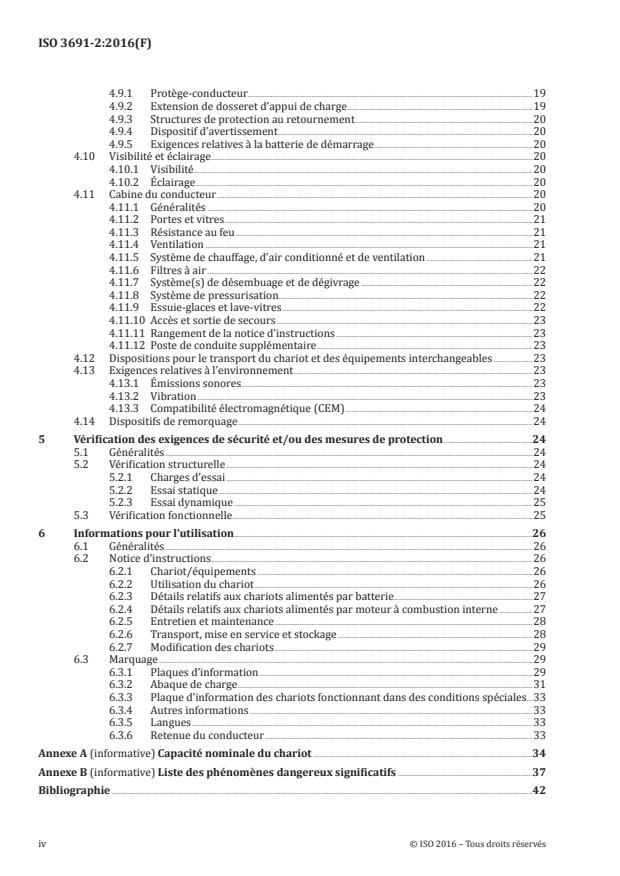
Sommaire Page
Avant-propos .v
Introduction .vi
1 Domaine d’application . 1
2 Références normatives . 1
3 Termes et définitions . 3
4 Exigences de sécurité et/ou mesures de protection . 5
4.1 Généralités . 5
4.1.1 Exigences globales . 5
4.1.2 Conditions climatiques normales . 5
4.1.3 Conditions normales de conduite . 6
4.1.4 Arêtes vives . . . 6
4.1.5 Exigences électriques . 6
4.1.6 Composants à énergie accumulée . 6
4.2 Démarrage/déplacement . 6
4.2.1 Démarrage non autorisé. 6
4.2.2 Mouvement intempestif et activation par inadvertance . 6
4.3 Freins . 7
4.3.1 Généralités . 7
4.3.2 Défaillance de l’alimentation en énergie . 7
4.4 Organe de service . 7
4.4.1 Généralités . 7
4.4.2 Commandes de roulage et de freinage . 8
4.4.3 Commandes de direction . 8
4.4.4 Commandes de manutention de la charge . 9
4.4.5 Autres commandes . 9
4.4.6 Marquage .10
4.5 Systèmes moteurs et accessoires .10
4.5.1 Système d’échappement .10
4.5.2 Système de refroidissement .10
4.5.3 Réservoirs de carburant .10
4.5.4 Accès au moteur et aux autres compartiments .10
4.5.5 Chariots alimentés par gaz de pétrole liquéfié (GPL) .11
4.6 Systèmes de déploiement télescopique, de levage et d’inclinaison .13
4.6.1 Chaînes de levage .13
4.6.2 Levage hydraulique, déploiement télescopique et inclinaison du chariot .14
4.6.3 Systèmes hydrauliques .14
4.6.4 Bras de fourche .15
4.6.5 Extensions de bras de fourche .15
4.6.6 Porte-fourches .15
4.6.7 Équipements de manutention de charge .15
4.7 Positions de conduite .16
4.7.1 Dimensions .16
4.7.2 Siège du conducteur . .16
4.7.3 Retenue du conducteur .17
4.7.4 Accès et sortie de l’opérateur .17
4.7.5 Protection contre les roues et les projections d’objets par les roues .17
4.7.6 Protection contre les brûlures .18
4.7.7 Protection contre l’écrasement, le cisaillement et l’emprisonnement .18
4.8 Stabilité .18
4.8.1 Généralités .18
4.8.2 Conditions spécifiques de conduite .19
4.8.3 Détermination de la stabilité longitudinale .19
4.9 Dispositifs de protection .19
4.9.1 Protège-conducteur . .19
4.9.2 Extension de dosseret d’appui de charge .19
4.9.3 Structures de protection au retournement .20
4.9.4 Dispositif d’avertissement .20
4.9.5 Exigences relatives à la batterie de démarrage .20
4.10 Visibilité et éclairage .20
4.10.1 Visibilité .20
4.10.2 Éclairage .20
4.11 Cabine du conducteur .20
4.11.1 Généralités .20
4.11.2 Portes et vitres .21
4.11.3 Résistance au feu .21
4.11.4 Ventilation .21
4.11.5 Système de chauffage, d’air conditionné et de ventilation .21
4.11.6 Filtres à air .22
4.11.7 Système(s) de désembuage et de dégivrage .22
4.11.8 Système de pressurisation.22
4.11.9 Essuie-glaces et lave-vitres .22
4.11.10 Accès et sortie de secours .23
4.11.11 Rangement de la notice d’instructions .23
4.11.12 Poste de conduite supplémentaire .23
4.12 Dispositions pour le transport du chariot et des équipements interchangeables .23
4.13 Exigences relatives à l’environnement .23
4.13.1 Émissions sonores .23
4.13.2 Vibration .23
4.13.3 Compatibilité électromagnétique (CEM) .24
4.14 Dispositifs de remorquage .24
5 Vérification des exigences de sécurité et/ou des mesures de protection .24
5.1 Généralités .24
5.2 Vérification structurelle .24
5.2.1 Charges d’essai .24
5.2.2 Essai statique .24
5.2.3 Essai dynamique .25
5.3 Vérification fonctionnelle .25
6 Informations pour l’utilisation .26
6.1 Généralités .26
6.2 Notice d’instructions .26
6.2.1 Chariot/équipements .26
6.2.2 Utilisation du chariot .26
6.2.3 Détails relatifs aux chariots alimentés par batterie.27
6.2.4 Détails relatifs aux chariots alimentés par moteur à combustion interne .27
6.2.5 Entretien et maintenance .28
6.2.6 Transport, mise en service et stockage .28
6.2.7 Modification des chariots .29
6.3 Marquage .29
6.3.1 Plaques d’information .29
6.3.2 Abaque de charge .31
6.3.3 Plaque d’information des chariots fonctionnant dans des conditions spéciales.33
6.3.4 Autres informations .33
6.3.5 Langues .33
6.3.6 Retenue du conducteur .33
Annexe A (informative) Capacité nominale du chariot .34
Annexe B (informative) Liste des phénomènes dangereux significatifs .37
Bibliographie .42
iv © ISO 2016 – Tous droits réservés
Avant-propos
L’ISO (Organisation internationale de normalisation) est une fédération mondiale d’organismes
nationaux de normalisation (comités membres de l’ISO). L’élaboration des Normes internationales est
en général confiée aux comités techniques de l’ISO. Chaque comité membre intéressé par une étude
a le droit de faire partie du comité technique créé à cet effet. Les organisations internationales,
gouvernementales et non gouvernementales, en liaison avec l’ISO participent également aux travaux.
L’ISO collabore étroitement avec la Commission électrotechnique internationale (IEC) en ce qui
concerne la normalisation électrotechnique.
Les procédures utilisées pour élaborer le présent document et celles destinées à sa mise à jour sont
décrites dans les Directives ISO/IEC, Partie 1. Il convient, en particulier de prendre note des différents
critères d’approbation requis pour les différents types de documents ISO. Le présent document a été
rédigé conformément aux règles de rédaction données dans les Directives ISO/IEC, Partie 2 (voir www.
iso.org/directives).
L’attention est appelée sur le fait que certains des éléments du présent document peuvent faire l’objet de
droits de propriété intellectuelle ou de droits analogues. L’ISO ne saurait être tenue pour responsable
de ne pas avoir identifié de tels droits de propriété et averti de leur existence. Les détails concernant
les références aux droits de propriété intellectuelle ou autres droits analogues identifiés lors de
l’élaboration du document sont indiqués dans l’Introduction et/ou dans la liste des déclarations de
brevets reçues par l’ISO (voir www.iso.org/brevets).
Les appellations commerciales éventuellement mentionnées dans le présent document sont données
pour information, par souci de commodité, à l’intention des utilisateurs et ne sauraient constituer
un engagement.
Pour une explication de la signification des termes et expressions spécifiques de l’ISO liés à
l’évaluation de la conformité, ou pour toute information au sujet de l’adhésion de l’ISO aux principes
de l’OMC concernant les obstacles techniques au commerce (OTC), voir le lien suivant: Avant-propos —
Informations supplémentaires.
Le comité chargé de l’élaboration du présent document est l’ISO/TC 110, Chariots de manutention,
sous-comité SC 2, Sécurité des chariots de manutention automoteurs.
L’ISO 3691 comprend les parties suivantes, présentées sous le titre général Chariots de manutention —
Exigences de sécurité et vérification:
— Partie 1: Chariots de manutention automoteurs, autres que les chariots sans conducteur, les chariots à
portée variable et les chariots transporteurs de charges
— Partie 2: Chariots automoteurs à portée variable
— Partie 3: Exigences complémentaires pour chariots avec poste de conduite élevable et pour chariots
spécialement conçus pour une conduite avec des charges en élévation
— Partie 4: Chariots sans conducteur et leurs systèmes
— Partie 5: Chariots à conducteur accompagnant
— Partie 6: Transporteurs de charges et de personnel
— Partie 7: Exigences régionales pour les pays de la Communauté européenne [Spécification Technique]
— Partie 8: Exigences régionales pour les pays en dehors de la Communauté européenne [Spécification
Technique]
Introduction
Généralités
Le présent document est une norme de type C tel que mentionné dans l’ISO 12100.
Les machines concernées et l’étendue des phénomènes dangereux, situations ou évènements dangereux
couverts sont indiquées dans le Domaine d’application du présent document.
Lorsque les exigences de cette norme de type C sont différentes de celles des normes de type A ou B, les
exigences de cette norme de type C ont priorité sur celles des autres normes, pour les machines conçues
et fabriquées selon les exigences de cette norme de type C.
La série de normes ISO 3691 traite des exigences de sécurité et de leurs vérifications pour les chariots
de manutention tels que définis dans l’ISO 5053-1.
Structure
Un important progrès au cours du travail sur la série de normes ISO 3691 a consisté en un accord pour
mettre en place une nouvelle structure de Normes internationales relatives aux chariots de manutention
ayant d’une part des normes de base applicables à tous les types de chariots (voir Avant-propos) et
d’autre part des normes indépendantes couvrant les fonctions spécifiques respectives des chariots de
manutention, par exemple, la visibilité, le bruit, les vibrations, les exigences électriques, etc.
Évaluation des phénomènes dangereux
Il est nécessaire de concevoir le produit de telle sorte qu’il soit adapté à son utilisation ou à sa fonction
et qu’il puisse être réglé et entretenu sans exposer quiconque à un risque lorsqu’il est utilisé dans les
conditions prévues par le fabricant.
Afin de bien concevoir un produit et de couvrir toutes les exigences de sécurité spécifiques, le fabricant
aura à identifier les phénomènes dangereux qui s’appliquent à son produit et réaliser une évaluation du
risque. Il est nécessaire alors que le fabricant conçoive et fabrique le produit en prenant en compte cette
appréciation.
L’objectif de cette procédure est d’éliminer le risque d’accidents tout au long de la durée de vie prévisible
de la machine, y compris les phases d’assemblage et de démontage où des risques d’accidents pourraient
également apparaître à la suite de situations anormales prévisibles.
En choisissant les méthodes les plus appropriées, le fabricant devra appliquer les principes suivants
dans l’ordre donné:
a) éliminer ou réduire les risques autant que possible par conception (conception et fabrication de
machines intrinsèquement sûres);
b) prendre les mesures de protection nécessaires par rapport aux risques qui ne peuvent pas être
éliminés par conception;
c) informer les utilisateurs de tout défaut relatif aux mesures de protection adoptées;
d) indiquer si une formation particulière est requise;
e) spécifier toute nécessité de fournir un équipement de protection individuelle;
f) se référer au document approprié de l’utilisateur pour des instructions d’utilisation adéquates.
Il est nécessaire de concevoir les chariots de manutention pour empêcher une mauvaise utilisation
prévisible chaque fois que possible, si une telle utilisation engendrait des risques. Dans d’autres cas,
il est nécessaire que les instructions attirent l’attention de l’utilisateur sur des manières issues de
l’expérience selon lesquelles la machine ne doit pas être utilisée.
vi © ISO 2016 – Tous droits réservés
La présente partie de l’ISO 3691 ne reproduit pas toutes les règles techniques qui sont l’état de l’art
et qui sont applicables au matériau utilisé pour fabriquer le chariot de manutention. Il est également
nécessaire de se reporter à l’ISO 12100.
Situation juridique/Accord de Vienne
Depuis le tout début, la tâche du groupe de travail a été de réviser l’ISO 3691:1980 et d’instaurer des
normes de base à travers le monde pour répondre aux principales réglementations législatives dans le
monde, par exemple, dans l’Union Européenne, au Japon, en Australie et en Amérique du Nord.
Tout a été mis en œuvre pour élaborer une Norme internationale applicable dans le monde. Cet objectif
a été atteint pour la plupart des publications. Pour plusieurs sources de problèmes potentiels, des
compromis ont été nécessaires et le seront dans le futur. Lorsque des exigences divergentes demeurent,
celles-ci sont traitées par l’ISO/TS 3691-7 et par l’ISO/TS 3691-8.
Afin de s’assurer que la Norme internationale révisée soit activement utilisée dans les pays membres de
l’ISO partout dans le monde, des procédures seront nécessaires pour remplacer les normes nationales
existantes et les réglementations techniques par la Norme internationale révisée. Dans la Communauté
européenne, l’ISO et le Comité Européen de Normalisation (CEN) ont accepté une coopération entre
l’ISO et le CEN (accord de Vienne) dans l’objectif de remplacer les normes européennes (EN) par les
Normes internationales. Il est demandé que les autres pays procèdent à des accords similaires pour
s’assurer que leurs normes nationales et leurs réglementations techniques soient remplacées par la
présente Norme internationale.
C’est seulement par ces actions qu’il pourra être garanti que les produits en conformité avec les Normes
internationales pourront être commercialisés mondialement et librement sans aucun obstacle technique.
NORME INTERNATIONALE ISO 3691-2:2016(F)
Chariots de manutention — Exigences de sécurité et
vérification —
Partie 2:
Chariots automoteurs à portée variable
1 Domaine d’application
La présente partie de l’ISO 3691 définit les exigences de sécurité ainsi que leurs moyens de vérification
pour les chariots de manutention automoteurs à portée variable et les chariots porte-conteneur
à portée variable/gerbeurs à portée variable tels que définis dans l’ISO 5053-1 (ci-après désignés
chariots), équipés de fourches ou de dispositifs complets de manutention de la charge pour des activités
industrielles normales (par exemple, des bras de fourche ou des moyens, tels que des palonniers pour
la manutention de conteneurs).
Elle n’est pas applicable aux:
— chariots tout-terrain à portée variable,
— chariots tout-terrain à portée variable pour la manutention de conteneurs,
— machines conçues principalement pour le terrassement (par exemple, les chargeuses et les bouteurs)
même si leurs godets et leurs lames sont remplacés par des fourches,
— machines dont la charge peut osciller librement dans toutes les directions.
Pour les besoins de la présente partie de l’ISO 3691, les bras de fourche et les accessoires intégrés sont
considérées comme une partie du chariot, tandis que les accessoires/équipement monté sur le tablier
porte-charge ou sur les bras de fourche qui sont démontables par l’utilisateur, ne le sont pas. Toutefois,
les exigences pour de tels accessoires sont également données dans le document.
Toutes les exigences régionales supplémentaires aux dispositions de la présente partie de l’ISO 3691,
sont traitées dans l’ISO/TS 3691-7 et dans l’ISO/TS 3691-8.
La présente partie de l’ISO 3691 traite de tous les phénomènes dangereux, des situations dangereuses
ou des événements dangereux, tels que listés dans l’Annexe B, à l’exception des suivants, relatifs aux
machines concernées lorsqu’elles sont utilisées comme prévu et dans des conditions de mauvaise
utilisation qui sont raisonnablement prévisibles par le fabricant.
Elle n’établit pas d’exigences concernant les phénomènes dangereux qui peuvent apparaître
— en cours de fabrication,
— lorsque les chariots sont utilisés sur des voies publiques,
— lors d’utilisation en atmosphères potentiellement explosives, ou
— lors du levage de personnes.
2 Références normatives
Les documents suivants, en tout ou en partie, sont référencés de manière normative dans le présent
document, et sont indispensables pour son application. Pour les références datées, seule l’édition citée
s’applique. Pour les références non datées, la dernière édition du document de référence (y compris les
éventuels amendements) s’applique.
ISO 2328, Chariots élévateurs à fourche — Bras de fourche à tenons et tabliers porte-fourches —
Dimensions de montage
ISO 2330, Chariots élévateurs à fourches — Bras de fourche — Caractéristiques techniques et essais
ISO 2867, Engins de terrassement — Moyens d’accès
ISO 3287, Chariots de manutention automoteurs — Symboles pour les organes de commandes de l’opérateur
et autres dispositifs indicateurs
ISO/TS 3691-7, Chariots de manutention — Exigences de sécurité et vérification — Partie 7: Exigences
régionales pour les pays de la Communauté européenne
ISO/TS 3691-8, Chariots de manutention — Exigences de sécurité et vérification — Partie 8: Exigences
régionales pour les pays en dehors de la Communauté européenne
ISO 3411:2007, Engins de terrassement — Dimensions des opérateurs et espace enveloppe minimal pour
les opérateurs
ISO 3795, Véhicules routiers et tracteurs et matériels agricoles et forestiers — Détermination des
caractéristiques de combustion des matériaux intérieurs
ISO 4413, Transmissions hydrauliques — Règles générales et exigences de sécurité relatives aux systèmes et
leurs composants
ISO 5053-1, Chariots de manutention — Terminologie et classification — Partie 1: Types de chariots de
manutention
ISO 5353, Engins de terrassement, et tracteurs et matériels agricoles et forestiers — Point repère du siège
ISO 6055:2004, Chariots de manutention — Protège-conducteurs — Spécifications et essais
ISO 6292, Chariots de manutention et tracteurs industriels automoteurs — Performance de freinage et
résistance des éléments de frein
ISO 10263-2, Engins de terrassement — Environnement de l’enceinte de l’opérateur — Partie 2: Méthode
d’essai de l’élément du filtre à air
ISO 10263-3, Engins de terrassement — Environnement de l’enceinte de l’opérateur — Partie 3: Méthode
d’essai du système de pressurisation
ISO 10263-4, Engins de terrassement — Environnement de l’enceinte de l’opérateur — Partie 4:
Performances et méthode d’essai des systèmes de chauffage, de ventilation et de climatisation (CVCA)
ISO 12100:2010, Sécurité des machines — Principes généraux de conception — Appréciation du risque et
réduction du risque
ISO 13284, Chariots élévateurs à fourche — Extensions de bras de fourche et bras de fourche télescopiques —
Caractéristiques techniques et prescriptions de résistance
ISO 13564-1, Chariots de manutention automoteurs — Méthodes d’essai pour la vérification de la
visibilité — Partie 1: Chariots à conducteur assis et debout et chariots à portée variable ayant une capacité
allant jusqu’à 10 t incluses
ISO 15870, Chariots de manutention automoteurs — Signaux de sécurité et de danger — Principes généraux
ISO 15871, Chariots de manutention — Spécifications relatives aux voyants lumineux pour la manutention
de conteneurs et les opérations de bras de grappin
ISO 21281, Construction et configuration des pédales des chariots de manutention automoteurs à
conducteurs assis — Règles de construction et de configuration des pédales
ISO 22915-1, Chariots de manutention — Vérification de la stabilité — Partie 1: Généralités
2 © ISO 2016 – Tous droits réservés
ISO 22915-10, Chariots de manutention — Vérification de la stabilité — Partie 10: Essai de stabilité
supplémentaire pour les chariots travaillant dans des conditions de gerbage spéciales avec la charge
décentrée latéralement par des dispositifs à moteur
ISO 22915-11, Chariots de manutention — Vérification de la stabilité — Partie 11: Chariots de manutention
à portée variable
ISO 22915-12, Chariots de manutention — Vérification de la stabilité — Partie 12: Chariots à portée
variable manutentionnant des conteneurs de 6 m (20 ft) de long et plus
ISO 22915-20, Chariots de manutention — Vérification de la stabilité — Partie 20: Essai de stabilité
supplémentaire pour les chariots travaillant dans des conditions de gerbage spéciales avec une charge
déportée, déport par utilisation
ISO 24135-1, Chariots de manutention — Spécifications et méthodes d’essai pour les systèmes de retenue de
l’opérateur — Partie 1: Ceintures de sécurité ventrales
3 Termes et définitions
Pour les besoins du présent document, les termes et définitions donnés dans l’ISO 5053-1 et l’ISO 12100
ainsi que les suivants s’appliquent.
3.1
chariot de manutention automoteur à portée variable
chariot élévateur en porte-à-faux à conducteur assis comportant un ou plusieurs bras articulés,
télescopiques, non rotatifs, utilisé pour le gerbage des charges et pour le fonctionnement sur des
surfaces lisses, planes, aménagées et consolidées
3.2
capacité effective à hauteur de levée maximale avec les fourches
charge maximale Q , spécifiée par le fabricant, que le chariot est capable de lever à sa hauteur maximale
dans les conditions normales de fonctionnement
Note 1 à l’article: Elle est égale à la charge maximale de centre de gravité G (voir Figure A.1), portée sur les bras de
fourche (3.7) à la distance normalisée du centre de la charge, D, tel que spécifié à l’Annexe A et avec la flèche (3.9)
réglée à sa hauteur maximale. Elle est exprimée en kilogrammes.
3.3
capacité effective à la position du conteneur avec un palonnier
charge maximale, Q, de rangé (d) et de hauteur (h), spécifiée par le fabricant, que le chariot est capable
de lever à sa hauteur maximale dans les conditions normales de fonctionnement
3.4
blocage d’essieu
mécanisme conçu pour arrêter l’oscillation de l’essieu arrière afin d’améliorer la stabilité du chariot
3.5
stabilisateur
supports mécaniques extensibles ou pivotants, utilisés pour améliorer la stabilité d’un chariot à l’arrêt
3.6
correcteur de dévers
acte de changement de la relation angulaire entre l’articulation de la flèche et le sol de manière à régler
l’axe de la flèche à l’horizontale lorsque le chariot se tient sur une pente latérale
Note 1 à l’article: Utilisé pour s’assurer que la flèche (3.9) fonctionne dans un plan vertical.
3.7
bras de fourche
dispositif constitué d’au moins deux fourches à section pleine, à tenon ou à barre, fixées sur le tablier
porte-équipement et dont l’écartement est habituellement réalisé de façon manuelle
3.8
extensions de bras de fourche
dispositifs placés sur les bras de fourche (3.7) pour augmenter leur longueur
3.9
flèche
élément support pivotant assurant un mouvement radial et télescopique (s’il est présent) des moyens de
préhension de la charge
3.10
palonnier
dispositif monté sur la flèche (3.9), conçu pour s’accrocher aux points de levage des conteneurs de fret,
de caisses mobiles et de semi-remorques
Note 1 à l’article: Il peut être muni de dispositifs motorisés utilisés pour accrocher les points de levage de la
charge et d’un mécanisme articulé pour faciliter l’engagement.
3.11
godet
dispositif destiné à transporter des produits en vrac tels que du sable, des gravillons ou du charbon
3.12
protège-conducteur
dispositif monté sur le chariot afin de protéger le conducteur contre les chutes d’objets
3.13
dosseret d’appui de charge
partie du tablier porte-fourche retenant la charge en cas d’inclinaison arrière ou ascendante la charge
3.14
position normale de conduite
position dans laquelle le conducteur est en mesure de commander toutes les fonctions pour la conduite
et la manutention de charge, tel que défini par le fabricant
Note 1 à l’article: Des positions supplémentaires peuvent être définies par le fabricant s’il n’est pas possible
de commander toutes les fonctions du chariot à partir d’une seule position. Un chariot à siège pivotant ou à
conducteur debout, commandé de l’extrémité avec plus d’une direction de conduite est considéré comme étant ou
ayant un seul poste de conduite.
3.15
porte-fourches
dispositif monté à l’extrémité de la flèche (3.9) pour accrocher et verrouiller les équipements
interchangeables sans utiliser d’outil
3.16
mât auxiliaire
mât situé à l’extrémité de la flèche (3.9) destiné à atteindre de plus grandes hauteurs de levage
Note 1 à l’article: Simplement appelé mât dans la présente partie de l’ISO 3691.
3.17
non rotatif
dont le mouvement de rotation n’est pas supérieur à 5° de chaque côté de l’axe longitudinal du chariot
Note 1 à l’article: Voir Figure 1.
4 © ISO 2016 – Tous droits réservés
Figure 1 — Mouvement de pivotement ≤ 5° (non rotatif)
3.18
capacité nominale avec les bras de fourche
charge, Q , en kilogrammes, autorisée par le fabricant, que le type de chariot peut transporter et lever
dans des conditions de fonctionnement normales, avec la flèche complètement rentrée
Note 1 à l’article: Pour le centre de gravité G.
Note 2 à l’article: La capacité nominale est utilisée pour comparer la capacité des chariots de différents fabricants
et pour fournir les points critiques utilisés dans les normes techniques et dans les statistiques. Les limites de
fonctionnement pour les chariots sont définies par la capacité effective (3.2, 3.3).
3.19
capacité nominale avec palonnier
charge, Q , en kilogrammes, autorisée par le fabricant, que le type de chariot peut transporter et lever
dans des conditions de fonctionnement normale avec le palonnier en position de la première rangée de
conteneurs au point de mesurage d et à une hauteur de levage de 6,5 m
Note 1 à l’article: Pour le second conteneur, voir Figure A.2.
4 Exigences de sécurité et/ou mesures de protection
4.1 Généralités
4.1.1 Exigences globales
Le chariot doit être conforme aux exigences de sécurité et/ou aux mesures de protection du présent
article.
En complément, le chariot doit être conçu conformément aux principes de l’ISO 12100:2010 pour les
phénomènes dangereux pertinents mais non significatifs qui ne sont pas traités dans le présent document.
4.1.2 Conditions climatiques normales
Pour le fonctionnement du chariot, les conditions climatiques suivantes s’appliquent:
— température ambiante moyenne pour service continu: + 25°C ;
— température ambiante maximale, de courte durée (jusqu’à 1 h): + 40°C ;
— température ambiante minimale pour les chariots destinés à être utilisés dans des conditions
normales en intérieur: + 5°C ;
5º
5º
— température ambiante minimale pour les chariots destinés à être utilisés dans des conditions
normales en extérieur: − 20°C ;
— altitude: jusqu’à 2 000 m.
4.1.3 Conditions normales de conduite
Les conditions normales de conduite sont les suivantes:
— conduite (roulage et levage) sur des surfaces substantiellement fermes, lisses, planes, aménagées et
consolidées — les conditions de la surface sur laquelle le chariot est conçu pour fonctionner doivent
être spécifiées dans la notice d’instructions (voir 6.2);
— conduite avec le centre de gravité de la charge horizontale situé approximativement dans le plan
médian longitudinal du chariot;
— roulage avec la flèche rentrée et, si des bras de fourche sont montés, ceux-ci étant inclinés vers
l’arrière et avec et sans charge, la charge en position de roulage désignée
Si les conditions ci-dessus ne suffisent pas pour permettre de spécifier les conditions de stabilité d’un
type de chariot particulier, alors les conditions de fonctionnement doivent être conformes aux Normes
internationales auxquelles il est fait référence pour la stabilité en 4.8.
4.1.4 Arêtes vives
Il ne doit pas y avoir d’arêtes ou d’angles vifs donnant lieu à un phénomène dangereux dans la zone du
conducteur en position normale de conduite ou dans la zone d’entrée et de sortie en utilisation normale
et pendant les vérifications quotidiennes.
NOTE Pour des conseils, voir l’ISO 12508.
4.1.5 Exigences électriques
Les exigences électriques sont sujettes à des exigences régionales. Voir l’ISO/TS 3691-7 et l’ISO/TS 3691-8.
4.1.6 Composants à énergie accumulée
Les composants qui emmagasinent de l’énergie et dont le retrait ou le démontage présenterait un risque,
par exemple, accumulateur hydraulique ou freins à ressort, doivent disposer d’un moyen de dissipation
de l’énergie avant retrait ou démontage.
4.2 Démarrage/déplacement
4.2.1 Démarrage non autorisé
Les chariots doivent être équipés d’un dispositif (par exemple, une clé, un code, une carte magnétique)
qui empêche le démarrage sans son utilisation.
4.2.2 Mouvement intempestif et activation par inadvertance
Le mouvement du chariot en position de retenue, autrement que par l’actionnement des commandes par
le conducteur, dû à la dérive ou au fléchissement (par exemple, par fuite), doit être évité.
4.2.2.1 Frein de stationnement
Un frein de stationnement conforme au 4.3.1 doit être fourni.
La défaillance du système de commande d’un frein de stationnement à serrage automatique doit être
signalée à l’opérateur.
6 © ISO 2016 – Tous droits réservés
4.2.2.2 Chariots à moteur à combustion interne
Les chariots à moteur à combustion interne doivent être équipés d’un dispositif qui empêche la mise en
marche du moteur tant que la transmission est engagée.
4.2.2.3 Commandes de roulage
Les commandes de roulage doivent être disposées de sorte que sur un sol plan, le chariot ne puisse pas
se déplacer depuis la position de repos jusqu’à ce que la transmission ait été engagée.
4.2.2.4 Déplacement motorisé
Le déplacement motorisé du chariot ne doit être possible que si le conducteur est en position
normale de conduite.
Le déplacement motorisé ne doit pas
...
Questions, Comments and Discussion
Ask us and Technical Secretary will try to provide an answer. You can facilitate discussion about the standard in here.
Loading comments...