


ISO 9000-2:1993
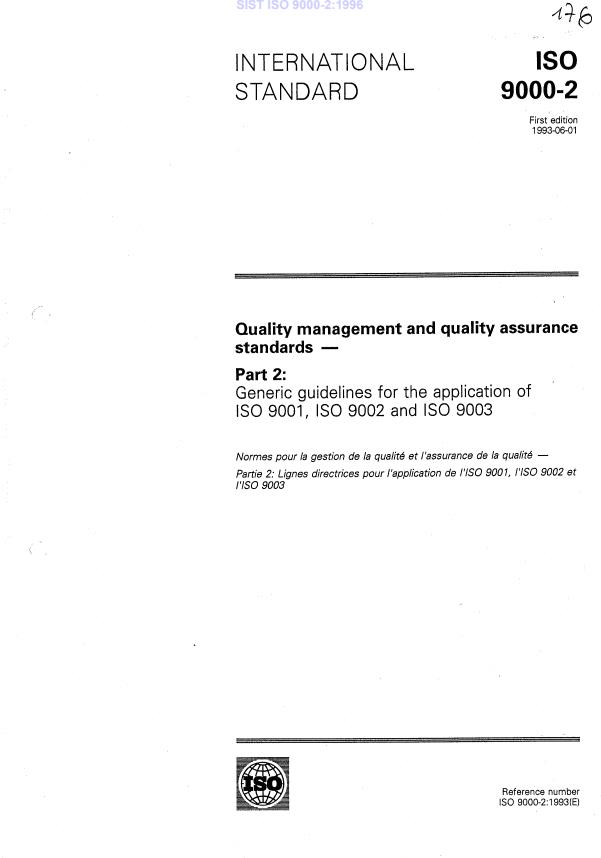
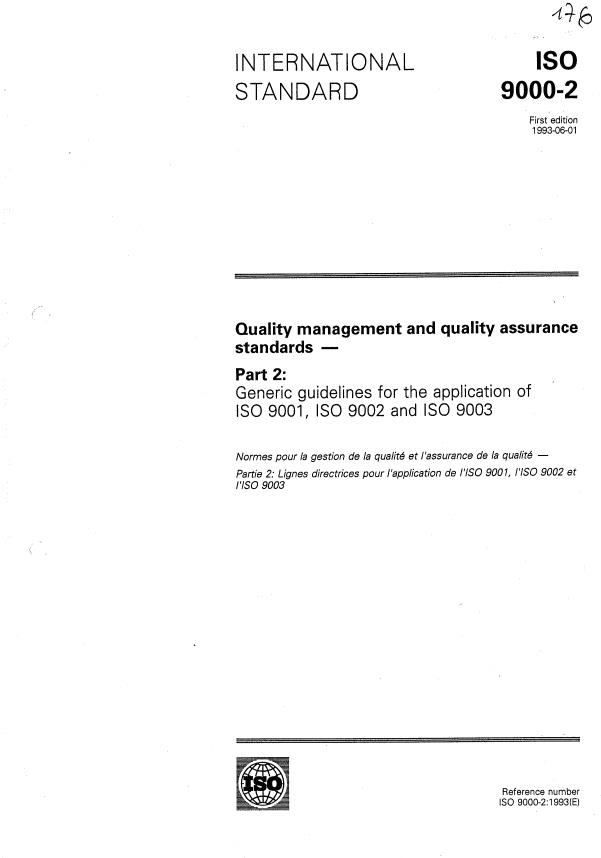
(Main)Quality management and quality assurance standards — Part 2: Generic guidelines for the application of ISO 9001, ISO 9002 and ISO 9003
Quality management and quality assurance standards — Part 2: Generic guidelines for the application of ISO 9001, ISO 9002 and ISO 9003
Normes pour le management de la qualité et l'assurance de la qualité — Partie 2: Lignes directrices pour l'application de l'ISO 9001, l'ISO 9002 et l'ISO 9003
Standardi za vodenje in zagotavljanje kakovosti - 2. del: Splošne smernice za uporabo standardov ISO 9001, ISO 9002 in ISO 9003
General Information
- Status
- Withdrawn
- Publication Date
- 02-Jun-1993
- Withdrawal Date
- 02-Jun-1993
- Technical Committee
- ISO/TC 176/SC 2 - Quality systems
- Drafting Committee
- ISO/TC 176/SC 2 - Quality systems
- Current Stage
- 9599 - Withdrawal of International Standard
- Start Date
- 12-Jun-1997
- Completion Date
- 12-Feb-2026
Relations
- Effective Date
- 12-May-2008
- Effective Date
- 15-Apr-2008


ISO 9000-2:1993 - Quality management and quality assurance standards

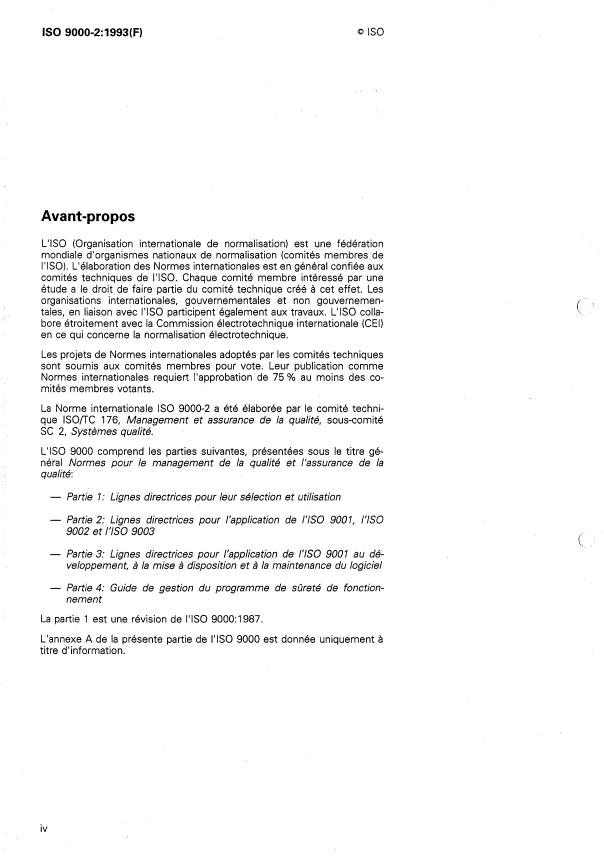
ISO 9000-2:1993 - Normes pour le management de la qualité et l'assurance de la qualité
Get Certified
Connect with accredited certification bodies for this standard

BSI Group
BSI (British Standards Institution) is the business standards company that helps organizations make excellence a habit.

Bureau Veritas
Bureau Veritas is a world leader in laboratory testing, inspection and certification services.

DNV
DNV is an independent assurance and risk management provider.
Sponsored listings
Frequently Asked Questions
ISO 9000-2:1993 is a standard published by the International Organization for Standardization (ISO). Its full title is "Quality management and quality assurance standards — Part 2: Generic guidelines for the application of ISO 9001, ISO 9002 and ISO 9003". This standard covers: Quality management and quality assurance standards — Part 2: Generic guidelines for the application of ISO 9001, ISO 9002 and ISO 9003
Quality management and quality assurance standards — Part 2: Generic guidelines for the application of ISO 9001, ISO 9002 and ISO 9003
ISO 9000-2:1993 is classified under the following ICS (International Classification for Standards) categories: 03.100.70 - Management systems; 03.120.10 - Quality management and quality assurance. The ICS classification helps identify the subject area and facilitates finding related standards.
ISO 9000-2:1993 has the following relationships with other standards: It is inter standard links to SIST ISO 9000-2:1998, ISO 9000-2:1997. Understanding these relationships helps ensure you are using the most current and applicable version of the standard.
ISO 9000-2:1993 is available in PDF format for immediate download after purchase. The document can be added to your cart and obtained through the secure checkout process. Digital delivery ensures instant access to the complete standard document.
Standards Content (Sample)
SLOVENSKI STANDARD
01-maj-1996
Standardi za vodenje in zagotavljanje kakovosti - 2. del: Splošne smernice za
uporabo standardov ISO 9001, ISO 9002 in ISO 9003
Quality management and quality assurance standards -- Part 2: Generic guidelines for
the application of ISO 9001, ISO 9002 and ISO 9003
Normes pour le management de la qualité et l'assurance de la qualité -- Partie 2: Lignes
directrices pour l'application de l'ISO 9001, l'ISO 9002 et l'ISO 9003
Ta slovenski standard je istoveten z: ISO 9000-2:1993
ICS:
03.120.10 Vodenje in zagotavljanje Quality management and
kakovosti quality assurance
2003-01.Slovenski inštitut za standardizacijo. Razmnoževanje celote ali delov tega standarda ni dovoljeno.
IS0
I N TE R NAT I O NA L
STANDARD 9000-2
First edition
1993-06-01
Quality management and quality assurance
standards -
Part 2:
Generic guidelines for the application of
IS0 9001, IS0 9002 and IS0 9003
Normes pour la gestion de la qualité et l'assurance de la qualité -
Partie 2: Lignes directrices pour l'application de I'ISO 9001, l'lS0 9002 et
I'ISO 9003
Reference number
IS0 9000-2:1993(E)
IS0 9000-2:1993(E)
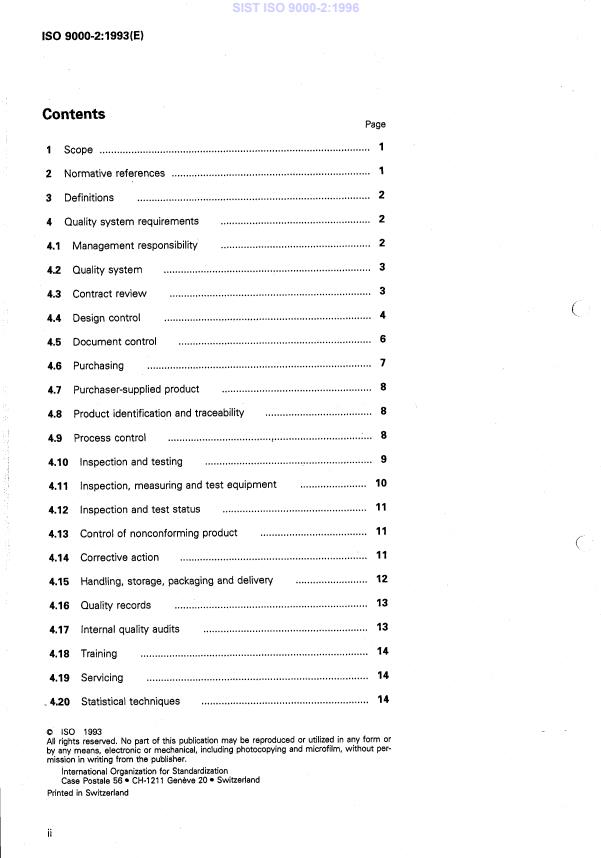
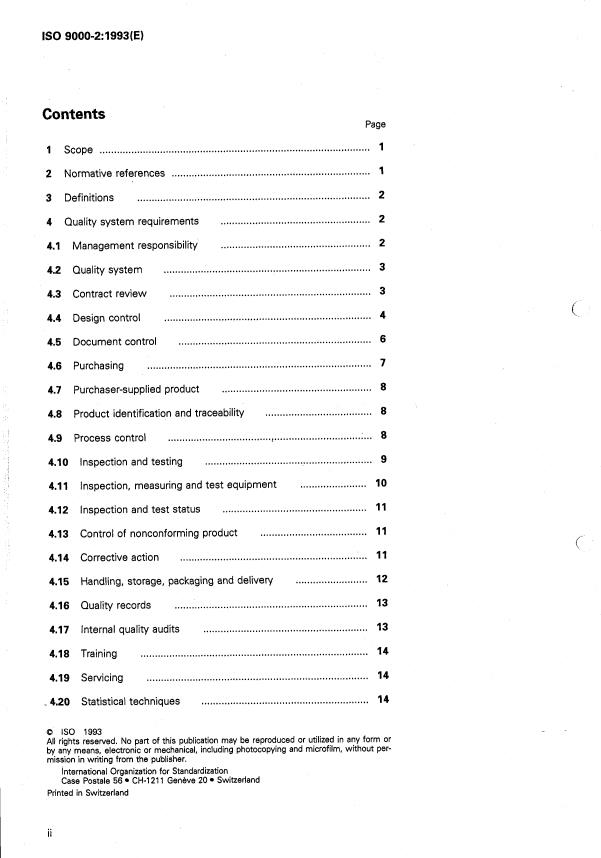
Contents
Page
1 Scope . 1
2 Normative references . 1
3 Definitions . 2
4 Quality system requirements . 2
4.1 Management responsibility . 2
4.2 Quality system . 3
4.3 Contract review . 3
4.4 Design control . 4
4.5 Document control . 6
4.6 Purchasing . 7
4.7 Purchaser-supplied product . 8
4.8 Product identification and traceability . 8
Process control . 8
4.9
4.10 Inspection and testing . 9
4.11 Inspection, measuring and test equipment . 10
4.12 Inspection and test status . 11
4.13 Control of nonconforming product . 11
4.1 4 Corrective action . 11
4.15 Handling, storage, packaging and delivery . 12
4.16 Quality records . 13
4.17 Internal quality audits . 13
4.18 Training . 14
4.19 Servicing . 14
. 4.20 Statistical techniques . 14
0 IS0 1993
Ail rights reserved . No part of this publication may be reproduced or utilized in any form or
by any means. electronic or mechanical. including photocopying and microfilm. without per-
mission in writing from the publisher .
International Organization for Standardization
Case Postale 56 CH-1 21 1 Genève 20 Switzerland
Printed in Switzerland
ii
IS0 9000-2:1993(E)
Annex
A Bibliography . 16
...
..I11
IS0 9000-2:1993(E)
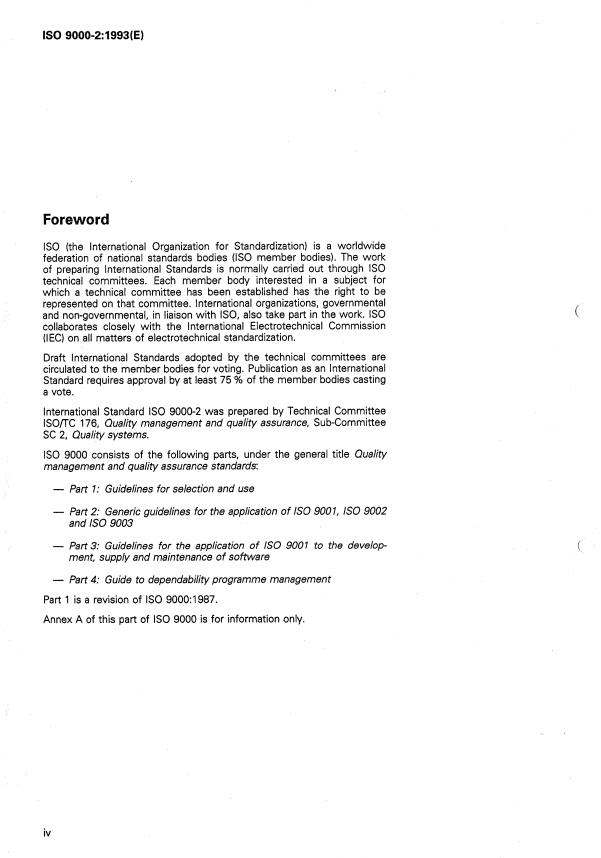
Foreword
IS0 (the International Organization for Standardization) is a worldwide
federation of national standards bodies (IS0 member bodies). The work
of preparing International Standards is normally carried out through IS0
technical committees. Each member body interested in a subject for
which a technical committee has been established has the right to be
represented on that committee. International organizations, governmental
and non-governmental, in liaison with ISO, also take part in the work. IS0
collaborates closely with the International Electrotechnical Commission
(IEC) on all matters of electrotechnical standardization.
Draft International Standards adopted by the technical committees are
circulated to the member bodies for voting. Publication as an International
Standard requires approval by at least 75 % of the member bodies casting
a vote.
International Standard IS0 9000-2 was prepared by Technical Committee
ISO/TC 176, Quality management and quality assurance, Sub-committee
SC 2, Quality systems.
IS0 9000 consists of the following parts, under the general title Quality
management and quality assurance standards:
- Part 1: Guidelines for selection and use
- Part 2: Generic guidelines for the application of IS0 9001, IS0 9002
and IS0 9003
- Part3: Guidelines for the application of IS0 9001 to the develop-
ment, supply and maintenance of software
- Part 4: Guide to dependability programme management
Part 1 is a revision of IS0 9000:1987.
Annex A of this part of IS0 9000 is for information only.
iv
IS0 9000-2:1993(E)
Introduction
This part of IS0 9000 gives guidelines for application of IS0 9001,
IS0 9002 and IS0 9003. To facilitate cross-reference to those standards,
this part of IS0 9000 has the same clause structure as IS0 9001 and
contains clause-by-clause cross-references to IS0 9001,
IS0 9002 and
IS0 9003.
In general, the number and scope of the quality system elements and
procedures contractually required for quality assurance are greatest in
IS0 9001 and least in IS0 9003. For all clauses, the guidelines of this part
of IS0 9000 should be applied in a manner consistent with the scope and
requirements of the corresponding clause, if present, in the standard in-
volved (i.e. IS0 9001, IS0 9002 or IS0 9003). Reference should be made
to sub-clause 8.3 of IS0 9000 for guidance on the extent and degree of
demonstration that may be appropriate.
IS0 9000 provides an overview of the IS0 9000 series of International
Standards, and is a "road map" for use of the entire series. IS0 9004
provides extensive quality management guidance to the supplier organ-
ization, for designing and installing a quality system appropriate to its
needs, without regard to contractual requirements of quality assurance.
This part of IS0 9000 does not duplicate the guidance to users that is
provided in other IS0 guidance standards such as IS0 9000, IS0 9000-3,
IS0 9004 and IS0 9004-2.
V
IS0 9000-2:1993(E)
INTERNATIONAL STANDARD
Quality management and quality assurance
standards -
Part 2:
Generic guidelines for the application of so 9001,
IS0 9002 and IS0 9003
auditors who need to assess and communicate
cl
1 Scope
the adequacy of implementation of the require-
ments of IS0 9001, IS0 9002 or IS0 9003 in a
specific situation.
IS0 9000 corre-
The field of application of this part of
This part of IS0 9000 gives guidance to enable its
sponds to the field of application of IS0 9001,
users to have improved consistency, precision, clarity
IS0 9002 or IS0 9003.
and understanding when applying the requirements
of the quality systems standards IS0 9001, IS0 9002
and IS0 9003. This part of IS0 9000 is phrased in
terms of guidance to the supplier in order to reflect
2 Normative references
the requirements of IS0 9001, IS0 9002 or IS0 9003.
However, this part of IS0 9000 does not add to, or
The following standards contain provisions which,
otherwise change, the requirements of IS0 9001,
through reference in this text, constitute provisions
IS0 9002 and IS0 9003. In a case of conflicting in-
of this part of IS0 9000. At the time of publication, the
terpretation of IS0 9001, IS0 9002 or IS0 9003 on
(
editions indicated were valid. All standards are subject
the one hand, and IS0 9000-2 on the other, the in-
to revision, and parties to agreements based on this
terpretation of the text in IS0 9001, IS0 9002 or
part of IS0 9000 are encouraged to investigate the
IS0 9003 takes precedence.
possibility of applying the most recent editions of the
standards indicated below. Members of IEC and IS0
This part of IS0 9000 is equally applicable to both
maintain registers of currently valid International
manufacturing and service industries seeking to im-
Standards.
plement quality assurance into organizations.
IS0 8402:-”, Quality management and quality as-
In particular, this part of IS0 9000 gives guidance for
- Vocabulary.
surance
the following users:
IS0 9001 :1987, Quality systems - Model for quality
a) suppliers and purchasers involved directly in
assurance in design/development, production, instal-
contractual applications of IS0 9001 , IS0 9002
lation and servicing.
and IS0 9003;
IS0 9002:1987, Quality systems - Model for quality
b) sub-contractors who provide to the supplier raw
assurance in production and installation.
materials, intermediate processing, equipment,
services, etc., and who are affected by the appli-
IS0 9003:1987, Quality systems - Model for quality
cation of IS0 9001, IS0 9002 or IS0 9003;
assurance in final inspection and test.
1) To be published. (Revision of IS0 8402:1986)
IS0 9000-2: 1993(E)
- providing adequate resources and training to sup-
3 Definitions
port quality system development and implemen-
tation.
For the purposes of this part of IS0 9000, the defi-
nitions given in IS0 8402 apply.
In order to clarify the meaning of the terms
"supplier", "purchaser" and "sub-contractor", the
following usages apply in this part of IS0 9000.
4.1.2 Organization
3.1 supplier: Organization to which the require-
IS0 9001, IS0 9002 or IS0 9003 apply.
ments of
4.1.2.1 Responsibility and authority
3.2 purchaser: Recipient of products (including ser-
Guidance for IS0 9001 (4,1.2.1), IS0 9002 (4.1.2.1)
vices) delivered by the supplier.
and IS0 9003 (4.1.2.1)
3.3 sub-contractor: Organization which provides
Individuals in the supplier organization should be
products (including services) to the supplier.
aware of the scope, responsibility and authority of
their functions and their impact on product or service
NOTE 1 For any one situation, an organization can, in
qua iity.
addition to being the supplier, also be a purchaser and/or a
(
sub-contractor at the same time.
Adequate authority should be delegated to individuals
to allow them to carry out their designated responsi-
a clear understanding of
bilities. They should have
4 Quality system requirements their defined authority, and freedom and designated
channels to take action. Everyone in the organization
should be made aware of, and feel responsibility for,
4.1 Management responsibility achieving the quality objectives and for fulfilling the
requirements for the quality of its products.
4.1.1 Quality policy
It is usual to designate one or more individuals to
It is im-
monitor and to report the quality achieved.
Guidance for IS0 9001 (4.1.1), IS0 9002 (4.1.1) and
portant that those so designated have access to the
IS0 9003 (4.1.1 )
highest levels of management in the organization.
When defining and documenting its quality policy,
quality objectives and commitment to quality, supplier
management should consider the following points.
4.1.2.2 Verification resources and personnel
a) The quality policy should be expressed in language
Guidance for IS0 9001 (4.1.2.21, IS0 9002 (4.1.2.2)
which is easy to understand.
and IS0 9003 (4.1.2.2)
b) The quality policy should be relevant to the organ-
Supplier management should recognize that adequate
ization, its other policies, the products or services
verification resources and personnel can involve the
provided, and the organization's personnel.
following:
c) The objectives should be achievable.
- people doing the verification;
Management should demonstrate commitment visibly
- awareness of the standards and verification ar-
a continuing basis.
and actively on
rangements which exist;
Commitment can be demonstrated by activities such
as the following: - training (see 4.18);
- ensuring that the organization's personnel under- - sufficient time to do the work;
stand and implement the quality policy;
- production schedules which allow time for activi-
- initiating, managing and following up on the im- ties such as inspection, test and verification;
plementation of the quality policy, including im-
plementation of the quality system; - equipment;
- not accepting deviations from quality policy or - documented procedures;
wasted resources in any part or aspect of the or-
ganization; - means to access quality records.
IS0 9000-2:1993(E)
4.1.2.3 Management representative
understand its intention and how it functions, in par-
ticular in the area of their responsibility and its inter-
Guidance for IS0 9001 (4.1.2.31, IS0 9002 (4.1.2.3) face with other parts of the system.
and IS0 9003 (4.1.2.3)
The note to sub-clause 4.2 in IS0 9001 and in
The management representative may have other IS0 9002 provides guidance. As in all International
functions. Where this is the case, the responsibilities Standards, the notes given in IS0 9001 and IS0 9002
are not mandatory requirements. The following guid-
and authorities for both the quality system and the
ance expands upon item a) in the notes to sub-clause
other functions should be clearly defined. Potential
4.2 in IS0 9001 and in IS0 9002.
conflicts of interest should be examined to ensure
that the effectiveness of the quality system is not
The quality system is often documented by means of
degraded.
a quality manual. The quality manual could be one
document supported by several tiers of documents,
each tier becoming progressively more detailed. For
4.1.2.4 Management review
example, there may be an overall system manual and
one or more specific procedural manuals. Together
Guidance for IS0 9001 (4.1.31, IS0 9002 (4.1.31 and
these documents define the quality system.
IS0 9003 (4.1.3)
Quality plans may be used to define how the quality
The quality system review process and the reasons
it should be known and understood by the or- system requirements will be met in a specific con-
behind
tract, or for a specific class of products. Most of them
ganization. Reviews should include the following:
will have a sequence of activities in relation to a
time-frame. Here again, the plans can be in several
- the organizational structure, including the ad-
tiers, becoming progressively more detailed. An ex-
equacy of staffing and resources;
a detailed sequence of in-
ample could include
spections, together with the type of inspection
- the structure and degree of implementation of the
equipment and quality record requirements for a par-
quality system;
ticular contract.
- the achieved quality of the end product or service
in relation to the requirements for quality;
4.3 Contract review
- information based on purchaser feedback, internal
feedback (such as results of internal audits), pro-
Guidance for IS0 9001 (4.3) and IS0 9002 (4.3)
cess performance and product (including services)
performance.
The importance of a thorough understanding of the
purchaser's needs during the tendering stage, at the
The management should review periodically the ap-
all subsequent
formulation of the contract and in
propriateness of the review frequency. The frequency
stages cannot be overstated. Often dialogue will be
depends on individual circumstances. Many organiz-
necessary to achieve this understanding, that should
ations have found that annual management reviews
clearly establish the purchaser's requirements as to
( are appropriate, but this interval is not mandatory.
the product, delivery and other critical factors. The
Activities and results may be evaluated on a system- contract review can be viewed by the supplier as a
atic and/or random basis. Chronic problem areas process of three steps.
should receive special attention. Results should be
The existence of a draft quality plan is sometimes
documented and analysed for trends that may indi-
useful to support a contract review.
cate systematic problems. These results should be
discussed with the individuals concerned.
The process steps include the following.
Required changes to the quality system determined
a) Review of the contract; this may be appropriate
during a management review should be implemented
at the tendering stage and at subsequent stages.
in a timely manner. The effectiveness of any changes
should be evaluated.
b) Achievement of agreements within the supplier's .
organization that
4.2 Quality system - the requirements have been completely de-
fined;
Guidance for IS0 9001 (4.21, IS0 9002 (4.2) and
- the requirements are understood;
IS0 9003 (4.2)
The implementation of a quality system by the sup-
- the supplier has the capability to meet con-
plier is most effective when those in the organization
tractual requirements.
IS0 9000-2:1993(E)
- plans for evaluating the safety, performance and
c) Discussion of the results of the contract review
and any draft quality plan with the purchaser in dependability incorporated in the product design;
order to achieve agreement.
- plans for methods of product measurement, test
It is beneficial for the supplier to adopt a contract re-
and acceptance criteria;
view procedure that has the following features.
- assignment of responsibilities.
a) All interested parties have an opportunity to review
the contract.
Design and development planning should recognize
the existence of other plans and verification pro-
b) A checklist or some other means is available for cedures for the implementation of the contract, and
reviewers to verify that they have reviewed and be integrated with them.
understood the requirements of the contract.
4.4.2.1 Activity assignment
c) A method is available for reviewers to question the
requirements of the contract and to have their
Guidance for IS0 9001 (4.4.2.1)
questions addressed.
The supplier should clearly assign responsibilities for
d) If appropriate, a draft quality plan is developed to
specific design leadership and other design work
have an understanding of how to implement the
functions to designated personnel. The personnel in
contract successfulty.
G
these functions should be qualified and have access
to information and the resources to complete the
e) There is a provision for reviews in the event that
work.
the contract is changed.
Design activities should be specified at the level of
detail necessary for carrying out the design process
4.4 Design control
and a manner which permits verification that the de-
sign meets the requirements.
4.4.1 General
4.4.2.2 Organizational and technical interfaces
Guidance for IS0 9001 (4.4.1)
Guidance for IS0 9001 (4.4.2.2)
The essential quality aspects and the regulatory re-
quirements such as safety, performance and
When input to the design is from a variety of sources,
dependability of a product (whether hardware, soft-
the inter-relationships and interfaces (as well as the
ware, services, or processed materials) are estab-
pertinent responsibilities and authorities) should be
lished during the design and development phase.
defined, documented, coordinated and controlled.
Deficient design can be a major cause of quality
problems. IS0 9001 specifies design control require-
Many organizational functions contribute to the design
ments for the design process.
process. These may include
i
In considering design control, it is important to note
- research and development;
that the design function may apply to various facets
of the operation in differing styles and time-scales.
- marketing;
Such facets are related to products, including services
and software, as well as to process design associated
- purchasing;
with product design. The supplier should consider all
phases of the design associated with product design.
- quality assurance and quality management;
The supplier should consider all phases of the design
function process for which controlled procedures are
- engineering;
necessary.
- materials technology;
4.4.2 Design and development planning
- production/manufacturing;
Guidance for IS0 9001 (4.4.2)
- service groups;
The supplier should establish procedures for design
and development planning that include the following: - facilities management;
- sequential and parallel work schedules; - warehousing/transportation/logistics;
- design verification activities; - communications facilities;
IS0 9000-2:1993(E)
- information systems. - drawings;
To function effectively, the suppliers' design work
- specifications (including process and materials
groups, both internal and external, should establish
specifications);
- what information should be received and trans-
- instructions;
mitted;
- software;
- identification of sending and receiving groups;
- servicing procedures.
- the purpose of the information transmittal;
Outputs of the design are the final technical docu-
- identification of transmittal mechanisms; ments used for purchasing, production, installation,
inspection and testing, and servicing.
- document transmittal records maintenance.
4.4.5 Design verification
4.4.3 Design input
Guidance for IS0 9001 (4.4.5)
Guidance for IS0 9001 (4.4.3)
IS0 9001 describes design control measures (e.g.
Design inputs are typically in the form of
design reviews, qualification tests, alternative calcu-
lations, comparison with a proven design) by which
- product requirements specifications, and/or
design verification may be established by the supplier.
In most instances it is appropriate to employ two or
- product description with specifications relating to
more of these measures. Design reviews typically are
configuration, composition, incorporated elements
the coordinating design control measure. Design re-
and other design features.
view and/or type testing by an authorized external or-
ganization may be a regulatory requirement for certain
All pertinent design inputs (such as performance,
types of product. Even under ordinary circumstances,
functional, descriptive, environmental, safety and
design verification should involve personnel other
regulatory requirements) should be defined, reviewed,
than those having direct responsibility for the design
and recorded by the supplier in a design description
work under review.
document.
The competence of the participants in the design re-
This design description document should quantify all
views should be adequate to permit them to examine
requirements to the greatest possible extent. It lays
designs and their implications. Design reviews for the
the foundation and provides a unified approach to the
purpose of design verification can consider questions
design. Details agreed between the purchaser and
such as the following.
supplier on how purchaser and regulatory require-
ments will be met should be included. The design
a) Do designs satisfy all specified requirements for
description document should also record the resol-
the product, process or service?
utions of any incomplete, ambiguous or conflicting
requirements that have been uncovered.
b) Are product design and processing capabilities
com pa ti bl e?
The design description document should identify de-
sign aspects, materials and processes requiring de-
c) Are safety considerations covered?
velopment and analysis, including prototype testing to
verify their adequacy. The design description docu-
ment should be prepared in a way that facilitates pe- d) Do designs meet functional and operational re-
riodic updates. lt also should indicate "when" or quirements, that is, performance and dependability
objectives?
"what criteria" will cause the document to be up-
dated, who is responsible for the update, and if, and
e) Have appropriate materials and/or facilities been
under what circumstances, the purchaser will receive
selected?
a copy. A design description document prepared in
this way serves as the definitive up-to-date reference
f) Is there adequate compatibility of materials, com-
document as the design progresses to completion.
ponents and/or service elements?
4.4.4 Design output
g) Is the design satisfactory for all anticipated en-
vironmental and load conditions?
Guidance for IS0 9001 (4.4.4)
Throughout the design process, the requirements h) Are components or service elements standardized
contained in the design description are translated by
and do they provide for interchangeability, main-
the supplier into outputs, such as the following:
tainability and replacement?
IS0 9000-2:1993(E)
i) Are plans for implementing the design (e.g. pur- influence previously approved design verification re-
sults. Design changes in one component of a product
chasing, production, installation, inspection and
testing) technically feasible? should be evaluated for their influence on the whole.
Improving one characteristic may have unforeseen
adverse influences on another.
j) Can the tolerance requirements consistently be
met?
When significant design changes are made, the veri-
fication procedure should also be reviewed and
k) Where computer software has been used in de-
modified as appropriate.
sign computations, modelling or analyses, has the
software (and its configuration control) been ap-
Procedures should be established to communicate
propriately validated, authorized and verified?
the new design output to all concerned, to record any
design changes and to ensure, as well as document,
I) Have the inputs to such software, and the outputs,
that only authorized design changes have been made.
been appropriately verified and documented?
m) Are the assumptions made during the design pro-
4.5 Document control
cess valid?
When qualification tests and demonstrations are em-
Guidance for IS0 9001 (4.5), IS0 9002 (4.4) and
ployed as a form of design verification, the safety and
IS0 9003 (4.3)
performance of the product, whether hardware, soft-
ware, services, or processed materials, should be
4.5.1 Document approval and issue
verified under conditions that are representative of the
full range of circumstances of actual use. The product
Documents and data containing information and/or
units employed for qualification tests and demon-
instructions can be recorded, transmitted or received
strations should be ones that were produced under
using a variety of media.
the expected production conditions.
The supplier's system should provide a clear and pre-
When alternative calculations or comparison with a
cise control of procedures and responsibilities for ap-
proven design are employed as forms of design veri-
proval, issue, distribution and administration of
fication, the appropriateness of the alternative calcu-
documentation, including the removal of obsolete
lation method, and/or the proven design, should be
documents. This can be accomplished, for example,
reviewed in relation to this new application.
by maintaining a master list of documents identifying
the level of approval, distribution (location of copies)
4.4.6 Design changes
and revision status.
Document control should include those documents
Guidance for IS0 9001 (4.4.6)
and/or computer records pertinent to design, pur-
The design of a product may be changed or modified
chasing, work execution, quality standards, inspection
for a number of reasons, for example:
of materials and the quality system documents. A
supplier's internal written procedures should describe (
- omissions or errors (e.g. due to calculation, ma-
terial selection, etc.) during the design phase have
- how the documentation for these functions should
been identified afterwards;
be controlled;
- manufacturing and/or installation difficulties are
- who is responsible for the control;
discovered after the design phase;
- what is to be controlled;
- the purchaser or sub-contractor requests changes;
- where and when the control is to take place.
- the function or performance of a product or service
is to be improved; Not all documents are needed at each individual place
of work.
- safety, regulatory or other requirements have been
changed;
4.5.2 Document changes/modifications
- design verification necessitates change (see
Recognizing that supplier documentation may be
4.4.5);
subject to revision and change, controls should exist
for the preparation, handling, issue and recording of
- corrective action necessitates change (see 4.1 4).
changes. This applies 'not only to internal documen-
Any changes to design inputs should be identified and
tation but also to externally updated documentation
reviewed by the supplier to determine whether they
(e.g. national standards).
IS0 9000-2:1993(E)
The supplier should establish a continuing mechanism
4.6.2 Assessment of sub-contractors
for controlling changes in documentation. The mech-
anism should
Guidance for IS0 9001 (4.6.2) and IS0 9002 (4.5.2)
The supplier may employ several ways of choosing
- provide for control irrespective of documentation
satisfactory sub-contractors, given that technical
media;
capabilities are satisfactory for the product to be de-
livered, for example:
- follow documentation procedures;
- a review of previous performance in supplying
- ensure accurate updating of documents;
similar products, processes or services;
- provide for using only authorized documents when
- a satisfactory assessment to an appropriate quality
implementing changes;
system standard by a body considered to be
competent for the purpose;
- preclude confusion, especially where there is a
multiplicity of sources authorizing changes and re-
- an assessment of the sub-contractor by the sup-
leasing documents.
plier to an appropriate quality system standard.
Consideration should be given to the effect that the
The supplier's quality records concerning the assess-
proposed changes may have on other parts of the
ment should be sufficiently comprehensive to dem-
procedure, system and product (including service).
onstrate the ability of sub-contractors to meet
Actions may be needed before a change is im-
contract requirements and should allow for selection
plemented to assess the effect of the change on
on the basis of quality capability.
other parts of the organization and notify them as ap-
propriate.
Factors such as product compliance with specified
requirements, the total cost for the supplier, delivery
Planned circulation of a change proposal to personnel
arrangements, and the sub-contractor's own quality
in the affected functions can assist in avoiding dis-
systems may be pertinent in this context. The per-
ruption. The timing of the implementation of the
formance of sub-contractors should be reviewed at
change may be an important factor, particularly when
intervals consistent with the complexity and technical
several changes of documentation are to be coordi-
requirements of the product and demonstrated sub-
nated.
contractor performance.
4.6.3 Purchasing data
4.6 Purchasing
Guidance for IS0 9001 (4.6.3) and IS0 9002 (4.5.3)
The supplier's purchasing data should define the
4.6.1 General
specified technical product requirements to the sub-
contractor to ensure the quality of the purchased
Guidance for IS0 9001 (4.6.1) and IS0 9002 (4.5.1)
product, process or service. This may be done, in part,
by reference to other applicable technical information
To ensure that purchased, sub-contracted products
such as national or international standards, test
(including services) conform to specified purchaser
methods, etc. Well-defined purchase orders can pro-
requirements as well as regulatory requirements,
vide documented evidence. Another option is for es-
purchasing should be planned and carried out by the
sential information to be clearly and precisely stated
supplier under adequate control. This should include
in the sub-contract. Responsibilities for reviewing and
the following:
approving the purchasing data should be clearly as-
signed to appropriate personnel. Arrangements
- assessment and selection of sub-contractors (see
should be made to identify the revision status of
4.6.2);
documents referenced in the purchasing data.
- clear and unambiguous specification of the pur-
4.6.4 Verification of purchased product
chaser requirements (see 4.6.3);
Guidance for IS0 9001 (4.6.4) and IS0 9002 (4.5.4)
- the performance of suitable verification (see
4.6.4);
The supplier should include in sub-contracts special
clauses or statements when verification is required
- inspection procedures (see 4.1 0.1 1.
at source (e.g. the sub-contractor's facilities) by the
purchaser.
The supplier should establish an effective working re-
lationship and feedback system with the sub-
When specified in the contract to assure that the
contractor.
product (including service) fulfils the specified re-
IS0 9000-2:1993(E)
quirements, the purchaser may extend verification chaser, as appropriate, information or requirements
activities to the facilities of the sub-contractor for this concerning handling, storage and maintenance of
purpose. In such cases, the supplier should arrange purchaser-supplied product.
for the purchaser to assess the quality of the sub-
When necessary, the need for calibration of equip-
contractor's product (including service) and/or the ef-
ment of "purchaser-supplied products" should be
fectiveness of the process.
specified.
Where the contract provides, the purchaser may use
the supplier's data to decide which of the products
4.8 Product identification and traceability
(including services) to be purchased will require veri-
fication at source and to decide the nature and extent
Guidance for IS0 9001 (4.8), IS0 9002 (4.7) and
of such verification.
IS0 9003 (4.4)
If the purchaser, on verification of the sub-contractor's
The supplier can achieve product identification by
product, expresses satisfaction, the supplier should
marking or tagging the product or its container. For
not take this as an opportunity to relax vigilance. The
example, on visually identical parts where the func-
supplier retains full responsibility for the quality of the
tional characteristics are different, different colours
products (including services) being supplied to the
can be used. For bulk products or product from con-
purchaser.
tinuous processes, the identification may be limited
to identification of batches or well-defined lots.
4.7 Purchaser-supplied product
c
Service identification can be achieved by documen-
Guidance for IS0 9001 (4.7) and IS0 9002 (4.6)
tation that accompanies the service. (Only this para-
graph of this guidance clause applies to IS0 9003.)
" Purchaser-supplied product" is product owned by
the purchaser and furnished to the supplier for use in
Product (including service) traceability involves the
meeting the requirements of the contract. The sup-
ability to trace the history, application or location of
plier, upon delivery, accepts responsibilities for pre-
an item or activity by means of recorded identification.
vention from damage and for identification,
Traceability can entail high costs and, when called up
maintenance, storage, handling and use while that
in a contract, the extent of quality records required
product is in the supplier's possession.
should be included.
The supplier should therefore establish arrangements
The supplier can achieve traceability by each individual
for the following:
product having an identifier (e.g. serial number, date
code, batch code, lot number) unique to the source
- examination of the product upon receipt to check
of operation. Separate identifiers could be required for
the quantity received and its identity, and to detect
changes in operative personnel, changes in raw ma-
any damage in transit;
terials, changes in tooling, new or different machine
set-ups, changes in process methods, etc. Traceability
- periodic inspection during storage to detect any
identifiers should appear on applicable inspection and
signs of deterioration, to check the limitations on
stock records.
of proper
time in storage, to assure maintenance
i
There may be situations where traceability requires
conditions and to determine the current state of
identification of the specific personnel involved in
the product;
each phase of the operation or service delivery pro-
A sequence of individuals may perform SUC-
cess.
- compliance with any contractual requirements for
cessive service functions, each of which is to be
reinspection;
traceable. The recording of identification evidence
through signatures on serially numbered documents
- identification and safeguarding of the supplied
in invoicing and banking operations are examples.
product to prevent any unauthorized use or im-
Here there is no tangible product, per se, but each
proper disposal.
individual's identification evidence should be
The responsibility should be defined for reporting un-
traceable.
suitability to the purchaser who is responsible for
providing acceptable product within the terms of the
4.9 Process control
contract.
The purchaser-supplied product could be a service, for
4.9.1 General
example the use of a purchaser's transport for deliv-
ery. The supplier should make sure of the suitability
Guidance for IS0 9001 (4.9.1) and IS0 9002 (4.8.1)
of that service and the maintenance of its effective-
ness. The supplier should be able to show documen-
The supplier's planning for the production and, where
tary evidence that this is being done, where
applicable, installation processes should consider
appropriate. The supplier should obtain from the pur-
each of the controlled conditions described in the rel-
a
IS0 9000-2:1993(E)
evant clause of the International Standard. Control - strength, ductility, fatigue life, corrosion resistance
within the process to prevent nonconformities from of a metal part following welding, soldering, heat
occurring is preferable to inspection of finished prod- treatment or plating;
uct or service alone. The characteristics that are most
critical to the productbervice quality should be identi- - dyeability, shrinkage, tensile properties of a
polymerized plastic;
fied and should be under the closest process control.
Both written and electronic media documentation
- taste, texture, appearance of a bakery product;
methods should be recognized for documented pro-
cedures.
- correctness of a software product or a financial or
legal document.
Process-control activities may include procedures for
accepting materials or items into the process and de-
Such products are typically the final result of a series
termining their characteristics while in the process.
of operations and require close adherence to specified
The amount of testing and inspecting needed for
in-process procedures and sequences such as the
process control may bear a relationship to the influ-
following.
ence of nonconformities on the downstream process.
The adequacy of measurement processes should be
a) For a hardware or processed-materials product,
considered in assessing the adequacy of production
these can involve starting materials, temperature
process control.
profiles, physical deformations, mixing and en-
vironmental conditions.
(
Where suitable, process control should include statis-
tical process-control methods, supplemented by pro-
b) For a software or service product, these can in-
cedures to maintain the suitability of software, of
volve source data and documents, intellectual and
in-process materials and of activities needed for ap-
clerical correctness.
propriate storage, handling and segregation.
Comprehensive measurement assurance and cali-
Where the achievement of desired levels of process
bration of equipment used to produce or measure the
control is dependent upon consistent and stable op-
product may be required for such “special
eration of process equipment and essential materials,
processes”. The use of statistical process control is
the supplier should include within the scope of the
often most advantageous.
quality system the proper maintenance of such pro-
cess equipment and essential materials.
Special skills, capabilities and training of personnel
may be needed and should be demonstrated.
Process knowledge can be considered as a basis to
4.9.2 Special processes
distinguish finished-product characteristics from
measurable in-process characteristics. Such pro-
Guidance for IS0 9001 (4.9.2) and IS0 9002 (4.8.2)
cesses should be qualified in advance by tests to
make sure that the process can meet the specified
The supplier should give special consideration to
requirements.
“special processes”. These are processes in which
the product quality characteristics cannot be fully
verified in the finished product.
Examples include circumstances where
4.10 Inspection and testing
- the characteristics of interest do not exist until
further downstream in the process;
4.10.1 Receiving inspection and testing
- the method of measurement does not exist or is
Guidance for IS0 9001 (4.10,l) and IS0 9002
destructive to the product;
(4.9.1 1
- results within the process cannot be measured in
4.10.1.1 Receiving inspection is one means for the
later inspections or tests.
supplier to verify that sub-contractors have fulfilled
All products are produced by processes, and special
their contractual obligations relating to quality and that
processes are found in all generic product categories:
procured items entering the supplier’s facilities fulfil
hardware, software, processed materials and ser-
specified requirements for quality.
vices. However, special processes are particularly
This sub-clause in IS0 9001 and IS0 9002 does not
common in the production of processed materials.
imply that incoming items have to be inspected and
Some examples where critical product quality charac-
tested by the supplier, if the necessary confidence in
teristics fall within one or more of the three process
the product (including service) can be obtained by
circumstances above include: other defined procedures.
IS0 9000-2:1993(E)
4.10.3 Final inspection and testing
The supplier's procedures or quality plan should
specify the means of verifying that shipments re-
ceived are in accordance with specifications, are Guidance for IS0 9001 (4.10.31, IS0 9002 (4.9.3)
complete, have the proper identity and are undam- and IS0 9003 (4.5)
aged. The procedures should also include provisions
Final inspection involves the activities (examination,
for verifying that incoming items, materials or services
inspection, measurement or test) upon which the final
are accompanied by supporting documentation as,
release of product (including service) is based with
and if, required (e.g. mill test reports, non-destructive
respect to specified characterist
...
IS0
I N TE R NAT I O NA L
STANDARD 9000-2
First edition
1993-06-01
Quality management and quality assurance
standards -
Part 2:
Generic guidelines for the application of
IS0 9001, IS0 9002 and IS0 9003
Normes pour la gestion de la qualité et l'assurance de la qualité -
Partie 2: Lignes directrices pour l'application de I'ISO 9001, l'lS0 9002 et
I'ISO 9003
Reference number
IS0 9000-2:1993(E)
IS0 9000-2:1993(E)
Contents
Page
1 Scope . 1
2 Normative references . 1
3 Definitions . 2
4 Quality system requirements . 2
4.1 Management responsibility . 2
4.2 Quality system . 3
4.3 Contract review . 3
4.4 Design control . 4
4.5 Document control . 6
4.6 Purchasing . 7
4.7 Purchaser-supplied product . 8
4.8 Product identification and traceability . 8
Process control . 8
4.9
4.10 Inspection and testing . 9
4.11 Inspection, measuring and test equipment . 10
4.12 Inspection and test status . 11
4.13 Control of nonconforming product . 11
4.1 4 Corrective action . 11
4.15 Handling, storage, packaging and delivery . 12
4.16 Quality records . 13
4.17 Internal quality audits . 13
4.18 Training . 14
4.19 Servicing . 14
. 4.20 Statistical techniques . 14
0 IS0 1993
Ail rights reserved . No part of this publication may be reproduced or utilized in any form or
by any means. electronic or mechanical. including photocopying and microfilm. without per-
mission in writing from the publisher .
International Organization for Standardization
Case Postale 56 CH-1 21 1 Genève 20 Switzerland
Printed in Switzerland
ii
IS0 9000-2:1993(E)
Annex
A Bibliography . 16
...
..I11
IS0 9000-2:1993(E)
Foreword
IS0 (the International Organization for Standardization) is a worldwide
federation of national standards bodies (IS0 member bodies). The work
of preparing International Standards is normally carried out through IS0
technical committees. Each member body interested in a subject for
which a technical committee has been established has the right to be
represented on that committee. International organizations, governmental
and non-governmental, in liaison with ISO, also take part in the work. IS0
collaborates closely with the International Electrotechnical Commission
(IEC) on all matters of electrotechnical standardization.
Draft International Standards adopted by the technical committees are
circulated to the member bodies for voting. Publication as an International
Standard requires approval by at least 75 % of the member bodies casting
a vote.
International Standard IS0 9000-2 was prepared by Technical Committee
ISO/TC 176, Quality management and quality assurance, Sub-committee
SC 2, Quality systems.
IS0 9000 consists of the following parts, under the general title Quality
management and quality assurance standards:
- Part 1: Guidelines for selection and use
- Part 2: Generic guidelines for the application of IS0 9001, IS0 9002
and IS0 9003
- Part3: Guidelines for the application of IS0 9001 to the develop-
ment, supply and maintenance of software
- Part 4: Guide to dependability programme management
Part 1 is a revision of IS0 9000:1987.
Annex A of this part of IS0 9000 is for information only.
iv
IS0 9000-2:1993(E)
Introduction
This part of IS0 9000 gives guidelines for application of IS0 9001,
IS0 9002 and IS0 9003. To facilitate cross-reference to those standards,
this part of IS0 9000 has the same clause structure as IS0 9001 and
contains clause-by-clause cross-references to IS0 9001,
IS0 9002 and
IS0 9003.
In general, the number and scope of the quality system elements and
procedures contractually required for quality assurance are greatest in
IS0 9001 and least in IS0 9003. For all clauses, the guidelines of this part
of IS0 9000 should be applied in a manner consistent with the scope and
requirements of the corresponding clause, if present, in the standard in-
volved (i.e. IS0 9001, IS0 9002 or IS0 9003). Reference should be made
to sub-clause 8.3 of IS0 9000 for guidance on the extent and degree of
demonstration that may be appropriate.
IS0 9000 provides an overview of the IS0 9000 series of International
Standards, and is a "road map" for use of the entire series. IS0 9004
provides extensive quality management guidance to the supplier organ-
ization, for designing and installing a quality system appropriate to its
needs, without regard to contractual requirements of quality assurance.
This part of IS0 9000 does not duplicate the guidance to users that is
provided in other IS0 guidance standards such as IS0 9000, IS0 9000-3,
IS0 9004 and IS0 9004-2.
V
IS0 9000-2:1993(E)
INTERNATIONAL STANDARD
Quality management and quality assurance
standards -
Part 2:
Generic guidelines for the application of so 9001,
IS0 9002 and IS0 9003
auditors who need to assess and communicate
cl
1 Scope
the adequacy of implementation of the require-
ments of IS0 9001, IS0 9002 or IS0 9003 in a
specific situation.
IS0 9000 corre-
The field of application of this part of
This part of IS0 9000 gives guidance to enable its
sponds to the field of application of IS0 9001,
users to have improved consistency, precision, clarity
IS0 9002 or IS0 9003.
and understanding when applying the requirements
of the quality systems standards IS0 9001, IS0 9002
and IS0 9003. This part of IS0 9000 is phrased in
terms of guidance to the supplier in order to reflect
2 Normative references
the requirements of IS0 9001, IS0 9002 or IS0 9003.
However, this part of IS0 9000 does not add to, or
The following standards contain provisions which,
otherwise change, the requirements of IS0 9001,
through reference in this text, constitute provisions
IS0 9002 and IS0 9003. In a case of conflicting in-
of this part of IS0 9000. At the time of publication, the
terpretation of IS0 9001, IS0 9002 or IS0 9003 on
(
editions indicated were valid. All standards are subject
the one hand, and IS0 9000-2 on the other, the in-
to revision, and parties to agreements based on this
terpretation of the text in IS0 9001, IS0 9002 or
part of IS0 9000 are encouraged to investigate the
IS0 9003 takes precedence.
possibility of applying the most recent editions of the
standards indicated below. Members of IEC and IS0
This part of IS0 9000 is equally applicable to both
maintain registers of currently valid International
manufacturing and service industries seeking to im-
Standards.
plement quality assurance into organizations.
IS0 8402:-”, Quality management and quality as-
In particular, this part of IS0 9000 gives guidance for
- Vocabulary.
surance
the following users:
IS0 9001 :1987, Quality systems - Model for quality
a) suppliers and purchasers involved directly in
assurance in design/development, production, instal-
contractual applications of IS0 9001 , IS0 9002
lation and servicing.
and IS0 9003;
IS0 9002:1987, Quality systems - Model for quality
b) sub-contractors who provide to the supplier raw
assurance in production and installation.
materials, intermediate processing, equipment,
services, etc., and who are affected by the appli-
IS0 9003:1987, Quality systems - Model for quality
cation of IS0 9001, IS0 9002 or IS0 9003;
assurance in final inspection and test.
1) To be published. (Revision of IS0 8402:1986)
IS0 9000-2: 1993(E)
- providing adequate resources and training to sup-
3 Definitions
port quality system development and implemen-
tation.
For the purposes of this part of IS0 9000, the defi-
nitions given in IS0 8402 apply.
In order to clarify the meaning of the terms
"supplier", "purchaser" and "sub-contractor", the
following usages apply in this part of IS0 9000.
4.1.2 Organization
3.1 supplier: Organization to which the require-
IS0 9001, IS0 9002 or IS0 9003 apply.
ments of
4.1.2.1 Responsibility and authority
3.2 purchaser: Recipient of products (including ser-
Guidance for IS0 9001 (4,1.2.1), IS0 9002 (4.1.2.1)
vices) delivered by the supplier.
and IS0 9003 (4.1.2.1)
3.3 sub-contractor: Organization which provides
Individuals in the supplier organization should be
products (including services) to the supplier.
aware of the scope, responsibility and authority of
their functions and their impact on product or service
NOTE 1 For any one situation, an organization can, in
qua iity.
addition to being the supplier, also be a purchaser and/or a
(
sub-contractor at the same time.
Adequate authority should be delegated to individuals
to allow them to carry out their designated responsi-
a clear understanding of
bilities. They should have
4 Quality system requirements their defined authority, and freedom and designated
channels to take action. Everyone in the organization
should be made aware of, and feel responsibility for,
4.1 Management responsibility achieving the quality objectives and for fulfilling the
requirements for the quality of its products.
4.1.1 Quality policy
It is usual to designate one or more individuals to
It is im-
monitor and to report the quality achieved.
Guidance for IS0 9001 (4.1.1), IS0 9002 (4.1.1) and
portant that those so designated have access to the
IS0 9003 (4.1.1 )
highest levels of management in the organization.
When defining and documenting its quality policy,
quality objectives and commitment to quality, supplier
management should consider the following points.
4.1.2.2 Verification resources and personnel
a) The quality policy should be expressed in language
Guidance for IS0 9001 (4.1.2.21, IS0 9002 (4.1.2.2)
which is easy to understand.
and IS0 9003 (4.1.2.2)
b) The quality policy should be relevant to the organ-
Supplier management should recognize that adequate
ization, its other policies, the products or services
verification resources and personnel can involve the
provided, and the organization's personnel.
following:
c) The objectives should be achievable.
- people doing the verification;
Management should demonstrate commitment visibly
- awareness of the standards and verification ar-
a continuing basis.
and actively on
rangements which exist;
Commitment can be demonstrated by activities such
as the following: - training (see 4.18);
- ensuring that the organization's personnel under- - sufficient time to do the work;
stand and implement the quality policy;
- production schedules which allow time for activi-
- initiating, managing and following up on the im- ties such as inspection, test and verification;
plementation of the quality policy, including im-
plementation of the quality system; - equipment;
- not accepting deviations from quality policy or - documented procedures;
wasted resources in any part or aspect of the or-
ganization; - means to access quality records.
IS0 9000-2:1993(E)
4.1.2.3 Management representative
understand its intention and how it functions, in par-
ticular in the area of their responsibility and its inter-
Guidance for IS0 9001 (4.1.2.31, IS0 9002 (4.1.2.3) face with other parts of the system.
and IS0 9003 (4.1.2.3)
The note to sub-clause 4.2 in IS0 9001 and in
The management representative may have other IS0 9002 provides guidance. As in all International
functions. Where this is the case, the responsibilities Standards, the notes given in IS0 9001 and IS0 9002
are not mandatory requirements. The following guid-
and authorities for both the quality system and the
ance expands upon item a) in the notes to sub-clause
other functions should be clearly defined. Potential
4.2 in IS0 9001 and in IS0 9002.
conflicts of interest should be examined to ensure
that the effectiveness of the quality system is not
The quality system is often documented by means of
degraded.
a quality manual. The quality manual could be one
document supported by several tiers of documents,
each tier becoming progressively more detailed. For
4.1.2.4 Management review
example, there may be an overall system manual and
one or more specific procedural manuals. Together
Guidance for IS0 9001 (4.1.31, IS0 9002 (4.1.31 and
these documents define the quality system.
IS0 9003 (4.1.3)
Quality plans may be used to define how the quality
The quality system review process and the reasons
it should be known and understood by the or- system requirements will be met in a specific con-
behind
tract, or for a specific class of products. Most of them
ganization. Reviews should include the following:
will have a sequence of activities in relation to a
time-frame. Here again, the plans can be in several
- the organizational structure, including the ad-
tiers, becoming progressively more detailed. An ex-
equacy of staffing and resources;
a detailed sequence of in-
ample could include
spections, together with the type of inspection
- the structure and degree of implementation of the
equipment and quality record requirements for a par-
quality system;
ticular contract.
- the achieved quality of the end product or service
in relation to the requirements for quality;
4.3 Contract review
- information based on purchaser feedback, internal
feedback (such as results of internal audits), pro-
Guidance for IS0 9001 (4.3) and IS0 9002 (4.3)
cess performance and product (including services)
performance.
The importance of a thorough understanding of the
purchaser's needs during the tendering stage, at the
The management should review periodically the ap-
all subsequent
formulation of the contract and in
propriateness of the review frequency. The frequency
stages cannot be overstated. Often dialogue will be
depends on individual circumstances. Many organiz-
necessary to achieve this understanding, that should
ations have found that annual management reviews
clearly establish the purchaser's requirements as to
( are appropriate, but this interval is not mandatory.
the product, delivery and other critical factors. The
Activities and results may be evaluated on a system- contract review can be viewed by the supplier as a
atic and/or random basis. Chronic problem areas process of three steps.
should receive special attention. Results should be
The existence of a draft quality plan is sometimes
documented and analysed for trends that may indi-
useful to support a contract review.
cate systematic problems. These results should be
discussed with the individuals concerned.
The process steps include the following.
Required changes to the quality system determined
a) Review of the contract; this may be appropriate
during a management review should be implemented
at the tendering stage and at subsequent stages.
in a timely manner. The effectiveness of any changes
should be evaluated.
b) Achievement of agreements within the supplier's .
organization that
4.2 Quality system - the requirements have been completely de-
fined;
Guidance for IS0 9001 (4.21, IS0 9002 (4.2) and
- the requirements are understood;
IS0 9003 (4.2)
The implementation of a quality system by the sup-
- the supplier has the capability to meet con-
plier is most effective when those in the organization
tractual requirements.
IS0 9000-2:1993(E)
- plans for evaluating the safety, performance and
c) Discussion of the results of the contract review
and any draft quality plan with the purchaser in dependability incorporated in the product design;
order to achieve agreement.
- plans for methods of product measurement, test
It is beneficial for the supplier to adopt a contract re-
and acceptance criteria;
view procedure that has the following features.
- assignment of responsibilities.
a) All interested parties have an opportunity to review
the contract.
Design and development planning should recognize
the existence of other plans and verification pro-
b) A checklist or some other means is available for cedures for the implementation of the contract, and
reviewers to verify that they have reviewed and be integrated with them.
understood the requirements of the contract.
4.4.2.1 Activity assignment
c) A method is available for reviewers to question the
requirements of the contract and to have their
Guidance for IS0 9001 (4.4.2.1)
questions addressed.
The supplier should clearly assign responsibilities for
d) If appropriate, a draft quality plan is developed to
specific design leadership and other design work
have an understanding of how to implement the
functions to designated personnel. The personnel in
contract successfulty.
G
these functions should be qualified and have access
to information and the resources to complete the
e) There is a provision for reviews in the event that
work.
the contract is changed.
Design activities should be specified at the level of
detail necessary for carrying out the design process
4.4 Design control
and a manner which permits verification that the de-
sign meets the requirements.
4.4.1 General
4.4.2.2 Organizational and technical interfaces
Guidance for IS0 9001 (4.4.1)
Guidance for IS0 9001 (4.4.2.2)
The essential quality aspects and the regulatory re-
quirements such as safety, performance and
When input to the design is from a variety of sources,
dependability of a product (whether hardware, soft-
the inter-relationships and interfaces (as well as the
ware, services, or processed materials) are estab-
pertinent responsibilities and authorities) should be
lished during the design and development phase.
defined, documented, coordinated and controlled.
Deficient design can be a major cause of quality
problems. IS0 9001 specifies design control require-
Many organizational functions contribute to the design
ments for the design process.
process. These may include
i
In considering design control, it is important to note
- research and development;
that the design function may apply to various facets
of the operation in differing styles and time-scales.
- marketing;
Such facets are related to products, including services
and software, as well as to process design associated
- purchasing;
with product design. The supplier should consider all
phases of the design associated with product design.
- quality assurance and quality management;
The supplier should consider all phases of the design
function process for which controlled procedures are
- engineering;
necessary.
- materials technology;
4.4.2 Design and development planning
- production/manufacturing;
Guidance for IS0 9001 (4.4.2)
- service groups;
The supplier should establish procedures for design
and development planning that include the following: - facilities management;
- sequential and parallel work schedules; - warehousing/transportation/logistics;
- design verification activities; - communications facilities;
IS0 9000-2:1993(E)
- information systems. - drawings;
To function effectively, the suppliers' design work
- specifications (including process and materials
groups, both internal and external, should establish
specifications);
- what information should be received and trans-
- instructions;
mitted;
- software;
- identification of sending and receiving groups;
- servicing procedures.
- the purpose of the information transmittal;
Outputs of the design are the final technical docu-
- identification of transmittal mechanisms; ments used for purchasing, production, installation,
inspection and testing, and servicing.
- document transmittal records maintenance.
4.4.5 Design verification
4.4.3 Design input
Guidance for IS0 9001 (4.4.5)
Guidance for IS0 9001 (4.4.3)
IS0 9001 describes design control measures (e.g.
Design inputs are typically in the form of
design reviews, qualification tests, alternative calcu-
lations, comparison with a proven design) by which
- product requirements specifications, and/or
design verification may be established by the supplier.
In most instances it is appropriate to employ two or
- product description with specifications relating to
more of these measures. Design reviews typically are
configuration, composition, incorporated elements
the coordinating design control measure. Design re-
and other design features.
view and/or type testing by an authorized external or-
ganization may be a regulatory requirement for certain
All pertinent design inputs (such as performance,
types of product. Even under ordinary circumstances,
functional, descriptive, environmental, safety and
design verification should involve personnel other
regulatory requirements) should be defined, reviewed,
than those having direct responsibility for the design
and recorded by the supplier in a design description
work under review.
document.
The competence of the participants in the design re-
This design description document should quantify all
views should be adequate to permit them to examine
requirements to the greatest possible extent. It lays
designs and their implications. Design reviews for the
the foundation and provides a unified approach to the
purpose of design verification can consider questions
design. Details agreed between the purchaser and
such as the following.
supplier on how purchaser and regulatory require-
ments will be met should be included. The design
a) Do designs satisfy all specified requirements for
description document should also record the resol-
the product, process or service?
utions of any incomplete, ambiguous or conflicting
requirements that have been uncovered.
b) Are product design and processing capabilities
com pa ti bl e?
The design description document should identify de-
sign aspects, materials and processes requiring de-
c) Are safety considerations covered?
velopment and analysis, including prototype testing to
verify their adequacy. The design description docu-
ment should be prepared in a way that facilitates pe- d) Do designs meet functional and operational re-
riodic updates. lt also should indicate "when" or quirements, that is, performance and dependability
objectives?
"what criteria" will cause the document to be up-
dated, who is responsible for the update, and if, and
e) Have appropriate materials and/or facilities been
under what circumstances, the purchaser will receive
selected?
a copy. A design description document prepared in
this way serves as the definitive up-to-date reference
f) Is there adequate compatibility of materials, com-
document as the design progresses to completion.
ponents and/or service elements?
4.4.4 Design output
g) Is the design satisfactory for all anticipated en-
vironmental and load conditions?
Guidance for IS0 9001 (4.4.4)
Throughout the design process, the requirements h) Are components or service elements standardized
contained in the design description are translated by
and do they provide for interchangeability, main-
the supplier into outputs, such as the following:
tainability and replacement?
IS0 9000-2:1993(E)
i) Are plans for implementing the design (e.g. pur- influence previously approved design verification re-
sults. Design changes in one component of a product
chasing, production, installation, inspection and
testing) technically feasible? should be evaluated for their influence on the whole.
Improving one characteristic may have unforeseen
adverse influences on another.
j) Can the tolerance requirements consistently be
met?
When significant design changes are made, the veri-
fication procedure should also be reviewed and
k) Where computer software has been used in de-
modified as appropriate.
sign computations, modelling or analyses, has the
software (and its configuration control) been ap-
Procedures should be established to communicate
propriately validated, authorized and verified?
the new design output to all concerned, to record any
design changes and to ensure, as well as document,
I) Have the inputs to such software, and the outputs,
that only authorized design changes have been made.
been appropriately verified and documented?
m) Are the assumptions made during the design pro-
4.5 Document control
cess valid?
When qualification tests and demonstrations are em-
Guidance for IS0 9001 (4.5), IS0 9002 (4.4) and
ployed as a form of design verification, the safety and
IS0 9003 (4.3)
performance of the product, whether hardware, soft-
ware, services, or processed materials, should be
4.5.1 Document approval and issue
verified under conditions that are representative of the
full range of circumstances of actual use. The product
Documents and data containing information and/or
units employed for qualification tests and demon-
instructions can be recorded, transmitted or received
strations should be ones that were produced under
using a variety of media.
the expected production conditions.
The supplier's system should provide a clear and pre-
When alternative calculations or comparison with a
cise control of procedures and responsibilities for ap-
proven design are employed as forms of design veri-
proval, issue, distribution and administration of
fication, the appropriateness of the alternative calcu-
documentation, including the removal of obsolete
lation method, and/or the proven design, should be
documents. This can be accomplished, for example,
reviewed in relation to this new application.
by maintaining a master list of documents identifying
the level of approval, distribution (location of copies)
4.4.6 Design changes
and revision status.
Document control should include those documents
Guidance for IS0 9001 (4.4.6)
and/or computer records pertinent to design, pur-
The design of a product may be changed or modified
chasing, work execution, quality standards, inspection
for a number of reasons, for example:
of materials and the quality system documents. A
supplier's internal written procedures should describe (
- omissions or errors (e.g. due to calculation, ma-
terial selection, etc.) during the design phase have
- how the documentation for these functions should
been identified afterwards;
be controlled;
- manufacturing and/or installation difficulties are
- who is responsible for the control;
discovered after the design phase;
- what is to be controlled;
- the purchaser or sub-contractor requests changes;
- where and when the control is to take place.
- the function or performance of a product or service
is to be improved; Not all documents are needed at each individual place
of work.
- safety, regulatory or other requirements have been
changed;
4.5.2 Document changes/modifications
- design verification necessitates change (see
Recognizing that supplier documentation may be
4.4.5);
subject to revision and change, controls should exist
for the preparation, handling, issue and recording of
- corrective action necessitates change (see 4.1 4).
changes. This applies 'not only to internal documen-
Any changes to design inputs should be identified and
tation but also to externally updated documentation
reviewed by the supplier to determine whether they
(e.g. national standards).
IS0 9000-2:1993(E)
The supplier should establish a continuing mechanism
4.6.2 Assessment of sub-contractors
for controlling changes in documentation. The mech-
anism should
Guidance for IS0 9001 (4.6.2) and IS0 9002 (4.5.2)
The supplier may employ several ways of choosing
- provide for control irrespective of documentation
satisfactory sub-contractors, given that technical
media;
capabilities are satisfactory for the product to be de-
livered, for example:
- follow documentation procedures;
- a review of previous performance in supplying
- ensure accurate updating of documents;
similar products, processes or services;
- provide for using only authorized documents when
- a satisfactory assessment to an appropriate quality
implementing changes;
system standard by a body considered to be
competent for the purpose;
- preclude confusion, especially where there is a
multiplicity of sources authorizing changes and re-
- an assessment of the sub-contractor by the sup-
leasing documents.
plier to an appropriate quality system standard.
Consideration should be given to the effect that the
The supplier's quality records concerning the assess-
proposed changes may have on other parts of the
ment should be sufficiently comprehensive to dem-
procedure, system and product (including service).
onstrate the ability of sub-contractors to meet
Actions may be needed before a change is im-
contract requirements and should allow for selection
plemented to assess the effect of the change on
on the basis of quality capability.
other parts of the organization and notify them as ap-
propriate.
Factors such as product compliance with specified
requirements, the total cost for the supplier, delivery
Planned circulation of a change proposal to personnel
arrangements, and the sub-contractor's own quality
in the affected functions can assist in avoiding dis-
systems may be pertinent in this context. The per-
ruption. The timing of the implementation of the
formance of sub-contractors should be reviewed at
change may be an important factor, particularly when
intervals consistent with the complexity and technical
several changes of documentation are to be coordi-
requirements of the product and demonstrated sub-
nated.
contractor performance.
4.6.3 Purchasing data
4.6 Purchasing
Guidance for IS0 9001 (4.6.3) and IS0 9002 (4.5.3)
The supplier's purchasing data should define the
4.6.1 General
specified technical product requirements to the sub-
contractor to ensure the quality of the purchased
Guidance for IS0 9001 (4.6.1) and IS0 9002 (4.5.1)
product, process or service. This may be done, in part,
by reference to other applicable technical information
To ensure that purchased, sub-contracted products
such as national or international standards, test
(including services) conform to specified purchaser
methods, etc. Well-defined purchase orders can pro-
requirements as well as regulatory requirements,
vide documented evidence. Another option is for es-
purchasing should be planned and carried out by the
sential information to be clearly and precisely stated
supplier under adequate control. This should include
in the sub-contract. Responsibilities for reviewing and
the following:
approving the purchasing data should be clearly as-
signed to appropriate personnel. Arrangements
- assessment and selection of sub-contractors (see
should be made to identify the revision status of
4.6.2);
documents referenced in the purchasing data.
- clear and unambiguous specification of the pur-
4.6.4 Verification of purchased product
chaser requirements (see 4.6.3);
Guidance for IS0 9001 (4.6.4) and IS0 9002 (4.5.4)
- the performance of suitable verification (see
4.6.4);
The supplier should include in sub-contracts special
clauses or statements when verification is required
- inspection procedures (see 4.1 0.1 1.
at source (e.g. the sub-contractor's facilities) by the
purchaser.
The supplier should establish an effective working re-
lationship and feedback system with the sub-
When specified in the contract to assure that the
contractor.
product (including service) fulfils the specified re-
...
NORME IS0
I N T E R NAT I O NA LE
9000-2
Première édition
1993-06-01
/-
Normes pour le management de la qualité
et l'assurance de la qualité -
Partie 2:
Lignes directrices pour l'application de
I'ISO 9001, I'ISO 9002 et I'ISO 9003
Quality management and quality assurance standards -
Part 2: Generic guidelines for the application of IS0 9001, IS0 9002 and
IS0 9003
Numéro de référence
IS0 9000-2:1993(F)
IS0 9000-2:1993(F)
Sommaire
Page
1 Domaine d'application . 1
Références normatives . 1
3 Définitions . 2
4 Exigences en matière de système qualité . 2
4.1 Responsabilité de la direction . 2
4.2 Système qualité . 3
4.3 Revue de contrat . 4
4.4 Maîtrise de la conception . 4
4.5 Maîtrise des documents . 7
4.6 Achats . 8
4.7 Produit acheté Dar l'acheteur . 9
4.8 Identification et traçabilité du produit . 10
4.9 Maîtrise des processus . 10
4.10 Contrôle et essais . 11
4.11 Équipements de contrôle. de mesure et d'essai . 12
4.12 État des contrôles et des essais . 13
4.13 Maîtrise du produit non conforme . 13
4.14 Actions correctives . 14
4.15 Manutention. stockage. conditionnement et livraison . 14
4.16 Enregistrements relatifs à la qualité . 15
4.17 Audits qualité internes . 16
4.18 Formation . 16
4.19 Soutien après la vente . 17
4.20 Techniques statistiques . 17
O IS0 1993
Droits de reproduction réservés . Sauf prescription différente. aucune partie de cette publi-
cation ne peut être reproduite ni utilisée sous quelque forme que ce soit et par aucun pro-
cédé. électronique ou mécanique. y compris la photocopie et les microfilms. sans l'accord
écrit de l'éditeur .
Organisation internationale de normalisation
Case Postale 56 CH-1211 Genève 20 Suisse
Version française tirée en 1994
imprimé en Suisse
ii
Q IS0 IS0 9000-2:1993(F)
Annexe
A Bibliographie . 19
iii
Q IS0
IS0 9000-2: 1993( F)
Avant-propos
L'ISO (Organisation internationale de normalisation) est une fédération
mondiale d'organismes nationaux de normalisation (comités membres de
I'ISO). L'élaboration des Normes internationales est en général confiée aux
comités techniques de I'ISO. Chaque comité membre intéressé par une
étude a le droit de faire partie du comité technique créé à cet effet. Les
organisations internationales, gouvernementales et non gouvernemen-
tales, en liaison avec I'ISO participent également aux travaux. L'ISO colla-
bore étroitement avec la Commission électrotechnique internationale (CEI)
en ce qui concerne la normalisation électrotechnique.
Les projets de Normes internationales adoptés par les comités techniques
sont soumis aux comités membres pour vote. Leur publication comme
Normes internationales requiert l'approbation de 75 % au moins des co-
mités membres votants.
La Norme internationale IS0 9000-2 a été élaborée par le comité techni-
que ISOflC 176, Management et assurance de la qualité, sous-comité
SC 2, Systèmes qualité.
L'ISO 9000 comprend les parties suivantes, présentées sous le titre gé-
néral Normes pour le management de la qualité et l'assurance de la
qualité:
- Partie I: Lignes directrices pour leur sélection et utilisation
- Partie 2: Lignes directrices pour l'application de I'ISO 9001, I'ISO
9002 et I'ISO 9003
- Partie 3: Lignes directrices pour l'application de I'ISO 9001 au dé-
veloppement, à la mise à disposition et à la maintenance du logiciel
- Partie 4: Guide de gestion du programme de sûreté de fonction-
nement
La partie 1 est une révision de I'ISO 9000:1987.
L'annexe A de la présente partie de I'ISO 9000 est donnée uniquement à
titre d'information.
IV
Q IS0
IS0 9000-2:1993(F)
Introduction
La présente partie de I'ISO 9000 donne les lignes directrices pour I'appli-
cation de I'ISO 9001, I'ISO 9002 et I'ISO 9003. Pour faciliter la référence
à ces normes, la présente partie de I'ISO 9000 a la même struc-
croisée
ture d'articles que l'lS0 9001 et comprend, article par article, des réfé-
rences croisées à I'ISO 9001, I'ISO 9002 et I'ISO 9003.
En général, le nombre et le domaine d'application des éléments et procé-
dures du système de la qualité contractuellement exigés pour l'assurance
qualité sont plus développés dans I'ISO 9001 et moins dans I'ISO 9003.
Pour tous les articles, il convient d'appliquer les lignes directrices de la
présente partie de I'ISO 9000 de façon cohérente avec les objectifs et les
exigences de l'article correspondant, à supposer qu'il existe, dans la
norme concernée (c'est-à-dire I'ISO 9001, I'ISO 9002 ou I'ISO 9003). II est
important de se référer au paragraphe 8.3 de I'ISO 9000 pour les recom-
mandations relatives à l'importance et à l'étendue de la démonstration
susceptible de convenir.
L'GO 9000 fournit un aperçu général des Normes internationales de la
série IS0 9000 et constitue un «plan d'accès)) pour l'utilisation de I'en-
semble de ces normes. L'ISO 9004, indépendamment des exigences
contractuelles de l'assurance qualité, fournit des recommandations dé-
taillées du management de la qualité permettant à l'organisme fournisseur
de développer et mettre en œuvre un système qualité répondant à ses
besoins.
La présente partie de I'ISO 9000 ne fait pas double emploi avec les re-
commandations aux utilisateurs qui sont fournies dans d'autres normes
de recommandations de I'ISO telles que I'ISO 9000, I'ISO 9000-3,
I'ISO 9004 et I'ISO 9004-2.
IS0 9000-2:1993(F)
NORME INTERNATIONALE Q IS0
Normes pour le management de la qualité et
l'assurance de la qualité -
Partie 2:
Lignes directrices pour l'application de I'ISO 9001,
I'ISO 9002 et I'ISO 9003
i
concernés par l'application de I'ISO 9001,
1 Domaine d'application
I'ISO 9002 ou I'ISO 9003;
La présente partie de I'ISO 9000 donne des recom-
c) auditeurs qui ont besoin d'évaluer et de faire
mandations afin de permettre à ses utilisateurs d'avoir
connaître l'adéquation de la mise en œuvre des
plus de cohérence, de précision, de clarté et de com-
exigences de I'ISO 9001, I'ISO 9002 ou
préhension dans la mise en application des exigences
I'ISO 9003 dans une situation donnée.
des normes d'assurance de la qualité IS0 9001,
IS0 9002 et IS0 9003. La présente partie de
Le domaine d'application de la présente partie de
I'ISO 9000 est redigée en termes de recomman-
I'ISO 9000 correspond au domaine d'application de
dations au fournisseur pour refléter les exigences de
I'ISO 9001, I'ISO 9002 ou I'ISO 9003.
I'lSO 9001, I'ISO 9002 et I'ISO 9003.
En cas d'interprétation conflictuelle de I'ISO 9001,
2 Références normatives
I'ISO 9002 ou I'ISO 9003 d'une part, et de
\ I'ISO 9000-2 d'autre part, l'interprétation du texte
Les normes suivantes contiennent des dispositions
dans I'ISO 9001, I'ISO 9002 ou I'ISO 9003 fait auto-
qui, par suite de la référence qui en est faite, consti-
rité.
tuent des dispositions valables pour la présente partie
de I'ISO 9000. Au moment de la publication, les édi-
La présente partie de I'ISO 9000 est aussi bien appli-
tions indiquées étaient en vigueur. Toute norme est
cable aux industries manufacturières qu'aux industries
sujette à révision et les parties prenantes des accords
de services qui cherchent à mettre en place l'assu-
fondés sur la présente partie de I'ISO 9000 sont invi-
rance qualité dans leurs organismes.
tées à rechercher la possibilité d'appliquer les éditions
En particulier, la présente partie de I'ISO 9000 donne les plus récentes des normes indiquées ci-après. Les
des recommandations aux utilisateurs suivants: membres de la CE1 et de I'ISO possèdent le registre
des Normes internationales en vigueur à un moment
a) fournisseurs et acheteurs directement concer- donné.
nés par les applications contractuelles de
I'ISO 9001, I'ISO 9002 et I'ISO 9003; IS0 8402:-", Management de la qualité et assurance
de la qualité - Vocabulaire.
b) sous-contractants qui fournissent des matières
premières, des travaux de fabrication intermédiai- IS0 9001:1987, Systèmes qualité - Modèle pour
res, des équipements, services, etc., et qui sont l'assurance de la qualité en conceptionldéve-
1) À publier. (Révision de I'ISO 8402:1986)
0 IS0
IS0 9000-2:1993(F)
loppement, production, installation et soutien après la II convient que la direction manifeste clairement et
vente. activement son engagement en faveur de la qualité
et ce, de manière permanente.
IS0 9002:1987, Systèmes qualité - Modèle pour
Cet engagement peut se concrétiser de la façon sui-
l'assurance de la qualité en production et installation.
vante:
IS0 9003:1987, Systèmes qualité - Modèle pour
- s'assurer que le personnel de l'organisme com-
l'assurance de la qualité en contrôle et essais finals.
prend bien et met en œuvre la politique qualité;
- lancer, piloter et suivre la mise en œuvre de la
3 Définitions
politique qualité, y compris la mise en œuvre du
système qualité;
Pour les besoins de la présente partie de I'ISO 9000,
les définitions données dans I'ISO 8402 s'appliquent.
- ne pas accepter de dérogations à la politique qua-
lité ou de gaspillage des ressources dans tous les
Afin de clarifier le sens des termes «fournisseur»,
domaines et aspects de l'organisme;
«acheteur» et ((sous-contractant)), les usages sui-
vants s'appliquent à la présente partie de I'ISO 9000.
- fournir des ressources et une formation appro-
i
priées pour appuyer le développement et la mise
3.1 fournisseur: Organisme auquel les exigences
en œuvre du système qualité.
de I'ISO 9001, I'ISO 9002 ou I'ISO 9003 s'appliquent.
3.2 acheteur: Destinataire des produits (y compris
4.1.2 Organisation
des services) livrés par le fournisseur.
3.3 sous-contractant: Organisme qui fournit des
4.1.2.1 Responsabilité et autorité
produits (y compris des services) au fournisseur.
Recommandations pour I'ISO 9001 (4.1.2.11,
NOTE 1 Pour toute situation donnée, un organisme peut,
I'ISO 9002 (4.1.2.1) et I'ISO 9003 (4.1.2.1)
en plus d'être le fournisseur, être en même temps un
acheteur etlou un sous-contractant.
II convient que les personnes appartenant à I'orga-
nisme du fournisseur aient conscience des objectifs,
des responsabilités et de l'autorité liées à leurs fonc-
4 Exigences en matière de système
tions et de leur incidence sur la qualité des produits
qualité
ou services.
II convient que l'autorité appropriée soit déléguée à
4.1 Responsabilité de la direction
ces personnes pour leur permettre de mener à bien
les responsabilités qui leur sont confiées. II convient
4.1.1 Politique qualité qu'elles aient pleinement conscience de leur autorité
et de leur liberté de prendre les mesures qui s'impo-
Recommandations pour I'ISO 9001 (4.1.11, sent. II convient que chacun, au sein de l'organisme,
I'ISO 9002 (4.1.1) et I'ISO 9003 (4.1.1) soient conscient et se sente responsable de la réali-
sation des objectifs de la qualité et de la satisfaction
Pour définir et mettre par écrit sa politique, ses ob-
des exigences pour la qualité des produits offerts.
jectifs et son engagement en matière de qualité, il
convient que la direction du fournisseur tienne
II est habituel de désigner une ou plusieurs personnes
compte des points suivants.
chargées d'assurer le contrôle de la qualité obtenue
et d'en rendre compte. II importe que ces personnes
a) II est bon que la politique qualité soit exprimée en
aient accès aux plus hauts niveaux de la direction au
termes ne prêtant pas à confusion.
sein de l'organisme.
b) II est bon que la politique qualité soit adaptée à
4.1.2.2 Moyens et personnel pour les
l'organisme, à ses autres politiques, aux produits
vérifications
ou services offerts et au personnel de I'orga-
nisme.
Recommandations pour I'ISO 9001 (4.1.2.21,
I'ISO 9002 (4.1.2.2) et I'ISO 9003 (4.1.2.2)
c) II est bon que les objectifs soient réalisables.
Q IS0
IS0 9000-2:1993(F)
II convient que la direction du fournisseur reconnaisse (tels que les résultats d'audits internes), les per-
que les moyens et le personnel appropriés pour les formances du processus, et les performances du
vérifications peuvent inclure les éléments suivants: produit (y compris des services).
II convient que la direction revoie périodiquement
- les personnes effectuant les vérifications;
dans quelle mesure la fréquence des revues est ap-
propriée. La fréquence dépend de circonstances par-
- la connaissance des normes et des dispositions
ticulières. De nombreux organismes ont constaté que
de vérification existantes;
des revues de direction annuelles leur conviennent,
- la formation (voir 4.18);
mais cet intervalle n'est pas obligatoire.
Les activités et résultats peuvent être évalués de fa-
- un temps suffisant pour faire le travail;
çon systématique et/ou aléatoire. ll importe de prêter
- un planning de production tenant compte du une attention particulière aux domaines présentant
temps nécessaire pour des activités telles que le des problèmes chroniques. II est recommandé que
contrôle, les essais et les vérifications; les résultats soient relevés par écrit et analysés de
manière à dégager les tendances susceptibles d'être
- les équipements;
révélatrices de problèmes systématiques. II convient
que ces résultats soient discutés avec les personnes
i
- des procédures écrites;
concernées.
- des moyens d'accéder aux enregistrements rela- II convient que les modifications nécessaires du sys-
tifs à la qualité.
tème qualité déterminées lors d'une revue de direc-
tion soient mises en œuvre en temps utile. II est bon
4.1.2.3 Représentant de la direction
d'évaluer l'efficacité de toute modification.
Recommandations pour I'ISO 9001 (4.1.2.31,
4.2 Système qualité
I'ISO 9002 (4.1.2.3) et 1'60 9003 (4.1.2.3)
Le représentant de la direction peut avoir d'autres
Recommandations pour I'ISO 9001 (4.21,
fonctions. Lorsque c'est le cas, il convient de définir
I'ISO 9002 (4.2) et I'ISO 9003 (4.2)
clairement les responsabilités et l'autorité pour à la
La mise en œuvre d'un système qualité par le four-
fois le système qualité et les autres fonctions. II est
nisseur est plus efficace lorsque les personnes tra-
recommandé d'étudier les conflits d'intérêts poten-
vaillant dans l'organisme comprennent bien ses
tiels de façon à s'assurer que l'efficacité du système
objectifs et son fonctionnement, en particulier dans le
ne se dégrade pas.
cadre de leur responsabilité, et ses interfaces avec les
autres parties du système.
4.1.2.4 Revues de direction
La note figurant au paragraphe 4.2 de I'ISO 9001 et
Recommandations pour I'ISO 9001 (4.1.31,
de I'ISO 9002 donne des conseils. Comme dans tou-
I'ISO 9002 (4.1.3) et I'ISO 9003 (4.1.3)
tes les Normes internationales, les notes ajoutées à
II convient que le processus de revue du système I'ISO 9001 et à I'ISO 9002 ne sont pas des exigences
qualité et ses raisons d'être soient connus et compris obligatoires. Les conseils suivants clarifient le point
de l'organisme. II convient que les revues comportent a) des notes figurant au paragraphe 4.2 de I'ISO 9001
ce qui suit: et de I'ISO 9002.
Le système qualité est souvent formalisé dans un
- la structure organisationnelle, y compris I'adéqua-
manuel qualité. Ce manuel qualité peut être complété
tion des besoins en personnel et en autres
par plusieurs autres niveaux de documents, chacun
moyens;
d'eux devenant progressivement plus détaillé. Par
- la structure et le niveau de mise en œuvre du
exemple, il peut y avoir un manuel global pour le sys-
système qualité; tème qualité et un ou plusieurs manuels spécifiques
de procédures. Ensemble, ces documents définissent
- la qualité obtenue du produit fini ou du service, par
le système qualité.
rapport aux exigences de qualité;
On peut avoir recours aux plans qualité pour définir
- l'information basée sur les retours d'informations comment les exigences du système qualité seront
de l'acheteur, les retours d'informations internes satisfaites dans le cadre d'un contrat donné ou pour
IS0 9000-2: 1993( F) 0 IS0
une catégorie donnée de produits. La plupart d'entre qu'elles ont revu et compris les exigences du
eux indiqueront une suite d'activités liées à des dates contrat.
cibles. Là également, les plans peuvent être à plu-
sieurs niveaux et devenir progressivement plus dé- c) Les personnes participant à la revue de contrat
disposent d'une méthode leur permettant de re-
taillés. A titre d'exemple, un plan pourra indiquer une
suite détaillée de contrôles ainsi que le type d'équi- mettre en question les termes du contrat et
pement de contrôle et les exigences relatives aux d'obtenir les éclaircissements nécessaires.
enregistrements qualité pour un contrat particulier.
d) Si cela est approprié, un projet de plan qualité est
élaboré pour comprendre la façon de réussir la
mise en œuvre du contrat.
4.3 Revue de contrat
e) Existence d'une disposition adaptée, en cas de
Recommandations pour I'ISO 9001 (4.3) et
modification du contrat.
I'ISO 9002 (4.3)
4.4 Maîtrise de la conception
On ne dira jamais assez à quel point il est important
de bien comprendre les besoins de l'acheteur pen-
4.4.1 Généralités
dant la phase d'appel d'offre, au moment de la for-
mulation du contrat et lors de toute phase ultérieure.
I'ISO 9001 (4.4.1)
Recommandations pour
Souvent, il importe d'établir un dialogue pour acquérir
cette compréhension des besoins de l'acheteur en ce
Les aspects essentiels de la qualité, les exigences
qui concerne le produit, la livraison et les autres fac-
complémentaires telles que la sécurité, les caracté-
teurs importants. La revue de contrat peut être
ristiques et la sûreté de fonctionnement d'un produit
considérée par le fournisseur comme un processus
(qu'il s'agisse de matériel, de logiciel, de services ou
en trois étapes.
produits issus de processus à caractère continu) sont
déterminés durant la phase de conception et de dé-
L'existence d'un projet de plan qualité est quelquefois
veloppement. Toute conception défectueuse peut
utile pour faciliter une revue de contrat.
être une cause majeure de problèmes de qualité.
L'ISO 9001 prescrit les exigences de maîtrise de la
Les étapes du processus comprennent ce qui suit.
conception pour le processus de conception.
a) La revue de contrat; elle se justifie à partir de la
Lorsque l'on considère la maîtrise de la conception, il
phase d'appel d'offre et aux phases ultérieures.
est important de noter que la fonction de conception
peut s'appliquer à divers stades des opérations, selon
b) L'obtention d'accords, au sein de l'organisme du
des styles et des échelles de temps différents. Ces
fournisseur, montrant que
stades sont liés aux produits, y compris aux services
et aux logiciels, ainsi qu'à la conception du processus
- les exigences ont été entièrement définies;
associée à la conception du produit. II convient que le
fournisseur considère toutes les phases de la
- ces exigences sont comprises;
conception associées à la conception du produit. II
convient que le fournisseur tienne compte de toutes
- le fournisseur est à même de satisfaire les
ces phases du processus de conception pour les-
exigences contractuelles.
quelles des procédures maîtrisées sont nécessaires.
c) La discussion des résultats de la revue de contrat
et, s'il existe, du projet de plan qualité avec
4.4.2 Préparation de la conception et du
l'acheteur afin de se mettre d'accord.
développement
Le fournisseur a intérêt à adopter une procédure de
Recommandations pour I'ISO 9001 (4.4.2)
revue de contrat qui présente les caractéristiques
suivantes. II convient que le fournisseur établisse des procédu-
res de préparation de la conception et du dévelop-
a) Toutes les parties intéressées ont l'occasion de
pement qui incluent ce qui suit:
revoir le contrat.
- des programmes de travail séquentiels et parallè-
b) Une checklist (liste de contrôle) ou tout autre
les;
moyen est à la disposition des personnes qui
participent à la revue de contrat pour vérifier - des activités de vérification de la conception;
0 IS0 IS0 9000-2:1993(F)
- des plans d'évaluation de la sécurité, des caracté- - les services internes;
ristiques et de la sûreté de fonctionnement inté-
- la gestion des installations;
grés à la conception du produit;
- I'emmagasinage/le transport/la logistique;
- des plans pour des méthodes de mesure et d'es-
sai du produit ainsi que des critères d'acceptation;
- les facilités de communications;
- l'affectation des responsabilités.
- les systèmes d'information.
II est recommandé que la préparation de la conception
Pour fonctionner efficacement, il convient que les
et du développement reconnaisse l'existence d'autres
groupes de travail du fournisseur participant aux tra-
plans et procédures de vérification pour la mise en
vaux de conception, en interne comme en externe,
œuvre du contrat, et s'intègre à ceux-ci.
précisent
4.4.2.1 Affectation des activités
- quelles informations il convient de recevoir et de
communiquer;
Recommandations pour I'ISO 9001 (4.4.2.1)
- l'identification des groupes émetteurs et récep-
II convient que le fournisseur affecte clairement, à un
teurs:
personnel désigné, des responsabilités spécifiques de
leadership en conception et autres fonctions relatives
- l'objet de la transmission d'informations;
II convient que ce person-
aux travaux de conception.
nel soit qualifié et ait accès aux informations et - Ilidentification des mécanismes de transmission;
moyens nécessaires pour réaliser les travaux.
- comment garder la trace des mouvements de do-
II est recommandé que les activités de conception
cuments, si nécessaire.
soient spécifiées au niveau de détail nécessaire pour
permettre de mener à terme le processus de
4.4.3 Données d'entrée dans la conception
conception et de façon à vérifier que la conception
répond aux exigences.
Recommandations pour I'ISO 9001 (4.4.3)
D'une manière générale, les données d'entrée de la
4.4.2.2 Interfaces organisationnelles et
conception ont la forme
techniques
- de spécifications relatives aux exigences du pro-
Recommandations pour I'ISO 9001 (4.4.2.2)
duit, et/ou
Lorsque les données d'entrée de la conception pro-
- de description de produit avec des spécifications
viennent de diverses sources, les relations et interfa-
relatives à la configuration, à la composition, aux
ces qui en découlent (ainsi que les responsabilités et
composants et à d'autres caractéristiques techni-
autorités appropriées) ont intérêt à être clairement
ques.
définies, documentées, coordonnées et maîtrisées.
II est recommandé que toutes les données perti-
De nombreuses fonctions d'organisation contribuent
nentes concernant la conception (telles que les exi-
au processus de conception. Elles peuvent inclure
gences de caractéristiques, fonctionnelles,
descriptives et environnementales, les exigences de
- la recherche et le développement;
sécurité et réglementaires) soient définies, révisées
et enregistrées par le fournisseur dans un document
- la mercatique;
de description de la conception.
- les achats;
II est recommandé que ce document de description
de la conception quantifie toutes les exigences dans
- l'assurance qualité et le management de la qualité;
la plus large mesure possible. C'est lui qui pose les
bases et constitue une approche unifiée de la
- l'ingénierie;
conception. II est bon que ce document inclue les
détails convenus entre l'acheteur et le fournisseur sur
- la technologie des matériaux;
la façon dont ce dernier répondra aux exigences de
- la production/la fabrication; l'acheteur et aux exigences réglementaires. II est
IS0 9000-2:1993(F) CQ IS0
également recommandé que le document de des- fait ses preuves) grâce auxquelles le fournisseur peut
cription de la conception inclue également les résolu- établir la vérification de la conception. Dans la plupart
tions concernant toutes les exigences incomplètes, des cas, il est approprié d'utiliser au moins deux de
ambiguës ou contradictoires susceptibles d'avoir été ces mesures. Les revues de conception constituent
identifiées. le moyen typique de coordination de la maîtrise de la
conception. La revue de conception et/ou des essais
II est bon que le document de description de la
particuliers par un organisme externe agréé peuvent
conception identifie les aspects de la conception, les
être une exigence réglementaire pour certains types
matériaux et les processus nécessitant un dévelop-
de produits. II convient que, même dans des circons-
pement et une analyse, y compris les essais de pro-
tances ordinaires, la vérification de la conception
totypes nécessaires pour vérifier leur adéquation. II
concerne le personnel autre que celui ayant la res-
est recommandé que le document de description de
ponsabilité directe des travaux de conception faisant
la conception soit préparé de façon à faciliter les mi-
l'objet de la revue de conception.
ses à jour périodiques. ll est recommandé qu'il indi-
que aussi ((quand)) et ((sur quels critères)) une mise
II convient que les participants aux revues de
à jour du document sera déclenchée, qui est respon-
conception soient suffisamment qualifiés pour être
sable de cette mise à jour, et si et dans quelles cir-
capables d'examiner les études de conception et
constances l'acheteur sera destinataire d'une copie.
leurs implications. Les revues de conception aux fins
Un document de description de la conception préparé
de vérification de conception peuvent prendre en
de cette manière constitue le document de référence
considération des questions telles que les suivantes.
restant à jour pendant toute la durée de la conception.
Les études satisfont-elles à toutes les exigences
spécifiées du produit, du processus ou du ser-
vice?
4.4.4 Données de sortie de la conception
La conception du produit est-elle compatible avec
Recommandations pour I'ISO 9001 (4.4.4)
les moyens de fabrication?
Pendant toute la durée du processus de conception,
Les considérations de sécurité sont-elles traitées?
les exigences contenues dans la description sont tra-
duites par le fournisseur en données de sortie, telles
Les études répondent-elles aux exigences fonc-
que les suivantes:
tionnelles et opérationnelles, c'est-à-dire aux ob-
jectifs de rendement et de sûreté de
- dessins;
fonctionnement?
- spécifications (y compris spécifications concernant
Les matériaux et/ou les installations appropriés
les processus et les matériaux);
ont-ils été sélectionnés?
- instructions:
La compatibilité des matériaux, des composants
et/ou des éléments du service a-t-elle été véri-
- logiciel;
fiée?
- procédures de service.
à toutes les conditions
La conception répond-elle
prévues concernant l'environnement et la charge
Les données de la conception détaillée sont les do-
de travail?
cuments techniques définitifs utilisés pour I'approvi-
sionnement, la production, l'installation, le contrôle et
Les composants ou les éléments du service
les essais, ainsi que le soutien après la vente.
sont-ils normalisés et tiennent-ils compte des exi-
gences d'interchangeabilité, de maintenabilité et
de remplacement?
4.4.5 Vérification de la conception
Les plans de mise en ceuvre de la conception (par
exemple les plans d'approvisionnement, de pro-
Recommandations pour I'ISO 9001 (4.4.5)
duction, d'installation, de contrôle et d'essai)
L'ISO 9001 décrit les mesures à prendre pour la maî- sont-ils techniquement réalisables?
trise de la conception (par exemple revues de
Les exigences de tolérance peuvent-elles être
conception, essais de qualification, calculs en paral-
respectées de manière cohérente?
lèle, comparaison avec une conception similaire ayant
Q IS0 IS0 9000-2:1993(F)
- modifications rendues nécessaires par les actions
k) Lorsque l'on a eu recours à un logiciel pour les
calculs de conception, la modélisation ou les ana- correctives (voir 4.1 4).
lyses, le logiciel (et son contrôle de configuration)
II convient que toute modification des données d'en-
a-t-il été correctement validé, agréé et vérifié?
trée de la conception soit identifiée et examinée par
le fournisseur afin de déterminer si elle a une inci-
I) Les données d'entrée et les données de sortie de
dence sur les résultats de la vérification de conception
ce logiciel ont-elles été correctement vérifiées et
préalablement approuvés. II convient que les modifi-
consignées par écrit?
cations de conception d'un élément isolé d'un produit
m) Les hypothèses faites pendant le processus de soient évaluées quant à leur incidence sur l'ensemble
conception sont-elles valides? du produit. L'amélioration d'une caractéristique peut
avoir des effets néfastes imprévus sur une autre ca-
Lorsque l'on a recours aux essais et autres épreuves
ractéristique.
de qualification comme forme de vérification de la
conception, il convient que la sécurité et les caracté- Lorsque l'on procède à des modifications de concep-
ristiques du produit, qu'il s'agisse de matériel, de lo- tion majeures, il est bon que la procédure de vérifica-
giciel, de services ou produits issus de processus à tion soit également revue et modifiée.
caractère continu, soient vérifiées dans des conditions
'
II convient d'instaurer des procédures pour communi-
représentatives de l'éventail complet des conditions
quer les nouvelles données de sortie de la conception
d'utilisation réelles. Les unités de produit utilisées
à toutes les personnes concernées, pour enregistrer
pour les essais et autres épreuves de qualification
les éventuelles modifications de conception et pour
devraient être celles qui ont été obtenues dans les
s'assurer que seules les modifications de conception
conditions de production prévues.
autorisées ont été effectuées.
Lorsqu'on a recours à des calculs parallèles ou à une
comparaison avec une conception similaire ayant fait
ses preuves comme forme de vérification de la
4.5 Maîtrise des documents
conception, il est bon que le caractère approprié de
ces méthodes de calcul et/ou de conception soit
Recommandations pour IWO 9001 (4.51,
examiné par rapport à cette nouvelle application.
IWO 9002 (4.4) et IWO 9003 (4.3)
4.4.6 Modifications de la conception
4.5.1 Approbation et diffusion des documents
Recommandations pour I'ISO 9001 (4.4.6)
Les documents et les données contenant des infor-
mations et/ou des instructions peuvent être enregis-
La conception d'un produit peut faire l'objet d'un
trés, transmis ou reçus par différents moyens.
changement ou d'une modification pour plusieurs rai-
l
sons, par exemple
II convient que le système du fournisseur assure une
maîtrise claire et précise des procédures et des res-
- omissions ou erreurs (par exemple imputables aux
ponsabilités d'approbation, d'édition, de diffusion et
calculs ou au choix des matériaux) commises
de gestion de la documentation, y compris en ce qui
pendant la phase de conception et identifiées
concerne l'élimination des documents périmés. Ceci
après coup;
peut se faire, par exemple, en conservant une liste
de référence des documents, indiquant le niveau
- difficultés de fabrication et/ou d'installation dé-
d'approbation, la diffusion (emplacement des copies)
couvertes après la phase de conception;
et l'état de révision.
- modifications demandées par l'acheteur ou le
II est recommandé que la maîtrise des documents in-
sous-contractant;
clue les documents imprimés et/ou informatisés se
rapportant à la conception, aux achats, à l'exécution
- nécessité d'améliorer le fonctionnement ou les
des travaux, aux normes de qualité et au contrôle des
caractéristiques d'un produit ou d'un service;
matériaux, ainsi que les documents du système qua-
- modification des exigences de sécurité, régle- lité. II convient que les procédures écrites internes du
mentaires ou autres; fournisseur décrivent
- modifications rendues nécessaires par la vérifica- - comment doit s'effectuer la maîtrise des docu-
tion de conception (voir 4.4.5); ments pour ces fonctions;
IS0 9000-2: 1993( F)
- qui est responsable de la maîtrise des documents;
4.6 Achats
- ce qui, dans les documents, doit être maîtrisé;
4.6.1 Généralités
- où et quand la maîtrise doit avoir lieu.
Recommandations pour I'ISO 9001 (4.6.1) et
I'ISO 9002 (4.5.1)
On n'a pas nécessairement besoin de tous les docu-
à chaque poste de travail.
ments stipulés
Pour s'assurer que les produits (y compris les servi-
ces) sous-contractés achetés sont conformes aux
exigences spécifiées par l'acheteur ainsi qu'aux exi-
gences réglementaires, il est recommandé que les
achats prévus et effectués par le fournisseur soient
4.5.2 Changements/modifications des
soumis à un contrôle approprié. Il est bon que celui-ci
documents
comprenne les éléments ci-après:
Compte tenu du fait que la documentation du four-
- l'évaluation et le choix des sous-contractants
nisseur peut être sujette à révision et à modification,
(4.6.2);
il est recommandé que des vérifications existent pour
la préparation, la réalisation, la publication et I'enre-
'
- la spécification claire et non ambiguë des exi- I
gistrement des modifications. Ceci s'applique non
gences de l'acheteur (4.6.3);
seulement à la documentation interne mais
également à la documentation externe mise à jour (les
- une vérification appropriée (4.6.4);
normes nationales, par exemple).
- des procédures de contrôle (4.1 O. 1).
Il convient que le fournisseur instaure un mécanisme
permanent de maîtrise des modifications de la docu-
II convient que le fournisseur établisse une relation
mentation. Il convient que ce mécanisme
de travail efficace et un système de retour d'infor-
mation avec les sous-contractants.
- assure cette maîtrise quel que soit le support de
la documentation;
4.6.2 Évaluation des sous-contractants
- suive les procédures écrites;
Recommandations pour I'ISO 9001 (4.6.2) et
I'ISO 9002 (4.5.2)
- assure une mise à jour précise des documents;
Le fournisseur dispose de divers moyens pour choisir
- fasse en sorte que seuls des documents autorisés
les sous-contractants susceptibles de lui donner sa-
soient utilisés lors de la mise en œuvre de modifi-
tisfaction, si les aptitudes techniques donnent satis-
cations;
faction pour le produit à fournir, ces moyens étant par (,
exemple les suivants:
- évite toute confusion, notamment lorsque les au-
torisations de modifications et les diffusions de
- l'étude des résultats liés à la fourniture antérieure
documents imprimés proviennent de sources
de produits, processus ou services similaires;
multiples.
- l'évaluation de conformité à une norme appropriée
Il convient de tenir compte de l'incidence que les
de système qualité, par un organisme considéré
modifications proposées peuvent avoir sur d'autres
comme compétent en la matière;
parties de la procédure, du système et du produit (y
compris le service). Des actions peuvent être néces-
- l'évaluation du sous-contractant par le fournisseur
saires avant la mise en œuvre d'une modification pour
selon une norme appropriée du système qualité.
évaluer l'incidence de la modification sur d'autres
parties de l'organisme et les en aviser, le cas échéant.
II convient que les enregistrements relatifs à I'éva-
luation 'de la qualité du fournisseur soient suffisam-
La diffusion planifiée d'une proposition de modifica-
ment complets pour démontrer l'aptitude des
tion auprès du personnel des fonctions concernées
sous-contractants à répondre aux exigences contrac-
peut contribuer à éviter une interruption de produc-
tuelles et permëttent une sélection en .fonction de
tion. Le choix du moment approprié pour mettre en
leur aptitude à assurer le niveau de qualité prévu.
œuvre la modification peut être un facteur important,
notamment lorsque plusieurs modifications de la do- Des facteurs tels que la conformité du produit aux
exigences spécifiées, le coût total supporté par le
cumentation doivent être coordonnées.
0 IS0
IS0 9000-2:1993(F)
fournisseur, les dispositions de livraison et le propre
pour décider de la nature et de la portée de cette vé-
système qualité du sous-contractant peuvent être ap- rification.
propriés à cet effet. II convient d'examiner les résul-
Si l'acheteur, après vérification du produit du saus-
tats des sous-contractants à des intervalles adaptés
contractant, exprime sa satisfaction, il n'est pas bon
à la complexité et aux exigences techniques du pro-
que le fournisseur prenne cela comme un prétexte
duit, ainsi que les résultats démontrés des sous-
pour relâcher sa vigilance. Le fournisseur reste en-
contractants.
tièrement responsable de la qualité du produit (y
compris les services) fourni à l'acheteur.
4.6.3 Données concernant les achats
Recommandations pour I'ISO 9001 (4.6.3) et 4.7 Produit acheté par l'acheteur
I'ISO 9002 (4.5.3)
Recommandations pour I'ISO 9001 (4.7) et
II convient que les données du fournisseur concernant
I'lSO 9002 (4.6)
les achats définissent les exigences techniques aux-
Un ((produit fourni par l'acheteur)) est un produit ap-
quelles doit se soumettre le sous-contractant pour
partenant à l'acheteur et mis à la disposition du four-
assurer la qualité du produit, du processus ou du ser-
vice achetés. Ce résultat peut être obtenu, en partie, nisseur qui doit s'en servir pour répondre aux
(
à d'autres renseignements techniques exigences contractuelles. Le fournisseur, après livrai-
par référence
son de ce ((produit fourni par l'acheteur)), accepte les
disponibles tels que les normes nationales, les Nor-
responsabilités concernant la prévention des domma-
mes internationales ou les méthodes d'essai. Des
ges, Ilidentification, l'entretien, le stockage, la manu-
commandes d'achats bien définies peuvent fournir
A défaut, les renseignements tention et l'utilisation de ce produit pendant qu'il est
des preuves écrites.
en sa possession.
indispensables peuvent être clairement et précisé-
II est
ment énoncés dans le contrat de sous-traitance.
Il convient donc que le fournisseur prenne des dispo-
bon que les responsabilités d'examen et d'approba-
sitions pour
tion des données concernant les achats soient clai-
rement confiées au personnel adéquat. II est
- l'inspection du produit à la réception afin de vérifier
recommandé que des dispositions soient prises pour
la quantité livrée et l'identité du produit et de dé-
savoir si les documents cités dans les données
tecter d'éventuels dommages survenus pendant
concernant les achats sont à jour.
le transport,
4.6.4 Vérification du produit acheté - le contrôle périodique pendant le
détecter des signes éventuels de
Recommandations pour IWO 9001 (4.6.4) et contrôler les durées limites de st
( l'lS0 9002 (4.5.4) le maintien en bon état et de déterminer l'état du
produit,
Lorsqu'une vérification est exigée à la source (c'est-
à-dire dans les installations du sous-contractant) par
- procéder à tout nouveau contrôle de conformité
l'acheteur, il convient que le fournisseur inclue dans
aux exigences contractuelles,
les contrats de sous-traitance des articles ou des for-
mulations spéciaux.
- l'identification appropriée et la mise en sécurité du
produit fourni de manière à éviter toute utilisation
Lorsqu'il est spécifié dans le contrat que le produit (y
non autorisée ou toute mise au rebut non
compris le service) doit être conforme à des exi-
conforme.
gences spécifiées, l'acheteur peut étendre ses ac-
tions de vérification aux installations du
II convient de définir la responsabilité pour faire un
sous-contractant. Dans de telles circonstances, il
rapport de non-aptitude à l'acheteur qui est respon-
convient que le fournisseur prenne des dispositions
sable de fournir un produit acceptable conformément
pour que l'acheteur puisse évaluer la qualité du pro-
aux termes du contrat.
duit (y compris le service) offert par le SOUS-
Le produit fournit par l'acheteur peut être un service,
contractant ainsi que l'efficacité du processus.
par exemple, l'utilisation des moyens de transport de
Lorsque cela est stipulé dans le contrat, l'acheteur l'acheteur pour la livraison. II est recommandé au
peut utiliser les données du fournisseur pour décider fournisseur de s'assurer que ce service est adapté et
quels produits (y compris les services) destinés à être que sa mise à disposition est effective. II convient que
achetés nécessitent une vérification à la source et le fournisseur soit en mesure de fournir une preuve
IS0 9000-2:1993(F)
0 IS0
écrite indiquant que cesdispositions sont prises. II est
traçable. Les enregistrements de preuves d'identifi-
bon que le fournisseur obtienne de l'acheteur, s'il y a
cation au moyen de signatures sur des documents
lieu, des renseignements ou des exigences concer-
numérotés par séries dans les opérations de factu-
nant la manutention, le stockage et la maintenance
ration et les opérations bancaires sont des exemples
du produit fourni par l'acheteur. de ce qui précède. II n'y a pas de produit tangible en
soi, mais il convient que la preuve de l'identité de
II convient de spécifier les besoins d'étalonnage
chaque intervenant soit traçable.
(lorsque nécessaire)$ du ((produit fourni par
I 'acheteur )) ,
4.9 Maîtrise des processus
4.8 Identification et tieaçabilité du produit
4.9.1 Généralités
Recommandations pour I'ISO 9001 (4.81,
I'ISO 9002 (4.7) et IWO 9003 (4.4) Recommandations pour I'ISO 9001 (4.9.1) et
I'ISO 9002 (4.8.1)
Le fournisseur peut assurer l'identification du produit
II convient que la planification, effectuée par le four-
par marquage ou étiquetage du produit ou de son
emballage. Par exemple, on peut utiliser des couleurs
nisseur, des processus de production et, le cas éché- ( ,
différentes sur des pièces visuellement identiques ant, d'installation, tienne compte de chacune des
conditions à maîtriser décrites dans le paragraphe ap-
mais présentant des caractéristiques fonctionnelles
la Norme internationale. La maîtrise du
différentes. Pour les produits en vrac ou les produits proprié de
issus de processus, &caractère continu, l'identification processus visant à prévenir l'apparition de non-
conformités est préférable au seul contrôle du produit
peut se limiter à l'identification de lots bien définis.
ou service fini. II convient que les caractéristiques les
L'identification d'un, service peut s'effectuer au
plus critiques pour la qualité du produit/du service
moyen de la documentation qui accompagne ce ser-
soient identifiées et mises sous maîtrise étroite de
vice. (Seul, ce paragraphe du présent article s'appli-
processus.
que à I'ISO 9003.)
II convient que les méthodes de documentation écrite
La traçabilité d'un praduit (y compris un service)
soient reconnues au même titre que les
...
Questions, Comments and Discussion
Ask us and Technical Secretary will try to provide an answer. You can facilitate discussion about the standard in here.
Loading comments...