

ISO 28706-4
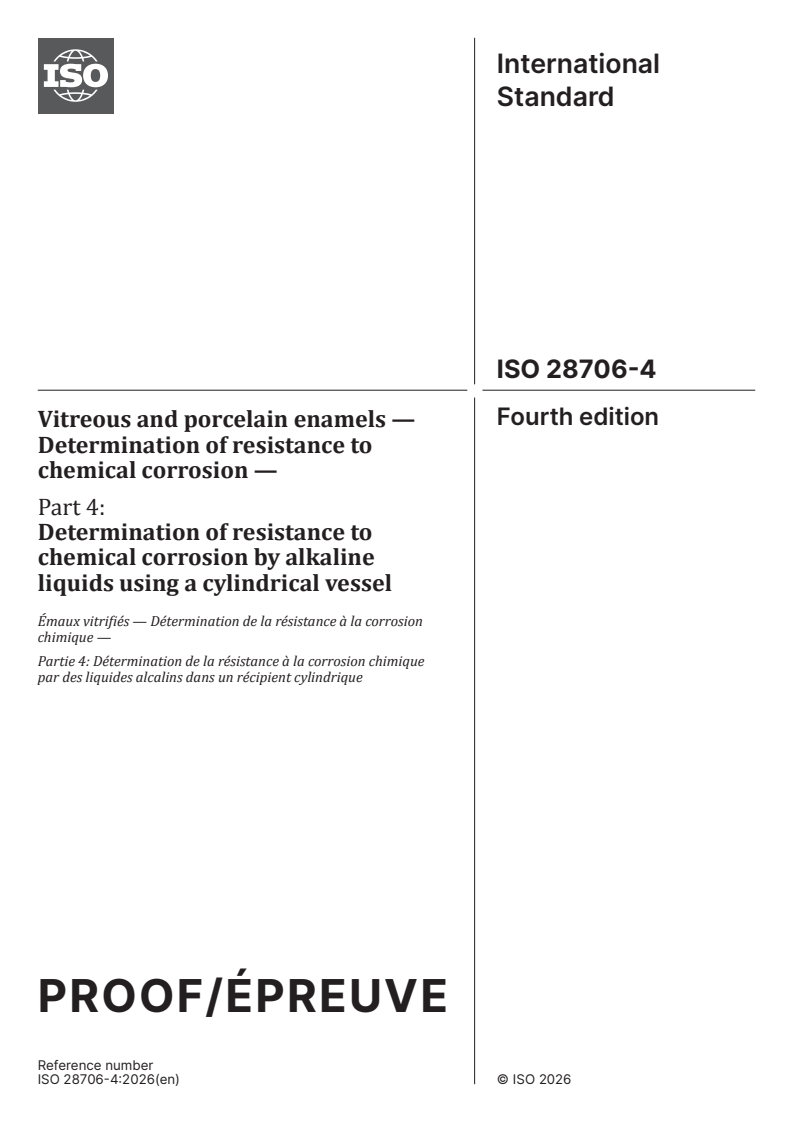
(Main)Vitreous and porcelain enamels — Determination of resistance to chemical corrosion — Part 4: Determination of resistance to chemical corrosion by alkaline liquids using a cylindrical vessel
- Abstract
ISO 28706-4:2016 describes a test method for the determination of the resistance of vitreous and porcelain enamelled articles to attack by alkaline liquids at temperatures between 25 °C and 95 °C. The apparatus used is a cylindrical vessel in which only one enamelled specimen is tested. NOTE 1 The test method was initially set up for determination of the resistance of vitreous and porcelain enamels to a hot sodium hydroxide solution. Within the scope of this part of ISO 28706, the resistance of other alkaline liquids can be tested. NOTE 2 This part of ISO 28706, which uses a cylindrical vessel, is generally used for tests carried out on vitreous and porcelain enamel coatings for the chemical industry.
- Status
- Not Published
- Technical Committee
- ISO/TC 107 - Metallic and other inorganic coatings
- Drafting Committee
- ISO/TC 107/WG 2 - Vitreous and porcelain enamel coatings
- Current Stage
- 6000 - International Standard under publication
- Start Date
- 20-Nov-2026
- Completion Date
- 21-Nov-2026
Buy Documents
ISO/PRF 28706-4 - Vitreous and porcelain enamels — Determination of resistance to chemical corrosion — Part 4: Determination of resistance to chemical corrosion by alkaline liquids using a cylindrical vessel
REDLINE ISO/PRF 28706-4 - Vitreous and porcelain enamels — Determination of resistance to chemical corrosion — Part 4: Determination of resistance to chemical corrosion by alkaline liquids using a cylindrical vessel
ISO/PRF 28706-4 - Émaux vitrifiés — Détermination de la résistance à la corrosion chimique — Partie 4: Détermination de la résistance à la corrosion chimique par des liquides alcalins dans un récipient cylindrique
ISO 28706-4 is an ISO standard for testing the resistance of vitreous and porcelain enamels to alkaline liquids using a cylindrical vessel. It specifies a laboratory method for exposing one enamelled specimen at a time at temperatures from 25 °C to 95 °C, then measuring mass loss and, for the sodium hydroxide test, calculating a corrosion rate. It is used mainly for vitreous and porcelain enamel coatings intended for chemical-industry service.
What does ISO 28706-4 specify?
ISO 28706-4 specifies a test method for vitreous and porcelain enamelled articles exposed to alkaline liquids in a cylindrical vessel. The document is focused on one specimen per test position and on results based on loss in mass per unit area, with corrosion rate calculated for the hot sodium hydroxide test.
The standard is organized into these main clauses:
- Clause 1 - Scope
- Clause 2 - Normative references
- Clause 3 - Terms and definitions
- Clause 4 - Principle
- Clause 5 - Reagents
- Clause 6 - Apparatus and material
- Clause 7 - Test specimens
- Clause 8 - Procedure for test with an apparatus with a volume-surface ratio 20:1 cm
- Clause 9 - Expression of results
- Clause 10 - Hot 0.1 mol/l sodium hydroxide test
- Clause 11 - Other test solutions
The scope states that the method applies to alkaline liquids at temperatures between 25 °C and 95 °C, and that the apparatus uses a cylindrical vessel with a 20:1 cm volume-surface ratio. It is generally used for testing vitreous and porcelain enamel coatings for the chemical industry, where alkaline service conditions matter in practice.
What are the key requirements of ISO 28706-4?
ISO 28706-4 requires a controlled exposure test: an enamelled specimen is placed in a cylindrical vessel, the alkaline liquid is not stirred, and the mass change of the specimen is used to assess chemical attack. For the sodium hydroxide test, the standard also turns that mass loss into a corrosion rate.
Test principle and measurement
Clause 4 states that the specimen is exposed under specified temperature and time conditions, then weighed before and after the test. In practice, this means the laboratory must control the exposure conditions closely enough that mass loss can be compared between specimens and between laboratories.
Reagents and water quality
Clause 5 requires analytical-grade reagents unless otherwise specified, uses water in accordance with ISO 3696 grade 3, and names acetic acid solution, degreasing solvent and sodium hydroxide as the required chemicals. This matters because contamination or poor water quality can change the attack on the enamel and distort the result.
Apparatus and materials
Clause 6 defines a cylindrical vessel system with a 20:1 cm volume-surface ratio. The cylinder, flange plate and wing nuts are stainless steel, and the protective envelope and stopper are synthetic rubber of 70 IRHD hardness resistant to alkaline solutions at 100 °C; a thermostatically controlled water bath must hold temperature to 0.1 °C.
In practice, the vessel geometry and material choices are part of the test conditions, not just equipment details. They help keep the exposure area, temperature and chemical environment consistent from test to test.
Test specimens
Clause 7 requires specimens to be prepared in accordance with ISO 28764, rinsed, cleaned if needed, dried at 110 °C ± 5 °C, conditioned in a desiccator and weighed to the specified balance precision before exposure. This means the initial mass has to be stable and repeatable before the corrosion test begins.
Test procedure for the 20:1 apparatus
Clause 8 requires at least two specimens and one determination per specimen. The specimen is mounted so the enamel faces the opening in the protective envelope, the apparatus is sealed watertight, 1 000 ml of test solution is heated to the test temperature and poured in, and the vessel is then kept in the water bath for the specified time.
After exposure, the solution is removed, the apparatus is rinsed, and the specimen is cleaned with cold acetic acid solution, rinsed, dried again and reweighed. Clause 8 also requires measuring the exposed diameter in three places and using the mean to calculate the exposed area. In practice, that area controls the reported mass-loss result.
Expression of results
Clause 9 requires the total loss in mass per unit area to be reported from the starting and final masses and the exposed area. For the sodium hydroxide test, the standard also requires the rate of loss in mass per unit area and the corrosion rate in mm/year; the formula assumes a homogeneous enamel density of 2.5 g/cm3.
Results from specimens with defects such as pinholes to metal, chipped edges or edge corrosion are discarded and replaced. This protects the report from edge effects that are not representative of the enamel surface itself.
Specific test conditions for sodium hydroxide and other liquids
Clause 10 sets the hot sodium hydroxide test at 0.1 mol/l NaOH, 80 °C ± 1 °C, for 24 h, and requires the report to include mass loss, rate of loss and corrosion rate. Clause 11 covers other agreed test solutions, with test temperature and duration agreed in advance and recorded in the report.
That structure lets users run the standard NaOH test or adapt the method to other alkaline liquids while still keeping the reporting format controlled.
What terms does ISO 28706-4 use?
- Alkaline liquid - the attacking medium used in the test; its chemical action on the enamel is what the method measures.
- Protective envelope - the rubber or ePTFE part that supports and isolates the specimen in the vessel, helping protect the edges and define the exposed area.
- Volume-surface ratio 20:1 cm - the vessel condition used in this part of ISO 28706-4; it fixes the relationship between test liquid volume and exposed specimen area.
- Loss in mass per unit area, Δρ - the mass loss normalized to exposed area, reported in g/m2 so results from different specimens can be compared.
- Rate of loss in mass per unit area, v - the mass-loss rate per exposed area and time, used when the attack is treated as linear.
- Corrosion rate, w - the converted result in mm/year for the hot sodium hydroxide test, giving a thickness-loss view that is easier to compare with service life expectations.
- NaOH - sodium hydroxide, the standard alkaline test liquid used in Clause 10.
Who uses ISO 28706-4?
ISO 28706-4 is used by laboratories that test corrosion resistance of vitreous and porcelain enamels, especially where alkaline service is expected. It is also used by manufacturers of enamelled articles, quality control teams, and buyers or specifiers who need a defined corrosion test for coating acceptance or comparison.
The document is particularly relevant for coatings for the chemical industry, because its apparatus and temperature range are set up for alkaline liquid attack in a controlled vessel. It is also useful for test houses preparing reports for product qualification, development work or procurement checks.
What changed in ISO 28706-4 from the previous edition?
ISO 28706-4 replaces the third edition and is described in the foreword as technically revised. The stated changes are:
- terms and definitions were included
- references to the 20:1 volume-surface ratio of the apparatus were added
- the hot 1.0 mol/l sodium hydroxide test was removed
- additional information was added on the material and type of protective envelope that can be used
Which standards are used with ISO 28706-4?
ISO 28706-4 names these standards as references or companion documents:
- ISO 48 - gives the hardness method used to verify the synthetic rubber parts of the protective envelope and stopper.
- ISO 1042 - specifies the class A one-mark volumetric flask used to prepare the NaOH test solution.
- ISO 3696 - specifies the water quality required for reagent preparation and specimen cleaning.
- ISO 28764 - gives the specimen preparation method for enamelled sheet steel, sheet aluminium and cast iron.
- ISO 868 - is cited for Shore hardness when a rubber ring is used as a protective option in the apparatus note.
- EN 10088-1 - is cited for stainless steel material selection for the cylinder, flange plate and wing nuts.
- ISO 28706-2 - covers related corrosion testing with boiling acids, boiling neutral liquids, alkaline liquids and their vapours.
- ISO 28706-3 - covers related alkaline-liquid testing using a hexagonal vessel or a tetragonal glass bottle.
- ISO 28706-5 - covers related corrosion testing in closed systems under autoclave conditions.
What does the ISO 28706-4 document contain?
ISO 28706-4 contains the test principle, reagent list, apparatus description, specimen preparation steps, the exposure procedure, calculation methods and reporting requirements. It also includes figures of the test apparatus, the cylinder, the protective envelope, the flange plate and the stopper.
Clause 9 contains the formulas for total mass loss per unit area, rate of loss in mass per unit area, and corrosion rate. Clauses 10 and 11 set out two test routes: the fixed hot 0.1 mol/l sodium hydroxide test, and tests with other agreed alkaline liquids.
The document is practical for testing and reporting, because it tells the user how to build the setup, how to prepare and weigh specimens, how to run the exposure, and what to put in the test report.
Relations
- Effective Date
- 12-Feb-2026
- Effective Date
- 15-Jun-2024
Buy Documents
ISO/PRF 28706-4 - Vitreous and porcelain enamels — Determination of resistance to chemical corrosion — Part 4: Determination of resistance to chemical corrosion by alkaline liquids using a cylindrical vessel
REDLINE ISO/PRF 28706-4 - Vitreous and porcelain enamels — Determination of resistance to chemical corrosion — Part 4: Determination of resistance to chemical corrosion by alkaline liquids using a cylindrical vessel
ISO/PRF 28706-4 - Émaux vitrifiés — Détermination de la résistance à la corrosion chimique — Partie 4: Détermination de la résistance à la corrosion chimique par des liquides alcalins dans un récipient cylindrique
Get Certified
Connect with accredited certification bodies for this standard

DVS-ZERT GmbH
German welding certification society.

CARES (UK Certification Authority for Reinforcing Steels)
UK certification for reinforcing steels and construction.

EWF/IIW (European/International Welding Federation)
International welding personnel certification.
Sponsored listings
Frequently Asked Questions
ISO 28706-4 is a draft published by the International Organization for Standardization (ISO). Its full title is "Vitreous and porcelain enamels — Determination of resistance to chemical corrosion — Part 4: Determination of resistance to chemical corrosion by alkaline liquids using a cylindrical vessel". This standard covers: ISO 28706-4:2016 describes a test method for the determination of the resistance of vitreous and porcelain enamelled articles to attack by alkaline liquids at temperatures between 25 °C and 95 °C. The apparatus used is a cylindrical vessel in which only one enamelled specimen is tested. NOTE 1 The test method was initially set up for determination of the resistance of vitreous and porcelain enamels to a hot sodium hydroxide solution. Within the scope of this part of ISO 28706, the resistance of other alkaline liquids can be tested. NOTE 2 This part of ISO 28706, which uses a cylindrical vessel, is generally used for tests carried out on vitreous and porcelain enamel coatings for the chemical industry.
ISO 28706-4:2016 describes a test method for the determination of the resistance of vitreous and porcelain enamelled articles to attack by alkaline liquids at temperatures between 25 °C and 95 °C. The apparatus used is a cylindrical vessel in which only one enamelled specimen is tested. NOTE 1 The test method was initially set up for determination of the resistance of vitreous and porcelain enamels to a hot sodium hydroxide solution. Within the scope of this part of ISO 28706, the resistance of other alkaline liquids can be tested. NOTE 2 This part of ISO 28706, which uses a cylindrical vessel, is generally used for tests carried out on vitreous and porcelain enamel coatings for the chemical industry.
ISO 28706-4 is classified under the following ICS (International Classification for Standards) categories: 25.220.50 - Enamels. The ICS classification helps identify the subject area and facilitates finding related standards.
ISO 28706-4 has the following relationships with other standards: It is inter standard links to prEN ISO 28706-4, ISO 28706-4:2016. Understanding these relationships helps ensure you are using the most current and applicable version of the standard.
ISO 28706-4 is available in PDF format for immediate download after purchase. The document can be added to your cart and obtained through the secure checkout process. Digital delivery ensures instant access to the complete standard document.
Standards Content (Sample)
International
Standard
Fourth edition
Vitreous and porcelain enamels —
Determination of resistance to
chemical corrosion —
Part 4:
Determination of resistance to
chemical corrosion by alkaline
liquids using a cylindrical vessel
Émaux vitrifiés — Détermination de la résistance à la corrosion
chimique —
Partie 4: Détermination de la résistance à la corrosion chimique
par des liquides alcalins dans un récipient cylindrique
PROOF/ÉPREUVE
Reference number
© ISO 2026
All rights reserved.
This ISO publication is protected by copyright and is owned by ISO and/or its licensors.
The content of this ISO publication is provided under licence, not sold. Use is subject to the applicable licence terms issued by ISO,
an ISO member body, or an authorized third-party distributor.
Except as required for implementation or expressly permitted by a separate licence, no part of this ISO publication may be
reproduced, distributed, modified, used, or made available in any form or by any means – electronic or mechanical, including
photocopying, scanning, recording, or posting on internal or external digital platforms.
Any use beyond the scope of the granted rights is prohibited and may result in legal action.
ISO copyright office
CP 401 • CH-1214 Vernier, Geneva
Phone: +41 22 749 01 11
Email: copyright@iso.org
Website: www.iso.org
Published in Switzerland
PROOF/ÉPREUVE
ii
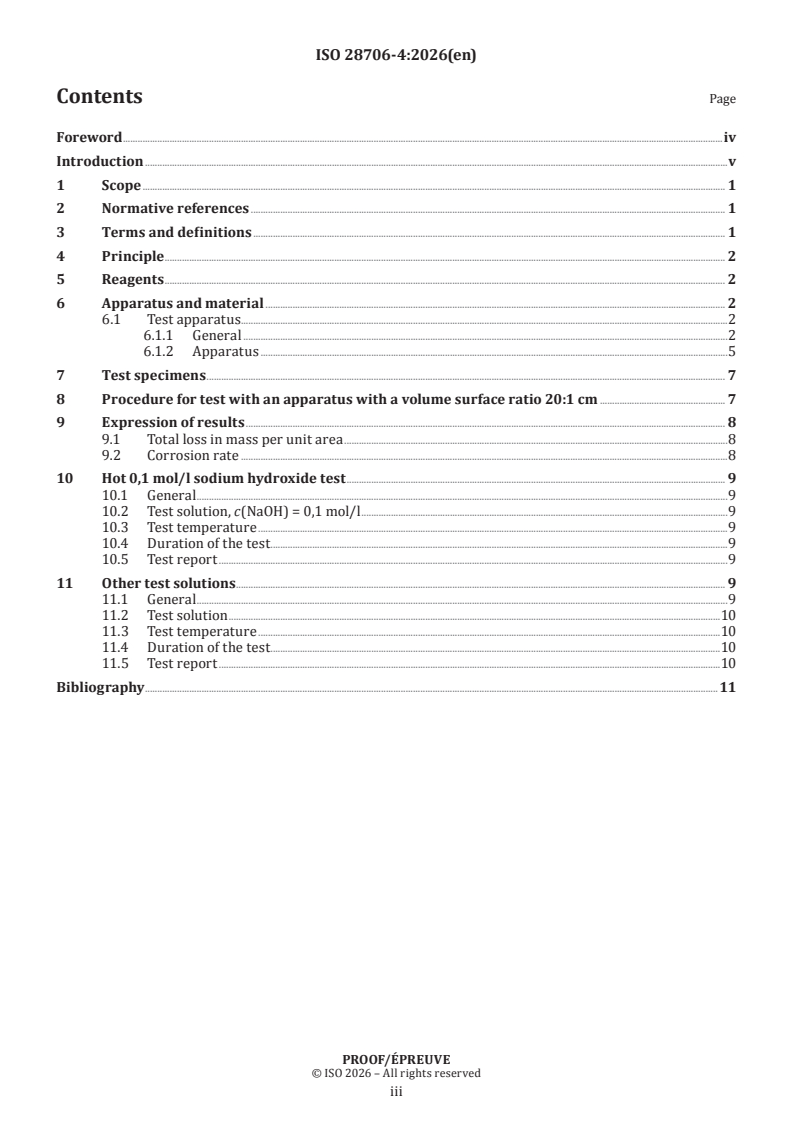
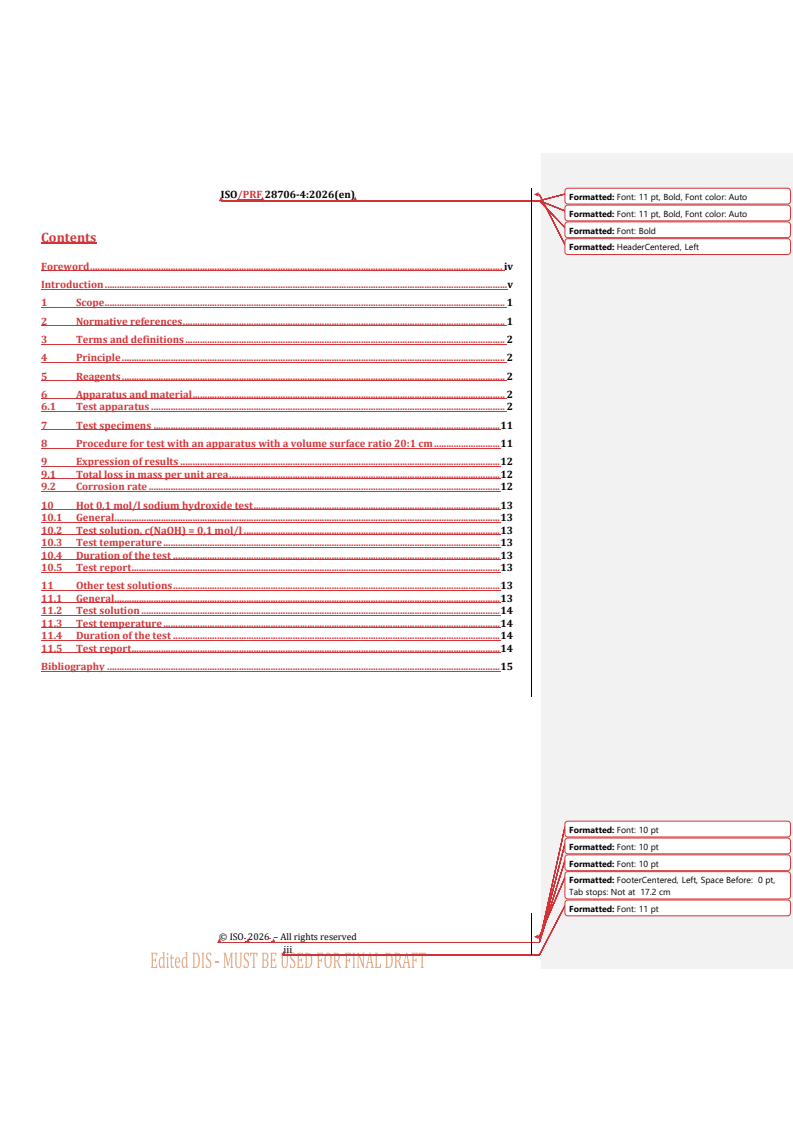
Contents Page
Foreword .iv
Introduction .v
1 Scope . 1
2 Normative references . 1
3 Terms and definitions . 1
4 Principle . 2
5 Reagents . 2
6 Apparatus and material . 2
6.1 Test apparatus.2
6.1.1 General .2
6.1.2 Apparatus .5
7 Test specimens . 7
8 Procedure for test with an apparatus with a volume surface ratio 20:1 cm . 7
9 Expression of results . 8
9.1 Total loss in mass per unit area .8
9.2 Corrosion rate .8
10 Hot 0,1 mol/l sodium hydroxide test . 9
10.1 General .9
10.2 Test solution, c(NaOH) = 0,1 mol/l .9
10.3 Test temperature .9
10.4 Duration of the test .9
10.5 Test report .9
11 Other test solutions . . 9
11.1 General .9
11.2 Test solution .10
11.3 Test temperature .10
11.4 Duration of the test .10
11.5 Test report .10
Bibliography .11
PROOF/ÉPREUVE
iii
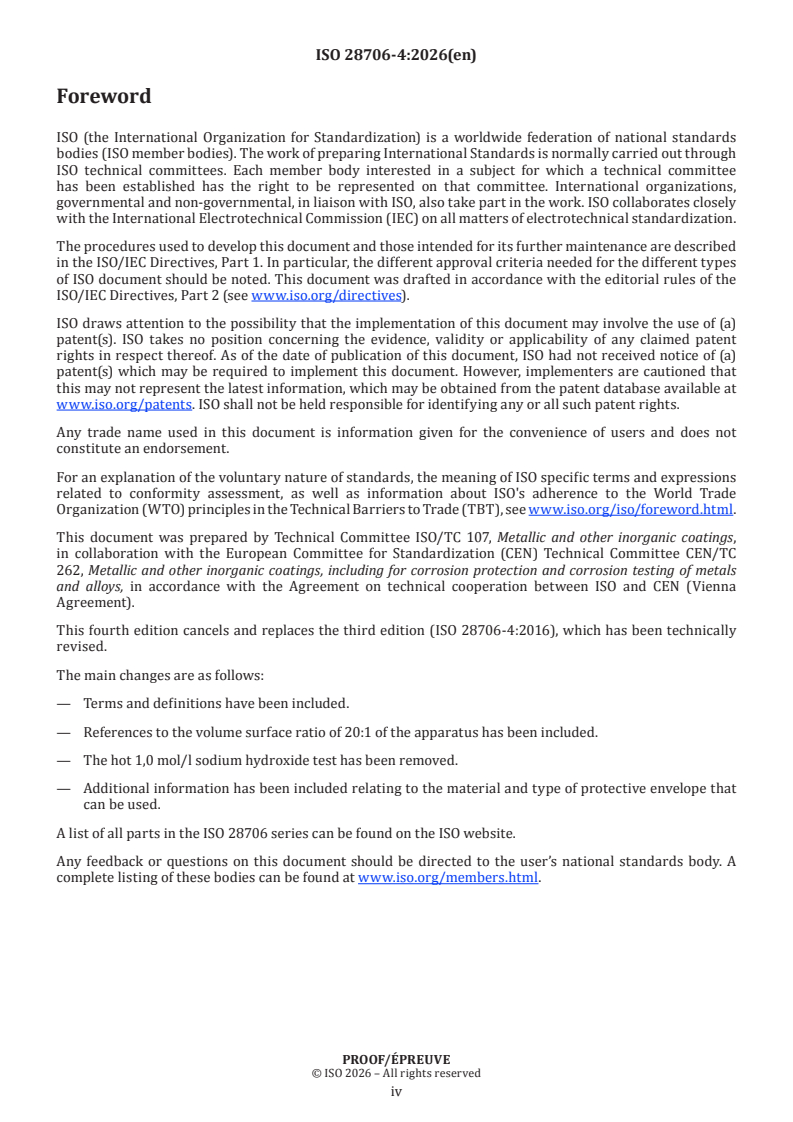
Foreword
ISO (the International Organization for Standardization) is a worldwide federation of national standards
bodies (ISO member bodies). The work of preparing International Standards is normally carried out through
ISO technical committees. Each member body interested in a subject for which a technical committee
has been established has the right to be represented on that committee. International organizations,
governmental and non-governmental, in liaison with ISO, also take part in the work. ISO collaborates closely
with the International Electrotechnical Commission (IEC) on all matters of electrotechnical standardization.
The procedures used to develop this document and those intended for its further maintenance are described
in the ISO/IEC Directives, Part 1. In particular, the different approval criteria needed for the different types
of ISO document should be noted. This document was drafted in accordance with the editorial rules of the
ISO/IEC Directives, Part 2 (see www.iso.org/directives).
ISO draws attention to the possibility that the implementation of this document may involve the use of (a)
patent(s). ISO takes no position concerning the evidence, validity or applicability of any claimed patent
rights in respect thereof. As of the date of publication of this document, ISO had not received notice of (a)
patent(s) which may be required to implement this document. However, implementers are cautioned that
this may not represent the latest information, which may be obtained from the patent database available at
www.iso.org/patents. ISO shall not be held responsible for identifying any or all such patent rights.
Any trade name used in this document is information given for the convenience of users and does not
constitute an endorsement.
For an explanation of the voluntary nature of standards, the meaning of ISO specific terms and expressions
related to conformity assessment, as well as information about ISO's adherence to the World Trade
Organization (WTO) principles in the Technical Barriers to Trade (TBT), see www.iso.org/iso/foreword.html.
This document was prepared by Technical Committee ISO/TC 107, Metallic and other inorganic coatings,
in collaboration with the European Committee for Standardization (CEN) Technical Committee CEN/TC
262, Metallic and other inorganic coatings, including for corrosion protection and corrosion testing of metals
and alloys, in accordance with the Agreement on technical cooperation between ISO and CEN (Vienna
Agreement).
This fourth edition cancels and replaces the third edition (ISO 28706-4:2016), which has been technically
revised.
The main changes are as follows:
— Terms and definitions have been included.
— References to the volume surface ratio of 20:1 of the apparatus has been included.
— The hot 1,0 mol/l sodium hydroxide test has been removed.
— Additional information has been included relating to the material and type of protective envelope that
can be used.
A list of all parts in the ISO 28706 series can be found on the ISO website.
Any feedback or questions on this document should be directed to the user’s national standards body. A
complete listing of these bodies can be found at www.iso.org/members.html.
PROOF/ÉPREUVE
iv
Introduction
Corrosion of vitreous and porcelain enamels by aqueous solutions is a dissolution process. The main
component of the enamel, silica (SiO ), forms a three-dimensional silica network. After hydrolysis, it
decomposes and forms silicic acid or silicates. These are released into the attacking medium. Other
components, mainly metal oxides, are hydrolysed as well and form the corresponding hydrated metal ions
or hydroxides. All corrosion products are soluble in the attacking medium. The whole process results in a
loss in mass per unit area.
For some aqueous solutions, the attack on the enamel proceeds linearly during the corrosion time. For other
aqueous solutions, the attack on the enamel proceeds concerning a root-t law during the corrosion time.
Only for the first series of solutions can a scientifically exact rate of loss in mass per unit area (g/m ⋅h) be
calculated as well as a corrosion rate (mm/year).
The most important parameters influencing aqueous corrosion of the enamel are the enamel quality, the
temperature and the pH-value. Inhibition effects resulting from the limited solubility of silica can also
contribute. The following list describes different types of enamel attack for different corrosion conditions:
a) In aqueous alkali solutions like 0,1 mol/l NaOH (see Clause 9 of this document), the silica network of the
enamel is considerably attacked at 80 °C. Silicates and most of the other hydrolysed components are
soluble in the alkali. Depending on the test conditions the attack proceeds linearly or follows a root-t-
law. Therefore, test results are expressed in terms of a rate of loss in mass per unit area (mass loss per
unit area and time) and a corrosion rate (millimetres per year).
b) At room temperature, in weak aqueous acids like citric acid (see ISO 28706-1:2008, Clause 9) and in
stronger acids like sulfuric acid (see ISO 28706-1:2008, Clause 10), there is only minor attack on the
silica network of the enamel. Other constituents are leached to some extent from the surface. Highly
resistant enamels show no visual change after exposure. On less resistant enamels, some staining or
surface roughening occurs.
c) In boiling aqueous acids (see ISO 28706-2), the silica network of the enamel is being attacked and silica
as well as the other enamel components are released into solution. However, the solubility of silica in
acids is low. Soon, the attacking solutions become saturated with dissolved silica and then only leach the
surface. The acid attack is inhibited, and the rate of corrosion drops markedly.
NOTE The glass test equipment also releases silica by acid attack and contributes to the inhibition of the
corrosion.
The inhibition is only partly prevented in vapour phase. The condensate formed on the test specimen
is nearly free of any dissolved enamel constituents. However, the corrosion rate follows a root-t-law.
Examples of enamel corrosion proceeding in a logarithmic manner [see 1)] and linearly [see 2)] are:
1) Boiling citric acid (see of ISO 28706-2:—, Clause 10) and boiling 30 % sulfuric acid (see
ISO 28706-2:—, Clause 11)
Since only minor amounts of these acids are found in their vapours, the test is restricted to the
liquid phase. The attack is influenced by inhibition effects and corrosion depends on the time of
exposure. Therefore, test results are expressed in terms of loss in mass per unit area; no rate of loss
in mass per unit area is calculated.
2) Boiling 20 % hydrochloric acid (see ISO 28706-2:—, Clause 12)
Since this is an azeotropic boiling acid, its concentration in the liquid and the vapour phase are
identical and liquid phase testing is not required. The corrosion mechanism is non-linear but follows
a root-t law. To obtain results which can be compared, a fixed test time is necessary. Therefore, test
results are only expressed in terms of rate of loss in mass per unit area (mass loss per unit area and
time) and the corrosion rate (millimetres per year).
d) At high temperatures, with tests in the liquid phase under autoclave conditions (see ISO 28706-5),
aqueous acid attack is severe. To avoid inhibition, the test time is restricted to 24 h and the ratio of
attacking acid to attacked enamel surface is chosen so that it is comparatively high (similar to that in a
PROOF/ÉPREUVE
v
chemical reaction vessel). In addition, only low-silica water is used for the preparation of test solutions.
Under these conditions, attack will proceed linearly with time of exposure. Therefore, test results with
20 % hydrochloric acid (see ISO 28706-5:2010, Clause 8), artificial test solutions (see ISO 28706-5:2010,
Clause 10) or process fluids (see ISO 28706-5:2010, Clause 11) are also expressed in terms of a rate of
loss in mass per unit area (loss in mass per unit area and time).
e) In boiling water (see ISO 28706-2:—, Clause 13), the silica network is fairly stable. The enamel surface
is leached and silica is dissolved only to a small extent. This type of attack is clearly represented by the
vapour phase attack. In the liquid phase, some inhibition can be observed with highly resistant enamels.
However, if the enamel being tested is weak, leached alkali from the enamel can raise pH-values to
alkaline levels, thus increasing the attack by the liquid phase. Both liquid and vapour phase testing can
give valuable information.
f) Since it is possible that the attack is not linear, the results are expressed only in terms of loss in mass per
unit area, and the test time should be indicated.
g) For standard detergent solution (see ISO 28706-3:2008, Clause 9), it will not be certain whether the
linear part of the corrosion curve will be reached during testing for 24 h or 168 h. Calculation of the
corrosion rate is therefore not included in the test report.
h) For other acids (see ISO 28706-2:2008, Clause 14) and other alkaline solutions (see ISO 28706-3:2008,
Clause 10 and Clause 11 of this document), it will also not be known if a linear corrosion rate will be
reached during the test period. Calculation of the corrosion rate is therefore not included in the test
reports of those parts of this document.
For vitreous enamels fired at temperatures below 700 °C, the test parameters (media, temperatures and
times) of this docu
...
Style Definition
...
Style Definition
...
Style Definition
...
Style Definition
...
Style Definition
...
ISO/PRF 28706-4:2026(en)
Style Definition
...
ISO/TC 107
Style Definition
...
Style Definition
...
Secretariat: KATS
Style Definition
...
Date: 13 August 2026-10-22
Style Definition
...
Style Definition
...
Style Definition
...
Style Definition
...
Style Definition
...
Style Definition
...
Vitreous and porcelain enamels — Determination of resistance to
Style Definition
...
chemical corrosion —
Style Definition
...
Style Definition
...
Style Definition
...
Style Definition
...
Style Definition
...
Part 4: Style Definition
...
Determination of resistance to chemical corrosion by alkaline Style Definition
...
Style Definition
liquids using a cylindrical vessel
...
Style Definition
...
Émaux vitrifiés — Détermination de la résistance à la corrosion chimique —
Style Definition
...
Partie 4: Détermination de la résistance à la corrosion chimique par des liquides alcalins dans un récipient Style Definition
...
cylindrique
Style Definition
...
Style Definition
...
Style Definition
...
Style Definition
...
Style Definition
...
Style Definition
...
Style Definition
...
Style Definition
...
Style Definition
...
Style Definition
...
Style Definition
...
Style Definition
...
Style Definition
...
Style Definition
...
Style Definition
...
Style Definition
...
Style Definition
...
Style Definition
...
Style Definition
...
Style Definition
...
Style Definition
...
Style Definition
...
Style Definition
...
Style Definition
...
Style Definition
...
Style Definition
...
Style Definition
...
Style Definition
...
Style Definition
...
Style Definition
...
Style Definition
© PROOF
ISO/PRF 28706-4:2026(en)
Formatted: Font: Bold
Formatted: HeaderCentered, Left
Formatted: Default Paragraph Font
Formatted: Adjust space between Latin and Asian text,
All rights reserved. Unless otherwise specified,
Adjust space between Asian text and numbers
This ISO publication is protected by copyright and is owned by ISO and/or its licensors.
The content of this ISO publication is provided under licence, not sold. Use is subject to the applicable licence terms issued
Formatted: Right: 1.5 cm, Gutter: 0 cm, Header
by ISO, an ISO member body, or an authorized third-party distributor.
distance from edge: 1.27 cm, Footer distance from
Except as required in the context of its for implementation or expressly permitted by a separate licence, no part of this
edge: 0.5 cm
ISO publication may be reproduced or utilized otherwise, distributed, modified, used, or made available in any form or
by any means, – electronic or mechanical, including photocopying, scanning, recording, or posting on internal or external
digital platforms.
Any use beyond the internet or an intranet, without prior written permission. Permission can be requested from either
Formatted: Adjust space between Latin and Asian text,
ISO at the address below or ISO’s member body in the countryscope of the requestergranted rights is prohibited and may
Adjust space between Asian text and numbers
result in legal action.
ISO copyright office
CP 401 • Ch. de Blandonnet 8
CH-1214 Vernier, Geneva
Formatted: zzCopyright address, Adjust space between
Phone: + 41 22 749 01 11
Latin and Asian text, Adjust space between Asian text
Email: copyright@iso.org
and numbers
Website: www.iso.orgwww.iso.org
Published in Switzerland
Formatted: Font: 10 pt, Not Bold
Formatted: Font: 10 pt, Not Bold
ii
ISO/PRF 28706-4:2026(en)
Formatted: Font: 11 pt, Bold, Font color: Auto
Formatted: Font: 11 pt, Bold, Font color: Auto
Formatted: Font: Bold
Contents
Formatted: HeaderCentered, Left
Foreword . iv
Introduction . v
1 Scope . 1
2 Normative references . 1
3 Terms and definitions . 2
4 Principle . 2
5 Reagents . 2
6 Apparatus and material . 2
6.1 Test apparatus . 2
7 Test specimens . 11
8 Procedure for test with an apparatus with a volume surface ratio 20:1 cm . 11
9 Expression of results . 12
9.1 Total loss in mass per unit area . 12
9.2 Corrosion rate . 12
10 Hot 0,1 mol/l sodium hydroxide test . 13
10.1 General . 13
10.2 Test solution, c(NaOH) = 0,1 mol/l . 13
10.3 Test temperature . 13
10.4 Duration of the test . 13
10.5 Test report . 13
11 Other test solutions . 13
11.1 General . 13
11.2 Test solution . 14
11.3 Test temperature . 14
11.4 Duration of the test . 14
11.5 Test report . 14
Bibliography . 15
Formatted: Font: 10 pt
Formatted: Font: 10 pt
Formatted: Font: 10 pt
Formatted: FooterCentered, Left, Space Before: 0 pt,
Tab stops: Not at 17.2 cm
Formatted: Font: 11 pt
© ISO 2026 – All rights reserved
iii
ISO/PRF 28706-4:2026(en)
Formatted: Font: Bold
Formatted: HeaderCentered, Left
Foreword Formatted: Adjust space between Latin and Asian text,
Adjust space between Asian text and numbers
ISO (the International Organization for Standardization) is a worldwide federation of national standards
bodies (ISO member bodies). The work of preparing International Standards is normally carried out through
ISO technical committees. Each member body interested in a subject for which a technical committee has been
established has the right to be represented on that committee. International organizations, governmental and
non-governmental, in liaison with ISO, also take part in the work. ISO collaborates closely with the
International Electrotechnical Commission (IEC) on all matters of electrotechnical standardization.
The procedures used to develop this document and those intended for its further maintenance are described
in the ISO/IEC Directives, Part 1. In particular, the different approval criteria needed for the different types of
ISO document should be noted. This document was drafted in accordance with the editorial rules of the
ISO/IEC Directives, Part 2 (see www.iso.org/directives).
Formatted: English (United Kingdom)
Formatted: Default Paragraph Font, English (United
ISO draws attention to the possibility that the implementation of this document may involve the use of (a)
Kingdom)
patent(s). ISO takes no position concerning the evidence, validity or applicability of any claimed patent rights
in respect thereof. As of the date of publication of this document, ISO had not received notice of (a) patent(s)
which may be required to implement this document. However, implementers are cautioned that this may not
represent the latest information, which may be obtained from the patent database available at
www.iso.org/patents.www.iso.org/patents. ISO shall not be held responsible for identifying any or all such
patent rights.
Any trade name used in this document is information given for the convenience of users and does not
constitute an endorsement.
For an explanation of the voluntary nature of standards, the meaning of ISO specific terms and expressions
related to conformity assessment, as well as information about ISO's adherence to the World Trade
Organization (WTO) principles in the Technical Barriers to Trade (TBT), see
Formatted: English (United Kingdom)
www.iso.org/iso/foreword.htmlwww.iso.org/iso/foreword.html.
Formatted: Font: Not Italic
This document was prepared by Technical Committee ISO/TC 107, Metallic and other inorganic coatings, in
Formatted: Font: Not Italic
collaboration with the European Committee for Standardization (CEN) Technical Committee CEN/TC 262,
Formatted: Default Paragraph Font
Metallic and other inorganic coatings, including for corrosion protection and corrosion testing of metals and
alloys, in accordance with the Agreement on technical cooperation between ISO and CEN (Vienna Agreement).
Formatted: Default Paragraph Font
Formatted: Default Paragraph Font
This thirdfourth edition cancels and replaces the third edition (ISO 28706--4:2016), which has been
technically revised. Formatted: Default Paragraph Font
Formatted: Adjust space between Latin and Asian text,
The main changes are as follows:
Adjust space between Asian text and numbers
Formatted: Adjust space between Latin and Asian text,
— — Terms and Definitionsdefinitions have been included.
Adjust space between Asian text and numbers, Tab
stops: Not at 0.7 cm + 1.4 cm + 2.1 cm + 2.8 cm +
— — References to the volume surface ratio of 20:1 of the apparatus has been included.
3.5 cm + 4.2 cm + 4.9 cm + 5.6 cm + 6.3 cm + 7 cm
— — The hot 1,0 mol/l sodium hydroxide test has been removed.
Formatted: Default Paragraph Font
Formatted: Default Paragraph Font
— — Additional information has been included relating to the material and type of protective envelope that
Formatted: Default Paragraph Font
can be used.
Formatted: Adjust space between Latin and Asian text,
A list of all parts in the ISO 28706 series can be found on the ISO website.
Adjust space between Asian text and numbers
Formatted: English (United Kingdom)
Any feedback or questions on this document should be directed to the user’s national standards body. A
Formatted: English (United Kingdom)
complete listing of these bodies can be found at www.iso.org/members.htmlwww.iso.org/members.html.
Formatted: Font: 10 pt, Not Bold
Formatted: Font: 10 pt, Not Bold
iv
ISO/PRF 28706-4:2026(en)
Formatted: Font: 11 pt, Bold, Font color: Auto
Formatted: Font: 11 pt, Bold, Font color: Auto
Formatted: Font: Bold
Introduction
Formatted: HeaderCentered, Left
Formatted: Adjust space between Latin and Asian text,
Corrosion of vitreous and porcelain enamels by aqueous solutions is a dissolution process. The main
Adjust space between Asian text and numbers
component of the enamel, silica (SiO ), forms a three-dimensional silica network. After hydrolysis, it
decomposes and forms silicic acid or silicates. These are released into the attacking medium. Other
components, mainly metal oxides, are hydrolysed as well and form the corresponding hydrated metal ions or
hydroxides. All corrosion products are more or less soluble in the attacking medium. The whole process
results in a loss in mass per unit area.
Formatted: Default Paragraph Font
For some aqueous solutions, the attack on the enamel proceeds linearly during the corrosion time. For other
aqueous solutions, the attack on the enamel proceeds concerning a root-t law during the corrosion time. Only
Formatted: Default Paragraph Font
for the first series of solutions can a scientifically exact rate of loss in mass per unit area (g/m ⋅h) be calculated
Formatted: Default Paragraph Font
as well as a corrosion rate (mm/year).
Formatted: Default Paragraph Font
The most important parameters influencing aqueous corrosion of the enamel are the enamel quality, the
Formatted: Default Paragraph Font
temperature and the pH-value. Inhibition effects resulting from the limited solubility of silica can also
Formatted: Default Paragraph Font
contribute. The following list describes different types of enamel attack for different corrosion conditions:
Formatted: Default Paragraph Font
a) a) In aqueous alkali solutions like 0,1 mol/l NaOH (see Clause 9Clause 9 of this document), the
Formatted: Default Paragraph Font
silica network of the enamel is considerably attacked at 80 °C. Silicates and most of the other hydrolysed
Formatted: Default Paragraph Font
components are soluble in the alkali. Depending on the test conditions the attack proceeds linearly or
follows a root-t-law. Therefore, test results are expressed in terms of a rate of loss in mass per unit area
Formatted: Default Paragraph Font
(mass loss per unit area and time) and a corrosion rate (millimetres per year).
Formatted: Default Paragraph Font
b) b) At room temperature, in weak aqueous acids like citric acid (see ISO 28706--1:2008, Clause 9) Formatted: Default Paragraph Font
and in stronger acids like sulfuric acid (see ISO 28706--1:2008, Clause 10), there is only minor attack on
Formatted: Default Paragraph Font
the silica network of the enamel. Other constituents are leached to some extent from the surface. Highly
Formatted: Default Paragraph Font
resistant enamels show no visual change after exposure. On less resistant enamels, some staining or
surface roughening occurs. Formatted: Default Paragraph Font
Formatted: Default Paragraph Font
c) c) In boiling aqueous acids (see ISO 28706--2), the silica network of the enamel is being attacked
Formatted: Default Paragraph Font
and silica as well as the other enamel components are released into solution. However, the solubility of
silica in acids is low. Soon, the attacking solutions become saturated with dissolved silica and then only
Formatted
...
leach the surface. The acid attack is inhibited, and the rate of corrosion drops markedly.
Formatted: Default Paragraph Font
NOTE The glass test equipment also releases silica by acid attack and contributes to the inhibition of the Formatted: Default Paragraph Font
corrosion.
Formatted: Default Paragraph Font
Formatted: Default Paragraph Font
The inhibition is only partly prevented in vapour phase. The condensate formed on the test specimen is
nearly free of any dissolved enamel constituents. However, the corrosion rate follows a root-t-law.
Formatted: Body Text Indent 2
Examples of enamel corrosion proceeding in a logarithmic manner [see 1)]1)] and linearly [see 2)]2)] are:
Formatted: Default Paragraph Font
Formatted: Default Paragraph Font
1) 1) Boiling citric acid (see of ISO 28706--2:—, Clause 10) and boiling 30 % sulfuric acid (see
ISO 28706--2:—, Clause 11)
Formatted: Default Paragraph Font
Formatted: Default Paragraph Font
Since only minor amounts of these acids are found in their vapours, the test is restricted to the liquid
phase. The attack is influenced by inhibition effects and corrosion depends on the time of exposure. Formatted
...
Therefore, test results are expressed in terms of loss in mass per unit area; no rate of loss in mass per
Formatted: Body Text Indent 2
unit area is calculated.
Formatted: Font: 10 pt
2) 2) Boiling 20 % hydrochloric acid (see ISO 28706--2:—, Clause 12)
Formatted: Font: 10 pt
Formatted: Font: 10 pt
Since this is an azeotropic boiling acid, its concentration in the liquid and the vapour phase are
Formatted
identical and liquid phase testing is not required. The corrosion mechanism is non-linear but follows
...
a root-t law. In order toTo obtain results which can be compared, a fixed test time is necessary.
Formatted: Font: 11 pt
© ISO 2026 – All rights reserved
v
ISO/PRF 28706-4:2026(en)
Formatted: Font: Bold
Formatted: HeaderCentered, Left
Therefore, test results are only expressed in terms of rate of loss in mass per unit area (mass loss per
unit area and time) and the corrosion rate (millimetres per year).
d) d) At high temperatures, with tests in the liquid phase under autoclave conditions (see
Formatted: Numbered + Level: 1 + Numbering Style: a,
ISO 28706--5), aqueous acid attack is severe. To avoid inhibition, the test time is restricted to 24 h and
b, c, … + Start at: 4 + Alignment: Left + Aligned at: 0
the ratio of attacking acid to attacked enamel surface is chosen so that it is comparatively high (similar to cm + Indent at: 0 cm
that in a chemical reaction vessel). In addition, only low-silica water is used for the preparation of test
Formatted: Default Paragraph Font
solutions. Under these conditions, attack will proceed linearly with time of exposure. Therefore, test
results with 20 % hydrochloric acid (see ISO 28706--5:2010, Clause 8), artificial test solutions (see
ISO 28706--5:2010, Clause 10) or process fluids (see ISO 28706--5:2010, Clause 11) are also expressed in
terms of a rate of loss in mass per unit area (loss in mass per unit area and time).
e) e) In boiling water (see ISO 28706--2:—, Clause 13), the silica network is fairly stable. The enamel
Formatted: Default Paragraph Font
surface is leached and silica is dissolved only to a small extent. This type of attack is clearly represented
by the vapour phase attack. In the liquid phase, some inhibition can be observed with highly resistant
enamels. However, if the enamel being tested is weak, leached alkali from the enamel can raise pH-values
to alkaline levels, thus increasing the attack by the liquid phase. Both liquid and vapour phase testing can
give valuable information.
f) f) Since it is possible that the attack is not linear, the results are expressed only in terms of loss
in mass per unit area, and the test time should be indicated.
g) g) For standard detergent solution (see ISO 28706--3:2008, Clause 9), it will not be certain
Formatted: Default Paragraph Font
whether the linear part of the corrosion curve will be reached during testing for 24 h or 168 h. Calculation
of the corrosion rate is therefore not included in the test report.
h) h) For other acids (see ISO 28706--2:2008, Clause 14) and other alkaline solutions (see
Formatted: Default Paragraph Font
ISO 28706--3:2008, Clause 10 and Clause 11 of this document), it will also not be known if a linear
corrosion rate will be reached during the test period. Calculation of the corrosion rate is therefore not
included in the test reports of those parts of this document.
For vitreous enamels fired at temperatures below 700 °C, the test parameters (media, temperatures and
Formatted: Adjust space between Latin and Asian text,
times) of this document are not appropriate. For such enamels, for example aluminium enamels, other media, Adjust space between Asian text and numbers
temperatures, or times should be used. This can be done following the procedures described in ISO 28706--1,
Formatted: Default Paragraph Font
ISO 28706-2, ISO 28706--3 and this document. .
Formatted: Font: 10 pt, Not Bold
vi
International Standard ISO 28706-4:2026(en)
Formatted: Font: Not Bold
Formatted: Header, Centered, Space After: 0 pt, Line
spacing: single
Vitreous and porcelain enamels — Determination of resistance to
chemical corrosion —Part 4:
Determination of resistance to chemical corrosion by alkaline liquids
using a cylindrical vessel
Formatted: Right: 1.5 cm, Gutter: 0 cm, Header
Vitreous and porcelain enamels — Determination of resistance to distance from edge: 1.27 cm, Footer distance from
edge: 0.5 cm
chemical corrosion —
Part 4:
Determination of resistance to chemical corrosion by alkaline liquids
using a cylindrical vessel
WARNING — This document calls for the use of substances and/or procedures that can be injurious to
Formatted: Adjust space between Latin and Asian text,
health if adequate safety measures are not taken. This document does not address any health hazards,
Adjust space between Asian text and numbers
safety or environmental matters associated with its use. It is the responsibility of the user of this
document to establish appropriate health, safety and environmentally acceptable practices and take
Formatted: Body Text, Adjust space between Latin and
suitable actions for any national and international regulations. Conformance with this document does
Asian text, Adjust space between Asian text and
not of itself confer immunity from legal obligations.
numbers, Tab stops: Not at 0.7 cm + 1.4 cm + 2.1 cm
+ 2.8 cm + 3.5 cm + 4.2 cm + 4.9 cm + 5.6 cm + 6.3
1 Scope
cm + 7 cm
Formatted: Adjust space between Latin and Asian text,
This document describes a test method for the determination of the resistance of vitreous and porcelain
Adjust space between Asian text and numbers
enamelled articles to attack by alkaline liquids at temperatures between 25 °C and 95 °C. The apparatus used
is a cylindrical vessel with a volume-surface ratio 20:1 cm in which only one enamelled specimen is tested.
Formatted: Default Paragraph Font
Formatted: Default Paragraph Font
This document, which uses a cylindrical vessel, is generally used for tests carried out on vitreous and porcelain
Formatted: Default Paragraph Font
enamel coatings for the chemical industry.
Formatted: Default Paragraph Font
2 Normative references
Formatted: Adjust space between Latin and Asian text,
Adjust space between Asian text and numbers, Tab
The following documents, in whole or in part, are normatively referenced in this document and are
stops: Not at 0.7 cm + 1.4 cm + 2.1 cm + 2.8 cm +
indispensable for its application. For dated references, only the edition cited applies. For undated references,
3.5 cm + 4.2 cm + 4.9 cm + 5.6 cm + 6.3 cm + 7 cm
the latest edition of the referenced document (including any amendments) applies.
Formatted: Default Paragraph Font
ISO 48, Rubber, vulcanized or thermoplastic — Determination of hardness (hardness between 10 IRHD and
Formatted: Default Paragraph Font
100 IRHD)
Formatted: Default Paragraph Font
Formatted: Default Paragraph Font
ISO 1042, Laboratory glassware — One-mark volumetric flasks
Formatted: Default Paragraph Font
ISO 3696, Water for analytical laboratory use — Specification and test methods
Formatted: Default Paragraph Font
ISO 28764, Vitreous and porcelain enamels — Production of specimens for testing enamels on sheet steel, Formatted: Default Paragraph Font
sheet aluminium and cast iron
Formatted: Default Paragraph Font
Formatted: Default Paragraph Font
Formatted: Default Paragraph Font
ISO/PRF 28706-4:2026(en)
Formatted: Font: Bold
Formatted: HeaderCentered, Left
3 Terms and definitions
Formatted: Adjust space between Latin and Asian text,
Adjust space between Asian text and numbers
No terms and definitions are listed in this document.
ISO and IEC maintain terminology databases for use in standardization at the following addresses:
Formatted: English (United Kingdom)
Formatted: Font: Cambria, 11 pt, English (United
— — ISO Online browsing platform: available at https://www.iso.org/obphttps://www.iso.org/obp
Kingdom)
Formatted: English (United Kingdom)
— — IEC Electropedia: available at https://www.electropedia.org/https://www.electropedia.org/
Formatted: Default Paragraph Font, Font color: Auto,
4 Principle
English (United Kingdom)
Formatted: English (United Kingdom)
An enamelled specimen is exposed to attack by an alkaline liquid under specified conditions of temperature
Formatted: Default Paragraph Font, Font color: Auto,
and time. The solution is not stirred during the test.
English (United Kingdom)
The loss in mass is determined and used to calculate the rate of loss in mass per unit area and, if necessary,
Formatted: Adjust space between Latin and Asian text,
the corrosion rate.
Adjust space between Asian text and numbers
5 Reagents
During the determination, use only reagents of recognized analytical grade, unless otherwise specified.
5.1 5.1 Water, in accordance with grade 3 of ISO 3696, i.e. distilled water or water of equivalent
Formatted: Font: 11 pt, Not Bold
purity.
Formatted: Adjust space between Latin and Asian text,
Adjust space between Asian text and numbers, Tab
5.2 5.2 Acetic acid solution, 50 ml/l, for cleaning the test specimens.
stops: Not at 0.7 cm + 1.4 cm + 2.1 cm + 2.8 cm +
3.5 cm + 4.2 cm + 4.9 cm + 5.6 cm + 6.3 cm + 7 cm
5.3 5.3 Degreasing solvent, e.g. ethanol (C H OH) or water containing a few drops of liquid
2 5
Formatted: Font: Not Bold
detergent, suitable for cleaning and degreasing the test specimens.
Formatted: Font: 11 pt, Not Bold
5.4 5.4 Sodium hydroxide (NaOH).
Formatted: Font: Not Bold
6 Apparatus and material Formatted: Font: 11 pt, Not Bold
Formatted: Font: Not Bold
6.1 Test apparatus
Formatted: Font: 11 pt, Not Bold
Cylindrical vessel with a volume-surface ratio 20:1 cm.
Formatted: Font
...
Norme
internationale
Quatrième édition
Émaux vitrifiés — Détermination
2026-12
de la résistance à la corrosion
chimique —
Partie 4:
Détermination de la résistance
à la corrosion chimique par des
liquides alcalins dans un récipient
cylindrique
Vitreous and porcelain enamels — Determination of resistance to
chemical corrosion —
Part 4: Determination of resistance to chemical corrosion by
alkaline liquids using a cylindrical vessel
PROOF/ÉPREUVE
Numéro de référence
Norme
internationale
Quatrième édition
Émaux vitrifiés — Détermination
2026-12
de la résistance à la corrosion
chimique —
Partie 4:
Détermination de la résistance
à la corrosion chimique par des
liquides alcalins dans un récipient
cylindrique
Vitreous and porcelain enamels — Determination of resistance to
chemical corrosion —
Part 4: Determination of resistance to chemical corrosion by
alkaline liquids using a cylindrical vessel
DOCUMENT PROTÉGÉ PAR COPYRIGHT
© ISO 2026
Tous droits réservés. Sauf prescription différente ou nécessité dans le contexte de sa mise en œuvre, aucune partie de cette
publication ne peut être reproduite ni utilisée sous quelque forme que ce soit et par aucun procédé, électronique ou mécanique,
y compris la photocopie, ou la diffusion sur l’internet ou sur un intranet, sans autorisation écrite préalable. Une autorisation peut
être demandée à l’ISO à l’adresse ci-après ou au comité membre de l’ISO dans le pays du demandeur.
ISO copyright office
Case postale 401 • Ch. de Blandonnet 8
PROOF/ÉPREUVE
CH-1214 Vernier, Genève
Tél.: +41 22 749 01 11
E-mail: copyright@iso.org
Web: www.iso.org
Publié en Suisse Numéro de référence
PROOF/ÉPREUVE
ii
Sommaire Page
Avant-propos .iv
Introduction .v
1 Domaine d'application . 1
2 Références normatives . 1
3 Termes et définitions . 1
4 Principe. 2
5 Réactifs . 2
6 Appareillage et matériel . 2
6.1 Appareillage d'essai .2
6.1.1 Généralités .2
6.1.2 Appareillage .5
7 Éprouvettes. 7
8 Mode opératoire d’essai avec un appareil dont le rapport volume/surface est de 20:1 cm . 7
9 Expression des résultats . 8
9.1 Perte totale de masse surfacique .8
9.2 Vitesse de corrosion .8
10 Essai à l'hydroxyde de sodium chaud à 0,1 mol/l. 9
10.1 Généralités .9
10.2 Solution d'essai, c(NaOH) = 0,1 mol/l .9
10.3 Température d'essai .9
10.4 Durée de l'essai .9
10.5 Rapport d'essai .9
11 Autres solutions d'essai .10
11.1 Généralités .10
11.2 Solution d'essai .10
11.3 Température d'essai .10
11.4 Durée de l'essai .10
11.5 Rapport d'essai .10
Bibliographie .11
PROOF/ÉPREUVE
iii
Avant-propos
L'ISO (Organisation internationale de normalisation) est une fédération mondiale d'organismes nationaux
de normalisation (comités membres de l'ISO). L'élaboration des Normes internationales est en général
confiée aux comités techniques de l'ISO. Chaque comité membre intéressé par une étude a le droit de faire
partie du comité technique créé à cet effet. Les organisations internationales, gouvernementales et non
gouvernementales, en liaison avec l'ISO participent également aux travaux. L'ISO collabore étroitement avec
la Commission électrotechnique internationale (IEC) en ce qui concerne la normalisation électrotechnique.
Les procédures utilisées pour élaborer le présent document et celles destinées à sa mise à jour sont
décrites dans les Directives ISO/IEC, Partie 1. Il convient, en particulier, de prendre note des différents
critères d'approbation requis pour les différents types de documents ISO. Le présent document
a été rédigé conformément aux règles de rédaction données dans les Directives ISO/IEC, Partie 2
(voir www.iso.org/directives).
L'ISO attire l'attention sur le fait que la mise en application du présent document peut entraîner l'utilisation
d'un ou de plusieurs brevets. L'ISO ne prend pas position quant à la preuve, à la validité et à l'applicabilité de
tout droit de brevet revendiqué à cet égard. À la date de publication du présent document, l'ISO n'avait pas
reçu notification qu'un ou plusieurs brevets pouvaient être nécessaires à sa mise en application. Toutefois,
il y a lieu d'avertir les responsables de la mise en application du présent document que des informations
plus récentes sont susceptibles de figurer dans la base de données de brevets, disponible à l'adresse
www.iso.org/brevets. L'ISO ne saurait être tenue pour responsable de ne pas avoir identifié tout ou partie de
tels droits de brevet.
Les appellations commerciales éventuellement mentionnées dans le présent document sont données pour
information, par souci de commodité, à l'intention des utilisateurs et ne sauraient constituer un engagement.
Pour une explication de la nature volontaire des normes, la signification des termes et expressions
spécifiques de l'ISO liés à l'évaluation de la conformité, ou pour toute information au sujet de l'adhésion de
l'ISO aux principes de l'Organisation mondiale du commerce (OMC) concernant les obstacles techniques au
commerce (OTC), voir www.iso.org/iso/fr/avant-propos.html.
Le présent document a été élaboré par le comité technique ISO/TC 107, Revêtements métalliques et autres
revêtements inorganiques, en collaboration avec le comité technique CEN/TC 262, Revêtements métalliques
et inorganiques, incluant ceux pour la protection contre la corrosion et les essais de corrosion des métaux et
alliages, du Comité européen de normalisation (CEN), conformément à l'Accord de coopération technique
entre l'ISO et le CEN (Accord de Vienne).
Cette quatrième édition annule et remplace la troisième édition (ISO 28706-4:2016), qui a fait l'objet d'une
révision technique.
Les principales modifications sont les suivantes:
— La partie Termes et définitions a été ajoutée.
— Des références au rapport volume/surface de 20:1 cm de l'appareil ont été ajoutées.
— L’essai à l’hydroxyde de sodium chaud à 1,0 mol/l a été supprimé.
— Des informations supplémentaires ont été incluses concernant le matériau et le type d'enveloppe
protectrice qui peuvent être utilisés.
Une liste de toutes les parties de la série ISO 28706 se trouve sur le site web de l'ISO.
Il convient que l'utilisateur adresse tout retour d'information ou toute question concernant le présent
document à l'organisme national de normalisation de son pays. Une liste exhaustive desdits organismes se
trouve à l'adresse www.iso.org/fr/members.html.
PROOF/ÉPREUVE
iv
Introduction
La corrosion aqueuse des émaux vitrifiés est un processus de dissolution. Le composant principal de l'émail,
la silice (SiO ), forme un réseau tridimensionnel de silice. Après hydrolyse, celle-ci se décompose en formant
de l'acide silicique ou des silicates. Ceux-ci sont libérés dans le milieu attaquant. D'autres composants,
principalement des oxydes de métal, également soumis à l'hydrolyse, forment les ions métalliques hydratés
ou les hydroxydes correspondants. Tous les produits de corrosion sont solubles dans le milieu attaquant. Le
processus complet entraîne une perte de masse par unité de surface.
Avec certaines solutions aqueuses, l’attaque de l’émail s’opère de façon linéaire pendant le temps que dure
la corrosion; pour d’autres solutions aqueuses, l’attaque de l’émail suit une loi racine carrée de t pendant
le temps que dure la corrosion. Pour la première série de solutions seulement, un taux de perte de masse
surfacique (g/m ⋅h) scientifiquement exact peut être calculé, ainsi qu'une vitesse de corrosion (mm/an).
Les paramètres les plus importants ayant une incidence sur la corrosion aqueuse de l'émail sont la qualité de
l'émail, la température et la valeur de pH. En outre, les effets d'inhibition résultant de la solubilité limitée de
la silice peuvent y contribuer. La liste suivante décrit les différents types d'attaque de l'émail en fonction de
différentes conditions de corrosion.
a) Avec des solutions alcalines aqueuses telles que NaOH à 0,1 mol/l (voir Article 9 du présent document), le
réseau de silice de l'émail est fortement attaqué à 80 °C. Les silicates et la plupart des autres composants
hydrolysés sont solubles dans l'alcali. Selon les conditions d'essai, l'attaque s'opère de manière linéaire
ou suit une loi racine carrée de t. Par conséquent, les résultats des essais sont exprimés en termes
de taux de perte de masse surfacique (perte de masse par unité de surface et temps) et de vitesse de
corrosion (millimètres par an).
b) À température ambiante, les acides aqueux faibles tels que l’acide citrique (voir ISO 28706-1:2008,
Article 9) et les acides plus forts tels que l’acide sulfurique (voir ISO 28706-1:2008, Article 10),
n’attaquent guère le réseau de silice de l’émail. D'autres constituants sont, dans une certaine mesure,
lixiviés de la surface. Les émaux hautement résistants ne présentent aucun changement visible après
exposition. Sur les émaux moins résistants, des taches apparaissent ou la surface devient rugueuse.
c) Avec des acides aqueux bouillants (voir ISO 28706-2), le réseau de silice de l'émail est attaqué et la silice
ainsi que les autres composants de l'émail sont libérés dans la solution. La solubilité de la silice dans les
acides est néanmoins faible. Les solutions attaquantes, qui sont vite saturées de silice dissoute, ne font
que lixivier la surface. L'attaque acide est inhibée et la vitesse de corrosion diminue de façon marquée.
NOTE L’appareillage d'essai en verre libère également de la silice sous l'effet de l'attaque acide et contribue à
l'inhibition de la corrosion.
L'inhibition n'est que partiellement évitée en phase vapeur. Le condensat formé sur l'éprouvette est
quasi exempt de tout composant d'émail dissous. La vitesse de corrosion suit néanmoins une loi racine
carrée de t. Des exemples d'acides opérant une corrosion de l'émail de façon logarithmique [voir 1)] et
linéairement [voir 2)] sont:
1) Acide citrique bouillant (voir ISO 28706-2:—, Article 10) et acide sulfurique à 30 % bouillant
(voir ISO 28706-2:—, Article 11)
Étant donné que les vapeurs de ces acides sont très peu concentrées, l'essai est limité à la phase
liquide. L'attaque est influencée par des effets d'inhibition et la corrosion dépend du temps
d'exposition. Par conséquent, les résultats d'essai sont exprimés en termes de perte de masse par
unité de surface; aucun taux de perte de masse surfacique n'est calculé.
2) Acide chlorhydrique à 20 % bouillant (voir ISO 28706-2:—, Article 12)
S'agissant d'un acide bouillant azéotropique, sa concentration est identique en phase liquide et
en phase vapeur; aucun essai en phase liquide n’est donc requis. Le mécanisme de corrosion n'est
pas linéaire mais suit une loi racine carrée de t. Pour obtenir des résultats comparables, une durée
d'essai fixe est nécessaire. Par conséquent, les résultats des essais ne sont exprimés qu'en termes de
taux de perte de masse surfacique (perte de masse par unité de surface et temps) et de vitesse de
corrosion (millimètres par an).
PROOF/ÉPREUVE
v
d) À des températures élevées, lors d'essais en phase liquide en autoclave (voir ISO 28706-5), l'attaque
d'acide aqueux est forte. Pour éviter l'inhibition, la durée de l'essai est limitée à 24 h et un rapport
relativement élevé est choisi entre l'acide attaquant et la surface d'émail attaquée (analogue à celui
d'une cuve pour réaction chimique). En outre, seule de l'eau à faible teneur en silice est utilisée pour
la préparation des solutions d'essai. Dans ces conditions, l'attaque s'opère de façon linéaire pendant le
temps que dure l'exposition. Par conséquent, les résultats des essais avec de l'acide chlorhydrique à 20 %
(voir ISO 28706-5:2010, Article 8), des solutions d'essai artificielles (voir ISO 28706-5:2010, Article 10)
ou des fluides de traitement (voir ISO 28706-5:2010, Article 11) sont également exprimés en termes de
taux de perte de masse surfacique (perte de masse par unité de surface et temps).
e) Dans l'eau bouillante (voir ISO 28706-2:—, Article 13), le réseau de silice est assez stable. La surface
d'émail est lixiviée et la silice n'est que faiblement dissoute. Ce type d'attaque est clairement représenté
par l'attaque en phase vapeur. En phase liquide, une certaine inhibition peut être observée avec les
émaux hautement résistants. Toutefois, si l'émail soumis à essai est peu résistant, l'alcali lixivié dégagé
par l'émail peut relever les valeurs de pH à des niveaux alcalins, augmentant ainsi l'attaque par la phase
liquide. Les essais en phase liquide et en phase vapeur peuvent donner des informations précieuses.
f) Comme il est possible que l'attaque ne soit pas linéaire, les résultats sont seulement exprimés en termes
de perte de masse par unité de surface et il convient que la durée de l'essai soit indiquée.
g) Pour la solution détergente normalisée (voir ISO 28706-3:2008, Article 9), il n’est pas certain que la
partie linéaire de la courbe de corrosion soit atteinte pendant l’essai durant 24 h ou 168 h. Le calcul de la
vitesse de corrosion n’est donc pas inclus dans le rapport d’essai.
h) Pour d'autres acides (voir ISO 28706-2:2008, Article 14) et d'autres solutions alcalines
(voir ISO 28706-3:2008, Articles 10 et 11 du présent document), il n'est également pas certain qu'une
vitesse de corrosion linéaire soit atteinte au cours de la période d'essai. Le calcul de la vitesse de
corrosion n’est donc pas inclus dans les rapports d’essais de ces parties du présent document.
Pour les émaux vitrifiés cuits à des températures inférieures à 700 °C, les paramètres d’essai (milieux,
températures et temps) du présent document ne sont pas appropriés. Pour de tels émaux, par exemple les
émaux d'aluminium, il convient d'utiliser d'autres milieux, tem
...