

ISO/IEC TS 20125-1:2026
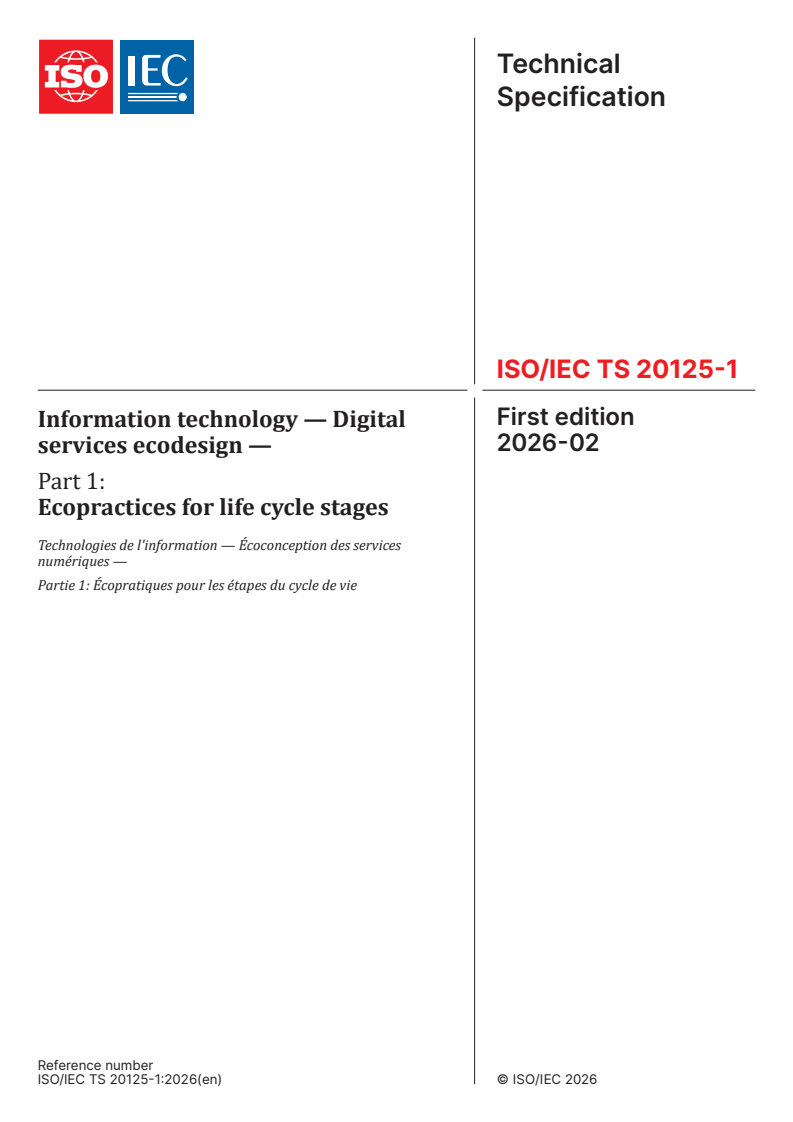
(Main)Information technology — Digital services ecodesign — Part 1: Ecopractices for life cycle stages
General Information
- Abstract
This document is applicable to environmental matters for a digital service. It establishes requirements and recommendations applicable for requirements gathering, design, implementation, operations, maintenance and the end of life of digital services in order to minimise adverse environmental impacts during all stages of its life cycle. It also establishes a common language and understanding on this subject. This document focuses on reducing the environmental impacts of a digital service. It therefore does not address all aspects of digital service design. For example, it does not address other aspects such as performance, resilience, reliability, availability or development language choice (see other standards covering these topics, e.g. ISO/IEC 25010 and ISO/IEC 27001). This document does not include matters linked to other corporate social responsibility (CSR) topics, e.g. social, cultural, diversity, inclusion or exclusion. This document is applicable to all development methodologies (waterfall, agile, etc.).
- Status
- Published
- Publication Date
- 26-Feb-2026
- Technical Committee
- ISO/IEC JTC 1/SC 39 - Sustainability, IT and data centres
- Drafting Committee
- ISO/IEC JTC 1/SC 39 - Sustainability, IT and data centres
- Current Stage
- 6060 - International Standard published
- Start Date
- 27-Feb-2026
- Due Date
- 27-Mar-2026
- Completion Date
- 27-Feb-2026
Overview
ISO/IEC TS 20125-1:2026 is a technical specification developed by ISO and IEC that addresses the environmental impacts associated with digital services throughout their entire life cycle. Titled "Information technology - Digital services ecodesign - Part 1: Ecopractices for life cycle stages," this standard establishes foundational requirements and practical recommendations for minimizing negative environmental effects at every stage-requirements gathering, design, implementation, operations, maintenance, and end of life. By focusing on ecodesign for digital services, this document aims to promote sustainable IT practices, ensure resource efficiency, and support organizations aligned with the United Nations Sustainable Development Goals (SDGs).
Key Topics
- Digital Services Ecodesign: Introduces ecopractices and processes to reduce energy consumption, resource depletion, and environmental harm from digital services.
- Life Cycle Approach: Defines six key stages: requirements gathering, design, implementation, operations (use and run), maintenance, and end-of-life. At each stage, specific ecodesign requirements and recommendations are outlined.
- Common Language: Establishes shared terminology for digital service ecodesign, enabling effective communication among stakeholders.
- Indicators and Impact Assessment: Encourages the use of measurable indicators for environmental impact, such as energy consumption and resource utilization.
- Transparent Reporting: Emphasizes the need for clear disclosure and assessment methods for communicating environmental performance and ecodesign achievements.
- Trade-Off Evaluation: Provides guidelines for balancing environmental objectives with competing system requirements, documenting trade-offs, and supporting continuous improvement.
Applications
ISO/IEC TS 20125-1:2026 is relevant for organizations of all sizes engaged in the creation, management, and delivery of digital services, whether through custom development or integration of third-party solutions. Practical applications include:
Sustainable Digital Service Development: Incorporating environmental considerations from initial requirements to end-of-life decision-making.
- Reducing unnecessary features and resource-intensive functions.
- Ensuring software design does not induce hardware obsolescence.
- Establishing policies for data retention and resource reuse.
Operational Efficiency: Implementing monitoring and maintenance strategies to ensure digital services remain efficient and environmentally friendly over time.
- Continual assessment and training for teams on ecodesign best practices.
- Initiating responsible hardware decommissioning and recycling protocols.
Procurement and Vendor Management: Specifying ecodesign requirements in procurement, and selecting vendors or platforms that adhere to recognized sustainability practices.
Third-Party Auditing: Providing a basis for audits or assessments of digital services’ environmental impacts, supporting claims of digital sustainability and compliance.
Stakeholder Communication: Using standardized definitions and reporting to communicate strategies and performance to internal teams, business partners, or the public.
Lifecycle Impact Minimization: Applying recommendations to avoid indirect or rebound effects and prioritize overall ecological benefit.
Related Standards
For a comprehensive sustainability and quality management strategy, organizations should reference the following standards alongside ISO/IEC TS 20125-1:2026:
- ISO/IEC 25010: Software product quality, covering characteristics such as performance, reliability, and security.
- ISO/IEC 27001: Information security management systems, crucial for ensuring digital services remain reliable and secure.
- ISO 14006: Environmental management systems-guidelines for incorporating ecodesign.
- ISO 14044: Environmental management-life cycle assessment.
- ISO/IEC 20000-1: Service management system requirements.
- ISO/IEC TS 18864: Metrics for IT service management.
By integrating ISO/IEC TS 20125-1:2026 with these related standards, organizations can achieve a balanced approach to digital sustainability, quality, and efficiency.
Keywords: digital services ecodesign, environmental impact, IT sustainability, ISO/IEC TS 20125-1, life cycle assessment, green IT standards, digital service lifecycle, ecopractices, sustainable software development, environmental indicators, ISO standards for digital services
Get Certified
Connect with accredited certification bodies for this standard

BSI Group
BSI (British Standards Institution) is the business standards company that helps organizations make excellence a habit.

Bureau Veritas
Bureau Veritas is a world leader in laboratory testing, inspection and certification services.

DNV
DNV is an independent assurance and risk management provider.
Sponsored listings
Frequently Asked Questions
ISO/IEC TS 20125-1:2026 is a technical specification published by the International Organization for Standardization (ISO). Its full title is "Information technology — Digital services ecodesign — Part 1: Ecopractices for life cycle stages". This standard covers: This document is applicable to environmental matters for a digital service. It establishes requirements and recommendations applicable for requirements gathering, design, implementation, operations, maintenance and the end of life of digital services in order to minimise adverse environmental impacts during all stages of its life cycle. It also establishes a common language and understanding on this subject. This document focuses on reducing the environmental impacts of a digital service. It therefore does not address all aspects of digital service design. For example, it does not address other aspects such as performance, resilience, reliability, availability or development language choice (see other standards covering these topics, e.g. ISO/IEC 25010 and ISO/IEC 27001). This document does not include matters linked to other corporate social responsibility (CSR) topics, e.g. social, cultural, diversity, inclusion or exclusion. This document is applicable to all development methodologies (waterfall, agile, etc.).
This document is applicable to environmental matters for a digital service. It establishes requirements and recommendations applicable for requirements gathering, design, implementation, operations, maintenance and the end of life of digital services in order to minimise adverse environmental impacts during all stages of its life cycle. It also establishes a common language and understanding on this subject. This document focuses on reducing the environmental impacts of a digital service. It therefore does not address all aspects of digital service design. For example, it does not address other aspects such as performance, resilience, reliability, availability or development language choice (see other standards covering these topics, e.g. ISO/IEC 25010 and ISO/IEC 27001). This document does not include matters linked to other corporate social responsibility (CSR) topics, e.g. social, cultural, diversity, inclusion or exclusion. This document is applicable to all development methodologies (waterfall, agile, etc.).
ISO/IEC TS 20125-1:2026 is classified under the following ICS (International Classification for Standards) categories: 13.020.30 - Environmental impact assessment; 35.020 - Information technology (IT) in general. The ICS classification helps identify the subject area and facilitates finding related standards.
ISO/IEC TS 20125-1:2026 is available in PDF format for immediate download after purchase. The document can be added to your cart and obtained through the secure checkout process. Digital delivery ensures instant access to the complete standard document.
Standards Content (Sample)
Technical
Specification
ISO/IEC TS 20125-1
First edition
Information technology — Digital
2026-02
services ecodesign —
Part 1:
Ecopractices for life cycle stages
Technologies de l'information — Écoconception des services
numériques —
Partie 1: Écopratiques pour les étapes du cycle de vie
Reference number
© ISO/IEC 2026
All rights reserved. Unless otherwise specified, or required in the context of its implementation, no part of this publication may
be reproduced or utilized otherwise in any form or by any means, electronic or mechanical, including photocopying, or posting on
the internet or an intranet, without prior written permission. Permission can be requested from either ISO at the address below
or ISO’s member body in the country of the requester.
ISO copyright office
CP 401 • Ch. de Blandonnet 8
CH-1214 Vernier, Geneva
Phone: +41 22 749 01 11
Email: copyright@iso.org
Website: www.iso.org
Published in Switzerland
© ISO/IEC 2026 – All rights reserved
ii
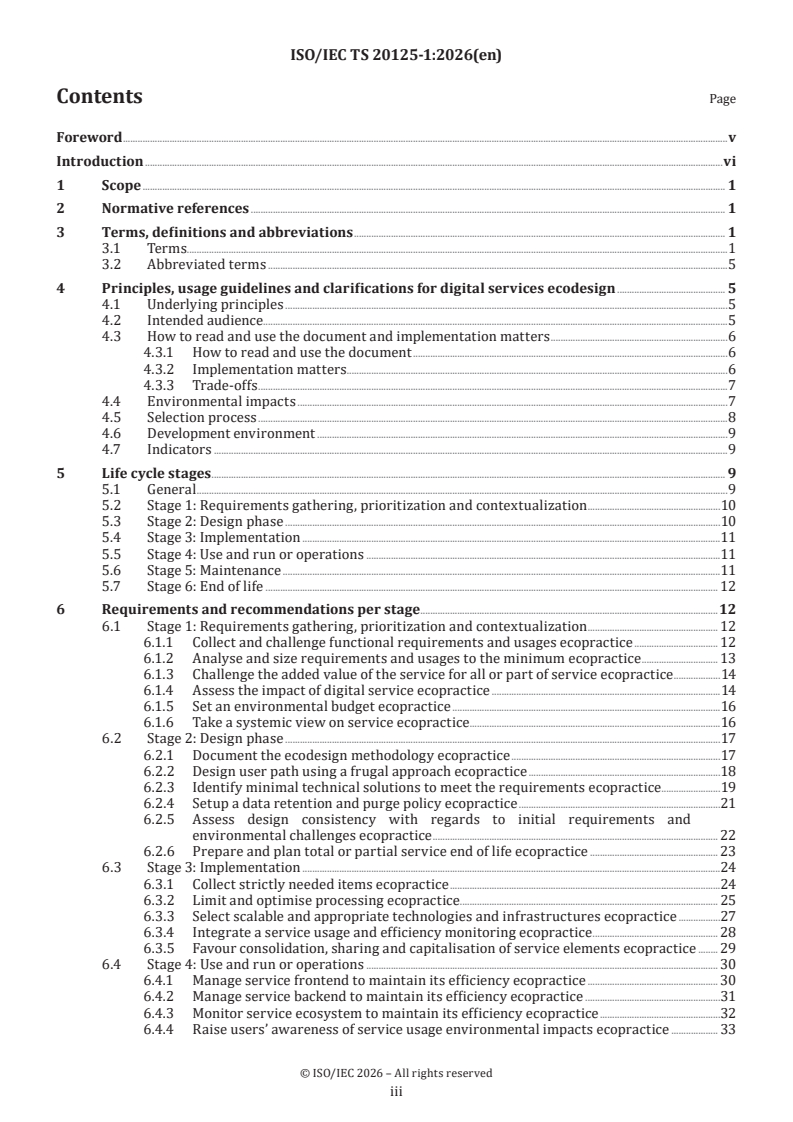
Contents Page
Foreword .v
Introduction .vi
1 Scope . 1
2 Normative references . 1
3 Terms, definitions and abbreviations . 1
3.1 Terms.1
3.2 Abbreviated terms .5
4 Principles, usage guidelines and clarifications for digital services ecodesign . 5
4.1 Underlying principles .5
4.2 Intended audience.5
4.3 How to read and use the document and implementation matters .6
4.3.1 How to read and use the document .6
4.3.2 Implementation matters . . .6
4.3.3 Trade-offs .7
4.4 Environmental impacts .7
4.5 Selection process .8
4.6 Development environment .9
4.7 Indicators .9
5 Life cycle stages . 9
5.1 General .9
5.2 Stage 1: Requirements gathering, prioritization and contextualization .10
5.3 Stage 2: Design phase .10
5.4 Stage 3: Implementation .11
5.5 Stage 4: Use and run or operations .11
5.6 Stage 5: Maintenance .11
5.7 Stage 6: End of life . 12
6 Requirements and recommendations per stage .12
6.1 Stage 1: Requirements gathering, prioritization and contextualization . 12
6.1.1 Collect and challenge functional requirements and usages ecopractice . 12
6.1.2 Analyse and size requirements and usages to the minimum ecopractice . 13
6.1.3 Challenge the added value of the service for all or part of service ecopractice .14
6.1.4 Assess the impact of digital service ecopractice .14
6.1.5 Set an environmental budget ecopractice .16
6.1.6 Take a systemic view on service ecopractice.16
6.2 Stage 2: Design phase .17
6.2.1 Document the ecodesign methodology ecopractice .17
6.2.2 Design user path using a frugal approach ecopractice .18
6.2.3 Identify minimal technical solutions to meet the requirements ecopractice .19
6.2.4 Setup a data retention and purge policy ecopractice .21
6.2.5 Assess design consistency with regards to initial requirements and
environmental challenges ecopractice . 22
6.2.6 Prepare and plan total or partial service end of life ecopractice . 23
6.3 Stage 3: Implementation .24
6.3.1 Collect strictly needed items ecopractice .24
6.3.2 Limit and optimise processing ecopractice. 25
6.3.3 Select scalable and appropriate technologies and infrastructures ecopractice .27
6.3.4 Integrate a service usage and efficiency monitoring ecopractice . 28
6.3.5 Favour consolidation, sharing and capitalisation of service elements ecopractice . 29
6.4 Stage 4: Use and run or operations . 30
6.4.1 Manage service frontend to maintain its efficiency ecopractice . 30
6.4.2 Manage service backend to maintain its efficiency ecopractice .31
6.4.3 Monitor service ecosystem to maintain its efficiency ecopractice .32
6.4.4 Raise users’ awareness of service usage environmental impacts ecopractice . 33
© ISO/IEC 2026 – All rights reserved
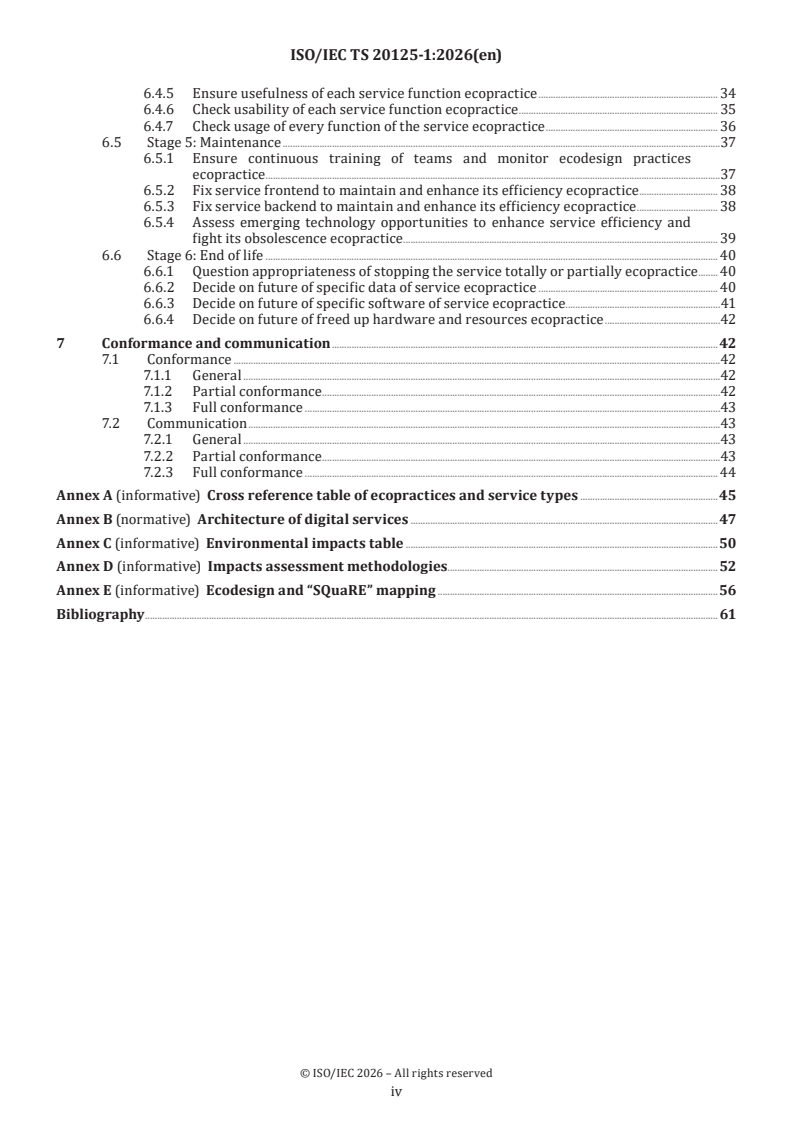
iii
6.4.5 Ensure usefulness of each service function ecopractice . 34
6.4.6 Check usability of each service function ecopractice . 35
6.4.7 Check usage of every function of the service ecopractice . 36
6.5 Stage 5: Maintenance .37
6.5.1 Ensure continuous training of teams and monitor ecodesign practices
ecopractice .37
6.5.2 Fix service frontend to maintain and enhance its efficiency ecopractice . 38
6.5.3 Fix service backend to maintain and enhance its efficiency ecopractice . 38
6.5.4 Assess emerging technology opportunities to enhance service efficiency and
fight its obsolescence ecopractice . 39
6.6 Stage 6: End of life . 40
6.6.1 Question appropriateness of stopping the service totally or partially ecopractice . 40
6.6.2 Decide on future of specific data of service ecopractice . 40
6.6.3 Decide on future of specific software of service ecopractice . .41
6.6.4 Decide on future of freed up hardware and resources ecopractice .42
7 Conformance and communication .42
7.1 Conformance .42
7.1.1 General .42
7.1.2 Partial conformance .42
7.1.3 Full conformance .43
7.2 Communication .43
7.2.1 General .43
7.2.2 Partial conformance .43
7.2.3 Full conformance . 44
Annex A (informative) Cross reference table of ecopractices and service types .45
Annex B (normative) Architecture of digital services . 47
Annex C (informative) Environmental impacts table .50
Annex D (informative) Impacts assessment methodologies.52
Annex E (informative) Ecodesign and “SQuaRE” mapping .56
Bibliography . 61
© ISO/IEC 2026 – All rights reserved
iv
Foreword
ISO (the International Organization for Standardization) and IEC (the International Electrotechnical
Commission) form the specialized system for worldwide standardization. National bodies that are
members of ISO or IEC participate in the development of International Standards through technical
committees established by the respective organization to deal with particular fields of technical activity.
ISO and IEC technical committees collaborate in fields of mutual interest. Other international organizations,
governmental and non-governmental, in liaison with ISO and IEC, also take part in the work.
The procedures used to develop this document and those intended for its further maintenance are described
in the ISO/IEC Directives, Part 1. In particular, the different approval criteria needed for the different types
of document should be noted. This document was drafted in accordance with the editorial rules of the ISO/
IEC Directives, Part 2 (see www.iso.org/directives or www.iec.ch/members_experts/refdocs).
ISO and IEC draw attention to the possibility that the implementation of this document may involve the
use of (a) patent(s). ISO and IEC take no position concerning the evidence, validity or applicability of any
claimed patent rights in respect thereof. As of the date of publication of this document, ISO and IEC had not
received notice of (a) patent(s) which may be required to implement this document. However, implementers
are cautioned that this may not represent the latest information, which may be obtained from the patent
database available at www.iso.org/patents and https://patents.iec.ch. ISO and IEC shall not be held
responsible for identifying any or all such patent rights.
Any trade name used in this document is information given for the convenience of users and does not
constitute an endorsement.
For an explanation of the voluntary nature of standards, the meaning of ISO specific terms and expressions
related to conformity assessment, as well as information about ISO's adherence to the World Trade
Organization (WTO) principles in the Technical Barriers to Trade (TBT) see www.iso.org/iso/foreword.html.
In the IEC, see www.iec.ch/understanding-standards.
This document was prepared by Technical Committee ISO/IEC JTC 1, Information technology, Subcommittee
SC 39, Sustainability, IT and data centres.
Any feedback or questions on this document should be directed to the user’s national standards body. A
complete listing of these bodies can be found at www.iso.org/members.html.
© ISO/IEC 2026 – All rights reserved
v
Introduction
The main purpose of this document is to set requirements and give recommendations on how an organization
can ecodesign a digital service.
As the evidence of the consequences of human activity on the climate, the earth’s resources and earth sanity
become increasingly visible, it is important to reduce as much as possible the adverse environmental impacts
of various products and services made by people.
Many publications demonstrate the consequences of digital services on the environment, such as
greenhouse gas emissions, abiotic resources depletion and acidification. Studies on the impact of emails,
video streaming, network usage, storage explosion, chatbots using large language models (LLM), to name a
few, are numerous.
Examples of use cases of digital services include: searching for a trip on a train transportation system,
booking a hotel ticket, paying an invoice online, booking an appointment, watching an online video,
performing an administrative task. Those are mainly digital services with user interface, but digital
services can also be backend or application programming interface (API) type services, invoked by others,
like authorising a card payment or querying a reference database.
As far as digital services are concerned, based on today's knowledge on their adverse environmental
impacts, it is possible to include, at the design, implementation, operation, maintenance and end-of-life
stages, methodological, technical and measurement tools to limit those adverse impacts.
An increasing number of small and large organisations announce stances in favour of the UN Sustainable
Development Goals (SDGs) and the will to reduce the adverse environmental impacts of their activities,
including those induced by the digital services they provide to their users. Such companies are in need
of requirements and recommendations identifying ways to reduce these digital services’ adverse
environmental impact.
The ecodesign approach (requirements, recommendations and indicators) ensures efficiency in the usage
and consumption ratio. This can have a direct impact on the sobriety of consumption of resources (devices,
networks, data centres).
By following ecodesign requirements and recommendations, lighter digital services tend to offer a better
and faster user response. They also tend to allow broader access to users with old devices or operating
systems or low bandwidth, or both. Lighter digital services will not compel users to prematurely change
their devices for more powerful ones, therefore extending the lifespan of the devices they already possess.
This document is intended for people and entities involved in digital services and aims to be understood and
used by the project teams of private and public organisations.
This document primarily targets digital service providers. However, organisations producing tools,
methodologies, training and consulting can use this document to explain, help, train and advise their
customers. Even though digital service end users (e.g. client, consumers) will not implement this document,
they may, if interested, request information from digital service providers about a digital service, provided
these are transparently disclosed.
© ISO/IEC 2026 – All rights reserved
vi
Technical Specification ISO/IEC TS 20125-1:2026(en)
Information technology — Digital services ecodesign —
Part 1:
Ecopractices for life cycle stages
1 Scope
This document is applicable to environmental matters for a digital service. It establishes requirements and
recommendations applicable for requirements gathering, design, implementation, operations, maintenance
and the end of life of digital services in order to minimise adverse environmental impacts during all stages
of its life cycle. It also establishes a common language and understanding on this subject.
This document focuses on reducing the environmental impacts of a digital service. It therefore does not
address all aspects of digital service design. For example, it does not address other aspects such as
performance, resilience, reliability, availability or development language choice (see other standards
covering these topics, e.g. ISO/IEC 25010 and ISO/IEC 27001).
This document does not include matters linked to other corporate social responsibility (CSR) topics, e.g.
social, cultural, diversity, inclusion or exclusion.
This document is applicable to all development methodologies (waterfall, agile, etc.).
2 Normative references
There are no normative references in this document.
3 Terms, definitions and abbreviations
For the purposes of this document, the following terms and definitions apply.
ISO and IEC maintain terminology databases for use in standardization at the following addresses:
— ISO Online browsing platform: available at https:// www .iso .org/ obp
— IEC Electropedia: available at https:// www .electropedia .org/
3.1 Terms
3.1.1
architecture
specific configuration of hardware and software elements in a system
Note 1 to entry: In this context, “system” refers to a digital service.
Note 2 to entry: Hardware and software elements are referred to as “tiers”.
[SOURCE: IEC 61508-4:2010, 3.3.5]
3.1.2
architecture tier
element of the architecture
Note 1 to entry: A particular tier fulfils the property of being definable by various ecodesign criteria.
© ISO/IEC 2026 – All rights reserved
Note 2 to entry: A tier can include hardware and/or software.
Note 3 to entry: The totality of all tiers describes the architecture.
3.1.3
data
representation of information in a formalised manner suitable for human or automatic processing
[SOURCE: IEC 60050-171:2019, 171-01-02]
3.1.4
design
set of actions needed to build a product
3.1.5
design phase
first stage directly following the requirements gathering stage, during which the various software, hardware
and network components are selected among other activities
3.1.6
development environment
set of electronic devices, software and telecommunications networks, used to implement the software
components of the digital service
3.1.7
DevOps
combined development and operations to increase the efficiency, speed, and security of software
development and delivery compared to traditional processes
Note 1 to entry: Adapted from ISO/IEC/IEEE 32675:2022, 3.1.
3.1.8
digital service
service that provides one or several functions to users through a combination of
electronic devices, software and telecommunication networks, with clearly defined functional boundaries,
interacting with each other
Note 1 to entry: A digital service may use other digital services. In this case, requirements and recommendations
apply to all services under control of the organisation performing ecodesign.
3.1.9
digital sufficiency
approach which aims to use as little resources as possible to achieve the desired outcome
3.1.10
ecodesign
systematic approach that considers environmental aspects in design and development with the aim to
reduce adverse environmental impacts throughout the life cycle of a product
Note 1 to entry: Other terminology used worldwide includes “environmentally conscious design (ECD)”, “design for
environment (DfE)”, “green design” and “environmentally sustainable design”.
[SOURCE: ISO 14006:2020, 3.2.2]
3.1.11
ecoefficiency assessment
evaluation of the quantity of resources used to reach the desired result
3.1.12
ecopractice
set of requirements and recommendations referring to a specific topic within a life cycle stage to achieve the
ecodesign of a digital service
© ISO/IEC 2026 – All rights reserved
3.1.13
environmental budget
predefined level of beneficial or adverse environmental impacts
3.1.14
environmental impact
any change to the environment, whether adverse or beneficial, wholly or partially resulting from an
organization's environmental aspects
[SOURCE: ISO 14001:2015, 3.2.4]
3.1.15
indicator
quantitative, qualitative or descriptive measure
EXAMPLE Energy consumption in kWh, weight in kg, distance in m.
[SOURCE: ISO 6707-3:2022, 3.10.8, modified — The EXAMPLE has been added.]
3.1.16
life cycle
consecutive and interlinked stages of a product system, from raw material acquisition or generation from
natural resources to final disposal
[SOURCE: ISO 14044:2006, 3.1]
3.1.17
life cycle stage
element of a life cycle
[SOURCE: IEC 62430:2019, 3.2.2]
3.1.18
metric
verifiable measure that captures performance in terms of how something is being done relative to a standard
[SOURCE: ISO/TS 18864:2017, 3.20, modified — The phrase "allows and encourages comparison, supports
business strategy" has been removed.]
3.1.19
procurement
process of asking a quote to suppliers, studying their propositions, choosing and raising the procurement
order
3.1.20
product
any goods or service
[SOURCE: ISO 14006:2020, 3.2.3]
3.1.21
recommendation
expression that conveys a suggested possible choice or course of action deemed to be particularly suitable
without necessarily mentioning or excluding others
3.1.22
redesign
design of a product based on an existing product design to improve targeted characteristics of the product
Note 1 to entry: Examples of targeted characteristics include reducing the use of raw materials, enhancing the recycled
content, reducing the use of hazardous substances, energy saving, improving material recyclability.
[SOURCE: ISO 14009:2020, 3.2.2]
© ISO/IEC 2026 – All rights reserved
3.1.23
relevance score
indicator assessing the level of relevance of the service with regards to requirements
3.1.24
requirement
expression that conveys objectively verifiable criteria to be fulfilled and from which no deviation
is permitted if conformance with the document is to be claimed
3.1.25
requirement
need or expectation that is stated, generally implied or obligatory
3.1.26
service
means of delivering value for the customer by facilitating outcomes the customer wants to achieve
Note 1 to entry: Service is generally intangible.
[SOURCE: ISO/IEC 20000-1:2018, 3.2.15, modified — Note 2 to entry has been removed.]
3.1.27
service type
characteristic of digital service (i.e. with or without user interface)
Note 1 to entry: See Annex A.
3.1.28
stakeholder
person or organization that can affect, be affected by, or perceive itself to be affected by a decision or activity
[SOURCE: ISO 14006:2020, 3.1.7, modified — The EXAMPLE and Notes 1 and 2 to entry have been removed.]
3.1.29
technical architecture
information technology activity that aims to design computer solutions
Note 1 to entry: Technical architecture involves the structured arrangement, interaction and interdependence
of all elements so that system-relevant requirements are met.
3.1.30
technical debt
implied cost of future reworking required when choosing an easy but limited solution instead of a better
approach that can take more time
Note 1 to entry: In software development, or any other IT field (e.g. infrastructure, networking.), technical
debt – the chosen term for this document – is also known as design debt or code debt.
3.1.31
telecommunications
branch of technology concerned with the transmission, emission, and reception of signs, signals, writing,
images, and sounds, that is, information of any nature by cable, radio, optical, or other electromagnetic
systems
Note 1 to entry: The term “telecommunication networks” can be used synonymously.
[SOURCE: ISO/IEC 22237-1:2021, 3.1.31, modified — Note 1 to entry has been added.]
3.1.32
user
any person or thing that communicates or interacts with the digital service at any time
Note 1 to entry: The term “thing” covers digital services.
© ISO/IEC 2026 – All rights reserved
3.1.33
virtual architecture
in information technology, architecture that defines servers without stating which ones are virtual or
physical (real)
3.2 Abbreviated terms
For the purpose of this document, the following abbreviated terms apply:
LCA life cycle assessment
LLM large language models
PUE power usage effectiveness
SDGs sustainable development goals
4 Principles, usage guidelines and clarifications for digital services ecodesign
4.1 Underlying principles
The following principles form the basis of all the ecopractices, requirements and recommendations:
— The digital service should only deliver functions essential to the business case.
— Only those devices, both physical and virtual, required to perform the necessary functions should be
active at any point in time. A reasonable balance is necessary between the digital service performance,
active devices and resource utilization.
— Digital service software and other used software components should not induce unjustified hardware
obsolescence.
— When an additional hardware device is needed, a digital service provider should select a device with the
lower environmental impact over the whole life cycle and should consider reusing hardware devices.
— When decommissioning hardware devices, a digital service provider should ensure it is reused if feasible:
— first internally in the organisation;
— second, if previous scenario is not possible, in other organisations.
If disposal is the only choice, a digital service provider should ensure the hardware device goes
through proper recycling channels, so that it can be disassembled and that parts or raw material can be
reused to build new products.
— The digital service should be designed with a modular approach that allows for the easy integration and
reuse of service elements.
— The digital service should maintain transparency regarding its environmental impact. Regular reporting
on progress towards sustainability goals and seeking feedback can drive continuous improvements in
eco-friendly practices.
4.2 Intended audience
This document is intended to be used by people and organisations involved in any stage of the life cycle of
digital services, e.g. requirements gathering, design, implementation, operations, maintenance and end of
life. It aims to be understood and used by the project teams of private and public organisations.
This document primarily targets digital service providers. However, organisations that produce tools,
methodologies, training materials and consultation can use this document to explain, help, train and advise
© ISO/IEC 2026 – All rights reserved
their customers. Even though digital service end users (e.g. clients, consumers) will not implement this
document, they may, if interested, request information from digital service providers about a digital service,
provided these are transparently disclosed.
4.3 How to read and use the document and implementation matters
4.3.1 How to read and use the document
Clause 5 of this document describes six life cycle stages of a digital service:
— Stage 1: Requirements gathering, prioritization and contextualization
— Stage 2: Design phase
— Stage 3: Implementation
— Stage 4: Use and run or operations
— Stage 5: Maintenance
— Stage 6: End of life
Clause 6 introduces several ecopractices that should be addressed at each of the six life cycle stages.
Each ecopractice is introduced from various perspectives (e.g. various stakeholders, environmental
aspects, environmental impacts, technologies). These ecopractices are composed of a brief description
(subclause 6.X.Y.1), requirements and recommendations (subclause 6.X.Y.2) followed by quantitative
indicators (subclause 6.X.Y.3). They help measure to what extent the requirements and recommendations of
the ecopractice as a whole have been considered during the service ecodesign (e.g. whether an environmental
budget has been set and checked). As the name indicates, only measurable or countable indicators will be
given. Indicators are not requirements or recommendations.
This document does not cover tools or methodologies to produce a global ecoscore of the digital service or
an evaluation of its ecodesign maturity. Third parties can use this document as a basis to audit or assess the
ecodesign of a digital service.
Some of the recommendations for the various stages of the digital service life do not apply to all the digital
services. Typically, a backend or an API type service will not consider the requirements and recommendations
of the user interface because it does not have this interface. However, this exclusion shall be explicitly stated
when communicating about the digital service ecodesign externally. Annex A should be used for a reference
of ecopractices per service types. Service types refer to some characteristics of a digital service (i.e. with or
without user interface, new or existing service).
A digital service can be new, when no such service is already in operation, or existing otherwise. This
document addresses both scenarios. However, some requirements or recommendations do not apply when
the service is new (Annex A includes a reference table per service type).
4.3.2 Implementation matters
The goal of ecodesign is to reduce the environmental impact of a digital service. So, once the business,
technical and user needs are collected and prioritised (see 5.2 and 6.1), the project team shall carefully select
the relevant stages and ecopractices it intends to implement (see 7.1). Similarly, environmental impacts that
the digital service provider can act upon are considered.
Using Annex A, the project team can see which ecopractices are relevant, depending on the digital service
category.
Using Annex B, a digital service provider shall consider the relationship between the architecture tiers and
ecopractices and, by extension, the environmental impacts.
© ISO/IEC 2026 – All rights reserved
Whether the digital service is being planned or is already in use, an estimate of the chosen environmental
impacts should be performed [e.g. using the life cycle assessment (LCA)]. See Annex D for a list of impact
assessment methodologies.
The project team then shall use 5.3 to 5.7 and 6.2 to 6.6, according to the selection using 5.2 and 6.1, to fulfil
the requirements and optional recommendations of the chosen stages and ecopractices.
Finally, the user of this document shall disclose the results by following 7.2.
4.3.3 Trade-offs
Ecodesign opportunities to reduce environmental impacts throughout the life cycle stages of a digital service
can be interlinked and are not mutually exclusive. As a consequence, the improvement of particular impacts
can lead to the deterioration of one or more other impacts associated with the digital service. For example,
targeting aspects of resilience (e.g. availability, reliability, fault tolerance according to ISO/IEC TS 22237-31,
IEC 60300), cybersecurity, software quality (e.g. SQuaRE, see Annex E and Table E.1) or performance
considerations to the digital service, can potentially lead to conflicts with ecodesign opportunities on
environmental impacts level (see 4.4).
Such interlinked effects result in a trade-off in the design and environmental improvement opportunities.
These trade-offs should be assessed and evaluated before committing to specific ecodesign and
implementation options. Balancing targets to improve different impact categories can be appropriate.
Organizations can find it helpful to maintain a trade-off log or decision matrix that records:
— conflicting objectives (e.g. energy efficiency vs. latency requirements);
— rationale for chosen solutions;
— stakeholder input;
— expected vs. actual outcomes;
— legal or regulatory requirements.
This ensures transparency and supports continuous improvement.
4.4 Environmental impacts
Environmental impacts are changes to the environment, whether adverse or beneficial, that wholly or
partially result from a digital service over its life cycle.
An example of a positive environmental impact of a digital service is the reduction of CO e emissions, e.g.
by implementing a carpooling service that allows travellers to group in a single means of transportation,
instead of each traveller using their own.
An example of a negative environmental impact of a digital service is the increase of CO e emissions involved
by the energy consumption of intensive computing required for a cryptographic operation.
This document aims at minimising the adverse environmental impacts of digital services. Increasing positive
impacts is important and should be considered. However, this document focuses on limiting negative impacts
and does not provide a methodology to balance both types of impacts.
When estimating the impacts of a digital service, care should be taken to avoid unexpected consequences
of the digital service that produce adverse impacts. Such unexpected consequences can be categorised as
induced or opportunity effects or rebound effects (which are indirect impacts):
— Induced or opportunity effects: A digital service provides a train ticket purchasing service. The user
can directly purchase tickets from home or elsewhere, rather than at the train station desks. However,
users often have to print the tickets themselves. This therefore leads to the purchase of a printer. The
printer purchase is an induced or opportunity effect. Another example is home working: employees
© ISO/IEC 2026 – All rights reserved
have to equip their home office with associated devices to work from home. All this generates additional
greenhouse gas (GHG) emissions and exhausts earth resources.
— Rebound effects: These are indirect effects. The digital service provides an efficiency gain on a process, a
component or a good. They, most of the time, come from innovation and can lead to energy, time, physical
space or financial gains. The result is to achieve the same result with less resources. The rebound effect
occurs when the saved resources are used to do more of the same thing. In other words, the efficiency
savings are partially or totally nullified, if not exceeded. For example, a digital service provides carpooling
to travellers to avoid taking one fossil-fuel consuming vehicle per traveller (gains). However, given its
ease of use, many users use it, or the same users begin to travel more, thus making the environmental
impacts worse than before.
There are various types of adverse environmental impacts that can be categorized. This document does not
offer a judgement of the importance of a specific impact category.
However, when developing a digital service, it is important that an organization uses a multi-impacts
approach as opposed to a single-impact approach. The approach taken to ecodesign a digital service in a way
that minimises one environmental impact should not increase others. Annex C shows a non-exhaustive list
of environmental impacts.
This document does not provide a methodology of environmental impact assessment for digital services. The
LCA methodology can be found in ISO 14040. Additional guidance can be found in Reference [3]. See Annex D
for methodologies. There is no widespread methodology to assess the environmental impact of digital
services at the time of publication. For this reason, it is difficult in some cases to calculate environmental
impacts until efforts to evaluate LCA and other similar methodologies of digital services become widespread.
However, this document can complement the LCA approach:
— LCA can be used when impact evaluation is needed in the ecodesign approach.
— Ecodesign can be used when trying to reduce the impact of the service assessed through the LCA.
This document is not intended to be used to compare the environmental impact performance of digital
services and digital service providers.
4.5 Selection process
While the procurement process (e.g. supplier selection, purchasing) is beyond the scope of this document,
this document provides criteria for selecting hardware/software types and specifications to minimise the
environmental impact (see ISO 20400). Figure 1 shows procurement activities included and excluded in the
scope of this document.
Figure 1 — Procurement process activities in scope and out of scope
© ISO/IEC 2026 – All rights reserved
4.6 Development environment
This document covers the selection, choice and usage of the most appropriate eco-friendly development
environments (see 6.2.3.2). Whatever the tool chosen, care should be taken to ensure it is used properly
to limit the adverse environmental impacts. Requirements and recommendations on the usage of the
development tools are covered by this document.
This document is applicable to all development methodologies (waterfall, agile, etc.).
4.7 Indicators
For each ecopractice, indicators are suggested in this document. These are non-exhaustive and for
informational purposes only at this stage.
These indicators should be used as tools to help digital service providers in their decision-making process by
supplying quantitative information that can be considered before (only for existing digital service), during
and after ecodesign.
Some indicators use measured means, some use measured results.
EXAMPLE The power usage effectiveness (PUE) indicator is defined in ISO/IEC 30134-2. It can be used in
ecodesign. However, it does not provide a full view on ecodesign efficiency alone. An organisation can host a digital
service infrastructure in an efficient datacentre, but that does not mean the digital service is efficient. Also, while a
datacentre can have a low PUE, the CO e intensity is not necessarily optimal.
5 Life cycle stages
5.1 General
This clause outlines each stage of a digital service life cycle. Clause 6 describes ecopractices for each stage.
Reduction of adverse environmental impacts is handled in each stage.
The life cycle of digital services differs based on the nature, purpose, usage and prevailing circumstances
of the digital service (e.g. regulatory context, user needs and tech limitations). Each stage serves a specific
purpose and contributes to the overall life cycle. Thus, a life cycle model consists of one or more stages
and can be tailored to the digital service’s scope, scale, complexity, evolving needs and opp
...