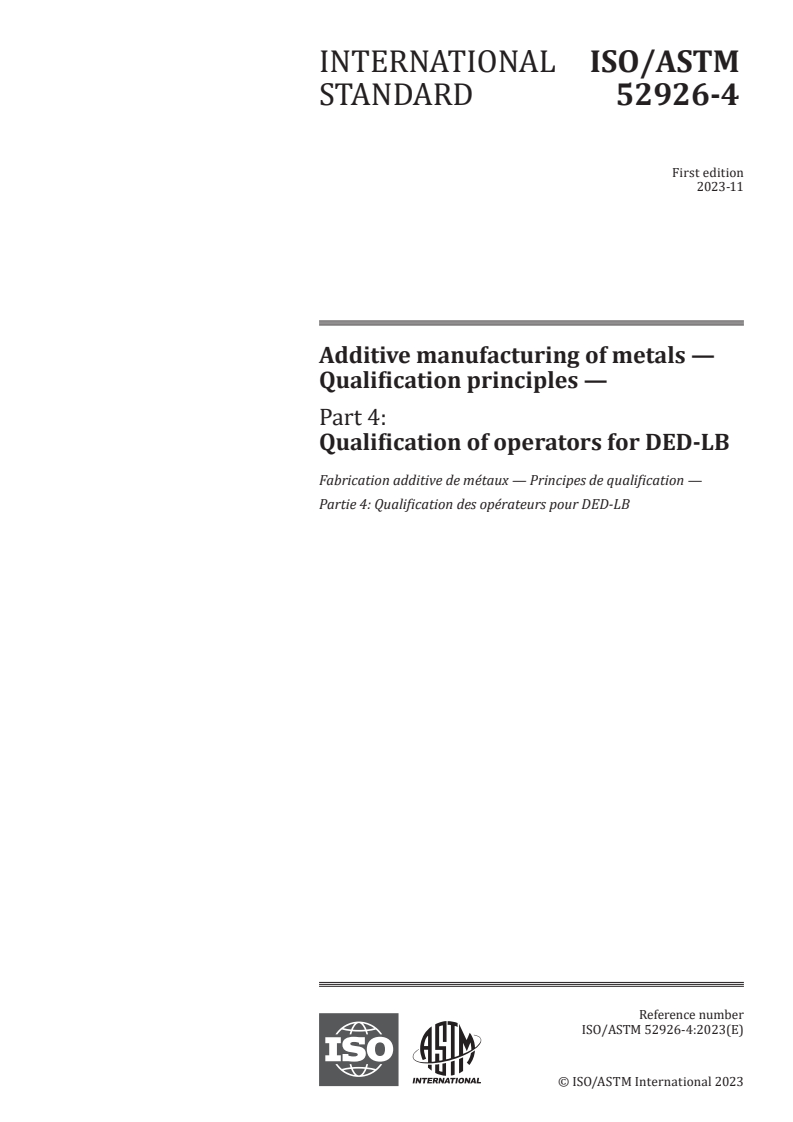
Additive manufacturing of metals — Qualification principles — Part 4: Qualification of operators for DED-LB

This document specifies the capabilities and responsibilities required for the qualification of the AM operators on the field of the additive manufacturing technologies dealing with metallic parts production, specifically for the employment of DED-LB/M. This document specifies criteria for the theoretical and practical assessment of personnel operating DED-LB/M machines. The activities and procedures foreseen to be performed by the DED-LB/M operator are also part of this document. This document is intended to provide an outline for qualification of AM machine operators in general industrial applications.

Fabrication additive de métaux — Principes de qualification — Partie 4: Qualification des opérateurs pour DED-LB

Le présent document spécifie les capacités et les responsabilités exigées pour la qualification des opérateurs dans le domaine des technologies de fabrication additive traitant de la production de pièces métalliques, spécifiquement pour l'emploi de DED-LB/M. Le présent document spécifie les critères pour l'évaluation théorique et pratique du personnel utilisant des machines de DED-LB/M. Les activités et procédures prévues pour être exécutées par l'opérateur de DED-LB/M font également partie du présent document. Le présent document est destiné à fournir une vue d'ensemble pour la qualification des opérateurs de machines de FA dans les applications industrielles générales.

General Information

Status
Published
Publication Date
08-Nov-2023
Current Stage
6060 - International Standard published
Start Date
09-Nov-2023
Due Date
09-Dec-2023
Completion Date
09-Nov-2023
Ref Project
Standard
ISO/ASTM 52926-4:2023 - Additive manufacturing of metals — Qualification principles — Part 4: Qualification of operators for DED-LB Released:9. 11. 2023
English language
5 pages
sale 15% off
Preview
sale 15% off
Preview
Standard
ISO/ASTM 52926-4:2023 - Fabrication additive de métaux — Principes de qualification — Partie 4: Qualification des opérateurs pour DED-LB Released:9. 11. 2023
French language
5 pages
sale 15% off
Preview
sale 15% off
Preview
Draft
ISO/ASTM 52926-4 - Additive manufacturing of metals — Qualification principles — Part 4: Qualification of operators for DED-LB Released:28. 07. 2023
English language
5 pages
sale 15% off
sale 15% off
Draft
REDLINE ISO/ASTM 52926-4 - Additive manufacturing of metals — Qualification principles — Part 4: Qualification of operators for DED-LB Released:28. 07. 2023
English language
5 pages
sale 15% off
sale 15% off
Draft
ISO/ASTM 52926-4 - Fabrication additive de métaux — Principes de qualification — Partie 4: Qualification des opérateurs pour DED-LB Released:14. 08. 2023
French language
5 pages
sale 15% off
sale 15% off

Standards Content (Sample)


INTERNATIONAL ISO/ASTM
STANDARD 52926-4
First edition
2023-11
Additive manufacturing of metals —
Qualification principles —
Part 4:
Qualification of operators for DED-LB
Fabrication additive de métaux — Principes de qualification —
Partie 4: Qualification des opérateurs pour DED-LB
Reference number
© ISO/ASTM International 2023
© ISO/ASTM International 2023
All rights reserved. Unless otherwise specified, or required in the context of its implementation, no part of this publication may
be reproduced or utilized otherwise in any form or by any means, electronic or mechanical, including photocopying, or posting on
the internet or an intranet, without prior written permission. Permission can be requested from either ISO at the address below
or ISO’s member body in the country of the requester. In the United States, such requests should be sent to ASTM International.
ISO copyright office ASTM International
CP 401 • Ch. de Blandonnet 8 100 Barr Harbor Drive, PO Box C700
CH-1214 Vernier, Geneva West Conshohocken, PA 19428-2959, USA
Phone: +41 22 749 01 11 Phone: +610 832 9634
Fax: +610 832 9635
Email: copyright@iso.org Email: khooper@astm.org
Website: www.iso.org Website: www.astm.org
Published in Switzerland
ii
© ISO/ASTM International 2023 – All rights reserved

Contents Page
Foreword .iv
Introduction .v
1 Scope . 1
2 Normative references . 1
3 Terms and definitions . 1
4 Operator qualification .1
4.1 General . 1
4.2 Assessment procedures . 2
4.2.1 General . 2
4.2.2 Aspects of DED-LB/M. 2
4.2.3 Feedstock activities . 2
4.2.4 System set up activities . 3
4.2.5 Manufacturing/Build activities . 3
4.2.6 Post-processing activities. 3
4.2.7 Quality related activities . 3
Bibliography . 5
iii
© ISO/ASTM International 2023 – All rights reserved

Foreword
ISO (the International Organization for Standardization) is a worldwide federation of national standards
bodies (ISO member bodies). The work of preparing International Standards is normally carried out
through ISO technical committees. Each member body interested in a subject for which a technical
committee has been established has the right to be represented on that committee. International
organizations, governmental and non-governmental, in liaison with ISO, also take part in the work.
ISO collaborates closely with the International Electrotechnical Commission (IEC) on all matters of
electrotechnical standardization.
The procedures used to develop this document and those intended for its further maintenance are
described in the ISO/IEC Directives, Part 1. In particular, the different approval criteria needed for the
different types of ISO document should be noted. This document was drafted in accordance with the
editorial rules of the ISO/IEC Directives, Part 2 (see www.iso.org/directives).
ISO draws attention to the possibility that the implementation of this document may involve the use
of (a) patent(s). ISO takes no position concerning the evidence, validity or applicability of any claimed
patent rights in respect thereof. As of the date of publication of this document, ISO had not received
notice of (a) patent(s) which may be required to implement this document. However, implementers are
cautioned that this may not represent the latest information, which may be obtained from the patent
database available at www.iso.org/patents. ISO shall not be held responsible for identifying any or all
such patent rights.
Any trade name used in this document is information given for the convenience of users and does not
constitute an endorsement.
For an explanation of the voluntary nature of standards, the meaning of ISO specific terms and
expressions related to conformity assessment, as well as information about ISO's adherence to
the World Trade Organization (WTO) principles in the Technical Barriers to Trade (TBT), see
www.iso.org/iso/foreword.html.
This document was prepared by Technical Committee ISO/TC 261, Additive manufacturing, in
cooperation with ASTM Committee F42, Additive manufacturing technologies, on the basis of a
partnership agreement between ISO and ASTM International with the aim to create a common set of
ISO/ASTM standards on additive manufacturing, in collaboration with the European Committee for
Standardization (CEN) Technical Committee CEN/TC 438, Additive manufacturing, in accordance with
the Agreement on technical cooperation between ISO and CEN (Vienna Agreement).
A list of all parts of the ISO/ASTM 52926 series can be found on the ISO website.
Any feedback or questions on this document should be directed to the user’s national standards body. A
complete listing of these bodies can be found at www.iso.org/members.html.
iv
© ISO/ASTM International 2023 – All rights reserved

Introduction
For many companies, additive manufacturing represents an alternative to more conventional
manufacturing processes such as casting, forging or milling. The trend towards complex components,
decentralised production and customer specific products allows an economically feasible use for more
and more areas. This also applies to many series applications, which comprise completely different
demands on the efficiency of the processes. In particular, components used in different fields (e.g.,
automotive industry, mechanical engineering, railway sector, aerospace, process and industrial plants,
medical technology, etc.) are subject to high demands in terms of quality and safety. This creates a need
for norms and standards that provide a transparent baseline for the production of components for a
great variety of application areas.
The manufacturing of products intended for applications subjected to specific requirements relies
on that the products' compliance to these requirements can be assured. Additive manufacturing is
no exception to this. To this end, the production chain and environment should be designed in such a
way that the process quality and the resulting product quality are always consistent and reproducible.
To assure this consistency and reproducibility, is of utmost importance to ensure that the involved
workforce is adequately qualified for all stages in the production.
ISO/ASTM 52926 series describes the activities and responsibilities of the operators in the field of the
Additive Manufacturing technology. Its aim is to specify the qualification t
...


NORME ISO/ASTM
INTERNATIONALE 52926-4
Première édition
2023-11
Fabrication additive de métaux —
Principes de qualification —
Partie 4:
Qualification des opérateurs pour
DED-LB
Additive manufacturing of metals — Qualification principles —
Part 4: Qualification of operators for DED-LB
Numéro de référence
© ISO/ASTM International 2023
DOCUMENT PROTÉGÉ PAR COPYRIGHT
© ISO/ASTM International 2023
Tous droits réservés. Sauf prescription différente ou nécessité dans le contexte de sa mise en œuvre, aucune partie de cette
publication ne peut être reproduite ni utilisée sous quelque forme que ce soit et par aucun procédé, électronique ou mécanique,
y compris la photocopie, ou la diffusion sur l’internet ou un intranet, sans autorisation écrite soit de l’ISO à l’adresse ci-après,
soit d’un organisme membre de l’ISO dans le pays du demandeur. Aux États-Unis, les demandes doivent être adressées à ASTM
International.
ISO copyright office ASTM International
Case postale 401 • Ch. de Blandonnet 8 100 Barr Harbor Drive, PO Box C700
CH-1214 Vernier, Genève West Conshohocken, PA 19428-2959, USA
Tél.: +41 22 749 01 11 Tél.: +610 832 9634
Fax: +610 832 9635
E-mail: copyright@iso.org E-mail: khooper@astm.org
Web: www.iso.org Web: www.astm.org
Publié en Suisse
ii
© ISO/ASTM International 2023 – Tous droits réservés

Sommaire Page
Avant-propos .iv
Introduction .v
1 Domaine d'application .1
2 Références normatives .1
3 Termes et définitions . 1
4 Qualification de l’opérateur . 1
4.1 Généralités . 1
4.2 Procédures d'évaluation . 2
4.2.1 Généralités . 2
4.2.2 Aspects du procédé de DED-LB/M . 2
4.2.3 Activités liées aux matières premières . 3
4.2.4 Activités de réglage du système . 3
4.2.5 Activités de fabrication/Fabrication . 3
4.2.6 Activités de post-traitement . 4
4.2.7 Activités liées à la qualité . 4
Bibliographie . 5
iii
© ISO/ASTM International 2023 – Tous droits réservés

Avant-propos
L'ISO (Organisation internationale de normalisation) est une fédération mondiale d'organismes
nationaux de normalisation (comités membres de l'ISO). L'élaboration des Normes internationales est
en général confiée aux comités techniques de l'ISO. Chaque comité membre intéressé par une étude
a le droit de faire partie du comité technique créé à cet effet. Les organisations internationales,
gouvernementales et non gouvernementales, en liaison avec l'ISO participent également aux travaux.
L'ISO collabore étroitement avec la Commission électrotechnique internationale (IEC) en ce qui
concerne la normalisation électrotechnique.
Les procédures utilisées pour élaborer le présent document et celles destinées à sa mise à jour sont
décrites dans les Directives ISO/IEC, Partie 1. Il convient, en particulier de prendre note des différents
critères d'approbation requis pour les différents types de documents ISO. Le présent document
a été rédigé conformément aux règles de rédaction données dans les Directives ISO/IEC, Partie 2
(voir www.iso.org/directives).
L’ISO attire l’attention sur le fait que la mise en application du présent document peut entraîner
l’utilisation d’un ou de plusieurs brevets. L’ISO ne prend pas position quant à la preuve, à la validité
et à l’applicabilité de tout droit de brevet revendiqué à cet égard. À la date de publication du présent
document, l’ISO n'avait pas reçu notification qu’un ou plusieurs brevets pouvaient être nécessaires à sa
mise en application. Toutefois, il y a lieu d’avertir les responsables de la mise en application du présent
document que des informations plus récentes sont susceptibles de figurer dans la base de données de
brevets, disponible à l'adresse www.iso.org/brevets. L’ISO ne saurait être tenue pour responsable de ne
pas avoir identifié tout ou partie de tels droits de propriété.
Les appellations commerciales éventuellement mentionnées dans le présent document sont données
pour information, par souci de commodité, à l'intention des utilisateurs et ne sauraient constituer un
engagement.
Pour une explication de la nature volontaire des normes, la signification des termes et expressions
spécifiques de l'ISO liés à l'évaluation de la conformité, ou pour toute information au sujet de l'adhésion
de l'ISO aux principes de l'Organisation mondiale du commerce (OMC) concernant les obstacles
techniques au commerce (OTC), voir le lien suivant : www.iso.org/iso/fr/avant-propos.
Le présent document a été élaboré par le Comité technique ISO/TC 261, Fabrication additive, en
coopération avec le Comité F42 de l'ASTM, Technologies de fabrication additive, dans le cadre d'un accord
de partenariat entre l'ISO et ASTM International dans le but de créer un ensemble de normes ISO/ASTM
sur la fabrication additive, et en collaboration avec le Comité technique CEN/TC 438 Fabrication additive
du Comité Européen de Normalisation (CEN), conformément à l'Accord de coopération technique entre
l'ISO et le CEN (Accord de Vienne).
Une liste de toutes les parties de la série ISO/ASTM 52926 se trouve sur le site Web de l'ISO.
Il convient que l'utilisateur adresse tout retour d'information ou toute question concernant le présent
document à l'organisme national de normalisation de son pays. Une liste exhaustive desdits organismes
se trouve à l'adresse www.iso.org/fr/members.html.
iv
© ISO/ASTM International 2023 – Tous droits réservés

Introduction
Pour de nombreuses entreprises, la fabrication additive représente une alternative à des procédés de
fabrication plus traditionnels, comme le moulage, la forge et le fraisage. La tendance aux composants
complexes, à la production décentralisée et aux produits spécifiques au client permet une utilisation
économiquement viable dans davantage de domaines. Cela s'applique également à de nombreuses
applications en série, qui comprennent des demandes complètement différentes sur l'efficacité des
procédés. En particulier, les composants utilisés dans plusieurs segments (par exemple, industrie
automobile, ingénierie mécanique, secteur ferroviaire, aérospatial, installations de procédé et
industrielles, technologie médicale, etc.) sont soumis à des exigences élevées en termes de qualité et de
sécurité. Ceci engendre la nécessité de règles et de documents normatifs capables de fournir une base
transparente pour la production de composants dans une variété de domaines d’application.
La fabrication de produits utilisés dans des applications soumises à des exigences spécifiques, repose
sur le fait que la conformité des produits à de telles exigences puisse être garantie. La fabrication
additive n’échappe pas à ce constat. À cet effet, il convient que la chaîne et l'environnement de production
soient conçus de sorte que la qualité du procédé et la qualité du produit qui en résulte soient toujours
constantes et reproductibles. Pour assurer cette constance et cette reproductibilité mentionnées ci-
dessus, il est extrêmement important de s'assurer que la main-d'œuvre impliquée est qualifiée de
manière adéquate pour toutes les phases de production.
La série ISO/ASTM 52926 décrit les activités et les responsabilités des opérateurs dans le domaine de la
technologie de fabrication additive. Son but est de spécifier les essais de qualification à employer dans
l'évaluation des aptitudes des opérateurs de FA lors de l'utilisation de machines de FA, spécialement
dans les industries réglementées, telles que l'industrie automobile, l'ingénierie mécanique, le secteur
ferroviaire, les installations de procédé et industrielles, ou la technologie médicale, la prise en compte
des critères définis dans le cadre de la présente norme ISO constitue une base pour la satisfaction aux
exigences des produits spécifiques.
NOTE Le présent document donne les co
...


FINAL
INTERNATIONAL ISO/ASTM
DRAFT
STANDARD FDIS
52926-4
ISO/TC 261
Additive manufacturing of metals —
Secretariat: DIN
Qualification principles —
Voting begins on:
2023-08-11
Part 4:
Voting terminates on:
Qualification of operators for DED-LB
2023-10-06
Fabrication additive de métaux — Principes de qualification —
Partie 4: Qualification des opérateurs pour DED-LB
ISO/CEN PARALLEL PROCESSING
RECIPIENTS OF THIS DRAFT ARE INVITED TO
SUBMIT, WITH THEIR COMMENTS, NOTIFICATION
OF ANY RELEVANT PATENT RIGHTS OF WHICH
THEY ARE AWARE AND TO PROVIDE SUPPOR TING
DOCUMENTATION.
IN ADDITION TO THEIR EVALUATION AS
Reference number
BEING ACCEPTABLE FOR INDUSTRIAL, TECHNO-
ISO/ASTM FDIS 52926-4:2023(E)
LOGICAL, COMMERCIAL AND USER PURPOSES,
DRAFT INTERNATIONAL STANDARDS MAY ON
OCCASION HAVE TO BE CONSIDERED IN THE
LIGHT OF THEIR POTENTIAL TO BECOME STAN-
DARDS TO WHICH REFERENCE MAY BE MADE IN
NATIONAL REGULATIONS. © ISO/ASTM International 2023

ISO/ASTM FDIS 52926-4:2023(E)
FINAL
INTERNATIONAL ISO/ASTM
DRAFT
STANDARD FDIS
52926-4
ISO/TC 261
Additive manufacturing of metals —
Secretariat: DIN
Qualification principles —
Voting begins on:
Part 4:
Voting terminates on:
Qualification of operators for DED-LB
Fabrication additive de métaux — Principes de qualification —
Partie 4: Qualification des opérateurs pour DED-LB
© ISO/ASTM International 2023
All rights reserved. Unless otherwise specified, or required in the context of its implementation, no part of this publication may
ISO/CEN PARALLEL PROCESSING
be reproduced or utilized otherwise in any form or by any means, electronic or mechanical, including photocopying, or posting on
the internet or an intranet, without prior written permission. Permission can be requested from either ISO at the address below
or ISO’s member body in the country of the requester. In the United States, such requests should be sent to ASTM International.
ISO copyright office ASTM International
RECIPIENTS OF THIS DRAFT ARE INVITED TO
CP 401 • Ch. de Blandonnet 8 100 Barr Harbor Drive, PO Box C700
SUBMIT, WITH THEIR COMMENTS, NOTIFICATION
OF ANY RELEVANT PATENT RIGHTS OF WHICH
CH-1214 Vernier, Geneva West Conshohocken, PA 19428-2959, USA
THEY ARE AWARE AND TO PROVIDE SUPPOR TING
Phone: +41 22 749 01 11 Phone: +610 832 9634
DOCUMENTATION.
Fax: +610 832 9635
IN ADDITION TO THEIR EVALUATION AS
Reference number
Email: copyright@iso.org Email: khooper@astm.org
BEING ACCEPTABLE FOR INDUSTRIAL, TECHNO-
ISO/ASTM FDIS 52926-4:2023(E)
Website: www.iso.org Website: www.astm.org
LOGICAL, COMMERCIAL AND USER PURPOSES,
DRAFT INTERNATIONAL STANDARDS MAY ON
Published in Switzerland
OCCASION HAVE TO BE CONSIDERED IN THE
LIGHT OF THEIR POTENTIAL TO BECOME STAN-
DARDS TO WHICH REFERENCE MAY BE MADE IN
ii
© ISO/ASTM International 2023 – All rights reserved
NATIONAL REGULATIONS. © ISO/ASTM International 2023

ISO/ASTM FDIS 52926-4:2023(E)
Contents Page
Foreword .iv
Introduction .v
1 Scope . 1
2 Normative references . 1
3 Terms and definitions . 1
4 Operator qualification .1
4.1 General . 1
4.2 Assessment procedures . 2
4.2.1 General . 2
4.2.2 Aspects of DED-LB/M. 2
4.2.3 Feedstock activities . 2
4.2.4 System set up activities . 3
4.2.5 Manufacturing/Build activities . 3
4.2.6 Post-processing activities. 3
4.2.7 Quality related activities . 3
Bibliography . 5
iii
© ISO/ASTM International 2023 – All rights reserved

ISO/ASTM FDIS 52926-4:2023(E)
Foreword
ISO (the International Organization for Standardization) is a worldwide federation of national standards
bodies (ISO member bodies). The work of preparing International Standards is normally carried out
through ISO technical committees. Each member body interested in a subject for which a technical
committee has been established has the right to be represented on that committee. International
organizations, governmental and non-governmental, in liaison with ISO, also take part in the work.
ISO collaborates closely with the International Electrotechnical Commission (IEC) on all matters of
electrotechnical standardization.
The procedures used to develop this document and those intended for its further maintenance are
described in the ISO/IEC Directives, Part 1. In particular, the different approval criteria needed for the
different types of ISO document should be noted. This document was drafted in accordance with the
editorial rules of the ISO/IEC Directives, Part 2 (see www.iso.org/directives).
ISO draws attention to the possibility that the implementation of this document may involve the use
of (a) patent(s). ISO takes no position concerning the evidence, validity or applicability of any claimed
patent rights in respect thereof. As of the date of publication of this document, ISO had not received
notice of (a) patent(s) which may be required to implement this document. However, implementers are
cautioned that this may not represent the latest information, which may be obtained from the patent
database available at www.iso.org/patents. ISO shall not be held responsible for identifying any or all
such patent rights.
Any trade name used in this document is information given for the convenience of users and does not
constitute an endorsement.
For an explanation of the voluntary nature of standards, the meaning of ISO specific terms and
expressions related to conformity assessment, as well as information about ISO's adherence to
the World Trade Organization (WTO) principles in the Technical Barriers to Trade (TBT), see
www.iso.org/iso/foreword.html.
This document was prepared by Technical Committee ISO/TC 261, Additive manufacturing, Joint Group
JG 74, Personnel Qualifications in cooperation with ASTM Committee F42, Additive manufacturing
technologies, on the basis of a partnership agreement between ISO and ASTM International with
the aim to create a common set of ISO/ASTM standards on additive manufacturing, in collaboration
with the European Committee for Standardization (CEN) Technical Committee CEN/TC 438, Additive
manufacturing, in accordance with the Agreement on technical cooperation between ISO and CEN
(Vienna Agreement).
A list of all parts of the ISO/ASTM 52926 series can be found on the ISO website.
Any feedback or questions on this document should be directed to the user’s national standards body. A
complete listing of these bodies can be found at www.iso.org/members.html.
iv
© ISO/ASTM International 2023 – All rights reserved

ISO/ASTM FDIS 52926-4:2023(E)
Introduction
For many companies, additive manufacturing represents an alternative to more conventional
manufacturing processes such as casting, forging or milling. The trend towards complex components,
decentralised production and customer specific products allows an economically feasible use for more
and more areas. This also applies to many series applications, which comprise completely different
demands on the efficiency of the processes. In particular, components used in different fields (e.g.,
automotive industry, mechanical engineering, railway sector, aerospace, process and industrial plants,
medical technology, etc.) are subject to high demands in terms of quality and safety. This creates a need
for norms and standards that provide a transparent baseline for the production of components for a
great variety of application areas.
...


2023-06-22
Style Definition: Heading 1: Indent: Left: 0 pt, First
line: 0 pt, Tab stops: Not at 21.6 pt
ISO/ASTM FDIS 52926-4:2023(E)
Style Definition: Heading 2: Font: Bold, Tab stops: Not
ISO/TC 261
at 18 pt
DATE: 2023-xx
Style Definition: Heading 3: Font: Bold
Secretariat: DIN
Style Definition: Heading 4: Font: Bold
Additive Manufacturingmanufacturing of metals — Qualification principles — Part 4: Style Definition: Heading 5: Font: Bold
Qualification of operators for DED-LB
Style Definition: Heading 6: Font: Bold
Fabrication additive de métaux — Principes de qualification — Partie 4: Qualification des opérateurs pour
Style Definition: ANNEX
DED-LB
Style Definition: AMEND Terms Heading: Font: Bold
Style Definition: AMEND Heading 1 Unnumbered:
Font: Bold
Style Definition: List Bullet: Indent: Left: 0 pt, Hanging:
18 pt, No bullets or numbering, Tab stops: 18 pt, List
tab
Style Definition: List Bullet 2: Indent: Left: 14.15 pt,
Hanging: 18 pt, No bullets or numbering, Tab stops:
32.15 pt, List tab
Style Definition: List Bullet 3: Indent: Left: 28.3 pt,
Hanging: 18 pt, No bullets or numbering, Tab stops:
46.3 pt, List tab
Style Definition: List Bullet 4: Indent: Left: 42.45 pt,
Hanging: 18 pt, No bullets or numbering, Tab stops:
60.45 pt, List tab
Style Definition: List Bullet 5: Indent: Left: 56.6 pt,
Hanging: 18 pt, No bullets or numbering, Tab stops:
74.6 pt, List tab
Style Definition: List Number: Indent: Left: 0 pt,
Hanging: 18 pt, No bullets or numbering, Tab stops:
18 pt, List tab
Style Definition: List Number 5: Indent: Left: 56.6 pt,
Hanging: 18 pt, No bullets or numbering, Tab stops:
74.6 pt, List tab
© ISO/ASTM International 2023 – All rights 1
reserved
ISO/ASTM FDIS 52926-4:2023(E)
© ISO/ASTM 2023
Commented [eXtyles1]: Not found: "ISO/ASTM 2023"
Formatted: Pattern: Clear
All rights reserved. Unless otherwise specified, or required in the context of its implementation,
Formatted: Pattern: Clear
no part of this publication may be reproduced or utilized otherwise in any form or by any means,
electronic or mechanical, including photocopying, or posting on the internet or an intranet,
without prior written permission. Permission can be requested from either ISO at the address
below or ISO’s member body in the country of the requester. In the United States, such requests
should be sent to ASTM International.
ISO copyright office  ASTM International
CP 401 • Ch. de Blandonnet 8   100 Barr Harbor Drive, PO Box C700
CH-1214 Vernier, Geneva   West Conshohocken, PA 19428-2959, USA
Phone: +41 22 749 01 11  Phone: +610 832 9634
Fax: +41 22 749 09 47  Fax: +610 832 9635
Email: copyright@iso.org   Email: khooper@astm.org
Website: www.iso.org  Website: www.astm.org
ii © ISO/ASTM International 2023 – All rights
reserved
ISO/ASTM FDIS 52926-4:2023(E)
Contents
Foreword . 4
Introduction. 5
1 Scope . 1
2 Normative Referencesreferences . 1
3 Terms and Definitionsrefinitions . 1
4 Operator qualification . 2
4.1 General . 2
4.2 Assessment procedures . 2
4.2.1 General . 2
4.2.2 Aspects of DED-LB/M . 2
4.2.3 Feedstock activities . 3
4.2.4 System set up activities . 3
4.2.5 Manufacturing/Build activities . 3
4.2.6 Post-processing activities . 4
4.2.7 Quality related activities . 4
Annex A (informative) Example of manufacturing plan . Error! Bookmark not defined.
Bibliography . 5
© ISO/ASTM International 2023 – All rights iii
reserved
ISO/ASTM FDIS 52926-4:2023(E)
Foreword
ISO (the International Organization for Standardization) is a worldwide federation of national
Formatted: Adjust space between Latin and Asian text,
standards bodies (ISO member bodies). The work of preparing International Standards is normally Adjust space between Asian text and numbers
carried out through ISO technical committees. Each member body interested in a subject for which a
technical committee has been established has the right to be represented on that committee.
International organizations, governmental and non-governmental, in liaison with ISO, also take part in
the work. ISO collaborates closely with the International Electrotechnical Commission (IEC) on all
matters of electrotechnical standardization.
The procedures used to develop this document and those intended for its further maintenance are
described in the ISO/IEC Directives, Part 1. In particular, the different approval criteria needed for the
different types of ISO documentsdocument should be noted. This document was drafted in accordance
with the editorial rules of the ISO/IEC Directives, Part 2 (see www.iso.org/directives).
Field Code Changed
Attention is drawnISO draws attention to the possibility that some of the elementsimplementation of
this document may beinvolve the subjectuse of (a) patent(s). ISO takes no position concerning the
evidence, validity or applicability of any claimed patent rights. in respect thereof. As of the date of
publication of this document, ISO had not received notice of (a) patent(s) which may be required to
implement this document. However, implementers are cautioned that this may not represent the latest
information, which may be obtained from the patent database available at www.iso.org/patents. ISO
shall not be held responsible for identifying any or all such patent rights. Details of any patent rights
identified during the development of the document will be in the Introduction and/or on the ISO list of
patent declarations received (see www.iso.org/patents).
Any trade name used in this document is information given for the convenience of users and does not
constitute an endorsement.
For an explanation of the voluntary nature of standards, the meaning of ISO specific terms and
expressions related to conformity assessment, as well as information about ISO's adherence to the
World Trade Organization (WTO) principles in the Technical Barriers to Trade (TBT), see
www.iso.org/iso/foreword.html.
Formatted: English (United States)
This document was prepared by Technical Committee ISO/TC 261, Additive manufacturing, Joint Group
JG 74, Personnel Qualifications in cooperation with ASTM Committee F42, Additive manufacturing
technologies, on the basis of a partnership agreement between ISO and ASTM International with the aim
to create a common set of ISO/ASTM standards on additive manufacturing, in collaboration with the
European Committee for Standardization (CEN) Technical Committee CEN/TC 438, Additive
manufacturing, in accordance with the Agreement on technical cooperation between ISO and CEN
(Vienna Agreement).
A list of all parts of the ISO/ASTM 52926 series can be found on the ISO website.
Commented [eXtyles2]: Invalid reference: "ISO/ASTM
52926 series"
Any feedback or questions on this document should be directed to the user’s national standards body. A
Formatted: Pattern: Clear
complete listing of these bodies can be found at www.iso.org/members.html.
Formatted: Pattern: Clear
iv © ISO/ASTM International 2023 – All rights
reserved
ISO/ASTM FDIS 52926-4:2023(E)
Introduction
For many companies, additive manufacturing represents an alternative to more conventional
manufacturing processes such as casting, forging or milling. The trend towards complex components,
decentralised production and customer specific products allows an economically feasible use for more
and more areas. This also applies to many series applications, which comprise completely different
demands on the efficiency of the processes. In particular, components used in different fields (e.g.,
automotive industry, mechanical engineering, railway sector, aerospace, process and industrial plants,
medical technology, etc.) are subject to high demands in terms of quality and safety. This creates a need
for norms and standards that provide a transparent baseline for the production of components for a
great variety of application areas.
The manufacturing of products intended for applications subjected to specific requirements relies on
that the products' compliance to these requirements can be assured. Additive manufacturing is no
exception to this. To this end, the production chain and environment should be designed in such a way
that the process quality and the resulting product quality are always consistent and reproducible. To
assure this consistency and reproducibility, is of utmost importance to ensure that the involved
workforce is adequately qualified for all stages in the production.
ISO/ASTM 52926 series describes the activities and responsibilities of the operators in the field of the
Commented [eXtyles3]: Invalid reference: "ISO/ASTM
52926 series"
Additive Manufacturing technology. Its aim is to specify the qualification tests to be employed in the
assessment of AM operators’ skills when operating AM machines, especially in regulated industries,
Formatted: Pattern: Clear
such as automotive industry, mechanical engineering, the railway sector, process and industrial plants
Formatted: Pattern: Clear
or medical technology, consideration of the criteria specified within the framework of this document
create a basis for fulfilling the requirements for specific products. Formatted: Pattern: Clear
NOTE: This document specifiesgives the constraints and requirements for an operator to be qualified for
Directed Energy Depositiondirected energy deposition – Laser Beambeam (DED-LB).
© ISO/ASTM International 2023 – All rights v
reserved
INTERNATIONAL STANDARD ISO/ASTM FDIS 52926-4:2023(E)

Additive Manufacturingmanufacturing of metals— Qualification
principles—
Formatted: Font: Bold
Part4: Qualification of operators for DED-LB
1 Scope
This document specifies the capabilities and responsibilities required for the qualification of the AM
operators on the field of the additive manufacturing technologies dealing with metallic parts
production, specifically for the employment of DED-LB/M.
This document specifies criteria for the theoretical and practical assessment of personnel operating
DED-LB/M machines. The activities and procedures foreseen to be performed by the DED-LB/M
operator are also part of this document.
This document is intended to provide an outline for qualification of AM machine operators in general
industrial applications.
2 Normative Referencesreferences
The following documents are referred to in the text in such a way that some or all their content
constitutes requirements of this document. For dated references, only the edition cited applies. For
undated references, the latest edition of the referenced document (including any amendments) applies.
ISO/ASTM 52900, Additive manufacturing — General principles — Fundamentals and
vocabulary
ISO/ASTM 52900, Additive manufacturing — General principles — Fundamentals and vocabulary
Formatted: Pattern: Clear
ISO/ASTM 52926-1, Additive Manufacturing of metals — Qualification principles — Part 1: General Formatted: Pattern: Clear
qualification of operators
Formatted: Pattern: Clear
3 Terms and Definitionsdefinitions Commented [eXtyles4]: ISO/ASTM 52926-1: current
stage is 50.00
For the purposes of this document, the following terms and definitions given in ISO/ASTM 52900,
Formatted: Pattern: Clear
ISO/ASTM 52926-1 and the following apply.
Formatted: Pattern: Clear
ISO and IEC maintain terminology databases for use in standardization at the following addresses:
Commented [eXtyles5]: ISO/ASTM 52926-1: current
stage is 50.00
— ISO Online browsing platform: available at https://www.iso.org/obp
Formatted: Pattern: Clear
— IEC Electropedia: available at https://www.electropedia.org/
Formatted: Pattern: Clear
Formatted: English (United States)
© ISO/ASTM International 2023 – All rights 1
reserved
ISO/ASTM FDIS 52926-4:2023(E)
4 Operator qualification
4.1 General
The qualification test for AM operators should follow a suitable documented procedure or
manufacturing plan. Example of such document is contained in Annex A.
Prior to the assessment the AM operator should have received the necessary amount of theoretical and
practical training (example of 24 hoursh of training) or prior equivalent experience in a DED-LB/M
operator role.
Qualifications of operators in DED-LB/M should follow the a
...


PROJET
NORME ISO/ASTM
FINAL
INTERNATIONALE FDIS
52926-4
ISO/TC 261
Fabrication additive de métaux —
Secrétariat: DIN
Principes de qualification —
Début de vote:
2023-08-11
Partie 4:
Vote clos le:
Qualification des opérateurs pour
2023-10-06
DED-LB
Additive manufacturing of metals — Qualification principles —
Part 4: Qualification of operators for DED-LB
TRAITEMENT PARALLÈLE ISO/CEN
LES DESTINATAIRES DU PRÉSENT PROJET SONT
INVITÉS À PRÉSENTER, AVEC LEURS OBSER-
VATIONS, NOTIFICATION DES DROITS DE PRO-
PRIÉTÉ DONT ILS AURAIENT ÉVENTUELLEMENT
CONNAISSANCE ET À FOURNIR UNE DOCUMEN-
TATION EXPLICATIVE.
OUTRE LE FAIT D’ÊTRE EXAMINÉS POUR
ÉTABLIR S’ILS SONT ACCEPTABLES À DES FINS
INDUSTRIELLES, TECHNOLOGIQUES ET COM-
Numéro de référence
MERCIALES, AINSI QUE DU POINT DE VUE
ISO/ASTM FDIS 52926-4:2023(F)
DES UTILISATEURS, LES PROJETS DE NORMES
INTERNATIONALES DOIVENT PARFOIS ÊTRE
CONSIDÉRÉS DU POINT DE VUE DE LEUR POSSI-
BILITÉ DE DEVENIR DES NORMES POUVANT
SERVIR DE RÉFÉRENCE DANS LA RÉGLEMENTA-
TION NATIONALE. © ISO/ASTM International 2023

ISO/ASTM FDIS 52926-4:2023(F)
PROJET
NORME ISO/ASTM
FINAL
INTERNATIONALE FDIS
52926-4
ISO/TC 261
Fabrication additive de métaux —
Secrétariat: DIN
Principes de qualification —
Début de vote:
2023-08-11
Partie 4:
Vote clos le:
Qualification des opérateurs pour
2023-10-06
DED-LB
Additive manufacturing of metals — Qualification principles —
Part 4: Qualification of operators for DED-LB
DOCUMENT PROTÉGÉ PAR COPYRIGHT
© ISO/ASTM International 2023
Tous droits réservés. Sauf prescription différente ou nécessité dans le contexte de sa mise en œuvre, aucune partie de cette
publication ne peut être reproduite ni utilisée sous quelque forme que ce soit et par aucun procédé, électronique ou mécanique,
TRAITEMENT PARALLÈLE ISO/CEN
y compris la photocopie, ou la diffusion sur l’internet ou un intranet, sans autorisation écrite soit de l’ISO à l’adresse ci-après,
soit d’un organisme membre de l’ISO dans le pays du demandeur. Aux États-Unis, les demandes doivent être adressées à ASTM
LES DESTINATAIRES DU PRÉSENT PROJET SONT
International.
INVITÉS À PRÉSENTER, AVEC LEURS OBSER-
VATIONS, NOTIFICATION DES DROITS DE PRO-
ISO copyright office ASTM International
PRIÉTÉ DONT ILS AURAIENT ÉVENTUELLEMENT
Case postale 401 • Ch. de Blandonnet 8 100 Barr Harbor Drive, PO Box C700
CONNAISSANCE ET À FOURNIR UNE DOCUMEN-
TATION EXPLICATIVE.
CH-1214 Vernier, Genève West Conshohocken, PA 19428-2959, USA
Tél.: +41 22 749 01 11 Tél.: +610 832 9634 OUTRE LE FAIT D’ÊTRE EXAMINÉS POUR
ÉTABLIR S’ILS SONT ACCEPTABLES À DES FINS
Fax: +41 22 749 09 47 Fax: +610 832 9635
INDUSTRIELLES, TECHNOLOGIQUES ET COM-
Numéro de référence
E-mail: copyright@iso.org E-mail: khooper@astm.org
MERCIALES, AINSI QUE DU POINT DE VUE
ISO/ASTM FDIS 52926-4:2023(F)
Web: www.iso.org Web: www.astm.org
DES UTILISATEURS, LES PROJETS DE NORMES
INTERNATIONALES DOIVENT PARFOIS ÊTRE
Publié en Suisse
CONSIDÉRÉS DU POINT DE VUE DE LEUR POSSI-
BILITÉ DE DEVENIR DES NORMES POUVANT
SERVIR DE RÉFÉRENCE DANS LA RÉGLEMENTA-
ii
© ISO/ASTM International 2023 – Tous droits réservés
TION NATIONALE. © ISO/ASTM International 2023

ISO/ASTM FDIS 52926-4:2023(F)
Sommaire Page
Avant-propos .iv
Introduction .v
1 Domaine d'application .1
2 Références normatives .1
3 Termes et définitions . 1
4 Qualification de l’opérateur . 1
4.1 Généralités . 1
4.2 Procédures d'évaluation . 2
4.2.1 Généralités . 2
4.2.2 Aspects du procédé de DED-LB/M . 2
4.2.3 Activités liées aux matières premières . 3
4.2.4 Activités de réglage du système . 3
4.2.5 Activités de fabrication/Fabrication . 3
4.2.6 Activités de post-traitement . 4
4.2.7 Activités liées à la qualité . 4
Bibliographie . 5
iii
© ISO/ASTM International 2023 – Tous droits réservés

ISO/ASTM FDIS 52926-4:2023(F)
Avant-propos
L'ISO (Organisation internationale de normalisation) est une fédération mondiale d'organismes
nationaux de normalisation (comités membres de l'ISO). L'élaboration des Normes internationales est
en général confiée aux comités techniques de l'ISO. Chaque comité membre intéressé par une étude
a le droit de faire partie du comité technique créé à cet effet. Les organisations internationales,
gouvernementales et non gouvernementales, en liaison avec l'ISO participent également aux travaux.
L'ISO collabore étroitement avec la Commission électrotechnique internationale (IEC) en ce qui
concerne la normalisation électrotechnique.
Les procédures utilisées pour élaborer le présent document et celles destinées à sa mise à jour sont
décrites dans les Directives ISO/IEC, Partie 1. Il convient, en particulier de prendre note des différents
critères d'approbation requis pour les différents types de documents ISO. Le présent document
a été rédigé conformément aux règles de rédaction données dans les Directives ISO/IEC, Partie 2
(voir www.iso.org/directives).
L’ISO attire l’attention sur le fait que la mise en application du présent document peut entraîner
l’utilisation d’un ou de plusieurs brevets. L’ISO ne prend pas position quant à la preuve, à la validité
et à l’applicabilité de tout droit de brevet revendiqué à cet égard. À la date de publication du présent
document, l’ISO n'avait pas reçu notification qu’un ou plusieurs brevets pouvaient être nécessaires à sa
mise en application. Toutefois, il y a lieu d’avertir les responsables de la mise en application du présent
document que des informations plus récentes sont susceptibles de figurer dans la base de données de
brevets, disponible à l'adresse www.iso.org/brevets. L’ISO ne saurait être tenue pour responsable de ne
pas avoir identifié tout ou partie de tels droits de propriété.
Les appellations commerciales éventuellement mentionnées dans le présent document sont données
pour information, par souci de commodité, à l'intention des utilisateurs et ne sauraient constituer un
engagement.
Pour une explication de la nature volontaire des normes, la signification des termes et expressions
spécifiques de l'ISO liés à l'évaluation de la conformité, ou pour toute information au sujet de l'adhésion
de l'ISO aux principes de l'Organisation mondiale du commerce (OMC) concernant les obstacles
techniques au commerce (OTC), voir le lien suivant : www.iso.org/iso/fr/avant-propos.
Le présent document a été élaboré par le Comité technique ISO/TC 261, Fabrication additive, Groupe
mixte JG 74, Qualifications personnelles, en coopération avec le Comité F42 de l'ASTM, Technologies de
fabrication additive, dans le cadre d'un accord de partenariat entre l'ISO et ASTM International dans
le but de créer un ensemble de normes ISO/ASTM sur la fabrication additive, et en collaboration avec
le Comité technique CEN/TC 438 Fabrication additive du Comité Européen de Normalisation (CEN),
conformément à l'Accord de coopération technique entre l'ISO et le CEN (Accord de Vienne).
Une liste de toutes les parties de la série ISO/ASTM 52926 se trouve sur le site Web de l'ISO.
Il convient que l'utilisateur adresse tout retour d'information ou toute question concernant le présent
document à l'organisme national de normalisation de son pays. Une liste exhaustive desdits organismes
se trouve à l'adresse www.iso.org/fr/members.html.
iv
© ISO/ASTM International 2023 – Tous droits réservés

ISO/ASTM FDIS 52926-4:2023(F)
Introduction
Pour de nombreuses entreprises, la fabrication additive représente une alternative à des procédés de
fabrication plus traditionnels, comme le moulage, la forge et le fraisage. La tendance aux composants
complexes, à la production décentralisée et aux produits spécifiques au client permet une utilisation
économiquement viable dans davantage de domaines. Cela s'applique également à de nombreuses
applications en série, qui comprennent des demandes complètement différentes sur l'efficacité des
procédés. En particulier, les composants utilisés dans plusieurs segments (par exemple, industrie
automobile, ingénierie mécanique, secteur ferroviaire, aérospatial, installations de procédé et
industrielles, technologie médicale, etc.) sont soumis à des exigences élevées en termes de qualité et de
sécurité. Ceci engendre la nécessité de règles et de documents normatifs capables de fournir une base
transparente pour la production de composants dans une variété de domaines d’application.
La fabrication de produits utilisés dans des applications soumises à des exigences spécifiques, repose
sur le fait que la conformité des produits à de telles exigences puisse être garantie. La fabrication
additive n’échappe pas à ce constat. À cet effet, il convient que la chaîne et l'environnement de production
soient conçus de sorte que la qualité du procédé et la qualité du produit qui en résulte soient toujours
constantes et reproductibles. Pour assurer cette constance et cette reproductibilité mentionnées ci-
dessus, il est extrêmement important de s'assurer que la main-d'œuvre impliquée est qualifiée de
manière adéquate pour toutes les phases de production.
La série ISO/ASTM 52926 décrit les activités et les responsabilités des opérateurs dans le domaine de la
technologie de fabrication additive. Son but est de spécifier les essais de qualification à employer dans
l'évaluation des aptitudes des opérateurs de FA lors de l'utilisation de machines de FA, spécialement
dans les industries réglementées, telles que l'industrie automobile, l'ingénierie mécanique, le secteur
ferroviaire, les installations de procédé et industrielles, ou la technologie médicale, la prise en compte
des critères définis dans le cadre de la présente norme ISO constitue une base pour la satisfaction aux
exigences des produits spécifiques.
NOTE Le présent document donne les contraintes et les exigences pour qu'un opérateur soit certifié pour le
dépôt de matière sous énergie concentrée – faisceau laser (DED-LB, directed energy deposition – laser beam).
v
© ISO/ASTM International 2023 – Tous droits réservés

NORME INTERNATIONALE ISO/ASTM FDIS 52926-4:2023(F)
Fabrication additive de métaux — Principes de
qualification —
Partie 4:
Qualification des opérateurs pour DED-LB
1 Domaine d'application
Le présent document spécifie les capacités et les responsabilités exigées pour la qualification des
opérateurs dans le domaine des technologies de fabrication additive traitant de la production de pièces
métalliques, spécifiquement pour l'emploi de DED-LB/M.
Le présent document spécifie les critères pour l'évaluation théorique et pratique du personnel utilisant
des machines de DED-LB/M. Les activités et procédures prévues pour être exécutées par l'opérateur de
DED-LB/M font également partie du présent document.
Le présent document est destiné à fournir une vue d'ensemble pour la qualification des opérateurs de
machines de FA dans les applications industrielles générales.
2 Références normatives
Les documents suivants cités dans le texte constituent, pour tout ou partie de leur contenu, des
exigences du présent document. Pour les références datées, seule l'édition citée s'applique. Pour les
références non datées, la dernière édition du document de référence s'applique (y compris les éventuels
amendements).
ISO/ASTM 52900, Fabrication additive — Principes généraux — Fondamentaux et vocabulaire
ISO/ASTM 52926-1, Fabrication additive de métaux — Principes de qualification — Partie 1 : Qualification
générale des opérateurs
3 Termes et définitions
Pour les besoins du présent document, les termes et définitions donnés dans l'ISO/ASTM 52900 et
l'ISO/ASTM 52926-1 ainsi que les suivants s'appliquent.
L'ISO et l'IEC tiennent à jour des bases de données terminologiques destinées à être utilisées en
normalisation, consultables aux adresses suivantes :
— ISO Online browsing platform : disponible à l'adresse https:// www .iso .org/ obp
— IEC Electropedia : disponible à l'adresse https:// www .electropedia .org/
4 Qualification de l’opérateur
4.1 Généralités
Il convient que l'essai de qualification pour les opérateurs suive une procédure documentée ou un plan
de fabrication approprié(e). Un exemple de ces documents
...

Questions, Comments and Discussion

Ask us and Technical Secretary will try to provide an answer. You can facilitate discussion about the standard in here.