

ISO 16192:2024
(Main)Space systems — Lessons learned — Principles and guidelines
General Information
- Abstract
This document specifies lessons learned principles and guidelines that are applicable in all space project activities (management, technical, quality, cost and schedule). The application of this document is intended to be included in the supplier quality management system, but can be tailored in individual contracts as agreed by the customer and supplier, depending on: — the content of each project (size, technological level and novelty, particular organization, participants, etc.); — the interest and usefulness of the related information. The lessons learned information can result from any situation which can be encountered in similar contexts for future projects, i.e.: — undesirable experiences to be avoided; — strategies, rules, principles of design, validation, tests and operations proved to be successful or necessary. This document neither endorses nor recommends the transmission of company proprietary information to external entities as part of a lessons learned process. Implementing a formal lessons learned process as outlined in this document makes it possible to capture and benefit from this information. The lessons learned activity is an important contribution to the processing of the preventive and corrective actions specified in ISO 9001, ISO 17666, ISO 14620-1 and ISO 23460. This document also provides lessons learned processes and suggested lessons learned forms.
- Status
- Published
- Publication Date
- 03-Jan-2024
- Technical Committee
- ISO/TC 20/SC 14 - Space systems and operations
- Drafting Committee
- ISO/TC 20/SC 14 - Space systems and operations
- Current Stage
- 6060 - International Standard published
- Start Date
- 04-Jan-2024
- Due Date
- 15-Feb-2025
- Completion Date
- 04-Jan-2024
Overview - ISO 16192:2024 (Space systems - Lessons learned)
ISO 16192:2024 provides principles and guidelines for a formal lessons learned process across all space project activities (management, technical, quality, cost and schedule). Intended for inclusion in a supplier quality management system and tailorable by contract, the standard explains how to capture, classify, record and share experiences - both successful practices and undesirable outcomes - to improve future space projects. It is the third edition (revising ISO 16192:2017) and includes lessons learned processes and suggested forms (Annex A and B).
Key topics and technical requirements
- Lessons learned process framework: three-phase approach producing (1) background of the root event, (2) lessons learned, and (3) recommendations applicable to new projects.
- Process steps (high level): data collection; selection; validation/acceptance; classification; recording; recommendation to new projects; measurement of results.
- Information management: use of searchable databases or collections; accessibility by domain, project type, period and anomaly; active knowledge transfer (debriefings, presentations).
- Sources of lessons learned: expert opinions, technical reports, non-conformity and failure analysis reports, reviews, risk assessments, incidents, operation feedback and customer feedback.
- Scope and tailoring: apply to projects of varying size, technology level and organization; contractual tailoring between customer and supplier is permitted.
- Proprietary data caution: standard neither endorses nor recommends sharing company proprietary information externally as part of lessons learned.
- Outputs and traceability: structured records that support preventive and corrective actions and feed into quality and safety activities.
Applications - who uses ISO 16192:2024 and why
- Project managers and programme leads use it to reduce repeat errors, shorten development cycles and improve estimating (costs, schedule, technical scope).
- Systems engineers and technical leads use lessons learned to refine design rules, validation and test strategies.
- Quality, safety and risk teams integrate the outputs with ISO 9001, ISO 17666 (risk management), ISO 14620-1 (safety) and ISO 23460 (dependability) activities.
- Contracting organizations and suppliers embed lessons learned into supplier quality management and contract transition processes.
- Knowledge managers implement searchable databases and run debriefings to ensure institutional learning.
Related standards
- ISO 9001 (quality management) - preventive and corrective actions
- ISO 17666 (space projects - risk management)
- ISO 14620-1 (space systems - safety requirements)
- ISO 23460 (dependability assurance for space projects)
Using ISO 16192:2024 helps space organizations institutionalize knowledge transfer, reduce recurring issues and strengthen safety, dependability and program efficiency across space systems and projects.
Relations
- Effective Date
- 18-Feb-2023
Get Certified
Connect with accredited certification bodies for this standard

BSI Group
BSI (British Standards Institution) is the business standards company that helps organizations make excellence a habit.

Bureau Veritas
Bureau Veritas is a world leader in laboratory testing, inspection and certification services.

DNV
DNV is an independent assurance and risk management provider.
Sponsored listings
Frequently Asked Questions
ISO 16192:2024 is a standard published by the International Organization for Standardization (ISO). Its full title is "Space systems — Lessons learned — Principles and guidelines". This standard covers: This document specifies lessons learned principles and guidelines that are applicable in all space project activities (management, technical, quality, cost and schedule). The application of this document is intended to be included in the supplier quality management system, but can be tailored in individual contracts as agreed by the customer and supplier, depending on: — the content of each project (size, technological level and novelty, particular organization, participants, etc.); — the interest and usefulness of the related information. The lessons learned information can result from any situation which can be encountered in similar contexts for future projects, i.e.: — undesirable experiences to be avoided; — strategies, rules, principles of design, validation, tests and operations proved to be successful or necessary. This document neither endorses nor recommends the transmission of company proprietary information to external entities as part of a lessons learned process. Implementing a formal lessons learned process as outlined in this document makes it possible to capture and benefit from this information. The lessons learned activity is an important contribution to the processing of the preventive and corrective actions specified in ISO 9001, ISO 17666, ISO 14620-1 and ISO 23460. This document also provides lessons learned processes and suggested lessons learned forms.
This document specifies lessons learned principles and guidelines that are applicable in all space project activities (management, technical, quality, cost and schedule). The application of this document is intended to be included in the supplier quality management system, but can be tailored in individual contracts as agreed by the customer and supplier, depending on: — the content of each project (size, technological level and novelty, particular organization, participants, etc.); — the interest and usefulness of the related information. The lessons learned information can result from any situation which can be encountered in similar contexts for future projects, i.e.: — undesirable experiences to be avoided; — strategies, rules, principles of design, validation, tests and operations proved to be successful or necessary. This document neither endorses nor recommends the transmission of company proprietary information to external entities as part of a lessons learned process. Implementing a formal lessons learned process as outlined in this document makes it possible to capture and benefit from this information. The lessons learned activity is an important contribution to the processing of the preventive and corrective actions specified in ISO 9001, ISO 17666, ISO 14620-1 and ISO 23460. This document also provides lessons learned processes and suggested lessons learned forms.
ISO 16192:2024 is classified under the following ICS (International Classification for Standards) categories: 49.020 - Aircraft and space vehicles in general; 49.140 - Space systems and operations. The ICS classification helps identify the subject area and facilitates finding related standards.
ISO 16192:2024 has the following relationships with other standards: It is inter standard links to ISO 16192:2017. Understanding these relationships helps ensure you are using the most current and applicable version of the standard.
ISO 16192:2024 is available in PDF format for immediate download after purchase. The document can be added to your cart and obtained through the secure checkout process. Digital delivery ensures instant access to the complete standard document.
Standards Content (Sample)
International
Standard
ISO 16192
Third edition
Space systems — Lessons learned —
2024-01
Principles and guidelines
Systèmes spatiaux — Retour d’expérience — Principes et lignes
directrices
Reference number
© ISO 2024
All rights reserved. Unless otherwise specified, or required in the context of its implementation, no part of this publication may
be reproduced or utilized otherwise in any form or by any means, electronic or mechanical, including photocopying, or posting on
the internet or an intranet, without prior written permission. Permission can be requested from either ISO at the address below
or ISO’s member body in the country of the requester.
ISO copyright office
CP 401 • Ch. de Blandonnet 8
CH-1214 Vernier, Geneva
Phone: +41 22 749 01 11
Email: copyright@iso.org
Website: www.iso.org
Published in Switzerland
ii
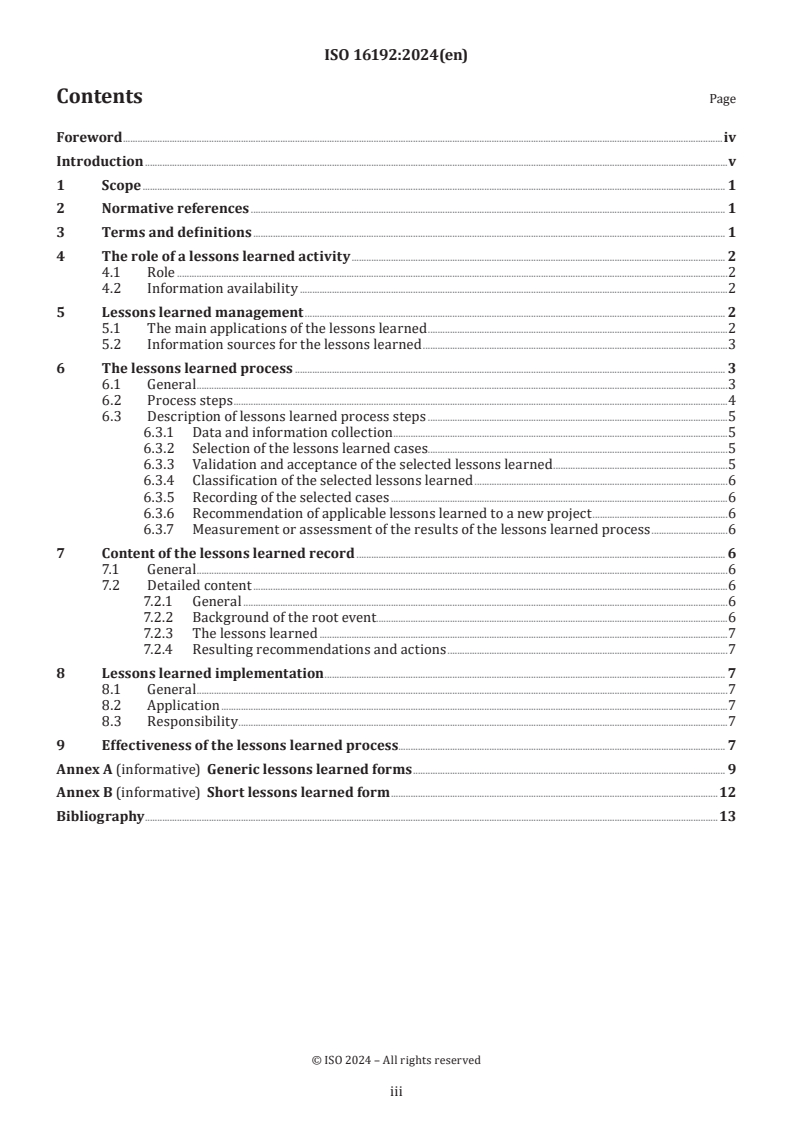
Contents Page
Foreword .iv
Introduction .v
1 Scope . 1
2 Normative references . 1
3 Terms and definitions . 1
4 The role of a lessons learned activity . 2
4.1 Role .2
4.2 Information availability .2
5 Lessons learned management . 2
5.1 The main applications of the lessons learned .2
5.2 Information sources for the lessons learned .3
6 The lessons learned process . 3
6.1 General .3
6.2 Process steps .4
6.3 Description of lessons learned process steps .5
6.3.1 Data and information collection .5
6.3.2 Selection of the lessons learned cases.5
6.3.3 Validation and acceptance of the selected lessons learned .5
6.3.4 Classification of the selected lessons learned .6
6.3.5 Recording of the selected cases .6
6.3.6 Recommendation of applicable lessons learned to a new project .6
6.3.7 Measurement or assessment of the results of the lessons learned process .6
7 Content of the lessons learned record . 6
7.1 General .6
7.2 Detailed content .6
7.2.1 General .6
7.2.2 Background of the root event.6
7.2.3 The lessons learned .7
7.2.4 Resulting recommendations and actions .7
8 Lessons learned implementation . 7
8.1 General .7
8.2 Application .7
8.3 Responsibility .7
9 Effectiveness of the lessons learned process. 7
Annex A (informative) Generic lessons learned forms . 9
Annex B (informative) Short lessons learned form .12
Bibliography .13
iii
Foreword
ISO (the International Organization for Standardization) is a worldwide federation of national standards
bodies (ISO member bodies). The work of preparing International Standards is normally carried out through
ISO technical committees. Each member body interested in a subject for which a technical committee
has been established has the right to be represented on that committee. International organizations,
governmental and non-governmental, in liaison with ISO, also take part in the work. ISO collaborates closely
with the International Electrotechnical Commission (IEC) on all matters of electrotechnical standardization.
The procedures used to develop this document and those intended for its further maintenance are described
in the ISO/IEC Directives, Part 1. In particular, the different approval criteria needed for the different types
of ISO document should be noted. This document was drafted in accordance with the editorial rules of the
ISO/IEC Directives, Part 2 (see www.iso.org/directives).
ISO draws attention to the possibility that the implementation of this document may involve the use of (a)
patent(s). ISO takes no position concerning the evidence, validity or applicability of any claimed patent
rights in respect thereof. As of the date of publication of this document, ISO had not received notice of (a)
patent(s) which may be required to implement this document. However, implementers are cautioned that
this may not represent the latest information, which may be obtained from the patent database available at
www.iso.org/patents. ISO shall not be held responsible for identifying any or all such patent rights.
Any trade name used in this document is information given for the convenience of users and does not
constitute an endorsement.
For an explanation of the voluntary nature of standards, the meaning of ISO specific terms and expressions
related to conformity assessment, as well as information about ISO's adherence to the World Trade
Organization (WTO) principles in the Technical Barriers to Trade (TBT), see www.iso.org/iso/foreword.html.
This document was prepared by Technical Committee ISO/TC 20, Aircraft and space vehicles, Subcommittee
SC 14, Space systems and operations.
This third edition cancels and replaces the second edition (ISO 16192:2017), which has been technically
revised.
The main changes are as follows:
— normative references have been added.
Any feedback or questions on this document should be directed to the user’s national standards body. A
complete listing of these bodies can be found at www.iso.org/members.html.
iv
Introduction
In order to improve the quality of products and to work efficiently, it is important to consider past
experiences and how the knowledge of those experiences is transmitted. The aim is to decrease errors (in
terms of both quantity and gravity), improve working methods and decrease risks of nonconformity to
specified objectives (management, technical, quality, costs and schedules).
In the process of lessons learned, future space projects or programmes are intended to draw benefit from
past experiences, by capturing and communicating knowledge from the past through recording, classifying
and making the information available.
An efficient processing of lessons learned is considered essential for:
— ongoing efficiency and quality improvement inside any organization;
— successful project management.
v
International Standard ISO 16192:2024(en)
Space systems — Lessons learned — Principles and
guidelines
1 Scope
This document specifies lessons learned principles and guidelines that are applicable in all space project
activities (management, technical, quality, cost and schedule).
The application of this document is intended to be included in the supplier quality management system, but
can be tailored in individual contracts as agreed by the customer and supplier, depending on:
— the content of each project (size, technological level and novelty, particular organization, participants,
etc.);
— the interest and usefulness of the related information.
The lessons learned information can result from any situation which can be encountered in similar contexts
for future projects, i.e.:
— undesirable experiences to be avoided;
— strategies, rules, principles of design, validation, tests and operations proved to be successful or
necessary.
This document neither endorses nor recommends the transmission of company proprietary information to
external entities as part of a lessons learned process.
Implementing a formal lessons learned process as outlined in this document makes it possible to capture
and benefit from this information.
The lessons learned activity is an important contribution to the processing of the preventive and corrective
actions specified in ISO 9001, ISO 17666, ISO 14620-1 and ISO 23460.
This document also provides lessons learned processes and suggested lessons learned forms.
2 Normative references
The following documents are referred to in the text in such a way that some or all of their content constitutes
requirements of this document. For dated references, only the edition cited applies. For undated references,
the latest edition of the referenced document (including any amendments) applies.
ISO 10795, Space systems — Programme management and quality — Vocabulary
ISO 14620-1, Space systems — Safety requirements — Part 1: System safety
ISO 17666, Space projects — Risk management
ISO 23460, Space projects — Programme management — Dependability assurance requirements
3 Terms and definitions
No terms and definitions are listed in this document. For the purposes of this document, the terms and
definitions given in ISO 10795 apply.
ISO and IEC maintain terminology databases for use in standardization at the following addresses:
— IEC Electropedia: available at https:// www .electropedia .org/
— ISO Online browsing platform: available at https:// www .iso .org/ obp
4 The role of a lessons learned
...