

ISO 11609:2026
(Main)Dentistry — Dentifrices — Requirements, test methods and marking
- Abstract
This document specifies requirements for the physical and chemical properties of dentifrices and provides guidelines for suitable test methods. It also specifies requirements for the marking, labelling and packaging of dentifrices. This document is applicable to dentifrices, including toothpastes, destined to be used by consumers on a daily basis with a toothbrush to promote oral hygiene. This document does not apply to specific qualitative and quantitative requirements for freedom from biological and toxicological hazards. These are covered in ISO 7405 and ISO 10993-1.
- Status
- Published
- Publication Date
- 23-Jul-2026
- Technical Committee
- ISO/TC 106/SC 7 - Oral care products
- Drafting Committee
- ISO/TC 106/SC 7/WG 4 - Dentifrice
- Current Stage
- 6060 - International Standard published - 60 Publication
- Start Date
- 24-Jul-2026
- Due Date
- 29-Jun-2026
- Completion Date
- 29-Jun-2026
Buy Documents
ISO 11609:2026 - Dentistry — Dentifrices — Requirements, test methods and marking
ISO 11609:2026 - Médecine bucco-dentaire — Dentifrices — Exigences, méthodes d’essai et marquage
ISO 11609:2026 is an ISO International Standard for dentifrices, including toothpastes intended for daily use with a toothbrush by consumers. It specifies physical and chemical requirements, suitable test methods, and rules for marking, labelling and packaging, so manufacturers and test laboratories can check product quality and presentation against one common specification.
What does ISO 11609:2026 specify?
ISO 11609:2026 covers dentifrices used for oral hygiene and is organized into Clauses 1 to 7, followed by three informative annexes. It focuses on product properties that can be measured or verified in practice, plus the information and packaging needed for market use.
The standard applies to consumer dentifrices used daily with a toothbrush. It excludes specific qualitative and quantitative requirements for freedom from biological and toxicological hazards, which are addressed in ISO 7405 and ISO 10993-1.
| Annex | What it covers |
|---|---|
| Annex A | ADA method for dentifrice abrasivity testing |
| Annex B | Surface profile method for relative dentifrice abrasivity to dentine and enamel |
| Annex C | Total fluoride test methods for dentifrices |
Clauses 4 to 7 set the requirements for composition, test methods, marking and packaging. Clause 4 states the performance and composition limits, Clause 5 gives the test methods, Clause 6 covers marking and labelling, and Clause 7 covers packaging.
What are the key requirements of ISO 11609:2026?
Composition limits and product quality
- Total fluoride concentration in the dentifrice shall not exceed a mass fraction of 0.15% (Clause 4.1.1). In practice, formulators need to control fluoride content tightly and verify it with a suitable analytical method, such as the example method in Annex C.
- Total fluoride in a single-unit container shall not exceed 300 mg (Clause 4.1.2), unless the product is dispensed under professionally supervised conditions or in community-based caries prevention programmes. This matters when deciding container size and pack format.
- Heavy metals (elemental impurities) shall not exceed 20 mg/kg in total (Clause 4.2). The clause points to ISO 21392 for antimony, arsenic, cadmium, lead or mercury, so quality control needs an impurity check suitable for the finished product.
- pH shall be below 10.5 when tested in accordance with 5.1 (Clause 4.3). The test uses a suspension of one part dentifrice and three parts water, measured within 10 minutes, so the product must stay within a controlled alkaline range.
Microbiology, abrasivity and stability
- Microbiology testing shall be carried out (Clause 4.4). The standard points to several ISO cosmetics microbiology methods and allows other validated methods with equivalent sensitivity, accuracy and specificity. This gives laboratories flexibility, but they still need a documented, validated approach.
- Abrasivity shall not exceed 2.5 times the primary reference material for dentine or 4.0 times for enamel (Clause 4.5). Testing may use Annex A or Annex B, and if another abrasive reference is used, the laboratory must keep traceability to the primary reference material, calcium pyrophosphate. That is important for comparing results between labs.
- Stability is acceptable only if the dentifrice shows no deterioration that could affect conformity or create toxicological hazards after ageing per 5.4 or after 30 months at room temperature (Clause 4.6). If deterioration is found, the product needs an expiry date on the label.
- Readily fermentable carbohydrates shall not be present (Clause 4.7). Manufacturers can show this by formula review or by suitable analytical testing, which helps prevent ingredients that could support dental caries.
Test methods and what they mean in practice
Clause 5 sets the practical checks behind those limits. Clause 5.2 and 5.3 allow abrasivity measurement by Annex A, Annex B, or another validated method of similar sensitivity and accuracy. Clause 5.4 gives an accelerated ageing condition at 40 °C and 75% relative humidity for 3 months, or equivalent conditions that simulate 30 months at room temperature.
Marking, labelling and packaging
Clause 6 requires most primary containers, except small single units below 10 ml, to show the product identity, trade name, manufacturer or responsible distributor contact details, a tracking code with an intelligible production date, a full ingredient list using INCI names, fluoride concentration and type if present, net volume or mass, and an expiry date when shelf-life is under 30 months. It also requires a safety notice for children below 6 years of age when the fluoride concentration is 1 000 µg/g or more.
Clause 7 requires packaging that protects the dentifrice from contamination under normal handling and transport, including after the ageing procedure in 5.4. In practice, packaging has to preserve product conformity, not just appearance.
What terms does ISO 11609:2026 define?
- Dentifrice - a substance or combination of substances specially prepared for consumers to clean the accessible surfaces of teeth and surrounding tissues.
- Toothpaste - a semi-solid dentifrice in paste, cream or gel form. The note to the definition points to common ingredients such as abrasives, humectants, binders, surfactants, flavourings and fluorides.
- Single-unit container - a container of dentifrice marketed to individual consumers.
- Primary container - the container that is in direct contact with the product.
Who uses ISO 11609:2026?
ISO 11609:2026 is used by dentifrice and toothpaste manufacturers, analytical laboratories, and quality assurance teams that need to verify formula limits, abrasivity, pH, stability and fluoride content. It is also relevant to packaging and labelling teams because the standard specifies what must appear on the primary container.
In practice, oral care product developers use it when designing formulations, test labs use it when running compliance tests, and regulatory or technical buyers use it when comparing supplier specifications for consumer oral hygiene products.
What changed in ISO 11609:2026 from the previous edition?
ISO 11609:2026 is the fourth edition and it cancels and replaces ISO 11609:2017. The stated changes are edits and clarifications to align with ISO directives, updates for abrasive availability, corrections for contacting the manufacturer of the cross-brushing machine, a correction to Clause 2 and the Bibliography, and a revision of Clause 4.2 to suggest ISO 21392 for analysis of five elemental impurities.
Which standards are used with ISO 11609:2026?
- ISO 1942 - provides dentistry vocabulary used for the terms and definitions.
- ISO 3696 - specifies the analytical water used in the pH test.
- ISO 8601-1 and ISO 8601-2 - provide the date and time format used for expiry dates.
- ISO 5725-1 to ISO 5725-6 - provide accuracy and precision principles used when working with abrasivity measurement methods.
- ISO 19448 - supports fluoride analysis in aqueous solutions used in Annex C.
- ISO 21392 - provides an analytical method for traces of heavy metals in finished cosmetic products.
- ISO 16212, ISO 18416, ISO 21148, ISO 21149, ISO 21150, ISO 22717, ISO 22718 and ISO 29621 - support microbiological examination, detection and low-risk assessment.
- ISO 7405 and ISO 10993-1 - cover biological safety and biocompatibility issues that are outside the scope of this standard.
What does the ISO 11609:2026 document contain?
ISO 11609:2026 contains the requirements for fluoride, heavy metals, pH, microbiology, abrasivity, stability and readily fermentable carbohydrates, together with the test methods needed to check them. It also includes the marking, labelling and packaging rules that support traceability and safe consumer use.
Annex A gives a detailed ADA abrasivity procedure based on a radio-tracer method, including specimen preparation, brushing conditions, reference materials and calculation steps. Annex B gives a profilometry-based alternative for dentine and enamel, including specimen masking, brushing regimes, quality control by proportional linearity and calculation of RDA-PE and REA-PE.
Annex C provides two ways to determine total fluoride in dentifrices. One is an ADA diffusion and ion-selective electrode procedure, and the other is an IS 6356-based method.
Relations
- Consolidates
EN ISO 11609:2026 - Dentistry - Dentifrices - Requirements, test methods and marking (ISO 11609:2026) - Effective Date
- 12-Feb-2026
- Effective Date
- 22-Oct-2022
Buy Documents
ISO 11609:2026 - Dentistry — Dentifrices — Requirements, test methods and marking
ISO 11609:2026 - Médecine bucco-dentaire — Dentifrices — Exigences, méthodes d’essai et marquage
Frequently Asked Questions
ISO 11609:2026 is a standard published by the International Organization for Standardization (ISO). Its full title is "Dentistry — Dentifrices — Requirements, test methods and marking". This standard covers: This document specifies requirements for the physical and chemical properties of dentifrices and provides guidelines for suitable test methods. It also specifies requirements for the marking, labelling and packaging of dentifrices. This document is applicable to dentifrices, including toothpastes, destined to be used by consumers on a daily basis with a toothbrush to promote oral hygiene. This document does not apply to specific qualitative and quantitative requirements for freedom from biological and toxicological hazards. These are covered in ISO 7405 and ISO 10993-1.
This document specifies requirements for the physical and chemical properties of dentifrices and provides guidelines for suitable test methods. It also specifies requirements for the marking, labelling and packaging of dentifrices. This document is applicable to dentifrices, including toothpastes, destined to be used by consumers on a daily basis with a toothbrush to promote oral hygiene. This document does not apply to specific qualitative and quantitative requirements for freedom from biological and toxicological hazards. These are covered in ISO 7405 and ISO 10993-1.
ISO 11609:2026 is classified under the following ICS (International Classification for Standards) categories: 97.170 - Body care equipment. The ICS classification helps identify the subject area and facilitates finding related standards.
ISO 11609:2026 has the following relationships with other standards: It is inter standard links to EN ISO 11609:2026, ISO 11609:2017. Understanding these relationships helps ensure you are using the most current and applicable version of the standard.
ISO 11609:2026 is available in PDF format for immediate download after purchase. The document can be added to your cart and obtained through the secure checkout process. Digital delivery ensures instant access to the complete standard document.
Standards Content (Sample)
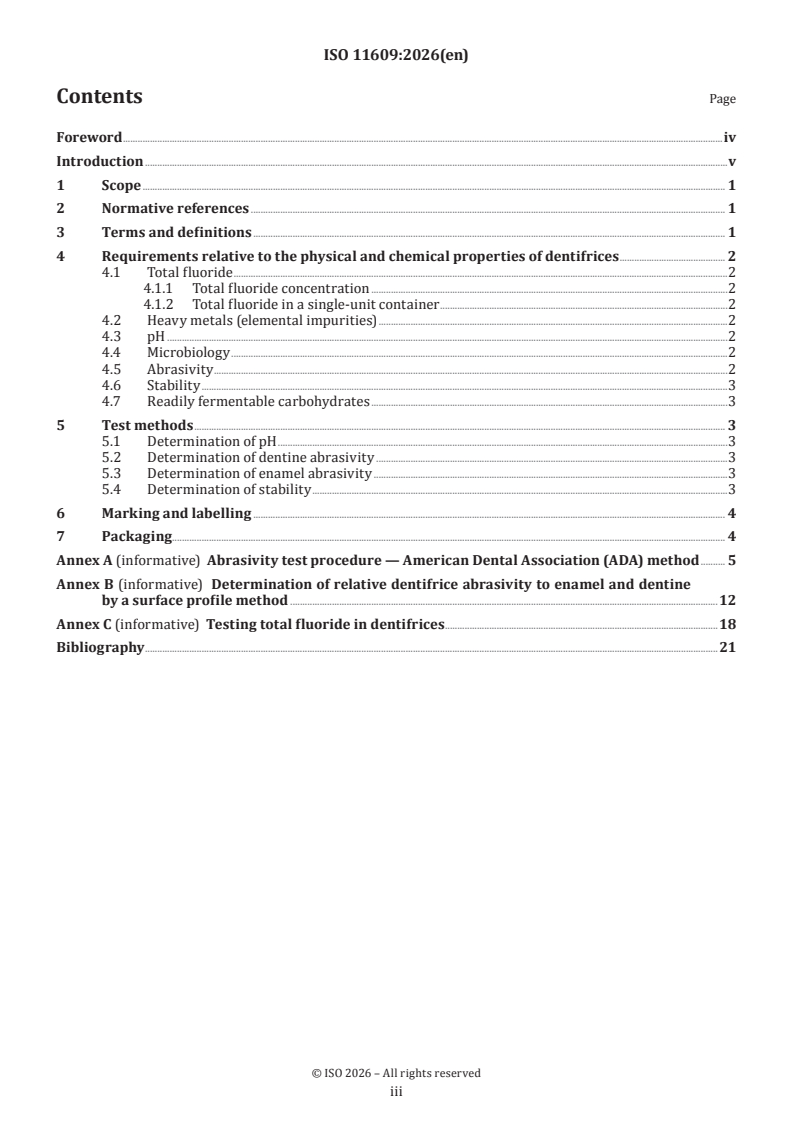
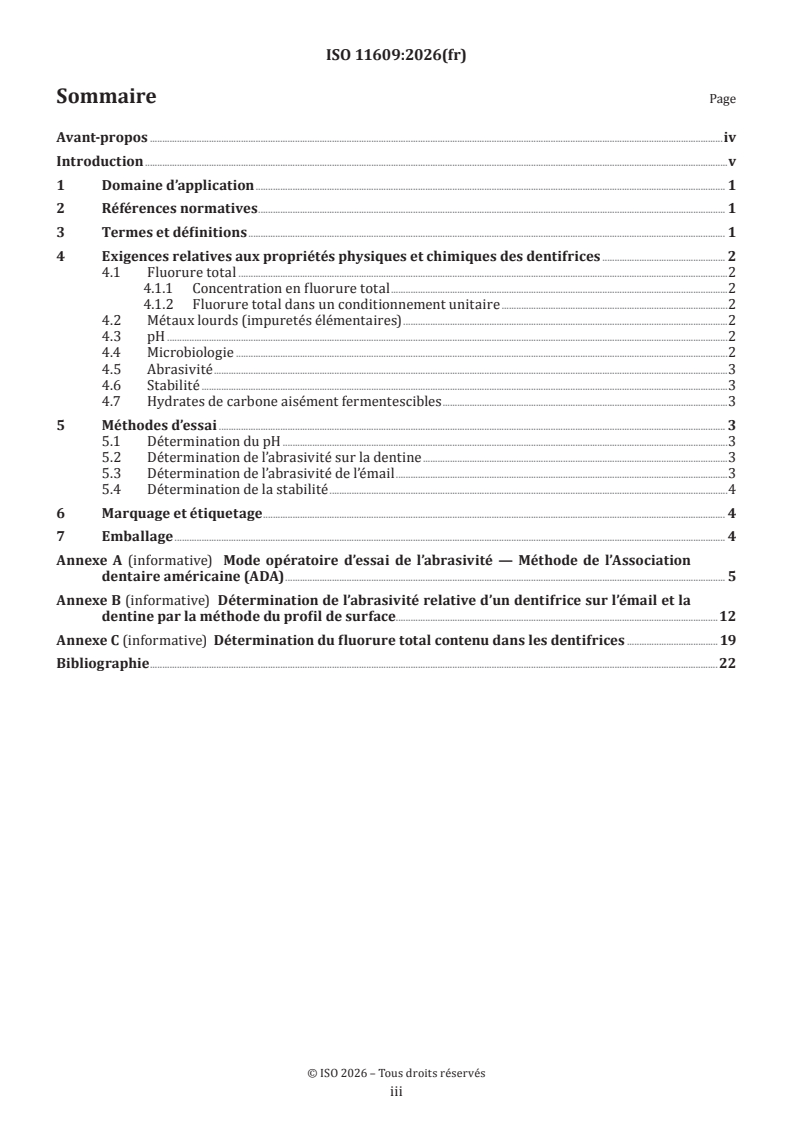
Contents
- Introduction
- 1 Scope
- 2 Normative references
- 3 Terms and definitions
- 3.1 dentifrice
- 3.2 toothpaste
- 3.3 single-unit container
- 3.4 primary container
- 4 Requirements relative to the physical and chemical properties of dentifrices
- 4.1 Total fluoride
- 4.2 Heavy metals (elemental impurities)
- 4.4 Microbiology
- 4.5 Abrasivity
- 4.6 Stability
- 4.7 Readily fermentable carbohydrates
- 5 Test methods
- 5.1 Determination of pH
- 5.2 Determination of dentine abrasivity
- 5.3 Determination of enamel abrasivity
- 5.4 Determination of stability
- 6 Marking and labelling
- 7 Packaging
- Annex A
- Annex B
- Annex C
- Bibliography
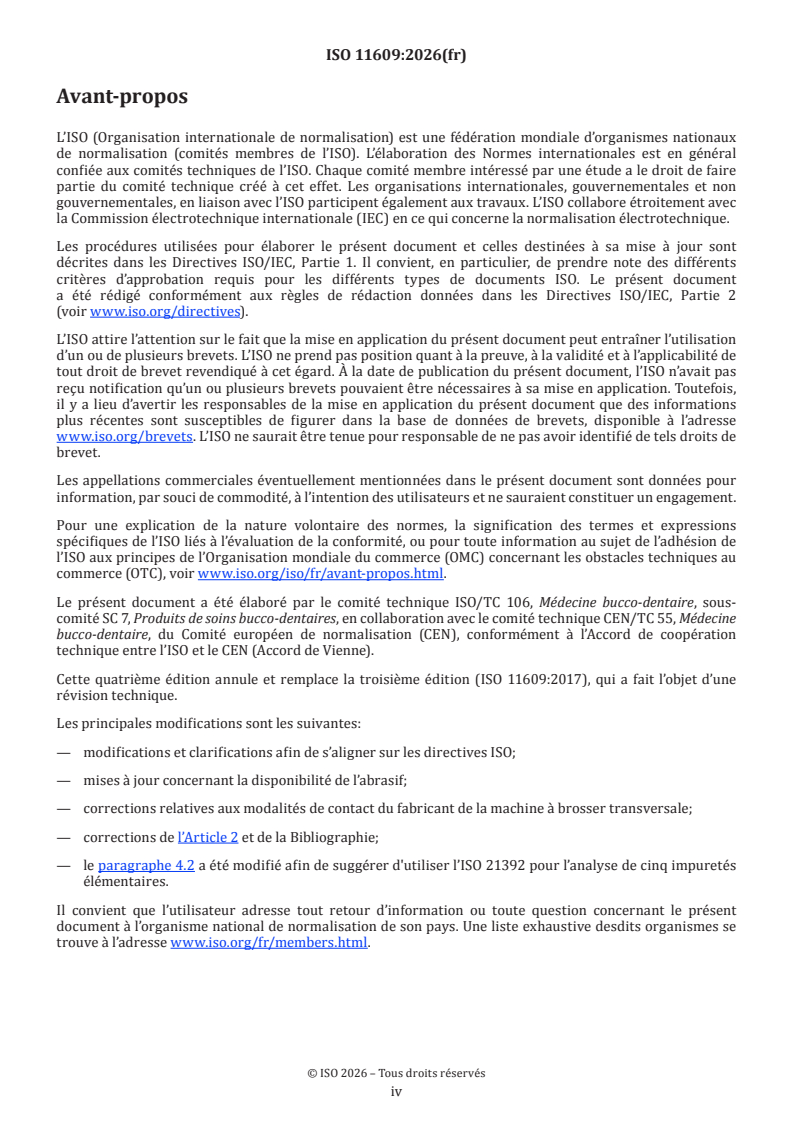
Introduction
Dentifrices are not expected to cause adverse reactions to oral soft tissue when used in accordance with the manufacturer's recommendation for frequency and duration of use, nor cause any known side effects. Guidelines on assessing the claimed or implied efficacy of dentifrices for the prevention or control of oral conditions can be found through Reference [19], Reference [20] and Reference [21].
International Standard ISO 11609:2026(en) Dentistry — Dentifrices — Requirements, test methods and marking
1 Scope
This document specifies requirements for the physical and chemical properties of dentifrices and provides guidelines for suitable test methods. It also specifies requirements for the marking, labelling and packaging of dentifrices.
This document is applicable to dentifrices, including toothpastes, destined to be used by consumers on a daily basis with a toothbrush to promote oral hygiene.
This document does not apply to specific qualitative and quantitative requirements for freedom from biological and toxicological hazards. These are covered in ISO 7405 and ISO 10993-1.
2 Normative references
The following documents are referred to in the text in such a way that some or all of their content constitutes requirements of this document. For dated references, only the edition cited applies. For undated references, the latest edition of the referenced document (including any amendments) applies. ISO 1942, Dentistry — Vocabulary ISO 3696, Water for analytical laboratory use — Specification and test methods ISO 8601-1, Date and time — Representations for information interchange — Part 1: Basic rules ISO 8601-2, Date and time — Representations for information interchange — Part 2: Extensions International Nomenclature of Cosmetic Ingredients (INCI), in International Cosmetic Ingredient Dictionary 1) and Handbook
3 Terms and definitions
For the purposes of this document, the terms and definitions given in ISO 1942 and the following apply. ISO and IEC maintain terminology databases for use in standardization at the following addresses:
- ISO Online browsing platform: available at https:// www .iso .org/ obp
- IEC Electropedia: available at https:// www .electropedia .org/
3.1 dentifrice
substance or combination of substances specially prepared for consumers for hygiene of the accessible surfaces of teeth and surrounding tissues 1) Nomenclature developed by the Personal Care Products Council (formerly CTFA). Available at: https:// access .personalcarecouncil .org/ eweb/ DynamicPage .aspx ?Site = pcpc & WebKey = 4513b14e -2f75 -4857 -85b4 -b3697be5d5d9.
ISO 11609:2026(en)
3.2 toothpaste
semi-solid dentifrice preparation presented in the form of a paste, cream or gel Note 1 to entry: The product’s common constituents are abrasives, humectants, binders, surfactants, flavourings, fluorides and other agents for oral health benefits.
3.3 single-unit container
container of dentifrice marketed to individual consumers
3.4 primary container
container that is in direct contact with the product
4 Requirements relative to the physical and chemical properties of dentifrices
4.1 Total fluoride
4.1.1 Total fluoride concentration
The total fluoride concentration shall not exceed a mass fraction of 0,15 %. For an example method, see Annex C.
Other validated methods of similar sensitivity and accuracy may be used (see References [22] to [31]).
4.1.2 Total fluoride in a single-unit container
The amount of total fluoride in a single-unit container shall not exceed 300 mg. This requirement does not apply to containers of dentifrice to be dispensed under professionally supervised conditions or in community-based caries prevention programmes, e.g. school toothbrushing programmes.
4.2 Heavy metals (elemental impurities)
The total maximum concentration of heavy metals shall not exceed 20 mg/kg. See ISO 21392 for antimony, arsenic, cadmium, lead or mercury and for other elemental impurities. The methods described in References [32] and [33], or another validated method of similar sensitivity and accuracy, may be used.
4.3 pH When tested in accordance with 5.1, the dentifrice shall have a pH below 10,5.
4.4 Microbiology
Testing for microbiological contamination shall be carried out. For some methods, see ISO 16212, ISO 18416, ISO 21148, ISO 21149, ISO 21150, ISO 22717, ISO 22718 and ISO 29621 or any other validated method of equivalent sensitivity, accuracy and specificity.
4.5 Abrasivity
The abrasivity of the dentifrice shall not exceed the following limit for dentine:
- 2,5 times that of the primary reference material (see the procedure specified in Annex A or Annex B).
ISO 11609:2026(en) The abrasivity of the dentifrice shall not exceed the following limit for enamel:
- 4,0 times that of the primary reference material (see the procedure specified in Annex A or Annex B). NOTE Abrasivity values below the limits specified in this document are not intended to be used to rank the safety of dentifrices. All dentifrices beneath the abrasivity limits are recognized as safe with respect to their abrasion of human hard tissues.
Test in accordance with 5.2 or 5.3 or any other validated method of similar sensitivity and accuracy. When an alternative abrasivity reference to the primary reference material (calcium pyrophosphate) is used, traceability to the primary reference material shall be maintained by the testing laboratory. When any alternative abrasivity reference is used, the results shall be reported with respect to the original primary reference material (calcium pyrophosphate).
4.6 Stability
The dentifrice shall show no deterioration that can affect conformity with this document or can result in toxicological hazards after being subjected to one of the ageing procedures specified in 5.4 or after 30 months of storage at room temperature. If deterioration is detected, the dentifrice shall be labelled with an expiry date.
4.7 Readily fermentable carbohydrates
The dentifrice shall not contain readily fermentable carbohydrates. Conformity shall be established by the absence of such compounds in the complete formula or by performing tests in accordance with commonly used analytical methods.
5 Test methods
5.1 Determination of pH
Suspend one part by mass of the dentifrice into three parts by mass of water for analytical laboratory use in accordance with ISO 3696 (grade 3). Determine the pH of the suspension within 10 min, using a pH-meter and electrode assembly.
5.2 Determination of dentine abrasivity
Determine the mean relative abrasivity compared to the primary reference sample or any other reference material calibrated to the primary reference sample for human dentine. One of the methods specified in Annex A or Annex B may be used. Other validated measurement methods on dentine of similar sensitivity and accuracy may be used. Conforming principles can be found in ISO 5725-1, ISO 5725-2, ISO 5725-3, ISO 5725-4, ISO 5725-5, and ISO 5725-6. For other references, see, for example, References [34] and [35].
5.3 Determination of enamel abrasivity
Determine the mean relative abrasivity compared to the primary reference sample, or any other reference material calibrated to the primary reference sample for human enamel. One of the methods specified in Annex A or Annex B or another validated measurement method on enamel of similar sensitivity and accuracy may be used. Principles can be found in ISO 5725-1, ISO 5725-2, ISO 5725-3, ISO 5725-4, ISO 5725-5, and ISO 5725-6. For other references, see, for example, References [34] and [35].
5.4 Determination of stability
For the accelerated ageing procedure, the dentifrice shall be stored in its original container at 40 °C ± 2 °C at 75 % ± 5 % relative humidity for 3 months or at such conditions of time and temperature as will simulate storage at room temperature for 30 months, see Reference [36]. Following storage, test the product according to this document.
ISO 11609:2026(en)
6 Marking and labelling
With the exception of small single units (less than 10 ml), all primary containers shall be marked with the following information:
a) the word “dentifrice” or equivalent; b) the trade name; c) the name and contact information of the manufacturer or responsible distributor; d) the tracking code that includes an intelligible production date; e) a complete list of ingredients according to the International Nomenclature of Cosmetic Ingredients (INCI); f) the concentration and type of fluoride, if present, expressed in micrograms per gram, or percent by mass, or both; g) the net volume, in millilitres, or net mass in grams, or both; h) the expiry date, expressed in accordance with ISO 8601-1 and ISO 8601-2, if the period of stability (shelflife) is less than 30 months; i) a safety notice regarding the use, by children below 6 years of age, of dentifrices containing concentrations of fluoride of 1 000 µg/g or more.
7 Packaging
The product shall be packaged in such a way that under normal conditions of handling and transport, the container or dispensing system, or both, shall not contaminate or permit contamination of the dentifrice inside, so as to affect its conformity with this document, after being subjected to the ageing procedure described in 5.4.
ISO 11609:2026(en)
Annex A
(informative)
Abrasivity test procedure — American Dental Association (ADA) method A.1 General This annex identifies the specific procedures for determination of the dentifrice abrasivity using the ADA [37] laboratory method. Other validated methods of similar or better sensitivity and accuracy may also be used.
A.2 Sampling A representative sample shall be taken from at least two batches. A.3 Procedure A.3.1 Standard reference abrasive 2) The primary reference abrasive is from a specific lot of calcium pyrophosphate . An alternate, silica 3) reference abrasive , or another well characterized material or composition that is well characterized and 2,3 its performance understood in the laboratory of choice may be used instead of calcium pyrophosphate. A.3.2 Apparatus A.3.2.1 Brushing machine 4) A cross-brushing machine is the apparatus of choice . The apparatus should have eight positions for holding specimens. A toothbrush shall be positioned to pass reciprocally at a small angle (approximately 5 °) over the mounted specimens, with a designated tension on the brush, while immersed in a dentifrice slurry. The distance traversed by the brush should not be longer than the brush head so that the specimen does not lose contact with the brush. The mechanism for holding the dentifrice slurry may vary with different machine designs but should allow for easy removal of the slurry sample. It is recommended to have some mechanism for the agitation of the slurry while the brushing is taking place. A convenient method to accomplish this is to attach rubber mixing vanes just below the brush head. As the brushing takes place, these vanes prevent the abrasive from settling to the bottom of the slurry container. A.3.2.2 Radioactivity detector The two recommended methods for the determination of the radioactivity of the used dentifrice slurries are a Geiger-Müller planchet counter and a liquid scintillation detector. The use of the Geiger counter requires 2) Reference calcium pyrophosphate was historically available from Odontex Inc. For more information contact ADA/ ANSI standards. This information is given for the convenience of users of this document and does not constitute an endorsement by ISO of this product.
3) One alternative reference silica is available from Evonik, Rodenbacher Chaussee 4, 63457 Hanau Wolfgang, Germany. This information is given for the convenience of users of this document and does not constitute an endorsement by ISO of this product.
4) One acceptable product is available from ODEME, odeme@odeme .com .br; https:// www .odeme .com .br the MEV 5 Series of cross-brushing machines. This information is given for the convenience of users of this document and does not constitute an endorsement by ISO of this product.
ISO 11609:2026(en) that the samples be dried under defined controlled conditions. The liquid scintillation method has the advantage of reading directly from the slurry.
Counting should be done for a period, expected to reduce the alpha value for counting error to less than 2 %. Counting should be performed for a minimum of 1 000 counts and for at least 1 min. The number of brushing strokes may be increased if counting times become too long.
A.3.3 Preparation of tooth specimens A.3.3.1 Dentine specimens A.3.3.1.1 Selection Human root dentine of extracted permanent teeth is used as the substrate. Single-rooted teeth that were vital at extraction should be selected. An exception, because of the small size, are mandibular incisors: these should not be used. The specimen should be at least 14 mm long and 2 mm wide at the narrow end. All roots shall be caries-free and free of anatomical defects. After extraction, the roots should be stored in a neutralized solution that disinfects but does not alter the physical properties. A.3.3.1.2 Preparation Scrape the roots clean of all soft tissue and as much cementum as possible. Then remove the crown and the root tips using a separating disc under a flow of water.
A.3.3.1.3 Irradiation For each set of eight specimens to be irradiated, add one or two extra roots for use in correction factors. Pack the specimens in disinfection solution and submit to a nuclear reactor for irradiation. The neutron
flux should be sufficient to produce about 37 MBq (1 mCi) of P beta radiation after several hours. Elevated temperatures in the reactor (above 65 °C) should be avoided. A specific position shall be requested to shield the samples from fast neutrons and gamma radiation. Handling of the irradiated specimens should be done with care using good laboratory practice. The specimens should not be used during the first half-life because of excess radiation and should be used before the end of the third half-life because of lack of activity. The
half-life of P is 14,3 days so the usable life span of a set of teeth is 4 weeks. A.3.3.1.4 Mounting of specimens Mount the specimens individually in a mould in cold-cure methyl methacrylate resin such that either the buccal or lingual surface protrudes at least 2 mm above and parallel to the resin. Orient the mould in the brushing machine such that the direction of brushing is perpendicular to the long dimension of the root. Store the mounted specimens in a neutralized solution that disinfects but does not alter the physical properties.
NOTE The type and configuration of the mould depend on the holder of the brushing machine. A.3.3.2 Enamel specimens A.3.3.2.1 Selection Selection criteria for enamel specimens are the same as for dentine. The enamel specimens should be obtained from human maxillary incisors.
A.3.3.2.2 Preparation The entire labial surface of the specimen is used after removing the root. Clean the enamel in the same way as the root.
ISO 11609:2026(en) A.3.3.2.3 Irradiation Irradiation of the enamel is identical to the method used with the roots. The roots and enamel specimens may be packed together for submission to the reactor.
A.3.3.2.4 Mounting Mount the enamel specimens in the same way as the roots. The labial surface shall protrude 2 mm and be parallel to the resin surface.
A.3.4 Toothbrushes The toothbrushes used should have Polyamid 66 (nylon) filaments about 10 mm in length. Filament ends should lie in a plane.
Store the brushes in water overnight prior to their first use and then keep them in water until they are discarded. Use a new set of brushes for each set of teeth. Do not remove the brushes from the machine between runs but raise the tufts off the specimen so as not to bend the bristles. At the beginning of each run, set the tension of the brush on the specimen to 150 g using a Chatillon spring gauge or equivalent. This tension should be rechecked at least twice daily. The method of adjusting the tension will vary depending upon the type of mechanism on the brushing machine.
A.3.5 Reference diluent 5) The diluent is a 0,5 % carboxymethyl cellulose (7MF CMC) solution in 10 % glycerine. To prepare 1 l of the diluent, heat 50 ml of glycerine to 60 °C and add 5 g of CMC while stirring. When the mixture is homogeneous, add another 50 ml of heated glycerine and continue stirring for 60 min. Transfer the solution to a 1 l flask and add 900 ml of distilled water. Allow to cool but continue stirring slowly overnight. To stabilize the viscosity, allow the solution to stand overnight before using. This solution is used to make up slurries of the reference abrasive or any powder being tested.
A.3.6 Reference abrasive slurry Using the reference material described in A.3.1, dilute 10 g of the abrasive with 50 ml of the diluent (see A.3.5). The same ratio is used for all powders. The reference abrasive can be used as a dentifrice. If this is the case, it shall be made up as a 40 % abrasive dentifrice with the rest of the constituents being conventional dentifrice components. The slurry is then made using 25 g of reference dentifrice and 40 ml of water. A.3.7 Dentifrice slurries To prepare the test slurries, add 40 ml of water to 25 g of each dentifrice. For the machine, prepare eight slurries of each dentifrice. This dilution produces a final slurry volume and concentration similar to those of the reference abrasive slurry. All slurries (reference and test) shall be used shortly after preparation and after vigorous mechanical stirring to prevent particles from settling. A.3.8 Preconditioning of tooth specimens A.3.8.1 Dentine To reduce the variation caused by dentine surface differences, precondition the specimens prior to each use. The preconditioning treatment consists of brushing with a slurry of the reference abrasive but not taking a sample. The first-time dentine specimens are used, the preconditioning should be for 6 000 strokes. Each successive daily run should begin with a shorter preconditioning brushing of 1 000 strokes. The tension of the toothbrush on the roots shall be 150 g.
5) An acceptable CMC is available from Hercules Incorporated, Aqualon Division, 1111 Hercules Road, Hopewell, VA 23860, USA, http:// www .ashland .com/ industries/ pharmaceutical/ oral -solid -dose/ aqualon -sodium -ca rboxymethylcellulose. This information is given for the convenience of users of this document and does not constitute an endorsement by ISO of this product.
ISO 11609:2026(en) Discard the preconditioning slurries.
A.3.8.2 Enamel Preconditioning of the enamel is similar to that of the dentine, except that 10 000 strokes are used prior to the first use and 1 000 strokes are given at the beginning of each day. Discard the preconditioning slurries.
...
Contents
- Introduction
- 1 Domaine d’application
- 2 Références normatives
- 3 Termes et définitions
- 3.1 dentifrice
- 3.2 pâte dentifrice
- 3.3 conditionnement unitaire
- 3.4 conditionnement primaire
- 4 Exigences relatives aux propriétés physiques et chimiques des dentifrices
- 4.1 Fluorure total
- 4.2 Métaux lourds (impuretés élémentaires)
- 4.4 Microbiologie
- 4.5 Abrasivité
- 4.6 Stabilité
- 4.7 Hydrates de carbone aisément fermentescibles
- 5 Méthodes d’essai
- 5.1 Détermination du pH
- 5.2 Détermination de l’abrasivité sur la dentine
- 5.3 Détermination de l’abrasivité de l’émail
- 5.4 Détermination de la stabilité
- 6 Marquage et étiquetage
- 7 Emballage
- Annexe A
- Annexe B
- Annexe C
- Bibliographie
Introduction
Les dentifrices ne sont pas censés provoquer de réactions indésirables des tissus mous de la cavité buccale lorsqu’ils sont utilisés conformément aux recommandations du fabricant en matière de fréquence et de durée d’utilisation, et qu’ils ne causent pas d’effets secondaires connus. Des lignes directrices concernant l’évaluation de l’efficacité déclarée ou implicite des dentifrices destinés à la prévention bucco-dentaire ou au contrôle des maladies bucco-dentaires figurent dans la Référence [19], la Référence [20] et la Référence [21].
Norme internationale ISO 11609:2026(fr) Médecine bucco-dentaire — Dentifrices — Exigences, méthodes d’essai et marquage
1 Domaine d’application
Le présent document spécifie des exigences relatives aux propriétés physiques et chimiques des dentifrices et donne des lignes directrices concernant les méthodes d’essai appropriées. Il spécifie également des exigences relatives au marquage, à l’étiquetage et à l’emballage des dentifrices. Le présent document s’applique aux dentifrices, y compris les pâtes dentifrices, destinés à être utilisés quotidiennement par les consommateurs avec une brosse à dents, dans le but de favoriser l’hygiène buccale. Le présent document ne s’applique pas aux exigences qualitatives et quantitatives spécifiques pour une absence de risques biologiques et toxicologiques. Celles-ci sont traitées dans l’ISO 7405 et l’ISO 10993-1.
2 Références normatives
Les documents suivants sont cités dans le texte de sorte qu’ils constituent, pour tout ou partie de leur contenu, des exigences du présent document. Pour les références datées, seule l’édition citée s’applique. Pour les références non datées, la dernière édition du document de référence s’applique (y compris les éventuels amendements).
ISO 1942, Médecine bucco-dentaire — Vocabulaire ISO 3696, Eau pour laboratoire à usage analytique — Spécification et méthodes d'essai ISO 8601-1, Date et heure — Représentations pour l'échange d'information — Partie 1: Règles de base ISO 8601-2, Date et heure — Représentations pour l'échange d'information — Partie 2: Extensions International Nomenclature of Cosmetic Ingredients (INCI, Nomenclature internationale des ingrédients 1) cosmétiques), dans International Cosmetic Ingredient Dictionary and Handbook
3 Termes et définitions
Pour les besoins du présent document, les termes et les définitions de l’ISO 1942 ainsi que les suivants s’appliquent.
L’ISO et l’IEC tiennent à jour des bases de données terminologiques destinées à être utilisées en normalisation, consultables aux adresses suivantes:
- ISO Online browsing platform: disponible à l’adresse https:// www .iso .org/ obp
- IEC Electropedia: disponible à l’adresse https:// www .electropedia .org/
3.1 dentifrice
substance ou composition spécialement préparée pour les consommateurs destinée à l’hygiène des surfaces accessibles des dents et des tissus environnants 1) Nomenclature élaborée par le Personal Care Products Council (précédemment CTFA). Disponible à l’adresse:
https:// access .personalcarecouncil .org/ eweb/ DynamicPage .aspx ?Site = pcpc & WebKey = 4513b14e -2f75 -4857 -85b4 -b3697be5d5d9..
ISO 11609:2026(fr)
3.2 pâte dentifrice
préparation dentifrice semi-solide présentée sous forme de pâte, de crème ou de gel Note 1 à l'article: Les composants courants de ces produits sont des abrasifs, des agents humectants, des liants, des tensioactifs, des arômes, des fluorures et d’autres agents destinés à favoriser la santé buccale.
3.3 conditionnement unitaire
conditionnement de dentifrice commercialisé pour des consommateurs individuels
3.4 conditionnement primaire
conditionnement qui est en contact direct avec le produit
4 Exigences relatives aux propriétés physiques et chimiques des dentifrices
4.1 Fluorure total
4.1.1 Concentration en fluorure total
La concentration totale en fluorure ne doit pas dépasser une fraction massique de 0,15 %. Pour un exemple de méthode, voir l’Annexe C.
D’autres méthodes validées de sensibilité et d’exactitude similaires peuvent être utilisées (voir les Références [22] à [31]).
4.1.2 Fluorure total dans un conditionnement unitaire
La quantité de fluorure total contenue dans un conditionnement unitaire ne doit pas excéder 300 mg. Cette exigence ne s’applique pas aux conditionnements de dentifrice à distribuer dans des conditions professionnelles surveillées ou dans le cadre de programmes de prévention de la carie à l’échelle de la collectivité, par exemple les programmes scolaires de sensibilisation au brossage des dents.
4.2 Métaux lourds (impuretés élémentaires)
La concentration maximale totale en métaux lourds ne doit pas dépasser 20 mg/kg. Voir l’ISO 21392 pour l’antimoine, l’arsenic, le cadmium, le plomb ou le mercure et pour les autres impuretés élémentaires. Les méthodes décrites dans les Références [32] et [33], ou une autre méthode validée de sensibilité et d’exactitude similaires, peuvent être utilisées. 4.3 pH Lorsqu’il est déterminé conformément à 5.1, le pH du dentifrice doit être inférieur à 10,5.
4.4 Microbiologie
Les essais de contamination microbiologique doivent être réalisés. Pour des méthodes, voir l’ISO 16212, l’ISO 18416, l’ISO 21148, l’ISO 21149, l’ISO 21150, l’ISO 22717, l’ISO 22718 et l’ISO 29621 ou toute autre méthode validée de sensibilité, d’exactitude et de spécificité équivalentes.
ISO 11609:2026(fr)
4.5 Abrasivité
L’abrasivité du dentifrice ne doit pas dépasser la limite suivante pour la dentine:
- 2,5 fois celle du matériau primaire de référence (voir le mode opératoire spécifié à l’Annexe A ou à l’Annexe B).
L’abrasivité du dentifrice ne doit pas dépasser la limite suivante pour l’émail:
- 4,0 fois celle du matériau primaire de référence (voir le mode opératoire spécifié à l’Annexe A ou à l’Annexe B).
NOTE Les valeurs d’abrasivité inférieures aux limites spécifiées dans le présent document ne sont pas destinées à servir de notes d’évaluation de la sécurité des dentifrices. Tous les dentifrices dont l’abrasivité est inférieure aux limites d’abrasivité sont reconnus comme sûrs en ce qui concerne l’abrasion des tissus durs humains. Effectuer l’essai conformément à 5.2 ou 5.3, ou selon toute autre méthode validée de sensibilité et d’exactitude similaires. Si une autre référence d’abrasivité que le matériau primaire de référence (pyrophosphate de calcium) est utilisée, le laboratoire d’essai doit garantir la traçabilité par rapport au matériau primaire de référence. Lorsqu’une autre référence d’abrasivité est utilisée, les résultats doivent être consignés par rapport au matériau de référence primaire d’origine (pyrophosphate de calcium).
4.6 Stabilité
Après avoir été soumis à l’un des modes opératoires de vieillissement spécifiés en 5.4 ou à l’issue de 30 mois de stockage à température ambiante, le dentifrice ne doit présenter aucun signe de détérioration pouvant compromettre sa conformité au présent document ou entraîner des risques toxicologiques. Si une détérioration est décelée, le dentifrice doit porter une étiquette indiquant une date de péremption.
4.7 Hydrates de carbone aisément fermentescibles
Le dentifrice ne doit pas contenir d’hydrates de carbone aisément fermentescibles. La conformité à cette exigence doit être établie par l’absence de tels constituants dans la formule complète ou par l’intermédiaire d’essais réalisés en conformité avec des méthodes d’analyse courantes.
5 Méthodes d’essai
5.1 Détermination du pH
Mettre en suspension une partie en masse du dentifrice dans trois parties en masse d’eau pour laboratoire à usage analytique conformément à l’ISO 3696 (qualité 3). Déterminer le pH de la suspension dans les 10 min qui suivent au moyen d’un pH-mètre et d’électrodes.
5.2 Détermination de l’abrasivité sur la dentine
Déterminer l’abrasivité relative moyenne par comparaison avec l’échantillon primaire de référence, ou avec tout autre matériau de référence étalonné sur l’échantillon primaire de référence pour la dentine humaine. L’une des méthodes spécifiées à l’Annexe A ou à l’Annexe B peut être utilisée. D’autres méthodes de mesurage validées sur la dentine présentant une sensibilité et une exactitude similaires peuvent être utilisées. Des principes de conformité se trouvent dans l’ISO 5725-1, l’ISO 5725-2, l’ISO 5725-3, l’ISO 5725-4, l’ISO 5725-5 et l’ISO 5725-6. Pour d’autres références, voir par exemple les Références [34] et [35].
5.3 Détermination de l’abrasivité de l’émail
Déterminer l’abrasivité relative moyenne par comparaison avec l’échantillon primaire de référence, ou avec tout autre matériau de référence étalonné sur l’échantillon primaire de référence pour l’émail humaine. L’une des méthodes spécifiées à l’Annexe A ou à l’Annexe B ou d’autres méthodes de mesurage validées sur l’émail présentant une sensibilité et une exactitude similaires peuvent être utilisées. Des principes se trouvent dans
ISO 11609:2026(fr) l’ISO 5725-1, l’ISO 5725-2, l’ISO 5725-3, l’ISO 5725-4, l’ISO 5725-5 et l’ISO 5725-6. Pour d’autres références, voir par exemple les Références [34] et [35].
5.4 Détermination de la stabilité
Pour le mode opératoire de vieillissement accéléré, le dentifrice doit être stocké dans son conditionnement d’origine à une température de 40 °C ± 2 °C et à une humidité relative de 75 % ± 5 % pendant 3 mois ou dans des conditions de durée et de température qui soient de nature à simuler un stockage à température ambiante pendant 30 mois, voir la Référence [36]. À l’issue de la période de stockage, soumettre le produit à l’essai conformément au présent document.
6 Marquage et étiquetage
À l’exception des conditionnements unitaires de petite taille (inférieurs à 10 ml), tous les conditionnements primaires doivent porter un marquage indiquant les informations suivantes:
a) le mot “dentifrice” ou équivalent; b) le nom commercial; c) le nom et les coordonnées du fabricant ou du distributeur mandaté; d) le code de traçage comportant une date de fabrication compréhensible; e) une liste complète des constituants, conformément aux appellations de la Nomenclature internationale des ingrédients cosmétiques (INCI); f) la concentration en fluorures (ainsi que le type), le cas échéant, exprimée en microgrammes par gramme, ou en pourcentage en masse, ou les deux; g) le volume net, en millilitres, ou la masse nette, en grammes, ou les deux; h) la date de péremption, exprimée conformément à l’ISO 8601-1 et à l’ISO 8601-2, dans le cas où la période de stabilité (durée de conservation) est inférieure à 30 mois; i) un avertissement de sécurité relatif à l’utilisation par les enfants âgés de moins de 6 ans de dentifrices ayant une concentration en fluorures de 1 000 µg/g ou plus.
7 Emballage
Le produit doit être emballé de sorte que, dans des conditions normales de manipulation et de transport, le conditionnement ou le système de distribution, ou les deux, ne doivent pas contaminer ni permettre la contamination du dentifrice qu’ils contiennent de façon à compromettre sa conformité au présent document après qu’il a été soumis au mode opératoire de vieillissement spécifié en 5.4.
ISO 11609:2026(fr)
Annexe A
(informative)
Mode opératoire d’essai de l’abrasivité — Méthode de l’Association dentaire américaine (ADA) A.1 Généralités La présente annexe décrit les modes opératoires spécifiques pour la détermination de l’abrasivité des [37] dentifrices selon la méthode de laboratoire de l’ADA. D’autres méthodes validées de sensibilité et d’exactitude similaires ou meilleures peuvent également être utilisées. A.2 Échantillonnage Un échantillon représentatif doit être prélevé sur au moins deux lots. A.3 Mode opératoire A.3.1 Abrasif étalon de référence 2) L’abrasif primaire de référence est extrait d’un lot spécifique de pyrophosphate de calcium . En variante, 3) un abrasif de référence de silice , ou un autre matériau / une autre composition qui sont bien caractérisés 2,3 et dont les performances ont été établies par le laboratoire fournisseur peuvent être utilisés à la place du pyrophosphate de calcium.
A.3.2 Appareillage A.3.2.1 Machine à brosser 4) Une machine à brosser transversale constitue l’appareillage approprié . Il convient que l’appareil dispose de huit emplacements permettant de maintenir les échantillons. Une brosse à dents doit être positionnée de façon à effectuer un mouvement de va-et-vient à un faible angle (environ 5°) sur les échantillons installés, la tension de la brosse étant définie, tandis que les échantillons sont immergés dans une suspension à base de dentifrice. Il convient que la distance parcourue par la brosse ne soit pas supérieure à la longueur de la tête de celle-ci, de façon à maintenir le contact entre l’échantillon et la brosse. Le mécanisme assurant le maintien de la suspension à base de dentifrice peut varier selon les différentes conceptions de machines, mais il convient qu’il permette de retirer aisément l’échantillon de suspension. Il est recommandé de disposer d’un moyen mécanique quelconque permettant d’agiter la suspension pendant le brossage. Une méthode appropriée permettant d’y parvenir consiste à fixer des ailettes de mélange en caoutchouc juste au-dessous de la tête de la brosse. Pendant le brossage, ces ailettes empêchent l’abrasif de se déposer au fond du récipient contenant la suspension.
2) Le pyrophosphate de calcium de référence était autrefois disponible auprès de la société Odontex Inc. Pour de plus amples informations, consulter les normes ADA/ANSI. Cette information est donnée à l’intention des utilisateurs du présent document et ne signifie nullement que l’ISO approuve l’emploi du produit ainsi désigné. 3) Un abrasif de silice de référence est disponible auprès de la société Evonik, Rodenbacher Chaussee 4, 63457 Hanau Wolfgang, Allemagne. Cette information est donnée à l’intention des utilisateurs du présent document et ne signifie nullement que l’ISO approuve l’emploi du produit ainsi désigné. 4) Un produit acceptable est disponible auprès d’ODEME, odeme@odeme .com .br; https:// www .odeme .com .br, la série MEV 5 de machines à brosser transversales. Cette information est donnée à l’intention des utilisateurs du présent document et ne signifie nullement que l’ISO approuve l’emploi du produit ainsi désigné.
ISO 11609:2026(fr) A.3.2.2 Détecteur de radioactivité Les deux méthodes recommandées pour déterminer la radioactivité des suspensions à base de dentifrice utilisées consistent à employer un compteur Geiger-Müller ou un détecteur par scintillation liquide. Le recours à un compteur Geiger-Müller nécessite le séchage des échantillons dans des conditions contrôlées définies. La méthode par scintillation liquide offre l’avantage de permettre une lecture directe à partir de la suspension.
Il convient que le comptage soit effectué pendant une durée supposée réduire la valeur alpha d’erreur de comptage à une valeur inférieure à 2 %. Il convient d’effectuer le comptage sur un minimum de 1 000 coups et pendant au moins 1 min. Il est possible d’augmenter le nombre de coups de brosse lorsque les durées de comptage deviennent trop longues.
A.3.3 Préparation des échantillons de dents A.3.3.1 Échantillons de dentine A.3.3.1.1 Sélection De la dentine radiculaire issue de dents humaines permanentes après extraction est utilisée comme substrat. Il convient de choisir des dents monoradiculées qui n’étaient pas dévitalisées au moment de l’extraction. Les incisives mandibulaires constituent une exception du fait de leur petite taille: il convient de ne pas les utiliser. Il convient que l’échantillon mesure au moins 14 mm de long sur 2 mm de large en son extrémité mince. Les racines doivent toutes être exemptes de caries et de défauts anatomiques. Après l’extraction, il convient de conserver les racines dans une solution neutralisée qui désinfecte, mais ne modifie pas les propriétés physiques.
A.3.3.1.2 Préparation Gratter les racines pour éliminer toute présence de tissu mou et le maximum de cément. Retirer ensuite la couronne et les extrémités de la racine au moyen d’un disque séparateur, sous un jet d’eau. A.3.3.1.3 Irradiation Pour chaque jeu de huit échantillons à irradier, ajouter une ou deux racines supplémentaires destinées à être utilisées pour les facteurs de correction. Immerger les échantillons dans la solution de désinfection et les soumettre à une irradiation à l’intérieur d’un réacteur nucléaire. Il convient que le flux de neutrons
soit suffisant pour émettre environ 37 Mbq (1 mCi) de radiations bêta de P après plusieurs heures. Il est recommandé d’éviter les températures élevées à l’intérieur du réacteur (supérieures à 65 °C). Un emplacement spécifique doit être prévu pour protéger les échantillons contre les neutrons rapides et les rayons gamma. Il est recommandé de manipuler les échantillons irradiés avec soin en appliquant de bonnes pratiques de laboratoire. Il convient de ne pas utiliser les échantillons pendant la première demi-vie (période radioactive) en raison des rayonnements excessifs, mais de les utiliser avant la fin de la troisième demi-vie
en raison de l’absence d’activité. La demi-vie du P est de 14,3 jours, de sorte que la durée de vie utile d’un jeu de dents est de 4 semaines.
A.3.3.1.4 Montage des échantillons Monter les échantillons individuellement dans un moule fabriqué dans une résine de méthacrylate de méthyle polymérisée à froid, de sorte que la surface vestibulaire ou linguale dépasse d’au moins 2 mm audessus de la résine, parallèlement à celle-ci. Disposer le moule dans la machine à brosser de sorte que le brossage s’effectue perpendiculairement à l’axe longitudinal de la racine. Conserver les échantillons montés dans une solution neutralisée qui désinfecte, mais ne modifie pas les propriétés physiques. NOTE Le type de moule et sa configuration dépendent du support de maintien de la machine à brosser.
ISO 11609:2026(fr) A.3.3.2 Échantillons d’émail A.3.3.2.1 Sélection Les critères de sélection des échantillons d’émail sont identiques à ceux appliqués pour la dentine. Il convient que les échantillons d’émail proviennent d’incisives maxillaires humaines. A.3.3.2.2 Préparation La totalité de la surface vestibulaire de l’échantillon est utilisée après élimination de la racine. Nettoyer l’émail de la même manière que la racine.
A.3.3.2.3 Irradiation L’irradiation de l’émail est identique à la méthode employée pour les racines. Les échantillons d’émail et les racines peuvent être soumis ensemble à l’irradiation dans le réacteur. A.3.3.2.4 Montage Monter les échantillons d’émail de la même manière que les racines. La surface vestibulaire doit dépasser de 2 mm et être parallèle à la surface de la résine.
...