

ISO/FDIS 12966-1
(Main)Animal and vegetable fats and oils — Gas chromatography of fatty acid methyl esters — Part 1: Guidelines on modern gas chromatography of fatty acid methyl esters
General Information
- Abstract
ISO 12966-1:2014 gives an overview of the gas chromatographic determination of fatty acids, free and bound, in animal and vegetable fats and oils following their conversion to fatty acid methyl esters (FAMEs).
- Status
- Not Published
- Technical Committee
- ISO/TC 34/SC 11 - Animal and vegetable fats and oils
- Drafting Committee
- ISO/TC 34/SC 11 - Animal and vegetable fats and oils
- Current Stage
- 5000 - FDIS registered for formal approval
- Start Date
- 30-Jul-2026
- Completion Date
- 26-Sep-2026
Buy Documents
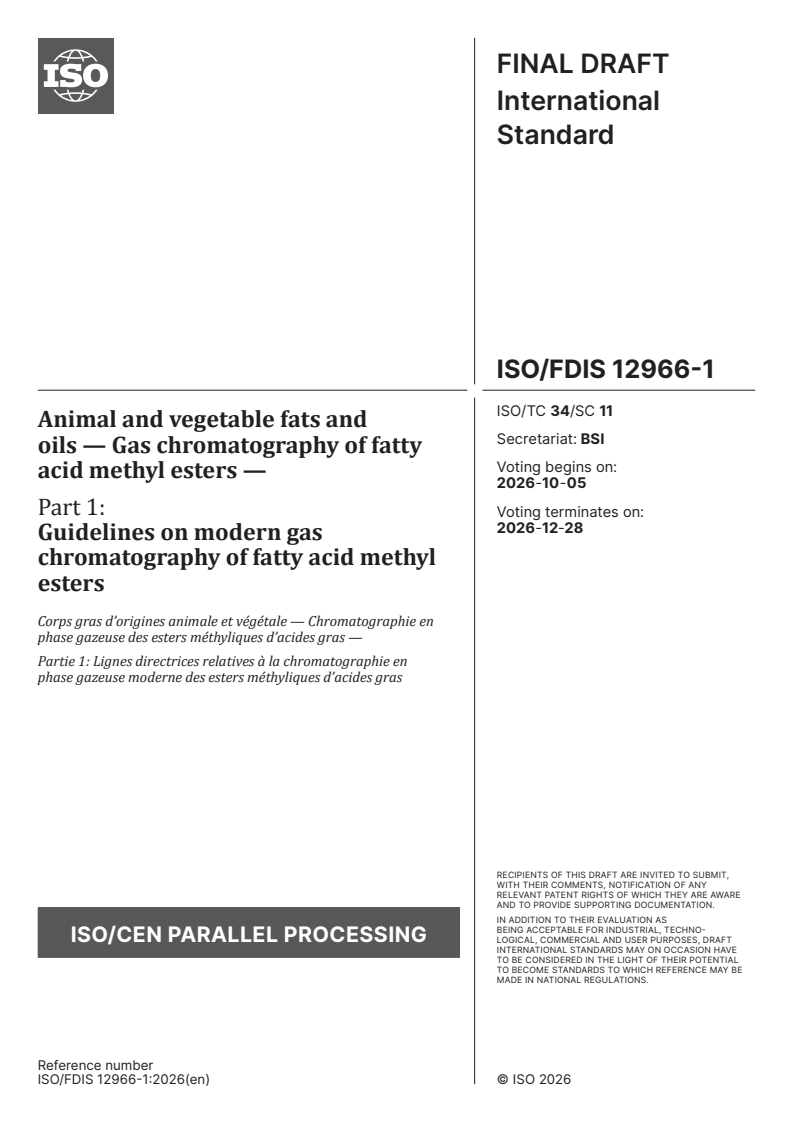
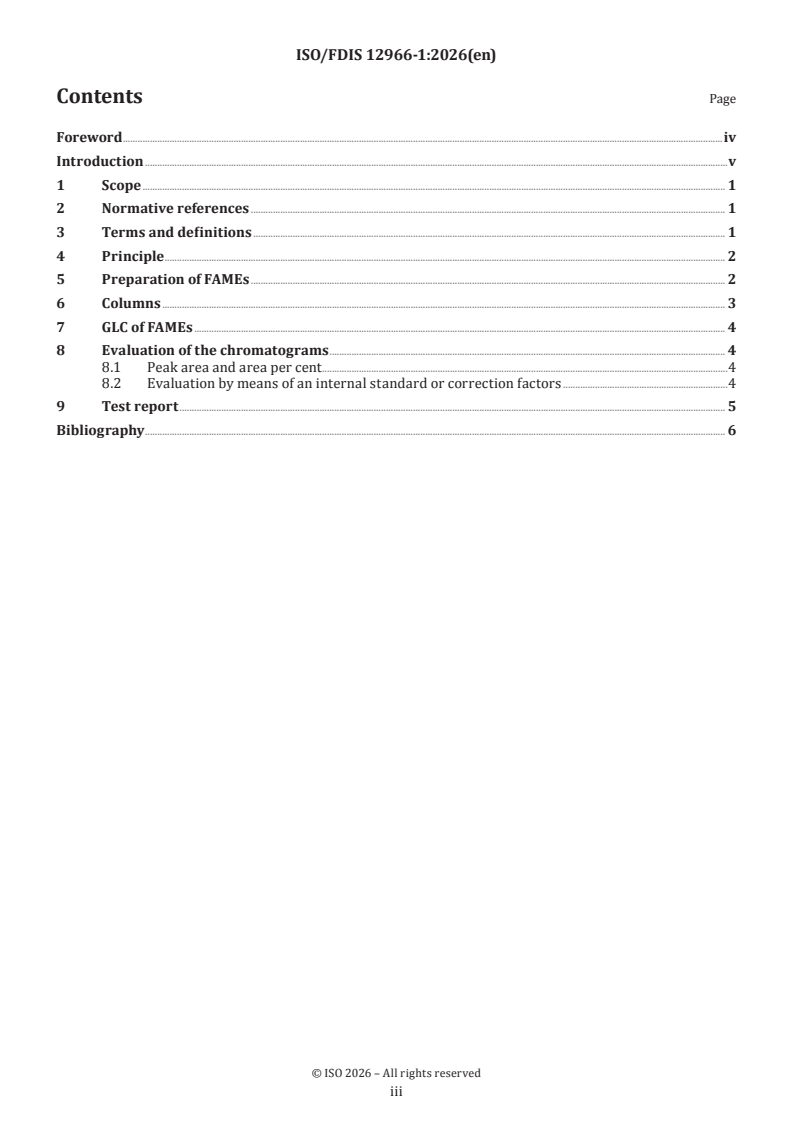
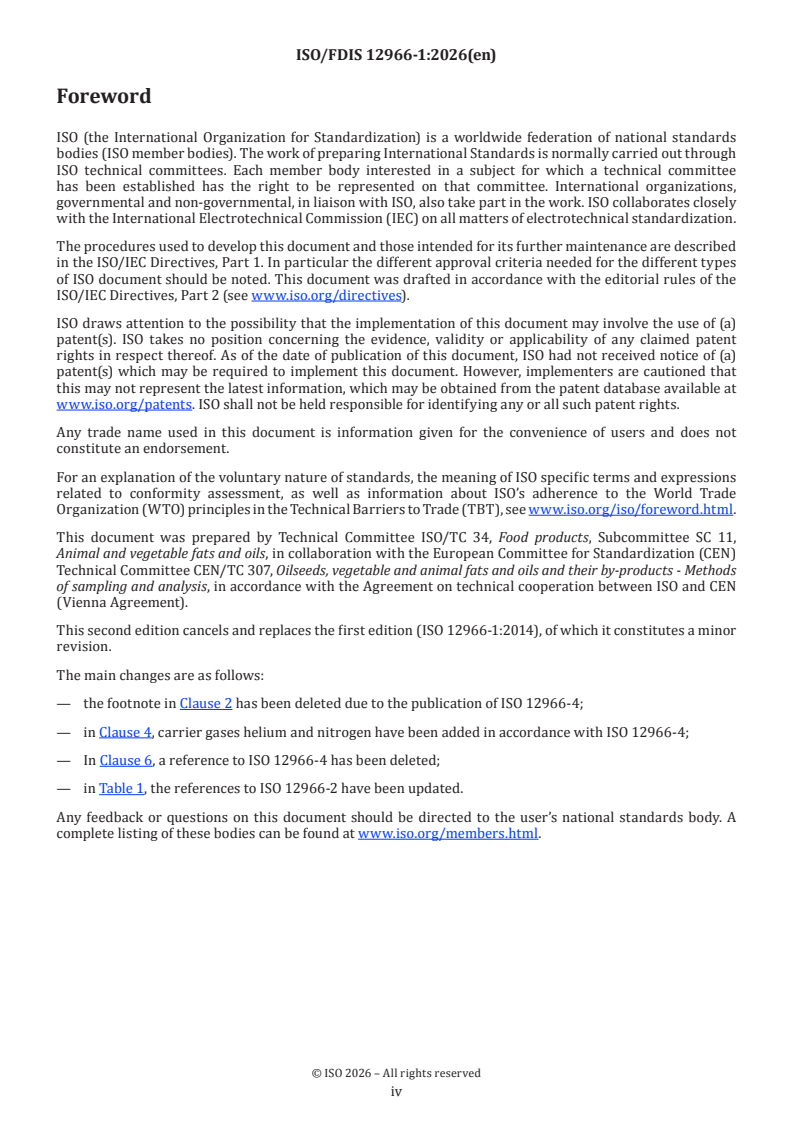
ISO/FDIS 12966-1 - Animal and vegetable fats and oils — Gas chromatography of fatty acid methyl esters — Part 1: Guidelines on modern gas chromatography of fatty acid methyl esters
REDLINE ISO/FDIS 12966-1 - Animal and vegetable fats and oils — Gas chromatography of fatty acid methyl esters — Part 1: Guidelines on modern gas chromatography of fatty acid methyl esters
Overview
ISO/FDIS 12966-1 is an ISO standard for animal and vegetable fats and oils that provides guidelines on modern gas chromatography of fatty acid methyl esters (FAMEs). It gives an overview of the gas chromatographic determination of fatty acids, free and bound, after conversion to FAMEs.
This standard is part of the ISO 12966 series for fatty acid methyl ester analysis in lipid testing. It supports laboratories working with fats, oils, and extracted fat from foodstuffs by helping define a consistent approach to gas chromatography (GLC) and capillary gas chromatography workflows.
ISO/FDIS 12966-1 is especially relevant for organizations that need reliable fatty acid composition analysis, FAME preparation guidance, and chromatographic evaluation aligned with internationally recognized practices.
Key Topics
ISO/FDIS 12966-1 focuses on practical guidance for modern gas chromatography of FAMEs, including:
Scope of analysis
- Covers qualitative and quantitative determination of fatty acids
- Applies to animal and vegetable fats and oils after conversion to FAMEs
- Supports analysis of saturated, cis, and trans fatty acid methyl esters
Preparation of FAMEs
- Refers users to the relevant ISO 12966 preparation methods
- Highlights the importance of selecting the appropriate esterification route
- Notes that preparation method choice can affect suitability for specific sample types
Columns and separation
- Describes the use of wall coated open tubular (WCOT) capillary columns
- Emphasizes column polarity, length, and film thickness as key factors in separation
- Addresses the analysis of complex mixtures, including cis-trans isomers
Chromatographic evaluation
- Explains peak area assessment and area per cent reporting
- Notes when response factors or internal standards should be used
- Supports accurate interpretation of chromatograms for lipid profiling
Test reporting
- Outlines the information that should appear in the test report
- Promotes traceability, transparency, and reproducibility in FAME analysis
Applications
ISO/FDIS 12966-1 is useful in a wide range of food and lipid analysis environments, including:
- Quality control of edible oils and fats
- Fatty acid profile testing in food laboratories
- Analysis of crude, refined, partially hydrogenated, or fully hydrogenated fats and oils
- Characterization of fatty foodstuffs after extraction
- Routine laboratory method selection for GC-FAME workflows
The standard is designed to support practical laboratory use where accurate fatty acid methyl ester analysis is needed. It is particularly valuable when selecting chromatographic conditions for complex samples, ensuring consistent interpretation of fatty acid composition results.
Related Standards
ISO/FDIS 12966-1 is part of the broader ISO 12966 series:
- ISO 12966-2 - Preparation of methyl esters of fatty acids
- ISO 12966-3 - Preparation of methyl esters using trimethylsulfonium hydroxide (TMSH)
- ISO 12966-4 - Determination by capillary gas chromatography
Together, these standards provide a structured framework for FAME analysis, from sample preparation through chromatographic determination and reporting.
Relations
- Effective Date
- 11-Apr-2026
Buy Documents
ISO/FDIS 12966-1 - Animal and vegetable fats and oils — Gas chromatography of fatty acid methyl esters — Part 1: Guidelines on modern gas chromatography of fatty acid methyl esters
REDLINE ISO/FDIS 12966-1 - Animal and vegetable fats and oils — Gas chromatography of fatty acid methyl esters — Part 1: Guidelines on modern gas chromatography of fatty acid methyl esters
Get Certified
Connect with accredited certification bodies for this standard

BSI Group
BSI (British Standards Institution) is the business standards company that helps organizations make excellence a habit.

Bureau Veritas
Bureau Veritas is a world leader in laboratory testing, inspection and certification services.

DNV
DNV is an independent assurance and risk management provider.
Sponsored listings
Frequently Asked Questions
ISO/FDIS 12966-1 is a draft published by the International Organization for Standardization (ISO). Its full title is "Animal and vegetable fats and oils — Gas chromatography of fatty acid methyl esters — Part 1: Guidelines on modern gas chromatography of fatty acid methyl esters". This standard covers: ISO 12966-1:2014 gives an overview of the gas chromatographic determination of fatty acids, free and bound, in animal and vegetable fats and oils following their conversion to fatty acid methyl esters (FAMEs).
ISO 12966-1:2014 gives an overview of the gas chromatographic determination of fatty acids, free and bound, in animal and vegetable fats and oils following their conversion to fatty acid methyl esters (FAMEs).
ISO/FDIS 12966-1 is classified under the following ICS (International Classification for Standards) categories: 67.200.10 - Animal and vegetable fats and oils. The ICS classification helps identify the subject area and facilitates finding related standards.
ISO/FDIS 12966-1 has the following relationships with other standards: It is inter standard links to ISO 12966-1:2014. Understanding these relationships helps ensure you are using the most current and applicable version of the standard.
ISO/FDIS 12966-1 is available in PDF format for immediate download after purchase. The document can be added to your cart and obtained through the secure checkout process. Digital delivery ensures instant access to the complete standard document.
Standards Content (Sample)
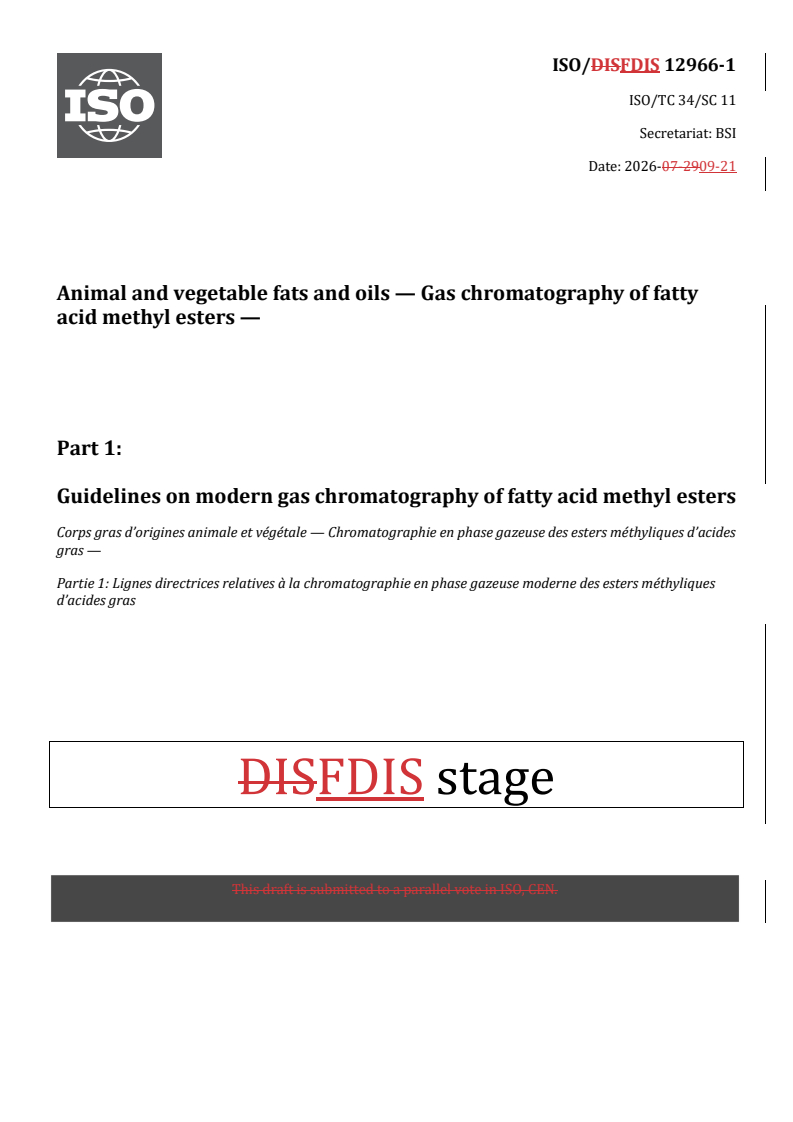
FINAL DRAFT
International
Standard
ISO/TC 34/SC 11
Animal and vegetable fats and
Secretariat: BSI
oils — Gas chromatography of fatty
Voting begins on:
acid methyl esters —
2026-10-05
Part 1:
Voting terminates on:
2026-12-28
Guidelines on modern gas
chromatography of fatty acid methyl
esters
Corps gras d’origines animale et végétale — Chromatographie en
phase gazeuse des esters méthyliques d’acides gras —
Partie 1: Lignes directrices relatives à la chromatographie en
phase gazeuse moderne des esters méthyliques d’acides gras
RECIPIENTS OF THIS DRAFT ARE INVITED TO SUBMIT,
WITH THEIR COMMENTS, NOTIFICATION OF ANY
RELEVANT PATENT RIGHTS OF WHICH THEY ARE AWARE
AND TO PROVIDE SUPPOR TING DOCUMENTATION.
IN ADDITION TO THEIR EVALUATION AS
BEING ACCEPTABLE FOR INDUSTRIAL, TECHNO-
ISO/CEN PARALLEL PROCESSING LOGICAL, COMMERCIAL AND USER PURPOSES, DRAFT
INTERNATIONAL STANDARDS MAY ON OCCASION HAVE
TO BE CONSIDERED IN THE LIGHT OF THEIR POTENTIAL
TO BECOME STAN DARDS TO WHICH REFERENCE MAY BE
MADE IN NATIONAL REGULATIONS.
Reference number
FINAL DRAFT
International
Standard
ISO/TC 34/SC 11
Animal and vegetable fats and
Secretariat: BSI
oils — Gas chromatography of fatty
Voting begins on:
acid methyl esters —
Part 1:
Voting terminates on:
Guidelines on modern gas
chromatography of fatty acid methyl
esters
Corps gras d’origines animale et végétale — Chromatographie en
phase gazeuse des esters méthyliques d’acides gras —
Partie 1: Lignes directrices relatives à la chromatographie en
phase gazeuse moderne des esters méthyliques d’acides gras
RECIPIENTS OF THIS DRAFT ARE INVITED TO SUBMIT,
WITH THEIR COMMENTS, NOTIFICATION OF ANY
RELEVANT PATENT RIGHTS OF WHICH THEY ARE AWARE
AND TO PROVIDE SUPPOR TING DOCUMENTATION.
© ISO 2026
IN ADDITION TO THEIR EVALUATION AS
All rights reserved. Unless otherwise specified, or required in the context of its implementation, no part of this publication may
BEING ACCEPTABLE FOR INDUSTRIAL, TECHNO-
ISO/CEN PARALLEL PROCESSING
LOGICAL, COMMERCIAL AND USER PURPOSES, DRAFT
be reproduced or utilized otherwise in any form or by any means, electronic or mechanical, including photocopying, or posting on
INTERNATIONAL STANDARDS MAY ON OCCASION HAVE
the internet or an intranet, without prior written permission. Permission can be requested from either ISO at the address below
TO BE CONSIDERED IN THE LIGHT OF THEIR POTENTIAL
or ISO’s member body in the country of the requester.
TO BECOME STAN DARDS TO WHICH REFERENCE MAY BE
MADE IN NATIONAL REGULATIONS.
ISO copyright office
CP 401 • Ch. de Blandonnet 8
CH-1214 Vernier, Geneva
Phone: +41 22 749 01 11
Email: copyright@iso.org
Website: www.iso.org
Published in Switzerland Reference number
ii
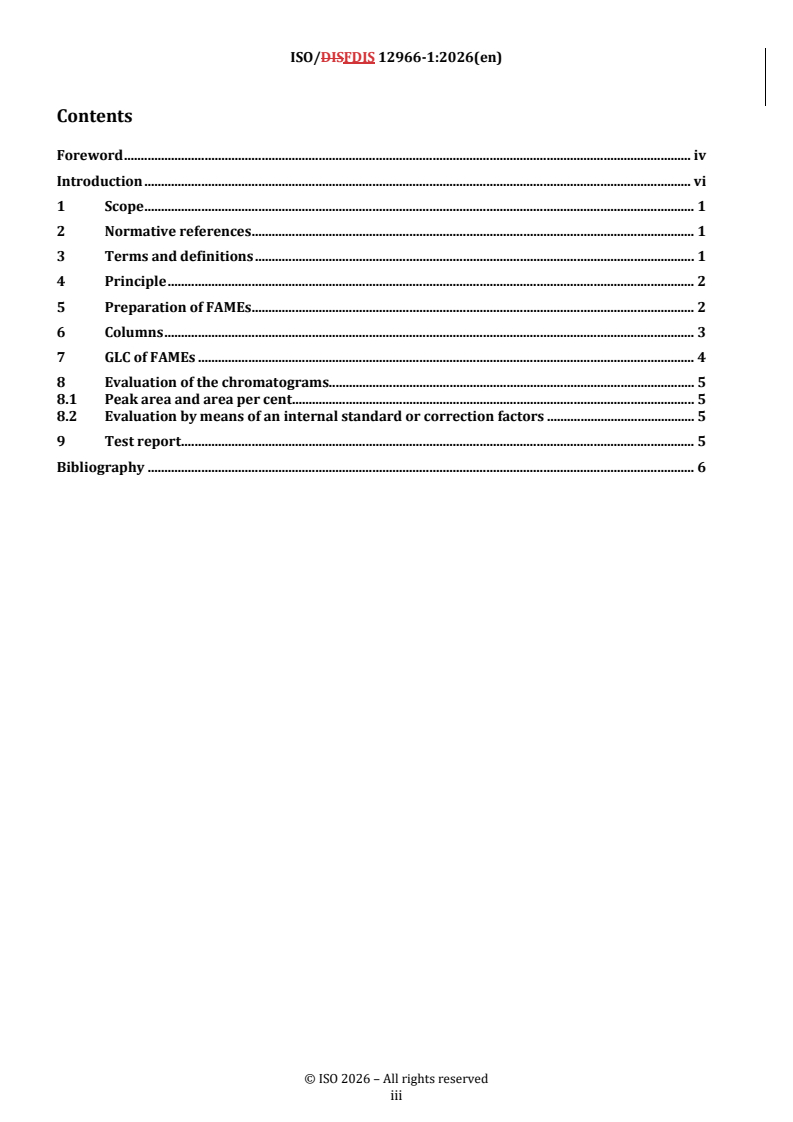
Contents Page
Foreword .iv
Introduction .v
1 Scope . 1
2 Normative references . 1
3 Terms and definitions . 1
4 Principle . 2
5 Preparation of FAMEs . 2
6 Columns . 3
7 GLC of FAMEs . 4
8 Evaluation of the chromatograms . 4
8.1 Peak area and area per cent .4
8.2 Evaluation by means of an internal standard or correction factors .4
9 Test report . 5
Bibliography . 6
iii
Foreword
ISO (the International Organization for Standardization) is a worldwide federation of national standards
bodies (ISO member bodies). The work of preparing International Standards is normally carried out through
ISO technical committees. Each member body interested in a subject for which a technical committee
has been established has the right to be represented on that committee. International organizations,
governmental and non-governmental, in liaison with ISO, also take part in the work. ISO collaborates closely
with the International Electrotechnical Commission (IEC) on all matters of electrotechnical standardization.
The procedures used to develop this document and those intended for its further maintenance are described
in the ISO/IEC Directives, Part 1. In particular the different approval criteria needed for the different types
of ISO document should be noted. This document was drafted in accordance with the editorial rules of the
ISO/IEC Directives, Part 2 (see www.iso.org/directives).
ISO draws attention to the possibility that the implementation of this document may involve the use of (a)
patent(s). ISO takes no position concerning the evidence, validity or applicability of any claimed patent
rights in respect thereof. As of the date of publication of this document, ISO had not received notice of (a)
patent(s) which may be required to implement this document. However, implementers are cautioned that
this may not represent the latest information, which may be obtained from the patent database available at
www.iso.org/patents. ISO shall not be held responsible for identifying any or all such patent rights.
Any trade name used in this document is information given for the convenience of users and does not
constitute an endorsement.
For an explanation of the voluntary nature of standards, the meaning of ISO specific terms and expressions
related to conformity assessment, as well as information about ISO’s adherence to the World Trade
Organization (WTO) principles in the Technical Barriers to Trade (TBT), see www.iso.org/iso/foreword.html.
This document was prepared by Technical Committee ISO/TC 34, Food products, Subcommittee SC 11,
Animal and vegetable fats and oils, in collaboration with the European Committee for Standardization (CEN)
Technical Committee CEN/TC 307, Oilseeds, vegetable and animal fats and oils and their by-products - Methods
of sampling and analysis, in accordance with the Agreement on technical cooperation between ISO and CEN
(Vienna Agreement).
This second edition cancels and replaces the first edition (ISO 12966-1:2014), of which it constitutes a minor
revision.
The main changes are as follows:
— the footnote in Clause 2 has been deleted due to the publication of ISO 12966-4;
— in Clause 4, carrier gases helium and nitrogen have been added in accordance with ISO 12966-4;
— In Clause 6, a reference to ISO 12966-4 has been deleted;
— in Table 1, the references to ISO 12966-2 have been updated.
Any feedback or questions on this document should be directed to the user’s national standards body. A
complete listing of these bodies can be found at www.iso.org/members.html.
iv
Introduction
This document is one part of a series of four International Standards for the preparation and determination
of fatty acid methyl esters (FAMEs) by gas chromatography in animal and vegetable fats and oils. The
ISO 12966 series is applicable to crude, refined, partially hydrogenated or fully hydrogenated fats, oils and
fatty acids derived from animal and vegetable sources, and fats extracted from foodstuffs.
The ISO 12966 series is not suitable for the analysis of dairy, ruminant fats and oils (including milk and milk
products or fat coming from milk and milk products), or products supplemented with conjugated linoleic
acid (CLA). Furthermore, it is not intended to be applied to polymerized and oxidized fats and oils.
[1]
This document is a guideline to the modern gas chromatography of FAMEs, while ISO 12966-2 and
[2] [3]
ISO 12966-3 cover the preparation of FAMEs by different methods. In ISO 12966-4 , the conditions for
the analysis of FAMEs by capillary gas chromatography are given.
v
FINAL DRAFT International Standard ISO/FDIS 12966-1:2026(en)
Animal and vegetable fats and oils — Gas chromatography of
fatty acid methyl esters —
Part 1:
Guidelines on modern gas chromatography of fatty acid
methyl esters
1 Scope
This document gives an overview of the gas chromatographic determination of fatty acids, free and bound,
in animal and vegetable fats and oils following their conversion to fatty acid methyl esters (FAMEs).
The qualitative and quantitative determination of the composition of fatty acids by gas liquid chromatography
(GLC) is a widely used application in lipid analysis. It is used for the characterization of fats and oils, or fatty
foodstuffs after the extraction of the oil from the matrix. The bound fatty acids of the triacylglycerols (TAGs)
and, depending on the esterification method, the free fatty acids (FFAs) and other lipids, are converted to
FAMEs, which are determined by capillary gas chromatography. Depending on the number of different fatty
acids (theoretically more than 50 different fatty acids can be present) capillary columns with a length of 10
m to 100 m are used for a separation.
The GLC of FAMEs is applicable to all natural and synthetic mixtures of tri-, di- and monoacylglycerols, as
well as to fatty acid esters, FFAs, soaps and other fatty compounds. With the ISO 12966 series, FAMEs from
C4 to C26 can be determined, including saturated FAMEs, cis- and trans-monounsaturated FAMEs, and cis-
and trans-polyunsaturated FAMEs.
For the determination of short chain fatty acids, isopropyl and butyl esters are often used so as to avoid
interferences with the solvent peak and in order to reduce differences in detector responses.
2 Normative references
The following documents are referred to in the text in such a way that some or all of their content constitutes
requirements of this document. For dated references, only the edition cited applies. For undated references,
the latest edition of the referenced document (including any amendments) applies.
ISO 12966-2, Animal and vegetable fats and oils — Gas chromatography of fatty acid methyl esters — Part 2:
Preparation of methyl esters of fatty acids
ISO 12966-3, Animal and vegetable fats and oils — Gas chromatography of fatty acid methyl esters — Part 3:
Preparation of methyl esters using trimethylsulfonium hydroxide (TMSH)
ISO 12966-4, Animal and vegetable fats and oils — Gas chromatography of fatty acid methyl esters — Part 4:
Determination by capillary gas chromatography
3 Terms and definitions
No terms and definitions are listed in this document.
ISO and IEC maintain terminology databases for use in standardization at the following addresses:
— ISO Online browsing platform: available at https:// www .iso .org/ obp
— IEC Electropedia: available at https:// www .electropedia .org/
4 Principle
GLC is used for the qualitative and quantitative analysis of FAMEs. The FAMEs are prepared in accordance
[1] [2]
with ISO 12966-2 or ISO 12966-3 and the dissolved FAMEs are then injected into and vapori
...
ISO/DISFDIS 12966-1
ISO/TC 34/SC 11
Secretariat: BSI
Date: 2026-07-2909-21
Animal and vegetable fats and oils — Gas chromatography of fatty
acid methyl esters —
Part 1:
Guidelines on modern gas chromatography of fatty acid methyl esters
Corps gras d’origines animale et végétale — Chromatographie en phase gazeuse des esters méthyliques d’acides
gras —
Partie 1: Lignes directrices relatives à la chromatographie en phase gazeuse moderne des esters méthyliques
d’acides gras
DISFDIS stage
TTTTTTTTThhhhhhhhhiiiiiiiiisssssssss d d d d d d d d drrrrrrrrraftaftaftaftaftaftaftaftaft i i i i i i i i isssssssss s s s s s s s s suuuuuuuuubbbbbbbbbmmmmmmmmmiiiiiiiiittttttttttttttttttededededededededed t t t t t t t t tooooooooo a pa pa pa pa pa pa pa pa parararararararararallel vallel vallel vallel vallel vallel vallel vallel vallel vooooooooottttttttte e e e e e e e e iiiiiiiiinnnnnnnnn I I I I I I I I ISSSSSSSSSOOOOOOOOO,,,,,,,,, C C C C C C C C CEEEEEEEEENNNNNNNNN.
ISO/DISFDIS 12966-1:2026(en)
All rights reserved. Unless otherwise specified, or required in the context of its implementation, no part of this publication
may be reproduced or utilized otherwise in any form or by any means, electronic or mechanical, including photocopying,
or posting on the internet or an intranet, without prior written permission. Permission can be requested from either ISO
at the address below or ISO’s member body in the country of the requester.
ISO copyright office
CP 401 • Ch. de Blandonnet 8
CH-1214 Vernier, Geneva
Phone: + 41 22 749 01 11
E-mail: copyright@iso.org
Website: www.iso.org
Published in Switzerland
ii
ISO/DISFDIS 12966-1:2026(en)
Contents
Foreword . iv
Introduction . vi
1 Scope . 1
2 Normative references . 1
3 Terms and definitions . 1
4 Principle . 2
5 Preparation of FAMEs . 2
6 Columns . 3
7 GLC of FAMEs . 4
8 Evaluation of the chromatograms. 5
8.1 Peak area and area per cent. 5
8.2 Evaluation by means of an internal standard or correction factors . 5
9 Test report . 5
Bibliography . 6
iii
ISO/DISFDIS 12966-1:2026(en)
Foreword
ISO (the International Organization for Standardization) is a worldwide federation of national standards
bodies (ISO member bodies). The work of preparing International Standards is normally carried out through
ISO technical committees. Each member body interested in a subject for which a technical committee has been
established has the right to be represented on that committee. International organizations, governmental and
non-governmental, in liaison with ISO, also take part in the work. ISO collaborates closely with the
International Electrotechnical Commission (IEC) on all matters of electrotechnical standardization.
The procedures used to develop this document and those intended for its further maintenance are described
in the ISO/IEC Directives, Part 1. In particular the different approval criteria needed for the different types of
ISO documentsdocument should be noted. This document was drafted in accordance with the editorial rules
of the ISO/IEC Directives, Part 2 (see www.iso.org/directives).
Attention is drawnISO draws attention to the possibility that some of the elementsimplementation of this
document may beinvolve the subjectuse of (a) patent(s). ISO takes no position concerning the evidence,
validity or applicability of any claimed patent rights in respect thereof. As of the date of publication of this
document, ISO had not received notice of (a) patent(s) which may be required to implement this document.
However, implementers are cautioned that this may not represent the latest information, which may be
obtained from the patent database available at www.iso.org/patents. ISO shall not be held responsible for
identifying any or all such patent rights. Details of any patent rights identified during the development of the
document will be in the Introduction and/or on the ISO list of patent declarations received (see ).
Any trade name used in this document is information given for the convenience of users and does not
constitute an endorsement.
For an explanation onof the voluntary nature of standards, the meaning of ISO specific terms and expressions
related to conformity assessment, as well as information about ISO’s adherence to the World Trade
Organization (WTO) principles in the Technical Barriers to Trade (TBT)), see
www.iso.org/iso/foreword.htmlthe following URL: .
The committee responsible for this This document iswas prepared by Technical Committee ISO/TC 34, Food
products, Subcommittee SC 11, Animal and vegetable fats and oils.
This first edition of ISO 12966-1, together, in collaboration with ISO 12966-4, cancelsthe European Committee
for Standardization (CEN) Technical Committee CEN/TC 307, Oilseeds, vegetable and replaces ISO
5508:1990animal fats and ISO 15304:2002 which have been technically revised.oils and their by-products -
Methods of sampling and analysis, in accordance with the Agreement on technical cooperation between ISO
and CEN (Vienna Agreement).
This second edition cancels and replaces the first edition (ISO 12966-1:2015),2014), of which has undergoneit
constitutes a minor revision.
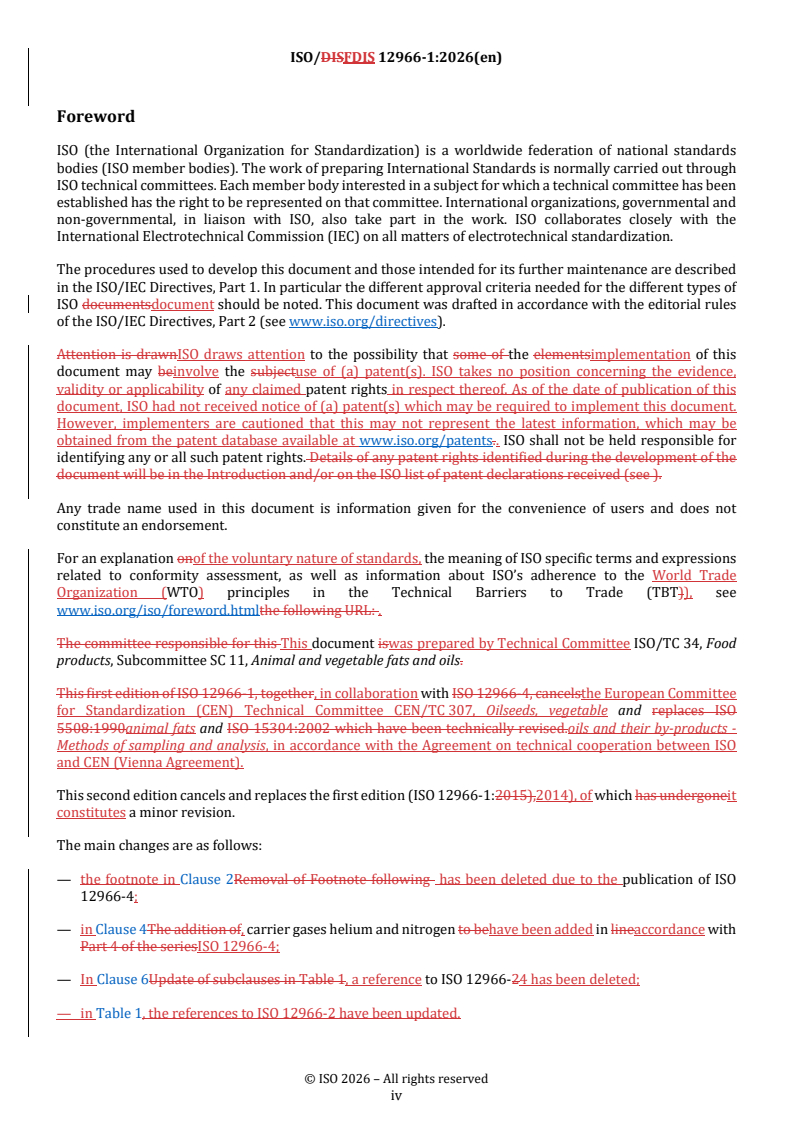
The main changes are as follows:
— the footnote in Clause 2Removal of Footnote following has been deleted due to the publication of ISO
12966-4;
— in Clause 4The addition of, carrier gases helium and nitrogen to behave been added in lineaccordance with
Part 4 of the seriesISO 12966-4;
— In Clause 6Update of subclauses in Table 1, a reference to ISO 12966-24 has been deleted;
— in Table 1, the references to ISO 12966-2 have been updated.
iv
ISO/DISFDIS 12966-1:2026(en)
ISO 12966 consists of the following parts, under the general title Animal and vegetable fats and oils — Gas
chromatography of fatty acid methyl esters:
— Part 1: Guidelines on modern gas chromatography of fatty acid methyl esters
— Part 2: Preparation of methyl esters of fatty acids
— Part 3: Preparation of methyl esters using trimethylsulfonium hydroxide (TMSH)
— Part 4: Determination by capillary gas chromatography
Any feedback or questions on this document should be directed to the user’s national standards body. A
complete listing of these bodies can be found at www.iso.org/members.html.
v
ISO/DISFDIS 12966-1:2026(en)
Introduction
This document is one part of ISO 12966 is one of a suiteseries of four International Standards for the
preparation and determination of fatty acid methyl esters (FAMEs) by gas chromatography in animal and
vegetable fats and oils. The ISO 12966 (all parts)series is applicable to crude, refined, partially hydrogenated
or fully hydrogenated fats, oils and fatty acids derived from animal and vegetable sources, and fats extracted
from foodstufffoodstuffs.
The ISO 12966 (all parts)series is not suitable for the analysis of dairy, ruminant fats and oils (including milk
and milk products or fat coming from milk and milk products), or products supplemented with conjugated
linoleic acid (CLA). Furthermore, it is not intended to be applied to polymerized and oxidized fats and oils.
This part of ISO 12966document is a guideline to the modern gas chromatography of fatty acid methyl
[4] [2]
estersFAMEs, while ISO 12966-2 ISO 12966-2 and ISO 12966-3 ISO 12966-3 cover the preparation of fatty
[8]
acid methyl estersFAMEs by different methods. In ISO 12966-4 ISO 12966-4,, the conditions for the analysis
of fatty acid methyl estersFAMEs by capillary gas chromatography are given.
This suite of International Standards replaces the following International Standards:
— ISO 5508:1990 is replaced by ISO 12966-1 and ISO 12966-4
— ISO 15304:2002 is replaced by ISO 12966-1 and ISO 12966-4
— ISO 5509:2000 is replaced by ISO 12966-2 and ISO 12966-3
vi
ISO/DISFDIS 12966-1:2026(en)
Animal and vegetable fats and oils — Gas chromatography of fatty acid
methyl esters —
Part 1:
Guidelines on modern gas chromatography of fatty acid methyl esters
1 Scope
This part of ISO 12966document gives an overview of the gas chromatographic determination of fatty acids,
free and bound, in animal and vegetable fats and oils following their conversion to fatty acid methyl esters
(FAMEs).
The qualitative and quantitative determination of the composition of fatty acids by gas liquid chromatography
(GLC) is a widely used application in lipid analysis. It is used for the characterization of fats and oils, or fatty
foodstuffs after the extraction of the oil from the matrix. The bound fatty acids of the triacylglycerols (TAGs)
and, depending on the esterification method, the free fatty acids (FFAFFAs) and other lipids, are converted to
fatty acid methyl esters (FAMEs),, which are determined by capillary gas chromatography. Depending on the
number of different fatty acids (theoretically more than 50 different fatty acids can be present) capillary
columns with a length of 10 m to 100 m are used for a separation.
The GLC of FAMEs is applicable to all natural and synthetic mixtures of tri-, di- and monoacylglycerols, as well
as to fatty acid esters, free fatty acidsFFAs, soaps and other fatty compounds. With this suite of standardsthe
ISO 12966 series, FAMEs from C4 to C26 can be determined, including saturated fatty acid methyl
estersFAMEs, cis- and trans-monounsaturated fatty acid methyl estersFAMEs, and cis- and trans-
polyunsaturated fatty acid methyl estersFAMEs.
For the determination of short chain fatty acids, isopropyl and butyl esters are often used so as to avoid
interferences with the solvent peak and in order to reduce differences in detector responses.
2 Normative references
The following documents are referred to in the text in such a way that some or all of their content constitutes
requirements of this document. For dated references, only the edition cited applies. For undated references,
the latest edition of the referenced document (including any amendments) applies.
ISO 12966-2, Animal and vegetable fats and oils — Gas chromatography of fatty acid methyl esters — Part 2:
Preparation of methyl esters of fatty acids
ISO 12966-3, Animal and vegetable fats and oils — Gas chromatography of fatty acid methyl esters — Part 3:
Preparation of methyl esters using trimethylsulfonium hydroxide (TMSH)
ISO 12966-4, Animal and vegetable fats and oils — Gas chromatography of fatty acid methyl esters — Part 4:
Determination by capillary gas chromatography
3 Terms and definitions
There are noNo terms and definitions are listed in this document.
ISO and IEC maintain terminology databases for use in standardization at the following addresses:
— ISO Online browsing platform: available at https://www.iso.org/obp
ISO/DISFDIS 12966-1:2026(en)
— IEC Electropedia: available at https://www.electropedia.org/
4 Principle
Gas liquid chromatography (GLC)GLC is used for the qualitative and quantitative analysis of FAMEs. The
[4] [2]
FAMEs are prepared in accordance with ISO 12966-2 ISO 12966-2 or ISO 12966-3 ISO 12966-3 and the
dissolved FAMEs are then injected into and vaporized within the injector. The separation of FAMEs is achieved
on analytical columns of different polarity and lengths. For the detection of the FAMEs, a flame ionization
detector (FID) is used.
In the gas chromatography of FAMEs with FID, hydrogen (recommended), nitrogenshould be used as the
carrier gas (mobile phase). Nitrogen or helium with a purity of 99,995 % or greater canbe
...