


ISO 9004-3:1993
(Main)Quality management and quality system elements — Part 3: Guidelines for processed materials
Quality management and quality system elements — Part 3: Guidelines for processed materials
Management de la qualité et éléments de système qualité — Partie 3: Lignes directrices pour les produits issus de processus à caractère continu
Vodenje kakovosti in elementi sistema kakovosti - 3. del: Smernice za predelane materiale
General Information
- Status
- Withdrawn
- Publication Date
- 16-Jun-1993
- Withdrawal Date
- 16-Jun-1993
- Technical Committee
- ISO/TC 176/SC 2 - Quality systems
- Drafting Committee
- ISO/TC 176/SC 2 - Quality systems
- Current Stage
- 9599 - Withdrawal of International Standard
- Start Date
- 26-Apr-2001
- Completion Date
- 14-Feb-2026
Buy Documents

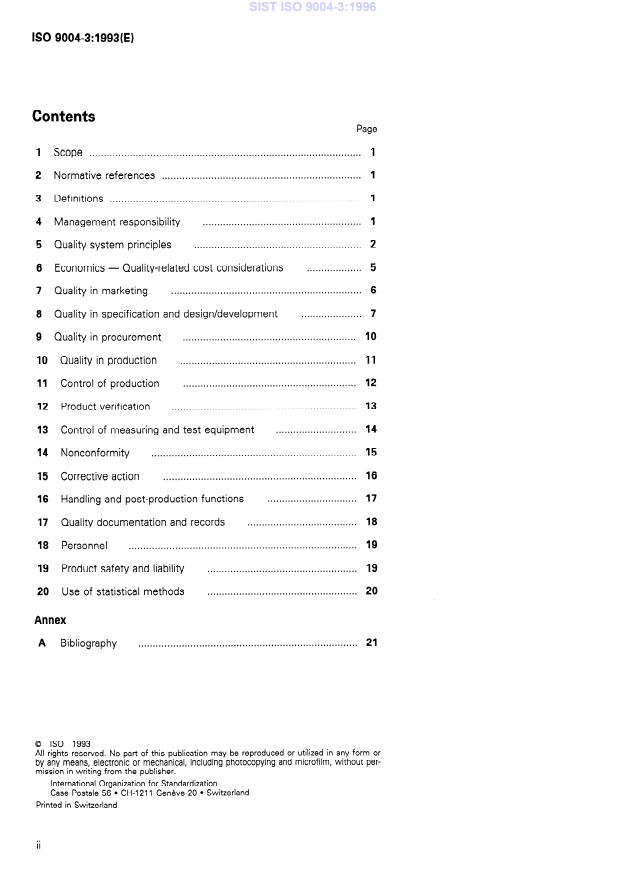
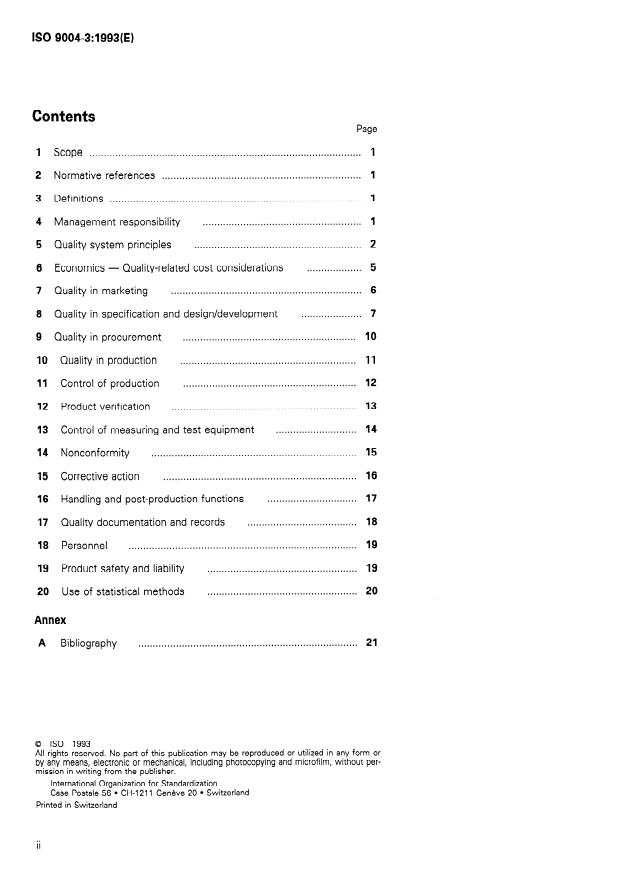
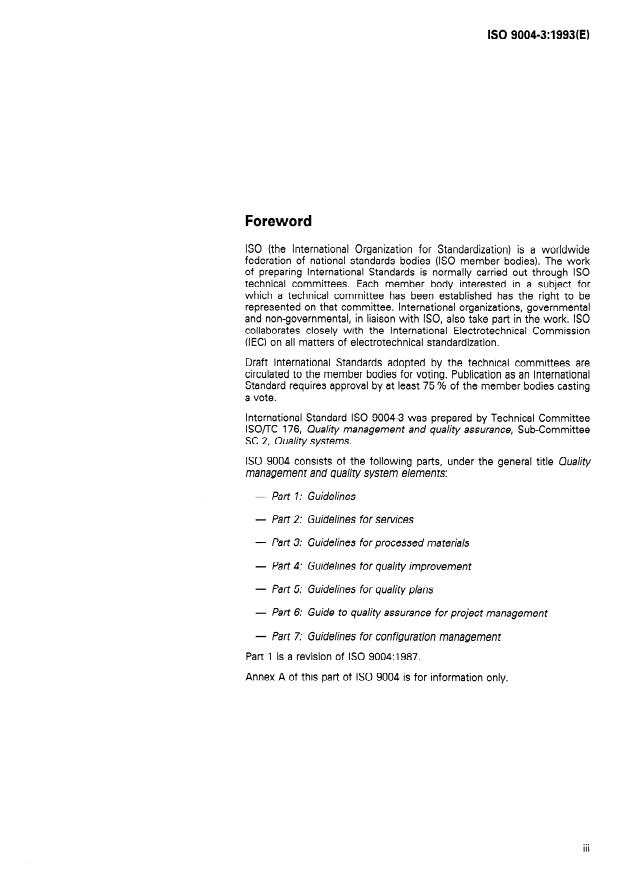
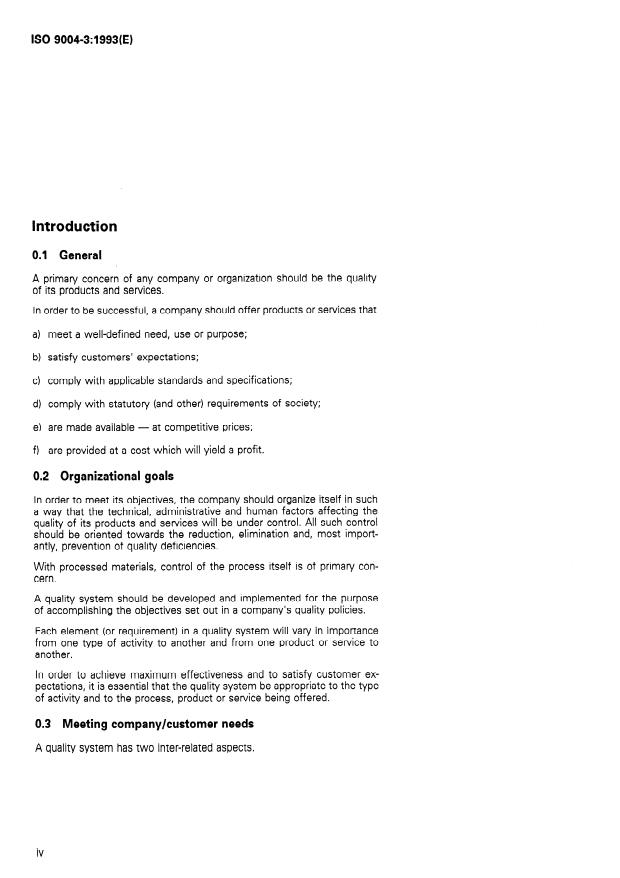
ISO 9004-3:1993 - Quality management and quality system elements
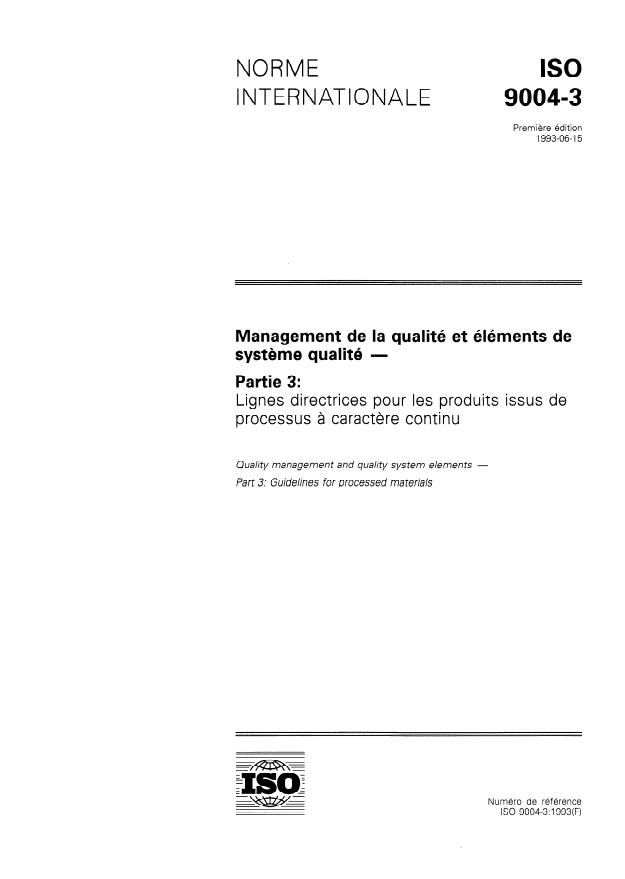
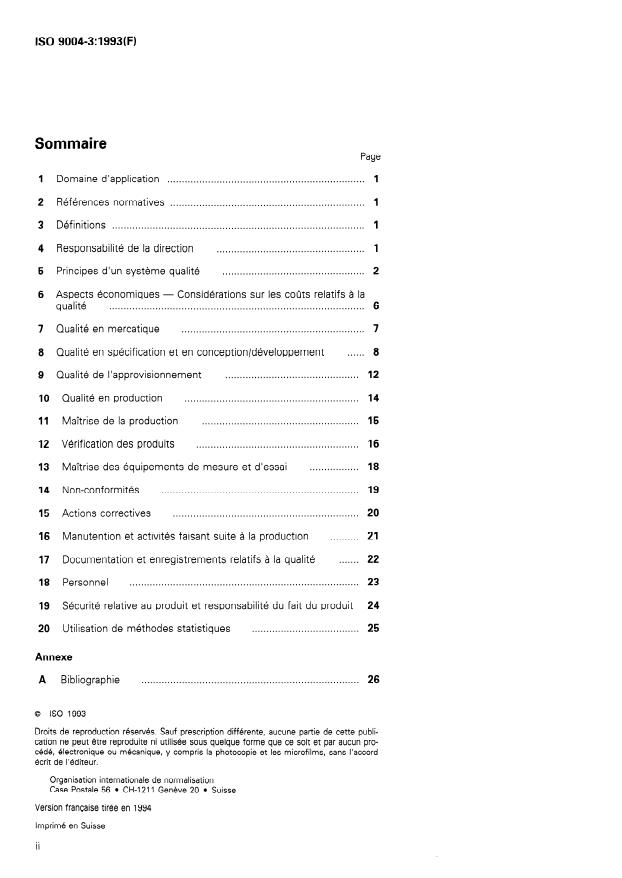
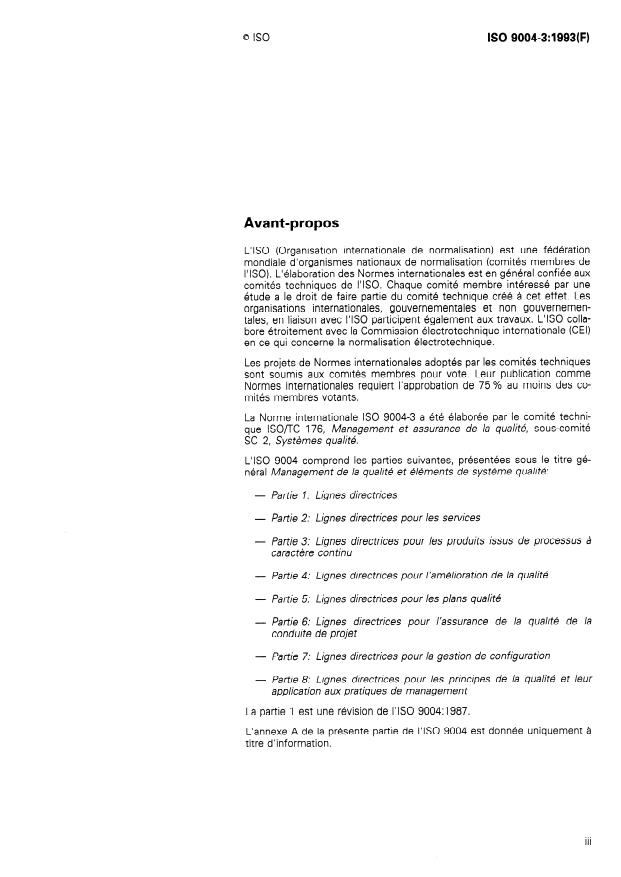
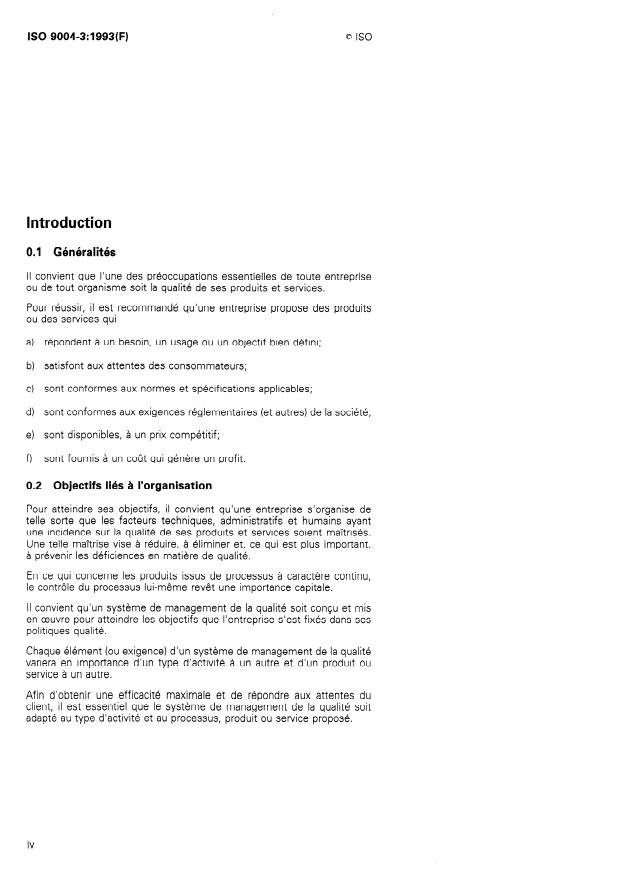
ISO 9004-3:1993 - Management de la qualité et éléments de systeme qualité
Get Certified
Connect with accredited certification bodies for this standard

BSI Group
BSI (British Standards Institution) is the business standards company that helps organizations make excellence a habit.

Bureau Veritas
Bureau Veritas is a world leader in laboratory testing, inspection and certification services.

DNV
DNV is an independent assurance and risk management provider.
Sponsored listings
Frequently Asked Questions
ISO 9004-3:1993 is a standard published by the International Organization for Standardization (ISO). Its full title is "Quality management and quality system elements — Part 3: Guidelines for processed materials". This standard covers: Quality management and quality system elements — Part 3: Guidelines for processed materials
Quality management and quality system elements — Part 3: Guidelines for processed materials
ISO 9004-3:1993 is classified under the following ICS (International Classification for Standards) categories: 03.100.70 - Management systems; 03.120.10 - Quality management and quality assurance. The ICS classification helps identify the subject area and facilitates finding related standards.
ISO 9004-3:1993 is available in PDF format for immediate download after purchase. The document can be added to your cart and obtained through the secure checkout process. Digital delivery ensures instant access to the complete standard document.
Standards Content (Sample)
SLOVENSKI STANDARD
01-maj-1996
Vodenje kakovosti in elementi sistema kakovosti - 3. del: Smernice za predelane
materiale
Quality management and quality system elements -- Part 3: Guidelines for processed
materials
Management de la qualité et éléments de système qualité -- Partie 3: Lignes directrices
pour les produits issus de processus à caractère continu
Ta slovenski standard je istoveten z: ISO 9004-3:1993
ICS:
03.120.10 Vodenje in zagotavljanje Quality management and
kakovosti quality assurance
2003-01.Slovenski inštitut za standardizacijo. Razmnoževanje celote ali delov tega standarda ni dovoljeno.
INTERNATIONAL IS0
STANDARD 9004-3
First edition
1993-06-l 5
Quality management and quality system
elements -
Part 3:
Guidelines for processed materials
Gestion de la qualit6 et Mments de systdme qua/it6 -
Partie 3: Lignes directrices pour /es mat&iels fabriquh
Reference number
IS0 9004-3:1993(E)
IS0 9004=3:1993(E)
Contents
Page
Scope . . . . . . . . . . . . . . . . . . . . . . . . . . . . . . . . . . . . . . . . . . . . . . . . . . . . . . . . . . . . . . . . . . . . . . . . . . . . . . . . . . . . . . . . . . . . . .
. . . . . . . . . . . . . . . . . . . . . . . . . . . . . . . . . . . . . . . . . . . . . . . . . . . . . . . . . . . . .“.
Normative references
Definitions . . . . . . . . . . . . . . . . . . . . . . . . . . . . . . . . . . . . . . . . . . . .~.
.......................................................
Management responsibility
..........................................................
Quality system principles
...................
- Quality-related cost considerations
Economics
..................................................................
Quality in marketing
.....................
Quality in specification and design/development
............................................................
Quality in procurement
.............................................................
10 Quality in production
............................................................
11 Control of production
................................................................
12 Product verification
............................ 14
13 Control of measuring and test equipment
.......................................................................
14 Nonconformity
...................................................................
15 Corrective action
...............................
16 Handling and post-production functions
......................................
17 Quality documentation and records
18 Personnel .
....................................................
Product safety and liability
....................................................
20 Use of statistical methods
Annex
............................................................................
A Bibliography
t3 IS0 1993
All rights reserved. No part of this publication may be reproduced or utilized in any form or
by any means, electronic or mechanical, including photocopying and microfilm, without per-
mission in writing from the publisher.
International Organization for Standardization
Case Postale 56 l CH-1211 Geneve 20 l Switzerland
Printed in Switzerland
ii
IS0 9004=3:1993(E)
Foreword
IS0 (the International Organization for Standardization) is a worldwide
federation of national standards bodies (IS0 member bodies). The work
of preparing International Standards is normally carried out through IS0
technical committees. Each member body interested in a subject for
which a technical committee has been established has the right to be
represented on that committee. International organizations, governmental
and non-governmental, in liaison with ISO, also take part in the work. IS0
collaborates closely with the International Electrotechnical Commission
(IEC) on all matters of electrotechnical standardization.
Draft International Standards adopted by the technical committees are
circulated to the member bodies for voting. Publication as an International
Standard requires approval by at least 75 % of the member bodies casting
a vote.
International Standard IS0 9004-3 was prepared by Technical Committee
lSO/TC 176, Quality management and quality assurance, Sub-Committee
SC 2, Quality systems.
IS0 9004 consists of the following parts, under the general title Quality
management and quality system elements:
- Part 1: Guidelines
- Part 2: Guidelines for services
- Part 3: Guidelines for processed materials
- Part 4: Guidelines for quality improvement
- Part 5: Guidelines for quality plans
- Part 6: Guide to quality assurance for project management
- Part 7: Guidelines for configuration management
Part 1 is a revision of IS0 9004:1987.
Annex A of this part of IS0 9004 is for information only.
. . .
III
IS0 9004-3:1993(E)
Introduction
0.1 General
A primary concern of any company or organization should be the quality
of its products and services.
fer products or services that
In order to be successful, a company should of
a) meet a well-defined need, use or purpose
b) satisfy customers’ expectations;
c) comply with applicable standards and specifications;
d) comply with statutory (and other) requirements of society;
e) are made available - at competitive prices;
are provided at a cost which will yield a profit.
f )
0.2 Organizational goals
In order to meet its objectives, the company should organize itself in such
a way that the technical, administrative and human factors affecting the
quality of its products and services will be under control. All such control
should be oriented towards the reduction, elimination and, most import-
antly, prevention of quality deficiencies.
With processed materials, control of the process itself is of primary con-
cern.
A quality system should be developed and implemented for the purpose
of accomplishing the objectives set out in a company’s quality policies.
Each element (or requirement) in a quality system will vary in importance
from one type of activity to another and from one product or service to
another.
In order to achieve maximum effectiveness and to satisfy customer ex-
pectations, it is essential that the quality system be appropriate to the type
of activity and to the process, product or service being offered.
03 . Meeting company/customer needs
A quality system has two inter-related aspects.
iv
IS0 9004=3:1993(E)
a) The company’s needs and interests
For the company, there is a business need to attain and to maintain the
desired quality at an optimum cost; the fulfilment of this quality aspect
is related to the planned and efficient utilization of the technological,
human and material resources available to the company.
b) The customer’s needs and expectations
For the customer, there is a need for confidence in the ability of the
company to deliver the desired quality as well as the consistent main-
tenance of that quality.
Each of the above aspects of a quality system requires objective evidence
in the form of information and data concerning the quality of the system
and the quality of the company’s products.
0.4 Risks, costs and benefits
Risk, cost and benefit considerations have great importance for both
company and customer. These considerations are inherent aspects of
most products and services. The possible effects and ramifications of
these considerations are given as follows.
Risk considerations
a)
For the company: Consideration has to be given to risks related to
deficient products or services which lead to loss of image or reputation,
loss of market, complaints, claims, liability, safety, waste of human and
financial resources.
For the customer: Consideration has to be given to risks such as
those pertaining to the health and safety of people, dissatisfaction with
goods and services, availability, marketing claims and loss of confi-
dence.
Cost considerations
b)
For the company: Consideration has to be given to costs due to
marketing and design deficiencies, including unsatisfactory materials,
rework, repair, replacement, reprocessing, loss of production, warran-
ties and field repair.
For the customer: Consideration has to be given to safety, acquisition
cost, operating, maintenance, downtime and repair costs, and possible
disposal costs.
d Benefit considerations
For the company: Consideration has to be given to increased profit-
ability and market share.
For the customer: Consideration has to be given to reduced costs,
improved fitness for use, increased satisfaction and growth in confi-
dence.
0.5 Conclusions
An effective quality system should be designed to satisfy customer needs
and expectations while serving to protect the company’s interests. A
well-structured quality system is a valuable management resource in the
optimization and control of quality in relation to risk, cost and benefit con-
siderations.
This page intentionally left blank
IS0 9004=3:1993(E)
INTERNATIONAL STANDARD
Quality management and quality system elements -
Part 3:
Guidelines for processed materials
3.1 processed materials: Products (final or inter-
1 Scope
mediate) prepared by transformations, consisting of
solids, liquids, gases, or combinations thereof, includ-
This part of IS0 9004 gives guidance on the appli-
ing particulate materials, ingots, filaments or sheet
cation of quality management to processed materials.
structures.
The selection of appropriate elements contained in
NOTE 1 Processed materials are typically delivered in
this part of IS0 9004 and the extent to which these
bulk systems, such as pipelines, drums, bags, tanks, cans
elements are adopted and applied by a company de-
or rolls.
pend upon factors such as the market being served,
the nature of the product, production processes and
consumer needs.
4 Management responsibility
This part of IS0 9004 is not intended to be used as a
checklist for compliance with a set of requirements.
4.1 General
The responsibility for and commitment to a quality
2 Normative references
policy belongs to the highest level of management.
Quality management is that aspect of the overall
The following standards contain provisions which,
management function which determines and im-
through reference in this text, constitute provisions
of this part of IS0 9004. At the time of publication, the plements quality policy.
editions indicated were valid. All standards are subject
to revision, and parties to agreements based on this
4.2 Quality policy
part of IS0 9004 are encouraged to investigate the
possibility of applying the most recent editions of the
The management of a company should develop and
standards indicated below. Members of IEC and IS0
state its corporate quality policy. This policy should be
maintain registers of currently valid International
consistent with other company policies. Management
Standards.
should take all necessary measures to ensure that its
corporate quality policy is understood, implemented
IS0 8402: -l) Quality management and quality as-
and maintained.
surance - Vdcabulary.
IS0 9004: 1987, Quality management and quality sys-
4.3 Quality objectives
tem elements - Guidelines.
4.3.1 For a corporate quality policy, management
3 Definitions should define objectives pertaining to key elements
of quality, such as fitness for use, performance, safety
and reliability. Objectives pertaining to process con-
For the purposes of this part of IS0 9004, the defi-
trol, process capability, process performance, safety
nitions given in IS0 8402 and IS0 9004 and the fol-
and reliability of the process should also be defined.
lowing definition apply.
1) To be published. (Revision of IS0 84021986)
IS0 9004=3:1993(E)
4.3.2 The calculation and evaluation of costs associ- h) process maintenance;
ated with all quality elements and objectives should
i) inspection, testing and examination;
always be an important consideration, with the ob-
jective of minimizing quality losses.
j) packaging and storage;
4.3.3 Appropriate levels of management, where
k) sales and distribution;
necessary, should define specialized quality objectives
consistent with corporate quality policy as well as
I) customer use;
other corporate objectives.
m) technical assistance;
4.4 Quality system
n) disposal after use.
4.4.1 Management should develop, establish and
implement a quality system as the means by which See figure 1 for a schematic representation of the
stated policies and objectives might be accomplished. quality system elements.
5.1.2 In the context of interacting activities within a
4.4.2 The quality system should be structured and
company, marketing and design should be empha-
adapted to the company’s particular type of business
sized as especially important for
and should take into account the appropriate el-
ements outlined in this part of IS0 9004.
a) determining and defining customer needs, expec-
tations and the product requirements;
4.4.3 The such a
quality system should function in
manner as to provide proper confidence that
b) providing the concepts (including back-up data) for
producing a product or service to defined specifi-
a) the system is well understood and effective;
cations at optimum cost.
b) the products or services actually do satisfy cus-
tomer expectations; 5.2 Structure of the quality system
c) emphasis is placed on problem prevention rather
5.2.1 General
than dependence on detection after occurrence.
Management is responsible for establishing the qual-
ity policy and for decisions concerning the initiation,
5 Quality system principles
development, implementation and maintenance of the
quality system.
5.1 Quality system elements
5.2.2 Quality responsibility and authority
5.1.1 The quality system typically applies to, and
Activities contributing to quality, either directly or in-
interacts with, all activities pertinent to the quality of
directly, should be identified and documented, and
a product, process or service. It involves all phases
the following actions taken.
from initial identification to final satisfaction of re-
quirements and customer expectations. These phases
General and specific responsibilities should be ex-
and activities may include the following: a)
plicitly defined.
a) marketing and market research;
ac-
Responsibility and authority delegated to each
b)
es-
b) technical research and development; tivity contributing to quality should be clearly
tablished; that authority and responsibility should
c) design/specification engineering and product de- be sufficient to attain the assigned quality objec-
velopment; tives with the desired efficiency.
Interface control and coordination measures be-
d) procurement; d
tween different activities should be defined.
e) process planning and development;
Management may choose to delegate the re-
f) production process measurement, control and ad- sponsibility for internal quality assurance and for
justment; external quality assurance where necessary; the
persons so delegated should be independent of
the activities reported on.
g) production;
IS0 9004-3: 1993(E)
Design/specification
engineering and product
market research
Disposal after use
Process planning
and development
Producer/
Technical assistance
consumer
and maintenance
and operation
Inspection, testing
Sales and distribution
and examination
Packing and storage
Figure 1 - Quality loop
e) In organizing a well-structured and effective quality Management should determine the level of com-
system, emphasis should be placed on the identi- petence, experience and training necessary to ensure
fication of actual or potential quality problems and the capability of personnel. (See clause 18.)
the initiation of remedial or preventive measures.
Management should identify quality factors affecting
market position and objectives relative to new prod-
ucts, processes or services (including new technol-
5.2.3 Organizational structure
ogies) in order to allocate company resources on a
planned and timely basis.
The organizational structure pertaining to the quality
system should be clearly established within the over-
Programmes and schedules covering these resources
all management of a company. The lines of authority
and skills should be consistent with the company’s
and communication should be defined.
overall objectives.
5.2.4 Resources and personnel
5.2.5 Operational procedures
Management should provide sufficient and appropri-
The quality system should be organized in such a way
ate resources essential to the implementation of
that adequate and continuous control is exercised
quality policies and the achievement of quality objec-
over all activities affecting quality.
tives. These resources may include:
It should emphasize preventive actions that avoid oc-
a) human resources and specialized skills;
currence of problems, whilst not sacrificing the ability
to respond to and correct failures should they occur.
b) design and development equipment;
Operational procedures coordinating different activi-
ties with respect to an effective quality system should
c) manufacturing equipment;
be developed, issued and maintained to implement
corporate quality policies and objectives. These pro-
d) inspection, test and examination equipment;
cedures should lay down the objectives and perform-
e) instrumentation and computer software. ance of the various activities having an impact on
IS0 9004=3:1993(E)
quality (e.g. design, development, procurement, pro- Quality plans should define the following:
duction and sales).
a) the quality objectives to be attained;
All written procedures should be stated simply, un-
ambiguously and understandably, and should indicate
b) the specific allocation of responsibilities and auth-
methods to be used and criteria to be satisfied.
ority during the different phases of the project;
the specific procedures, methods and work in-
c)
5.3 Documentation of the system
structions to be applied;
53.1 Quality policies and procedures
d) suitable testing, inspection, examination and audit
programmes at appropriate stages (e.g. design,
All the elements, requirements and provisions development);
adopted by a company for its quality system should
be documented in a systematic and orderly manner in e) a method for making changes and modifications
the form of written policies and procedures. Such to a quality plan as projects proceed;
documentation should ensure a common understand-
f) other measures necessary to meet objectives.
ing of quality policies and procedures (i.e. quality
programmes/plans/manuals/records).
A quality plan may form part of a detailed operating
The quality system should include adequate provision procedure.
for the proper identification, distribution, collection
and maintenance of all quality documents and rec-
ords. However, care should be taken to limit docu-
5.3.4 Quality records
mentation to the extent pertinent to the application.
(See clause 17.)
Quality records and charts pertaining to design, in-
spection, testing, survey, audit, review or related re-
constituents of a quality
sults are important
5.3.2 Quality manual
management system (see 17.2 and 17.3).
5.3.2.1 The typical form of the main document used
in drawing up and implementing a quality system is a
“Quality Manual”. 5.4 Auditing the quality system
5.3.2.2 The primary purpose of a quality manual is
5.4.1 General
to provide an adequate description of the quality
management system while serving as a permanent
All elements, aspects and components pertaining to
reference in the implementation and maintenance of
a quality system should be internally audited and
that system.
evaluated on a regular basis. Audits should be carried
out in order to determine whether various elements
5.3.2.3 Methods should be established for making
within a quality system are effective in achieving
changes, modifications, revisions or additions to the
stated quality objectives. For this purpose, an appro-
contents of a quality manual.
priate audit plan should be formulated and established
by company management. (For further details, see
5.3.2.4 In larger companies, the documentation re-
parts 1, 2 and 3 of IS0 10011.)
lating to the quality management system may take
various forms, including the following:
5.4.2 Audit plan
a) a corporate quality manual;
The format of the audit plan should cover the follow-
b) divisional quality manuals;
ing points:
c) specialized quality manuals (e.g. design, develop-
a) specific activities and areas to be audited;
ment, procurement, project, work instructions).
b) qualifications of personnel carrying out the audits;
5.3.3 Quality plans
c) the basis for carrying out the audits (e.g. organiz-
ational changes, reported deficiencies, routine
For projects relating to new products,, services or
checks and surveys);
processes, management should prepare, as appropri-
ate, written quality plans consistent with all other re-
d) procedures for reporting audit findings, con-
quirements of a company’s quality management
clusions and recommendations.
system.
IS0 9004=3:1993(E)
5.4.3 Carrying out the audit c) considerations for up-dating the quality system in
relation to changes brought about by new tech-
Objective evaluations of quality system elements by nologies, quality concepts, market strategies, and
competent personnel may include the following ac- social or environmental conditions.
tivities or areas:
Findings, conclusions and recommendations reached
as a result of review and evaluation should be sub-
organizational structures;
a)
mitted in documentary form for necessary action by
company management.
administrative and operational procedures;
b)
personnel, equipment and material resources;
d
6 Economics - Quality-related cost
work areas, operations and processes;
d)
considerations
items being produced (to establish conformance
e)
to standards and specifications);
6.1 General
f 1 documentation, reports and record-keeping.
The impact of quality upon the profit-and-loss state-
Personnel carrying out audits of quality system el- ment can be highly significant, particularly in the long
ements should be independent of the specific activi- term. It is, therefore, important that the effectiveness
ties or areas being audited. of a quality system be measured in a businesslike
manner. The main objective of quality cost reporting
is to provide means for evaluating effectiveness and
5.4.4 Reporting and follow-up of audit findings
establishing the basis for internal improvement pro-
grammes.
Audit findings, conclusions and recommendations
should be submitted in documentary form for con-
sideration by appropriate members of company man-
6.2 Selecting appropriate elements
agement.
A portion of total business costs is earmarked for
The following items should be covered in the report-
meeting the quality objectives. In practice, the com-
ing and follow-up of audit findings:
bination of selected elements from this portion of
total costs can provide the necessary information for
specific examples of non-compliance or de-
a)
marshalling efforts towards achieving quality goals. It
ficiencies should be documented in the audit re-
is now common practice to identify and measure
port; possible reasons for such deficiencies, where
“quality costs”. Both the costs of activities directed
evident, may be included;
at achieving appropriate quality and the resultant costs
from inadequate control should be identified.
implementation and effectiveness of corrective
b)
actions suggested in previous audits should be
assessed;
6.3 Types of quality-related costs
appropriate corrective actions may be suggested
d
6.3.1 General
if requested.
Quality costs can be broadly divided into operating
5.5 Review and evaluation of the quality
quality costs (see 6.3.2) and external assurance qual-
system
ity costs (see 6.3.3).
Provision should be made by company management
6.3.2 Operating quality costs
for independent review and evaluation of the quality
system. Such reviews should be carried out by ap-
Operating quality costs are those costs incurred by a
propriate members of company management or by
business in order to attain and ensure specified quality
competent independent personnel, as decided on by
levels. These include the following.
company management.
Reviews should consist of well-structured and com- a) Prevention and appraisal costs (or invest-
prehensive evaluations which include: ments)
a) findings of audits centred on various elements of - prevention: costs of efforts to prevent failures;
the quality system (see 5.4.3);
- appraisal: costs of testing, inspection and
b) the overall effectiveness of the quality system in examination to assess whether the specified
achieving stated quality objectives;
quality is being maintained;
b) Failure costs (or losses)
7.2 Product brief
- internal failure: costs resulting from a product
The marketing function should provide the company
or service failing to meet the quality require- with a formal statement or outline of product require-
ments prior to delivery (e.g. re-performing of ments (e.g. a product brief). The product brief trans-
service, reprocessing, rework, retest, scrap, lates customer requirements and expectations into a
low yields);
preliminary set of specifications as the basis for sub-
sequent design/development work. (See note 2.)
- external failure: costs resulting from a product
Among the elements that may be included in the
or service failing to meet the quality require-
product brief are the following requirements:
ments after delivery (e.g. product service, war-
and returns, direct costs and
ranties a) performance characteristics such as strength,
allowances, product recall costs, liability costs). durability, corrosion resistance, thermal resistance
and workability, as well as other measurable
properties of the process output;
6.3.3 External assurance quality costs
b) sensory characteristics (e.g. visual, taste, touch,
External assurance quality costs are those costs re-
smell);
lating to the demonstration and proof required as ob-
jective evidence by customers, including particular
c) safety and environment considerations;
and additional quality assurance provisions, pro-
cedures, data, demonstration tests and assessments
d) applicable standards and statutory regulations;
(e.g. the cost of testing for specific safety character-
istics by recognized independent testing bodies).
e) packaging, transportation, handling or storage;
f) quality assurance/verification.
6.4 Management visibility
NOTE 2 The use of the term “design/development” in-
Quality costs should be regularly reported to and
cludes
monitored by management and be related to other
cost (ratio) measures, such as sales, turnover or
- development of product designs that meet customer
added value, so as to
requirements (development of new products or en-
hancement of existing products);
a) evaluate the adequacy and effectiveness of the
- development of a process design that meets product
quality management system;
requirements.
b) identify additional areas requiring attention;
7.3 Customer feedback information
c) establish quality and cost objectives.
The marketing function should establish an infor-
mation monitoring and feedback system on a con-
7 Quality in marketing
tinuous basis. All information pertinent to the quality
of a product or service should be analysed, collated,
interpreted and communicated in accordance with
7.1 Marketing requirements
defined procedures. Such information will help to de-
termine the nature and extent of product or service
The marketing function should take the lead in estab-
problems in relation to customer experience and ex-
lishing quality requirements for the product. It should
pectations. In addition, feedback information may
provide clues to possible design changes as well as
a) determine the need for a product or service;
appropriate management action. (See also 8.8, 8.9
and 16.3.)
b) accurately define the market demand and sector,
since doing so is important in determining the
7.4 Joint development
grade, quality, quantity, price and timing estimates
for the product or service;
In developing new products and materials, the quality
requirements submitted in advance by users are fre-
c) accurately determine customer requirements by a
review of contract or market needs; actions in- quently shown qualitatively rather than specified ac-
curately and quantitatively. In such cases, joint
clude an assessment of any unstated expectations
development may be carried out in collaboration with
or biases held by customers;
customers to clarify the requirements by iterating the
process of shipment of samples, trial use and evalu-
communicate all customer require ments clearly
d)
ation.
and accurately WI thin the company.
IS0 9004-3: 1993(E)
8.2.4 In addition to customer needs, due consider-
8 Quality in specification and
ation should be given to the requirements relating to
design/development
safety, product liability, environmental and other
regulations, including items in the company’s quality
8.1 policy which may go beyond existing statutory re-
Contribution of specification and design
quirements.
to quality
8.2.5 The quality aspects of the design/development
The specification and design/development function
should be unambiguous and adequately define
should provide for the translation of customer needs
characteristics important to quality, such as the ac-
from the product brief into technical specifications for
ceptance and rejection criteria. Both fitness for pur-
materials, products and processes. This should result
pose and safeguards against misuse should be
in a product that provides customer satisfaction at an
considered. Product definition may include process
acceptable price that enables a satisfactory return on
capability, durability, reliability, processability, hom-
investment for the enterprise. The product and pro-
ogeneity, impurities, foreign substances, changes in
cess specification should be such that the material is
quality over time, deterioration, safety and
producible, verifiable and controllable for the proposed
disposability.
products, materials, method of processing, transport-
ing, storing or operating involved.
8.2.6 At the time of establishment and modification
of the process, experiments should be performed in
8.2 Planning and objectives of
order to understand the technical condition of the new
design/development (defining the project)
or modified process related to the quality of products.
Attention should be paid to the necessary mainten-
8.2.1 Management should specifically assign re- ance programme for the process, including the re-
sponsibilities for various design duties to activities in- moval of deficiencies found, and also to establishing
side and/or outside the organization and ensure that future maintenance needs.
all those who contribute to design are aware of their
responsibilities for achieving quality.
8.3 Product testing and measurement
The methods of measurement and test, and the ac-
8.2.2 In its delegation of responsibilities for quality,
ceptance criteria applied to evaluate the product and
management should ensure that design functions
provide clear and definitive technical data for pro- processes during both the design and production
curement, the execution of work and verification of phases, should be specified. Parameters should in-
conformance of products and processes to specifi- clude the following:
cation requirements. Responsibilities apply both in the
process of research and development and at the performance target values, tolerances and attri-
a)
stage of continuous or batch operations. bute features;
method of sampling and preparation of samples;
b)
8.2.3 Management should establish time-phased
design/development programmes with checkpoints
c) method of measurement and analysis;
appropriate to the nature of the product. The extent
of each phase and the stages at which evaluations of
acceptance and rejection criteria;
d)
the product and process will take place may be in
general as follows, although they depend on the
requirements for test and measurement accuracy.
e)
product’s application, its design complexity, the ex-
tent of innovation and technology being introduced,
8.4 Process and product design qualification
the degree of standardization and similarity with past
proven designs. The stages may include: and validation
a) research and development at a laboratory stage;
The design process should provide periodic evaluation
of the design at significant stages. Evaluation should
b) trial at the plant to assure that the pilot plant out- include trial samples from pilot plant and commercial
put can be scaled-up to predict the commercial plant. Such evaluation can take the form of analytical
plant output; methods, such as Fault Modes and Effect Analysis
(FMEA), Fault Tree Analysis (FTA) or risk assessment,
c) tentative use by a customer or in the market; as well as inspection or test of prototype and/or actual
production samples. The amount and degree of test-
d) initial production at a commercial plant; ing should be related to the risks identified in the de-
sign plan (see 8.2). Independent evaluation may be
e) mass production; employed, as appropriate, to verify original calcu-
lations, provide alternative calculations or perform
f) design of monitoring and process control systems. tests. Adequate numbers of samples should be
4) considerations of unintended uses and mis-
examined by tests and/or inspection to provide ad-
uses;
equate statistical confidence in the results. The tests
should include the following activities:
5) safety and environmental compatibility;
a) validation of performance, durability, safety, re-
liability and maintainability under expected storage 6) compliance with regulatory requirements, na-
and operational conditions; tional and international standards and corporate
practices;
b) verification that .aII design features are as intended
comparisons with competitive products;
and that all authorized design changes have been
accomplished and recorded;
8 comparison with similar products, especially
analysis of internal and external problem his-
c) validation of computer systems and software.
tory to avoid repeating problems.
The results of all tests and evaluations should be
documented regularly throughout the qualification test
b) Items pertaining to product specification and
cycle. Review of test results should include defect
service requirements:
and failure analysis.
I) reliability, serviceability and maintainability re-
quirements;
8.5 Review in design/development
2) permissible tolerances and comparison with
process capability;
8.5.1 General
3) product acceptance/rejection criteria;
At the conclusion of each phase of design/develop-
4) handling, package, transportation, storage
ment, a formal, documented, systematic and critical
needs, shelf-life and disposability;
review of the design/development results should be
conducted. This review should include those aspects
5) benign failure characteristics;
concerning the quality of product and manufacturing
processes involved. The design/development review
should identify and anticipate problem areas and in- 6) aesthetic specifications, such as surface as-
adequacies, and initiate corrective actions to ensure pects and impurity criteria;
that the final design and supporting data meet cus-
tomer requirements. 7) limits on foreign substances;
labelling, warnings, id entification, traceability
8)
8.5.2 Elements of process and product design
nts and user instructions.
requireme
reviews
specifications and
Items pertaining to pro
d
Review teams should be set up with all relevant
service requirements:
functions/disciplines represented in order to have the
totality of the design/development evaluated. Inas-
I) producibility of the design, including special
much as the design of the process is of particular
process needs, mechanization, automation, as-
importance in the manufacture of processed material,
sembly and installation of components;
product requirements and process requirements
should be considered at the same time. As appropri-
) capability to inspect and test the design, in-
ate to the design/development phase and product, the
cluding special inspection and test require-
following elements outlined below should be con-
ments;
sidered.
) specification of materials, components and
a) Items pertaining to customer needs and satis-
sub-assemblies, including approved supplies
faction:
and suppliers as well as availability;
I) comparison of customer needs expressed in
4) packaging, handling, storage and shelf-life re-
the product brief with technical specifications
quirements, especially safety and environ-
for materials, products and processes;
mental factors relating to incoming and
outgoing items;
2) validation of the process and product design
through small-scale trial and sample tests;
5) quality characteristics affected by scaling-up of
the process from the trial plant in a small size
3) durability and effectiveness of the product un-
to the mass-production plant in a large size;
der expected conditions of processing and use;
IS0 9oo4=3:1993(E)
identification and control of the process par- Depending upon the type of product, the
6) review
may
ameters affecting the quality of products; cover the following points:
a) availability and adequacy of documented pro-
7) identification and control of the external el-
cedures for handling, transportation, storage and
ements such as impurities which affect quality;
distribution;
grasp and sufficiency of process capability to
8)
meet the required tolerance; b) existence of an adequate distribution and cus-
tomer service organization;
such analyses as FMEA and FTA for the
manufacturing processes and facilities; c) training of field personnel;
ease of operation, control and maintenance; d) field trials;
matters relating to trial runs; e) certification of the satisfactory completion of qual-
ification tests;
12) education and training in advance, with the aim
f) physical inspection of early production units and
of ensuring the manufacturing and servicing
their packaging and labelling;
activities;
13) evaluation of manufacturing costs. g) evidence of process capability to meet specifi-
cation on production equipment.
8.5.3 Design verification
8.8 Change control of product and process
specification
Design verification may be undertaken independently
or in support of design reviews by applying the fol-
The quality system should provide a procedure for
lowing methods:
controlling the release, change and use of documents
that define the specification of products and pro-
a) alternative calculations, made to verify the cor-
cesses, and for authorizing the necessary work to be
rectness of the original calculations and analyses;
performed to implement changes that may affect the
product or process during its entire life-cycle. The
b) testing (e.g. by model or prototype test); if this
procedures should provide for various necessary ap-
method is adopted, the test programmes should
provals, specified points and times for implementing
be clearly defined and the results documented;
changes, removing obsolete drawings and specifi-
cations from work areas, and verification that changes
c) independent verification, to verify the correctness
are made at the appointed times and places. This
of the original calculations and/or other design ac-
control process is referred to as “change control”.
tivities.
These procedures should handle emergency changes
necessary to prevent production of nonconforming
product. Consideration should be given to instituting
8.6 Approval for commercial production
formal specification and process reviews and vali-
dation testing when the magnitude, complexity or risk
Development process review concerning the prod-
associated with the change warrant such actions.
uct’s quality and manufacturing process should be
appropriately documented in product specification and
8.9 Requalification of product and process
manufacturing engineering standards. The total docu-
ment package that defines the product quality and the specifications
manufacturing methods should require approval at
Periodic re-evaluation of a product should be per-
appropriate levels of management affected by or
formed in order to ensure that the product and pro-
contributing to the product.
cess are still valid with respect to all specified
“Approval” also signifies that the new product can be
requirements. This should include a review of cus-
manufactured using the planned process. This “ap-
tomer needs and technical specifications in the light
proval” constitutes the production release and signi-
of field experiences, field performance surveys, or
fies concurrence that the design can be realized.
new technology and techniques. The review should
also consider process modifications. The quality sys-
tem should ensure that any production and field ex-
8.7 Market readiness review perience indicating the need for design change is fed
back for analysis. Care should be taken that design
The quality system should provide for a review to de- changes do not cause product quality degradation and
that proposed changes are evaluated for their impact
termine whether production capability and field sup-
on all specified product quality characteristics.
port are adequate for the new or redesigned product.
IS0 9004-3: 1993(E)
purchase orders, supplier and purchaser conferences
9 Quality in procurement
prior to purchase order release, and other methods
appropriate for the supplies being procured.
9.1 General
Purchasing documents should contain data clearly
describing the product or service ordered. Elements
Purchased raw materials and auxiliary materials such
that may be included are as follows:
as water, chemicals and gases can become an in-
gredient of the company’s product and can directly
a) precise identification of grade;
affect the quality of its product. Thorough consider-
ation should be given to the process capability of the
inspection instructions and applicable specifi-
b)
manufacturing facilities when specifying raw and
cations;
auxiliary materials. Quality of services such as cali-
bration and special processes should also be con-
quality system standard to be applied;
c)
sidered. The procurement of purchased supplies
should be planned and controlled. The purchaser
requirements for evidence of process control from
d
should establish a close working relationship and
the supplier (e.g. control charts);
feedback system with each supplier. In this way, a
programme of contin
...
INTERNATIONAL IS0
STANDARD 9004-3
First edition
1993-06-l 5
Quality management and quality system
elements -
Part 3:
Guidelines for processed materials
Gestion de la qualit6 et Mments de systdme qua/it6 -
Partie 3: Lignes directrices pour /es mat&iels fabriquh
Reference number
IS0 9004-3:1993(E)
IS0 9004=3:1993(E)
Contents
Page
Scope . . . . . . . . . . . . . . . . . . . . . . . . . . . . . . . . . . . . . . . . . . . . . . . . . . . . . . . . . . . . . . . . . . . . . . . . . . . . . . . . . . . . . . . . . . . . . .
. . . . . . . . . . . . . . . . . . . . . . . . . . . . . . . . . . . . . . . . . . . . . . . . . . . . . . . . . . . . .“.
Normative references
Definitions . . . . . . . . . . . . . . . . . . . . . . . . . . . . . . . . . . . . . . . . . . . .~.
.......................................................
Management responsibility
..........................................................
Quality system principles
...................
- Quality-related cost considerations
Economics
..................................................................
Quality in marketing
.....................
Quality in specification and design/development
............................................................
Quality in procurement
.............................................................
10 Quality in production
............................................................
11 Control of production
................................................................
12 Product verification
............................ 14
13 Control of measuring and test equipment
.......................................................................
14 Nonconformity
...................................................................
15 Corrective action
...............................
16 Handling and post-production functions
......................................
17 Quality documentation and records
18 Personnel .
....................................................
Product safety and liability
....................................................
20 Use of statistical methods
Annex
............................................................................
A Bibliography
t3 IS0 1993
All rights reserved. No part of this publication may be reproduced or utilized in any form or
by any means, electronic or mechanical, including photocopying and microfilm, without per-
mission in writing from the publisher.
International Organization for Standardization
Case Postale 56 l CH-1211 Geneve 20 l Switzerland
Printed in Switzerland
ii
IS0 9004=3:1993(E)
Foreword
IS0 (the International Organization for Standardization) is a worldwide
federation of national standards bodies (IS0 member bodies). The work
of preparing International Standards is normally carried out through IS0
technical committees. Each member body interested in a subject for
which a technical committee has been established has the right to be
represented on that committee. International organizations, governmental
and non-governmental, in liaison with ISO, also take part in the work. IS0
collaborates closely with the International Electrotechnical Commission
(IEC) on all matters of electrotechnical standardization.
Draft International Standards adopted by the technical committees are
circulated to the member bodies for voting. Publication as an International
Standard requires approval by at least 75 % of the member bodies casting
a vote.
International Standard IS0 9004-3 was prepared by Technical Committee
lSO/TC 176, Quality management and quality assurance, Sub-Committee
SC 2, Quality systems.
IS0 9004 consists of the following parts, under the general title Quality
management and quality system elements:
- Part 1: Guidelines
- Part 2: Guidelines for services
- Part 3: Guidelines for processed materials
- Part 4: Guidelines for quality improvement
- Part 5: Guidelines for quality plans
- Part 6: Guide to quality assurance for project management
- Part 7: Guidelines for configuration management
Part 1 is a revision of IS0 9004:1987.
Annex A of this part of IS0 9004 is for information only.
. . .
III
IS0 9004-3:1993(E)
Introduction
0.1 General
A primary concern of any company or organization should be the quality
of its products and services.
fer products or services that
In order to be successful, a company should of
a) meet a well-defined need, use or purpose
b) satisfy customers’ expectations;
c) comply with applicable standards and specifications;
d) comply with statutory (and other) requirements of society;
e) are made available - at competitive prices;
are provided at a cost which will yield a profit.
f )
0.2 Organizational goals
In order to meet its objectives, the company should organize itself in such
a way that the technical, administrative and human factors affecting the
quality of its products and services will be under control. All such control
should be oriented towards the reduction, elimination and, most import-
antly, prevention of quality deficiencies.
With processed materials, control of the process itself is of primary con-
cern.
A quality system should be developed and implemented for the purpose
of accomplishing the objectives set out in a company’s quality policies.
Each element (or requirement) in a quality system will vary in importance
from one type of activity to another and from one product or service to
another.
In order to achieve maximum effectiveness and to satisfy customer ex-
pectations, it is essential that the quality system be appropriate to the type
of activity and to the process, product or service being offered.
03 . Meeting company/customer needs
A quality system has two inter-related aspects.
iv
IS0 9004=3:1993(E)
a) The company’s needs and interests
For the company, there is a business need to attain and to maintain the
desired quality at an optimum cost; the fulfilment of this quality aspect
is related to the planned and efficient utilization of the technological,
human and material resources available to the company.
b) The customer’s needs and expectations
For the customer, there is a need for confidence in the ability of the
company to deliver the desired quality as well as the consistent main-
tenance of that quality.
Each of the above aspects of a quality system requires objective evidence
in the form of information and data concerning the quality of the system
and the quality of the company’s products.
0.4 Risks, costs and benefits
Risk, cost and benefit considerations have great importance for both
company and customer. These considerations are inherent aspects of
most products and services. The possible effects and ramifications of
these considerations are given as follows.
Risk considerations
a)
For the company: Consideration has to be given to risks related to
deficient products or services which lead to loss of image or reputation,
loss of market, complaints, claims, liability, safety, waste of human and
financial resources.
For the customer: Consideration has to be given to risks such as
those pertaining to the health and safety of people, dissatisfaction with
goods and services, availability, marketing claims and loss of confi-
dence.
Cost considerations
b)
For the company: Consideration has to be given to costs due to
marketing and design deficiencies, including unsatisfactory materials,
rework, repair, replacement, reprocessing, loss of production, warran-
ties and field repair.
For the customer: Consideration has to be given to safety, acquisition
cost, operating, maintenance, downtime and repair costs, and possible
disposal costs.
d Benefit considerations
For the company: Consideration has to be given to increased profit-
ability and market share.
For the customer: Consideration has to be given to reduced costs,
improved fitness for use, increased satisfaction and growth in confi-
dence.
0.5 Conclusions
An effective quality system should be designed to satisfy customer needs
and expectations while serving to protect the company’s interests. A
well-structured quality system is a valuable management resource in the
optimization and control of quality in relation to risk, cost and benefit con-
siderations.
This page intentionally left blank
IS0 9004=3:1993(E)
INTERNATIONAL STANDARD
Quality management and quality system elements -
Part 3:
Guidelines for processed materials
3.1 processed materials: Products (final or inter-
1 Scope
mediate) prepared by transformations, consisting of
solids, liquids, gases, or combinations thereof, includ-
This part of IS0 9004 gives guidance on the appli-
ing particulate materials, ingots, filaments or sheet
cation of quality management to processed materials.
structures.
The selection of appropriate elements contained in
NOTE 1 Processed materials are typically delivered in
this part of IS0 9004 and the extent to which these
bulk systems, such as pipelines, drums, bags, tanks, cans
elements are adopted and applied by a company de-
or rolls.
pend upon factors such as the market being served,
the nature of the product, production processes and
consumer needs.
4 Management responsibility
This part of IS0 9004 is not intended to be used as a
checklist for compliance with a set of requirements.
4.1 General
The responsibility for and commitment to a quality
2 Normative references
policy belongs to the highest level of management.
Quality management is that aspect of the overall
The following standards contain provisions which,
management function which determines and im-
through reference in this text, constitute provisions
of this part of IS0 9004. At the time of publication, the plements quality policy.
editions indicated were valid. All standards are subject
to revision, and parties to agreements based on this
4.2 Quality policy
part of IS0 9004 are encouraged to investigate the
possibility of applying the most recent editions of the
The management of a company should develop and
standards indicated below. Members of IEC and IS0
state its corporate quality policy. This policy should be
maintain registers of currently valid International
consistent with other company policies. Management
Standards.
should take all necessary measures to ensure that its
corporate quality policy is understood, implemented
IS0 8402: -l) Quality management and quality as-
and maintained.
surance - Vdcabulary.
IS0 9004: 1987, Quality management and quality sys-
4.3 Quality objectives
tem elements - Guidelines.
4.3.1 For a corporate quality policy, management
3 Definitions should define objectives pertaining to key elements
of quality, such as fitness for use, performance, safety
and reliability. Objectives pertaining to process con-
For the purposes of this part of IS0 9004, the defi-
trol, process capability, process performance, safety
nitions given in IS0 8402 and IS0 9004 and the fol-
and reliability of the process should also be defined.
lowing definition apply.
1) To be published. (Revision of IS0 84021986)
IS0 9004=3:1993(E)
4.3.2 The calculation and evaluation of costs associ- h) process maintenance;
ated with all quality elements and objectives should
i) inspection, testing and examination;
always be an important consideration, with the ob-
jective of minimizing quality losses.
j) packaging and storage;
4.3.3 Appropriate levels of management, where
k) sales and distribution;
necessary, should define specialized quality objectives
consistent with corporate quality policy as well as
I) customer use;
other corporate objectives.
m) technical assistance;
4.4 Quality system
n) disposal after use.
4.4.1 Management should develop, establish and
implement a quality system as the means by which See figure 1 for a schematic representation of the
stated policies and objectives might be accomplished. quality system elements.
5.1.2 In the context of interacting activities within a
4.4.2 The quality system should be structured and
company, marketing and design should be empha-
adapted to the company’s particular type of business
sized as especially important for
and should take into account the appropriate el-
ements outlined in this part of IS0 9004.
a) determining and defining customer needs, expec-
tations and the product requirements;
4.4.3 The such a
quality system should function in
manner as to provide proper confidence that
b) providing the concepts (including back-up data) for
producing a product or service to defined specifi-
a) the system is well understood and effective;
cations at optimum cost.
b) the products or services actually do satisfy cus-
tomer expectations; 5.2 Structure of the quality system
c) emphasis is placed on problem prevention rather
5.2.1 General
than dependence on detection after occurrence.
Management is responsible for establishing the qual-
ity policy and for decisions concerning the initiation,
5 Quality system principles
development, implementation and maintenance of the
quality system.
5.1 Quality system elements
5.2.2 Quality responsibility and authority
5.1.1 The quality system typically applies to, and
Activities contributing to quality, either directly or in-
interacts with, all activities pertinent to the quality of
directly, should be identified and documented, and
a product, process or service. It involves all phases
the following actions taken.
from initial identification to final satisfaction of re-
quirements and customer expectations. These phases
General and specific responsibilities should be ex-
and activities may include the following: a)
plicitly defined.
a) marketing and market research;
ac-
Responsibility and authority delegated to each
b)
es-
b) technical research and development; tivity contributing to quality should be clearly
tablished; that authority and responsibility should
c) design/specification engineering and product de- be sufficient to attain the assigned quality objec-
velopment; tives with the desired efficiency.
Interface control and coordination measures be-
d) procurement; d
tween different activities should be defined.
e) process planning and development;
Management may choose to delegate the re-
f) production process measurement, control and ad- sponsibility for internal quality assurance and for
justment; external quality assurance where necessary; the
persons so delegated should be independent of
the activities reported on.
g) production;
IS0 9004-3: 1993(E)
Design/specification
engineering and product
market research
Disposal after use
Process planning
and development
Producer/
Technical assistance
consumer
and maintenance
and operation
Inspection, testing
Sales and distribution
and examination
Packing and storage
Figure 1 - Quality loop
e) In organizing a well-structured and effective quality Management should determine the level of com-
system, emphasis should be placed on the identi- petence, experience and training necessary to ensure
fication of actual or potential quality problems and the capability of personnel. (See clause 18.)
the initiation of remedial or preventive measures.
Management should identify quality factors affecting
market position and objectives relative to new prod-
ucts, processes or services (including new technol-
5.2.3 Organizational structure
ogies) in order to allocate company resources on a
planned and timely basis.
The organizational structure pertaining to the quality
system should be clearly established within the over-
Programmes and schedules covering these resources
all management of a company. The lines of authority
and skills should be consistent with the company’s
and communication should be defined.
overall objectives.
5.2.4 Resources and personnel
5.2.5 Operational procedures
Management should provide sufficient and appropri-
The quality system should be organized in such a way
ate resources essential to the implementation of
that adequate and continuous control is exercised
quality policies and the achievement of quality objec-
over all activities affecting quality.
tives. These resources may include:
It should emphasize preventive actions that avoid oc-
a) human resources and specialized skills;
currence of problems, whilst not sacrificing the ability
to respond to and correct failures should they occur.
b) design and development equipment;
Operational procedures coordinating different activi-
ties with respect to an effective quality system should
c) manufacturing equipment;
be developed, issued and maintained to implement
corporate quality policies and objectives. These pro-
d) inspection, test and examination equipment;
cedures should lay down the objectives and perform-
e) instrumentation and computer software. ance of the various activities having an impact on
IS0 9004=3:1993(E)
quality (e.g. design, development, procurement, pro- Quality plans should define the following:
duction and sales).
a) the quality objectives to be attained;
All written procedures should be stated simply, un-
ambiguously and understandably, and should indicate
b) the specific allocation of responsibilities and auth-
methods to be used and criteria to be satisfied.
ority during the different phases of the project;
the specific procedures, methods and work in-
c)
5.3 Documentation of the system
structions to be applied;
53.1 Quality policies and procedures
d) suitable testing, inspection, examination and audit
programmes at appropriate stages (e.g. design,
All the elements, requirements and provisions development);
adopted by a company for its quality system should
be documented in a systematic and orderly manner in e) a method for making changes and modifications
the form of written policies and procedures. Such to a quality plan as projects proceed;
documentation should ensure a common understand-
f) other measures necessary to meet objectives.
ing of quality policies and procedures (i.e. quality
programmes/plans/manuals/records).
A quality plan may form part of a detailed operating
The quality system should include adequate provision procedure.
for the proper identification, distribution, collection
and maintenance of all quality documents and rec-
ords. However, care should be taken to limit docu-
5.3.4 Quality records
mentation to the extent pertinent to the application.
(See clause 17.)
Quality records and charts pertaining to design, in-
spection, testing, survey, audit, review or related re-
constituents of a quality
sults are important
5.3.2 Quality manual
management system (see 17.2 and 17.3).
5.3.2.1 The typical form of the main document used
in drawing up and implementing a quality system is a
“Quality Manual”. 5.4 Auditing the quality system
5.3.2.2 The primary purpose of a quality manual is
5.4.1 General
to provide an adequate description of the quality
management system while serving as a permanent
All elements, aspects and components pertaining to
reference in the implementation and maintenance of
a quality system should be internally audited and
that system.
evaluated on a regular basis. Audits should be carried
out in order to determine whether various elements
5.3.2.3 Methods should be established for making
within a quality system are effective in achieving
changes, modifications, revisions or additions to the
stated quality objectives. For this purpose, an appro-
contents of a quality manual.
priate audit plan should be formulated and established
by company management. (For further details, see
5.3.2.4 In larger companies, the documentation re-
parts 1, 2 and 3 of IS0 10011.)
lating to the quality management system may take
various forms, including the following:
5.4.2 Audit plan
a) a corporate quality manual;
The format of the audit plan should cover the follow-
b) divisional quality manuals;
ing points:
c) specialized quality manuals (e.g. design, develop-
a) specific activities and areas to be audited;
ment, procurement, project, work instructions).
b) qualifications of personnel carrying out the audits;
5.3.3 Quality plans
c) the basis for carrying out the audits (e.g. organiz-
ational changes, reported deficiencies, routine
For projects relating to new products,, services or
checks and surveys);
processes, management should prepare, as appropri-
ate, written quality plans consistent with all other re-
d) procedures for reporting audit findings, con-
quirements of a company’s quality management
clusions and recommendations.
system.
IS0 9004=3:1993(E)
5.4.3 Carrying out the audit c) considerations for up-dating the quality system in
relation to changes brought about by new tech-
Objective evaluations of quality system elements by nologies, quality concepts, market strategies, and
competent personnel may include the following ac- social or environmental conditions.
tivities or areas:
Findings, conclusions and recommendations reached
as a result of review and evaluation should be sub-
organizational structures;
a)
mitted in documentary form for necessary action by
company management.
administrative and operational procedures;
b)
personnel, equipment and material resources;
d
6 Economics - Quality-related cost
work areas, operations and processes;
d)
considerations
items being produced (to establish conformance
e)
to standards and specifications);
6.1 General
f 1 documentation, reports and record-keeping.
The impact of quality upon the profit-and-loss state-
Personnel carrying out audits of quality system el- ment can be highly significant, particularly in the long
ements should be independent of the specific activi- term. It is, therefore, important that the effectiveness
ties or areas being audited. of a quality system be measured in a businesslike
manner. The main objective of quality cost reporting
is to provide means for evaluating effectiveness and
5.4.4 Reporting and follow-up of audit findings
establishing the basis for internal improvement pro-
grammes.
Audit findings, conclusions and recommendations
should be submitted in documentary form for con-
sideration by appropriate members of company man-
6.2 Selecting appropriate elements
agement.
A portion of total business costs is earmarked for
The following items should be covered in the report-
meeting the quality objectives. In practice, the com-
ing and follow-up of audit findings:
bination of selected elements from this portion of
total costs can provide the necessary information for
specific examples of non-compliance or de-
a)
marshalling efforts towards achieving quality goals. It
ficiencies should be documented in the audit re-
is now common practice to identify and measure
port; possible reasons for such deficiencies, where
“quality costs”. Both the costs of activities directed
evident, may be included;
at achieving appropriate quality and the resultant costs
from inadequate control should be identified.
implementation and effectiveness of corrective
b)
actions suggested in previous audits should be
assessed;
6.3 Types of quality-related costs
appropriate corrective actions may be suggested
d
6.3.1 General
if requested.
Quality costs can be broadly divided into operating
5.5 Review and evaluation of the quality
quality costs (see 6.3.2) and external assurance qual-
system
ity costs (see 6.3.3).
Provision should be made by company management
6.3.2 Operating quality costs
for independent review and evaluation of the quality
system. Such reviews should be carried out by ap-
Operating quality costs are those costs incurred by a
propriate members of company management or by
business in order to attain and ensure specified quality
competent independent personnel, as decided on by
levels. These include the following.
company management.
Reviews should consist of well-structured and com- a) Prevention and appraisal costs (or invest-
prehensive evaluations which include: ments)
a) findings of audits centred on various elements of - prevention: costs of efforts to prevent failures;
the quality system (see 5.4.3);
- appraisal: costs of testing, inspection and
b) the overall effectiveness of the quality system in examination to assess whether the specified
achieving stated quality objectives;
quality is being maintained;
b) Failure costs (or losses)
7.2 Product brief
- internal failure: costs resulting from a product
The marketing function should provide the company
or service failing to meet the quality require- with a formal statement or outline of product require-
ments prior to delivery (e.g. re-performing of ments (e.g. a product brief). The product brief trans-
service, reprocessing, rework, retest, scrap, lates customer requirements and expectations into a
low yields);
preliminary set of specifications as the basis for sub-
sequent design/development work. (See note 2.)
- external failure: costs resulting from a product
Among the elements that may be included in the
or service failing to meet the quality require-
product brief are the following requirements:
ments after delivery (e.g. product service, war-
and returns, direct costs and
ranties a) performance characteristics such as strength,
allowances, product recall costs, liability costs). durability, corrosion resistance, thermal resistance
and workability, as well as other measurable
properties of the process output;
6.3.3 External assurance quality costs
b) sensory characteristics (e.g. visual, taste, touch,
External assurance quality costs are those costs re-
smell);
lating to the demonstration and proof required as ob-
jective evidence by customers, including particular
c) safety and environment considerations;
and additional quality assurance provisions, pro-
cedures, data, demonstration tests and assessments
d) applicable standards and statutory regulations;
(e.g. the cost of testing for specific safety character-
istics by recognized independent testing bodies).
e) packaging, transportation, handling or storage;
f) quality assurance/verification.
6.4 Management visibility
NOTE 2 The use of the term “design/development” in-
Quality costs should be regularly reported to and
cludes
monitored by management and be related to other
cost (ratio) measures, such as sales, turnover or
- development of product designs that meet customer
added value, so as to
requirements (development of new products or en-
hancement of existing products);
a) evaluate the adequacy and effectiveness of the
- development of a process design that meets product
quality management system;
requirements.
b) identify additional areas requiring attention;
7.3 Customer feedback information
c) establish quality and cost objectives.
The marketing function should establish an infor-
mation monitoring and feedback system on a con-
7 Quality in marketing
tinuous basis. All information pertinent to the quality
of a product or service should be analysed, collated,
interpreted and communicated in accordance with
7.1 Marketing requirements
defined procedures. Such information will help to de-
termine the nature and extent of product or service
The marketing function should take the lead in estab-
problems in relation to customer experience and ex-
lishing quality requirements for the product. It should
pectations. In addition, feedback information may
provide clues to possible design changes as well as
a) determine the need for a product or service;
appropriate management action. (See also 8.8, 8.9
and 16.3.)
b) accurately define the market demand and sector,
since doing so is important in determining the
7.4 Joint development
grade, quality, quantity, price and timing estimates
for the product or service;
In developing new products and materials, the quality
requirements submitted in advance by users are fre-
c) accurately determine customer requirements by a
review of contract or market needs; actions in- quently shown qualitatively rather than specified ac-
curately and quantitatively. In such cases, joint
clude an assessment of any unstated expectations
development may be carried out in collaboration with
or biases held by customers;
customers to clarify the requirements by iterating the
process of shipment of samples, trial use and evalu-
communicate all customer require ments clearly
d)
ation.
and accurately WI thin the company.
IS0 9004-3: 1993(E)
8.2.4 In addition to customer needs, due consider-
8 Quality in specification and
ation should be given to the requirements relating to
design/development
safety, product liability, environmental and other
regulations, including items in the company’s quality
8.1 policy which may go beyond existing statutory re-
Contribution of specification and design
quirements.
to quality
8.2.5 The quality aspects of the design/development
The specification and design/development function
should be unambiguous and adequately define
should provide for the translation of customer needs
characteristics important to quality, such as the ac-
from the product brief into technical specifications for
ceptance and rejection criteria. Both fitness for pur-
materials, products and processes. This should result
pose and safeguards against misuse should be
in a product that provides customer satisfaction at an
considered. Product definition may include process
acceptable price that enables a satisfactory return on
capability, durability, reliability, processability, hom-
investment for the enterprise. The product and pro-
ogeneity, impurities, foreign substances, changes in
cess specification should be such that the material is
quality over time, deterioration, safety and
producible, verifiable and controllable for the proposed
disposability.
products, materials, method of processing, transport-
ing, storing or operating involved.
8.2.6 At the time of establishment and modification
of the process, experiments should be performed in
8.2 Planning and objectives of
order to understand the technical condition of the new
design/development (defining the project)
or modified process related to the quality of products.
Attention should be paid to the necessary mainten-
8.2.1 Management should specifically assign re- ance programme for the process, including the re-
sponsibilities for various design duties to activities in- moval of deficiencies found, and also to establishing
side and/or outside the organization and ensure that future maintenance needs.
all those who contribute to design are aware of their
responsibilities for achieving quality.
8.3 Product testing and measurement
The methods of measurement and test, and the ac-
8.2.2 In its delegation of responsibilities for quality,
ceptance criteria applied to evaluate the product and
management should ensure that design functions
provide clear and definitive technical data for pro- processes during both the design and production
curement, the execution of work and verification of phases, should be specified. Parameters should in-
conformance of products and processes to specifi- clude the following:
cation requirements. Responsibilities apply both in the
process of research and development and at the performance target values, tolerances and attri-
a)
stage of continuous or batch operations. bute features;
method of sampling and preparation of samples;
b)
8.2.3 Management should establish time-phased
design/development programmes with checkpoints
c) method of measurement and analysis;
appropriate to the nature of the product. The extent
of each phase and the stages at which evaluations of
acceptance and rejection criteria;
d)
the product and process will take place may be in
general as follows, although they depend on the
requirements for test and measurement accuracy.
e)
product’s application, its design complexity, the ex-
tent of innovation and technology being introduced,
8.4 Process and product design qualification
the degree of standardization and similarity with past
proven designs. The stages may include: and validation
a) research and development at a laboratory stage;
The design process should provide periodic evaluation
of the design at significant stages. Evaluation should
b) trial at the plant to assure that the pilot plant out- include trial samples from pilot plant and commercial
put can be scaled-up to predict the commercial plant. Such evaluation can take the form of analytical
plant output; methods, such as Fault Modes and Effect Analysis
(FMEA), Fault Tree Analysis (FTA) or risk assessment,
c) tentative use by a customer or in the market; as well as inspection or test of prototype and/or actual
production samples. The amount and degree of test-
d) initial production at a commercial plant; ing should be related to the risks identified in the de-
sign plan (see 8.2). Independent evaluation may be
e) mass production; employed, as appropriate, to verify original calcu-
lations, provide alternative calculations or perform
f) design of monitoring and process control systems. tests. Adequate numbers of samples should be
4) considerations of unintended uses and mis-
examined by tests and/or inspection to provide ad-
uses;
equate statistical confidence in the results. The tests
should include the following activities:
5) safety and environmental compatibility;
a) validation of performance, durability, safety, re-
liability and maintainability under expected storage 6) compliance with regulatory requirements, na-
and operational conditions; tional and international standards and corporate
practices;
b) verification that .aII design features are as intended
comparisons with competitive products;
and that all authorized design changes have been
accomplished and recorded;
8 comparison with similar products, especially
analysis of internal and external problem his-
c) validation of computer systems and software.
tory to avoid repeating problems.
The results of all tests and evaluations should be
documented regularly throughout the qualification test
b) Items pertaining to product specification and
cycle. Review of test results should include defect
service requirements:
and failure analysis.
I) reliability, serviceability and maintainability re-
quirements;
8.5 Review in design/development
2) permissible tolerances and comparison with
process capability;
8.5.1 General
3) product acceptance/rejection criteria;
At the conclusion of each phase of design/develop-
4) handling, package, transportation, storage
ment, a formal, documented, systematic and critical
needs, shelf-life and disposability;
review of the design/development results should be
conducted. This review should include those aspects
5) benign failure characteristics;
concerning the quality of product and manufacturing
processes involved. The design/development review
should identify and anticipate problem areas and in- 6) aesthetic specifications, such as surface as-
adequacies, and initiate corrective actions to ensure pects and impurity criteria;
that the final design and supporting data meet cus-
tomer requirements. 7) limits on foreign substances;
labelling, warnings, id entification, traceability
8)
8.5.2 Elements of process and product design
nts and user instructions.
requireme
reviews
specifications and
Items pertaining to pro
d
Review teams should be set up with all relevant
service requirements:
functions/disciplines represented in order to have the
totality of the design/development evaluated. Inas-
I) producibility of the design, including special
much as the design of the process is of particular
process needs, mechanization, automation, as-
importance in the manufacture of processed material,
sembly and installation of components;
product requirements and process requirements
should be considered at the same time. As appropri-
) capability to inspect and test the design, in-
ate to the design/development phase and product, the
cluding special inspection and test require-
following elements outlined below should be con-
ments;
sidered.
) specification of materials, components and
a) Items pertaining to customer needs and satis-
sub-assemblies, including approved supplies
faction:
and suppliers as well as availability;
I) comparison of customer needs expressed in
4) packaging, handling, storage and shelf-life re-
the product brief with technical specifications
quirements, especially safety and environ-
for materials, products and processes;
mental factors relating to incoming and
outgoing items;
2) validation of the process and product design
through small-scale trial and sample tests;
5) quality characteristics affected by scaling-up of
the process from the trial plant in a small size
3) durability and effectiveness of the product un-
to the mass-production plant in a large size;
der expected conditions of processing and use;
IS0 9oo4=3:1993(E)
identification and control of the process par- Depending upon the type of product, the
6) review
may
ameters affecting the quality of products; cover the following points:
a) availability and adequacy of documented pro-
7) identification and control of the external el-
cedures for handling, transportation, storage and
ements such as impurities which affect quality;
distribution;
grasp and sufficiency of process capability to
8)
meet the required tolerance; b) existence of an adequate distribution and cus-
tomer service organization;
such analyses as FMEA and FTA for the
manufacturing processes and facilities; c) training of field personnel;
ease of operation, control and maintenance; d) field trials;
matters relating to trial runs; e) certification of the satisfactory completion of qual-
ification tests;
12) education and training in advance, with the aim
f) physical inspection of early production units and
of ensuring the manufacturing and servicing
their packaging and labelling;
activities;
13) evaluation of manufacturing costs. g) evidence of process capability to meet specifi-
cation on production equipment.
8.5.3 Design verification
8.8 Change control of product and process
specification
Design verification may be undertaken independently
or in support of design reviews by applying the fol-
The quality system should provide a procedure for
lowing methods:
controlling the release, change and use of documents
that define the specification of products and pro-
a) alternative calculations, made to verify the cor-
cesses, and for authorizing the necessary work to be
rectness of the original calculations and analyses;
performed to implement changes that may affect the
product or process during its entire life-cycle. The
b) testing (e.g. by model or prototype test); if this
procedures should provide for various necessary ap-
method is adopted, the test programmes should
provals, specified points and times for implementing
be clearly defined and the results documented;
changes, removing obsolete drawings and specifi-
cations from work areas, and verification that changes
c) independent verification, to verify the correctness
are made at the appointed times and places. This
of the original calculations and/or other design ac-
control process is referred to as “change control”.
tivities.
These procedures should handle emergency changes
necessary to prevent production of nonconforming
product. Consideration should be given to instituting
8.6 Approval for commercial production
formal specification and process reviews and vali-
dation testing when the magnitude, complexity or risk
Development process review concerning the prod-
associated with the change warrant such actions.
uct’s quality and manufacturing process should be
appropriately documented in product specification and
8.9 Requalification of product and process
manufacturing engineering standards. The total docu-
ment package that defines the product quality and the specifications
manufacturing methods should require approval at
Periodic re-evaluation of a product should be per-
appropriate levels of management affected by or
formed in order to ensure that the product and pro-
contributing to the product.
cess are still valid with respect to all specified
“Approval” also signifies that the new product can be
requirements. This should include a review of cus-
manufactured using the planned process. This “ap-
tomer needs and technical specifications in the light
proval” constitutes the production release and signi-
of field experiences, field performance surveys, or
fies concurrence that the design can be realized.
new technology and techniques. The review should
also consider process modifications. The quality sys-
tem should ensure that any production and field ex-
8.7 Market readiness review perience indicating the need for design change is fed
back for analysis. Care should be taken that design
The quality system should provide for a review to de- changes do not cause product quality degradation and
that proposed changes are evaluated for their impact
termine whether production capability and field sup-
on all specified product quality characteristics.
port are adequate for the new or redesigned product.
IS0 9004-3: 1993(E)
purchase orders, supplier and purchaser conferences
9 Quality in procurement
prior to purchase order release, and other methods
appropriate for the supplies being procured.
9.1 General
Purchasing documents should contain data clearly
describing the product or service ordered. Elements
Purchased raw materials and auxiliary materials such
that may be included are as follows:
as water, chemicals and gases can become an in-
gredient of the company’s product and can directly
a) precise identification of grade;
affect the quality of its product. Thorough consider-
ation should be given to the process capability of the
inspection instructions and applicable specifi-
b)
manufacturing facilities when specifying raw and
cations;
auxiliary materials. Quality of services such as cali-
bration and special processes should also be con-
quality system standard to be applied;
c)
sidered. The procurement of purchased supplies
should be planned and controlled. The purchaser
requirements for evidence of process control from
d
should establish a close working relationship and
the supplier (e.g. control charts);
feedback system with each supplier. In this way, a
programme of continual quality improvements can be
precise descriptions of chemical composition and
e)
maintained and quality disputes avoided or settled
physical properties;
quickly. This close working relationship and feedback
system will benefit both the purchaser and the sup-
.
packaging, labelling, transportation and delivery
f )
plier .
timing requirements;
laboratory method specifications and analysis in-
9)
structions;
advance notification when the supplier intends
h)
a) requirements for specification, drawings and pur-
making changes to the material composition or
chase orders (see 9.2);
process.
b) selection of qualified suppliers (see 9.3);
c) agreement on quality assurance (see 9.4);
d) agreement on verification methods (see 9.5);
Purchasing documents should be reviewed for accu-
racy and completeness before release.
provisions for settlement quality disputes
e) of (see
.
.
9 6)
I
NOTE 3 When purchasing machinery or equipment, con-
sideration should be given to specifying their process capa-
f) receiving inspection plans when appropriate (see
bilities.
.
.
9 7)
I
g) receiving controls (see 9.7);
h) receiving quality re
...
IS0
NORME
9004-3
INTERNATIONALE
Premibe kdition
1993-06-I 5
Management de la qualit et Wments de
systhme qualit -
Partie 3:
Lignes directrices pour les produits issus de
processus a caractbe continu
Quaky management and quality system elements -
Part 3: Guidelines for processed materials
Numhro de rkfkrence
IS0 9004-3:1993(F)
IS0 9004-3: 1993(F)
Sommaire
Page
1 Domaine d’application . . . . . . . . . . . . . . . . . . . . . . . . . . . . . . . . . . . . . . . . . . . . . . . . . . . . . . . . . . . . . . . . . . . .
2 References normatives . . . . . . . . . . . . . . . . . . . . . . . . . . . . . . . . . . . . . . . . . . . . . . . . . . . . . . . . . . . . . . . . . . .
3 Definitions . . . . . . . . . . . . . . . . . . . . . . . . . . . . . . . . . . . . . . . . . . . . . . . . . . . . . . . . . . . . . . . . . . . . . . . . . . . . . . . . . . . . . . .
4 Responsabilite de la direction ,.,.,.
5 Principes d’un systeme qualite . . . . . . . . . . . . . . . . . . . . . . . . . . . . . .*.
Considerations sur les coots relatifs a la
6 Aspects economiques -
. . . . . . . . . . . . . . . . . . . . . . . . . . . . . . . . . . . . . . . . . . . . . . . . . . . . . . . . . . . . . . . . . . . . . . . . . . . . . . . . . . . . . . . .
qualite
7 Qualite en mercatique . . . . . . . . . . . . . . . . . . . . . . . . . . . . . . . . . . . . . . . . . . . . . . . . . . . . . . . . . . . . . . .
. . . . . . 8
8 Qualite en specification et en conception/developpement
. . . . . . . . . . . . . . . . . . . . . . . . . . . . . . . . . . . . . . . . . . . . . . 12
9 Qualite de I’approvisionnement
10 Qualite en production . . . . . . . . . . . . . . . . . . . . . . . . . . . . . . . . . . . . . . . . . . . . . . . . . . . . . . . . . . . .
11 MaTtrise de la production .
........................................................ 16
12 Verification des produits
. . . . . . . . . . . . . . . . . 18
‘l3 MaTtrise des equipements de mesure et d’essai
. . . . . . . . . . . . . . . . . . . . . . . . . . . . . . . . . . . . . . . . . . . . . . . . . . . . . . . . . . . . . . . . . . . .
14 Non-conformites
. . . . . . . . . . . . . . . . . . . . . . . . . . . . . . . . . . . . . . . . . . . . . . . . . . . . . . . . . . . . . . . .
15 Actions correctives
. . . . . . . . . . 21
16 Manutention et activites faisant suite 8 la production
. . . . . . . 22
17 Documentation et enregistrements relatifs a la qualite
. . . . . . . . . . . . . . . . . . . . . . . . . . . . . . . . . . . . . . . . . . . . . . . . . . . . . . . . . . . . . . . . . . . . . . . . . . . . . . .
18 Personnel
Securite relative au produit et responsabilite du fait du produit
. . . . . . . . . . . . . . . . . . . . . . . . . . . . . . . . . . . . .
20 Utilisation de methodes statistiques
Annexe
. . . . . . . . . . . . . . . . . . . . . . . . . . . . . . . . . . . . . . . . . . . . . . . . . . . . . . . . . . . . . . . . . . . . . . . . . . . 26
A Bibliographie
8 IS0 1993
Droits de reproduction reserves. Sauf prescription differente, aucune partie de cette publi-
cation ne peut Qtre reproduite ni utilisee sous quelque forme que ce soit et par aucun pro-
cede, electronique ou mecanique, y compris la photocopie et les microfilms, sans I’accord
ecrit de I’editeur.
Organisation internationale de normalisation
Case Postale 56 l CH-1211 Geneve 20 l Suisse
Version francaise tiree en 1994
lmprime en Suisse
ii
Q IS0
IS0 9004=3:1993(F)
Avant-propos
L’ISO (Organisation internationale de normalisation) est une federation
mondiale d’organismes nationaux de normalisation (comites membres de
I’ISO). L’elaboration des Normes internationales est en general confiee aux
comites techniques de I’ISO. Chaque comite membre interesse par une
etude a le droit de faire partie du comite technique tree 8 cet effet. Les
organisations internationales, gouvernementales et non gouvernemen-
tales, en liaison avec I’ISO participent egalement aux travaux. L’ISO colla-
bore etroitement avec la Commission electrotechnique internationale (CEI)
en ce qui concerne la normalisation electrotechnique.
Les projets de Normes internationales adopt& par les comites techniques
sont soumis aux comites membres pour vote. Leur publication comme
Normes internationales requiert I’approbation de 75 % au moins des co-
mites membres votants.
La Norme internationale IS0 9004-3 a ete elaboree par le comite techni-
que lSO/rC 176, Management et assurance de /a qua/it& sous-comite
SC 2, Systhmes qua/it&
L’ISO 9004 comprend les parties suivantes, presentees sous le titre ge-
neral Management de la qua/it& et 6lements de systgme qua/it&
- Partie 1: Lignes directrices
- Partie 2: Lignes directrices pour /es sewices
- Partie 3: Lignes direc trices pour les produits issus de processus A
caracthre con tin U
- Partie 4: Lignes directrices pour I’amblioration de la quake
- Partie 5: Lignes directrices pour /es plans qua/it6
- Partie 6: Lignes directrices pour I’assurance de la qualitb de la
conduite de projet
- Partie 7: Lignes directrices pour la gestion de configuration
- Partie 8: Lignes directrices pour les principes de la qualitb et leur
application aux pratiques de management
La partie 1 est une revision de I’ISO 9004:1987.
L’annexe A de la presente partie de I’ISO 9004 est donnee uniquement a
titre d’information.
. . .
III
ISO.9004-3:1993(F) CJ IS0
Introduction
0.1 Gh6ralit6s
II convient I’une des preoccupations essentielles de toute entreprise
we
nrsme SOI
ou de tout orga t la qualite de ses produits et se f-vices
Pour reussir, il est recommande qu’une entreprise propose des produits
ou des services qui
a) repondent 8 un besoin, un usage ou un objectif bien defini;
b) satisfont aux attentes des consommateurs;
c) sont conformes aux normes et specifications applicables;
d) sont conformes aux exigences reglementaires (et autres) de la societe;
e) sont disponibles, a un prix competitif;
f) sont fournis 8 un cotit qui genere un profit.
0.2 Objectifs Ii& 5 I’organisation
Pour atteindre ses objectifs, il convient qu’une entreprise s’organise de
telle sorte que les facteurs techniques, administratifs et humains ayant
une incidence sur la qualite de ses produits et services soient maTtrises.
Une telle maTtrise vise a reduire, 8 eliminer et, ce qui est plus important,
a prevenir les deficiences en mat&e de qualite.
En ce qui con cerne I es produ its is sus de processus 8 c maractere continu,
le controle du proce S sus lui-m eme revet u ne importance capitale.
II convient qu’un systeme de management de la qualite soit concu et mis
en ceuvre pour atteindre les objectifs que I’entreprise s’est fixes dans ses
politiques qualite.
Chaque element (ou exigence) d’un systeme de management de la qualite
variera en importance d’un type d’activite a un autre et d’un produit ou
service a un autre.
Afin d’obtenir une efficacite maximale et de repondre aux attentes du
client, il est essentiel que le systeme de management de la qualite soit
adapte au type d’activite et au processus, produit ou service propose.
iv
0 IS0
IS0 9004-3: 1993(F)
03 . Conformit aux besoins de I’entrepriseldu client
Un systeme de gestion de a qualite presente deux aspects etroitement
.
II& .
Les besoins et inth&s de l’entreprise
a)
Pour I’entreprise, c’est I Ine necessite dans les affaires d’atteindre et
de maintenir la qualite voulue a un co& optimal; la realisation de cet
aspect concernant la qualite est lice a une utilisation planifiee et effi-
cace des ressources technologiques, humaines et materielles dispo-
nibles pour I’entreprise.
Les besoins et attentes du client
W
Pour le client, c’est une necessite d’avoir confiance tant dans I’apti-
tude de I’entreprise a fournir la qualite voulue que dans le maintien
adequat de cette qualite.
Chacun des aspects precedents d’un systeme qualite implique de fournir
une preuve objective sous la forme d’informations et de donnees concer-
nant la qualite du systeme et la qualite des produits de I’entreprise.
0.4 Risques, co&s et benefices
Les considerations relatives aux risques, coots et benefices jouent un role
important 8 la fois pour I’entreprise et pour le client. Ces considerations
sont des aspects propres 8 la plupart des produits et services. Les effets
et aspects decoulant de ces considerations sont donnes comme suit.
Conditions relatives aux risques
a)
Pour I’entreprise: On doit prendre en consideration les risques lies 8
des produits ou services deficients qui entrainent une perte d’image
de marque ou de reputation, une perte de marche, des plaintes, des
reclamations, une responsabilite, une securite, un gaspillage des res-
sources humaines et financieres.
Pour le client: On doit prendre en consideration les risques tels que
ceux qui sont lies a la Sante et 8 la securite des personnes, 8
I’insatisfaction qu’entralnent les produits et services, a la disponibilite,
aux revendications commerciales et a la perte de confiance.
Conditions relatives aux coQts
b)
Pour I’entreprise: On doit prendre en consideration les couts impu-
tables aux deficiences de mercatique et de conception, qui compren-
nent les produits non satisfaisants, les retouches, les reparations, les
remplacements, les reprises en processus, les pertes de production,
les garanties et les reparations en clientele.
Pour le client: On doit prendre en consideration la securite, les touts
d’acquisition, les coats d’exploitation, de maintenance, d’arrets et de
reparation ainsi que les coats eventuels de mise au rebut.
Conditions relatives aux bknhfices
c)
Pour I’entreprise: On doit prendre en consideration I’accroissement
du profit et de la part du marche.
Pour le client: On doit prendre en consideration la reduction des
couts, I’amelioration de I’aptitude a I’usage, I’accroissement de la sa-
tisfaction et de la confiance.
0 IS0
IS0 9004=3:1993(F)
0.5 Conclusions
II convient de concevoir un systkme efficace de management de la qualit
pour kpondre aux besoins et aux attentes du client, tout en servant +SI
protkger les int&$ts de l’entreprise. Un systkme qualit bien structuk est
un prkcieux moyen de management pour optimiser et maRriser la qualit
en regard des considkrations de risques, de coots et de b&Gfices.
vi
NORME INTERNATIONALE 0 IS0 IS0 9004=3:1993(F)
Management de la qualit et Uments de systhme
qualit -
Partie 3:
Lignes directrices pour les produits issus de processus A
caractbe continu
IS0 8402: -l) Management de la qualit6 et assurance
1 Domaine d’application
de la qua/it& 1 Vocabulaire.
La presente partie de I’ISO 9004 donne des lignes di-
IS0 9004:1987, Gestion de la qua/it6 et &Sments de
rectrices pour I’application du management de la
sys t&me qua/it6 - Lignes directrices.
qualite aux produits issus de processus a caractere
continu.
3 Dbfinitions
La selection des elements appropries figurant dans la
presente partie de I’ISO 9004 et la mesure dans la-
Pour les besoins de la presente partie de I’ISO 9004,
quelle ces elements sont adopt& et appliques par
les definitions donnees dans I’ISO 8402 et I’ISO 9004
une entreprise dependent de facteurs tels que le
et la definition suivante s’appliquent.
marche a couvrir, la nature des produits, les proces-
sus de production et les besoins des clients.
3.1 produits issus de processus h caracthre
La presente partie de I’ISO 9004 nest pas destinee
continu: Produits (finis ou semi-ouvres) prepares par
a etre utilisee en tant que liste-type pour la verification
transformation continue de la matiere, qu’il s’agisse
de la conformite a un ensemble d’exigences. de solides, de liquides, de gaz ou de combinaisons de
ces derniers, y compris les mat&es particulaires, Iin-
gots, filaments ou structures en feuilles.
2 Rkfbrences normatives
NOTE 1 Les produits issus de processus & caract&e
continu sont typiquement livrks au moyen de systkmes de
Les normes suivantes contiennent des dispositions
Iivraison en vrac tels que les pipelines, tonneaux, sacs, rh-
qui, par suite de la reference qui en est faite, consti-
servoirs, boites ou rouleaux.
tuent des dispositions valables pour la presente partie
de I’ISO 9004. Au moment de la publication, les edi-
tions indiquees etaient en vigueur. Toute norme est
4 Responsabilit6 de la direction
sujette a revision et les parties prenantes des accords
fond& sur la presente partie de I’ISO 9004 sont invi-
tees a rechercher la possibilite d’appliquer les editions 4.1 Gh6ralit6s
les plus recentes des normes indiquees ci-apres. Les
La responsabilite et I’engagement relatifs a la politique
membres de la CEI et de I’ISO possedent le registre
des Normes internationales en vigueur a un moment qualite incombent au plus haut niveau de direction.
donne. Le management de la qualite est I’aspect de la fonc-
I) A publier. (R&ision de I’ISO 84021986)
IS0 9004-3: 1993(F) 0 IS0
tion g&Wale de management qui determine et met c) une attention particuliere est portee a la preven-
en ceuvre la politique qualite. tion des problemes, plutot qu’a leur detection
apres leur apparition.
4.2 Politique qualit
II convient que la direction de I’entreprise developpe
5 Principes d’un systkme qualit
et etablisse la politique qualite de son entreprise. II
convient que cette politique soit coherente avec les
5.1 hments d’un systhme qualit
autres politiques de I’entreprise. II convient que la di-
rection prenne toutes les mesures necessaires pour
51.1 Le systeme qualite s’applique de facon carac-
faire en sorte que sa politique qualite soit comprise,
teristique a toutes les activites concernant la qualite
mise en ceuvre et entretenue.
d’un produit, d’un processus ou d’un service, et
interagit avec ces activites. II implique toutes les
4.3 Objectifs qualit
phases, de I’identification initiale jusqu’a la satisfac-
tion finale des exigences et attentes du client. Ces
4.3.1 Dans le cadre de la politique qualite de
phases et activites peuvent comprendre les aspects
I’entreprise, il convient que la direction definisse des
suivants:
objectifs lies aux elements-cles de la qualite, tels que
I’aptitude a I’emploi, la performance, la securite et la recherche et etude de marches;
a)
fiabilite. II convient, egalement, de definir les objectifs
b) recherche et developpement techniques;
relatifs a la maRrise du processus, a I’aptitude du
processus, au rendement du processus, a la securite
c) etude/specification technique et developpement
et a la fiabilite du processus.
du produit;
4.3.2 II est recommande que le calcul et I’evaluation
d) approvisionnement;
des co&s, associes a tous les elements et objectifs
qualite, soient toujours des considerations impor-
e) preparation et developpement des processus;
tantes, dans le but de minimiser les pertes relatives
a la qualite.
f) mesure, maTtrise et reglage du processus de pro-
duction;
4.3.3 II convient que les niveaux hierarchique appro-
pries de la direction definissent, lorsque cela est ne-
g) production;
cessaire, des objectifs qualite specifiques, coherents
tant avec la politique qualite de I’entreprise qu’avec
h) maintenance du processus;
ses autres objectifs.
controles, essais et examens;
i)
4.4 Systkme qualit
.
conditionnement et stockage;
I)
4.4.1 II convient que la direction elabore, etablisse
k) ventes et distribution;
et mette en oeuvre un systeme qualite au moyen du-
quel les politiques et objectifs qualite peuvent etre
utilisation par le client;
I)
realises.
m) assistance technique;
4.4.2 II convient que le systeme qualite soit
structure et adapte au type particulier d’activite de
mise au rebut apres utilisation.
n)
I’entreprise et tienne compte des elements appro-
Voir la figure 1 qui donne une representation schema-
pries decrits dans la presente par-tie de I’ISO 9004.
tique des elements d’un systeme qualite.
4.4.3 II convient que le systeme qualite fonctionne
5.1.2 Dans le contexte des activites interdepen-
de facon telle qu’il donne une confiance appropriee
dantes au sein d’une entreprise, il convient de porter
en ce que
I’accent sur la mercatique et la conception qui sont
a) le systeme est bien compris et efficace; particulierement importants pour
determiner et definir les besoins du client, les at-
b) les produits ou services repondent reellement aux a)
tentes et exigences relatives au produit;
attentes du client;
EtudeIspCcification technique
Recherche et
et deveeoppement du produit
etude de marche
Approvisionnement
Mise au rebut
apres utilisation
d@veloppement
L-- Conditionnement et stockage
Figure 1 - Boucle de la qualit
b) procurer les concepts (y compris les donnees I’autorite et les responsabilites soient suffisantes
pour atteindre, avec I’efficacite voulue, les objec-
fondamentales) permettant de realiser un produit
ou un service conforme 8 des specifications defi- tifs qualite fixes.
nies, a un tout optimal.
c) II convient de definir les mesures de maltrise et
de coordination des interfaces entre les diverses
5.2 Structure du systhme qualit
activites.
d) Lorsque cela est necessaire, la direction peut de-
5.2.1 Gh&alit&
cider de deleguer la responsabilite en mat&e
d’assurance de la qualite interne et d’assurance
La direction est responsable de l’etablissement de la
de la qualite externe; il est recommande que les
politique qualite et des decisions concernant la cre-
personnes faisant I’objet de cette delegation
ation, le developpement, la mise en ceuvre et l’entre-
soient independantes des activites sur lesquelles
tien du systeme qualite.
elles rendent compte.
5.2.2 Responsabilith et autorite relatives 2r la
e) Dans I’organisation d’un systeme qualite bien
qualit
structure et efficace, il convient de mettre I’accent
sur I’identification des problemes reels ou poten-
II convient d’identifier et de documenter les activites
tiels en mat&e de qualite, et sur I’instauration de
qui contribuent directement ou indirectement a la
remedes ou de mesures preventives.
qualite, et il convient d’entreprendre les actions sui-
vantes.
5.2.3 Qrganisation
II convient de definir claireme nt les responsabili-
a)
tes generales et parti culieres.
II convient d’etablir clairement I’organisation lice au
II convient d’etablir clairement les responsabilites systeme qualite au sein du management global de
b)
I’entreprise. II convient de definir les liaisons hierar-
et I’autorite qui sont deleguees a chaque activite
chiques et les lignes de communication.
contribuant 8 la qualite; il est recommande que
0 IS0
IS0 9004=3:1993(F)
b) plusieurs manuels qualite sectoriels; internes et d’evaluations a intervalles reguliers. II
convient que les audits soient realises de facon a de-
c) des manuels qualite specialises (par exemple
terminer si les differents elements d’un systeme
conception, approvisionnement, projet, instruc-
qualite sont efficaces pour atteindre les objectifs
tions de travail). qualite etablis. II est recommande que, dans ce but,
la direction de I’entreprise formule et etablisse un
programme d’audit approprie. (Pour plus de details,
5.3.3 Plans qualit
voir les parties 1, 2 et 3 de I’ISO 10011.)
Pour les projets concernant des produits, services ou
processus nouveaux, il convient que la direction pre-
pare, de facon appropriee, des plans qualite ecrits,
5.4.2 Programme d’audit
coherents avec toutes les autres exigences d’un sys-
teme de management de la qualite d’entreprise.
II convient que la structure du plan d’audit couvre les
II convient que les plans qualite definissent les as-
points suivants:
pects suivants:
a) les activites particulieres et domaines soumis a
es objectifs qualite a atteindre;
a)
audit;
‘attribution specifique des responsabilites et de
b) b) les qualifications des personnes chargees des au-
‘autorite au tours des differentes phases du pro-
dits;
et;
c) les faits generateurs d’audit (par exemple chan-
es procedures, methodes et instructions de tra-
d
gements organisationnels, deficiences relevees,
vail specifiques a appliquer;
verifications et surveillances de routine);
d) les programmes appropries d’essai, de controle,
d) des procedures pour rendre compte des consta-
d’examen et d’audit aux stades appropries (par
tations, des conclusions et des recommandations
exemple conception, developpement);
resultant des audits.
e) une methode concernant les changements et
modifications 8 apporter au plan qualite au fur et
a mesure de I’avancement des projets;
5.4.3 hendue de I’audit
f) d’autres mesures necessaires pour atteindre les
Les evaluations objectives des elements du systeme
objectifs.
qualite par des personnes competentes peuvent por-
d’une pro-
Un plan qualite peut faire partie integrante
ter sur les activites ou domaines suivants:
cedure detaillee d’exploitation.
organisations;
5.3.4 Enregistrements relatifs ir la qualit
procedures administratives et operationnelles;
b)
Les enregistrements relatifs a la qualite et les releves
c) ressources en hommes, en equipement et en
concernant la conception, le controle, les essais, la
materiel;
surveillance, I’audit, la revue ou les resultats qui s’y
rapportent constituent des elements importants d’un domaines d’activite, operations et processus;
systeme qualite (voir 17.2 et 17.3).
e) entites produites (pour etablir la conformite aux
normes et aux specifications);
f) documentation, rapports, enregistrements de
5.4 Audit du systhme qualit
suivi.
II est recommande que les personnes effectuant des
5.4.1 Gbn6ralitbs
audits sur les elements du systeme qualite soient in-
dependantes des activites ou des domaines particu-
II convient que tous les elements, aspects et compo-
liers soumis a audit.
sants lies 8 un systeme qualite fassent I’objet d’audits
IS0 9004-3:1993(F)
6i.J IS0
5.4.4 Communication et suivi des constatations
6 Aspects kconomiques -
d’audit
Considbrations sur les coiits relatifs & la
qualitk
II convient que les constatations, conclusions et re-
commandations resultant de I’audit soient rassem-
blees dans un document et soumises aux membres
6.1 Gbnbralitks
appropries de la direction de I’entreprise pour prise
en consideration.
L’impact de la qualite sur les profits et pertes peut
etre tres significatif, en particulier a long terme. II est
I I convien t que les aspects suivants soient C ouverts
I done important de pouvoir mesurer I’efficacite d’un
dans le ra et le suivi de s constatations d audit:
PPort
systeme qualite en termes economiques. Rendre
compte des co&s relatifs a la qualite a pour principal
il convient de documenter des exemples de non-
a)
objectif de donner des moyens pour evaluer l’effi-
conformite ou de deficiences specifiques dans le
cacite et pour etablir les bases des programmes
rapport d’audit; lorsqu’elles sont manifestes, les
internes d’amelioration.
raisons de telles deficiences peuvent y etre inclu-
ses;
6.2 Choix des Mments appropriks
b) il convient d’evaluer la mise en oeuvre et l’effi-
cacite des actions correctives, suggerees lors
Dans I’entreprise, une partie de I’ensemble des couts
d’audits anterieurs;
est consacree 8 la realisation des objectifs qualite. En
pratique, la combinaison d’elements selectionnes
c) des actions correctives appropriees peuvent etre
dans cette partie de I’ensemble des touts fournit I’in-
suggerees, si necessaire.
formation necessaire pour hierarchiser les efforts
permettant d’atteindre les objectifs qualite. II est
maintenant de pratique courante d’identifier et de
mesurer les ((cotits qualit&. II convient d’identifier a
5.5 Revue et bvaluation du systeme qualit
la fois les touts des activites visant a obtenir la qualite
appropriee et les coirts resultant d’une maTtrise
II est recommande que la direction de I’entreprise
inadequate de la qualite.
prenne des dispositions pour la revue et I’evaluation
du systeme qualite. II convient que de telles revues
soient effectuees par des membres appropries ap-
6.3 Types de cotits relatifs k la qualitb
partenant, selon le choix de la direction de I’entre-
prise, soit a cette direction, soit 8 une equipe
competente et independante.
6.3.1 Ghkralith
II convient que les revues comportent des evaluations
Les touts qualite peuvent en gros etre repartis en
completes et bien structurees, qui comprennent les
touts d’obtention de la qualite (voir 6.3.2) et en coiits
elements ci-apres:
d’assurance externe de la qualite (voir 6.3.3).
a) les constatations d’audits articules autour de di-
vers elements du systeme qualite (voir 5.4.3);
6.3.2 Coots d’obtention de la qualith
b) I’efficacite globale du systeme qualite dans la re- Les touts d’obtention de la qualite sont des co&s
alisation des objectifs qualite fixes;
engages par I’entreprise pour atteindre et assurer les
niveaux de qualite requis. Ils comprennent les ele-
c) les conditions d’actualisation du systeme qualite
ments ci-apres.
eu egard aux changements qu’apportent les nou-
velles technologies, les nouveaux concepts de a) Les coQts de prevention et d’haluation (ou
qualite, les nouvelles strategies commerciales,
investissements)
ainsi que les nouvelles conditions sociales ou re-
latives a I’environnement. - prevention: co&s des efforts pour prevenir les
defaillances;
II convient que les constatations, les conclusions et
les recommandations resultant des revues et des - evaluation: coats des essais, controles et exa-
evaluations soient soumises sous forme documentee mens pour evaluer si la qualite requise est
pour action necessaire par la direction de I’entreprise.
maintenue.
0 IS0
IS0 9004=3:1993(F)
a) determine les besoins pour le produit ou le ser-
Les co2rts lib aux dkfaillances (ou pertes)
b)
vice;
- defaillance interne: coots resultant de I’inca-
b) definisse avec precision la demande et le secteur
pacite d’un produit ou d’un service 8 satisfaire
les exigences de qualite avant Iivraison (par du marche, cette demarche &ant importante pour
exemple prestation de service a reprendre, re- effectuer des estimations de classe, de qualite,
retouche, contre-essai, de quantite, de prix et de delai concernant un
prise en fabrication,
produit ou service;
mise au rebut, faible rendement);
c) determine avec precision les exigences du client
- defaillance externe: touts resultant de I’inca-
par une revue de contrat ou une revue de besoins
pacite d’un produit ou d’un service a satisfaire
du marche; ces actions comprennent une eva-
les exigences de qualite apres livraison (par
exemple services lies aux produits, garanties, luation de toutes les attentes ou incertitudes dans
retours, touts directs et indemnites, co&s lies les souhaits des clients;
au rappel de produits, couts lies a la respon-
d) communique clairement et avec precision toutes
sabilite).
les exigences du client a I’interieur de I’entreprise.
6.3.3 Cotits d’assurance externe de la qualitb
Les touts d’assurance externe de la qualite sont les
touts lies a la demonstration et aux preuves exigees
par les clients comme preuve objective de la qualite
7.2 Descriptif relatif au produit
et qui incluent, en mat&e d’assurance de la qualite,
des dispositions, procedures, donnees, essais de de-
II est recommande que la fonction mercatique donne
monstration et evaluations particuliers et supplemen-
a I’entreprise une description formelle ou les grandes
taires (par exemple le cout des essais effect&s par
lignes des exigences relatives au produit (par exemple
des instances de controle habilitees et independantes
un descriptif du produit). Celui-ci traduit les exigences
et qui portent sur des caracteristiques specifiques de
et attentes du client en un ensemble preliminaire de
securite).
specifications destine 8 servir de base aux travaux ul-
terieurs de conception. (Voir note 2.) Parmi les ele-
ments susceptibles de figurer dans le descriptif du
6.4 Observation par la direction
produit figurent les exigences suivantes:
II convient que les couts qualite soient regulierement
a) caracteristiques relatives aux performances, telles
communiques a la direction pour qu’elle les suive et
que la resistance mecanique, la durabilite, la re-
soient relies a d’autres indicateurs de coats (ratios),
sistance 8 la corrosion, la resistance thermique et
tels que ventes, rotation du personnel ou valeur ajou-
I’aptitude au faconnage, ainsi que d’autres pro-
tee, de facon a
prietes mesurables du rendement du processus;
systeme
evaluer I’adequation et I’efficacite du
a)
mple vi-
b) cara cteristiques sensorielles (par exe
qualite;
suel les, gustatives, tactiles, 0 Ifactives);
identifier les domaines supplementaires necessi-
b)
considerations relatives 8 la securite et a I’envi-
c)
tant attention;
ronnement;
c) etablir les objectifs en matiere de qualite et de
d) normes et textes reglementaires applicables;
coas.
e) conditionnement, transport, manutention et sto-
ckage;
7 Qualit en mercatique
f) assurance/verification de la qualite.
7.1 Exigences en mat&e de mercatique
NOTE 2 L’utilisation de I’expression c(conception/d&e-
loppement)) inclut
II est recommande que la fonction mercatique joue
un role de premier plan dans la definition des exi-
- Mtude d’un produit kpondant aux exigences du client
gences de qualite relatives au produit. II convient (blaboration de nouveaux produits ou am6lioration de
produits existants);
qu’elle
IS0 9004=3:1993(F)
0 IS0
- l’ktude d’un processus de fabrication
kpondant aux
8.2 PrQparation et objectifs de la
exigences du produit.
conception/du d6veloppement (definition du
projet)
7.3 Retour d’information de la part des
8.2.1 II est recommande que la direction attribue de
clients
facon specifique les responsabilites des diverses ta-
ches de conception aux activites internes et/au ex-
II est recommande que la fonction mercatique eta-
ternes de I’entreprise, et assure que tous ceux qui
blisse de facon continue un systeme de retour d’in-
contribuent a la conception soient conscients de leurs
formation et de suivi de cette information. II convient
responsabilites pour I’obtention de la qualite.
que toute information relative 8 la qualite d’un produit
ou d’un service soit analysee, comparee, interpretee
8.2.2 II est recommande que dans sa delegation de
et communiquee conformement a des procedures
responsabilites en mat&e de qualite, la direction
definies. Une telle information vise a permettre de
s’assure que les activites de conception fournissent
determiner la nature et II&endue des problemes rela-
des don&es techniques claires et definitives pour
tifs au produit ou service, en liaison avec I’experience
I’approvisionnement, l’execution du travail ainsi que
et les attentes du client. En plus, un retour d’infor-
pour la verification de conformite des produits et des
mation peut fournir des indications sur d’eventuelles
processus aux exigences des specifications. Les res-
modifications de la conception et permettre une ac-
ponsabilites s’appliquent a la fois au processus de re-
tion appropriee de la direction. (Voir aussi 8.8, 8.9 et
cherche et de developpement et au stade de la
16.3.)
production continue ou par lots.
8.2.3 II est recommande que la direction etablisse
7.4 etude conjointe
une planification des phases de conception/develop-
pement incluant des points de verification appropries
Lors de l’elaboration de nouveaux produits et mate-
a la nature du produit. L’etendue de chaque phase et
riaux, les exigences de qualite formulees 8 I’avance
les &apes auxquelles des evaluations du produit ou
par les utilisateurs sont souvent formulees de facon
du processus auront lieu, peuvent en general etre
qualitative plutot que de facon precise et quantitative.
comme suit, bien qu’elles dependent de I’application
Dans ce cas, une etude conjointe peut etre effect&e
du produit, de la complexite de sa conception, du de-
en collaboration avec le client afin de clarifier ces exi-
gre d’innovation et du niveau de technologie a intro-
gences, en r&t&ant le processus d’expedition des
duire, du degre de normalisation et de similitude avec
echantillons, de mise a I’essai et d’evaluation.
des conceptions ayant deja fait leurs preuves. Ces
&apes peuvent inclure les aspects suivants:
a) recherche et developpement en laboratoire;
8 Qualit en spbcification et en
conception/dhveloppement
b) essais en usine pour s’assurer que la production
de I’usine pilote peut etre augmentee pour pou-
voir prevoir la production de I’usine de production;
8.1 Contribution de la spkcification et de la
conception h la qualit d utilisation experimentale par un client ou sur un
marche;
II est recommande que les fonctions ((specification))
d production initiale dans I’usine commerciale;
et ccconception/developpement)) traduisent les be-
soins du client, exprimes dans le descriptif du produit,
e production en grandes series;
en specifications techniques relatives aux materiels,
produits et processus. II convient que ceci aboutisse
f) conception des systemes de surveillance et de
a la creation d’un produit qui satisfasse le client, a un
controle du processus.
prix acceptable et qui permette un retour d’investis-
sement satisfaisant pour I’entreprise. II convient que
la specification du produit et du processus soit telle 8.2.4 En plus des besoins du client, il faut tenir
que le produit ou materiau soit apte a etre elabore,
compte des exigences liees a la securite, a la res-
verifie et controle pour les types de produits, de ma-
ponsabilite du fait du produit, a la reglementation
teriaux, de methode de production, de transport, de
concernant I’environnement et autres aspects, y
stockage ou d’exploitation proposes.
compris des elements de la politique qualite de
0 IS0
IS0 9004=3:1993(F)
I’entreprise qui vont au-dela des exigences reglemen- pes significatives. II convient que I’evaluation inclue
taires. des echantillons d’essais provenant de I’atelier des
prototypes et de I’atelier de fabrication. Une telle
evaluation peut prendre la forme de methodes analy-
8.2.5 II convient que les aspects relatifs 8 la qualite
tiques, telles que I’AMDE (analyse des modes de de-
et concernant la conception/le developpement soient
faillance et de leurs effets), I’AMAD (analyse par la
non ambigus et definissent de facon adequate les
methode de I’arbre de defaillance) ou I’evaluation du
caracteristiques importantes pour la qualite, telles que
risque, ainsi que le controle ou I’essai de prototypes
des criteres d’acceptation et de rejet. II convient de
et/au d’echantillons preleves dans la production reelle.
prendre en compte a la fois I’aptitude a I’emploi et la
II convient que I’etendue et le niveau de s&&rite des
prevention contre une mauvaise utilisation. La defini-
essais soient fonction des risques identifies au tours
tion du produit peut aussi porter sur I’aptitude du
de la preparation de la conception (voir 8.2). On peut
processus, la durabilite, la fiabilite, la possibilite de
recourir, lorsque cela est approprie, a une evaluation
mise en ceuvre, I’homogeneite, les impuretes, les
independante pour verifier les calculs d’origine, pour
substances &rang&es, les modifications de la qualite
effectuer d’autres calculs ou realiser des essais. II
avec le temps, la deterioration, la securite et le retrait
convient qu’un nombre adequat d’echantillons soit
d’utilisation.
soumis a des essais ou a des controles, pour donner
une confiance statistique adequate dans les resultats.
8.2.6 II convient, au moment de I’elaboration et de II convient que ces essais incluent les activites sui-
la modification d’un processus, que des experiences vantes:
soient effect&es de man&e a mettre en evidence
a) validation des performances, de la durabilite, de la
I’influence technique du nouveau processus ou du
securite, de la fiabilite et de la maintenabilite dans
processus modifie sur la qualite des produits. II
des conditions prevues de stockage et de fonc-
convient de faire attention au programme de mainte-
tionnement;
nance necessaire pour le processus, y compris 8 l’eli-
mination des deficiences constatees, et aussi a se
b) verification que les caracteristiques de conception
preoccuper des besoins ulterieurs de maintenance.
sont telles que prevues et que toutes les modifi-
cations autorisees de conception ont ete effec-
8.3 Essais et mesures sur le produit t&es et enregistrees;
c) validation des systemes informatiques et des lo-
II convient de specifier les methodes de mesure et
giciels.
d’essais, et les criteres d’acceptation appliques a
I’evaluation du produit et des processus pendant les
II convient de documenter regulierement les resultats
phases de conception et de production. II convient
de tous les essais et evaluations tout au long du cycle
que les parametres comprennent les aspects sui-
d’essai de qualification. II convient qu’une revue des
vants:
resultats d’essai inclue une analyse des defauts et
des defaillances.
les valeurs des performances envisagees, les to-
a)
lerances et les caracteristiques relatives aux pro-
prietes;
8.5 Revue de conception/dheloppement
la methode d’echantillonnage et de preparation
W
des echantillons;
8.51 G&&alit&
la methode de mesure et d’analyse;
cl
II convient de proceder a la fin de chaque phase de
les criteres d’acceptation et de rejet;
d)
conception/developpement a une revue formelle, do-
cumentee, systematique et critique des resultats de
les exigences sur I’exactitude des essais et des
e)
conception/developpement. II convient que cette re-
mesures.
vue inclue les aspects concernant la qualite du produit
et les processus de fabrication concernes. II convient
8.4 Qualification et validation de la
que la revue de conception/developpement identifie
conception du processus et du produit et prevoie les domaines a probleme et les
inadequations, et declenche des actions correctives
II convient que le processus de conception prevoie pour assurer que la conception finale et les donnees
une evaluation periodique de la conception a des eta- correspondantes repondent aux exigences du client.
IS0 9004=3:1993(F)
0 IS0
8.5.2 hments relatifs aux revues de conception
2) tokrances admissibles et comparaison de
du processus et du produit
celles-ci avec I’aptitude du processus;
3) criteres d’acceptation/de rejet du produit;
II est recommande que toutes les fonctions/disci-
plines pertinentes representees soient integrees dans
4) manutention, conditionnement, transport, be-
les equipes chargees d’effectuer les revues afin que
soins de stockage, duree de conservation et
la totalite de la conception/developpement soit eva-
((jetabilite));
luee. itant donne que la conception du processus est
particulierement importante pour la fabrication du
5) caracteristiques concernant les defaillances
produit issu de processus a caractere continu, il
benignes;
convient que les exigences relatives au produit et
celles relatives au processus soient prises en consi-
6) specifications concernant I’esthetique, telles
deration en meme temps. En fonction de la phase de
que fini de surface et criteres d’impurete;
conception/developpement et du produit consider& il
convient de prendre en consideration les elements
7) limites applicables aux substances &rang&es;
precises ci-apres.
8) exigences concernant I’etiquetage, les aver-
tissements, I’identification, la tracabilite et les
a) klkments relatifs aux besoins et h la satisfac-
instructions d’utilisation.
tion du client:
hments relatifs aux spkcifications de proces-
comparaison des besoins du client, exprimes
I)
sus et aux exigences concernant I’aptitude 6
dans le descriptif du produit, aux specifica-
I’usage:
tions techniques applicables aux materiaux,
aux produits et aux processus;
I) ((productibilite)) de la conception, y compris
les besoins relatifs aux processus speciaux, la
validation de la conception du processus et
2)
mecanisation, I’automatisation, I’assemblage
du produit au moyen d’essais & petite 6chelle
et I’installation des constituants;
et d’echantillons d’essais;
2) aptitude aux controles et essais de la
durabilite et efficacite du produit dans les
3)
conception, y compris les exigences particu-
conditions prevues de transformation et d’uti-
Ii&es de controle et d’essai;
lisation;
3) specification des materiaux, des constituants
considerations relatives aux utilisations non
4)
et des sous-ensembles, incluant tant les ap-
prevues et aux utilisations anormales;
provisionnements et les fournisseurs agrees
que leur disponibilite;
I’environ-
securite et compatibilite avec
nnmnn+*
I lcil I IGI IL,
exigences concernant le conditionnement, la
manutention, le stockage, la duree de
conformite aux exigences reglementaires, aux
conservation, en particulier les facteurs lies a
normes nationales et aux Normes internatio-
la securite et I’environnement et concernant
nales, ainsi qu’aux pratiques de I’entreprise;
les entites entrantes et sortantes;
comparaison avec des produits concurrents;
caracteristiques de qualite affectees par
I’intensification du processus de la production
comparaison avec des produits similaires, en
experimentale a petite echelle 8 la production
particulier analyse de I’historique des proble-
en grandes series;
mes internes et externes, afin d’eviter qu’ils
se reproduisent.
identification et ma’itrise des parametres rela-
tifs au processus, ayant une incidence sur la
qualite des produits;
b ) hments relatifs aux spkifications de produit
et aux exigences concernant I’aptitude h
identification et maRrise des elements exter-
I’usage:
nes, tels que les impure%, affectant la qua-
’ I
.
lrte
I
I) exigences relatives a la fiabilite, a I’aptitude a
I’usage et a la maintenabilite;
0 IS0
IS0 9004-3: ‘1993(F)
capacite et poss ibil ite pour I’a ptitude du pro-
8) 8.7 Revue d’aptitude & la mise sur march6
re pond re aux exigen ces de toleran-
cessus 8
ces;
II convient que le systeme qualite prevoie une revue
visant a determiner si la capacite de production et les
9) analyses telles que I’AMDE et I’AMAD (voir
moyens logistiques sont satisfaisants pour le produit
8.4) pour les processus de fabrication et les
nouveau ou reetudie. Selon le type de produit, cette
installations;
revue peut couvrir les points suivants:
10) facilite de fonctionnement, de pilotage et
a) disponibilite et adequation des procedures &rites
d’entretien;
de manutention, de transport, de stockage et de
distribution;
1 I) questions ayant trait aux essais en situation
reelle;
b) existence d’une organisation adequate de distri-
bution et de service a la clientele;
) education et formation prealables, visant a
assurer les activites de fabrication et d’entre-
formation du personnel d’exploitation;
c)
tien;
essais en exploitation;
d
) evaluation des touts de fabrication.
e) certification du bon achevement des essais de
qualification;
8.5.3 Vbrification de la conception
prem i&es unites produi tes,
controle physique des
f 1
La verification de la conception peut etre entreprise
nt et de le ur etiq uetage
de leur conditionn eme
independamment ou complementairement aux re-
vues de conception, en appliquant les methodes sui-
g) preuve de I’aptitude du processus a satisfaire aux
vantes:
specifications sur les equipements de production.
a) calculs alternatifs, afin de verifier I’exactitude des
calculs et des analyses d’origine;
b) essais (par exemple, essais de modele ou de
prototype); si cette methode est adoptee, il
convient que les programmes d’essai soient clai-
8.8 Maitrise des modifications des
rement definis et les resultats document&;
spkifications du produit et du processus
c) verification
...
Questions, Comments and Discussion
Ask us and Technical Secretary will try to provide an answer. You can facilitate discussion about the standard in here.
Loading comments...