


ISO/DTS 25427
(Main)Traditional Chinese medicine — Chuzhen instruments
Traditional Chinese medicine — Chuzhen instruments
This document specifies the general requirements and test methods of Chuzhen instruments. It is only applicable to non-disposable Chuzhen instruments. This document is not applicable to non-invasive meridian and acupoint stimulators with electrical, magnetic, or laser characteristics.
Médecine traditionnelle chinoise — Instruments Chuzhen
General Information
- Status
- Not Published
- Technical Committee
- ISO/TC 249 - Traditional Chinese medicine
- Current Stage
- 5020 - FDIS ballot initiated: 2 months. Proof sent to secretariat
- Start Date
- 30-Apr-2026
- Completion Date
- 30-Apr-2026
Overview
ISO/DTS 25427: Traditional Chinese medicine - Chuzhen instruments establishes comprehensive requirements and standardized test methods for non-disposable Chuzhen instruments, essential tools in Traditional Chinese Medicine (TCM) for non-invasive meridian and acupoint stimulation. Developed by ISO/TC 249/SC 1, this draft standard addresses the structural, safety, material, and packaging criteria to promote the consistent manufacture and safe global use of Chuzhen instruments. The specification applies exclusively to non-disposable (reusable) Chuzhen instruments and does not cover devices with electrical, magnetic, or laser characteristics, or disposable stimulators.
Key Topics
Scope and Definitions:
The document defines the Chuzhen instrument as a pestle-shaped, non-invasive reusable device, describing its typical functional components: head, root, body (handle), and base, as well as its primary use for tapping or scraping along meridians and acupoints.Structural Requirements:
Four standardized types of Chuzhen instruments are detailed, specifying form factors and dimensions intended to ensure safe, effective, and consistent application. Each instrument has requirements for length, diameter, shape, and specific configuration features.Material and Safety Criteria:
- Materials must be biocompatible and evaluated for cytotoxicity, irritation, and sensitization per relevant ISO 10993 standards.
- Minimum material hardness, mechanical strength, and abrasion and corrosion resistance are specified for safe long-term use.
- Surface roughness and appearance criteria minimize risk of injury.
- Risk management processes must be in accordance with ISO 14971.
Test Methods:
Standardized procedures for measuring instrument dimensions, weight, hardness, roughness, abrasion resistance, and corrosion resistance are established, referencing internationally recognized methodologies such as micrometer measurement, visual inspection, and salt spray tests (ISO 9227).Packaging and Labeling:
Stipulates requirements for primary, secondary, and transport packaging to help ensure cleanliness, integrity, and traceability. Labeling must comply with ISO 15223-1, highlighting manufacturer details, product identity, material information, and reuse warnings.Instructions for Use:
Instructions must provide proper directions, precautions, contraindications, and warnings, supporting both safety and compliance for practitioners and end-users.
Applications
Chuzhen instruments are widely utilized by TCM practitioners globally, including in China, Europe, Southeast Asia, and Africa. Their principal applications include:
Acupoint and Meridian Stimulation:
Used to stimulate the body through tapping, pressing, scraping, or rotating, supporting TCM therapies for health promotion, disease prevention, and symptom relief.Musculoskeletal Therapy:
Commonly applied in physiotherapy and rehabilitation for muscle fascia stimulation and pain management.Clinical and Wellness Settings:
Suitable for use in hospitals, TCM clinics, physiotherapy centers, and by trained professionals for routine therapeutic or preventive care.
Standardizing Chuzhen instruments enhances user safety and treatment effectiveness, enabling reliable use worldwide through harmonized quality and safety benchmarks.
Related Standards
Organizations seeking compliance with ISO/DTS 25427:2026 on Chuzhen instruments should also reference these relevant international standards:
- ISO 9227: Corrosion tests in artificial atmospheres - Salt spray tests
- ISO 10993 (Parts 1, 5, 10, 23): Biological evaluation of medical devices
- ISO 14971: Medical devices - Application of risk management
- ISO 15223-1: Medical devices - Symbols for information supplied by manufacturer
- IEC 60335-2-32: Electrical safety for massage appliances
- ISO 20308: Traditional Chinese medicine - Gua Sha instruments
- ISO 23958-1/2: Traditional Chinese medicine - Dermal needles for single use
Adherence to these standards ensures comprehensive safety, biocompatibility, and quality management within the global TCM instruments sector.
Get Certified
Connect with accredited certification bodies for this standard

BSI Group
BSI (British Standards Institution) is the business standards company that helps organizations make excellence a habit.

TÜV Rheinland
TÜV Rheinland is a leading international provider of technical services.

TÜV SÜD
TÜV SÜD is a trusted partner of choice for safety, security and sustainability solutions.
Sponsored listings
Frequently Asked Questions
ISO/DTS 25427 is a draft published by the International Organization for Standardization (ISO). Its full title is "Traditional Chinese medicine — Chuzhen instruments". This standard covers: This document specifies the general requirements and test methods of Chuzhen instruments. It is only applicable to non-disposable Chuzhen instruments. This document is not applicable to non-invasive meridian and acupoint stimulators with electrical, magnetic, or laser characteristics.
This document specifies the general requirements and test methods of Chuzhen instruments. It is only applicable to non-disposable Chuzhen instruments. This document is not applicable to non-invasive meridian and acupoint stimulators with electrical, magnetic, or laser characteristics.
ISO/DTS 25427 is classified under the following ICS (International Classification for Standards) categories: 11.040.60 - Therapy equipment. The ICS classification helps identify the subject area and facilitates finding related standards.
ISO/DTS 25427 is available in PDF format for immediate download after purchase. The document can be added to your cart and obtained through the secure checkout process. Digital delivery ensures instant access to the complete standard document.
Standards Content (Sample)
FINAL DRAFT
Technical
Specification
ISO/TC 249/SC 1
Traditional Chinese medicine —
Secretariat: SAC
Chuzhen instruments
Voting begins on:
2026-04-30
Voting terminates on:
2026-06-25
RECIPIENTS OF THIS DRAFT ARE INVITED TO SUBMIT,
WITH THEIR COMMENTS, NOTIFICATION OF ANY
RELEVANT PATENT RIGHTS OF WHICH THEY ARE AWARE
AND TO PROVIDE SUPPOR TING DOCUMENTATION.
IN ADDITION TO THEIR EVALUATION AS
BEING ACCEPTABLE FOR INDUSTRIAL, TECHNO
LOGICAL, COMMERCIAL AND USER PURPOSES, DRAFT
INTERNATIONAL STANDARDS MAY ON OCCASION HAVE
TO BE CONSIDERED IN THE LIGHT OF THEIR POTENTIAL
TO BECOME STAN DARDS TO WHICH REFERENCE MAY BE
MADE IN NATIONAL REGULATIONS.
Reference number
FINAL DRAFT
Technical
Specification
ISO/TC 249/SC 1
Traditional Chinese medicine —
Secretariat: SAC
Chuzhen instruments
Voting begins on:
Voting terminates on:
RECIPIENTS OF THIS DRAFT ARE INVITED TO SUBMIT,
WITH THEIR COMMENTS, NOTIFICATION OF ANY
RELEVANT PATENT RIGHTS OF WHICH THEY ARE AWARE
AND TO PROVIDE SUPPOR TING DOCUMENTATION.
© ISO 2026
IN ADDITION TO THEIR EVALUATION AS
All rights reserved. Unless otherwise specified, or required in the context of its implementation, no part of this publication may
BEING ACCEPTABLE FOR INDUSTRIAL, TECHNO
LOGICAL, COMMERCIAL AND USER PURPOSES, DRAFT
be reproduced or utilized otherwise in any form or by any means, electronic or mechanical, including photocopying, or posting on
INTERNATIONAL STANDARDS MAY ON OCCASION HAVE
the internet or an intranet, without prior written permission. Permission can be requested from either ISO at the address below
TO BE CONSIDERED IN THE LIGHT OF THEIR POTENTIAL
or ISO’s member body in the country of the requester.
TO BECOME STAN DARDS TO WHICH REFERENCE MAY BE
MADE IN NATIONAL REGULATIONS.
ISO copyright office
CP 401 • Ch. de Blandonnet 8
CH-1214 Vernier, Geneva
Phone: +41 22 749 01 11
Email: copyright@iso.org
Website: www.iso.org
Published in Switzerland Reference number
ii
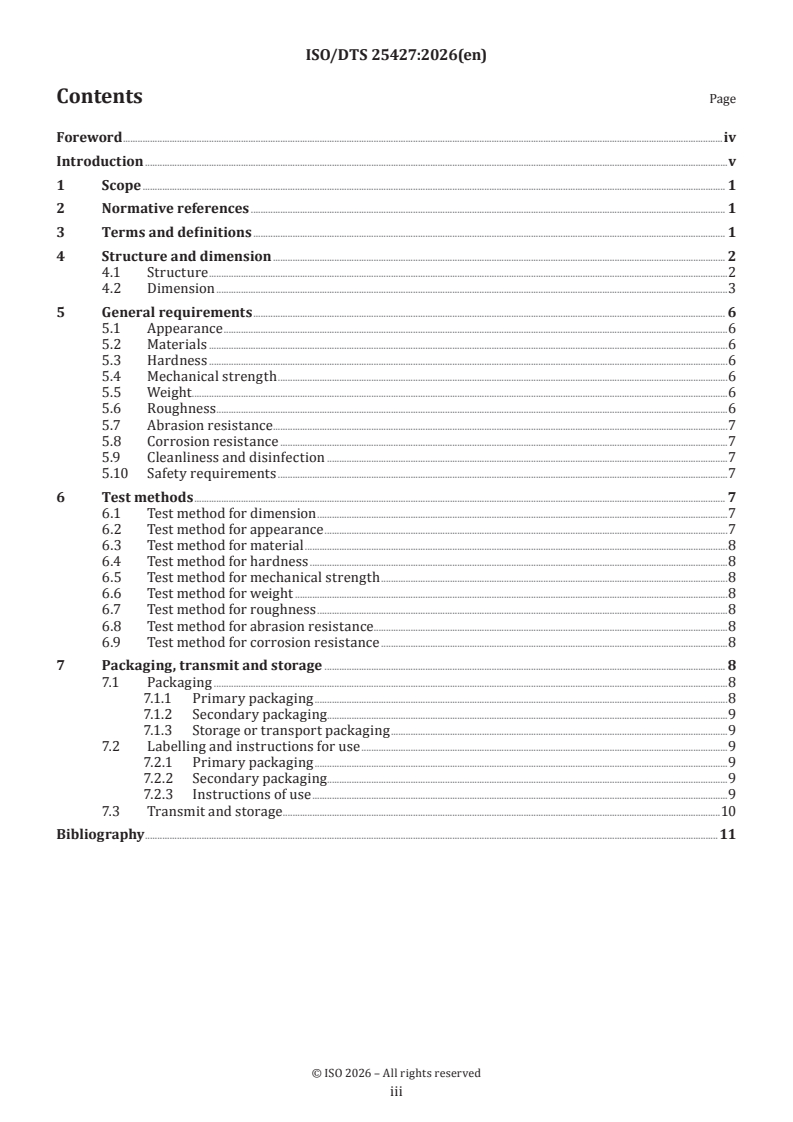
Contents Page
Foreword .iv
Introduction .v
1 Scope . 1
2 Normative references . 1
3 Terms and definitions . 1
4 Structure and dimension . 2
4.1 Structure .2
4.2 Dimension .3
5 General requirements . 6
5.1 Appearance .6
5.2 Materials .6
5.3 Hardness .6
5.4 Mechanical strength .6
5.5 Weight . .6
5.6 Roughness .6
5.7 Abrasion resistance . . .7
5.8 Corrosion resistance .7
5.9 Cleanliness and disinfection .7
5.10 Safety requirements .7
6 Test methods . 7
6.1 Test method for dimension .7
6.2 Test method for appearance .7
6.3 Test method for material .8
6.4 Test method for hardness .8
6.5 Test method for mechanical strength .8
6.6 Test method for weight .8
6.7 Test method for roughness .8
6.8 Test method for abrasion resistance .8
6.9 Test method for corrosion resistance .8
7 Packaging, transmit and storage . 8
7.1 Packaging .8
7.1.1 Primary packaging .8
7.1.2 Secondary packaging.9
7.1.3 Storage or transport packaging .9
7.2 Labelling and instructions for use .9
7.2.1 Primary packaging .9
7.2.2 Secondary packaging.9
7.2.3 Instructions of use .9
7.3 Transmit and storage .10
Bibliography .11
iii
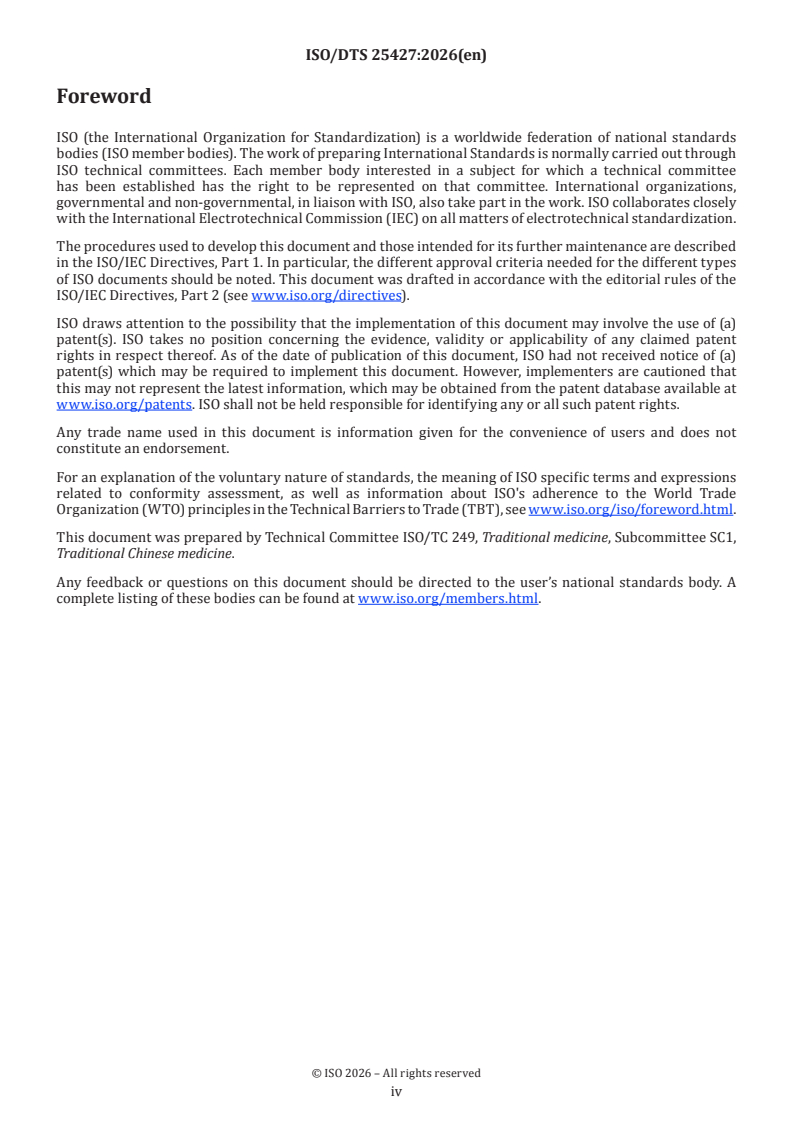
Foreword
ISO (the International Organization for Standardization) is a worldwide federation of national standards
bodies (ISO member bodies). The work of preparing International Standards is normally carried out through
ISO technical committees. Each member body interested in a subject for which a technical committee
has been established has the right to be represented on that committee. International organizations,
governmental and non-governmental, in liaison with ISO, also take part in the work. ISO collaborates closely
with the International Electrotechnical Commission (IEC) on all matters of electrotechnical standardization.
The procedures used to develop this document and those intended for its further maintenance are described
in the ISO/IEC Directives, Part 1. In particular, the different approval criteria needed for the different types
of ISO documents should be noted. This document was drafted in accordance with the editorial rules of the
ISO/IEC Directives, Part 2 (see www.iso.org/directives).
ISO draws attention to the possibility that the implementation of this document may involve the use of (a)
patent(s). ISO takes no position concerning the evidence, validity or applicability of any claimed patent
rights in respect thereof. As of the date of publication of this document, ISO had not received notice of (a)
patent(s) which may be required to implement this document. However, implementers are cautioned that
this may not represent the latest information, which may be obtained from the patent database available at
www.iso.org/patents. ISO shall not be held responsible for identifying any or all such patent rights.
Any trade name used in this document is information given for the convenience of users and does not
constitute an endorsement.
For an explanation of the voluntary nature of standards, the meaning of ISO specific terms and expressions
related to conformity assessment, as well as information about ISO's adherence to the World Trade
Organization (WTO) principles in the Technical Barriers to Trade (TBT), see www.iso.org/iso/foreword.html.
This document was prepared by Technical Committee ISO/TC 249, Traditional medicine, Subcommittee SC1,
Traditional Chinese medicine.
Any feedback or questions on this document should be directed to the user’s national standards body. A
complete listing of these bodies can be found at www.iso.org/members.html.
iv
Introduction
Non-invasive meridian and acupoint stimulators are essential external instruments of traditional Chinese
medicine, with a rich historical background, diverse typology, and a thriving global market.
As a commonly utilized non-invasive meridian and acupoint stimulation instrument, the Chuzhen
instrument stimulates acupoints, meridians, muscles and fascia through manipulations such as tapping,
pressing, scraping, and rotating to prevent and treat diseases. Currently, it has been used in Germany, the
Netherlands, France, China, Malaysia, South Africa and other countries.
The safety and quality of Chuzhen instruments are closely linked to the safety and efficacy of Chuzhen
therapy. Currently, there is a wide variety of Chuzhen instruments available on the market, presenting issues
such as excessive sharpness at the tip, high surface roughness, and immature structural design. However,
there is no standardized guidance for their manufacturing and processing. This lack of standardization
poses potential safety risks and raises concerns among operators and consumers. Standardizing Chuzhen
instruments enhances their safety and quality, and promotes more scientific, safe, and effective global use of
Chuzhen instruments.
v
FINAL DRAFT Technical Specification ISO/DTS 25427:2026(en)
Traditional Chinese medicine — Chuzhen instruments
1 Scope
This document specifies the general requirements and test methods of Chuzhen instruments.
It is only applicable to non-disposable Chuzhen instruments.
It is not applicable for any disposable Chuzhen instruments or for those with electrical, heat-storing, or other
special characteristics.
2 Normative references
The following documents are referred to in the text in such a way that some or all of their content constitutes
requirements of this document. For dated references, only the edition cited applies. For undated references,
the latest edition of the referenced document (including any amendments) applies.
ISO 9227, Corrosion tests in artificial atmospheres — Salt spray tests
ISO 10993-1, Biological evaluation of medical devices — Part 1: Requirements and general principles for the
evaluation of biological safety within a risk management process
ISO 10993-5, Biological evaluation of medical devices — Part 5: Tests for in vitro cytotoxicity
ISO 10993-10, Biological evaluation of medical devices — Part 10: Tests for skin sensitization
ISO 10993-23, Biological evaluation of medical devices — Part 23: Tests for irritation
ISO 14971, Medical devices — Application of risk management to medical devices
ISO 15223-1, Medical devices — Symbols to be used with information to be supplied by the manufacturer — Part
1: General requirements
IEC 60335-2-32, Household and similar electrical appliances — Safety — Part 2-32: Particular requirements for
massage appliances
3 Terms and definitions
For the pur
...