


ISO/FDIS 24996
(Main)Traditional Chinese medicine — General requirements and recommendations for the basic safety and essential performance of the transcutaneous electrical acupoint stimulators
Traditional Chinese medicine — General requirements and recommendations for the basic safety and essential performance of the transcutaneous electrical acupoint stimulators
This document specifies general requirements of the basic safety and essential performance of transcutaneous electrical acupoint stimulators (TEAS), which are applicable to all kinds of transcutaneous electrical stimulators for acupoints intended to stimulate the human body. It is not applicable to invasive electro-acupuncture stimulators.
Médecine traditionnelle chinoise — Exigences générales et recommandations pour la sécurité de base et les performances essentielles des stimulateurs électriques transcutanés d'acupoints
General Information
- Status
- Not Published
- Technical Committee
- ISO/TC 249 - Traditional Chinese medicine
- Current Stage
- 5020 - FDIS ballot initiated: 2 months. Proof sent to secretariat
- Start Date
- 26-May-2026
- Completion Date
- 26-May-2026
Buy Documents
ISO/FDIS 24996 - Traditional Chinese medicine — General requirements and recommendations for the basic safety and essential performance of the transcutaneous electrical acupoint stimulators
REDLINE ISO/FDIS 24996 - Traditional Chinese medicine — General requirements and recommendations for the basic safety and essential performance of the transcutaneous electrical acupoint stimulators
Overview
ISO/FDIS 24996:2026 – Traditional Chinese Medicine - General Requirements and Recommendations for the Basic Safety and Essential Performance of Transcutaneous Electrical Acupoint Stimulators sets forth standardized requirements for the safe design and reliable performance of transcutaneous electrical acupoint stimulators (TEAS). This ISO standard applies specifically to non-invasive TEAS devices intended for application in traditional Chinese medicine (TCM) practices, ensuring that equipment used to stimulate acupoints on the human body meets internationally recognized safety and usability criteria. Notably, ISO 24996 does not cover invasive electro-acupuncture stimulators that deliver electric currents via needles.
Key Topics
ISO 24996 details the foundational principles and essential performance elements required for TEAS, addressing several important aspects, including:
- Device Scope and Application: Applies to all non-invasive TEAS used on acupoints for therapeutic purposes within TCM contexts.
- Identification and Documentation: Specifies marking, identification, and documentation requirements, including proper labeling of controls, instruments, and device parts.
- Electrode Design: Outlines recommended electrode types, sizes, and area measurements for various body regions to ensure safe and effective stimulation.
- Electrical and Mechanical Safety: Sets requirements to guard against electrical and mechanical hazards, excessive radiation, and thermal risks.
- Performance Accuracy: Defines acceptable tolerances for pulse width, frequency, and intensity, as well as current density standards for electrodes on different acupoint locations.
- Protection Against Hazardous Outputs: Requires output safeguards such as interlocks, indicators, and supply fluctuation protection to prevent unintended or dangerous stimulation.
- Testing and Compliance: Provides guidance on required testing methods and accuracy checks to verify device safety and function.
- ME Equipment Classification: Addresses the proper classification of TEAS as medical electrical equipment, referencing relevant IEC and ISO provisions.
- Usability for Special Populations: Includes recommendations for pediatric use, such as appropriate electrode fit and the need for adult supervision.
Applications
Implementing ISO 24996 delivers practical benefits for a range of stakeholders in the healthcare and medical devices field:
- Manufacturers: Gain clear criteria for design, labeling, documentation, and quality assurance, ensuring that TEAS products consistently meet international safety benchmarks and performance expectations.
- Healthcare Providers: Rely on standardized requirements to select and operate TEAS devices confidently, supporting evidence-based TCM procedures and patient safety.
- Regulatory Authorities: Use the ISO standard as a reference for certification, approval, and market surveillance, fostering harmonization in device approval processes worldwide.
- Patients and Clients: Benefit from improved transparency, reduced risk, and enhanced trust in TEAS-based treatments.
These requirements are particularly relevant for clinics, hospitals, device manufacturers, and regulatory bodies engaged in the global practice and oversight of traditional Chinese medicine therapies involving electrical acupoint stimulation.
Related Standards
ISO/FDIS 24996 references and aligns with core standards in the medical device safety domain, including:
- IEC 60601-1: General requirements for basic safety and essential performance of medical electrical equipment.
- IEC 60601-1-2: Electromagnetic compatibility requirements.
- IEC 60601-2-10: Particular safety requirements for nerve and muscle stimulators.
- ISO 10993-1: Biological evaluation principles for medical devices.
- IEC 62366-1: Usability engineering for medical devices.
- ISO 15223-1: Standardized medical device labeling and symbols.
- ISO 20417: Information to be supplied by the manufacturer.
Utilizing ISO 24996 in combination with these related standards supports comprehensive compliance for manufacturers and users seeking to ensure both the safety and effectiveness of TEAS in traditional Chinese medicine.
Keywords: ISO 24996, transcutaneous electrical acupoint stimulators, TEAS safety, traditional Chinese medicine standards, medical electrical device performance, non-invasive acupuncture, ISO medical device requirements, TEAS electrode design, healthcare equipment standards.
Buy Documents
ISO/FDIS 24996 - Traditional Chinese medicine — General requirements and recommendations for the basic safety and essential performance of the transcutaneous electrical acupoint stimulators
REDLINE ISO/FDIS 24996 - Traditional Chinese medicine — General requirements and recommendations for the basic safety and essential performance of the transcutaneous electrical acupoint stimulators
Get Certified
Connect with accredited certification bodies for this standard

BSI Group
BSI (British Standards Institution) is the business standards company that helps organizations make excellence a habit.

TÜV Rheinland
TÜV Rheinland is a leading international provider of technical services.

TÜV SÜD
TÜV SÜD is a trusted partner of choice for safety, security and sustainability solutions.
Sponsored listings
Frequently Asked Questions
ISO/FDIS 24996 is a draft published by the International Organization for Standardization (ISO). Its full title is "Traditional Chinese medicine — General requirements and recommendations for the basic safety and essential performance of the transcutaneous electrical acupoint stimulators". This standard covers: This document specifies general requirements of the basic safety and essential performance of transcutaneous electrical acupoint stimulators (TEAS), which are applicable to all kinds of transcutaneous electrical stimulators for acupoints intended to stimulate the human body. It is not applicable to invasive electro-acupuncture stimulators.
This document specifies general requirements of the basic safety and essential performance of transcutaneous electrical acupoint stimulators (TEAS), which are applicable to all kinds of transcutaneous electrical stimulators for acupoints intended to stimulate the human body. It is not applicable to invasive electro-acupuncture stimulators.
ISO/FDIS 24996 is classified under the following ICS (International Classification for Standards) categories: 11.040.60 - Therapy equipment. The ICS classification helps identify the subject area and facilitates finding related standards.
ISO/FDIS 24996 is available in PDF format for immediate download after purchase. The document can be added to your cart and obtained through the secure checkout process. Digital delivery ensures instant access to the complete standard document.
Standards Content (Sample)
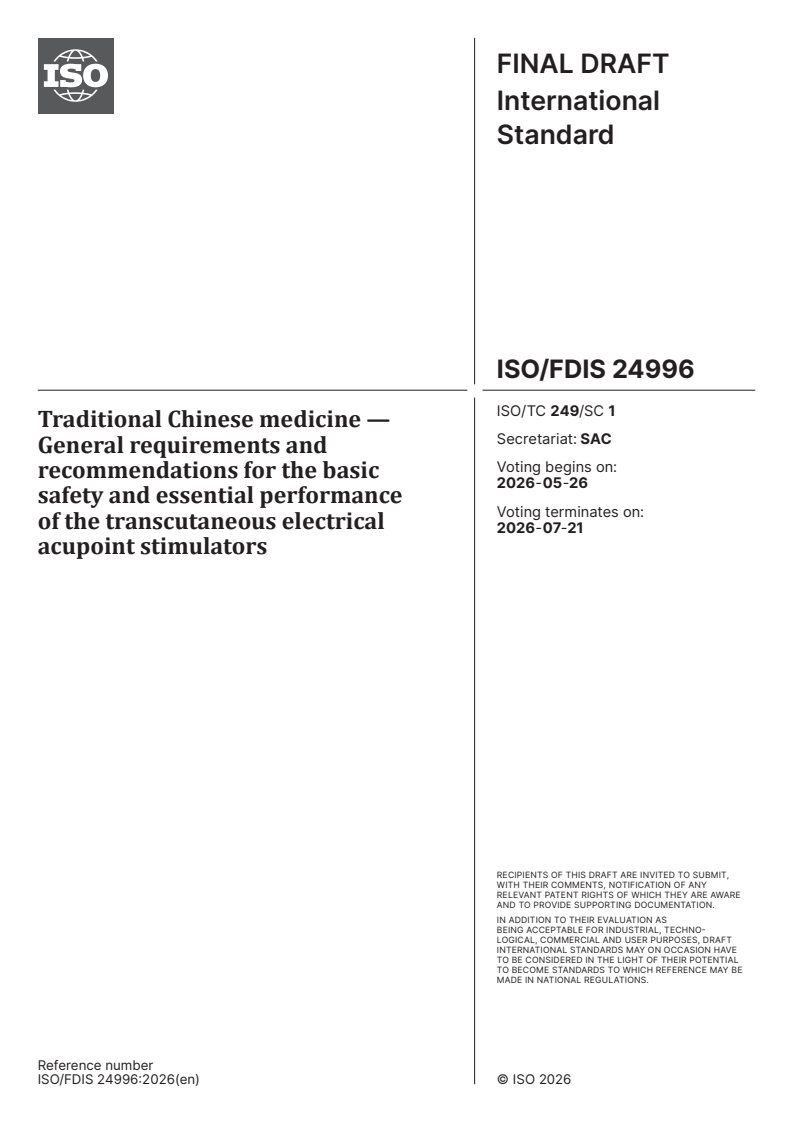
FINAL DRAFT
International
Standard
ISO/TC 249/SC 1
Traditional Chinese medicine —
Secretariat: SAC
General requirements and
Voting begins on:
recommendations for the basic
2026-05-26
safety and essential performance
Voting terminates on:
of the transcutaneous electrical
2026-07-21
acupoint stimulators
RECIPIENTS OF THIS DRAFT ARE INVITED TO SUBMIT,
WITH THEIR COMMENTS, NOTIFICATION OF ANY
RELEVANT PATENT RIGHTS OF WHICH THEY ARE AWARE
AND TO PROVIDE SUPPOR TING DOCUMENTATION.
IN ADDITION TO THEIR EVALUATION AS
BEING ACCEPTABLE FOR INDUSTRIAL, TECHNO
LOGICAL, COMMERCIAL AND USER PURPOSES, DRAFT
INTERNATIONAL STANDARDS MAY ON OCCASION HAVE
TO BE CONSIDERED IN THE LIGHT OF THEIR POTENTIAL
TO BECOME STAN DARDS TO WHICH REFERENCE MAY BE
MADE IN NATIONAL REGULATIONS.
Reference number
FINAL DRAFT
International
Standard
ISO/TC 249/SC 1
Traditional Chinese medicine —
Secretariat: SAC
General requirements and
Voting begins on:
recommendations for the basic
safety and essential performance
Voting terminates on:
of the transcutaneous electrical
acupoint stimulators
RECIPIENTS OF THIS DRAFT ARE INVITED TO SUBMIT,
WITH THEIR COMMENTS, NOTIFICATION OF ANY
RELEVANT PATENT RIGHTS OF WHICH THEY ARE AWARE
AND TO PROVIDE SUPPOR TING DOCUMENTATION.
© ISO 2026
IN ADDITION TO THEIR EVALUATION AS
All rights reserved. Unless otherwise specified, or required in the context of its implementation, no part of this publication may
BEING ACCEPTABLE FOR INDUSTRIAL, TECHNO
LOGICAL, COMMERCIAL AND USER PURPOSES, DRAFT
be reproduced or utilized otherwise in any form or by any means, electronic or mechanical, including photocopying, or posting on
INTERNATIONAL STANDARDS MAY ON OCCASION HAVE
the internet or an intranet, without prior written permission. Permission can be requested from either ISO at the address below
TO BE CONSIDERED IN THE LIGHT OF THEIR POTENTIAL
or ISO’s member body in the country of the requester.
TO BECOME STAN DARDS TO WHICH REFERENCE MAY BE
MADE IN NATIONAL REGULATIONS.
ISO copyright office
CP 401 • Ch. de Blandonnet 8
CH-1214 Vernier, Geneva
Phone: +41 22 749 01 11
Email: copyright@iso.org
Website: www.iso.org
Published in Switzerland Reference number
ii
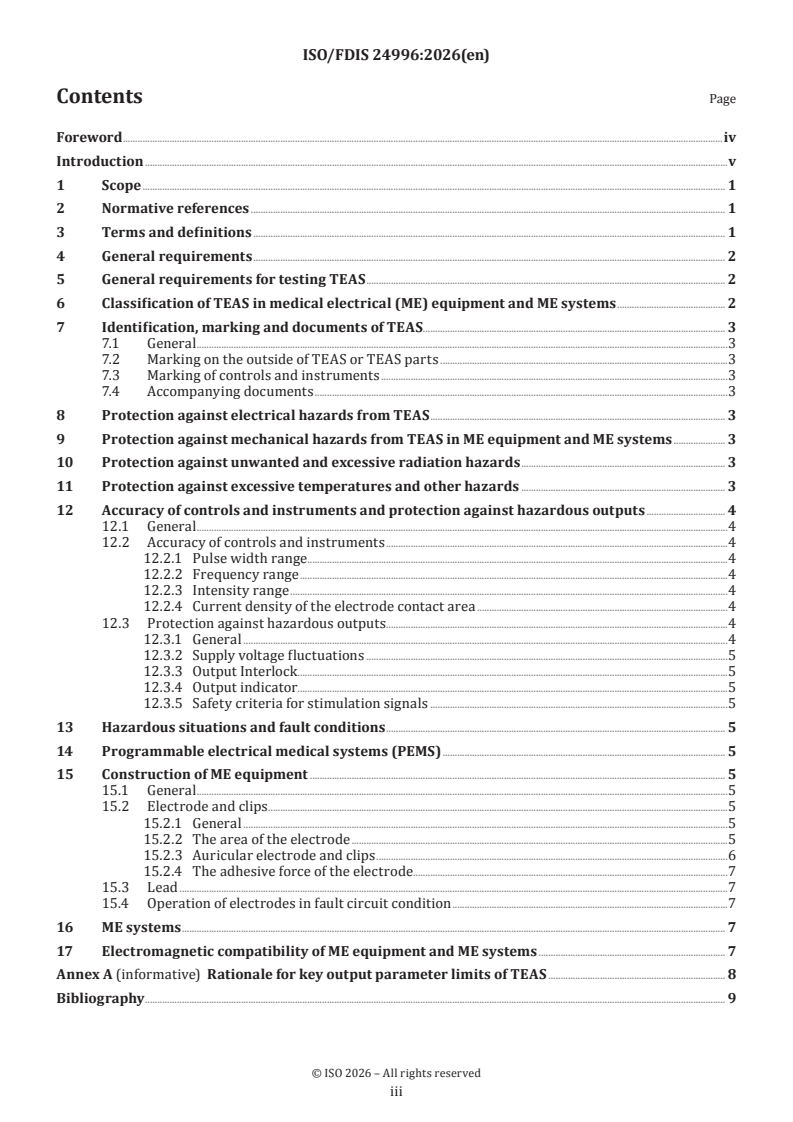
Contents Page
Foreword .iv
Introduction .v
1 Scope . 1
2 Normative references . 1
3 Terms and definitions . 1
4 General requirements . 2
5 General requirements for testing TEAS . 2
6 Classification of TEAS in medical electrical (ME) equipment and ME systems . 2
7 Identification, marking and documents of TEAS. 3
7.1 General .3
7.2 Marking on the outside of TEAS or TEAS parts .3
7.3 Marking of controls and instruments .3
7.4 Accompanying documents .3
8 Protection against electrical hazards from TEAS . 3
9 Protection against mechanical hazards from TEAS in ME equipment and ME systems . 3
10 Protection against unwanted and excessive radiation hazards . 3
11 Protection against excessive temperatures and other hazards . 3
12 Accuracy of controls and instruments and protection against hazardous outputs . 4
12.1 General .4
12.2 Accuracy of controls and instruments .4
12.2.1 Pulse width range.4
12.2.2 Frequency range .4
12.2.3 Intensity range .4
12.2.4 Current density of the electrode contact area .4
12.3 Protection against hazardous outputs.4
12.3.1 General .4
12.3.2 Supply voltage fluctuations .5
12.3.3 Output Interlock .5
12.3.4 Output indicator.5
12.3.5 Safety criteria for stimulation signals .5
13 Hazardous situations and fault conditions . 5
14 Programmable electrical medical systems (PEMS) . 5
15 Construction of ME equipment . 5
15.1 General .5
15.2 Electrode and clips .5
15.2.1 General .5
15.2.2 The area of the electrode .5
15.2.3 Auricular electrode and clips .6
15.2.4 The adhesive force of the electrode.7
15.3 Lead .7
15.4 Operation of electrodes in fault circuit condition .7
16 ME systems . 7
17 Electromagnetic compatibility of ME equipment and ME systems . 7
Annex A (informative) Rationale for key output parameter limits of TEAS . 8
Bibliography . 9
iii
Foreword
ISO (the International Organization for Standardization) is a worldwide federation of national standards
bodies (ISO member bodies). The work of preparing International Standards is normally carried out through
ISO technical committees. Each member body interested in a subject for which a technical committee
has been established has the right to be represented on that committee. International organizations,
governmental and non-governmental, in liaison with ISO, also take part in the work. ISO collaborates closely
with the International Electrotechnical Commission (IEC) on all matters of electrotechnical standardization.
The procedures used to develop this document and those intended for its further maintenance are described
in the ISO/IEC Directives, Part 1. In particular, the different approval criteria needed for the different types
of ISO document should be noted. This document was drafted in accordance with the editorial rules of the
ISO/IEC Directives, Part 2 (see www.iso.org/directives).
ISO draws attention to the possibility that the implementation of this document may involve the use of (a)
patent(s). ISO takes no position concerning the evidence, validity or applicability of any claimed patent
rights in respect thereof. As of the date of publication of this document, ISO had not received notice of (a)
patent(s) which may be required to implement this document. However, implementers are cautioned that
this may not represent the latest information, which may be obtained from the patent database available at
www.iso.org/patents. ISO shall not be held responsible for identifying any or all such patent rights.
Any trade name used in this document is information given for the convenience of users and does not
constitute an endorsement.
For an explanation of the voluntary nature of standards, the meaning of ISO specific terms and expressions
related to conformity assessment, as well as information about ISO's adherence to the World Trade
Organization (WTO) principles in the Technical Barriers to Trade (TBT), see www.iso.org/iso/foreword.html.
This document was prepared by Technical Committee ISO/TC 249, Traditional medicine, Subcommittee SC 1,
Traditional Chinese medicine.
Any feedback or questions on this document should be directed to the user’s national standards body. A
complete listing of these bodies can be found at www.iso.org/members.html.
iv
Introduction
Acupuncture is the vanguard in the internationalization of traditional Chinese medicine. It has been adopted
and practiced in 196 countries or regions around the world. Transcutaneous electrical acupoint stimulation
is a non-invasive acupuncture application.
Transcutaneous electrical acupoint stimulators (TEAS) have been produced to meet the need of this
non-invasive acupuncture technique. Currently, many TEAS are available on the market. However, most
manufacturers did not indicate the output parameters comprehensively. There are no international
standards guiding the manufacture and processing to ensure safety and performance. The growing interest
and increasing use of TEAS, combined with increasing patients’ expectations and concerns about the safety
and performance of transcutaneous electrical acupoint stimulation, have given rise to the need to improve
the safety and performance through implementation of an International Standard.
It is extensively accepted that the output parameters are significant to ensuring the basic safety and
essential performance of the TEAS.
v
FINAL DRAFT International Standard ISO/FDIS 24996:2026(en)
Traditional Chinese medicine — General requirements
and recommendations for the basic safety and essential
performance of the transcutaneous electrical acupoint
stimulators
1 Scope
This document specifies general requirements for the basic safety and essential performance of
transcutaneous electrical acupoint stimulators (TEAS) with a focus on devices intended to stimulate
acupoints on the human body.
It applies to all types of TEAS specifically designed for acupoint-related therapeutic usage, only in the context
of professional traditional Chinese medicine (TCM) healthcare services.
It is not applicable to invasive electro-acupuncture stimulators for the application of electric currents via
acupuncture needles inserted into the body.
2 Normative references
The following documents are referred to in the text in such a way that some or all of their content constitutes
requirements of this document. For dated references, only the edition cited applies. For undated references,
the latest edition of the referenced document (including any amendments) applies.
IEC 60601-1:2005+AMD1: 2012, Medical electrical equipment—Part 1: General requirements for basic safety
and essential performance
IEC 60601-1-2:2014+AMD1: 2020, Medical electrical equipment—Part 1-2: General req
...
Formatted
...
Style Definition
...
Style Definition
...
Style Definition
...
Style Definition
...
Style Definition
...
ISO/TC 249/SC 1
Style Definition
...
Style Definition
...
Secretariat: SAC
Style Definition
...
Date: 2026-03-17
Style Definition
...
Style Definition
...
Style Definition
...
Style Definition
...
Style Definition
...
Style Definition
...
Traditional Chinese medicine — General requirements and
Style Definition
...
recommendations for the basic safety and essential performance of
Style Definition
...
the transcutaneous electrical acupoint stimulators
Style Definition
...
Style Definition
...
Style Definition
...
Style Definition
...
Style Definition
...
Style Definition
...
Style Definition
...
Style Definition
...
FDIS stage
Style Definition
...
Style Definition
...
Style Definition
...
Style Definition
...
Style Definition
...
Style Definition
...
Style Definition
...
Style Definition
...
Style Definition
...
Style Definition
...
Style Definition
...
Style Definition
...
Style Definition
...
Style Definition
...
Style Definition
...
Style Definition
...
Style Definition
...
Style Definition
...
Style Definition
...
Style Definition
...
Style Definition
...
Style Definition
...
Style Definition
...
Style Definition
...
Style Definition
...
Style Definition
...
Style Definition
...
Style Definition
...
Style Definition
...
Style Definition
...
Style Definition
...
Style Definition
...
St l D fi iti
Formatted: Font: Bold
Formatted: HeaderCentered
Formatted: Default Paragraph Font
Formatted: Adjust space between Latin and Asian text,
All rights reserved. Unless otherwise specified, or required in the context of its implementation, no part of this publication
Adjust space between Asian text and numbers
may be reproduced or utilized otherwise in any form or by any means, electronic or mechanical, including photocopying,
or posting on the internet or an intranet, without prior written permission. Permission can be requested from either ISO
Formatted: Right: 1.5 cm, Bottom: 1 cm, Gutter: 0 cm,
at the address below or ISO’s member body in the country of the requester.
Header distance from edge: 1.27 cm, Footer distance
from edge: 0.5 cm
ISO copyright office
CP 401 • Ch. de Blandonnet 8
CH-1214 Vernier, Geneva
Phone: + 41 22 749 01 11
Formatted: French (France)
EmailE-mail: copyright@iso.org
Formatted: French (France)
Website: www.iso.orgwww.iso.org
Formatted: French (France)
Published in Switzerland
Formatted: Font: 10 pt
Formatted: Font: 10 pt
Formatted: Font: 11 pt
Formatted: FooterPageRomanNumber, Space After: 0
pt, Line spacing: single
ii © ISO #### 2026 – All rights reserved
ii
Formatted: Font: 11 pt, Bold, Font color: Auto
Formatted: Font: Bold
Formatted: HeaderCentered, Left
Contents
Formatted: None, Adjust space between Latin and
Asian text, Adjust space between Asian text and
Foreword . v
numbers
Introduction . vi
1 Scope . 1
2 Normative references . 1
3 Terms and definitions . 1
4 General requirements . 3
5 General requirements for testing TEAS . 3
6 Classification of TEAS in medical electrical (ME) equipment and ME systems . 3
7 Identification, marking and documents of TEAS . 3
7.1 General . 3
7.2 Marking on the outside of TEAS or TEAS parts . 3
7.3 Marking of controls and instruments . 3
7.4 Accompanying documents . 3
8 Protection against electrical hazards from TEAS . 3
9 Protection against mechanical hazards from TEAS in ME equipment and ME systems . 4
10 Protection against unwanted and excessive radiation hazards . 4
11 Protection against excessive temperatures and other hazards . 4
12 Accuracy of controls and instruments and protection against hazardous outputs . 4
12.1 General . 4
12.2 Accuracy of controls and instruments . 4
12.3 Protection against hazardous outputs . 5
13 Hazardous situations and fault conditions . 5
14 Programmable electrical medical systems (PEMS) . 5
15 Construction of ME equipment . 6
15.1 General . 6
15.2 Electrode and clips . 6
15.3 Lead . 7
15.4 Operation of electrodes in fault circuit condition . 8
16 ME systems . 8
17 Electromagnetic compatibility of ME equipment and ME systems . 8
Annex A (informative) Rationale for key output parameter limits of TEAS . 9
Bibliography . 11
Foreword . v
Formatted: Font: 10 pt
Introduction . vi
Formatted: Font: 10 pt
1 Scope . 1
Formatted: FooterCentered, Left, Space Before: 0 pt,
2 Normative references . 1
Tab stops: Not at 17.2 cm
3 Terms and definitions . 1 Formatted: Font: 11 pt
Formatted: FooterPageRomanNumber, Left, Space
4 General requirements . 3
After: 0 pt, Tab stops: Not at 17.2 cm
iii
Formatted: Font: Bold
Formatted: HeaderCentered
5 General requirements for testing TEAS . 3
6 Classification of TEAS in medical electrical (ME) equipment and ME systems . 3
7 Identification, marking and documents of TEAS . 3
7.1 General . 3
7.2 Marking on the outside of TEAS or TEAS parts . 3
7.3 Marking of controls and instruments . 3
7.4 Accompanying documents . 3
8 Protection against electrical hazards from TEAS . 3
9 Protection against mechanical hazards from TEAS in ME equipment and ME systems . 3
10 Protection against unwanted and excessive radiation hazards . 4
11 Protection against excessive temperatures and other hazards . 4
12 Accuracy of controls and instruments and protection against hazardous outputs . 4
12.1 General . 4
12.2 Accuracy of controls and instruments . 4
12.2.1 Pulse width range . 4
12.2.2 Frequency range . 4
12.2.3 Intensity range . 4
12.2.4 Current density of the electrode contact area . 4
12.3 Protection against hazardous outputs . 5
12.3.1 General . 5
12.3.2 Supply voltage fluctuations . 5
12.3.3 Output Interlock . 5
12.3.4 Output indicator . 5
12.3.5 Safety criteria for stimulation signals . 5
13 Hazardous situations and fault conditions . 5
14 Programmable electrical medical systems (PEMS) . 5
15 Construction of ME equipment . 5
15.1 General . 5
15.2 Electrode and clips . 5
15.2.1 General . 5
15.2.2 The area of the electrode . 5
15.2.3 Auricular electrode and clips . 6
15.2.4 The adhesive force of the electrode. 7
15.3 Lead . 7
15.4 Operation of electrodes in fault circuit condition. 7
16 ME systems . 7
17 Electromagnetic compatibility of ME equipment and ME systems . 7
Annex A (informative) Rationale for key output parameter limits of TEAS . 8
Bibliography . 9
Formatted: Font: 10 pt
Formatted: Font: 10 pt
Formatted: Font: 11 pt
Formatted: FooterPageRomanNumber, Space After: 0
pt, Line spacing: single
iv © ISO #### 2026 – All rights reserved
iv
Formatted: Font: 11 pt, Bold, Font color: Auto
Formatted: Font: Bold
Formatted: HeaderCentered, Left
Foreword
Formatted: Adjust space between Latin and Asian text,
Adjust space between Asian text and numbers
ISO (the International Organization for Standardization) is a worldwide federation of national standards
bodies (ISO member bodies). The work of preparing International Standards is normally carried out through
ISO technical committees. Each member body interested in a subject for which a technical committee has been
established has the right to be represented on that committee. International organizations, governmental and
non-governmental, in liaison with ISO, also take part in the work. ISO collaborates closely with the
International Electrotechnical Commission (IEC) on all matters of electrotechnical standardization.
The procedures used to develop this document and those intended for its further maintenance are described
in the ISO/IEC Directives, Part 1. In particular, the different approval criteria needed for the different types of
ISO document should be noted. This document was drafted in accordance with the editorial rules of the
ISO/IEC Directives, Part 2 (see www.iso.org/directives).
Formatted: English (United Kingdom)
ISO draws attention to the possibility that the implementation of this document may involve the use of (a)
patent(s). ISO takes no position concerning the evidence, validity or applicability of any claimed patent rights
in respect thereof. As of the date of publication of this document, ISO had not received notice of (a) patent(s)
which may be required to implement this document. However, implementers are cautioned that this may not
represent the latest information, which may be obtained from the patent database available at
www.iso.org/patents.www.iso.org/patents. ISO shall not be held responsible for identifying any or all such
patent rights.
Any trade name used in this document is information given for the convenience of users and does not
constitute an endorsement.
For an explanation of the voluntary nature of standards, the meaning of ISO specific terms and expressions
related to conformity assessment, as well as information about ISO's adherence to the World Trade
Organization (WTO) principles in the Technical Barriers to Trade (TBT), see
www.iso.org/iso/foreword.htmlwww.iso.org/iso/foreword.html.
Formatted: English (United Kingdom)
This document was prepared by Technical Committee ISO/TC 249, Traditional medicine, Subcommittee SC 1,
Formatted: Adjust space between Latin and Asian text,
Traditional Chinese medicine.
Adjust space between Asian text and numbers
Any feedback or questions on this document should be directed to the user’s national standards body. A
complete listing of these bodies can be found at www.iso.org/members.htmlwww.iso.org/members.html.
Formatted: Font: 10 pt
Formatted: Font: 10 pt
Formatted: FooterCentered, Left, Space Before: 0 pt,
Tab stops: Not at 17.2 cm
Formatted: Font: 11 pt
Formatted: FooterPageRomanNumber, Left, Space
After: 0 pt, Tab stops: Not at 17.2 cm
v
Formatted: Font: Bold
Formatted: HeaderCentered
Introduction
Acupuncture is the vanguard in the internationalization of traditional Chinese medicine. It has been adopted
and practiced in 196 countries or regions around the world. Transcutaneous electrical acupoint stimulation is
a non-invasive acupuncture application.
Transcutaneous electrical acupoint stimulators (TEAS) have been produced to meet the need of this non-
invasive acupuncture technique. Currently, many TEAS are available on the market. However, most
manufacturers did not indicate the output parameters comprehensively. There are no international standards
guiding the manufacture and processing to ensure safety and performance. The growing interest and
increasing use of TEAS, combined with increasing patients’ expectations and concerns about the safety and
performance of transcutaneous electrical acupoint stimulation, have given rise to the need to improve the
safety and performance through implementation of an International Standard.
It is extensively accepted that the output parameters are significant to ensuring the basic safety and essential
performance of the TEAS.
Formatted: Font: 10 pt
Formatted: Font: 10 pt
Formatted: Font: 11 pt
Formatted: FooterPageRomanNumber, Space After: 0
pt, Line spacing: single
vi © ISO #### 2026 – All rights reserved
vi
FINAL DRAFT International Standard ISO/FDIS 24996:2026(en)
Formatted: Font: Not Bold
Formatted: Header, Space After: 0 pt, Line spacing:
single
Formatted: Main Title 1, Adjust space between Latin
Traditional Chinese medicine— — General requirements and
and Asian text, Adjust space between Asian text and
recommendations for the basic safety and essential performance of
numbers
the transcutaneous electrical acupoint stimulators
1 Scope Formatted: Right: 1.5 cm, Bottom: 1 cm, Gutter: 0 cm,
Header distance from edge: 1.27 cm, Footer distance
This document specifies general requirements for the basic safety and essential performance of from edge: 0.5 cm
transcutaneous electrical acupoint stimulators (TEAS) with a focus on devices intended to stimulate acupoints
on the human body.
Formatted: English (United Kingdom)
Formatted: Default Paragraph Font
It applies to all types of TEAS specifically designed for acupoint-related therapeutic usage, only in the context
Formatted: Default Paragraph Font
of professional traditional Chinese medicine (TCM) healthcare services.
Formatted: Default Paragraph Font
It is not applicable to invasive electro-acupuncture stimulators for the application of electric currents via
Formatted: Default Paragraph Font
acupuncture needles inserted into the body.
Formatted: Default Paragraph Font
2 Normative references
Formatted: Adjust space between Latin and Asian text,
Adjust space between Asian text and numbers, Tab
The following documents are referred to in the text in such a way that some or all of their content constitutes
stops: Not at 0.7 cm + 1.4 cm + 2.1 cm + 2.8 cm +
requirements of this document. For dated references, only the edition cited applies. For undated references,
3.5 cm + 4.2 cm + 4.9 cm + 5.6 cm + 6.3 cm + 7 cm
the latest edition of the referenced document (including any amendments) applies.
Formatted: Default Paragraph Font, English (United
Kingdom)
IEC 60601--1:2005+AMD1:2012+AMD2:2020, Medical electrical equipment—Part 1: General requirements
Formatted: Default Paragraph Font, English (United
for basic safety and essential performance
Kingdom)
IEC 60601-1-2:2014+AMD1:2020, Medical electrical equipment—Part 1-2: General requirements for basic
Formatted: Default Paragraph Font, English (United
safety and essential performance—Collateral Standard: Electromagnetic disturbances—Requirements and
Kingdom)
tests
Formatted: Default Paragraph Font
Formatted: Default Paragraph Font, English (United
IEC 60601--2-10:2012+AMD1:2016+AMD2:2023, Medical electrical equipment—Part 2: Particular
Kingdom)
requirements for the safety of nerve and muscle stimulators
Formatted: Default Paragraph Font
ISO 10993-1:2025, Biological evaluation of medical devices—Part 1: Requirements and general principles for the
Formatted: Default Paragraph Font, English (United
evaluation of biological safety within a risk management process
Kingdom)
Formatted: Default Paragraph Font
IEC 62366-1:2015+AMD1:2020, Medical devices—Part 1: Application of usability engineering to medical
devices
Formatted: Default Paragraph Font, English (United
Kingdom)
ISO 15223-1:2021+AMD1:2025, Medical devices—Symbols to be used with information to be supplied by the
Formatted: Default Paragraph Font
manufacturer—Part 1: General requirements
Formatted: Default Paragraph Font
ISO 20417:2021, Medical devices—Information to be supplied by the manufacturer Formatted: Default Paragraph Font
Formatted: Default Paragraph Font
3 Terms and definitions
Formatted: Default Paragraph Font
For the purposes of this document, the following terms and definitions apply. Formatted: Adjust space between Latin and Asian text,
Adjust space between Asian text and numbers
ISO and IEC maintain terminology databases for use in standardization at the following addresses:
Formatted: Footer, Left, Space After: 0 pt, Tab stops:
Not at 17.2 cm
Formatted: Font: Bold
Formatted: HeaderCentered
— — ISO Online browsing platform: available at https://www.iso.org/obphttps://www.iso.org/obp
Formatted: Adjust space between Latin and Asian text,
Adjust space between Asian text and numbers, Tab
— — IEC Electropedia: available at https://www.electropedia.org/https://www.electropedia.org/
stops: Not at 0.7 cm + 1.4 cm + 2.1 cm + 2.8 cm +
3.5 cm + 4.2 cm + 4.9 cm + 5.6 cm + 6.3 cm + 7 cm
3.1 3.1
Formatted: TermNum2, Adjust space between Latin
acupoint
and Asian text, Adjust space between Asian text and
small region or area of body located by either body features or uses, or both, where stimulus is applied with
numbers
intention to induce reactions for diagnosis or therapeutical purpose in acupuncture
Note 1 to entry: An electrode (3.6)(3.6) or a probe pen may be used on an acupoint to dredge meridians and collaterals.
Formatted: English (United Kingdom)
Formatted: Adjust space between Latin and Asian text,
Note 2 to entry: Acupoints are located by the side of bone, tendon and muscle, or between two bones, tendons and
Adjust space between Asian text and numbers, Tab
muscles.
stops: Not at 0.7 cm + 1.4 cm + 2.1 cm + 2.8 cm +
3.5 cm + 4.2 cm + 4.9 cm + 5.6 cm + 6.3 cm + 7 cm
[SOURCE: ISO 16843-1:2025, 3.1.3, modified — "acupuncture point" revised to "acupoint" and EXAMPLES 1-
3 deleted; original Note 1 to entry replaced; Note 2 to entry added] Formatted: English (United Kingdom)
Formatted: Adjust space between Latin and Asian text,
3.2 3.2
Adjust space betwe
...