

ISO 9934-3:2015
(Main)Non-destructive testing — Magnetic particle testing — Part 3: Equipment
General Information
- Abstract
ISO 9934-3:2015 describes three types of equipment for magnetic particle testing: - portable or transportable equipment; - fixed installations; - specialized testing systems for testing components on a continuous basis, comprising a series of processing stations placed in sequence to form a process line. Equipment for magnetizing, demagnetizing, illumination, measurement, and monitoring are also described. This part of ISO 9934 specifies the properties to be provided by the equipment supplier, minimum requirements for application and the method of measuring certain parameters. Where appropriate, measuring and calibration requirements and in-service checks are also specified.
- Status
- Published
- Publication Date
- 27-Aug-2015
- Technical Committee
- ISO/TC 135/SC 2 - Surface methods
- Drafting Committee
- ISO/TC 135/SC 2 - Surface methods
- Current Stage
- 9093 - International Standard confirmed
- Start Date
- 17-Apr-2024
- Completion Date
- 29-Aug-2026
Buy Documents

ISO 9934-3:2015 - Non-destructive testing — Magnetic particle testing — Part 3: Equipment Released:8/28/2015

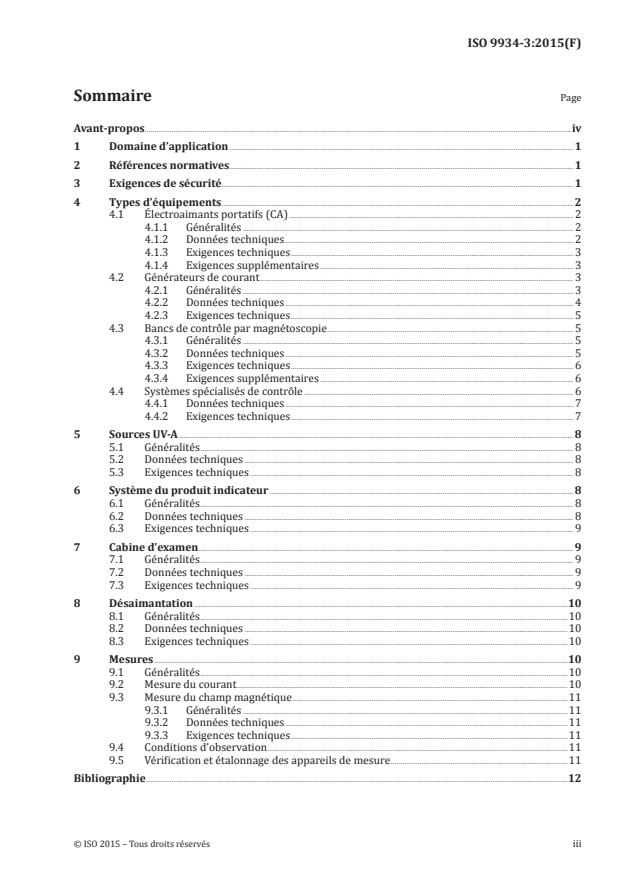
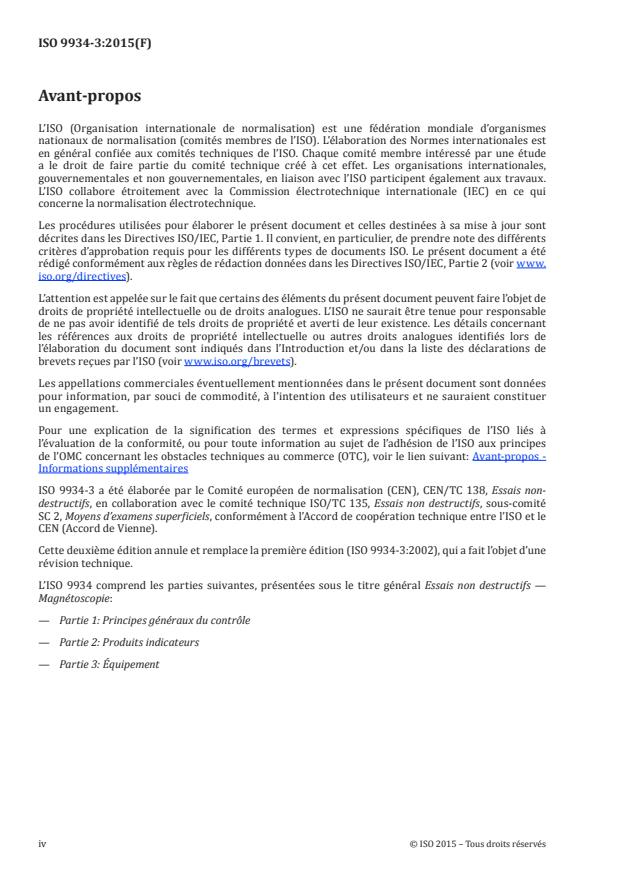
ISO 9934-3:2015 - Essais non destructifs — Magnétoscopie — Partie 3: Équipement Released:8/28/2015
Overview
ISO 9934-3:2015 is the equipment-focused part of the ISO series on magnetic particle testing (MPT) for non-destructive testing (NDT). It specifies the types of equipment used for MPT (portable/transportable devices, fixed installations and continuous-process specialized systems) and defines the properties, minimum performance requirements, measurement methods, calibration and in‑service checks that equipment suppliers and users should provide and follow.
Key topics and requirements
- Types of equipment covered
- Portable electromagnets (yokes)
- Current generators for magnetizing
- Magnetic benches and fixed installations
- Specialized continuous testing systems (process lines)
- Supporting equipment: UV-A sources, detection media systems, inspection booths, demagnetization units, measurement and monitoring instruments
- Supplier information and technical data (examples required to be provided):
- Recommended pole spacing, pole dimensions, electrical supply, duty cycle, current waveforms, overall dimensions, equipment mass, IP rating (IEC 60529)
- For current generators: open-circuit voltage (U0), short‑circuit current (Ik), rated current (Ir), duty cycle, working range, control method, meter type and accuracy
- Performance and safety minimums
- Portable electromagnet requirements at 30 °C and maximum output: duty cycle ≥ 10%, current “ON” time ≥ 5 s, handle surface temperature ≤ 40 °C, tangential field strength Ht ≥ 2 kA/m (RMS) at specified pole spacing, lifting force ≥ 44 N
- Magnetization is measured as the tangential magnetic field strength at the centre line of pole faces; a standard test plate (500 ±25 mm × 250 ±13 mm × 10 ±0.5 mm, steel C22 / 1.0402) is used for functional checks
- Measurement, verification and calibration
- Methods for determining generator load characteristics (load line technique), current and magnetic field measurement requirements, verification and in‑service checks for continued compliance
Practical applications & users
ISO 9934-3 is practical for:
- NDT technicians and inspectors performing magnetic particle testing
- NDT equipment manufacturers and suppliers preparing technical data and compliance documentation
- Quality, maintenance and procurement teams specifying or purchasing MPT equipment
- Industries relying on surface crack detection: aerospace, automotive, oil & gas, forging and heavy fabrication, welding inspection
Using ISO 9934-3 helps ensure consistent equipment performance, reliable defect detection and compliance with recognized NDT practice.
Related standards
- ISO 9934-1 - Magnetic particle testing: general rules
- ISO 9934-2 - Magnetic particle testing: detection media
- ISO 3059 - Viewing conditions for penetrant and magnetic particle testing
- IEC 60529 - Degrees of protection provided by enclosures (IP code)
- EN 10250-2 - Steel forgings reference for test plates
Keywords: ISO 9934-3:2015, magnetic particle testing, non-destructive testing, MPT equipment, portable electromagnets, current generators, magnetic benches, calibration, UV-A sources.
Relations
- Effective Date
- 09-Feb-2026
- Effective Date
- 09-Feb-2026
- Referred By
EN ISO 17638:2016 - Non-destructive testing of welds - Magnetic particle testing (ISO 17638:2016) - Effective Date
- 09-Feb-2026
- Effective Date
- 09-Feb-2026
- Effective Date
- 12-Feb-2026
- Consolidates
ISO 12097-3:2002 - Road vehicles — Airbag components — Part 3: Testing of inflator assemblies - Effective Date
- 06-Jun-2022
- Effective Date
- 13-Nov-2010
Buy Documents
ISO 9934-3:2015 - Non-destructive testing — Magnetic particle testing — Part 3: Equipment Released:8/28/2015
ISO 9934-3:2015 - Essais non destructifs — Magnétoscopie — Partie 3: Équipement Released:8/28/2015
Get Certified
Connect with accredited certification bodies for this standard

IMP NDT d.o.o.
Non-destructive testing services. Radiography, ultrasonic, magnetic particle, penetrant, visual inspection.
Inštitut za kovinske materiale in tehnologije
Institute of Metals and Technology. Materials testing, metallurgical analysis, NDT.
Q Techna d.o.o.
NDT and quality assurance specialist. 30+ years experience. NDT personnel certification per ISO 9712, nuclear and thermal power plant inspections, QA/
Sponsored listings
Frequently Asked Questions
ISO 9934-3:2015 is a standard published by the International Organization for Standardization (ISO). Its full title is "Non-destructive testing — Magnetic particle testing — Part 3: Equipment". This standard covers: ISO 9934-3:2015 describes three types of equipment for magnetic particle testing: - portable or transportable equipment; - fixed installations; - specialized testing systems for testing components on a continuous basis, comprising a series of processing stations placed in sequence to form a process line. Equipment for magnetizing, demagnetizing, illumination, measurement, and monitoring are also described. This part of ISO 9934 specifies the properties to be provided by the equipment supplier, minimum requirements for application and the method of measuring certain parameters. Where appropriate, measuring and calibration requirements and in-service checks are also specified.
ISO 9934-3:2015 describes three types of equipment for magnetic particle testing: - portable or transportable equipment; - fixed installations; - specialized testing systems for testing components on a continuous basis, comprising a series of processing stations placed in sequence to form a process line. Equipment for magnetizing, demagnetizing, illumination, measurement, and monitoring are also described. This part of ISO 9934 specifies the properties to be provided by the equipment supplier, minimum requirements for application and the method of measuring certain parameters. Where appropriate, measuring and calibration requirements and in-service checks are also specified.
ISO 9934-3:2015 is classified under the following ICS (International Classification for Standards) categories: 19.100 - Non-destructive testing. The ICS classification helps identify the subject area and facilitates finding related standards.
ISO 9934-3:2015 has the following relationships with other standards: It is inter standard links to EN ISO 9934-1:2016, EN ISO 9934-1:2015, EN ISO 17638:2016, EN ISO 9934-2:2015, EN ISO 9934-3:2015, ISO 12097-3:2002, ISO 9934-3:2002. Understanding these relationships helps ensure you are using the most current and applicable version of the standard.
ISO 9934-3:2015 is available in PDF format for immediate download after purchase. The document can be added to your cart and obtained through the secure checkout process. Digital delivery ensures instant access to the complete standard document.
Standards Content (Sample)
INTERNATIONAL ISO
STANDARD 9934-3
Second edition
2015-09-01
Non-destructive testing — Magnetic
particle testing —
Part 3:
Equipment
Essais non destructifs — Magnétoscopie —
Partie 3: Équipement
Reference number
©
ISO 2015
© ISO 2015, Published in Switzerland
All rights reserved. Unless otherwise specified, no part of this publication may be reproduced or utilized otherwise in any form
or by any means, electronic or mechanical, including photocopying, or posting on the internet or an intranet, without prior
written permission. Permission can be requested from either ISO at the address below or ISO’s member body in the country of
the requester.
ISO copyright office
Ch. de Blandonnet 8 • CP 401
CH-1214 Vernier, Geneva, Switzerland
Tel. +41 22 749 01 11
Fax +41 22 749 09 47
copyright@iso.org
www.iso.org
ii © ISO 2015 – All rights reserved
Contents Page
Foreword .iv
1 Scope . 1
2 Normative references . 1
3 Safety requirements . 1
4 Types of devices . 1
4.1 Portable electromagnets (AC) . 1
4.1.1 General. 1
4.1.2 Technical data . 2
4.1.3 Technical requirements . 3
4.1.4 Additional requirements . 3
4.2 Current generators . 3
4.2.1 General. 3
4.2.2 Technical data . 4
4.2.3 Technical requirements . 5
4.3 Magnetic benches . 5
4.3.1 General. 5
4.3.2 Technical data . 5
4.3.3 Technical requirements . 6
4.3.4 Additional requirements . 6
4.4 Specialized testing systems . 6
4.4.1 Technical data . 7
4.4.2 Technical requirements . 7
5 UV-A sources . 8
5.1 General . 8
5.2 Technical data . 8
5.3 Technical requirements . 8
6 Detection media system . 8
6.1 General . 8
6.2 Technical data . 8
6.3 Technical requirements . 9
7 Inspection booth . 9
7.1 General . 9
7.2 Technical data . 9
7.3 Technical requirements . 9
8 Demagnetization .10
8.1 General .10
8.2 Technical data .10
8.3 Technical requirements .10
9 Measurements .10
9.1 General .10
9.2 Current measurement .10
9.3 Magnetic field measurement .11
9.3.1 General.11
9.3.2 Technical data .11
9.3.3 Technical requirements .11
9.4 Viewing conditions .11
9.5 Verification and calibration of instruments .11
Bibliography .12
Foreword
ISO (the International Organization for Standardization) is a worldwide federation of national standards
bodies (ISO member bodies). The work of preparing International Standards is normally carried out
through ISO technical committees. Each member body interested in a subject for which a technical
committee has been established has the right to be represented on that committee. International
organizations, governmental and non-governmental, in liaison with ISO, also take part in the work.
ISO collaborates closely with the International Electrotechnical Commission (IEC) on all matters of
electrotechnical standardization.
The procedures used to develop this document and those intended for its further maintenance are
described in the ISO/IEC Directives, Part 1. In particular the different approval criteria needed for the
different types of ISO documents should be noted. This document was drafted in accordance with the
editorial rules of the ISO/IEC Directives, Part 2 (see www.iso.org/directives).
Attention is drawn to the possibility that some of the elements of this document may be the subject of
patent rights. ISO shall not be held responsible for identifying any or all such patent rights. Details of
any patent rights identified during the development of the document will be in the Introduction and/or
on the ISO list of patent declarations received (see www.iso.org/patents).
Any trade name used in this document is information given for the convenience of users and does not
constitute an endorsement.
For an explanation on the meaning of ISO specific terms and expressions related to conformity
assessment, as well as information about ISO’s adherence to the WTO principles in the Technical
Barriers to Trade (TBT) see the following URL: Foreword - Supplementary information
ISO 9934-3 was prepared by the European Committee for Standardization (CEN) Technical Committee
CEN/TC 138, Non-destructive testing, in collaboration with ISO/TC 135, Non-destructive testing,
Subcommittee SC 2, Surface methods, in accordance with the Agreement on technical cooperation
between ISO and CEN (Vienna Agreement).
This second edition cancels and replaces the first edition (ISO 9934-3:2002), which has been
technically revised.
ISO 9934 consists of the following parts under the general title Non-destructive testing — Magnetic
particle testing:
— Part 1: General principles
— Part 2: Detection media
— Part 3: Equipment
iv © ISO 2015 – All rights reserved
INTERNATIONAL STANDARD ISO 9934-3:2015(E)
Non-destructive testing — Magnetic particle testing —
Part 3:
Equipment
1 Scope
This part of ISO 9934 describes three types of equipment for magnetic particle testing:
— portable or transportable equipment;
— fixed installations;
— specialized testing systems for testing components on a continuous basis, comprising a series of
processing stations placed in sequence to form a process line.
Equipment for magnetizing, demagnetizing, illumination, measurement, and monitoring are also
described.
This part of ISO 9934 specifies the properties to be provided by the equipment supplier, minimum
requirements for application and the method of measuring certain parameters. Where appropriate,
measuring and calibration requirements and in-service checks are also specified.
2 Normative references
The following documents, in whole or in part, are normatively referenced in this document and are
indispensable for its application. For dated references, only the edition cited applies. For undated
references, the latest edition of the referenced document (including any amendments) applies.
ISO 3059, Non-destructive testing — Penetrant testing and magnetic particle testing — Viewing conditions
ISO 9934-1, Non-destructive testing — Magnetic particle testing — Part 1: General rules
EN 10250-2, Open steel die forgings for general engineering purposes — Non-alloy quality and special steels
IEC 60529, Degrees of protection provided by enclosures (IP Code)
3 Safety requirements
The equipment design shall take into account all international, European, national and local regulations
which include health, safety, electrical and environmental requirements.
4 Types of devices
1)
4.1 Portable electromagnets (AC )
4.1.1 General
Hand-held portable electromagnets (yokes) produce a magnetic field between the two poles. When
1)
testing according to ISO 9934-1, DC electromagnets should only be used if agreed at enquiry and
order stages.
1) AC = alternating current, and DC = rectified current.
Magnetization shall be determined by measuring the tangential field strength, H , at the centre of a
t
line joining the centres of the pole faces of the electromagnet with pole extenders where used. The
electromagnet with a pole spacing, s, is placed on a steel plate as shown in Figure 1. The plate shall
have the dimensions (500 ± 25) mm × (250 ± 13) mm × (10 ± 0,5) mm and shall be of steel conforming
to C22 (1.0402) of EN 10250-2. Periodic functional checks can be carried out either by the method
described above or by a lift test. The electromagnet shall be capable of supporting a steel plate or
rectangular bar conforming to C22 (1.0402) of EN 10250-2 and having a minimum mass of 4,5 kg, with
the magnet poles set at their recommended spacing. The major dimension of the plate or bar shall be
greater than the pole spacing, s, of the electromagnet.
NOTE To lift a steel plate with a mass of 4,5 kg requires a lifting force of 44 N.
Dimensions in millimetres
Key
1 poles
s pole spacing
MP measuring point for the tangential field strength
Figure 1 — Determination of the characteristics of portable electromagnets
4.1.2 Technical data
The following data shall be
...
NORME ISO
INTERNATIONALE 9934-3
Deuxième édition
2015-09-01
Essais non destructifs —
Magnétoscopie —
Partie 3:
Équipement
Non-destructive testing — Magnetic particle testing —
Part 3: Equipment
Numéro de référence
©
ISO 2015
DOCUMENT PROTÉGÉ PAR COPYRIGHT
© ISO 2015, Publié en Suisse
Droits de reproduction réservés. Sauf indication contraire, aucune partie de cette publication ne peut être reproduite ni utilisée
sous quelque forme que ce soit et par aucun procédé, électronique ou mécanique, y compris la photocopie, l’affichage sur
l’internet ou sur un Intranet, sans autorisation écrite préalable. Les demandes d’autorisation peuvent être adressées à l’ISO à
l’adresse ci-après ou au comité membre de l’ISO dans le pays du demandeur.
ISO copyright office
Ch. de Blandonnet 8 • CP 401
CH-1214 Vernier, Geneva, Switzerland
Tel. +41 22 749 01 11
Fax +41 22 749 09 47
copyright@iso.org
www.iso.org
ii © ISO 2015 – Tous droits réservés
Sommaire Page
Avant-propos .iv
1 Domaine d’application . 1
2 Références normatives . 1
3 Exigences de sécurité . 1
4 Types d’équipements . 2
4.1 Électroaimants portatifs (CA) . 2
4.1.1 Généralités . 2
4.1.2 Données techniques . 2
4.1.3 Exigences techniques . 3
4.1.4 Exigences supplémentaires . 3
4.2 Générateurs de courant . 3
4.2.1 Généralités . 3
4.2.2 Données techniques . 4
4.2.3 Exigences techniques . 5
4.3 Bancs de contrôle par magnétoscopie . 5
4.3.1 Généralités . 5
4.3.2 Données techniques . 5
4.3.3 Exigences techniques . 6
4.3.4 Exigences supplémentaires . 6
4.4 Systèmes spécialisés de contrôle . 6
4.4.1 Données techniques . 7
4.4.2 Exigences techniques . 7
5 Sources UV-A . 8
5.1 Généralités . 8
5.2 Données techniques . 8
5.3 Exigences techniques . 8
6 Système du produit indicateur . 8
6.1 Généralités . 8
6.2 Données techniques . 8
6.3 Exigences techniques . 9
7 Cabine d’examen . 9
7.1 Généralités . 9
7.2 Données techniques . 9
7.3 Exigences techniques . 9
8 Désaimantation .10
8.1 Généralités .10
8.2 Données techniques .10
8.3 Exigences techniques .10
9 Mesures .10
9.1 Généralités .10
9.2 Mesure du courant .10
9.3 Mesure du champ magnétique .11
9.3.1 Généralités .11
9.3.2 Données techniques .11
9.3.3 Exigences techniques .11
9.4 Conditions d’observation .11
9.5 Vérification et étalonnage des appareils de mesure .11
Bibliographie .12
Avant-propos
L’ISO (Organisation internationale de normalisation) est une fédération mondiale d’organismes
nationaux de normalisation (comités membres de l’ISO). L’élaboration des Normes internationales est
en général confiée aux comités techniques de l’ISO. Chaque comité membre intéressé par une étude
a le droit de faire partie du comité technique créé à cet effet. Les organisations internationales,
gouvernementales et non gouvernementales, en liaison avec l’ISO participent également aux travaux.
L’ISO collabore étroitement avec la Commission électrotechnique internationale (IEC) en ce qui
concerne la normalisation électrotechnique.
Les procédures utilisées pour élaborer le présent document et celles destinées à sa mise à jour sont
décrites dans les Directives ISO/IEC, Partie 1. Il convient, en particulier, de prendre note des différents
critères d’approbation requis pour les différents types de documents ISO. Le présent document a été
rédigé conformément aux règles de rédaction données dans les Directives ISO/IEC, Partie 2 (voir www.
iso.org/directives).
L’attention est appelée sur le fait que certains des éléments du présent document peuvent faire l’objet de
droits de propriété intellectuelle ou de droits analogues. L’ISO ne saurait être tenue pour responsable
de ne pas avoir identifié de tels droits de propriété et averti de leur existence. Les détails concernant
les références aux droits de propriété intellectuelle ou autres droits analogues identifiés lors de
l’élaboration du document sont indiqués dans l’Introduction et/ou dans la liste des déclarations de
brevets reçues par l’ISO (voir www.iso.org/brevets).
Les appellations commerciales éventuellement mentionnées dans le présent document sont données
pour information, par souci de commodité, à l’intention des utilisateurs et ne sauraient constituer
un engagement.
Pour une explication de la signification des termes et expressions spécifiques de l’ISO liés à
l’évaluation de la conformité, ou pour toute information au sujet de l’adhésion de l’ISO aux principes
de l’OMC concernant les obstacles techniques au commerce (OTC), voir le lien suivant: Avant-propos -
Informations supplémentaires
ISO 9934-3 a été élaborée par le Comité européen de normalisation (CEN), CEN/TC 138, Essais non-
destructifs, en collaboration avec le comité technique ISO/TC 135, Essais non destructifs, sous-comité
SC 2, Moyens d’examens superficiels, conformément à l’Accord de coopération technique entre l’ISO et le
CEN (Accord de Vienne).
Cette deuxième édition annule et remplace la première édition (ISO 9934-3:2002), qui a fait l’objet d’une
révision technique.
L’ISO 9934 comprend les parties suivantes, présentées sous le titre général Essais non destructifs —
Magnétoscopie:
— Partie 1: Principes généraux du contrôle
— Partie 2: Produits indicateurs
— Partie 3: Équipement
iv © ISO 2015 – Tous droits réservés
NORME INTERNATIONALE ISO 9934-3:2015(F)
Essais non destructifs — Magnétoscopie —
Partie 3:
Équipement
1 Domaine d’application
La présente partie de l’ISO 9934 s’applique à trois types d’équipements pour contrôle par magnétoscopie:
— équipement portatif ou transportable;
— installations fixes;
— systèmes spécifiques pour le contrôle en continu des pièces, comprenant une série de postes
successifs de traitement formant une chaîne de traitement.
Les équipements pour aimanter, désaimanter, éclairer, mesurer et contrôler sont également inclus.
La présente partie de l’ISO 9934 précise tous les éléments qui sont à fournir par le fournisseur
d’équipements, les exigences minimales d’application et la méthode de mesure de certains paramètres.
Lorsque nécessaire, les exigences de mesurage et d’étalonnage ainsi que les vérifications en service
sont aussi précisées.
2 Références normatives
Les documents ci-après, dans leur intégralité ou non, sont des références normatives indispensables à
l’application du présent document. Pour les références datées, seule l’édition citée s’applique. Pour les
références non datées, la dernière édition du document de référence s’applique (y compris les éventuels
amendements).
ISO 3059, Essais non destructifs — Contrôle par ressuage et contrôle par magnétoscopie — Conditions
d’observation
ISO 9934-1, Essais non destructifs — Magnétoscopie — Partie 1: Principes généraux du contrôle
EN 10250-2, Pièces forgées en acier pour usage général — Partie 2: Aciers de qualité non alliés et
aciers spéciaux
EN 60529, Degrés de protection procurés par les enveloppes (code IP)
3 Exigences de sécurité
La conception des équipements doit tenir compte de tous les règlements locaux, nationaux, européens
et internationaux concernant la santé, la sécurité, les exigences électriques et d’environnement.
4 Types d’équipements
1)
4.1 Électroaimants portatifs (CA )
4.1.1 Généralités
Les électroaimants portatifs (en fer à cheval) produisent un champ magnétique entre les deux pôles.
1)
Pour les contrôles selon l’ISO 9934-1, il convient d’utiliser les électroaimants à CR , seulement après
accord lors de l’appel d’offres et de la commande.
L’aimantation doit être déterminée en mesurant l’intensité du champ magnétique tangentiel, H ,
t
au centre d’une ligne joignant les centres des surfaces des pôles écartés de l’électroaimant avec les
rallonges de pôles quand elles sont utilisées. L’électroaimant avec un espacement entre pôles, s, est
placé sur une plaque en acier comme indiqué à la Figure 1. La plaque doit avoir les dimensions suivantes
(500 ± 25) mm × (250 ± 13) mm × (10 ± 0,5) mm et doit être fabriquée en acier C22 (1.0402) selon
l’EN 10250-2. Les tests fonctionnels périodiques peuvent être exécutés soit par la méthode décrite ci-
dessus soit par un test de soulèvement. L’électroaimant doit être capable de soulever une plaque en acier
ou une barre rectangulaire en acier C22 (1.0402) selon l’EN 10250-2 d’une masse minimale de 4,5 kg,
avec les pôles positionnés à leur espacement recommandé. La dimension la plus grande de la plaque ou
de la barre doit être supérieure à l’espacement entre pôles, s, de l’électroaimant.
NOTE Soulever une plaque d’acier de 4,5 kg demande une force de soulèvement de 44 N.
Dimensions en millimètres
Légende
1 pôles
s espacement entre pôles
MP point de mesure de l’intensité du champ magnétique tangentiel
Figure 1 — Détermination des caractéristiques des électroaimants portatifs
4.1.2 Données techniques
Les données suivantes doivent être fournies:
— espacement préconisé entre pôles (espacement maximal et minimal des pôles) (s , s );
max min
— dimensions de la section des pôles;
1) CA = courant alternatif, et CR = courant redressé
2 © ISO 2015 – Tous droits réservés
— alimentation électrique (tension, intensité et fréquence);
— formes d’onde du courant disponibles;
— méthode de réglage du courant et effet sur la forme d’onde (par exemple thyristor);
— facteur de marche à la puissance maximale (rapport entre la durée de fonctionnement et la durée
totale exprimée en pourcentage);
— durée maximale de fonctionnement;
— intensité du champ magnétique tangentiel H à s et s (selon 4.1);
t max min
— dimensions hors tout de l’équipement;
— masse de l’équipement, en kilogrammes;
— degré de protection électrique spécifié (Code IP) conformément à l’IEC 60529.
4.1.3 Exigences techniques
Les exigences suivantes doivent être satisfaites à une température ambiante de 30 °C et au
rendement maximal:
— facteur de marche ≥ 10 %
— durée de fonctionnement ≥ 5 s
—
...