


ISO 1775:1975
(Main)Porcelain laboratory apparatus — Requirements and methods of test
Porcelain laboratory apparatus — Requirements and methods of test
The requirements specify the quality of the material. The different methods of test are specified. They concern the porosity and imperfections of glaze, the resistance to heat and sudden change in temperature, the resistance of glaze to high temperature, to acid and to alkali and the constancy of mass on ignition.
Appareils de laboratoire en porcelaine — Spécifications et méthodes d'essai
Porcelanske laboratorijske naprave - Zahteve in preskusne metode
General Information
- Status
- Published
- Publication Date
- 31-Aug-1975
- Technical Committee
- ISO/TC 48 - Laboratory equipment
- Drafting Committee
- ISO/TC 48 - Laboratory equipment
- Current Stage
- 9093 - International Standard confirmed
- Start Date
- 07-Mar-2023
- Completion Date
- 14-Feb-2026
Overview
ISO 1775:1975 is an international standard specifying the requirements and testing methods for porcelain laboratory apparatus. This standard ensures that porcelain materials used in laboratory equipment meet stringent quality criteria for durability, chemical resistance, and thermal stability. Developed by the International Organization for Standardization (ISO), ISO 1775:1975 addresses essential properties such as porosity, glaze imperfections, heat resistance, and chemical resistance to acids and alkalis. By defining these requirements, the standard guarantees that porcelain laboratory apparatus can withstand the demanding conditions of scientific experimentation and analysis.
Key Topics
ISO 1775:1975 covers a comprehensive range of quality factors and test methods for porcelain used in laboratory settings. The key topics include:
Porosity and Imperfections of Glaze
Testing with eosin solution detects staining and penetration, indicating flaws in the porcelain body or glaze adhesion. The standard requires zero significant porosity or glaze defects to maintain chemical inertness and durability.Resistance to Heat and Sudden Temperature Changes
Porcelain apparatus must withstand rapid cooling from temperatures 230°C above ambient without cracking or crazing. This guarantees the integrity of apparatus subjected to thermal cycling during experiments.Resistance of Glaze to High Temperatures
Tested by heating porcelain at 900°C, the glaze must not soften or cause adhesion between pieces, ensuring stability for high-temperature laboratory processes.Constancy of Mass on Ignition
After ignition at 950 to 1000°C, porcelain should show minimal mass variation (maximum 0.1 mg per 10g), indicating material stability and absence of volatile components.Resistance of Glaze to Acids and Alkalis
The standard specifies maximum allowable mass loss when exposed to hydrochloric acid, sodium carbonate, and sodium hydroxide solutions. This ensures resistance to common laboratory chemicals and prolonged use without degradation.
Applications
ISO 1775:1975 is critical for manufacturers, laboratories, and quality control professionals involved with porcelain laboratory equipment, including:
- General Laboratory Apparatus such as crucibles, evaporating dishes, and funnels that require chemical and thermal robustness.
- Microchemical Laboratory Equipment that demands high precision and resistance to minute chemical interactions.
- High-Temperature Experimental Tools, where resistance to thermal shock and heat is mandatory.
- Chemical Resistance Applications involving exposure to strong acids and alkalis in analytical and preparatory processes.
By adhering to ISO 1775:1975, laboratories benefit from durable, safe, and reliable porcelain apparatus, reducing contamination risks and equipment failure.
Related Standards
Professionals using or producing porcelain laboratory ware may also consider the following related international standards for comprehensive quality assurance:
- ISO 6783 – Laboratory glassware specifications, providing tests for glass materials.
- ISO 4802 – Chemical resistance of ceramic materials, complementing chemical durability requirements.
- ISO 1817 – Resistance of rubber materials to chemical exposure, applicable in laboratory seals and gaskets.
- ASTM C242 – Porcelain and ceramic materials testing, for additional porcelain characterization methods.
These related standards complement ISO 1775:1975 by covering broader material types and specialized test procedures, supporting a complete quality framework.
Keywords: ISO 1775:1975, porcelain laboratory apparatus, porcelain quality, laboratory porcelain tests, heat resistance porcelain, chemical resistance porcelain, porcelain glaze testing, thermal shock resistance, laboratory equipment standards, chemical durability porcelain.
Buy Documents





ISO 1775:1975 - Porcelain laboratory apparatus -- Requirements and methods of test


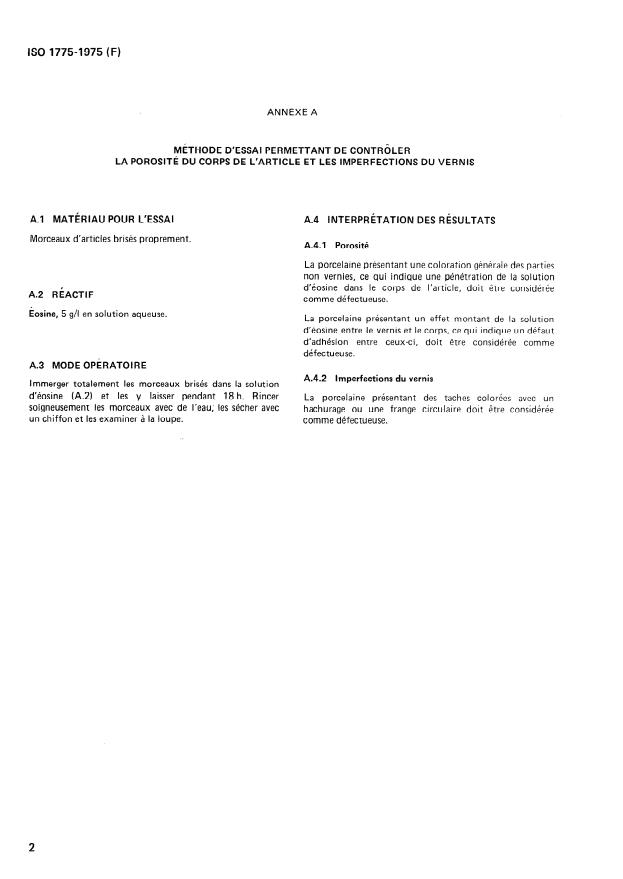
ISO 1775:1975 - Appareils de laboratoire en porcelaine -- Spécifications et méthodes d'essai

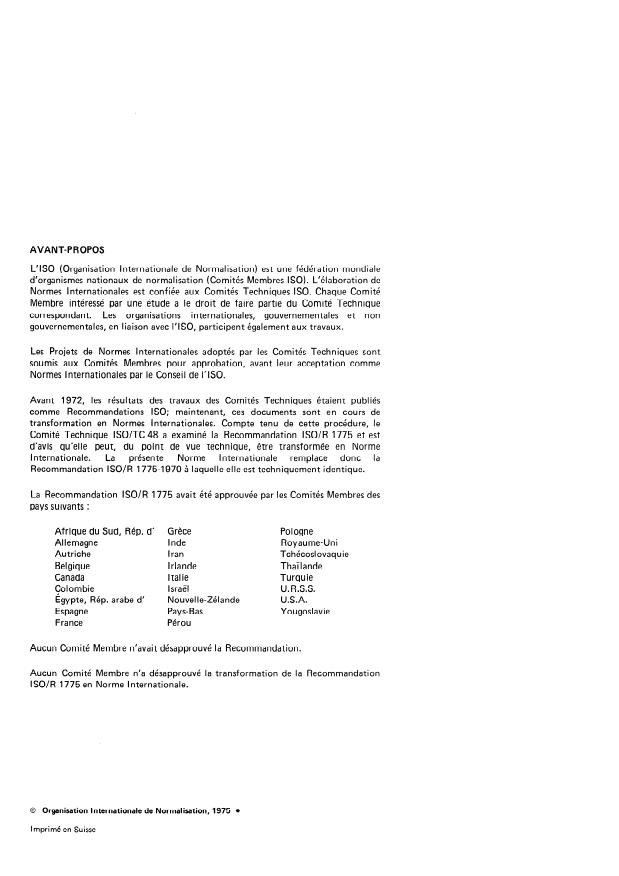

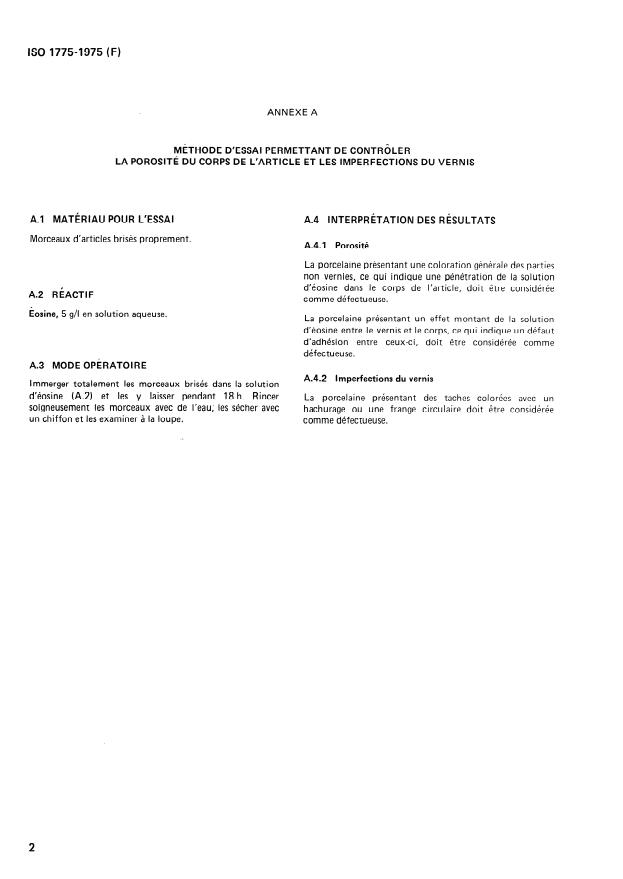
ISO 1775:1975 - Appareils de laboratoire en porcelaine -- Spécifications et méthodes d'essai
Get Certified
Connect with accredited certification bodies for this standard

ECOCERT
Organic and sustainability certification.

Eurofins Food Testing Global
Global leader in food, environment, and pharmaceutical product testing.

Intertek Bangladesh
Intertek certification and testing services in Bangladesh.
Sponsored listings
Frequently Asked Questions
ISO 1775:1975 is a standard published by the International Organization for Standardization (ISO). Its full title is "Porcelain laboratory apparatus — Requirements and methods of test". This standard covers: The requirements specify the quality of the material. The different methods of test are specified. They concern the porosity and imperfections of glaze, the resistance to heat and sudden change in temperature, the resistance of glaze to high temperature, to acid and to alkali and the constancy of mass on ignition.
The requirements specify the quality of the material. The different methods of test are specified. They concern the porosity and imperfections of glaze, the resistance to heat and sudden change in temperature, the resistance of glaze to high temperature, to acid and to alkali and the constancy of mass on ignition.
ISO 1775:1975 is classified under the following ICS (International Classification for Standards) categories: 71.040.20 - Laboratory ware and related apparatus. The ICS classification helps identify the subject area and facilitates finding related standards.
ISO 1775:1975 is available in PDF format for immediate download after purchase. The document can be added to your cart and obtained through the secure checkout process. Digital delivery ensures instant access to the complete standard document.
Standards Content (Sample)
SLOVENSKI STANDARD
01-avgust-1995
Porcelanske laboratorijske naprave - Zahteve in preskusne metode
Porcelain laboratory apparatus -- Requirements and methods of test
Appareils de laboratoire en porcelaine -- Spécifications et méthodes d'essai
Ta slovenski standard je istoveten z: ISO 1775:1975
ICS:
71.040.20 Laboratorijska posoda in Laboratory ware and related
aparati apparatus
2003-01.Slovenski inštitut za standardizacijo. Razmnoževanje celote ali delov tega standarda ni dovoljeno.
INTERNATIONAL STANDARD
INTERNATIONAL ORGANIZATION FOR STANDARDIZATION l MEXflYHAPOAHAfl OPrAHM3AUMR no CTAHLIAPTM3AUWM~ORGANISATION INTERNATIONALE DE NORMALISATION
Porcelain laboratory apparatus - Requirements and methods
of test
Appareils de laboratoire en porcelaine - Sp6cifications et methodes d’essai
First edition - 1975-09-01
UDC 542.232 : 620.16 Ref. No. ISO 1775-1975 (E)
Descriptors : laboratory glassware, porcelain, tests, thermal tests, high temperature tests, alkali resistance tests, acid resistance tests.
Price based on 5 pages
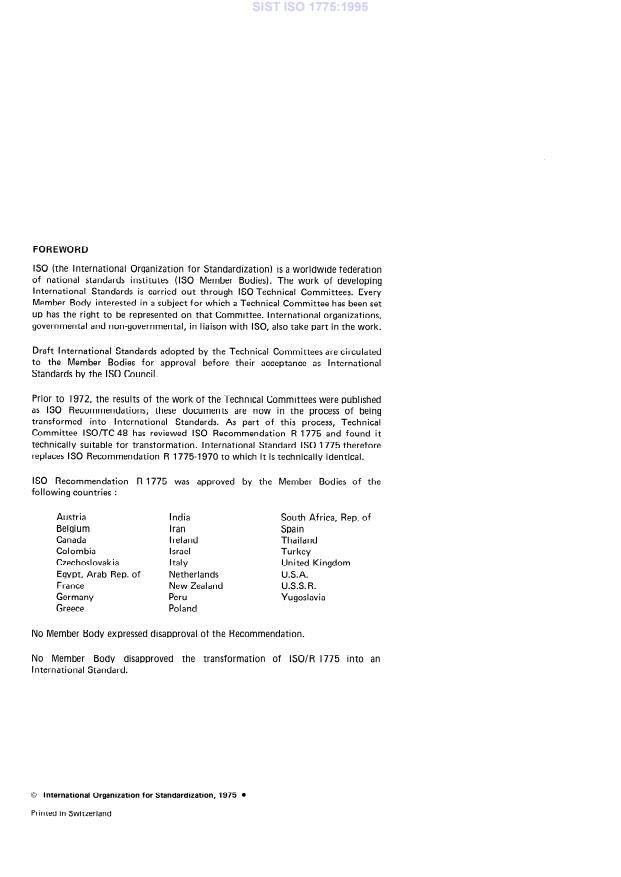
FOREWORD
ISO (the International Organization for Standardization) is a worldwide federation
of national Standards institutes (ISO Member Bodies). The work of developing
International Standards is carried out through ISO Technical Committees. Every
Member Body interested in a subject for which a Technical Committee has been set
up has the right to be represented on that Committee. International organizations,
governmental and non-governmental, in liaison with ISO, also take part in the work.
Draft International Standards adopted by the Technical Committees are circulated
to the Member Bodies for approval before their acceptance as International
Standards by the ISO Council.
Prior to 1972, the results of the work of the Technical Committees were published
as ISO Recommendations; these documents are now in the process of being
transformed into International Standards. As part of this process, Technical
Committee lSO/TC 48 has reviewed ISO Recommendation R 1775 and found it
technically suitable for transformation. International Standard ISO 1775 therefore
replaces ISO Recommendation R 1775-1970 to which it is technically identical.
ISO Recommendation R 1775 was approved by the Member Bodies of the
following countries :
Austria India South Africa, Rep. of
Belgium Iran Spain
Canada Ireland Thailand
Colombia Israel Turkey
United Kingdom
Czechoslovakia Italy
Netherlands U.S.A.
Egypt, Arab Rep. of
France New Zealand U.S.S. R.
Peru Yugoslavia
Germany
Greece Poland
No Member Body expressed disapproval of the Recommendation.
No Member Body disapproved the transformation of ISO/R 1775 into an
International Standard.
0 International Organkation for Standardkation, 1975 0
Printed in Switzerland
INTERNATIONAL STANDARD ISO 17754975 (E)
Porcelain laboratory apparatus - Requirements and methods
of test
1 SCOPE AND FIELD OF APPLICATION the porcelain shall not break, Crack or show crazing as
defined in 8.4.
This International Standard specifies requirements for a
quality of porcelain suitable for all types of porcelain
Iaboratory apparatus (including microchemical apparatus)
and describes appropriate methods of test. 6 RESISTANCE OF GLAZE TO HIGH TEMPERATURE
When tested by the method described in annex C, the glaze
NO-l-E - Some of the tests specified should, for convenience, be
carried out only on the articles mentioned, the results being
of the porcelain shall not show softening as defined in C.3.
accepted as generally applicable to all articles manufactured under
similar conditions from the same batch of material.
7 CONSTANCY OF MASS ON IGNITION
2 SAMPLING
When tested by the method described in annex D, the
The whole articles or pieces of porcelain apparatus selected
porcelain shall not vary in mass by more than 0,l mg per
for the tests shall be representative of the batch or
IO g of total mass.
consignment as a whole. The selection should preferably be
made by application of a Standard sampling procedure,
agreed between the Parties to the tests.
8 RESISTANCE OF GLAZE TO ACID OR ALKALI
3 POROSITY
When tested by the method described in annex E, the
porcelain shall not show losses in mass greater than the fol-
When tested by the method described in annex A, the
lowing amounts :
porcelain shall not show staining as defined in A.4.1.
a) Hydrochlorit acid test
4 GLAZE
0,Ol mg per Square centimetre of the total inner
surface of the vessel.
When tested by the method described in annex A, the glaze
of the porcelain shall not show crazing or other defects as
b) Sodium carbonate test
defined in A.4.2.
0,l mg per Square centimetre of the surface covered
by the liquid.
5 RESISTANCE TO HEAT AND SUDDEN CHANGE OF
TEMPERATURE c) Sodium hydroxide test
When quenched from a temperature of 230 “C above 0,6 mg per Square centimetre of the surface covered
ambient temperature, in the manner described in annex B, by the liquid.
ISO 1775-1975 (E)
ANNEX A
METHOD OF TEST FOR POROSITY OF BODY AND IMPERFECTIONS OF GLAZE
A.4 INTERPRETATION OF RESULTS
A.1 MATERIAL FOR TEST
Cleanly broken pieces.
A.4.1 Porosity
Porcelain showing general staining of unglazed portions,
A.2 REAGENT
indicating Penetration of the eosin Solution through the
body, shall be reported as failing the t
...
INTERNATIONAL STANDARD
INTERNATIONAL ORGANIZATION FOR STANDARDIZATION l MEXflYHAPOAHAfl OPrAHM3AUMR no CTAHLIAPTM3AUWM~ORGANISATION INTERNATIONALE DE NORMALISATION
Porcelain laboratory apparatus - Requirements and methods
of test
Appareils de laboratoire en porcelaine - Sp6cifications et methodes d’essai
First edition - 1975-09-01
UDC 542.232 : 620.16 Ref. No. ISO 1775-1975 (E)
Descriptors : laboratory glassware, porcelain, tests, thermal tests, high temperature tests, alkali resistance tests, acid resistance tests.
Price based on 5 pages
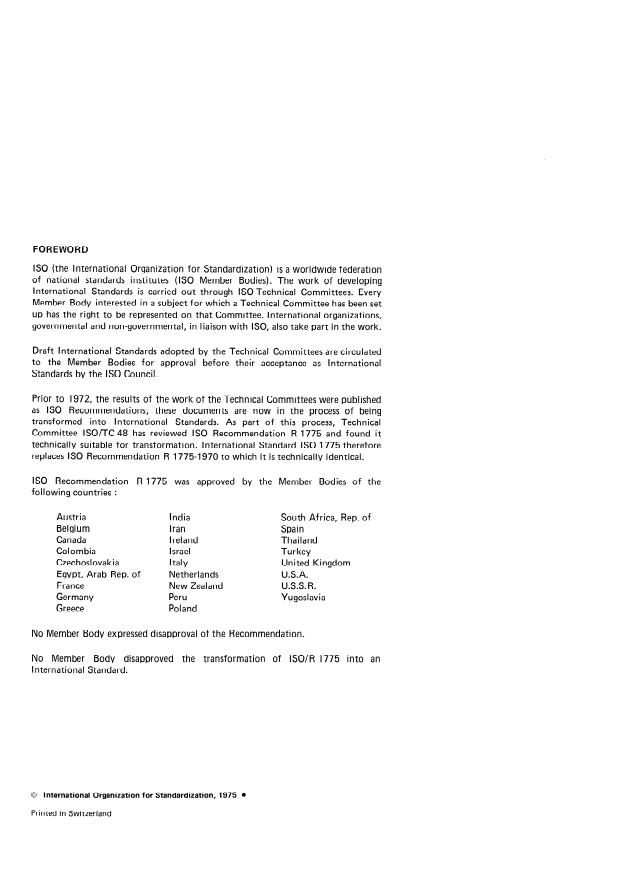
FOREWORD
ISO (the International Organization for Standardization) is a worldwide federation
of national Standards institutes (ISO Member Bodies). The work of developing
International Standards is carried out through ISO Technical Committees. Every
Member Body interested in a subject for which a Technical Committee has been set
up has the right to be represented on that Committee. International organizations,
governmental and non-governmental, in liaison with ISO, also take part in the work.
Draft International Standards adopted by the Technical Committees are circulated
to the Member Bodies for approval before their acceptance as International
Standards by the ISO Council.
Prior to 1972, the results of the work of the Technical Committees were published
as ISO Recommendations; these documents are now in the process of being
transformed into International Standards. As part of this process, Technical
Committee lSO/TC 48 has reviewed ISO Recommendation R 1775 and found it
technically suitable for transformation. International Standard ISO 1775 therefore
replaces ISO Recommendation R 1775-1970 to which it is technically identical.
ISO Recommendation R 1775 was approved by the Member Bodies of the
following countries :
Austria India South Africa, Rep. of
Belgium Iran Spain
Canada Ireland Thailand
Colombia Israel Turkey
United Kingdom
Czechoslovakia Italy
Netherlands U.S.A.
Egypt, Arab Rep. of
France New Zealand U.S.S. R.
Peru Yugoslavia
Germany
Greece Poland
No Member Body expressed disapproval of the Recommendation.
No Member Body disapproved the transformation of ISO/R 1775 into an
International Standard.
0 International Organkation for Standardkation, 1975 0
Printed in Switzerland
INTERNATIONAL STANDARD ISO 17754975 (E)
Porcelain laboratory apparatus - Requirements and methods
of test
1 SCOPE AND FIELD OF APPLICATION the porcelain shall not break, Crack or show crazing as
defined in 8.4.
This International Standard specifies requirements for a
quality of porcelain suitable for all types of porcelain
Iaboratory apparatus (including microchemical apparatus)
and describes appropriate methods of test. 6 RESISTANCE OF GLAZE TO HIGH TEMPERATURE
When tested by the method described in annex C, the glaze
NO-l-E - Some of the tests specified should, for convenience, be
carried out only on the articles mentioned, the results being
of the porcelain shall not show softening as defined in C.3.
accepted as generally applicable to all articles manufactured under
similar conditions from the same batch of material.
7 CONSTANCY OF MASS ON IGNITION
2 SAMPLING
When tested by the method described in annex D, the
The whole articles or pieces of porcelain apparatus selected
porcelain shall not vary in mass by more than 0,l mg per
for the tests shall be representative of the batch or
IO g of total mass.
consignment as a whole. The selection should preferably be
made by application of a Standard sampling procedure,
agreed between the Parties to the tests.
8 RESISTANCE OF GLAZE TO ACID OR ALKALI
3 POROSITY
When tested by the method described in annex E, the
porcelain shall not show losses in mass greater than the fol-
When tested by the method described in annex A, the
lowing amounts :
porcelain shall not show staining as defined in A.4.1.
a) Hydrochlorit acid test
4 GLAZE
0,Ol mg per Square centimetre of the total inner
surface of the vessel.
When tested by the method described in annex A, the glaze
of the porcelain shall not show crazing or other defects as
b) Sodium carbonate test
defined in A.4.2.
0,l mg per Square centimetre of the surface covered
by the liquid.
5 RESISTANCE TO HEAT AND SUDDEN CHANGE OF
TEMPERATURE c) Sodium hydroxide test
When quenched from a temperature of 230 “C above 0,6 mg per Square centimetre of the surface covered
ambient temperature, in the manner described in annex B, by the liquid.
ISO 1775-1975 (E)
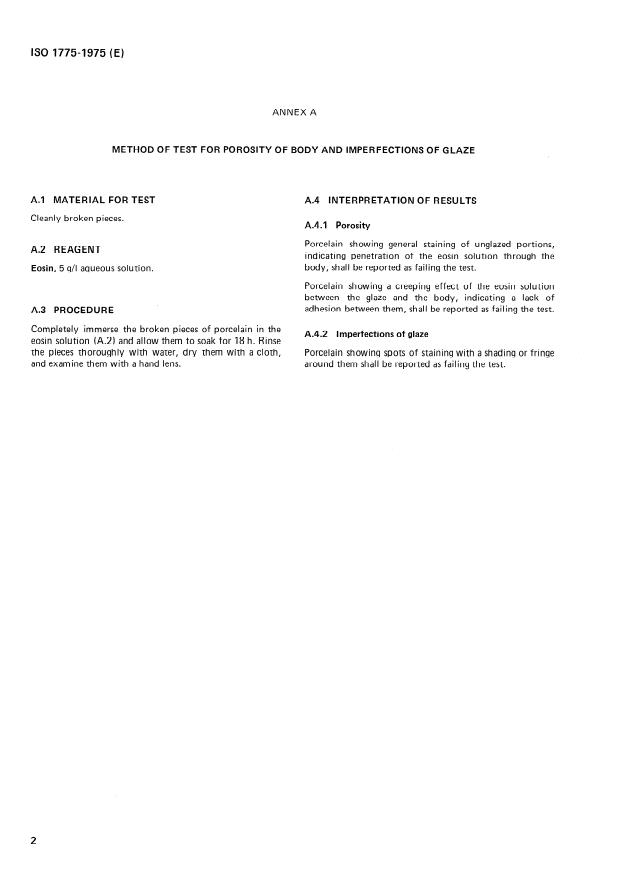
ANNEX A
METHOD OF TEST FOR POROSITY OF BODY AND IMPERFECTIONS OF GLAZE
A.4 INTERPRETATION OF RESULTS
A.1 MATERIAL FOR TEST
Cleanly broken pieces.
A.4.1 Porosity
Porcelain showing general staining of unglazed portions,
A.2 REAGENT
indicating Penetration of the eosin Solution through the
body, shall be reported as failing the test.
Eosin, 5 g/l aqueous Solution.
Porcelain showing a creeping effect of the eosin Solution
between the glaze and the body, indicating a Iack of
adhesion between them, shall be reported as failing the test.
A.3 PROCEDURE
Completely immerse the broken pieces of porcelain in the
A.4.2 Imperfections of glaze
eosin Solution (A.2) and allow them to soak for 18 h. Rinse
Porcelain sh
...
NORME INTERNATIONALE
INTERNATIONAL ORGANIZATION FOR STANDARDIZATION l MEXaYHAPOAHASi OPI-AHM3AUMII l-I0 CTAHAAPTM3A~MM-ORGANISATION INTERNATIONALE DE NORMALISATION
Appareils de laboratoire en porcelaine - Spécifications et
méthodes d’essai
Porcelain laboratory apparatus - Requirements and methods of test
Première édition - 1975-09-01
u:
Réf. no : ISO 1775-1975 (6)
Y
CDU 542.232 : 620.16
CT,
Y
I essai de résistance aux bases, essai de
verrerie de laboratoire, porcelaine, essai, essai thermique, essai à haute température,
Descripteurs :
E
résistance aux acides.
r\
c
si
Prix basé sur 5 pages
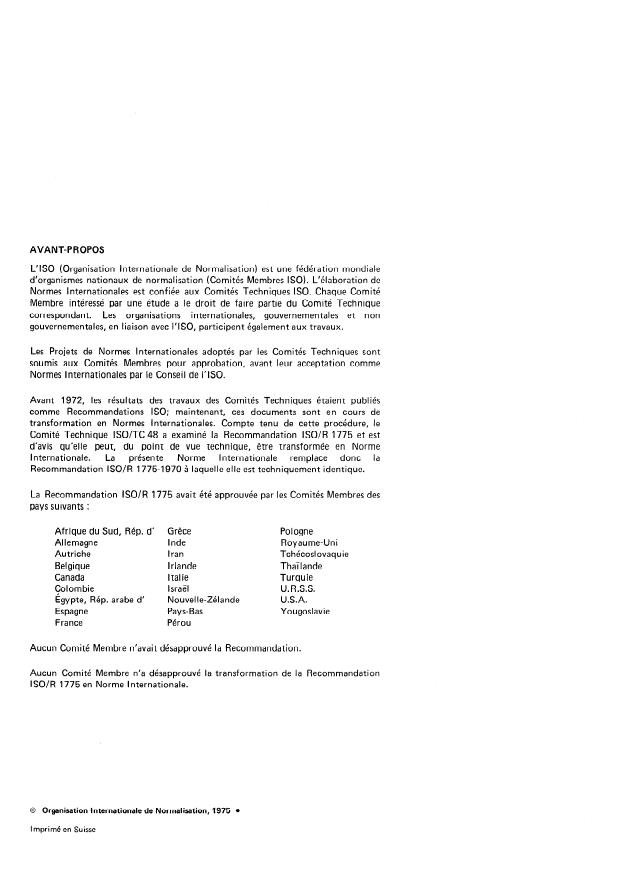
AVANT-PROPOS
L’ISO (Organisation Internationale de Normalisation) est une fédération mondiale
d’organismes nationaux de normalisation (Comités Membres 60). L’élaboration de
Normes Internationales est confiée aux Comités Techniques ISO. Chaque Comité
Membre intéressé par une étude a le droit de faire partie du Comité Technique
correspondant. Les organisations internationales, gouvernementales et non
gouvernementales, en liaison avec I’ISO, participent également aux travaux.
Les Projets de Normes Internationales adoptés par les Comités Techniques sont
soumis aux Comités Membres pour approbation, avant leur acceptation comme
Normes Internationales par le Conseil de I’ISO.
Avant 1972, les résultats des travaux des Comités Techniques étaient publiés
comme Recommandations ISO; maintenant, ces documents sont en cours de
transformation en Normes Internationales. Compte tenu de cette procédure, le
Comité Technique ISO/TC 48 a examiné la Recommandation ISO/R 1775 et est
d’avis qu’elle peut, du point de vue technique, être transformée en Norme
Internationale. La
présen te Norme Internationale remplace donc la
Recommandation ISO/R 1775-1970 à laquelle elle est techniquement identique.
La Recommandation lSO/R 1775 avait été approuvée par les Comités Membres des
pays suivants :
Afrique du Sud, Rép. d’ Grèce Pologne
Allemagne Inde Royaume-Uni
Autriche l ran Tchécoslovaquie
Belgique Irlande
Thaïlande
Canada Italie Turquie
Colombie Israël U.R.S.S.
Égypte, Rép. arabe d’ Nouvelle-Zélande U.S.A.
Espagne Pays-Bas Yougoslavie
France Pérou
Aucun Comité Membre n’avait désapprouvé la Recommandation.
Aucun Comité Membre n’a désapprouvé la transformation de la Recommandation
ISO/R 1775 en Norme Internationale.
0 Organisation Internationale de Normalisation, 1975 l
Imprimé en Suisse
NORME INTERNATIONALE ISO 17754975 (F)
Appareils de laboratoire en porcelaine - Spécifications et
méthodes d’essai
1 OBJET ET DOMAINE D’APPLICATION méthode décrite en annexe B, la porcelaine ne doit pas être
brisée, fêlée ou écaillée, comme indiqué en B-4.
La présente Norme Internationale fixe les spécifications
d’une qualité de porcelaine convenable pour tous les types
d’appareils de laboratoire en porcelaine (y compris les 6 RÉSISTANCE DU VERNIS À UNE HAUTE
appareils de microchimie) et décrit les méthodes d’essai
TEMPÉRATURE
correspondantes.
Après avoir subi l’essai décrit en annexe C, le vernis de la
NOTE - Certains des essais indiqués doivent, pour plus de porcelaine ne doit présenter aucun ramollissement, comme
commodité, être effectués uniquement sur les articles mentionnés
indiqué en C.3.
dans les méthodes d’essai, les résultats étant considérés comme
généralement applicables à tous les articles fabriqués dans des
conditions semblables à partir du même lot de matériau.
7 CONSTANCE DE LA MASSE À LA CALCINATION
2 ÉCHANTILLONNAGE
Après avoir subi l’essai décrit en annexe D, la masse de la
L’ensemble des articles ou parties d’appareils en porcelaine porcelaine ne doit pas avoir varié de plus de 0,‘l mg par
sélectionnés pour les essais doit être représentatif du lot ou
10 g.
de la livraison. La sélection doit, de préférence, être
effectuée en suivant les indications d’une méthode
d’échantillonnage normalisée, acceptée par les parties
intéressées.
8 RÉSISTANCE DU VERNIS AUX ACIDES ET AUX
BASES
3 POROSITÉ
Après avoir subi les essais décrits en annexe E, la porcelaine
ne doit pas présenter une perte de masse supérieure aux
Après avoir subi l’essai décrit en annexe A, la porcelaine ne
valeurs suivantes :
doit présenter aucune coloration, comme indiqué en A.4.1.
a) Essai à l’acide chlorhydrique
4 VERNIS
0,Ol mg par centimètre carré de la surface intérieure
totale de l’article.
Après avoir subi l’essai décrit en annexe A, le vernis de la
porcelaine ne doit pas être craquelé ni présenter d’autres
b) Essai au carbonate de sodium
défauts, comme indiqué en A.4.2.
0,l mg par centimètre carré de la surface recouverte
par le liquide.
5 RÉSISTANCE À LA CHALEUR ET AU
CHANGEMENT BRUSQUE DE TEMPÉRATURE c) Essai à l’hydroxyde de sodium
0,6 mg par centimètre carré de la surface recouverte
Après avoir été chauffée à 230 “C au-dessus de la
par le liquide.
température ambiante et brusquement refroidie selon la
lSO1775=1975(F)
ANNEXE A
MÉTHODE D’ESSAI PERMETTANT DE CONTRÔLER
LA POROSITÉ DU CORPS DE L’ARTICLE ET LES IMPERFECTIONS DU VERNIS
A.4 INTERPRÉTATION DES RÉSULTATS
A.1 MATÉRIAU POUR L’ESSAI
Morceaux d’articles brisés proprement.
A.4.1 Porosité
La porcelaine présentant une coloration générale des parties
non vernies, ce qui indique une pénétration de la solution
d’éosine dans le corps de l’article, doit être considérée
A.2 RÉACTIF
comme défectueuse.
Éosine, 5 g/l en solution aqueuse.
La porcelaine présentant un effet montant de la solution
d’éosine entre le vernis et le corps, ce qui indique un défaut
d’adhésion entre ceux-ci, doit être considérée comme
défectueuse.
A.3 MODE OPÉRATOIRE
A.4.2 Imperfections du vernis
Immerger totalement les morceaux brisés dans la solution
d’éosine (A.2) et les y laisser pendant 18 h. Rincer La porcelaine présentant des taches colorées avec un
soigneusement les morceaux avec de l’eau;
...
NORME INTERNATIONALE
INTERNATIONAL ORGANIZATION FOR STANDARDIZATION l MEXaYHAPOAHASi OPI-AHM3AUMII l-I0 CTAHAAPTM3A~MM-ORGANISATION INTERNATIONALE DE NORMALISATION
Appareils de laboratoire en porcelaine - Spécifications et
méthodes d’essai
Porcelain laboratory apparatus - Requirements and methods of test
Première édition - 1975-09-01
u:
Réf. no : ISO 1775-1975 (6)
Y
CDU 542.232 : 620.16
CT,
Y
I essai de résistance aux bases, essai de
verrerie de laboratoire, porcelaine, essai, essai thermique, essai à haute température,
Descripteurs :
E
résistance aux acides.
r\
c
si
Prix basé sur 5 pages
AVANT-PROPOS
L’ISO (Organisation Internationale de Normalisation) est une fédération mondiale
d’organismes nationaux de normalisation (Comités Membres 60). L’élaboration de
Normes Internationales est confiée aux Comités Techniques ISO. Chaque Comité
Membre intéressé par une étude a le droit de faire partie du Comité Technique
correspondant. Les organisations internationales, gouvernementales et non
gouvernementales, en liaison avec I’ISO, participent également aux travaux.
Les Projets de Normes Internationales adoptés par les Comités Techniques sont
soumis aux Comités Membres pour approbation, avant leur acceptation comme
Normes Internationales par le Conseil de I’ISO.
Avant 1972, les résultats des travaux des Comités Techniques étaient publiés
comme Recommandations ISO; maintenant, ces documents sont en cours de
transformation en Normes Internationales. Compte tenu de cette procédure, le
Comité Technique ISO/TC 48 a examiné la Recommandation ISO/R 1775 et est
d’avis qu’elle peut, du point de vue technique, être transformée en Norme
Internationale. La
présen te Norme Internationale remplace donc la
Recommandation ISO/R 1775-1970 à laquelle elle est techniquement identique.
La Recommandation lSO/R 1775 avait été approuvée par les Comités Membres des
pays suivants :
Afrique du Sud, Rép. d’ Grèce Pologne
Allemagne Inde Royaume-Uni
Autriche l ran Tchécoslovaquie
Belgique Irlande
Thaïlande
Canada Italie Turquie
Colombie Israël U.R.S.S.
Égypte, Rép. arabe d’ Nouvelle-Zélande U.S.A.
Espagne Pays-Bas Yougoslavie
France Pérou
Aucun Comité Membre n’avait désapprouvé la Recommandation.
Aucun Comité Membre n’a désapprouvé la transformation de la Recommandation
ISO/R 1775 en Norme Internationale.
0 Organisation Internationale de Normalisation, 1975 l
Imprimé en Suisse
NORME INTERNATIONALE ISO 17754975 (F)
Appareils de laboratoire en porcelaine - Spécifications et
méthodes d’essai
1 OBJET ET DOMAINE D’APPLICATION méthode décrite en annexe B, la porcelaine ne doit pas être
brisée, fêlée ou écaillée, comme indiqué en B-4.
La présente Norme Internationale fixe les spécifications
d’une qualité de porcelaine convenable pour tous les types
d’appareils de laboratoire en porcelaine (y compris les 6 RÉSISTANCE DU VERNIS À UNE HAUTE
appareils de microchimie) et décrit les méthodes d’essai
TEMPÉRATURE
correspondantes.
Après avoir subi l’essai décrit en annexe C, le vernis de la
NOTE - Certains des essais indiqués doivent, pour plus de porcelaine ne doit présenter aucun ramollissement, comme
commodité, être effectués uniquement sur les articles mentionnés
indiqué en C.3.
dans les méthodes d’essai, les résultats étant considérés comme
généralement applicables à tous les articles fabriqués dans des
conditions semblables à partir du même lot de matériau.
7 CONSTANCE DE LA MASSE À LA CALCINATION
2 ÉCHANTILLONNAGE
Après avoir subi l’essai décrit en annexe D, la masse de la
L’ensemble des articles ou parties d’appareils en porcelaine porcelaine ne doit pas avoir varié de plus de 0,‘l mg par
sélectionnés pour les essais doit être représentatif du lot ou
10 g.
de la livraison. La sélection doit, de préférence, être
effectuée en suivant les indications d’une méthode
d’échantillonnage normalisée, acceptée par les parties
intéressées.
8 RÉSISTANCE DU VERNIS AUX ACIDES ET AUX
BASES
3 POROSITÉ
Après avoir subi les essais décrits en annexe E, la porcelaine
ne doit pas présenter une perte de masse supérieure aux
Après avoir subi l’essai décrit en annexe A, la porcelaine ne
valeurs suivantes :
doit présenter aucune coloration, comme indiqué en A.4.1.
a) Essai à l’acide chlorhydrique
4 VERNIS
0,Ol mg par centimètre carré de la surface intérieure
totale de l’article.
Après avoir subi l’essai décrit en annexe A, le vernis de la
porcelaine ne doit pas être craquelé ni présenter d’autres
b) Essai au carbonate de sodium
défauts, comme indiqué en A.4.2.
0,l mg par centimètre carré de la surface recouverte
par le liquide.
5 RÉSISTANCE À LA CHALEUR ET AU
CHANGEMENT BRUSQUE DE TEMPÉRATURE c) Essai à l’hydroxyde de sodium
0,6 mg par centimètre carré de la surface recouverte
Après avoir été chauffée à 230 “C au-dessus de la
par le liquide.
température ambiante et brusquement refroidie selon la
lSO1775=1975(F)
ANNEXE A
MÉTHODE D’ESSAI PERMETTANT DE CONTRÔLER
LA POROSITÉ DU CORPS DE L’ARTICLE ET LES IMPERFECTIONS DU VERNIS
A.4 INTERPRÉTATION DES RÉSULTATS
A.1 MATÉRIAU POUR L’ESSAI
Morceaux d’articles brisés proprement.
A.4.1 Porosité
La porcelaine présentant une coloration générale des parties
non vernies, ce qui indique une pénétration de la solution
d’éosine dans le corps de l’article, doit être considérée
A.2 RÉACTIF
comme défectueuse.
Éosine, 5 g/l en solution aqueuse.
La porcelaine présentant un effet montant de la solution
d’éosine entre le vernis et le corps, ce qui indique un défaut
d’adhésion entre ceux-ci, doit être considérée comme
défectueuse.
A.3 MODE OPÉRATOIRE
A.4.2 Imperfections du vernis
Immerger totalement les morceaux brisés dans la solution
d’éosine (A.2) et les y laisser pendant 18 h. Rincer La porcelaine présentant des taches colorées avec un
soigneusement les morceaux avec de l’eau;
...
Questions, Comments and Discussion
Ask us and Technical Secretary will try to provide an answer. You can facilitate discussion about the standard in here.
Loading comments...