

ISO 3947:1977
(Main)Starches, native or modified — Determination of total fat content
General Information
- Abstract
Hydrolysis of the product by boiling hydrochloric acid, and coagulation of the insoluble products by cooling. Separation by filtration, drying and isolation the wanted matter by solvent extraction. The method applies to contents less than 1,5 % (m/m).
- Status
- Published
- Publication Date
- 31-Jul-1977
- Technical Committee
- ISO/TC 93 - Starch (including derivatives and by-products)
- Drafting Committee
- ISO/TC 93 - Starch (including derivatives and by-products)
- Current Stage
- 9060 - Close of review
- Completion Date
- 02-Sep-2031
Buy Documents
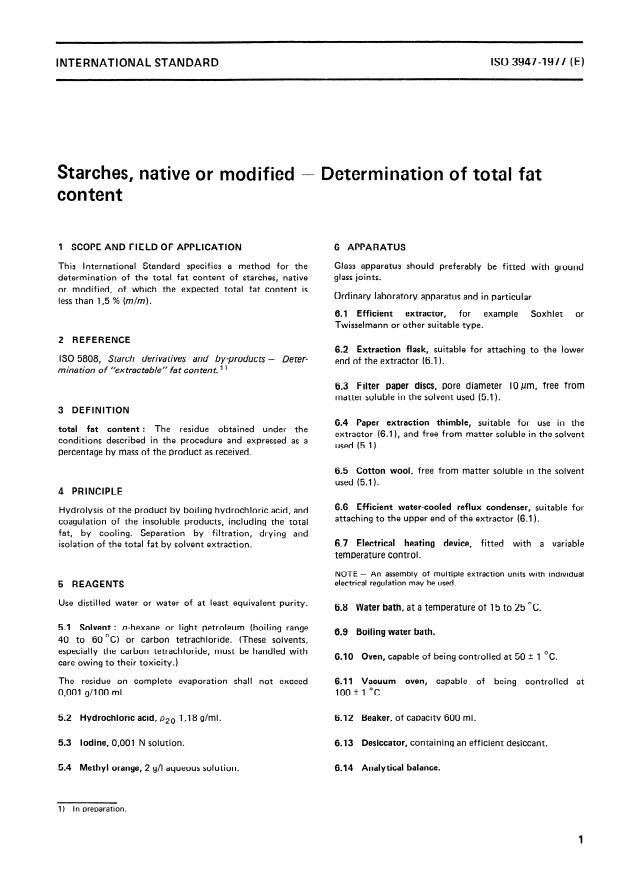

ISO 3947:1977 - Starches, native or modified -- Determination of total fat content
ISO 3947:1977 - Starches, native or modified — Determination of total fat content/1/1977
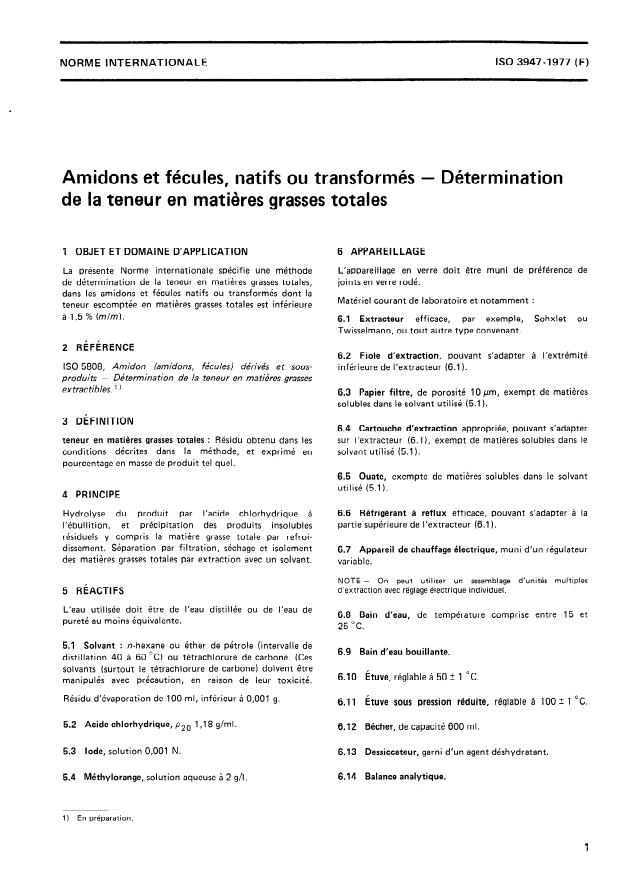

ISO 3947:1977 - Amidons et fécules, natifs ou transformés -- Détermination de la teneur en matieres grasses totales
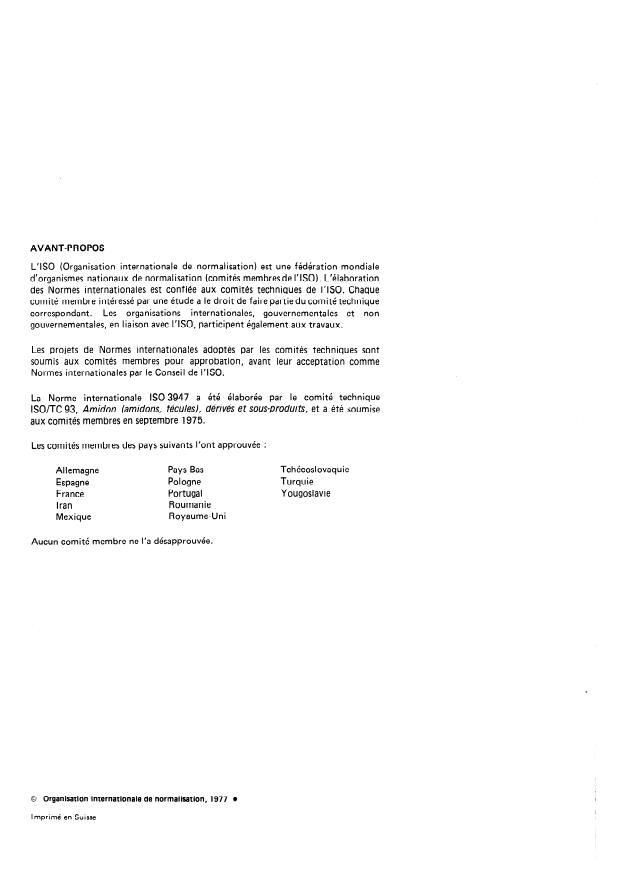

ISO 3947:1977 - Amidons et fécules, natifs ou transformés -- Détermination de la teneur en matieres grasses totales
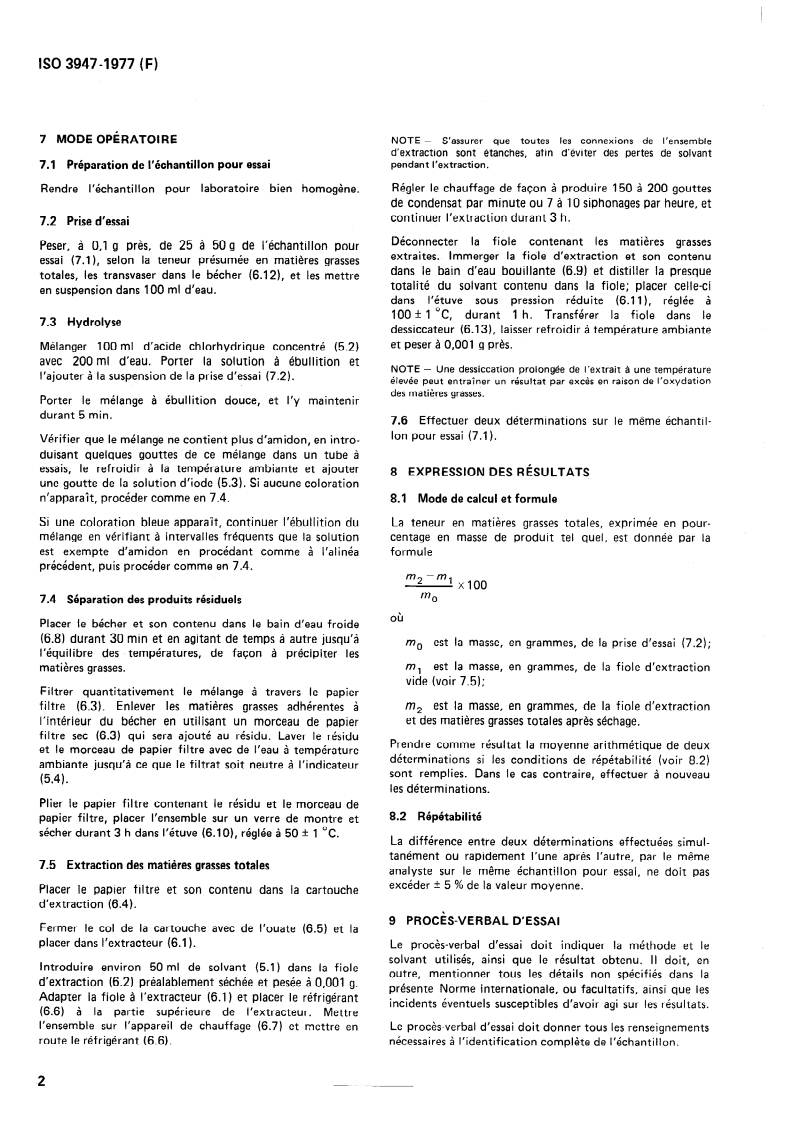
ISO 3947:1977 - Amidons et fécules, natifs ou transformés — Détermination de la teneur en matières grasses totales/1/1977
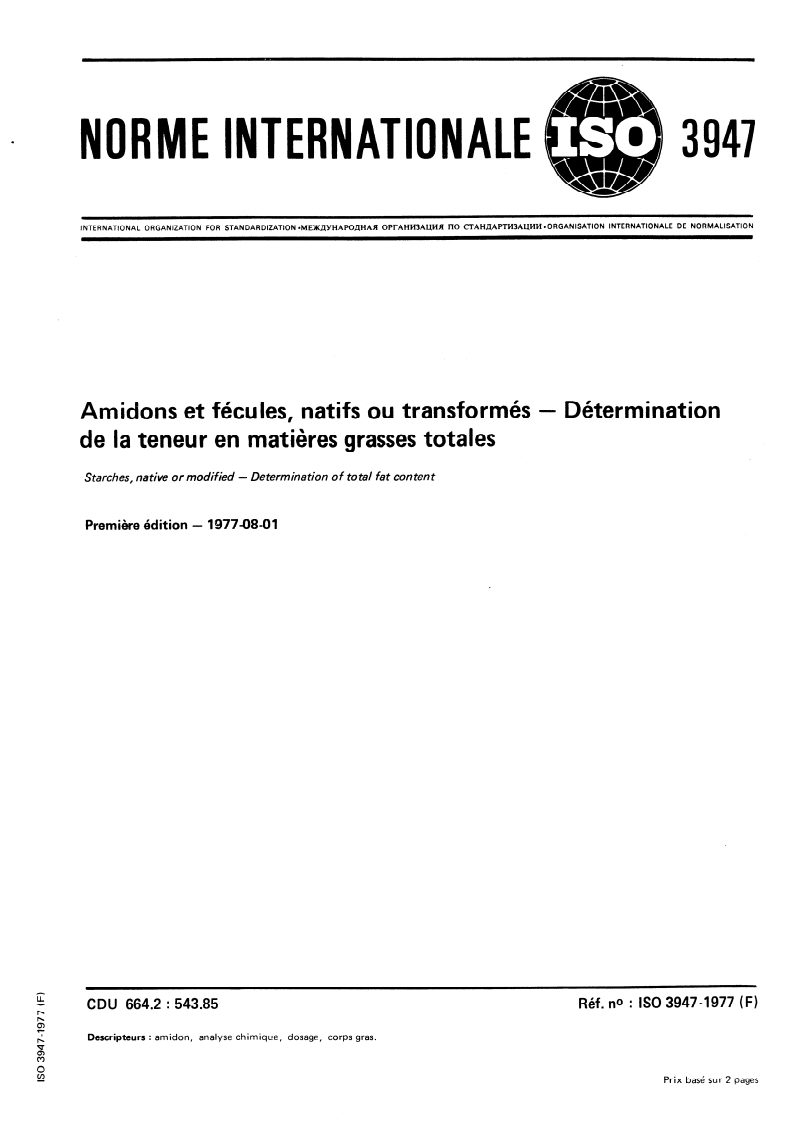
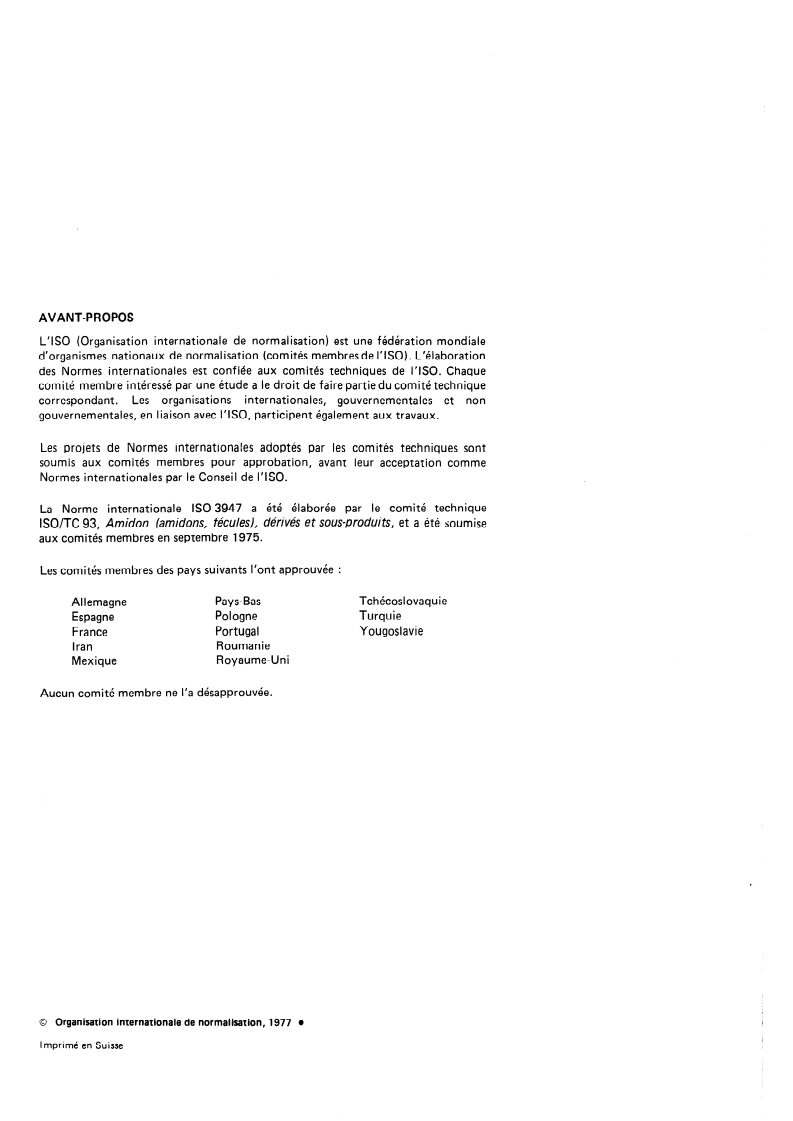
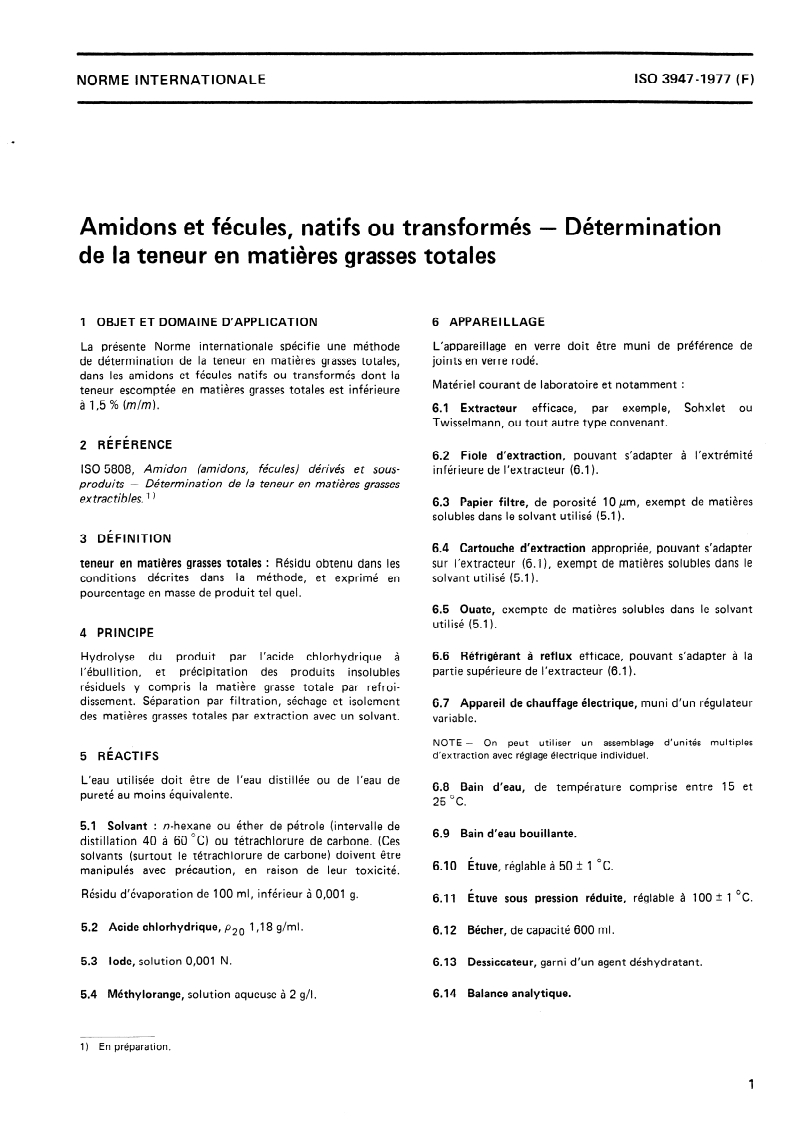
ISO 3947:1977 - Amidons et fécules, natifs ou transformés — Détermination de la teneur en matières grasses totales/1/1977
Overview
ISO 3947:1977 is an international standard established by the International Organization for Standardization (ISO) for the determination of total fat content in starches, whether native or modified. This methodology is specifically designed for starch products with a total fat content of less than 1.5% by mass (m/m). The process involves hydrolysis with boiling hydrochloric acid, followed by coagulation, filtration, drying, and extraction of fat using a suitable solvent.
Determining fat content is essential in the starch industry for quality control, product labeling, and compliance with food regulations. This standard ensures consistency and reliability in analytical results across laboratories worldwide.
Key Topics
- Scope: Applies to both native and modified starches with low total fat content (<1.5% m/m).
- Analytical Principle:
- Hydrolysis of starch using boiling hydrochloric acid
- Coagulation of insoluble products by cooling
- Filtration and drying of the precipitate
- Extraction of total fat using solvents such as n-hexane, light petroleum, or carbon tetrachloride
- Required Apparatus:
- Efficient extractor (e.g., Soxhlet or Twisselmann)
- Filter paper and extraction thimbles
- Water baths, vacuum/standard ovens, and analytical balance
- Test Precision: Reproducibility is ensured by performing duplicate determinations under defined repeatability conditions.
- Reporting: Test results must specify the method, solvent used, and any incidental observations.
Applications
ISO 3947:1977 is widely applicable in sectors where precise quantification of fat content in starch products is critical:
- Food Industry: Ensures compliance with nutritional labeling and regulatory standards for starch-based ingredients, additives, and processed foods.
- Quality Assurance: Enables consistent quality control in the production and modification of starch derivatives by monitoring residual fat content.
- Research and Development: Supports the development of new starch formulations and modified starches with tailored physical and nutritional properties.
- Trade and Compliance: Facilitates international trade and verification by providing a harmonized methodology for total fat determination, reducing disputes caused by inconsistent analytical practices.
This standard is crucial for producers, analytical laboratories, food inspectors, and anyone involved in the manufacture or assessment of starch products.
Related Standards
For comprehensive starch analysis and quality control, ISO 3947:1977 is used alongside other key ISO standards, such as:
- ISO 5808: Starch derivatives and by-products - Determination of "extractable" fat content
- ISO/TC 93: Standards for starch, derivatives, and by-products
Consulting related standards supports holistic testing and reliable product characterization across the starch industry.
Adhering to ISO 3947:1977 ensures precise, repeatable, and internationally recognized results for total fat content analysis in native and modified starches, supporting compliance, safety, and industry best practices.
Buy Documents
ISO 3947:1977 - Starches, native or modified -- Determination of total fat content
ISO 3947:1977 - Starches, native or modified — Determination of total fat content/1/1977
ISO 3947:1977 - Amidons et fécules, natifs ou transformés -- Détermination de la teneur en matieres grasses totales
ISO 3947:1977 - Amidons et fécules, natifs ou transformés -- Détermination de la teneur en matieres grasses totales
ISO 3947:1977 - Amidons et fécules, natifs ou transformés — Détermination de la teneur en matières grasses totales/1/1977
ISO 3947:1977 - Amidons et fécules, natifs ou transformés — Détermination de la teneur en matières grasses totales/1/1977
Get Certified
Connect with accredited certification bodies for this standard

BSI Group
BSI (British Standards Institution) is the business standards company that helps organizations make excellence a habit.

Bureau Veritas
Bureau Veritas is a world leader in laboratory testing, inspection and certification services.

DNV
DNV is an independent assurance and risk management provider.
Sponsored listings
Frequently Asked Questions
ISO 3947:1977 is a standard published by the International Organization for Standardization (ISO). Its full title is "Starches, native or modified — Determination of total fat content". This standard covers: Hydrolysis of the product by boiling hydrochloric acid, and coagulation of the insoluble products by cooling. Separation by filtration, drying and isolation the wanted matter by solvent extraction. The method applies to contents less than 1,5 % (m/m).
Hydrolysis of the product by boiling hydrochloric acid, and coagulation of the insoluble products by cooling. Separation by filtration, drying and isolation the wanted matter by solvent extraction. The method applies to contents less than 1,5 % (m/m).
ISO 3947:1977 is classified under the following ICS (International Classification for Standards) categories: 67.180.20 - Starch and derived products. The ICS classification helps identify the subject area and facilitates finding related standards.
ISO 3947:1977 is available in PDF format for immediate download after purchase. The document can be added to your cart and obtained through the secure checkout process. Digital delivery ensures instant access to the complete standard document.
Standards Content (Sample)
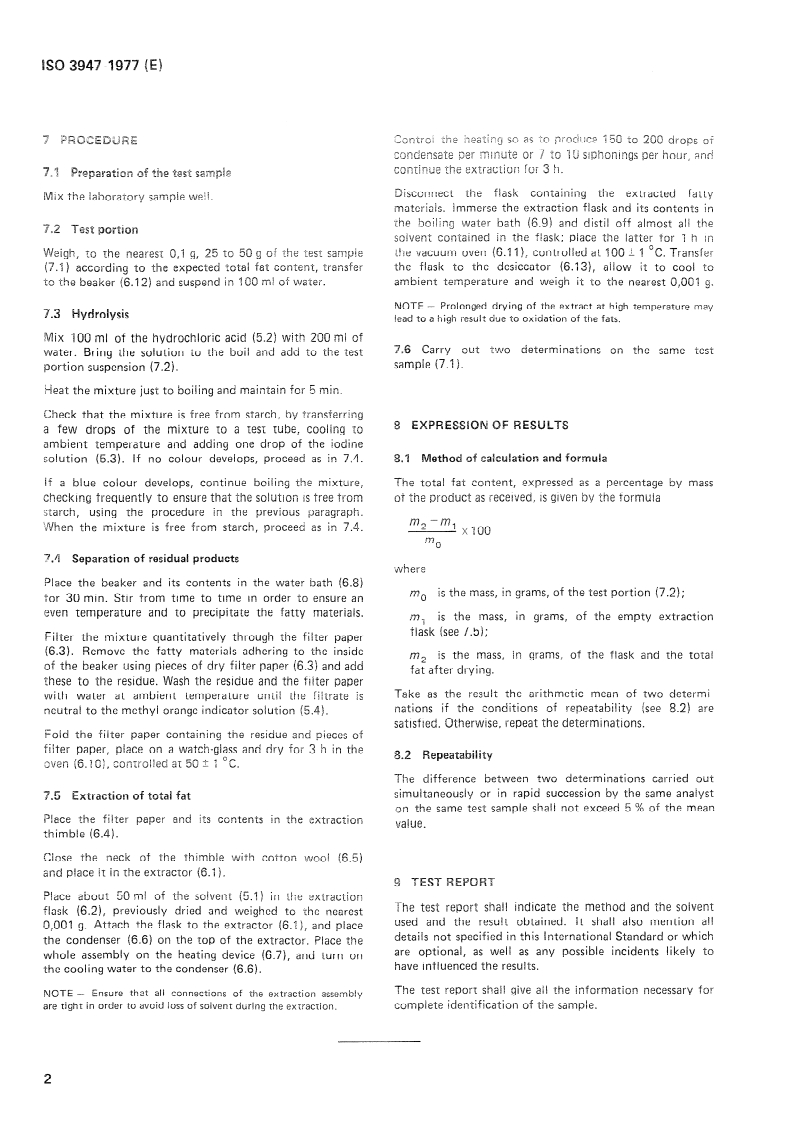
INTERNATIONAL STANDARD.
INTERNATIONAL ORGANIZATION FOR STANDARDIZATION l MEXAYHAPOAHAR OPl-AHM3AUMII l-IO CTAHAAPTM3AUMM -ORGANISATION INTERNATIONALE DE NORMALISATION
- Determination of total fat
Starches, native or modified
content
Amidons et feCules, natifs ou transform& - Determination de Ja teneur en matikes grasses totales
First edition - 1977-08-0 1
w
-
Ref. No. ISO 3947-1977 (E)
UDC 664.2 : 543.85
Descriptors : starches, Chemical analysis, determination of content, fats.
Price based on 2 pages
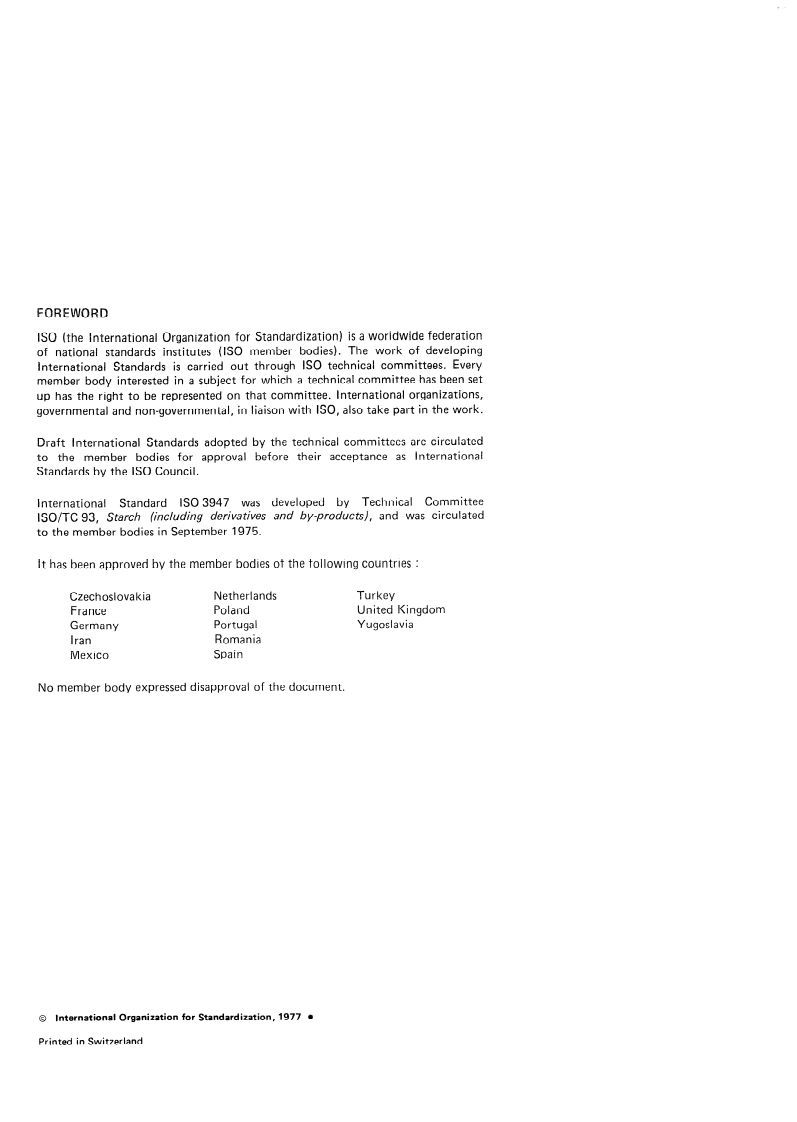
ISO (the International Organization for Standardization) is a worfdwide federation
of national Standards institutes (ISO member bodies). The work of developing
International Standards is carried out through ISQ technical committees. Every
member body interested in a subject for which a technical committee has been set
up has the right to be represented on that committee. International organizations,
governmental and non-gowernmental, in liaison with ISO, also take part in the work.
Draft International Standards adopted by the technical committees are circulated
to the member bodies for approwal before their acceptance as International
Standards by the ISO Council.
International Standard ISO 3947 was developed by Technical Committee
ISO/TC 93, Starch (including derivatives and by-products), and was circulated
to the member bodies in September 1975.
lt has been approved by the member bodies of the following countries :
Netherlands Turkey
Czechoslovakia
Poland United Mingdom
France
Portugal Yugoslavia
Germany
Romania
Iran
Spain
Mexico
No member body expressed disapprovai of the document.
0 International Organkation for Standardkation, 1977 @
Printed in Switzerland
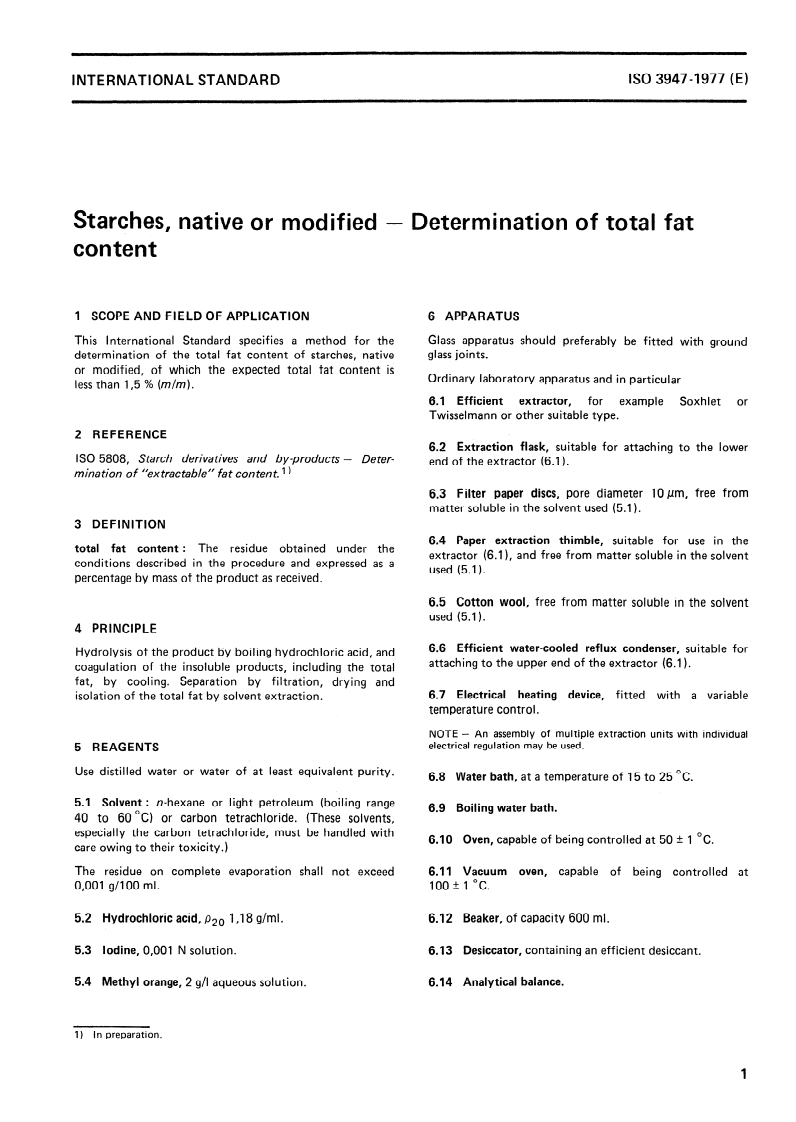
ISO 3947-1977 (E)
INTERNATIONAL STANDARD
Starches, native or modif ied - Determination of total fat
content
6 APPARATUS
1 SCOPE AND FIELD OF APPtlCATION
This International Standard specifies a method for the Glass apparatus should preferably be fitted with ground
glass joints.
determination of the total fat content of starches, native
or modified, of which the expected total fat content is
Ordinary Iaboratory apparatus and in particular
less than 1,5 % (mlm).
6.1 Efficient extractor, for example Soxhlet or
Twisselmann or other suitable type.
2 REFERENCE
6.2 Extraction flask, suitable for attaching to the lower
ISO 5808, Starch derivatives and by-products - Deter-
end of the extractor (6.1).
mination of “extractable” fat content. 1 )
6.3 Filter Paper discs, pore diameter 10 Pm, free from
matter soluble in the solvent used (5.1).
3 DEFINITION
6.4 Paper extraction thimble, suitable for use in the
total fat content : The residue obtained under the
extractor (63, and free from matter soluble in the solvent
conditions described in the procedure and expressed as a
used (5.1).
percentage by mass of the product as received.
6.5 Cotton wool, free from matter soluble in the solvent
used (5.1).
4 PRINCIPLE
6.6 Efficient water-cooled reflux condenser, suitable for
Hydrolysis of the product by boiling hydrochloric acid, and
attaching to the upper end of the extractor (6.1).
coagulation of the insoluble products, including the total
fat, by cooling. Separation by filtration, drying and
6.7 Electrical heating device, fitted with a variable
isolation of the total fat by solvent extraction.
temperature control.
NOTE - An assembly of multiple extraction units with individual
electrical regulation may be used.
5 REAGENTS
Use distilled water or water of at least equivalent purity.
6.8 Water bath, at a temperature of 15 to 25 “C.
5.1 Solvent : n-hexane or light Petroleum (boil-ing range
6.9 Boiling water bath.
40 to 60 “C) or carbon tetrachloride. (These solvents,
especially the carbon tetrachloride, must be handled with
6.10 Oven, capable of being controlled at 50 + 1 “C.
care owing to their toxicity.)
The residue on complete evaporation shall not exceed 6.11 Vacuum oven, capable of being cont
...
INTERNATIONAL STANDARD.
INTERNATIONAL ORGANIZATION FOR STANDARDIZATION l MEXAYHAPOAHAR OPl-AHM3AUMII l-IO CTAHAAPTM3AUMM -ORGANISATION INTERNATIONALE DE NORMALISATION
- Determination of total fat
Starches, native or modified
content
Amidons et feCules, natifs ou transform& - Determination de Ja teneur en matikes grasses totales
First edition - 1977-08-0 1
w
-
Ref. No. ISO 3947-1977 (E)
UDC 664.2 : 543.85
Descriptors : starches, Chemical analysis, determination of content, fats.
Price based on 2 pages
ISO (the International Organization for Standardization) is a worfdwide federation
of national Standards institutes (ISO member bodies). The work of developing
International Standards is carried out through ISQ technical committees. Every
member body interested in a subject for which a technical committee has been set
up has the right to be represented on that committee. International organizations,
governmental and non-gowernmental, in liaison with ISO, also take part in the work.
Draft International Standards adopted by the technical committees are circulated
to the member bodies for approwal before their acceptance as International
Standards by the ISO Council.
International Standard ISO 3947 was developed by Technical Committee
ISO/TC 93, Starch (including derivatives and by-products), and was circulated
to the member bodies in September 1975.
lt has been approved by the member bodies of the following countries :
Netherlands Turkey
Czechoslovakia
Poland United Mingdom
France
Portugal Yugoslavia
Germany
Romania
Iran
Spain
Mexico
No member body expressed disapprovai of the document.
0 International Organkation for Standardkation, 1977 @
Printed in Switzerland
ISO 3947-1977 (E)
INTERNATIONAL STANDARD
Starches, native or modif ied - Determination of total fat
content
6 APPARATUS
1 SCOPE AND FIELD OF APPtlCATION
This International Standard specifies a method for the Glass apparatus should preferably be fitted with ground
glass joints.
determination of the total fat content of starches, native
or modified, of which the expected total fat content is
Ordinary Iaboratory apparatus and in particular
less than 1,5 % (mlm).
6.1 Efficient extractor, for example Soxhlet or
Twisselmann or other suitable type.
2 REFERENCE
6.2 Extraction flask, suitable for attaching to the lower
ISO 5808, Starch derivatives and by-products - Deter-
end of the extractor (6.1).
mination of “extractable” fat content. 1 )
6.3 Filter Paper discs, pore diameter 10 Pm, free from
matter soluble in the solvent used (5.1).
3 DEFINITION
6.4 Paper extraction thimble, suitable for use in the
total fat content : The residue obtained under the
extractor (63, and free from matter soluble in the solvent
conditions described in the procedure and expressed as a
used (5.1).
percentage by mass of the product as received.
6.5 Cotton wool, free from matter soluble in the solvent
used (5.1).
4 PRINCIPLE
6.6 Efficient water-cooled reflux condenser, suitable for
Hydrolysis of the product by boiling hydrochloric acid, and
attaching to the upper end of the extractor (6.1).
coagulation of the insoluble products, including the total
fat, by cooling. Separation by filtration, drying and
6.7 Electrical heating device, fitted with a variable
isolation of the total fat by solvent extraction.
temperature control.
NOTE - An assembly of multiple extraction units with individual
electrical regulation may be used.
5 REAGENTS
Use distilled water or water of at least equivalent purity.
6.8 Water bath, at a temperature of 15 to 25 “C.
5.1 Solvent : n-hexane or light Petroleum (boil-ing range
6.9 Boiling water bath.
40 to 60 “C) or carbon tetrachloride. (These solvents,
especially the carbon tetrachloride, must be handled with
6.10 Oven, capable of being controlled at 50 + 1 “C.
care owing to their toxicity.)
The residue on complete evaporation shall not exceed 6.11 Vacuum oven, capable of being cont
...
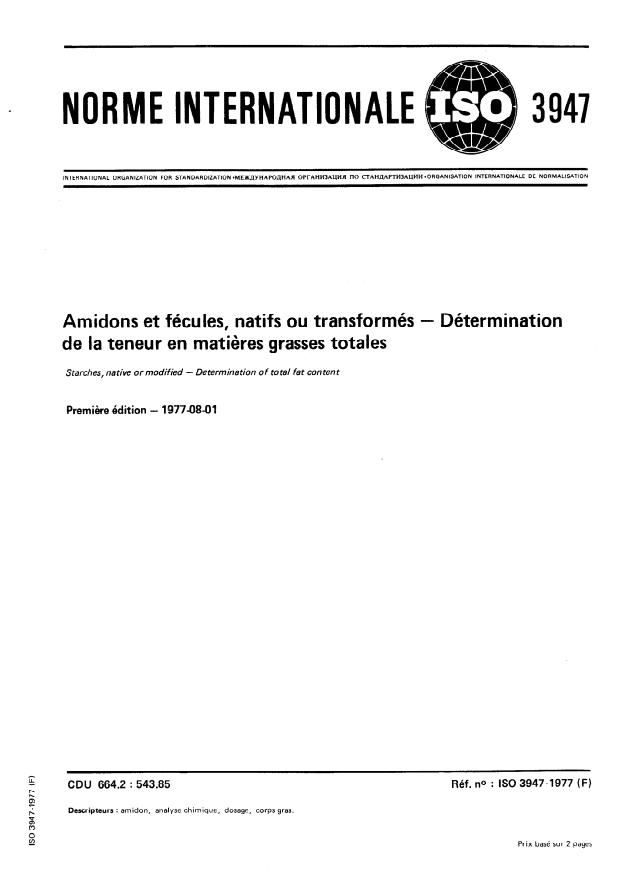
NORME INTERNATIONALE
INTERNATIONAL ORGANIZATION FOR STANDARDIZATION l EX~YHAPOAHAJ’I OPl-AHW3ALWl n0 CTAHL1[APTM3AWïW .ORGANISATION INTERNATIONALE DE NORMALISATION
Amidons et fécules, natifs ou transformés - Détermination
de la teneur en matières grasses totales
Starches, native or modified - Determination of total fat content
Première édition - 1977-08-01
c
Y
CDU 664.2 : 543.85 Réf. no : ISO 3947-1977 (F)
Descripteurs : amidon,
analyse chimique, dosage, corps gras.
Prix basé sur 2 pages
AVANT-PROPOS
L’ISO (Organisation internationale de normalisation) est une fédération mondiale
d’organismes nationaux de normalisation (comités membres de I’ISO). L’élaboration
des Normes internationales est confiée aux comités techniques de I’ISO. Chaque
comité membre intéressé par une étude a le droit de faire partiedu comité technique
correspondant. Les organisations internationales, gouvernementales et non
gouvernementales, en liaison avec I’ISO, participent également aux travaux.
Les projets de Normes internationales adoptés par les comités techniques sont
soumis aux comités membres pour approbation, avant leur acceptation comme
Normes internationales par le Conseil de I’ISO.
La Norme internationale ISO 3947 a été élaborée par le comité technique
ISO/TC 93, Amidon (amidons, fécules), dérivés et sous-produits, et a été soumise
aux comités membres en septembre 1975.
Les comités membres des pays suivants l’ont approuvée :
Pays-Bas Tchécoslovaquie
Allemagne
Pologne Turquie
Espagne
Portugal Yougoslavie
France
Roumanie
Iran
Royaume-Uni
Mexique
Aucun comité membre ne l’a désapprouvée.
0 Organisation internationale de normalisation, 1977 l
Imprimé en Suisse
ISO 3947-1977 (F)
NORME INTERNATIONALE
Amidons et fécules, natifs ou transformés - Détermination
de la teneur en matières grasses totales
6 APPAREILLAGE
1 OBJET ET DOMAINE D’APPLICATION
La présente Norme internationale spécifie une méthode L’appareillage en verre doit être muni de préférence de
de détermination de la teneur en matières grasses totales, joints en verre rodé.
dans les amidons et fécules natifs ou transformés dont la
Matériel courant de laboratoire et notamment :
teneur escomptée en matières grasses totales est inférieure
à 1,5 % (mlm).
6.1 Extracteur efficace, par exemple, Sohxlet ou
Twisselmann, ou tout autre type convenant.
2 RÉFÉRENCE
6.2 Fiole d’extraction, pouvant s’adapter à l’extrémité
ISO 5808, Amidon (amidons, fécules) dérivés et sous-
inférieure de l’extracteur (6.1).
Détermination de la teneur en matières grasses
produits -
ex trac tibles. ’ )
6.3 Papier filtre, de porosité 10 prn, exempt de matières
solubles dans le solvant utilisé (5.1).
3 DÉFINITION
6.4 Cartouche d’extraction appropriée, pouvant s’adapter
teneur en matières grasses totales : Résidu obtenu dans les
sur l’extracteur (6.1), exempt de matières solubles dans le
conditions décrites dans la méthode, et exprimé en
solvant utilisé (5.1).
pourcentage en masse de produit tel quel.
6.5 Ouate, exempte de matières solubles dans le solvant
utilisé (5.1).
4 PRINCIPE
6.6 Réfrigérant à reflux efficace, pouvant s’adapter à la
Hydrolyse du produit par l’acide chlorhydrique à
partie supérieure de l’extracteur (6.1).
l’ébullition, et précipitation des produits insolubles
résiduels y compris la matière grasse totale par refroi-
dissement. Séparation par filtration, séchage et isolement
6.7 Appareil de chauffage électrique, muni d’un régulateur
des matières grasses totales par extraction avec un solvant.
variable.
NOTE - On peut utiliser un assemblage d’unités multiples
d’extraction avec réglage électrique individuel.
5 RÉACTIFS
L’eau utilisée doit être de l’eau distillée ou de l’eau de
6.8 Bain d’eau, de température comprise entre 15 et
pureté au moins équivalente.
25 “c.
5.1 Solvant : n-hexane ou éther de pétrole (intervalle de
6.9 Bain d’eau bouillante.
distillation 40 à 66 “C) ou tétrachlorure de carbone. (Ces
solvants (surtout le tétrachlorure de carbone) doivent être
6.10 Étuve, réglable à 50 + 1 “C.
manipulés avec précaution,
en raison de leur toxicité.
Résidu d’évaporation de 100 ml, inférieur à 0,001 g.
6.11 Étuve sous pression réduite, réglable à 100 + 1 “C.
5.2 Acide chlorhydrique, pzO 1 ,18 g/ml.
6.12 Bécher, de capacité 600 ml.
5.3 Iode, solution 0,001 N. 6.13 Dessiccateur, garni d’un agent déshydratant.
5.4 Méthylorange, solution aqueuse à 2 g/l. 6.14 Balance analytique.
1) En préparation.
ISO 3947-1977 (F)
7 MODE OPÉRATOIRE NOTE - S’assu
...
NORME INTERNATIONALE
INTERNATIONAL ORGANIZATION FOR STANDARDIZATION l EX~YHAPOAHAJ’I OPl-AHW3ALUM n0 CTAHL1[APTM3AUWW .ORGANISATION INTERNATIONALE DE NORMALISATION
Amidons et fécules, natifs ou transformés - Détermination
de la teneur en matières grasses totales
Starches, native or modified - Determination of total fat content
Première édition - 1977-08-01
CDU 664.2 : 543.85 Réf. no : ISO 3947-1977 (F)
Descripteurs : amidon,
analyse chimique, dosage, corps gras.
Prix basé sur 2 pages
AVANT-PROPOS
L’ISO (Organisation internationale de normalisation) est une fédération mondiale
d’organismes nationaux de normalisation (comités membres de I’ISO). L’élaboration
des Normes internationales est confiée aux comités techniques de I’ISO. Chaque
comité membre intéressé par une étude a le droit de faire partiedu comité technique
correspondant. Les organisations internationales, gouvernementales et non
gouvernementales, en liaison avec I’ISO, participent également aux travaux.
Les projets de Normes internationales adoptés par les comités techniques sont
soumis aux comités membres pour approbation, avant leur acceptation comme
Normes internationales par le Conseil de I’ISO.
La Norme internationale ISO 3947 a été élaborée par le comité technique
ISO/TC 93, Amidon (amidons, fécules), dérivés et sous-produits, et a été soumise
aux comités membres en septembre 1975.
Les comités membres des pays suivants l’ont approuvée :
Pays-Bas Tchécoslovaquie
Allemagne
Pologne Turquie
Espagne
Portugal Yougoslavie
France
Roumanie
Iran
Royaume-Uni
Mexique
Aucun comité membre ne l’a désapprouvée.
0 Organisation internationale de normalisation, 1977 l
Imprimé en Suisse
ISO 3947-1977 (F)
NORME INTERNATIONALE
Amidons et fécules, natifs ou transformés - Détermination
de la teneur en matières grasses totales
6 APPAREILLAGE
1 OBJET ET DOMAINE D’APPLICATION
La présente Norme internationale spécifie une méthode L’appareillage en verre doit être muni de préférence de
de détermination de la teneur en matières grasses totales, joints en verre rodé.
dans les amidons et fécules natifs ou transformés dont la
Matériel courant de laboratoire et notamment :
teneur escomptée en matières grasses totales est inférieure
à 1,5 % (mlm).
6.1 Extracteur efficace, par exemple, Sohxlet ou
Twisselmann, ou tout autre type convenant.
2 RÉFÉRENCE
6.2 Fiole d’extraction, pouvant s’adapter à l’extrémité
ISO 5808, Amidon (amidons, fécules) dérivés et sous-
inférieure de l’extracteur (6.1).
Détermination de la teneur en matières grasses
produits -
ex trac tibles. 1 )
6.3 Papier filtre, de porosité 10 prn, exempt de matières
solubles dans le solvant utilisé (5.1).
3 DÉFINITION
6.4 Cartouche d’extraction appropriée, pouvant s’adapter
teneur en matières grasses totales : Résidu obtenu dans les
sur l’extracteur (6.1), exempt de matières solubles dans le
conditions décrites dans la méthode, et exprimé en
solvant utilisé (5.1).
pourcentage en masse de produit tel quel.
6.5 Ouate, exempte de matières solubles dans le solvant
utilisé (5.1).
4 PRINCIPE
6.6 Réfrigérant à reflux efficace, pouvant s’adapter à la
Hydrolyse du produit par l’acide chlorhydrique à
partie supérieure de l’extracteur (6.1).
l’ébullition, et précipitation des produits insolubles
résiduels y compris la matière grasse totale par refroi-
dissement. Séparation par filtration, séchage et isolement
6.7 Appareil de chauffage électrique, muni d’un régulateur
des matières grasses totales par extraction avec un solvant.
variable.
NOTE - On peut utiliser un assemblage d’unités multiples
d’extraction avec réglage électrique individuel.
5 RÉACTIFS
L’eau utilisée doit être de l’eau distillée ou de l’eau de
6.8 Bain d’eau, de température comprise entre 15 et
pureté au moins équivalente.
25 “c.
5.1 Solvant : n-hexane ou éther de pétrole (intervalle de
6.9 Bain d’eau bouillante.
distillation 40 à 66 “C) ou tétrachlorure de carbone. (Ces
solvants (surtout le tétrachlorure de carbone) doivent être
6.10 Étuve, réglable à 50 + 1 “C.
manipulés avec précaution,
en raison de leur toxicité.
Résidu d’évaporation de 100 ml, inférieur à 0,001 g.
6.11 Étuve sous pression réduite, réglable à 100 + 1 “C.
5.2 Acide chlorhydrique, pzO 1 ,18 g/ml.
6.12 Bécher, de capacité 600 ml.
5.3 Iode, solution 0,001 N.
6.13 Dessiccateur, garni d’un agent déshydratant.
5.4 Méthylorange, solution aqueuse à 2 g/l. 6.14 Balance analytique.
1) En préparation.
ISO 3947-1977 (F)
7 MODE OPÉRATOIRE NOTE - S’assure
...
NORME INTERNATIONALE
INTERNATIONAL ORGANIZATION FOR STANDARDIZATION l EX~YHAPOAHAJ’I OPl-AHW3ALWl n0 CTAHL1[APTM3AWïW .ORGANISATION INTERNATIONALE DE NORMALISATION
Amidons et fécules, natifs ou transformés - Détermination
de la teneur en matières grasses totales
Starches, native or modified - Determination of total fat content
Première édition - 1977-08-01
c
Y
CDU 664.2 : 543.85 Réf. no : ISO 3947-1977 (F)
Descripteurs : amidon,
analyse chimique, dosage, corps gras.
Prix basé sur 2 pages
AVANT-PROPOS
L’ISO (Organisation internationale de normalisation) est une fédération mondiale
d’organismes nationaux de normalisation (comités membres de I’ISO). L’élaboration
des Normes internationales est confiée aux comités techniques de I’ISO. Chaque
comité membre intéressé par une étude a le droit de faire partiedu comité technique
correspondant. Les organisations internationales, gouvernementales et non
gouvernementales, en liaison avec I’ISO, participent également aux travaux.
Les projets de Normes internationales adoptés par les comités techniques sont
soumis aux comités membres pour approbation, avant leur acceptation comme
Normes internationales par le Conseil de I’ISO.
La Norme internationale ISO 3947 a été élaborée par le comité technique
ISO/TC 93, Amidon (amidons, fécules), dérivés et sous-produits, et a été soumise
aux comités membres en septembre 1975.
Les comités membres des pays suivants l’ont approuvée :
Pays-Bas Tchécoslovaquie
Allemagne
Pologne Turquie
Espagne
Portugal Yougoslavie
France
Roumanie
Iran
Royaume-Uni
Mexique
Aucun comité membre ne l’a désapprouvée.
0 Organisation internationale de normalisation, 1977 l
Imprimé en Suisse
ISO 3947-1977 (F)
NORME INTERNATIONALE
Amidons et fécules, natifs ou transformés - Détermination
de la teneur en matières grasses totales
6 APPAREILLAGE
1 OBJET ET DOMAINE D’APPLICATION
La présente Norme internationale spécifie une méthode L’appareillage en verre doit être muni de préférence de
de détermination de la teneur en matières grasses totales, joints en verre rodé.
dans les amidons et fécules natifs ou transformés dont la
Matériel courant de laboratoire et notamment :
teneur escomptée en matières grasses totales est inférieure
à 1,5 % (mlm).
6.1 Extracteur efficace, par exemple, Sohxlet ou
Twisselmann, ou tout autre type convenant.
2 RÉFÉRENCE
6.2 Fiole d’extraction, pouvant s’adapter à l’extrémité
ISO 5808, Amidon (amidons, fécules) dérivés et sous-
inférieure de l’extracteur (6.1).
Détermination de la teneur en matières grasses
produits -
ex trac tibles. ’ )
6.3 Papier filtre, de porosité 10 prn, exempt de matières
solubles dans le solvant utilisé (5.1).
3 DÉFINITION
6.4 Cartouche d’extraction appropriée, pouvant s’adapter
teneur en matières grasses totales : Résidu obtenu dans les
sur l’extracteur (6.1), exempt de matières solubles dans le
conditions décrites dans la méthode, et exprimé en
solvant utilisé (5.1).
pourcentage en masse de produit tel quel.
6.5 Ouate, exempte de matières solubles dans le solvant
utilisé (5.1).
4 PRINCIPE
6.6 Réfrigérant à reflux efficace, pouvant s’adapter à la
Hydrolyse du produit par l’acide chlorhydrique à
partie supérieure de l’extracteur (6.1).
l’ébullition, et précipitation des produits insolubles
résiduels y compris la matière grasse totale par refroi-
dissement. Séparation par filtration, séchage et isolement
6.7 Appareil de chauffage électrique, muni d’un régulateur
des matières grasses totales par extraction avec un solvant.
variable.
NOTE - On peut utiliser un assemblage d’unités multiples
d’extraction avec réglage électrique individuel.
5 RÉACTIFS
L’eau utilisée doit être de l’eau distillée ou de l’eau de
6.8 Bain d’eau, de température comprise entre 15 et
pureté au moins équivalente.
25 “c.
5.1 Solvant : n-hexane ou éther de pétrole (intervalle de
6.9 Bain d’eau bouillante.
distillation 40 à 66 “C) ou tétrachlorure de carbone. (Ces
solvants (surtout le tétrachlorure de carbone) doivent être
6.10 Étuve, réglable à 50 + 1 “C.
manipulés avec précaution,
en raison de leur toxicité.
Résidu d’évaporation de 100 ml, inférieur à 0,001 g.
6.11 Étuve sous pression réduite, réglable à 100 + 1 “C.
5.2 Acide chlorhydrique, pzO 1 ,18 g/ml.
6.12 Bécher, de capacité 600 ml.
5.3 Iode, solution 0,001 N. 6.13 Dessiccateur, garni d’un agent déshydratant.
5.4 Méthylorange, solution aqueuse à 2 g/l. 6.14 Balance analytique.
1) En préparation.
ISO 3947-1977 (F)
7 MODE OPÉRATOIRE NOTE - S’assu
...
NORME INTERNATIONALE
INTERNATIONAL ORGANIZATION FOR STANDARDIZATION l EX~YHAPOAHAJ’I OPl-AHW3ALUM n0 CTAHL1[APTM3AUWW .ORGANISATION INTERNATIONALE DE NORMALISATION
Amidons et fécules, natifs ou transformés - Détermination
de la teneur en matières grasses totales
Starches, native or modified - Determination of total fat content
Première édition - 1977-08-01
CDU 664.2 : 543.85 Réf. no : ISO 3947-1977 (F)
Descripteurs : amidon,
analyse chimique, dosage, corps gras.
Prix basé sur 2 pages
AVANT-PROPOS
L’ISO (Organisation internationale de normalisation) est une fédération mondiale
d’organismes nationaux de normalisation (comités membres de I’ISO). L’élaboration
des Normes internationales est confiée aux comités techniques de I’ISO. Chaque
comité membre intéressé par une étude a le droit de faire partiedu comité technique
correspondant. Les organisations internationales, gouvernementales et non
gouvernementales, en liaison avec I’ISO, participent également aux travaux.
Les projets de Normes internationales adoptés par les comités techniques sont
soumis aux comités membres pour approbation, avant leur acceptation comme
Normes internationales par le Conseil de I’ISO.
La Norme internationale ISO 3947 a été élaborée par le comité technique
ISO/TC 93, Amidon (amidons, fécules), dérivés et sous-produits, et a été soumise
aux comités membres en septembre 1975.
Les comités membres des pays suivants l’ont approuvée :
Pays-Bas Tchécoslovaquie
Allemagne
Pologne Turquie
Espagne
Portugal Yougoslavie
France
Roumanie
Iran
Royaume-Uni
Mexique
Aucun comité membre ne l’a désapprouvée.
0 Organisation internationale de normalisation, 1977 l
Imprimé en Suisse
ISO 3947-1977 (F)
NORME INTERNATIONALE
Amidons et fécules, natifs ou transformés - Détermination
de la teneur en matières grasses totales
6 APPAREILLAGE
1 OBJET ET DOMAINE D’APPLICATION
La présente Norme internationale spécifie une méthode L’appareillage en verre doit être muni de préférence de
de détermination de la teneur en matières grasses totales, joints en verre rodé.
dans les amidons et fécules natifs ou transformés dont la
Matériel courant de laboratoire et notamment :
teneur escomptée en matières grasses totales est inférieure
à 1,5 % (mlm).
6.1 Extracteur efficace, par exemple, Sohxlet ou
Twisselmann, ou tout autre type convenant.
2 RÉFÉRENCE
6.2 Fiole d’extraction, pouvant s’adapter à l’extrémité
ISO 5808, Amidon (amidons, fécules) dérivés et sous-
inférieure de l’extracteur (6.1).
Détermination de la teneur en matières grasses
produits -
ex trac tibles. 1 )
6.3 Papier filtre, de porosité 10 prn, exempt de matières
solubles dans le solvant utilisé (5.1).
3 DÉFINITION
6.4 Cartouche d’extraction appropriée, pouvant s’adapter
teneur en matières grasses totales : Résidu obtenu dans les
sur l’extracteur (6.1), exempt de matières solubles dans le
conditions décrites dans la méthode, et exprimé en
solvant utilisé (5.1).
pourcentage en masse de produit tel quel.
6.5 Ouate, exempte de matières solubles dans le solvant
utilisé (5.1).
4 PRINCIPE
6.6 Réfrigérant à reflux efficace, pouvant s’adapter à la
Hydrolyse du produit par l’acide chlorhydrique à
partie supérieure de l’extracteur (6.1).
l’ébullition, et précipitation des produits insolubles
résiduels y compris la matière grasse totale par refroi-
dissement. Séparation par filtration, séchage et isolement
6.7 Appareil de chauffage électrique, muni d’un régulateur
des matières grasses totales par extraction avec un solvant.
variable.
NOTE - On peut utiliser un assemblage d’unités multiples
d’extraction avec réglage électrique individuel.
5 RÉACTIFS
L’eau utilisée doit être de l’eau distillée ou de l’eau de
6.8 Bain d’eau, de température comprise entre 15 et
pureté au moins équivalente.
25 “c.
5.1 Solvant : n-hexane ou éther de pétrole (intervalle de
6.9 Bain d’eau bouillante.
distillation 40 à 66 “C) ou tétrachlorure de carbone. (Ces
solvants (surtout le tétrachlorure de carbone) doivent être
6.10 Étuve, réglable à 50 + 1 “C.
manipulés avec précaution,
en raison de leur toxicité.
Résidu d’évaporation de 100 ml, inférieur à 0,001 g.
6.11 Étuve sous pression réduite, réglable à 100 + 1 “C.
5.2 Acide chlorhydrique, pzO 1 ,18 g/ml.
6.12 Bécher, de capacité 600 ml.
5.3 Iode, solution 0,001 N.
6.13 Dessiccateur, garni d’un agent déshydratant.
5.4 Méthylorange, solution aqueuse à 2 g/l. 6.14 Balance analytique.
1) En préparation.
ISO 3947-1977 (F)
7 MODE OPÉRATOIRE NOTE - S’assure
...