

ISO 15927-4:2005
(Main)Hygrothermal performance of buildings — Calculation and presentation of climatic data — Part 4: Hourly data for assessing the annual energy use for heating and cooling
General Information
- Abstract
ISO 15927-4:2005 specifies a method for constructing a reference year of hourly values of appropriate meteorological data suitable for assessing the average annual energy for heating and cooling. Other reference years representing average conditions can be constructed for special purposes. The procedures in this part of ISO 15927-4:2005 are not suitable for constructing extreme or semi-extreme years for simulation of, for example, moisture damage or energy demand in cold years. Meteorological instrumentation and methods of observation are not covered.
- Status
- Published
- Publication Date
- 18-Aug-2005
- Technical Committee
- ISO/TC 163/SC 2 - Calculation methods
- Drafting Committee
- ISO/TC 163/SC 2 - Calculation methods
- Current Stage
- 9092 - International Standard to be revised
- Start Date
- 24-Feb-2026
- Completion Date
- 29-Aug-2026
Buy Documents
ISO 15927-4:2005 - Hygrothermal performance of buildings — Calculation and presentation of climatic data — Part 4: Hourly data for assessing the annual energy use for heating and cooling Released:8/19/2005
ISO 15927-4:2005 - Performance hygrothermique des bâtiments — Calcul et présentation des données climatiques — Partie 4: Données horaires pour l'évaluation du besoin énergétique annuel de chauffage et de refroidissement Released:8/19/2005
Overview
ISO 15927-4:2005 is an international standard that defines a method for constructing a reference year using hourly meteorological data to assess the annual energy use for heating and cooling in buildings. This part of ISO 15927 focuses on creating a representative climatic dataset, comprising hourly values for key meteorological parameters, intended to simulate the average long-term energy demand for building thermal comfort. It provides a systematic approach to selecting and adjusting data from multi-year records to form a continuous reference year useful for reliable thermal performance simulations. The standard does not cover meteorological instrumentation or extreme weather year construction, focusing strictly on average climatic conditions.
Key Topics
Reference Year Construction
The standard outlines a method to piece together the most representative months from at least ten years of meteorological data, creating a continuous year that matches long-term climate averages. Hourly values are adjusted to ensure smooth transitions between months.Primary Climate Parameters
The reference year includes hourly data of:- Dry-bulb air temperature
- Solar irradiance (both direct normal and diffuse on a horizontal surface)
- Humidity (relative, absolute, or dewpoint temperature)
- Wind speed at 10 meters above ground
Selection Criteria Using Statistical Methods
The Finkelstein-Schafer statistic is applied on daily mean values of the key meteorological parameters to select the “best” months from historic data sets. Additional filtering includes comparing wind speed deviations to finalize the monthly selection.Data Quality and Preparation
The standard emphasizes high data quality, requiring rigorous quality control such as interpolation for missing or erratic values. Data should be measured following the World Meteorological Organization (WMO) guidelines.Smooth Transition Adjustments
To avoid unrealistic jumps in data when months are concatenated, the last and first eight hours of consecutive months are interpolated, ensuring continuity for simulation purposes.
Applications
ISO 15927-4:2005 is primarily used in:
Building Energy Simulation
Energy modelers and HVAC engineers use these constructed reference years to estimate long-term average heating and cooling loads with hourly resolution, enabling more accurate energy performance assessments.Building Design and Retrofit Assessments
Architects and designers apply these climatic datasets to optimize building envelopes, HVAC system sizes, and control strategies based on reliable climate input data.Energy Policy and Planning
Policymakers and energy analysts rely on standardized climatic data for regional or national energy demand projections, energy efficiency standards, and the development of energy-saving policies.Academic Research
Researchers studying building thermal performance, renewable energy integration, and climate-responsive design utilize these standard reference years to ensure consistency and comparability in scientific investigations.
Related Standards
ISO 15927-1: Hygrothermal performance of buildings - Monthly means of single meteorological elements
Provides monthly average values of basic meteorological parameters for climatic assessment.ISO 15927-5: Data for design heat load for space heating
Focuses on selecting meteorological data relevant to estimating peak heating demands, complementing the annual energy use focus of ISO 15927-4.ISO 15927-6: Accumulated temperature differences (degree days)
Offers methodologies for calculating heating and cooling degree days which support simplified energy demand estimation.World Meteorological Organization (WMO) Guide No. 8
Establishes best practices for meteorological instrumentation and data observation methods referenced for data quality in ISO 15927-4.
By adhering to ISO 15927-4:2005, professionals can ensure consistent, high-quality climatic input data is used in hygrothermal performance calculations and building energy simulations-critical for optimizing energy efficiency and enhancing the sustainability of built environments.
Relations
- Effective Date
- 25-Aug-2026
- Effective Date
- 25-Aug-2026
- Effective Date
- 25-Aug-2026
- Effective Date
- 12-Feb-2026
- Effective Date
- 06-Jun-2022
- Effective Date
- 06-Jun-2022
Buy Documents
ISO 15927-4:2005 - Hygrothermal performance of buildings — Calculation and presentation of climatic data — Part 4: Hourly data for assessing the annual energy use for heating and cooling Released:8/19/2005
ISO 15927-4:2005 - Performance hygrothermique des bâtiments — Calcul et présentation des données climatiques — Partie 4: Données horaires pour l'évaluation du besoin énergétique annuel de chauffage et de refroidissement Released:8/19/2005
Get Certified
Connect with accredited certification bodies for this standard

DIBt (Deutsches Institut für Bautechnik)
German Institute for Building Technology.
DIN CERTCO
DIN Group product certification.

Aboma Certification B.V.
Specialized in construction, metal, and transport sectors.
Sponsored listings
Frequently Asked Questions
ISO 15927-4:2005 is a standard published by the International Organization for Standardization (ISO). Its full title is "Hygrothermal performance of buildings — Calculation and presentation of climatic data — Part 4: Hourly data for assessing the annual energy use for heating and cooling". This standard covers: ISO 15927-4:2005 specifies a method for constructing a reference year of hourly values of appropriate meteorological data suitable for assessing the average annual energy for heating and cooling. Other reference years representing average conditions can be constructed for special purposes. The procedures in this part of ISO 15927-4:2005 are not suitable for constructing extreme or semi-extreme years for simulation of, for example, moisture damage or energy demand in cold years. Meteorological instrumentation and methods of observation are not covered.
ISO 15927-4:2005 specifies a method for constructing a reference year of hourly values of appropriate meteorological data suitable for assessing the average annual energy for heating and cooling. Other reference years representing average conditions can be constructed for special purposes. The procedures in this part of ISO 15927-4:2005 are not suitable for constructing extreme or semi-extreme years for simulation of, for example, moisture damage or energy demand in cold years. Meteorological instrumentation and methods of observation are not covered.
ISO 15927-4:2005 is classified under the following ICS (International Classification for Standards) categories: 07.060 - Geology. Meteorology. Hydrology; 91.120.10 - Thermal insulation of buildings. The ICS classification helps identify the subject area and facilitates finding related standards.
ISO 15927-4:2005 has the following relationships with other standards: It is inter standard links to EN ISO 13790:2008, EN ISO 52016-1:2017, EN ISO 52010-1:2017, EN ISO 15927-4:2005, ISO 140-6:1998, ISO 4630:2015. Understanding these relationships helps ensure you are using the most current and applicable version of the standard.
ISO 15927-4:2005 is available in PDF format for immediate download after purchase. The document can be added to your cart and obtained through the secure checkout process. Digital delivery ensures instant access to the complete standard document.
Standards Content (Sample)
INTERNATIONAL ISO
STANDARD 15927-4
First edition
2005-07-15
Hygrothermal performance of
buildings — Calculation and presentation
of climatic data —
Part 4:
Hourly data for assessing the annual
energy use for heating and cooling
Performance hygrothermique des bâtiments — Calcul et présentation
des données climatiques —
Partie 4: Données horaires pour l'évaluation du besoin énergétique
annuel de chauffage et de refroidissement
Reference number
©
ISO 2005
PDF disclaimer
This PDF file may contain embedded typefaces. In accordance with Adobe's licensing policy, this file may be printed or viewed but
shall not be edited unless the typefaces which are embedded are licensed to and installed on the computer performing the editing. In
downloading this file, parties accept therein the responsibility of not infringing Adobe's licensing policy. The ISO Central Secretariat
accepts no liability in this area.
Adobe is a trademark of Adobe Systems Incorporated.
Details of the software products used to create this PDF file can be found in the General Info relative to the file; the PDF-creation
parameters were optimized for printing. Every care has been taken to ensure that the file is suitable for use by ISO member bodies. In
the unlikely event that a problem relating to it is found, please inform the Central Secretariat at the address given below.
© ISO 2005
All rights reserved. Unless otherwise specified, no part of this publication may be reproduced or utilized in any form or by any means,
electronic or mechanical, including photocopying and microfilm, without permission in writing from either ISO at the address below or
ISO's member body in the country of the requester.
ISO copyright office
Case postale 56 • CH-1211 Geneva 20
Tel. + 41 22 749 01 11
Fax + 41 22 749 09 47
E-mail copyright@iso.org
Web www.iso.org
Published in Switzerland
ii © ISO 2005 – All rights reserved
Contents Page
Foreword. iv
Introduction . v
1 Scope. 1
2 Normative references. 1
3 Terms, definitions and symbols. 1
4 Sources of meteorological data . 2
5 Construction of reference year . 2
6 Presentation of the reference years. 4
Bibliography . 5
Foreword
ISO (the International Organization for Standardization) is a worldwide federation of national standards bodies
(ISO member bodies). The work of preparing International Standards is normally carried out through ISO
technical committees. Each member body interested in a subject for which a technical committee has been
established has the right to be represented on that committee. International organizations, governmental and
non-governmental, in liaison with ISO, also take part in the work. ISO collaborates closely with the
International Electrotechnical Commission (IEC) on all matters of electrotechnical standardization.
International Standards are drafted in accordance with the rules given in the ISO/IEC Directives, Part 2.
The main task of technical committees is to prepare International Standards. Draft International Standards
adopted by the technical committees are circulated to the member bodies for voting. Publication as an
International Standard requires approval by at least 75 % of the member bodies casting a vote.
Attention is drawn to the possibility that some of the elements of this document may be the subject of patent
rights. ISO shall not be held responsible for identifying any or all such patent rights.
ISO 15927-4 was prepared by the European Committee for Standardization (CEN) Technical Committee
CEN/TC 89, Thermal performance of buildings and building components, in collaboration with Technical
Committee ISO/TC 163, Thermal performance and energy use in the built environment, Subcommittee SC 2,
Calculation methods in accordance with the Agreement on technical cooperation between ISO and CEN
(Vienna Agreement).
ISO 15927 consists of the following parts, under the general title Hygrothermal performance of buildings —
Calculation and presentation of climatic data:
Part 1: Monthly means of single meteorological elements
Part 4: Hourly data for assessing the annual energy for heating and cooling
Part 5: Data for design heat load for space heating
Part 6: Accumulated temperature differences (degree days)
Future parts are planned on the following subjects:
Hourly data for design cooling load
Calculation of a driving rain index for vertical surfaces from hourly wind and rain data
iv © ISO 2005 – All rights reserved
Introduction
This standard covers the selection of appropriate meteorological data for the assessment of the long-term
mean energy use for heating and cooling of buildings. Means of selecting data to assess the maximum
heating demand are specified in ISO 15927-5.
Correct simulation of building performance depends not only on the appropriate mean values of the
meteorological parameters, but also on the frequency distributions of individual parameters and the cross
correlations between them. As these can be difficult to retain in the type of artificially constructed reference
year discussed in this part of ISO 15927, the use of long periods (at least ten years but preferably more) of
hourly meteorological data is preferred where possible. This also takes into account long spells of unusually
warm or cold weather, lasting several months, which is eliminated in the construction of a reference year. In
practice, however, long runs of hourly data containing all the necessary parameters are very expensive and
can be difficult to obtain for many areas. There is, therefore, still a need for annual sets of data that can be
used to represent the long-term mean performance of buildings. These can be generated once from long runs
of expensive data and then distributed more cheaply.
This part of ISO 15927 specifies a method for the construction of a reference year from a longer
meteorological record. Other methods are possible for constructing reference years for specific purposes,
including those methods that are based on an analysis of general weather situations.
INTERNATIONAL STANDARD ISO 15927-4:2005(E)
Hygrothermal performance of buildings — Calculation
and presentation of climatic data —
Part 4:
Hourly data for assessing the annual energy use for heating
and cooling
1 Scope
This part of ISO 15927 specifies a method for constructing a reference year of hourly values of appropriate
meteorological data suitable for assessing the average annual energy for heating and cooling. Other reference
years representing average conditions can be constructed for special purposes. The procedures in this part of
ISO 15927 are not suitable for constructing extreme or semi-extreme years for simulation of, for example,
moisture damage or energy demand in cold yea
...
NORME ISO
INTERNATIONALE 15927-4
Première édition
2005-07-15
Performance hygrothermique des
bâtiments — Calcul et présentation
des données climatiques —
Partie 4:
Données horaires pour l'évaluation
du besoin énergétique annuel de
chauffage et de refroidissement
Hygrothermal performance of buildings — Calculation and presentation
of climatic data —
Part 4: Hourly data for assessing the annual energy use for heating and
cooling
Numéro de référence
©
ISO 2005
PDF – Exonération de responsabilité
Le présent fichier PDF peut contenir des polices de caractères intégrées. Conformément aux conditions de licence d'Adobe, ce fichier
peut être imprimé ou visualisé, mais ne doit pas être modifié à moins que l'ordinateur employé à cet effet ne bénéficie d'une licence
autorisant l'utilisation de ces polices et que celles-ci y soient installées. Lors du téléchargement de ce fichier, les parties concernées
acceptent de fait la responsabilité de ne pas enfreindre les conditions de licence d'Adobe. Le Secrétariat central de l'ISO décline toute
responsabilité en la matière.
Adobe est une marque déposée d'Adobe Systems Incorporated.
Les détails relatifs aux produits logiciels utilisés pour la création du présent fichier PDF sont disponibles dans la rubrique General Info
du fichier; les paramètres de création PDF ont été optimisés pour l'impression. Toutes les mesures ont été prises pour garantir
l'exploitation de ce fichier par les comités membres de l'ISO. Dans le cas peu probable où surviendrait un problème d'utilisation,
veuillez en informer le Secrétariat central à l'adresse donnée ci-dessous.
© ISO 2005
Droits de reproduction réservés. Sauf prescription différente, aucune partie de cette publication ne peut être reproduite ni utilisée sous
quelque forme que ce soit et par aucun procédé, électronique ou mécanique, y compris la photocopie et les microfilms, sans l'accord écrit
de l'ISO à l'adresse ci-après ou du comité membre de l'ISO dans le pays du demandeur.
ISO copyright office
Case postale 56 • CH-1211 Geneva 20
Tel. + 41 22 749 01 11
Fax. + 41 22 749 09 47
E-mail copyright@iso.org
Web www.iso.org
Publié en Suisse
ii © ISO 2005 – Tous droits réservés
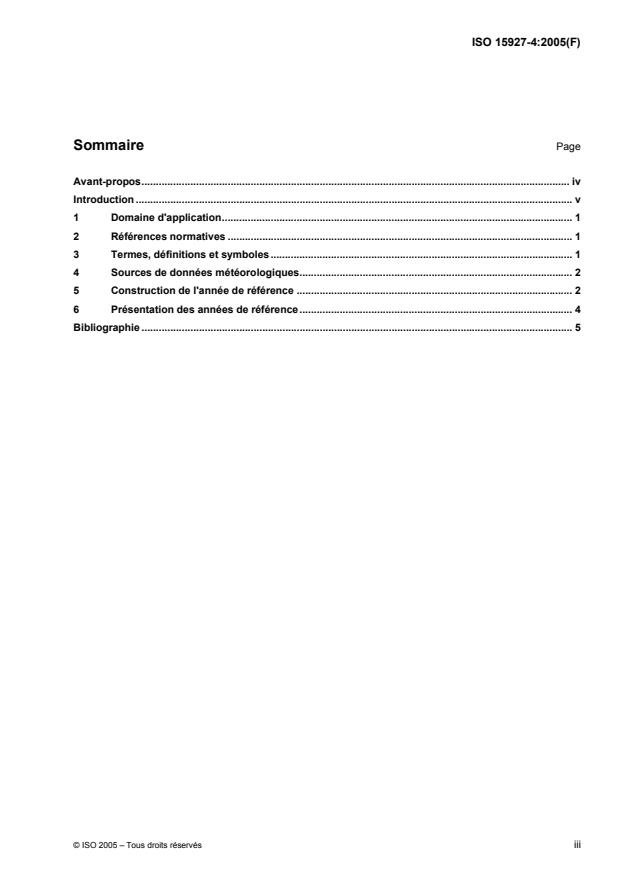
Sommaire Page
Avant-propos. iv
Introduction . v
1 Domaine d'application. 1
2 Références normatives. 1
3 Termes, définitions et symboles. 1
4 Sources de données météorologiques. 2
5 Construction de l'année de référence . 2
6 Présentation des années de référence. 4
Bibliographie . 5
Avant-propos
L'ISO (Organisation internationale de normalisation) est une fédération mondiale d'organismes nationaux de
normalisation (comités membres de l'ISO). L'élaboration des Normes internationales est en général confiée
aux comités techniques de l'ISO. Chaque comité membre intéressé par une étude a le droit de faire partie du
comité technique créé à cet effet. Les organisations internationales, gouvernementales et non
gouvernementales, en liaison avec l'ISO participent également aux travaux. L'ISO collabore étroitement avec
la Commission électrotechnique internationale (CEI) en ce qui concerne la normalisation électrotechnique.
Les Normes internationales sont rédigées conformément aux règles données dans les Directives ISO/CEI,
Partie 2.
La tâche principale des comités techniques est d'élaborer les Normes internationales. Les projets de Normes
internationales adoptés par les comités techniques sont soumis aux comités membres pour vote. Leur
publication comme Normes internationales requiert l'approbation de 75 % au moins des comités membres
votants.
L'attention est appelée sur le fait que certains des éléments du présent document peuvent faire l'objet de
droits de propriété intellectuelle ou de droits analogues. L'ISO ne saurait être tenue pour responsable de ne
pas avoir identifié de tels droits de propriété et averti de leur existence.
L'ISO 15927-4 a été élaborée par le comité technique CEN/TC 89, Performance thermique des bâtiments et
des composants du bâtiment, du Comité européen de normalisation (CEN) en collaboration avec le comité
technique ISO/TC 163, Performance thermique et utilisation de l'énergie en environnement bâti, sous-comité
SC 2, Méthodes de calcul, conformément à l'Accord de coopération technique entre l'ISO et le CEN (Accord
de Vienne).
L'ISO 15927 comprend les parties suivantes, présentées sous le titre général Performance hygrothermique
des bâtiments — Calcul et présentation des données climatiques:
⎯ Partie 1: Moyennes mensuelles des paramètres météorologiques pris séparément
⎯ Partie 4: Données horaires pour l'évaluation du besoin énergétique annuel de chauffage et de
refroidissement
⎯ Partie 5: Données pour la charge calorifique de conception pour le chauffage des locaux
⎯ Partie 6: Différences de température cumulées (en degrés jour)
De futures parties sont prévues, portant sur les sujets suivants:
⎯ Données horaires pour le dimensionnement des systèmes de refroidissement
⎯ Calcul d’un indice de pluie battante pour les surfaces verticales à partir des données horaires de pluie et
de vent
iv © ISO 2005 – Tous droits réservés
Introduction
La présente partie de l'ISO 15927 traite de la sélection de données météorologiques appropriées à
l’évaluation du besoin énergétique moyen, à long terme, pour le chauffage et le refroidissement des bâtiments.
Les méthodes pour le choix de données permettant d’évaluer la demande maximale de chauffage sont
spécifiées dans l’ISO 15927-5.
La simulation correcte des performances d’un bâtiment ne dépend pas uniquement des valeurs moyennes
appropriées des paramètres météorologiques, mais également des distributions de fréquences des différents
paramètres, ainsi que des corrélations qui existent entre eux. Étant donné que celles-ci peuvent être difficiles
à conserver dans le type d’année de référence artificiellement construite dont il est question dans la présente
partie de l'ISO 15927, il est préférable d’utiliser de longues périodes de données horaires météorologiques
(d’au moins dix ans et, de préférence, encore davantage), chaque fois que c'est possible. Cela tient
également compte de longues périodes de temps exceptionnellement chaud ou froid, sur plusieurs mois, qui
seront éliminées lors de la construction d’une année de référence. En pratique, cependant, les longues séries
de valeurs horaires qui contiennent tous les paramètres nécessaires sont très onéreuses et peuvent être
difficiles à obtenir dans nombre de zones. C’est pourquoi il existe toujours un besoin de disposer d’ensembles
annuels de données utilisables pour représenter les performances moyennes des bâtiments à long terme.
Ces ensembles peuvent être générés une fois à partir de longues séries de données onéreuses, puis être
distribués plus avantageusement.
La présente partie de l'ISO 15927 spécifie une méthode de construction d'une année de référence à partir
d’un enregistrement météorologique couvrant une longue période. D’autres méthodes peuvent être adoptées
pour construire des années de référence en vue d’applications spécifiques, y compris des méthodes qui
reposent sur une analyse de situations météorologiques générales.
NORME INTERNATIONALE ISO 15927-4:2005(F)
Performance hygrothermique des bâtiments — Calcul
et présentation des données climatiques —
Partie 4:
Données horaires pour l'évaluation du besoin énergétique
annuel de chauffage et de refroidissement
1 Domaine d'application
La présente partie de l'ISO 15927 spécifie une méthode pour construire une année de référence de données
horaires correspondant à des paramètres météorologiques appropriés qui permettent d’évaluer le besoin
énergétique annuel moyen de chauffage et de refroidissement. D’autres années de référence représentant
des conditions moyennes peuvent être construites pour des besoins spécifiques. Les méthodes exposées
dans la présente partie de l'ISO 15927 ne sont pas appropriées à la construction d’années extrêmes ou semi-
extrêmes pour la simulation, par exemple, de dégâts causés par l’
...