


ISO/DGuide 83
(Main)Harmonized structure for MSS with guidance for use
Harmonized structure for MSS with guidance for use
Structure-harmonisée pour les NSM avec préconisations relatives à l’utilisation
General Information
- Status
- Withdrawn
- Technical Committee
- ISO/TMBG - Technical Management Board - groups
- Drafting Committee
- ISO/TMBG - Technical Management Board - groups
- Current Stage
- 4098 - Project deleted
- Start Date
- 03-Oct-2023
- Completion Date
- 14-Feb-2026
Overview
ISO/DGuide 83, titled Harmonized Structure for Management System Standards (MSS) with Guidance for Use, is a draft guide published by the International Organization for Standardization (ISO). This document proposes revisions to the harmonized structure (formerly known as High-Level Structure or HLS) applied across all ISO Management System Standards. The harmonized structure includes uniform clause numbers, titles, core definitions, and text to ensure consistency among different MSS frameworks, such as quality, environment, information security, and energy management systems.
The guide aims to support ISO's climate change action plan by integrating climate considerations into MSS and ensuring that MSS writers have clear instructions on embedding these important factors into their standards. While still in draft form and subject to change, the guide fosters alignment and coherence across multiple MSS disciplines, facilitating easier adoption and integration by organizations worldwide.
Key Topics
Harmonized Structure Revision
The guide introduces updates to Annex SL Appendix 2 of the ISO Supplement to the ISO/IEC Directives Part 1, to strengthen the harmonization of MSS. Key changes relate to clause titles, numbering, common terms, and definitions.Climate Change Integration
A notable addition is the explicit requirement for organizations to determine whether climate change is a relevant issue impacting their management system. This is reflected in the context analysis clauses (4.1 and 4.2), emphasizing external/internal issues and interested parties with climate-related requirements.Guidance for MSS Writers
The guide provides comprehensive advice for MSS developers to:- Use consistent terminology such as “management system” (MS) and “management system standard” (MSS).
- Adapt discipline-specific qualifiers effectively (e.g., energy, IT security).
- Promote interoperability to help organizations manage multiple MSS concurrently.
- Avoid introducing new or conflicting terms and maintain alignment with ISO/IEC Directives.
- Reference existing MSS documents for consistency and compliance.
Documented Information Requirements
It clarifies the meaning of phrases like “shall be available” versus “shall be available as evidence of conformity” with respect to recorded information necessary for compliance demonstration.Approval Process
The guide follows the Draft Guide (DGuide) approval process, ensuring that proposed changes to the harmonized structure get equal scrutiny and consensus as new international standards.
Applications
Standard Development
ISO technical committees and MSS writers use this guide to develop or revise management system standards. The harmonized structure simplifies drafting by providing a clear framework and common language.Organizational Implementation
Organizations implementing multiple MSS (such as ISO 9001 for quality and ISO 14001 for environmental management) benefit from the harmonized clauses and definitions, which streamline integration efforts and reduce duplication.Climate Action
By embedding climate change considerations, the guide aligns MSS with global sustainability goals and helps organizations address legal, regulatory, and stakeholder demands related to climate resilience and environmental impact.Regulatory Compliance
As the harmonized structure forms the basis for MSS referenced in national and international regulations, compliance efforts are facilitated through consistent requirements and terminology.
Related Standards
ISO/IEC Directives, Part 1 and Part 2
The harmonized structure is an annex to these key governance documents that guide the development and maintenance of ISO standards.Annex SL of the ISO Supplement
Provides the foundational template for MSS harmonization that ISO/DGuide 83 revises and expands upon.Discipline-Specific MSS
Including but not limited to:- ISO 9001: Quality management systems
- ISO 14001: Environmental management systems
- ISO 45001: Occupational health and safety management systems
- ISO 27001: Information security management systems
ISO 10241-1
Provides rules for drafting ISO standards and definitions, useful for MSS writers introducing discipline-specific terms.
Keywords: ISO/DGuide 83, Management System Standards, MSS harmonization, Annex SL, climate change, ISO standards development, management system integration, ISO/IEC Directives, ISO technical committees, draft guide, ISO TMB, standardization, climate considerations, harmonized clauses, international standards compliance.
Frequently Asked Questions
ISO/DGuide 83 is a draft published by the International Organization for Standardization (ISO). Its full title is "Harmonized structure for MSS with guidance for use". This standard covers: Harmonized structure for MSS with guidance for use
Harmonized structure for MSS with guidance for use
ISO/DGuide 83 is available in PDF format for immediate download after purchase. The document can be added to your cart and obtained through the secure checkout process. Digital delivery ensures instant access to the complete standard document.
Standards Content (Sample)
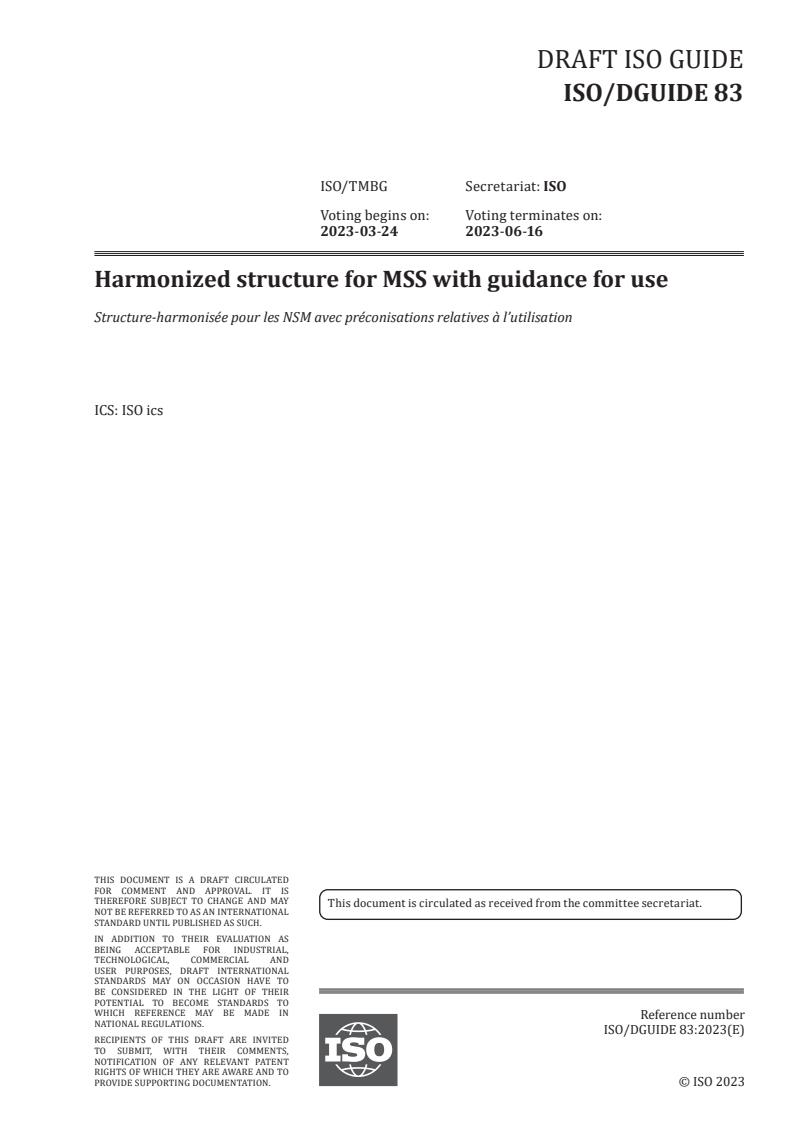
DRAFT ISO GUIDE
ISO/TMBG Secretariat: ISO
Voting begins on: Voting terminates on:
2023-03-24 2023-06-16
Harmonized structure for MSS with guidance for use
Structure-harmonisée pour les NSM avec préconisations relatives à l’utilisation
ICS: ISO ics
THIS DOCUMENT IS A DRAFT CIRCULATED
FOR COMMENT AND APPROVAL. IT IS
THEREFORE SUBJECT TO CHANGE AND MAY
This document is circulated as received from the committee secretariat.
NOT BE REFERRED TO AS AN INTERNATIONAL
STANDARD UNTIL PUBLISHED AS SUCH.
IN ADDITION TO THEIR EVALUATION AS
BEING ACCEPTABLE FOR INDUSTRIAL,
TECHNOLOGICAL, COMMERCIAL AND
USER PURPOSES, DRAFT INTERNATIONAL
STANDARDS MAY ON OCCASION HAVE TO
BE CONSIDERED IN THE LIGHT OF THEIR
POTENTIAL TO BECOME STANDARDS TO
WHICH REFERENCE MAY BE MADE IN
Reference number
NATIONAL REGULATIONS.
RECIPIENTS OF THIS DRAFT ARE INVITED
TO SUBMIT, WITH THEIR COMMENTS,
NOTIFICATION OF ANY RELEVANT PATENT
RIGHTS OF WHICH THEY ARE AWARE AND TO
PROVIDE SUPPORTING DOCUMENTATION. © ISO 2023
DRAFT ISO GUIDE
ISO/TMBG Secretariat: ISO
Voting begins on: Voting terminates on:
2023-03-24 2023-06-16
Harmonized structure for MSS with guidance for use
Structure-harmonisée pour les NSM avec préconisations relatives à l’utilisation
ICS: ISO ics
THIS DOCUMENT IS A DRAFT CIRCULATED
FOR COMMENT AND APPROVAL. IT IS
© ISO 2023
THEREFORE SUBJECT TO CHANGE AND MAY
This document is circulated as received from the committee secretariat.
All rights reserved. Unless otherwise specified, or required in the context of its implementation, no part of this publication may
NOT BE REFERRED TO AS AN INTERNATIONAL
be reproduced or utilized otherwise in any form or by any means, electronic or mechanical, including photocopying, or posting on STANDARD UNTIL PUBLISHED AS SUCH.
the internet or an intranet, without prior written permission. Permission can be requested from either ISO at the address below
IN ADDITION TO THEIR EVALUATION AS
or ISO’s member body in the country of the requester. BEING ACCEPTABLE FOR INDUSTRIAL,
TECHNOLOGICAL, COMMERCIAL AND
ISO copyright office
USER PURPOSES, DRAFT INTERNATIONAL
CP 401 • Ch. de Blandonnet 8
STANDARDS MAY ON OCCASION HAVE TO
BE CONSIDERED IN THE LIGHT OF THEIR
CH-1214 Vernier, Geneva
POTENTIAL TO BECOME STANDARDS TO
Phone: +41 22 749 01 11
WHICH REFERENCE MAY BE MADE IN
Reference number
Email: copyright@iso.org
NATIONAL REGULATIONS.
Website: www.iso.org ISO/DGUIDE 83:2023(E)
RECIPIENTS OF THIS DRAFT ARE INVITED
Published in Switzerland
TO SUBMIT, WITH THEIR COMMENTS,
NOTIFICATION OF ANY RELEVANT PATENT
RIGHTS OF WHICH THEY ARE AWARE AND TO
ii
PROVIDE SUPPORTING DOCUMENTATION. © ISO 2023
REVISION OF ISO SUPPLEMENT TO THE ISO/IEC DIRECTIVES
PART 1, ANNEX SL, APPENDIX 2 (HARMONIZED STRUCTURE FOR
MSS WITH GUIDANCE FOR USE)
Background
In September 2021, ISO members have signed the London Declaration to combat climate change
through standards. To help deliver on ISO commitments, the TMB has developed an action plan
that will support the ISO technical community. One of the focus of the TMB action plan is for
committees to include climate considerations in their works.
Because ISO Management Systems Standards (MSS) are widespread, well enshrined in
business organizations, and respected, they have the capacity to induce change. For this reason,
the TMB action plan requested the TMB/JTCG (Joint Technical Coordination Group, gathering all
leaders of committees in charge of MSS) to submit change proposal to the Appendix 2 of the
Annex SL of the ISO Supplement to the ISO/IEC Directives Part 1. This Appendix 2 is also known
as "Harmonized Structure" (formerly known as "High Level Structure", or "HLS") and provides
identical clause numbers, clause titles, text and common terms and core definitions for all MSS.
Change in the Harmonized Structure will therefore have repercussions in all ISO MSS, and it is
expected that the proposed changes will support the delivery of the ISO climate commitment.
Change proposal
The TMB (through a dedicated Task Force in charge of implementing the TMB action plan) has
asked the JTCG to provide recommendations for the revision of the Harmonized Structure. Via
dedicated plenary meetings, the JTCG has reached consensus on the changes to the
Harmonized Structure. These proposed changes were reviewed and accepted by TMB and are
outlined below (additions highlighted):
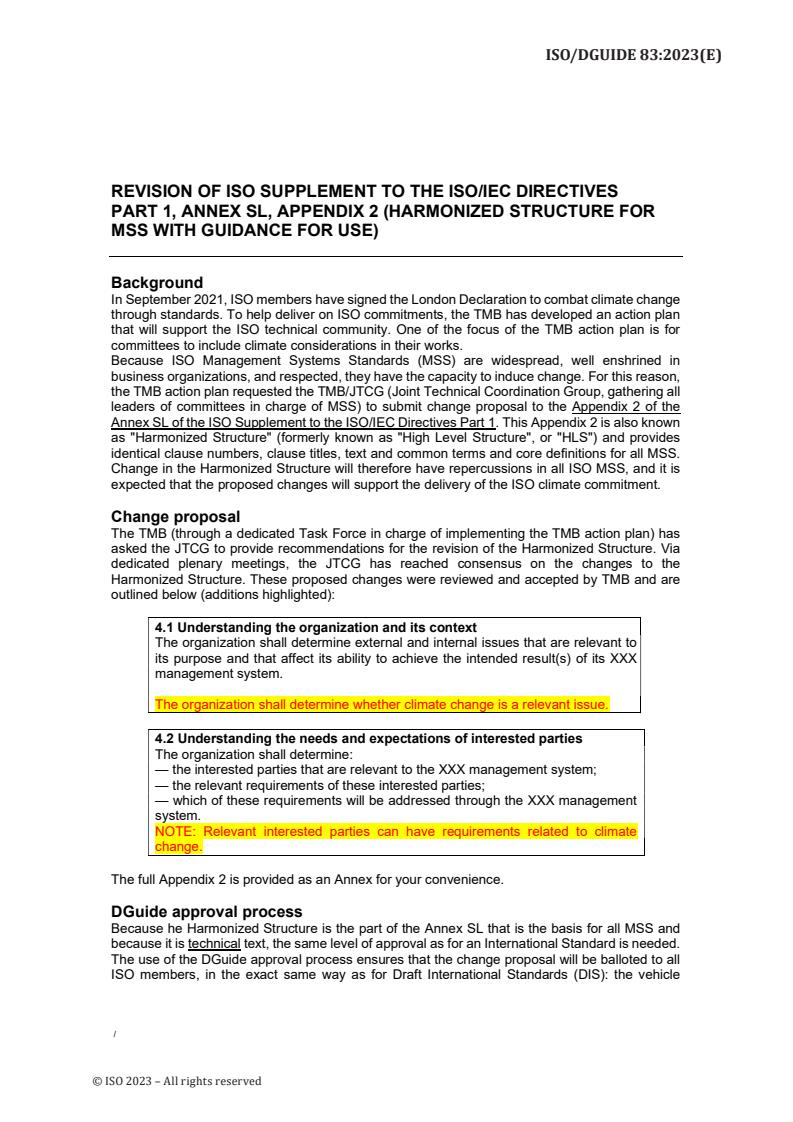
4.1 Understanding the organization and its context
The organization shall determine external and internal issues that are relevant to
its purpose and that affect its ability to achieve the intended result(s) of its XXX
management system.
The organization shall determine whether climate change is a relevant issue.
4.2 Understanding the needs and expectations of interested parties
The organization shall determine:
— the interested parties that are relevant to the XXX management system;
— the relevant requirements of these interested parties;
— which of these requirements will be addressed through the XXX management
system.
NOTE: Relevant interested parties can have requirements related to climate
change.
The full Appendix 2 is provided as an Annex for your convenience.
DGuide approval process
Because he Harmonized Structure is the part of the Annex SL that is the basis for all MSS and
because it is technical text, the same level of approval as for an International Standard is needed.
The use of the DGuide approval process ensures that the change proposal will be balloted to all
ISO members, in the exact same way as for Draft International Standards (DIS): the vehicle
/
Reference
Page 2
(DGuide ballot) is different but the process is the same. This guarantees that all ISO members
are consulted, they are asked to vote and comment, and the resulting Harmonized Structure
benefits from the same member consensus as International Standards do, hence providing the
same legitimacy.
/
Annex SL Appendix 2
(normative)
Harmonized structure for MSS with guidance for use
Harmonized structure (identical clause numbers, clause titles, text and common terms Guidance for MSS writers
and core definitions) for MSS
(informative)
(normative)
In the identical text proposals: Throughout this guidance:
⎯ XXX = a Management System Standard (MSS) discipline specific qualifier (e.g. energy, ⎯ MS = Management System
road traffic safety, IT security, food safety, environment, quality) that needs to be inserted
⎯ MSS = Management System Standard
⎯ MSS writers = ISO TC/SC/PCs that are responsible for writing discipline-specific MSS
Red italicized text is given as advisory notes to MSS writers
based on Annex SL of the Consolidated ISO Supplement to the ISO/IEC Directives, Part 1,
as well as editors of MSS
⎯ HS = Harmonized structure - that part of the Harmonized Approach that defines the
identical clause numbers, clause titles, text and common terms and core definitions
General
a) This guidance is intended for MSS writers. It does not add to or change any requirement of
the ISO/IEC Directives, Part 1 or Part 2 (including the HS). The objectives of the guidance
are to promote a common understanding of the HS, reduce the need for deviations, and
indicate opportunities for further alignment between the various discipline-specific
requirements that an MSS committee may choose to add.
b) MSS writers should be aware that an organization may address the requirements of
several MSS within a single MS. They should therefore aim to ensure that any additional
discipline-specific requirements can be integrated into such a system.
c) If MSS writers are considering additional discipline-specific requirements, they can consult
other MSS to verify if similar additions have been made and, wherever possible, use
identical or similar text and positioning to ensure ongoing alignment of these additional
requirements. A complete list of MSS can be found at https://www.iso.org/management-
system-standards-list.html. MSS writers should liaise with their Committee Manager to
arrange access to relevant documents including an editable template of the Harmonized
Structure available from the JTCG Secretariat. Further advice is also available via
participation in the ISO/TMBG/JTCG (Joint Technical Coordination Group on MSS).
d) Where references are made in this guidance to other documents, or where examples are
provided, these references are offered to provide MSS writers with a better understanding
and context of the use of discipline-specific elements of an MSS. The references and
examples are not intended for inclusion in discipline-specific MSS. MSS writers can
consult these standards and consider them as potential inputs when drafting their own
MSS.
Harmonized structure (identical clause numbers, clause titles, text and common terms Guidance for MSS writers
and core definitions) for MSS
(informative)
(normative)
e) MSS writers should be aware of the ISO Policy on references to legal requirements in
standards, and in particular to TMB Resolution 70/2018 and the additional “Guidance on
legal statements in ISO standards” (see https://www.iso.org/drafting-standards.html).
f) There are many requirements in the HS that use the verb “determine”. MSS writers should
be aware that this does not specifically require documented information to be available as
evidence of conformity.
g) If MSS writers need to include discipline-specific requirements for documented information
(see 3.10) in any clause of their MSS, they should base such requirements on the same
phrases that are used in the HS:
⎯ “… shall be available …” = the documented information is available for use
⎯ “… shall be available as evidence of …” = the documented information is to provide
evidence of conformity
h) While this guidance can also be of interest for users of discipline-specific MSS, it is the
responsibility of the relevant MSS writers to decide on the need for any guidance on the
implementation of their standards, and to provide such guidance as appropriate.
i) For clauses where no additional guidance is deemed necessary, this column is marked as
“No additional guidance”.
No additional guidance
Introduction
Drafting instruction: Specific to the discipline.
This text has been prepared using the harmonized structure (i.e. identical clause numbers,
clause titles, text and common terms and core definitions) intended to enhance alignment
among MSS and to facilitate their implementation for organizations that need to meet the
requirements of two or more such standards.
Text taken from the harmonized structure is highlighted in the text of Clauses 1 to 10 by the
use of blue font. Discipline-specific text is given in black. Strikeout is used to show agreed
deletions within the HS text. The use of blue text and strikeout is only to facilitate analysis and
will not be incorporated after the Draft International Standard stage of development for this
document.
The “intended results” refer to the results that are expected to be achieved by implementing the
1. Scope
MSS. MSS writers should be aware that throughout the HS, references to the “intended results
of the MS" include, but are not limited to, those mentioned by the MSS writers in Clause 1, within
Drafting instruction: Specific to the discipline.
the scope of the MS as defined by the organization (see 4.3).
Harmonized structure (identical clause numbers, clause titles, text and common terms Guidance for MSS writers
and core definitions) for MSS
(informative)
(normative)
Drafting instruction: The scope of the document shall address the intended result(s) of the To facilitate translation and to provide a better link with the definition of “objective” (see 3.6), MSS
management system. writers should avoid introducing new terms such as “outcomes” instead of “results”.
See guidance on Normative references in ISO/IEC Directives, Part 2.
2. Normative references
Drafting instruction: Specific to the discipline.
Include generic text specified in ISO/IEC Directives, Part 2.
See guidance on Terms and definitions in ISO/IEC Directives, Part 2, as well as Appendix 3.
3. Terms and definitions
Drafting Instruction 1
Drafting instruction 1: Common terms and core definitions shall be included in the MSS and they
When the terms and their associated definitions that are located in Clause 3 of the MSS are also
may also be included in a separate vocabulary standard.
included in a separate vocabulary standard, in accordance with ISO/IEC Directives, Part 2, the
vocabulary standard is required to be listed as a Normative reference in Clause 2 of the MSS.
In Clause 3, discipline specific terms and definitions may also be included.
Depending on the way in which terms and definitions are given for the standard, MSS writers
Include generic text specified in ISO/IEC Directives, Part 2.
should choose the appropriate introductory wording specified in ISO/IEC Directives, Part 2.
ISO/IEC Directives, Part 2 recommends that terms and definitions are organized according to
the hierarchy of concepts (i.e. systematic order). Term entries in an MSS may be numbered
differently from those in the HS because of the addition of discipline-specific concepts.
The arrangement of terms and definitions should preferably be in systematic order, but may
differ from the order given below in Clause 3. Alphabetical order is the least preferred order.
Drafting Instruction 2
General
Drafting instruction 2: The following terms and definitions constitute an integral part of the
The term entries (i.e. terms, definitions and all associated notes) stated in Clause 3 of the HS
harmonized structure for management systems standards. Additional terms and definitions
are mandatory in all MSS.
may be added as needed. Notes to entry may be added to serve the purpose of each standard.
MSS writers should be aware that any changes made to these term entries in discipline-specific
When drafting terms and definitions, MSS writers are advised to make use of the flowcharts
MSS can change requirements in the remainder of the MSS. If a modification of a definition or
given in Annex SL Appendix 3.
note to entry is made, this is regarded as a deviation for which a justification is required (see
Annex SL 8.3.4).
Additional notes to entry
Notes to entry may be added to serve the purpose of a discipline-specific MSS provided they do
not contradict, or deviate from, the defined concept.
Additional terms and definitions
When drafting a new definition corresponding to a discipline-specific term, the guidelines of ISO
10241-1 should be followed.
Harmonized structure (identical clause numbers, clause titles, text and common terms Guidance for MSS writers
and core definitions) for MSS
(informative)
(normative)
When a new definition corresponding to a subordinate (i.e. XXX MSS) concept is drafted, the
definition should begin with the term of the concept defined in Clause 3 of the HS, followed by
the specific characteristics of the subject field in question (see Annex SL Appendix 3).
Example from ISO 45001:2018:
3.14
policy
intentions and direction of an organization as formally expressed by its top
management
3.15
occupational health and safety policy
OH&S policy
policy (3.14) to prevent work-related injury and ill health to workers and to provide safe
and healthy workplaces
Drafting Instruction 3
Example:
3.20
Drafting instruction 3: Italic type in a definition indicates a cross-reference to another term
monitoring
defined in this clause, and the number reference for the term is given in parentheses.
determining the status of a system, a process (3.8) or an activity
Drafting Instruction 4
“XXX” in the Notes to entry should be substituted with the appropriate reference. These additional
terms (subordinate concepts) may be included as new term entries.
Example from ISO 14001:2015:
Drafting instruction 4: Where the text “XXX” appears throughout this clause, the appropriate
3.2.5
reference should be inserted depending on the context in which these terms and definitions are
objective
being applied. For example: “an XXX objective” could be substituted as “an information security
result to be achieved
objective”.
Note 1 to entry: An objective can be strategic, tactical, or operational.
Note 2 to entry: Objectives can relate to different disciplines (such as finance, health and safety,
and environment). They can be, for example, organization-wide or specific to a project, product or
process.
Harmonized structure (identical clause numbers, clause titles, text and common terms Guidance for MSS writers
and core definitions) for MSS
(informative)
(normative)
Note 3 to entry: An objective can be expressed in other ways, e.g. as an intended result, a
purpose, an operational criterion, as an environmental objective (3.2.6) or by the use of other words
with similar meaning (e.g. aim, goal, or target).
Note 4 to entry: In the context of environmental management systems objectives are set by the
organization, consistent with the environmental policy, to achieve specific results.
3.2.6
environmental objective
objective (3.2.5) set by the organization consistent with its environmental policy
MSS writers should ensure that any use of the term “organization” with a different intent from that
3.1
described in Note 2 to entry is clearly distinguished.
organization
person or group of people that has its own functions with responsibilities, authorities and
relationships to achieve its objectives (3.6)
Note 1 to entry: The concept of organization includes, but is not limited to, sole-trader, company, corporation,
firm, enterprise, authority, partnership, charity or institution, or part or combination thereof, whether
incorporated or not, public or private.
Note 2 to entry: If the organization is part of a larger entity, the term “organization” refers only to the part of
the larger entity that is within the scope of the XXX management system (3.4).
MSS writers should use the term “interested party”, in which case “stakeholder” may be deleted
3.2
from the term entry.
interested party (preferred term)
stakeholder (admitted term)
The use of the term “stakeholder” is not considered a deviation, but if MSS writers choose to
use that term (e.g. for reasons of tradition in their specific discipline), they should be aware of
person or organization (3.1) that can affect, be affected by, or perceive itself to be affected by a
potential translation problems to find an equivalent in other languages. If MSS writers choose
decision or activity
to use the term “stakeholder”, the term “interested party” may be deleted from the term entry.
MSS writers should not use the terms “interested party” and “stakeholder” as synonyms or
representing different concepts in the same MSS.
No additional guidance
3.3
top management
person or group of people who directs and controls an organization (3.1) at the highest level
Note 1 to entry: Top management has the power to delegate authority and provide resources within the
organization.
Note 2 to entry: If the scope of the management system (3.4) covers only part of an organization, then top
management refers to those who direct and control that part of the organization.
Harmonized structure (identical clause numbers, clause titles, text and common terms Guidance for MSS writers
and core definitions) for MSS
(informative)
(normative)
The scope of an MS may include the whole of the organization, specific and identified functions
3.4
or activities of the organization, specific and identified sections of the organization, or one or
management system
more functions across a group of organizations.
set of interrelated or interacting elements of an organization (3.1) to establish policies (3.5) and
objectives (3.6), as well as processes (3.8) to achieve those objectives
MSS writers should take care not to confuse the scope of the MSS, the scope of the MS, and
the scope of any eventual certification of the MS.
Note 1 to entry: A management system can address a single discipline or several disciplines.
Note 2 to entry: The management system elements include the organization’s structure, roles and
responsibilities, planning and operation.
No additional guidance
3.5
policy
intentions and direction of an organization (3.1) as formally expressed by its top management
(3.3)
No additional guidance
3.6
objective
result to be achieved
Note 1 to entry: An objective can be strategic, tactical, or operational.
Note 2 to entry: Objectives can relate to different disciplines (such as finance, health and safety, and
environment). They can be, for example, organization-wide or specific to a project, product or process (3.8).
Note 3 to entry: An objective can be expressed in other ways, e.g. as an intended result, as a purpose, as
an operational criterion, as an XXX objective or by the use of other words with similar meaning (e.g. aim,
goal, or target).
Note 4 to entry: In the context of XXX management systems (3.4), XXX objectives are set by the
organization (3.1), consistent with the XXX policy (3.5), to achieve specific results.
It is recognized that some MSS disciplines have their own understanding of risk, which is not
3.7
exactly aligned with that of others, but which has been adopted over many years.
risk
effect of uncertainty
MSS writers need to be aware that the main advantage of the HS is to make it easier for an
organization to incorporate the requirements of multiple MSS into its management system.
Note 1 to entry: An effect is a deviation from the expected — positive or negative.
They should therefore be aware of the need to maintain alignment wherever possible when
Note 2 to entry: Uncertainty is the state, even partial, of deficiency of information related to, understanding
introducing discipline-specific term entries or requirements related to risk.
or knowledge of, an event, its consequence, or likelihood.
If MSS writers (due to discipline-specific or sector-specific requirements) need to address a
Note 3 to entry: Risk is often characterized by reference to potential events (as defined in ISO Guide 73) and
particular risk group, category or type for their users, in addition to the general concept
consequences (as defined in ISO Guide 73), or a combination of these.
specified here, they should consult Annex SL 8.3.8.
Note 4 to entry: Risk is often expressed in terms of a combination of the consequences of an event
For further information, MSS writers can refer to ISO 31000 (Risk management – Guidelines).
(including changes in circumstances) and the associated likelihood (as defined in ISO Guide 73) of
occurrence.
Harmonized structure (identical clause numbers, clause titles, text and common terms Guidance for MSS writers
and core definitions) for MSS
(informative)
(normative)
No additional guidance
3.8
process
set of interrelated or interacting activities that uses or transforms inputs to deliver a result
Note 1 to entry: Whether the result of a process is called an output, a product or a service depends on the
context of the reference.
No additional guidance
3.9
competence
ability to apply knowledge and skills to achieve intended results
MSS writers need to be aware that “documented information” is a term to represent any
3.10
information that needs to be documented for the effective implementation of the MS, and to
documented information
demonstrate conformity to the MS requirements. This includes requirements specified by the
information required to be controlled and maintained by an organization (3.1) and the medium
relevant MSS as well as requirements that the organization has to, or chooses to, comply with.
on which it is contained
The term “documented information” is used to convey the fact that the focus should be primarily
Note 1 to entry: Documented information can be in any format and media and from any source.
on the delivery of information rather than the medium used to convey it.
Note 2 to entry: Documented information can refer to:
“Documented information” replaces the nouns “documentation”, “documents” “records” and
– the management system (3.4), including related processes (3.8);
“documented procedures” used in previous editions of some MSS.
– information created in order for the organization to operate (documentation);
– evidence of results achieved (records).
MSS writers need to be aware that whenever reference is made to “documented information”
throughout the HS, the requirements specified in 7.5 apply.
No additional guidance
3.11
performance
measurable result
Note 1 to entry: Performance can relate either to quantitative or qualitative findings.
Note 2 to entry: Performance can relate to managing activities, processes (3.8), products, services,
systems or organizations (3.1).
No additional guidance
3.12
continual improvement
recurring activity to enhance performance (3.11)
MSS writers should only use the terms "effectiveness" and "effective" when referring to the
3.13
ability to deliver intended results. It is important not to confuse the concept of "effectiveness"
effectiveness
with that of "efficiency", which relates the result achieved compared to the resources used.
extent to which planned activities are realized and planned results are achieved
No additional guidance
3.14
Harmonized structure (identical clause numbers, clause titles, text and common terms Guidance for MSS writers
and core definitions) for MSS
(informative)
(normative)
requirement
need or expectation that is stated, generally implied or obligatory
Note 1 to entry: “Generally implied” means that it is custom or common practice for the organization (3.1)
and interested parties (3.2) that the need or expectation under consideration is implied.
Note 2 to entry: A specified requirement is one that is stated, e.g. in documented information (3.10).
The term “conformity” applies to all requirements, including those specified in the relevant
3.15
MSS.
conformity
fulfilment of a requirement (3.14)
The term “compliance” can have a different meaning from the term “conformity” and is not used
in the HS.
MSS writers who want to introduce the term “compliance” should provide appropriate guidance
on how to interpret it with respect to “conformity” in their specific discipline.
MSS writers should consult ISO 37301 (Compliance management systems – Requirements
with guidance for use) for more information if they need to include discipline-specific
requirements relating to compliance.
Nonconformity relates to the non-fulfilment of requirements (see 3.14) including those specified
3.16
by the MSS or adopted by the organization as an integral part of its MS (e.g. for products,
nonconformity
processes, agreements with interested parties).
non-fulfilment of a requirement (3.14)
No additional guidance
3.17
corrective action
action to eliminate the cause(s) of a nonconformity (3.16) and to prevent recurrence
This definition of “audit” differs slightly from the definition given in ISO 19011:2018 (Guidelines
3.18
for auditing management systems), in that the definition in 3.18 does not specifically state that
audit
the audit process is to be “documented”.
systematic and independent process (3.8) for obtaining evidence and evaluating it objectively to
determine the extent to which the audit criteria are fulfilled
If MSS writers need to include additional discipline-specific definitions related to audit, they
should consult ISO 19011.
Note 1 to entry: An audit can be an internal audit (first party) or an external audit (second party or third party),
and it can be a combined audit (combining two or more disciplines).
Note 2 to entry: An internal audit is conducted by the organization (3.1) itself, or by an external party on its
behalf.
Note 3 to entry: “Audit evidence” and “audit criteria” are defined in ISO 19011.
Measurement consists of determining a value (e.g. physical quantity, property) using
3.19
measurement measurement resources such as a measuring instrument, equipment, system or surveys.
process (3.8) to determine a value
Harmonized structure (identical clause numbers, clause titles, text and common terms Guidance for MSS writers
and core definitions) for MSS
(informative)
(normative)
If MSS writers need to include discipline-specific definitions related to measurement, they
should consult ISO/IEC Guide 99, International Vocabulary of Metrology — Basic and general
concepts and associated terms (VIM).
MSS writers need to be aware of the difference between monitoring and measurement.
3.20
Monitoring can, but does not necessarily, involve measurement (see 3.19) at intervals,
monitoring
especially for the purpose of regulation or control.
determining the status of a system, a process (3.8) or an activity
Useful clarifications of these differences can be found in the ISO 9001 Auditing Practices
Note 1 to entry: To determine the status, there can be a need to check, supervise or critically observe. Group Guidance on “Monitoring and measuring resources” See
https://committee.iso.org/home/tc176/iso-9001-auditing-practices-group.html
See also the reference to ISO/IEC Guide 99 mentioned in guidance for 3.19.
4. Context of the organization
Intent of the requirement(s)
4.1 Understanding the organization and its context
To make sure the organization has an understanding of the issues that can affect, either
The organization shall determine external and internal issues that are relevant to its
positively or negatively, the organization and its ability to achieve the intended results of its
purpose and that affect its ability to achieve the intended result(s) of its XXX management
XXX MS. The knowledge gained is then used to guide the planning, implementation, operation,
system.
evaluation and improvement of the MS.
The determined issues represent the main inputs for several other requirements of the MSS,
The organization shall determine whether climate change is a relevant issue.
including determination of the scope, risks and opportunities and inputs to management review,
among others.
Guidance for MSS writers
MSS writers should be aware that the word “issue” means “an important topic or problem for
debate or discussion”. It can have a positive or negative impact on the organization.
MSS writers may prescribe additional requirements related to understanding the organization
and its context that are specific to their discipline.
Examples of issues that MSS writers may need to consider for their specific discipline include:
⎯ external issues:
cultural, social, environmental, political, legal, regulatory, financial, technological,
economic, natural and competitive factors, whether international, national, regional or local
⎯ internal issues:
organizational identity (including its vision, mission, values and culture), governance,
structure, policies, resources, capabilities, people and finance.
In accordance with ISO’s commitment to address climate change (London Declaration), MSS
writers should consider how climate change can be relevant within the context of their MSS.
ISO resources related to sustainability and climate change include but are not limited to Guide
Harmonized structure (identical clause numbers, clause titles, text and common terms Guidance for MSS writers
and core definitions) for MSS
(informative)
(normative)
82 Guidelines for addressing sustainability in standards, Guide 84 Guidelines for addressing
climate change in standards, and IWA 42 Net Zero Guiding Principles. .
4.2 Understanding the needs and expectations of interested parties Intent of the requirement(s)
To specify the requirements for an understanding of the needs and expectations of relevant
interested parties that are applicable to the MS.
The organization shall determine:
The relevant interested parties and their relevant requirements represent important inputs for
several other requirements of the MSS, including determination of the scope, risks and
opportunities and inputs to management review, among others.
⎯ the interested parties that are relevant to the XXX management system;
Guidance for MSS writers
⎯ t i
he relevant requirements of these nterested parties;
MSS writers may prescribe additional requirements related to understanding the needs and
⎯ which of these requirements will be addressed through the XXX management
expectations of interested parties in their discipline-specific MSS. They may also clarify whose
system.
and what needs and expectations should be addressed for the specific MSS.
NOTE: Relevant interested parties can have requirements related to climate change.
For example, ISO 9001 considers “customers” to be the main (but not the only) interested party
for the Quality Management System. ISO 45001 considers “workers” to be the main (but not
the only) interested party for the Occupational Health and Safety Management System.
MSS writers should also be aware that not all interested party requirements necessarily
become requirements for the organization. Some may not be applicable to the organization or
relevant to the MS. Others are “mandatory” because they have been incorporated into laws,
regulations, permits and licences by governmental or court action, or because they have been
specified by a higher level of the corporate entity to which the organization belongs. There can
be others that an organization may decide to adopt voluntarily or by entering into an agreement
or contract. Once adopted or agreed to, these become requirements for the organization (see
4.3). Some MSS (such as ISO 14001) refer to these as “compliance obligations” (see 3.15)
Examples of potential interested parties that MSS writers may need to consider when
formulating any discipline-specific requirements can include:
⎯ regulators (local, regional, national or international);
⎯ parent or subsidiary organizations;
⎯ customers;
⎯ trade and professional associations;
⎯ community groups;
⎯ non-governmental organizations;
⎯ suppliers;
⎯ neighbours;
⎯ partners;
⎯ future generations;
Harmonized structure (identical clause numbers, clause titles, text and common terms Guidance for MSS writers
and core definitions) for MSS
(informative)
(normative)
⎯ workers, their representatives, apprentices and other persons working on behalf of the
organization;
⎯ owners/investors;
⎯ competitors;
⎯ academia and researchers;
⎯ nongovernmental organizations.
Examples of interested party requirements that MSS writers may need to consider can include:
⎯ applicable laws;
⎯ permits, licences or other forms of authorization;
⎯ government regulations;
⎯ requirements related to climate change, climate action or net zero initiatives;
⎯ judgments of courts or administrative tribunals;
⎯ requirements of a larger entity to which the organization belongs;
⎯ treaties, conventions and protocols;
⎯ relevant industry codes and standards;
⎯ contracts which have been entered into;
⎯ agreements with customers, community groups or non-governmental organizations;
⎯ agreements with public authorities and customers;
⎯ requirements by adopting voluntary principles or codes of practice;
⎯ voluntary labelling or environmental commitments;
⎯ obligations arising under contractual arrangements with the organization.
4.3 Determining the scope of the XXX management system Intent of the requirement(s)
The organization shall determine the boundaries and applicability of the XXX management To establish the physical and organizational boundaries to which the MS will apply.
system to establish its scope.
Guidance for MSS writers
When determining this scope, the organization shall consider:
MSS writers should be aware that the credibility of the organization’s MS relies on the
appropriate choice of its boundaries and applicability. The documented information on scope
⎯ the external and internal issues referred to in 4.1;
should be a factual and representative statement of the organization’s business processes and
⎯ the requirements referred to in 4.2.
operations included within the MS boundaries and should not mislead interested parties.
The scope shall be available as documented information.
4.4 XXX management system Intent of the requirement(s)
The organization shall establish, implement, maintain and continually improve an XXX To ensure that processes and other elements of the organization form an effective MS (see
management system, including the processes needed and their interactions, in accordance 3.4) in accordance with the MSS, taking into consideration the context of the organization (see
with the requirements of this document. 4.1 to 4.3).
Guidance for MSS writers
Harmonized structure (identical clause numbers, clause titles, text and common terms Guidance for MSS writers
and core definitions) for MSS
(informative)
(normative)
MSS writers should be aware that the processes referred to include all processes needed to
meet the requirements of Clauses 4, 5, 6, 7, 8, 9 and 10, whether these are provided internally
or by external providers.
Prior to drafting additional discipline-specific requirements, MSS writers should consider to
what extent an organization retains authority, accountability, and autonomy to decide how it will
fulfil the MS requirements, including the level of detail and extent to which it will integrate the
MS requirements into its organization.
Note that when drafting discipline-specific requirements, MSS writers may wish to reference
this 4.4 to avoid the need to keep repeating phrases such as “establish, implement, maintain,
and continually improve …”, in multiple clauses.
5. Leadership
5.1 Leadership and commitment Intent of the requirement(s)
Top management shall demonstrate leadership and commitment with respect to the XXX To identify actions in which top management is directly involved to demonstrate its leadership
management system by: and commitment to the MS.
Visible support, involvement and commitment of the organization’s top management is
⎯ ensuring that the XXX policy and XXX objectives are established and are
important for the successful implementation of the MS. It sets the attitude and expectations,
compatible with the strategic direction of the organization;
increases awareness and acceptance, and motivates persons to be engaged in the MS
⎯ ensuring the integration of the XXX management system requirements into the
initiatives. It can provide reassurance to interested parties that an effective management
system is likely to be in place.
organization’s business processes;
This clause also emphasizes the need for top management to ensure that the MS requirements
⎯ ensuring that the resources needed for the XXX management system are
are not perceived as being “separate” from the way the business is run.
available;
The concept of “business” can include activities for profit or non-profit purposes, and also refer
⎯ communicating the importance of effective XXX management and of conforming to
to the activities conducted by private or public entities (including, for example, government).
the XXX management system requirements;
Guidance for MSS writers
⎯ ensuring that the XXX management system achieves its intended result(s);
MSS writers should note that the word "ensuring" used in parts of this clause means that top
⎯ directing and supporting persons to contribute to the effectiveness of the XXX
management does not necessarily perform all of these actions itself (the authority to do so can
management system;
be delegated to others), but top management is responsible for making sure the actions are
performed. When adding any discipline-specific requirements, MSS writers should use a similar
⎯ promoting continual improvement;
rationale for activities that can be delegated by top management.
⎯ supporting other relevant roles to demonstrate their leadership as it applies to
Some discipline-specific MSS writers (e.g. in ISO 37001) needed to differentiate between “top
their areas of responsibility.
management” and a “governing body”. Where this “governance” function is provided by a role
other than top management then MSS writers should include requirements related to that role
NOTE Reference to “business” in this document can be interpreted broadly to mean those activities that
in this clause.
are core to the purposes of the organization’s existence.
Harmonized structure (identical clause numbers, clause titles, text and common terms Guidance for MSS writers
and core definitions) for MSS
(informative)
(normative)
The definition of a “governing body” is given in ISO 37000:201, 3.3.4 as follows:
3.7
governing body
person or group of people who have ultimate accountability (3.2.2) for the whole
organization (3.1.3)
Note 1 to entry: Every organizational entity (3.1.4) has one governing body, whether
or not it is explicitly established. When the organization is not an organizational entity,
the term governing group (3.3.5) is applicable where “governing body” is used
throughout this document.
Note 2 to entry: A governing body can be explicitly established in a number of formats
including, but not limited to, a board of directors, supervisory board, sole director, joint
and several directors, or trustees.
Note 3 to entry: ISO management system standards make reference to the term “top
management” to describe a role that, depending on the standard and organizational
context, reports to, and is held accountable by, the governing body
.
Examples of sources of information on the concept of governance in relation to MSS can be
found in the following documents, among others:
⎯ ISO 18091, Quality management systems — Guidelines for the application of ISO 9001 in
local government
⎯ ISO/IEC 38500, Information technology — Governance of IT for the organization
⎯ ISO 37000, Governance of organizations - Guidance
⎯ ISO 37001, Anti-bribery management systems — Requirements with guidance for use
⎯ ISO 37301, Compliance management systems — Requirements with guidance for use
⎯ ISO/IEC 27014, Information technology — Security techniques — Governance of
information security
5.2 XXX Policy Intent of the requirement(s)
Top management shall establish a XXX policy that: To require top management to specify the intentions and direction of the organization that are
needed as part of the effective implementation of the MS, taking into account the organization’s
a) is appropriate to the purpose of the organization;
purpose. The XXX policy is used to frame the XXX objectives which the organization sets for
itself.
b) provides a framework for setting XXX objectives;
Guidance for MSS writers
c) includes a commitment to meet applicable requirements;
d) includes a commitment to continual improvement of the XXX manageme
...
Questions, Comments and Discussion
Ask us and Technical Secretary will try to provide an answer. You can facilitate discussion about the standard in here.
Loading comments...