

ISO/FDIS 21285
(Main)Soil quality — Inhibition of reproduction of the soil mite (Hypoaspis (Gaeolaelaps) aculeifer) by soil contaminants
- Abstract
This document specifies a chronic test method for evaluating the habitat function of soils and determining effects of soil contaminants and substances on the reproduction of Hypoaspis aculeifer by ? mainly ? alimentary uptake. This method is applicable to soils and soil materials of unknown quality, e.g. from contaminated sites, amended soils, soils after remediation, industrial, agricultural or other sites under concern and waste materials (e.g. dredged material, municipal sludge from a wastewater treatment plant, composed material, or manure, especially those for possible land disposal). The reproduction (= number of juveniles) is the measured parameter of the test. The test reflects the bioavailability of a mixture of contaminants in natural soils (contaminated site soils) to a species which represents a trophic level which is not covered by other ISO standards. This test is not intended to replace the earthworm (see ISO 11268-2) or Collembola (see ISO 11267) reproduction tests since this species belongs not only to a different trophic group but also a different taxonomic group (= mites; i.e. arachnids) than those used usually. Effects of substances are assessed using a standard soil, preferably a defined artificial soil substrate. For contaminated soils, the effects are determined in the soil to be tested and in a control soil. Depending on the objective of the study, the control and dilution substrate (dilution series of contaminated soil) are either an uncontaminated soil comparable to the soil to be tested (reference soil) or a standard soil (e.g. artificial soil). This document provides information on how to use this method for testing samples (soils or substances) under temperate conditions. This document is not applicable to substances for which the air/soil partition coefficient is greater than one, or to substances with vapour pressure exceeding 300 Pa at 25 °C. NOTE The stability of the test substance cannot be ensured over the test period. No provision is made in the test method for monitoring the persistence of the substance under test.
- Status
- Not Published
- Technical Committee
- ISO/TC 190/SC 4 - Biological characterization
- Drafting Committee
- ISO/TC 190/SC 4/WG 2 - Effects on soil fauna
- Current Stage
- 5020 - FDIS ballot initiated: 2 months. Proof sent to secretariat
- Start Date
- 01-Oct-2026
- Completion Date
- 01-Oct-2026
Buy Documents


ISO/FDIS 21285 - Soil quality — Inhibition of reproduction of the soil mite (Hypoaspis (Gaeolaelaps) aculeifer) by soil contaminants
REDLINE ISO/FDIS 21285 - Soil quality — Inhibition of reproduction of the soil mite (Hypoaspis (Gaeolaelaps) aculeifer) by soil contaminants
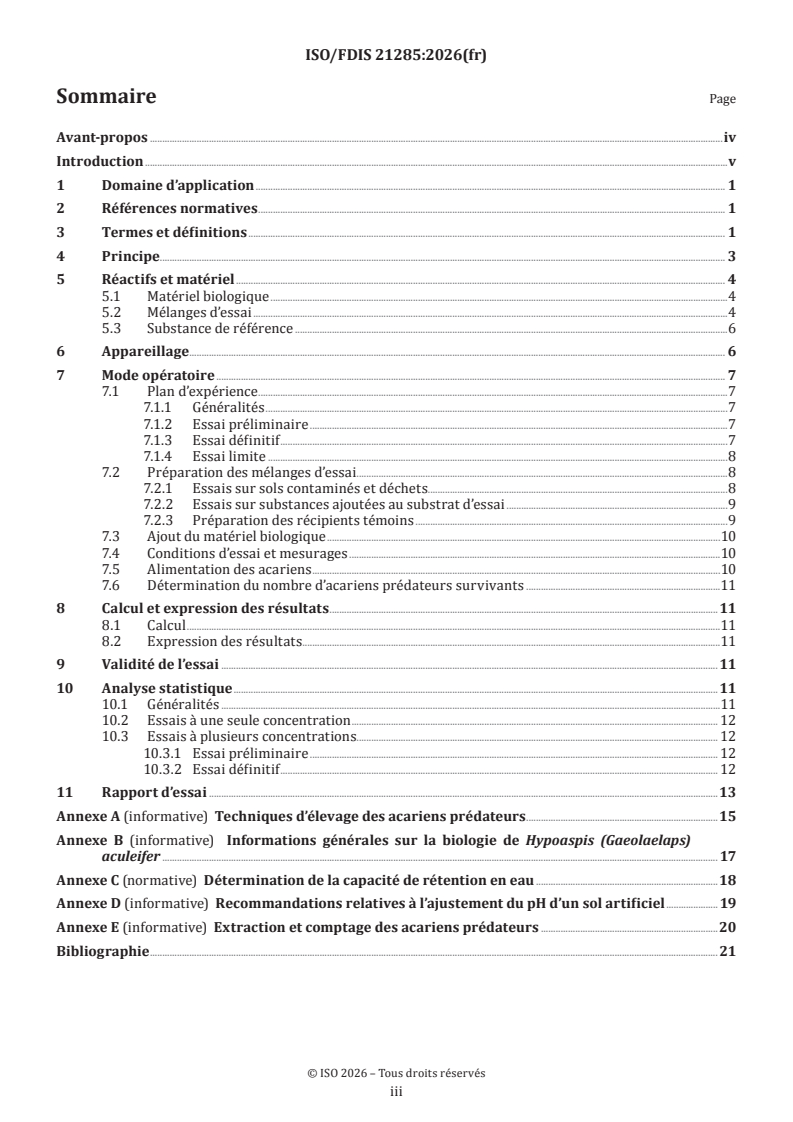
ISO/FDIS 21285 - Qualité du sol — Inhibition de la reproduction de l’acarien prédateur (Hypoaspis (Gaeolaelaps) aculeifer) par les contaminants présents dans le sol
ISO/FDIS 21285 is an ISO standard for a chronic soil test with the predatory mite Hypoaspis (Gaeolaelaps) aculeifer. It specifies how to assess the habitat function of soils and how soil contaminants or added substances affect reproduction, measured as the number of juveniles. Laboratories use it for contaminated soils, amended soils, soils after remediation, waste materials, and test substances under temperate conditions.
What does ISO/FDIS 21285 specify?
ISO/FDIS 21285 specifies a chronic reproduction test for Hypoaspis (Gaeolaelaps) aculeifer and the way to use that test for soils and soil materials of unknown quality. It is aimed at evaluating bioavailability and reproductive effects in a soil-dwelling predatory mite that represents a trophic group not covered by other ISO soil ecotoxicity standards.
The scope covers contaminated sites, amended soils, soils after remediation, industrial, agricultural and other sites under concern, and waste materials such as dredged material, municipal sludge, composted material and manure. It also states the substance limits of applicability: the method is not applicable to substances with an air/soil partition coefficient greater than one or vapour pressure above 300 Pa at 25 °C.
The document is organized into 11 clauses and 5 annexes.
| Annex | What it covers |
|---|---|
| Annex A | Techniques for rearing and breeding predatory mites |
| Annex B | Basic biology of Hypoaspis (Gaeolaelaps) aculeifer |
| Annex C | Determination of water-holding capacity |
| Annex D | Guidance on adjustment of pH of artificial soil |
| Annex E | Extraction and counting of predatory mites |
What are the key requirements of ISO/FDIS 21285?
ISO/FDIS 21285 requires a controlled laboratory test with adult females of Hypoaspis (Gaeolaelaps) aculeifer, standardised soil preparation, defined environmental conditions, and reproduction as the main endpoint. In practice, the reader has to control the soil, the test vessels, the mites, the feeding regime and the statistical treatment so that juvenile counts can be compared reliably with controls.
Test organism and exposure design
The test starts with 10 adult females per vessel, selected from a synchronised cohort. Males are not introduced into the test vessels, because the females are considered already mated; this reduces variability and keeps the test focused on reproduction.
Clause 7 allows single-concentration, multi-concentration, range-finding and limit-test designs. For field-collected soils and waste materials, the test soil is mixed with a control soil; for substances, the substance is mixed into a standard soil, usually artificial soil. That choice matters because it determines whether the result is reported as a dilution of soil or as a concentration of substance.
Soil preparation and sample handling
Clause 5 requires the test sample to be sieved through 4 mm mesh, mixed thoroughly, and stored according to the relevant soil or waste handling standard. Soil pH is not adjusted for the test sample, because correction would change contaminant bioavailability.
For field samples, Clause 5 requires supporting soil characterisation data: pH, texture, water content, water-holding capacity, cation exchange capacity, organic carbon and the proportion retained by the 4 mm sieve. Those data help the reader judge whether an observed effect is due to contamination or to soil properties.
Control soil and artificial soil
ISO/FDIS 21285 uses either a reference soil or a standard soil as control soil. A reference soil is a comparable uncontaminated site soil, while a standard soil is a field-collected or manufactured soil with known properties; that distinction matters when separating contaminant effects from background soil effects.
For artificial soil, Clause 5 gives the required components and shows how to prepare it in advance, adjust pH and bring it to the target moisture range. Annex D supports pH adjustment, and Annex C is used to determine water-holding capacity. In practice, these steps are needed so that the control substrate behaves consistently from test to test.
Test conditions and feeding
Clause 6 and Clause 7 define the test environment: about 20 °C, a light intensity of 400 lx to 800 lx at the substrate surface, and a light-dark cycle between 12 h:12 h and 16 h:8 h. The substrate moisture is kept close to the starting value and within the stated water range, because drying or over-wetting can change mite survival and reproduction.
Clause 7 also covers feeding. Cheese mites, small collembolans, enchytraeids or nematodes can be used as food, and the food supply should be adequate for the validity criteria. This matters because insufficient prey would reduce juvenile output even when the soil itself is not toxic.
Counting, calculation and validity
On day 14, the surviving mites are extracted and on day 16 the juveniles and adults are counted separately. Annex E describes the heat/light extraction method and the need to validate extraction efficiency at least once or twice a year.
Clause 8 explains that results are expressed as mortality and juvenile production, and for multi-concentration tests as NOEC/NOER or EC/ER values depending on the design. Clause 9 sets validity criteria: adult control mortality, minimum juvenile output and the coefficient of variation for control reproduction. In practice, these criteria tell the user whether the test run is acceptable before interpreting the toxicological result.
What terms does ISO/FDIS 21285 define?
- Contaminant - a substance or agent in soil that is present because of human activity.
- Effect concentration for x % effect (EC) - the concentration of a test material or test sample that causes an x % effect on a given endpoint within a defined exposure period.
- Effect rate (ER) - the dilution of a soil to be tested that causes an x % effect on a given endpoint within a defined exposure period.
- Lowest observed effect concentration (LOEC) - the lowest test substance concentration that produces a statistically significant effect.
- No observed effect concentration (NOEC) - the highest test substance concentration below the LOEC with no statistically significant effect.
- Reference soil - an uncontaminated site-specific soil with properties similar to the test soil.
- Standard soil - a field-collected or manufactured soil with known main properties.
- Control soil - an uncontaminated substrate or natural soil used as the comparison medium and for dilution series.
Who uses ISO/FDIS 21285?
ISO/FDIS 21285 is used by soil ecotoxicology laboratories, environmental consultants, remediation teams, and test facilities that assess contaminated land or waste materials. It is also relevant to quality managers and buyers who need a biological soil test for contaminated sites, amended soils, sludge, composted materials, manure, or other materials considered for land disposal.
The standard is also useful in regulatory and product-evaluation work where a lab needs a repeatable soil bioassay, a reference substance check, and a documented report. In practice, it supports decisions on whether a soil or material is suitable for further use, treatment, or disposal.
What changed in ISO/FDIS 21285 from the previous edition?
ISO/FDIS 21285 is the second edition and it cancels and replaces ISO 21285:2019. The foreword states that the document was technically revised.
The stated changes are:
- the species name was refined in the title and throughout the document to include Gaeolaelaps
- terms and definitions in Clauses 3 and 7 were corrected to align with ISO and IEC terminology databases
- detailed recommendations for testing waste materials were added in 5.2.1, 7.1.1 and 7.1.2
- the description of control soil was refined in 5.2.2
- recommendations were added in Clause 7.5 on feeding the mites
- bibliographic references were updated
Which standards are used with ISO/FDIS 21285?
ISO/FDIS 21285 cites these standards as normative references:
- EN 14735 - preparation of waste samples for ecotoxicity tests
- ISO 10390 - determination of pH
- ISO 10694 - determination of organic and total carbon after dry combustion
- ISO 11260 - determination of effective cation exchange capacity and base saturation level
- ISO 11277 - determination of particle size distribution in mineral soil material
- ISO 11465 - determination of dry residue or water content
- ISO 18400-206 - sampling, handling and storage of soil under aerobic conditions for laboratory biological assessment
The introduction also points to ISO 15799 for ecotoxicological characterisation of soils and soil materials and ISO 17616 for choosing and evaluating bioassays. The text also compares this method with ISO 11268-2 for earthworms and ISO 11267 for Collembola, showing that ISO/FDIS 21285 is a separate mite reproduction test rather than a replacement for those methods.
What does the ISO/FDIS 21285 document contain?
ISO/FDIS 21285 contains the full test workflow, from sample preparation through exposure, counting, calculation, statistics and reporting. It also contains the apparatus list, including test containers, mixers, balances, a pH and moisture measuring device, an exhauster and extraction equipment.
The annexes add practical support: Annex A explains rearing and synchronising predatory mites, Annex B gives biological background, Annex C provides the water-holding capacity method and formula, Annex D shows how to adjust artificial soil pH, and Annex E describes heat/light extraction and counting. The document also includes worked test-design guidance for range-finding, definitive and limit tests, plus statistical approaches for single-concentration and multi-concentration data.
Relations
- Effective Date
- 12-Feb-2026
- Effective Date
- 07-Jan-2025
- Effective Date
- 07-Jan-2025
Buy Documents
ISO/FDIS 21285 - Soil quality — Inhibition of reproduction of the soil mite (Hypoaspis (Gaeolaelaps) aculeifer) by soil contaminants
REDLINE ISO/FDIS 21285 - Soil quality — Inhibition of reproduction of the soil mite (Hypoaspis (Gaeolaelaps) aculeifer) by soil contaminants
ISO/FDIS 21285 - Qualité du sol — Inhibition de la reproduction de l’acarien prédateur (Hypoaspis (Gaeolaelaps) aculeifer) par les contaminants présents dans le sol
Get Certified
Connect with accredited certification bodies for this standard

CIS Institut d.o.o.
Personal Protective Equipment (PPE) certification body. Notified Body NB-2890 for EU Regulation 2016/425 PPE.

Kiwa BDA Testing
Building and construction product certification.
Kmetijski inštitut Slovenije
Agricultural Institute of Slovenia. Soil testing, plant health, agricultural product analysis.
Sponsored listings
Frequently Asked Questions
ISO/FDIS 21285 is a draft published by the International Organization for Standardization (ISO). Its full title is "Soil quality — Inhibition of reproduction of the soil mite (Hypoaspis (Gaeolaelaps) aculeifer) by soil contaminants". This standard covers: This document specifies a chronic test method for evaluating the habitat function of soils and determining effects of soil contaminants and substances on the reproduction of Hypoaspis aculeifer by ? mainly ? alimentary uptake. This method is applicable to soils and soil materials of unknown quality, e.g. from contaminated sites, amended soils, soils after remediation, industrial, agricultural or other sites under concern and waste materials (e.g. dredged material, municipal sludge from a wastewater treatment plant, composed material, or manure, especially those for possible land disposal). The reproduction (= number of juveniles) is the measured parameter of the test. The test reflects the bioavailability of a mixture of contaminants in natural soils (contaminated site soils) to a species which represents a trophic level which is not covered by other ISO standards. This test is not intended to replace the earthworm (see ISO 11268-2) or Collembola (see ISO 11267) reproduction tests since this species belongs not only to a different trophic group but also a different taxonomic group (= mites; i.e. arachnids) than those used usually. Effects of substances are assessed using a standard soil, preferably a defined artificial soil substrate. For contaminated soils, the effects are determined in the soil to be tested and in a control soil. Depending on the objective of the study, the control and dilution substrate (dilution series of contaminated soil) are either an uncontaminated soil comparable to the soil to be tested (reference soil) or a standard soil (e.g. artificial soil). This document provides information on how to use this method for testing samples (soils or substances) under temperate conditions. This document is not applicable to substances for which the air/soil partition coefficient is greater than one, or to substances with vapour pressure exceeding 300 Pa at 25 °C. NOTE The stability of the test substance cannot be ensured over the test period. No provision is made in the test method for monitoring the persistence of the substance under test.
This document specifies a chronic test method for evaluating the habitat function of soils and determining effects of soil contaminants and substances on the reproduction of Hypoaspis aculeifer by ? mainly ? alimentary uptake. This method is applicable to soils and soil materials of unknown quality, e.g. from contaminated sites, amended soils, soils after remediation, industrial, agricultural or other sites under concern and waste materials (e.g. dredged material, municipal sludge from a wastewater treatment plant, composed material, or manure, especially those for possible land disposal). The reproduction (= number of juveniles) is the measured parameter of the test. The test reflects the bioavailability of a mixture of contaminants in natural soils (contaminated site soils) to a species which represents a trophic level which is not covered by other ISO standards. This test is not intended to replace the earthworm (see ISO 11268-2) or Collembola (see ISO 11267) reproduction tests since this species belongs not only to a different trophic group but also a different taxonomic group (= mites; i.e. arachnids) than those used usually. Effects of substances are assessed using a standard soil, preferably a defined artificial soil substrate. For contaminated soils, the effects are determined in the soil to be tested and in a control soil. Depending on the objective of the study, the control and dilution substrate (dilution series of contaminated soil) are either an uncontaminated soil comparable to the soil to be tested (reference soil) or a standard soil (e.g. artificial soil). This document provides information on how to use this method for testing samples (soils or substances) under temperate conditions. This document is not applicable to substances for which the air/soil partition coefficient is greater than one, or to substances with vapour pressure exceeding 300 Pa at 25 °C. NOTE The stability of the test substance cannot be ensured over the test period. No provision is made in the test method for monitoring the persistence of the substance under test.
ISO/FDIS 21285 is classified under the following ICS (International Classification for Standards) categories: 13.080.30 - Biological properties of soils. The ICS classification helps identify the subject area and facilitates finding related standards.
ISO/FDIS 21285 has the following relationships with other standards: It is inter standard links to FprEN ISO 21285, ISO 23953-1:2023, ISO 21285:2019. Understanding these relationships helps ensure you are using the most current and applicable version of the standard.
ISO/FDIS 21285 is available in PDF format for immediate download after purchase. The document can be added to your cart and obtained through the secure checkout process. Digital delivery ensures instant access to the complete standard document.
Standards Content (Sample)
FINAL DRAFT
International
Standard
ISO/TC 190/SC 4
Soil quality — Inhibition of
Secretariat: AFNOR
reproduction of the soil mite
Voting begins on:
(Hypoaspis (Gaeolaelaps) aculeifer)
2026-10-01
by soil contaminants
Voting terminates on:
2026-11-26
Qualité du sol — Inhibition de la reproduction de l’acarien
prédateur (Hypoaspis (Gaeolaelaps) aculeifer) par les
contaminants présents dans le sol
RECIPIENTS OF THIS DRAFT ARE INVITED TO SUBMIT,
WITH THEIR COMMENTS, NOTIFICATION OF ANY
RELEVANT PATENT RIGHTS OF WHICH THEY ARE AWARE
AND TO PROVIDE SUPPOR TING DOCUMENTATION.
IN ADDITION TO THEIR EVALUATION AS
BEING ACCEPTABLE FOR INDUSTRIAL, TECHNO
ISO/CEN PARALLEL PROCESSING LOGICAL, COMMERCIAL AND USER PURPOSES, DRAFT
INTERNATIONAL STANDARDS MAY ON OCCASION HAVE
TO BE CONSIDERED IN THE LIGHT OF THEIR POTENTIAL
TO BECOME STAN DARDS TO WHICH REFERENCE MAY BE
MADE IN NATIONAL REGULATIONS.
Reference number
FINAL DRAFT
International
Standard
ISO/TC 190/SC 4
Soil quality — Inhibition of
Secretariat: AFNOR
reproduction of the soil mite
Voting begins on:
(Hypoaspis (Gaeolaelaps) aculeifer)
by soil contaminants
Voting terminates on:
Qualité du sol — Inhibition de la reproduction de l’acarien
prédateur (Hypoaspis (Gaeolaelaps) aculeifer) par les
contaminants présents dans le sol
RECIPIENTS OF THIS DRAFT ARE INVITED TO SUBMIT,
WITH THEIR COMMENTS, NOTIFICATION OF ANY
RELEVANT PATENT RIGHTS OF WHICH THEY ARE AWARE
AND TO PROVIDE SUPPOR TING DOCUMENTATION.
© ISO 2026
IN ADDITION TO THEIR EVALUATION AS
All rights reserved. Unless otherwise specified, or required in the context of its implementation, no part of this publication may
BEING ACCEPTABLE FOR INDUSTRIAL, TECHNO
ISO/CEN PARALLEL PROCESSING
LOGICAL, COMMERCIAL AND USER PURPOSES, DRAFT
be reproduced or utilized otherwise in any form or by any means, electronic or mechanical, including photocopying, or posting on
INTERNATIONAL STANDARDS MAY ON OCCASION HAVE
the internet or an intranet, without prior written permission. Permission can be requested from either ISO at the address below
TO BE CONSIDERED IN THE LIGHT OF THEIR POTENTIAL
or ISO’s member body in the country of the requester.
TO BECOME STAN DARDS TO WHICH REFERENCE MAY BE
MADE IN NATIONAL REGULATIONS.
ISO copyright office
CP 401 • Ch. de Blandonnet 8
CH-1214 Vernier, Geneva
Phone: +41 22 749 01 11
Email: copyright@iso.org
Website: www.iso.org
Published in Switzerland Reference number
ii
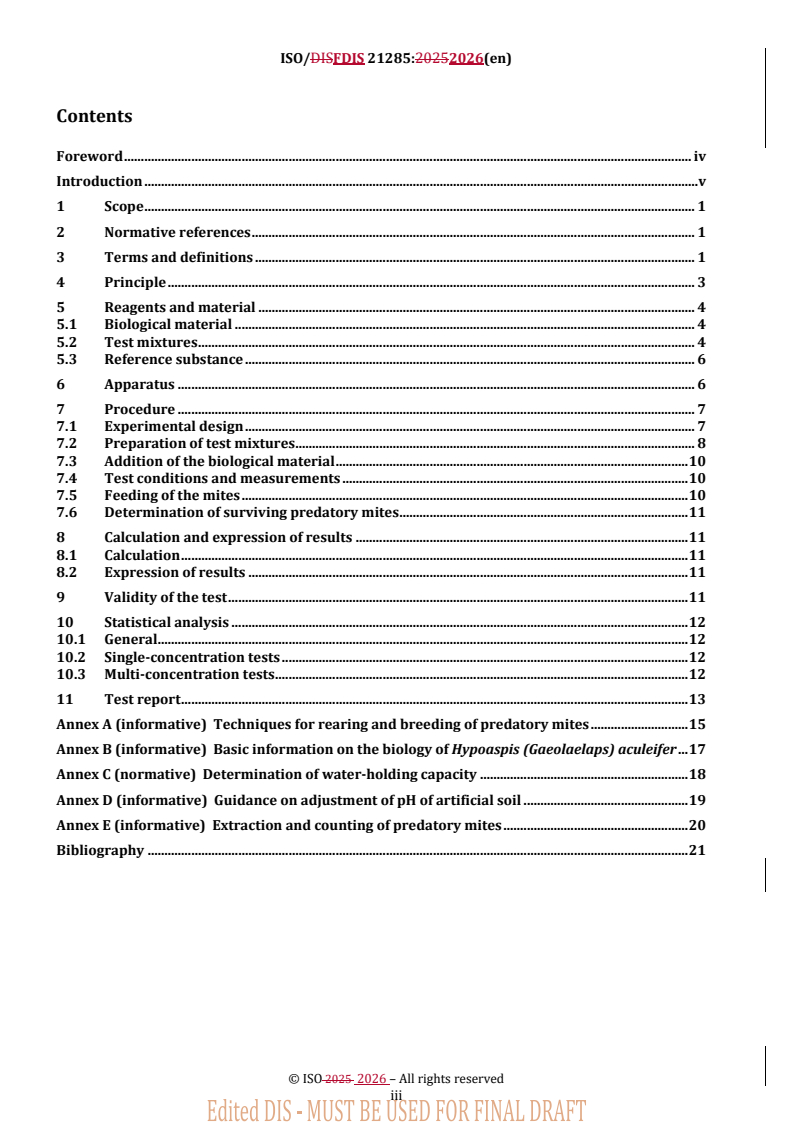
Contents Page
Foreword .iv
Introduction .v
1 Scope . 1
2 Normative references . 1
3 Terms and definitions . 1
4 Principle . 3
5 Reagents and material . 4
5.1 Biological material .4
5.2 Test mixtures .4
5.3 Reference substance .5
6 Apparatus . 6
7 Procedure . 7
7.1 Experimental design .7
7.1.1 General .7
7.1.2 Range-finding test (preliminary test) .7
7.1.3 Definitive test .7
7.1.4 Limit test .8
7.2 Preparation of test mixtures .8
7.2.1 Testing of contaminated soil and waste materials .8
7.2.2 Testing substances added to the test substrate .8
7.2.3 Preparation of control containers.9
7.3 Addition of the biological material .9
7.4 Test conditions and measurements .9
7.5 Feeding of the mites .10
7.6 Determination of surviving predatory mites.10
8 Calculation and expression of results . 10
8.1 Calculation .10
8.2 Expression of results . .10
9 Validity of the test .11
10 Statistical analysis .11
10.1 General .11
10.2 Single-concentration tests .11
10.3 Multi-concentration tests . 12
10.3.1 Range-finding test . 12
10.3.2 Definitive test . 12
11 Test report .12
Annex A (informative) Techniques for rearing and breeding of predatory mites . 14
Annex B (informative) Basic information on the biology of Hypoaspis (Gaeolaelaps) aculeifer .15
Annex C (normative) Determination of water-holding capacity .16
Annex D (informative) Guidance on adjustment of pH of artificial soil . 17
Annex E (informative) Extraction and counting of predatory mites .18
Bibliography . 19
iii
Foreword
ISO (the International Organization for Standardization) is a worldwide federation of national standards
bodies (ISO member bodies). The work of preparing International Standards is normally carried out through
ISO technical committees. Each member body interested in a subject for which a technical committee
has been established has the right to be represented on that committee. International organizations,
governmental and non-governmental, in liaison with ISO, also take part in the work. ISO collaborates closely
with the International Electrotechnical Commission (IEC) on all matters of electrotechnical standardization.
The procedures used to develop this document and those intended for its further maintenance are described
in the ISO/IEC Directives, Part 1. In particular, the different approval criteria needed for the different types
of ISO documents should be noted. This document was drafted in accordance with the editorial rules of the
ISO/IEC Directives, Part 2 (see www.iso.org/directives).
ISO draws attention to the possibility that the implementation of this document may involve the use of (a)
patent(s). ISO takes no position concerning the evidence, validity or applicability of any claimed patent
rights in respect thereof. As of the date of publication of this document, ISO had not received notice of (a)
patent(s) which may be required to implement this document. However, implementers are cautioned that
this may not represent the latest information, which may be obtained from the patent database available at
www.iso.org/patents. ISO shall not be held responsible for identifying any or all such patent rights.
Any trade name used in this document is information given for the convenience of users and does not
constitute an endorsement.
For an explanation of the voluntary nature of standards, the meaning of ISO specific terms and expressions
related to conformity assessment, as well as information about ISO’s adherence to the World Trade
Organization (WTO) principles in the Technical Barriers to Trade (TBT), see www.iso.org/iso/foreword.html.
This document was prepared by Technical Committee ISO/TC 190, Soil quality, Subcommittee SC 4, Biological
characterization, in collaboration with the European Committee for Standardization (CEN) Technical
Committee CEN/TC 444, Environmental characterization of solid matrices, in accordance with the Agreement
on technical cooperation between ISO and CEN (Vienna Agreement).
This second edition cancels and replaces the first edition (ISO 21285:2019), which has been technically
revised.
The main changes are as follows:
— refinement of the species name in the title and throughout the document to include the genus Gaeolaelaps,
and correction of this name in the text where the former version had already used it;
— correction of terms and definitions in Clauses 3 to align with the ISO and IEC terminological databases;
— addition of detailed recommendations for testing with waste materials in 5.2.1, 7.1.1 and 7.1.2;
— refinement of the description of the methods to apply to control soil in 5.2.2;
— addition of recommendations in 7.5;
— update of the bibliographic references.
Any feedback or questions on this document should be directed to the user’s national standards body. A
complete listing of these bodies can be found at www.iso.org/members.html.
iv
Introduction
Ecotoxicological test systems are applied to obtain information about the effects of contaminants in soil and
[1] [2]
are proposed to complement conventional chemical analysis (see ISO 15799 and ISO 17616 ). ISO 15799
includes a list and short characterization of recommended and standardized test systems and ISO 17616
gives guidance on the choice and evaluation of the bioassays. Aquatic test systems with soil eluate are
applied to obtain information about the fraction of contaminants potentially reaching the groundwater by
the water path (retention function of soils), whereas terrestrial test systems are used to assess the habitat
function of soils.
Mites (Acari) are a world-wide and diverse group of arthropods belonging to the class Arachnida with over
40 000 species recorded, divided into two super-orders (Acariformes and Parasitiformes). Due to their
relative small size (a few µm to a few cm), they occupy specific ecological niches on plants as well as in soils
(see Reference [3]).
Among soil-inhabiting mites, the role of predation is ensured by, for example, Hypoaspis (Gaeolaelaps) sp.
(Laelapidae). Because they are exposed to chemical contamination, mites are already considered in the
environmental risk assessment of pesticides, as non-target organisms (see Reference [4]). Indeed, among
the data required for active substances of pesticides, effects on predatory mites are assessed, i.e. for the
plant-inhabitant Typhlodromus pyri (Phytoseiidae) and the soil-inhabitant Hypoaspis (Gaeolaelaps) aculeifer
(Laelapidae) (see Reference [5]).
[6][7]
The first authors introducing H. aculeifer as a test organism in ecotoxicological studies later proposed
a two-species test system in the European project SECOFASE (Sublethal Effects of Chemicals on Fauna in
the Soil Ecosystem), including the collembolan Folsomia fimetaria as prey. In the context of the development
of an ecotoxicological test for the assessment of plant protection products on non-target arthropods (see
References [8] [5]), a protocol on soil predatory mites using H. aculeifer was further proposed. After that, a
standard test protocol for the assessment of chemicals was developed for this species by OECD in 2008 and
[9]
revised in 2016 . The results of the associated international ring-test were published in Reference [10].
Among mites, the predator Hypoaspis (Gaeolaelaps) aculeifer is the most studied species in the laboratory. The
reproduction end point was found in general to be more sensitive than mortality and avoidance. Compared
to other soil meso-fauna invertebrates, mites were found in general less sensitive than or as sensitive as
other test species, depending on the end points and chemicals studied. Considering semi-field studies,
H. aculeifer was used as a top predator whereas other soil invertebrates, mainly springtails, were ranked in
the grazer group. In these studies, mites showed to be quite tolerant towards anthropogenic contamination.
This statement was also corroborated by field surveys. However, the applicability of laboratory test methods
for the assessment of environmental samples (contaminated soils, wastes etc.) with mites is emphasized, as
to date a limited number of studies are available.
This document describes a method that is based on the determination of lethal and sublethal effects
of contaminated soils or waste materials to adult predatory mites of the species Hypoaspis (Gaeolaelaps)
aculeifer. This species is considered representative of predatory soil arthropods. Background information
on the ecology of these mites and their use in ecotoxicological testing is available in Reference [11].
v
FINAL DRAFT International Standard ISO/FDIS 21285:2026(en)
Soil quality — Inhibition of reproduction of the soil mite
(Hypoaspis (Gaeolaelaps) aculeifer) by soil contaminants
1 Scope
This document specifies a chronic test method for evaluating the habitat function of soils and determining
effects of soil contaminants and substances on the reproduction of Hypoaspis (Gaeolaelaps) aculeifer. This
method is applicable to soils and soil materials of unknown quality, e.g. from contaminated sites, amended
soils, soils after remediation, industrial, agricultural or other sites under concern and waste materials (e.g.
dredged material, municipal sludge from a wastewater treatment plant, composed material, or manure,
especially those for possible land disposal).
This document provides information on how to use this method for testing samples (soils or substances)
under temperate conditions.
This document is not applicable to substances for which the air/soil partition coefficient is greater than one,
or to substances with vapour pressure exceeding 300 Pa at 25 °C.
NOTE The stability of the test substance cannot be ensured over the test period. No provision is made in the test
method for monitoring the persistence of the substance under test.
2 Normative references
The following documents are referred to in the text in such a way that some or all of their content constitutes
requirements of this document. For dated references, only the edition cited applies. For undated references,
the latest edition of the referenced document (including any amendments) applies.
EN 14735, Characterization of waste — Preparation of waste samples for ecotoxicity tests
ISO 10390, Soil, treated biowaste and sludge — Determination of pH
ISO 10694, Soil quality — Determination of organic and total carbon after dry combustion (elementary analysis)
ISO 11260, Soil quality — Determination of effective cation exchange capacity and base saturation level using
barium chloride solution
ISO 11277, Soil quality — Determination of particle size distribution in mineral soil material — Method by
sieving and sedimentation
ISO 11465, Sludge and solid environmental matrices — Determination of dry residue or water content and
calculation of the dry matter fraction on a mass basis
ISO 18400-206, Soil quality — Sampling — Part 206: Collection, handling and storage of soil under aerobic
conditions for the assessment of microbiological processes, biomass and diversity in the laboratory
3 Terms and definitions
For the purposes of this document, the following terms and definitions apply.
ISO and IEC maintain terminology databases for use in standardization at the following addresses:
— ISO Online browsing platform: available at https:// www .iso .org/ obp
— IEC Electropedia: available at https:// www .electropedia .org/
3.1
contaminant
substance or agent present in the soil as a result of human activity
3.2
effect concentration for x % effect
EC
x
concentration (mass fraction) of a test material or test sample that causes x % of an effect on a given end
point within a given exposure period, when compared with a control
EXAMPLE An EC is a concentration estimated to cause an effect on a test end point in 50 % of an exposed
population over a defined exposure period.
Note 1 to entry: The EC is expressed as a percentage of test soil (dry mass) per soil mixture (dry mass). When
x
substances are tested, the EC is expressed as the mass of the test substance per dry mass of soil in milligrams per
x
kilogram.
3.3
effect rate
ER
x
dilution of a soil to be tested that causes an x % of an effect on a given end point within a given exposure
period, when compared with a control
3.4
limit test
single concentration test
EXAMPLE The test soil without any dilution or one concentration of a test substance mixed into the control soil
(3.11) and compared with the control.
3.5
lowest observed effect concentration
LOEC
lowest test substance concentration that has a statistically significant effect (probability p ≤ 0,05)
Note 1 to entry: In this test, the LOEC is expressed as a mass of test substance per dry mass of the soil to be tested. All
test concentrations above the LOEC should usually show an effect that is statistically different from the control.
3.6
lowest observed effect rate
LOER
lowest dilution of a soil to be tested in a control soil (3.11) at which a statistically significant effect (p ≤ 0,05)
is observed
3.7
no observed effect concentration
NOEC
highest test substance concentration immediately below the LOEC (3.5) at which no statistically significant
effect is observed
Note 1 to entry: In this test, the concentration corresponding to the NOEC has no statistically significant effect
(probability p ≤ 0,05) within a given exposure period when compared with the control.
3.8
no observed effect rate
NOER
lowest dilution of a soil to be tested immediately below the LOER (3.6) which, when compared to the control,
has no statistically significant effect (probability p ≤ 0,05) within a given exposure period
3.9
reference soil
uncontaminated site-specific soil with properties (nutrient concentrations, pH, organic carbon content and
texture, etc.) similar to the test soil
3.10
standard soil
field-collected soil or manufactured (artificial) soil whose main properties (e.g. pH, texture, organic matter
content) are within a known range
EXAMPLE Euro soils, artificial soil, LUFA standard soil type 2.2.
Note 1 to entry: The properties of standard soils can differ from the soil to be tested.
3.11
control soil
uncontaminated substrate or natural soil, used as a control and as medium for preparing dilution series
with test soils or chemicals to be tested, that allows fulfilling the validity criteria
Note 1 to entry: In the case of natural soil, it is advisable to demonstrate its suitability for a test and for achieving the
test validity criteria before using the soil in a definitive test.
3.12
test mixture
mixture of contaminated soil or the test substance (e.g. chemical, biosolid, waste) with control soil (3.11)
3.13
test mixture ratio
ratio between the test soil and the control soil (3.11) in a test mixture (3.12)
4 Principle
The reproduction (= number of juveniles) is the measured parameter of the test. The test reflects the
bioavailability of a mixture of contaminants in natural soils (contaminated site soils) to a species which
represents a trophic level which is not covered by other ISO standards. This test is not intended to replace
[12] [1]
the earthworm (see ISO 11268-2 ) or Collembola (see ISO 11267 ) reproduction tests since this species
belongs not only to a different trophic group but also a different taxonomic group (= mites, i.e. arachnids)
than those used usually.
Effects of substances are assessed using a standard soil, preferably a defined artificial soil substrate. For
contaminated soils, the effects are determined in the soil that is intended to be tested and in a control soil.
Depending on the objective of the study, the control and dilution substrate (dilution series of contaminated
soil or waste material) are either an uncontaminated soil comparable to the test soil (reference soil) or a
standard soil (e.g. artificial soil).
Adult females are exposed to the test soil and the effects on reproduction measured are compared to those
observed for females exposed to a control soil. If appropriate, effects based on exposure to a dilution range
of contaminated soil or waste material and control soil or a range of concentrations of a test substance mixed
into control soil are determined. Test mixtures are prepared at the start of the test and are not renewed
within the test period. The test is started with 10 adult females per test vessel. Males are not introduced in
the test, because experience has shown that females mate immediately or shortly after hatching from the
deutonymph stage, if males are present. As the females are introduced into the test approximately 7 d after
they have reached the adult stage, the females can be considered as already mated (Annex A and Annex B).
The test runs until the first offspring have reached the deutonymph stage. At 20 °C the exposure time ends
at day 14 after introducing the females (day 0), followed by two days of extraction. The number of surviving
females and the number of juveniles per test vessel are determined. The reproductive output of the mites
exposed to the test mixtures is compared to that of the controls in order to determine the dilutions/
concentrations which cause no effects on mortality and reproduction (NOER/NOEC) and the dilution/
concentration resulting in x % reduction of juveniles hatched from eggs compared to the control (ER /EC )
x x
respectively, depending on the experimental design (see 7.1.3).
In case there is no prior knowledge of the dilution/concentration of the test soil or the test substance likely
to have an effect, then it is useful to conduct the test in two steps:
— A range-finding test on reproduction is carried out, to give an indication of the effect dilution/concentration,
and the dilution/concentration giving no mortality (NOER/NOEC). Dilutions/concentrations to be used
in the definitive test can then be selected.
— The definitive test on reproduction is carried out, to determine sublethal effects of (dilutions of)
contaminated soil, a waste material or the concentration of a substance which, when evenly mixed into
the standard soil, causes no significant effects on numbers of offspring hatched from eggs compared
with the control (NOER/NOEC), and the lowest dilution/concentration causing effects (LOER/LOEC).
A reference soil shall be used to demonstrate the present status of the test population, and to avoid
misinterpretation of results.
5 Reagents and material
5.1 Biological material
In this test, Hypoaspis (Gaeolaelaps) aculeifer. adult female mites (7 d to 14 d after becoming adult; 28 d to
35 d after the start of the egg laying in the synchronisation) are required to start the test. The mites shall be
selected from a synchronised cohort (see Annex B).
5.2 Test mixtures
5.2.1 Field-collected soil or waste material. The field-collected soils or the waste material used in the
test shall be passed through a sieve of 4 mm square mesh to remove coarse fragments and thoroughly mixed.
If necessary, the soil or waste material can be air-dried without heating before sieving. Storage of the soil or
waste material that is intended to be tested should be as short as possible. The test sample shall be stored
in accordance with ISO 18400-206 (soils) and EN 14735 (waste materials), using containers that minimize
losses of contaminants sorption to the container walls. If soils or test mixtures have been stored, they
should be mixed a second time immediately before use. Soil pH should not be corrected as it can influence
bioavailability of contaminants.
For interpretation of test results, the following characteristics shall be determined for each soil sampled
from a field site:
a) pH in accordance with ISO 10390;
b) texture (sand, loam or silt, clay) in accordance with ISO 11277;
c) water content in accordance with ISO 11465;
d) water-holding capacity in accordance with Annex C;
e) cationic exchange capacity in accordance with ISO 11260;
f) organic carbon in accordance with ISO 10694;
g) percentage of material removed by the 4 mm sieve.
NOTE It is not practical to measure the water holding capacity of all mixtures used in the test. Therefore, soil
moisture content is checked by gently squeezing the soil in the hand; if the moisture content is correct, small drops of
water will appear between the fingers.
5.2.2 Control soil, either a) reference soil or b) standard soil that allows the presence of predatory mites.
Control soil and soil used for dilution shall not differ in one test [either a) or b)].
a) If reference soils from uncontaminated areas near a contaminated site are available, they should be
treated and characterized like the soils that are intended to be tested. If a toxic contamination or
unusual soil properties cannot be ruled out, standard control soils should be preferred.
b) For testing the effects of substances mixed into soil, standard soils (e.g. artificial soil, LUFA standard
soil type 2.2.) shall be used as test substrate. The properties of the field-collected standard soil shall be
reported.
The substrate called artificial soil can be used as a standard soil and has the following composition:
Percentage expressed
on dry mass basis
— sphagnum peat finely ground [a particle size of (2 ± 1) mm is acceptable] 5 %
and with no visible plant remains
— kaolinite clay containing not less than 30 % kaolinite 20 %
— industrial quartz sand (dominant fine sand with more than 50 % of 74 %
particle size 0,05 mm to 0,2 mm)
Approximately 0,3 % to 1,0 % calcium carbonate (CaCO , pulverised, analytical grade) are necessary to
obtain a pH of 6,0 ± 0,5.
NOTE 1 Taking the properties of highly non-polar (log K > 2) or ionizing substances into account, 5 % of peat and
ow
74 % of quartz sand have proven to be sufficient for maintaining the desired structure of the artificial soil.
NOTE 2 It has been demonstrated that Hypoaspis (Gaeolaelaps) aculeifer can conform with the validity criteria even
on reproduction when tested in field soils with lower organic carbon content (e.g. 2,7 %), and there is experience that
this can be achieved in artificial soil with 5 % peat. Therefore, it is not necessary before using such a soil in a definitive
test to demonstrate the suitability of the artificial soil for allowing the test to conform with the validity criteria unless
the peat contents lowered more than specified above.
Prepare the artificial soil at least three days prior to start the test, by mixing the dry constituents listed
above, e.g. in a large-scale laboratory mixer. Determine the pH and, if necessary, adjust. The amount of
calcium carbonate required can vary, depending on properties of the individual batch of sphagnum peat
(see Annex D). Determine the maximum water holding capacity in accordance with Annex C. A portion of the
deionized water required is added two to seven days before starting the test to obtain approximately half of
the required final water content of 40 % to 60 % of the maximum water holding capacity. Allowance should
be made for any water that is used for introducing the test substance into the soil. Store the mixed artificial
soil at room temperature until starting the test to equilibrate acidity.
The total water-holding capacity shall be determined in accordance with Annex C, the pH shall be determined
according to ISO 10390.
5.3 Reference substance
5.3.1 To ensure the quality of the test system, tests should be performed regularly (once or twice a year)
with a reference substance.
The NOEC or the EC of a reference substance, or both, shall be determined to provide assurance that the
x
laboratory test conditions are adequate and to verify that the response of the test organisms did not change
over time. The reference substance can be tested in parallel to the determination of the toxicity of each test
sample at one concentration, which needs be demonstrated beforehand in a dose response study to result
in an effect of about 50 %. In this case, the number of replicates should be the same as that in the controls.
Alternatively, the reference substance is tested once or twice a year in a dose-response test. Depending on
the design chosen, the number of concentrations and replicates and the spacing factor differ (see 7.1.3), but
a response of 10 % to 90 % effect should be achieved (spacing factor of 1,8). Dimethoate as well as boric acid
[10]
are suitable reference substances that have shown to affect reproduction.
The EC for dimethoate based on the number of juveniles should fall in the range between 3,0 mg a.s. (active
substance)/kg soil (dry mass) and 7,0 mg a.s. (active substance)/kg soil (dry mass). Based on the results
obtained with boric acid so far, the EC based on the number of juveniles should fall in the range between
100 mg/kg (dry mass) soil and 300 mg/kg (dry mass) soil.
1) 2)
5.3.2 Dimethoate (CAS 60-51-5), C H NO PS , to be tested as a formulation [e.g. Perfekthion (ca. 40 %
5 12 3 2
dimethoate)].
5.3.3 Boric acid (CAS 10043-35-3), H BO (99 %).
3 3
WARNING — When handling these substances, appropriate precautions should be taken to avoid
ingestion or skin contact.
6 Apparatus
Use laboratory equipment and the following.
6.1 Test containers, made of glass or other chemically inert material of about 100 ml capacity and with a
diameter of about 5 cm, with lids (e.g. plastic, glass discs or parafilm, able to be closed tightly).
6.2 Apparatus to determine the dry mass of the substrate, in accordance with ISO 11465.
6.3 Large scale laboratory mixer, for the preparation of the test mixture (5.2).
6.4 Suitable accurate balances.
6.5 Apparatus, capable of measuring pH and water content of the substrate.
6.6 Exhauster, for transfer of mites (see ISO 11267:2023, Clause A.2).
6.7 Test environment.
6.7.1 Enclosure, capable of being controlled to a temperature of (20 ± 2) °C.
6.7.2 Light source, capable of delivering a constant light intensity of 400 lx to 800 lx at the substrate
surface at a controlled light: dark cycle of between 12 h:12 h and 16 h:8 h.
6.8 Extraction apparatus, Tullgren funnel or comparable methods such as McFadyen (see Annex E).
1) Chemical Abstracts Service (CAS) Registry Number® is a trademark of the American Chemical Society (ACS). This
information is given for the convenience of users of this document and does not constitute an endorsement by ISO of the
product named. Equivalent products can be used if they can be shown to lead to the same results.
2) Perfekthion is an example of a suitable product available commercially. This information is given for the convenience
of users of this document and does not constitute an endorsement by ISO of this product.
7 Procedure
7.1 Experimental design
7.1.1 General
A sample of field-collected soil or waste material can be tested at a single concentration (typically 100 %
for field-collected soil or 25 % for waste material when ratios above 25 % are not practical, e.g. sludge or
manure) or evaluated for toxicity in a multi-concentration test whereby a series of concentrations (dilutions)
is prepared by mixing measured quantities with a control soil (5.2.2). When testing substances, a series of
concentrations is prepared by mixing quantities of the test substance with a standard soil (e.g. artificial soil).
The concentrations are expressed in milligrams of test substance per kilogram of dried control soil (5.2.2).
Depending on the knowledge of relevant response levels a range-finding test can precede the definitive test.
Each definitive test consists of a series of soil mixtures (treatments).
7.1.2 Range-finding test (preliminary test)
A preliminary test to find the range of mixture ratio affecting predatory mites is optional, e.g. 0 %, 1 %,
5 %, 25 %, 50 %, 75 %, 100 % soil for field-sampled soil and 0 %, 1,56 %, 3,12 %, 6,25 %, 12,5 %, 25 % for
waste material (e.g. sludge or manure), or of the test substance, e.g. 0 mg/kg, 1 mg/kg, 10 mg/kg, 100 mg/kg
and 1 000 mg/kg [the concentrations being expressed in milligrams of test substance per kilogram of dried
control soil (see 5.2.2) and a control using 10 mites per container]. The preliminary test is conducted without
replication. The duration of the range finding test is 14 d (exposure time), followed by an extraction time of
two days. After a total 16 d, mortality of the adult mites and the number of juveniles is determined. Based on
the results of the range finding test, the ER /EC is roughly determined by calculating the geometric mean
50 50
of those two dilutions/concentrations showing 0 % and 100 % mortality. The concentration/dilution range
in the final test should preferably be chosen so that it includes concentrations at which juvenile numbers are
affected while survival of the maternal generation is not. This, however, can be not possible for substances
that cause lethal and sub-lethal effects at similar concentrations.
When no effects are observed, even at 100 % contaminated soil, 25 % waste material or at concentrations of
1 000 mg test substance/kg standard soil (dry mass), the definitive test can be designed as a limit test.
7.1.3 Definitive test
The design of the definitive test depends on the test objectives. Typically, the habitat properties of samples of
a field-collected soil are characterized by comparison of the biological effects found in the test soil with those
found in a reference soil, or if not available or not appropriate due to toxicity or atypical physicochemical
characteristics, in a standard soil. Results for the standard soil assist in distinguishing contaminant effects
from non-contaminant effects caused by soil physicochemical properties. Regardless of whether a reference
soil or standard soil is used for the statistical comparisons, the results from standard soil shall be used to
[27]
judge the validity and acceptability of the test. The duration of the definitive test is 14 d (exposure time),
followed by an extraction time of two days. After a total of 16 d, the mortality of the adult mites and the
number of juveniles are determined.
If a test design including dilution series is required for characterization purposes, one of the following
designs should be used (the concentrations shall be spaced by a factor not exceeding 2):
— For the NOER/NOEC approach, at least five concentrations or test mixtures in a geometric series should
be used. Four replicates for each treatment plus eight controls are recommended.
— For the ER /EC approach, 12 concentrations or test mixtures should be used. Two replicates for each
x x
concentration plus six controls are recommended. The spacing factor can be variable: smaller at low
concentrations, larger at high concentrations.
— For the mixed approach, 6 to 8 concentrations or test mixtures in a geometric series should be used.
Four replicates for each treatment plus eight controls are recommended. This mixed approach allows a
NOER/NOEC as well as an ER /EC evaluation.
x x
To facilitate checking of the pH and humidity of the test sample, use of additional containers for each
concentration and for the control is recommended.
Each test container (replicate) is filled with 20 g dry mass of the test sample. To ensure easy migration of
mites the substrate in the test container should not be compressed.
7.1.4 Limit test
If no effects are observed at the highest concentration in the range-finding test (i.e. 1 000 mg/kg or 100 %),
the reproduction test can be performed as a limit test, using a test concentration of 1 000 mg/kg or undiluted
soil. A limit test will provide the opportunity to demonstrate that the NOEC/NOER or the EC ER for
10/ 10
reproduction is greater than the limit concentration while minimising the number of mites used in the test.
Eight replicates should be used for both the treated soil and the control.
7.2 Preparation of test mixtures
7.2.1 Testing of contaminated soil and waste materials
According to the selected dilution range, the soil or waste material that is intended to be tested is mixed
with the reference soil or the standard soil thoroughly (either manually or by using a hand mixer). The
homogeneity of the mixture is checked visually. The total mass of the test mixture and the reference soil
or the standard soil shall be 20 g (dry mass) in each test container (6.1). The test mixture shall be wetted
with deionised water to reach 40 % to 60 % of the total water holding capacity determined in accordance
with Annex C. In some cases, e.g. when testing waste materials, higher or lower percentages are required.
A rough check of the test mixture moisture content can be obtained by gently squeezing the test mixture in
the hand, if the moisture content is correct small drops of water will appear between the fingers.
Determine the pH for each test mixture (one container per concentration) in accordance with ISO 10390 at
the beginning and end of the test (when acid or basic samples are tested, do not adjust the pH).
Prepare the appropriate number of replicates per test mixture and the control(s) according to the selected
approach (see 7.1.3).
WARNING — Contaminated soils and waste materials can contain unknown mixtures of toxic,
mutagenic, or otherwise harmful substances or infectious microorganisms. Occupational health
risks can arise from dust or evaporated substances as well as via dermal contact during handling
and incubation.
7.2.2 Testing substances added to the test substrate
Standard soil (5.2.2) is used to prepare the test sample. For each test container (6.1), the mass of the
substrate used shall be 20 g (dry mass). Substances are added to the test substrate and mixed thoroughly.
For the introduction of test substances, use either method a), b) or c), as appropriate.
a) Water-soluble substance
— Immediately before starting the test, dissolve the quantity of the test substance in the water or a
portion of it required to wet the soil samples for the replicates of one concentration in order to reach
a final water content of 40 % to 60 % of the maximum wate
...
ISO/DISFDIS 21285:2025(en)
ISO/TC 190/SC 4/WG 2
Date: 2026-02-13
Secretariat: AFNOR
Date: 2026-09-17
Soil quality — Inhibition of reproduction of the soil mite (Hypoaspis
(Gaeolaelaps) aculeifer) by soil contaminants
Qualité du sol — Inhibition de la reproduction de l'acarienl’acarien prédateur (Hypoaspis (Gaeolaelaps)
aculeifer) par desles contaminants duprésents dans le sol
FDIS stage
TTTTTThhhhhhiiiiiis drs drs drs drs drs draaaaaafffffftttttt i i i i i is s s s s s susususususubbbbbbmimmmmmiiiiitttttttttttteeeeeed d d d d d ttttttoooooo aaaaaa ppppppaaaaaarrrrrraaaaaallellellellellellel l l l l l vvvvvvooooootttttteeeeee i i i i i innnnnn IIIIIISSSSSSOOOOOO,,,,,, CCCCCCEEEEEEN.N.N.N.N.N.
All rights reserved. Unless otherwise specified, or required in the context of its implementation, no part of this publication
may be reproduced or utilized otherwise in any form or by any means, electronic or mechanical, including photocopying,
or posting on the internet or an intranet, without prior written permission. Permission can be requested from either ISO
at the address below or ISO’s member body in the country of the requester.
ISO copyright office
CP 401 • Ch. de Blandonnet 8
CH-1214 Vernier, Geneva
Phone: + 41 22 749 01 11
EmailE-mail: copyright@iso.org
Website: www.iso.org
Published in Switzerland
ii
ISO/DISFDIS 21285:20252026(en)
Contents
Foreword . iv
Introduction . v
1 Scope . 1
2 Normative references . 1
3 Terms and definitions . 1
4 Principle . 3
5 Reagents and material . 4
5.1 Biological material . 4
5.2 Test mixtures . 4
5.3 Reference substance . 6
6 Apparatus . 6
7 Procedure . 7
7.1 Experimental design . 7
7.2 Preparation of test mixtures . 8
7.3 Addition of the biological material . 10
7.4 Test conditions and measurements . 10
7.5 Feeding of the mites . 10
7.6 Determination of surviving predatory mites . 11
8 Calculation and expression of results . 11
8.1 Calculation . 11
8.2 Expression of results . 11
9 Validity of the test . 11
10 Statistical analysis . 12
10.1 General . 12
10.2 Single-concentration tests . 12
10.3 Multi-concentration tests . 12
11 Test report . 13
Annex A (informative) Techniques for rearing and breeding of predatory mites . 15
Annex B (informative) Basic information on the biology of Hypoaspis (Gaeolaelaps) aculeifer . 17
Annex C (normative) Determination of water-holding capacity . 18
Annex D (informative) Guidance on adjustment of pH of artificial soil . 19
Annex E (informative) Extraction and counting of predatory mites . 20
Bibliography . 21
iii
Foreword
ISO (the International Organization for Standardization) is a worldwide federation of national standards
bodies (ISO member bodies). The work of preparing International Standards is normally carried out through
ISO technical committees. Each member body interested in a subject for which a technical committee has been
established has the right to be represented on that committee. International organizations, governmental and
non-governmental, in liaison with ISO, also take part in the work. ISO collaborates closely with the
International Electrotechnical Commission (IEC) on all matters of electrotechnical standardization.
The procedures used to develop this document and those intended for its further maintenance are described
in the ISO/IEC Directives, Part 1. In particular, the different approval criteria needed for the different types of
ISO documents should be noted. This document was drafted in accordance with the editorial rules of the
ISO/IEC Directives, Part 2 (see www.iso.org/directives).
ISO draws attention to the possibility that the implementation of this document may involve the use of (a)
patent(s). ISO takes no position concerning the evidence, validity or applicability of any claimed patent rights
in respect thereof. As of the date of publication of this document, ISO had not received notice of patents(a)
patent(s) which may be required to implement this document. However, implementers are cautioned that this
may not represent the latest information, which may be obtained from the patent database available at
www.iso.org/patents. ISO shall not be held responsible for identifying any or all such patent rights.
Any trade name used in this document is information given for the convenience of users and does not
constitute an endorsement.
For an explanation of the voluntary nature of standards, the meaning of ISO specific terms and expressions
related to conformity assessment, as well as information about ISO'sISO’s adherence to the World Trade
Organization (WTO) principles in the Technical Barriers to Trade (TBT), see www.iso.org/iso/foreword.html.
This document was prepared by Technical Committee ISO/TC 190, Soil quality, Subcommittee SC 4, Biological
characterization, in collaboration with the European Committee for Standardization (CEN) Technical
Committee CEN/TC 444, Environmental characterization of solid matrices, in accordance with the Agreement
on technical cooperation between ISO and CEN (Vienna Agreement).
This second edition cancels and replaces the first edition (ISO 21285:2019), which has been technically
revised.
The main changes are as follows:
— — Refinementrefinement of the species name in the title and throughout the document to include the
genus Gaeolaelaps, and correction of this name in the text where the former version had already used it;
— Correctioncorrection of terms and definitions in Clauses 3Clauses 3 and Clause 7 to align with the ISO and
IEC terminological databases;
— Additionaddition of detailed recommendations for testing with waste materials in 5.2.15.2.1, 7.1.1, 7.1.1
and 7.1.27.1.2;;
— Refinementrefinement of the description of the methods to apply to control soil in 5.2.25.2.2;;
— Additionaddition of recommendations in 7.5Feeding and mites section of 7.5;;
— Updateupdate of the bibliographic references.
Any feedback or questions on this document should be directed to the user’s national standards body. A
complete listing of these bodies can be found at www.iso.org/members.html.
iv
ISO/DISFDIS 21285:20252026(en)
Introduction
Ecotoxicological test systems are applied to obtain information about the effects of contaminants in soil and
[1][1] [2][2]
are proposed to complement conventional chemical analysis (see ISO 15799 and ISO 17616 ).).
ISO 15799 includes a list and short characterization of recommended and standardized test systems and
ISO 17616 gives guidance on the choice and evaluation of the bioassays. Aquatic test systems with soil eluate
are applied to obtain information about the fraction of contaminants potentially reaching the groundwater by
the water path (retention function of soils), whereas terrestrial test systems are used to assess the habitat
function of soils.
Mites (Acari) are a world-wide and diverse group of arthropods belonging to the class Arachnida with over
40 000 species recorded, divided into two super-orders (Acariformes and Parasitiformes). Due to their
relative small size (a few µm to a few cm), they occupy specific ecological niches on plants as well as in soils
(see Reference 3 [3]).).
Among soil-inhabiting mites, the role of predation is ensured by, for example, Hypoaspis (Gaeolaelaps) sp.
(Laelapidae). Because they are exposed to chemical contamination, mites are already considered in the
[4]
environmental risk assessment of pesticides, as non-target organisms (see Reference [4]).). Indeed, among
the data required for active substances of pesticides, effects on predatory mites are assessed, i.e. for the plant-
inhabitant Typhlodromus pyri (Phytoseiidae) and the soil-inhabitant Hypoaspis (Gaeolaelaps) aculeifer
[5]
(Laelapidae) (see Reference [5]).).
[6] [7][6][7]
The first authors introducing H. aculeifer as a test organism in ecotoxicological studies were later
proposed a two-species test system in the European project SECOFASE (Sublethal Effects of Chemicals on
Fauna in the Soil Ecosystem), including the collembolan Folsomia fimetaria as prey. In the context of the
development of an ecotoxicological test for the assessment of plant protection products on non-target
[8] [5]
arthropods (see References [8] [5]),), a protocol on soil predatory mites using H. aculeifer was further
proposed. After that, a standard test protocol for the assessment of chemicals was developed for this species
[9] [9]
by OECD in 2008 and revised in 2016 . . The results of the associated international ring-test were published
[10]
in Reference [10].
Among mites, the predator Hypoaspis (Gaeolaelaps) aculeifer is the most studied species in the laboratory. The
reproduction end point was found in general to be more sensitive than mortality and avoidance. Compared to
other soil meso-fauna invertebrates, mites were found in general less sensitive than or as sensitive as other
test species, depending on the end points and chemicals studied. Considering semi-field studies, H. aculeifer
was used as a top predator whereas other soil invertebrates, mainly springtails, were ranked in the grazer
group. In these studies, mites showed to be quite tolerant towards anthropogenic contamination. This
statement was also corroborated by field surveys. However, the applicability of laboratory test methods for
the assessment of environmental samples (contaminated soils, wastes etc.) with mites is emphasized, as to
date a limited number of studies are available.
This document describes a method that is based on the determination of lethal and sublethal effects of
contaminated soils or waste materials to adult predatory mites of the species Hypoaspis (Gaeolaelaps)
aculeifer. This species is considered to be representative of predatory soil arthropods. Background
[11]
information on the ecology of these mites and their use in ecotoxicological testing is available in Reference
[11].
v
DRAFT International Standard ISO/DIS 21285:2025(en)
Soil quality — Inhibition of reproduction of the soil mite (Hypoaspis
(Gaeolaelaps) aculeifer) by soil contaminants
1 Scope
This document specifies a chronic test method for evaluating the habitat function of soils and determining
effects of soil contaminants and substances on the reproduction of Hypoaspis (Gaeolaelaps) aculeifer. This
method is applicable to soils and soil materials of unknown quality, e.g. from contaminated sites, amended
soils, soils after remediation, industrial, agricultural or other sites under concern and waste materials (e.g.
dredged material, municipal sludge from a wastewater treatment plant, composed material, or manure,
especially those for possible land disposal).
This document provides information on how to use this method for testing samples (soils or substances)
under temperate conditions.
This document is not applicable to substances for which the air/soil partition coefficient is greater than one,
or to substances with vapour pressure exceeding 300 Pa at 25 °C.
NOTE The stability of the test substance cannot be ensured over the test period. No provision is made in the test
method for monitoring the persistence of the substance under test.
2 Normative references
The following documents are referred to in the text in such a way that some or all of their content constitutes
requirements of this document. For dated references, only the edition cited applies. For undated references,
the latest edition of the referenced document (including any amendments) applies.
EN 14735, Characterization of waste — Preparation of waste samples for ecotoxicity tests
ISO 10390, Soil, treated biowaste and sludge – — Determination of pH
ISO 10694, Soil quality — Determination of organic and total carbon after dry combustion (elementary analysis)
ISO 11260, Soil quality — Determination of effective cation exchange capacity and base saturation level using
barium chloride solution
ISO 11277, Soil quality — Determination of particle size distribution in mineral soil material — Method by
sieving and sedimentation
ISO 11465, Sludge and solid environmental matrices — Determination of dry residue or water content and
calculation of the dry matter fraction on a mass basis
ISO 18400--206, Soil quality — Sampling — Part 206: Collection, handling and storage of soil under aerobic
conditions for the assessment of microbiological processes, biomass and diversity in the laboratory
3 Terms and definitions
For the purposes of this document, the following terms and definitions apply.
ISO and IEC maintain terminologicalterminology databases for use in standardization at the following
addresses:
— — ISO Online browsing platform: available at https://www.iso.org/obp
— — IEC Electropedia: available at https://www.electropedia.org/
3.1 3.1
contaminant
substance or agent present in the soil as a result of human activity
3.2 3.2
effect concentration for x % effect
EC
x
concentration (mass fraction) of a test material or test sample that causes x % of an effect on a given end point
within a given exposure period, when compared with a control
EXAMPLE An EC50 is a concentration estimated to cause an effect on a test end point in 50 % of an exposed
population over a defined exposure period.
Note 1 to entry: The EC is expressed as a percentage of test soil (dry mass) per soil mixture (dry mass). When substances
x
are tested, the EC is expressed as the mass of the test substance per dry mass of soil in milligrams per kilogram.
x
3.3 3.3
effect rate
ER
x
dilution of a soil to be tested that causes an x % of an effect on a given end point within a given exposure
period, when compared with a control
3.4 3.4
limit test
single concentration test
EXAMPLE theThe test soil without any dilution or one concentration of a test substance mixed into the control soil
(3.11) and compared with the control.
3.5 3.5
lowest observed effect concentration
LOEC
lowest test substance concentration that has a statistically significant effect (probability p ≤ 0,05)
Note 1 to entry: In this test, the LOEC is expressed as a mass of test substance per dry mass of the soil to be tested. All test
concentrations above the LOEC should usually show an effect that is statistically different from the control.
3.6 3.6
lowest observed effect rate
LOER
lowest dilution of a soil to be tested in a control soil (3.11) at which a statistically significant effect (p ≤ 0,05)
is observed
3.7 3.7
no observed effect concentration
NOEC
highest test substance concentration immediately below the LOEC (3.5(3.5)) at which no statistically
significant effect is observed
© ISO #### 2026 – All rights reserved
ISO/DISFDIS 21285:20252026(en)
Note 1 to entry: In this test, the concentration corresponding to the NOEC, has no statistically significant effect
(probability p ≤ 0,05) within a given exposure period when compared with the control.
3.8 3.8
no observed effect rate
NOER
lowest dilution of a soil to be tested immediately below the LOER (3.6(3.6)) which, when compared to the
control, has no statistically significant effect (probability p ≤ 0,05) within a given exposure period when
compared with the control
3.9 3.9
reference soil
uncontaminated site-specific soil with properties (nutrient concentrations, pH, organic carbon content and
texture, etc.) similar to the test soil
3.10 3.10
standard soil
field-collected soil or manufactured (artificial) soil whose main properties (e.g. pH, texture, organic matter
content) are within a known range
EXAMPLE Euro soils, artificial soil, LUFA standard soil type 2.2.
Note 1 to entry: The properties of standard soils can differ from the soil to be tested.
3.11 3.11
control soil
uncontaminated substrate or natural soil, used as a control and as medium for preparing dilution series with
test soils or chemicals to be tested, that allows fulfilling the validity criteria
Note 1 to entry: In the case of natural soil, it is advisable to demonstrate its suitability for a test and for achieving the test
validity criteria before using the soil in a definitive test.
3.12 3.12
test mixture
mixture of contaminated soil or the test substance (e.g. chemical, biosolid, waste) with control soil (3.11(3.11))
3.13 3.13
test mixture ratio
ratio between the test soil and the control soil (3.11(3.11)) in a test mixture (3.12)
4 Principle
The reproduction (= number of juveniles) is the measured parameter of the test. The test reflects the
bioavailability of a mixture of contaminants in natural soils (contaminated site soils) to a species which
represents a trophic level which is not covered by other ISO standards. This test is not intended to replace the
[12] [12] [1] [1]
earthworm (see ISO 11268-2 )) or Collembola (see ISO 11267 )) reproduction tests since this
species belongs not only to a different trophic group but also a different taxonomic group (= mites;, i.e.
arachnids) than those used usually.
Effects of substances are assessed using a standard soil, preferably a defined artificial soil substrate. For
contaminated soils, the effects are determined in the soil that is intended to be tested and in a control soil.
Depending on the objective of the study, the control and dilution substrate (dilution series of contaminated
soil or waste material) are either an uncontaminated soil comparable to the test soil (reference soil) or a
standard soil (e.g. artificial soil).
Adult females are exposed to the test soil and the effects on reproduction measured are compared to those
observed for females exposed to a control soil. If appropriate, effects based on exposure to a dilution range of
contaminated soil or waste material and control soil or a range of concentrations of a test substance mixed
into control soil are determined. Test mixtures are prepared at the start of the test and are not renewed within
the test period. The test is started with 10 adult females per test vessel. Males are not introduced in the test,
because experience has shown that females mate immediately or shortly after hatching from the deutonymph
stage, if males are present. As the females are introduced into the test approximately 7 d after they have
reached the adult stage, the females can be considered as already mated (Annex A(Annex A and
Annex BAnnex B).). The test runs until the first offspring have reached the deutonymph stage. At 20 °C the
exposure time ends at day 14 after introducing the females (day 0), followed by two days of extraction. The
number of surviving females and the number of juveniles per test vessel are determined. The reproductive
output of the mites exposed to the test mixtures is compared to that of the controls in order to determine the
dilutions/concentrations which cause no effects on mortality and reproduction (NOER/NOEC) and the
dilution/concentration resulting in x % reduction of juveniles hatched from eggs compared to the control
(ER /EC ) respectively, depending on the experimental design (see 7.1.37.1.3).).
x x
In case there is no prior knowledge of the dilution/concentration of the test soil or the test substance likely to
have an effect, then it is useful to conduct the test in two steps:
— — A range-finding test on reproduction is carried out, to give an indication of the effect
dilution/concentration, and the dilution/concentration giving no mortality (NOER/NOEC).
Dilutions/concentrations to be used in the definitive test can then be selected;.
— — theThe definitive test on reproduction is carried out, to determine sublethal effects of (dilutions of)
contaminated soil, a waste material or the concentration of a substance which, when evenly mixed into
the standard soil, causes no significant effects on numbers of offspring hatched from eggs compared with
the control (NOER/NOEC), and the lowest dilution/concentration causing effects (LOER/LOEC).
The use of aA reference soil is an essential requirementshall be used to demonstrate the present status of the
test population, and to avoid misinterpretation of results.
5 Reagents and material
5.1 Biological material
In this test, Hypoaspis (Gaeolaelaps) aculeifer. adult female mites (7 d to 14 d after becoming adult; 28 d to 35 d
after the start of the egg laying in the synchronisation) are required to start the test. The mites shall be selected
from a synchronised cohort (see Annex BAnnex B).).
5.2 Test mixtures
5.2.1 5.2.1 Field-collected soil or waste material. The field-collected soils or the waste material used in
the test shall be passed through a sieve of 4 mm square mesh to remove coarse fragments and thoroughly
mixed. If necessary, the soil or waste material can be air-dried without heating before sieving. Storage of the
soil or waste material that is intended to be tested should be as short as possible. The test sample shall be
stored in accordance with ISO 18400--206 (soils) and EN 14735 (waste materials), using containers that
minimize losses of contaminants sorption to the container walls. If soils or test mixtures have been stored,
they should be mixed a second time immediately before use. Soil pH should not be corrected as it can influence
bioavailability of contaminants.
For interpretation of test results, the following characteristics shall be determined for each soil sampled from
a field site:
a) a) pH in accordance with ISO 10390;
b) b) texture (sand, loam or silt, clay) in accordance with ISO 11277;
© ISO #### 2026 – All rights reserved
ISO/DISFDIS 21285:20252026(en)
c) c) water content in accordance with ISO 11465;
d) d) water-holding capacity in accordance with Annex CAnnex C;;
e) e) cationic exchange capacity in accordance with ISO 11260;
f) f) organic carbon in accordance with ISO 10694;
g) g) percentage of material removed by the 4 mm sieve.
NOTE It is not practical to measure the water holding capacity of all mixtures used in the test. Therefore, soil
moisture content is checked by gently squeezing the soil in the hand; if the moisture content is correct, small drops of
water will appear between the fingers.
5.2.2 5.2.2 Control soil, either a) reference soil or b) standard soil that allows the presence of predatory
mites. Control soil and soil used for dilution shall not differ in one test [either a) or b)].
a) a) If reference soils from uncontaminated areas near a contaminated site are available, they
should be treated and characterized like the soils that are intended to be tested. If a toxic contamination
or unusual soil properties cannot be ruled out, standard control soils should be preferred.
b) b) For testing the effects of substances mixed into soil, standard soils (e.g. artificial soil, LUFA
standard soil type 2.2.) shall be used as test substrate. The properties of the field-collected standard soil
shall be reported.
The substrate called artificial soil can be used as a standard soil and has the following composition:
Percentage expressed
on dry mass basis
— — Sphagnumsphagnum peat finely ground [a particle size 5 %
of (2 ± 1) mm is acceptable] and with no visible plant remains
— — Kaolinitekaolinite clay containing not less than 30 % 20 %
kaolinite
— — Industrialindustrial quartz sand (dominant fine sand 74 %
with more than 50 % of particle size 0,05 mm to 0,2 mm)
Approximately 0,3 % to 1,0 % calcium carbonate (CaCO , pulverised, analytical grade) are necessary to obtain
a pH of 6,0 ± 0,5.
NOTE 1 Taking the properties of highly non-polar (log K > 2) or ionizing substances into account, 5 % of peat and
ow
74 % of quartz sand have proven to be sufficient for maintaining the desired structure of the artificial soil.
NOTE 2 It has been demonstrated that Hypoaspis (Gaeolaelaps) aculeifer can conform with the validity criteria even
on reproduction when tested in field soils with lower organic carbon content (e.g. 2,7 %), and there is experience that
this can be achieved in artificial soil with 5 % peat. Therefore, it is not necessary before using such a soil in a definitive
test to demonstrate the suitability of the artificial soil for allowing the test to conform with the validity criteria unless the
peat contents lowered more than specified above.
Prepare the artificial soil at least three days prior to start the test, by mixing the dry constituents listed above,
e.g.,. in a large-scale laboratory mixer. Determine the pH and, if necessary, adjust. The amount of calcium
carbonate required can vary, depending on properties of the individual batch of sphagnum peat (see
Annex DAnnex D).). Determine the maximum water holding capacity in accordance with Annex CAnnex C. A
portion of the deionized water required is added two to seven days before starting the test to obtain
approximately half of the required final water content of 40 % to 60 % of the maximum water holding capacity.
Allowance should be made for any water that is used for introducing the test substance into the soil. Store the
mixed artificial soil at room temperature until starting the test to equilibrate acidity.
The total water-holding capacity shall be determined in accordance with Annex CAnnex C,, the pH shall be
determined according to ISO 10390.
5.3 Reference substance
5.3.1 5.3.1 To ensure the quality of the test system, tests should be performed regularly (once or twice a
year) with a reference substance.
The NOEC or the EC of a reference substance, or both, shall be determined to provide assurance that the
x
laboratory test conditions are adequate and to verify that the response of the test organisms did not change
over time. The reference substance can be tested in parallel to the determination of the toxicity of each test
sample at one concentration, which needs be demonstrated beforehand in a dose response study to result in
an effect of about 50 %. In this case, the number of replicates should be the same as that in the controls.
Alternatively, the reference substance is tested once or twice a year in a dose-response test. Depending on the
design chosen, the number of concentrations and replicates and the spacing factor differ (see 7.1.37.1.3),), but
a response of 10 % to 90 % effect should be achieved (spacing factor of 1,8). Dimethoate as well as boric acid
[10] [10]
are suitable reference substances that have shown to affect reproduction .
The EC for dimethoate based on the number of juveniles should fall in the range between 3,0 mg a.s. (active
substance)/kg soil (dry mass) and 7,0 mg a.s. (active substance)/kg soil (dry mass). Based on the results
obtained with boric acid so far, the EC based on the number of juveniles should fall in the range between
100 mg/kg (dry mass) soil and 300 mg/kg (dry mass) soil.
11) 22)
5.3.2 5.3.2 Dimethoate (CAS 60--51--5), C H NO PS , to be tested as a formulation [e.g. Perfekthion
5 12 3 2
(ca. 40 % dimethoate)].
5.3.3 5.3.3 Boric acid (CAS 10043--35--3), H BO (99 %).
3 3
WARNING — When handling these substances, appropriate precautions should be taken to avoid
ingestion or skin contact.
6 Apparatus
Use laboratory equipment and the following.
6.1 6.1 Test containers, made of glass or other chemically inert material of about 100 ml capacity and
with a diameter of about 5 cm, with lids (e.g. plastic, glass discs or parafilm, able to be closed tightly).
6.2 6.2 Apparatus to determine the dry mass of the substrate, in accordance with ISO 11465.
Chemical Abstracts Service (CAS) Registry Number® is a trademark of the American Chemical Society (ACS). This
information is given for the convenience of users of this document and does not constitute an endorsement by ISO of the
product named. Equivalent products can be used if they can be shown to lead to the same results.
1)
Chemical Abstracts Service (CAS) Registry Number® is a trademark of the American Chemical Society (ACS). This
information is given for the convenience of users of this document and does not constitute an endorsement by ISO of the
product named. Equivalent products can be used if they can be shown to lead to the same results.
Perfekthion is an example of a suitable product available commercially. This information is given for the convenience
of users of this document and does not constitute an endorsement by ISO of this product.
2)
Perfekthion is an example of a suitable product available commercially. This information is given for the convenience
of users of this document and does not constitute an endorsement by ISO of this product.
© ISO #### 2026 – All rights reserved
ISO/DISFDIS 21285:20252026(en)
6.3 6.3 Large scale laboratory mixer, for the preparation of the test mixture (5.2(5.2).).
6.4 6.4 Suitable accurate balances.
6.5 6.5 Apparatus, capable of measuring pH and water content of the substrate.
6.6 6.6 Exhauster, for transfer of mites (see ISO 11267:2023, Clause A.2).
6.7 6.7 Test environment.
6.7.1 6.7.1 Enclosure, capable of being controlled to a temperature of (20 ± 2) °C.
6.7.2 6.7.2 Light source, capable of delivering a constant light intensity of 400 lx to 800 lx at the substrate
surface at a controlled light:dark cycle of between 12 h:12 h and 16 h:8 h.
6.8 6.8 Extraction apparatus, Tullgren funnel or comparable methods such as McFadyen (see
Annex EAnnex E).).
7 Procedure
7.1 Experimental design
7.1.1 General
A sample of field-collected soil or waste material can be tested at a single concentration (typically 100 % for
field-collected soil or 25 % for waste material when ratios above 25 % are not practical, e.g. sludge or manure)
or evaluated for toxicity in a multi-concentration test whereby a series of concentrations (dilutions) is
prepared by mixing measured quantities with a control soil (5.2.2(5.2.2).). When testing substances, a series
of concentrations is prepared by mixing quantities of the test substance with a standard soil (e.g. artificial
soil). The concentrations are expressed in milligrams of test substance per kilogram of dried control soil
(5.2.2(5.2.2).). Depending on the knowledge of relevant response levels a range-finding test can precede the
definitive test. Each definitive test consists of a series of soil mixtures (treatments).
7.1.2 Range-finding test (preliminary test)
A preliminary test to find the range of mixture ratio affecting predatory mites is optional, e.g. 0 %, 1 %, 5 %,
25 %, 50 %, 75 %, 100 % soil for field-sampled soil and 0 %, 1,56 %, 3,12 %, 6,25 %, 12,5 %, 25 % for waste
material (e.g. sludge or manure), or of the test substance, e.g. 0 mg/kg, 1 mg/kg, 10 mg/kg, 100 mg/kg and
1 000 mg/kg [the concentrations being expressed in milligrams of test substance per kilogram of dried control
soil (see 5.2.25.2.2)) and a control using 10 mites per container]. The preliminary test is conducted without
replication. The duration of the range finding test is 14 d (exposure time), followed by an extraction time of
two days. After a total 16 d, mortality of the adult mites and the number of juveniles is determined. Based on
the results of the range finding test, the ER /EC is roughly determined by calculating the geometric mean
50 50
of those two dilutions/concentrations showing 0 % and 100 % mortality. The concentration/dilution range in
the final test should preferably be chosen so that it includes concentrations at which juvenile numbers are
affected while survival of the maternal generation is not. This, however, cannotcan be not possible for
substances that cause lethal and sub-lethal effects at similar concentrations.
When no effects are observed, even at 100 % contaminated soil, 25 % waste material or at concentrations of
1 000 mg test substance/kg standard soil (dry mass), the definitive test can be designed as a limit test.
7.1.3 Definitive test
The design of the definitive test depends on the test objectives. Typically, the habitat properties of samples of
a field-collected soil are characterized by comparison of the biological effects found in the test soil with those
found in a reference soil, or if not available or not appropriate due to toxicity or atypical physicochemical
characteristics, in a standard soil. Results for the standard soil assist in distinguishing contaminant effects
from non-contaminant effects caused by soil physicochemical properties. Regardless of whether a reference
soil or standard soil is used for the statistical comparisons, the results from standard soil shall be used to judge
[27] [27]
the validity and acceptability of the test. . The duration of the definitive test is 14 d (exposure time),
followed by an extraction time of two days. After a total of 16 d, the mortality of the adult mites and the number
of juveniles isare determined.
If for characterization purposesIf a test design including dilution series is required for characterization
purposes, one of the following designs should be used (the concentrations shall be spaced by a factor not
exceeding 2):
— — For the NOER/NOEC approach, at least five concentrations or test mixtures in a geometric series
should be used. Four replicates for each treatment plus eight controls are recommended.
— — For the ER /EC approach, 12 concentrations or test mixtures should be used. Two replicates for each
x x
concentration plus six controls are recommended. The spacing factor can be variable;: smaller at low
concentrations, larger at high concentrations.
— — For the mixed approach, 6 to 8 concentrations or test mixtures in a geometric series should be used.
Four replicates for each treatment plus eight controls are recommended. This mixed approach allows a
NOER/NOEC as well as an ER /EC evaluation.
x x
To facilitate checking of the pH and humidity of the test sample, use of additional containers for each
concentration and for the control is recommended.
Each test container (replicate) is filled with 20 g dry mass of the test sample. To ensure easy migration of mites
the substrate in the test container should not be compressed.
7.1.4 Limit test
If no effects are observed at the highest concentration in the range-finding test (i.e. 1 000 mg/kg or 100 %),
the reproduction test can be performed as a limit test, using a test concentration of 1 000 mg/kg or undiluted
soil. A limit test will provide the opportunity to demonstrate that the NOEC/NOER or the EC ER for
10/ 10
reproduction is greater than the limit concentration while minimising the number of mites used in the test.
Eight replicates should be used for both the treated soil and the control.
7.2 Preparation of test mixtures
7.2.1 Testing of contaminated soil and waste materials
According to the selected dilution range, the soil or waste material that is intended to be tested is mixed with
the reference soil or the standard soil thoroughly (either manually or by using a hand mixer). The homogeneity
of the mixture is checked visually. The total mass of the test mixture and the reference soil or the standard soil
shall be 20 g (dry mass) in each test container (6.1(6.1).). The test mixture shall be wetted with deionised
water to reach 40 % to 60 % of the total water holding capacity determined in accordance with
Annex CAnnex C. In some cases, e.g. when testing waste materials, higher or lower percentages are required.
A rough check of the test mixture moisture content can be obtained by gently squeezing the test mixture in
the hand, if the moisture content is correct small drops of water will appear between the fingers.
Determine the pH for each test mixture (one container per concentration) in accordance with ISO 10390 at
the beginning and end of the test (when acid or basic samples are tested, do not adjust the pH).
Prepare the appropriate number of replicates per test mixture and the control(s) according to the selected
approach (see 7.1.37.1.3).).
© ISO #### 2026 – All rights reserved
ISO/DISFDIS 21285:20252026(en)
WARNING — Contaminated soils and waste materials can contain unknown mixtures of toxic,
mutagenic, or otherwise harmful substances or infectious microorganisms. Occupational health risks
can arise from dust or evaporated substances as well as via dermal contact during handling and
incubation.
7.2.2 Testing substances added to the test substrate
Standard soil (5.2.2(5.2.2)) is used to prepare the test sample. For each test container (6.1(6.1),), the mass of
the substrate used shall be 20 g (dry mass). Substances are added to the test substrate and mixed thoroughly.
For the introduction of test substances, use either method a), b) or c), as appropriate.
a) a) Water-soluble substance
— — Immediately before starting the test, dissolve the quantity of the test substance in the water or
a portion of it required to wet the soil samples for the replicates of one concentration in order to reach
a final water content of 40 % to 60 % of the maximum water holding capacity, and mix it thoroughly
with the soil before introducing it into the test containers.
b) b) Substances insoluble in water but soluble in organic solvents
— — Dissolve the quantity of test substance required to obtain the desired concentration in a
volatile solvent (such as acetone or hexane) mix it with a portion (up to 10 %) of the quartz sand
required. After evaporating the solvent by placing the container under a fume hood, add the
remainder of the soil and the water and mix it thoroughly before introducing it into the test
containers.
NOTE Ultrasonic dispersion, organic solvents, emulsifiers or dispersants can be used to disperse substances
with low aqueous solubility. When such auxiliary substances are used, all test concentrations and an additional
control are intended to contain the same minimum amount of auxiliary substance.
WARNING — Take appropriate precautions when dealing with solvent vapour to avoid danger from inhalation or
explosion, and to avoid damage to extraction equipment, pumps, etc.
c) c) Substances insoluble in water or organic solvents
— — For a substance insoluble in a volatile solvent, separate a portion (up to 10 %) of the quartz
sand required (see 5.2.25.2.2).). Prepare a mixture of an appropriate quantity of quartz sand and the
quantity of the test substance required to obtain the desired concentration. Add that mixture and any
unused quartz sand to the remainder of the soil and the water and mix thoroughly before introducing
it into a test container.
Base the concentrations selected to provide the LOEC/NOEC on the results of the range-finding test. Space the
concentrations by a factor not exceeding 2.
Substances mixed into the substrate do not need to be tested at concentrations higher than 1 000 mg/kg mass
of test sample.
Proceed simultaneously with all replicates per concentration and the control(s) required according to the
selected approach.
Determine the pH for each test mixture (one container per concentration) in accordance with ISO 10390 at
the beginning and end of the test.
7.2.3 Preparation of control containers
The control container contains the control soil (5.2.2(5.2.2)) wetted with deionised water to reach 40 % to
60 % of the total water holding capacity (determined in accordance with Annex CAnnex C).).
Perform one control container for the range-finding test and at least six control containers for the definitive
test.
Prepare the control containers in the same way as the test containers. If the preparation of the test requires
the use of a solvent (see 7.2.27.2.2),), use at least six additional control containers p
...
PROJET FINAL
Norme
internationale
ISO/TC 190/SC 4
Qualité du sol — Inhibition de la
Secrétariat: AFNOR
reproduction de l’acarien prédateur
Début de vote:
(Hypoaspis (Gaeolaelaps) aculeifer)
2026-10-01
par les contaminants présents dans
Vote clos le:
le sol
2026-11-26
Soil quality — Inhibition of reproduction of the soil mite
(Hypoaspis (Gaeolaelaps) aculeifer) by soil contaminants
LES DESTINATAIRES DU PRÉSENT PROJET SONT
INVITÉS À PRÉSENTER, AVEC LEURS OBSERVATIONS,
NOTIFICATION DES DROITS DE PROPRIÉTÉ DONT ILS
AURAIENT ÉVENTUELLEMENT CONNAISSANCE ET À
FOURNIR UNE DOCUMENTATION EXPLICATIVE.
OUTRE LE FAIT D’ÊTRE EXAMINÉS POUR
ÉTABLIR S’ILS SONT ACCEPTABLES À DES FINS
INDUSTRIELLES, TECHNOLOGIQUES ET COM-MERCIALES,
AINSI QUE DU POINT DE VUE DES UTILISATEURS, LES
PROJETS DE NORMES
TRAITEMENT PARALLÈLE ISO/CEN
INTERNATIONALES DOIVENT PARFOIS ÊTRE CONSIDÉRÉS
DU POINT DE VUE DE LEUR POSSI BILITÉ DE DEVENIR DES
NORMES POUVANT
SERVIR DE RÉFÉRENCE DANS LA RÉGLEMENTATION
NATIONALE.
Numéro de référence
PROJET FINAL
Norme
internationale
ISO/TC 190/SC 4
Qualité du sol — Inhibition de la
Secrétariat: AFNOR
reproduction de l’acarien prédateur
Début de vote:
(Hypoaspis (Gaeolaelaps) aculeifer)
2026-10-01
par les contaminants présents dans
Vote clos le:
le sol
2026-11-26
Soil quality — Inhibition of reproduction of the soil mite
(Hypoaspis (Gaeolaelaps) aculeifer) by soil contaminants
DOCUMENT PROTÉGÉ PAR COPYRIGHT
© ISO 2026
LES DESTINATAIRES DU PRÉSENT PROJET SONT
Tous droits réservés.
INVITÉS À PRÉSENTER, AVEC LEURS OBSERVATIONS,
NOTIFICATION DES DROITS DE PROPRIÉTÉ DONT ILS
La présente publication de l’ISO est protégée par le droit d’auteur et demeure la propriété de l’ISO et/ou de ses concédants de
AURAIENT ÉVENTUELLEMENT CONNAISSANCE ET À
licence.
FOURNIR UNE DOCUMENTATION EXPLICATIVE.
Le contenu de la présente publication de l’ISO est fourni sous licence, et n’est pas vendu. Son utilisation est soumise aux conditions
OUTRE LE FAIT D’ÊTRE EXAMINÉS POUR
ÉTABLIR S’ILS SONT ACCEPTABLES À DES FINS
de licence applicables définies par l’ISO, un organisme membre de l’ISO, ou un distributeur tiers agréé.
INDUSTRIELLES, TECHNOLOGIQUES ET COM-MERCIALES,
Sous réserve des besoins liés à sa mise en œuvre ou d’une autorisation expresse prévue aux termes d’une licence distincte, aucune
AINSI QUE DU POINT DE VUE DES UTILISATEURS, LES
partie de la présente publication de l’ISO ne peut être reproduite, distribuée, modifiée, utilisée ou mise à disposition sous quelque PROJETS DE NORMES
TRAITEMENT PARALLÈLE ISO/CEN
INTERNATIONALES DOIVENT PARFOIS ÊTRE CONSIDÉRÉS
forme ou par quelque moyen que ce soit – électronique ou mécanique, y compris la photocopie, la numérisation, l’enregistrement
DU POINT DE VUE DE LEUR POSSI BILITÉ DE DEVENIR DES
ou la publication sur des plateformes numériques internes ou externes.
NORMES POUVANT
SERVIR DE RÉFÉRENCE DANS LA RÉGLEMENTATION
Toute utilisation hors du champ d’application des droits accordés est interdite et peut donner lieu à des poursuites judiciaires.
NATIONALE.
ISO copyright office
Case postale 401 • CH-1214 Vernier, Genève
Tél.: +41 22 749 01 11
E-mail: copyright@iso.org
Web: www.iso.org
Publié en Suisse
Numéro de référence
ii
Sommaire Page
Avant-propos .iv
Introduction .v
1 Domaine d’application . 1
2 Références normatives . 1
3 Termes et définitions . 1
4 Principe. 3
5 Réactifs et matériel . 4
5.1 Matériel biologique .4
5.2 Mélanges d’essai .4
5.3 Substance de référence .6
6 Appareillage . 6
7 Mode opératoire . 7
7.1 Plan d’expérience .7
7.1.1 Généralités .7
7.1.2 Essai préliminaire .7
7.1.3 Essai définitif .7
7.1.4 Essai limite .8
7.2 Préparation des mélanges d’essai .8
7.2.1 Essais sur sols contaminés et déchets.8
7.2.2 Essais sur substances ajoutées au substrat d’essai .9
7.2.3 Préparation des récipients témoins .9
7.3 Ajout du matériel biologique .10
7.4 Conditions d’essai et mesurages .10
7.5 Alimentation des acariens .10
7.6 Détermination du nombre d’acariens prédateurs survivants .11
8 Calcul et expression des résultats .11
8.1 Calcul .11
8.2 Expression des résultats .11
9 Validité de l’essai .11
10 Analyse statistique .11
10.1 Généralités .11
10.2 Essais à une seule concentration . 12
10.3 Essais à plusieurs concentrations. 12
10.3.1 Essai préliminaire . 12
10.3.2 Essai définitif . 12
11 Rapport d’essai .13
Annexe A (informative) Techniques d’élevage des acariens prédateurs .15
Annexe B (informative) Informations générales sur la biologie de Hypoaspis (Gaeolaelaps)
aculeifer . 17
Annexe C (normative) Détermination de la capacité de rétention en eau .18
Annexe D (informative) Recommandations relatives à l’ajustement du pH d’un sol artificiel . 19
Annexe E (informative) Extraction et comptage des acariens prédateurs .20
Bibliographie .21
iii
Avant-propos
L’ISO (Organisation internationale de normalisation) est une fédération mondiale d’organismes nationaux
de normalisation (comités membres de l’ISO). L’élaboration des Normes internationales est en général
confiée aux comités techniques de l’ISO. Chaque comité membre intéressé par une étude a le droit de faire
partie du comité technique créé à cet effet. Les organisations internationales, gouvernementales et non
gouvernementales, en liaison avec l’ISO participent également aux travaux. L’ISO collabore étroitement avec
la Commission électrotechnique internationale (IEC) en ce qui concerne la normalisation électrotechnique.
Les procédures utilisées pour élaborer le présent document et celles destinées à sa mise à jour sont
décrites dans les Directives ISO/IEC, Partie 1. Il convient, en particulier, de prendre note des différents
critères d’approbation requis pour les différents types de documents ISO. Le présent document a été rédigé
conformément aux règles de rédaction des Directives ISO/IEC, Partie 2 (voir www.iso.org/directives).
L’ISO attire l’attention sur le fait que la mise en application du présent document peut entraîner l’utilisation
d’un ou de plusieurs brevets. L’ISO ne prend pas position quant à la preuve, à la validité et à l’applicabilité de
tout droit de brevet revendiqué à cet égard. À la date de publication du présent document, l’ISO n’avait pas
reçu notification qu’un ou plusieurs brevets pouvaient être nécessaires à sa mise en application. Toutefois,
il y a lieu d’avertir les responsables de la mise en application du présent document que des informations
plus récentes sont susceptibles de figurer dans la base de données de brevets, disponible à l’adresse
www.iso.org/brevets. L’ISO ne saurait être tenue pour responsable de ne pas avoir identifié tout ou partie de
tels droits de brevet.
Les appellations commerciales éventuellement mentionnées dans le présent document sont données pour
information, par souci de commodité, à l’intention des utilisateurs et ne sauraient constituer un engagement.
Pour une explication de la nature volontaire des normes, la signification des termes et expressions
spécifiques de l’ISO liés à l’évaluation de la conformité, ou pour toute information au sujet de l’adhésion de
l’ISO aux principes de l’Organisation mondiale du commerce (OMC) concernant les obstacles techniques au
commerce (OTC), voir www.iso.org/avant-propos.
Le présent document a été élaboré par le comité technique ISO/TC 190, Qualité du sol, sous-comité
SC 4, Caractérisation biologique, en collaboration avec le comité technique CEN/TC 444, Caractérisation
environnementale des matrices solides, du Comité européen de normalisation (CEN), conformément à l’Accord
de coopération technique entre l’ISO et le CEN (Accord de Vienne).
Cette deuxième édition annule et remplace la première édition (ISO 21285:2019), qui a fait l’objet d’une
révision technique.
Les principales modifications sont les suivantes:
— affinement du nom de l’espèce dans le titre et tout au long du document pour inclure le genre Gaeolaelaps,
et correction de ce nom dans le texte aux endroits où la version précédente le mentionnait;
— correction des termes et définitions de l’Article 3 pour les aligner sur les bases de données terminologiques
de l’ISO et de l’IEC;
— ajout de recommandations détaillées pour les essais sur des déchets en 5.2.1, 7.1.1 et 7.1.2;
— affinement de la description des méthodes à appliquer aux sols témoins en 5.2.2;
— ajout de recommandations en 7.5;
— mise à jour des références bibliographiques.
Il convient que l’utilisateur adresse tout retour d’information ou toute question concernant le présent
document à l’organisme national de normalisation de son pays. Une liste exhaustive desdits organismes se
trouve à l’adresse www.iso.org/fr/members.html.
iv
Introduction
Les systèmes d’essais d’écotoxicité servent à obtenir des informations sur les effets des contaminants
présents dans les sols et sont proposés en complément des analyses chimiques conventionnelles (voir
[1] [2]
ISO 15799 et ISO 17616 ). L’ISO 15799 contient une liste et une brève caractérisation des systèmes d’essai
recommandés et normalisés et l’ISO 17616 donne des recommandations relatives au choix et à l’évaluation
des essais biologiques. Les systèmes d’essai aquatiques avec un éluat de sol sont mis en œuvre pour obtenir
des informations sur la fraction des contaminants susceptibles d’être entraînés jusque dans les eaux
souterraines par le cheminement de l’eau (fonction de rétention des sols), alors que les systèmes d’essai
terrestres sont utilisés pour évaluer la fonction d’habitat des sols.
Les acariens représentent un groupe divers d’arthropodes, présent dans le monde entier, appartenant
à la classe des Arachnides, avec plus de 40 000 espèces comptabilisées, divisé en deux super-
ordres (Acariformes et Parasitiformes). En raison de leur taille relativement petite (de quelques micromètres
à quelques centimètres), ils occupent des niches écologiques spécifiques sur les végétaux et dans les sols
(voir Référence [3]).
Chez les acariens terricoles, le rôle de prédation est assuré, par exemple, par Hypoaspis (Gaeolaelaps)
sp. (Laelapidae). Étant donné qu’ils sont exposés à une contamination chimique, les acariens sont déjà
pris en compte dans l’évaluation des risques environnementaux des pesticides, au titre d’organismes non
cibles (voir Référence [4]). En effet, parmi les données requises pour les substances actives pesticides,
les effets sur les acariens prédateurs sont évalués, à savoir pour l’espèce planticole Typhlodromus
pyri (Phytoseiidae) et l’espèce terricole Hypoaspis (Gaeolaelaps) aculeifer (Laelapidae) (voir Référence [5]).
Les premiers auteurs à avoir introduit l’espèce H. aculeifer comme organisme d’essai lors d’études
[6][7]
écotoxicologiques ont ensuite proposé un système d’essai à deux espèces dans le cadre du projet
européen SECOFASE (Sublethal Effects of Chemicals on Fauna in the Soil Ecosystem), avec le collembole
Folsomia fimetaria comme proie. Lors de l’élaboration d’un essai d’écotoxicité pour l’évaluation de produits
phytopharmaceutiques sur des arthropodes non cibles (voir Références [8] [5]), un autre protocole relatif
aux acariens prédateurs du sol utilisant H. aculeifer a été proposé. Ensuite, un protocole d’essai normalisé
pour l’évaluation des produits chimiques a été mis au point pour cette espèce par l’OCDE en 2008 et a été
[9]
révisé en 2016. Les résultats de l’essai interlaboratoires international associé ont été publiés dans la
Référence [10].
Chez les acariens, le prédateur Hypoaspis (Gaeolaelaps) aculeifer est l’espèce la plus étudiée en laboratoire.
En général, le critère d’effet lié à la reproduction s’est révélé plus sensible que la mortalité et l’évitement.
Comparés à d’autres invertébrés de la mésofaune du sol, les acariens se sont généralement révélés moins
ou aussi sensibles que d’autres espèces d’essai, selon les critères d’effet et les produits chimiques étudiés.
D’après les études réalisées dans des conditions semi-naturelles, H. aculeifer a été utilisé comme prédateur
supérieur alors que les invertébrés du sol, notamment les collemboles, ont été classés dans le groupe
des herbivores. Dans ces études, les acariens se sont montrés relativement résistants à la contamination
anthropogénique. Cette observation a été corroborée par des études sur le terrain. Cependant, l’applicabilité
des méthodes d’essai de laboratoire relatives à l’évaluation d’échantillons environnementaux (sols
contaminés, déchets, etc.) avec des acariens est soulignée bien que, jusqu’à présent, un faible nombre
d’études soit disponible.
Le présent document décrit une méthode reposant sur la détermination des effets létaux et sublétaux de
sols contaminés ou de déchets sur des acariens prédateurs adultes de l’espèce Hypoaspis (Gaeolaelaps)
aculeifer. Cette espèce est considérée comme étant représentative des arthropodes prédateurs du sol. Des
informations générales sur l’écologie de ces acariens et leur utilisation dans les essais d’écotoxicité sont
disponibles dans la Référence [11].
v
PROJET FINAL Norme internationale ISO/FDIS 21285:2026(fr)
Qualité du sol — Inhibition de la reproduction de l’acarien
prédateur (Hypoaspis (Gaeolaelaps) aculeifer) par les
contaminants présents dans le sol
1 Domaine d’application
Le présent document décrit une méthode d’essai chronique pour évaluer la fonction d’habitat des sols et
déterminer les effets de contaminants du sol et de substances présents dans le sol sur la reproduction de
l’espèce Hypoaspis (Gaeolaelaps) aculeifer. Cette méthode est applicable aux sols et matériaux du sol de
qualité inconnue, par exemple, provenant de sites contaminés, de sols amendés, de sols ayant fait l’objet
d’une dépollution, de sites industriels, agricoles et autres, et aux déchets (par exemple, matériau de dragage,
boue résiduaire des stations d’épuration des eaux usées, engrais ou fumier, notamment ceux pour épandage
éventuel).
Le présent document fournit des informations sur la façon d’utiliser cette méthode pour analyser des
échantillons (sols ou substances) dans des conditions tempérées.
Le présent document n’est pas applicable aux substances dont le coefficient de partage air/sol est supérieur
à un, ou pour lesquelles la pression de vapeur est supérieure à 300 Pa à 25 °C.
NOTE La stabilité de la substance d’essai ne peut pas être garantie pendant toute la durée de l’essai. La méthode
d’essai ne prévoit pas de contrôler la persistance de la substance soumise à essai.
2 Références normatives
Les documents suivants sont cités dans le texte de sorte qu’ils constituent, pour tout ou partie de leur
contenu, des exigences du présent document. Pour les références datées, seule l’édition citée s’applique. Pour
les références non datées, la dernière édition du document de référence s’applique (y compris les éventuels
amendements).
EN 14735, Caractérisation des déchets — Préparation des échantillons de déchets en vue d’essais
écotoxicologiques
ISO 10390, Sols, biodéchets traités et boues — Détermination du pH
ISO 10694, Qualité du sol — Dosage du carbone organique et du carbone total après combustion sèche (analyse
élémentaire)
ISO 11260, Qualité du sol — Détermination de la capacité d'échange cationique et du taux de saturation en
bases échangeables à l'aide d'une solution de chlorure de baryum
ISO 11277, Qualité du sol — Détermination de la répartition granulométrique de la matière minérale des sols —
Méthode par tamisage et sédimentation
ISO 11465, Boues et matrices environnementales solides — Détermination de la teneur en résidu sec ou en eau et
calcul de la fraction massique de matière sèche
ISO 18400-206, Qualité du sol — Échantillonnage — Partie 206: Collecte, manipulation et conservation de sols
destinés à l’évaluation de paramètres biologiques fonctionnels et structurels en laboratoire
3 Termes et définitions
Pour les besoins du présent document, les termes et définitions suivants s’appliquent.
L’ISO et l’IEC tiennent à jour des bases de données terminologiques destinées à être utilisées en normalisation,
consultables aux adresses suivantes:
— ISO Online browsing platform: disponible à l’adresse https:// www .iso .org/ obp
— IEC Electropedia: disponible à l’adresse https:// www .electropedia .org/
3.1
contaminant
substance ou agent présent(e) dans le sol du fait de l’activité humaine
3.2
concentration efficace à x %
CE
x
concentration (fraction massique) d’un matériau soumis à essai ou d’un échantillon pour essai qui engendre
un effet de x % sur un critère d’effet donné durant une période d’exposition déterminée, par rapport au
témoin
EXEMPLE Une CE est une concentration estimée produire un effet de 50 % d’une population exposée sur un
critère d’effet donné durant une période d’exposition déterminée.
Note 1 à l'article: La CE est exprimée en pourcentage de sol soumis à essai (masse sèche) par mélange de sols (masse
x
sèche). Lorsque des substances sont soumises à essai, la CE est exprimée en masse de substance d’essai par masse
x
sèche de sol en milligrammes par kilogramme.
3.3
taux efficace
TE
x
dilution d’un sol soumis à essai qui engendre un effet de x % sur un critère d’effet donné durant une période
d’exposition déterminée, par rapport au témoin
3.4
essai limite
essai à une seule concentration
EXEMPLE Le sol soumis à essai sans dilution ou une seule concentration d’une substance d’essai mélangée dans le
sol témoin (3.11) et comparée au témoin.
3.5
concentration minimale avec effet observé
CMEO
concentration minimale en substance d’essai ayant un effet statistiquement significatif (probabilité p ≤ 0,05)
Note 1 à l'article: Dans cet essai, la CMEO est exprimée en masse de substance d’essai par masse sèche de sol soumis
à essai. Il convient que toutes les concentrations d’essai supérieures à la CMEO présentent généralement un effet
statistiquement différent du témoin.
3.6
taux minimal avec effet observé
TMEO
dilution minimale d’un sol soumis à essai dans un sol témoin (3.11) pour lequel un effet statistiquement
significatif est observé (p ≤ 0,05)
3.7
concentration sans effet observé
CSEO
concentration maximale en substance d’essai, immédiatement inférieure à la CMEO (3.5), à laquelle aucun
effet statistiquement significatif n’est observé
Note 1 à l'article: Dans cet essai, la concentration correspondant à la CSEO ne présente aucun effet statistiquement
significatif (probabilité p ≤ 0,05) durant une période d’exposition déterminée, en comparaison avec le témoin.
3.8
taux sans effet observé
TSEO
dilution minimale d’un sol soumis à essai, immédiatement inférieure au TMEO (3.6), qui, en comparaison
avec le témoin, ne présente aucun effet statistiquement significatif (probabilité p ≤ 0,05) durant une période
d’exposition déterminée
3.9
sol de référence
sol non contaminé spécifique du site ayant des propriétés (concentrations d’éléments nutritifs, pH, teneur en
carbone organique, texture, etc.) similaires à celles du sol soumis à essai
3.10
sol standard
sol prélevé sur le terrain ou sol fabriqué (artificiel) dont les principales propriétés (par exemple pH, texture,
teneur en matières organiques) se situent dans une gamme connue
EXEMPLE Euro-sols, sol artificiel, sol LUFA standard de type 2.2 .
Note 1 à l'article: Les propriétés des sols standards peuvent différer de celles du sol d’essai.
3.11
sol témoin
sol naturel ou substrat non contaminé, utilisé comme témoin et comme milieu pour préparer une gamme de
dilutions avec les sols soumis à essai ou produits chimiques à soumettre à essai, qui permet de satisfaire aux
critères de validité
Note 1 à l'article: Dans le cas d’un sol naturel, il est recommandé de démontrer sa capacité à être utilisé pour un essai
et à remplir les critères de validité de l’essai avant de l’utiliser dans un essai définitif.
3.12
mélange d’essai
mélange d’un sol contaminé ou de la substance d’essai (par exemple, substance chimique, biosolide, déchet)
avec un sol témoin (3.11)
3.13
ratio de mélange d’essai
ratio entre le sol soumis à essai et le sol témoin (3.11) dans un mélange d’essai (3.12)
4 Principe
La reproduction (= nombre de juvéniles) est le paramètre mesuré au cours de l’essai. L’essai reflète la
biodisponibilité d’un mélange de contaminants dans les sols naturels (sols de sites contaminés) vis-à-vis
d’une espèce qui représente un niveau trophique qui n’est pas couvert par les autres normes ISO. Cet essai
[12]
n’est pas destiné à remplacer les essais de reproduction vis-à-vis des vers de terre (voir ISO 11268-2 ) ou
[1]
des collemboles (voir ISO 11267 ) car cette espèce appartient non seulement à un autre groupe trophique,
mais également à un autre groupe taxonomique (= acariens, c’est-à-dire, arachnides) que les autres espèces
utilisées habituellement.
Les effets des substances sont évalués à l’aide d’un sol standard, de préférence un substrat de sol artificiel
défini. Pour les sols contaminés, les effets sont déterminés dans le sol qui est destiné à être soumis à essai et
dans un sol témoin. Selon l’objectif de l’étude, le substrat pour le témoin et les dilutions (gamme de dilutions
d’un sol contaminé ou d’un déchet) est un sol non contaminé comparable au sol à analyser (sol de référence),
ou un sol standard (par exemple, un sol artificiel).
Des femelles adultes sont exposées au sol soumis à essai et les effets mesurés sur la reproduction sont comparés
à ceux observés pour des femelles exposées à un sol témoin. Le cas échéant, les effets sont déterminés sur
la base de l’exposition à une gamme de dilutions du sol contaminé ou du déchet et du sol témoin ou à une
gamme de concentrations de la substance d’essai mélangée dans le sol témoin. Les mélanges d’essai sont
préparés au début de l’essai et ne sont pas renouvelés au cours de la période d’essai. L’essai commence avec
10 femelles adultes par récipient d’essai. Les mâles ne sont pas inclus dans l’essai car l’expérience a montré
que les femelles s’accouplent dès l’éclosion du stade deutonymphe ou peu après, dès lors que des mâles sont
présents. Étant donné que les femelles sont introduites dans l’essai environ 7 jours après avoir atteint le
stade adulte, on peut considérer qu’elles se sont déjà accouplées (Annexe A et Annexe B). L’essai se déroule
jusqu’à ce que la première larve ait atteint le stade deutonymphe. À 20 °C, la période d’exposition se termine
le 14ème jour à compter de l’introduction des femelles (jour 0), et est suivie de deux jours d’extraction. Le
nombre de femelles survivantes et le nombre de juvéniles par récipient d’essai sont déterminés. Le taux de
reproduction des acariens exposés aux mélanges d’essai est comparé à celui des témoins, afin de déterminer
les dilutions/concentrations sans effet observé sur la mortalité et la reproduction (TSEO/CSEO) et la
dilution/concentration entraînant x % de réduction des juvéniles éclos à partir des œufs en comparaison
avec le témoin (TE /CE ), respectivement, selon le plan d’expérience (voir 7.1.3).
x x
Si la dilution/concentration à laquelle le sol soumis à essai ou la substance d’essai est susceptible de produire
un effet n’est pas connue, il est utile de conduire l’essai en deux étapes:
— un essai préliminaire sur la reproduction est réalisé pour obtenir une indication de la dilution/
concentration produisant un effet, et de la dilution/concentration ne provoquant pas de mortalité (TSEO/
CSEO). Les dilutions/concentrations à utiliser au cours de l’essai définitif peuvent ensuite être choisies;
— l’essai définitif sur la reproduction est réalisé pour déterminer les effets sublétaux de (dilutions de) d’un sol
contaminé, de déchets ou de la concentration d’une substance qui, lorsqu’elle est uniformément répartie
dans le sol standard, n’a pas d’effet significatif sur le nombre de larves écloses des œufs comparativement
au témoin (TSEO/CSEO), et la dilution/concentration minimale produisant un effet (TMEO/CMEO).
Un sol de référence doit être utilisé pour démontrer l’état actuel de la population soumise à essai et éviter
une mauvaise interprétation des résultats.
5 Réactifs et matériel
5.1 Matériel biologique
Dans cet essai, des acariens femelles Hypoaspis (Gaeolaelaps) aculeifer adultes (7 jours à 14 jours après avoir
atteint le stade adulte; 28 jours à 35 jours après le début de la ponte lors de la synchronisation) sont requis
pour commencer l’essai. Les acariens doivent être choisis parmi une cohorte synchronisée (voir Annexe B).
5.2 Mélanges d’essai
5.2.1 Sols prélevés sur le terrain ou déchets. Les sols prélevés sur le terrain ou les déchets utilisés au
cours de l’essai doivent être passés dans un tamis à mailles carrées de 4 mm et être soigneusement mélangés.
Si nécessaire, le sol ou les déchets peuvent être séchés à l’air sans chauffage avant le tamisage. Il convient
que les sols ou déchets qui sont destinés à être soumis à essai soient conservés le moins longtemps possible.
L’échantillon pour essai doit être conservé conformément à l’ISO 18400-206 (sols) et à l’EN 14735 (déchets)
en utilisant des récipients qui réduisent au minimum les pertes de contaminants par sorption sur les parois
des récipients. Si des sols ou des mélanges d’essai ont été conservés, il convient de les mélanger une nouvelle
fois avant de les utiliser. Il convient de ne pas rectifier le pH du sol car il peut avoir une incidence sur la
biodisponibilité des contaminants.
Pour l’interprétation des résultats d’essai, les caractéristiques suivantes doivent être déterminées pour
chaque échantillon de sol prélevé sur site:
a) le pH, conformément à l’ISO 10390;
b) la texture (sable, limon ou loam, argile) conformément à l’ISO 11277;
c) la teneur en eau, conformément à l’ISO 11465;
d) la capacité de rétention en eau conformément à l’Annexe C;
e) la capacité d’échange cationique, conformément à l’ISO 11260;
f) le carbone organique conformément à l’ISO 10694;
g) le pourcentage de matériel retenu par le tamis de 4 mm.
NOTE Il n’est pas évident de mesurer la capacité de rétention en eau de tous les mélanges utilisés dans l’essai.
Par conséquent, la teneur en eau du sol est vérifiée en comprimant légèrement le sol dans la main; si la teneur en eau
est correcte, de petites gouttes d’eau apparaîtront entre les doigts.
5.2.2 Sol témoin, soit a) un sol de référence soit b) un sol standard permettant la présence d’acariens
prédateurs. Le sol témoin et le sol utilisé pour la dilution ne doivent pas différer l’un de l’autre au cours d’un
essai [soit a) soit b)].
a) Si des sols de référence provenant de zones non contaminées voisines d’un site contaminé sont
disponibles, il convient de les traiter et de les caractériser de la même manière que les sols qui sont
destinés à être soumis à essai. S’il est impossible d’exclure une contamination toxique ou des propriétés
inhabituelles du sol, il convient de préférer des sols témoins standards.
b) Pour évaluer les effets de substances mélangées au sol, des sols standards (par exemple, sol artificiel, sol
standard LUFA de type 2.2) doivent être utilisés comme substrat d’essai. Les propriétés du sol standard
prélevé sur le terrain doivent être consignées dans le rapport.
Le substrat dénommé “sol artificiel” peut être utilisé comme un sol standard et a la composition suivante:
Pourcentage exprimé en
masse sèche
— tourbe de sphaignes, finement moulue [une granulométrie 5 %
de (2 ± 1) mm est acceptable], exempte de tout résidu végétal visible
— argile kaolinique contenant moins de 30 % de kaolinite 20 %
— sable de quartz industriel (contenant en majorité du sable fin, 74 %
constitué à plus de 50 % de grains de granulométrie comprise
entre 0,05 mm et 0,2 mm)
Environ 0,3 % à 1,0 % de carbonate de calcium (CaCO , pulvérisé, de qualité analytique) est nécessaire pour
obtenir un pH de 6,0 ± 0,5.
NOTE 1 Afin de prendre en compte les propriétés des substances fortement non polaires (log K > 2) ou ionisantes,
ow
5 % de tourbe et 74 % de sable de quartz se sont révélés suffisants pour maintenir la structure souhaitée du sol
artificiel.
NOTE 2 Il a été démontré que Hypoaspis (Gaeolaelaps) aculeifer peut respecter les critères de validité, même en
ce qui concerne la reproduction, lorsqu’il est soumis à essai dans des sols ayant une plus faible teneur en carbone
organique (par exemple 2,7 %), et des expériences prouvent que cette teneur peut être obtenue dans un sol artificiel
avec 5 % de tourbe. Par conséquent, avant d’utiliser un tel sol dans un essai définitif, il n’est pas nécessaire de
démontrer que le sol artificiel permet de réaliser l’essai conformément aux critères de validité, sauf si la teneur en
tourbe est inférieure à la valeur spécifiée ci-dessus.
Préparer le sol artificiel au moins trois jours avant le début de l’essai, en mélangeant les constituants secs
indiqués ci-dessus, par exemple dans un mélangeur de laboratoire de grandes dimensions. Déterminer le pH
et, si nécessaire, l’ajuster. La quantité de carbonate de calcium requise peut varier en fonction des propriétés
du lot individuel de tourbe de sphaigne (voir Annexe D). Déterminer la capacité maximale de rétention en
eau conformément à l’Annexe C. Une partie de l’eau déionisée requise est ajoutée deux à sept jours avant
le début de l’essai afin d’obtenir environ la moitié de la teneur en eau finale requise de 40 % à 60 % de la
capacité maximale de rétention en eau. Il convient de tenir compte de l’eau qui est utilisée pour introduire la
substance d’essai dans le sol. Conserver le sol artificiel mélangé à température ambiante jusqu’au début de
l’essai pour équilibrer l’acidité.
La capacité totale de rétention en eau doit être déterminée conformément à l’Annexe C, le pH doit être
déterminé conformément à l’ISO 10390.
5.3 Substance de référence
5.3.1 Pour assurer la qualité du système d’essai, il convient d’effectuer des essais à intervalles réguliers
(une ou deux fois par an) en utilisant une substance de référence.
La CSEO ou la CE d’une substance de référence, ou les deux, doivent être déterminées pour garantir que les
x
conditions d’essai en laboratoire sont adéquates et pour vérifier que la réponse des organismes d’essai n’a pas
évolué dans le temps. La substance de référence peut être soumise à essai parallèlement à la détermination
de la toxicité de chaque échantillon pour essai à une concentration qui doit être démontrée au préalable lors
d’une étude dose-réponse comme produisant un effet d’environ 50 %. Dans ce cas, il convient que le nombre
de réplicats soit identique à celui des témoins. Autrement, la substance de référence est soumise à essai
une à deux fois par an lors d’un essai dose-réponse. Selon le dispositif choisi, le nombre de concentrations
et de réplicats et le facteur de séparation diffèrent (voir 7.1.3), mais il convient d’obtenir une réponse de
10 % à 90 % d’effet (facteur de séparation de 1,8). Le diméthoate et l’acide borique sont des substances de
[10]
référence appropriées ayant montré un effet sur la reproduction .
Il convient que la CE du diméthoate basée sur le nombre de juvéniles se situe entre 3,0 mg s.a. (substance
active)/kg de sol (masse sèche) et 7,0 mg s.a. (substance active)/kg de sol (masse sèche). D’après les résultats
obtenus jusqu’ici avec l’acide borique, il convient que la CE basée sur le nombre de juvéniles se situe
entre 100 mg/kg (masse sèche) de sol et 300 mg/kg (masse sèche) de sol.
1)
5.3.2 Diméthoate (CAS 60-51-5), C H NO PS , soumis à essai sous forme de formulation [par exemple,
5 12 3 2
2)
Perfekthion (env. 40 % de diméthoate)].
5.3.3 Acide borique (CAS 10043-35-3), H BO (99 %).
3 3
AVERTISSEMENT — Lors de la manipulation de ces substances, il convient de prendre toutes les
précautions nécessaires pour éviter toute ingestion ou tout contact avec la peau.
6 Appareillage
Utiliser du matériel de laboratoire et l’appareillage suivant.
6.1 Récipients d’essai, en verre ou autre matériau chimiquement inerte, d’une capacité d’environ 100 ml
et d’un diamètre d’environ 5 cm, munis de couvercles (par exemple, couvercles en plastique, disques en verre
ou film plastique, pouvant être fermés hermétiquement).
6.2 Appareillage permettant de déterminer la masse sèche du substrat, conformément à l’ISO 11465.
6.3 Mélangeur de laboratoire de grandes dimensions, pour la préparation des mélanges d’essai (5.2).
6.4 Balances de précision adaptée.
6.5 Appareillage, permettant de mesurer le pH et la teneur en eau du substrat.
6.6 Système d’aspiration, pour le transfert des acariens (voir ISO 11267:2023, Article A.2).
1) Chemical Abstracts Service (CAS) Registry Number® est une marque commerciale de l’American Chemical
Society (ACS). Cette information est donnée à l’intention des utilisateurs du présent document et ne signifie nullement
que l’ISO approuve l’emploi du produit ainsi désigné. Des produits équivalents peuvent être utilisés s’il est démontré
qu’ils aboutissent aux mêmes résultats.
2) Perfekthion est un exemple de produit approprié disponible sur le marché. Cette information est donnée à l’intention
des utilisateurs du présent document et ne signifie nullement que l’ISO approuve l’emploi du produit ainsi désigné.
6.7 Environnement d’essai.
6.7.1 Enceinte, thermostatée à (20 ± 2) °C.
6.7.2 Source lumineuse, pouvant fournir une intensité lumineuse constante de 400 lx à 800 lx à la surface
du substrat, selon un cycle contrôlé de lumière/obscurité compris entre 12 h:12 h et 16 h:8 h.
6.8 Appareil d’extraction, entonnoir de Tullgren ou méthode équivalente, telle que la méthode McFadyen
(voir Annexe E).
7 Mode opératoire
7.1 Plan d’expérience
7.1.1 Généralités
Un échantillon de sol prélevé sur le terrain ou de déchets peut être soumis à essai à une seule
concentration (généralement 100 % pour du sol prélevé sur le terrain ou 25 % pour des déchets lorsque
des ratios supérieurs à 25 % ne sont pas possibles, par exemple boues ou fumier) ou faire l’objet d’une
évaluation de sa toxicité au moyen d’un essai à plusieurs concentrations pour lequel une gamme de
concentrations (dilutions) est préparée en mélangeant des quantités mesurées avec un sol témoin (5.2.2).
Lorsque des substances sont soumises à essai, une gamme de concentrations est préparée en mélangeant
des quantités de la substance d’essai avec un sol standard (par exemple un sol artificiel). Les concentrations
sont exprimées en milligrammes de substance d’essai par kilogramme de sol témoin équivalent sec (5.2.2).
Selon la connaissance des niveaux de réponse pertinents, un essai préliminaire peut précéder l’essai définitif.
Chaque essai définitif comprend une gamme de mélanges de sols (traitements).
7.1.2 Essai préliminaire
L’essai préliminaire permettant de déterminer la gamme de mélanges affectant les acariens prédateurs
est facultatif, par exemple 0 %, 1 %, 5 %, 25 %, 50 %, 75 %, 100 % de sol pour les sols prélevés sur le
terrain et 0 %, 1,56 %, 3,12 %, 6,25 %, 12,5 %, 25 % pour les déchets (par exemple, boues ou fumiers), ou
en concentration de substance d’essai, par exemple 0 mg/kg, 1 mg/kg, 10 mg/kg, 100 mg/kg et 1 000 mg/
kg [les concentrations étant exprimées en milligrammes de substance d’essai par kilogramme de sol
témoin sec (voir 5.2.2) et un témoin en utilisant 10 acariens par récipient]. L’essai préliminaire est effectué
sans répétition. La durée de l’essai préliminaire est de 14 jours (temps d’exposition) suivis d’une période
d’extraction de deux jours. Au bout de 16 jours, la mortalité des acariens adultes et le nombre de juvéniles
sont déterminés. D’après les résultats de l’essai préliminaire, le TE /la CE sont déterminés sommairement
50 50
en calculant la moyenne géométrique de ces deux dilutions/concentrations présentant une mortalité de 0 %
et 100 %. Lors de l’essai définitif, il convient de choisir la gamme de concentrations/dilutions de sorte qu’elle
inclue les concentrations auxquelles le nombre de juvéniles est affecté alors que la survie des femelles ne
l’est pas. Toutefois, ceci peut être impossible pour les substances engendrant des effets létaux et sublétaux
à des concentrations similaires.
Lorsqu’aucun effet n’est observé, même à 100 % de sol contaminé, à 25 % de déchets ou à une concentration
de substance d’essai de 1 000 mg par kg de sol standard (équivalent sec), l’essai définitif peut être conçu
comme un essai limite.
7.1.3 Essai définitif
La conception de l’essai définitif dépend des objectifs de l’essai. Les propriétés d’habitat des échantillons de
sol prélevé sur site sont généralement caractérisées en comparant les effets biologiques observés dans le
sol soumis à essai avec ceux observés dans un sol de réf
...