

ISO 7617-2:2026
(Main)Plastics-coated fabrics for upholstery — Part 2: Specification for PVC-coated woven fabrics
- Abstract
This document specifies requirements for coated fabrics for upholstered furniture, manufactured by applying to one side of a woven cloth a substantially continuous coating of a suitably plasticized polymer of vinyl chloride, or a copolymer the major constituent of which is vinyl chloride. NOTE Such coatings are known as poly(vinyl chloride) (PVC) coatings. This document is applicable to two grades (A and B) of PVC-coated woven fabrics.
- Status
- Published
- Publication Date
- 31-May-2026
- Technical Committee
- ISO/TC 45/SC 4 - Products (other than hoses)
- Drafting Committee
- ISO/TC 45/SC 4/WG 13 - Coated fabrics
- Current Stage
- 6060 - International Standard published
- Start Date
- 01-Jun-2026
- Due Date
- 05-Apr-2027
- Completion Date
- 01-Jun-2026
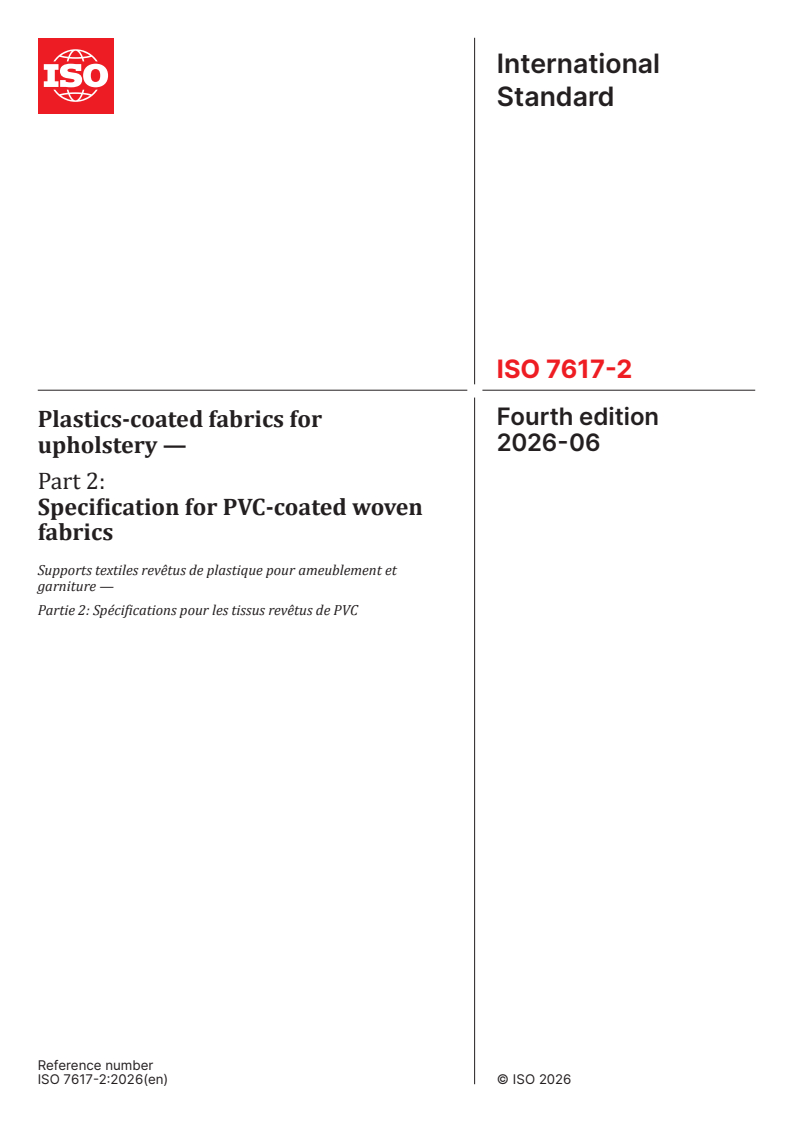
ISO 7617-2:2026 is an International Standard from ISO for PVC-coated woven fabrics used in upholstered furniture. It specifies requirements for materials made by applying a substantially continuous coating of plasticized vinyl chloride polymer, or a copolymer whose main constituent is vinyl chloride, to one side of a woven cloth. The document sets out two grades, A and B, so buyers, suppliers, and test labs can specify, inspect, and verify the fabric against the same technical basis.
What does ISO 7617-2:2026 specify?
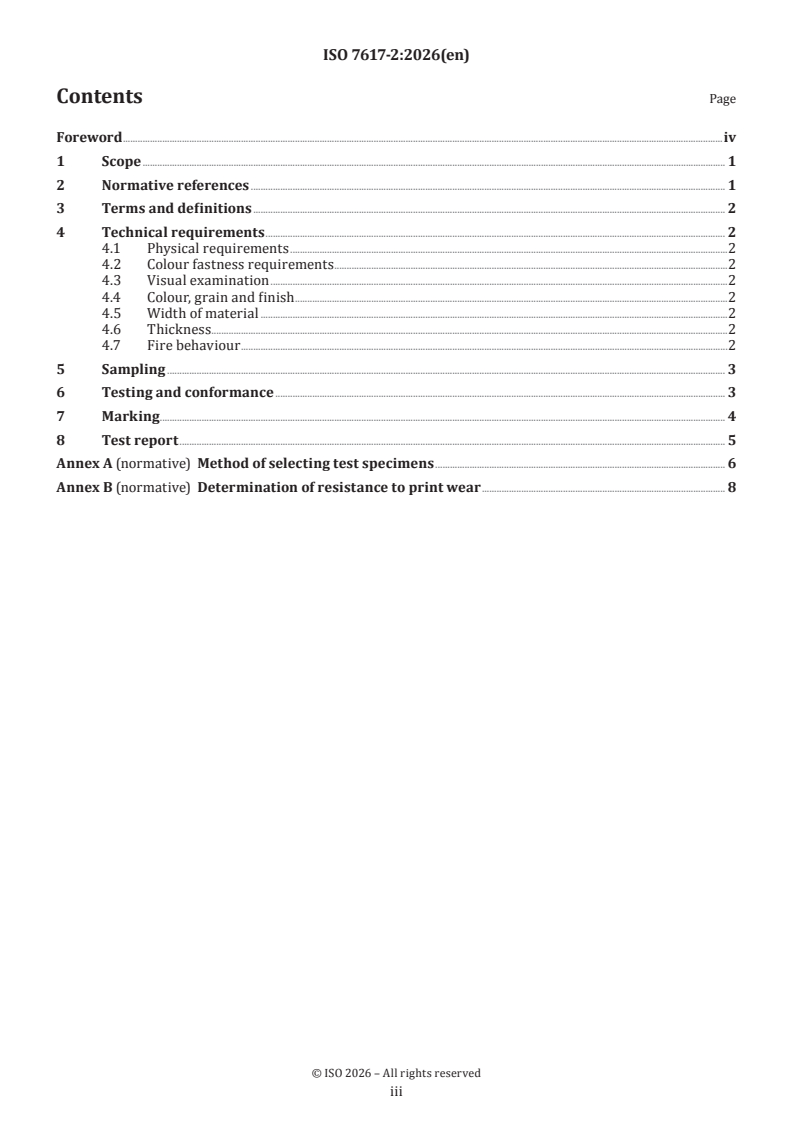
ISO 7617-2:2026 specifies the requirements for PVC-coated woven fabrics for upholstered furniture and the way they are sampled, tested, marked, and reported. The standard is organized into clauses for scope, normative references, terms and definitions, technical requirements, sampling, testing and conformance, marking, and test reports, followed by two normative annexes.
| Annex | What it covers |
|---|---|
| Annex A | Method of selecting test specimens |
| Annex B | Determination of resistance to print wear |
Clause 4 covers the technical requirements, Clause 5 sampling, Clause 6 conformance, Clause 7 marking, and Clause 8 the contents of the test report. This structure matters in practice because it links the product requirements to the way samples are taken and the evidence that has to be recorded.
What are the key requirements of ISO 7617-2:2026?
ISO 7617-2:2026 combines material performance, appearance, sampling, and documentation requirements. The most important point is that compliance depends on the grade, the agreed visual properties, and the test results from representative samples.
Physical performance requirements
Clause 4.1 and Table 1 set the physical requirements for Grade A and Grade B fabrics. The table covers total mass per unit area, coating mass per unit area, tear load, coating adhesion, maximum tensile force, flex resistance by flexometer method, heat ageing mass loss, thickness at 2 kPa, shear flexing and rubbing, and abrasion resistance in dry and wet conditions.
In practice, this is the core acceptance check for strength, durability, and coating integrity. A buyer or quality manager uses these properties to confirm that the fabric is suitable for upholstery service and that the delivered rolls match the declared grade.
Surface appearance and colour fastness
Clause 4.2 and Table 2 cover print wear, colour fastness to light, dry rubbing, wet rubbing, rubbing with soapy water, and blocking resistance. Clause 4.3 requires the coating to be uniformly applied, free from visible flaws and cracks, and substantially free from pin holes when viewed at ×10; the base fabric must not show through from the coated side unless the coating is unpigmented.
This matters because upholstered furniture is judged both by appearance and by day-to-day wear. Clause 4.4 also says colour, grain, and finish are agreed between purchaser and supplier, with colour comparison under ISO 105-A01.
Dimensions, fire information, sampling, and conformance
Clause 4.5 requires usable width to be measured in accordance with ISO 2286-1 and agreed between the purchaser and supplier. Clause 4.6 requires thickness to be measured in accordance with ISO 2286-3 under 2 kPa, and the results must be reported. Clause 4.7 says general fire performance requirements cannot be specified for these fabrics alone, but manufacturers are strongly encouraged to provide fire-behaviour information for finished furnishings.
Clause 5 sets the sampling approach, including batch-based sampling where rolls can be identified, or buyer-supplier agreement for random sampling when they cannot. Clause 6 links conformance to the results from the selected specimens, with retesting allowed when any specimen fails.
Marking and test reporting
Clause 7 requires each roll label to identify the manufacturer, batch number, colour, length, usable width, and the document reference ISO 7617-2:2026. Clause 8 requires the test report to identify the fabric, grade, test authority, conformance status, results for Tables 1 and 2, observations from visual and colour checks, width, thickness, any deviations, and the test date.
Who uses ISO 7617-2:2026?
ISO 7617-2:2026 is used by upholstered-furniture manufacturers, coated-fabric suppliers, purchasing teams, quality managers, and testing laboratories. It is also used by conformity assessors who need a common basis for checking physical properties, appearance, sampling, and reporting for PVC-coated woven fabrics. In practice, it supports product specification, incoming inspection, batch release, and dispute resolution.
What changed in ISO 7617-2:2026 from the previous edition?
ISO 7617-2:2026 is the fourth edition and cancels and replaces ISO 7617-2:2003. The foreword states these main changes: the normative references were updated, the property indication in Tables 1 and 2 was altered, abrasion resistance and flex testing were added to Table 1, and Clause 8 on the test report was added.
Which standards are used with ISO 7617-2:2026?
| Normative reference | What it contributes |
|---|---|
| ISO 105-A01 | General principles for colour fastness testing |
| ISO 105-A02 | Grey scale for assessing colour change |
| ISO 105-B02 | Colour fastness to artificial light |
| ISO 105-F09 | Cotton rubbing cloth specification |
| ISO 105-X12 | Colour fastness to rubbing |
| ISO 176 | Determination of loss of plasticizers |
| ISO 1421:2016 | Tensile strength and elongation at break |
| ISO 2231:1989 | Standard atmospheres for conditioning and testing |
| ISO 2286-1 | Length, width, and net mass of rolls |
| ISO 2286-2 | Total mass per unit area and coating/substrate mass per unit area |
| ISO 2286-3 | Thickness of coated fabrics |
| ISO 2411 | Coating adhesion |
| ISO 4674-1:2016 | Tear resistance, constant-rate methods |
| ISO 5470-2:2021 | Abrasion resistance by Martindale abrader |
| ISO 5978 | Blocking resistance |
| ISO 5981:2007 | Resistance to combined shear flexing and rubbing |
| ISO 32100 | Flex resistance by the flexometer method |
What does the ISO 7617-2:2026 document contain?
ISO 7617-2:2026 contains two requirement tables, one for physical properties and one for surface properties, with test methods matched to each property. It also contains a specimen-selection scheme in Annex A, shown in Figure A.1, which identifies where specimens are taken for mass, tear, tensile, adhesion, flexing, rubbing, print wear, blocking, and thickness tests.
Annex B gives the print-wear procedure, including the apparatus conditions, specimen size, conditioning, and grey-scale assessment. These parts are used for routine laboratory testing, batch acceptance, and conformity reporting.
Relations
- Effective Date
- 13-Apr-2024
Get Certified
Connect with accredited certification bodies for this standard

Control Union Certifications
Global certification for agriculture and sustainability.

Hohenstein Institut
Textile testing and certification.

Bureau Veritas Bangladesh
Bureau Veritas certification services in Bangladesh.
Sponsored listings
Frequently Asked Questions
ISO 7617-2:2026 is a standard published by the International Organization for Standardization (ISO). Its full title is "Plastics-coated fabrics for upholstery — Part 2: Specification for PVC-coated woven fabrics". This standard covers: This document specifies requirements for coated fabrics for upholstered furniture, manufactured by applying to one side of a woven cloth a substantially continuous coating of a suitably plasticized polymer of vinyl chloride, or a copolymer the major constituent of which is vinyl chloride. NOTE Such coatings are known as poly(vinyl chloride) (PVC) coatings. This document is applicable to two grades (A and B) of PVC-coated woven fabrics.
This document specifies requirements for coated fabrics for upholstered furniture, manufactured by applying to one side of a woven cloth a substantially continuous coating of a suitably plasticized polymer of vinyl chloride, or a copolymer the major constituent of which is vinyl chloride. NOTE Such coatings are known as poly(vinyl chloride) (PVC) coatings. This document is applicable to two grades (A and B) of PVC-coated woven fabrics.
ISO 7617-2:2026 is classified under the following ICS (International Classification for Standards) categories: 59.080.40 - Coated fabrics; 97.140 - Furniture. The ICS classification helps identify the subject area and facilitates finding related standards.
ISO 7617-2:2026 has the following relationships with other standards: It is inter standard links to ISO 7617-2:2003. Understanding these relationships helps ensure you are using the most current and applicable version of the standard.
ISO 7617-2:2026 is available in PDF format for immediate download after purchase. The document can be added to your cart and obtained through the secure checkout process. Digital delivery ensures instant access to the complete standard document.
Standards Content (Sample)
International
Standard
ISO 7617-2
Fourth edition
Plastics-coated fabrics for
2026-06
upholstery —
Part 2:
Specification for PVC-coated woven
fabrics
Supports textiles revêtus de plastique pour ameublement et
garniture —
Partie 2: Spécifications pour les tissus revêtus de PVC
Reference number
© ISO 2026
All rights reserved. Unless otherwise specified, or required in the context of its implementation, no part of this publication may
be reproduced or utilized otherwise in any form or by any means, electronic or mechanical, including photocopying, or posting on
the internet or an intranet, without prior written permission. Permission can be requested from either ISO at the address below
or ISO’s member body in the country of the requester.
ISO copyright office
CP 401 • Ch. de Blandonnet 8
CH-1214 Vernier, Geneva
Phone: +41 22 749 01 11
Email: copyright@iso.org
Website: www.iso.org
Published in Switzerland
ii
Contents Page
Foreword .iv
1 Scope . 1
2 Normative references . 1
3 Terms and definitions . 2
4 Technical requirements . 2
4.1 Physical requirements .2
4.2 Colour fastness requirements .2
4.3 Visual examination .2
4.4 Colour, grain and finish .2
4.5 Width of material .2
4.6 Thickness .2
4.7 Fire behaviour .2
5 Sampling . 3
6 Testing and conformance . 3
7 Marking . . 4
8 Test report . 5
Annex A (normative) Method of selecting test specimens . 6
Annex B (normative) Determination of resistance to print wear . 8
iii
Foreword
ISO (the International Organization for Standardization) is a worldwide federation of national standards
bodies (ISO member bodies). The work of preparing International Standards is normally carried out through
ISO technical committees. Each member body interested in a subject for which a technical committee
has been established has the right to be represented on that committee. International organizations,
governmental and non-governmental, in liaison with ISO, also take part in the work. ISO collaborates closely
with the International Electrotechnical Commission (IEC) on all matters of electrotechnical standardization.
The procedures used to develop this document and those intended for its further maintenance are described
in the ISO/IEC Directives, Part 1. In particular, the different approval criteria needed for the different types
of ISO document should be noted. This document was drafted in accordance with the editorial rules of the
ISO/IEC Directives, Part 2 (see www.iso.org/directives).
ISO draws attention to the possibility that the implementation of this document may involve the use of (a)
patent(s). ISO takes no position concerning the evidence, validity or applicability of any claimed patent
rights in respect thereof. As of the date of publication of this document, ISO had not received notice of (a)
patent(s) which may be required to implement this document. However, implementers are cautioned that
this may not represent the latest information, which may be obtained from the patent database available at
www.iso.org/patents. ISO shall not be held responsible for identifying any or all such patent rights.
Any trade name used in this document is information given for the convenience of users and does not
constitute an endorsement.
For an explanation of the voluntary nature of standards, the meaning of ISO specific terms and expressions
related to conformity assessment, as well as information about ISO's adherence to the World Trade
Organization (WTO) principles in the Technical Barriers to Trade (TBT), see www.iso.org/iso/foreword.html.
This document was prepared by Technical Committee ISO/TC 45, Rubber and rubber products, Subcommittee
SC 4, Products (other than hoses).
This fourth edition cancels and replaces the third edition (ISO 7617-2:2003), which has been technically
revised.
The main changes are as follows:
— update of normative references;
— alteration of property indication in Tables 1 and 2;
— addition of test methods and property requirements of abrasion resistance and flex testing in Table 1;
— addition of Clause 8 regarding the test report.
A list of all parts in the ISO 7617 series can be found on the ISO website.
Any feedback or questions on this document should be directed to the user’s national standards body. A
complete listing of these bodies can be found at www.iso.org/members.html.
iv
International Standard ISO 7617-2:2026(en)
Plastics-coated fabrics for upholstery —
Part 2:
Specification for PVC-coated woven fabrics
1 Scope
This document specifies requirements for coated fabrics for upholstered furniture, manufactured by
applying to one side of a woven cloth a substantially continuous coating of a suitably plasticized polymer of
vinyl chloride, or a copolymer the major constituent of which is vinyl chloride.
NOTE Such coatings are known as poly(vinyl chloride) (PVC) coatings.
This document is applicable to two grades (A and B) of PVC-coated woven fabrics.
2 Normative references
The following documents are referred to in the text in such a way that some or all of their content constitutes
requirements of this document. For dated references, only the edition cited applies. For undated references,
the latest edition of the referenced document (including any amendments) applies.
ISO 105-A01, Textiles — Tests for colour fastness — Part A01: General principles of testing
ISO 105-A02, Textiles — Tests for colour fastness — Part A02: Grey scale for assessing change in colour
ISO 105-B02, Textiles — Tests for colour fastness — Part B02: Colour fastness to artificial light: Xenon arc fading
lamp test
ISO 105-F09, Textiles — Tests for colour fastness — Part F09: Specification for cotton rubbing cloth
ISO 105-X12, Textiles — Tests for colour fastness — Part X12: Colour fastness to rubbing
ISO 176, Plastics — Determination of loss of plasticizers — Activated carbon method
ISO 1421:2016, Rubber- or plastics-coated fabrics — Determination of tensile strength and elongation at break
ISO 2231:1989, Rubber- or plastics-coated fabrics — Standard atmospheres for conditioning and testing
ISO 2286-1, Rubber- or plastics-coated fabrics — Determination of roll characteristics — Part 1: Methods for
determination of length, width and net mass
ISO 2286-2, Rubber- or plastics-coated fabrics — Determination of roll characteristics — Part 2: Methods for
determination of total mass per unit area, mass per unit area of coating and mass per unit area of substrate
ISO 2286-3, Rubber- or plastics-coated fabrics — Determination of roll characteristics — Part 3: Method for
determination of thickness
ISO 2411, Rubber- or plastics-coated fabrics — Determination of coating adhesion
ISO 4674-1:2016, Rubber- or plastics-coated fabrics — Determination of tear resistance — Part 1: Constant rate
of tear methods
ISO 5470-2:2021, Rubber- or plastics-coated fabrics — Determination of abrasion resistance — Part 2:
Martindale abrader
ISO 5978, Rubber- or plastics-coated fabrics — Determination of blocking resistance
ISO 5981:2007, Rubber- or plastics-coated fabrics — Determination of resistance to combined shear flexing and
rubbing
ISO 32100, Rubber- or plastics-coated fabrics — Physical and mechanical tests — Determination of flex
resistance by the flexometer method
3 Terms and definitions
No terms and definitions are listed in this document.
ISO and IEC maintain terminology databases for use in standardization at the following addresses:
— ISO Online browsing platform: available at https:// www .iso .org/ obp
— IEC Electropedia: available at https:// www .electropedia .org/
4 Technical requirements
4.1 Physical requirements
The material shall conform to the applicable requirements of Table 1.
4.2 Colour fastness requirements
The material shall conform to the requirements of Table 2.
4.3 Visual examination
The coating of the material shall be uniformly applied and shall be free fr
...