

ISO 7617-3:1988
(Main)Plastics-coated fabrics for upholstery — Part 3: Specification for polyurethane-coated woven fabrics
General Information
- Abstract
Specifies requirements for polyurethane-coated fabrics for upholstered furniture, where a substantially continuous coating is applied to one side of the fabric. Two annexes for the selection of the specimen and for the determination of the resistance to print wear. Part 1 of this standard: PVC-coated knitted fabrics; part 2: PVC-coated woven fabrics.
- Status
- Published
- Publication Date
- 15-Jun-1988
- Technical Committee
- ISO/TC 45/SC 4 - Products (other than hoses)
- Drafting Committee
- ISO/TC 45/SC 4/WG 13 - Coated fabrics
- Current Stage
- 9092 - International Standard to be revised
- Start Date
- 05-Apr-2024
- Completion Date
- 29-Aug-2026
Buy Documents
ISO 7617-3:1988 - Plastics-coated fabrics for upholstery — Part 3: Specification for polyurethane-coated woven fabrics Released:6/16/1988
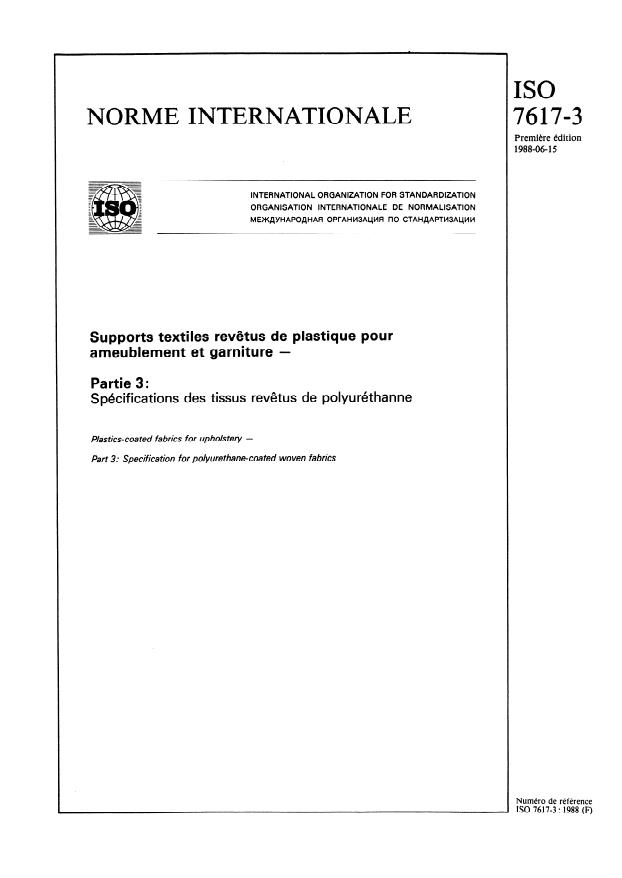
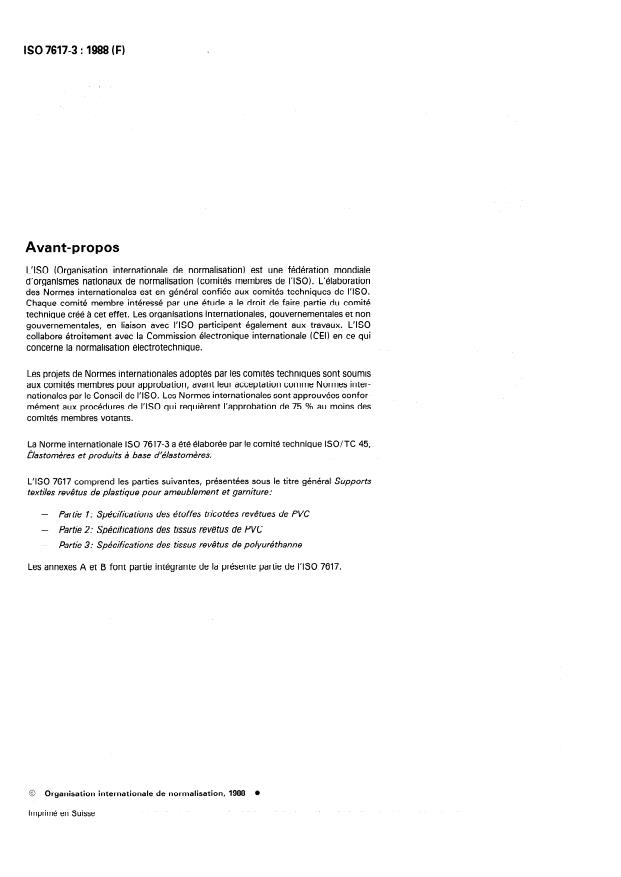
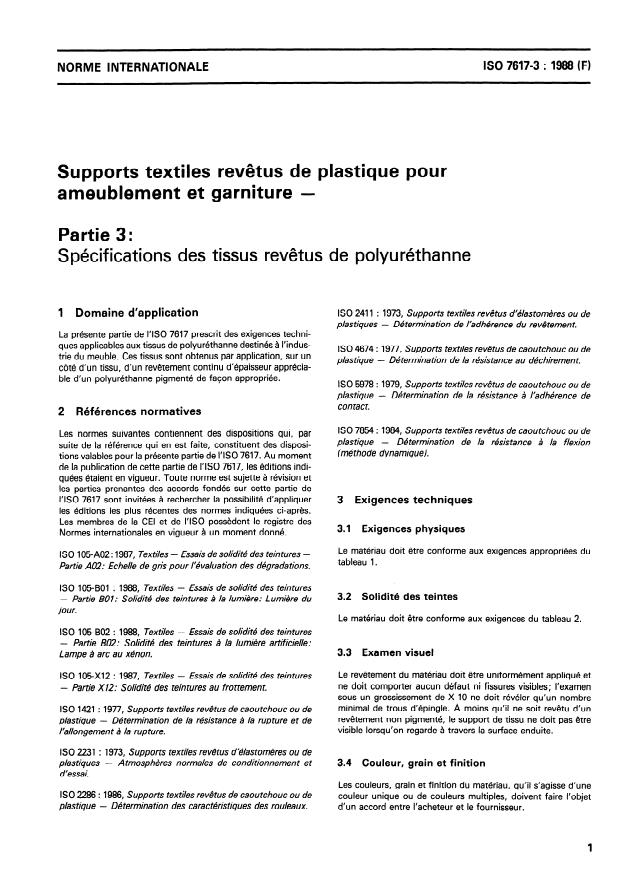
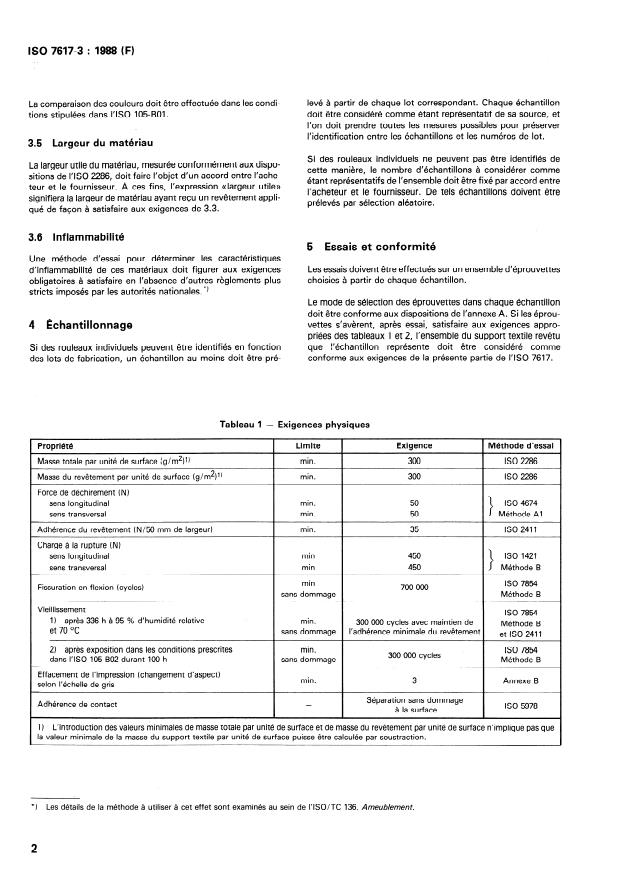
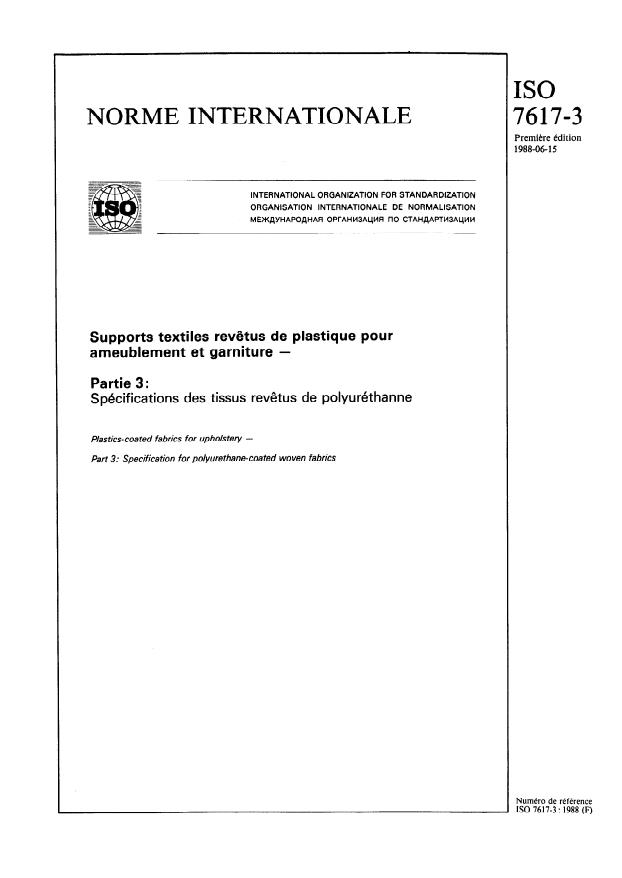
ISO 7617-3:1988 - Supports textiles revetus de plastique pour ameublement et garniture — Partie 3: Spécifications des tissus revetus de polyuréthanne Released:6/16/1988
ISO 7617-3:1988 - Supports textiles revetus de plastique pour ameublement et garniture — Partie 3: Spécifications des tissus revetus de polyuréthanne Released:6/16/1988
Overview
ISO 7617-3:1988 is an international standard published by the International Organization for Standardization (ISO) specifying the technical requirements for polyurethane-coated woven fabrics used in upholstered furniture. This part of ISO 7617 focuses on fabrics with a substantially continuous polyurethane coating applied to one side of the base textile, providing enhanced durability and aesthetic qualities suitable for furniture upholstery. It complements Parts 1 and 2, which cover PVC-coated knitted and woven fabrics, respectively.
The standard establishes essential criteria on physical properties, durability, color fastness, and safety, ensuring consistent quality and performance of polyurethane-coated upholstery fabrics.
Key Topics
Material Composition and Construction
Specifies the use of woven textile bases coated with a pigmented, substantially continuous layer of polyurethane on one side.Physical Property Requirements
- Minimum total mass and coating mass per square meter
- Tear and tensile strength (longitudinal and transverse directions)
- Coating adhesion and resistance to cracking during bending
- Durability under accelerated aging conditions including humidity and temperature
Color Fastness and Appearance
- Requirements for resistance to fading under artificial light (xenon arc lamp)
- Resistance to rubbing (both dry and wet conditions)
- Visual examination for uniformity, absence of defects or cracks, and limited pinholes under magnification
- Color, grain, and finish consistency agreed upon between supplier and buyer
Testing and Compliance Procedures
- Sampling methods for obtaining representative test specimens, including multiple samples for multi-colored fabrics
- Repetitive testing procedures if initial test results fail to meet criteria
- Detailed test methods for adhesion, tear resistance, flexing endurance, and color fastness based on referenced ISO standards
Print Wear Resistance
Includes a normative annex specifying a method to assess resistance to print wear through a 500-cycle abrasion test using standardized cotton fabric and evaluation of color change on a gray scale.Inflammability Considerations
Advises on evaluating flammability according to applicable national regulations, with test methods to be included as needed.Marking and Traceability
Each fabric roll must bear a label containing the manufacturer’s identification, batch number, color, length, usable width, and reference to ISO 7617-3 for clear traceability.
Applications
ISO 7617-3:1988 is critical for manufacturers, suppliers, and quality inspectors of polyurethane-coated upholstery fabrics. The standard supports consistent quality in materials used for:
- Residential and commercial upholstered furniture
- Automotive and transportation seating
- Office furniture coverings
- Hospitality industry furnishings such as hotel seating and restaurant booths
By adhering to this standard, producers ensure fabric durability, aesthetic longevity, and safety compliance, thus improving product reliability and reducing returns or complaints related to coating failure or poor color fastness.
Related Standards
For a comprehensive understanding and application, ISO 7617-3 should be considered alongside other relevant ISO standards for textile and coated fabrics:
- ISO 7617 Parts 1 & 2 – Specifications for PVC-coated knitted and woven upholstery fabrics
- ISO 2411 – Determination of coating adhesion on textile supports
- ISO 4674 – Tear resistance testing for coated fabrics
- ISO 5970 – Surface contact adhesion of coatings
- ISO 105 series – Textile color fastness testing methods for light and rubbing
- ISO 2286 – Measuring characteristics of coated fabrics including width and mass
- ISO 1421 – Breaking force and elongation tests for rubber or plastic coated textiles
- ISO 7854 – Resistance to flex cracking of coated fabrics
- ISO 2231 – Conditioning atmospheres for textile testing
Utilizing these related standards in concert with ISO 7617-3 offers a robust framework for assessing and verifying the performance of polyurethane-coated upholstery fabrics within quality management systems worldwide.
Keywords: polyurethane-coated fabrics, upholstery fabric standards, ISO 7617-3, coated fabrics for furniture, textile coating specifications, fabric durability, color fastness, upholstery material testing, fabric marking and traceability.
Buy Documents
ISO 7617-3:1988 - Plastics-coated fabrics for upholstery — Part 3: Specification for polyurethane-coated woven fabrics Released:6/16/1988
ISO 7617-3:1988 - Supports textiles revetus de plastique pour ameublement et garniture — Partie 3: Spécifications des tissus revetus de polyuréthanne Released:6/16/1988
ISO 7617-3:1988 - Supports textiles revetus de plastique pour ameublement et garniture — Partie 3: Spécifications des tissus revetus de polyuréthanne Released:6/16/1988
Get Certified
Connect with accredited certification bodies for this standard

Control Union Certifications
Global certification for agriculture and sustainability.

Hohenstein Institut
Textile testing and certification.

Bureau Veritas Bangladesh
Bureau Veritas certification services in Bangladesh.
Sponsored listings
Frequently Asked Questions
ISO 7617-3:1988 is a standard published by the International Organization for Standardization (ISO). Its full title is "Plastics-coated fabrics for upholstery — Part 3: Specification for polyurethane-coated woven fabrics". This standard covers: Specifies requirements for polyurethane-coated fabrics for upholstered furniture, where a substantially continuous coating is applied to one side of the fabric. Two annexes for the selection of the specimen and for the determination of the resistance to print wear. Part 1 of this standard: PVC-coated knitted fabrics; part 2: PVC-coated woven fabrics.
Specifies requirements for polyurethane-coated fabrics for upholstered furniture, where a substantially continuous coating is applied to one side of the fabric. Two annexes for the selection of the specimen and for the determination of the resistance to print wear. Part 1 of this standard: PVC-coated knitted fabrics; part 2: PVC-coated woven fabrics.
ISO 7617-3:1988 is classified under the following ICS (International Classification for Standards) categories: 59.080.40 - Coated fabrics; 97.140 - Furniture. The ICS classification helps identify the subject area and facilitates finding related standards.
ISO 7617-3:1988 is available in PDF format for immediate download after purchase. The document can be added to your cart and obtained through the secure checkout process. Digital delivery ensures instant access to the complete standard document.
Standards Content (Sample)
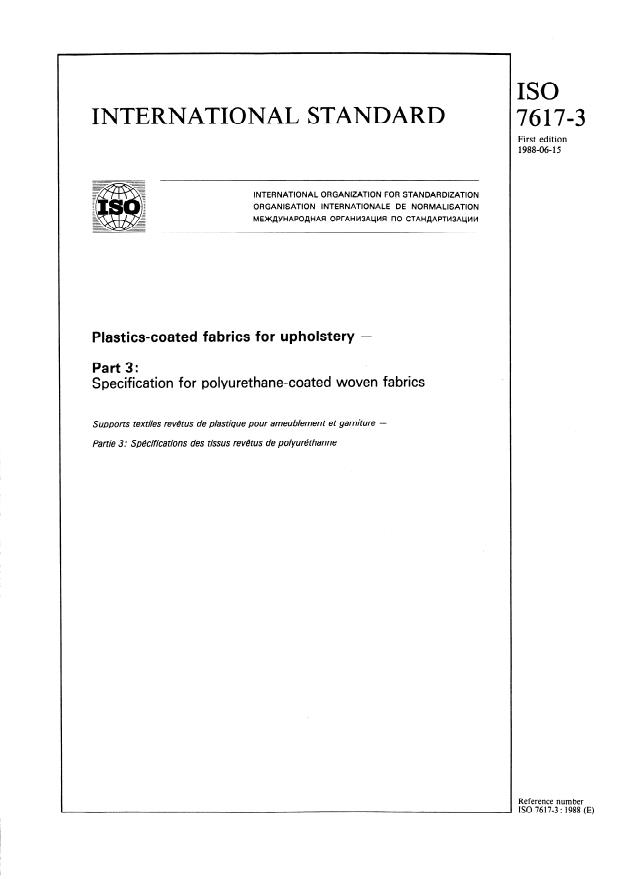
IS0
INTERNATIONAL STANDARD
7617-3
First edition
1988-06-U
INTERNATIONAL ORGANIZATION FOR STANDARDIZATION
ORGANISATION INTERNATIONALE DE NORMALISATION
MEXAYHAPOAHAFI OPTAHM3AL&lR i-l0 CTAH~APTM3A~MM
Plastics-coated fabrics for upholstery -
Part 3:
Specification for polyurethane-coated woven fabrics
Supports textiles rev&us de plastique pour ameublement et garniture -
Partie 3: Sphcifications des tissus revetus de polyurhthanne
Reference number
IS0 7617-3: 1988 (E)
IS0 7617-3 : 1988 (El
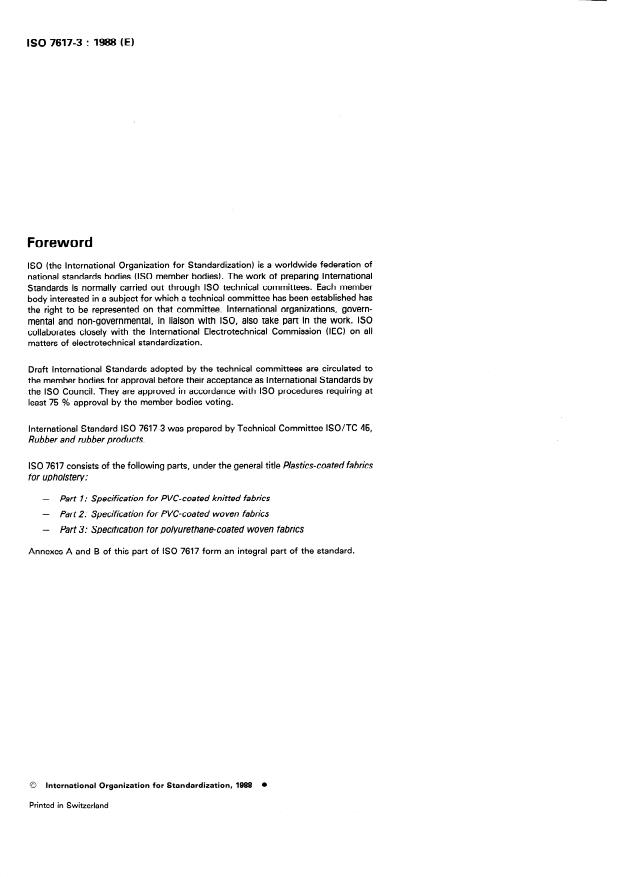
Foreword
IS0 (the International Organization for Standardization) is a worldwide federation of
national standards bodies (IS0 member bodies). The work of preparing International
Standards is normally carried out through IS0 technical committees. Each member
body interested in a subject for which a technical committee has been established has
the right to be represented on that committee. International organizations, govern-
mental and non-governmental, in liaison with ISO, also take part in the work. IS0
collaborates closely with the International Electrotechnical Commission (IEC) on all
matters of electrotechnical standardization.
Draft International Standards adopted by the technical committees are circulated to
the member bodies for approval before their acceptance as International Standards by
the IS0 Council. They are approved in accordance with IS0 procedures requiring at
least 75 % approval by the member bodies voting.
International Standard IS0 7617-3 was prepared by Technical Committee ISO/TC 45,
Rubber and rubber products.
IS0 7617 consists of the followi ng parts, under the general title Plastics-coated fabrics
for upholstery:
- Part I : Specification for PVC-coated knitted fabrics
- Part 2: Specification for PVC-coated woven fabrics
-
Part 3: Specification for polyurethane-coated woven fabrics
Annexes A and B of this part of IS0 7617 form an integral part of the standard.
International Organization for Standardization, 1988
Printed in
IS0 7617-3 : 1988 (E)
INTERNATIONAL STANDARD
tics-coated fabrics for upholstery -
Part 3:
Specification for polyurethane-coated woven fabrics
IS0 5978 : 1979, Rubber- or plastics-coated fabrics - Deter-
1 Scope
mina tion of blocking resistance.
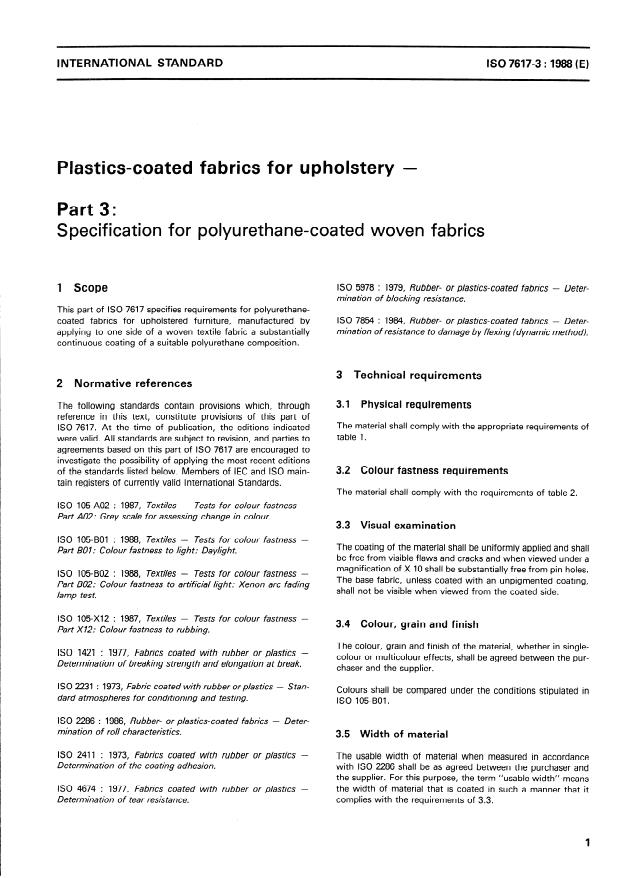
This part of IS0 7617 specifies requirements for polyurethane-
I SO 7854 : 1984, Rubber- or plastics-coated fabrics - Deter-
coated fabrics for upholstered furniture, manufactured by
mina tion of resistance to damage by flexing (dynamic method).
applying to one side of a woven textile fabric a substantially
continuous coating of a suitable polyurethane composition.
3 Technical requirements
2 Normative references
3.1 Physical requirements
The following standards contain provisions which, through
reference in this text, constitute provisions of this part of
The material shall comply with the appropriate requirements of
IS0 7617. At the time of publication, the editions indicated
table 1.
were valid. All standards are subject to revision, and parties to
agreements based on this part of IS0 7617 are encouraged to
investigate the possibility of applying the most recent editions
3.2 Colour fastness requirements
of the standards listed below. Members of IEC and IS0 main-
tain registers of currently valid International Standards.
The material shall comply with the requirements of table 2.
I SO 105-A02 : 1987, Textiles - Tests for colour fastness -
Part A02: Grey scale for assessing change in colour.
3.3 Visual examination
IS0 105-BOl : 1988, Textiles - Tests for colour fastness -
The coating of the material shall be uniformly applied and shall
Part BOI : Colour fastness to light: Daylight.
be free from visible flaws and cracks and when viewed under a
magnification of X 10 shall be substantially free from pin holes.
IS0 105-B02 : 1988, Textiles - Tests for colour fastness --
The base fabric, unless coated with an unpigmented coating,
Part B02: Colour fastness to artificial light: Xenon arc fading
shall not be visible when viewed from the coated side.
lamp test.
IS0 105-X12 : 1987, Textiles - Tests for colour fastness -
3.4 Colour, grain and finish
Part X72: Colour fastness to rubbing.
The colour, grain and finish of the material, whether in single-
IS0 1421 : 1977, Fabrics coated with rubber or plastics -
colour or multicolour effects, shall be agreed between the pur-
Determination of breaking strength and elongation at break.
chaser and the supplier.
IS0 2231 : 1973, Fabric coated with rubber or plastics - Stan-
Colours shall be compared under the conditions stipulated in
dard atmospheres for conditioning and testing.
IS0 105-BOI.
IS0 2286 : 1986, Rubber- or plastics-coated fabrics - Deter-
mina tion of roll characteristics.
3.5 Width of material
IS0 2411 : 1973, Fabrics coated with rubber or plastics - The usable width of material when measured in accordance
Determination of the coating adhesion. with IS0 2286 shall be as agreed between the purchaser and
the supplier. For this purpose, the term “usable width” means
the width of material that is coated in such a manner that it
IS0 4674 : 1977, Fabrics coated with rubber or plastics -
complies with the requirements of 3.3.
Determination of tear resistance.
IS0 7617-3 : 1988 E)
The method of selecting specimens from each sample shall be
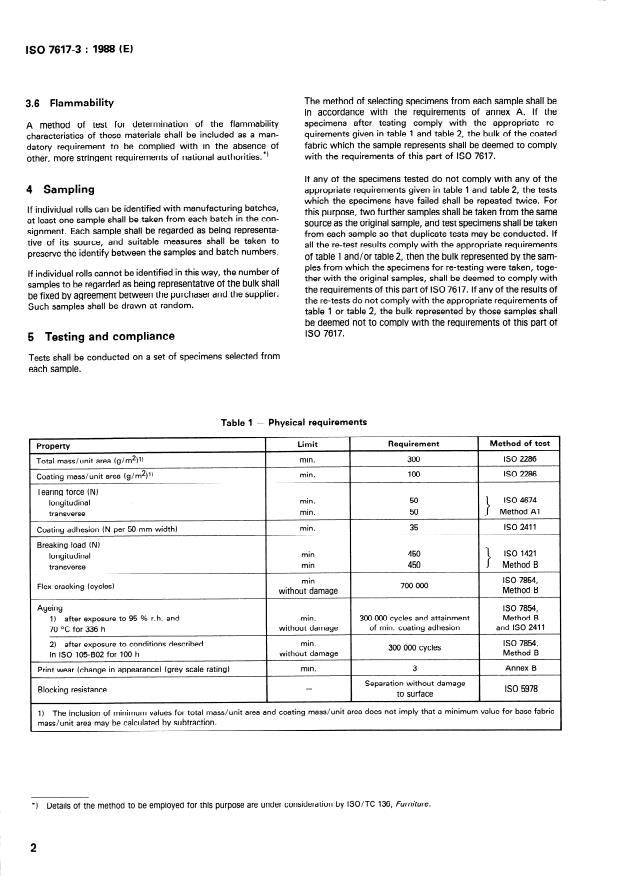
3.6 Flammability
in accordance with the requirements of annex A. If the
specimens after testing comply with the appropriate re-
A method of test for determination of the flammability
quirements given in table 1 and table 2, the bulk of the coated
characteristics of these materials shall be included as a man-
fabric which the sample represents shall be deemed to comply
datory requirement to be complied with in the absence of
authorities. *) with the requirements of this part of IS0 7617.
other, more stringent requirements of nationa
If any of the specimens tested do not comply with any of the
4 Sampling appropriate requirements given in table 1 and table 2, the tests
which the specimens have failed shall be repeated twice. For
zturing batches,
If individual rolls can be identified with manuf;
this purpose, two further samples shall be taken from the same
at least one sample shall be taken from each batch in the con-
source as the original sample, and test specimens shall be taken
signment. Each sample shall be regarded as being representa-
from each sample so that duplicate tests may be conducted. If
tive of its source, and suitable measures shall be taken to
all the re-test results comply with the appropriate requirements
preserve the identify between the samples and batch numbers.
of table 1 and/or table 2, then the bulk represented by the sam-
ples from which the specimens for re-testing were taken, toge-
If individual rolls cannot be identified in this way, the numb
...
ISO
NORME INTERNATIONALE
7617-3
Première édition
1988-06-15
INTERNATIONAL ORGANIZATION FOR STANDARDIZATION
ORGANISATION INTERNATIONALE DE NORMALISATION
MEXtJlYHAPOflHAR OPrAHM3ALlMR l-l0 CTAH~APTM3A~MM
Supports textiles revêtus de plastique pour
ameublement et garniture -
Partie 3:
Spécifications des tissus revêtus de polyuréthanne
Plastics-coated fabrics for upholstery -
Part 3: Specification for polyurethane-coated woven fabrics
Numéro de référence
ISO 7617-3: 1988 (F)
ISO7617-3:1988(F)
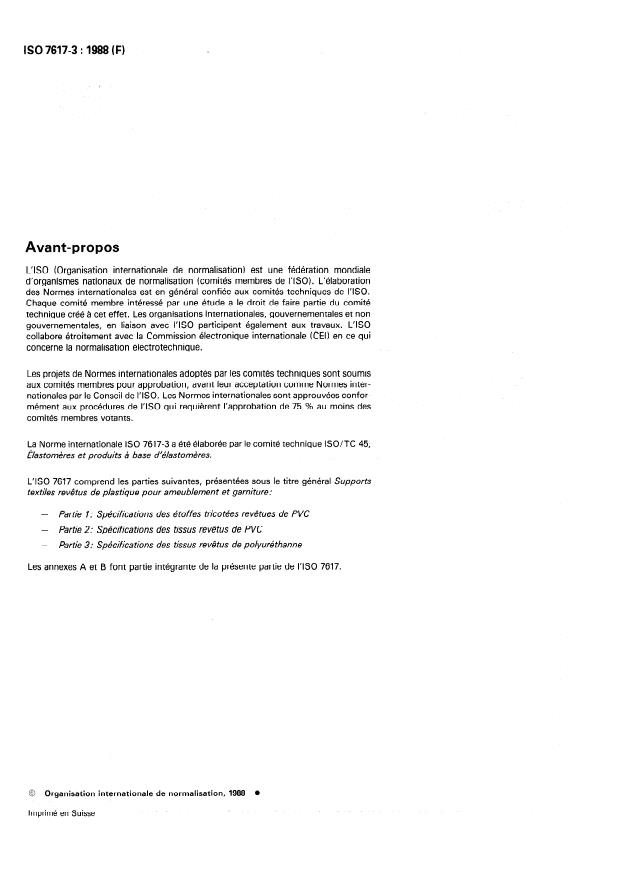
Avant-propos
L’ISO (Organisation internationale de normalisation) est une fédération mondiale
d’organismes nationaux de normalisation (comités membres de I’ISO). L’élaboration
des Normes internationales est en général confiée aux comités techniques de I’ISO.
Chaque comité membre intéressé par une étude a le droit de faire partie du comité
technique créé à cet effet. Les organisations internationales, gouvernementales et non
gouvernementales, en liaison avec I’ISO participent également aux travaux. L’ISO
collabore étroitement avec la Commission électronique internationale (&l) en ce qui
concerne la normalisation électrotechnique.
Les projets de Normes internationales adoptés par les comités techniques sont soumis
aux comités membres pour approbation, avant leur acceptation comme Normes inter-
nationales par le Conseil de I’ISO. Les Normes internationales sont approuvées confor-
mément aux procédures de I’ISO qui requièrent l’approbation de 75 % au moins des
comités membres votants.
La Norme internationale ISO 7617-3 a été élaborée par le comité technique ISO/TC 45,
Élastomères et produits à base d’élastomères.
L’ISO 7617 comprend les parties suivantes, présentées sous le titre général Supports
textiles revêtus de plastique pour ameublement et garniture:
- Partie 7 : Spkifications des étoffes tricotées revêtues de PVC
- Partie 2: Spécifications des tissus revêtus de PVC
-
Partie 3: Spécifications des tissus revêtus de polyuréthanne
Les annexes A et B font partie intégrante de la présente partie de I’ISO 7617.
0 Organisation internationale de normalisation, 1988
Imprimé en Suisse
ISO 7617-3 : 1988 (FI
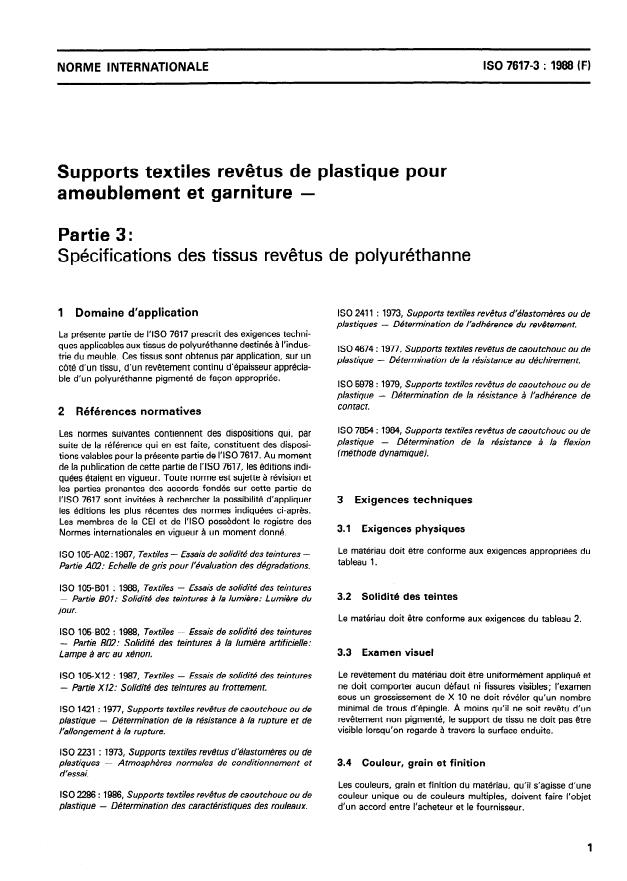
NORME INTERNATIONALE
Supports textiles revêtus de plastique pour
ameublement et garniture -
Partie 3:
Spécifications des tissus revêtus de polyuréthanne
1 Domaine d’application ISO 2411 : 1973, Supports textiles revêtus d’élastomères ou de
plastiques - Détermination de l’adhérence du revêtement.
La présente partie de I’ISO 7617 prescrit des exigences techni-
ques applicables aux tissus de polyuréthanne destinés a I’indus-
ISO 4674 : 1977, Supports textiles revêtus de caoutchouc ou de
trie du meuble. Ces tissus sont obtenus par application, sur un
plastique - Dé termina tion de la résis tance au dechiremen t.
côté d’un tissu, d’un revêtement continu d’épaisseur apprécia-
ble d’un polyuréthanne pigmenté de facon appropriée.
ISO 5970 : 1979, Supports textiles revêtus de caoutchouc ou de
plastique - Détermination de la résistance à l’adhérence de
con tact.
2 Références normatives
ISO 7854 : 1994, Supports textiles revêtus de caoutchouc ou de
Les normes suivantes contiennent des dispositions qui, par
plastique - Détermination de la résistance à la flexion
suite de la référence qui en est faite, constituent des disposi-
(méthode dynamique).
tions valables pour la présente partie de I’ISO 7617. Au moment
de la publication de cette partie de I’ISO 7617, les éditions indi-
quées étaient en vigueur. Toute norme est sujette à révision et
les parties prenantes des accords fondés sur cette partie de
I’ISO 7617 sont invitées à rechercher la possibilité d’appliquer 3 Exigences techniques
les éditions les plus récentes des normes indiquées ci-après.
Les membres de la CEI et de I’ISO possédent le registre des
3.1 Exigences physiques
Normes internationales en vigueur à un moment donné.
Le matériau doit être conforme aux exigences appropriées du
ISO 105-A02: 1987, Textiles - Essais de solidité des teintures -
tableau 1.
Partie A02: Echelle de gris pour l’évaluation des dégradations.
Essais de solidité des teintures
ISO 105-BO1 : 1988, Textiles -
3.2 Solidité des teintes
- Partie BO7: Solidite des teintures à la lumière: Lumière du
jour.
Le matériau doit être conforme aux exigences du tableau 2.
ISO 105-BO2 : 1988, Textiles - Essais de solidité des teintures
- Partie BOZ: Solidite des teintures à la lumière artificielle:
3.3 Examen visuel
Lampe à arc au xénon.
Le revêtement du matériau doit être uniformément appliqué et
ISO 105-X12 : 1987, Textiles - Essais de solidité des teintures
ne doit comporter aucun défaut ni fissures visibles; l’examen
- Partie X 72: Solidité des tein turcs au frottement.
sous un grossissement de X 10 ne doit révéler qu’un nombre
minimal de trous d’épingle. A moins qu’il ne soit revêtu d’un
ISO 1421 : 1977, Supports textiles revetus de caoutchouc ou de
revêtement non pigmenté, le support de tissu ne doit pas être
plastique - Détermination de la résistance à la rupture et de
visible lorsqu’on regarde à travers la surface enduite.
l’allongement à la rupture.
ISO 2231 : 1973, Supports textiles revêtus d’élastomères ou de
plastiques - A tmosphères normales de conditionnement et 3.4 Couleur, grain et finition
d’essai.
Les couleurs, grain et finition du matériau, qu’il s’agisse d’une
ISO 2286 : 1986, Supports textiles revêtus de caoutchouc ou de
couleur unique ou de couleurs multiples, doivent faire l’objet
plastique - Dé termina tion des carat téris tiques des rouleaux.
d’un accord entre l’acheteur et le fournisseur.
ISO 7617-3 : 1988 (FI
levé à partir de chaque lot correspondant. Chaque échantillon
La comparaison des couleurs doit être effectuée dans les condi-
doit être considéré comme étant représentatif de sa source, et
tions stipulées dans I’ISO 105-Bol.
l’on doit prendre toutes les mesures possibles pour préserver
l’identification entre les échantillons et les numéros de lot.
3.5 Largeur du matériau
Si des rouleaux individuels ne peuvent pas être identifiés de
La largeur utile du matériau, mesurée conformément aux dispo-
cette manière, le nombre d’échantillons à considérer comme
sitions de I’ISO 2286, doit faire l’objet d’un accord entre I’ache-
étant représentatifs de l’ensemble doit être fixé par accord entre
teur et le fournisseur. A ces fins, l’expression «largeur utile»
l’acheteur et le fournisseur. De tels échantillons doivent être
signifiera la largeur de matériau ayant recu un revêtement appli-
prélevés par sélection aléatoire.
qué de facon à satisfaire aux exigences de 3.3.
3.6 Inflammabilité
5 Essais et conformité
Une méthode d’essai pour déterminer les caractéristiques
Les essais doivent être effectués sur un ensemble d’éprouvettes
d’inflammabilité de ces matériaux doit figurer aux exigences
choisies à partir de chaque échantillon.
obligatoires à satisfaire en l’absence d’autres règlements plus
stricts imposés par les autorités nationales. *)
Le mode de sélection des éprouvettes dans chaque échantillon
doit être conforme aux dispositions de l’annexe A. Si les éprou-
vettes s’avèrent, après essai, satisfaire aux exigences appro-
4 Échantillonnage
priées des tableaux 1 et 2, l’ensemble du support textile revêtu
l’échantillon représente doit être considéré comme
Si des rouleaux individuels peuvent être identifiés en fonction que L
conforme aux exigences de la présente partie de I’ISO 7617.
des lots de fabrication, un échantillon au moins doit être pré-
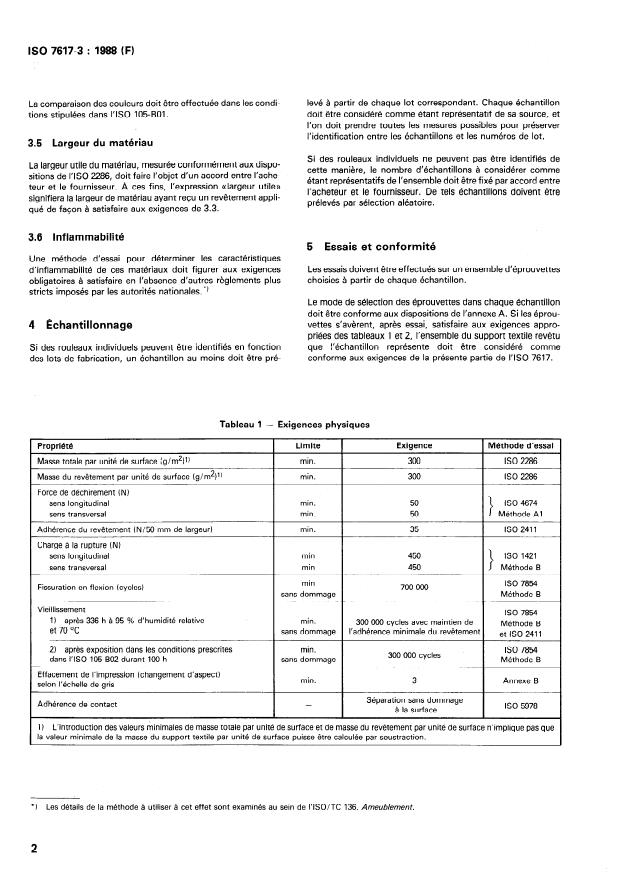
Tableau 1 - Exigences physiques
Exigence
Propriété Limite Méthode d’essai
min. 300
Masse totale par unité de surface (g/m2)1) ISO 2286
Masse du revêtement par unité de surface (g/m2)1) min. 300 SO 2286
Force de déchirement (N)
min. 50 ISO 4674
sens longitudinal
sens transversal min. 50 > Méthode Al
Adhérence du revêtement (N/50 mm de largeur) min. 35 ISO 2411
Charge à la rupture (N)
sens longitudinal min 450 ISO 142
...
ISO
NORME INTERNATIONALE
7617-3
Première édition
1988-06-15
INTERNATIONAL ORGANIZATION FOR STANDARDIZATION
ORGANISATION INTERNATIONALE DE NORMALISATION
MEXtJlYHAPOflHAR OPrAHM3ALlMR l-l0 CTAH~APTM3A~MM
Supports textiles revêtus de plastique pour
ameublement et garniture -
Partie 3:
Spécifications des tissus revêtus de polyuréthanne
Plastics-coated fabrics for upholstery -
Part 3: Specification for polyurethane-coated woven fabrics
Numéro de référence
ISO 7617-3: 1988 (F)
ISO7617-3:1988(F)
Avant-propos
L’ISO (Organisation internationale de normalisation) est une fédération mondiale
d’organismes nationaux de normalisation (comités membres de I’ISO). L’élaboration
des Normes internationales est en général confiée aux comités techniques de I’ISO.
Chaque comité membre intéressé par une étude a le droit de faire partie du comité
technique créé à cet effet. Les organisations internationales, gouvernementales et non
gouvernementales, en liaison avec I’ISO participent également aux travaux. L’ISO
collabore étroitement avec la Commission électronique internationale (&l) en ce qui
concerne la normalisation électrotechnique.
Les projets de Normes internationales adoptés par les comités techniques sont soumis
aux comités membres pour approbation, avant leur acceptation comme Normes inter-
nationales par le Conseil de I’ISO. Les Normes internationales sont approuvées confor-
mément aux procédures de I’ISO qui requièrent l’approbation de 75 % au moins des
comités membres votants.
La Norme internationale ISO 7617-3 a été élaborée par le comité technique ISO/TC 45,
Élastomères et produits à base d’élastomères.
L’ISO 7617 comprend les parties suivantes, présentées sous le titre général Supports
textiles revêtus de plastique pour ameublement et garniture:
- Partie 7 : Spkifications des étoffes tricotées revêtues de PVC
- Partie 2: Spécifications des tissus revêtus de PVC
-
Partie 3: Spécifications des tissus revêtus de polyuréthanne
Les annexes A et B font partie intégrante de la présente partie de I’ISO 7617.
0 Organisation internationale de normalisation, 1988
Imprimé en Suisse
ISO 7617-3 : 1988 (FI
NORME INTERNATIONALE
Supports textiles revêtus de plastique pour
ameublement et garniture -
Partie 3:
Spécifications des tissus revêtus de polyuréthanne
1 Domaine d’application ISO 2411 : 1973, Supports textiles revêtus d’élastomères ou de
plastiques - Détermination de l’adhérence du revêtement.
La présente partie de I’ISO 7617 prescrit des exigences techni-
ques applicables aux tissus de polyuréthanne destinés a I’indus-
ISO 4674 : 1977, Supports textiles revêtus de caoutchouc ou de
trie du meuble. Ces tissus sont obtenus par application, sur un
plastique - Dé termina tion de la résis tance au dechiremen t.
côté d’un tissu, d’un revêtement continu d’épaisseur apprécia-
ble d’un polyuréthanne pigmenté de facon appropriée.
ISO 5970 : 1979, Supports textiles revêtus de caoutchouc ou de
plastique - Détermination de la résistance à l’adhérence de
con tact.
2 Références normatives
ISO 7854 : 1994, Supports textiles revêtus de caoutchouc ou de
Les normes suivantes contiennent des dispositions qui, par
plastique - Détermination de la résistance à la flexion
suite de la référence qui en est faite, constituent des disposi-
(méthode dynamique).
tions valables pour la présente partie de I’ISO 7617. Au moment
de la publication de cette partie de I’ISO 7617, les éditions indi-
quées étaient en vigueur. Toute norme est sujette à révision et
les parties prenantes des accords fondés sur cette partie de
I’ISO 7617 sont invitées à rechercher la possibilité d’appliquer 3 Exigences techniques
les éditions les plus récentes des normes indiquées ci-après.
Les membres de la CEI et de I’ISO possédent le registre des
3.1 Exigences physiques
Normes internationales en vigueur à un moment donné.
Le matériau doit être conforme aux exigences appropriées du
ISO 105-A02: 1987, Textiles - Essais de solidité des teintures -
tableau 1.
Partie A02: Echelle de gris pour l’évaluation des dégradations.
Essais de solidité des teintures
ISO 105-BO1 : 1988, Textiles -
3.2 Solidité des teintes
- Partie BO7: Solidite des teintures à la lumière: Lumière du
jour.
Le matériau doit être conforme aux exigences du tableau 2.
ISO 105-BO2 : 1988, Textiles - Essais de solidité des teintures
- Partie BOZ: Solidite des teintures à la lumière artificielle:
3.3 Examen visuel
Lampe à arc au xénon.
Le revêtement du matériau doit être uniformément appliqué et
ISO 105-X12 : 1987, Textiles - Essais de solidité des teintures
ne doit comporter aucun défaut ni fissures visibles; l’examen
- Partie X 72: Solidité des tein turcs au frottement.
sous un grossissement de X 10 ne doit révéler qu’un nombre
minimal de trous d’épingle. A moins qu’il ne soit revêtu d’un
ISO 1421 : 1977, Supports textiles revetus de caoutchouc ou de
revêtement non pigmenté, le support de tissu ne doit pas être
plastique - Détermination de la résistance à la rupture et de
visible lorsqu’on regarde à travers la surface enduite.
l’allongement à la rupture.
ISO 2231 : 1973, Supports textiles revêtus d’élastomères ou de
plastiques - A tmosphères normales de conditionnement et 3.4 Couleur, grain et finition
d’essai.
Les couleurs, grain et finition du matériau, qu’il s’agisse d’une
ISO 2286 : 1986, Supports textiles revêtus de caoutchouc ou de
couleur unique ou de couleurs multiples, doivent faire l’objet
plastique - Dé termina tion des carat téris tiques des rouleaux.
d’un accord entre l’acheteur et le fournisseur.
ISO 7617-3 : 1988 (FI
levé à partir de chaque lot correspondant. Chaque échantillon
La comparaison des couleurs doit être effectuée dans les condi-
doit être considéré comme étant représentatif de sa source, et
tions stipulées dans I’ISO 105-Bol.
l’on doit prendre toutes les mesures possibles pour préserver
l’identification entre les échantillons et les numéros de lot.
3.5 Largeur du matériau
Si des rouleaux individuels ne peuvent pas être identifiés de
La largeur utile du matériau, mesurée conformément aux dispo-
cette manière, le nombre d’échantillons à considérer comme
sitions de I’ISO 2286, doit faire l’objet d’un accord entre I’ache-
étant représentatifs de l’ensemble doit être fixé par accord entre
teur et le fournisseur. A ces fins, l’expression «largeur utile»
l’acheteur et le fournisseur. De tels échantillons doivent être
signifiera la largeur de matériau ayant recu un revêtement appli-
prélevés par sélection aléatoire.
qué de facon à satisfaire aux exigences de 3.3.
3.6 Inflammabilité
5 Essais et conformité
Une méthode d’essai pour déterminer les caractéristiques
Les essais doivent être effectués sur un ensemble d’éprouvettes
d’inflammabilité de ces matériaux doit figurer aux exigences
choisies à partir de chaque échantillon.
obligatoires à satisfaire en l’absence d’autres règlements plus
stricts imposés par les autorités nationales. *)
Le mode de sélection des éprouvettes dans chaque échantillon
doit être conforme aux dispositions de l’annexe A. Si les éprou-
vettes s’avèrent, après essai, satisfaire aux exigences appro-
4 Échantillonnage
priées des tableaux 1 et 2, l’ensemble du support textile revêtu
l’échantillon représente doit être considéré comme
Si des rouleaux individuels peuvent être identifiés en fonction que L
conforme aux exigences de la présente partie de I’ISO 7617.
des lots de fabrication, un échantillon au moins doit être pré-
Tableau 1 - Exigences physiques
Exigence
Propriété Limite Méthode d’essai
min. 300
Masse totale par unité de surface (g/m2)1) ISO 2286
Masse du revêtement par unité de surface (g/m2)1) min. 300 SO 2286
Force de déchirement (N)
min. 50 ISO 4674
sens longitudinal
sens transversal min. 50 > Méthode Al
Adhérence du revêtement (N/50 mm de largeur) min. 35 ISO 2411
Charge à la rupture (N)
sens longitudinal min 450 ISO 142
...