

ISO/FDIS 22316
(Main)Security and resilience — Organizational resilience — Guidelines
- Abstract
ISO 22316:2017 provides guidance to enhance organizational resilience for any size or type of organization. It is not specific to any industry or sector. ISO 22316:2017 can be applied throughout the life of an organization. ISO 22316:2017 does not promote uniformity in approach across all organizations, as specific objectives and initiatives are tailored to suit an individual organization's needs.
- Status
- Not Published
- Technical Committee
- ISO/TC 292 - Security and resilience
- Drafting Committee
- ISO/TC 292/WG 2 - Continuity and organizational resilience
- Current Stage
- 5020 - Proof sent to secretariat or FDIS ballot initiated: 8 weeks - 50 Approval
- Start Date
- 30-Oct-2026
- Due Date
- 30-Oct-2026
- Completion Date
- 30-Oct-2026
Buy Documents

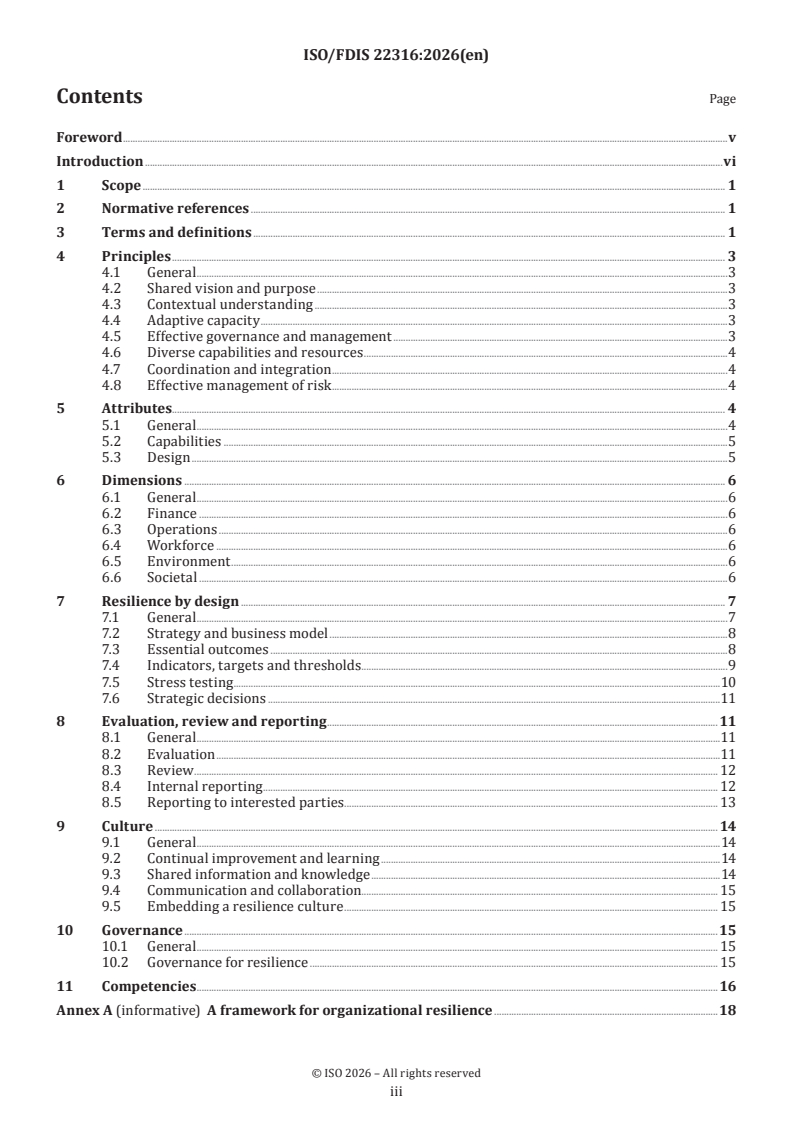

ISO/FDIS 22316 - Security and resilience — Organizational resilience — Guidelines
REDLINE ISO/FDIS 22316 - Security and resilience — Organizational resilience — Guidelines
ISO/FDIS 22316 is an ISO guideline for organizational resilience. It helps any size or type of organization anticipate, absorb and adapt to change by using principles, a measurement-based framework, design choices, governance and reporting practices. The document is not tied to one industry, and its guidance is meant to be tailored to the organization’s own context and objectives.
What does ISO/FDIS 22316 specify?
ISO/FDIS 22316 specifies guidance to enhance organizational resilience for any size or type of organization. It is written for broad use across sectors and throughout the life of an organization, rather than as a uniform model that every organization must follow.
ISO/FDIS 22316 is organized into clauses on scope, normative references, terms and definitions, principles, attributes, dimensions, resilience by design, evaluation/review/reporting, culture, governance, and competencies. The informative annexes support the clauses with a framework, a summary of recommendations, and example capabilities.
| Annex | What it covers |
|---|---|
| Annex A | A framework for organizational resilience, including examples of essential outcomes, indicators, targets, thresholds, and stress testing |
| Annex B | A clause-by-clause summary of the recommendations in the document |
| Annex C | Example capabilities for organizational resilience by dimension |
What are the key requirements of ISO/FDIS 22316?
ISO/FDIS 22316 centers on a strategic approach: organizations should define what resilience means for them, measure it, test it, review it, and assign clear accountability for it. In practice, that means resilience is treated as a management issue, not only as an emergency response issue.
Principles and attributes
Clause 4 says organizations should build resilience on shared vision and purpose, contextual understanding, adaptive capacity, effective governance and management, diverse capabilities and resources, coordination and integration, and effective management of risk. These principles matter because they connect resilience to leadership, strategy and day-to-day decisions.
Clause 5 adds two attributes - capabilities and design. The document treats capabilities as the ability to anticipate, absorb and adapt, and it treats design as the use of diversity, modularity, redundancy, flexibility and simplicity. In practice, an organization needs both competent people and well-designed systems.
A measurement-based framework
Clause 6 frames resilience across finance, operations, workforce, environment and societal dimensions. This matters because resilience weaknesses can appear in several places at once, not only in operations or IT.
Clause 7 requires top management to make resilience part of strategy and the business model, determine essential outcomes, define indicators, and set targets and thresholds. The organization should also check whether those thresholds can be maintained under stress. In practice, this turns resilience into something measurable and reviewable.
Clause 7.2 asks organizations to consider their wider system and society context, including interdependencies with interested parties. Clause 7.3 requires essential outcomes to be chosen from the organization’s purpose, context and the outcomes that matter most to interested parties, the sector and society. That means resilience planning should reflect what would actually cause serious harm if it failed.
Clause 7.4 requires measurable indicators with approved targets for normal conditions and thresholds for severe adverse conditions. Clause 7.5 requires regular stress testing to understand how and why thresholds may be breached, what actions would help, and what assumptions need checking. In practice, the organization should test more than one scenario and use the results to improve design and investments.
Clause 7.6 says strategic decisions should balance control, flexibility, efficiency and innovation, and should be reviewed when context changes. This matters because an over-focus on efficiency alone can create vulnerabilities.
Evaluation, review and reporting
Clause 8 requires processes to measure and monitor resilience, evaluate effectiveness for each essential outcome, and use the results for internal decision-making and transparent external reporting. This gives management evidence for deciding whether resilience is adequate and where investment is needed.
Clause 8.3 requires periodic top management review, including changes in context, major business model changes, new markets, new products, staff changes, improvement results and risks. Clause 8.5 encourages reporting to interested parties and says reporting should fit the organization’s size, sector and stakeholder expectations. In practice, this supports both internal control and external confidence.
Culture, governance and competencies
Clause 9 says resilience depends on culture, continual learning, shared information, collaboration and open communication. That matters because people need to raise concerns, share knowledge and learn from near-misses without hesitation.
Clause 10 assigns governance responsibilities: the governing body has accountability, while top management implements the direction, oversees resilience across dimensions, and ensures external reporting is approved. Clause 11 requires competencies for strategy alignment, determining essential outcomes, setting indicators and thresholds, conducting stress tests, reporting, making strategic decisions, and working across interested parties. In practice, resilience needs both authority and capability.
What terms does ISO/FDIS 22316 define?
- Capability - the ability to accomplish an undertaking with a defined intended outcome and within specified conditions.
- Essential outcome - a result or effect that is vital to the organization’s purpose, strategic objectives, interested parties, sector or wider society.
- Governing body - the person or group with ultimate accountability for the whole organization.
- Interested party (stakeholder) - a person or organization that can affect, be affected by, or perceive itself to be affected by a decision or activity.
- Organizational resilience - the ability of an organization to anticipate, absorb and adapt to change, enabling it to survive and prosper.
- Stress testing - techniques used to evaluate resilience under increasingly adverse conditions and to understand when and why a target or threshold is breached.
- Top management - the person or group that directs and controls an organization at the highest level.
Who uses ISO/FDIS 22316?
ISO/FDIS 22316 is used by organizations of any size and type that want a structured way to manage resilience. It is especially relevant to top management, governing bodies, risk leaders, business continuity teams, operations managers, finance teams, workforce and HR functions, sustainability teams, and reporting teams.
It is also useful where organizations need to explain resilience to interested parties such as customers, investors, regulators, lenders, employees and communities. The document explicitly addresses reporting needs in regulated sectors and refers to sectors such as financial services, energy, water and transport in its examples.
What changed in ISO/FDIS 22316 from the previous edition?
ISO/FDIS 22316 is the second edition and it replaces ISO 22316:2017. The foreword says the main changes are:
- new and updated recommendations for organizations to enhance resilience, with an annex containing recommendations by clause
- more concise principles and attributes for organizational resilience
- a measurement-based framework and a resilience by design approach
- new governance activities and competencies for organizational resilience
- a new sub-clause on reporting to interested parties
- new annexes, including illustrative examples for the measurement-based framework
Which standards are used with ISO/FDIS 22316?
ISO 22300 provides the vocabulary used for the terms and definitions in ISO/FDIS 22316. The document also points readers to related standards in governance, risk management, business continuity, environmental management, information security, occupational health and safety, and sustainability reporting, which help organizations connect resilience work with other management and reporting systems.
What does the ISO/FDIS 22316 document contain?
ISO/FDIS 22316 contains explanatory clauses, definitions, examples and implementation guidance rather than a single checklist. Its body explains principles, resilience capabilities, dimensions, design choices, stress testing, review, reporting, culture, governance and competencies.
Annex A provides the main framework figure, examples of essential outcomes, and a table of illustrative indicators, targets and thresholds. It is used to support design, measurement and stress testing.
Annex B summarizes the recommendations clause by clause, which makes it easier to map the document into internal procedures or training material. Annex C gives example capabilities for each resilience dimension, helping organizations translate the guidance into operational practice.
The document also includes figures and tables that support interpretation of the framework and its examples. These are intended to help organizations assess resilience, plan improvements and prepare internal or external reporting.
Relations
- Revises
ISO 22316:2017 - Security and resilience — Organizational resilience — Principles and attributes - Effective Date
- 04-Feb-2023
Buy Documents
ISO/FDIS 22316 - Security and resilience — Organizational resilience — Guidelines
REDLINE ISO/FDIS 22316 - Security and resilience — Organizational resilience — Guidelines
Get Certified
Connect with accredited certification bodies for this standard

BSI Group
BSI (British Standards Institution) is the business standards company that helps organizations make excellence a habit.

Bureau Veritas
Bureau Veritas is a world leader in laboratory testing, inspection and certification services.

DNV
DNV is an independent assurance and risk management provider.
Sponsored listings
Frequently Asked Questions
ISO/FDIS 22316 is a draft published by the International Organization for Standardization (ISO). Its full title is "Security and resilience — Organizational resilience — Guidelines". This standard covers: ISO 22316:2017 provides guidance to enhance organizational resilience for any size or type of organization. It is not specific to any industry or sector. ISO 22316:2017 can be applied throughout the life of an organization. ISO 22316:2017 does not promote uniformity in approach across all organizations, as specific objectives and initiatives are tailored to suit an individual organization's needs.
ISO 22316:2017 provides guidance to enhance organizational resilience for any size or type of organization. It is not specific to any industry or sector. ISO 22316:2017 can be applied throughout the life of an organization. ISO 22316:2017 does not promote uniformity in approach across all organizations, as specific objectives and initiatives are tailored to suit an individual organization's needs.
ISO/FDIS 22316 is classified under the following ICS (International Classification for Standards) categories: 03.100.01 - Company organization and management in general. The ICS classification helps identify the subject area and facilitates finding related standards.
ISO/FDIS 22316 has the following relationships with other standards: It is inter standard links to ISO 22316:2017. Understanding these relationships helps ensure you are using the most current and applicable version of the standard.
ISO/FDIS 22316 is available in PDF format for immediate download after purchase. The document can be added to your cart and obtained through the secure checkout process. Digital delivery ensures instant access to the complete standard document.
Standards Content (Sample)
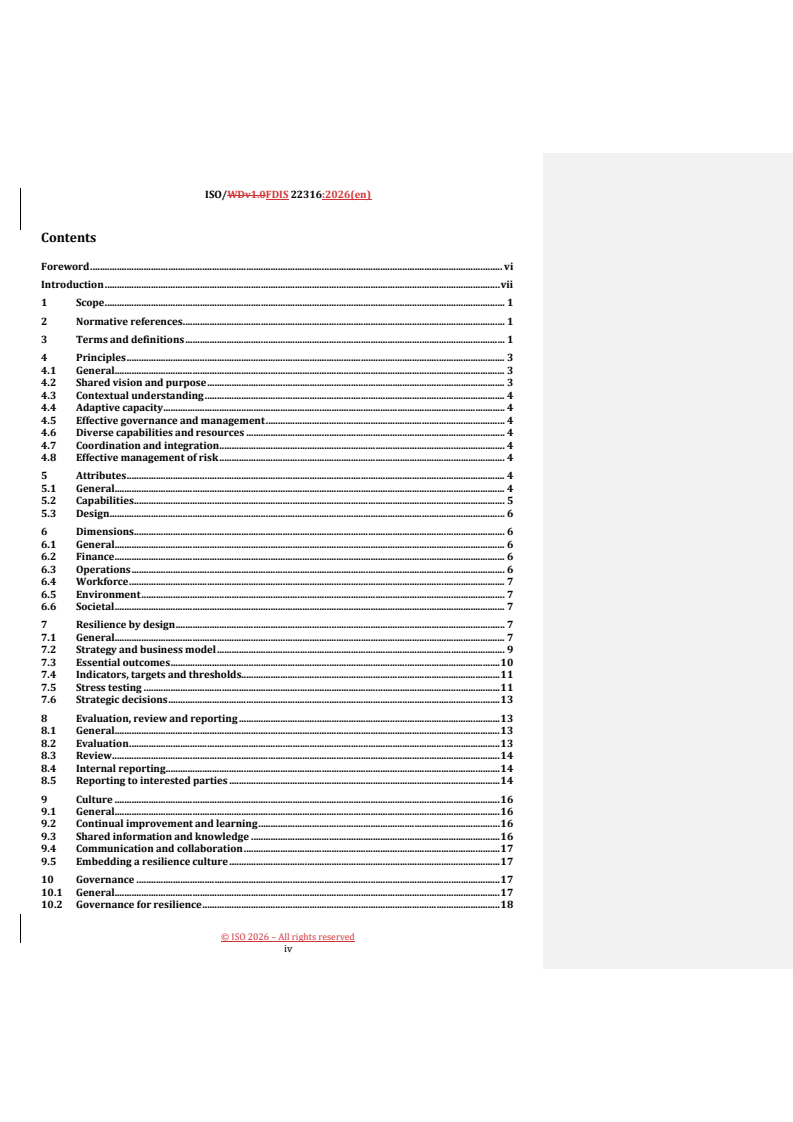
Contents
- Introduction
- 1 Scope
- 2 Normative references
- 3 Terms and definitions
- 3.1 capability
- 3.2 essential outcome
- 3.3 governing body
- 3.4 interested party
- 3.5 organization
- 3.6 organizational resilience
- 3.7 resilience
- 3.8 stress testing
- 3.9 top management
- 3.10 values
- 4 Principles
- 4.1 General
- 4.2 Shared vision and purpose
- 4.3 Contextual understanding
- 4.4 Adaptive capacity
- 4.5 Effective governance and management
- 4.6 Diverse capabilities and resources
- 4.7 Coordination and integration
- 4.8 Effective management of risk
- 5 Attributes
- 5.1 General
- 5.2 Capabilities
- 5.3 Design
- 6 Dimensions
- 6.1 General
- 6.2 Finance
- 6.3 Operations
- 6.4 Workforce
- 6.5 Environment
- 6.6 Societal
- 7 Resilience by design
- 7.1 General
- 7.2 Strategy and business model
- 7.3 Essential outcomes
- 7.4 Indicators, targets and thresholds
- 7.5 Stress testing
- 7.6 Strategic decisions
- 8 Evaluation, review and reporting
- 8.1 General
- 8.2 Evaluation
- 8.3 Review
- 8.4 Internal reporting
- 8.5 Reporting to interested parties
- 9 Culture
- 9.1 General
- 9.2 Continual improvement and learning
- 9.3 Shared information and knowledge
- 9.4 Communication and collaboration
- 9.5 Embedding a resilience culture
- 10 Governance
- 10.1 General
- 10.2 Governance for resilience
- 11 Competencies
- Annex A
- Annex B
- 4. Principles
- 4.1 General 1. The organization should apply the following principles that
- 5. Attributes
- 5.3 Design 8. The organization should apply a resilience by design approach
- 6. Dimensions
- 6.1 General 9. The organization should address resilience across different
- 11. Top management should assess whether there is sufficient
- 7. Resilience by design
- 7.1 General Top management 12. Top management should ensure the resilience of the
- 19. The organization should consider the impact if the outcome is
- 20. Where appropriate, essential outcomes should be both forward
- 22. Weaknesses that are identified should be addressed or further
- 24. Top management should approve the indicators, targets and
- 25. They [Thresholds] should be based on the understanding
- 26. Indicators, targets and thresholds should relate to the essential
- 29. The ability to remain within thresholds should be validated
- 33. The execution of stress tests should be specific to the
- 34. Stress tests should be conducted regularly to support continual
- 41. Top management should make strategic decisions that reflect
- 8. Evaluation, review and reporting
- 8.3 Review Periodic review 46. Top management should carry out a periodic review to ensure
Introduction
This document provides guidelines for organizations to enhance resilience using a strategic approach. An organization adjusts its level of resilience in accordance with its changing context. A more resilient organization can absorb the impacts of change and adapt in a timely manner. Change can be acute (shocks) or chronic (stresses).
Characteristics of a more resilient organization include:
- greater understanding of changes or potential changes to the context within which the organization operates and how these changes can impact it and its interested parties;
- more likely to anticipate change, address weaknesses and be able to meet the needs of interested parties during periods of shock or stress, uncertainty, or turbulence;
- the ability to adjust its level of resilience, and to modify and innovate products and services;
- a reputation for reliability, which creates confidence and trust in the organization;
- a culture of learning, with an ability to transform or regenerate the organization; and
- awareness that the resilience of the system or sector within which it operates is important to its own resilience and so seeks to enhance and influence the resilience of that sector or system. This document provides the core principles and attributes; a measurement-based framework; and top management responsibilities and governance activities for an organization’s resilience. It recommends organizations integrate resilience within strategy and business model considerations. The measurement-based framework, shown in Figure A.1, has five recommended dimensions, though organizations can choose different ones. Each dimension has outcomes and associated indicators, that are determined by the organization based on its context and strategic objectives. Desired levels of resilience are set using targets (for normal operating conditions) and thresholds (for severe adverse conditions). These can be expressed as a capability output or capacity level. Stress testing is used to assess whether the resilience level set is sufficient (i.e. targets and thresholds are not easily breached). Further details on this framework are provided in Annex A. The principles and attributes set out in Clauses 4 and 5 support the adoption of the framework.
A summary of recommendations contained in this document is provided in Annex B.
FINAL DRAFT International Standard ISO/FDIS 22316:2026(en) Security and resilience — Organizational resilience — Guidelines
1 Scope
This document provides guidelines to enhance organizational resilience for any size or type of organization.
2 Normative references
The following documents are referred to in the text in such a way that some or all of their content constitutes requirements of this document. For dated references, only the edition cited applies. For undated references, the latest edition of the referenced document (including any amendments) applies. ISO 22300, Security and resilience — Vocabulary
3 Terms and definitions
For the purposes of this document, the terms and definitions given in ISO 22300 and the following apply. ISO and IEC maintain terminology databases for use in standardization at the following addresses:
- ISO Online browsing platform: available at https:// www .iso .org/ obp
- IEC Electropedia: available at https:// www .electropedia .org/
3.1 capability
ability to accomplish an undertaking with a defined intended outcome and within specified conditions Note 1 to entry: Capability for organizational resilience (3.6) can be a combination of: (i) defensive capabilities (i.e. the ability of an organization (3.5) to manage and maintain assets (asset management), to respond quickly and effectively to events (e.g. incident management, crisis management capability) and to recover in a timely manner (e.g. business continuity capability); and (ii) progressive capabilities [i.e. the ability of the organization to innovate, recruit skills for the future and to adapt to changing conditions to meet the needs of all its interested parties (3.4)]. Note 2 to entry: Capabilities for organizational resilience are enabled by supporting capacities. (e.g. the level of environmental, physical, financial, societal or workforce resources). Note 3 to entry: Capacity refers to the quantity, volume or level of resources available, whereas capability refers to the ability to use those resources effectively to achieve defined outcomes.
3.2 essential outcome
desired result or effect of an action or event that is of vital importance to the achievement of the organization's (3.5) purpose and strategic objectives, to its interested parties (3.4), the sector within which it operates, or the wider society EXAMPLE 1 Essential outcomes relate to the products or services, or other outcomes such as financial returns, or achievement of climate net zero targets which are deemed of vital importance to interested parties. EXAMPLE 2 An essential outcome for the operational dimension can include the provision of a service, product or function to interested parties, which if unavailable would cause significant harm or detriment that cannot be easily remedied or can result in a wider failure within the market, system, sector or organization.
ISO/FDIS 22316:2026(en) EXAMPLE 3 An essential outcome for the financial dimension can include maintaining solvency and sufficient liquidity to absorb (or withstand) shocks or adverse events.
3.3 governing body
person or group of people who have ultimate accountability for the whole organization (3.5) Note 1 to entry: Every organizational entity has one governing body, whether or not it is explicitly established. When the organization is not an organizational entity, the term governing group is applicable where “governing body” is used throughout this document.
Note 2 to entry: A governing body can be explicitly established in a number of formats including, but not limited to, a board of directors, supervisory board, sole director, joint and several directors, or trustees. [SOURCE: ISO 37000:2021, 3.3.4, modified — Note 3 to entry was deleted.]
3.4 interested party
stakeholder person or organization (3.5) that can affect, be affected by, or perceive itself to be affected by a decision or activity EXAMPLE 1 Customers, owners, personnel, providers, bankers, insurers, regulators, unions, partners or society that can include competitors or opposing pressure groups.
EXAMPLE 2 Impacted communities and local populations are considered to be interested parties. [SOURCE: ISO 22300:2025, 3.3.11, modified — Examples were added.]
3.5 organization
person or group of people that has its own functions with responsibilities, authorities and relationships to achieve its objectives Note 1 to entry: The concept of organization includes, but is not limited to, sole-trader, company, corporation, firm, enterprise, authority, partnership, charity or institution, or part or combination thereof, whether incorporated or not, public or private.
Note 2 to entry: For management systems, if the organization is part of a larger entity, the term “organization” refers only to the part of the larger entity that is within the scope of the management system. [SOURCE: ISO 22300:2025, 3.3.19]
3.6 organizational resilience
ability of an organization (3.5) to anticipate, absorb and adapt to change, enabling it to survive and prosper Note 1 to entry: Organizational resilience requires consideration of finance, infrastructure and operations, workforce, environment and societal dimensions.
Note 2 to entry: Change includes shocks and stresses, adverse conditions and periods of uncertainty and turbulence.
3.7 resilience
ability to absorb and adapt in a changing environment [SOURCE: ISO 22300:2025, 3.1.59]
ISO/FDIS 22316:2026(en)
3.8 stress testing
techniques used to evaluate or examine resilience (3.7) under increasingly adverse conditions Note 1 to entry: Stress testing is an analytical process used to understand how, when, where and why a target and threshold set for an essential outcome (3.2) is breached. It examines the ability of the resilience capability (3.1) and supporting capacity to react or perform to a scenario, how that reaction or performance can be improved and to examine explicit and implicit assumptions.
3.9 top management
person or group of people who directs and controls an organization (3.5) at the highest level Note 1 to entry: Top management has the power to delegate authority and provide resources within the organization. Note 2 to entry: Top management has the accountability for the execution of the direction provided by the governing body and can delegate its responsibilities whilst remaining accountable to the governing body. [SOURCE: ISO 22300:2025, 3.3.33, modified — Note 2 to entry was replaced.]
3.10 values
beliefs an organization (3.5) adheres to and the standards that it seeks to observe
4 Principles
4.1 General
The organization should apply the following principles that provide the foundation to achieve enhanced resilience.
4.2 Shared vision and purpose
A shared vision, committed to and promoted by top management, provides clarity on the organization's purpose and direction. This fosters a culture that supports resilience-enhancing activities and guides decision-making. When people understand why the organization exists and what it stands for, they are more likely to stay committed and work together especially during times of change and uncertainty.
4.3 Contextual understanding
The understanding of the organization's internal and external context, including its interdependencies and the needs of its interested parties enhances an organizations resilience. This situational awareness, including knowledge of the past and consideration of the future, is critical for anticipating and preparing for potential changes in the operating environment.
4.4 Adaptive capacity
Adaptive capacity refers to the structural, cultural and strategic conditions that enable the organization to adapt to change. Organizations that cultivate the ability to anticipate, absorb, and adapt are able to adjust or transform strategies and processes. This includes fostering a culture of innovation and learning to embrace change. This adaptive capacity enables the organization to manage change with agility and learn from experience for continual improvement.
4.5 Effective governance and management
Resilience is underpinned by a governance framework that ensures clear accountability and empowers management to embed resilience policy and strategies into all activities. This structure enables timely and effective decision-making in response to stress or disruption.
ISO/FDIS 22316:2026(en) Effective governance for resilience includes accountability for the organization's resilience to its governing body and to external interested parties. This encompasses oversight of external resilience reporting and ensuring that the organization's approach to resilience contributes to the broader goals of sustainable development and societal resilience.
NOTE For more information on governance of organizations, see ISO 37000.
4.6 Diverse capabilities and resources
Diversity of skills, knowledge, leadership, and resources enhance problem-solving and innovation, enabling a more flexible and robust response to unforeseen challenges. The diverse nature and capabilities of its people, information sources, and technical elements enhances the organization’s resilience.
4.7 Coordination and integration
Resilience is enhanced through the coordination and integration of various management systems and disciplines. This holistic approach breaks down silos and leverages specialized expertise to manage the organization as a complete system.
4.8 Effective management of risk
Effective management of risk to identify and treat vulnerabilities underpins resilience. Proactively understanding and addressing risks and opportunities is fundamental to building and maintaining the resilience of the organization. This involves scenario planning, stress testing, and maintaining situational awareness to anticipate potential threats.
NOTE For more information on risk management, see ISO 31000.
5 Attributes
5.1 General
An organization that adopts the principles of resilience demonstrates the following attributes:
- capabilities: the supporting capacities which are embedded in the measurement-based framework for organizational resilience; and
- design: important considerations for resilience by design of essential outcomes. The application of these attributes supports the measurement-based framework for organizational resilience and helps to ensure that the organization is able to anticipate change and to adapt accordingly, whilst absorbing and mitigating all or some of the impact of change. Application of these attributes are fundamental to be a more resilient organization. They also support operational excellence, creating reliable and efficient systems that can withstand stress and disruption. In overarching terms, these attributes create systems that address vulnerabilities, whilst balancing risk, performance, and cost, to ensure that they can withstand significant impacts without damage or loss of function and over-reliance on a single asset where cascading failure and design limitations can lead to catastrophic collapse.
When applying these attributes, the organization should:
- ensure that resilience investments and activities acknowledge the trade-offs, which should be carefully considered and transparent to all, and are approved under governance. They should address the needs of all interested parties and create a sense of shared ownership and a joint vision for the resilience strategy;
- use past experience and lessons learned to inform future decisions allowing its workforce to think beyond its current activities, strategy, organizational boundaries, and to build knowledge capital;
ISO/FDIS 22316:2026(en) - foster creativity by seeking out and promoting new and innovative ideas to achieve its essential outcomes under changing circumstances. This includes recognizing alternative ways to use resources and meet their goals.
These attributes are supported by the organization’s culture and governance activities which oversees their utilization, evaluation and enhancement.
5.2 Capabilities
The organization should have the following capabilities.
- Anticipate: incorporates the ability to identify and assess potential changes in the context of the organization in a timely manner. The organization should have mature horizon scanning, foresight, forecasting, risk intelligence and impact assessment capabilities.
- Absorb: incorporates the ability to withstand, respond and recover from shocks and stresses. Shocks can be the result of longer-term stresses, for example, climate change can cause more frequent severe flooding or wildfires. The measurement-based framework for organizational resilience is designed to help ensure sufficient capabilities and supporting capacities are in place within each dimension, based on what is most important to them and their interested parties. The organization should ensure essential outcomes are determined, indicators are established and corresponding targets and thresholds are set for each essential outcome. These should be subject to regular stress testing (see 7.5).
- Adapt: incorporates the ability to reconfigure and realign the organization’s resources, processes, products and services, or change its business model to changing conditions and capitalise on new opportunities in a timely manner. The organization should consider resilience within strategy and business model design, taking account of the context of the organization particularly in respect of chronic stresses. This includes the ability to be agile, and to adjust at the time of change or disruption. The organization should learn from past event and near-misses, whether experienced internally or by others—and use these lessons to strengthen their resilience. This capability is enabled by the organization’s adaptive capacity (see 4.4).
5.3 Design
The organization should apply a resilience by design approach by using the following. - Diversity: the production of its essential outcomes through a diverse range of elements (e.g. people, resources, customers, suppliers, products, sources of funding and geographically, physically and logically separated assets) to achieve its essential outcomes. This can help organizations absorb shocks and stresses because the different elements are sensitive to disturbances to different extents. It reduces the risk of complete failure due to a single event.
- Modularity: creating and maintaining assets and resources in a decoupled, disconnected or decentralized manner which allows for elements to fail without the entire organization collapsing. This allows for rapid, independent, responses to shocks and stresses and thereby faster recovery.
- Redundancy: substitutability and the provision of spare capacity to absorb shocks and respond to stresses. This can include multiple means of performing the same function, employees who can perform the same role, spare resources, reserve stocks or liquidity, unused capacity. It provides the ability to recover more quickly.
- Flexibility: the capabilities and supporting capacities, resourcefulness and ability to adjust, rapidly adapt or recombine resources in a timely manner. This supports the ability to create alternative solutions and provide an agile and effective response to chronic stresses and recovery from shocks.
- Simplicity: avoid unnecessarily complex systems where potential latent failures can be observed and active failures prevented from transmitting through the system in ways that are unforeseen and hard to predict.
ISO/FDIS 22316:2026(en)
6 Dimensions
6.1 General
The organization should address resilience across different dimensions (sometimes referred to as capitals). These include the following, though they can be adapted for the organization.
6.2 Finance
Addresses the ability of an organization to absorb financial losses, access liquidity and maintain capital in stressed conditions. It also addresses funding or investment in resilience such as maintaining higher resource levels and improving redundancy across all dimensions, or redirecting investment to different or new products and services which do no rely on the same market conditions. It can also include funding for buying another organization in order to enhance resilience (e.g. to provide security of supply, to provide additional products and services) or sell off parts of the organization to restore or enhance liquidity or capital.
6.3 Operations
Addresses the ability of an organization to adapt its operational model to changes in its context, and to absorb operational impacts during adverse events. This can include different or new product and services addressing changes to competitors and customer requirements. The operational model includes supply chain, vital assets and infrastructure, including information and digital infrastructure as well as any dependencies on the sector(s) in which it operates and the wider society which it supplies.
6.4 Workforce
Addresses the ability of the organization’s workforce to adapt to times of change and to be able to respond appropriately during times of uncertainty. This includes the requisite knowledge, skills, behaviours, and values necessary for the workforce. It also addresses the health, safety, well-being and engagement of its workforce. The resilience of the organization’s workforce can be affected by the organization’s culture.
...
Contents
- Introduction
- 1 Scope
- 2 Normative references
- 3 Terms and definitions
- 3.6 organizational resilience
- 3.8 stress testing
- 4 Principles
- 4.1 General
- 4.2 Shared vision and purpose
- 4.3 Contextual understanding
- 4.4 Adaptive capacity
- 4.5 Effective governance and management
- 4.6 Diverse capabilities and resources
- 4.7 Coordination and integration
- 4.8 Effective management of risk
- 5 Attributes
- 5.1 General
- 5.2 Capabilities
- 5.3 Design
- 6 Dimensions
- 6.1 General
- 6.2 Finance
- 6.3 Operations
- 6.4 Workforce
- 6.5 Environment
- 6.6 Societal
- 7 Resilience by design
- 7.1 General
- 7.2 Strategy and business model
- 7.3 Essential outcomes
- 7.4 Indicators, targets and thresholds
- 7.5 Stress testing
- 7.6 Strategic decisions
- 8 Evaluation, review and reporting
- 8.1 General
- 8.2 Evaluation
- 8.3 Review
- 8.4 Internal reporting
- 8.5 Reporting to interested parties
- 9 Culture
- 9.1 General
- 9.2 Continual improvement and learning
- 9.3 Shared information and knowledge
- 9.4 Communication and collaboration
- 9.5 Embedding a resilience culture
- 10 Governance
- 10.1 General
- 10.2 Governance for resilience
- 11 Competencies
- Annex A
- Annex B
- 4. Principles
- 4.14.1 principles that provide the foundation to achieve enhanced
- 4.2 4.2 to
- 4.84.8 — Adaptive capcity
- 5. Attributes
- 5.15.1 Gener
- 6. Dimensions
- 6.16.1 Gener across different dimensions (sometimes referred to as
- 6.2 Operations
- 6.66.6 stressed conditions. It also addresses funding or investment in
- 8. Evaluation, review and reporting
- 8.4 Intern
- 8.58.5 Deleted Cells
- 9. Culture
- 10. Governance
- 0.2 Gover
- 11. Competencies for organizational resilience
- Annex C
- Bibliography
Introduction
This document provides guidelines for organizations to enhance resilience using a strategic approach. An organization adjusts its level of resilience in accordance with its changing context. A more resilient organization can absorb the impacts of, change and adapt in a timely manner. Change can be acute (shocks) or chronic (stresses).
Characteristics of a more resilient organization includesinclude:
- — greater understanding of changes or potential changes to the context within which the organization operates and how these changes can impact it and its interested parties;
- — more likely to anticipate change, address weaknesses and be able to meet the needs of interested parties during periods of shock or stress, uncertainty, or turbulence;
- — the ability to adjust its level of resilience, and to modify and innovate products and services;
- — a reputation for reliability, which creates confidence and trust in the organization;
- — a culture of learning, with an ability to transform or regenerate the organization; and
- — recognizesawareness that the resilience of the system or sector within which it operates is important to its own resilience and so seeks to enhance and influence the resilience of that sector or system. This document provides the core principles and attributes; a measurement-based framework; and top management responsibilities and governance activities for an organization’s resilience. It recommends organizations integrate resilience within strategy and business model considerations. The measurement-based framework, shown in Figure A.1 Figure 1 below,, has five recommended dimensions, though organizations can choose different ones. Each dimension has outcomes and associated indicators, that are determined by the organization based on its context and strategic objectives. Desired levels of resilience are set using targets (for normal operating conditions) and thresholds (for severe adverse conditions). These can be expressed as a capability output or capacity level. Stress testing is used to assess whether the resilience level set is sufficient (i.e. targets and thresholds are not easily breached).
ISO/WDv1.0FDIS 22316:2026(en)
Figure 1 — A measurement-based framework for organizational resilience Further details on this framework are provided in Annex AAnnex A.. The principles and attributes set out in 4Clauses 4 and 55 support the adoption of the framework.
A summary of recommendations contained in this document is provided in Annex BAnnex B..
Final DRAFT International Standard ISO/FDIS 22316:2026(en)
Security and resilience — Organizational resilience — Guidelines
1 Scope
This document provides guidanceguidelines to enhance organizational resilience for any size or type of organization.
2 Normative references
The following documents are referred to in the text in such a way that some or all of their content constitutes requirements of this document. For dated references, only the edition cited applies. For undated references, the latest edition of the referenced document (including any amendments) applies. ISO 22300, Security and resilience — Vocabulary
3 Terms and definitions
For the purposes of this document, the terms and definitions given in ISO 22300 and the following apply. ISO and IEC maintain terminologicalterminology databases for use in standardization at the following addresses:
- — ISO Online browsing platform: available at https://www.iso.org/obp - — IEC Electropedia: available at https://www.electropedia.org/ 3.1 3.1 capability ability to accomplish an undertaking with a defined intended outcome and within specified conditions Note 1 to entry: capability Capability for organizational resilience (3.6) can be a combination of: (i) defensive capabilities (i.e. the ability of an organization (3.5) to manage and maintain assets (asset management), to respond quickly and effectively to events (e.g. incident management, crisis management capability) and to recover in a timely manner (e.g. business continuity capability); and (ii) progressive capabilities ([i.e. the ability of the organization to innovate, recruit skills for the future and to adapt to changing conditions to meet the needs of all its interested parties (3.4).)]. Note 2 to entry: capabilities Capabilities for organizational resilience are enabled by supporting capacities. (e.g. the level of environmental, physical, financial, societal or workforce resources.)). Note 3 to entry: capacity Capacity refers to the quantity, volume or level of resources available, whereas capability refers to the ability to use those resources effectively to achieve defined outcomes. 3.2 3.2 essential outcome Desireddesired result or effect of an action or event that is of vital importance to the achievement of the organization's (3.5organization’s) purpose and strategic objectives, to its interested parties (3.4,), the sector within which it operates, or the wider society EXAMPLE 1: essential Essential outcomes relate to the products or services, or other outcomes such as financial returns, or achievement of climate net zero targets which are deemed of vital importance to interested parties.
ISO/WDv1.0FDIS 22316:2026(en) EXAMPLE 2: an An essential outcome for the operational dimension can include the provision of a service, product or function to interested parties, which if unavailable would cause significant harm or detrim entdetriment that cannot be easily remedied or can result in a wider failure within the market, system, sector or organization. EXAMPLE 3: an An essential outcome for the financial dimension can include maintaining solvency and sufficient liquidity to absorb (or withstand) shocks or adverse events.
3.3 3.3 governing body person or group of people who have ultimate accountability for the whole organization (3.5(3.5) ) Note 1 to entry: every Every organizational entity has one governing body, whether or not it is explicitly established. When the organization is not an organizational entity, the term governing group is applicable where “governing body” is used throughout this document.
Note 2 to entry: a A governing body can be explicitly established in a number of formats including, but not limited to, a board of directors, supervisory board, sole director, joint and several directors, or trustees. [SOURCE: ISO 22300:2025 –37000:2021, 3.3.4, modified, — Note 3 to entry was deleted].] 3.4 3.4 interested party stakeholder person or organization (3.5) that can affect, be affected by, or perceive itself to be affected by a decision or activity Note 1 to entry: customersEXAMPLE 1 Customers, owners, personnel, providers, bankers, insurers, regulators, unions, partners or society that can include competitors or opposing pressure groups. Note EXAMPLE 2 to entry: impacted Impacted communities and local populations are considered to be interested parties.
Note 3 to entry: this constitutes one of the common terms and core definitions of the high level structure for ISO management system standards. The original definition has been modified by adding the notes to entry. [SOURCE: ISO 22300:2025, 3.13.11 –, modified, new Notes — Examples were added].] 3.5 3.5 organization person or group of people that has its own functions with responsibilities, authorities and relationships to achieve its objectives Note 1 to entry: the The concept of organization includes, but is not limited to, sole-trader, company, corporation, firm, enterprise, authority, partnership, charity or institution, or part or combination thereof, whether incorporated or not, public or private.
Note 2 to entry: for For management systems, if the organization is part of a larger entity, the term “organization” refers only to the part of the larger entity that is within the scope of the management system. [SOURCE: ISO 22300:2025] , 3.63.19]
3.6 organizational resilience
ability of an organization (3.5) to anticipate, absorb and adapt to change, enabling it to survive and prosper
ISO/FDIS 22316:2026(en) Note 1 to entry: organizational Organizational resilience requires consideration of finance, infrastructure and operations, workforce, environment and societal dimensions.
Note 2 to entry: change Change includes shocks and stresses, adverse conditions and periods of uncertainty and turbulence.
[SOURCE: ISO 22300:2025 definition modified by adding “to anticipate” and replacing “in a changing environment” with “to change, enabling it to survive and prosper”. 2 Notes added.] [SOURCE: ISO 22300:2025, 3.1.59, modified — note 1 to entry added.] 3.7 3.7 resilience ability to absorb and adapt in a changing environment [SOURCE: ISO 22300:2025] , 3.81.59]
3.8 stress testing
techniques used to evaluate or examine resilience (0) under increasingly adverse conditions Note 1 to entry: stress Stress testing is an analytical process used to understand how, when, where and why a target and threshold set for an essential outcome (3.2) is breached. It examines the ability of the resilience capability (3.1) and supporting capacity to react or perform to a scenario, how that reaction or performance can be improved and to examine explicit and implicit assumptions.
3.9 3.9 top management person or group of people who directs and controls an organization (3.5) at the highest level Note 1 to entry: Top management has the power to delegate authority and provide resources within the organization. Note 2 to entry: Top management has the accountability for the execution of the direction provided by the governing body and can delegate its responsibilities whilst remaining accountable to the governing body. [SOURCE: ISO 22300:2025, note3.3.33, modified — Note 2 to entry was replaced].] 3.10 3.10 values beliefs an organization (3.5) adheres to and the standards that it seeks to observe
4 Principles
4.1 General
The organization should apply the following principles that provide the foundation to achieve enhanced resilience:
4.2 Shared vision and purpose
A shared vision, committed to and promoted by top management, provides clarity on the organization's purpose and direction. This fosters a culture that supports resilience-enhancing activities and guides decisionmaking. When people understand why the organization exists and what it stands for, they are more likely to stay committed and work together especially during times of change and uncertainty.
ISO/WDv1.0FDIS 22316:2026(en)
4.3 Contextual understanding
The understanding of the organization's internal and external context, including its interdependencies and the needs of its interestinterested parties enhances an organizations resilience. This situational awareness, including knowledge of the past and consideration of the future, is critical for anticipating and preparing for potential changes in the operating environment.
4.4 Adaptive capacity
Adaptive capacity refers to the structural, cultural and strategic conditions that enable the organization to adapt to change. Organizations that cultivate the ability to anticipate, absorb, and adapt are able to adjust or transform strategies and processes. This includes fostering a culture of innovation and learning to embrace change. This adaptive capacity enables the organization to manage change with agility and learn from experience for continual improvement.
4.5 Effective governance and management
Resilience is underpinned by a governance framework that ensures clear accountability and empowers management to embed resilience policy and strategies into all activities. This structure enables timely and effective decision-making in response to stress or disruption. Effective governance for resilience includes accountability for the organisation'sorganization's resilience to its governing body and to external interested parties. This encompasses oversight of external resilience reporting and ensuring that the organisation'sorganization's approach to resilience contributes to the broader goals of sustainable development and societal resilience.
[Note: forNOTE For more information on governance of organizations, see ISO 37000].
4.6 Diverse capabilities and resources
Diversity of skills, knowledge, leadership, and resources enhance problem-solving and innovation, enabling a more flexible and robust response to unforeseen challenges. The diverse nature and capabilities of its people, information sources, and technical elements enhances the organization’s resilience.
4.7 Coordination and integration
Resilience is enhanced through the coordination and integration of various management systems and disciplines. This holistic approach breaks down silos and leverages specialized expertise to manage the organization as a complete system.
4.8 Effective management of risk
Effective management of risk to identify and treat vulnerabilities underpins resilience. Proactively understanding and addressing risks and opportunities is fundamental to building and maintaining the resilience of the organization. This involves scenario planning, stress testing, and maintaining situational awareness to anticipate potential threats.
[Note: forNOTE For more information on risk management, see ISO 31000].
5 Attributes
5.1 General
An organization that adopts the principles of resilience demonstratedemonstrates the following attributes:
ISO/FDIS 22316:2026(en) - — capabilities: the supporting capacities which are embedded in the measurement-based framework for organizational resilience; and - — design: important considerations for resilience by design of essential outcomes. The application of these attributes supports the measurement-based framework for organizational resilience and helps to ensure that the organization is able to anticipate change and to adapt accordingly, whilst absorbing and mitigating all or some of the impact of change.
Application of these attributes are fundamental to be a more resilient organization. They also support operational excellence, creating reliable and efficient systems that can withstand stress and disruption. In overarching terms, these attributes create systems that address vulnerabilities, whilst balancing risk, performance, and cost, to ensure that they can withstand significant impacts without damage or loss of function and over-reliance on a single asset where cascading failure and design limitations can lead to catastrophic collapse.
When applying these attributes, the organization should:
- — ensure that resilience investments and activities acknowledge the trade-offs, which should be carefully considered and transparent to all, and are approved under governance. They should address the needs of all interested parties and create a sense of shared ownership and a joint vision for the resilience strategy.;
- — use past experience and lessons learned to inform future decisions allowing its workforce to think beyond its current activities, strategy, organizational boundaries, and to build knowledge capital.;
- — foster creativity by seeking out and promoting new and innovative ideas to achieve its essential outcomes under changing circumstances. This includes recognizing alternative ways to use resources and meet their goals.
These attributes are supported by the organization’s culture and governance activities which oversees their utilization, evaluation and enhancement.
5.2 Capabilities
The organization should have the following capabilities:.
- — Anticipate: incorporates the ability to identify and assess potential changes in the context of the organization in a timely manner. The organization should have mature horizon scanning, foresight, forecasting, risk intelligence and impact assessment capabilities.
- — Absorb: incorporates the ability to withstand, respond and recover from shocks and stresses. Shocks can be the result of longer-term stresses, for example, climate change can cause more frequent severe flooding or wildfires. The measurement-based framework for organizational resilience is designed to help ensure sufficient capabilities and supporting capacities are in place within each dimension, based on what is most important to them and their interested parties. The organization should ensure essential outcomes are determined, indicators are established and corresponding targets and thresholds are set for each essential outcome. These should be subject to regular stress testing (see 7.5[7.5].).
- — Adapt: incorporates the ability to reconfigure and realign the organisation’sorganization’s resources, processes, products and services, or change its business model to changing conditions and capitalise on new opportunities in a timely manner. The organization should consider resilience within strategy and business model design, taking account of the context of the organization particularly in respect of chronic stresses. This includes the ability to be agile, and to adjust at the time of change or disruption. The organization should learn from past event and near-misses, whether experienced internally or by others—
ISO/WDv1.0FDIS 22316:2026(en) and use these lessons to strengthen their resilience. This capability is enabled by the organization’s adaptive capacity (see 4.4[4.4].).
5.3 Design
The organization should apply a resilience by design approach by using: the following. - — Diversity: the production of its essential outcomes through a diverse range of elements (e.g. people, resources, customers, suppliers, products, sources of funding and geographically, physically and logically separated assets) to achieve its essential outcomes. This can help organizations absorb shocks and stresses because the different elements are sensitive to disturbances to different extents. It reduces the risk of complete failure due to a single event.
- — Modularity: creating and maintaining assets and resources in a decoupled, disconnected or decentralized manner which allows for elements to fail without the entire organization collapsing. This allows for rapid, independent, responses to shocks and stresses and thereby faster recovery.
- — Redundancy: substitutability and the provision of spare capacity to absorb shocks and respond to stresses. This can include multiple means of performing the same function, employees who can perform the same role, spare resources, reserve stocks or liquidity, unused capacity. It provides the ability to recover more quickly.
- — Flexibility: the capabilities and supporting capacities, resourcefulness and ability to adjust, rapidly adapt or recombine resources in a timely manner. This supports the ability to create alternative solutions and provide an agile and effective response to chronic stresses and recovery from shocks.
- — Simplicity: avoid unnecessarily complex systems where potential latent failures can be observed and active failures prevented from transmitting through the system in ways that are unforeseen and hard to predict.
6 Dimensions
6.1 General
The organization should address resilience across different dimensions (sometimes referred to as capitals). These include the following, though they can be adapted for the organization:.
6.2 Finance
Addresses the ability of an organization to absorb financial losses, access liquidity and maintain capital in stressed conditions. It also addresses funding or investment in resilience such as maintaining higher resource levels and improving redundancy across all dimensions, or redirecting investment to different or new products and services which do no rely on the same market conditions. It can also include funding for buying another organization in order to enhance resilience (e.g. to provide security of supply, to provide additional products and services) or sell off parts of the organization to restore or enhance liquidity or capital.
...