

ISO 22354:2026
(Main)Security and resilience — Societal resilience — Guidelines to develop local resilience capability
- Abstract
This document provides guidelines on how to implement an eight-stage process to enhance resilience to disruptions arising from emergencies, disasters or crises. It describes how a local resilience partnership can work with members of the public, civil society and business sectors to address needs in society that have been created by a disruption. The process describes how the local resilience partnership can create a local resilience capability that encourages self-help and helping others, while focusing on the needs of priority groups. This document describes: how the local resilience partnership can co-design and create a capability to enhance resilience to disruption; partnerships and establishing a shared vision to enhance societal resilience; risks, vulnerabilities, needs, and community assets; implementation and management of capability; evaluation and continual improvement. This document takes a whole-of-society approach to enhancing resilience by adopting principles and developing systems to support societal networks, organizations (from private, public, and voluntary sectors), community groups, and individuals. This document is applicable to any organization or group involved in enhancing the resilience of society to disruption.
- Status
- Published
- Publication Date
- 09-Jul-2026
- Technical Committee
- ISO/TC 292 - Security and resilience
- Drafting Committee
- ISO/TC 292 - Security and resilience
- Current Stage
- 6060 - International Standard published
- Start Date
- 10-Jul-2026
- Due Date
- 17-Jul-2027
- Completion Date
- 10-Jul-2026

ISO 22354:2026 is an International Standard published by ISO that gives guidelines for developing local resilience capability. It describes an eight-stage process for a local resilience partnership to work with the public, civil society, and business sectors to improve resilience to disruption from emergencies, disasters, or crises. The document is for any organization or group that helps society prepare for, respond to, and recover from disruption.
What does ISO 22354:2026 specify?
ISO 22354:2026 specifies a framework and process for building a local resilience capability that supports priority groups and encourages self-help and helping others. The scope centers on societal resilience from a whole-of-society point of view, so the document is about how to organize people, partnerships, and modules of support rather than about a single emergency service or sector.
The document is organized into:
- Clause 1: Scope
- Clause 2: Normative references
- Clause 3: Terms and definitions
- Clause 4: Framework for a local resilience capability
- Clause 5: Process to create local resilience capability
- Clauses 6 to 9: Planning, designing, implementing, and improving the design
- Annex A: Informative case study
| Annex | What it covers |
|---|---|
| Annex A | A generic case study that applies the 8 steps to create local resilience capability, including example modules, roles, collaboration, baseline review, and self-assessment |
The scope keeps the focus on the process, the partnership, and the system for support. It does not set out specific modules in detail, specific technologies, or a way to measure resilience.
What are the key requirements of ISO 22354:2026?
ISO 22354:2026 is a guidelines document, so its substance is expressed as a structured approach rather than a compliance checklist. The main message is that a local resilience partnership should build a capability in stages, keep it focused on priority groups, and improve it through use and feedback.
Build the framework first
Clause 4 sets out the framework for a local resilience capability: its aims, objectives, principles, opportunities, risks, and resources required. In practice, this means the partnership should decide what the capability is for, who it is meant to support, what local risks and vulnerabilities matter, and what resources it can realistically use.
Clause 4 says the capability should support society to improve its own resilience, reduce risk and vulnerability, and unite the parts of the system that work with priority groups. That matters because the work is not only about emergency response - it is also about preparedness, access to support, and long-term resilience.
Follow the eight-stage process
Clause 5 describes the eight-stage process, and Clauses 6 to 9 give the detail:
- Step 1: Agree on a shared vision
- Step 2: Establish the team
- Step 3: Agree the strategy and business case
- Step 4: Co-design modules
- Step 5: Develop collaborations
- Step 6: Manage modules
- Step 7: Deliver benefits to society
- Step 8: Assess feedback and continually improve
This matters in practice because the document treats local resilience capability as an ongoing system, not a one-time project.
Use planning and design to make the work workable
Clause 6 asks the partnership to align people around a shared vision for societal resilience. Clause 7 then asks it to build the team, review current activity, define a strategy and business case, and co-design modules that fit local needs.
The practical point is that the partnership should not start with a generic package. It should work from current performance, available investment, local priorities, and the needs of the people and places it wants to support.
Co-design modules around local needs
Clause 7.4 asks for modules that reflect the local community, local risks, opportunities, and available support. The module design should record the vision, aims, objectives, principles, risks, opportunities, and resources for each module.
That means the document expects the partnership to translate the broad vision into workable activities that can be activated when needed.
Manage collaborations and modules
Clause 8 emphasizes effective collaborations, simple management, governance, intelligence gathering, two-way communication, and support delivery. The partnership should develop collaborations that help at least one priority group, monitor whether they work, and replace collaborations that are not effective.
In practice, this means the capability should connect local government, voluntary bodies, businesses, community groups, and other resilience partners in ways that can actually deliver support before, during, and after disruption.
Activate, balance, and improve
Clause 8.4 focuses on activation protocols, balancing demand and supply, and using emerging technologies for timely data. Clause 9 then requires structured feedback, surveys, focus groups, performance metrics, and peer review to improve readiness and external impact.
The practical meaning is that the partnership should know when to activate modules, how to close them down, and how to learn from use so the capability becomes more effective over time.
What terms does ISO 22354:2026 define?
- Local resilience capability - a system for enhancing resilience to disruption by delivering support to people and places.
- Capability - a demonstrable ability to prepare for, respond to, and recover from a disruption.
- Societal resilience - the collective capability of individuals, groups, businesses, and networks to anticipate, absorb, and adapt during disruption.
- System - a set of interrelated and interacting elements.
- Resilience partner - a collaborating entity that provides services to the community to help it absorb and adapt in a changing environment.
- Local resilience partnership - a multi-organizational group of resilience partners that serves a geographic area.
- Priority group - a part of society that the local resilience capability aims to support during disruption.
- Disruption - an anticipated or unanticipated event that interrupts normal functions, operations, or processes.
Who uses ISO 22354:2026?
ISO 22354:2026 is used by local resilience partnerships, local government, emergency services, voluntary and community organizations, businesses, and other resilience partners. It is also relevant to strategic champions, tactical leads, community engagement teams, public health functions, utilities, and organizations that connect with priority groups.
They use it to:
- build a shared vision for societal resilience
- identify risks, vulnerabilities, needs, and community assets
- co-design and manage modules such as community support, volunteering, and essential services
- coordinate intelligence and two-way communication
- plan activation, close-down, review, and improvement
Which standards are used with ISO 22354:2026?
ISO 22354:2026 has one normative reference:
- ISO 22300 - provides the vocabulary used for security and resilience terms
The document also points to related standards and guidance in its text and bibliography:
- ISO 22395 - supporting vulnerable persons in an emergency
- ISO 22319 - planning the involvement of spontaneous volunteers
- ISO 22315 - mass evacuation planning
- ISO 22320 - incident management
- ISO 22322 - public warning
- ISO 22324 - colour-coded alert
- ISO 22361 - crisis management
- ISO 22371 - urban resilience
- ISO 22392 - peer reviews
- ISO 22393:2023 - planning recovery and renewal
- ISO 22396 - information exchange between organizations
- ISO 22397 - partnering arrangements
- ISO 22398 - exercises
- ISO 9000:2026 - the source of the definition of system used in the document
- ISO 31000 and IEC 31010 - risk management and risk assessment techniques
What does the ISO 22354:2026 document contain?
ISO 22354:2026 contains a framework, an eight-step process, and an informative case study. It explains how to move from vision-setting to design, implementation, and continual improvement, and it repeatedly links those steps to local partnerships and priority groups.
Annex A turns the guidance into a generic example with tables for modules, roles, collaboration types, needs, and module topics. It also includes a self-assessment figure for judging performance across the eight steps.
Get Certified
Connect with accredited certification bodies for this standard

BSI Group
BSI (British Standards Institution) is the business standards company that helps organizations make excellence a habit.

Bureau Veritas
Bureau Veritas is a world leader in laboratory testing, inspection and certification services.

DNV
DNV is an independent assurance and risk management provider.
Sponsored listings
Frequently Asked Questions
ISO 22354:2026 is a standard published by the International Organization for Standardization (ISO). Its full title is "Security and resilience — Societal resilience — Guidelines to develop local resilience capability". This standard covers: This document provides guidelines on how to implement an eight-stage process to enhance resilience to disruptions arising from emergencies, disasters or crises. It describes how a local resilience partnership can work with members of the public, civil society and business sectors to address needs in society that have been created by a disruption. The process describes how the local resilience partnership can create a local resilience capability that encourages self-help and helping others, while focusing on the needs of priority groups. This document describes: how the local resilience partnership can co-design and create a capability to enhance resilience to disruption; partnerships and establishing a shared vision to enhance societal resilience; risks, vulnerabilities, needs, and community assets; implementation and management of capability; evaluation and continual improvement. This document takes a whole-of-society approach to enhancing resilience by adopting principles and developing systems to support societal networks, organizations (from private, public, and voluntary sectors), community groups, and individuals. This document is applicable to any organization or group involved in enhancing the resilience of society to disruption.
This document provides guidelines on how to implement an eight-stage process to enhance resilience to disruptions arising from emergencies, disasters or crises. It describes how a local resilience partnership can work with members of the public, civil society and business sectors to address needs in society that have been created by a disruption. The process describes how the local resilience partnership can create a local resilience capability that encourages self-help and helping others, while focusing on the needs of priority groups. This document describes: how the local resilience partnership can co-design and create a capability to enhance resilience to disruption; partnerships and establishing a shared vision to enhance societal resilience; risks, vulnerabilities, needs, and community assets; implementation and management of capability; evaluation and continual improvement. This document takes a whole-of-society approach to enhancing resilience by adopting principles and developing systems to support societal networks, organizations (from private, public, and voluntary sectors), community groups, and individuals. This document is applicable to any organization or group involved in enhancing the resilience of society to disruption.
ISO 22354:2026 is classified under the following ICS (International Classification for Standards) categories: 03.100.01 - Company organization and management in general; 13.200 - Accident and disaster control. The ICS classification helps identify the subject area and facilitates finding related standards.
ISO 22354:2026 is available in PDF format for immediate download after purchase. The document can be added to your cart and obtained through the secure checkout process. Digital delivery ensures instant access to the complete standard document.
Standards Content (Sample)
International
Standard
ISO 22354
First edition
Security and resilience — Societal
2026-07
resilience — Guidelines to develop
local resilience capability
Reference number
© ISO 2026
All rights reserved. Unless otherwise specified, or required in the context of its implementation, no part of this publication may
be reproduced or utilized otherwise in any form or by any means, electronic or mechanical, including photocopying, or posting on
the internet or an intranet, without prior written permission. Permission can be requested from either ISO at the address below
or ISO’s member body in the country of the requester.
ISO copyright office
CP 401 • Ch. de Blandonnet 8
CH-1214 Vernier, Geneva
Phone: +41 22 749 01 11
Email: copyright@iso.org
Website: www.iso.org
Published in Switzerland
ii
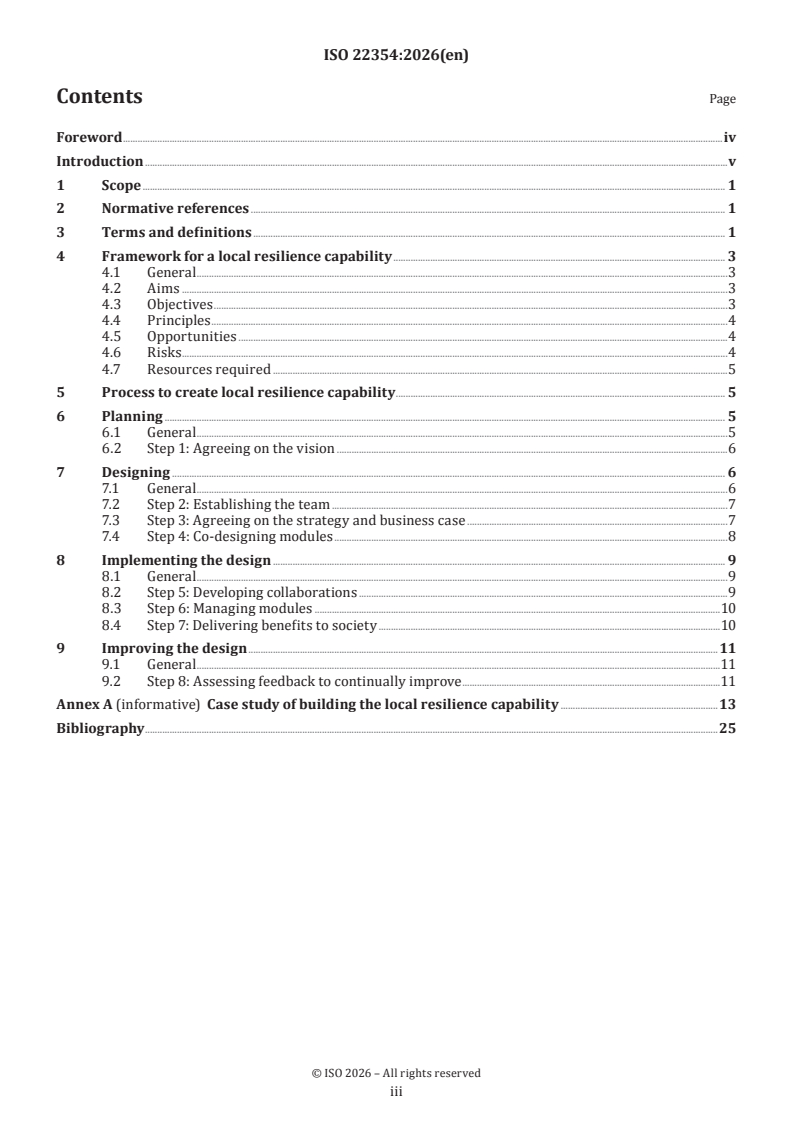
Contents Page
Foreword .iv
Introduction .v
1 Scope . 1
2 Normative references . 1
3 Terms and definitions . 1
4 Framework for a local resilience capability . 3
4.1 General .3
4.2 Aims .3
4.3 Objectives .3
4.4 Principles .4
4.5 Opportunities .4
4.6 Risks . .4
4.7 Resources required .5
5 Process to create local resilience capability . 5
6 Planning . 5
6.1 General .5
6.2 Step 1: Agreeing on the vision .6
7 Designing . 6
7.1 General .6
7.2 Step 2: Establishing the team .7
7.3 Step 3: Agreeing on the strategy and business case .7
7.4 Step 4: Co-designing modules .8
8 Implementing the design . 9
8.1 General .9
8.2 Step 5: Developing collaborations .9
8.3 Step 6: Managing modules .10
8.4 Step 7: Delivering benefits to society .10
9 Improving the design .11
9.1 General .11
9.2 Step 8: Assessing feedback to continually improve .11
Annex A (informative) Case study of building the local resilience capability .13
Bibliography .25
iii
Foreword
ISO (the International Organization for Standardization) is a worldwide federation of national standards
bodies (ISO member bodies). The work of preparing International Standards is normally carried out through
ISO technical committees. Each member body interested in a subject for which a technical committee
has been established has the right to be represented on that committee. International organizations,
governmental and non-governmental, in liaison with ISO, also take part in the work. ISO collaborates closely
with the International Electrotechnical Commission (IEC) on all matters of electrotechnical standardization.
The procedures used to develop this document and those intended for its further maintenance are described
in the ISO/IEC Directives, Part 1. In particular, the different approval criteria needed for the different types
of ISO document should be noted. This document was drafted in accordance with the editorial rules of the
ISO/IEC Directives, Part 2 (see www.iso.org/directives).
ISO draws attention to the possibility that the implementation of this document may involve the use of (a)
patent(s). ISO takes no position concerning the evidence, validity or applicability of any claimed patent
rights in respect thereof. As of the date of publication of this document, ISO had received notice of (a)
patent(s) which may be required to implement this document. However, implementers are cautioned that
this may not represent the latest information, which may be obtained from the patent database available at
www.iso.org/patents. ISO shall not be held responsible for identifying any or all such patent rights.
Any trade name used in this document is information given for the convenience of users and does not
constitute an endorsement.
For an explanation of the voluntary nature of standards, the meaning of ISO specific terms and expressions
related to conformity assessment, as well as information about ISO's adherence to the World Trade
Organization (WTO) principles in the Technical Barriers to Trade (TBT), see www.iso.org/iso/foreword.html.
This document was prepared by Technical Committee ISO/TC 292, Security and resilience.
Any feedback or questions on this document should be directed to the user’s national standards body. A
complete listing of these bodies can be found at www.iso.org/members.html.
iv
Introduction
Resilience to disruption as a whole-of-society endeavour is becoming an ambition in many countries.
Disruptions arise from major emergencies, disasters, crises, or other events. They disturb normal conditions,
undermine social relations, expose fragilities, challenge systems and have cascading impacts that cause
suffering. Helping society to tackle those impacts can help to alleviate suffering, quicken recovery and unite
communities.
The local and national contexts of societal resilience differ in terms of the role of emergency responders,
priorities and available funding. Other differences include the role of local and national governments, the
nature of communities, culture and how society organizes itself. The way in which different contexts engage
with new technologies, emerging trends and their priorities determine the pace of change. These factors
influence the capacity and capability of emergency management structures to work with society, and the
interest of society to be resilient to disruption.
Past disruptions show that many entities such as individuals, groups, organizations and networks in society
are already quite resilient and can prepare for a disruption and take care of themselves if it happens.
However, some entities are less resilient to a disruption, suffer more from its impacts and need additional
support. These are priority groups that are most at risk, vulnerable, unprepared, unaware or unable to
leverage their agency to determine their own resilience to a disruption. Priority groups can be identified
before and during a disruption. They include groups that are not addressed by, or can be suspicious of,
government intervention, so a different approach is required to support them through organizations they
already trust.
These organizations can participate in a local resilience partnership which is formed of (and coordinates)
civil society, and voluntary, community and business sectors that have different connections to society.
Through these connections, a local resilience partnership can access priority groups that are harder to
reach.
A local resilience partnership can prioritize its efforts to help those most in need, but some disruptions
are so big that a local resilience partnership cannot satisfy the needs that emerge. Society therefore has a
crucial role to create additional support so that local resilience partnerships can focus on priority groups.
Local resilience partnerships can help society to surge and channel its effort before, during and after a
disruption. To accomplish this surge, local resilience partnerships can develop a system to operationalise
societal resilience as a local resilience capability that is activated when additional support is required.
Creating the local resilience capability involves local resilience partnerships working in ambitious and
non-competitive ways to enhance the resilience of individuals, groups, organizations and networks. The
local resilience capability can encourage society’s self-help and helping of others so that the role for the
local resilience partnership is to develop society. This system involves national partners, for example,
with specialist skills that do not depend on local context (e.g. translation services). However, because local
connections are so important to supporting priority groups, the role of local resilience partnerships is key.
For example, local resilience partnerships can identify and understand important gaps in societal resilience
and develop new capabilities to support the changing needs of priority groups.
The local resilience capability prioritizes the needs of society by establishing what those needs are and
developing capabilities to address them. Modules can be activated by the local resilience partnership to
gather local intelligence, pinpoint and prioritize needs, coordinate society’s efforts and support professional
responders. Modules address needs when:
— anticipating disruptions – by understanding risk, vulnerability, needs and community assets;
— preparing for a disruption – by encouraging self-help and helping others;
— responding to a disruption – by coordinating requests for help and offers of support, and monitoring
changing needs;
— recovering from a disruption – by supporting society in the aftermath.
v
This document explains why a local resilience partnership should develop a local resilience capability. It also
describes the importance, principles, associated risks and opportunities, and the development process of a
local resilience capability (see Table 1).
Table 1 — Process to develop the local resilience capability
PLAN
Step 1 Vision Aligning the people and the organizational Step 1 establishes the vision on societal
politics to lead the vision to enhance societal resilience and the support for the local
resilience. resilience capability.
DESIGN
Step 2 Resources Establishing the team and assess current Steps 2 and 3 can be completed relatively
performance. quickly by local resilience partners already
working on societal resilience.
Step 3 Strategy Agreeing upon the strategy and business case.
Step 4 is based on a co-design approach
Step 4 Co-design Co-designing modules with partners.
with partners.
IMPLEMENT
Step 5 Partners Developing collaborations. Steps 5, 6, and 7 are a cycle aiming to expand
the modules that form the local resilience
Step 6 Management Managing modules.
capability.
Step 7 Operations Delivering benefits to society.
IMPROVE
Step 8 Evaluation Assessing feedback on the system to contin- Step 8 is an ongoing process to assess the
ually improve. performance of the system.
This document does not cover:
— needs in society that have been created by a disruption, concerning aspects such as mental health,
shelter, or needs finance, as described in ISO 22395;
— specifics of modules that address those needs. Those modules cover topics such as spontaneous
volunteers (see ISO 22319), mass evacuation (see ISO 22315), planning recovery (see ISO 22393), public
warning (see ISO 22322), public alerts (see ISO 22324), urban resilience (see ISO 22371), exercises (see
ISO 22398), or incident management (ISO 22320) and crisis management (ISO 22361);
— skills required to manage modules, such as information exchange (see ISO 22396); partnering
arrangements (see ISO 22397); or peer review (see ISO 22392);
— technologies required to support modules, such as artificial intelligence, computer modelling, or data
analysis;
— the measurement of resilience.
vi
International Standard ISO 22354:2026(en)
Security and resilience — Societal resilience — Guidelines to
develop local resilience capability
1 Scope
This document provides guidelines on how to implement an eight-stage process to enhance resilience to
disruptions arising from emergencies, disasters or crises. It describes how a local resilience partnership can
work with members of the public, civil society and business sectors to address needs in society that have
been created by a disruption. The process describes how the local resilience partnership can create a local
resilience capability that encourages self-help and helping others, while focusing on the needs of priority
groups.
This document describes:
— how the local resilience partnership can co-design and create a capability to enhance resilience to
disruption;
— partnerships and establishing a shared vision to enhance societal resilience;
— risks, vulnerabilities, needs, and community assets;
— implementation and management of capability;
— evaluation and continual improvement.
This document takes a whole-of-society approach to enhancing resilience by adopting principles and
developing systems to support societal networks, organizations (from private, public, and voluntary
sectors), community groups, and individuals.
This document is applicable to any organization or group involved in enhancing the resilience of society to
disruption.
2 Normative references
The following documents are referred to in the text in such a way that some or all of their content constitutes
requirements of this document. For dated references, only the edition cited applies. For undated references,
the latest edition of the referenced document (including any amendments) applies.
ISO 22300, Security and resilience — Vocabulary
3 Terms and definitions
For the purposes of this document, the terms and definitions given in ISO 22300 and the following apply.
ISO and IEC maintain terminology databases for use in standardization at the following addresses:
— ISO Online browsing platform: available at https:// www .iso .org/ obp
— IEC Electropedia: available at https:// www .electropedia .org/
3.1
local resilience capability
system (3.4) to enhance resilience to disruption (3.8) by delivering support to people and places
Note 1 to entry: Local resilience capability is formed of modules that are planned (e.g. collaborations across community
groups; businesses; voluntary, community and social enterprises; local government) even when they are spontaneous
(e.g. crowd-funding, ad hoc donations, spontaneous volunteering). Modules can include community emergency hubs,
spontaneous volunteers, essential services for vulnerable people.
3.2
capability
demonstrable ability to prepare for, respond to, and recover from a disruption (3.8)
3.3
societal resilience
collective capability (3.1) of individuals, community groups, voluntary organizations, businesses and
networks to anticipate, absorb and adapt in a disruption (3.8)
3.4
system
set of interrelated and interacting elements
[SOURCE: ISO 9000:2026, 3.4.1]
3.5
resilience partner
collaborating entity that provides services to the community to retain or enhance its ability to absorb and
adapt in a changing environment
Note 1 to entry: Services are provided as part of its day-to-day work and/or in the context of recovery or renewal
activities.
Note 2 to entry: Member of the local resilience partnership (3.6).
[SOURCE: ISO 22393:2023, 3.3, modified — addition of Note 2 to entry]
3.6
local resilience partnership
collaborating multi-organizational group of resilience partners (3.5) that provide services to a geographic
area to prepare for, respond to, and recover from a disruption (3.8)
Note 1 to entry: Partners include local government, emergency services, voluntary sectors and businesses.
Note 2 to entry: Services are provided in day-to-day work and/or in the context of recovery or renewal activities.
3.7
priority group
part of society that a local resilience capability (3.1) aims to support to address their needs in a disruption
(3.8)
EXAMPLE Individuals, groups, organizations, and networks that are most at-risk, vulnerable, not prepared,
unaware or unable to leverage their agency to determine their own resilience to a disruption.
Note 1 to entry: Priority groups include individuals.
Note 2 to entry: Priority groups are identified through risk assessments conducted in a community.
3.8
disruption
anticipated or unanticipated event that interrupts normal functions, operations, or processes
EXAMPLE Natural events, technological and infrastructure events, and events arising from human action.
[SOURCE: ISO 22300:2025, 3.1.26, modified — an example has been added.]
4 Framework for a local resilience capability
4.1 General
The local resilience partnership has an important role in coordinating the development of the local resilience
capability. Individuals, groups, organizations, and networks all have a role to play in building the resilience
of society. This clause describes the local resilience capability in terms of its:
— aims (see 4.2);
— objectives (see 4.3);
— principles (see 4.4);
— opportunities (see 4.5);
— risks (see 4.6);
— resources required (see 4.7).
4.2 Aims
The aims of the local resilience capability are to:
— support society to improve its own resilience, because society should be allowed to self-determine its
resilience;
— encourage priority groups to prepare for a disruption, because readiness lowers their demand for
support and reduces their diversity of need;
— reduce local risk and vulnerability, because then disruptions have less impact on society, reduce the
demand for support, and allow the local resilience capability to focus on priority groups;
— unite different parts of the system that work with priority groups on resilience, because collaborations
benefit from system-wide additionality.
NOTE The relationship between the people who are vulnerable and people who are in the priority group can be
explained by referring to ISO 22395. A vulnerable person is defined as an individual who is less able to anticipate,
cope with, resist or recover from the impacts of an emergency. Some vulnerable people depend on receiving services
to support their everyday living due to their personal conditions. Those services create resilience in the individual by
supporting them if a disruption occurs. Also, resilience of vulnerable people can be enhanced by family and friends
who know the person who is vulnerable so are organized to provide extra support to them in a disruption. For example,
care home residents are vulnerable persons but have sophisticated support structures that activate in a disruption.
In contrast, members of the priority group do not have ongoing support available so they rely on the local resilience
capability to address their needs in a disruption. People in the priority group can become vulnerable only because
of the impacts of the disruption and possibly do not have the necessary systems prepared to support their emerging
needs. They are therefore the first candidates for urgent support to ensure their needs do not cause suffering or harm.
The needs of priority groups can be identified in advance. See ISO 22395 for more information on vulnerable persons.
4.3 Objectives
The objectives of the local resilience capability are to:
— determine current performance;
— identify gaps and where more work is required;
— form effective collaborations needed to enhance resilience;
— design and implement modules to enhance resilience;
— determine how local intelligence is acquired and used to enhance resilience.
4.4 Principles
The local resilience capability should follow the following principles:
— focus on priority groups and those who maintain local essential services that support priority groups in
a disruption;
— support others who are not in priority groups to prepare for, and help themselves in, a disruption, and to
help others;
— work with members of the public and organizations to create the local resilience capability to address
local risks and ensure it is activated by existing structures, sustained by available resources, and valued
by society;
— work with resilience partners to access priority groups and understand their changing needs;
— focus on needs of the priority groups and the services that support them;
— operationalize societal resilience as modules to support those in need;
— start simple and grow modules strategically, for example, by focusing on one priority group at a time,
building confidence, learning from experience, and then implementing additional modules.
4.5 Opportunities
The local resilience capability should:
— identify and access parts of society (e.g. communities of place and of type) that are most in need during
a disruption;
— activate the support from the voluntary sector and other partners, such as healthcare, spontaneous
volunteers and donations;
— support the majority in society as they take care of themselves in a disruption;
— focus mainly on priority groups that cannot take care of themselves.
4.6 Risks
The local resilience capability should identify and address risks, including:
— individuals, groups, organizations and networks that have needs during a disruption, but they remain
unaware and uninterested in building resilience. This can be addressed by communicating the aims (see
4.2) and objectives (see 4.3) of local resilience capability;
— those involved in creating the local resilience capability losing interest because of insufficient activations.
This can be addressed by designing the local resilience capability to support preparedness activities,
including exercising, not only emergency response;
— being unable to evidence the impact of the local resilience capability on addressing needs. This can be
addressed by assessing the impact and value of the local resilience capability;
— the unavailability of communication channels (e.g. official, regular press, informal press, social media) to
share information with local essential services and priority groups in a disruption;
— the potential of misinformation and disinformation influencing society in a way that has a negative effect
on the local resilience capability;
— how the promise of local resilience capability can build an unrealistic expectation in communities
without the corresponding availability of funding, political leverage, etc.
NOTE More information on risk assessment techniques is available in IEC 31010 and on risk management in
ISO 31000.
4.7 Resources required
The local resilience capability should:
— identify what resources are needed (e.g. funding, knowledge, enthusiasm);
— create the local resilience capability by starting small to demonstrate its value and build confidence;
— determine a pace of growth according to the resources available.
5 Process to create local resilience capability
The local resilience partnership should:
— establish the vision to enhance societal resilience (see Clause 6) by:
— Step 1: Agreeing on a vision (see 6.2);
— design a local resilience capability (see Clause 7) by:
— Step 2: Establishing the team (see 7.2);
— Step 3: Agreeing on the strategy and business case (see 7.3);
— Step 4: Co-designing modules (see 7.4);
— implement the design (see Clause 8) by:
— Step 5: Developing collaborations (see 8.2);
— Step 6: Managing modules (see 8.3);
— Step 7: Delivering benefits to society (see 8.4);
— continually improve the design (see Clause 9) by:
— Step 8: Assessing feedback to continually improve (see 9.2).
Developing the local resilience capability is an ongoing process, not a single creation, so these steps are
repeated. For example, steps 5-7 are a cycle of development where one module of the capability is developed,
managed, and delivered while other modules are being implemented.
The steps to create the local resilience capability are detailed in Clauses 6 to 9. For each step, the following
is covered:
— the benefit;
— initial practices to deliver this step;
— advanced practices to enhance this step.
Annex A provides a case study of the application of steps 1-8.
6 Planning
6.1 General
This clause details Step 1 to agree on the vision to enhance societal resilience (see 6.2).
6.2 Step 1: Agreeing on the vision
The purpose of this step is to:
— emphasize the global, national, sub-national, and local momentum on a whole-of-society approach to
resilience;
— emphasize that societal resilience should reduce risk and vulnerability by building capability to address
needs;
— embed foundational blocks (e.g. institutional backing, aspiration);
— avoid resilience partners competing for visibility or funding;
— ensure that resilience partners are motivated and demonstrate a long-term commitment to achieving
the vision through working together.
Initial practices in this step should:
— identify resilience partners and other relevant organizations (e.g. community development, those
connected to priority groups);
— identify their vision for societal resilience;
— identify how a shared vision on societal resilience can support resilience partners to:
— deliver national legal, strategic and policy frameworks for resilience;
— support broader strategies that complement societal resilience (e.g. community development,
climate adaptation, social cohesion, public safety, health and well-being, business continuity);
— use intelligence from partners and society to design a vision to unite the local resilience partnership;
— establish the local resilience partnership’s vision to operationalize societal resilience as the local
resilience capability and its:
— desired outcomes;
— scale of initial investment;
— governance structures and strategic lead.
Advanced practices in this step should:
— review how the shared vision should adapt to get more benefits from the local resilience capability (e.g.
to grow the local resilience capability, use results from pilot work);
— broaden support for the vision (e.g. from community, voluntary and business sectors).
7 Designing
7.1 General
This clause details steps 2-4 to design the local resilience capability to:
— establish the team (see 7.2);
— agree the strategy and business case (see 7.3);
— co-design modules (see 7.4).
7.2 Step 2: Establishing the team
The purpose of this step is to:
— appoint a motivated and knowledgeable team;
— agree on the vision to enhance societal resilience based on current performance and available investment;
— develop the delivery plan.
The local resilience partnership should:
— establish the societal resilience working group to design and deliver the local resilience capability;
— ensure that the societal resilience working group has the support it needs (e.g. knowledge, strategic
support, resources, credibility).
To deliver initial practices in this step, the societal resilience working group should:
— establish itself to:
— be a permanent group of the local resilience partnership to ensure that local resilience capability is
delivered as a strategic programme;
— be a multi-organizational team that oversees the delivery of the local resilience capability;
— have a strategic champion, tactical leadership, working group members, secretariat, and terms of
reference;
— commission its first piece of work to review existing societal resilience activity to:
— identify the range and type of current activity;
— establish baselines for the impact of that activity on enhancing societal resilience;
— evaluate the resources needed to deliver this performance;
— identify statutory roles and legislation relevant to societal resilience;
— identify the resilience partners required to coordinate, design, and implement the local resilience
capability, and identify other partners with community development skills and that connect with priority
groups;
— design and implement the local resilience capability according to the vision (from Step 1, see 6.2).
To deliver advanced practices in this step, the societal resilience working group should:
— review its performance to identify how the resilience partners can strengthen their contributions,
including the contribution from other partners, leaders, local personalities and local services;
— encourage reviews which challenge mainstream thinking on local resilience capability (e.g. from
leadership scrutiny, peer review).
7.3 Step 3: Agreeing on the strategy and business case
The purpose of this step is to:
— agree on what is required to operationalize societal resilience as a local resilience capability;
— broaden and strengthen support for the local resilience capability;
— estimate and justify initial and ongoing investments.
To deliver initial practices in this step, the societal resilience working group should:
— consult on the scope of work, including: the vision, aims and objectives, priority groups, timing;
— identify the investment required (e.g. effort, knowledge, money), the timing to achieve the aims and
objectives, and the cost, benefit and value for money of that investment;
— use the output from the consultation to produce a strategy and business case that includes performance
criteria (e.g. outcomes, benefits);
— pass the strategy and business case through the local resilience partnership’s approval procedure to
secure support;
— engage with funding opportunities to support modules.
To deliver advanced practices in this step, the societal resilience working group should:
— identify the costs and benefits of continued investment and the type, scale, and timing of investments to
expand and sustain the local resilience capability;
— once the local resilience capability is operational, compare its value for money to its expected value as
described in the strategy and business case.
7.4 Step 4: Co-designing modules
The purpose of this step is to:
— identify the modules to achieve the vision to enhance societal resilience;
— align modules to the approved strategy and business case for local resilience capability;
— document agreements on modules and how time, resources, and funding will be invested;
— align the local resilience partnership to implement the modules.
To deliver initial practices in this step, the societal resilience working group should:
— co-design the aims for modules, taking into account the unique characteristics and needs of the local
community and adapting the module objectives accordingly;
— consider how to deliver the aims through delivering the objectives of:
— determine current performance;
— determine gaps and where work is required to enhance performance;
— form collaborations to enhance performance;
— design and implement modules as interventions to enhance performance;
— determine how local intelligence is acquired and used to enhance performance;
— consider opportunities and risks, including:
— the location and type of societal needs;
— the location and type of support available to help those in need;
— document the:
— vision for the module (based on the shared vision);
— module’s aims and objectives to deliver the vision (see 4.2 and 4.3);
— principles for how the module’s aims and objectives are achieved (see 4.4);
— opportunities and risks of the module (see 4.5 and 4.6);
— resources needed to implement the module (see 4.7).
To deliver advanced practices in this step, the societal resilience working group should:
— review the vision, aims, and objectives that inform the modules;
— review the work on societal resilience of other local resilience partnerships that contribute to modules;
— review the modules.
8 Implementing the design
8.1 General
This clause details steps 5-7 to implement the design of the local resilience capability by:
— developing collaborations (see 8.2);
— managing modules (see 8.3);
— delivering value to society (see 8.4).
8.2 Step 5: Developing collaborations
The purpose of this step is to:
— identify and develop effective collaborations that deliver modules which target at least one priority
group;
— reset or replace collaborations that are not effective.
To deliver initial practices in this step, the societal resilience working group should:
— assess whether existing collaborations to build societal resilience before, during, and after a disruption
are effective (e.g. use resources efficiently and effectively to have the expected value for priority groups);
— identify potential collaborators to enhance the resilience of each priority group;
— explore which resilience partners are best placed to form an effective collaboration;
— gradually increase the number of effective collaborations to support modules for priority groups;
— agree on the terms of a collaboration based on working towards shared objectives for each priority
group;
— monitor the delivery of objectives to determine if collaborations are effective for priority groups;
— identify new collaborations to close gaps in support of priority groups.
To deliver advanced practices in this step, the societal resilience working group should:
— review the performance of collaborations;
— work to make effective collaborations even more impactful;
— expand its collaborations with other partners that are connected with priority groups.
8.3 Step 6: Managing modules
The purpose of this step is to:
— provide governance and assurance of modules;
— ensure the modules stay simple;
— monitor feedback on modules and ensure deviations are resolved;
— ensure that the content of steps 1 to 8 evolve to meet new needs.
To deliver initial practices in this step, the societal resilience working group should:
— manage the implementation of modules, such as spontaneous volunteers (see ISO 22319), public warning
(see ISO 22322), or community emergency hubs;
— ensure each module is effective by monitoring:
— strategy and leadership;
— intelligence gathering and analysis;
— management processes;
— coordination of society through two-way communication;
— delivery of support to those in need.
— ensure that each module delivers its expected performance, is straightforward, eliminates unnecessary
bureaucracy, and is scaled to the vision and resources available;
— monitor and adjust the modules and systems to ensure the local resilience capability meets changing
needs;
— ensure each module inter-connects with other modules to complement each other and create added-
value to societal resilience.
To deliver advanced practices in this step, the societal resilience working group should:
— review management systems to ensure that modules stay simple;
— review and adjust the management systems to align modules with performance feedback, peer reviews,
and scrutiny.
8.4 Step 7: Delivering benefits to society
The purpose of this step is to:
— highlight the value to society of local resilience capability focusing on priority groups and their needs;
— implement modules for local resilience capability to address the variety of priority groups and their
needs;
— ensure activation protocols for modules are available to the local resilience partnership.
To deliver initial practices in this step, the societal resilience working group should:
— implement modules to reduce demand and increase supply;
— have a protocol for the local resilience partnership to activate each module before and during a disruption;
— during implementation of the module:
— refine understanding of the type and volume of demand for, and supply of, support from local
resilience capability;
— identify the difference in demand versus supply and the need to adjust the scale of the local resilience
capability.
— have a close-down protocol for each module so it can be paused by the local resilience partnership when
it is no longer needed;
— deliver benefits from those operations to priority groups before, during, and after a disruption;
— deliver operations with society as inter-connected modules from local resilience capability.
To deliver advanced practices in this step, the societal resilience working group should:
— identify how demand and supply of support should be better balanced;
— have a refined understanding of diverse needs and the likely demand in different scenarios;
— use emerging technologies (such as the Internet of Things, big data analysis, artificial intelligence)
to provide local resilience capability with timely and accurate data to enhance its efficiency and
effectiveness (such as by monitoring environmental changes in real-time and assessing information
about the population).
9 Improving the design
9.1 General
This clause presents step 8 to assess feedback to continually improve the local resilience capability (see 9.2).
9.2 Step 8: Assessing feedback to continually improve
The purpose of this step is to:
— ensure the local resilience partnership is aware of its own level of internal readiness to harness the local
resilience capability;
— ensure the efforts towards achieving local resilience capability have the expected external impact;
— identify improvements needed to the local resilience capability;
— assess the impact of the local resilience capability to inform its longer-term sustainability, including its
value for money.
To deliver initial practices in this step, the societal resilience working group should:
— establish a structured feedback mechanism that includes regular surveys, focus group discussions,
and performance metrics. The collected data should be analysed to identify areas for improvement and
inform the development of action plans;
— use the feedback mechanism to evaluate the local resilience capability based on the effectiveness of:
— strategy and leadership of the local resilience capability (e.g. effectiveness of the leader and team,
and having a clear starting point and strong business case);
— intelligence gathering and analysis by the local resilience capability (e.g. effectiveness of processes
to capture information from priority groups to understand unmet, emerging and new needs);
— management processes in the local resilience capability (e.g. effectiveness of systems to monitor and
enhance delivery of local resilience capability);
— coordination of society through two-way communication through the local resilience capability (e.g.
effectiveness of society-led action);
— deliver support by the local resilience capability to those in need (e.g. effectiveness of modules to
addressing need);
— establish processes to collect and analyse qualitative and quantitative data
...