

ISO/FDIS 15936
(Main)Soil, waste, treated biowaste and sludge — Determination of total organic carbon (TOC) by dry combustion
- Abstract
Specifies a method for the determination of the total carbon content in soil after dry combustion. The organic carbon content is calculated from this content after correcting for carbonates present in the sample. If carbonates are removed beforehand, the organic carbon content is measured directly. Applicable to all types of air-dried soil samples.
- Status
- Not Published
- Technical Committee
- ISO/TC 190/SC 3 - Chemical and physical characterization
- Drafting Committee
- ISO/TC 190/SC 3/WG 1 - Inorganic analysis
- Current Stage
- 5020 - FDIS ballot initiated: 2 months. Proof sent to secretariat
- Start Date
- 29-Sep-2026
- Completion Date
- 29-Sep-2026
Buy Documents
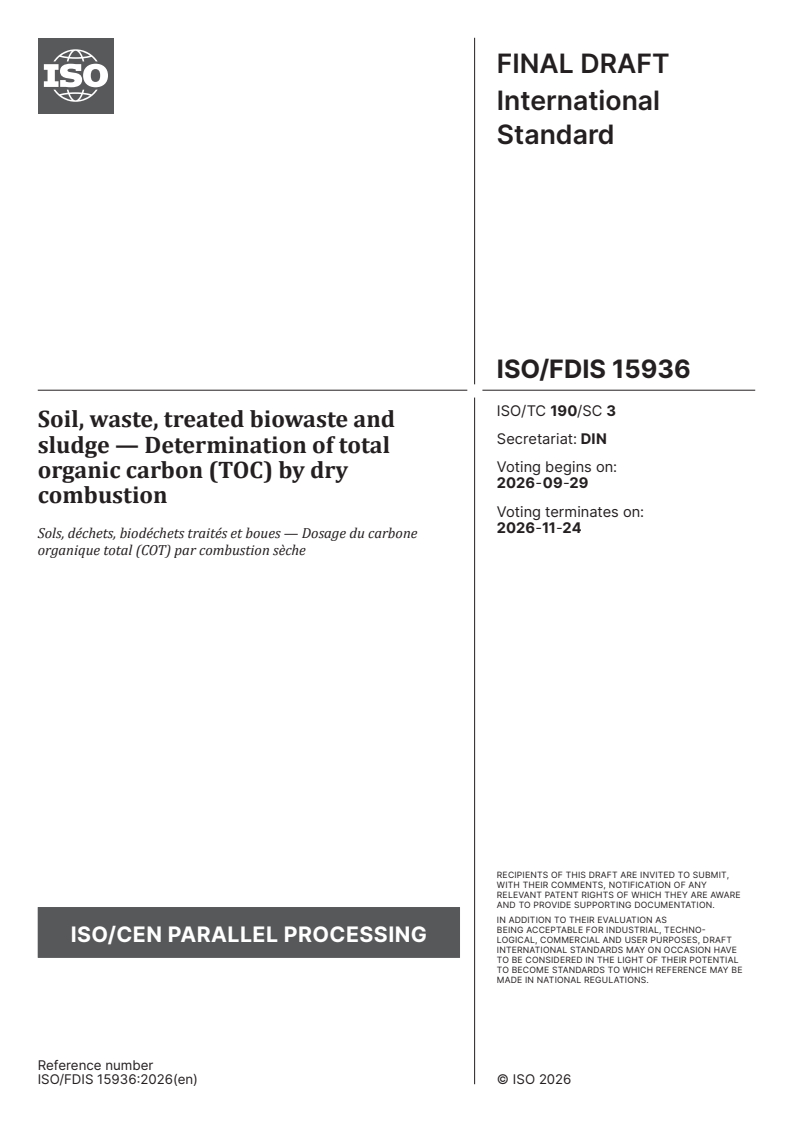
ISO/FDIS 15936 - Soil, waste, treated biowaste and sludge — Determination of total organic carbon (TOC) by dry combustion
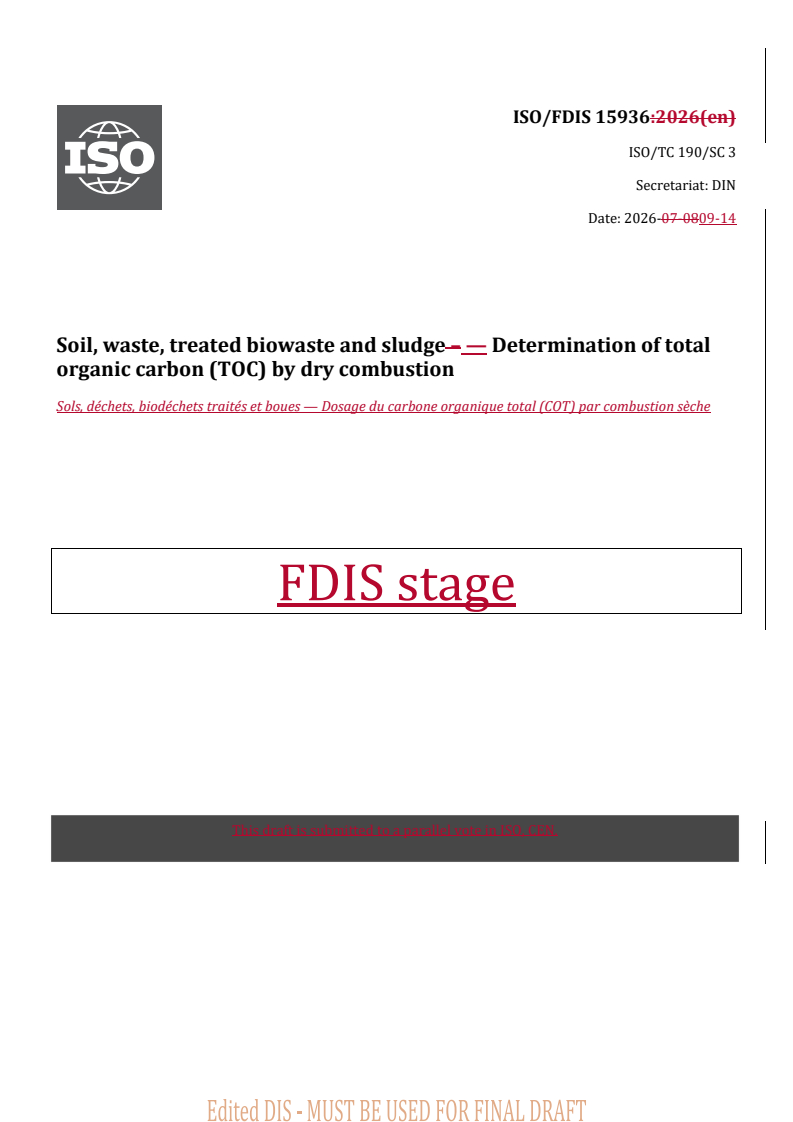
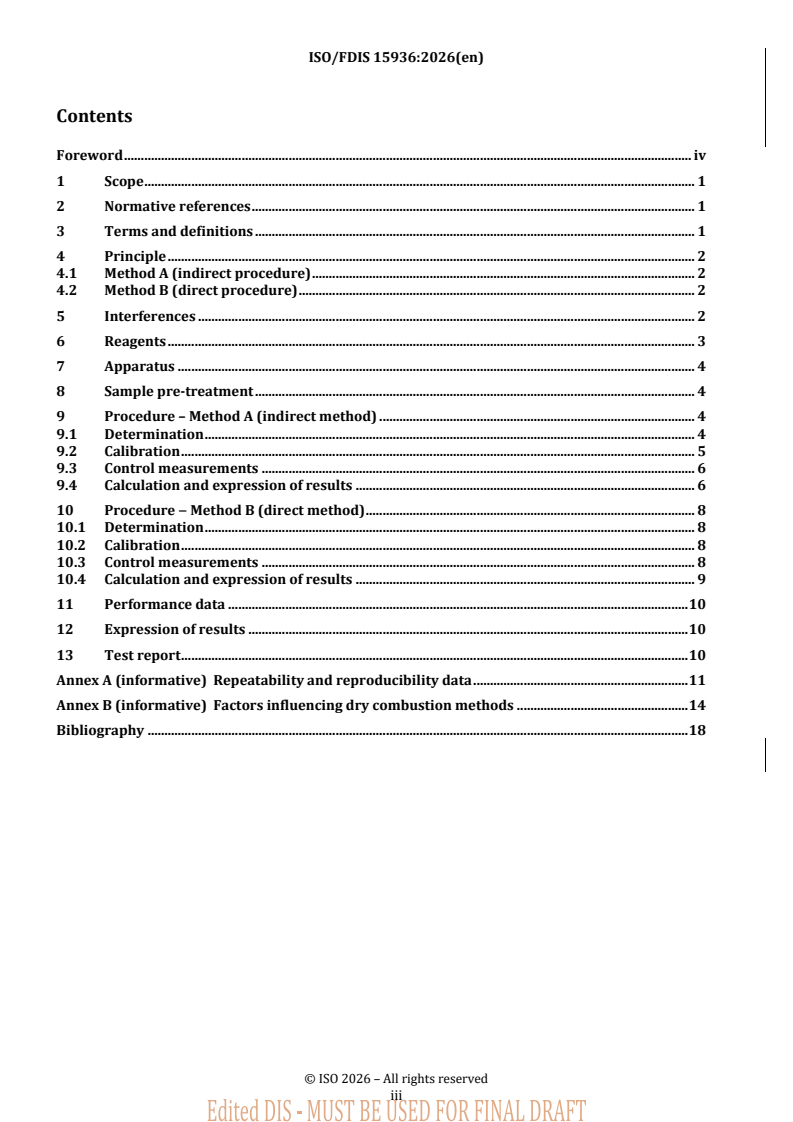
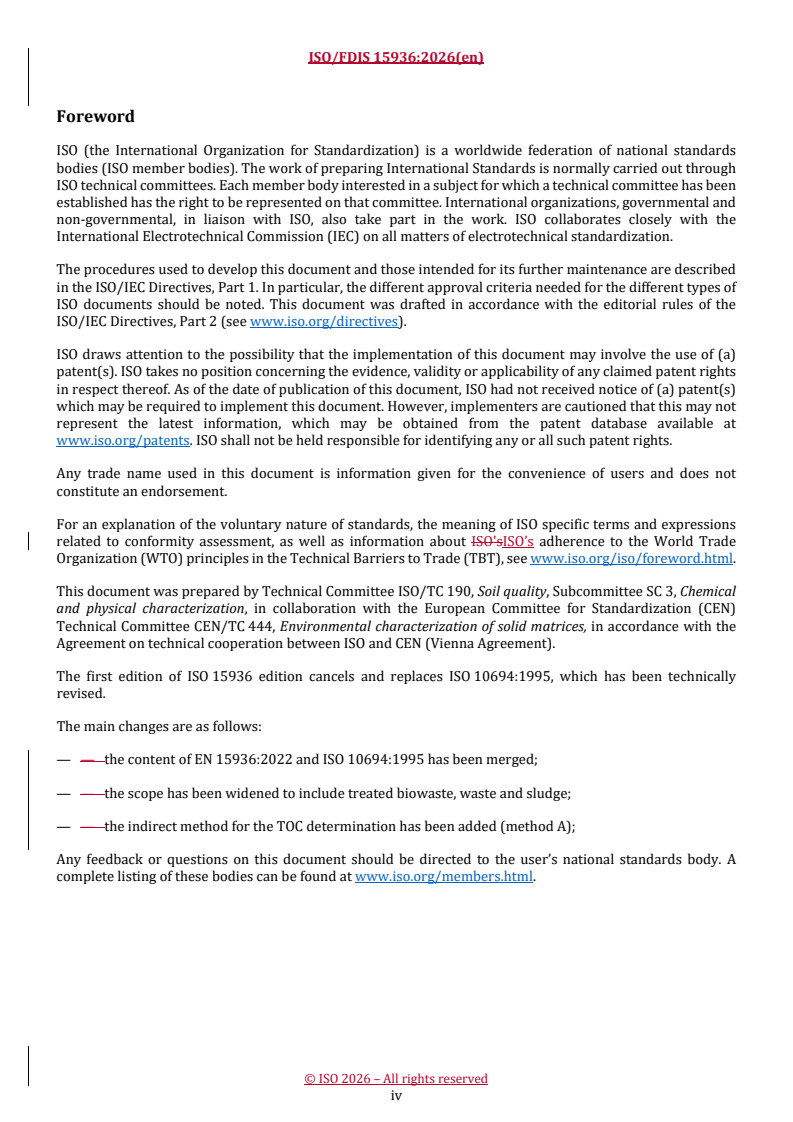
REDLINE ISO/FDIS 15936 - Soil, waste, treated biowaste and sludge — Determination of total organic carbon (TOC) by dry combustion
ISO/FDIS 15936 - Sols, déchets, biodéchets traités et boues — Dosage du carbone organique total (COT) par combustion sèche
ISO/FDIS 15936 is an ISO Final Draft International Standard for determining total organic carbon (TOC) by dry combustion in sludge, treated biowaste, soil and waste. It specifies two laboratory methods for samples containing more than 0.1 % carbon in relation to dry matter, and it is written for users who need TOC results on a dry matter basis.
What does ISO/FDIS 15936 specify?
ISO/FDIS 15936 specifies how to measure TOC by dry combustion and how to report the result for sludge, treated biowaste, soil and waste. It covers both an indirect route, where total carbon and total inorganic carbon are measured separately, and a direct route, where inorganic carbon is removed before combustion.
| Annex | What it covers |
|---|---|
| Annex A | Repeatability and reproducibility data from interlaboratory comparison studies |
| Annex B | Factors that influence dry combustion methods, including temperature, modifiers and sample preparation |
The document is organized into scope, terms and definitions, principle, interferences, reagents, apparatus, sample pre-treatment, two procedures, performance data, expression of results and test report requirements. That structure matters in practice because it shows the full workflow from preparing the sample to recording the final result.
What are the key requirements of ISO/FDIS 15936?
ISO/FDIS 15936 gives a complete laboratory procedure, not just a calculation. The main practical requirements are about sample suitability, controlling interferences, choosing the right method, calibrating the instrument and reporting the result in a consistent way.
1) Use the method only for suitable samples
Clause 1 limits the document to sludge, treated biowaste, soil and waste samples with more than 0.1 % carbon on a dry matter basis. The document is validated for those matrices, so the user can rely on the method for them rather than extrapolating it to unrelated materials.
2) Choose between Method A and Method B
Clause 4 describes two approaches. Method A determines TOC indirectly as the difference between total carbon (TC) and total inorganic carbon (TIC), while Method B removes TIC first and then measures TOC directly.
In practice, Method A is useful when both TC and TIC need to be known separately. Method B can be simpler for some samples, but it depends more on the acid removal step and the operator’s experience.
3) Control sample preparation and drying
Clause 8 requires the sample to be dried, and for moist or paste-like waste samples it allows mixing with aluminium oxide to obtain a granular material before grinding or crushing. The maximum particle size is limited to 250 μm.
This matters because poor homogeneity can drive bad repeatability. The document also notes that drying temperature should not exceed 40 °C, so the preparation step must avoid losing volatile organic compounds that would lower the measured TOC.
4) Manage matrix interferences before and during analysis
Clause 5 warns that a very high TIC-to-TOC ratio can make results unreliable. It also notes specific interferences such as cyanide in TIC measurement, halogenated compounds, volatile organic substances in Method B, and side reactions with acids.
For the laboratory, this means the sample matrix has to be checked before routine analysis. If relevant components such as elemental carbon, carbides, cyanides, cyanates, isocyanates, isothiocyanates or thiocyanates are present, they may need separate measurement and reporting.
5) Follow the combustion and TIC removal steps closely
In Method A, Clause 9 requires total carbon to be measured by combustion in an oxygen-containing carrier gas and TIC to be measured separately by acidification and purging or stirring. In Method B, Clause 10 requires inorganic carbon to be removed with a non-oxidizing mineral acid before combustion.
The practical point is that the carbon dioxide released during each step is what the detector measures. The document allows infrared spectrometry, thermal conductivity detection or other suitable techniques, so the laboratory can match the detector to its equipment while still following the same principle.
6) Calibrate and verify the instrument response
Clause 9.2 and Clause 10.2 require calibration when relative detection is used. The document gives examples of calibration substances for TC and TIC, and it requires control measurements at the beginning and end of a sequence.
This is important because the result depends on how the detector responds to known carbon amounts. The control checks are not optional routine paperwork: if recovery falls outside the acceptance limits, the calibration must be reviewed and, if needed, repeated before sample analysis continues.
7) Report results on a dry matter basis with repeatability checks for waste and sludge
Clauses 9.4, 10.4, 12 and 13 require TOC to be expressed as % C in relation to dry matter, typically to no more than two significant figures. For waste and sludge, TC and TIC in Method A, and TOC in Method B, must be measured at least twice, with defined agreement criteria.
For a buyer, lab manager or quality manager, this means the document is not satisfied by a single number alone. The report must show the method used, sample identity, drying method, any pre-treatment, deviations and the measurement date.
What terms does ISO/FDIS 15936 define?
- Total carbon (TC) is the quantity of carbon in the sample as organic, inorganic and elemental carbon.
- Total inorganic carbon (TIC) is the carbon released as carbon dioxide by acid treatment, and it typically represents carbonates in the sample.
- Total organic carbon (TOC) is the carbon converted into carbon dioxide by combustion and not released as carbon dioxide by acid treatment.
- Dry matter (dm) is the basis used to express the result after the sample has been dried, so the reported value reflects carbon content relative to the dry sample mass.
Who uses ISO/FDIS 15936?
ISO/FDIS 15936 is used by laboratories that test environmental solid matrices, including soil, sludge, treated biowaste and waste. Typical users include analytical chemists, environmental testing laboratories, inspection bodies, waste and sludge treatment operators, and quality managers who need comparable TOC results for control or reporting.
It is especially relevant where a lab needs to compare organic carbon levels across matrices with mineral carbon present, or where method selection between indirect and direct TOC measurement affects the workflow.
What changed in ISO/FDIS 15936 from the previous edition?
ISO/FDIS 15936 states that it cancels and replaces ISO 10694:1995. The main changes listed are the merger of EN 15936:2022 and ISO 10694:1995 content, an expanded scope that includes treated biowaste, waste and sludge, and the addition of the indirect TOC method, Method A.
What does the ISO/FDIS 15936 document contain?
ISO/FDIS 15936 contains the two analytical procedures, the reagent list, apparatus requirements, sample pre-treatment guidance, calculation formulas and reporting rules. It also includes acceptance checks for calibration and control measurements, so the user can run the method with defined performance checks rather than as a purely descriptive procedure.
Annex A provides interlaboratory repeatability and reproducibility data for sludge, treated biowaste, soil and waste. Annex B gives practical factors that influence the result, including the effect of temperature, modifiers, aluminium oxide in sample preparation, TIC-to-TOC ratio and the temperature used during inorganic carbon removal.
Relations
- Effective Date
- 12-Feb-2026
- Effective Date
- 17-May-2025
- Effective Date
- 07-Jan-2025
Buy Documents
ISO/FDIS 15936 - Soil, waste, treated biowaste and sludge — Determination of total organic carbon (TOC) by dry combustion
REDLINE ISO/FDIS 15936 - Soil, waste, treated biowaste and sludge — Determination of total organic carbon (TOC) by dry combustion
ISO/FDIS 15936 - Sols, déchets, biodéchets traités et boues — Dosage du carbone organique total (COT) par combustion sèche
Get Certified
Connect with accredited certification bodies for this standard

CIS Institut d.o.o.
Personal Protective Equipment (PPE) certification body. Notified Body NB-2890 for EU Regulation 2016/425 PPE.

Kiwa BDA Testing
Building and construction product certification.
Kmetijski inštitut Slovenije
Agricultural Institute of Slovenia. Soil testing, plant health, agricultural product analysis.
Sponsored listings
Frequently Asked Questions
ISO/FDIS 15936 is a draft published by the International Organization for Standardization (ISO). Its full title is "Soil, waste, treated biowaste and sludge — Determination of total organic carbon (TOC) by dry combustion". This standard covers: Specifies a method for the determination of the total carbon content in soil after dry combustion. The organic carbon content is calculated from this content after correcting for carbonates present in the sample. If carbonates are removed beforehand, the organic carbon content is measured directly. Applicable to all types of air-dried soil samples.
Specifies a method for the determination of the total carbon content in soil after dry combustion. The organic carbon content is calculated from this content after correcting for carbonates present in the sample. If carbonates are removed beforehand, the organic carbon content is measured directly. Applicable to all types of air-dried soil samples.
ISO/FDIS 15936 is classified under the following ICS (International Classification for Standards) categories: 13.080.10 - Chemical characteristics of soils. The ICS classification helps identify the subject area and facilitates finding related standards.
ISO/FDIS 15936 has the following relationships with other standards: It is inter standard links to FprEN ISO 15936, ISO/TR 12231-2:2022, ISO 10694:1995. Understanding these relationships helps ensure you are using the most current and applicable version of the standard.
ISO/FDIS 15936 is available in PDF format for immediate download after purchase. The document can be added to your cart and obtained through the secure checkout process. Digital delivery ensures instant access to the complete standard document.
Standards Content (Sample)
FINAL DRAFT
International
Standard
ISO/TC 190/SC 3
Soil, waste, treated biowaste and
Secretariat: DIN
sludge — Determination of total
Voting begins on:
organic carbon (TOC) by dry
2026-09-29
combustion
Voting terminates on:
2026-11-24
Sols, déchets, biodéchets traités et boues — Dosage du carbone
organique total (COT) par combustion sèche
RECIPIENTS OF THIS DRAFT ARE INVITED TO SUBMIT,
WITH THEIR COMMENTS, NOTIFICATION OF ANY
RELEVANT PATENT RIGHTS OF WHICH THEY ARE AWARE
AND TO PROVIDE SUPPOR TING DOCUMENTATION.
IN ADDITION TO THEIR EVALUATION AS
BEING ACCEPTABLE FOR INDUSTRIAL, TECHNO
ISO/CEN PARALLEL PROCESSING LOGICAL, COMMERCIAL AND USER PURPOSES, DRAFT
INTERNATIONAL STANDARDS MAY ON OCCASION HAVE
TO BE CONSIDERED IN THE LIGHT OF THEIR POTENTIAL
TO BECOME STAN DARDS TO WHICH REFERENCE MAY BE
MADE IN NATIONAL REGULATIONS.
Reference number
FINAL DRAFT
International
Standard
ISO/TC 190/SC 3
Soil, waste, treated biowaste and
Secretariat: DIN
sludge — Determination of total
Voting begins on:
organic carbon (TOC) by dry
combustion
Voting terminates on:
Sols, déchets, biodéchets traités et boues — Dosage du carbone
organique total (COT) par combustion sèche
RECIPIENTS OF THIS DRAFT ARE INVITED TO SUBMIT,
WITH THEIR COMMENTS, NOTIFICATION OF ANY
RELEVANT PATENT RIGHTS OF WHICH THEY ARE AWARE
AND TO PROVIDE SUPPOR TING DOCUMENTATION.
© ISO 2026
IN ADDITION TO THEIR EVALUATION AS
All rights reserved. Unless otherwise specified, or required in the context of its implementation, no part of this publication may
BEING ACCEPTABLE FOR INDUSTRIAL, TECHNO
ISO/CEN PARALLEL PROCESSING
LOGICAL, COMMERCIAL AND USER PURPOSES, DRAFT
be reproduced or utilized otherwise in any form or by any means, electronic or mechanical, including photocopying, or posting on
INTERNATIONAL STANDARDS MAY ON OCCASION HAVE
the internet or an intranet, without prior written permission. Permission can be requested from either ISO at the address below
TO BE CONSIDERED IN THE LIGHT OF THEIR POTENTIAL
or ISO’s member body in the country of the requester.
TO BECOME STAN DARDS TO WHICH REFERENCE MAY BE
MADE IN NATIONAL REGULATIONS.
ISO copyright office
CP 401 • Ch. de Blandonnet 8
CH-1214 Vernier, Geneva
Phone: +41 22 749 01 11
Email: copyright@iso.org
Website: www.iso.org
Published in Switzerland Reference number
ii
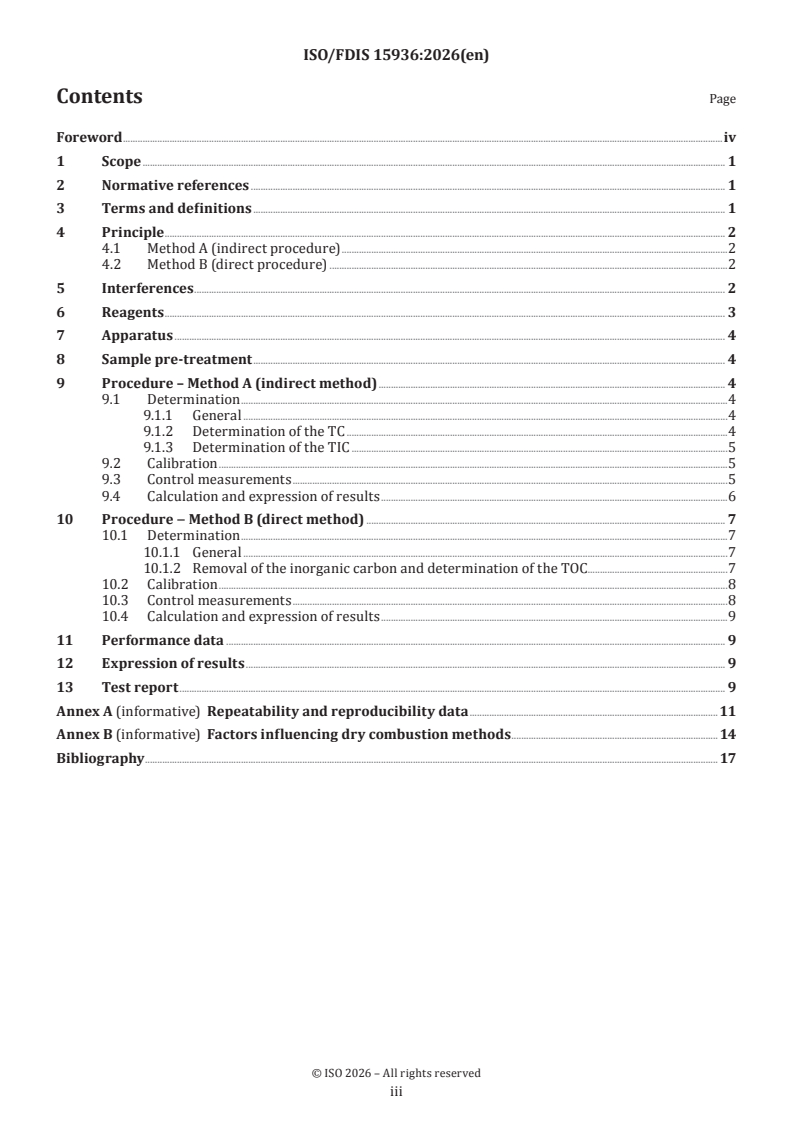
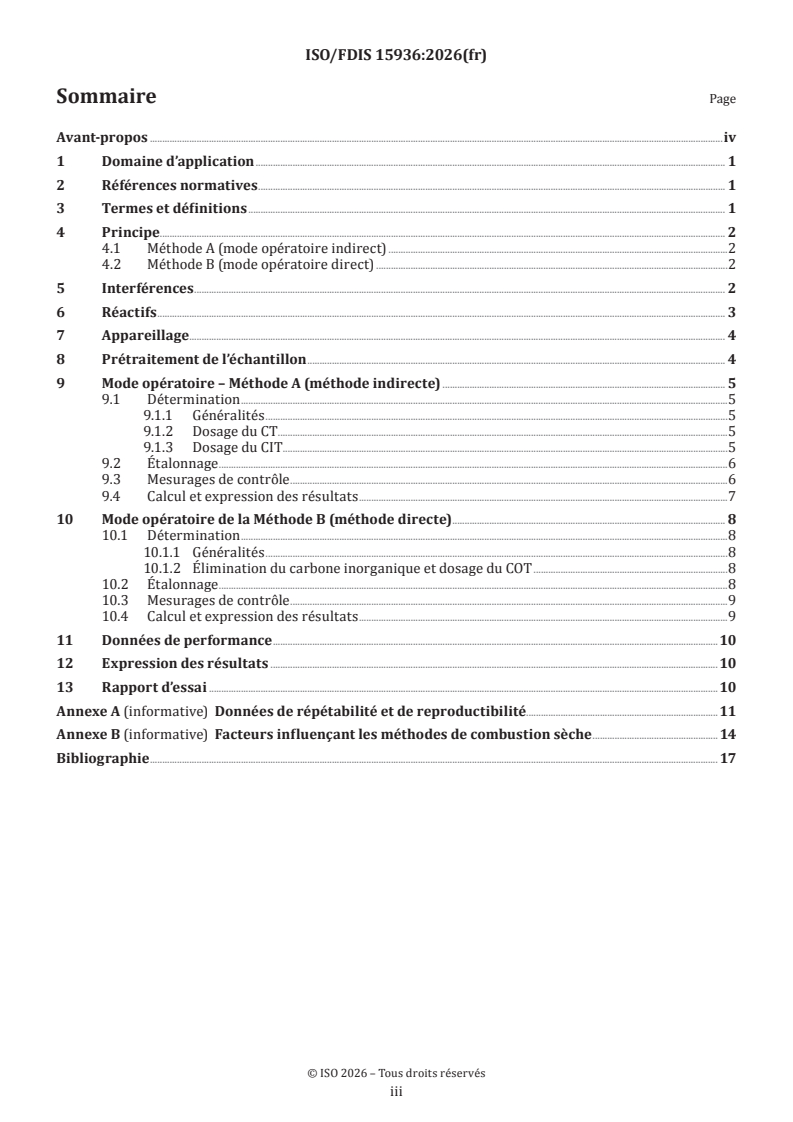
Contents Page
Foreword .iv
1 Scope . 1
2 Normative references . 1
3 Terms and definitions . 1
4 Principle . 2
4.1 Method A (indirect procedure) .2
4.2 Method B (direct procedure) .2
5 Interferences . 2
6 Reagents . 3
7 Apparatus . 4
8 Sample pre-treatment . 4
9 Procedure – Method A (indirect method) . 4
9.1 Determination .4
9.1.1 General .4
9.1.2 Determination of the TC .4
9.1.3 Determination of the TIC .5
9.2 Calibration .5
9.3 Control measurements .5
9.4 Calculation and expression of results .6
10 Procedure ‒ Method B (direct method) . 7
10.1 Determination .7
10.1.1 General .7
10.1.2 Removal of the inorganic carbon and determination of the TOC . .7
10.2 Calibration .8
10.3 Control measurements .8
10.4 Calculation and expression of results .9
11 Performance data . 9
12 Expression of results . 9
13 Test report . 9
Annex A (informative) Repeatability and reproducibility data .11
Annex B (informative) Factors influencing dry combustion methods . 14
Bibliography . 17
iii
Foreword
ISO (the International Organization for Standardization) is a worldwide federation of national standards
bodies (ISO member bodies). The work of preparing International Standards is normally carried out through
ISO technical committees. Each member body interested in a subject for which a technical committee
has been established has the right to be represented on that committee. International organizations,
governmental and non-governmental, in liaison with ISO, also take part in the work. ISO collaborates closely
with the International Electrotechnical Commission (IEC) on all matters of electrotechnical standardization.
The procedures used to develop this document and those intended for its further maintenance are described
in the ISO/IEC Directives, Part 1. In particular, the different approval criteria needed for the different types
of ISO documents should be noted. This document was drafted in accordance with the editorial rules of the
ISO/IEC Directives, Part 2 (see www.iso.org/directives).
ISO draws attention to the possibility that the implementation of this document may involve the use of (a)
patent(s). ISO takes no position concerning the evidence, validity or applicability of any claimed patent
rights in respect thereof. As of the date of publication of this document, ISO had not received notice of (a)
patent(s) which may be required to implement this document. However, implementers are cautioned that
this may not represent the latest information, which may be obtained from the patent database available at
www.iso.org/patents. ISO shall not be held responsible for identifying any or all such patent rights.
Any trade name used in this document is information given for the convenience of users and does not
constitute an endorsement.
For an explanation of the voluntary nature of standards, the meaning of ISO specific terms and expressions
related to conformity assessment, as well as information about ISO’s adherence to the World Trade
Organization (WTO) principles in the Technical Barriers to Trade (TBT), see www.iso.org/iso/foreword.html.
This document was prepared by Technical Committee ISO/TC 190, Soil quality, Subcommittee SC 3, Chemical
and physical characterization, in collaboration with the European Committee for Standardization (CEN)
Technical Committee CEN/TC 444, Environmental characterization of solid matrices, in accordance with the
Agreement on technical cooperation between ISO and CEN (Vienna Agreement).
The first edition of ISO 15936 edition cancels and replaces ISO 10694:1995, which has been technically
revised.
The main changes are as follows:
— the content of EN 15936:2022 and ISO 10694:1995 has been merged;
— the scope has been widened to include treated biowaste, waste and sludge;
— the indirect method for the TOC determination has been added (method A);
Any feedback or questions on this document should be directed to the user’s national standards body. A
complete listing of these bodies can be found at www.iso.org/members.html.
iv
FINAL DRAFT International Standard ISO/FDIS 15936:2026(en)
Soil, waste, treated biowaste and sludge — Determination of
total organic carbon (TOC) by dry combustion
WARNING — Persons using this document should be familiar with usual laboratory practice. This
document does not purport to address all of the safety problems, if any, associated with its use. It is
the responsibility of the user to establish appropriate safety and health practices.
IMPORTANT — The tests conducted according to this document shall be carried out by suitably
trained staff.
1 Scope
This document specifies two methods for the determination of total organic carbon (TOC) in sludge, treated
biowaste, soil and waste samples containing more than 0,1 % carbon in relation to the dry matter (dm).
This document is validated for sludge, biowaste, soil, and waste (see also Annex A for the results of the
validation).
2 Normative references
There are no normative references in this document.
3 Terms and definitions
For the purposes of this document, the following terms and definitions apply.
ISO and IEC maintain terminology databases for use in standardization at the following addresses:
— ISO Online browsing platform: available at https:// www .iso .org/ obp
— IEC Electropedia: available at https:// www .electropedia .org/
3.1
total carbon
TC
quantity of carbon present in the sample in the form of organic, inorganic and elemental carbon
3.2
total inorganic carbon
TIC
quantity of carbon that is liberated as carbon dioxide by acid treatment
Note 1 to entry: Typically, the TIC represents the carbonates present in a sample.
3.3
total organic carbon
TOC
quantity of carbon that is converted into carbon dioxide by combustion and which is not liberated as carbon
dioxide by acid treatment
4 Principle
4.1 Method A (indirect procedure)
In this procedure, the TOC is obtained by the difference between the results of the measurements of TC and
TIC.
The total carbon (TC) present in the sample is converted into carbon dioxide by combustion in an oxygen-
containing gas flow free of carbon dioxide. To ensure complete combustion, catalysts or modifiers, or
both, can be used. The released amount of carbon dioxide is measured by infrared spectrometry, thermal
conductivity detection, or other suitable techniques.
The TIC is determined separately from another sub-sample by means of acidification and purging of the
released carbon dioxide. The carbon dioxide is measured by one of the techniques mentioned above.
4.2 Method B (direct procedure)
In this procedure, the TIC present in the sample is previously removed by treating the sample with acid,
using the method described in 10.1.2. The carbon dioxide released by the following combustion step is
measured by one of the techniques mentioned in 4.1 and indicates the TOC directly.
NOTE The quality of results of Method B is dependent on experience and practice, especially regarding the steps
before the determination of TOC. Use of automatic dispensing units regarding removal of TIC prior to determination of
TOC can improve the performance of Method B.
5 Interferences
Depending on the laboratory experience with samples containing high amounts of TIC, the procedures can
lead to unreliable TOC results if the TIC to TOC ratio is very high (e.g. ≥ 10).
Depending on the detection method used, different interferences can occur, for instance:
— the presence of cyanide can interfere with the coulometric detection of TIC by modifying the pH value
[dissolution of hydrogen cyanide (HCN)];
— high content of halogenated compounds can lead to an underestimation of TIC when coulometric
detection is used and so an overestimation of calculated TOC; in some cases, the classical silver or copper
trap can be insufficient to absorb all halides.
Method B can lead to incorrect results in the following cases.
— Volatile organic substances (e.g. volatile hydrocarbons from sludge of oil separators) can be lost during
sample preparation especially during the acidification. If necessary, the carbon content resulting from
volatile organic substances shall be determined separately.
— Side reactions between the sample and the acid take place (e.g. decarboxylation, volatile reaction
products).
When present, elemental carbon, carbides, cyanides, cyanates, isocyanates, isothiocyanates and thiocyanates
are determined as organic carbon using the methods described in this document. An interpretation of the
measured value can therefore be problematic in cases where the sample contains relevant levels of the
above-mentioned components. If needed, these components shall be determined separately by means of a
suitable validated method and be recorded in the test report.
Depending on the method of detection used, reagents or catalysts, or both, may be required for reduction,
oxidation, removal and/or fixing of combustion gases which interfere with the analysis. These reagents and/
or chemicals shall be used according to the manufacturer’s instruction.
6 Reagents
Use only reagents of recognized analytical grade, unless otherwise specified.
Hygroscopic substances shall be stored in a desiccator.
6.1 Calcium carbonate, CaCO .
6.2 Sodium carbonate, Na CO , anhydrous.
2 3
6.3 Tetrasodium ethylenediamine tetraacetate-tetra-hydrate, Na -EDTA ∙ 4 H O (C H N O Na ∙
4 2 10 12 2 8 4
4 H O), heated at 80 °C for 2 h.
Other forms of Na -EDTA hydrates may be used if the water content is exactly known. In these cases, the
composition of the control mixtures shall be recalculated accordingly (see also 6.10 and 6.11).
6.4 Potassium hydrogen phthalate, C H O K.
8 5 4
6.5 Acetanilide, C H NO.
8 9
6.6 Atropine, C H NO .
17 23 3
6.7 Spectrographic graphite powder, C.
6.8 Sodium salicylate, C H O Na.
7 5 3
6.9 Aluminium oxide, Al O , neutral, granular size < 200 µm, annealed at 600 °C.
2 3
6.10 Control mixture A, prepared from sodium carbonate (6.2), Na -EDTA ∙ 4 H O (6.3) and aluminium
4 2
oxide (6.9) in a mass ratio of 2,34 : 1,00 : 7,28.
The mixture shall be homogenized. It shall contain 2,5 % TIC and 2,5 % TOC (e.g. 22,06 g of sodium carbonate,
9,41 g Na -EDTA ∙ 4 H O, 68,53 g of aluminium oxide).
4 2
Depending on the matrix of interest and manufacturer instructions, control mixtures with higher TIC and
TOC contents may be used additionally.
6.11 Control mixture B, prepared from sodium salicylate (6.8), calcium carbonate (6.1), Na -EDTA · 4 H O
4 2
(6.3) and aluminium oxide (6.9) in a mass ratio of 1,00 : 4,36 : 1,97 : 8,39.
The mixture shall be homogenized. It shall contain 3,3 % TIC and 6,6 % TOC (e.g. 6,36 g of sodium salicylate,
27,78 g of calcium carbonate, 12,50 g of Na4-EDTA · 4 H O, 53,36 g of aluminium oxide).
Depending on the matrix of interest and manufacturer instructions, control mixtures with higher TIC and
TOC contents may be used additionally.
6.12 Non-oxidizing mineral acid, used for carbon dioxide expulsion, e.g. phosphoric acid H PO (w =
3 4
85 %) or sulfurous acid H SO .
3 4
NOTE Due to potential corrosion by hydrochloric acid, phosphoric acid is preferred for TIC determination in
Method A (9.1.3). Due to potential formation of P O during combustion, hydrochloric acid is preferred for removal of
4 10
inorganic carbon in Method B (10.1.2).
6.13 Carrier gas, e.g. synthetic air, nitrogen, oxygen, argon or helium, free of carbon dioxide and organic
impurities in accordance with the manufacturer’s instructions.
6.14 Ethylenediaminetetraacetic acid (EDTA), C H N O .
10 16 2 8
6.15 Glycine, C H NO .
2 5 2
7 Apparatus
7.1 Precision balance, accurate to at least 0,5 % of test portion weight.
7.2 Equipment for determination of carbon in solids, with relevant accessories.
7.3 Purging unit for TIC determination, for Method A only.
7.4 Vessels, made of e.g. ceramic, silica, quartz, silver or platinum.
Tin and nickel vessels are not acid-resistant. Tin vessels are suitable only for Method A. If using sulfurous
acid, nickel boat liners may be used in combination with e.g. ceramic vessels.
8 Sample pre-treatment
Moist or paste-like waste samples may be mixed with aluminium oxide (6.9) until granular material is
obtained and then be ground or crushed to a maximum particle size (D ) ≤ 250 μm. In this case, the ratio of
aluminium oxide to sample shall be considered in the calculation of TOC (according to 9.4 or 10.4).
NOTE 1 For waste samples, the homogeneity is important and often the aluminium oxide step is helpful. More
information is given in Annex B.
All other samples should be pre-treated according to EN 16179 or EN 15002 or ISO 11464 or ISO PWI 21744,
if not otherwise specified. The maximum particle size (D ) shall be ≤ 250 μm. Foreign bodies or material
that can’t be ground or crushed should be separated from the sample and the weight and nature of the
material should be recorded.
NOTE 2 D is the so-called percentile value. It is a statistical parameter that can be read directly from the
cumulative particle size distribution. It indicates the size below which 95 % of all particles are found.
Samples shall be dried. If moist or paste-like waste samples contain – depending on the accuracy requested
for the method – negligible amounts of volatile compounds except water, the samples shall be also dried. The
drying temperature should not exceed 40 °C. The drying method shall be recorded.
NOTE 3 The drying method can affect the result.
9 Procedure – Method A (indirect method)
9.1 Determination
9.1.1 General
The mass of the test portion shall be as large as possible and shall be chosen so that the liberated quantity of
carbon dioxide lies within the working range of the equipment or calibration.
9.1.2 Determination of the TC
To minimize carbon blank values the vessel may be pre-treated by heating (in a muffle furnace or the TC
apparatus itself). The sample prepared according to Clause 8 is weighed into a suitable vessel (7.4).
The sample is combusted or decomposed in a flow of carrier gas containing oxygen (6.13).
The combustion temperature shall be high enough to convert all carbon completely to carbon dioxide.
NOTE For samples containing carbonates, which are difficult to decompose, e.g. barium carbonate, the release
of the carbon dioxide can be improved by increasing the temperature or by the use of modifiers, e.g. tin, copper (see
Clause B.1).
The temperature range of commercially available instruments is between 900 °C and 1 500 °C.
During the combustion of reactive samples, explosion or fuming can be prevented by covering the sample
with inert material e.g. silica sand.
The amount of carbon dioxide released during the combustion is measured e.g. by infrared spectrometry,
thermal conductivity detection, or other suitable techniques, and is expressed as total carbon (TC).
9.1.3 Determination of the TIC
The sample prepared according to Clause 8 is weighed into the purging unit (7.3) or i
...
ISO/TC 190/SC 3
Secretariat: DIN
Date: 2026-07-0809-14
Soil, waste, treated biowaste and sludge – — Determination of total
organic carbon (TOC) by dry combustion
Sols, déchets, biodéchets traités et boues — Dosage du carbone organique total (COT) par combustion sèche
FDIS stage
TThhiis drs draafftt i is s ssuubbmmiitttteedd ttoo aa ppaarraallellel l vvoottee i inn IISSOO,, CCEEN.N.
All rights reserved. Unless otherwise specified, or required in the context of its implementation, no part of this publication
may be reproduced or utilized otherwise in any form or by any means, electronic or mechanical, including photocopying,
or posting on the internet or an intranet, without prior written permission. Permission can be requested from either ISO
at the address below or ISO’s member body in the country of the requester.
ISO copyright office
CP 401 • Ch. de Blandonnet 8
CH-1214 Vernier, Geneva
Phone: + 41 22 749 01 11
EmailE-mail: copyright@iso.org
Website: www.iso.org
Published in Switzerland
ii
Contents
Foreword . iv
1 Scope . 1
2 Normative references . 1
3 Terms and definitions . 1
4 Principle . 2
4.1 Method A (indirect procedure) . 2
4.2 Method B (direct procedure) . 2
5 Interferences . 2
6 Reagents . 3
7 Apparatus . 4
8 Sample pre-treatment . 4
9 Procedure – Method A (indirect method) . 4
9.1 Determination . 4
9.2 Calibration . 5
9.3 Control measurements . 6
9.4 Calculation and expression of results . 6
10 Procedure ‒ Method B (direct method) . 8
10.1 Determination . 8
10.2 Calibration . 8
10.3 Control measurements . 8
10.4 Calculation and expression of results . 9
11 Performance data . 10
12 Expression of results . 10
13 Test report . 10
Annex A (informative) Repeatability and reproducibility data . 11
Annex B (informative) Factors influencing dry combustion methods . 14
Bibliography . 18
iii
Foreword
ISO (the International Organization for Standardization) is a worldwide federation of national standards
bodies (ISO member bodies). The work of preparing International Standards is normally carried out through
ISO technical committees. Each member body interested in a subject for which a technical committee has been
established has the right to be represented on that committee. International organizations, governmental and
non-governmental, in liaison with ISO, also take part in the work. ISO collaborates closely with the
International Electrotechnical Commission (IEC) on all matters of electrotechnical standardization.
The procedures used to develop this document and those intended for its further maintenance are described
in the ISO/IEC Directives, Part 1. In particular, the different approval criteria needed for the different types of
ISO documents should be noted. This document was drafted in accordance with the editorial rules of the
ISO/IEC Directives, Part 2 (see www.iso.org/directives).
ISO draws attention to the possibility that the implementation of this document may involve the use of (a)
patent(s). ISO takes no position concerning the evidence, validity or applicability of any claimed patent rights
in respect thereof. As of the date of publication of this document, ISO had not received notice of (a) patent(s)
which may be required to implement this document. However, implementers are cautioned that this may not
represent the latest information, which may be obtained from the patent database available at
www.iso.org/patents. ISO shall not be held responsible for identifying any or all such patent rights.
Any trade name used in this document is information given for the convenience of users and does not
constitute an endorsement.
For an explanation of the voluntary nature of standards, the meaning of ISO specific terms and expressions
related to conformity assessment, as well as information about ISO'sISO’s adherence to the World Trade
Organization (WTO) principles in the Technical Barriers to Trade (TBT), see www.iso.org/iso/foreword.html.
This document was prepared by Technical Committee ISO/TC 190, Soil quality, Subcommittee SC 3, Chemical
and physical characterization, in collaboration with the European Committee for Standardization (CEN)
Technical Committee CEN/TC 444, Environmental characterization of solid matrices, in accordance with the
Agreement on technical cooperation between ISO and CEN (Vienna Agreement).
The first edition of ISO 15936 edition cancels and replaces ISO 10694:1995, which has been technically
revised.
The main changes are as follows:
— — the content of EN 15936:2022 and ISO 10694:1995 has been merged;
— — the scope has been widened to include treated biowaste, waste and sludge;
— — the indirect method for the TOC determination has been added (method A);
Any feedback or questions on this document should be directed to the user’s national standards body. A
complete listing of these bodies can be found at www.iso.org/members.html.
iv
FINAL DRAFT International Standard ISO/FDIS 15936:2026(en)
Soil, waste, treated biowaste and sludge – — Determination of total
organic carbon (TOC) by dry combustion
WARNING — Persons using this document should be familiar with usual laboratory practice. This
document does not purport to address all of the safety problems, if any, associated with its use. It is
the responsibility of the user to establish appropriate safety and health practices.
IMPORTANT — The tests conducted according to this document shall be carried out by suitably trained
staff.
1 Scope
This document specifies two methods for the determination of total organic carbon (TOC) in sludge, treated
biowaste, soil and waste samples containing more than 0,1 % carbon in relation to the dry matter (dm).
This document is validated for sludge, biowaste, soil, and waste (see also Annex AAnnex A for the results of
the validation).
2 Normative references
There are no normative references in this document.
3 Terms and definitions
For the purposes of this document, the following terms and definitions apply.
ISO and IEC maintain terminology databases for use in standardization at the following addresses:
— — ISO Online browsing platform: available at https://www.iso.org/obp
— — IEC Electropedia: available at https://www.electropedia.org/
3.1 3.1
total carbon
TC
quantity of carbon present in the sample in the form of organic, inorganic and elemental carbon
3.2 3.2
total inorganic carbon
TIC
quantity of carbon that is liberated as carbon dioxide by acid treatment
Note 1 to entry: Typically, the TIC represents the carbonates present in a sample.
3.3 3.3
total organic carbon
TOC
quantity of carbon that is converted into carbon dioxide by combustion and which is not liberated as carbon
dioxide by acid treatment
4 Principle
4.1 Method A (indirect procedure)
In this procedure, the TOC is obtained by the difference between the results of the measurements of TC and
TIC.
The total carbon (TC) present in the sample is converted into carbon dioxide by combustion in an oxygen-
containing gas flow free of carbon dioxide. To ensure complete combustion, catalysts or modifiers, or both,
can be used. The released amount of carbon dioxide is measured e.g. by infrared spectrometry, thermal
conductivity detection, or other suitable techniques.
The TIC is determined separately from another sub-sample by means of acidification and purging of the
released carbon dioxide. The carbon dioxide is measured by one of the techniques mentioned above.
4.2 Method B (direct procedure)
In this procedure, the TIC present in the sample is previously removed by treating the sample with acid, using
the method described in 10.1.210.1.2. The carbon dioxide released by the following combustion step is
measured by one of the techniques mentioned in 4.14.1 and indicates the TOC directly.
NOTE The quality of results of Method B is dependent on experience and practice, especially regarding the steps
before the determination of TOC. Use of automatic dispensing units regarding removal of TIC prior to determination of
TOC can improve the performance of Method B.
5 Interferences
Depending on the laboratory experience with samples containing high amounts of TIC, the procedures can
lead to unreliable TOC results if the TIC to TOC ratio is very high (e.g. ≥ 10).
Depending on the detection method used, different interferences can occur, for instance:
— — the presence of cyanide can interfere with the coulometric detection of TIC by modifying the pH value
[dissolution of hydrogen cyanide (HCN)];
— — high content of halogenated compounds can lead to an underestimation of TIC when coulometric
detection is used and so an overestimation of calculated TOC; in some cases, the classical silver or copper
trap can be insufficient to absorb all halides.
Method B can lead to incorrect results in the following cases:.
— — Volatile organic substances (e.g. volatile hydrocarbons from sludge of oil separators) can be lost during
sample preparation especially during the acidification. If necessary, the carbon content resulting from
volatile organic substances shall be determined separately.
— — sideSide reactions between the sample and the acid take place (e.g. decarboxylation, volatile reaction
products).
When present, elemental carbon, carbides, cyanides, cyanates, isocyanates, isothiocyanates and thiocyanates
are determined as organic carbon using the methods described in this document. An interpretation of the
measured value can therefore be problematic in cases where the sample contains relevant levels of the above-
mentioned components. If needed, these components shall be determined separately by means of a suitable
validated method and be recorded in the test report.
Depending on the method of detection used, reagents or catalysts, or both, may be required for reduction,
oxidation, removal and/or fixing of combustion gases which interfere with the analysis. These reagents and/or
chemicals shall be used according to the manufacturer'smanufacturer’s instruction.
6 Reagents
Use only reagents of recognized analytical grade, unless otherwise specified.
Hygroscopic substances shall be stored in a desiccator.
6.1 6.1 Calcium carbonate, CaCO .
6.2 6.2 Sodium carbonate, Na CO , anhydrous.
2 3
6.3 6.3 Tetrasodium ethylenediamine tetraacetate-tetra-hydrate, Na -EDTA ∙ 4 H O
4 2
(C H N O Na ∙ 4 H O), heated at 80 °C for 2 h.
10 12 2 8 4 2
Other forms of Na -EDTA hydrates may be used if the water content is exactly known. In these cases, the
composition of the control mixtures shall be recalculated accordingly (see also 6.106.10 and 6.116.11).).
6.4 6.4 Potassium hydrogen phthalate, C H O K.
8 5 4
6.5 6.5 Acetanilide, C H NO.
8 9
6.6 6.6 Atropine, C H NO .
17 23 3
6.7 6.7 Spectrographic graphite powder, C.
6.8 6.8 Sodium salicylate, C H O Na.
7 5 3
6.9 6.9 Aluminium oxide, Al O , neutral, granular size < 200 µm, annealed at 600 °C.
2 3
6.10 6.10 Control mixture A, prepared from sodium carbonate (6.2(6.2),), Na -EDTA ∙ 4 H O (6.3(6.3))
4 2
and aluminium oxide (6.9(6.9)) in a mass ratio of 2,34 : 1,00 : 7,28.
The mixture shall be homogenized. It shall contain 2,5 % TIC and 2,5 % TOC (e.g. 22,06 g of sodium carbonate,
9,41 g Na -EDTA ∙ 4 H O, 68,53 g of aluminium oxide).
4 2
NOTE Depending on the matrix of interest and manufacturer instructions, control mixtures with
higher TIC and TOC contents may be used additionally.
6.11 6.11 Control mixture B, prepared from sodium salicylate (6.8(6.8),), calcium carbonate
(6.1(6.1),), Na -EDTA · 4 H O (6.3(6.3)) and aluminium oxide (6.9(6.9)) in a mass ratio of 1,00 : 4,36 : 1,97 :
4 2
8,39.
The mixture shall be homogenized. It shall contain 3,3 % TIC and 6,6 % TOC (e.g. 6,36 g of sodium salicylate,
27,78 g of calcium carbonate, 12,50 g of Na4-EDTA · 4 H O, 53,36 g of aluminium oxide).
NOTE Depending on the matrix of interest and manufacturer instructions, control mixtures with
higher TIC and TOC contents may be used additionally.
6.12 6.12 Non-oxidizing mineral acid, used for carbon dioxide expulsion, e.g. phosphoric acid H PO (w
3 4
= 85 %) or sulfurous acid H SO .
3 4
NOTE Due to potential corrosion by hydrochloric acid, phosphoric acid is preferred for TIC determination in
Method A (9.1.3(9.1.3).). Due to potential formation of P4O10 during combustion, hydrochloric acid is preferred for
removal of inorganic carbon in Method B (10.1.2(10.1.2).).
6.13 6.13 Carrier gas, e.g. synthetic air, nitrogen, oxygen, argon or helium, free of carbon dioxide and
organic impurities in accordance with the manufacturer'smanufacturer’s instructions.
6.14 6.14 Ethylenediaminetetraacetic acid (EDTA), C H N O .
10 16 2 8
6.15 6.15 Glycine, C H NO .
2 5 2
7 Apparatus
7.1 7.1 Precision balance, accurate to at least 0,5 % of test portion weight.
7.2 7.2 Equipment for determination of carbon in solids, with relevant accessories.
7.3 7.3 Purging unit for TIC determination, for Method A only.
7.4 7.4 Vessels, made of e.g. ceramic, silica, quartz, silver or platinum.
NOTE Tin and nickel vessels are not acid-resistant. Tin vessels are suitable only for Method A. If using
sulfurous acid, nickel boat liners may be used in combination with e.g. ceramic vessels.
8 Sample pre-treatment
Moist or paste-like waste samples may be mixed with aluminium oxide (6.9(6.9)) until granular material is
obtained and then be ground or crushed to a maximum particle size (D ) ≤ 250 μm. In this case, the ratio of
aluminium oxide to sample shall be considered in the calculation of TOC (according to 9.49.4 or 10.410.4).).
Note NOTE 1 For waste samples, the homogeneity is important and often the aluminium oxide step is helpful. More
information is given in Annex BAnnex B.
All other samples should be pre-treated according to EN 16179 or EN 15002 or ISO 11464 or ISO PWI 21744,
if not otherwise specified. The maximum particle size (D ) shall be ≤ 250 μm. Foreign bodies or material that
can’t be ground or crushed should be separated from the sample and the weight and nature of the material
should be recorded.
NOTE 2 D95 is the so-called percentile value. It is a statistical parameter that can be read directly from the cumulative
particle size distribution. It indicates the size below which 95 % of all particles are found.
Samples shall be dried. If moist or paste-like waste samples contain – depending on the accuracy requested
for the method – negligible amounts of volatile compounds except water, the samples shall be also dried. The
drying temperature should not exceed 40 ˚C °C. The drying method shall be recorded.
NOTE 3 The drying method can affect the result.
9 Procedure – Method A (indirect method)
9.1 Determination
9.1.1 General
The mass of the test portion shall be as large as possible and shall be chosen so that the liberated quantity of
carbon dioxide lies within the working range of the equipment or calibration.
9.1.2 Determination of the TC
To minimize carbon blank values the vessel may be pre-treated by heating (in a muffle furnace or the TC
apparatus itself). The sample prepared according to Clause 8Clause 8 is weighed into a suitable vessel
(7.4(7.4).).
The sample is combusted or decomposed in a flow of carrier gas containing oxygen (6.13(6.13).).
The combustion temperature shall be high enough to convert all carbon completely to carbon dioxide.
NOTE For samples containing carbonates, which are difficult to decompose, e.g. barium carbonate, the release of the
carbon dioxide can be improved by increasing the temperature or by the use of modifiers, e.g. tin, copper (see
Clause B.1B.1).).
The temperature range of commercially available instruments is between 900 °C and 1 500 °C.
During the combustion of reactive samples, explosion or fuming can be prevented by covering the sample with
inert material e.g. silica sand.
The amount of carbon dioxide released during the combustion is measured e.g. by infrared spectrometry,
thermal conductivity detection, or other suitable techniques, and is expressed as total carbon (TC).
9.1.3 Determination of the TIC
The sample prepared according to Clause 8Clause 8 is weighed into the purging unit (7.3(7.3)) or in the sample
vessel (7.4(7.4).).
The system is closed gas-tight and flushed with carrier gas until no more carbon dioxide from ambient air is
present. Then acid (6.12(6.12)) is added and the carbon dioxide is stripped by purging or stirring, by heating,
or both. The released carbon dioxide is transferred to the detector by the carrier gas.
The addition of wetting agents, e.g. surfactants, can improve wetting of the surface of the sample.
The addition of anti-foaming agents, e.g. silicone oil, can be helpful in the case of strongly foaming samples.
The amount of carbon dioxide released during the gas evolution is measured e.g. by infrared spectrometry,
thermal conductivity detection, or other suitable techniques and is expressed as total inorganic carbon (TIC).
Samples containing persistent carbonates (e.g. concrete, cement) require treatment with hot acid for complete
release of carbon dioxide according to manufacturers'manufacturers’ instructions.
9.2 Calibration
If a relative method is used for detection, e.g. infrared detection, calibration is necessary. Calibration shall be
performed according to the manufacturer'smanufacturer’s instruction.
Examples of calibration substances suitable for TC are calcium carbonate (6.1(6.1),), potassium hydrogen
phthalate (6.4(6.4),), acetanilide (6.5(6.5),), atropine (6.6(6.6),), spectrographic graphite powder (6.7(6.7),),
EDTA (6.14(6.14),), glycine (6.15(6.15).).
The following procedure shall be applied for calibration:
— — Establish the preliminary working range.
— — Measure a minimum of five standard samples. Typically, different sample weights of one calibration
substance are used to cover the calibration range. The absolute amount of carbon of these standard
samples shall be distributed evenly over the requested working range.
— — Calculate the calibration function according to manufacturer'smanufacturer’s instruction for TC and
TIC.
— — Use the calibration function for calculating the mean values of the recovery of each standard sample.
9.3 Control measurements
Control measurements shall be carried out using control mixture A (6.10(6.10)) for the procedures according
to 9.1.29.1.2 (TC) and 9.1.39.1.3 (TIC). For the control measurements, analysis of two sample weights of the
control
...
PROJET FINAL
Norme
internationale
ISO/TC 190/SC 3
Sols, déchets, biodéchets traités
Secrétariat: DIN
et boues — Dosage du carbone
Début de vote:
organique total (COT) par
2026-09-29
combustion sèche
Vote clos le:
2026-11-24
Soil, waste, treated biowaste and sludge — Determination of total
organic carbon (TOC) by dry combustion
LES DESTINATAIRES DU PRÉSENT PROJET SONT
INVITÉS À PRÉSENTER, AVEC LEURS OBSERVATIONS,
NOTIFICATION DES DROITS DE PROPRIÉTÉ DONT ILS
AURAIENT ÉVENTUELLEMENT CONNAISSANCE ET À
FOURNIR UNE DOCUMENTATION EXPLICATIVE.
OUTRE LE FAIT D’ÊTRE EXAMINÉS POUR
ÉTABLIR S’ILS SONT ACCEPTABLES À DES FINS
INDUSTRIELLES, TECHNOLOGIQUES ET COM-MERCIALES,
AINSI QUE DU POINT DE VUE DES UTILISATEURS, LES
PROJETS DE NORMES
TRAITEMENT PARALLÈLE ISO/CEN
INTERNATIONALES DOIVENT PARFOIS ÊTRE CONSIDÉRÉS
DU POINT DE VUE DE LEUR POSSI BILITÉ DE DEVENIR DES
NORMES POUVANT
SERVIR DE RÉFÉRENCE DANS LA RÉGLEMENTATION
NATIONALE.
Numéro de référence
PROJET FINAL
Norme
internationale
ISO/TC 190/SC 3
Sols, déchets, biodéchets traités
Secrétariat: DIN
et boues — Dosage du carbone
Début de vote:
organique total (COT) par
2026-09-29
combustion sèche
Vote clos le:
2026-11-24
Soil, waste, treated biowaste and sludge — Determination of total
organic carbon (TOC) by dry combustion
DOCUMENT PROTÉGÉ PAR COPYRIGHT
© ISO 2026
LES DESTINATAIRES DU PRÉSENT PROJET SONT
Tous droits réservés.
INVITÉS À PRÉSENTER, AVEC LEURS OBSERVATIONS,
NOTIFICATION DES DROITS DE PROPRIÉTÉ DONT ILS
La présente publication de l’ISO est protégée par le droit d’auteur et demeure la propriété de l’ISO et/ou de ses concédants de
AURAIENT ÉVENTUELLEMENT CONNAISSANCE ET À
licence.
FOURNIR UNE DOCUMENTATION EXPLICATIVE.
Le contenu de la présente publication de l’ISO est fourni sous licence, et n’est pas vendu. Son utilisation est soumise aux conditions
OUTRE LE FAIT D’ÊTRE EXAMINÉS POUR
ÉTABLIR S’ILS SONT ACCEPTABLES À DES FINS
de licence applicables définies par l’ISO, un organisme membre de l’ISO, ou un distributeur tiers agréé.
INDUSTRIELLES, TECHNOLOGIQUES ET COM-MERCIALES,
Sous réserve des besoins liés à sa mise en œuvre ou d’une autorisation expresse prévue aux termes d’une licence distincte, aucune
AINSI QUE DU POINT DE VUE DES UTILISATEURS, LES
partie de la présente publication de l’ISO ne peut être reproduite, distribuée, modifiée, utilisée ou mise à disposition sous quelque PROJETS DE NORMES
TRAITEMENT PARALLÈLE ISO/CEN
INTERNATIONALES DOIVENT PARFOIS ÊTRE CONSIDÉRÉS
forme ou par quelque moyen que ce soit – électronique ou mécanique, y compris la photocopie, la numérisation, l’enregistrement
DU POINT DE VUE DE LEUR POSSI BILITÉ DE DEVENIR DES
ou la publication sur des plateformes numériques internes ou externes.
NORMES POUVANT
SERVIR DE RÉFÉRENCE DANS LA RÉGLEMENTATION
Toute utilisation hors du champ d’application des droits accordés est interdite et peut donner lieu à des poursuites judiciaires.
NATIONALE.
ISO copyright office
Case postale 401 • CH-1214 Vernier, Genève
Tél.: +41 22 749 01 11
E-mail: copyright@iso.org
Web: www.iso.org
Publié en Suisse
Numéro de référence
ii
Sommaire Page
Avant-propos .iv
1 Domaine d’application . 1
2 Références normatives . 1
3 Termes et définitions . 1
4 Principe. 2
4.1 Méthode A (mode opératoire indirect) .2
4.2 Méthode B (mode opératoire direct) .2
5 Interférences . 2
6 Réactifs . 3
7 Appareillage . 4
8 Prétraitement de l’échantillon . 4
9 Mode opératoire – Méthode A (méthode indirecte) . 5
9.1 Détermination .5
9.1.1 Généralités .5
9.1.2 Dosage du CT.5
9.1.3 Dosage du CIT . .5
9.2 Étalonnage .6
9.3 Mesurages de contrôle .6
9.4 Calcul et expression des résultats .7
10 Mode opératoire de la Méthode B (méthode directe) . 8
10.1 Détermination .8
10.1.1 Généralités .8
10.1.2 Élimination du carbone inorganique et dosage du COT .8
10.2 Étalonnage .8
10.3 Mesurages de contrôle .9
10.4 Calcul et expression des résultats .9
11 Données de performance .10
12 Expression des résultats . 10
13 Rapport d’essai . 10
Annexe A (informative) Données de répétabilité et de reproductibilité.11
Annexe B (informative) Facteurs influençant les méthodes de combustion sèche . 14
Bibliographie . 17
iii
Avant-propos
L’ISO (Organisation internationale de normalisation) est une fédération mondiale d’organismes nationaux
de normalisation (comités membres de l’ISO). L’élaboration des Normes internationales est en général
confiée aux comités techniques de l’ISO. Chaque comité membre intéressé par une étude a le droit de faire
partie du comité technique créé à cet effet. Les organisations internationales, gouvernementales et non
gouvernementales, en liaison avec l’ISO participent également aux travaux. L’ISO collabore étroitement avec
la Commission électrotechnique internationale (IEC) en ce qui concerne la normalisation électrotechnique.
Les procédures utilisées pour élaborer le présent document et celles destinées à sa mise à jour sont
décrites dans les Directives ISO/IEC, Partie 1. Il convient, en particulier de prendre note des différents
critères d’approbation requis pour les différents types de documents ISO. Le présent document
a été rédigé conformément aux règles de rédaction données dans les Directives ISO/IEC, Partie 2
(voir www.iso.org/directives).
L’ISO attire l’attention sur le fait que la mise en application du présent document peut entraîner l’utilisation
d’un ou de plusieurs brevets. L’ISO ne prend pas position quant à la preuve, à la validité et à l’applicabilité de
tout droit de brevet revendiqué à cet égard. À la date de publication du présent document, l’ISO n’avait pas
reçu notification qu’un ou plusieurs brevets pouvaient être nécessaires à sa mise en application. Toutefois,
il y a lieu d’avertir les responsables de la mise en application du présent document que des informations
plus récentes sont susceptibles de figurer dans la base de données de brevets, disponible à l’adresse
www.iso.org/brevets. L’ISO ne saurait être tenue pour responsable de ne pas avoir identifié tout ou partie de
tels droits de brevet.
Les appellations commerciales éventuellement mentionnées dans le présent document sont données pour
information, par souci de commodité, à l’intention des utilisateurs et ne sauraient constituer un engagement.
Pour une explication de la nature volontaire des normes, la signification des termes et expressions
spécifiques de l’ISO liés à l’évaluation de la conformité, ou pour toute information au sujet de l’adhésion de
l’ISO aux principes de l’Organisation mondiale du commerce (OMC) concernant les obstacles techniques au
commerce (OTC), voir www.iso.org/avant-propos.
Le présent document a été élaboré par le comité technique ISO/TC 190, Qualité du sol, sous-comité SC 3,
Méthodes chimiques et caractéristiques physiques, en collaboration avec le comité technique CEN/TC 444,
Caractérisation environnementale des matrices solides, du Comité européen de normalisation (CEN),
conformément à l’Accord de coopération technique entre l’ISO et le CEN (Accord de Vienne).
Cette première édition de l’ISO 15936 annule et remplace l’ISO 10694:1995, qui a fait l’objet d’une révision
technique.
Les principales modifications sont les suivantes:
— les contenus de l’EN 15936:2022 et de l’ISO 10694:1995 ont été regroupés;
— le champ d’application a été élargi pour inclure les biodéchets traités, les déchets et les boues;
— la méthode indirecte pour la détermination du COT a été ajoutée (méthode A).
Il convient que l’utilisateur adresse tout retour d’information ou toute question concernant le présent
document à l’organisme national de normalisation de son pays. Une liste exhaustive desdits organismes se
trouve à l’adresse www.iso.org/fr/members.html.
iv
PROJET FINAL Norme internationale ISO/FDIS 15936:2026(fr)
Sols, déchets, biodéchets traités et boues — Dosage du
carbone organique total (COT) par combustion sèche
AVERTISSEMENT — Il convient que les utilisateurs du présent document connaissent bien les
pratiques courantes de laboratoire. Le présent document n’a pas pour but de traiter tous les
problèmes de sécurité qui sont, le cas échéant, liés à son utilisation. Il est de la responsabilité de
l’utilisateur d’établir des pratiques appropriées en matière de sécurité et de santé.
IMPORTANT — Les essais réalisés conformément au présent document doivent être exécutés par du
personnel ayant reçu une formation adéquate.
1 Domaine d’application
Le présent document spécifie deux méthodes de dosage du carbone organique total (COT) dans des
échantillons de boues, de biodéchets traités, de sols et de déchets contenant plus de 0,1 % de carbone par
rapport à la matière sèche (ms).
Le présent document est validé pour les boues, les biodéchets, les sols et les déchets (voir également
l’Annexe A pour les résultats de la validation).
2 Références normatives
Le présent document ne contient aucune référence normative.
3 Termes et définitions
Pour les besoins du présent document, les termes et définitions suivants s’appliquent.
L’ISO et l’IEC tiennent à jour des bases de données terminologiques destinées à être utilisées en normalisation,
consultables aux adresses suivantes:
— ISO Online browsing platform: disponible à l’adresse https:// www .iso .org/ obp
— IEC Electropedia: disponible à l’adresse https:// www .electropedia .org/
3.1
carbone total
CT
quantité de carbone présent dans l’échantillon sous forme organique, inorganique et élémentaire
3.2
carbone inorganique total
CIT
quantité de carbone libéré sous forme de dioxyde de carbone par traitement acide
Note 1 à l'article: En général, le CIT représente les carbonates présents dans un échantillon.
3.3
carbone organique total
COT
quantité de carbone transformé en dioxyde de carbone par combustion et qui n’est pas libéré sous forme de
dioxyde de carbone par traitement acide
4 Principe
4.1 Méthode A (mode opératoire indirect)
Dans ce mode opératoire, le COT est obtenu par la différence entre les résultats des mesurages du CT et du
CIT.
Le carbone total (CT) présent dans l’échantillon est transformé en dioxyde de carbone par combustion dans
un flux gazeux contenant de l’oxygène et ne contenant pas de dioxyde de carbone. Pour assurer la combustion
complète, des catalyseurs ou des modificateurs, ou les deux, peuvent être utilisés. La quantité de dioxyde de
carbone libérée est mesurée par spectrométrie infrarouge, par détection de conductivité thermique ou à
l’aide d’une autre technique appropriée.
Le CIT est dosé séparément à partir d’un autre sous-échantillon par acidification et rejet du dioxyde de
carbone libéré. Le dioxyde de carbone est mesuré à l’aide de l’une des techniques mentionnées ci-dessus.
4.2 Méthode B (mode opératoire direct)
Dans ce mode opératoire, le CIT présent dans l’échantillon est préalablement éliminé par traitement
de l’échantillon à l’acide, en utilisant la méthode décrite en 10.1.2. Le dioxyde de carbone libéré au cours
de l’étape de combustion est alors mesuré à l’aide de l’une des techniques mentionnées en 4.1 et indique
directement le COT.
NOTE La qualité des résultats de la Méthode B dépend de l’expérience et de la pratique, notamment concernant les
étapes qui précédent le dosage du COT. L’utilisation de systèmes automatisés de distribution des réactifs pour éliminer
les CIT avant de doser le COT peut améliorer les performances de la Méthode B.
5 Interférences
Selon l’expérience du laboratoire en matière d’échantillons contenant des quantités élevées de CIT, les modes
opératoires peuvent donner lieu à des résultats peu fiables pour le COT si le rapport CIT sur COT est très
élevé (≥10, par exemple).
Selon la méthode de détection utilisée, différentes interférences peuvent se produire, telles que:
— la présence de cyanure peut interférer avec la détection coulométrique du CIT en modifiant la valeur du
pH [dissolution de cyanure d’hydrogène (HCN)];
— une teneur élevée en composés halogénés peut conduire à une sous-estimation du CIT lors de l’utilisation
de la détection coulométrique et du coup à une sur-estimation du COT calculé; dans certains cas, le piège
à argent ou à cuivre classique peut se révéler insuffisant pour absorber tous les halogénures.
La Méthode B peut donner lieu à des résultats incorrects dans les cas suivants.
— Perte de substances organiques volatiles (par exemple, hydrocarbures volatils issus des boues de
déshuileurs) lors de la préparation de l’échantillon, en particulier lors de l’acidification. Si nécessaire, la
teneur en carbone des substances organiques volatiles doit être déterminée séparément.
— Réactions secondaires entre l’échantillon et l’acide (décarboxylation, produits réactionnels volatils, par
exemple).
S’ils sont présents, le carbone élémentaire, les carbures, les cyanures, les cyanates, les isocyanates, les
isothiocyanates et les thiocyanates sont déterminés en tant que carbone organique par les méthodes décrites
dans le présent document. Il peut donc se révéler difficile d’interpréter la valeur mesurée si l’échantillon
contient des niveaux significatifs des composants mentionnés ci-dessus. Si nécessaire, ces composants
doivent être déterminés séparément au moyen d’une méthode validée adaptée, puis être intégrés dans le
rapport d’essai.
Selon la méthode de détection utilisée, des réactifs ou des catalyseurs, ou les deux, peuvent être requis pour
la réduction, l’oxydation, l’élimination et/ou la fixation des gaz de combustion qui interfèrent avec l’analyse.
Ces réactifs et/ou produits chimiques doivent être utilisés conformément aux instructions du fabricant.
6 Réactifs
Sauf spécification contraire, utiliser uniquement des réactifs de qualité analytique reconnue.
Les substances hygroscopiques doivent être conservées dans un dessiccateur.
6.1 Carbonate de calcium, CaCO .
6.2 Carbonate de calcium, Na CO , anhydre.
2 3
6.3 Éthylènediaminetétraacétate-tétrahydrate de tétrasodium, Na -EDTA ∙ 4 H O (C H N O Na ∙
4 2 10 12 2 8 4
4 H O), chauffé à 80 °C pendant 2 h.
D’autres formes d’hydrates Na -EDTA peuvent être utilisées si leur teneur exacte en eau est connue. Dans
ces cas, la composition des mélanges de contrôle doit être recalculée en conséquence (voir également 6.10
et 6.11).
6.4 Hydrogénophtalate de potassium, C H O K.
8 5 4
6.5 Acétanilide, C H NO.
8 9
6.6 Atropine, C H NO .
17 23 3
6.7 Poudre de graphite spectrographique, C.
6.8 Salicylate de sodium, C H O Na.
7 5 3
6.9 Oxyde d’aluminium Al O , neutre, granulométrie < 200 µm, recuit à 600 °C.
2 3
6.10 Mélange de contrôle A, à base de carbonate de sodium (6.2), Na -EDTA ∙ 4 H O (6.3) et d’oxyde
4 2
d’aluminium (6.9) dans un rapport massique de 2,34: 1,00: 7,28.
Le mélange doit être homogénéisé. Il doit contenir 2,5 % de CIT et 2,5 % de COT (22,06 g de carbonate de
sodium, 9,41 g de Na -EDTA ∙ 4 H O, 68,53 g g d’oxyde d’aluminium, par exemple).
4 2
Selon la matrice étudiée et les instructions du fabricant, des mélanges de contrôle ayant des teneurs en CIT
et en COT plus élevées peuvent être utilisés en plus.
6.11 Mélange de contrôle B, à base de salicylate de sodium (6.8), de carbonate de calcium (6.1), de Na -
EDTA · 4 H O (6.3) et d’oxyde d’aluminium (6.9) dans un rapport massique de 1,00: 4,36: 1,97: 8,39.
Le mélange doit être homogénéisé. Il doit contenir 3,3 % de CIT et 6,6 % de COT (6,36 g de salicylate de
sodium, 27,78 g de carbonate de calcium, 12,50 g de Na4-EDTA · 4 H O, 53,36 g d’oxyde d’aluminium, par
exemple).
Selon la matrice étudiée et les instructions du fabricant, des mélanges de contrôle ayant des teneurs en CIT
et en COT plus élevées peuvent être utilisés en plus.
6.12 Acide minéral non oxydant, utilisé pour expulser le dioxyde de carbone, par exemple acide
phosphorique H PO (w = 85 % ou acide sulfureux H SO .
3 4 3 4
NOTE En raison du risque de corrosion par l’acide chlorhydrique, l’acide phosphorique est à privilégier pour le
dosage du CIT dans la Méthode A (9.1.3). En raison de la formation potentielle de P O au cours de la combustion,
4 10
l’acide chlorhydrique est à privilégier pour l’élimination du carbone inorganique dans la Méthode B (10.1.2).
6.13 Gaz porteur, par exemple air synthétique, azote, oxygène, argon ou hélium, exempt de dioxyde de
carbone et d’impuretés organiques conformément aux instructions du fabricant.
6.14 Acide éthylènediaminetétraacétique (EDTA), C H N O .
10 16 2 8
6.15 Glycine, C H NO .
2 5 2
7 Appareillage
7.1 Balance de précision, d’une précision correspondant à au moins 0,5 % du poids de la prise d’essai.
7.2 Équipement pour le dosage du carbone dans les solides, avec les accessoires appropriés.
7.3 Unité de purge pour le dosage du CIT, uniquement pour la Méthode A.
7.4 Récipients, en céramique, silice, quartz, argent ou platine.
Les récipients en étain et en nickel ne résistent pas à l’acide. Les récipients en étain sont adaptés à la
Méthode À uniquement. En cas d’utilisation d’acide sulfureux, des récipients munis d’un revêtement intérieur
en nickel peuvent être utilisés en combinaison avec, par exemple, des récipients en céramique.
8 Prétraitement de l’échantillon
Les échantillons humides ou pâteux peuvent être mélangés à de l’oxyde d’aluminium (6.9) jusqu’à obtention
d’un matériau granulaire, puis être broyés ou réduit mécaniquement à une taille maximale de particules
(D ) ≤ 250 μm. Dans ce cas, la teneur en oxyde d’aluminium de l’échantillon doit être prise en compte dans
le calcul du COT (conformément à 9.4 ou 10.4).
NOTE 1 L’homogénéité joue un rôle essentiel pour les échantillons de déchets et l’étape impliquant l’oxyde
d’aluminium se révèle souvent utile. L’Annexe B fournit plus d’informations.
Il convient que tous les autres échantillons soient prétraités conformément à l’EN 16179 ou à l’EN 15002 ou
à l’ISO 11464 ou à l’ISO PWI 21744, sauf indication contraire. La taille maximale des particules (D ) doit
être ≤ 250 μm. Il convient de séparer les corps étrangers ou les matériaux qui ne peuvent pas être broyés ou
réduits mécaniquement de l’échantillon et d’enregistrer le poids et la nature des matériaux.
NOTE 2 D est la valeur percentile. Il s’agit d’un paramètre statistique qui peut être lu directement sur la répartition
granulométrique cumulative. Il indique la taille en dessous de laquelle se trouvent 95 % de toutes les particules.
Les échantillons doivent être séchés. Si les échantillons humides ou pâteux contiennent – selon l’exactitude
demandée pour la méthode – des quantités négligeables de composés volatils autres que l’eau, ils doivent
également être séchés. Il convient que la température de séchage ne dépasse pas 40 °C. La méthode de
séchage doit être enregistrée.
NOTE 3 La méthode de séchage peut influencer le résultat.
9 Mode opératoire – Méthode A (méthode indirecte)
9.1 Détermination
9.1.1 Généralités
La masse de la prise d’essai doit être aussi élevée que possible et elle doit être choisie de sorte que la quantité
libérée de dioxyde de carbone se situe dans l’étendue de mesure de l’appareillage ou l’étalonnage.
9.1.2 Dosage du CT
Pour limiter les valeurs du blanc en carbone, le récipient peut être préalablement traité par chauffage
(dans un four à moufle ou dans l’appareillage pour CT lui-même). Peser l’échantillon préparé conformément
à l’Article 8 dans un récipient approprié (7.4).
L’échantillon est calciné ou décomposé dans un flux de gaz porteur contenant de l’oxygène (6.13).
La température de combustion doit être suffisamment élevée pour transformer l’intégralité du carbone en
dioxyde de carbone.
NOTE Pour les échantillons contenant des carbonates, qui sont difficiles à décomposer, tels que le carbonate de
baryum, il est possible de faciliter la libération du dioxyde de carbone en augmentant la température ou en utilisant
des modificateurs, tels que de l’étain ou du cuivre (voir B.1).
La plage de température des instruments disponibles dans le commerce est comprise entre 900 °C et
1 500 °C.
Lors de la combustion des échantillons réactifs, il est possible d’empêcher les explosions ou les émanations
en recouvrant l’échantillon avec des matières inertes, telles que du sable de silice.
La quantité de dioxyde de carbone libérée au cours de la combustion est mesurée, par exemple, par
spectrométrie infrarouge, par détection de conductivité thermique ou à l’aide d’une autre technique
appropriée et est exprimée sous forme de carbone total (CT).
9.1.3 Dosage du CIT
Peser l’échantillon préparé conformément à l’Article 8 dans l’unité de purge (7.3) ou dans le récipient de
l’échantillon (7.4).
Le système est fermé pour être étanche au gaz, puis purgé avec le gaz porteur jusqu’à élimination totale
du dioxyde de carbone de l’air ambiant. Ajouter ensuite de l’acide (6.12) et évacuer le dioxyde de carbone
par purge ou par agitation ou
...