

ISO 5501-3:2024
(Main)Tobacco heating systems — Definitions and standard conditions for aerosol generation and collection — Part 3: Carbon heated tobacco products (cHTPs)
General Information
- Abstract
This document: — defines the parameters and specifies the standard conditions for the routine analytical generation and collection of aerosol from carbon heated tobacco products (cHTP); — specifies technical requirements for the routine analytical puffing machine for cHTP generation and collection of aerosol, termed as “machine” in this document, conforming with the standard conditions stated within Clause 4; This document does not specify aerosol trapping nor subsequent sample preparation and analytical method of components in the trapped aerosol or the gas phase. This document is also applicable to products other than defined in 3.14 if a specific method references this document.
- Status
- Published
- Publication Date
- 23-May-2024
- Technical Committee
- ISO/TC 126 - Tobacco and tobacco products
- Drafting Committee
- ISO/TC 126 - Tobacco and tobacco products
- Current Stage
- 6060 - International Standard published
- Start Date
- 24-May-2024
- Due Date
- 18-Jun-2024
- Completion Date
- 24-May-2024
Buy Documents

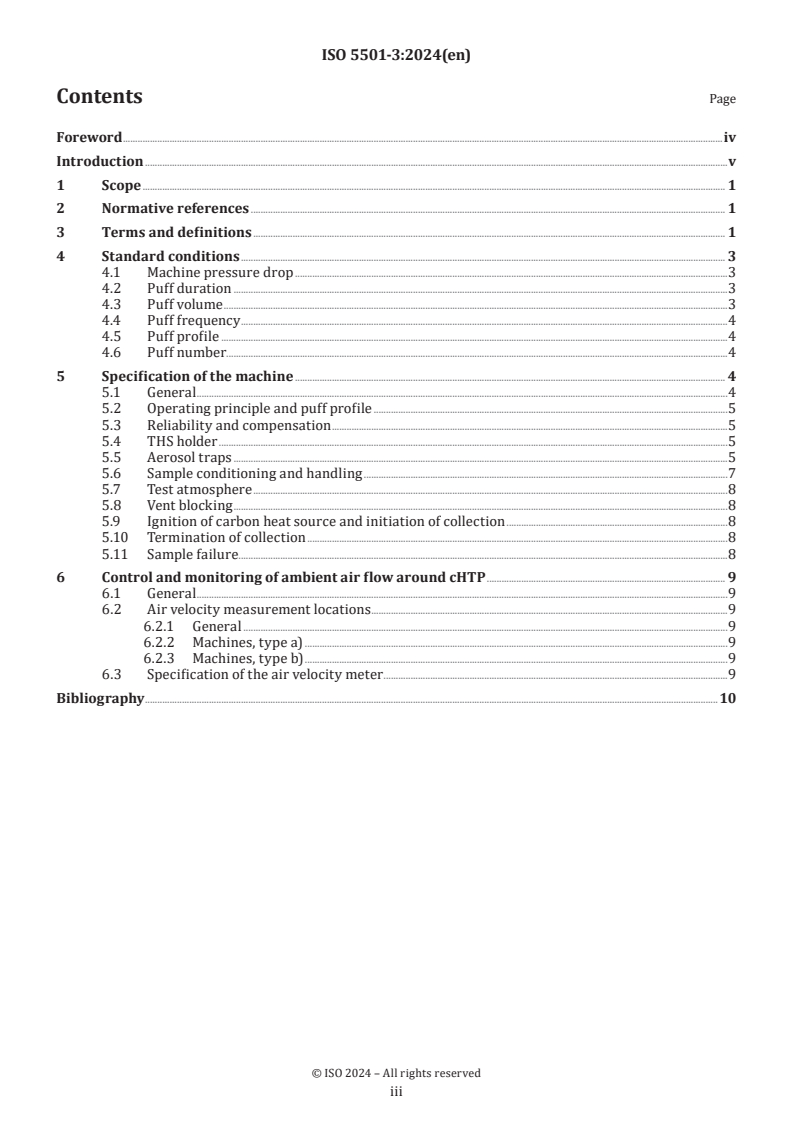

ISO 5501-3:2024 - Tobacco heating systems — Definitions and standard conditions for aerosol generation and collection — Part 3: Carbon heated tobacco products (cHTPs) Released:24. 05. 2024

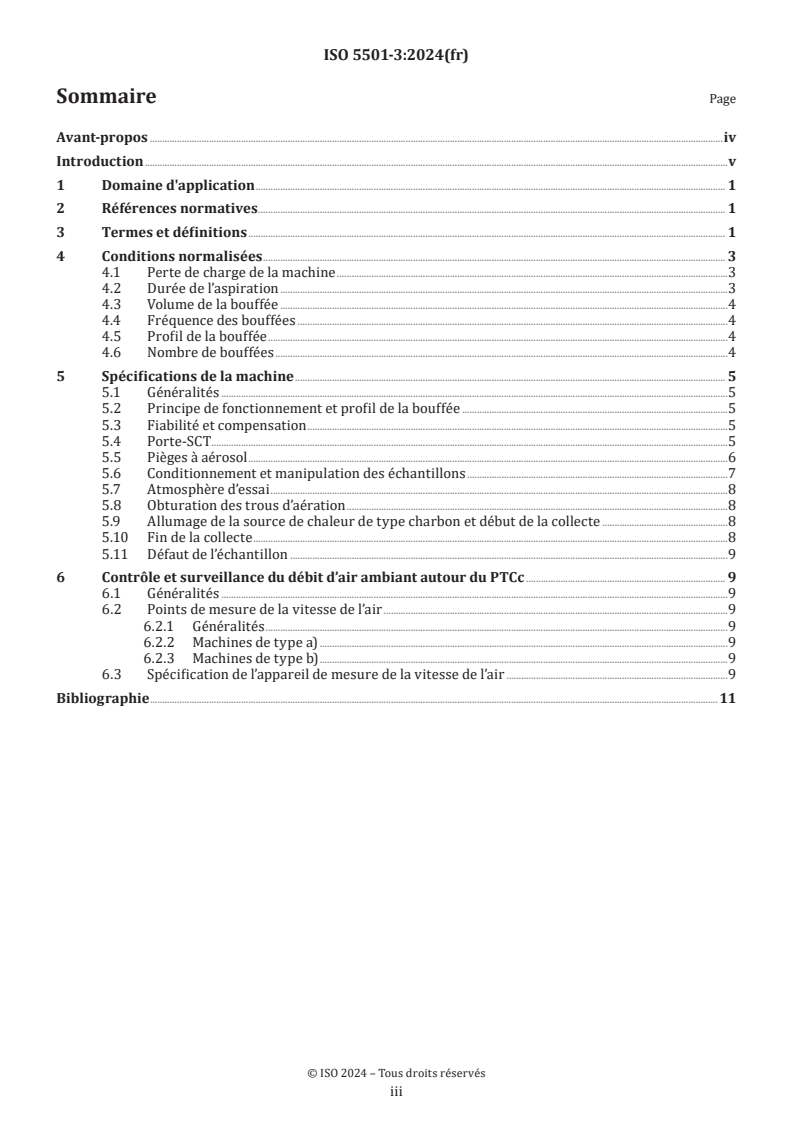
ISO 5501-3:2024 - Systemes de chauffage du tabac — Définitions et conditions normalisées pour la génération et la collecte d’aérosol — Partie 3: Produits de tabac chauffés par un charbon (PTCc) Released:24. 05. 2024
Overview
ISO 5501-3:2024 - "Tobacco heating systems - Definitions and standard conditions for aerosol generation and collection - Part 3: Carbon heated tobacco products (cHTPs)" - establishes standardized parameters and technical requirements for routine analytical generation and collection of aerosol from carbon heated tobacco products (cHTPs). The standard defines the puffing regime, machine performance limits and key terminology to ensure reproducible, comparable aerosol sampling for laboratory analysis. It does not specify aerosol trapping media, sample preparation or chemical analysis methods.
Key topics and technical requirements
The document sets mandatory standard conditions and machine specifications for cHTP aerosol testing, including:
- Machine pressure drop: whole flow path pressure drop shall not exceed 300 Pa.
- Puff duration:(2.00 ± 0.02) s.
- Puff volume:(55.0 ± 0.6) ml, measured at the machine port in series with a 1 000 ± 50 Pa pressure-drop device.
- Puff frequency: one puff starting every (30.0 ± 0.5) s.
- Puff profile: bell-shaped profile with maximum flow between 0.8 s and 1.2 s, maximum flow rate 40–50 ml/s, and no flow reversal; profile measured with the 1 000 ± 50 Pa impedance.
- Puff number: each puff counted and recorded; machines must allow preset puff counts or manual termination.
Other machine and test-system requirements addressed:
- Operating principle (fixed-volume puffing device) and compensation for pressure-drop changes.
- Specification of the THS holder, aerosol traps, sample conditioning, test atmosphere and vent blocking.
- Procedures for ignition of the carbon heat source, initiation and termination of collection, and handling of sample failures.
- Control and monitoring of ambient air flow around cHTP devices, including air-velocity measurement considerations.
Applications and users
ISO 5501-3:2024 is intended for:
- Analytical laboratories performing routine emissions testing of cHTPs.
- Manufacturers and test-engineers designing or qualifying puffing machines and THS holders.
- Regulatory bodies and standards developers who require consistent, reproducible aerosol generation data for product characterization and compliance assessment.
- Researchers evaluating design changes, emissions, or comparative performance of carbon-heated tobacco products.
Machine-based aerosol testing supports product development, quality control and inputs to hazard assessment; it is not a surrogate for human exposure or risk measurement.
Related standards
- ISO 6080 (Tobacco heating systems - Vocabulary)
- ISO 3402 (Atmosphere for conditioning and testing)
- References used for puff definitions and measurement practice: ISO 20778, ISO 3308 and ISO 4387 (as cited)
Keywords: ISO 5501-3:2024, carbon heated tobacco products, cHTP, tobacco heating systems, aerosol generation, puffing machine, puff profile, puff volume, puff duration, aerosol collected mass.
Buy Documents
ISO 5501-3:2024 - Tobacco heating systems — Definitions and standard conditions for aerosol generation and collection — Part 3: Carbon heated tobacco products (cHTPs) Released:24. 05. 2024
ISO 5501-3:2024 - Systemes de chauffage du tabac — Définitions et conditions normalisées pour la génération et la collecte d’aérosol — Partie 3: Produits de tabac chauffés par un charbon (PTCc) Released:24. 05. 2024
Get Certified
Connect with accredited certification bodies for this standard

Control Union Certifications
Global certification for agriculture and sustainability.

ECOCERT
Organic and sustainability certification.

FSC International
Forest Stewardship Council certification.
Sponsored listings
Frequently Asked Questions
ISO 5501-3:2024 is a standard published by the International Organization for Standardization (ISO). Its full title is "Tobacco heating systems — Definitions and standard conditions for aerosol generation and collection — Part 3: Carbon heated tobacco products (cHTPs)". This standard covers: This document: — defines the parameters and specifies the standard conditions for the routine analytical generation and collection of aerosol from carbon heated tobacco products (cHTP); — specifies technical requirements for the routine analytical puffing machine for cHTP generation and collection of aerosol, termed as “machine” in this document, conforming with the standard conditions stated within Clause 4; This document does not specify aerosol trapping nor subsequent sample preparation and analytical method of components in the trapped aerosol or the gas phase. This document is also applicable to products other than defined in 3.14 if a specific method references this document.
This document: — defines the parameters and specifies the standard conditions for the routine analytical generation and collection of aerosol from carbon heated tobacco products (cHTP); — specifies technical requirements for the routine analytical puffing machine for cHTP generation and collection of aerosol, termed as “machine” in this document, conforming with the standard conditions stated within Clause 4; This document does not specify aerosol trapping nor subsequent sample preparation and analytical method of components in the trapped aerosol or the gas phase. This document is also applicable to products other than defined in 3.14 if a specific method references this document.
ISO 5501-3:2024 is classified under the following ICS (International Classification for Standards) categories: 65.160 - Tobacco, tobacco products and related equipment. The ICS classification helps identify the subject area and facilitates finding related standards.
ISO 5501-3:2024 is available in PDF format for immediate download after purchase. The document can be added to your cart and obtained through the secure checkout process. Digital delivery ensures instant access to the complete standard document.
Standards Content (Sample)
International
Standard
ISO 5501-3
First edition
Tobacco heating systems —
2024-05
Definitions and standard conditions
for aerosol generation and
collection —
Part 3:
Carbon heated tobacco products
(cHTPs)
Systèmes de chauffage du tabac — Définitions et conditions
normalisées pour la génération et la collecte d’aérosol —
Partie 3: Produits de tabac chauffés par un charbon (PTCc)
Reference number
© ISO 2024
All rights reserved. Unless otherwise specified, or required in the context of its implementation, no part of this publication may
be reproduced or utilized otherwise in any form or by any means, electronic or mechanical, including photocopying, or posting on
the internet or an intranet, without prior written permission. Permission can be requested from either ISO at the address below
or ISO’s member body in the country of the requester.
ISO copyright office
CP 401 • Ch. de Blandonnet 8
CH-1214 Vernier, Geneva
Phone: +41 22 749 01 11
Email: copyright@iso.org
Website: www.iso.org
Published in Switzerland
ii
Contents Page
Foreword .iv
Introduction .v
1 Scope . 1
2 Normative references . 1
3 Terms and definitions . 1
4 Standard conditions . 3
4.1 Machine pressure drop .3
4.2 Puff duration .3
4.3 Puff volume .3
4.4 Puff frequency .4
4.5 Puff profile .4
4.6 Puff number.4
5 Specification of the machine . 4
5.1 General .4
5.2 Operating principle and puff profile .5
5.3 Reliability and compensation .5
5.4 THS holder .5
5.5 Aerosol traps .5
5.6 Sample conditioning and handling .7
5.7 Test atmosphere .8
5.8 Vent blocking .8
5.9 Ignition of carbon heat source and initiation of collection .8
5.10 Termination of collection .8
5.11 Sample failure . .8
6 Control and monitoring of ambient air flow around cHTP . 9
6.1 General .9
6.2 Air velocity measurement locations .9
6.2.1 General .9
6.2.2 Machines, type a) .9
6.2.3 Machines, type b) .9
6.3 Specification of the air velocity meter .9
Bibliography .10
iii
Foreword
ISO (the International Organization for Standardization) is a worldwide federation of national standards
bodies (ISO member bodies). The work of preparing International Standards is normally carried out through
ISO technical committees. Each member body interested in a subject for which a technical committee
has been established has the right to be represented on that committee. International organizations,
governmental and non-governmental, in liaison with ISO, also take part in the work. ISO collaborates closely
with the International Electrotechnical Commission (IEC) on all matters of electrotechnical standardization.
The procedures used to develop this document and those intended for its further maintenance are described
in the ISO/IEC Directives, Part 1. In particular, the different approval criteria needed for the different types
of ISO document should be noted. This document was drafted in accordance with the editorial rules of the
ISO/IEC Directives, Part 2 (see www.iso.org/directives).
ISO draws attention to the possibility that the implementation of this document may involve the use of (a)
patent(s). ISO takes no position concerning the evidence, validity or applicability of any claimed patent
rights in respect thereof. As of the date of publication of this document, ISO had not received notice of (a)
patent(s) which may be required to implement this document. However, implementers are cautioned that
this may not represent the latest information, which may be obtained from the patent database available at
www.iso.org/patents. ISO shall not be held responsible for identifying any or all such patent rights.
Any trade name used in this document is information given for the convenience of users and does not
constitute an endorsement.
For an explanation of the voluntary nature of standards, the meaning of ISO specific terms and expressions
related to conformity assessment, as well as information about ISO's adherence to the World Trade
Organization (WTO) principles in the Technical Barriers to Trade (TBT), see www.iso.org/iso/foreword.html.
This document was prepared by Technical Committee ISO/TC 126, Tobacco and tobacco products.
A list of all parts in the ISO 5501 series can be found on the ISO website.
Any feedback or questions on this document should be directed to the user’s national standards body. A
complete listing of these bodies can be found at www.iso.org/members.html.
iv
Introduction
Tobacco heating systems (THS) are designed to heat a tobacco substrate, to produce a nicotine-containing
aerosol without the combustion of the tobacco substrate. A THS is a combination of a heated tobacco product
(HTP) and a tobacco heating device (THD). The HTP part of the THS, is a product containing a tobacco
substrate that is designed to be heated and not combusted.
With the emerging development and commercialisation of HTPs, there are a number of different approaches
to heating the HTP, categorised as electrically, aerosol and carbon, HTPs; eHTP, aHTP and cHTP, respectively
(see ISO 6080).
This document has been developed to define and specify the requirements for a carbon heated tobacco
product (cHTP) puffing regime in order to generate and collect aerosol for subsequent analytical
measurement in a robust and reproducible manner.
No machine puffing regime can represent all human use behaviour, so dependent on the testing requirement
it may be appropriate to test cHTPs differently according to their design, or under conditions of different
intensity to reflect the range of human behaviour.
Machine testing is useful to characterize emissions for product development and regulatory purposes and
may be used as inputs for product hazard assessment; however, it is not intended to be nor is it valid as a
measure of human exposure or risk.
NOTE This document is a reference document for ISO standards on tobacco heating systems (e.g. ISO 5501).
Regulation and standardisation are independent from each other, and standardisation does not pre-empt regulation.
v
International Standard ISO 5501-3:2024(en)
Tobacco heating systems — Definitions and standard
conditions for aerosol generation and collection —
Part 3:
Carbon heated tobacco products (cHTPs)
1 Scope
This document:
— defines the parameters and specifies the standard conditions for the routine analytical generation and
collection of aerosol from carbon heated tobacco products (cHTP);
— specifies technical requirements for the routine analytical puffing machine for cHTP generation and
collection of aerosol, termed as “machine” in this document, conforming with the standard conditions
stated within Clause 4;
This document does not specify aerosol trapping nor subsequent sample preparation and analytical method
of components in the trapped aerosol or the gas phase.
This document is also applicable to products other than defined in 3.14 if a specific method references this
document.
2 Normative references
The following document is referred to in the text in such a way that some or all of their content constitutes
requirements of this document. For dated references, only the edition cited applies. For undated references,
the latest edition of the referenced document (including any amendments) applies.
ISO 3402, Tobacco and tobacco products — Atmosphere for conditioning and testing
ISO 6080, Tobacco heating systems — Vocabulary
3 Terms and definitions
For the purposes of this document, the terms and definitions given in ISO 6080 and the following apply.
ISO and IEC maintain terminological databases for use in standardization at the following addresses:
— ISO Online browsing platform: available at https:// www .iso .org/ obp
— IEC Electropedia: available at https:// www .electropedia .org/
3.1
test atmosphere
atmosphere to which the cHTP is exposed throughout the test
3.2
pressure drop
static pressure difference between the two ends of a pneumatic circuit when it is traversed by an air flow
under steady conditions as described in ISO 7210
Note 1 to entry: Although the pressure drop of a device or a pneumatic circuit is defined for a specific set of reference
parameters to describe its physical properties, the device could be used for measurements under conditions other
than the reference parameters.
[SOURCE: ISO 20778:2018, 3.4]
3.3
puff duration
interval of time, measured in seconds, during which the port of the machine is pneumatically connected to
the suction mechanism
[SOURCE: ISO 20778:2018, 3.6]
3.4
puff volume
volume leaving the cHTP and passing through the aerosol trap
3.5
puff frequency
number of puffs in a given time
[SOURCE: ISO 3308:2012, 3.10]
3.6
puff profile
flow rate measured over the time span of the puff at the port of the machine, typically depicted graphically
as a function of time
3.7
puff number
number of puffs coll
...
Norme
internationale
ISO 5501-3
Première édition
Systèmes de chauffage du
2024-05
tabac — Définitions et conditions
normalisées pour la génération et la
collecte d’aérosol —
Partie 3:
Produits de tabac chauffés par un
charbon (PTCc)
Tobacco heating systems — Definitions and standard conditions
for aerosol generation and collection —
Part 3: Carbon heated tobacco products (cHTPs)
Numéro de référence
ISO 5501-3:2024(fr)
DOCUMENT PROTÉGÉ PAR COPYRIGHT
© ISO 2024
Tous droits réservés. Sauf prescription différente ou nécessité dans le contexte de sa mise en œuvre, aucune partie de cette
publication ne peut être reproduite ni utilisée sous quelque forme que ce soit et par aucun procédé, électronique ou mécanique,
y compris la photocopie, ou la diffusion sur l’internet ou sur un intranet, sans autorisation écrite préalable. Une autorisation peut
être demandée à l’ISO à l’adresse ci-après ou au comité membre de l’ISO dans le pays du demandeur.
ISO copyright office
Case postale 401 • Ch. de Blandonnet 8
CH-1214 Vernier, Genève
Tél.: +41 22 749 01 11
E-mail: copyright@iso.org
Web: www.iso.org
Publié en Suisse
ii
ISO 5501-3:2024(fr)
Sommaire Page
Avant-propos .iv
Introduction .v
1 Domaine d'application . 1
2 Références normatives . 1
3 Termes et définitions . 1
4 Conditions normalisées . 3
4.1 Perte de charge de la machine .3
4.2 Durée de l’aspiration .3
4.3 Volume de la bouffée .4
4.4 Fréquence des bouffées .4
4.5 Profil de la bouffée .4
4.6 Nombre de bouffées .4
5 Spécifications de la machine . 5
5.1 Généralités .5
5.2 Principe de fonctionnement et profil de la bouffée .5
5.3 Fiabilité et compensation .5
5.4 Porte-SCT . .5
5.5 Pièges à aérosol .6
5.6 Conditionnement et manipulation des échantillons .7
5.7 Atmosphère d’essai .8
5.8 Obturation des trous d’aération .8
5.9 Allumage de la source de chaleur de type charbon et début de la collecte .8
5.10 Fin de la collecte .8
5.11 Défaut de l’échantillon .9
6 Contrôle et surveillance du débit d’air ambiant autour du PTCc . 9
6.1 Généralités .9
6.2 Points de mesure de la vitesse de l’air .9
6.2.1 Généralités .9
6.2.2 Machines de type a) .9
6.2.3 Machines de type b) .9
6.3 Spécification de l’appareil de mesure de la vitesse de l’air .9
Bibliographie .11
iii
ISO 5501-3:2024(fr)
Avant-propos
L’ISO (Organisation internationale de normalisation) est une fédération mondiale d’organismes nationaux
de normalisation (comités membres de l’ISO). L’élaboration des Normes internationales est en général
confiée aux comités techniques de l’ISO. Chaque comité membre intéressé par une étude a le droit de faire
partie du comité technique créé à cet effet. Les organisations internationales, gouvernementales et non
gouvernementales, en liaison avec l’ISO participent également aux travaux. L’ISO collabore étroitement avec
la Commission électrotechnique internationale (IEC) en ce qui concerne la normalisation électrotechnique.
Les procédures utilisées pour élaborer le présent document et celles destinées à sa mise à jour sont
décrites dans les Directives ISO/IEC, Partie 1. Il convient, en particulier, de prendre note des différents
critères d'approbation requis pour les différents types de documents ISO. Le présent document
a été rédigé conformément aux règles de rédaction données dans les Directives ISO/IEC, Partie 2
(voir www.iso.org/directives).
L’ISO attire l’attention sur le fait que la mise en application du présent document peut entraîner l’utilisation
d’un ou de plusieurs brevets. L’ISO ne prend pas position quant à la preuve, à la validité et à l’applicabilité de
tout droit de propriété revendiqué à cet égard. À la date de publication du présent document, l’ISO n'avait pas
reçu notification qu’un ou plusieurs brevets pouvaient être nécessaires à sa mise en application. Toutefois,
il y a lieu d’avertir les responsables de la mise en application du présent document que des informations
plus récentes sont susceptibles de figurer dans la base de données de brevets, disponible à l'adresse
www.iso.org/brevets. L’ISO ne saurait être tenue pour responsable de ne pas avoir identifié tout ou partie de
tels droits de propriété.
Les appellations commerciales éventuellement mentionnées dans le présent document sont données pour
information, par souci de commodité, à l’intention des utilisateurs et ne sauraient constituer un engagement.
Pour une explication de la nature volontaire des normes, la signification des termes et expressions
spécifiques de l’ISO liés à l’évaluation de la conformité, ou pour toute information au sujet de l’adhésion de
l’ISO aux principes de l’Organisation mondiale du commerce (OMC) concernant les obstacles techniques au
commerce (OTC), voir www.iso.org/iso/fr/avant-propos.html.
Le présent document a été élaboré par le comité technique ISO/TC 126, Tabac et produits du tabac.
Une liste de toutes les parties de la série ISO 5501 se trouve sur le site web de l’ISO.
Il convient que l’utilisateur adresse tout retour d’information ou toute question concernant le présent
document à l’organisme national de normalisation de son pays. Une liste exhaustive desdits organismes se
trouve à l’adresse www.iso.org/fr/members.html.
iv
ISO 5501-3:2024(fr)
Introduction
Les systèmes de chauffage du tabac (SCT) servent à chauffer un substrat de tabac, afin de produire un
aérosol contenant de la nicotine sans combustion du substrat de tabac. Un SCT est une combinaison d’un
produit de tabac chauffé (PTC) et d’un dispositif de chauffage du tabac (DCT). La partie PTC du SCT est un
produit contenant un substrat de tabac destiné à être chauffé et non pas brûlé.
En raison du développement et de la commercialisation des PTC, il existe différentes méthodes de chauffage
du PTC: électriquement, par un aérosol et par un charbon (PTC, PTCa et PTCc respectivement) (voir
l’ISO 6080).
Le présent document a été élaboré dans le but de définir et de spécifier les exigences relatives à un régime de
fumage d’un produit de tabac chauffé par un charbon (PTCc) afin de générer et collecter un aérosol destiné à
être soumis à un mesurage analytique ultérieur de façon fiable et reproductible.
Aucun régime de fumage mécanique ne peut reproduire la totalité des comportements humains. Ainsi,
en fonction des exigences d’essai, il peut être approprié de soumettre à essai différemment les produits
PTCc, selon leur conception ou dans des conditions d'intensités variées, afin de refléter la diversité des
comportements humains.
Les essais sur machine servent à déterminer les caractéristiques des émissions pour l’élaboration de
produits et à des fins règlementaires. Ils peuvent servir de données d'entrée pour l'évaluation des risques
liés au produit. Toutefois, ces essais ne sont destinés ni à constituer ni à valider une mesure de l’exposition
humaine ou des risques qui y sont associés.
NOTE Le présent document est un document de référence pour les normes ISO sur les systèmes de chauffage
du tabac (par exemple, l’ISO 5501). La réglementation et la normalisation sont indépendantes l’une de l’autre, et la
normalisation ne préjuge pas de la réglementation.
v
Norme internationale ISO 5501-3:2024(fr)
Systèmes de chauffage du tabac — Définitions et conditions
normalisées pour la génération et la collecte d’aérosol —
Partie 3:
Produits de tabac chauffés par un charbon (PTCc)
1 Domaine d'application
Le présent document:
— définit les paramètres et spécifie les conditions normalisées pour la génération et la collecte analytiques
de routine d’aérosol émis par les produits de tabac chauffés par un charbon (PTCc);
— spécifie les exigences techniques relatives à une machine à fumer analytique de routine pour la génération
et la collecte d’aérosol émis par les PTCc, appelée «machine» dans le présent document, conforme aux
conditions normalisées indiquées à l’Article 4.
Le présent document ne spécifie pas les moyens de piégeage de l’aérosol, la préparation ultérieure de
l’échantillon, ni la méthode d’analyse des constituants présents dans l’aérosol piégé ou la phase gazeuse.
Il peut également être applicable à des produits différents de ceux définis en 3.14 si une méthode spécifique
fait référence au présent document.
2 Références normatives
Les documents suivants sont cités dans le texte de sorte qu’ils constituent, pour tout ou partie de leur
contenu, des exigences du présent document. Pour les références datées, seule l’édition citée s’applique. Pour
les références non datées, la dernière édition du document de référence s'applique (y compris les éventuels
amendements).
ISO 3402, Tabac et produits du tabac — Atmosphère de conditionnement et d'essai
ISO 6080, Système de chauffage du tabac — Vocabulaire
3 Termes et définitions
Pour les besoins du présent document, les termes et les définitions de l’ISO 6080 ainsi que les suivants
s’appliquent.
L’ISO et l’IEC tiennent à jour des bases de données terminologiques destinées à être utilisées en normalisation,
consultables aux adresses suivantes:
— ISO Online browsing platform: disponible à l’adresse https:// www .iso .org/ obp
— IEC Electropedia: disponible à l’adresse https:// www .electropedia .org/
3.1
atmosphère d’essai
atmosphère à laquelle le PTCc est exposé, pendant toute la durée d'essai
ISO 5501-3:2024(fr)
3.2
perte de charge
différence de pression statique entre les deux extrémités d'un circuit pneumatique parcouru par un flux
d'air dans des conditions de régime permanent, comme décrit dans l'ISO 7210
Note 1 à l'article: Bien que la perte de charge d'un dispositif ou d'un circuit pneumatique soit définie pour un ensemble
spécifique de paramètres de référence afin de décrire ses propriétés physiques, le dispositif peut être utilisé pour
effectuer des mesures dans des conditions différentes de celles des paramètres de référence.
[SOURCE: ISO 20778:2018, 3.4]
3.3
durée de l’aspiration
intervalle de temps, mesuré en secondes, pendant lequel l’orifice d’aspiration de la machine est en
communication pneumatique avec le mécanisme d’aspiration
[SOURCE: ISO 20778:2018, 3.6]
3.4
volume de la bouffée
volume quittant le PTCc et traversant le piège à aérosol
3.5
fréquence des bouffées
nombre de bouffées en un temps donné
[SOURCE: ISO 3308:2012, 3.10]
3.6
profil de la bouffée
débit mesuré pendant la durée de la bouffée au niveau de l’orifice d’aspiration de la machine, généralement
représenté graphiquement en fonction du temps
3.7
nombre de bouffées
nombre de bouffées collectées à partir d’un PTCc
3.8
porte-SCT
dispositif servant à connecter le PTCc à l’orifice d’aspiration de la machine pendant la génération et la
collecte de l’aérosol
3.9
piège à aérosol
dispositif servant à collecter l'aérosol à partir du PTCc, et nécessaire à la détermination des analytes
spécifiques
3.10
orifice d’aspiration
ouverture du mécanisme d’aspiration à travers lequel sont tirées les bouffées et sur laquelle vient s’adapter
le piège à aérosol
[SOURCE: ISO 3308:2012, 3.16]
3.11
compensation
aptitude à maintenir constants le volume et le profil de la bouffée lorsque la perte de charge au niveau de
l’orifice d’aspiration change
Note 1 à l
...