

ISO 1619:1976
(Main)Cryolite, natural and artificial — Preparation and storage of test samples
General Information
- Abstract
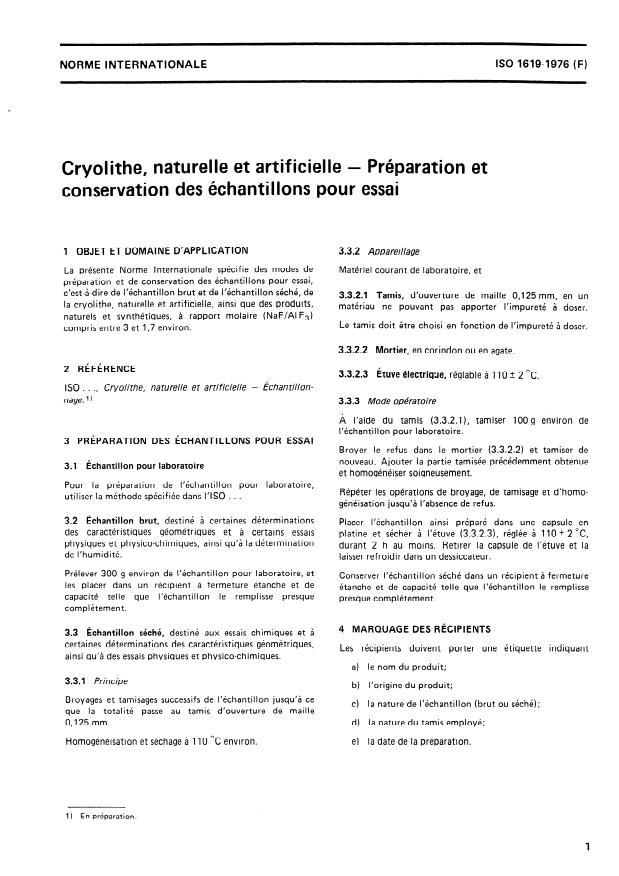
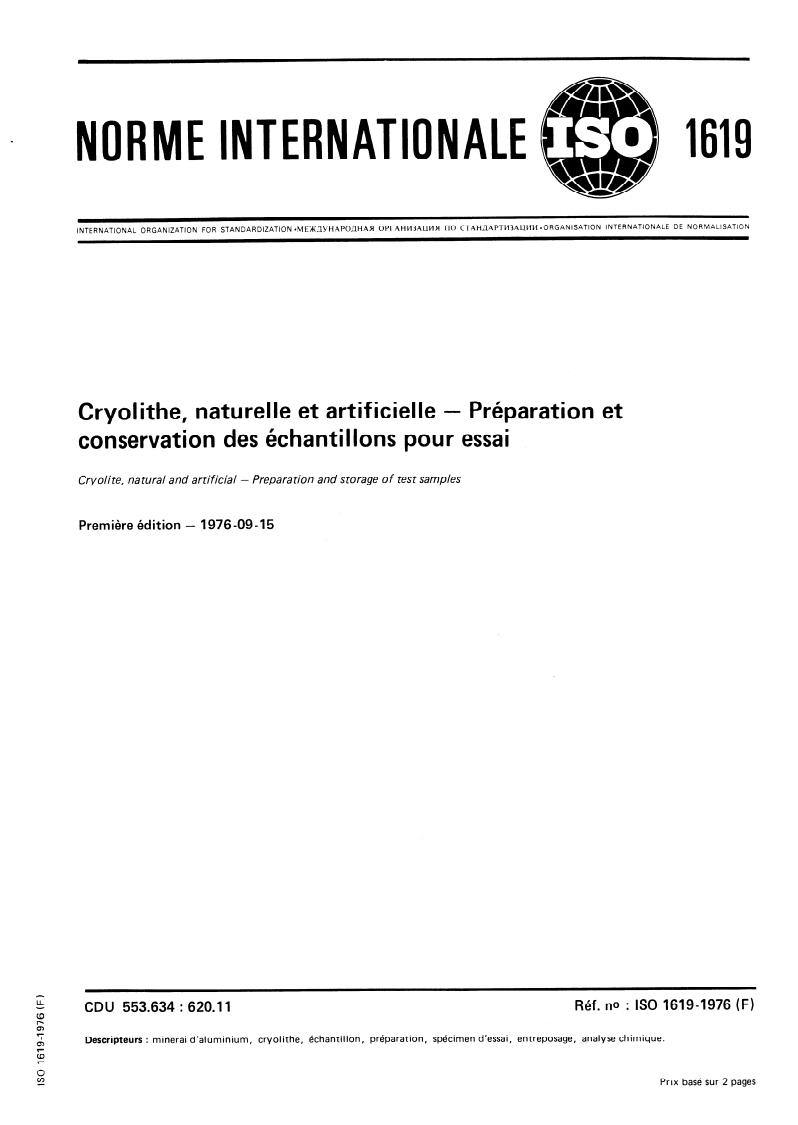
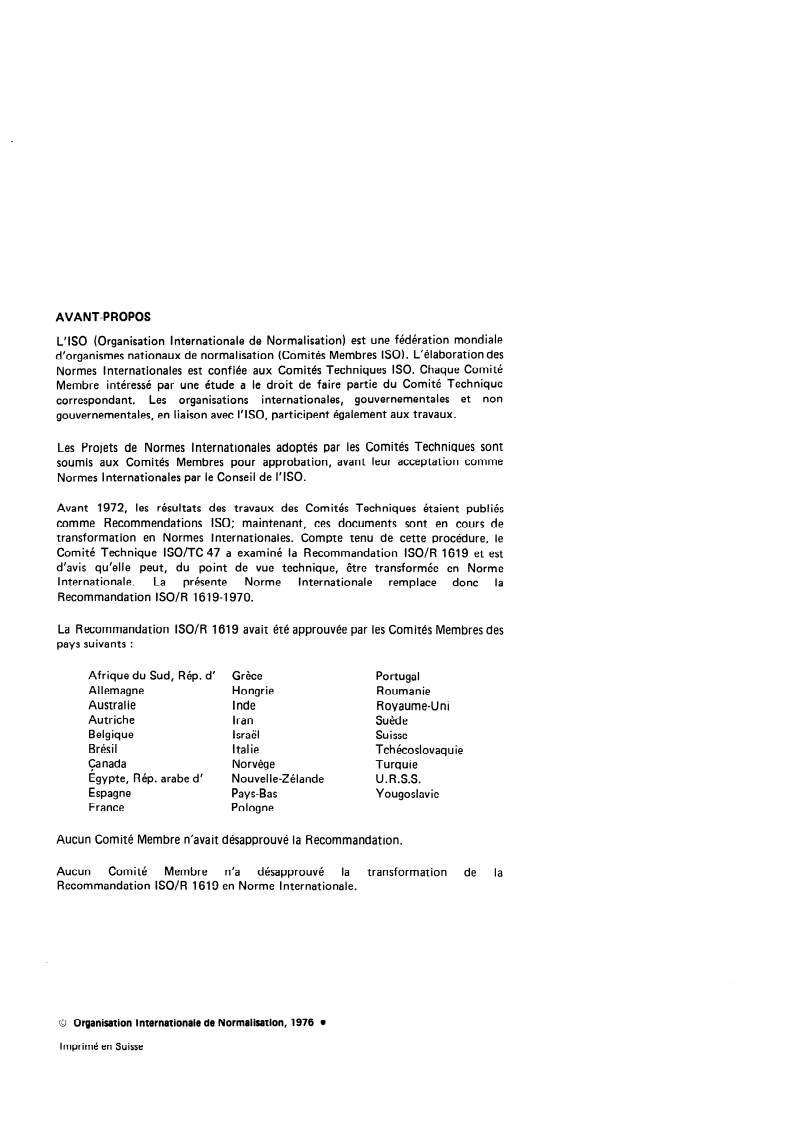
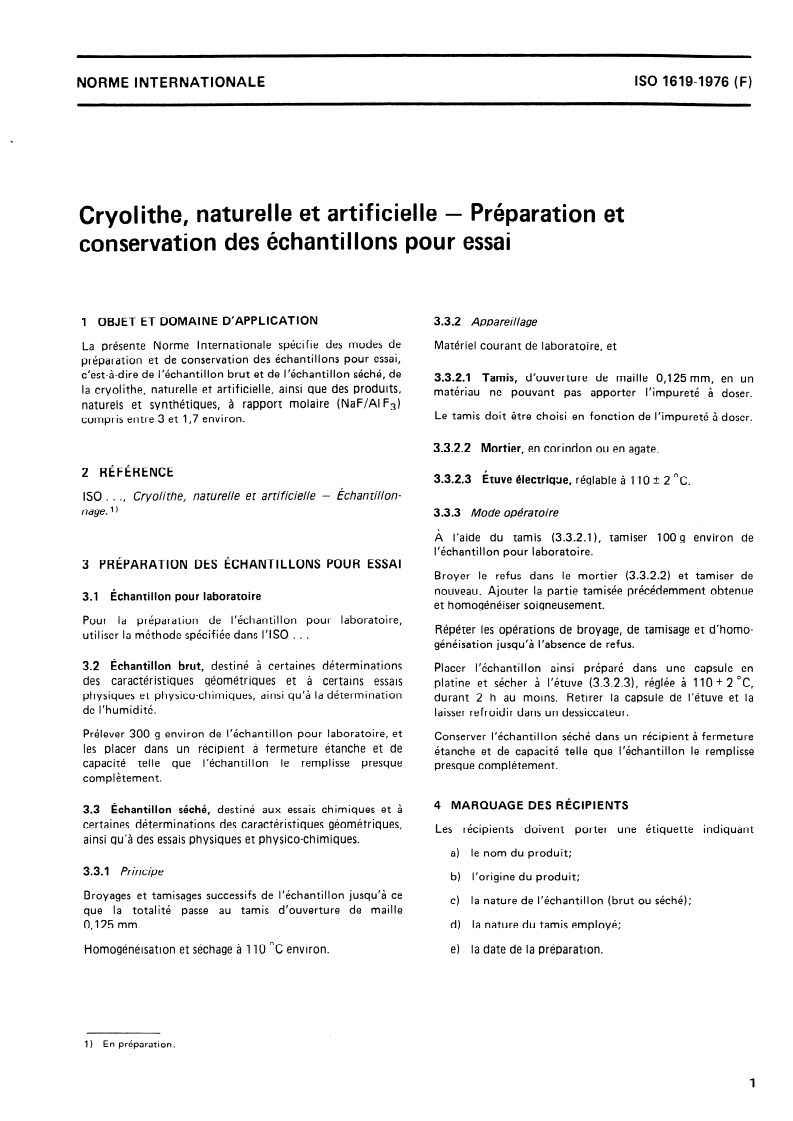
Specifies the procedure for the preparation of crude samples and dried samples and of natural and synthetic materials having a molar ratio sodium fluoride/aluminium trifluoride between 3 and 1,7 approximately. The crude sample is intended for the determination of geometric characteristics, for certain physical and physico-chemical tests and for moisture determination. The dried sample serves especially for chemical tests. The principle of the procedure consists in grinding followed by sieving of the sample until the whole passes through a sieve of mesh aperture 0,125 mm. Thorough mixing and drying at approximately 110 °C.
- Status
- Published
- Publication Date
- 31-Aug-1976
- Technical Committee
- ISO/TC 226 - Materials for the production of primary aluminium
- Drafting Committee
- ISO/TC 226/WG 4 - Smelter grade fluorides
- Current Stage
- 9093 - International Standard confirmed
- Start Date
- 24-Oct-2022
- Completion Date
- 29-Aug-2026
Buy Documents

ISO 1619:1976 - Cryolite, natural and artificial -- Preparation and storage of test samples
ISO 1619:1976 - Cryolite, natural and artificial — Preparation and storage of test samples/1/1976

ISO 1619:1976 - Cryolithe, naturelle et artificielle -- Préparation et conservation des échantillons pour essai

ISO 1619:1976 - Cryolithe, naturelle et artificielle -- Préparation et conservation des échantillons pour essai
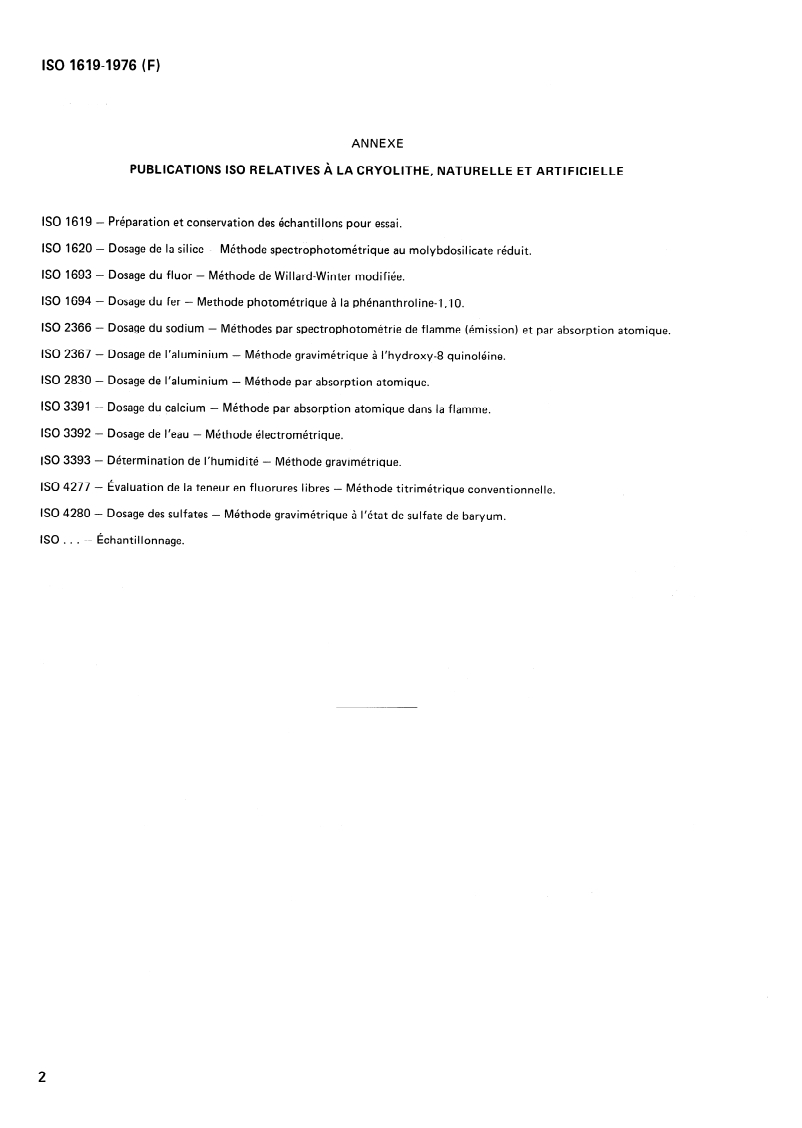
ISO 1619:1976 - Cryolithe, naturelle et artificielle — Préparation et conservation des échantillons pour essai/1/1976
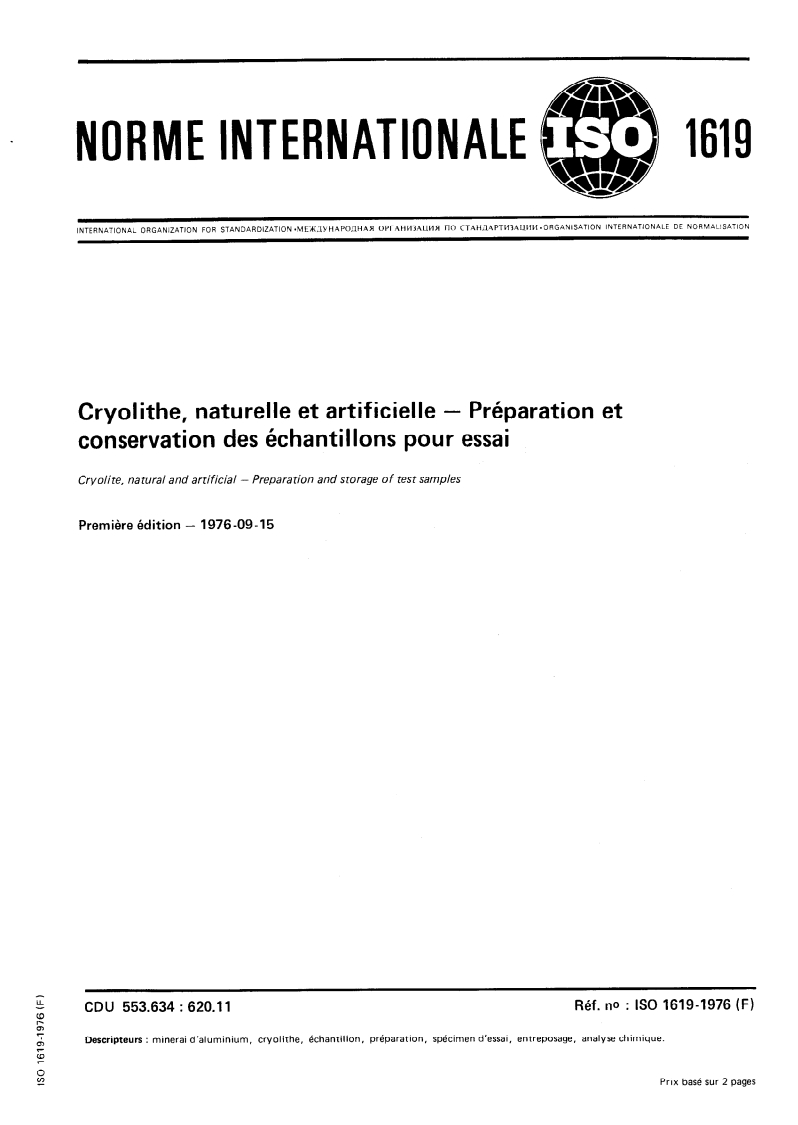
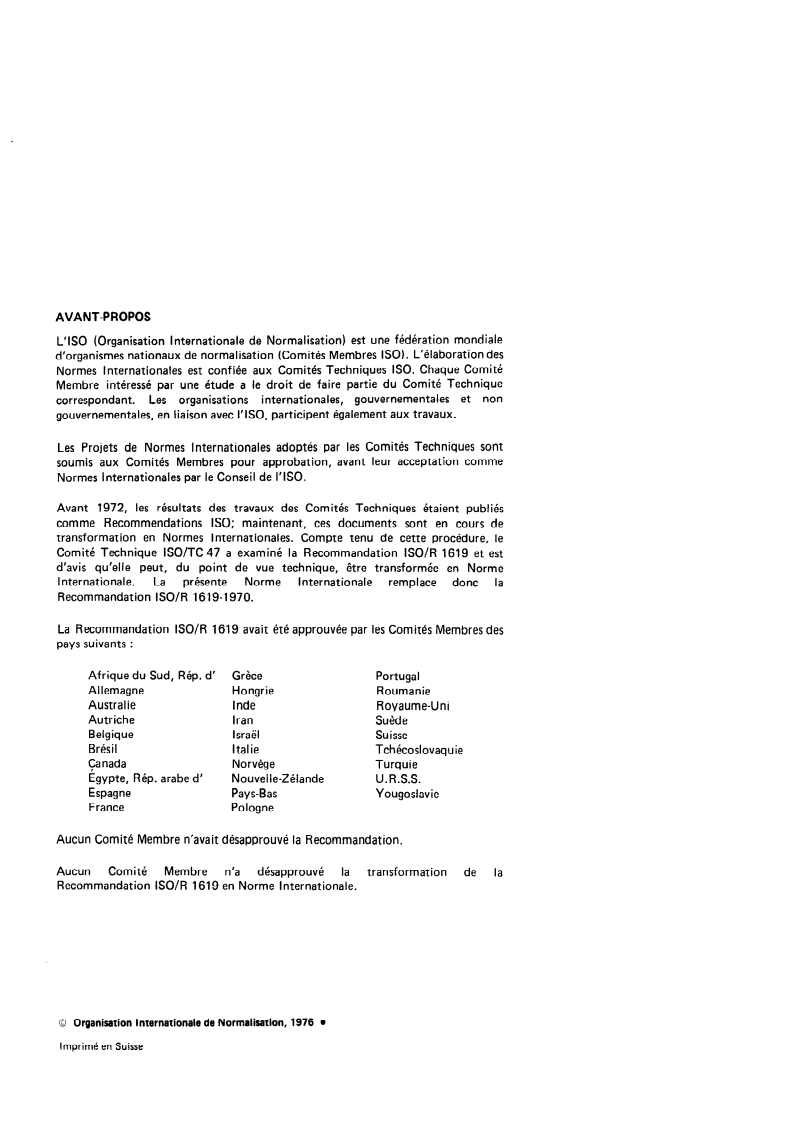
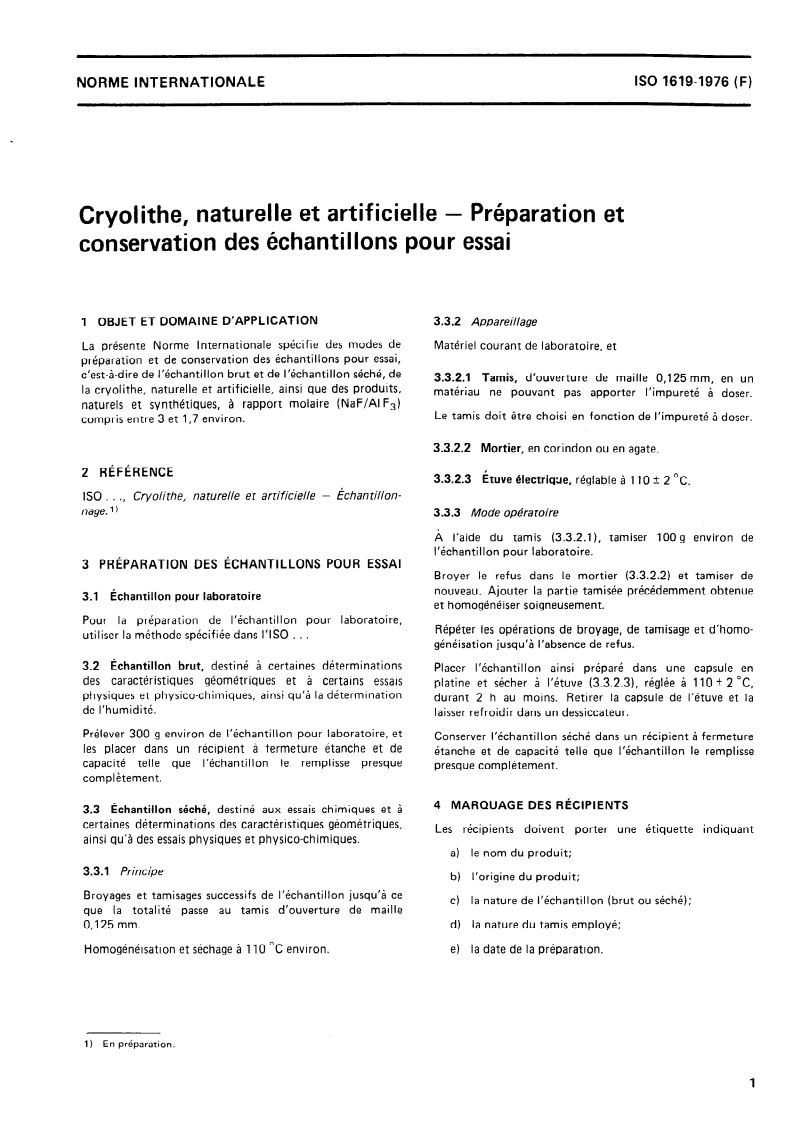
ISO 1619:1976 - Cryolithe, naturelle et artificielle — Préparation et conservation des échantillons pour essai/1/1976
Overview
ISO 1619:1976 - Cryolite, Natural and Artificial - Preparation and Storage of Test Samples specifies standardized procedures for preparing and storing test samples of both natural and artificial cryolite. This international standard applies to materials with a molar ratio of sodium fluoride (NaF) to aluminum trifluoride (AlF₃) between 3 and 1.7, encompassing a range of crude and synthetic cryolite samples. The standard is essential for ensuring the reliability and consistency of laboratory samples before physical, physico-chemical, and chemical tests.
Ensuring uniform sample preparation and storage directly improves the accuracy of subsequent analytical methods and helps laboratories, manufacturers, and quality control personnel maintain high-quality processes.
Key Topics
- Sample Types: Describes the preparation of both crude and dried samples of cryolite, addressing each step to ensure representative and consistent test materials.
- Sample Preparation:
- Laboratory samples are initially prepared following referenced ISO sampling methods.
- Crude samples are used for determining geometric characteristics, moisture content, and specific physical or physico-chemical properties.
- Dried samples are primarily prepared for chemical analysis, including elemental determination.
- Grinding and Sieving:
- All material is ground and passed through a 0.125 mm mesh sieve to achieve uniform particle size.
- Sieving is repeated until all particles meet mesh requirements.
- Drying Conditions:
- Dried samples are conditioned by heating at approximately 110°C to remove moisture, then cooled in a desiccator.
- Sample Storage:
- Prepared samples are stored in airtight containers that are nearly filled to minimize contamination and moisture change.
- Containers are required to be clearly labeled with the product name, origin, sample type, sieve details, and date of preparation.
Applications
ISO 1619:1976 is widely used in the following contexts:
- Quality Control: Used by chemical and metallurgical industries for quality assurance in cryolite production and processing.
- Analytical Laboratories: Laboratories performing physical, chemical, and physico-chemical analysis benefit from consistent methods for preparing cryolite samples, ensuring comparability and repeatability of test results.
- Materials Characterization: Researchers and analysts utilize the standard for accurate measurement of geometric properties, moisture, and composition in both natural and artificial cryolite.
- Regulatory Compliance: Helps organizations meet international and industry-specific regulatory requirements for the handling and analysis of cryolite.
Having a standardized procedure for sample preparation and storage also supports traceability and robust documentation, critical for audit trails and certification processes.
Related Standards
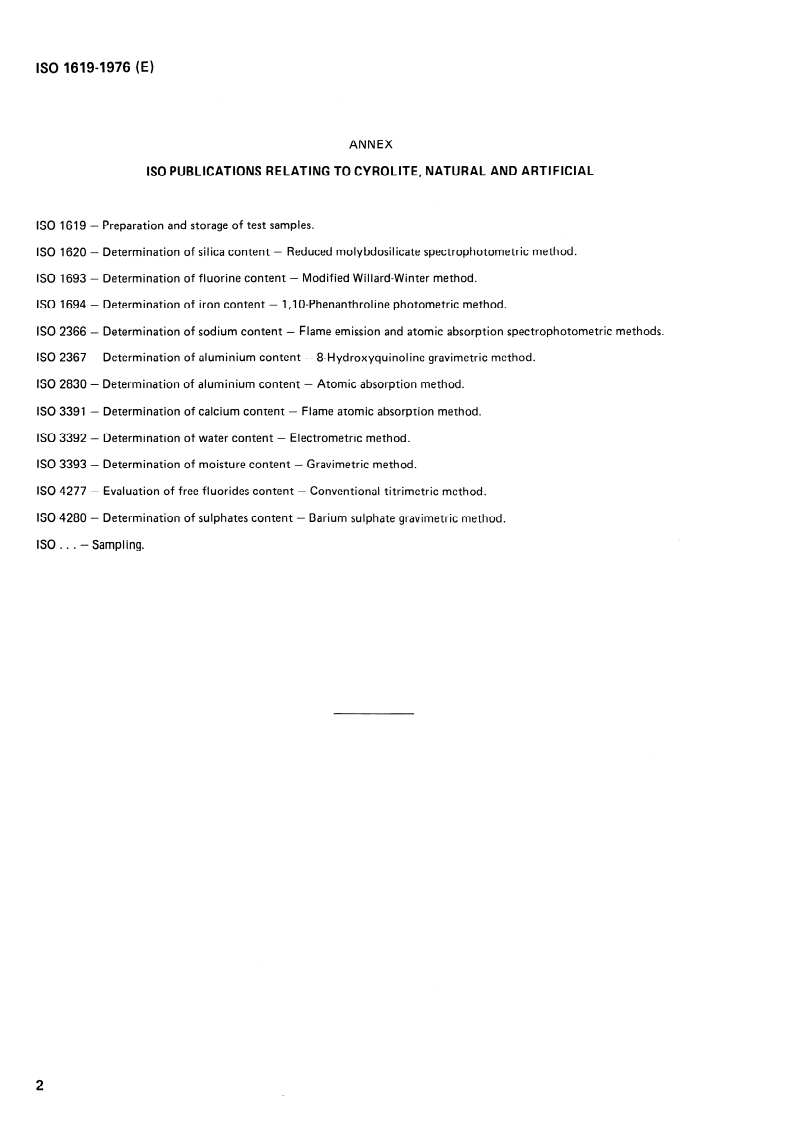
Several other ISO standards complement ISO 1619:1976, providing analytical methods for determining specific properties and impurities in cryolite:
- ISO 1620 - Determination of silica content in cryolite (Modified Willard-Winter method)
- ISO 1693 - Determination of fluorine content
- ISO 1694 - Determination of iron content (1,10-Phenanthroline photometric method)
- ISO 2366 & ISO 2367 - Determination of sodium and aluminum content (flame emission/atomic absorption and gravimetric methods)
- ISO 3391-3393 - Methods for determining calcium, water, and moisture content
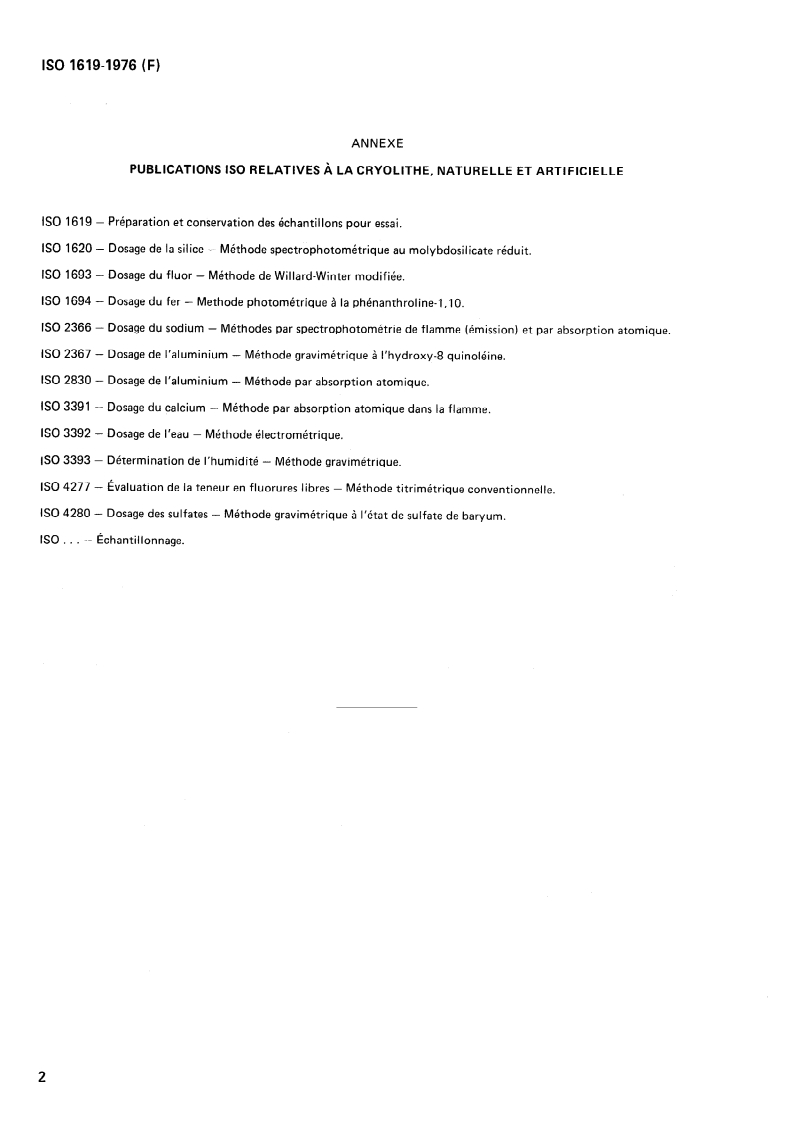
- ISO 4277 & ISO 4280 - Evaluation of free fluorides and sulphate content
Organizations implementing ISO 1619:1976 often integrate these related standards to provide a comprehensive quality and analytical framework for cryolite materials.
By conforming to ISO 1619:1976 for cryolite sample preparation and storage, organizations ensure reliable analytical results, maintain regulatory compliance, and enhance the consistency and reproducibility of laboratory data.
Buy Documents
ISO 1619:1976 - Cryolite, natural and artificial -- Preparation and storage of test samples
ISO 1619:1976 - Cryolite, natural and artificial — Preparation and storage of test samples/1/1976
ISO 1619:1976 - Cryolithe, naturelle et artificielle -- Préparation et conservation des échantillons pour essai
ISO 1619:1976 - Cryolithe, naturelle et artificielle -- Préparation et conservation des échantillons pour essai
ISO 1619:1976 - Cryolithe, naturelle et artificielle — Préparation et conservation des échantillons pour essai/1/1976
ISO 1619:1976 - Cryolithe, naturelle et artificielle — Préparation et conservation des échantillons pour essai/1/1976
Get Certified
Connect with accredited certification bodies for this standard

ECOCERT
Organic and sustainability certification.

Eurofins Food Testing Global
Global leader in food, environment, and pharmaceutical product testing.

Intertek Bangladesh
Intertek certification and testing services in Bangladesh.
Sponsored listings
Frequently Asked Questions
ISO 1619:1976 is a standard published by the International Organization for Standardization (ISO). Its full title is "Cryolite, natural and artificial — Preparation and storage of test samples". This standard covers: Specifies the procedure for the preparation of crude samples and dried samples and of natural and synthetic materials having a molar ratio sodium fluoride/aluminium trifluoride between 3 and 1,7 approximately. The crude sample is intended for the determination of geometric characteristics, for certain physical and physico-chemical tests and for moisture determination. The dried sample serves especially for chemical tests. The principle of the procedure consists in grinding followed by sieving of the sample until the whole passes through a sieve of mesh aperture 0,125 mm. Thorough mixing and drying at approximately 110 °C.
Specifies the procedure for the preparation of crude samples and dried samples and of natural and synthetic materials having a molar ratio sodium fluoride/aluminium trifluoride between 3 and 1,7 approximately. The crude sample is intended for the determination of geometric characteristics, for certain physical and physico-chemical tests and for moisture determination. The dried sample serves especially for chemical tests. The principle of the procedure consists in grinding followed by sieving of the sample until the whole passes through a sieve of mesh aperture 0,125 mm. Thorough mixing and drying at approximately 110 °C.
ISO 1619:1976 is classified under the following ICS (International Classification for Standards) categories: 71.060.50 - Salts. The ICS classification helps identify the subject area and facilitates finding related standards.
ISO 1619:1976 is available in PDF format for immediate download after purchase. The document can be added to your cart and obtained through the secure checkout process. Digital delivery ensures instant access to the complete standard document.
Standards Content (Sample)
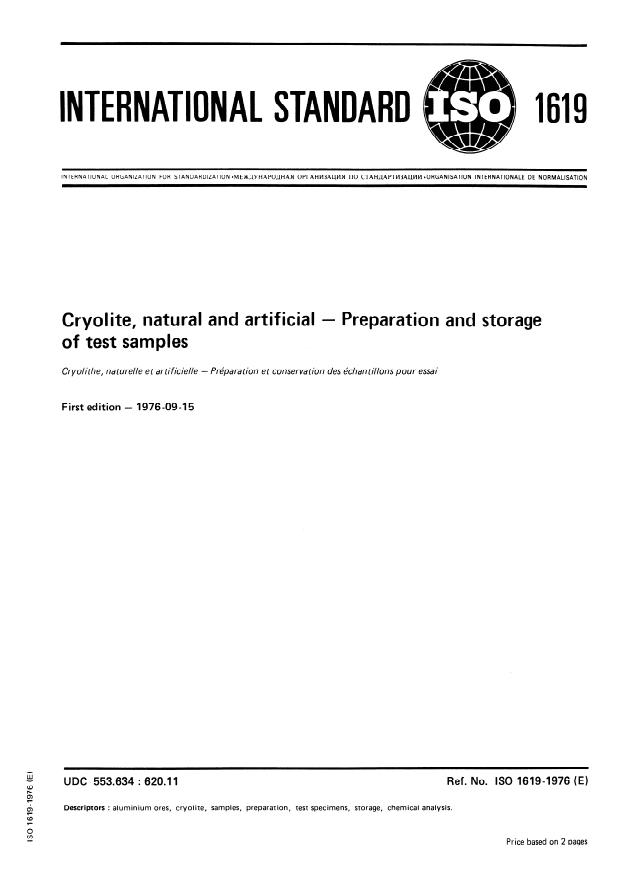
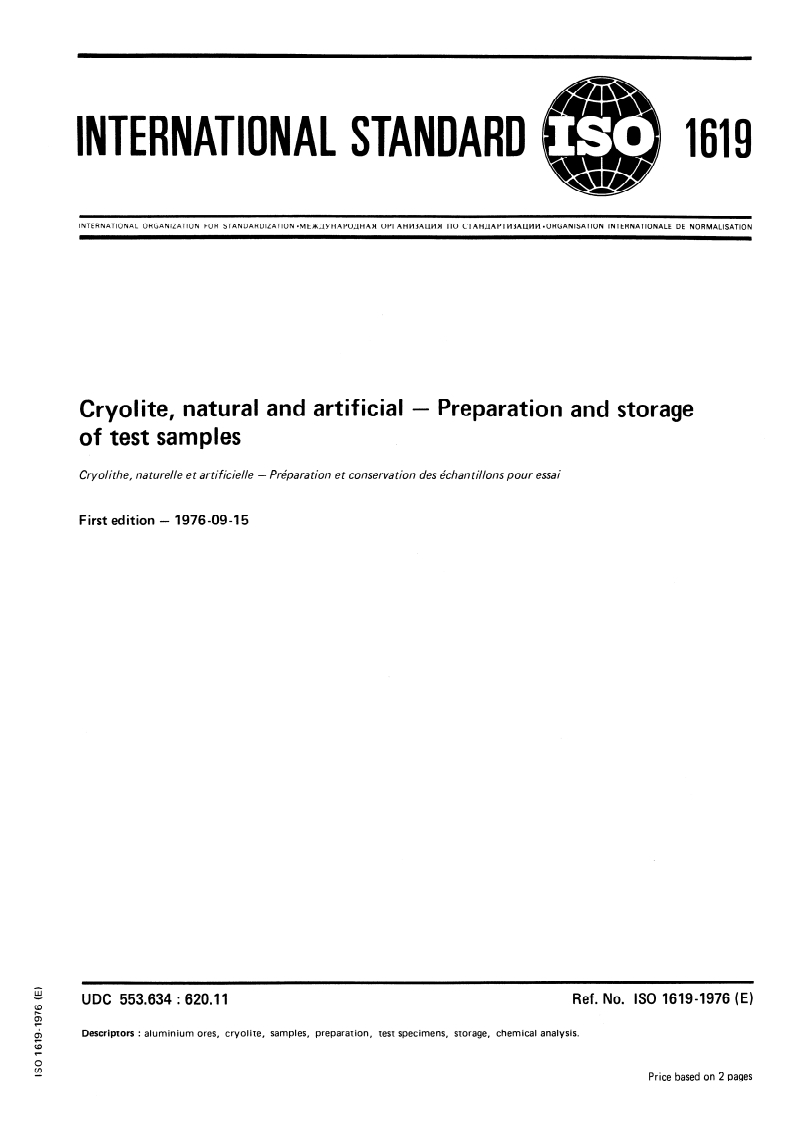
INTERNATIONAL STANDARD
INTERNATIONAL ORGANIZATION FOR STANDARDIZATION l MEXJYHAPOJJHASI OPTAHM3AUMR l-IO CTAH~APTM3A~MM~ORGANISATION INTERNATIONALE DE NORMALISATION
Cryolite, natura1 and artificial - Preparation and storage
of test samples
Cryolithe, na turelle e t ar tificielle - Prbpara tion et conserva tion des echan tillons pour essai
First edition - 1976-09-15
UDC 553.634 : 620.11
Ref. No. ISO 16194976 (E)
Descriptors : aluminium ores, cryolite, samples, preparation,
test specimens, storage, Chemical analysis.
Price based on 2 pages
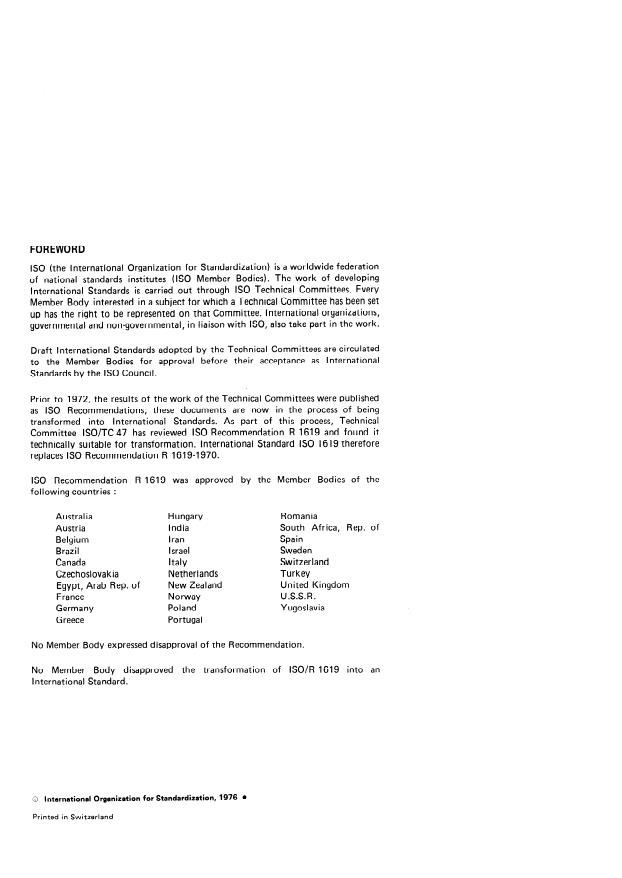
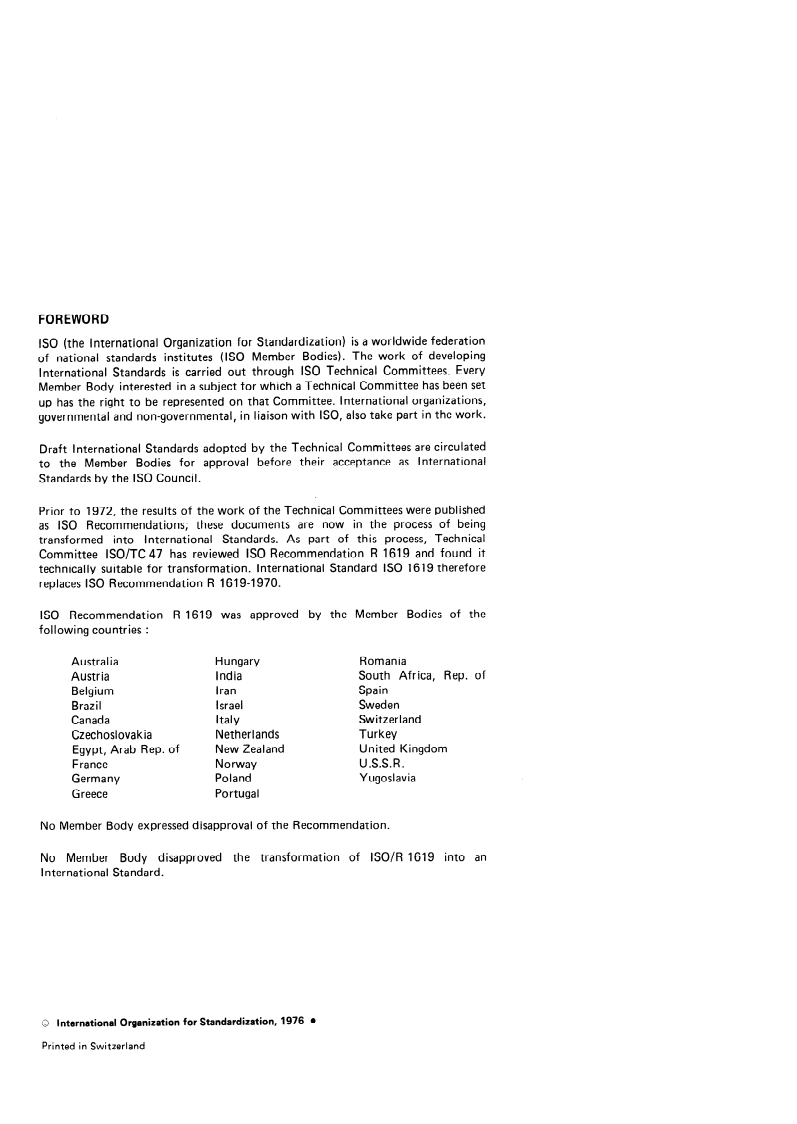
FOREWORD
ISO (the International Organization for Standardization) is a worldwide federation
of national Standards institutes (ISO Member Bodies). The work of developing
International Standards is carried out through ISO Technical Committees. Every
Member Body interested in a subject for which a Technical Committee has been set
up has the right to be represented on that Committee. International organizations,
governmental and non-governmental, in liaison with ISO, also take part in the work.
Draft International Standards adopted by the Technical Committees are circulated
to the Member Bodies for approval before their acceptance as International
Standards by the ISO Council.
Prior to 1972, the results of the work of the Technical Committees were published
as ISO Recommendations; these documents are now in the process of being
transformed into International Standards. As part of this process, Technical
Committee ISO/TC 47 has reviewed ISO Recommendation R 1619 and found it
technically suitable for transformation. International Standard ISO 1619 therefore
replaces ISO Recommendation R 1619-1970.
ISO Recommendation R 1619 was approved by the Member Bodies of the
following countries :
Austral ia Hungary Romania
Austria India South Africa, Rep. of
Belgium Iran Spain
Brazil l srael Sweden
Canada Italy Switzerland
Czechoslovakia Netherlands Turkey
Egypt, Arab Rep. of New Zealand United Kingdom
France Norway U.S.S.R.
Germany Poland Yugoslavia
Greece Portugal
No Member Body expressed disapproval of the Recommendation.
No Member Body disapproved the transformation of ISO/R 1619 into an
International Standard.
0 International Organkation for Standardkation, 1976 l
Printed in Switzerland
ISO 16194976 (E)
INTERNATIONAL STANDARD
Cryolite, natura1 and artificial - Preparation and storage
of test samples
The sieve shall be selected in relation to the impurity to be
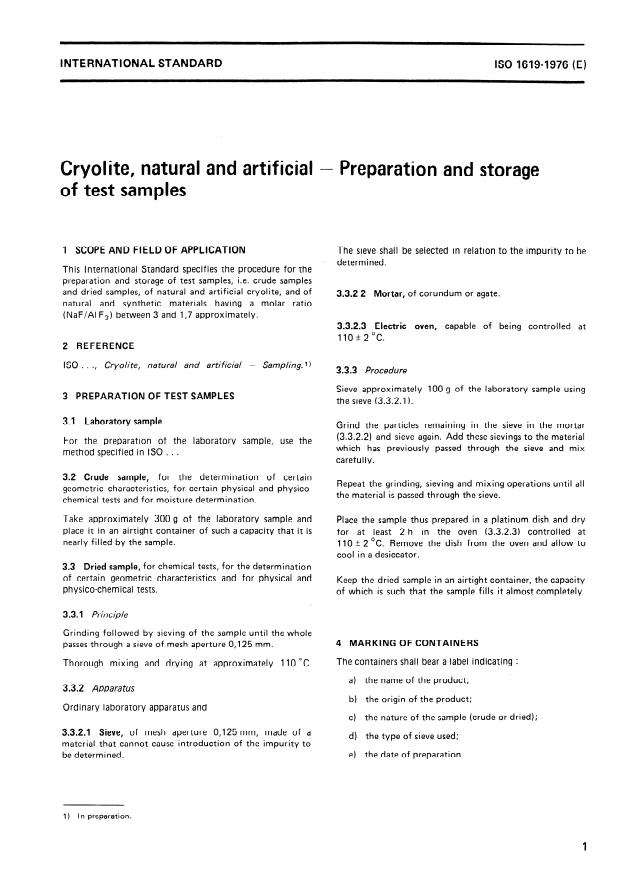
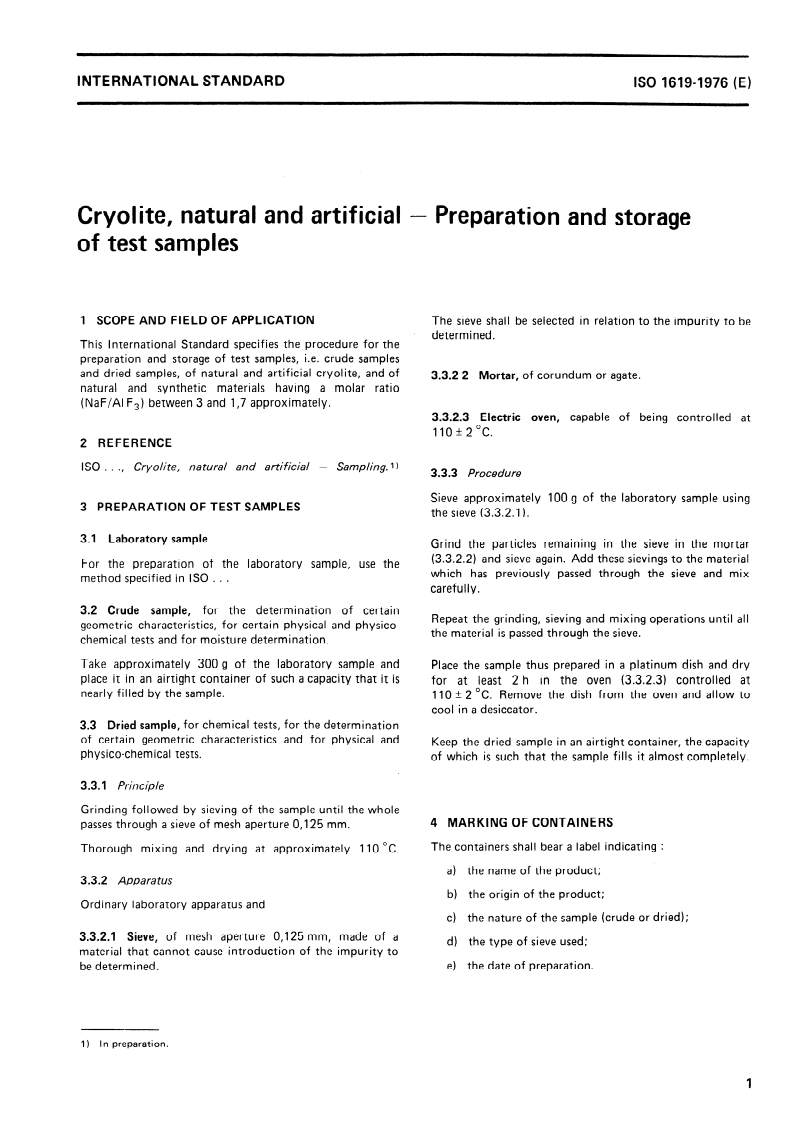
1 SCOPE AND FIELD OF APPLICATION
determined.
This International Standard specifies the procedure for the
preparation and storage of test samples, i.e. crude samples
and dried samples, of natura1 and artificial cryolite, and of Mortar, of corundum or agate.
3.3.2 2
natura) and synthetic materials having a molar ratio
(NaF/AI F3) between 3 and 1,7 approximately.
capable of being controlled at
3.3.2.3 Electric oven,
110rt2”c.
2 REFERENCE
ISO . . ., Cryolite, natura1 and artificial - Sanpling. 1)
3.3.3 Proc
...
INTERNATIONAL STANDARD
INTERNATIONAL ORGANIZATION FOR STANDARDIZATION l MEXJYHAPOJJHASI OPTAHM3AUMR l-IO CTAH~APTM3A~MM~ORGANISATION INTERNATIONALE DE NORMALISATION
Cryolite, natura1 and artificial - Preparation and storage
of test samples
Cryolithe, na turelle e t ar tificielle - Prbpara tion et conserva tion des echan tillons pour essai
First edition - 1976-09-15
UDC 553.634 : 620.11
Ref. No. ISO 16194976 (E)
Descriptors : aluminium ores, cryolite, samples, preparation,
test specimens, storage, Chemical analysis.
Price based on 2 pages
FOREWORD
ISO (the International Organization for Standardization) is a worldwide federation
of national Standards institutes (ISO Member Bodies). The work of developing
International Standards is carried out through ISO Technical Committees. Every
Member Body interested in a subject for which a Technical Committee has been set
up has the right to be represented on that Committee. International organizations,
governmental and non-governmental, in liaison with ISO, also take part in the work.
Draft International Standards adopted by the Technical Committees are circulated
to the Member Bodies for approval before their acceptance as International
Standards by the ISO Council.
Prior to 1972, the results of the work of the Technical Committees were published
as ISO Recommendations; these documents are now in the process of being
transformed into International Standards. As part of this process, Technical
Committee ISO/TC 47 has reviewed ISO Recommendation R 1619 and found it
technically suitable for transformation. International Standard ISO 1619 therefore
replaces ISO Recommendation R 1619-1970.
ISO Recommendation R 1619 was approved by the Member Bodies of the
following countries :
Austral ia Hungary Romania
Austria India South Africa, Rep. of
Belgium Iran Spain
Brazil l srael Sweden
Canada Italy Switzerland
Czechoslovakia Netherlands Turkey
Egypt, Arab Rep. of New Zealand United Kingdom
France Norway U.S.S.R.
Germany Poland Yugoslavia
Greece Portugal
No Member Body expressed disapproval of the Recommendation.
No Member Body disapproved the transformation of ISO/R 1619 into an
International Standard.
0 International Organkation for Standardkation, 1976 l
Printed in Switzerland
ISO 16194976 (E)
INTERNATIONAL STANDARD
Cryolite, natura1 and artificial - Preparation and storage
of test samples
The sieve shall be selected in relation to the impurity to be
1 SCOPE AND FIELD OF APPLICATION
determined.
This International Standard specifies the procedure for the
preparation and storage of test samples, i.e. crude samples
and dried samples, of natura1 and artificial cryolite, and of Mortar, of corundum or agate.
3.3.2 2
natura) and synthetic materials having a molar ratio
(NaF/AI F3) between 3 and 1,7 approximately.
capable of being controlled at
3.3.2.3 Electric oven,
110rt2”c.
2 REFERENCE
ISO . . ., Cryolite, natura1 and artificial - Sanpling. 1)
3.3.3 Proc
...
NORME INTERNATIONALE
INTERNATIONAL ORGANIZATION FOR STANDARDIZATION *ME-KlYHAPOLIHAR OPI-AHM3AUMJl i-I0 CTAHflAPTM3AUW4 .ORGANISATION INTERNATIONALE DE NORMALISATION
Cryolithe, naturelle et artificielle - Préparation et
conservation des échantillons pour essai
Cryolite, na tural and artificial - Preparation and storage of test samples
Première édition - 1976-09-15
-
LL
Y
CDU 553.634 : 620.11 Réf. no : ISO 1619-1976 (F)
Descripteurs : minerai d’aluminium, cryolithe, échantillon, préparation, spécimen d’essai,
entreposage, analyse chimique.
Prix basé sur 2 pages
AVANT-PROPOS
L’ISO (Organisation Internationale de Normalisation) est une fédération mondiale
d’organismes nationaux de normalisation (Comités Membres ISO). L’élaboration des
Normes Internationales est confiée aux Comités Techniques ISO. Chaque Comité
Membre intéressé par une étude a le droit de faire partie du Comité Technique
correspondant. Les organisations internationales, gouvernementales et non
gouvernementales, en liaison avec I’ISO, participent également aux travaux.
Les Projets de Normes Internationales adoptés par les Comités Techniques sont
soumis aux Comités Membres pour approbation, avant leur acceptation comme
Normes Internationales par le Conseil de I’ISO.
Avant 1972, les résultats des travaux des Comités Techniques étaient publiés
comme Recommendations ISO; maintenant, ces documents sont en cours de
transformation en Normes Internationales. Compte tenu de cette procédure, le
Comité Technique ISO/TC 47 a examiné la Recommandation ISO/R 1619 et est
d’avis qu’elle peut, du point de vue technique, être transformée en Norme
Internationale. La présente Norme Internationale remplace donc la
Recommandation ISO/R 1619-1970.
La Recommandation ISO/R 1619 avait été approuvée par les Comités Membres des
pays suivants :
Afrique du Sud, Rép. d’ Grèce Portugal
Allemagne Hongrie Roumanie
Australie
Inde Royaume-Uni
Autriche Iran Suède
Belgique
Israël Suisse
Brésil
Italie Tchécoslovaquie
Canada
Norvège Turquie
Égypte, Rép. arabe d’ Nouvelle-Zélande
U.R.S.S.
Espagne Pays-Bas
Yougoslavie
France Pologne
Aucun Comité Membre n’avait désapprouvé la Recommandation.
Aucun
Comité Membre n’a désapprouvé la transformation de la
Recommandation lSO/R 1619 en Norme Internationale.
0 Organisation Internationale de Normalisation, 1976 l
Imwimé en Suisse
ISO 16194976 (F)
NORME INTERNATIONALE
Cryolithe, naturelle et artificielle - Préparation et
conservation des échantillons pour essai
1 OBJET ET DOMAINE D’APPLICATION 3.3.2 Appareillage
La présente Norme Internationale spécifie des modes de Matériel courant de laboratoire, et
préparation et de conservation des échantillons pour essai,
c’est-à-dire de l’échantillon brut et de l’échantillon séché, de
3.3.2.1 Tamis, d’ouverture de maille 0,125 mm, en un
la cryolithe, naturelle et artificielle, ainsi que des produits,
matériau ne pouvant pas apporter l’impureté à doser.
à rapport molaire (NaF/Al F3)
naturels et synthétiques,
Le tamis doit être choisi en fonction de l’impureté à doser.
compris entre 3 et 1,7 environ.
3.3.2.2 Mortier, en
...
NORME INTERNATIONALE
INTERNATIONAL ORGANIZATION FOR STANDARDIZATION *ME-KlYHAPOLIHAR OPI-AHM3AUMJl i-I0 CTAHflAPTM3AUW4 .ORGANISATION INTERNATIONALE DE NORMALISATION
Cryolithe, naturelle et artificielle - Préparation et
conservation des échantillons pour essai
Cryolite, na tural and artificial - Preparation and storage of test samples
Première édition - 1976-09-15
-
LL
Y
CDU 553.634 : 620.11 Réf. no : ISO 1619-1976 (F)
Descripteurs : minerai d’aluminium, cryolithe, échantillon, préparation, spécimen d’essai,
entreposage, analyse chimique.
Prix basé sur 2 pages
AVANT-PROPOS
L’ISO (Organisation Internationale de Normalisation) est une fédération mondiale
d’organismes nationaux de normalisation (Comités Membres ISO). L’élaboration des
Normes Internationales est confiée aux Comités Techniques ISO. Chaque Comité
Membre intéressé par une étude a le droit de faire partie du Comité Technique
correspondant. Les organisations internationales, gouvernementales et non
gouvernementales, en liaison avec I’ISO, participent également aux travaux.
Les Projets de Normes Internationales adoptés par les Comités Techniques sont
soumis aux Comités Membres pour approbation, avant leur acceptation comme
Normes Internationales par le Conseil de I’ISO.
Avant 1972, les résultats des travaux des Comités Techniques étaient publiés
comme Recommendations ISO; maintenant, ces documents sont en cours de
transformation en Normes Internationales. Compte tenu de cette procédure, le
Comité Technique ISO/TC 47 a examiné la Recommandation ISO/R 1619 et est
d’avis qu’elle peut, du point de vue technique, être transformée en Norme
Internationale. La présente Norme Internationale remplace donc la
Recommandation ISO/R 1619-1970.
La Recommandation ISO/R 1619 avait été approuvée par les Comités Membres des
pays suivants :
Afrique du Sud, Rép. d’ Grèce Portugal
Allemagne Hongrie Roumanie
Australie
Inde Royaume-Uni
Autriche Iran Suède
Belgique
Israël Suisse
Brésil
Italie Tchécoslovaquie
Canada
Norvège Turquie
Égypte, Rép. arabe d’ Nouvelle-Zélande
U.R.S.S.
Espagne Pays-Bas
Yougoslavie
France Pologne
Aucun Comité Membre n’avait désapprouvé la Recommandation.
Aucun
Comité Membre n’a désapprouvé la transformation de la
Recommandation lSO/R 1619 en Norme Internationale.
0 Organisation Internationale de Normalisation, 1976 l
Imwimé en Suisse
ISO 16194976 (F)
NORME INTERNATIONALE
Cryolithe, naturelle et artificielle - Préparation et
conservation des échantillons pour essai
1 OBJET ET DOMAINE D’APPLICATION 3.3.2 Appareillage
La présente Norme Internationale spécifie des modes de Matériel courant de laboratoire, et
préparation et de conservation des échantillons pour essai,
c’est-à-dire de l’échantillon brut et de l’échantillon séché, de
3.3.2.1 Tamis, d’ouverture de maille 0,125 mm, en un
la cryolithe, naturelle et artificielle, ainsi que des produits,
matériau ne pouvant pas apporter l’impureté à doser.
à rapport molaire (NaF/Al F3)
naturels et synthétiques,
Le tamis doit être choisi en fonction de l’impureté à doser.
compris entre 3 et 1,7 environ.
3.3.2.2 Mortier, en
...
NORME INTERNATIONALE
INTERNATIONAL ORGANIZATION FOR STANDARDIZATION *ME-KlYHAPOLIHAR OPI-AHM3AUMJl i-I0 CTAHflAPTM3AUW4 .ORGANISATION INTERNATIONALE DE NORMALISATION
Cryolithe, naturelle et artificielle - Préparation et
conservation des échantillons pour essai
Cryolite, na tural and artificial - Preparation and storage of test samples
Première édition - 1976-09-15
-
LL
Y
CDU 553.634 : 620.11 Réf. no : ISO 1619-1976 (F)
Descripteurs : minerai d’aluminium, cryolithe, échantillon, préparation, spécimen d’essai,
entreposage, analyse chimique.
Prix basé sur 2 pages
AVANT-PROPOS
L’ISO (Organisation Internationale de Normalisation) est une fédération mondiale
d’organismes nationaux de normalisation (Comités Membres ISO). L’élaboration des
Normes Internationales est confiée aux Comités Techniques ISO. Chaque Comité
Membre intéressé par une étude a le droit de faire partie du Comité Technique
correspondant. Les organisations internationales, gouvernementales et non
gouvernementales, en liaison avec I’ISO, participent également aux travaux.
Les Projets de Normes Internationales adoptés par les Comités Techniques sont
soumis aux Comités Membres pour approbation, avant leur acceptation comme
Normes Internationales par le Conseil de I’ISO.
Avant 1972, les résultats des travaux des Comités Techniques étaient publiés
comme Recommendations ISO; maintenant, ces documents sont en cours de
transformation en Normes Internationales. Compte tenu de cette procédure, le
Comité Technique ISO/TC 47 a examiné la Recommandation ISO/R 1619 et est
d’avis qu’elle peut, du point de vue technique, être transformée en Norme
Internationale. La présente Norme Internationale remplace donc la
Recommandation ISO/R 1619-1970.
La Recommandation ISO/R 1619 avait été approuvée par les Comités Membres des
pays suivants :
Afrique du Sud, Rép. d’ Grèce Portugal
Allemagne Hongrie Roumanie
Australie
Inde Royaume-Uni
Autriche Iran Suède
Belgique
Israël Suisse
Brésil
Italie Tchécoslovaquie
Canada
Norvège Turquie
Égypte, Rép. arabe d’ Nouvelle-Zélande
U.R.S.S.
Espagne Pays-Bas
Yougoslavie
France Pologne
Aucun Comité Membre n’avait désapprouvé la Recommandation.
Aucun
Comité Membre n’a désapprouvé la transformation de la
Recommandation lSO/R 1619 en Norme Internationale.
0 Organisation Internationale de Normalisation, 1976 l
Imwimé en Suisse
ISO 16194976 (F)
NORME INTERNATIONALE
Cryolithe, naturelle et artificielle - Préparation et
conservation des échantillons pour essai
1 OBJET ET DOMAINE D’APPLICATION 3.3.2 Appareillage
La présente Norme Internationale spécifie des modes de Matériel courant de laboratoire, et
préparation et de conservation des échantillons pour essai,
c’est-à-dire de l’échantillon brut et de l’échantillon séché, de
3.3.2.1 Tamis, d’ouverture de maille 0,125 mm, en un
la cryolithe, naturelle et artificielle, ainsi que des produits,
matériau ne pouvant pas apporter l’impureté à doser.
à rapport molaire (NaF/Al F3)
naturels et synthétiques,
Le tamis doit être choisi en fonction de l’impureté à doser.
compris entre 3 et 1,7 environ.
3.3.2.2 Mortier, en
...
NORME INTERNATIONALE
INTERNATIONAL ORGANIZATION FOR STANDARDIZATION *ME-KlYHAPOLIHAR OPI-AHM3AUMJl i-I0 CTAHflAPTM3AUW4 .ORGANISATION INTERNATIONALE DE NORMALISATION
Cryolithe, naturelle et artificielle - Préparation et
conservation des échantillons pour essai
Cryolite, na tural and artificial - Preparation and storage of test samples
Première édition - 1976-09-15
-
LL
Y
CDU 553.634 : 620.11 Réf. no : ISO 1619-1976 (F)
Descripteurs : minerai d’aluminium, cryolithe, échantillon, préparation, spécimen d’essai,
entreposage, analyse chimique.
Prix basé sur 2 pages
AVANT-PROPOS
L’ISO (Organisation Internationale de Normalisation) est une fédération mondiale
d’organismes nationaux de normalisation (Comités Membres ISO). L’élaboration des
Normes Internationales est confiée aux Comités Techniques ISO. Chaque Comité
Membre intéressé par une étude a le droit de faire partie du Comité Technique
correspondant. Les organisations internationales, gouvernementales et non
gouvernementales, en liaison avec I’ISO, participent également aux travaux.
Les Projets de Normes Internationales adoptés par les Comités Techniques sont
soumis aux Comités Membres pour approbation, avant leur acceptation comme
Normes Internationales par le Conseil de I’ISO.
Avant 1972, les résultats des travaux des Comités Techniques étaient publiés
comme Recommendations ISO; maintenant, ces documents sont en cours de
transformation en Normes Internationales. Compte tenu de cette procédure, le
Comité Technique ISO/TC 47 a examiné la Recommandation ISO/R 1619 et est
d’avis qu’elle peut, du point de vue technique, être transformée en Norme
Internationale. La présente Norme Internationale remplace donc la
Recommandation ISO/R 1619-1970.
La Recommandation ISO/R 1619 avait été approuvée par les Comités Membres des
pays suivants :
Afrique du Sud, Rép. d’ Grèce Portugal
Allemagne Hongrie Roumanie
Australie
Inde Royaume-Uni
Autriche Iran Suède
Belgique
Israël Suisse
Brésil
Italie Tchécoslovaquie
Canada
Norvège Turquie
Égypte, Rép. arabe d’ Nouvelle-Zélande
U.R.S.S.
Espagne Pays-Bas
Yougoslavie
France Pologne
Aucun Comité Membre n’avait désapprouvé la Recommandation.
Aucun
Comité Membre n’a désapprouvé la transformation de la
Recommandation lSO/R 1619 en Norme Internationale.
0 Organisation Internationale de Normalisation, 1976 l
Imwimé en Suisse
ISO 16194976 (F)
NORME INTERNATIONALE
Cryolithe, naturelle et artificielle - Préparation et
conservation des échantillons pour essai
1 OBJET ET DOMAINE D’APPLICATION 3.3.2 Appareillage
La présente Norme Internationale spécifie des modes de Matériel courant de laboratoire, et
préparation et de conservation des échantillons pour essai,
c’est-à-dire de l’échantillon brut et de l’échantillon séché, de
3.3.2.1 Tamis, d’ouverture de maille 0,125 mm, en un
la cryolithe, naturelle et artificielle, ainsi que des produits,
matériau ne pouvant pas apporter l’impureté à doser.
à rapport molaire (NaF/Al F3)
naturels et synthétiques,
Le tamis doit être choisi en fonction de l’impureté à doser.
compris entre 3 et 1,7 environ.
3.3.2.2 Mortier, en
...